
PODCAST · history
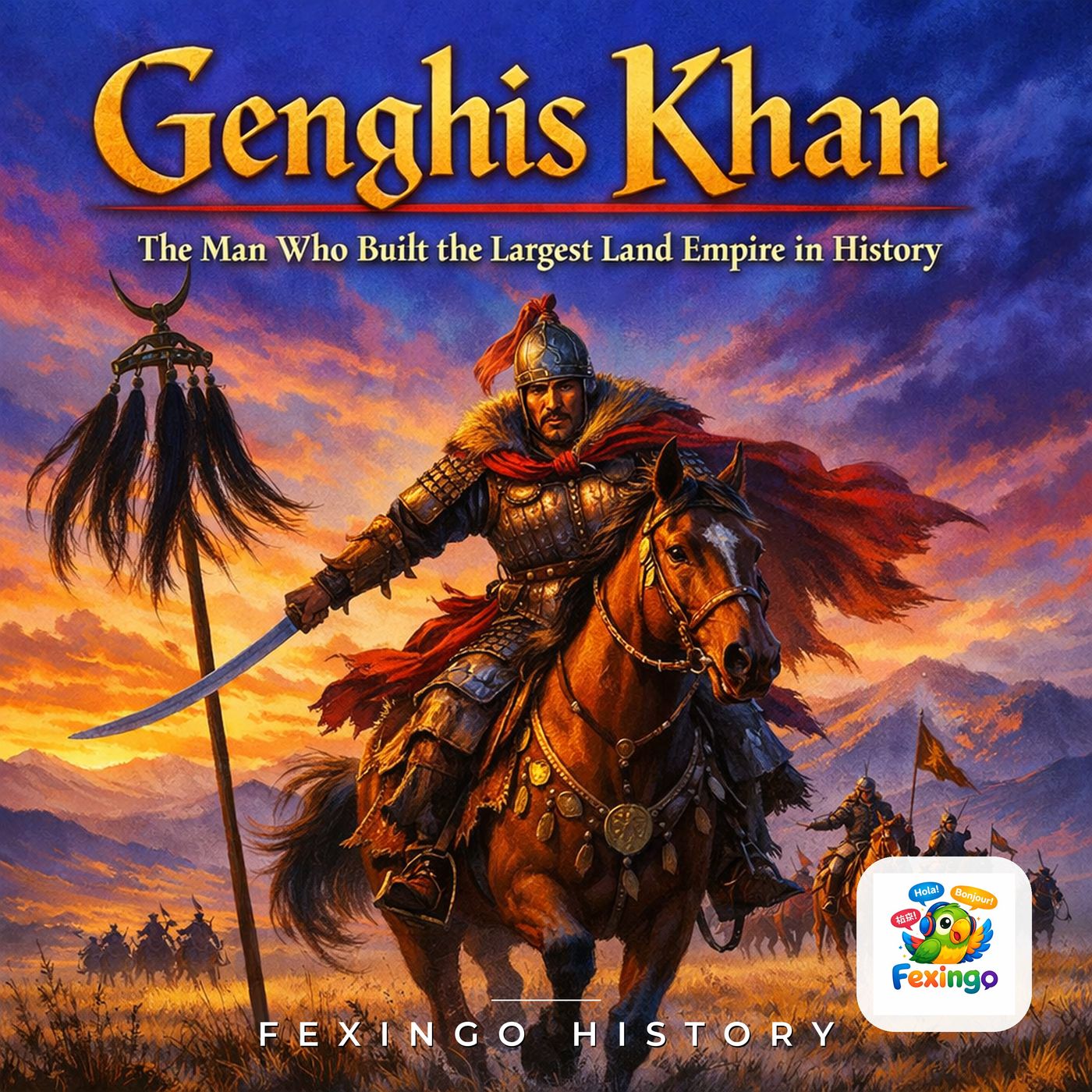
Genghis Khan: The Man Who Built the Largest Land Empire in History — Fexingo History
by Fexingo
Genghis Khan rose from the harsh Mongolian steppe to forge the largest contiguous land empire in history, stretching from the Pacific Ocean to the Caspian Sea. In this show, Lucas and Luna explore the life of the man born Temüjin, his unification of the Mongol tribes, and the brutal yet innovative military campaigns that shattered the Khwarezmian Empire, the Jin dynasty, and the Tanguts of Western Xia. They examine the Yassa legal code, the creation of the Silk Road's Pax Mongolica, and the controversial legacy of a conqueror who killed millions but also fostered trade, religious tolerance, and cultural exchange across Eurasia. The narrative follows the rise of the Mongol Empire through the reigns of Ögedei, Möngke, and Khubilai Khan, touching on the sack of Baghdad in 1258, the failed invasions of Japan and Vietnam, and the eventual fragmentation into the Yuan, Ilkhanate, Chagatai, and Golden Horde khanates. Debates about Mongol warfare—the use of composite bows, feigned retreats, and
-
35
Genghis Khan's Early Life: The Boy Who Became a Conqueror — Fexingo History
Before he united the Mongol tribes and built the largest land empire in history, Genghis Khan was a boy named Temüjin, born into a world of shifting alliances, brutal feuds, and survival on the harsh steppe. In this episode, Lucas and Luna explore the formative years of the future conqueror: his disputed ancestry tracing back to the legendary gray wolf and fallow doe, the murder of his father Yesügei by the Tatars, the abandonment of his family by their clan, and the brutal resource-scramble that followed. They examine the bond—and bitter rivalry—with his blood brother Jamukha, the kidnapping and rescue of his wife Börte from the Merkit, and the first hints of the leadership and ruthlessness that would define his reign. Drawing on the Secret History of the Mongols and later chronicles, they separate myth from fact, including the legend of Temüjin killing his half-brother Behter and the divine mandate from the sky god Tengri. This episode sets the stage for everything that followed.#GenghisKhan #Temujin #MongolEmpire #SteppeHistory #SecretHistoryOfTheMongols #Yesugei #Borte #Jamukha #Merkit #Tatars #Tengri #MongolUnification #EarlyLife #CentralAsia #WarriorCulture #History #FexingoHistory #Podcast #SteppeWarriors #YassaCodeBecome a supporter of this podcast: https://www.spreaker.com/podcast/genghis-khan-the-man-who-built-the-largest-land-empire-in-history-fexingo-history--6985229/support.
-
34
The Mongol Siege of Nishapur: Vengeance and Destruction — Fexingo History
In this episode, Lucas and Luna explore the Mongol siege of Nishapur in 1221, a brutal chapter in Genghis Khan's campaign against the Khwarezmian Empire. Following the death of Genghis's son-in-law Tokuchar at the hands of the Nishapuris, Genghis ordered a ruthless reprisal. His youngest daughter, the fierce warrior-princess Alakhai Bekhi, may have played a role in overseeing the city's total destruction. We examine the siege tactics, the use of Chinese engineers and siege engines, the massacre that followed, and the grim legacy of Mongol terror as a calculated military strategy. We also discuss the figure of Tokuchar and the ongoing debate among historians about the extent of Alakhai's involvement. This episode delves into the personal and political dimensions of Mongol warfare, revealing how vengeance and empire-building intertwined on the steppe.#MongolEmpire #GenghisKhan #Nishapur #Siege #Tokuchar #AlakhaiBekhi #KhwarezmianEmpire #MongolWarfare #SiegeWarfare #ChineseEngineers #MongolTerror #Vengeance #History #MedievalHistory #CentralAsia #Persia #FexingoHistory #Podcast #SteppeWarriors #YassaCodeBecome a supporter of this podcast: https://www.spreaker.com/podcast/genghis-khan-the-man-who-built-the-largest-land-empire-in-history-fexingo-history--6985229/support.
-
33
Genghis Khan's Summer Capital at Karakorum — Fexingo History
In this episode, Lucas and Luna explore the founding and development of Karakorum, the first real capital of the Mongol Empire, established by Genghis Khan in 1220 on the Orkhon River in present-day Mongolia. They discuss how it grew under his son Ögedei into a cosmopolitan hub where Chinese craftsmen, Persian scholars, and Nestorian Christians lived alongside Mongol nomads. The city's design included a palace with a giant silver tree fountain that dispensed wine and kumis, and a Buddhist monastery but also a church and mosque—testament to the empire's religious toleration. Lucas explains how Karakorum served as a logistical base for campaigns, a center for tribute redistribution, and a symbol of Mongol authority, contrasting with the later shift to Khanbaliq under Kublai. The episode also touches on the city's decline after the collapse of the Yuan dynasty and its rediscovery in the 20th century by Russian and Mongolian archaeologists who found evidence of trade goods from as far as Persia and China. Luna asks about daily life, the fate of the silver tree, and whether any ruins remain today.#Karakorum #GenghisKhan #MongolEmpire #OrkhonRiver #GedeiKhan #MongolCapital #MedievalCities #CentralAsiaHistory #Mongolia #SilkRoad #SilverTree #PaxMongolica #YuanDynasty #Archaeology #NomadicEmpire #WorldHistory #History #FexingoHistory #SteppeWarriors #YassaCodeBecome a supporter of this podcast: https://www.spreaker.com/podcast/genghis-khan-the-man-who-built-the-largest-land-empire-in-history-fexingo-history--6985229/support.
-
32
Genghis Khan's Death and the Succession Crisis — Fexingo History
In 1227, Genghis Khan died while leading a campaign against the Tangut kingdom of Xi Xia. His death set off a succession crisis that nearly tore the Mongol Empire apart before it had even fully consolidated. This episode explores the final months of the Great Khan's life, the political maneuvering among his sons and wives, and the mechanisms — including the kurultai and the yassa — that eventually elevated Ögedei to power. We also look at the competing claims of Jochi, Chagatai, and Tolui, and how the decision reshaped Mongol history. Along the way, we consider the historical sources: the Secret History of the Mongols, the work of Rashid al-Din, and later Chinese chronicles. The episode also touches on the myth of Genghis's hidden tomb and the ongoing search for it. This isn't a retread of earlier episodes; it's a focused look at the pivotal transition from founder to successor, the first real test of the empire's political institutions.#GenghisKhan #MongolEmpire #SuccessionCrisis #Gedei #Jochi #Chagatai #Tolui #Kurultai #Yassa #XiXia #Tangut #SecretHistoryOfTheMongols #RashidAlDin #TombOfGenghisKhan #1227 #SteppePolitics #History #FexingoHistory #SteppeWarriors #YassaCodeBecome a supporter of this podcast: https://www.spreaker.com/podcast/genghis-khan-the-man-who-built-the-largest-land-empire-in-history-fexingo-history--6985229/support.
-
31
The Mongol Siege of Aleppo: Hulagu vs the Ayyubids — Fexingo History
In 1260, Hulagu Khan, grandson of Genghis Khan, marched into Syria at the head of a Mongol army that had already devastated Baghdad. The Siege of Aleppo was a brutal six-day affair that pitted Mongol siege engineers against the ancient fortifications of the Ayyubid dynasty. This episode follows the fall of Aleppo, the subsequent capture of Damascus, and the diplomatic dance with the Crusader states. It explores how the Mongol advance was finally halted at the Battle of Ain Jalut by the Mamluks under Qutuz and Baibars, a turning point that saved the Islamic world from complete Mongol domination. We also discuss the role of the Armenian king Hethum I and the Mongol alliance with the Crusaders, and how internal succession struggles after Mongke's death left Hulagu short of reinforcements, changing the course of history.#MongolSiegeOfAleppo #HulaguKhan #Ayyubids #BattleOfAinJalut #Mamluks #Qutuz #Baibars #CrusaderStates #HethumI #MongolCampaigns #Syria1260 #MongolSiegeTactics #SilkRoad #Ilkhanate #MongkeKhan #Kitbuqa #MedievalWarfare #FexingoHistory #GenghisKhan #MongolEmpireBecome a supporter of this podcast: https://www.spreaker.com/podcast/genghis-khan-the-man-who-built-the-largest-land-empire-in-history-fexingo-history--6985229/support.
-
30
How Genghis Khan Used Terror as a Weapon of War — Fexingo History
In this episode, Lucas and Luna explore how Genghis Khan deliberately cultivated a reputation for merciless cruelty to break enemy resistance before battle even began. They discuss the Mongol strategy of offering surrender with stark choices—submit and be spared, or resist and face annihilation. Lucas recounts the sack of Nishapur and the use of human shields at Nishapur and other sieges. He explains the role of Chinese engineers in Mongol siegecraft, the use of terror as psychological warfare, and the way Genghis Khan integrated fear into his Yassa code. The episode also touches on how the Mongols used fleeing refugees as a tool to spread panic, and how this reputation for ferocity sometimes backfired, prolonging sieges. Lucas and Luna consider the ethics of terror warfare from a historical perspective, noting that the Mongols were not uniquely cruel by the standards of their time, but were uniquely efficient at weaponizing their reputation. The conversation ends with a reflection on the gap between reputation and reality in Genghis Khan's legacy.#GenghisKhan #MongolEmpire #TerrorWarfare #PsychologicalWarfare #SiegeWarfare #Nishapur #Yassa #MongolArmy #ChineseEngineers #HumanShields #MedievalHistory #CentralAsia #Warfare #Brutality #PaxMongolica #SteppeHistory #History #FexingoHistory #SteppeWarriors #YassaCodeBecome a supporter of this podcast: https://www.spreaker.com/podcast/genghis-khan-the-man-who-built-the-largest-land-empire-in-history-fexingo-history--6985229/support.
-
29
Genghis Khan's Unification of the Mongol Tribes — Fexingo History
Before Genghis Khan conquered the world, he first had to unite the fractious Mongol tribes of the steppe. This episode dives into the brutal and brilliant process that transformed a landscape of warring clans into a unified nation. We follow Temüjin's rise from a fugitive to a charismatic leader who defeated rivals like Jamukha and Toghrul Khan of the Kereyid. Lucas and Luna explore the pivotal Battle of Dalan Balzhut, the formation of the nökör system of sworn companions, and the crucial role of the kurultai in forging a new Mongol identity. We examine how Genghis Khan's early alliances and military innovations—like the decimal army organization—laid the groundwork for his later empire. The episode also touches on the controversial incorporation of the Tatars and the elimination of the Merkit threat. From the Kerülen River to the Burkhan Khaldun mountain, this is the story of how a scattered people became a conquering force.#GenghisKhan #MongolEmpire #Temujin #Jamukha #Kereyid #Tatars #Merkit #BattleOfDalanBalzhut #Kurultai #Nokor #SteppeTribes #Unification #MongolHistory #SecretHistoryOfTheMongols #CentralAsia #12thCentury #FexingoHistory #History #SteppeWarriors #YassaCodeBecome a supporter of this podcast: https://www.spreaker.com/podcast/genghis-khan-the-man-who-built-the-largest-land-empire-in-history-fexingo-history--6985229/support.
-
28
Why Genghis Khan Destroyed the Xi Xia and What It Cost Him — Fexingo History
In this episode of Fexingo History, Lucas and Luna explore Genghis Khan's final campaign — the destruction of the Tangut-led Xi Xia kingdom. While earlier episodes covered the Mongols' wars against the Jin, Khwarezm, and the famous siege of Nishapur, this story is different: it's personal, costly, and shrouded in mystery. Lucas explains why the Xi Xia, once vassals, provoked Genghis's wrath by refusing troops, and how the Tangut script — a unique, complex writing system — became a symbol of resistance. We follow the brutal five-year campaign, the fall of the capital Yinchuan, and the devastating blow Genghis took at the Battle of the Yellow River. Most intriguing is the legend of his death: did a Tangut princess kill him? Or did he fall from his horse? Lucas unpacks the evidence — or lack of it — from the Secret History of the Mongols and later chronicles. We also discuss the fate of the Tangut people: cultural erasure so complete that their language was lost for centuries. The episode closes with a reflection on how even the greatest conqueror's end can be a mystery — and how the Xi Xia's story is a reminder that history belongs to the victors, but also to those who write it.#GenghisKhan #XiXia #Tangut #Yinchuan #MongolEmpire #TangutScript #BattleOfTheYellowRiver #SecretHistoryOfTheMongols #Yassa #Kurultai #Helanshan #SilkRoad #CentralAsia #SteppeHistory #Conquest #MilitaryHistory #History #FexingoHistory #SteppeWarriors #YassaCodeBecome a supporter of this podcast: https://www.spreaker.com/podcast/genghis-khan-the-man-who-built-the-largest-land-empire-in-history-fexingo-history--6985229/support.
-
27
Genghis Khan the Lawgiver: How the Yassa Ruled an Empire — Fexingo History
In this episode, Lucas and Luna dive into the Yassa, Genghis Khan's legal code that held the Mongol Empire together. They explore how it blended tribal custom with harsh penalties, protected trade routes, enforced religious tolerance, and even included environmental regulations like banning washing in rivers. The discussion touches on specific laws: the death penalty for horse theft, tax exemptions for scholars and doctors, and the mandate that all shared food with travelers. They also examine how the Yassa evolved under later khans like Kublai and its influence on empires like the Timurids. Along the way, they debunk myths — was it really written down in a single book? — and reveal how this unwritten code shaped the Pax Mongolica. Perfect for history buffs who want the real story behind the Mongol Empire's legal DNA.#Yassa #GenghisKhan #MongolEmpire #LegalHistory #PaxMongolica #SteppeJustice #Kurultai #Ortoq #Paiza #Tengrism #Karakorum #KublaiKhan #Timur #TradeRoutes #SilkRoad #History #FexingoHistory #LawCode #SteppeWarriors #YassaCodeBecome a supporter of this podcast: https://www.spreaker.com/podcast/genghis-khan-the-man-who-built-the-largest-land-empire-in-history-fexingo-history--6985229/support.
-
26
Genghis Khan's Religious Toleration Policy — Fexingo History
This episode explores Genghis Khan's revolutionary policy of religious toleration across his empire. Lucas and Luna discuss how the Mongol Empire embraced Buddhism, Islam, Christianity, Taoism, and other faiths, granting tax exemptions to clergy and integrating diverse religious leaders into the imperial administration. They delve into specific examples: the Buddhist monk Haiyun advising Genghis, the Taoist Qiu Chuji's journey to meet the Khan, the role of Nestorian Christians among the Mongols, and the establishment of mosques in Karakorum. The conversation also touches on the political motivations behind the policy, its long-term impact on the unity of the empire, and the legacy of religious pluralism under Mongol rule. Listeners will learn about the yassa clauses protecting worship, the building of temples and churches, and how this approach contrasted with other contemporary empires.#GenghisKhan #MongolEmpire #ReligiousToleration #Yassa #Buddhism #Islam #Christianity #Taoism #Haiyun #QiuChuji #Nestorian #Karakorum #CentralAsia #SteppeEmpire #PaxMongolica #WorldHistory #History #FexingoHistory #SteppeWarriors #YassaCodeBecome a supporter of this podcast: https://www.spreaker.com/podcast/genghis-khan-the-man-who-built-the-largest-land-empire-in-history-fexingo-history--6985229/support.
-
25
Genghis Khan's Trade Empire The Silk Road Under Mongol Rule — Fexingo History
The Mongols are famous for conquest, but Genghis Khan also built the largest free-trade zone in history. This episode explores how the Mongol Empire revived the Silk Road, slashed tariffs, protected merchants with the Yassa, and created a single economic system from China to Persia. Lucas and Luna discuss the role of the ortoq merchant partnerships, the spread of paper money, and how Mongol rule enabled the exchange of goods, ideas, and technologies across Eurasia. They touch on the “Pax Mongolica,” the collapse of trade routes after the empire fragmented, and the legacy of Mongol trade in the Renaissance. Names like Ögedei, Kublai, and Marco Polo appear, but the focus is on systems, not individuals.#PaxMongolica #SilkRoad #MongolEmpire #GenghisKhan #Yassa #Ortoq #TradeHistory #MongolTrade #PaperMoney #SteppeDiplomacy #KublaiKhan #OgedeiKhan #MarcoPolo #EurasianHistory #MedievalTrade #MongolEconomy #History #FexingoHistory #SteppeWarriors #YassaCodeBecome a supporter of this podcast: https://www.spreaker.com/podcast/genghis-khan-the-man-who-built-the-largest-land-empire-in-history-fexingo-history--6985229/support.
-
24
Genghis Khan's Wives and the Politics of the Mongol Harem — Fexingo History
While Genghis Khan's military campaigns are legendary, his domestic life was equally strategic. In this episode, Lucas and Luna explore the role of Genghis Khan's wives and concubines in building the Mongol Empire. Börte, his senior wife and mother of his heirs, wielded significant political influence and managed the vast ordu, or camp, when Genghis was away. They discuss the kidnapping of Börte by the Merkit tribe, the birth of her first son Jochi amid uncertain paternity, and the resulting tensions with his brothers Chagatai and Ögedei. The episode also covers other wives like Yesui and Yisugen, who acted as diplomatic pawns in alliances with conquered tribes. Lucas explains how the Mongol harem system, with its hierarchy of senior and junior wives and concubines, served as a model for later empires including the Yuan and Mughals. The conversation touches on the legal status of women under the Yassa, including protections against kidnapping and rape, and the surprising independence of Mongol noblewomen in economic and political matters. Finally, they consider the legend of Genghis Khan's numerous offspring and his genetic legacy today.#GenghisKhan #Borte #MongolEmpire #Yassa #Ordu #Merkit #Jochi #Chagatai #Ogedei #Yesui #Yisugen #MongolWomen #13thCentury #SteppeHistory #FemalePower #Harem #History #FexingoHistory #SteppeWarriors #YassaCodeBecome a supporter of this podcast: https://www.spreaker.com/podcast/genghis-khan-the-man-who-built-the-largest-land-empire-in-history-fexingo-history--6985229/support.
-
23
Genghis Khan's Spies: How the Mongols Mastered Intel — Fexingo History
In this episode, Lucas and Luna delve into the sophisticated intelligence network that powered Genghis Khan's conquests. They explore how Mongol spies, known as 'khorchi' or arrow messengers, traveled vast distances using the relay system, gathering information on enemy troop movements, economic conditions, and internal divisions. Lucas explains the role of merchants as spies, the use of reconnaissance units called 'tumen' scouting ahead, and the infamous Mongol propaganda campaigns that sowed fear before battles. The discussion highlights key examples such as the campaign against the Khwarezmian Empire, where intelligence on Shah Muhammad's weaknesses proved decisive, and the invasion of the Jin Dynasty, where spies exploited ethnic tensions. Luna questions how the Mongols maintained secrecy and loyalty among their spy networks, and Lucas describes the brutal punishments for disinformation. The episode also touches on the legacy of Mongol intelligence, influencing later empires like the Timurids and Mughals. The conversation ends with a reflection on how Genghis Khan's focus on information warfare made his army not just faster, but smarter.#MongolSpies #Khorchi #IntelligenceNetwork #GenghisKhan #MongolEmpire #Espionage #Reconnaissance #YamSystem #Propaganda #KhwarezmianEmpire #JinDynasty #Subutai #Jebe #SteppeWarfare #MilitaryHistory #IntelligenceHistory #History #FexingoHistory #SteppeWarriors #YassaCodeBecome a supporter of this podcast: https://www.spreaker.com/podcast/genghis-khan-the-man-who-built-the-largest-land-empire-in-history-fexingo-history--6985229/support.
-
22
Genghis Khan's Daughter: The Secret Empress of the Silk Road — Fexingo History
In this episode, Lucas and Luna uncover the remarkable story of Alakhai Bekhi, Genghis Khan's daughter who became one of the most powerful women in the Mongol Empire. While history often focuses on the khans and generals, Alakhai ruled the vital Silk Road territories as a regent, commanded armies, and faced down her own treacherous husband. We trace her journey from the steppes of Mongolia to the throne of the Ongud kingdom, explore her role in managing trade routes that connected East and West, and examine the controversial claim that she was considered a female emperor. This episode also looks at how Mongol women wielded political power, the strategic marriages that built the empire, and the legacy of a princess who was erased from most official histories.#AlakhaiBekhi #GenghisKhan #MongolEmpire #SilkRoad #Ongud #Empress #WomenInHistory #MongolWomen #Regent #Khan #Yassa #Steppe #Xinjiang #13thCentury #TradeRoutes #PowerfulWomen #History #FexingoHistory #SteppeWarriors #YassaCodeBecome a supporter of this podcast: https://www.spreaker.com/podcast/genghis-khan-the-man-who-built-the-largest-land-empire-in-history-fexingo-history--6985229/support.
-
21
Genghis Khan's Last Campaign and the Mystery of His Tomb — Fexingo History
In this episode, Lucas and Luna explore the final chapter of Genghis Khan's life: his last campaign against the Tangut kingdom of Xi Xia in 1226–1227, and the enduring mystery of his burial site. They discuss why Genghis turned on the Tanguts after they refused to send troops for his Khwarezmian campaign, the brutal siege of the capital Yinchuan, and how Genghis fell from his horse during a hunt and died soon after. Lucas explains the legend that his funeral procession killed everyone they met to keep the location secret, the ritual offerings of 40 maidens and horses, and how the Mongols diverted a river to cover his grave. They also touch on modern attempts to find the tomb, including ground-penetrating radar surveys and the taboo against disturbing the site. The episode covers the Tangut script, the Yassa's inheritance laws, and how Genghis's death shaped the succession crisis that led to the election of Ögedei as his successor.#GenghisKhan #XiXia #Tangut #Yinchuan #MongolEmpire #SecretHistoryOfTheMongols #Yassa #Gedei #MongolBurial #Ordos #Yunnan #TangutScript #1227 #MongolConquest #SteppeHistory #LostTomb #History #FexingoHistory #SteppeWarriors #YassaCodeBecome a supporter of this podcast: https://www.spreaker.com/podcast/genghis-khan-the-man-who-built-the-largest-land-empire-in-history-fexingo-history--6985229/support.
-
20
Genghis Khan and the Mongol Army: Horse Archers of the Steppe — Fexingo History
In this episode of Fexingo History, Lucas and Luna explore the military machine that powered Genghis Khan's rise: the Mongol army. They break down the composition of a Mongol tumen, the legendary horse archers, and the tactics that made them unstoppable—feigned retreats, encirclements, and disciplined coordination. Learn about the equipment: the composite bow with its 350-yard range, the silk undershirts that helped extract arrows, and the remount system that gave each rider multiple horses. Hear how Genghis's decimal organization—arbats, zuuns, myangans, tumens—enabled flexible, loyal units. A close look at the Battle of the Indus in 1221 illustrates these tactics in action against Jalal al-Din. The episode also covers the surprising role of women in Mongol camps and the evolution of the army after Genghis's death, including Kublai's naval adventures and the Mamluks' strange success at Ain Jalut. All this and more in a warm, detailed conversation that shows how the Mongol army was not just brutal but brilliantly adaptive.#MongolArmy #HorseArchers #CompositeBow #GenghisKhan #Tumen #BattleOfTheIndus #FeignedRetreat #DecimalOrganization #Kheshig #MongolTactics #SteppeWarfare #JalalAlDin #Mamluk #AinJalut #KublaiKhan #History #FexingoHistory #CentralAsia #MongolEmpire #SteppeWarriorsBecome a supporter of this podcast: https://www.spreaker.com/podcast/genghis-khan-the-man-who-built-the-largest-land-empire-in-history-fexingo-history--6985229/support.
-
19
The Yassa: Genghis Khan's Legal Blueprint for an Empire — Fexingo History
In this episode, Lucas and Luna explore the Yassa, the legal code attributed to Genghis Khan that governed the Mongol Empire at its height. They discuss how the Yassa emerged from steppe traditions and Genghis's own experiences, covering its key principles—collective responsibility, religious tolerance, strict military discipline, and severe punishments for theft and adultery. The conversation examines the code's role in unifying diverse tribes, its enforcement across the empire, and the controversies surrounding its historical record, including the lack of surviving manuscripts and debates over its scope. They touch on how the Yassa influenced later Mongol rulers like Kublai and Timur, and its legacy in Central Asian legal traditions. Specifics include the death penalty for desertion, the protection of merchants, and the famous edict that all religions were to be tolerated.#Yassa #GenghisKhan #MongolEmpire #LegalHistory #SteppeLaw #CentralAsia #MongolConquests #Kurultai #MongolLaw #TemJin #Subutai #KublaiKhan #Timur #History #FexingoHistory #EmpireBuilding #CodeofLaw #Medieval #SteppeWarriors #YassaCodeBecome a supporter of this podcast: https://www.spreaker.com/podcast/genghis-khan-the-man-who-built-the-largest-land-empire-in-history-fexingo-history--6985229/support.
-
18
Genghis Khan's Secret Weapon: The Mongol Siege of Baghdad — Fexingo History
In this episode, we explore the Mongol siege of Baghdad in 1258, a turning point in world history that saw the destruction of the Abbasid Caliphate. We cover the leadership of Hulagu Khan, Genghis Khan's grandson, and the role of the Naiman commander Kitbuqa. The discussion includes the Mongol use of Chinese siege engineers, the strategic importance of the Tigris River, and the controversial role of the Assassins (Nizari Ismailis) in precipitating the invasion. We also examine the aftermath: the sack of Baghdad, the death of Caliph al-Musta'sim, the alleged destruction of the House of Wisdom, and the environmental and demographic impact. The episode touches on the legend of the Tigris running black with ink and red with blood, and the lasting legacy of this conquest in Islamic memory. Listeners will gain insight into Mongol warfare, medieval geopolitics, and the complex interplay of religion, revenge, and empire.#GenghisKhan #MongolEmpire #Baghdad1258 #HulaguKhan #AbbasidCaliphate #SiegeOfBaghdad #Kitbuqa #NizariIsmailis #Assassins #HouseOfWisdom #MongolSiegeTactics #ChineseSiegeEngineers #TigrisRiver #AlMustain #MedievalHistory #CentralAsia #IslamicHistory #FexingoHistory #SteppeWarriors #YassaCodeBecome a supporter of this podcast: https://www.spreaker.com/podcast/genghis-khan-the-man-who-built-the-largest-land-empire-in-history-fexingo-history--6985229/support.
-
17
Genghis Khan and the Defeat of the Khwarezmian Empire — Fexingo History
In this episode of Fexingo History, Lucas and Luna explore Genghis Khan's campaign against the Khwarezmian Empire, a turning point that transformed the Mongols from regional power to world conquerors. Learn how a single act of betrayal—the execution of Mongol merchants by Governor Inalchuq in Otrar—triggered a war that annihilated one of the era's greatest empires. Discover the Mongol army's innovative siege tactics, including the use of Chinese engineers and siege towers, and the devastating siege of Samarkand in 1220. Contrast the Khwarezmian ruler Shah Muhammad II's indecisive strategy with Genghis Khan's disciplined command. The episode also touches on the role of Subutai and Jebe's daring pursuit of the Shah, and the sack of the great city of Merv. Lucas and Luna discuss the human cost of the campaign, including the massacre of civilians, and reflect on how the Mongols adapted their nomadic warfare to conquer fortified cities.#GenghisKhan #KhwarezmianEmpire #MongolConquests #SiegeOfSamarkand #Otrar #Inalchuq #ShahMuhammadII #Subutai #Jebe #Merv #MongolSiegeTactics #ChineseEngineers #CentralAsia #History #FexingoHistory #13thCentury #NomadicWarfare #MedievalHistory #MongolEmpire #SteppeWarriorsBecome a supporter of this podcast: https://www.spreaker.com/podcast/genghis-khan-the-man-who-built-the-largest-land-empire-in-history-fexingo-history--6985229/support.
-
16
Genghis Khan and the Legend of the Secret History of the Mongols — Fexingo History
In this episode, Lucas and Luna dive into one of the most extraordinary documents from the medieval world: The Secret History of the Mongols. Written in the 13th century, this is the only surviving Mongol-language account of Genghis Khan's life and the rise of his empire. Lucas explains how the text was rediscovered centuries later, why it was kept secret, and what it reveals about Genghis's personality, his family conflicts, and the mythical origins of the Mongol people. They discuss the controversial passages about his ancestors, the legend of the blue wolf and the fallow doe, and the brutal story of his half-brother Behter. Luna asks about the text's accuracy, and Lucas explains what historians can trust and what is likely legend. They also explore the mysterious disappearance of the original manuscript and the modern translations that have made it accessible. This episode offers a deep look at how the Mongols saw themselves, and how their greatest khans wanted to be remembered.#SecretHistoryoftheMongols #GenghisKhan #MongolEmpire #MedievalHistory #TheSecretHistory #Temujin #MongolCulture #OralTradition #SteppeHistory #HistoricalSources #PrimarySource #MongolLanguage #13thCentury #Behter #Borte #MongolMythology #History #FexingoHistory #SteppeWarriors #YassaCodeBecome a supporter of this podcast: https://www.spreaker.com/podcast/genghis-khan-the-man-who-built-the-largest-land-empire-in-history-fexingo-history--6985229/support.
-
15
Genghis Khan's Conquest of the Jin Dynasty — Fexingo History
In this episode, Lucas and Luna explore Genghis Khan's decade-long war against the Jin Dynasty, a conflict that marked the Mongol transition from tribal raiders to imperial conquerors. They discuss the 1211 Battle of Yehuling, where Mongol tactics shattered a numerically superior Jin army; the controversial use of Chinese siege engineers to breach the Great Wall; and the fall of Zhongdu (modern Beijing) in 1215. The conversation delves into the strategic brilliance of Genghis Khan's campaign, the fractious relationship between the Jin and the Mongols prior to the war, and the cataclysmic aftermath that reshaped East Asia. Along the way, they touch on the role of the Wanyan clan, the Xiongnu analogy, and the environmental factors that aided Mongol mobility. This episode offers a focused look at one of the pivotal conquests that built the world's largest contiguous land empire.#GenghisKhan #JinDynasty #BattleOfYehuling #Zhongdu #MongolConquests #SiegeWarfare #GreatWall #Wanyan #ChineseEngineers #SteppeWarfare #MedievalHistory #EmpireBuilding #EastAsia #13thCentury #MilitaryHistory #History #FexingoHistory #MongolEmpire #SteppeWarriors #YassaCodeBecome a supporter of this podcast: https://www.spreaker.com/podcast/genghis-khan-the-man-who-built-the-largest-land-empire-in-history-fexingo-history--6985229/support.
-
14
Genghis Khan's Secret Weapon: The Mongol Postal System — Fexingo History
In this episode, Lucas and Luna dive into the Yam, the Mongol Empire's extraordinary relay postal system that Genghis Khan established to bind his vast conquests together. They explore how the Yam used a network of stations called örtöö, stocked with fresh horses and supplies, to move messages and officials at speeds of up to 200 miles per day. The discussion covers the system's origins, its reliance on local populations who were taxed to support it, and the strict rules enforced by Genghis's Yassa law, including the use of a paiza — a metal tablet granting passage. Lucas explains how the Yam influenced later postal systems in Persia and Russia, and how it allowed Genghis to maintain control over an empire stretching from the Pacific to the Caspian Sea. They also touch on the legendary journey of the Daoist monk Qiu Chuji, who traveled 3,000 miles to meet Genghis Khan using the Yam routes. The episode reveals how this logistical marvel was key to Mongol military intelligence and governance, and why it remains one of the most underappreciated innovations in world history.#Yam #MongolPostalSystem #GenghisKhan #MongolEmpire #Rt #Paiza #Yassa #SilkRoad #QiuChuji #MongolLogistics #PonyExpress #13thCentury #CentralAsia #SteppeHistory #MongolInnovation #History #FexingoHistory #WorldHistory #SteppeWarriors #YassaCodeBecome a supporter of this podcast: https://www.spreaker.com/podcast/genghis-khan-the-man-who-built-the-largest-land-empire-in-history-fexingo-history--6985229/support.
-
13
Genghis Khan's Siege of Nishapur: Revenge and Total War — Fexingo History
In this episode, Lucas and Luna delve into one of the most brutal and strategic episodes of Genghis Khan's campaigns: the siege of Nishapur in 1221. After the Mongols suffered a devastating defeat at the hands of the Khwarezmian prince Jalal al-Din, Genghis Khan dispatched his youngest son Tolui to exact revenge on the city of Nishapur. The episode explores the siege's background, including the murder of a Mongol envoy and the subsequent total destruction of the city. Lucas explains the Mongol siege tactics, such as the use of Chinese engineers and trebuchets, and the controversial decision to kill every living thing in the city. The conversation also touches on the broader context of the Mongol conquest of the Khwarezmian Empire, the role of women in Mongol society, and the historical debate over the scale of the massacre. Listeners will gain insight into how Genghis Khan's military machine operated and the psychological warfare that made the Mongols feared across Asia.#GenghisKhan #MongolEmpire #SiegeOfNishapur #Tolui #KhwarezmianEmpire #JalalAlDin #MongolSiegeTactics #TotalWar #ChineseEngineers #Trebuchet #MedievalWarfare #CentralAsia #1221 #Massacre #MongolInvasion #History #FexingoHistory #MilitaryHistory #SteppeWarriors #YassaCodeBecome a supporter of this podcast: https://www.spreaker.com/podcast/genghis-khan-the-man-who-built-the-largest-land-empire-in-history-fexingo-history--6985229/support.
-
12
The Horseman Who Shook the World: Genghis Khan's Origins — Fexingo History
In the year 1162, on the windswept banks of the Onon River in what is now Mongolia, a boy was born clutching a blood clot in his fist — an omen, his people said, that he would conquer the world. His name was Temüjin, and he would grow up to become Genghis Khan, the founder of the Mongol Empire. In this pilot episode of our new series, we step onto the steppe and into the world of 12th-century Mongolia: a land of rival clans, tribal vendettas, and constant warfare. We meet Temüjin as a child, abandoned by his clan after his father's murder, scavenging for survival. We explore the harsh environment that forged the Mongols into the toughest horsemen and archers the world had ever seen. And we ask the question that drives this entire series: how did a single man unite warring tribes and build the largest contiguous land empire in history? Along the way, we touch on key Mongol concepts like the kurultai (tribal council) and the yassa (code of law), and we meet figures like Yesügei (Temüjin's father) and Jamukha (his blood brother turned rival). This episode sets the stage for an epic story of ambition, brutality, and genius that reshaped Eurasia.#GenghisKhan #Temujin #MongolEmpire #OnonRiver #Yesugei #Jamukha #Kurultai #Yassa #Steppe #12thCentury #Mongolia #WorldHistory #Conquest #Nomads #Horsemen #Archers #FexingoHistory #History #SteppeWarriors #YassaCodeBecome a supporter of this podcast: https://www.spreaker.com/podcast/genghis-khan-the-man-who-built-the-largest-land-empire-in-history-fexingo-history--6985229/support.
No matches for "" in this podcast's transcripts.
No topics indexed yet for this podcast.
Loading reviews...
ABOUT THIS SHOW
Genghis Khan rose from the harsh Mongolian steppe to forge the largest contiguous land empire in history, stretching from the Pacific Ocean to the Caspian Sea. In this show, Lucas and Luna explore the life of the man born Temüjin, his unification of the Mongol tribes, and the brutal yet innovative military campaigns that shattered the Khwarezmian Empire, the Jin dynasty, and the Tanguts of Western Xia. They examine the Yassa legal code, the creation of the Silk Road's Pax Mongolica, and the controversial legacy of a conqueror who killed millions but also fostered trade, religious tolerance, and cultural exchange across Eurasia. The narrative follows the rise of the Mongol Empire through the reigns of Ögedei, Möngke, and Khubilai Khan, touching on the sack of Baghdad in 1258, the failed invasions of Japan and Vietnam, and the eventual fragmentation into the Yuan, Ilkhanate, Chagatai, and Golden Horde khanates. Debates about Mongol warfare—the use of composite bows, feigned retreats, and
HOSTED BY
Fexingo
Loading similar podcasts...
URL copied to clipboard!