
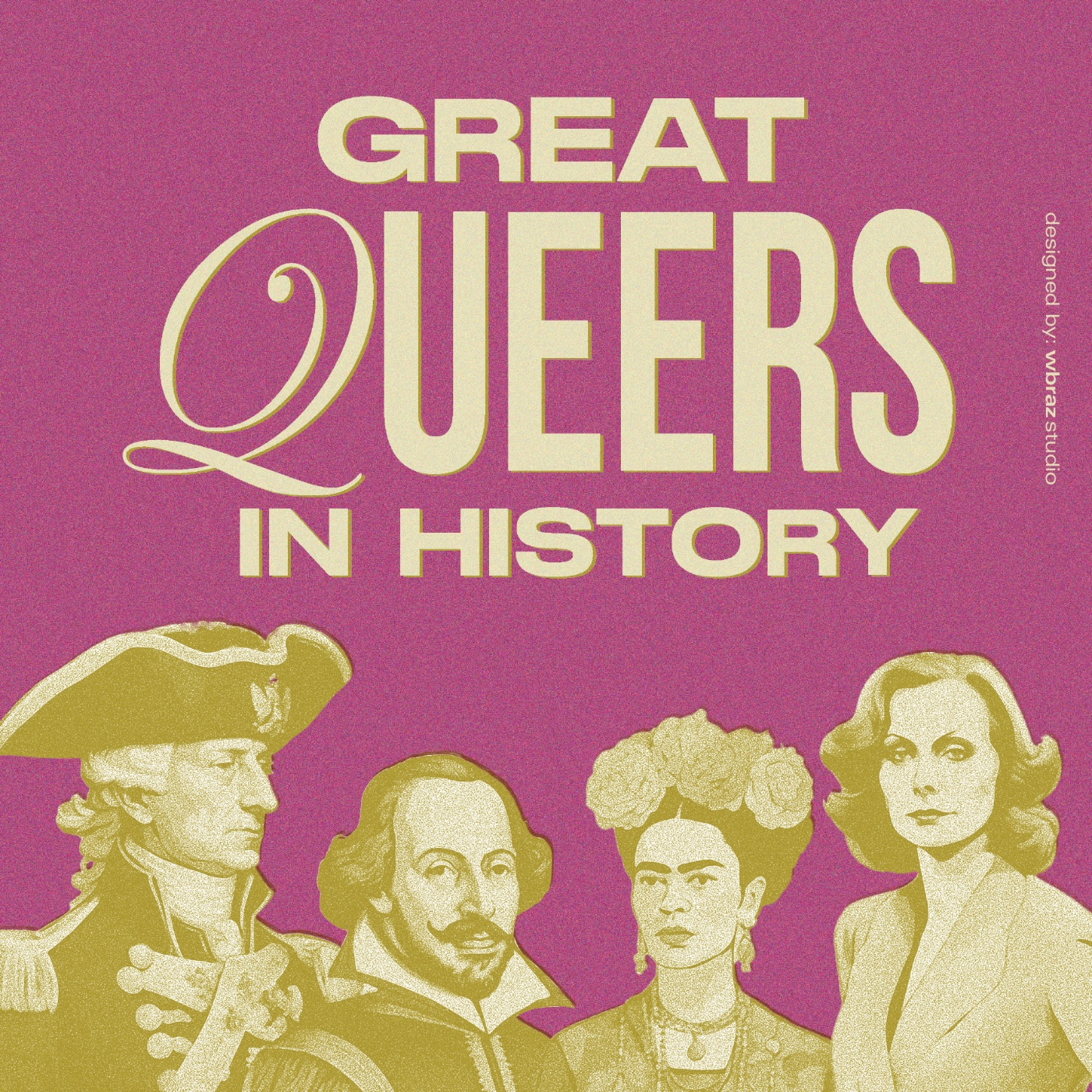
PODCAST · history
Great Queers in History
by Otto Mas
A laid-back approach to various historical figures whose homosexuality got lost, or was concealed, in history books because it turns out, western historiography didn't find any sexuality other than the predominant one, that is, heterosexuality, to be significant.Chapter by chapter, the lives of individuals whose significance in history caused their sexual orientation to be overshadowed under the pretext that their orientation was unnatural and shouldn’t be made public to avoid setting a bad example or tarnishing their image, as if being homosexual, bisexual, or transgender was bad.In addition to these episodes, you can also learn a lot more about other characters in my book, Grandes Maricas de la Historia, published in Spanish by Penguin Random House, which you can find in any bookstore in Spain or in digital format everywhere.For suggestions or any comments, you can go on Twitter to @Otto_Mas or on Instagram to @ottomas, though, heads up, trolls are not welcome! ;-)The cover d
-
21
S01E21: Francis Bacon, English writer, essayist, politician, and philosopher, founder of empiricism (1561-1626)
Francis Bacon, the one studied in philosophy classes in school, was a first-rate statesman and a great philosopher, as well as a homosexual who was fortunate enough to enjoy his sexuality because the king at the time was also homosexual, and Bacon was by his side, meaning he was privileged. Eventually, he fell from grace, but it was due to financial issues, and his brother, incidentally, was also homosexual, much to the dismay of their puritanical mother, Lady Anne Bacon, who ended up without grandchildren. The music you are listening to can be found on this playlist: https://open.spotify.com/playlist/6sTbqqy8eOhfoWKz2GAflu?si=K7IADIIaTCStd3JVZpTcLQ
-
20
S01E20: Hans Christian Andersen (1805-1875), Danish writer known for his children's fairy tales
But how can Hans Christian Andersen be homosexual when he wrote children's tales?! Reeeeeeally? Are homosexuals not allowed to write stories? Well, Andersen's love story was quite asexually oriented, with lots of letters, diaries, and 19th-century romanticism, of course. And, hey, he had his flings and prospered in his own way. After all, someone had to be the inspiration for his story "The Ugly Duckling"! Yes, himself. Oh, and the music for the episode can be found here: https://open.spotify.com/playlist/03i9DgQGJHRxkdOrGkBSjM?si=VC8WvBUXSi-BGEAlUHogrw
-
19
S01E19: Edward II of England, also known as Edward II of Plantagenet (1284-1327)
Edward II, the son of Eleanor of Castile, fell head over heels in love with Piers Gaveston, and they even had a religious ceremony that resembled a marriage... well, not exactly, it was more like a religious bonding, but you know, with some intimacy, even though the Church didn't allow such things. If you want to learn more about this union that wasn't a marriage, just click. It includes very medieval content in the form of public execution and the music of their time, as always, which you can listen to in this Spotify playlist: https://open.spotify.com/playlist/6WbB0z48Coe3qfoHy7EsVL?si=VASdBSXESpS6vjpWWEgfGg
-
18
S01E18: Pier Luigi Farnese, Duke of Castro and Parma (1503-1547)
Pier Luigi Farnese was the illegitimate son of a Pope, to begin with. In addition to being a mercenary, he had an insatiable sexual appetite and left no young man untouched, willingly or not, so he was essentially a rapist. He established the Duchy of Parma, which, oddly enough, ended up in the hands of the Spanish Bourbon family through the marriage of Felipe V. Oh, and he raped a young bishop, just like that... The music for this episode can be found, as always, on Spotify: https://open.spotify.com/playlist/4QB9qe17xxqpbEzl6GCgcp?si=bugormTSRv6J5qkS_q9inQ
-
17
S01E17: William Lygon, 7th Earl Beauchamp (1872-1938)
William Lygon was a true English nobleman with a long lineage, complete with medieval castles and all. He prospered in British society with all the merits and titles. Married with seven children, he had his flings and boyfriends until his brother-in-law found out and reported him. A scandal erupted, but his children never abandoned him, and his story inspired Evelyn Waugh's novel "Brideshead Revisited," which ITV turned into a legendary series. The music featured in this episode can be found in this Spotify playlist: https://open.spotify.com/playlist/2lTtwMB1uvDX03oiGY9KEK?si=LuVPPB2MS4un8bJdnppKiw
-
16
S01E16: Federico García Lorca, poet, playwright, musician, and member of the Generation of '27 (1898-1936)
What can be said about Federico García Lorca that hasn't been said already? Well, quite a few things, such as his three boyfriends, his homosexual friends, the works in which he reflected his condition, and even the album he recorded! A fundamental figure in universal literature forever linked to his tragic execution by the Francoists for being homosexual. The music for this episode can be found in this playlist: https://open.spotify.com/playlist/0YfrVsZcLZOS1Bm1dc36Wi?si=PsOH-fcHRnCfsMpk70MOOA
-
15
S01E15: Luis Cernuda, Spanish poet and literary critic, member of the Generation of '27 (1902-1963)
Luis Cernuda left his native Seville to discover his homosexuality in the warm city of Malaga, and from there, he moved to Madrid, where he became very close friends with two of Spain's greatest homosexual figures in literary history, Federico García Lorca and the future Nobel laureate in literature, Vicente Aleixandre. In his poetry, Cernuda explored his sexuality, loneliness, and love, making him one of the greatest poets in the Spanish language of the 20th century. An active anti-fascist, he spent his final days in exile, like many other Spaniards, welcomed by Mexico. You can find the playlist accompanying this episode here: https://open.spotify.com/playlist/5meWRA8y980wJX1qeRqCxP?si=RH09tPtMTMmXTMtZbUJ70w
-
14
S01E14: Philipp Friedrich Alexander, Prince of Eulenburg and Hertefeld, and Count of Sandels (1847-1921)
Philipp von Eulenburg was the typical stuffy aristocrat, old-fashioned, classist, antisemitic, and racist, who disliked parliamentary systems. He formed the Liebenberg Circle, a clique of friends like him, meaning nobles and homosexuals, to advise, or rather, influence, Kaiser Wilhelm II. However, people were somewhat tired of nobles and, on top of that, homosexuals. The scandal made its way into the press and the courts, and overall, homophobia ran rampant in what became known as the Eulenburg Affair. Quite a drama... but it had its waltzes and all, and here's the playlist: https://open.spotify.com/playlist/0rFmKreJSz80PWgitqKcFG?si=FuPAw04SQH605_2YkSgnuA
-
13
S01E13: Philip of France, Duke of Orleans, Frère unique du Roi and prince (1640-1701)
Philip of Orleans, the younger brother of the Sun King Louis XIV, was openly homosexual, a skilled military man, and a fashion victim of his time (possibly even more so than his brother, which is saying something). He maintained a long-term romantic relationship with the Chevalier de Lorraine, although it was a rather toxic relationship because the Chevalier was a spendthrift and a royal freeloader. But well, Philip had money to spare, to be honest... Today's playlist features the following songs: https://open.spotify.com/playlist/6OyyLUtUOLwKJJWzDdLSdp?si=3Ei6mHIgR6qU1EexQQcIwQ
-
12
S01E12: Henry III of France, king and sixth child to the great Catherine de' Medici (1551-89)
Henry of Valois was not born to be a king, but he ended up becoming the King of Poland and later of France, all due to the twists of fate and, of course, because his brother died. The favored son of Catherine de' Medici, caught between the Huguenots and Catholics, he left no one indifferent, especially when he partied with his "mignons," dressed as a woman and heavily made up, both literally and figuratively. A fanatical Catholic monk took him down at a young age. The playlist with the contemporary music used in the podcast about Henry is on Spotify, as always: https://open.spotify.com/playlist/6O2MNHIshKedBwDUZ7Lydy?si=FZ9okDZGTbyL5-FgasIhsQ
-
11
S01E11: Magnus Hirschfeld, German Jewish doctor and LGBT rights activist (1868-1935)
Episode dedicated to the "Einstein of Sex," the great Magnus Hirschfeld, the German Jewish homosexual doctor pursued relentlessly by the Nazis for advocating for the rights of homosexuals and women and for his studies on human sexuality. His legacy, which continues the research of Karl Heinrich Ulrichs, extends to this day, making him a fundamental figure in the history of LGBTI community rights and human rights. Fortunately, he was able to escape Germany and died in France. The playlist for this episode: https://open.spotify.com/playlist/5bsbRkcZJLHS1pTbGritsE?si=V3xp_S3sTNmfSFE83r9bJg
-
10
S01E10: Karl Heinrichs Ulrichs, German lawyer, jurist, journalist, and sexology pioneer (1825-1895)
Karl Heinrichs Ulrichs was the first LGBTQ+ activist as we know it today, determined to pave the way for the rest of us, in his time and in the future, and to convince everyone that our nature wasn't a perversion. He clashed with everyone, and he was treated poorly, but nobody is a prophet in their homeland. Therefore, he ended his days in Italy, respected and recognized. His was the first Pride; let's never forget that. The music, from Schubert, Schumann, Mendelssohn, and other contemporaries, is on this Spotify playlist: https://open.spotify.com/playlist/4Ggp6uWdoD4fniGmZkn8EB?si=JHzgc2QPQJSaERt15LyC9Q
-
9
S01E09: Sir Isaac Newton, English physicist and mathematician (1642-1727)
Sir Isaac Newton did not have the best childhood in the world, nor the best love life, but he laid the foundations for scientific thought and also developed infinitesimal calculus, something that is of no use to philologists and historians but is to the rest of humanity. So, thank you, Newton, for calculus and for having been one of us. The playlist for this episode's music is on Spotify, as always, at this link: https://open.spotify.com/playlist/1n23nYDkXMhxdJIrIol6ye?si=bCrta87sSXOyTU_MZCa7iw
-
8
S01E08: Frederick II of Prussia AKA Frederick the Great (1712-1786)
King of Prussia, with a father who was a monster and ordered the execution of Frederick's love in a cruel and horrible manner. An enlightened monarch and very close to Voltaire, despite the tricks the French philosopher played on him! Oh, and he was also a composer and flutist, as well as an admirer of J.S. Bach! This week's playlist, as always, on Spotify: https://open.spotify.com/playlist/5raF7QxaVXFOJackMMb5nb?si=CS526ccIQ7itNvAYyTLQUg
-
7
S01E07: Piotr Ilich Chaikovski (1840-1893), Russian composer
Today's episode is especially musical, as the ballet scores Tchaikovsky wrote couldn't be more renowned: Swan Lake, The Nutcracker... and a quite intense life, filled with homosexual romances and testimonies documented in his letters and diaries, even though his biographers in his homeland, Russia, insist on denying the evidence. This week's playlist: https://open.spotify.com/playlist/7wdD8FhiE5jaLq2BCGAQCJ?si=5uUWmed9TN6c-adm0ZePZw
-
6
S01E06: Cosme Pérez, AKA Juan Rana (1593-1672), Spanish Golden Age actor
In this episode, our sixth one, we discuss the most famous comedic actor of the Spanish Golden Age, the witty Cosme Pérez, better known as Juan Rana. Such an exceptional actor and even better comedian that even kings boasted of having him at their service, which is why he was spared from the Inquisition taking care of him due to the heinous sin he practiced, that is, for being homosexual. The playlist with the music from this episode is as follows: https://open.spotify.com/playlist/6D0RaZ4hUE9RrFLjfNuc8x?si=0at_pr9tTLesQ7DCj1My5w
-
5
S01E05: Francisco de Asís de Borbón (1822-1902), king consort of Spain
Fifth episode, dedicated to the one they called Doña Paquita and Paquito Natillas, among other things, grandson of Charles V and king consort due to his marriage to Queen Isabel II. A homosexual by birth and cuckold by profession, he ended up exiled in Paris but in loving company, and not of the queen, but of Antonio Meneses, Chief of the Royal House for whatever was needed. Today's music playlist is here: https://open.spotify.com/playlist/5TuSMTUzOu7q7OfmK9oCVq?si=1YqWdDq0SZmYROM_sfitcA
-
4
S01E04: Michelangelo Merisi da Caravaggio (1571-1610), Italian painter
Fourth episode of our lost, forgotten, or closeted homosexuals, today dedicated to the Italian painter Michelangelo Merisi da Caravaggio, creator of tenebrism and whose life also had lights and shadows everywhere, not just the artistic, but also the personal. He died too young and, despite that, probably did not leave a pretty corpse. This week's playlist can be found here: https://open.spotify.com/playlist/4MncnvN51meCQwD1fAEztK?si=8M6W4YGnTnOoiywv-pFB4Q
-
3
S01E03: William Shakespeare (1564-1616), actor, playwright and poet
Third episode of our series dedicated to homosexuals lost in history. Today, one of the most important figures in world literature, the Bard of Avon, as Shakespeare is known by his compatriots, and, to the dismay of his scholars, it seems that the boy wasn't so heterosexual after all and that, when it comes to bedroom entanglements, those in his works paled in comparison. The playlist with the music used today can be found on Spotify: https://open.spotify.com/playlist/38u0BKFwjuDV1J3GxvNizA?si=UI77Cx7TRIKmZbe89z4BkA
-
2
S01E02: Michelangelo Buonarroti (1475-1564), architect, painter, sculptor and poet
Second episode of our great counterparts, this time dedicated to Michelangelo, the very famous Italian Renaissance artist who has suffered the heterosexual whitewashing of his figure until, oh, surprise someone began to research the life of the painter and his writings... A fantasy. The playlist of the music used on Spotify: https://open.spotify.com/playlist/5zrEqGQIPOu5f7pITyaXTv?si=a__UHmWkTGOFymX6LzuSsA
-
1
S01E01: George Villiers (1592-1628), I Duke of Buckingham
First episode where I share how I began writing about the lives of my historical homosexual peers and right off the bat, we delve into the first of them, George Villiers, Duke of Buckingham, and a member of the English nobility who was a lover of King James I and also his son, Charles I... Keeping it all in the family! Oh, and he makes appearances in musketeer novels. Playlist of the music used: https://open.spotify.com/playlist/2K6ZhpONwxQvwImTFZUaCJ?si=uDSqMoZtQqCwqEjIqq6n4Q
We're indexing this podcast's transcripts for the first time — this can take a minute or two. We'll show results as soon as they're ready.
No matches for "" in this podcast's transcripts.
No topics indexed yet for this podcast.
Loading reviews...
ABOUT THIS SHOW
A laid-back approach to various historical figures whose homosexuality got lost, or was concealed, in history books because it turns out, western historiography didn't find any sexuality other than the predominant one, that is, heterosexuality, to be significant.Chapter by chapter, the lives of individuals whose significance in history caused their sexual orientation to be overshadowed under the pretext that their orientation was unnatural and shouldn’t be made public to avoid setting a bad example or tarnishing their image, as if being homosexual, bisexual, or transgender was bad.In addition to these episodes, you can also learn a lot more about other characters in my book, Grandes Maricas de la Historia, published in Spanish by Penguin Random House, which you can find in any bookstore in Spain or in digital format everywhere.For suggestions or any comments, you can go on Twitter to @Otto_Mas or on Instagram to @ottomas, though, heads up, trolls are not welcome! ;-)The cover d
HOSTED BY
Otto Mas
CATEGORIES
Loading similar podcasts...
Frequently Asked Questions
How many episodes does Great Queers in History have?
Great Queers in History currently has 21 episodes available on PodParley. New episodes are automatically indexed when they're published to the podcast feed.
What is Great Queers in History about?
A laid-back approach to various historical figures whose homosexuality got lost, or was concealed, in history books because it turns out, western historiography didn't find any sexuality other than the predominant one, that is, heterosexuality, to be significant.Chapter by chapter, the lives of...
How often does Great Queers in History release new episodes?
Great Queers in History has 21 episodes. Check the episode list to see recent publication dates and frequency.
Where can I listen to Great Queers in History?
You can listen to Great Queers in History on PodParley by clicking any episode. We provide an embedded audio player for direct listening, and you can also subscribe via your preferred podcast app using the RSS feed.
Who hosts Great Queers in History?
Great Queers in History is created and hosted by Otto Mas.
URL copied to clipboard!