
PODCAST · news
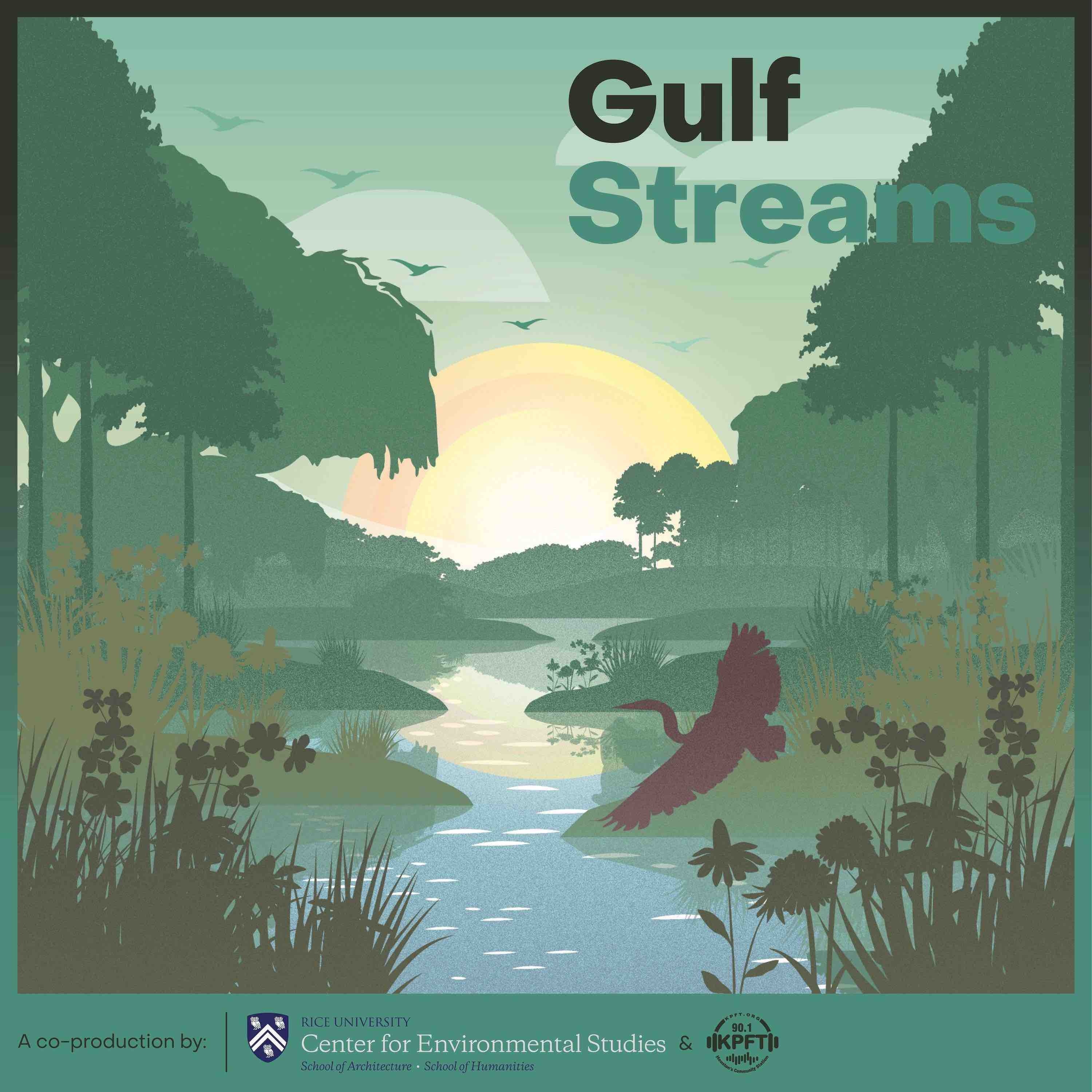
Gulf Streams
by KPFT Houston and Rice University’s Center for Environmental Studies
Environmental and Climate News out of Houston Texas. Gulf Streams is your source for environmental and climate news. Covering a range of topics around Houston, the Gulf Coast, and the world, Gulf Streams brings you the best in conversations with community leaders and advocates, academic experts, and national thought leaders. Join us as we sit down every Monday at noon (central) to dive into the most pressing environmental challenges, solutions, and ideas. A co-production of Rice University’s Center for Environmental Studies and KPFT Houston, with support from Rice’s EcoStudio and the Andrew W. Mellon Foundation.
-
110
Ep. 109 Harris County's Climate Justice Plan
At just a year old now, we're diving into the Harris County Climate Justice Plan to understand what it is, why it matters, and how it will shape our region's future resilience and success as we weather new environmental challenges. Joining us are Lisa Lin (Harris County Office of Sustainability) and Andy Escobar (Coalition for Environment, Equity, and Resilience).
-
109
Ep. 108 Cuts to Science Funding
On today's show we sit down with Andrew Hoffman (Rice University) to discuss the way that cuts to science are impacting climate research. After that, our researcher Antara talks with two local meteorologists, Justin Stapleton (KPRC2) and Travis Herzog (ABC13) about how funding reductions impact meteorological data at the local level.
-
108
Ep. 107 Water Strategies
On today's show our researcher Sarah sits down with two different practitioners working around the world to combat water scarcity. Later in the hour Dr. Chaney Hill and Sarah talk to a local wolf and wolf dog sanctuary about their work saving local animals.
-
107
Ep. 106 Building Ecosystems
What happens when we view spaces big (acres) and small (a patio) as its own ecosystem? On today's show, we sit down with Dr. Shaun McCoshum to discuss his new book Natural Habitats and Wildlife Gardening: Inviting Nature into Your Backyard. He walks us through ways to consider our landscapes, however big or small, as part of larger ecosystems and ways to support animals and plants in our lives. Later in the hour we explore some of our favorite parks and wildlife in recurring segments of Urban Explorer and Critter Corner with Sophia.
-
106
Ep. 105 Urban Farming
Our researcher Antara and a guest researcher Paolo take us through a tour of Houston urban farms. Along the way we learn about the challenges of farming in a city, the rewards for community, and how local groups are working to improve their neighborhoods and footways all throughout the city.
-
105
Ep. 104 Gulf Coast Demise?
The US Gulf Coast faces many, often compounding, threats. On today's show, we sit down with Dr. John B. Anderson (Rice University), whose recent book Gulf Coast Demise explores the unique challenges facing the reason, how sea level rise is exacerbating risk throughout the region, and what we are doing -- and should be doing -- to address these challenges.
-
104
Ep. 103 Toxic Air in Our Homes
After Hurricane Katrina devastated the Gulf Coast, a slow moving public health disaster followed in the form of disaster recovery: the ubiquitous FEMA trailers that were quickly utilized by rebuilding families turned out to often have extremely high levels of formaldehyde in them. Dr. Nicholas Shapiro (UCLA) spent years following these trailers to understand the impacts of living in toxic environments. His new book, Homesick, offers lessons not only in disaster recovery but for how we continue to build homes (especially amid a housing crisis) and the risks of running to the fastest, cheapest solutions. Across our conversation we discuss ways to improve indoor air quality, as well as discuss how we can ensure healthy homes going forward as we continue to meet the rising demand for houses across the country.
-
103
Ep. 102 Saving Animals and Writing to Save the World
On today's show, our junior researchers sit down with folks doing very different kinds of work to help protect our wildlife, natural resources, and planet. First, we speak with Nicole Rogers of Saint Francis Wolf Sanctuary about their work saving wolves and wolf dogs. Then we talk to Tristan Ahtone at Grist about the importance of journalism and telling unheard stories for promoting climate awareness and protection. Finally, another in our series of urban explorer segments focused on local parks.
-
102
Ep. 101 Can We Make It Rain?
Drought is increasing around the world, and with it desperate conditions for farmers and rural communities. Water shortages present major economic and political threats in the coming decades. One potential solution, much speculated on but less evidenced, is the controversial practice known as "cloud-seeding." Today we sit down with scientists and entrepreneurs to discuss how this practice is being deployed, what its effects are, and what its future might be.
-
101
Ep. 100 The Mineral Challenge to Electrification
Scientists agree that more electricity will be needed to power the world, and that we should use more renewable energy to meet that demand. But electrifying our world takes more minerals to build that infrastructure, especially lithium. How can industry keep up, and what are the risks and challenges in building out new mining facilities around the world? We sit down with Thea Riofrancos (Providence College) to discuss her new book, Extraction: The Frontiers of Green Capitalism, all about these challenges.
-
100
Ep. 99 How Urban Park Revitalization Took Over
Ever since the development of the High Line in New York, urban leaders have recognized the potential for unconventional spaces -- especially in economically marginalized areas or in deindustrialized spaces -- for new greenways. These spaces are often privately led, and explicitly aim for economic development as a goal of the new amenity. We sit down with Kevin Loughran (Temple University) to talk about his book, Parks for Profit, and the development of urban parks across the country, including Buffalo Bayou Park in Houston.
-
99
Ep. 98 New Ways to Find Nature All Around
On today's show we have two segments both thinking through how to bring more natural solutions and greenery into the world. First is a conversation with the team at SPARK, a local non-profit that builds park spaces for students, and how they're thinking about green initiatives in parks. After that we learn about Nature's Burial, a new organization working to preserve local landscape while helping put loved ones to rest in planet healthy ways.
-
98
Ep. 97 Growing Green
Keeping a city's canopy thriving is hard work: the planting, growing, and replanting of trees takes constant effort. Today we sit down with Barry Ward (Trees for Houston) to talk all about the work of maintaining and growing Houston's tree canopy. Later in the hour our researcher Sophia talks to Robby Robinson (Buffalo Bayou Preserve) in a Critter Corner segment.
-
97
Ep. 96 Art and Conservation
Teaching the science of ecology and environment is an essential part of educating the next generation of environmental caregivers. But how we communicate those core ideas and help future scientists to understand the world around us requires finding ways of connecting and learning across science and nature. Artist Boat, a local nonprofit dedicated to science education through the arts, works to bridge that divide through artistic engagement and conservation work. On today's show we talk to their Karla Klay, their executive director, to learn all about how they marry art and science to help protect our environment.
-
96
Ep. 95 Writing the Gulf South
Our co-host Dr. Chaney Hill (Rice University) is joined by Christopher Nicholson (Rice University) to sit down with author Kent Wascom (author of such books as The Blood of Heaven, The New Inheritors, and his newest book, The Great State of Florida). Together, they discuss the role of contemporary fiction in telling the story of the Gulf South and better understanding our natural world through fiction.
-
95
Ep. 94 Gardening for Resilience
Today we sit down with Austin gardener and designer Pam Penick, who tells us all about her newest book Gardens of Texas: Visions of Resilience from the Lone Star State. Over a career writing and thinking about garden spaces, Penick shares her insights into how gardens can survive and thrive even in the harshest of Texas environments.
-
94
Ep. 93 The Value of Emptiness
We sit down with Christopher Brown, whose new book A Natural History of Empty Lots to discuss finding meaning in abandoned places. Then we chat with Dr. Rebecca Potts (Rice University) who discusses how we came to afford value to places out of larger theological viewpoints.
-
93
Ep. 92 jackie sumell and Endangered Feces
Artist jackie sumell joins us to discuss her newest artwork, right here in Houston, Endangered Feces. A piece that helps to create ecosystems as it naturally decomposes, summell explains her process, mission, and goals with this new phase in her work.
-
92
Ep. 91 Second Nature with Nathaniel Rich
Nathaniel Rich (Tulane University) is a journalist, novelist, and creative writer whose work spans deep, investigative research to historical fiction. His documenting legal challenges to PFAS was turned into the 2019 film Dark Waters. Today our researcher Antara and host Weston Twardowski sit down to chat with him about his book Second Nature, which explores how humans are inherently entangled with our "natural" worlds, and what that means for how we choose to live with nature going forward.
-
91
Ep. 90 Tropical Conservation
On today's show we sit down with Dr. Rakan Zahawi (Charles Darwin Foundation) and Dr. Bren Ram (Island Conservation) who walk us through the work global conservation organizations take on, and how the lessons from conservation groups globally can help us rethink our local environments.
-
90
Ep. 89 Gulf Screams: Halloween Special
Today's episode takes a deep dive into three spooky stories: Edgar Allen Poe's The Fall of the House of Usher, Nathaniel Hawthorne's Young Goodman Brown, and Charlotte Perkins Gilman's The Giant Wisteria. Dr. Chaney Hill (Rice University) walks our researchers Antara and Sarah through how these 19th century Gothic authors turned to the environment to set mood and create haunting backdrops in three of the best known American short stories of the era.
-
89
Ep. 88 Update from the Policy World
Today we speak with two policy experts, Jennifer Walker (National Wildlife Federation) and Luke Metzger (Environment Texas) about upcoming policy decisions with immediate impact on Houston. First, Jennifer walks up through Proposition 4, which is on ballots in November and would guarantee funds for future water projects throughout the state. Second, Luke explains what the Roadless Rule is and how its repeal might impact forests in Texas and across the US. At the end of the episode is an update from our researcher Nomin on garden prep.
-
88
Ep. 87 Regenerative Agriculture
How are local farmers working to make agriculture more sustainable? On today's show we sit down with August Stubler, the head farmer at SkyFarm at POST Houston to talk about the innovative work being done to create newer, more ecologically friendly, agricultural systems.
-
87
Ep. 86 How Conservation Works
Today we sit down with Mary Anne Piacentini, Executive Director and CEO of Coastal Prairie Conservancy, to discuss the role of conservation organizations in building better environments all around us. Beyond the work of habitat creation and maintenance, conservation is a complex mix of science, law, education, and outreach that creates spaces that plants, humans, and animals can enjoy. Piacentini discusses the work of Coastal Prairie Conservancy throughout Southeast Texas, and how they are helping to protect our natural areas for generations to come.
-
86
Ep. 85 Houston's New Homes are Often in Flood Zones
Today we're sitting down with Yilun Cheng (Houston Chronicle) to talk about her recent series of stories focused on where and how we're building new homes in the Houston metro area. Through her reporting, the Chronicle has learned that nearly 1 in 5 new homes built in the area are in FEMA designated floodplains. We talk through what this means for flood risk throughout Houston, and what can be done about it. Later in the hour our researcher Nomin discusses how new parks are built in unlikely places, and our researcher Sophia has another piece in her Critter Corner series on animals around town.
-
85
Ep. 84 Hurricane Katrina at 20
With Hurricane Katrina's 20th anniversary landing in August, we sit down with Dr. Andy Horowitz (University of Connecticut) to discuss his book Katrina: A History, 1915-2015. Together we discuss the longterm impacts of the disaster, how the conditions in New Orleans were primed for disaster, and what recovery means -- and what we can learn -- in an age of more frequent extreme weather.
-
84
Ep. 83 Brandon Ballengée on Ecology and Art at the 15th Anniversary of the BP Oil Spill
Today we sit down with Brandon Ballengée, a biologist and artist, who researches and makes art that explores the unique ecosystems of the Gulf Coast. Reflecting on the fifteenth anniversary of the capping of the capping of the oil leak caused by the Deepwater Horizon disaster, Dr. Ballengée helps us understand the ongoing harm caused by the spill and the ways we can remember the devastation and continue to understand its relevance.
-
83
Ep. 82 EcoTourism
A thriving economy exists around our natural resources: tourists flock to take in beautiful destinations. But maintaining and leveraging these sites takes work. So today we're talking about EcoTourism, both how nature can attract tourists (and their dollars), and the ways that tourists are increasingly thinking about how they can "travel green." Our guests are Sasha Francis (Galveston Island Nature Tourism Council) and Dr. Bryan Schmidt (William and Mary).
-
82
Ep. 81 What We Eat
On today's show our researcher Jadyn turns the tables to sit down with Weston Twardowski (Rice University) to talk all about the environmental consequences of the agricultural system how what we choose to eat impacts the world around us.
-
81
Ep. 80 Drought
In today's episode, we talk with Dr. Chris Funk (Director of the Climate Hazards Center at UCSB) and Dr. John Nielsen-Gammon (Texas State Climatologist) about the growing impact of drought across Texas and how global climate patterns are shaping local conditions. They break down the science behind water scarcity, what to expect in the coming years, and what communities can do to prepare. Then, we learn a bit more about local animals and fauna from our student researcher, Sophia. This episode is guest hosted by our researcher Nomin Rentsendorj.
-
80
Ep. 79 Memorials to Changing Landscapes
As our environments change, whether from natural disaster or man-made forces, part of adapting to our new reality is processing the loss of what was as we accept what is. On today's show, Dr. Chaney Hill (Rice University) sits down with our usual host Dr. Weston Twardowski (Rice University), Dr. Jennifer Ladino (University of Idaho), and Dr. Nick Koenig (University of Idaho) to talk about the ways that we process environmental change. Later in the hour our research Sophia has another Critter Corner special all about local animals and plants.
-
79
Ep. 78 Expanding Buffalo Bayou's Trails
We sit down with Ian Rosenberg (Senior Vice President of Projects & Planning) and Karen Farber (Vice President of External Affairs) at Buffalo Bayou Partnership to talk about the expansion of Buffalo Bayou East and the coming projects that will remake one of the most iconic parks in Houston over the next few years. Later in the hour our researcher Nomin has a piece on the surprising environmental differences between common products, and our researcher Sophia chats animals and local fauna.
-
78
Ep. 77 Environmentalism Under the Trump Administration
Today we sit down with Matthew Tejada (Natural Resources Defense Council), the Deputy Director of Environmental Justice at the Environmental Protection Agency under President Obama, President Trump, and President Biden. Tejada, a longtime Houston environmentalist, is now working diligently with the NRDC to advocate for cleaner, safer environments. We have a direct conversation about the changes the new presidential administration has meant for the EPA and environmental research, and what the future may hold for improving our environmental health and resilience. Later in the hour our researcher Jadyn talks with Dr. Chaney Hill (Rice University) about The Overstory – one of the most popular books of the last decade.
-
77
Ep. 76 What's Biodiversity?
On today's episode we sit down with Dr. Korey Evans (Rice University) and Dr. Scott Egan (Rice University) who recently hosted a symposium all about biodiversity and what it means to the Houston region. Later in the hour our researcher Sophia kicks off a new series all about green spaces around Houston.
-
76
Ep. 75 The Columbia Tap Trail
The Columbia Tap Trail, a historic train line in Houston, is a four-mile path where residents have practiced tactical urbanism for decades. Now, with new support from the city and funders, the trail is becoming more of a community resource for the thousands who live nearby. Edward D. Pettitt, doctoral candidate the Bullard Center for Environmental and Climate Justice, joins us to discuss his work with the Friends of Columbia Tap, a group of residents working to bring this new vision to life.
-
75
Ep. 74 Deepwater Horizon at Fifteen
On today's show we sit down with Leigh Fondakowski, the playwright behind the documentary theatre show SPILL. SPILL recounts the events leading up to, and following the 2010 Deepwater Horizon and subsequent oil spill in the Gulf of Mexico. The Moody Center for the Arts, at Rice University, will be mounting a production of the show April 11th and 12. We revisit that moment and discuss how the world has changed in the wake of the largest oil spill in global history. Later in the hour, our researcher Jadyn has a piece on lead poisoning as an environmental concern.
-
74
Ep. 73 Nature Based Solutions
Often when we think of environmental hazards and climate change, it feels as though nature is fighting us. What if we reimagined nature as our partner, our ally, in the fight against climate change? Today we sit down with Jim Blackburn (Rice University) and Dr. Carrie Masiello (Rice University) to talk all about Nature Based Solutions.
-
73
Ep. 72 The Future of Nuclear Energy
Is nuclear energy the future? Or is it doomed to be a decreasingly important energy source in a rapidly changing landscape. On today's show we sit down with two different thinkers on opposite ends of the debate around the future of nuclear: Dr. MV Ramana (University of British Columbia), and Paris Ortiz-Wines (Mothers for Nuclear). This episode is guest hosted by our researcher Nomin Rentsendorj.
-
72
Ep. 71 CERA Week 2025
On today's show we're joined by Dr. Casey Williams (Environmental Studies Lecturer at Rice University) as co-host, Dr. Randal Hall (Environmental Historian at Rice University), and Dr. Gökçe Gunel (Anthropologist at Rice University) discussing this year's major energy conference in Houston, CERA Week. Later in the episode two Rice Anthropologists, Dr. Dominic Boyer and Dr. Cymene Howe, discuss their work on glaciers.
-
71
Ep. 70 New Solar Power and the EV Market Forming
On today's episode we sit down with Dan Gearino of Inside Climate News to talk about the growing solar industry in Texas. Later in the hour we're joined by the Electric Vehicle Association of Houston to talk about how EV's have never been more popular in the area.
-
70
Ep. 69 Houston Botanic Garden
Botanical gardens are a feature of great cities around the world, and since 2020, Houston has a botanical garden of its own, the Houston Botanic Garden. On today's show we sit down with three of the garden's staff to talk all about the role of botanical gardens in cities, and what makes the Houston Botanic Garden so special.
-
69
Ep. 68 Plant-Based Buildings?
On today's show we're talking about the very materials we use to build our homes and buildings. We sit down with Jesus Vasallo (Rice University) to talk all about the future of building materials and the coming prevalence of plant-based construction approaches.
-
68
Ep. 67 Understanding the Past for the Sake of our Future
Today we sit down with Jonathan Levy (University of Chicago) to talk all about the past of Houston to understand what might be coming in its future. In particular, where Houston can serve as a leading example in the coming world of climate adaptation. Later in the hour our researcher Jadyn has a story on animal welfare during disasters.
-
67
Ep. 66 The 2025 Texas Legislature is in Session
Dr. Cyrus Reed is the Conservation Director of the Sierra Club's Lone Star Chapter. The Lone Star Chapter is the oldest environmental organization in Texas, and today they're sharing with us some of the most important issues in front of the Texas Legislature this session regarding energy security, environmental protection, and water quality.
-
66
Ep. 65 Houston Bayous Pt. 2
Today we sit down with Geoff Winningham, an award winning photographer, to talk all about his experiences charting Buffalo Bayou and learning about Houston's ecology for his book, Along Forgotten River. Our researcher Sophia and regular host Weston Twardowski learn about adventuring along the bayou, and discuss how it continues to change as we reshape it today.
-
65
Ep. 64 Houston's Bayous Pt. 1
The first of two episodes focused on exploring the Bayous of "Bayou City," our researcher Sophia Soltes talk with ecologist Suzanne Simpson (Galveston Bay Foundation) and advocate Yudith Nieto (Bayou City Waterkeeper) about the history, health, and importance of the city's bayous. Later in the episode our researcher Jadyn Bray-Boyce shares the psychological benefits of spending time in nature.
-
64
Ep. 63 Toxic Matters in the Port of Houston
On today's show we have an update on Project 11, the expansion of the Port of Houston, and the history of polluted soil in local neighborhoods as a result of port dredging. We're joined by Leticia Gutierrez (Air Alliance Houston), Cleo Sharp (Achieving Community Tasks Successfully), and Naomi Yoder (the Bullard Center for Environmental and Climate Justice) to learn more.
-
63
Ep. 62 Birds, Bioacoustics, and Geology, oh my!
Today our researcher Nomin Rentsendorj sits down with Dr. Cin-Ty Lee to talk about his cutting edge geological research. Dr. Lee is a geologist/petrologist/geochemist whose work has moved into bioacoustics to study wildlife – especially birds. In this fascinating conversation, he walks us through his work.
-
62
Ep. 61 Environment and Art: What Interdisciplinary Collaboration Can Accomplish
Today we sit down with Alison Weaver, Founding Executive Director of the Moody Center for the Arts, to talk about what can be accomplished through collaborations between environmentalists, scientists, and artists. The Moody Center has been dedicated to producing community engaged work, much of which explores the environment, for years and has a new exhibit opening that speaks to how we can reimagine our world through art – and even solve some it's environmental challenges.
-
61
Ep.60 Learning to Laugh in a Changing Climate
On today's show we're diving into the unexpectedly important role of laughter and comedy in addressing climate change. Our guest, Dr. Aaron Sachs (Cornell University), walks us through the importance of comedy to survival, social movements, and, he argues, fighting climate change.
We're indexing this podcast's transcripts for the first time — this can take a minute or two. We'll show results as soon as they're ready.
No matches for "" in this podcast's transcripts.
No topics indexed yet for this podcast.
Loading reviews...
ABOUT THIS SHOW
Environmental and Climate News out of Houston Texas. Gulf Streams is your source for environmental and climate news. Covering a range of topics around Houston, the Gulf Coast, and the world, Gulf Streams brings you the best in conversations with community leaders and advocates, academic experts, and national thought leaders. Join us as we sit down every Monday at noon (central) to dive into the most pressing environmental challenges, solutions, and ideas. A co-production of Rice University’s Center for Environmental Studies and KPFT Houston, with support from Rice’s EcoStudio and the Andrew W. Mellon Foundation.
HOSTED BY
KPFT Houston and Rice University’s Center for Environmental Studies
Loading similar podcasts...
URL copied to clipboard!