
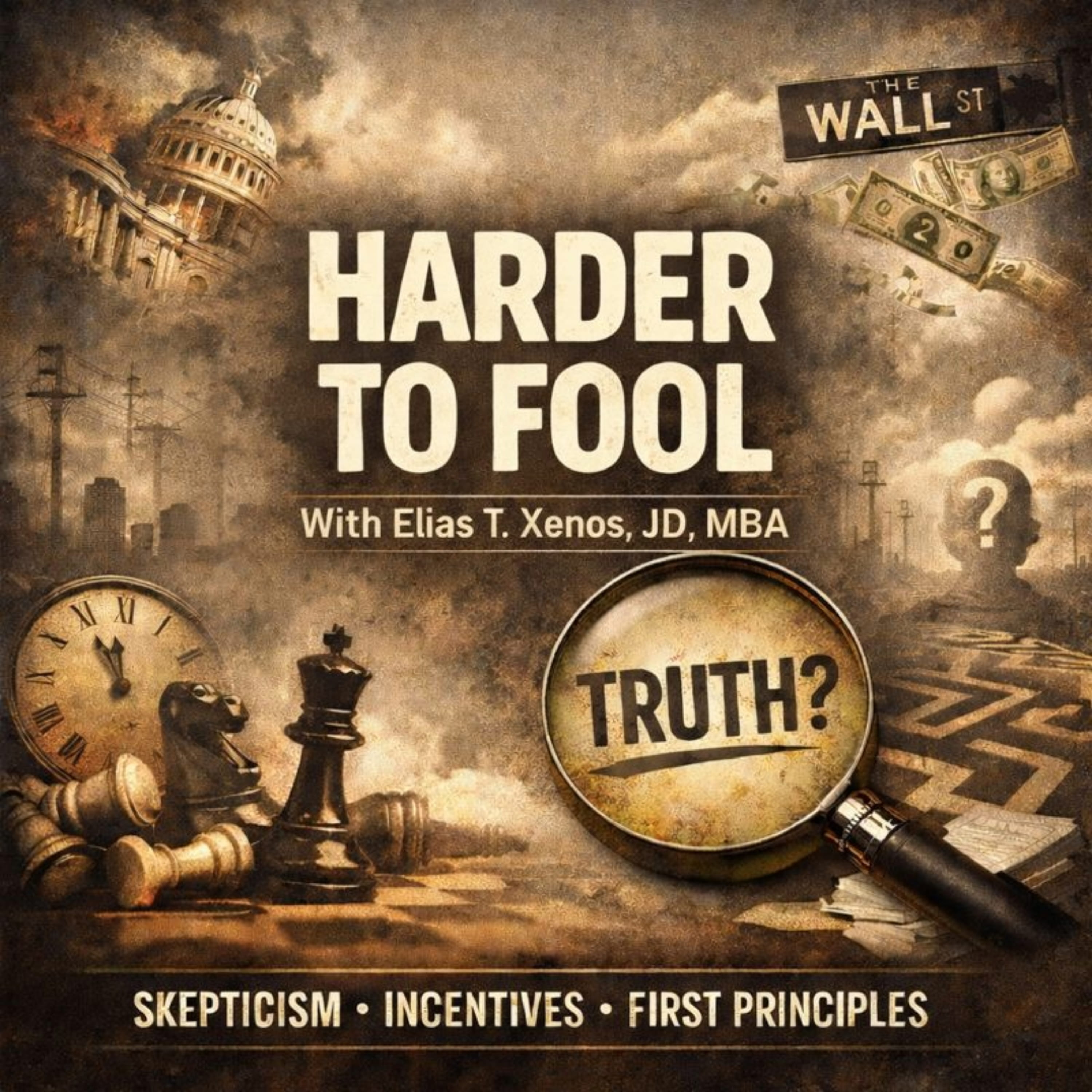
PODCAST · business
Harder to Fool
by Elias T. Xenos, JD, MBA
This podcast isn’t a manifesto, and it doesn’t offer a single grand theory to explain modern life. It’s closer to an almanac: a collection of observations, warnings, and hard-earned patterns—many of them unfashionable—meant to be consulted, not blindly accepted.Modern American life is saturated with advice but starved of wisdom. Institutions that once filtered nonsense now produce it at scale. Narratives are sold as facts, incentives are disguised as morality, and skepticism is increasingly treated as a character flaw. This podcast is an attempt to clear some of that fog.Episodes range across politics, economics, careers, money, institutional decay, and the quiet mechanics of everyday scams. They aren’t united by ideology, but by method—an insistence on incentives, tradeoffs, and first principles. Whenever possible, the question is simple: Who benefits if I believe this?Much of today’s public discourse is performative. Politics is framed as existential
-
12
The Quiet Criminalization of Ordinary Life
Why do more aspects of everyday life seem to be drifting toward criminalization? In this episode, we challenge the comforting myth that the past was simply more tolerant. Instead, we explore a harder truth: law often expands not because morality changes, but because enforcement technology advances. When surveillance becomes cheap, automated, and continuous, the question shifts from “Should this be illegal?” to “Why not enforce it, now that we can?”From data-integration platforms used by federal agencies to real-time license plate tracking, we examine how modern surveillance infrastructure reshapes criminal liability—and how private-sector incentives accelerate the process. As enforcement capability grows, discretion shrinks, and “practical innocence” becomes harder to maintain.This episode explores the quiet ratchet of technological power, the industrialization of suspicion, and the unsettling reality that the ability to enforce a rule is increasingly mistaken for a justification to create one.To learn about sponsorship and advertising opportunities, click here.
-
11
Higher Education and the Cost of Easy Money
College tuition didn’t spiral out of control by accident. This episode examines how unlimited access to subsidized money, non-dischargeable student loans, and administrative bloat turned higher education into one of the most profitable—and least disciplined—industries in America. From the Bennett Hypothesis to the explosion of bureaucracy and low-value degrees, the discussion argues that the crisis in higher education isn’t about learning or compassion, but about incentives—and why prices will keep rising until those incentives change.To learn about advertising and sponsorship opportunities, click here.
-
10
The Business of Illness
Healthcare in America isn’t broken—it’s perfectly aligned with the incentives that govern it. This episode examines how scale, insurance design, and cultural expectations have transformed medicine into a system where costs rise invisibly, accountability dissolves, and intermediaries thrive. From Medicare’s role as a dominant buyer to the psychological separation between patients and prices, the conversation explores why reform is endlessly discussed yet rarely achieved—and why the system continues to serve those closest to the money far better than the people who fund it.To learn about advertising and sponsorship opportunities, click here.
-
9
Before You Invest, Ask Why You're Being Invited
Most investors ask the wrong first question. Instead of “How much can I make?” this episode asks something far more revealing: “Why is this opportunity being offered to me at all?”This conversation explores what access really signals in investing—how scarcity, liquidity, and incentives shape both public and private markets. From private deals to publicly traded stocks, the episode unpacks why broadly marketed “opportunities” often exist to provide an exit for others, and why skepticism should scale with availability.Investment success, it argues, is less about finding hidden gems and more about understanding who needs your capital—and why.To learn about advertising and sponsorship opportunities, click here.
-
8
Decide on Your Relationship With Money Early
Most people never consciously decide what role money will play in their lives—they drift into it. In this episode, we examine why that quiet drift is so costly, and why your relationship with money should be chosen early and deliberately. We explore two coherent paths that actually work—intentional frugality and aggressive ambition—and why the unfocused middle ground produces stress rather than security. Along the way, we unpack hedonic adaptation, the modern rat race, and how small, intentional choices can restore alignment between effort and satisfaction. This is a conversation about clarity, coherence, and choosing a financial life that fits—before default choices make the decision for you.To learn about sponsorship and advertising opportunities, click here.
-
7
Own the Relationship
Every industry divides into two roles: those who do the work and those who control access to money. This episode examines why technicians—often the most skilled and indispensable people in the system—are routinely out-earned by relationship owners who sit closest to the transaction. From law and medicine to music, film, and corporate leadership, we unpack the structural reasons effort and difficulty fail to determine pay, and why owning relationships scales in ways technical mastery never can. Understanding this asymmetry is uncomfortable—but it’s also a competitive advantage.To learn about sponsorship and advertising opportunities, click here.
-
6
Why Responsibility Rarely Determines Pay
Why does someone entrusted with thousands of lives earn less than someone brokering expensive deals with little personal risk? Because pay is rarely about responsibility, difficulty, or social value. This episode breaks down how modern compensation actually works: income flows to those positioned near large pools of money, not those bearing the greatest consequences. We explore deal-size thinking, reference bias, executive pay rationalizations, and why access to big transactions matters more than skill or effort. Once you see the pattern, much of the economy stops being confusing—and starts being predictable.To learn about sponsorship and advertising opportunities, click here.
-
5
The Myth of the "Well=Rounded" Applicant
Colleges insist they want well-rounded students. In reality, they want something very different: a carefully engineered, well-rounded class. This episode unpacks the quiet distinction between individual breadth and institutional design, and why genuine intellectual range—formed through curiosity and free choice—often works against modern admissions incentives. We examine how the language of “well-roundedness” obscures social engineering, explains many of the contradictions in elite admissions, and rewards conformity over organic development.To learn about sponsorship and advertising opportunities, click here.
-
4
Home Ownership: The Costs That Shape Your Life
Home ownership is treated as a moral good in American life—question it and you risk sounding heretical. But beneath the spreadsheets, tax deductions, and rent-vs-buy calculators lies a deeper set of costs few are willing to confront. This episode examines home ownership not as a financial decision, but as an existential one: how it shapes mobility, opportunity, influence, and exposure to the state. We explore how government policy distorted housing markets, why ownership often means distance from cultural and economic centers, and how property quietly turns flexibility into friction. The real question isn’t whether buying is cheaper than renting—it’s what kind of life ownership makes possible, and what it silently forecloses.To learn about sponsorship and advertising opportunities, click here.
-
3
Be a Service Capitalist
Brick-and-mortar businesses are often celebrated as the backbone of the economy—but structurally, they are some of the most exposed. This episode examines why enterprises tied to physical locations and fixed assets become easy targets for taxation, regulation, and political extraction, especially as economic activity grows more mobile and digital. We contrast capital-intensive businesses with service-based, intangible models that offer flexibility, leverage, and insulation from creeping transferism. The takeaway is not anti-business or anti-local—it’s pragmatic: in a system that punishes visibility and immobility, mobility is leverage, and intangibility is protection.To learn about advertising and sponsorship opportunities on the Hard to Fool podcast, click here.
-
2
Wealth is Not Financial Independence
Wealth and financial independence are often treated as the same thing—but they aren’t. This episode examines the difference between having assets on paper and having a life that can withstand disruption. We look at how dependence hides inside jobs, markets, debt, and “passive” income, and why high net worth can still mean fragility. Financial independence, properly understood, isn’t about maximizing returns or escaping work; it’s about minimizing vulnerability. The goal isn’t to look rich. It’s to be hard to corner.To learn about sponsorship and advertising opportunities on the Harder to Fool podcast, click here.
-
1
Hold Cash to Preserve Your Liberty and Dignity
Harder to Fool examines how modern systems quietly trade liberty for convenience—and why that trade is rarely as benign as advertised. In this episode, we take a hard look at the push toward a cashless economy, not as a technological upgrade, but as a structural shift in power. When money becomes fully digital, choice erodes, enforcement becomes automatic, and compliance replaces consent. This is not nostalgia or paranoia—it’s a practical discussion about agency, dignity, and why keeping an exit still matters in a world optimized for frictionless control.Click to here to learn about advertising and sponsorship opportunities on the podcast.
We're indexing this podcast's transcripts for the first time — this can take a minute or two. We'll show results as soon as they're ready.
No matches for "" in this podcast's transcripts.
No topics indexed yet for this podcast.
Loading reviews...
ABOUT THIS SHOW
This podcast isn’t a manifesto, and it doesn’t offer a single grand theory to explain modern life. It’s closer to an almanac: a collection of observations, warnings, and hard-earned patterns—many of them unfashionable—meant to be consulted, not blindly accepted.Modern American life is saturated with advice but starved of wisdom. Institutions that once filtered nonsense now produce it at scale. Narratives are sold as facts, incentives are disguised as morality, and skepticism is increasingly treated as a character flaw. This podcast is an attempt to clear some of that fog.Episodes range across politics, economics, careers, money, institutional decay, and the quiet mechanics of everyday scams. They aren’t united by ideology, but by method—an insistence on incentives, tradeoffs, and first principles. Whenever possible, the question is simple: Who benefits if I believe this?Much of today’s public discourse is performative. Politics is framed as existential
HOSTED BY
Elias T. Xenos, JD, MBA
CATEGORIES
Loading similar podcasts...
Frequently Asked Questions
How many episodes does Harder to Fool have?
Harder to Fool currently has 12 episodes available on PodParley. New episodes are automatically indexed when they're published to the podcast feed.
What is Harder to Fool about?
This podcast isn’t a manifesto, and it doesn’t offer a single grand theory to explain modern life. It’s closer to an almanac: a collection of observations, warnings, and hard-earned patterns—many of them unfashionable—meant to be consulted, not blindly accepted.Modern American life is saturated...
How often does Harder to Fool release new episodes?
Harder to Fool has 12 episodes. Check the episode list to see recent publication dates and frequency.
Where can I listen to Harder to Fool?
You can listen to Harder to Fool on PodParley by clicking any episode. We provide an embedded audio player for direct listening, and you can also subscribe via your preferred podcast app using the RSS feed.
Who hosts Harder to Fool?
Harder to Fool is created and hosted by Elias T. Xenos, JD, MBA.
URL copied to clipboard!