
PODCAST · technology
Human-Robot Teaming
by Universitetet i Agder
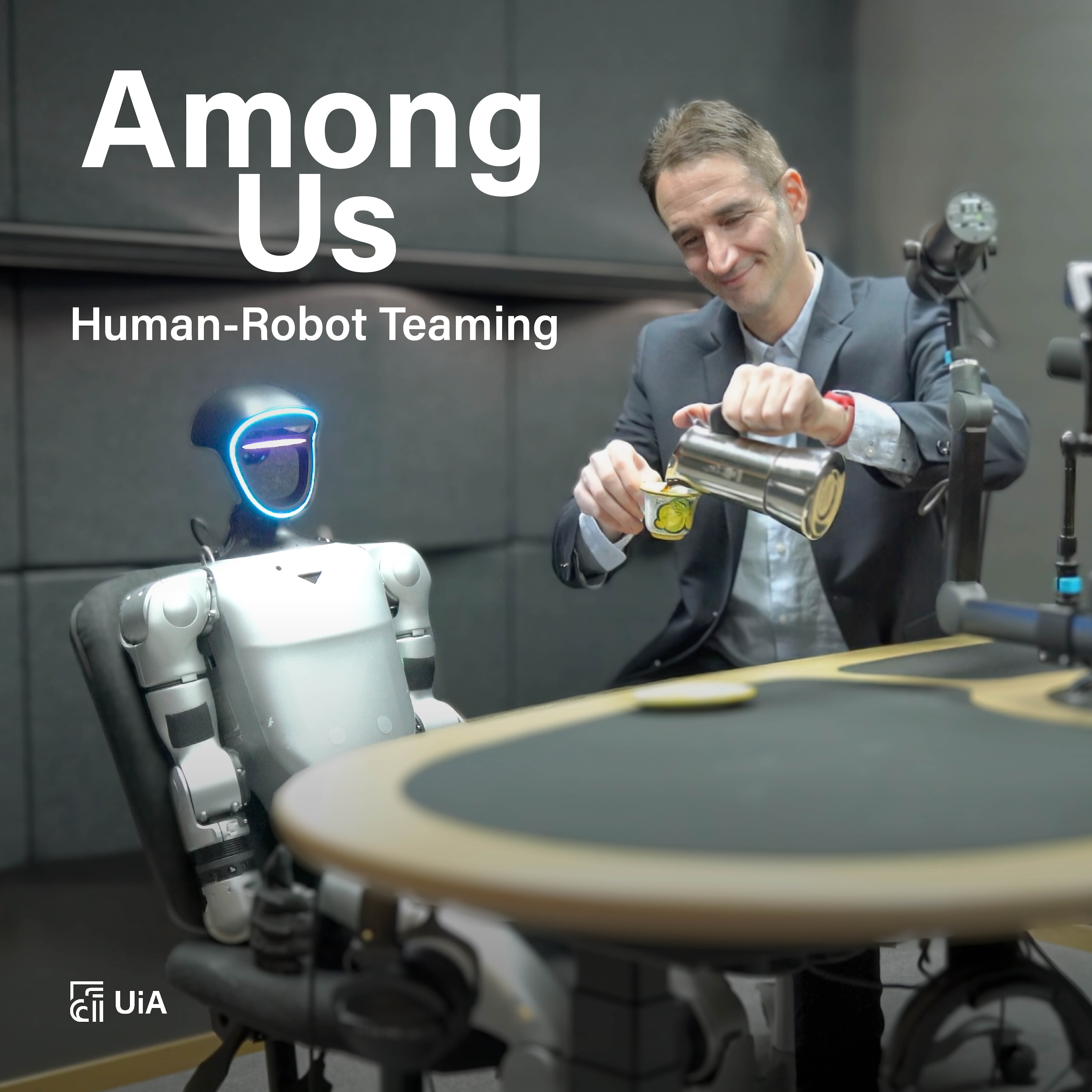
Robots are no longer confined to factories or research labs. They are in our hospitals, our industries, our public spaces, and increasingly, in our homes. Among Us: Human-Robot Teaming is a podcast exploring what happens when humans and intelligent machines work together. Hosted by Professor Filippo Sanfilippo, this series brings together leading international researchers, engineers, innovators, and thinkers to discuss the technical, cognitive, ethical, and societal dimensions for different levels of human-robot collaboration. Each episode dives into the challenges and opportunities of designing robotic systems that are not just autonomous but collaborative. This is not about science fiction. It is about trust, shared control, responsibility, and the future of teamwork. Through thoughtful, coffee-style conversations, the podcast highlights cutting-edge research while making complex ideas accessible to students, academics, industry professionals, and anyone curious about how intelligent
-
8
Human Activity Recognition for Human-Robot Teaming
Insights from Professor Florenc Demrozi. Explore how sensors, AI, and wearable technology are transforming human-robot collaboration, healthcare, and assisted living. Discover the vision of lifelong learning machines and their potential to evolve with us, aiding independence and safety.Key Topics:Evolution of human-robot interaction from isolation to collaborationThe role of sensors, wearables, and environmental context in human activity recognitionChallenges in data quality, AI modeling, and system safety for healthcare applicationsThe concept of robots as lifelong companions and lifelong learnersFuture scenarios: robots as learning partners, safety enforcers, and co-evolving entitiesTimestamps:00:00 - Introduction to human-robot teaming and interview guest Professor Florenc Demrozi01:16 - The historical transition from isolated robots to collaborative human-robot interaction02:13 - The progression towards physical collaboration and shared space in human-robot teaming02:43 - Recognizing human activity and intent through sensing and AI03:12 - The importance of understanding human status within physical and environmental contexts04:08 - How ubiquitous sensors and multi-modal data fusion advance healthcare robotics05:10 - Applications in healthcare: Parkinson’s, Alzheimer’s, disabilities, and aging population challenges09:17 - Robots in assisted living: coaching, teaching, and digital therapeutics11:10 - Empowering the elderly: training and maintaining independence with robots12:40 - Robots as lifelong companions, physical helpers, and co-learners14:08 - Challenges of trust, reliability, safety, and real-time collaboration in human-robot teaming15:02 - Controlling and ensuring safety of robots via constraints and innovative actuators16:00 - Developing intrinsically safe and elastic actuators like human muscles17:25 - Data quality, sensor noise, and AI model generalization challenges20:50 - Regulatory hurdles and the necessity of validation for medical applications21:51 - Generalization across different environments, sensors, and users23:21 - Envisioning the future: robots as lifelong learning partners and companions24:25 - The concept of the lifelong learning digital companion evolving with users26:25 - Knowledge exchange between humans and machines, and eventual AI surpassing human knowledge in specific tasks27:24 - Digital coaching systems: recognizing and blocking risky behaviors28:22 - The vision of humans and robots as equal, continuously evolving partners29:07 - The role of curiosity and ongoing research in advancing human-robot teaming29:44 - Closing thoughts and a special message for the next generation of researchersResources & Links:Florenc Demrozi - University of StavangerConnect with Professor Florenc Demrozi:LinkedIn
-
7
How Snake Robots Could Revolutionize Human-Robot Teaming
In this episode, we delve into innovative research on bio-inspired snake robots and their transformative potential in disaster scenarios. Syed Kumayl Raza Moosavi, a PhD researcher, shares insights on how these modular, adaptable robots can navigate complex terrains, assist first responders, and enhance safety through autonomous aid delivery.Key Topics:The bio-inspired design and modular structure of snake robotsApplications in space exploration, search and rescue, and disaster environmentsHow snake robots use terrain-aided locomotion and obstacle-aware navigation (POLl framework)Multi-robot systems integrating UAVs and snake robots for efficient aid deliveryFuture challenges: terrain adaptability, sensor integration, and real-world deploymentTechniques for simulating and optimizing locomotion across varied friction surfacesVision for human-robot teaming and autonomous decision-making in critical scenariosTimestamps:(00:46) - Introduction to among us: human-robot teaming in disaster scenarios(01:25) - Why bio-inspired snake robots? Flexibility and navigability benefits(02:24) - Biological traits inspiring robotic design; multi-environment adaptability(03:17) - Unique capabilities of snake robots in space exploration(04:16) - Snake robots in search and rescue: navigating debris and collapsed structures(08:03) - Modular design and skin imitation for terrain adaptability(09:29) - Using snake robots across disaster phases: preparedness, response, recovery(12:27) - Autonomous assessment and aid delivery with heterogeneous robot teams(16:16) - Combining grasping, navigation, and aid dispatch in rescue operations(20:37) - Prototype development challenges: skin mimicking and multi-terrain locomotion(25:45) - Transfer from simulation to real-life deployment: friction and terrain transitions(29:28) - Future of snake robotics in planetary exploration and low-light environments(31:50) - The POLL framework and perception-driven obstacle-aided locomotion(33:17) - Advancing sensory and planning capabilities for complex tasks(34:14) - Collaborative opportunities and upcoming discussions on snake robotics(35:01) - Final reminder and closing remarksResources & Links:Filippo Sanfilippo, Jon Azpiazu, Giancarlo Marafioti, Aksel A. Transeth, Øyvind Stavdahl, and Pål Liljebäck. 2017. "Perception-Driven Obstacle-Aided Locomotion for Snake Robots: The State of the Art, Challenges and Possibilities" Applied Sciences 7, no. 4: 336. https://doi.org/10.3390/app7040336.Filippo Sanfilippo, Erlend Helgerud, Per Anders Stadheim, and Sondre Lieblein Aronsen. 2019. "Serpens: A Highly Compliant Low-Cost ROS-Based Snake Robot with Series Elastic Actuators, Stereoscopic Vision and a Screw-Less Assembly Mechanism" Applied Sciences 9, no. 3: 396. https://doi.org/10.3390/app9030396.Filippo Sanfilippo. "Combining grasping with adaptive path following and locomotion for modular snake robots." International Journal of Mechanical Engineering and Robotics Research 11, no. 2 (2022): 59-65.Filippo Sanfilippo, Øyvind Stavdahl, and Pål Liljebäck. "SnakeSIM: A ROS-based rapid-prototyping framework for perception-driven obstacle-aided locomotion of snake robots." In 2017 IEEE International Conference on Robotics and Biomimetics (ROBIO), pp. 1226-1231. IEEE, 2017.Syed Kumayl Raza Moosavi, Muhammad Hamza Zafar, and Filippo Sanfilippo. "Collaborative robots (cobots) for disaster risk resilience: a framework for swarm of snake robots in delivering first aid in emergency situations." Frontiers in Robotics and AI 11 (2024): 1362294. doi: 10.3389/frobt.2024.1362294.Askan Duivon, Pino Kirsch, Boris Mauboussin, Gabriel Mougard, Jakub Woszczyk, and Filippo Sanfilippo. "The redesigned serpens, a low-cost, highly compliant snake robot." Robotics 11, no. 2 (2022): 42.Inaki Rañó, A. Gómez Eguíluz, and Filippo Sanfilippo. "Bridging the gap between bio-inspired steering and locomotion: A braitenberg 3a snake robot." In 2018 15th International Conference on Control, Automation, Robotics and Vision (ICARCV), pp. 1394-1399. IEEE, 2018.Connect with Kumail Raza:LinkedInNote:For more detailed research papers and collaboration inquiries, visit the research group's official site here.
-
6
How Passion Will Inspire Advances in Human-Robot Teaming
Join us in this inspiring episode featuring Professor Bruno Siciliano, a pioneer in robotics and a highly esteemed IEEE Fellow. We explore his incredible journey, the role of passion in research, and the future of human-robot collaboration. Discover how soccer, culture, and scientific innovation intertwine to shape the next era of robotics.Main Topics Discussed:The influence of passion, especially football and culture, on robotics innovationThe concept of human-robot teaming and shared autonomyBarriers, standards, and the global landscape of robotics developmentThe ethical and societal implications of technological progressInspirational advice for future generations of researchersIn this episode:Professor Siciliano recounts his lifelong passion for Napoli football and its influence on his creativityInsight into the potential of collaborative autonomy and the balance between control and complianceExamples of unexpected applications of robotics, from fashion industry to surgical toolsThe importance of cultural, societal, and international perspectives in shaping robotics standardsPersonal stories of mentorship, international cooperation, and the responsibility of future innovatorsThe vision of a seamless, human-centered future powered by physical AI and hyper-connectivityTimestamps:00:00 - Welcome and introduction to Professor Siciliano's impact in robotics01:13 - The significance of his research and cultural background02:33 - Passion for football and its influence on engineering creativity03:43 - The role of adrenaline and emotional engagement in research and teaching05:03 - The social and cultural insights from stadium visits across Europe06:44 - Creativity inspired by local city culture and its impact on innovations09:14 - The story behind the ERC grant and the pizza robot demonstrator11:44 - Robotics as a societally inspired pursuit rooted in cultural identity12:45 - The sociological dimension of human-robot interaction in urban environments13:14 - Gesticulation, cultural behaviors, and AI training datasets14:43 - The importance of sensory development and education in human evolution15:42 - Interdisciplinary approaches and cross-fertilization between robotics and other fields16:09 - Teaching beyond textbooks: inspiring the next generation18:11 - Student assessments, ethics in education, and the value of understanding concepts20:14 - The role of AI and accessible knowledge in democratizing robotics22:29 - The founding of the "Technology Humanism" initiative and societal responsibilities23:51 - Creativity as a driver for research and the symbolic link to soccer24:37 - Imagining robots playing soccer and rethinking human-robot interaction25:14 - Supporting and connecting people across disciplines for innovative collaborations33:42 - The potential of joint human-robot creative endeavors and storytelling34:00 - The importance of shared control and the blending roles in human-robot teaming50:53 - The balance between control, safety, and social acceptability in robots54:43 - The emerging era of diverse robotic systems beyond humanoids59:34 - The future of design, control, and integration in robotics60:00 - The establishment of Stanford’s new Robotics Center and the pillars of modern robotics61:10 - The four pillars: Knowledge, Design, Interaction, Impact65:21 - Shared emotions, the human side of robotics, and the euphoria of technological progress66:15 - Barriers to human-robot teaming and strategies to overcome them70:38 - Unexpected applications of robotics (surgical, industrial, assistive)75:29 - Enabling new applications, from virtual guides to assistive devices79:31 - Rethinking the human-robot relationship and the evolution of “robots” into collaborative partners82:29 - Standards, regulations, and international differences in robotics development90:22 - The potential of robotics to bridge cultural and societal gaps94:08 - The importance of interdisciplinary and international cooperation for future progress99:50 - Visions of the future: technological, emotional, and societal changes in the next decades104:37 - The responsibility of today’s scientists and engineers to preserve emotional and cultural legacies115:41 - Final reflections: inspiring the next generation to dream bigger and collaborate globallyResources & Links:Even Falkenberg Langås, Muhammad Hamza Zafar, and Filippo Sanfilippo. "Exploring the synergy of human-robot teaming, digital twins, and machine learning in Industry 5.0: a step towards sustainable manufacturing." Journal of Intelligent Manufacturing 37, no. 3 (2026): 999-1022. https://doi.org/10.1007/s10845-025-02580-x.Filippo Sanfilippo, Timothy Wiley, and Rebekah Rousi. "Robocup soccer autonomy uprising: How crowds, referees, and humanoid robots are redefining the future of human-robot interaction." In 2025 20th ACM/IEEE International Conference on Human-Robot Interaction (HRI), pp. 1131-1139. IEEE, 2025. doi: https://10.1109/HRI61500.2025.10974154.Filippo Sanfilippo, Muhammad Hamza Zafar, Timothy Wiley, and Fabio Zambetta. "From caged robots to high-fives in robotics: Exploring the paradigm shift from human–robot interaction to human–robot teaming in human–machine interfaces." Journal of Manufacturing Systems 78 (2025): 1-25. https://doi.org/10.1016/j.jmsy.2024.10.015.Connect with Professor Siciliano:LinkedInThis episode encapsulates the synergy between passion, culture, and scientific curiosity, demonstrating that the future of robotics is fundamentally human-centered and inspired by shared dreams and responsibilities.
-
5
Special Episode: European Robotics Forum (ERF) 2026
Recorded live at the European Robotics Forum 2026 in Stavanger, this special episode of Among Us: Human–Robot Teaming takes you inside one of Europe’s most important robotics gatherings—through conversations, demos, and cutting-edge research.This is not theory. This is what robotics actually looks like today.🎤 Who You’ll Hear in This Episode🔹 Opening Perspective: The Vision Behind ERFWe start with Nabil Belbachir, organizer of ERF, discussing:The strategic direction of robotics in EuropeWhere industry and research are actually convergingWhy events like ERF matter beyond networking🔹 Bio-Inspired Flight & Flapping DronesNext, a fascinating discussion with Matěj Karásek from Flapper Drones:How flapping-wing drones differ from traditional UAVsThe role of bio-inspired design in roboticsReal-world applications where conventional drones fail🔹 Precision Haptics & Human InteractionWe then speak with Marco Aggravi, Project Manager and R&D Engineer at Haption:High-fidelity force feedback systemsThe role of haptics in teleoperation and trainingWhy touch is still the missing piece in many robotic systems🔹 Live Demo: Immersive Interaction with SenseGloveA hands-on demo with SenseGlove showcases:Real-time haptic feedback in virtual and robotic environmentsApplications in training, simulation, and remote manipulationThe transition from demo tech → deployable systems🔹 Research Spotlight: Human Trajectory PredictionThe episode concludes with a presentation of the paper:“Transformer-Based Human Trajectory Prediction in Manufacturing Settings”Authored by:Even LangåsAtle AalerudDaniel HagenFilippo SanfilippoKey ideas explored:Predicting human motion in industrial environmentsUsing transformer architectures for temporal modelingImproving safety and fluency in human–robot collaboration🧠 What Connects All of This?At first glance, these look like separate topics:Event organizationBio-inspired dronesHapticsWearable interfacesAI-based trajectory predictionThey’re not.They all point toward one thing:👉 Robots that understand, adapt, and physically interact with humans in real environments⚙️ The Real Insight (No Sugarcoating)Most robotics systems today:Perceive poorlyPredict weaklyInteract unnaturallyThis episode shows what it takes to fix that:Better sensing (event cameras, multimodal systems)Better prediction (transformers, temporal models)Better interaction (haptics, wearable feedback)🎯 Who This Episode Is ForRobotics researchers and PhD studentsEngineers working on HRI/HRC systemsAnyone serious about moving from demos → deployable systems🚀 Final TakeawayIf you want real human–robot teaming, you need to combine:Perception + Prediction + Physical InteractionMiss one—and your system breaks in the real world.
-
4
Bilateral Communication Between Humans and Robots as the Future of Human-Robot Teaming
In this episode, Dr. Gionata Salvietti shares groundbreaking perspectives on human-robot collaboration, emphasizing the crucial role of tactile feedback and multisensory interaction. Discover the advances in robotic hand manipulation, sensory integration, and how these innovations are paving the way for more seamless and intuitive teaming between humans and robots.Key Topics:The evolving definition and importance of human-robot teamingBilateral and multi-modal communication channels, especially touchThe biological basis and engineering of tactile feedback in roboticsSynergies and compliance in robotic hand controlThe concept of augmentation: from sixth fingers to assistive roboticsTransition from prototypes to commercialization with companies like SixtoChallenges in sensor development, including robust e-skin technologyEthical considerations and societal implications of robotics revolutionThe future trajectory of AI-powered multisensory integrationTimestamps:00:00 - Introduction to human-robot teaming and its significance02:25 - Defining human-robot collaboration in a rapidly evolving context03:49 - The bilateral communication channel for effective teaming04:54 - Moving towards balanced human-robot interactions07:15 - The role of touch and tactile feedback in communication08:44 - How biological tactile interactions inspire robotic hand design10:08 - The importance of emotional and functional touch in humans11:17 - Using touch for guidance irrespective of sight and hearing impairments12:44 - Historical overview of sensory technology, focusing on touch14:24 - The revolutionary potential of recording and reproducing tactile interactions15:44 - The integration of multiple senses and multisensory teaming17:15 - Manipulation synergies and brain-inspired control strategies18:47 - Simplifying control through synergies and compliance in robotics20:16 - The concept of invisible threads and brain's organization of hand movements21:39 - The brain's management of hand complexity and use of compliance23:50 - The impact of synergy and compliance on collaborative manipulation26:01 - Exploring augmentation: the story of the sixth finger28:52 - Assistive robotics: aiding stroke patients with robotic augmentations31:47 - The pathway from prototypes to commercial products (e.g., Sixto)34:25 - Scaling devices for education and medical training35:23 - Main barriers and future challenges for human-robot teaming37:40 - Sensor technology limitations and future directions39:50 - The importance of standards, safety, and societal acceptance42:14 - The societal impact, fears, and opportunities of robotics revolution44:57 - Cross-disciplinary collaboration and the role of AI in sensor networks46:16 - Final thoughts and encouragement for active engagement in the fieldResources & Links:Domenico Prattichizzo's research groupImmersiveSurgicalEduConnect with Gionata Salvietti:LinkedInResearch Articles:Filippo Sanfilippo, Gionata Salvietti, Tomas Blazauskas, Guido Gabriele, Maria Zafar, Minh Tuan Hua, Muhammad Hamza Zafar, Syed Kumayl Raza Moosavi, Patrikas Armalis, Mohammad Poursina, Povilas Ignatavicius, Andrejus Subocius, Audrius Parseliunas, Ernest Margelis. “Integrating VR, AR, and haptics in basic surgical skills training: a review and perspective.” IEEE Access (2025), doi: 10.1109/ACCESS.2025.3574265.Filippo Sanfilippo, Tomas Blazauskas, Gionata Salvietti, Isabel Ramos, Silviu Vert, Jaziar Radianti, Tim A. Majchrzak, and Daniel Oliveira. 2022. "A Perspective Review on Integrating VR/AR with Haptics into STEM Education for Multi-Sensory Learning" Robotics 11, no. 2: 41. https://doi.org/10.3390/robotics11020041.Filippo Sanfilippo, Tomas Blažauskas, Martynas Girdžiūna, Airidas Janonis, Eligijus Kiudys, and Gionata Salvietti. "A multi-modal auditory-visual-tactile e-learning framework." In International conference on intelligent technologies and applications, pp. 119-131. Cham: Springer International Publishing, 2021. https://doi.org/10.1007/978-3-031-10525-8_10.Filippo Sanfilippo, Houxiang Zhang, Kristin Ytterstad Pettersen, Gionata Salvietti, and Domenico Prattichizzo. "ModGrasp: an open-source rapid-prototyping framework for designing low-cost sensorised modular hands." In 5th IEEE RAS/EMBS International Conference on Biomedical Robotics and Biomechatronics, pp. 951-957. IEEE, 2014. doi: 10.1109/BIOROB.2014.6913903.Filippo Sanfilippo, Gionata Salvietti, H. X. Zhang, Hans Petter Hildre, and Domenico Prattichizzo. "Efficient modular grasping: an iterative approach." In 2012 4th IEEE RAS & EMBS International Conference on Biomedical Robotics and Biomechatronics (BioRob), pp. 1281-1286. IEEE, 2012. https://10.0.4.85/BioRob.2012.6290693.Additional Notes:This episode highlights the importance of multidisciplinary approaches—combining neuroscience, robotics, AI, and design—to address the challenges and unlock the full potential of human-robot teaming. We also discuss societal implications, ethical considerations, and the accelerating pace of technological change.
-
3
When Robots Become Teammates: Sensors, Digital Twins, and the Rise of Human-Centric AI
Join us in this episode as we explore the cutting-edge developments in human-robot collaboration, emphasizing sensor technologies, gesture-based interfaces, privacy preservation, and emotional understanding. Hamza Zafar shares insights from his PhD research, highlighting how new sensors and algorithms are transforming the way humans and robots work together safely and intuitively.Main Topics Covered:The evolution and impact of gesture-based interfaces in human-robot teamingThe role of neuromorphic event cameras versus traditional RGB camerasPrivacy-preserving techniques such as federated learning in sensor dataIntegration of digital twins and Industry 5.0 for dynamic, human-centric environmentsPredicting human intentions and emotional states to enhance collaborationFuture perspectives: robots cohabiting living spaces, especially aiding elderly peopleTimestamps:00:00 - Introduction to "Among Us" podcast and episode theme 01:23 - High-level overview of human-robot teaming and core elements 04:16 - Hamza discusses gesture-based interfaces and sensor types 05:36 - Sensors used in human-robot interaction: RGB, EMG, neuromorphic cameras 07:18 - Privacy-preserving methods in gesture recognition using federated learning 09:09 - Differences between traditional and predictive gesture interfaces 10:54 - Real-time limb and hand tracking for improved robot responsiveness 13:40 - Merging digital twins with machine learning for Industry 5.0 16:17 - Ensuring safety and risk mitigation via digital twins 17:25 - Future visions: robots living with humans, especially the elderly 20:50 - Incorporating emotion prediction and physiological sensing 23:33 - Physiological vs non-verbal emotion recognition for adaptive systems 26:27 - The importance of interdisciplinary collaboration in advancing HRT 28:24 - Neuromorphic event cameras: how they work and their advantages 32:49 - Summary of benefits of event cameras: efficiency, privacy, low data load 34:17 - Final thoughts, collaborations, and closing remarksResources & Links:Hamza Zafar's Scholar ProfileExploring the synergies between collaborative robotics, digital twins, augmentation, and industry 5.0 for smart manufacturing: A state-of-the-art reviewEmpowering Human-Robot Interaction Using sEMG Sensor: Hybrid Deep Learning Model for Accurate Hand Gesture RecognitionFederated learning-enhanced edge deep learning model for EMG-based gesture recognition in real-time human–robot interactionHarmony unleashed: Exploring the ethical and philosophical aspects of machine learning in human-robot collaboration for industry 5.0Connect with Hamza:LinkedInIn this episode, we bridge the latest technological advancements with the ethical and human-centered considerations essential for safe and effective human-robot collaboration.
-
2
Emotional Intelligence in Human-Robot Teaming
In this episode, we explore the evolving field of human-robot teaming (HRT), emphasizing the importance of understanding human psychology, nonverbal communication, and ethical considerations in creating trustworthy and effective robotic partners. Our guest, Dr. Cristina Brasi, brings her expertise in forensic psychology and behavioral analysis to shed light on how robots can better read and respond to human cues, especially in high-pressure environments.Key TopicsThe evolution of human-robot interaction from isolated robots to collaborative teamsThe role of sensors, actuators, and algorithms in enabling effective teamingThe importance of personalized behavioral calibration over universal modelsRecognizing behavioral leakage and micro-expressions to interpret true emotionsCognitive ergonomics: tailoring robotic communication to individual neural profilesChallenges and risks of robot misinterpretation in emergency and stressful scenariosDesigning transparent and predictable robots to foster trustThe ethical implications of robots analyzing micro-expressions and emotional statesThe vision of a future where robots recognize and respect the complex social fabric of human lifeBridging the "invisible barrier" and liberating both humans and machines for more harmonious coexistenceTimestamps00:00 - Introduction to human-robot teaming and its significance03:08 - Why robots need to move beyond mere automation and towards true collaboration04:32 - The evolution from industrial robots to physical and shared space teaming05:29 - Critical elements for effective human-robot interaction: sensors, actuators, algorithms06:56 - The importance of humanizing robots through emotional and behavioral understanding12:21 - The story behind naming the robot "Ambroggio" and symbolic meaning13:43 - Identifying gaps between robotics and behavioral sciences14:12 - Personalizing robotic responses through behavioral signatures and leakage detection15:11 - Moving from action recognition to intent recognition in robots16:08 - Embracing cognitive ergonomics and adapting to diverse neural profiles18:28 - Risks of misinterpreting signals in emergency rescue environments19:38 - Distinguishing pain vs. deception through micro-dynamic gesture analysis20:35 - The importance of social fluency and subtle cues in high-stakes scenarios22:27 - Defining successful human-robot non-verbal collaboration: trust, transparency, predictability24:20 - Designing robots that display their internal states visually for better predictability27:35 - The future potential of human-robot teaming in mental health and operational safety29:14 - Contextual adaptive responses for social appropriateness30:12 - The vision of robots recognizing and respecting the social fabric of human life31:50 - Closing remarks and encouragement for ongoing collaborationResources & LinksEmotion recognition with a Randomized CNN-multihead-attention hybrid model optimized by evolutionary intelligence algorithmConnect with Dr. Cristina Brasi:LinkedInJoin us in future episodes as we continue to unravel the fascinating intersection of human psychology, AI, and robotics. Stay tuned for more inspiring insights and innovative visions for a harmonious future of humans and robots working together.
We're indexing this podcast's transcripts for the first time — this can take a minute or two. We'll show results as soon as they're ready.
No matches for "" in this podcast's transcripts.
No topics indexed yet for this podcast.
Loading reviews...
ABOUT THIS SHOW
Robots are no longer confined to factories or research labs. They are in our hospitals, our industries, our public spaces, and increasingly, in our homes. Among Us: Human-Robot Teaming is a podcast exploring what happens when humans and intelligent machines work together. Hosted by Professor Filippo Sanfilippo, this series brings together leading international researchers, engineers, innovators, and thinkers to discuss the technical, cognitive, ethical, and societal dimensions for different levels of human-robot collaboration. Each episode dives into the challenges and opportunities of designing robotic systems that are not just autonomous but collaborative. This is not about science fiction. It is about trust, shared control, responsibility, and the future of teamwork. Through thoughtful, coffee-style conversations, the podcast highlights cutting-edge research while making complex ideas accessible to students, academics, industry professionals, and anyone curious about how intelligent
HOSTED BY
Universitetet i Agder
CATEGORIES
Loading similar podcasts...
URL copied to clipboard!