
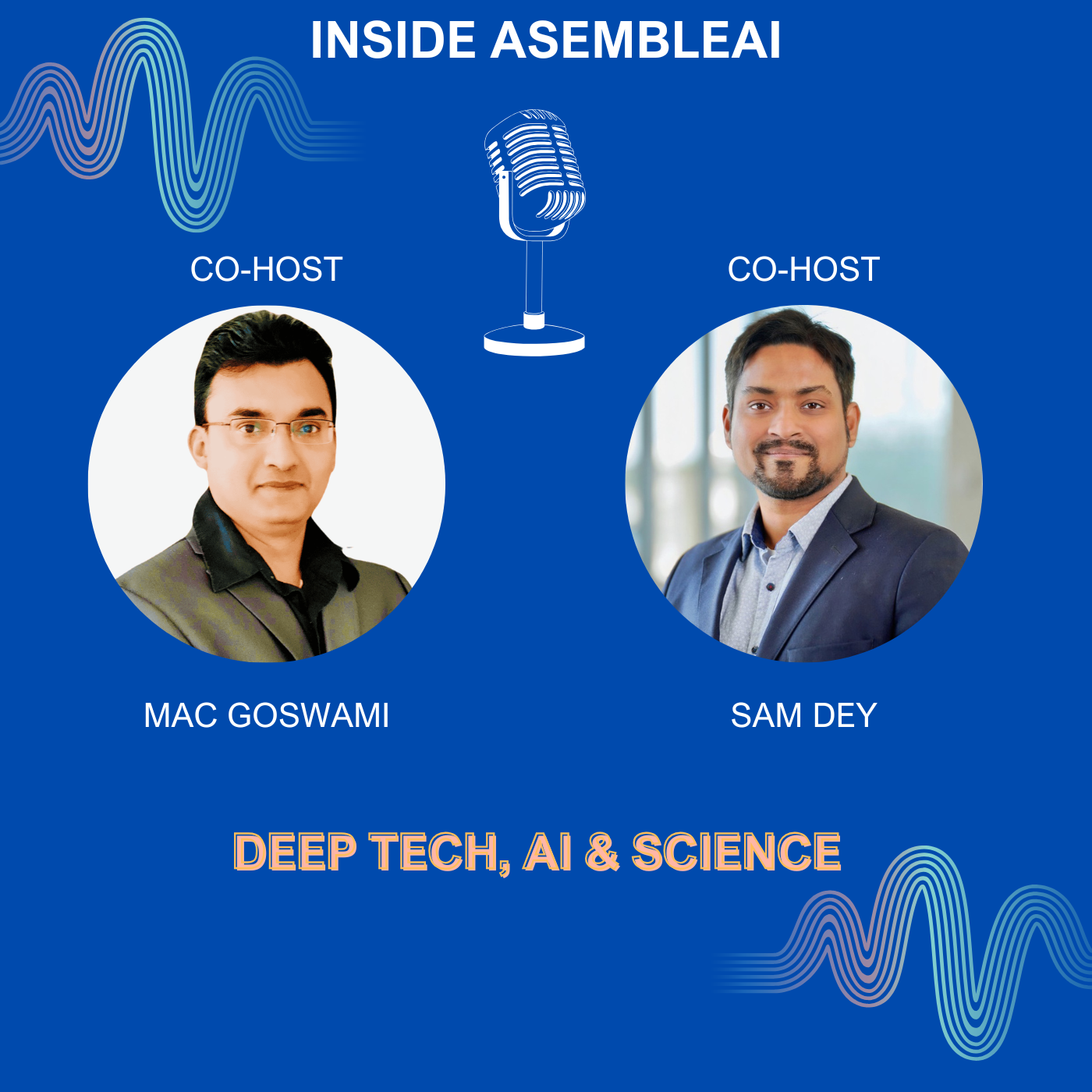
PODCAST · technology
Inside AsembleAI: DeepTech, AI & Science
by Mac & Sam
AsembleAI brings you thought-provoking conversations at the nexus of artificial intelligence, innovation, and leadership. In each episode, hosts Mac and Sam, veterans in data and tech world, sit down with AI researchers, fast‑scaling founders, Fortune 500 executives, and pioneering technologists to reveal how AI is reshaping business strategy, sparking breakthrough product development, and guiding executive decisions. Tune in for actionable insights, compelling case studies, and forward‑looking perspectives on the promises and pitfalls of AI‑driven innovation.
-
48
EP 48: AI Transforms Soccer: Premier League Analytics Revolution
68.5 billion euros in EPL betting annually. 1.4 million data points per match. Soccer sits at the absolute center of the AI revolution, and it's transforming the world's most popular sport from officiating to tactical analysis. In Episode 2 of our "AI in Sports Analytics" series, hosts Sam Dave and Mac Goswami explore how AI fundamentally changed soccer from 2020-2025. Revolutionary Technology: Semi-Automated Offside Detection (EPL 2024-25): Calibrated cameras + AI algorithms measure player positions with centimeter-level precision. Pioneered at 2022 Qatar World Cup, now standard across elite leagues. Processes data faster than humans, eliminating decades of controversial calls. Player Tracking: Optical systems track each player 25x/second, detecting invisible tactical patterns. Game-changer: Standard TV footage now generates tracking data previously requiring expensive dedicated cameras. Smaller-budget teams access insights once reserved for Barcelona, Manchester City, Bayern Munich. Match Prediction: 69-78% accuracy with ensemble models. Challenge: Soccer is harder to predict than basketball/baseball due to lower scoring and higher randomness. One lucky deflection can decide a match despite dominating possession. Real-World Impact: Tactical Analysis (March 2025 study): Real-time computer vision tracks all players, ball, formations simultaneously. Coaches see which tactical adjustments opponents made in the 67th minute three weeks ago and how they affected passing networks. Large Events Model (2024): Deep learning framework simulates games from any state. Test tactical approaches against AI-simulated opponents before stepping onto the pitch. Economic Impact: Sports analytics market: $1.03B (2024) → $2.61B (2030). AI-powered betting analytics provide sophisticated predictions. The Reality: AI reveals tactical sophistication fans never saw. That perfect through ball required reading three defenders' positioning, understanding striker's running profile, executing with millimeter precision. AI helps us see genius, not replace it. Subscribe: Spotify | Apple Podcasts | Amazon Music | iHeart Radio | YouTube Next: Baseball AI revolution #SoccerAnalytics #AIFootball #EPL #SportsAnalytics #AsembleAI
-
47
EP 47: AI Revolutionizes Basketball: NBA Analytics 2020-2025
1.4 million data points per game. NBA teams now track every player movement, defensive rotation, and shot attempt with AI-powered analytics—and it's transforming professional basketball in real-time. In this first episode of our "AI in Sports Analytics" series, hosts Sam Dey and Mac Goswami explore how the NBA and WNBA embraced AI more aggressively than any other league. Game-Changing Technology: SportVU Tracking System captures 29 data points per player, tracking all 22 players 10x/second and the ball 25x/second. Second Spectrum uses computer vision to extract data directly from broadcast video—no specialized cameras needed. NBA-AWS Partnership (Oct 2025): "Inside the Game" platform turns billions of data points into compelling insights, introducing AI-powered stats measuring performance never quantified before. Game Prediction: 87% accuracy with ensemble machine learning models (up from 65-70% five years ago). Models now weight three-point efficiency and spacing metrics heavily since the game evolved post-2015. Real-World Impact: Boston Celtics (2024-25): AI models refined defensive schemes using spatiotemporal data, contributing directly to playoff success. Golden State Warriors: Physical AI robots assist practice—rebounding, passing drills, simulating defensive plays. Steph Curry: "Robots provide consistent data-driven feedback humans can't match." Philadelphia 76ers: Large language models now participate as "a vote in any decision"—draft picks to game strategies. Broadcast Revolution: AWS Play Finder analyzes thousands of games, retrieving similar plays in milliseconds. Expected Field Goal models account for defender positioning, pressure, fatigue—not just distance. The Reality: AI predicts trends exceptionally well, but human elements—leadership, clutch performance, chemistry—resist quantification. 87% accuracy doesn't eliminate competitive balance when base-level data is universally available. Subscribe: Spotify | Apple Podcasts | Amazon Music | iHeart Radio | YouTube Next: Soccer/Football AI revolution #NBAnalytics #AIBasketball #SportsAnalytics #NBAtech #AsembleAI
-
46
EP 46: New Collar Jobs: Emerging Roles That Only Exist Because of AI
143% growth for AI Engineers. 136% for Prompt Engineers. 135% for AI Content Creators. These aren't niches—they're fundamental new careers that couldn't exist before AI. In this final "Who Survives the AI Shift" episode, Sam Dey and Mac Goswami reveal 16 brand-new job titles from 2025: Knowledge Architect, Orchestration Engineer, Conversation Designer, Human-AI Collaboration Leader. Top Emerging Roles: Prompt Engineer ($123K avg, top $200K+) - Building systematic AI outputs at scale. 40% fewer hallucinations, 60% better brand alignment. AI Model Trainer - Fine-tune algorithms. Requires technical skills + deep industry knowledge. AI Ethics Officer & Safety Analyst - Critical for governance in regulated industries. Assess biases, develop risk protocols. Data Curator - Most accessible entry point. Domain expertise matters more than degrees. Conversation Designer/NLP Engineer - Build chatbots, virtual assistants, translation systems. AI Product Manager - Bridge technology and business with deep AI understanding. AI Program/Project Manager - Handle AI implementation, operations, budgets. Huge growth projected. Where Jobs Are: Big Tech (Google, Microsoft, Amazon), AI-Native (OpenAI, Anthropic), Traditional Enterprises (JPMorgan, hospitals, retail) The Reality: New collar jobs exist at AI capability + human necessity intersection. Better AI needs MORE human oversight, not less. Consulting and freelancing booming—work that took days now takes hours. The future belongs to those treating AI as collaborative tool, not competitive threat. Subscribe: Spotify | Apple Podcasts | Amazon Music | iHeart Radio | YouTube | Podbean #AIJobs #PromptEngineer #FutureOfWork #AsembleAI
-
45
EP 45: Reskill or Perish? How to Future-Proof Your Career Against AI | Inside AsembleAI
50% of employees need reskilling by 2026-RIGHT NOW. Are you ready, or already falling behind? In this critical episode of "Who Survives the AI Shift," hosts Sam Dave and Mac Goswami expose the brutal reality: only 49% of employees feel equipped for their roles (down from 59% in 2024). Gen Z confidence crashed 20 points to 39%. The gap between awareness and action is where careers die. Key Takeaways: The Training Disconnect: 37% of employers claim they offer reskilling programs Only 28% of employees confirm these exist Companies check boxes without ensuring actual completion Skills That Matter for 2030: AI & big data, cybersecurity, technological literacy Creative thinking, resilience, curiosity Winning combo: Technical fluency + human capabilities AI can't replicate Subscribe: Spotify | Apple Podcasts | Amazon Music | iHeart Radio | YouTube | Podbean #Reskilling #AICareer #FutureProof #Upskilling #DataLiteracy #LifelongLearning #AsembleAI
-
44
EP 44: How AI Is Transforming Filmmaking - From Fear to Creative Amplification
Can AI amplify filmmaking creativity without killing the craft? Season 4 guest Sam Joos—20-year filmmaker, founder of AI Ad Studio and AI Film Society - shows how generative AI is transforming commercial production from $500K budgets to bedroom studios. Key Insights: The Breakthrough Moment: "Once I started prompting AI like I'd talk to a crew member on set, the cheat code unlocked." Sam went from AI skeptic to teaching 50+ filmmakers how to adapt. The Economics Shift: Traditional commercials: $30K-$500K, 2-6 month turnarounds AI-powered: Shoot "London scenes" from home, deliver in 1-2 weeks Reality check: "It's not an easy button—taste and expertise still determine quality" Quality vs. "AI Slop": What separates great AI work? Traditional filmmaking fundamentals-lighting, framing, camera movement, lens choice. "Hand a cinema camera to someone untrained—it'll look horrible. Same with AI tools." Democratizing Film: Breaking Hollywood's gatekeeping: Midwest creators can now visualize ideas without industry connections, red carpets, or million-dollar budgets. Your First Steps: Study films/commercials you love—analyze what moves you Learn cinematic vocabulary: shallow depth of field, steadicam, dolly shots Research lighting, camera work, color grading techniques Apply filmmaking knowledge to AI tools (MidJourney, Runway, Pika) Build taste before prompts Connect with Sam Joos: 🎬 AI Ad Studio 🎥 AI Film Society - Free resources, job boards, global community 📸 Instagram: @samjoosai The Verdict: AI doesn't replace filmmakers, it creates AI-enhanced creators who blend craft with technology. Subscribe: Spotify | Apple Podcasts | Amazon Music | iHeart Radio | YouTube
-
43
EP 43: On the Chopping Block - Roles Most Vulnerable to AI Automation Right Now
Which jobs are AI eliminating right now—not in five years, but today? In this hard-hitting episode of Inside AsembleAI, hosts Sam Dave and Mac Goswami examine the roles facing immediate AI displacement, backed by 2025 data showing actual job losses happening across industries. This is the episode nobody wants to hear but everyone needs to understand. What You'll Discover: Customer Service: The First Major Casualty 80% automation potential by 2025 (up from 60% recently) 2.8 million US customer service jobs at risk; 2.24 million likely displaced by 2025 Real examples: Dukaan replaced 27 agents with ChatGPT bot, cut costs 99%, maintained 85% satisfaction IBM's AskHR handles 11.5M interactions annually with <5% human oversight, resolves 78% without escalation Why customers now prefer bots: 62% choose chatbots over waiting, 74% prefer bots for simple questions $8 billion in annual business savings driving rapid adoption Data Entry: 7.5 Million Jobs on the Line Companies using AI form processing saw 56% reduction in data entry hiring rates Why it's vulnerable: quintessentially routine work—pattern matching, structured rules, accuracy-measured tasks AI eliminates human data quality issues while working faster and more consistently Entry-Level White Collar Jobs: The Vanishing Career Ladder Anthropic CEO Dario Amodei's prediction: AI could eliminate half of entry-level white collar jobs within 5 years Entry-level marketing assistant roles dropped 31% since 2022 Big Tech new graduate hiring down 25% (2024 vs 2023) Why entry-level specifically? Junior work = grunt work that AI now handles instantly The pipeline problem: eliminating training grounds that created pathways to senior positions The Timeline Is NOW—Not Later: Salesforce cut 4,000 customer support roles (9,000 → 5,000) Sky Telecom eliminated 2,000 customer service jobs Microsoft laid off software engineers while CEO Satya Nadella revealed 30% of company code is now AI-written Displacement accelerating through 2027-2028 Critical Risk Factors for Your Job: ✓ Routine, predictable tasks ✓ Primarily data processing or pattern recognition ✓ Structured environments with consistent rules ✓ Cost savings dramatically outweigh human value-add Who Bears the Biggest Risk: Southeast Asia: 52% increase in logistics/warehousing displacement since 2023 Women: 9.6% at highest automation risk vs 3.2% for men (concentration in admin/customer service) Urban vs rural divide: 38% urban job postings include AI vs 14% rural What You Should Do RIGHT NOW: Mac and Sam's urgent action plan: Upskill toward AI-adjacent positions - learn to supervise, quality-check, and improve AI outputs Transition to roles requiring human judgment - physical work, emotional intelligence, regulatory oversight Pursue structural barriers - healthcare, skilled trades, positions AI can't easily automate Don't wait - executives already rewarding employees who smartly implement AI into workflows The Brutal Truth: If your tasks can be described in a detailed manual that someone could follow without judgment calls, AI can and likely will replace you. This isn't about being good at your job—it's about whether your job's fundamental nature aligns with AI's strengths. Subscribe for the complete AI jobs series: YouTube, Spotify, Apple Podcasts, and Substack for in-depth articles.
-
42
EP 42: Safe Zones - Jobs AI Will Augment, Not Replace (And Why)
Not all jobs are at risk from AI automation. In this episode of Inside AsembleAI, hosts Sam Dey and Mac Goswami reveal the safe zones—careers where AI enhances human work rather than eliminating it-and explain the crucial "why" behind these patterns so you can evaluate your own role's resilience. What You'll Learn: Healthcare: The Clearest Example of AI Augmentation 34 million new healthcare roles emerging by 2030 globally Nurse practitioners projected to grow 52% from 2023-2033 AI healthcare spending rising from $15.1B to $19.8B, but it's augmenting, not replacing clinicians Why patients will always demand human faces for life-altering decisions—the trust factor AI can't overcome AI handles 15% (imaging, scheduling, protocols) while humans retain 85% (emotional support, complex diagnosis, ethical decisions) The Four Traits of Automation-Resistant Careers: Non-routine physical tasks in unstructured environments Real-time sensory perception and 3D motor skills Contextual problem-solving that can't be reduced to data Human judgment under uncertainty and emotional complexity Industries Where Humans Remain Essential: Skilled Trades & Technical Work: Electricians, plumbers, construction workers face minimal AI threat Why troubleshooting a 100-year-old building requires detective work AI can't replicate 95% of skilled trade work demands hands-on human expertise navigating messy real-world constraints Creative Leadership & Strategy: Brand directors, creative directors, strategic planners operating at psychology-culture-business intersection AI can draft content and analyze data (25% augmentation), but humans set vision and cultural direction Risk-taking, ethical accountability, and counter-cultural choices require human judgment Why AI struggles to navigate demographic sensitivities and cultural nuances in creative work Education & Mentorship: Teachers won't be replaced because learning is fundamentally social AI tutors handle 20% (grading, practice, supplemental content) Humans retain 80% (inspiration, mentorship, emotional vs. intellectual struggle recognition) Special needs students, artistic children, and classroom dynamics demand emotional intelligence AI lacks Your Career Action Plan: Sam and Mac provide practical guidance to audit your role: Identify automation risks: routine data processing, predictable patterns, structured environments Identify augmentation opportunities: human judgment, physical work, creative problem-solving, emotional intelligence Position yourself toward augmentation and embrace AI tools for routine tasks The Bottom Line: Safe zones aren't static—they're determined by current AI capabilities and economic feasibility. As technology advances, new tasks requiring uniquely human skills will emerge. The jobs that remain safe provide value that's either technically impossible or economically impractical for AI to replicate. Subscribe for More: Don't miss the next episode covering roles most vulnerable to AI automation. Subscribe on YouTube, Spotify, Apple Podcasts, and join our Substack for in-depth AI analysis.
-
41
EP 41: The AI Job Apocalypse - Myth vs Reality | What the Data Actually Shows
Is AI really coming for your job? Or is the "AI apocalypse" just another tech scare story? In this episode of Inside AsembleAI, hosts Sam Dave and Mac Goswami cut through the fear-mongering headlines to examine what's actually happening in the AI job market right now - backed by hard data from the World Economic Forum, SHRM, Goldman Sachs, and Microsoft research. What You'll Discover: The Real Numbers Behind AI Displacement: 85 million jobs displaced by 2025—but 97 million NEW roles created (net gain of 12 million jobs globally) 23.2 million US jobs already 50%+ automated, yet 63.3% have barriers preventing complete replacement Why Microsoft's 200,000-user study shows AI is augmenting work, not eliminating it wholesale Who's Actually at Risk: 58.87 million women vs. 48.62 million men in high-exposure roles—the demographic disparity nobody's discussing Why workers aged 18-24 are 129% more likely to fear job loss than those over 65 How 49% of Gen Z believes AI has devalued their college education The Historical Context: Why 85% of employment growth since 1940 came from tech-driven job creation, not destruction The pattern repeats: World Wide Web, cloud transition, and now AI—lessons from past transformations Goldman Sachs research: 0.3-point unemployment bumps are temporary, fading within two years The New Jobs AI Is Creating: 350,000 emerging positions: Prompt engineers, AI ethics officers, human-AI collaboration specialists The catch: 77% require master's degrees—creating accessibility challenges for displaced workers Real examples from Microsoft, Cisco, Intel, and Meta layoffs vs. new AI role hiring What This Means for YOU: Sam and Mac break down the transition vs. devastation reality—why this moment mirrors the World Wide Web revolution and cloud computing shift. You'll learn why pretending everything's fine OR catastrophizing about mass unemployment both miss the mark. Subscribe for More AI Insights: Don't miss our next episode covering jobs AI will augment (not replace) and why those safe zones exist. Hit subscribe on YouTube, Spotify, or Apple Podcasts, and sign up for our Inside AsembleAI newsletter for weekly AI industry analysis. Perfect for: Tech professionals, business leaders, career changers, students planning their future, and anyone wondering how AI will reshape work in the next five years.
-
40
EP 40: AI Analytics: From Hindsight to Foresight
AI analytics represents a fundamental shift from analyzing what happened to predicting what will happen. Traditional marketing analytics was retrospective-dashboards showing last month's performance, reports explaining why campaigns succeeded or failed. AI analytics is prospective-predictive models forecasting customer behavior, propensity scores indicating conversion likelihood, churn risk signals identifying at-risk customers before they leave. The shift in marketing team composition is significant. Traditional teams were heavy on creative and campaign managers. AI-driven marketing teams need data scientists, analytics engineers, and marketing technologists who understand both strategy and technical implementation. The skillset evolves from "what message resonates" toward "what patterns in customer data predict behavior we can influence." Critical pitfalls include overfitting models on historical data, optimizing for proxies rather than actual business outcomes, and creating feedback loops where AI recommendations reinforce existing biases rather than discovering new opportunities. Privacy regulations like GDPR and CCPA create constraints on what data you can collect and how you can use it for profiling. The ROI is compelling. McKinsey research shows businesses using advanced analytics growing 10-15% faster than competitors, with 20-40% improvement in marketing efficiency through better targeting and resource allocation.
-
39
EP 39: AI Chatbots: 95% of Interactions by 2025
Servian Global Solutions projects that 95% of customer interactions will be AI-powered by 2025. We're in 2026 now-that's not a future prediction anymore, it's the present reality. The chatbot market is growing by $11.45 billion through 2026, fueled by major advances in natural language processing and machine learning making chatbots intuitive, context-aware, and capable of handling genuinely complex conversations. Modern AI chatbots differ dramatically from frustrating automated systems of years ago. These systems now understand context, handle follow-up questions, detect sentiment, and maintain conversation flow naturally. They're not doing keyword matching scripts anymore—they're using transformer models similar to ChatGPT, trained specifically for customer service scenarios with reinforcement learning for real-time contextual awareness. However, limitations exist. Chatbots struggle with truly novel situations they haven't been trained on, can't make judgment calls requiring human empathy, and occasionally hallucinate confidently incorrect information—which is why accuracy checking and clear escalation paths matter. Some customers simply prefer human interaction regardless of AI capability, which businesses must respect. Cost savings are substantial but shouldn't be the only driver. NIB Health Insurance saved $22 million through AI-driven digital assistance, reducing customer service costs by 60%. The strategic value extends beyond cost reduction: 24/7 availability supports customers globally, instant response times improve satisfaction, and consistent answer quality eliminates variance in agent knowledge.
-
38
EP 38: AI-Powered Advertising: Programmatic’s Next Evolution
Traditional ad buying involved manual targeting, static audiences, and fixed bids. AI advertising uses machine learning to optimize targeting, bidding, and creative selection in real time across millions of data points. Performance Max and Meta Advantage+ campaigns represent this evolution - algorithms handling what used to require entire teams of media buyers. Smart bidding algorithms adjust bids based on conversion likelihood, time of day, device type, user behavior history, competitor activity, and dozens more variables simultaneously. This dynamic approach consistently outperforms manual bid management, especially for campaigns with large audiences and multiple ad variations. However, human strategy and oversight remain necessary—marketers must set clear goals, supply quality creative assets, and analyze performance to ensure AI automation aligns with business objectives. Critical risks include over-optimization—AI might optimize for metrics that don't actually align with business goals. Optimizing for clicks gets clicks but might not deliver quality traffic. Optimizing for conversions without considering lifetime value might acquire expensive customers who churn quickly. The human role is defining success properly so AI optimizes toward meaningful outcomes. Looking at 2026, programmatic advertising moves toward full automation. For small businesses without media buying expertise, this democratizes access to sophisticated advertising. For agencies and specialists, it forces evolution toward strategic consulting rather than tactical execution.
-
37
EP 37: AI Content Creation: 3x Output, Half the Cost
The numbers are staggering: 96% of companies now use generative AI for content production. Companies report 3-5x more content output, 30-50% cost savings, and 50% reductions in creation time. This isn't incremental improvement—it's transformational change in how marketing teams operate. AI content creation in 2025 encompasses far more than ChatGPT writing blog posts. We're talking about integrated workflows governing ideation, creation, distribution, and analytics. Tools like Jasper, Copy.ai, and ContentBot handle everything from drafting to scheduling and multi-platform distribution. The sophistication has moved far beyond simple text generation. Limitations remain clear: AI struggles with truly original creative thinking—breakthrough ideas that redefine categories. It excels at recombining existing concepts but genuine innovation requires human creativity. AI lacks emotional intelligence and cultural nuance, can mimic empathy but doesn't actually understand context the way humans do, and generates confidently wrong information (hallucinations), which is why human fact-checking remains non-negotiable. Looking ahead, the strategic implication is marketing teams shifting focus from production to strategy. When AI handles volume, humans focus on insight, positioning, and differentiation. Small teams can now compete with large enterprises because production bottlenecks disappear.
-
36
EP 36: AI Personalization: From Segments to Individuals
AI personalization has evolved dramatically from basic segmentation to true individual-level customization. McKinsey's 2025 research shows businesses using advanced personalization techniques are seeing 10-15% revenue increases, with 89% of decision makers saying AI-driven personalization will be critical in the next three years. This isn't optional anymore-it's competitive survival. Consumer expectations have shifted dramatically. 72% of consumers say they only engage with marketing messages tailored to their interests, and 90% are happy to share personal data if the result is a smoother, more personalized experience. However, they want immediate tangible value in exchange—brands can't just collect data and hope customers will be patient. Looking ahead to 2026, generative AI will create not just personalized messages but personalized imagery, video, and even product configurations. Adobe's 2025 Digital Trends Report shows 58% of teams seeing GenAI ROI expect better quality customer interactions in the next 12-24 months. The winners will be brands that see personalization as a system, not just a tactic-building predictive models into planning cycles while maintaining human oversight on privacy and ethics.
-
35
EP 35: AI Algorithmic Trading: The New Market Makers
Welcome to the final episode of the AI in Finance series, exploring algorithmic trading and AI market makers—genuinely the wild west of AI in finance. Here's context most people don't realize: 60-70% of equity market volume already comes from algorithmic trading, with high-frequency trading alone accounting for roughly 50%. When you think about the stock market, you're thinking about a system that's already majority AI and algorithms, not human traders. Sam and Mac explore what fundamentally differentiates AI algorithmic trading from traditional algorithmic trading. Traditional algorithms follow fixed rules: if condition X, then execute action Y—deterministic and predictable. AI algorithms learn and adapt dynamically, recognizing complex patterns across multiple variables, adjusting strategies in real time based on changing market conditions, and optimizing behaviors continuously. The technical models include reinforcement learning (AI learning optimal strategies through trial and error in simulations), LSTMs for time series prediction, and increasingly transformer models adapted for financial data—same basic architecture as ChatGPT but trained on market data instead of language. These models are exceptional at understanding that the same price movement means different things in different contexts: high volatility versus low volatility, bull market versus bear market. Regulatory landscape remains challenging. The SEC requires reasonable oversight, but defining "reasonable" for systems executing thousands of trades per second is genuinely difficult. In practice, this means kill switches, risk limits built into algorithms, monitoring systems that flag unusual patterns, and automatic shutoffs when volatility triggers occur.
-
34
EP 34: AI in Credit and Lending: Democratizing Access or Amplifying Bias?
AI in credit decisions is genuinely controversial because it could either democratize lending and expand access to underserved populations or take historical discrimination and amplify it at scale. The reality is both are happening simultaneously in different institutions—it all depends on how intentionally the AI is designed and monitored for fairness. Sam and Mac examine how AI is disrupting traditional credit scoring. FICO scores have dominated for decades using limited data: payment history, credit utilization, length of credit history, types of credit, and recent inquiries. This approach systematically excludes millions who don't have traditional credit histories, even if they're perfectly responsible with money and would be excellent borrowers. The technical models include XGBoost as the industry standard and neural networks for processing more data with hidden layers. Traditional logistic regression is often a poor fit for real-world credit behavior. Banks need model governance with clear ownership, regular bias testing, robust explainability, and human oversight for complex cases. AI handles straightforward approvals and denials; humans handle the middle—complex situations requiring judgment and contextual understanding.
-
33
EP 33: AI in Compliance: Turning Regulation into Competitive Advantage
Compliance has traditionally been viewed as a pure cost center—regulatory overhead that doesn't generate revenue. But AI is fundamentally changing this equation by turning compliance from a defensive obligation into an actual strategic advantage. New LSTM networks are achieving 94.2% accuracy in compliance monitoring while simultaneously cutting false positives dramatically. Sam and Mac explore why AI in compliance might be the biggest impact area that nobody is talking about. The false positive problem has always made compliance painful and expensive—traditional systems generated massive false positive rates, with analysts drowning in alerts where 95% turned out to be completely legitimate activity. This creates compliance fatigue where analysts become desensitized because so many alerts are false. The episode covers AI's impact across major regulatory areas: AML (Anti-Money Laundering), KYC (Know Your Customer), Sanctions Screening, and Trade Surveillance. For AML, AI narrows down suspicious patterns while letting routine activity pass without alerts. For KYC, banks report 78% faster onboarding times and 85% reduction in manual review—customers approved in an hour instead of days. AI must be transparent and auditable. The future is shifting from reacting to violations to preventing them entirely, flagging patterns on day three instead of catching problems on day 30, saving millions in potential federal lawsuits.
-
32
EP 32: AI Fraud Detection - Fighting Fire with Fire
Over 50% of fraud now involves AI. FIDZY surveyed 562 fraud professionals globally and found AI-powered fraud has become the norm, not the exception. We're talking about deepfakes, synthetic identities, and AI-powered phishing so sophisticated it's basically indistinguishable from legitimate communications. The counter punch? 90% of banks are now using AI to fight back—fighting fire with fire. Sam and Mac paint the threat landscape: deepfake calls that sound exactly like your bank's fraud department, using your bank's actual spoofed phone number, with perfect voice and professional script asking for your PIN. California bank customers received dozens of these calls and many fell for it because the technology is that convincing. This is an arms race. Fraudsters use AI, banks use AI—there's no final victory. As bank AI gets smarter at detection, fraud AI evolves to evade those systems. It's like computer viruses and antivirus software—never-ending evolution and counter-evolution. The economic stakes are enormous: Deloitte estimates US banking losses from fraud could increase from $12.3 billion in 2023 to $40 billion by 2027, more than tripling in four years due to generative AI sophistication. Human oversight remains essential. 88% of banking professionals say human oversight is non-negotiable. AI identifies potential issues and surfaces them to analysts, but humans make final calls on complex cases. The benefit: 43% of institutions report increased efficiency because AI handles high-volume straightforward cases, freeing human experts for complex nuanced cases requiring judgment.
-
31
EP 31: AI in Stock Prediction: The Stanford Study that outperformed 93% of Fund Managers
Stanford just dropped a bombshell study: an AI analyst made 30 years of stock picks and outperformed 93% of human mutual fund managers by an average of 600 basis points—that's 6% annually. This is absolutely massive in the investment world, kicking off Inside AssembleAI's AI in Finance series with the technology that's shaking Wall Street. Here's what's fascinating: the AI mostly used simple variables, not the sophisticated ones everyone expected. Firm size and dollar trading volume were dominant factors, but it used complex AI techniques to squeeze maximum predictive value from simple data everyone can access. The insight isn't about finding hidden data-it's about extracting more signal from obvious data. Any investment firm could have had this data in the pre-AI era, but it was simply too costly to justify economically. Sam and Mac explore three main approaches institutions use today: pattern recognition for known scenarios (AI learns what fraud or manipulation looks like), anomaly detection for unknown threats (establishing what's normal and alerting on deviations), and predictive analytics for future behavior (forecasting what's likely to happen next). All happening in real time, in milliseconds-the game changer compared to legacy systems. The data quality issue compounds everything—garbage in, garbage out. Models require at least five years of high-quality historical data for reliable results, and even then, past performance doesn't guarantee future success. Looking ahead to 2026, expect more hedge funds adopting sophisticated AI systems, models incorporating multi-modal data like satellite imagery and social sentiment, intensifying regulatory scrutiny, and continued democratization as retail investors gain access to tools that were hedge fund exclusive just years ago.
-
30
EP 30: Healthcare Data Security in The AI Era
In 2024, a single cyber attack exposed the medical records of 190 million Americans. As healthcare organizations rush to adopt AI—with 38% now using it regularly—a new crisis is emerging: how do we harness AI's transformative power while protecting the most sensitive data we possess? This episode tackles the critical intersection of AI innovation and healthcare data security, where the stakes couldn't be higher. Sam and Mac reveal alarming statistics that healthcare executives can't afford to ignore: AI privacy incidents surged 56.4% in 2024, with 72% of healthcare organizations citing data privacy as their top AI risk. The average healthcare breach now costs $11.07 million per incident, yet only 17% of organizations have technical controls in place to prevent data leaks. The math is terrifying—and the problem is accelerating. The conversation explores how AI fundamentally changes the threat model in healthcare. Unlike traditional software that processes data according to fixed rules, AI models can unintentionally retain sensitive patient information from training data, creating new vulnerabilities that standard security practices weren't designed to address. Shadow AI—unauthorized AI tools used by employees handling sensitive data—poses massive compliance risks that most organizations haven't even begun to map. But this isn't just a doom-and-gloom episode. Sam and Mac outline emerging solutions that could reshape how healthcare handles AI and data security. Federated learning allows AI models to train across multiple institutions without patient data ever leaving its original location, enabling collaboration without exposure. Synthetic data can mimic real patient populations for AI training without using actual patient information, dramatically reducing privacy risks while maintaining analytical value. Looking forward, the episode emphasizes that stronger regulations and compliance practices aren't obstacles to AI adoption—they're prerequisites for sustainable innovation. Patient trust is healthcare's most valuable asset, and once lost through a major AI-related breach, it may be impossible to recover. The organizations that will thrive in the AI era are those that treat data protection not as a compliance checkbox but as a competitive advantage and moral imperative. Key topics covered: • The 2024 cyber attack exposing 190 million American medical records • Why 72% of healthcare organizations cite data privacy as their top AI risk • The 56.4% surge in AI privacy incidents involving PII (personally identifiable information) • Healthcare breach costs: $11.07 million average per incident • Shadow AI risks: unauthorized tools handling sensitive patient data • Why only 17% of organizations have adequate technical controls • How AI models unintentionally retain sensitive training data • Federated learning: training AI without data leaving institutions • Synthetic data: mimicking real populations without using actual patient information • The regulatory landscape and need for stronger compliance frameworks • Balancing innovation velocity with responsible AI practices • Privacy-preserving techniques: differential privacy and secure multi-party computation • Patient trust as healthcare's most critical asset in the AI era • Practical governance frameworks for healthcare AI implementation This episode is essential listening for healthcare executives navigating AI adoption, data security professionals protecting sensitive information, technology leaders implementing AI systems, and anyone concerned about the privacy implications of AI in medicine. Sam and Mac cut through the hype to deliver actionable insights on one of healthcare's most pressing challenges: how to innovate responsibly in an era where a single breach can expose hundreds of millions of records.
-
29
EP 29: AlphaFold, AlphaGenome, And the Scientific Revolution
In 2024, the Nobel Prize in Chemistry was awarded for an AI breakthrough - an unprecedented recognition that signals a fundamental shift in scientific discovery. This episode explores how Google DeepMind's AlphaFold and AlphaGenome are revolutionizing protein biology and genomics, solving problems previously deemed unreachable. For 50 years, determining protein structures required months of painstaking laboratory work using X-ray crystallography or cryo-electron microscopy. AlphaFold shattered that paradigm by predicting structures for 200 million proteins in months—work that would have taken centuries using traditional methods. The accuracy is remarkable: for well-studied proteins, AlphaFold's predictions match experimental results with near-atomic precision. Sam and Mac explain how AlphaFold works, breaking down the AI's ability to predict 3D protein structures from amino acid sequences alone. This capability transforms drug discovery—pharmaceutical companies can now identify binding sites, predict drug interactions, and design molecules computationally before expensive laboratory synthesis. AlphaFold 3 takes this further by predicting how proteins interact with other molecules, DNA, RNA, and small drug compounds. This enables researchers to model entire biological pathways and understand disease mechanisms at molecular resolution. Google DeepMind is collaborating with major pharmaceutical companies, accelerating drug development timelines and reducing costs dramatically. AlphaGenome extends AI's reach into genomics, analyzing DNA sequences to predict gene expression patterns, regulatory elements, and genetic variations' functional impacts. Together, these tools are solving fundamentally unreachable problems in biology, making the impossible routine. The broader implications extend beyond any single discovery. AI is compressing timelines, reducing costs, and democratizing access to sophisticated biological research. Academic labs without massive infrastructure can now compete with well-funded institutions. Rare diseases become tractable research targets. Scientific discovery accelerates exponentially. TAGS: AlphaFold, Nobel Prize, Google DeepMind, Protein Structure, Drug Discovery, AlphaGenome, Genomics, AI Biology, Biotechnology, Pharmaceutical AI EPISODE LENGTH: ~15 minutes
-
28
EP 28: AI-Powered Patient Care Through Synthetic Data
By 2024, synthetic data will comprise 60% of all healthcare AI training data. This episode explores how this shift is solving the industry's massive data problem while protecting patient privacy. Healthcare faces a critical paradox: AI needs vast patient data for accurate diagnoses and personalized treatments, but HIPAA and GDPR restrict access to real records. Synthetic data offers a breakthrough—artificially generated datasets that mimic real patient populations statistically without containing actual patient information. Sam and Mac explain how generative AI techniques like GANs and auto-encoders create synthetic data preserving statistical properties of real healthcare data while eliminating privacy concerns. These datasets train AI to detect diseases, predict outcomes, and recommend treatments without exposing sensitive information. The AI healthcare market is expected to grow from $26.6 billion in 2024 to $187.7 billion by 2030, driven by synthetic data breakthroughs. AI tools trained on synthetic datasets are automating clinical documentation, reducing clinician burnout by handling administrative tasks consuming hours daily. For rare diseases with limited real data, synthetic data enables previously impossible AI training. However, challenges exist. If original data contains demographic biases or reflects healthcare disparities, synthetic data perpetuates those biases. This can lead to AI performing poorly for underrepresented populations, worsening health inequities. Careful validation and bias detection are essential. Regulatory guidance for synthetic data generation and use is still developing. Healthcare organizations must navigate this evolving framework carefully to ensure compliance while leveraging advantages. Early adoption provides competitive advantages. Organizations developing expertise in high-quality synthetic datasets are positioning themselves to lead the AI-driven healthcare transformation. The future of patient care increasingly depends on AI trained on synthetic data protecting privacy while enabling innovation. TAGS: Synthetic Data, Healthcare AI, Patient Privacy, HIPAA, Generative AI, GANs, Rare Disease AI, Clinical Documentation, AI Bias, Patient Outcomes, Healthcare Analytics
-
27
EP 27: AI Revolutionizing Drug Discovery (2023 - 2025)
The pharmaceutical industry is experiencing its most significant transformation in decades. AI is slashing drug development timelines from 10-15 years to 18-24 months and reducing costs from $2.6 billion to tens of millions—making previously impossible treatments financially feasible. Sam and Mac explore how AI is fundamentally changing drug discovery. Traditional methods required screening millions of compounds through physical laboratory testing, costing billions with a 90%+ failure rate. AI transforms this by simulating molecular interactions computationally, predicting which compounds will bind effectively to target proteins, and identifying promising candidates from virtual libraries containing billions of potential molecules. What took years in wet labs now happens in days. The impact extends beyond economics. AI is enabling treatments for rare diseases that pharmaceutical companies traditionally ignored due to small patient populations. When development costs drop from billions to millions, diseases affecting 50,000 patients globally become economically viable to address. AI serves as a true partner to scientists—identifying patterns in biological data humans would never detect, suggesting novel molecular structures chemists wouldn't intuitively design, and predicting side effects before human testing. However, significant challenges remain. Data quality is the most critical obstacle—AI models are only as good as their training data, and pharmaceutical research data is often messy, incomplete, or inconsistent. The "black box" problem poses another challenge: deep learning models make predictions through complex transformations that scientists can't interpret, creating tension between efficiency and understanding. Ethical considerations around algorithmic bias, data ownership, and equitable access demand careful attention. The regulatory landscape adds complexity. The FDA is still developing frameworks for evaluating AI-discovered drugs, and regulatory uncertainty can slow translation from discovery to approved therapy. Despite these challenges, investment in AI drug discovery has surged to record levels, with AI-discovered drugs progressing through clinical trials and validating the technology's potential. The future of drug discovery will heavily rely on AI innovations, but success requires thoughtful integration with attention to data quality, algorithmic transparency, ethical practices, and regulatory compliance. The pharmaceutical industry stands at an inflection point where today's decisions about responsible AI implementation will shape healthcare outcomes for decades.
-
26
EP 26: The Hybrid Creator - Where Humans and AI Collaborate Best
Beyond the lawsuits and disruption stories lies a quieter revolution: creators who are genuinely collaborating with AI, not just using it as a replacement tool. This episode explores the most fascinating development in creative AI—the emergence of hybrid creation where human vision meets AI execution to produce work neither could achieve alone. Sam and Mac spotlight artists like Sougwen Chung, who since 2015 has been collaborating with a robotic arm that uses AI to mimic her drawing style, creating what she calls a "duet, not automation." This work earned her the prestigious Lumen Prize in 2019 and represents a third category beyond "AI-generated" or "human-made"—collaborative art that's harder to understand, harder to scale, but potentially where the most interesting creative work happens. This episode tackles the authenticity question head-on: Is work less authentic because AI contributed? Sam and Mac argue that photography is considered authentic even though cameras do most of the technical work, and digital painting is authentic even though software handles perspective calculations. The real shift is from execution to direction—human skills evolve from manual creation to curating, directing, and refining AI outputs, similar to how film directors guide camera operators and editors. Looking ahead ten years, the hosts envision a stratified creative landscape: mass-market content will be AI-everything at commodity prices, while premium work commanding higher prices will emphasize human involvement and unique vision. The best creators will be deeply skilled in their domain AND fluent in AI tools, recognizing that the combination makes them more powerful than either skill alone. Key topics covered: • Sougwen Chung's robotic arm collaborations and the Lumen Prize-winning work • The third category: collaborative art that's neither purely AI nor purely human • AI as "thought partner" in music, visual art, and creative writing • How musicians generate 50 variations instantly then apply human refinement • Visual art workflows: AI base generation + human layers and paintover techniques • The authenticity debate: photography, digital tools, and shifting perceptions • Why human skill is shifting from execution to direction and curation • Interactive art explosion: AI generating music from movement, visuals from emotions • Scale transformation: what took months now takes days or hours • 10-year vision: stratified markets and augmented creativity becoming standard • Practical advice: experiment with AI while maintaining traditional craft skills • Why fighting AI tools is fighting the future—better to shape how they're used • The reality check: most art has always been mediocre, and that's not AI's fault This episode offers hope and practical guidance for creators navigating the AI transformation. Instead of framing AI as threat or savior, Sam and Mac present it as a tool whose impact depends entirely on how humans choose to wield it. Whether you're a creative professional exploring AI integration, a business leader supporting hybrid workflows, or simply someone interested in the future of human creativity, this conversation provides essential perspective on making AI collaboration meaningful rather than merely efficient.
-
25
EP 25: AI in Visual Art - Midjourney, DALL-E, and the Copyright Battlefield
The visual art world is being turned upside down by AI image generators, and the legal battles are just beginning. In June 2025, Disney, Universal, and Warner Brothers sued Midjourney for what they called "a bottomless pit of plagiarism." Warner Brothers followed in September, accusing the platform of theft involving Superman, Batman, and Wonder Woman. This episode explores the collision between AI-powered creativity and intellectual property rights that's reshaping the entire industry. Sam and Mac break down the three dominant AI image generators—Midjourney (for artistry), DALL-E 3 (for precision), and Stable Diffusion (for control)—and examine why they've become both indispensable tools and legal targets. These platforms can generate photorealistic, professionally usable images in seconds from simple text prompts, but the question remains: is it innovation or infringement? Beyond the legal drama, this episode tackles the fundamental shift happening in creative work. When AI can generate thousands of game assets, concept art, or marketing materials in seconds for free, how do human artists compete? The answer isn't simple resistance—it's adaptation. We explore how graphic designers are developing hybrid workflows, combining traditional techniques with AI layers to maintain authenticity while achieving 100x productivity gains. The conversation also addresses the elephant in the room: the very definition of creativity is changing. In today's world, prompt engineering and contextual understanding are becoming core creative skills. Artists like Lena are fine-tuning AI models to maintain consistent personal styles while generating assets at scale. Companies like Adobe Firefly are training exclusively on licensed data to offer commercially safe alternatives, even if they sacrifice some artistic quality. Key topics covered: • What Midjourney, DALL-E 3, and Stable Diffusion are and how they differ • The June and September 2025 lawsuits from Disney, Universal, and Warner Brothers • How AI image generation actually works: from prompt to photorealistic output • The 100x productivity gains transforming graphic design and concept art workflows • Why 80% of social media content is now AI-generated • How human artists can compete: specialization, intention, and storytelling • The shift in what "creativity" means in the AI era • Hybrid workflows: balancing traditional techniques with AI augmentation • Ethical AI approaches: Adobe Firefly's licensed training data model • Compliance considerations: why you should never generate images of celebrities without consent • The $432,500 AI artwork sold at Christie's and what it means for the market • Why these lawsuits will take years but won't stop technological progress This episode doesn't shy away from controversy. We acknowledge both the revolutionary potential of AI tools and the legitimate concerns about authenticity, compliance, and the displacement of traditional creative work. Whether you're a graphic designer navigating this transition, a business leader evaluating AI tools, or simply someone fascinated by how technology is redefining creativity itself, this conversation offers essential insights into an industry in flux.
-
24
EP 24: Sora Shocks Hollywood: The $1 Billion Peace Treaty
In December 2025, Disney did the unthinkable: they paid OpenAI $1 billion in equity and licensed 200+ characters to Sora, OpenAI's revolutionary text-to-video AI model. This episode unpacks the seismic deal that's reshaping Hollywood's future and transforming how entertainment gets made. Sam and Mac explore how Sora went from terrifying Hollywood studios to becoming their partner in less than a year. Discover why Bob Iger made this bold move, how Disney Plus is evolving from a passive viewing platform to an active creation platform, and what it means when producers like Tyler Perry pause $800 million studio expansions after seeing what AI can do. But this revolution comes with a human cost. We examine the darker side of this transformation: 75% of film companies adopting AI have reduced or eliminated jobs, with over 100,000 entertainment jobs potentially disrupted by 2026. Former Disney animators call it "soulless exploitation," while Hollywood directors claim they no longer need Tom Cruise or Brad Pitt, just an AI actor and a prompt. Yet resistance remains. Filmmakers like Guillermo del Toro are drawing battle lines, insisting movies should be "made by humans for humans." As the industry splits between AI-embracing innovators and authenticity-defending traditionalists, audiences face a choice: what are they willing to pay for? Key topics covered: • What Sora is and why it hit #1 on the Apple Store immediately after launch • Disney's $1 billion equity deal and licensing of 200+ characters to OpenAI • The shift from opt-out to opt-in after backlash over unauthorized character use • How Disney Plus is becoming a creator platform, not just a viewing platform • Why OpenAI won the Hollywood partnership race over Runway and Google • The economic reality: same production quality at one-third the price • Job displacement across VFX artists, set designers, background actors, and location scouts • The generational divide: AI-native audiences versus authenticity-seeking traditionalists • Speed of transformation: from "this is theft" to "$1 billion partnership" in under a year This episode offers an unflinching look at how AI is disrupting one of the world's most creative industries, examining both the unprecedented opportunities and the very real human consequences of this technological revolution. TAGS: OpenAI Sora, Disney AI, Hollywood AI, AI Video Generation, Text-to-Video AI, Entertainment Industry, AI Disruption, Bob Iger, Tyler Perry, Movie Production, VFX AI, AI Actors, Content Creation, Generative AI, Film Industry Future, AI Jobs Impact, Creator Economy, Disney Plus, Animation AI
-
23
EP 23: AI Music Revolution: From Lawsuit to Licensing Deals
The music industry went from trying to shut down AI music generators to partnering with them in less than a year. In this episode, Sam and Mac explore the explosive transformation of music creation through AI, examining how companies like Suno (generating 7 million songs daily) and Udio went from facing $500 million lawsuits from Sony, Universal, and Warner to securing landmark licensing agreements. Discover how professional songwriters are now embracing tools that seemed impossible just two years ago, why the Recording Academy CEO admits "every songwriter and producer I know has used Suno," and what this means for the future of musical creativity. We break down the shift from resistance to collaboration, explore new freelance professions emerging from AI music tools, and debate the line between amplifying human creativity and replacing it. Key topics covered: • Suno's $250M raise at $2.45B valuation and unprecedented music generation scale • The legal battle that changed everything: from copyright lawsuits to licensing partnerships • How AI music tools actually work and what the creative experience is like • Mixed reactions from traditional musicians versus innovation-embracing creators • The opt-in model and how artists maintain control over their work • New career opportunities and the democratization of music production • The future of live music and why it's becoming more valuable • AI-generated music avatars and virtual performances on the horizon Whether you're a musician, music lover, or simply fascinated by how AI is reshaping creative industries, this episode offers an essential look at the AI music revolution happening right now. TAGS: AI Music, Suno, Udio, Music Industry, AI Licensing, Copyright Law, Music Technology, Generative AI, Creative AI, Music Production, Songwriter Tools, Universal Music, Sony Music, Warner Music, AI Innovation, Music Future, Live Music, AI Avatars EPISODE LENGTH: ~20 minutes
-
22
EP 22: The Future of AI Policy: Emerging Challenges and What Comes Next
AI moves fast; laws struggle to keep up. In this episode of Inside Assemble AI, Mac Goswami and Sam Dey tackle the most pressing questions about the future of AI policy—from Artificial General Intelligence (AGI) that could exceed human capabilities to the murky liability questions around autonomous AI agents. What happens when AI agents cause harm? Who's liable - the developer, the deployer, or the user? Current regulations weren't designed for systems that can make independent decisions, negotiate contracts, or interact with other AI systems. The legal framework is unclear and complex, and we're already behind. The episode explores the double-edged sword of open source AI: it fosters innovation and democratizes access, but it also complicates control and regulation. How do you govern models that anyone can download, modify, and deploy? The traditional regulatory playbook doesn't work when the technology is freely distributed. Key insight: "AI policy will evolve as rapidly as AI itself." This isn't a one-time regulatory fix—it's a continuous process of adaptation, learning, and cooperation. Current regulations are already inadequate for AGI scenarios, and we need frameworks that can flex with technological advancement rather than break under it. The conversation emphasizes that public participation is crucial in shaping AI policy. These decisions affect everyone, and the dialogue can't be left only to technologists and policymakers. Topics covered: AGI implications for humanity, AI agent liability frameworks, open source AI governance paradox, synthetic content detection and regulation, global cooperation mechanisms, technology governance evolution, continuous regulatory adaptation Subscribe to Inside Assemble AI where AI, deep tech, and science meet storytelling. Stay curious and build responsibly.
-
21
EP 21: The Global AI Regulatory Chessboard: How Different Regions Approach AI Governance
The EU has its AI Act. The US has Biden's executive order followed by AI Action Plan released last year. China has something entirely different. In this episode, Sam and Mac zoom out to examine the global landscape of AI regulation—and it's not just about different rules, it's about competing visions of technology and society. What you'll learn: US sectoral approach: Different agencies (FDA, FTC, EEOC) regulate AI in their domains—flexibility but fragmentation China's radically different model: Algorithm registration, content filtering aligned with socialist values, state oversight Middle-path approaches: UK's pro-innovation framework, Canada's EU-aligned AIDA proposal, Singapore's voluntary incentives Is the Global South being left behind? Risk of regulatory colonialism from Brussels and Washington Regulatory convergence vs fragmentation: Shared principles (transparency, accountability, fairness) but wildly different implementation Data localization challenges: China, Russia, Indonesia require local storage—making global AI models harder to train Critical flashpoints: Content moderation: What counts as "harmful" varies drastically by country Technical standards: ISO, IEEE, NIST developing frameworks, but who sets standards matters geopolitically Market fragmentation: Chinese AI companies don't operate in the West; Western companies avoid China For AI builders and startups: Design for the most stringent requirements you expect. Build in privacy, transparency, and accountability from the start. If you want EU customers, you comply with EU rules—regardless of where you're based. Focus on your target market first for validation, then expand compliance as you scale. Key insight: These aren't just regulatory differences—they're geopolitical choices that shape what gets built, how it works, who benefits, and what risks we accept.
-
20
Ep 20: AI Compliance in Practice - Navigating Data Governance in AI
Data governance isn't sexy, but it's what makes or breaks your AI strategy. In this episode, Sam and Mac tackle the tactical reality of what happens inside companies trying to comply with AI regulations while keeping data governance practices intact. What you'll learn: Why you can't have compliant AI without proper data governance Data lineage: tracking where your data came from, how it's processed, and where it ends up Real-world bias example: How historical hiring data can violate EU AI Act principles The challenge of GDPR's "right to be forgotten" when data is baked into neural networks Model governance across the entire lifecycle—from selection to deployment monitoring Why human oversight remains critical in high-risk systems like loan decisions How smaller companies can stay compliant without enterprise-level budgets Key frameworks covered: ✓ Data lineage and chain of custody ✓ Audit trails throughout the AI lifecycle ✓ Model cards for documentation (used by Google, Microsoft, Meta, Amazon) ✓ Post-deployment monitoring: data drift, concept drift, and bias detection ✓ Human-in-the-loop requirements for consequential decisions The unsexy truth: Compliance as a service companies are emerging to help startups navigate these requirements. Trust isn't just a nice-to-have—it's becoming a competitive advantage.
-
19
EP 19: Understanding the EU AI Act - The World’s First Comprehensive AI Law
The EU AI Act became law in 2024, and even if you're not in Europe, it's going to affect how you build with AI. In this episode, Sam and Mac break down the world's first comprehensive AI regulation—from banned applications to high-risk use cases that require strict oversight. What you'll learn: The four-tier risk framework: unacceptable, high, limited, and minimal risk Why this matters for your AI projects (hint: think GDPR's global impact) How enterprises balance innovation with compliance Practical implementation strategies from the frontlines What "the right to be forgotten" means when data is baked into neural networks Whether you're building AI applications, leading data teams, or navigating enterprise AI governance, this episode gives you the framework to implement AI responsibly while maintaining innovation velocity. Timeline rollout: Bans effective early 2025, general purpose AI requirements mid-2025, full high-risk compliance by mid-2026.
-
18
Ep 18: How Model Context Protocol (MCP) Connects AI to Your Workflows
Mac and Sam break down Model Context Protocol (MCP)—the universal standard transforming how AI connects to tools, data, and workflows. Think of it as the "USB-C moment" for AI: plug-and-play integration that eliminates custom builds for every system. Discover what MCP actually is, how it enables seamless AI connections across your tech stack, real-world use cases for developers and enterprises, and why regulated industries are taking notice. Key Topics: The shift from custom integrations to standardized protocols Practical implementation strategies Enterprise and regulated industry applications What MCP solves (and its limitations) Perfect for: AI developers, enterprise teams, tech leaders in regulated industries, and anyone curious about the future of AI tooling. Key Insight: MCP isn't about making AI smarter—it's about making AI connections smarter. Resources: MCP documentation, weekly insights, and community links at asembleai.substack.com
-
17
Ep 17: Why Future of AI Depends on A2A Multi-Agent Teams
Discover why the future of AI isn't one "super agent" but coordinated teams of specialized agents working together. We explore Agent-to-Agent (A2A) communication—the protocol enabling AI agents to collaborate on complex tasks. Learn how A2A frameworks are transforming AI from isolated demos into production-ready organizations, the essential components of multi-agent systems, and why oversight mechanisms are critical for deployment. Key Topics: Why single agents fail at complex workflows A2A protocols and collaboration frameworks Building production-ready agent teams Real-world applications and risk management Perfect for: AI engineers, technical leaders, product managers, and anyone building with AI agents. Resources: A2A Framework documentation, weekly AI insights newsletter, and community links at asembleai.substack.com
-
16
The AI Ecosystem Explosion - Toolkits, Tech Giants, and Industry
2025 wasn't just about smarter models—it was about an entire ecosystem evolving around us. Developer toolkits matured, Big Tech made billion-dollar bets, and AI went from experiment to production infrastructure across every major industry. In this episode, Mac Goswami and Sam Dey break down what actually happened: the frameworks that made AI development accessible, Google vs. Microsoft vs. Meta's strategic plays, and how healthcare, finance, education, and creative industries are being transformed—with appropriate guardrails. Topics include the maturation of AI dev platforms like Vercel AI SDK, LangChain, and LlamaIndex that compress weeks of work into hours; vector databases and RAG frameworks hitting production readiness; why observability tools became the most underrated development of 2025; Google's aggressive Gemini push, Microsoft's Copilot-as-platform strategy, and Meta's open-source gambit with Llama; Amazon's infrastructure play and the GPU vs. TPU battle; healthcare AI for diagnostics, drug discovery, and clinical documentation with human oversight; finance applications including fraud detection, portfolio analysis, and compliance reporting; the EdTech dilemma of AI literacy vs. academic integrity; startup survival strategies when Big Tech enters every space; and 2026 predictions covering multimodal integration, on-device AI, and continued consolidation. Key insight: AI moved from experimentation to production at scale. The augmentation pattern won over the replacement narrative—across every industry, successful AI applications enhanced human expertise rather than replacing it. Hosts: Mac Goswami and Sam Dey Show: AsembleAI - Where AI, Deep Tech & Science meet storytelling Connect: https://substack.com/@asembleai? | https://www.linkedin.com/company/asembleai
-
15
The Agentic Revolution - How AI Learned to Think and Act in 2025
The AI landscape shifted dramatically in 2025. Agents aren't just executing commands anymore—they're making decisions, coordinating tasks, and working alongside humans as true collaborators. In this episode, Mac Goswami and Sam Dey break down what actually changed: expanded context windows, reasoning models that finally work, standardized tool use, and multi-agent frameworks ready for production. They also dig into what went wrong, the failures that taught the industry hard lessons about engineering and oversight. Topics covered include the technical breakthroughs that made 2025 the inflection point for agent AI, real-world applications proving agents are production-ready, how to calibrate autonomy to match the stakes, single vs. multi-agent systems, framework maturity, cautionary tales from AI failures, and trends shaping 2026. Key insight: Start simple. Decompose when needed. The future isn't AI replacing humans—it's human-agent collaboration done right. Hosts: Mac Goswami and Sam Dey Connect: https://www.linkedin.com/company/asembleai
-
14
Beyond the Buzzwords: Why Data Literacy is the Missing Link in AI Transformation
In this episode of Inside Assemble AI, hosts Mac and Sam sit down with Priya Reddy, an expert in AI strategy and data literacy, to explore why the real bottleneck in AI transformation isn't technology, it's understanding! Priya shares her insights on the critical importance of AI literacy across organizations, emphasizing that successful AI adoption requires bridging the gap between technical teams and business leaders. The conversation delves into why organizations must invest in people rather than just tools, how translation failures between data scientists and executives derail AI initiatives, and what it takes to build a culture of data-driven decision-making. From real-world examples of AI adoption failures to practical frameworks for effective data literacy programs, this episode offers actionable guidance for leaders navigating the rapidly evolving AI landscape. Key Topics Discussed: Why AI literacy—encompassing data, tech, and business literacy—is the foundation of successful AI transformation Real-world examples of how miscommunication between technical and business teams derails AI initiatives The difference between data quality issues and AI model problems, and why it matters How executives can ask the right questions about data and AI to drive better outcomes Building role-based, practical data literacy programs that stick The role of "bilinguals"—professionals who can translate between technical and business contexts Why data-literate leaders will define the next era of competitive advantage About Our Guest: Connect with Priya on LinkedIn: https://www.linkedin.com/in/priyareddy-dataleader/ Checkout her consultancy services: https://www.linkedin.com/company/priya-reddy-consulting/
-
13
From Gatsby to Mastra: Building the Typescript Framework for AI Agents
In this episode of Inside Assemble AI, hosts Sam Dey and Mac Goswami speak with Sam Bhagwat, Co-Founder & CEO of Maastra, about the rise of AI agents and the tools needed to build them for production. Sam shares his journey from Gatsby to Maastra, the developer pain points that inspired the pivot, and why context engineering is critical for effective AI agents. The conversation explores Maastra’s core primitives, the impact of the Model Context Protocol (MCP), and the challenges of moving from prototype to production. The episode concludes with a forward-looking vision of AI development—smaller models, broader access, and a future with a billion developers by 2030. 🔗 Guest Links • LinkedIn: https://www.linkedin.com/in/sambhagwat/ • Mastra: https://mastra.ai/ • Book(s): https://www.amazon.com/Principles-Building-Agents-Sam-Bhagwat/dp/B0DYH5GHDD
-
12
Rewiring the Enterprise: The AI Transformation Playbook
AI is no longer just a tool — it’s becoming a force multiplier for human potential. In this episode of The AI Transformation Playbook, we explore how artificial intelligence is reshaping job performance, empowering the workforce, and redefining what productivity looks like in the age of automation. Rather than framing AI as a threat, the conversation focuses on how individuals and organizations can harness AI to amplify passion, unlock genius, and create meaningful impact at work. We’re joined by Brett Schklar, a seasoned leader and practitioner at the intersection of AI, technology, and workforce transformation and the author of "AI Without the BS". With deep experience in driving real-world AI adoption, [Guest Name] brings a pragmatic perspective on how organizations and individuals can use AI to elevate performance, empower teams, and unlock human potential. Whether you’re a business leader, technologist, or knowledge worker navigating rapid change, this episode offers a grounded, optimistic lens on AI-driven transformation. 🎧 Tune in to understand how to work with AI — not against it.
-
11
Beyond Silicon: Building Computers from Human Neurons
What if the future of computing isn't silicon or quantum—but living neurons? In this groundbreaking episode of Inside Assemble AI, we sit down with Dr. Ewelina Kurtys to explore the fascinating world of biological computing and wetware bioprocessors. Dr. Kurtys takes us inside Final Spark's ambitious mission to build thinking machines powered by living neurons—systems that could process information with unprecedented energy efficiency compared to traditional silicon chips. From the neuroscience behind programming living cells to the technical challenges of maintaining biological systems, we uncover how this emerging technology could reshape artificial intelligence as we know it. We dive deep into the implications for AGI development, examining how biological stability might reduce AI hallucinations and why hybrid computing architectures combining silicon, quantum, and biological elements could define our technological future. Dr. Kurtys also addresses the critical ethical considerations surrounding wetware bioprocessors and shares her vision for scalable biocomputing systems. If you're curious about the convergence of neuroscience and AI, the energy crisis facing generative AI, or simply want to glimpse the next frontier in computing technology, this conversation will challenge everything you thought you knew about artificial intelligence. Topics Covered: Biological computing • Wetware bioprocessors • Energy efficiency in AI • Programming living neurons • AGI development • Hybrid computing systems • Ethics in neurotechnology • The future of generative AI
-
10
AI and the Future of Tech Jobs: Disruption, Opportunity, and the Path Forward
Is AI a job killer or a career catalyst? In this eye-opening episode, we dive deep into the seismic shifts happening in the tech employment landscape as artificial intelligence reshapes how we work, compete, and grow. Our Guest: Tegan Bartos, executive recruiter and founder of https://www.joltyourcareer.today, brings her expert insights on the evolving job market, emerging roles, and what it really takes to thrive in an AI-augmented world. What You'll Learn: 🔹 New Opportunities Amid Disruption – How AI is creating roles we never imagined while transforming existing ones 🔹 The Reskilling Imperative – Why continuous learning isn't optional anymore and how to stay ahead of the curve 🔹 Generational Dynamics – How different generations are adopting (or resisting) AI and what that means for workplace culture 🔹 Beyond the Layoff Headlines – The real story behind AI-attributed job cuts and what organizations are getting wrong 🔹 Career Ownership in the AI Era – How to articulate your value beyond technical skills and position yourself as irreplaceable 🔹 Innovation Through Collaboration – Why hackathons, cross-functional teams, and diverse leadership matter more than ever
-
9
AI-Enabled Growth Leadership: Performance Without Trade-offs
This episode tackles the ultimate leadership challenge: achieving next-level performance across profit, people, AND purpose without trading one off against the others. How do you turn AI vision into daily execution? What's the minimum viable AI roadmap that delivers value in 90 days? And how do you coach teams through transformation while maintaining speed and accountability? Guest: Greg Mester, co-author of "The Change, Vol. 20" and upcoming author of "Get to the Next Level" (2025/26). As an experienced Agile Coach and Program Manager, Greg helps companies break through blockers and accelerate performance using proven PMP, Scrum, and Agile frameworks across IT, manufacturing, quality, supply chain, and finance. Key Takeaways: • The minimum viable AI roadmap that produces value in 90 days • Leadership behaviors that compound profit, people, and purpose • Proven frameworks for stakeholder alignment and team coaching • Weekly leading indicators that actually predict AI success • Governance guardrails that enable speed without compromising safety • Growth metrics that drive action and resist gaming • SMB-specific strategies for rapid AI adoption and margin improvement Perfect for: Executive leaders driving AI transformation, mid-market and SMB owners, product leaders, marketers, operations professionals, and anyone ready to move from AI hype to measurable results. Season 2 delivers battle-tested strategies from leaders getting real results. Subscribe for practical, implementation-focused frameworks you can apply immediately.
-
8
AI and Robotics: The Future of Intelligent Automation
Join hosts Mac and Sam for an exciting season finale as they explore the cutting-edge intersection of AI and robotics with Daniel Ritchie, veteran technologist and founding member of Brain Wave Collective. 🤖 What You'll Discover: How AI is revolutionizing robotics across industries—from disaster zones to space exploration Real-world insights from AI hackathons with Hugging Face, NVIDIA, and Meta The role of reinforcement learning and computer vision in modern robotic control Strategies for ensuring ethical, safe, and interpretable autonomous systems Future trends that will reshape the AI-robotics landscape over the next 5 years Practical advice for AI enthusiasts entering the robotics space About Our Guest: Daniel Ritchie brings 15+ years of experience in DevOps, software integration, and system design, with hands-on expertise in networked robotics and agentic video frameworks. His unique perspective spans enterprise environments and rapid prototyping, making him the perfect guide for understanding how to evaluate technical feasibility and iterate toward breakthrough innovations. Connect with Daniel: LinkedIn: https://www.linkedin.com/in/danielritchie123/ BrainWave Collective: https://brainwavecollective.ai/ This marks the conclusion of Inside Asemble AI's first season—thank you for joining our journey through AI's transformative impact across industries. Stay tuned for Season 2! #AI #Robotics #ArtificialIntelligence #Innovation #TechPodcast #MachineLearning #Automation
-
7
Building AI Communities and Driving Real-World Impact
In this episode of Inside Assemble AI, hosts Mac and Sam sit down with Claude Jones to explore how artificial intelligence is being democratized through community-driven education and strategic implementation. This episode addresses the critical question of how to turn AI access into opportunity and create meaningful change through inclusive AI education. Claude, a veteran tech leader with over 20 years of experience at companies like Yahoo, Walmart, Strava, and Centr, is the founder of San Diego Tech Hub and Do It With AI—a platform offering free AI training, certification, and consulting to help people and businesses learn faster, build smarter, and create real-world results. What makes Claude's perspective unique is his passion for turning access into opportunity and using technology to drive meaningful change through community-building. Key insights from Claude Jones include: • The mission and vision behind democratizing AI education • How AI has shifted strategic priorities across different organizations • The role of community in successful AI transformation • Surprising patterns about who adopts AI fastest • Frameworks for deciding where to integrate AI in business operations • Building AI fluency in executive teams without technical backgrounds • Overcoming internal resistance to AI adoption • Emerging trends in AI education and community building 🎙️ Runtime: ~1 hour
-
6
AI-First Product Strategy and the Future of Product Management
In this episode of Inside Assemble AI, hosts Mac and Sam sit down with Jen Hanson to explore how artificial intelligence is fundamentally reshaping product management. This episode addresses the critical question of how AI is transforming what it means to be a product professional and what success looks like when building AI-enabled products. Jen, a seasoned product leader with over 15 years of experience building and launching products at early-stage startups, currently works as a fractional product consultant helping founders define MVPs and align teams. She's also co-organizer of AI & Product Colorado, a community exploring how AI is reshaping product management. What makes Jen's perspective unique is her hands-on experience with both traditional product development and emerging AI-first product strategies. Key insights from Jen Hanson include: • How AI is reshaping traditional PM responsibilities • Practical AI workflows for day-to-day product management • Unique challenges in AI-enabled product development • Methods for evaluating when AI is the right solution • Balancing innovation with user trust and transparency • Gathering feedback and iterating on AI features • Driving AI adoption among non-technical users • Essential skills and mindsets for the future of product management 🎙️ Runtime: ~1 hour
-
5
Agentic Leadership in AI Transformation
In this episode of Inside Assemble AI, hosts Mac and Sam sit down with David Catalano to explore how artificial intelligence is transforming business strategy and innovation. This episode, titled "Agentic Leadership in AI," addresses the critical question of how non-technical executives can successfully lead AI initiatives that drive real business impact. David, a former opera singer turned McKinsey consultant, is currently finishing his MBA at the University of Oxford, where he also tutored and presented at the university's AI summit on autonomous AI agents and his concept of agentic leadership. He coined the term "agentic leadership" in a recent LinkedIn article. Key insights from David Catalano include: • Identifying Strategic Pressure Points • Defining Well-Scoped AI Use Cases • Building Governance Frameworks • Metrics and Feedback Loops for Optimization • Quantifying ROI • Upskilling and Mindset Shifts • Avoiding Pitfalls and Addressing Concerns 🎙️ Runtime: ~1 hour (estimated)
-
4
AI in Action: From Enterprise Strategy to Technical Execution
In this episode of Inside Asemble AI, hosts Sam and Mac sit down with Aaron Blythe, a Google Cloud AI/ML expert and seasoned cloud architect, to explore how generative AI is moving from boardroom hype to real-world, enterprise-scale implementation. Aaron shares how companies are bridging strategy and execution by weaving AI into cloud-native architectures, and dives deep into tools like ChatGPT, Gemini, and Claude for coding tasks and enterprise transformation. We discuss practical challenges like trust, scalability, governance, and best practices for deploying AI agents across cloud systems. Whether you’re an executive shaping strategy or a technical leader executing it, this episode will help you understand how AI becomes reality—from pilot to production. Guest: Aaron Blythe, Google Cloud Architect, community builder, and certified Generative AI Leader, Founder of nextfive.io Topics: GenAI use cases, cloud-native agent design, LLM evaluation, AI infrastructure, enterprise trends 🎙️ Runtime: ~1 hour
-
3
AI in Education Innovation
In this episode of Inside Asemble AI, hosts Mac and Sam sit down with a special guest Sean Mclaughlin an experienced VR educator turned certified AI training coach—to explore how artificial intelligence is reshaping the classroom. From advocating for tools like MagicSchool AI to developing AI-ready pedagogies, our guest shares practical insights for educators, administrators, and parents navigating this digital transformation. We unpack how AI can foster collaborative learning, promote equity for diverse and SEND learners, and preserve student ownership in an AI-assisted world. The conversation also touches on teacher development, privacy concerns, and the future of lifelong digital learning. Whether you’re just starting or already experimenting with AI in education, this episode offers actionable strategies to keep your innovation efforts both impactful and inclusive.
-
2
AI & Program Management
In this episode of Inside Asemble AI, we explore how artificial intelligence is revolutionizing the role of program managers—from project planners and risk managers to strategic decision-makers. Hosts Mac and Sam sit down with Shea Furey King, a seasoned program manager and technologist, to unpack what it really means to manage complex programs in the age of AI. We dive into: What AI-powered program management looks like in practice Real-world tools that automate scheduling, resource conflicts, and stakeholder communication How AI is shifting the role from reactive to proactive Challenges around ethics, transparency, and human-AI collaboration The biggest myths—and biggest opportunities—surrounding AI in this space Whether you’re a tech leader, project professional, or just curious about the evolving role of AI in business operations, this episode offers both strategic insight and practical takeaways. You’ll walk away with a better understanding of how to augment—not replace—human intelligence in program management.
-
1
AI in Strategic Viewpoint
Join Mac and Sam for the inaugural episode of Inside Asemble AI, where they cut through the hype to explore using AI as a strategic business advantage. Phil Nugent, founder and editor‑in‑chief of Colorado AI News, veteran marketer, and amateur futurist, shares his journey integrating AI into branding, content planning, and client workflows. You’ll discover practical tips for small firms to begin harnessing AI, preserve brand voice, and enhance human creativity with concrete examples. Phil also reveals the emerging skills marketers need and offers advice on which AI tools to embrace or avoid. In the end, he outlines key governance frameworks and guardrails for responsible, ethical AI adoption. Connect with Phil on LinkedIn and explore Colorado AI News at coloradoainews.com for more AI insights.
We're indexing this podcast's transcripts for the first time — this can take a minute or two. We'll show results as soon as they're ready.
No matches for "" in this podcast's transcripts.
No topics indexed yet for this podcast.
Loading reviews...
ABOUT THIS SHOW
AsembleAI brings you thought-provoking conversations at the nexus of artificial intelligence, innovation, and leadership. In each episode, hosts Mac and Sam, veterans in data and tech world, sit down with AI researchers, fast‑scaling founders, Fortune 500 executives, and pioneering technologists to reveal how AI is reshaping business strategy, sparking breakthrough product development, and guiding executive decisions. Tune in for actionable insights, compelling case studies, and forward‑looking perspectives on the promises and pitfalls of AI‑driven innovation.
HOSTED BY
Mac & Sam
CATEGORIES
Loading similar podcasts...
URL copied to clipboard!