
PODCAST · news
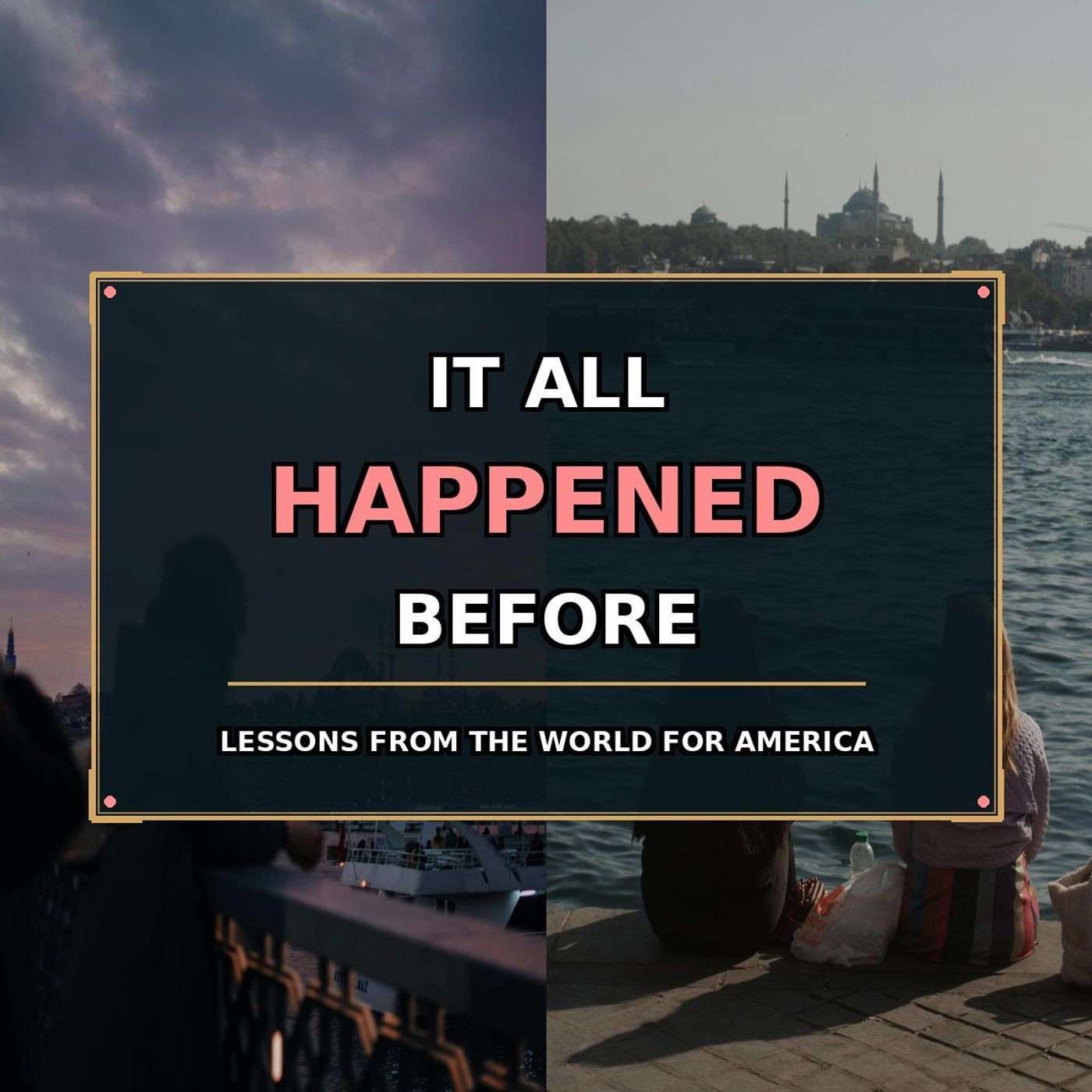
It All Happened Before
by Ekin and Burcu
Democracy doesn't collapse overnight—it follows a script. Join us as we decode America's current political crisis through the eyes of those who've seen it unfold elsewhere. Drawing on Turkey's experience and voices from across the globe, we explore the rise of autocracy and populism with guests who understand these forces intimately. This isn't just analysis—it's a search for solutions, guided by those who know that the past isn't just prologue, it's a roadmap.Hosts:Ekin Yaşin is the Director of Communication Leadership graduate program and a Teaching Professor at the University of Washington, where she designs inclusive and meaningful learning experiences for communities. She thinks and talks about the future of work, organizational communication, innovative teaching methods, and future of higher ed. Outside of work, she is a food, music, travel and literature enthusi
-
11
Episode 8: We've Seen Protesters Called Terrorists - A Conversation with Dr. Lisel Hintz
In March 2025, masked federal agents arrested a Turkish PhD student on a Somerville sidewalk as she walked to break her Ramadan fast. Rümeysa Öztürk's offense, according to the Trump administration, was co-authoring a Tufts Daily op-ed critical of the university's response to the war in Gaza. Her F-1 visa had been quietly revoked by the Secretary of State. She spent six weeks in detention, much of it in a Louisiana ICE facility, before a federal judge ruled there were no grounds to deport her.If you grew up in Turkey, none of this looks new. An op-ed becomes evidence. A student becomes a security threat. A protester becomes a terrorist.Days after Rümeysa's arrest, our guest Dr. Lisel Hintz co-wrote a piece in The Atlantic — "We Study Repression in Turkey. Now We See It Here." — making the case that Trump's playbook against student activists looked unmistakably like Erdoğan's. She would know. Lisel is a political scientist at SOAS, University of London, and the author of Identity Politics Inside Out (Oxford, 2018). Her current book project examines Turkey's state-society struggles through the lens of pop culture, and she writes regularly for Foreign Policy, the Washington Post, the BBC, and other outlets — work that pays close attention to how media itself, both captured and creative, shapes what's politically possible.After Gezi protests in 2013, Dr. Hintz mapped how the Erdoğan government built a vilification playbook around three moves — naming, blaming, framing — designed not just to discredit protesters but to actively demobilize them. We talk through how that playbook is being run in the United States right now, from the framing of anti-ICE protesters as domestic terrorists to the repression of pro-Palestine activism, and where the parallels stop and the differences begin to matter.We ask Dr. Lisel Hintz the question that haunts every conversation like this one: when protesters keep losing, why do they keep showing up? What does persistence actually do, politically — even when nothing visible seems to change? Her answer is one of the most clarifying things we've heard on this show.It happened in Turkey. It's happening here. The language the state uses to make dissent look like danger travels easier than we'd like to think.Listen and subscribe: itallhappenedbefore.substack.com
-
10
Episode 7: We've Lived With the Deep State -- A Conversation with Mert Can Bayar
Americans have been talking about the "deep state" like it's a new discovery. It isn't. Derin devlet is a Turkish coinage — a phrase the rest of the world borrowed from a country that has lived inside conspiratorial politics for so long that the language for it had to be invented there first.There used to be a kind of conspiracy theory that, however wrong, at least tried. It marshaled evidence, connected dots, named the shadowy operators. The new conspiracism is something else entirely: no proofs, no patterns, no operators — just innuendo and bare assertion. A lot of people are saying.In this episode, we chat with Mert Can Bayar — political scientist, postdoctoral scholar at the University of Washington's Center for an Informed Public, and one of the first scholars to take seriously what conspiracism is doing to democracies, not just to individuals. His dissertation, The Politics of Good and Evil, traces partisan conspiracy theories through the parallel democratic erosions of Turkey and the United States.Why those two countries? What does it mean that Turkish political culture has been "built on conspiracism" since the Tanzimat era — and what changes when an entire nation comes to embody itself in a single paranoid spokesperson? Why did Erdoğan grow into conspiracism while Trump arrived already fluent? And — Mert Can's most counterintuitive finding — what do we make of the fact that partisan conspiracy theories actually increase political participation? Is that good news? Or is it precisely the trap?We also spend some time with the question Bruno Latour kept asking before he died: where exactly is the line between the paranoid fantasy and the popularized version of social critique we teach our students?More on Dr. Mert Can Bayar: LinkedIn · CIP profile · personal siteSubscribe to our companion newsletter via Substack
-
9
Episode 6: We've seen the gilded buildings before
In 2014, a year after Gezi, Recep Tayyip Erdoğan moved into a 1,100-room palace built on Atatürk's protected forest farm — in defiance of court orders that ruled it illegal. In October 2025, Trump's crews demolished the East Wing of the White House to break ground on a $400 million ballroom, financed by anonymous corporate donors with active business before the federal government; this spring, he unveiled plans for a 250-foot triumphal arch across the Potomac from the Lincoln Memorial. When asked whom the arch was meant to honor, Trump replied: "Me."This week on It All Happened Before, we sit with the strange, telling pattern of leaders who build colossal monuments to themselves at the precise moment they believe the institutional resistance is broken. Both projects are bunkered — Erdoğan's against biological and nuclear attack, Trump's housing a classified military complex underneath the ballroom floor. Both involved demolitions that overwrote an older symbolic order: Çankaya, where every Turkish president since Atatürk had worked; the East Wing, the traditional working space of First Ladies. Both bypassed the courts and the planning bodies meant to constrain them, often with the courts then being remade in the leader's image. And both, in different ways, are being normalized.We trace the comparative pattern — from Ceaușescu's Casa Poporului to Hitler's Reichskanzlei, Tito's bunker at Konjic — and ask the question that should unsettle American listeners: a decade ago, Erdoğan's palace generated discussion and outrage. Today, it's just where the president lives. How long does that normalization take?
-
8
Episode 5: We’ve Seen Nepotism Before
In this episode, we go deep into the role of family in political power, unpacking how nepotism operates under the cloak of democracy. From Donald Trump’s inner circle—Jared Kushner and Ivanka Trump—to Turkey’s “damat” politics with Berat Albayrak and Selçuk Bayraktar, we explore how family ties become pathways to influence, wealth, and legitimacy.Building on our conversations about institutions, personalities, and the “strongman myth,” we examine how political dynasties are constructed—not just in the U.S. and Turkey, but across the world. From the Bush family to the Trudeaus, this isn’t new. But the scale, stakes, and consequences may be different. What happens when (very)underqualified relatives are handed extraordinary power? How do these networks shape economies, foreign policy, and democratic norms? And what are the real-world consequences—from economic crises to global conflict?This episode asks a simple but urgent question: when power stays in the family, how do we pay the price?
-
7
Episode 4: We've Seen Journalists Adapt Before -- A Conversation with Dr. Matt Powers
FCC Chair Brendan Carr threatens to revoke broadcast licenses over war coverage. Pete Hegseth demands a more "patriotic press." These declarations feel almost theatrical — and that's exactly the point. They draw attention to the loud, visible pressure, while the quieter kind takes hold inside the newsroom. We welcome a special guest to make sense of these new tactics, and examples from other countries and contexts that contextualize this moment.Matt Powers is a Professor of Communication at the University of Washington and Co-Director of its Center for Journalism, Media and Democracy. He is the author of The Journalist's Predicament: Difficult Choices in a Declining Profession (Columbia University Press, 2023) and NGOs as Newsmakers: The Changing Landscape of International News (Columbia University Press, 2018). In his recent article with Ozan Asik, An Ethics of Suppression: How Professional Values Silence Critical Journalism in Turkey, he takes us inside Turkish newsrooms to show how journalists navigate — and survive — under authoritarian pressure. (He also has a (very) close connection to one of our hosts!)What he found is unsettling: editors suppressing critical reporting while genuinely believing they are protecting the space for journalism to survive. At what point does maintaining the appearance of a functioning newsroom become indistinguishable from providing cover for its capture?And the question Turkish journalists learned the hard way: most people can't just leave. So what does staying and continuing to do the work actually look like — inside a system that is increasingly hostile to the journalism you came to do?
-
6
Bonus Episode: Media Capture Doesn't Announce Itself — A Conversation with Dr. Bilge Yesil
We started our media capture discussions last episode asking whether what's happening to American media is a rupture or a reckoning. Bilge Yesil's answer, drawn from decades of studying Turkish media, is clarifying and a little unsettling: there was no dramatic breaking point in Turkey either. Just a continuous drift — commercialization, consolidation, political pressure layering on top of market pressure — normalized and incremental, until the transformation was complete and no one could point to the moment it happened.Dr. Bilge Yesil is a Professor of Media Culture at the College of Staten Island and affiliate faculty in Middle Eastern Studies at the CUNY Graduate Center. She is the author of Media in New Turkey: The Origins of an Authoritarian Neoliberal State and, most recently, Talking Back to the West: How Turkey Uses Counter-Hegemony to Reshape the Global Communication Order — and she knows this terrain better than almost anyone.In this conversation, we ask her to walk us through both sides of how capture actually works: the coercive moves — arrests, closures, the blunt instruments — and the quieter, more durable ones: advertising leverage, debt dependencies, ownership consolidation. (Sound familiar? We talk about the Demirören family. We talk about Jeff Bezos and the Washington Post.)And then we ask the question we really wanted answered: for Americans watching declining ad revenues, shuttered newsrooms, and leaders who call journalists the enemy — what does Turkey's experience tell you about where to look? And what are you probably still not seeing?
-
5
Episode 3: We've Watched Media Get Captured Before
In this episode of It All Happened Before, Ekin and Burcu use the CBS controversy as a doorway into a much older story — how media capture works precisely because it doesn't announce itself. Drawing on Turkey's experience of press consolidation, where family publishers became state-friendly conglomerates and the transformation felt gradual until suddenly it wasn't, they ask Americans the uncomfortable question: what if you're already inside it? From ownership structures to the slow narrowing of what's sayable, this episode is about learning to recognize something that is designed not to be recognized.
-
4
Episode 2: We Still Vote
Burcu flew from Germany to Turkey for 36 hours just to vote. She went to the polls right after her back surgery. And still — she's not sure she fully trusts the outcome.In this episode of It All Happened Before, Ekin and Burcu explore what elections look like inside a competitive authoritarian system: formally intact, fiercely contested, and deeply uncertain. With Americans worried about whether the 2026 midterms will even be held, Turkey's story offers a sobering reframing — the greater danger isn't that elections stop. It's that they become fragile enough to doubt, confusing enough to suppress participation, and contested enough to be dismissed whenever the results are inconvenient.
-
3
Episode 1: We've Seen This Before
Some people are surprised by what's happening in America. We are not.It All Happened Before is a conversation between two people who grew up watching democracy erode in Turkey — and who now see the patterns repeating in the country they also call home. In our first episode, we talk about why we started this project, what firsthand experience with authoritarianism actually teaches you, and how we hold onto ourselves while living across two countries in two different stages of a similar story.
We're indexing this podcast's transcripts for the first time — this can take a minute or two. We'll show results as soon as they're ready.
No matches for "" in this podcast's transcripts.
No topics indexed yet for this podcast.
Loading reviews...
ABOUT THIS SHOW
Democracy doesn't collapse overnight—it follows a script. Join us as we decode America's current political crisis through the eyes of those who've seen it unfold elsewhere. Drawing on Turkey's experience and voices from across the globe, we explore the rise of autocracy and populism with guests who understand these forces intimately. This isn't just analysis—it's a search for solutions, guided by those who know that the past isn't just prologue, it's a roadmap.Hosts:Ekin Yaşin is the Director of Communication Leadership graduate program and a Teaching Professor at the University of Washington, where she designs inclusive and meaningful learning experiences for communities. She thinks and talks about the future of work, organizational communication, innovative teaching methods, and future of higher ed. Outside of work, she is a food, music, travel and literature enthusi
HOSTED BY
Ekin and Burcu
Loading similar podcasts...
Frequently Asked Questions
How many episodes does It All Happened Before have?
It All Happened Before currently has 9 episodes available on PodParley. New episodes are automatically indexed when they're published to the podcast feed.
What is It All Happened Before about?
Democracy doesn't collapse overnight—it follows a script. Join us as we decode America's current political crisis through the eyes of those who've seen it unfold elsewhere. Drawing on Turkey's experience and voices from across the globe, we explore the rise of autocracy and populism with guests who...
How often does It All Happened Before release new episodes?
It All Happened Before has 9 episodes. Check the episode list to see recent publication dates and frequency.
Where can I listen to It All Happened Before?
You can listen to It All Happened Before on PodParley by clicking any episode. We provide an embedded audio player for direct listening, and you can also subscribe via your preferred podcast app using the RSS feed.
Who hosts It All Happened Before?
It All Happened Before is created and hosted by Ekin and Burcu.
URL copied to clipboard!