
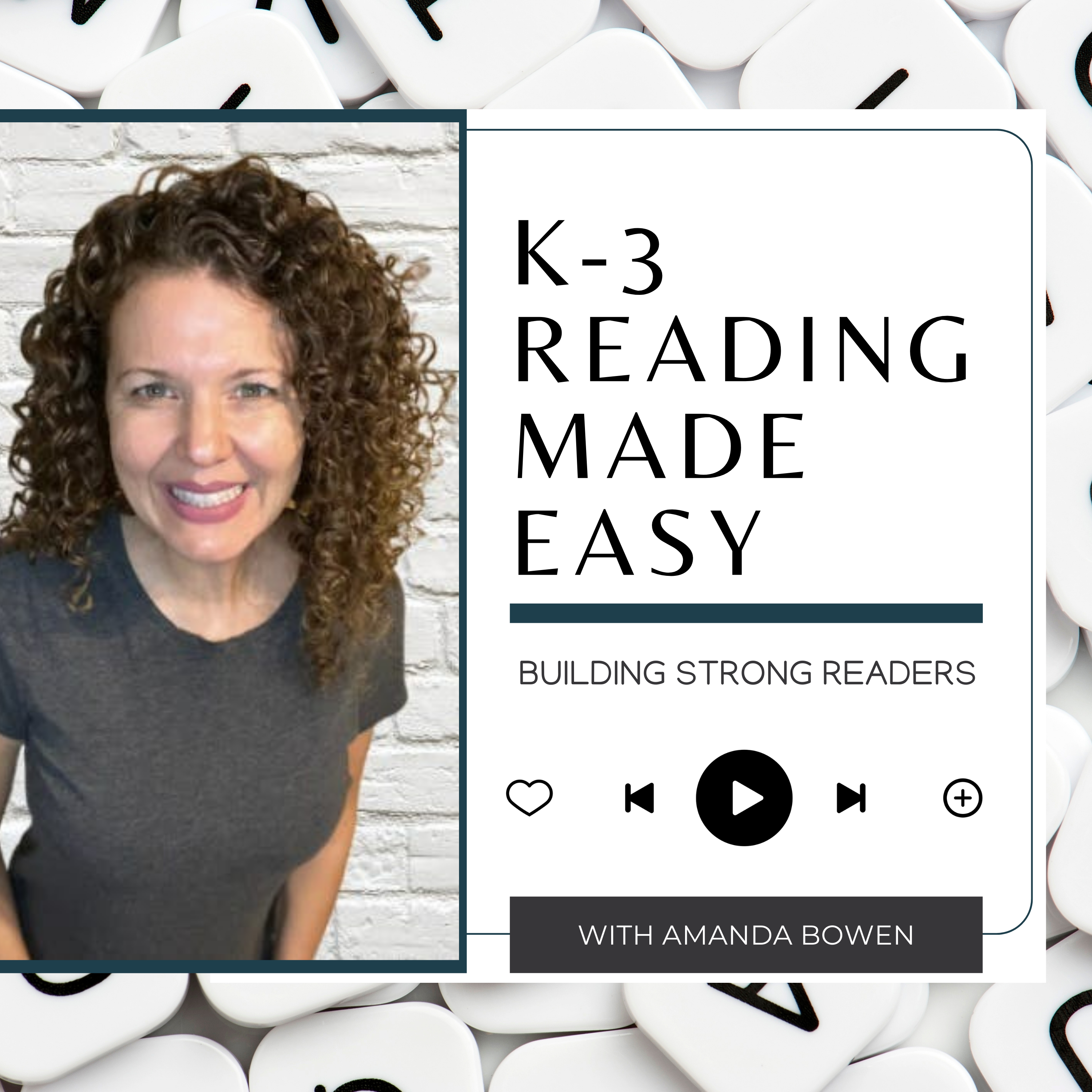
PODCAST · education
K-3 Reading Made Simple with Amanda Bowen
by Amanda Bowen
Have you ever sat in your classroom after dismissal — lights low, room finally quiet — and thought…“I love my students… but I am exhausted.”Not just tired.But tired in a way that makes you wonder if you’re doing enough. Tired in a way that makes you question your confidence. Tired in a way that makes you wish teaching felt lighter… and clearer. If that sounds like you, you’re in the right place.Welcome to K-3 Reading Made Simple with Amanda Bowen— the podcast for early childhood and primary teachers who want to teach reading with confidence, clarity, and heart.This isn’t about trendy strategies.This isn’t about doing more.This is about teaching smarter, calmer, and more intentionally — using research-based practices that actually work, without burning yourself out in the process.Inside this podcast, we talk about things like:• decoding and phonic
-
8
Ep 7 | How to Read: Sound to Symbol Strategies That Actually Build Readers
Have you ever had a student who knows every letter name… but still can’t read?In this episode of K-3 Reading Made Simple, we break down one of the most important pieces of early literacy that often gets missed: sound to symbol connection.If you’ve been searching for how to read strategies that actually work in real classrooms, this episode will help you understand what your students truly need to move from guessing… to confident reading.Grounded in the science of reading explicit instruction, this episode connects research to practice in a way that feels clear, doable, and aligned with what your students need most.In this episode, you will learn:• Why sound–symbol association is a critical foundation in the teaching of reading comprehension• How letter identification and letter sounds work together to build decoding skills• What research says about why some students struggle to learn how to read• Simple, effective ways to teach reading strategies that build automaticity• How new teaching learning methods rooted in structured literacy support all learnersWhat we unpack together:Not all students who know the alphabet know how to read.This episode walks you through the missing bridge between letter knowledge and actual reading ability. You will learn how explicit, multisensory instruction helps students connect sounds to print so their brains can build strong reading pathways.We also talk about what happens when this step is skipped and why students begin to guess, avoid, or shut down during reading.Classroom strategies you can use right away:• Alphabet arc and letter matching routines• Sound wall drills and articulation practice• Elkonin boxes and word chaining• Build-a-word and dictation routinesThese routines are simple to implement and align directly with science of reading writing and decoding development.Encouragement for youYou are not behind.You are learning, growing, and becoming the teacher your students need. When you understand how reading actually works, your instruction becomes the bridge that changes everything.Strong readers are built one sound at a time.Resources Mentioned in this EpisodeIf you are working to strengthen your reading instruction and want ready-to-use, research-aligned tools, you can access free resources here:https://msamandabowen.com/free/You will find classroom supports designed to help you confidently teach sound to symbol skills and support every reader in your room.
-
7
Ep 6 | They Know Their Letters but Can’t Read? Here’s Why Phonics Matters
If you’ve ever looked at a student who knew their letters but still couldn’t read… this episode is for you.In this episode of K-3 Reading Made Simple, reading interventionist Amanda Bowen explains why phonics isn’t outdated... it’s brain-based.Because learning how to read isn’t about guessing words or memorizing stories.It’s about building a reliable system that helps students decode print with confidence.And that system is phonics.In This Episode, You’ll Learn-Why explicit phonics instruction is essential — not optional-How strong phonics skills help students stop guessing and start decoding-Why phonics decoding builds both reading and spelling confidence-How these ideas connect to the science of reading and structured literacy principles-Practical phonics strategies you can begin using immediatelyWhen students struggle with reading, it’s rarely about effort.It’s usually about instruction.This episode helps you see what changes when instruction becomes clear, explicit, and brain-aligned.What We Talk AboutYou’ll hear how phonics works alongside phonemic awareness, why structured literacy supports all learners, and how small instructional shifts can dramatically change reading outcomes.We also explore:• Why students need predictable decoding systems• How phonemic awareness supports phonics learning• Why decodable texts help patterns stick• How explicit instruction builds reading confidence fasterBecause when instruction matches how the brain learns language, reading stops feeling like guessing — and starts feeling possible.Encouragement for Teacher FriendsIf you’ve ever questioned your reading instruction or felt unsure what students truly need, hear this:You are not behind.You are learning.And every step toward clearer instruction helps build stronger readers.Teacher Support Resources Mentioned in This EpisodeIf you’d like a simple starting place for strengthening your reading instruction systems without adding overwhelm, I created a free support resource for you.It’s designed to help you build calm, sustainable literacy routines rooted in research and real classrooms.You can explore it here:https://msamandabowen.com/free/Use what helps. Leave what doesn’t. Make it work for your teaching life.
-
6
Ep 5 | Before Phonics Comes This: The Missing Step in Learning How to Read
What if one playful, auditory shift could unlock a child’s reading confidence?In this episode of K-3 Reading Made Simple, reading interventionist Amanda Bowen explores the often-overlooked foundation of literacy: phonological awareness.Because learning how to read doesn’t start with letters on a page.It starts with ears tuned to the sounds of language.In This Episode, You’ll Learn-What phonological awareness actually is — and why it matters before phonics-Why research shows sound awareness predicts reading success more than IQ or vocabulary-How early listening skills strengthen later phonics instruction and phonics decoding-Simple, playful phonics strategies you can use tomorrow-How this work connects to broader structured literacy principles and effective instructionWhen students struggle with reading, it’s often not a motivation issue. It’s a missing foundation.This episode helps you see where that foundation begins.Why Sound Awareness Matters for Learning How to ReadPhonological awareness teaches children to hear language before they see it.And when students can hear sounds clearly:• Phonics instruction becomes easier to understand• Spelling patterns make more sense• Reading words becomes less about guessing and more about decodingIt also helps teachers make smarter instructional decisions, because observing sound awareness gives valuable insight that is often before any formal phonics assessment is even needed.This is where reading confidence begins.Practical Ideas You’ll Hear in This EpisodeYou’ll walk away with activities you can try immediately, including:• Clapping words in sentences• Stomping syllables• Rhyme-guessing games during read-alouds• Sound-box blending challenges• Simple oral language routines that build reading readinessThese are small shifts that create big clarity for students learning how to read.Encouragement for Teacher FriendsIf teaching reading sometimes feels overwhelming, this episode is your reminder:You don’t need complicated systems.You need clear foundations.And every playful listening moment you create is helping build a reader.Teacher Support Resources Mentioned in This EpisodeIf you want a simple place to start strengthening your reading instruction routines without adding more overwhelm, I created a free support resource for you.It’s designed to help you build calm, sustainable literacy systems grounded in research and real classrooms.You can explore it here: https://msamandabowen.com/free/Take what helps, leave what doesn’t, and make it work for your teaching life.
-
5
Ep 4 | Teacher Work-Life Balance 2.0: Sustainable Systems for Teaching Reading and Life
If you love teaching reading but feel like teaching is slowly taking over your life… this episode is for you.In this video, literacy educator Amanda Bowen shares how to design a sustainable teaching life — one where you can help students learn how to read while still protecting your time, energy, and identity outside the classroom.Because here’s the truth most teachers don’t hear enough:You don’t have to sacrifice yourself to be a great teacher.Sustainable teachers stay longer, teach better, and create stronger readers.This episode walks you through practical ways to build a teaching rhythm that supports both your students and your life. In This Episode, You’ll Learn-How to release guilt around boundaries-Simple systems that reduce mental load and planning stress-Teacher life hacks that actually make your day easier-Classroom organization tools that save time and energy-How protecting your energy improves how you teach students to readBecause when your workload is sustainable, your instruction becomes clearer — and that directly impacts how students learn how to read with confidence.What We Talk AboutThis episode explores a fresh approach to teacher sustainability — what we might call work life balance 2.0 — where balance isn’t about doing less, but about designing smarter systems.You’ll hear strategies for:• Creating planning boundaries that reduce decision fatigue• Using simple reusable templates and classroom organization tools• Batching tasks so you stop reinventing lessons weekly• Managing your energy like a professional resource• Walking into your classroom calm, prepared, and focusedIf you’ve ever searched “work life balance how” or wondered how other educators manage it all, this episode offers a practical starting point — not perfection, just progress.Who This Video Is ForThis episode is especially helpful if you are:• A K-3 teacher balancing literacy instruction and life demands• A new teacher trying to build sustainable routines• A veteran teacher ready for a calmer system• Anyone searching for teacher life hacks that truly workIf you’ve been looking for honest conversations about teaching, sustainability, and instruction on work life balance YouTube, you’re in the right place.Remember This, Teacher FriendYou are not unmotivated.You are not doing it wrong.You simply deserve systems that support you.Confident teachers build confident readers — and that starts with a teaching life that supports you, too.Teacher Support Resources Mentioned in This EpisodeIf you’re ready to build a teaching life that supports both your students and yourself, I created a free resource to help you get started.Inside, you’ll find simple planning supports and reflection tools designed to reduce overwhelm, protect your energy, and help you teach reading with more clarity and calm.You can grab it here:https://msamandabowen.com/free/Use it as a starting place, not another task on your to-do list.Take what helps, leave what doesn’t, and make it work for your teaching life.
-
4
Ep 3 | How Kids Actually Learn How to Read (And Why Some Struggle)
If you’ve ever watched a student try so hard to read. They are sounding out, guessing, hoping... all the while you wondered why it still isn’t clicking, this episode is for you.In this video, literacy educator Amanda Bowen breaks down the structured literacy framework and explains why it’s changing how teachers approach how to read instruction in classrooms everywhere.Because here’s the truth:Most children don’t learn to read naturally.They learn to read when instruction is clear, explicit, and intentional.And that’s exactly what structured literacy provides.In this episode, you’ll learn:-What structured literacy actually is (and what it isn’t)-Why it’s considered the gold standard in reading instruction- How it supports struggling readers and students with dyslexia-Practical strategies you can use immediately in your classroom-How teaching the structure of language helps students truly learn how to readIf you’ve ever felt like you’re still figuring reading instruction out, let this be your reminder:You are not behind.You are learning.And your students benefit every time you grow.Next Steps for Teacher FriendsIf this episode supports your reading instruction journey:-Like the video so more teachers can find it-Subscribe for weekly literacy encouragement and strategies-Comment below: What reading challenge are you seeing most right now?I read every comment, and your questions often shape future episodes.
-
3
Ep 2 | The Science of Reading and Structured Literacy: What Teachers Really Need to Know
Decoding the Confusion Around Reading InstructionIn this episode of the podcast, we’re talking about something many teachers quietly wrestle with:All the noise around reading instruction.Terms like science of reading and structured literacy get thrown around constantly — in trainings, online discussions, and curriculum meetings — but rarely explained in a way that actually brings clarity to your classroom.So today, we’re slowing it down together.In this conversation, Amanda shares the moment she realized that for many students, reading doesn’t develop just from exposure to books — it requires explicit instruction, intentional phonics teaching, and clear classroom strategies. From there, she walks you through what the research really says about how reading works, and how structured literacy fits into that picture as a practical, teacher-friendly instructional approach.Because when we understand the science behind reading development, something powerful happens:The guesswork fadesThe guilt softensAnd teaching reading starts to feel clearer and more manageableThis episode is designed to help you feel more confident in your reading instruction, more grounded in research-based literacy strategies, and more equipped to support struggling readers with practical, doable teaching methods. In This Episode, You’ll Learn• Why reading must be taught explicitly and doesn’t develop naturally for most students• What the science of reading actually means (and why it’s not just another trend)• How structured literacy provides systematic, step-by-step skill building for learners• Why cognitive overload can prevent students from making reading progress• How decodable texts support phonics learning and reduce guessing habits• Practical classroom strategies to make reading instruction clearer and calmerSound Bites From the Episode“Reading has to be taught; it doesn’t develop naturally.”“Understanding this research gives you clarity instead of confusion.”“Your classroom becomes calmer, your lessons become clearer.”Episode Chapters00:00 — Introduction to Reading Instruction Confusion01:26 — Understanding the Science of Reading04:53 — Exploring Structured Literacy10:28 — Strategies for Effective Reading Instruction15:48 — Structured vs. Balanced Literacy19:11 — Using Decodable Texts for Practice20:23 — Recap and Final ThoughtsFinal EncouragementIf you’ve ever felt overwhelmed by reading initiatives, shifting terminology, or the pressure to “get it right,” this episode is for you.Not because it gives you one perfect answer but, because it helps you understand why reading works the way it does……and when teachers understand that, instruction becomes more effective, more intentional, and a whole lot more sustainable.MentionsGet the Must Have 3 Apps: https://msamandabowen.com/free/
-
2
Ep 1 | Unlocking the Secrets of Reading Success
Have you ever sat with a student, tried everything you know, and quietly wondered…“Why isn’t this clicking?”If so, you are not alone — and you are definitely not failing.In this episode of Amanda Bowen Teaches Literacy, we’re diving into the science of reading and unpacking what research actually tells us about how children learn to read… and why some students struggle even when they’re surrounded by strong teaching, supportive families, and rich literacy environments.Because here’s the truth we don’t say enough:Reading isn’t natural.Reading isn’t passive.And reading must be taught intentionally.Today’s conversation walks through three powerful research-based reading models that help us understand what’s really happening when students read — and how our instructional practices can support them more effectively.We’ll explore:• The Simple View of Reading, first introduced by researchers like Philip Gough and William Tunmer, which reminds us that reading comprehension depends on both word recognition and language comprehension• Hollis Scarborough’s Reading Rope, which beautifully shows how decoding, vocabulary, background knowledge, and language skills weave together to create skilled reading• The Active View of Reading, advanced by scholars such as Nell Duke and Kelly Cartwright, emphasizing that readers must actively think, monitor, and engage with textTogether, these frameworks remind us that effective literacy education isn’t about choosing one strategy — it’s about understanding how all the pieces work together.In This Episode, You’ll Hear• Why some children struggle with reading despite strong effort and instruction• What the science of reading actually means (and what it doesn’t)• How phonics, vocabulary, and comprehension all play essential roles in reading development• Why modeling metacognition is one of the most powerful teaching strategies we can use• How informed teachers can dramatically change outcomes for struggling readersSound Bites From the Episode“Why isn’t this clicking?”“Reading must be taught.”“Reading isn’t passive.”Episode Chapters00:00 — Introduction to the Science of Reading00:57 — Understanding the Science of Reading02:21 — The Simple View of Reading03:57 — Scarborough’s Reading Rope Explained05:25 — The Active View of Reading07:54 — Conclusion Final ThoughtThe goal of this episode isn’t to overwhelm you with research.It’s to empower you.Because when teachers understand how reading develops, we don’t just change lessons…we change trajectories for students.And that matters more than any program, strategy, or trend ever could.Mentions: Get the 3 Must have apps now at thttps://msamandabowen.com/free/
-
1
Ep 0 | For Teachers Who Love Their Students but Feel Unsure: A Reading Podcast Made Simpler
Welcome to K-3 Reading Made Simple, the podcast created for early childhood and primary teachers who want reading instruction to feel clearer, calmer, and more effective — without adding more to their plates.Hosted by reading interventionist Amanda Bowen, this show is built for teachers who love their students deeply but sometimes feel overwhelmed, unsure, or stretched thin by the demands of teaching reading well.Inside each episode, you’ll find research-informed ideas paired with real classroom experience, including conversations about:Phonics and decoding that actually support readersSpelling and dictation practices that strengthen writingPhonemic awareness routines that help struggling students succeedSimple instructional systems that protect your time and energy and what sustainable, effective reading instruction really looks like day-to-dayYou’ll hear honest classroom reflections, gentle encouragement for your teacher-heart, and practical strategies that is always shared as support you can adapt for your own students and classroom.Because teaching reading shouldn’t require burnout. You deserve to feel confident, supported, and balanced in your work.If you’re ready for reading instruction that blends research with heart, this podcast is for you.
We're indexing this podcast's transcripts for the first time — this can take a minute or two. We'll show results as soon as they're ready.
No matches for "" in this podcast's transcripts.
No topics indexed yet for this podcast.
Loading reviews...
ABOUT THIS SHOW
Have you ever sat in your classroom after dismissal — lights low, room finally quiet — and thought…“I love my students… but I am exhausted.”Not just tired.But tired in a way that makes you wonder if you’re doing enough. Tired in a way that makes you question your confidence. Tired in a way that makes you wish teaching felt lighter… and clearer. If that sounds like you, you’re in the right place.Welcome to K-3 Reading Made Simple with Amanda Bowen— the podcast for early childhood and primary teachers who want to teach reading with confidence, clarity, and heart.This isn’t about trendy strategies.This isn’t about doing more.This is about teaching smarter, calmer, and more intentionally — using research-based practices that actually work, without burning yourself out in the process.Inside this podcast, we talk about things like:• decoding and phonic
HOSTED BY
Amanda Bowen
Loading similar podcasts...
Frequently Asked Questions
How many episodes does K-3 Reading Made Simple with Amanda Bowen have?
K-3 Reading Made Simple with Amanda Bowen currently has 8 episodes available on PodParley. New episodes are automatically indexed when they're published to the podcast feed.
What is K-3 Reading Made Simple with Amanda Bowen about?
Have you ever sat in your classroom after dismissal — lights low, room finally quiet — and thought…“I love my students… but I am exhausted.”Not just tired.But tired in a way that makes you wonder if you’re doing enough. Tired in a way that makes you question your confidence. Tired in a way that...
How often does K-3 Reading Made Simple with Amanda Bowen release new episodes?
K-3 Reading Made Simple with Amanda Bowen has 8 episodes. Check the episode list to see recent publication dates and frequency.
Where can I listen to K-3 Reading Made Simple with Amanda Bowen?
You can listen to K-3 Reading Made Simple with Amanda Bowen on PodParley by clicking any episode. We provide an embedded audio player for direct listening, and you can also subscribe via your preferred podcast app using the RSS feed.
Who hosts K-3 Reading Made Simple with Amanda Bowen?
K-3 Reading Made Simple with Amanda Bowen is created and hosted by Amanda Bowen.
URL copied to clipboard!