
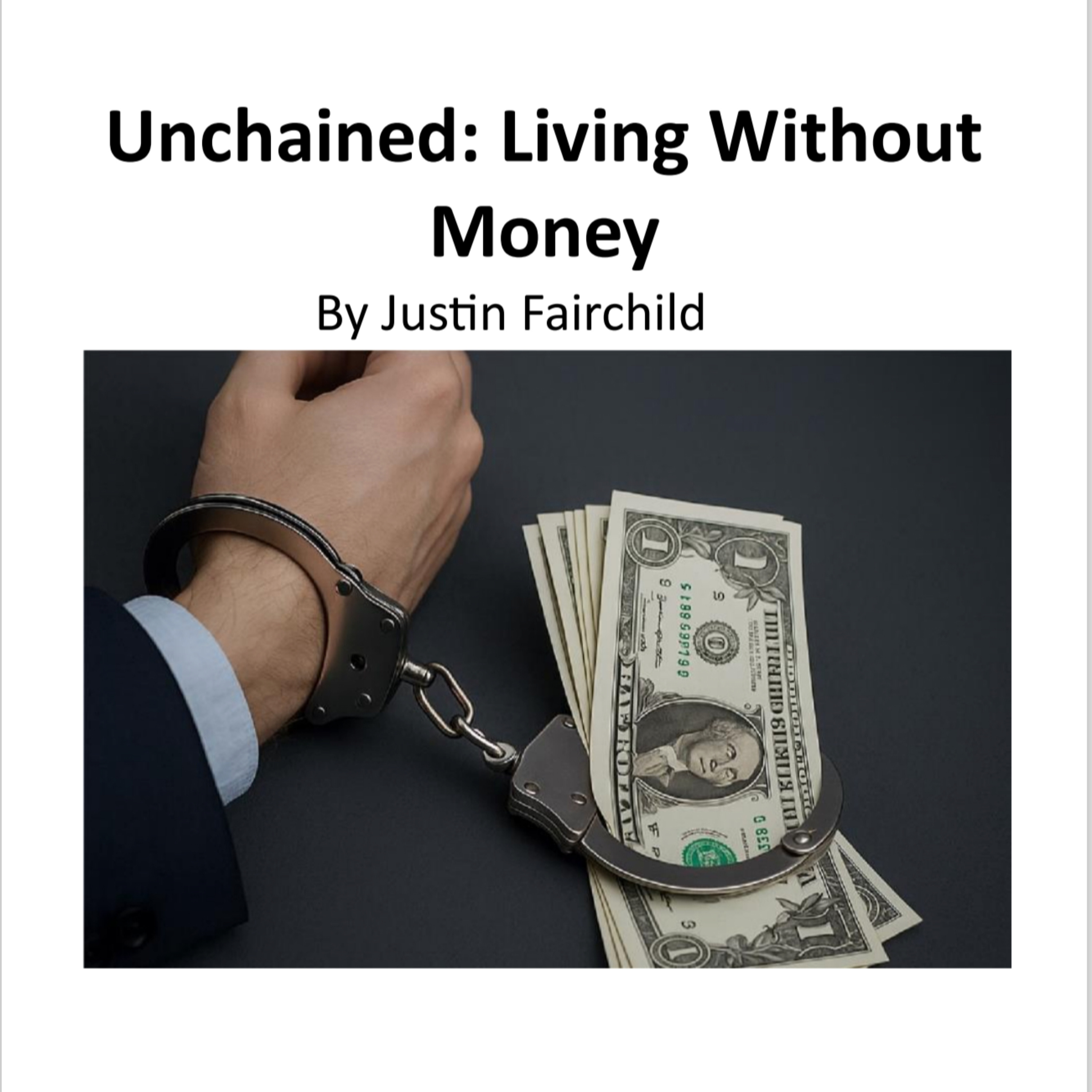
PODCAST · society
Living Unchained: Building a moneyless, post scarcity society
by Justin Fairchild
Living Unchained is a podcast exploring life beyond money. Each season features a powerful book—from Unchained: Living Without Money to Moneyless Society and The Gift—with narration, reflection, and action. Host Justin Fairchild invites listeners to challenge the status quo, build community, and reclaim a world rooted in generosity. Each episode ends with a “Contributionist Challenge”—a small step toward a more connected, liberated future. Join the movement to live free and give freely.
-
88
Episode 22: Building a Post-Money Culture
In this episode, Justin Fairchild explores real communities and movements around the world that are redefining wealth, work, and value. From time-banks to worker co-ops, from Auroville to open-source networks, these models show that life beyond money isn’t fantasy — it’s foundation.💭 We don’t end the old world by fighting it. We outgrow it by living differently.
-
87
Episode 21: The Ecology of Enough
In nature, nothing hoards. Nothing takes more than it needs. So why do we?In this episode, Justin Fairchild explores what it means to live in balance — to find the quiet harmony between ambition and rest, giving and receiving, humanity and the natural world.Through reflection, ecology, and the principles of Contributionism, he reminds us that the cure for scarcity isn’t more wealth — it’s wisdom.💭 Enough isn’t the end of growth — it’s the beginning of balance.
-
86
Episode 20: The Myth of Deservedness
We grow up believing people get what they deserve — that success, suffering, and love are all earned. In this episode, Justin Fairchild dismantles that story, exploring how the idea of deservedness keeps us trapped in guilt, competition, and comparison.Through personal reflection and the lens of Contributionism, he offers a radical alternative: a world where worth is inherent, compassion is unconditional, and belonging isn’t something you earn — it’s who you already are.💭 No one earns the right to exist. We already belong.
-
85
Episode 19 Reclaiming Time: Freedom Beyond the Clock
They say time is money — but what if that’s the lie that keeps us running? In this episode, Justin explores how capitalism turned time into currency, how it fractured our sense of peace, and how reclaiming our hours through rest, slowness, and contribution can restore our humanity.Through story, reflection, and a touch of philosophy, Reclaiming Time invites us to live more deeply and intentionally — to trade deadlines for daylight, urgency for presence, and productivity for purpose.💭 When we stop selling our time, we start owning our lives.
-
84
Episode 18 The Currency of Care: Healing Communities in a Broken Economy
After exploring money and mental health in the last episode, Justin turns outward to explore how communities heal together. From loneliness and burnout to the quiet strength of compassion, this episode reveals how cooperation, generosity, and shared purpose form the real wealth of a thriving society.Through personal stories and reflections on Contributionism, Justin shows how caring — freely, fearlessly, and without transaction — is the most radical act in a world built on separation.💭 Care isn’t charity. It’s currency — the kind that never runs out.
-
83
Episode 17: The Cost of Peace: Money and Mental Health
Money doesn’t just buy or sell — it shapes how we feel, how we think, and how we see ourselves. In this deeply personal episode, Justin Fairchild opens up about his own struggles with financial anxiety, burnout, and the quiet mental toll of living in a world where survival has a price tag.Through reflection and story, he explores how Contributionism — the practice of giving freely and living through cooperation — can heal the emotional wounds that money leaves behind.If you’ve ever felt like your worth is tied to your wallet, this episode is a reminder that peace isn’t something you earn. It’s something you remember.💭 Money may shape our world, but it doesn’t define our worth. Contribution heals what currency divides.
-
82
Episode 16: Faith Unchained — Spirit Beyond the Money System
Raised in Christianity, Siddha Yoga, and Scientology, Justin shares how each tradition carried both truth and falsehood, yet never offered the connection he longed for. Money often shaped what was taught, faith filtered through the lens of the teacher. But through it all, God pulled him in another direction — toward contributionism as worship. In this episode, Justin explores how money has chained faith across history, how generosity lives at the root of all religions, and how contributionism frees spirit itself.
-
81
Episode 15: Divide and Rule — How Wealth Shapes Division and How Contributionism Breaks the Cycle
Throughout history, the wealthy have relied on one timeless strategy: keep people divided so they cannot rise together. From Rome’s “bread and circuses” to colonial America’s racial laws, from strike-breaking propaganda to today’s culture wars, division has always served the ruling class. In this episode, Justin traces the pattern across centuries, shares personal reflections on division and solidarity, and shows how contributionism removes the levers of manipulation — replacing rivalry with cooperation and control with community.
-
80
Episode 14: Chains of Desperation: Crime, Addiction, and Family Violence Under a Money System
Crime, drug abuse, and family violence are often blamed on “bad people” or moral weakness. But what if they are predictable outcomes of a society where survival depends on money? In this episode, Justin examines how scarcity drives crime, profit fuels addiction, and financial stress magnifies abuse behind closed doors. Weaving in personal stories of his grandfather’s alcoholism, his time working in addiction recovery, and the pressures money has created in his own relationships, he shows how contributionism offers a path away from punishment and toward healing, safety, and dignity.
-
79
Episode 13: Money, Faith, and Relationships: Untangling What Binds Us
Money shapes our worth, faith directs our trust, and relationships define who we are. But under a money system, all three are distorted — money mediates love, faith is misplaced in failing institutions, and relationships are strained or commodified. In this episode, Justin reflects on how these forces have played out in his own life and community, explores the historical and cultural ways they’ve been entangled, and paints a vision of what happens when they are unchained.
-
78
Episode 12: What Do We Owe Each Other?
Capitalism tells us we owe wages to bosses, taxes to the state, and payments to banks — obligations measured in money and debt. But what do we truly owe each other as human beings? In this episode, Justin explores the history of obligation, from religion and philosophy to contracts and credit, and contrasts it with moments of solidarity like mutual aid and community care. He lays out contributionism’s answer: that we owe each other survival, dignity, and stewardship of the future — not as burdens, but as joyful contributions.
-
77
Episode 11: Is Democracy Possible in a Capitalist Economy?
Democracy is praised as “rule by the people,” but what happens when money speaks louder than votes? In this episode, Justin traces democracy’s roots from Athens to modern America, exposing how capitalism distorts politics through lobbying, campaign financing, media control, and voter suppression. He explores the myth of equal representation, highlights alternative democratic experiments, and shows how contributionism creates the foundation for real democracy — one built on equality, cooperation, and shared power.
-
76
Episode 10: Can Justice Exist in an Unequal System?
We’re told justice is blind. Courthouses proclaim “Equal Justice Under Law.” But can justice truly exist in a system built on inequality? In this episode, Justin traces the history of justice from Hammurabi to modern capitalism, revealing how laws have often protected property and the powerful over people. He explores the myth of equal justice, alternative models like restorative and indigenous justice, and how contributionism redefines fairness when survival is unconditional. Justice, he argues, can’t be patched onto inequality — it must be rooted in equality from the start.
-
75
Episode 9: Communism, SPGB Socialism, Communal Living, and Contributionism
Whenever people hear about a moneyless society, the first question is often: “Isn’t that just communism?” In this episode, Justin unpacks communism’s ideals and its authoritarian realities, explores the Socialist Party of Great Britain’s long-standing vision of a moneyless, wageless, stateless world, and looks at real-world experiments in communal living — from monasteries to kibbutzim to modern co-ops. Finally, he shows how contributionism builds on these lessons, offering a bridge forward that learns from the past without repeating its mistakes.
-
74
Episode 8: What Does Progress Really Mean?
Politicians and corporations praise “progress,” but what are we actually progressing toward? This episode challenges GDP, economic growth, and technological advancement as measures of success, and asks: is true progress about more stuff, or more life? Justin contrasts capitalism’s definition with contributionism’s vision of collective flourishing.
-
73
Episode 7: Is Ownership an Illusion?
From houses to land to even intellectual property, ownership is treated as natural and absolute. But is it real — or just a fragile illusion enforced by law, debt, and power? Justin explores the history of ownership, indigenous and alternative perspectives, and the freedom found when we replace ownership with stewardship and contribution.
-
72
Episode 6: Does Work Define Us, or Limit Us?
Work dominates modern identity — we ask people “What do you do?” as if labor is the whole of life. But does work free us, or does it confine us to survival at the expense of creativity and joy? This episode traces the history of work, the burnout of modern labor culture, and how contributionism reframes work as gift rather than burden.
-
71
Episode 5: Free Market Capitalism vs. Contributionism
The free market is often touted as the path to equality and fairness — but does it deliver? In this head-to-head comparison, Justin examines how free market capitalism functions in practice versus how contributionism reimagines survival, cooperation, and dignity.
-
70
Episode 4: Who Decides What’s Essential in Society?
During the pandemic, “essential workers” were praised yet poorly protected. What does “essential” really mean, and who gets to decide? This episode explores how capitalism defines essentials through profit, and how contributionism offers a radically different lens rooted in human need.
-
69
Episode 3: Do We Really Have Free Choice Under Capitalism?
Capitalism prides itself on freedom of choice — from the marketplace to the workplace. But how free are our choices when they’re shaped by survival, wages, and manipulation? Justin unpacks the illusion of choice and invites listeners to reclaim decisions that feel authentically their own.
-
68
Episode 2: Is Capitalism Modern Slavery?
We often think of slavery as a thing of the past — but when survival depends on selling labor, taking on debt, and obeying the rules of profit, is capitalism just a softer form of bondage? This episode dives into the parallels and differences between slavery and wage labor, and what it means to be truly free.
-
67
Episode 1: Does Capitalism Violate My Right to Pursue Happiness?
The U.S. Declaration of Independence promises life, liberty, and the pursuit of happiness — but does capitalism deliver on that ideal, or stand in its way? In this episode, Justin explores how happiness was originally defined, how capitalism measures up in practice, and what alternatives could better support human flourishing.
-
66
S4 E6 CH 13-15: The Lie That Build The World
As Ben peers into history, he sees the scaffolding of the old order: lies of scarcity, myths of competition, and the relentless story of money as necessity. To move forward, he must confront the illusions that built his world—and decide whether to keep believing them.For updates on all things "Waking Up" and or to purchase the book to tag along with this seasons BookCast visit www.wakingupstory.com
-
65
S4 E11 CH 28-31: The Shape of Tomorrow
In the season finale, Peter undergoes reconciliation instead of punishment, facing those harmed by his actions and beginning a true transformation. Ben joins circles of dialogue and design, witnessing how a post-money world organizes itself through trust, participation, and shared imagination. And for the first time, he envisions a home—not just survival. Season 5 closes with a challenge: what small steps can each of us take to help shape tomorrow, today?For updates on all things "Waking Up" and or to purchase the book to tag along with this seasons BookCast visit www.wakingupstory.com
-
64
S4 E10 CH 23-25: The Sound of Us
At Peter’s Alaska base, the old world makes its last desperate move: hijacked robots, hostages, and a philosophy of control. But resistance doesn’t come with bigger guns—it comes with rhythm, resonance, and forgiveness. Amo is wounded, Ben subdues Peter, and the group chooses care over domination. In the end, the “sound of us” isn’t fear or force—it’s the harmony of people working together to protect life.For updates on all things "Waking Up" and or to purchase the book to tag along with this seasons BookCast visit www.wakingupstory.com
-
63
S4 E9 CH 22-24: Crossing Over
In a playful world of augmented reality battles and dissolving water bottles, Ben finally stops doubting and starts belonging. But when chaos erupts and Peter’s manipulations surface, Ben faces betrayal and must choose where his loyalty lies. Guided by Aweena and Amo, he takes his first real step from relic of the past to participant in the present. This is the moment of crossing—from watching to walking.For updates on all things "Waking Up" and or to purchase the book to tag along with this seasons BookCast visit www.wakingupstory.com
-
62
S4 E8 CH 19-21: Bloodlines and Boundaries
Ben’s wandering comes to an end when he discovers the truth about Amo—she is Bianca, the daughter he thought he lost. As he grapples with five generations of family and a world run by trust instead of money, Ben confronts the boundaries between past and present, authority and care. Meanwhile, Peter plots in the shadows, and Ben learns that legacy isn’t control—it’s what continues through others.For updates on all things "Waking Up" and or to purchase the book to tag along with this seasons BookCast visit www.wakingupstory.com
-
61
S4 E7 CH 16-18 The Edge of Belief
Last time, we saw the lie—the way our old world manufactured pain through a story of scarcity and debt. Ben Michaels saw it too. And now, he finds himself on the edge—literally and spiritually.Because before you can believe in something new, you have to confront what you were never allowed to question.For updates on all things "Waking Up" and or to purchase the book to tag along with this seasons BookCast visit www.wakingupstory.com
-
60
S4 E5 Chapters 10-12: Bridges Between Worlds
Between past and future, Ben discovers bridges: people who translate between old systems and new, and technologies that support trust instead of control. Each encounter brings him closer to accepting that his survival isn’t an accident—it’s an invitation.For updates on all things "Waking Up" and or to purchase the book to tag along with this seasons BookCast visit www.wakingupstory.com
-
59
S4 E4 Chapters 7-9: No Place to Call Home
Last episode, Ben Michaels woke up in a future without money. No more cancer, no more skyscrapers, but also… no more wealth. No more trust fund. No more empire.This time, he returns to what used to be his world—his office, his mansion—and discovers they’ve been transformed into something radically new. And he meets someone who just might help him understand what this all means.For updates on all things "Waking Up" and or to purchase the book to tag along with this seasons BookCast visit www.wakingupstory.com
-
58
S4 E3 Chapters 5-6: Waking in a New World
Ben’s disorientation deepens as he confronts the realities of life without money: shared abundance, trust in technology, and communities built on care instead of profit. Each experience challenges his assumptions—and begins to soften his skepticism.For updates on all things "Waking Up" and or to purchase the book to tag along with this seasons BookCast visit www.wakingupstory.com.
-
57
S4 E2 Chapters 3-4: Letting Go
In Episode 1, we met Benjamin Michaels: a billionaire dying of cancer, clinging to control while the world outside his skyscraper begins to reject everything he built. Today, in Episode 2, we walk with him through his final moments—his last conversation with his daughter, his death, and the quiet beginning of something radically different.For updates on all things "Waking Up" and or to purchase the book to tag along with this seasons BookCast visit www.wakingupstory.com.
-
56
S4 E1 Waking Up Chapters 1-2:
Season 4—where we take a journey through Harald Neslein Sandø’s novel Waking Up: A Journey Towards a New Dawn for Humanity. This isn’t a textbook. It’s not a manifesto. It’s a story—a sci-fi narrative about a man named Benjamin Michaels who wakes up a hundred years after being cryogenically frozen… into a world that no longer uses money.This season, we’ll travel with Ben as he grapples with the collapse of his old beliefs, and we’ll reflect on what that story means for our lives today. In each episode, I’ll read several chapters, offer a recap, share reflections—often tied to ideas from my own book Unchained: Living Without Money—and end with a weekly contributionist challenge to try in your own life.For updates on all things "Waking Up" and or to purchase the book to tag along with this seasons BookCast visit www.wakingupstory.com.
-
55
S1 E18 25 Year Afterword: On Being Good Ancestors
As Season 3 draws to a close, we reflect on Lewis Hyde’s afterword to The Gift, written 25 years after the book’s release. In this powerful final chapter, Hyde explores the future of gift culture—how we support art, science, and connection in a world consumed by markets. We look at the call to create gift institutions that last beyond us—and the responsibility we all share to become good ancestors. With reflections tied to Unchained: Living Without Money and a preview of Season 4’s journey into Waking Up: A New Dawn for Humanity by Harald Sandø.
-
54
S 3 E 17 Conclusion
In this final chapter, Lewis Hyde steps back to reflect on everything we’ve explored—asking not only what the gift is, but what it means to live in alignment with it. And for us, as we reach the end of this season, that means taking stock of what we’ve learned and how we carry it forward.
-
53
S3 E16 Chapter 10 Part 5: Bathed in Alkali: The Descent of Ezra Pound
Here, we follow Ezra Pound—not just the poet, but the ideologue, the economist, the man who tried to rebuild a moral society by reshaping the mechanisms of money itself. It’s a descent into myth, politics, and silence… and it asks a piercing question: What happens when the giver tries to become the architect of the gift’s delivery system?
-
52
S3 E15 Chapter 10 Part 4: Imagist Money
In this episode of Living Unchained, we dive into “Imagist Money,” the fourth section of Chapter 10 in Lewis Hyde’s The Gift. Here, Hyde unpacks Ezra Pound’s radical vision: a currency that decays, a poetic economy grounded not in usury, but in the enduring gifts of nature and art.
-
51
S3 E14 Chapter 10 Part 3: The Jew in the Hedge
Today’s episode continues Chapter 10 of Lewis Hyde’s The Gift. This is Part III — The Jew in the Hedge, and I want to offer a clear warning upfront:This episode deals with Ezra Pound’s anti-Semitism, mental unraveling, and the psychological shadows that haunted his later years.It is not easy listening — and it shouldn't be.
-
50
S3 E13 Chapter 10 Part 2: Durable Treasure
Last time, we walked with Ezra Pound through his poetic awakening and his sensitivity to cultural value — value that lies beyond the realm of price. Today, we follow him deeper — into the politics of the imagination, and into the tension between the artist’s impulse to give, and the society’s habit of commodifying.
-
49
S3 E12 Chapter 10 Part 1: Scattered Light: Ezra Pound and the Gift of Order
Hyde introduces Ezra Pound’s poetic method as a kind of healing response to the fragmentation of modernity — and explores Pound’s drive to use poetry as a force for integration, moral coherence, and ultimately, gift exchange.
-
48
S3 E11: Chapter 9 Part 3: Saplings
Today we continue with the third and final section of Chapter 9 in The Gift by Lewis Hyde, titled “Saplings.” In this moving and deeply human chapter, we see Walt Whitman emerge not just as a poet of the people — but as a man shattered open by love, illness, grief, longing… and, ultimately, trees.
-
47
S3E9 Part 2: Adhesive Riches
In this episode, we continue our deep dive into Chapter 9 of The Gift by Lewis Hyde. We now step into Section II: Adhesive Riches—a dense, lyrical meditation on how Walt Whitman envisioned wealth, value, and the adhesive force of love and democracy.
-
46
Episode 9 Part One: The Grass Over Graves
This episode is about the power of lineage, inheritance, and art — not as property or product, but as a sacred continuation. We’ll follow Hyde’s reflections on Walt Whitman and what it means to give from beyond the grave, to sow gifts that continue sprouting long after we’re gone.
-
45
Episode 8: The Commerce of the Creative Spirit
In this episode of Living Unchained, we explore Lewis Hyde’s reflections on the complex relationship between creativity and commerce. Can art survive — or even thrive — in a marketplace that prizes profit over depth? We look at how the exchange of money can alter the spirit of the gift, why some artists struggle when their work enters the market, and how creative communities have found ways to keep the gift alive in a world driven by sales. Along the way, we connect these ideas to the vision of a moneyless society, where art is valued not for what it earns, but for how it enriches the human spirit.
-
44
Episode 7: Usury and the Price of the Gift
In this episode, we dive into Chapter 7 of The Gift—“Usury: A History of Gift Exchange.” Hyde explores how ancient lending practices rooted in reciprocity were slowly overtaken by interest-based systems that commodified human relationships. From Mesopotamian temples to modern banking, we trace the shift from mutual aid to profit-driven debt. Join us as we reflect on what was lost—and what a moneyless society might recover—when we choose generosity over gain.
-
43
Episode 6: A Female Property
In this episode, we explore Chapter 6 of The Gift by Lewis Hyde—“A Female Property.” Hyde takes us through cultural traditions where women were both givers and gifts in exchange systems, exploring the complex relationship between gender, value, and social structure. Join us as we unpack how these historical patterns shape our understanding of value today—and how a moneyless world might reimagine them.
-
42
Episode 5: The Gift Community
In this episode, we explore Lewis Hyde’s reflections on the structure of gift communities—those tightly woven circles of reciprocity where relationships and meaning take priority over profit. After narrating the chapter, we unpack the implications for a post-monetary world, and how communities like yours and mine are already walking that path. This discussion deeply connects to the vision shared in Unchained: Living Without Money and offers a grounding in what it truly means to live the gift.
-
41
Episode 4: The Rejected Gift
What happens when a gift is refused—or cannot be returned? This chapter explores the painful edges of gift exchange: obligation, imbalance, and rejection. In this episode, we reflect on the discomfort of nonreciprocal giving, and how modern society sometimes views true generosity with suspicion. Connecting with Unchained, we consider the social costs of living in a world where value is measured only in economic terms.
-
40
Episode 3: Commerce of the Creative Spirit
How does an artist survive in a world ruled by the market? In Chapter 3, Hyde digs deeper into the dilemma of the modern creative. This episode reflects on the artist’s double life—called by the muse, but bound by rent. Through stories of writers, musicians, and painters, we explore how the spirit of the gift continues to resist commodification. As in Unchained, we ask: What would it look like to build a society that sustains creativity without price tags?
-
39
Episode 2: "Gifts and the Bonds Between Us"
Chapter 2 examines the uneasy tension between gift and market economies. Hyde reveals how the labor of art often exists in a space where monetary compensation falls short. In this episode, we reflect on the spiritual and social role of the gift—how sustaining creativity demands not just material support but a cultural ethic of mutual care. Drawing parallels with Unchained, we explore how honoring the gift can free us from systems of exploitation.
We're indexing this podcast's transcripts for the first time — this can take a minute or two. We'll show results as soon as they're ready.
No matches for "" in this podcast's transcripts.
No topics indexed yet for this podcast.
Loading reviews...
ABOUT THIS SHOW
Living Unchained is a podcast exploring life beyond money. Each season features a powerful book—from Unchained: Living Without Money to Moneyless Society and The Gift—with narration, reflection, and action. Host Justin Fairchild invites listeners to challenge the status quo, build community, and reclaim a world rooted in generosity. Each episode ends with a “Contributionist Challenge”—a small step toward a more connected, liberated future. Join the movement to live free and give freely.
HOSTED BY
Justin Fairchild
CATEGORIES
Loading similar podcasts...
Frequently Asked Questions
How many episodes does Living Unchained: Building a moneyless, post scarcity society have?
Living Unchained: Building a moneyless, post scarcity society currently has 50 episodes available on PodParley. New episodes are automatically indexed when they're published to the podcast feed.
What is Living Unchained: Building a moneyless, post scarcity society about?
Living Unchained is a podcast exploring life beyond money. Each season features a powerful book—from Unchained: Living Without Money to Moneyless Society and The Gift—with narration, reflection, and action. Host Justin Fairchild invites listeners to challenge the status quo, build community, and...
How often does Living Unchained: Building a moneyless, post scarcity society release new episodes?
Living Unchained: Building a moneyless, post scarcity society has 50 episodes. Check the episode list to see recent publication dates and frequency.
Where can I listen to Living Unchained: Building a moneyless, post scarcity society?
You can listen to Living Unchained: Building a moneyless, post scarcity society on PodParley by clicking any episode. We provide an embedded audio player for direct listening, and you can also subscribe via your preferred podcast app using the RSS feed.
Who hosts Living Unchained: Building a moneyless, post scarcity society?
Living Unchained: Building a moneyless, post scarcity society is created and hosted by Justin Fairchild.
URL copied to clipboard!