
PODCAST · society
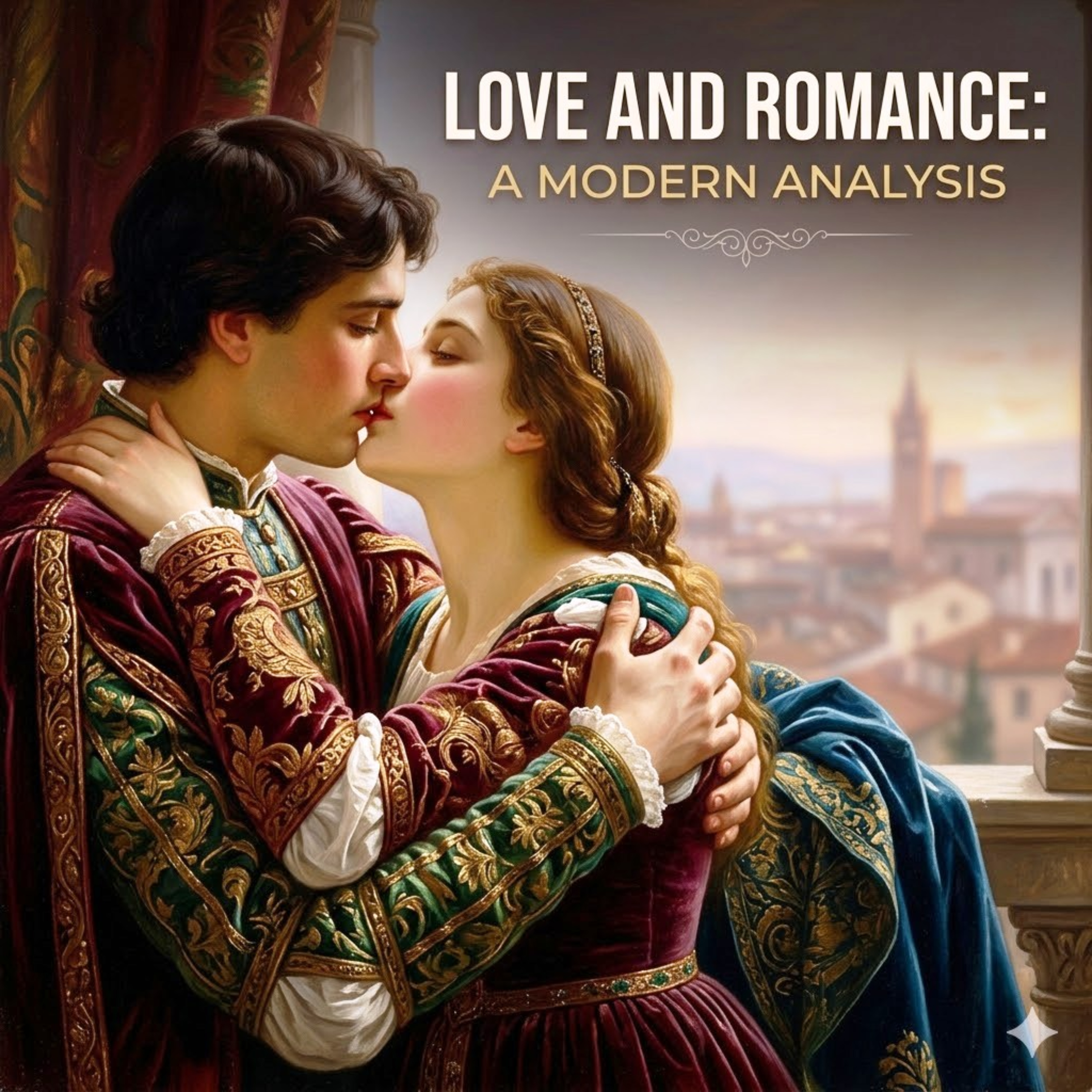
Love and Romance: A Modern Analysis
by Elton Sherwin
Why do some relationships and marriages succeed while others fail? From the math behind the Stanford Marriage Pact to the surprising science of arranged marriages, we go beyond the swipe to find what actually works.Using deep-dive research and data analysis, we investigate the biological and cultural trends shaping modern connection. Join us for a modern analysis of the heart, where evidence meets emotion to reveal the timeless rules of love and romance.Note: This show uses advanced AI tools for research and production; occasional mispronunciations may occur.
-
9
9. The Power of "We": Why Joint Decisions Equal Less Guilt
Is sharing financial control about losing power, or gaining a partner? This deep dive explores the fascinating science behind shared marital power and "dyadic coping." We examine why couples who decide together often feel more powerful than those who act alone, and how shifting from a "tug of war" mentality to a collaborative "we" reduces stress and increases psychological resilience. Discover why your most important investment might not be a stock or a bond, but the process of deciding together. In this episode, we dive into the research of Olsen, Rick, and Leonhardt to explore why moving from unilateral control to joint decision-making can be so transformative.
-
8
8. How "Fake" Smiles Hijack Your Brain and Improve Relationships
Can a forced smile actually lead to a genuine connection? We unpack the neuroscience of "mirror neurons" and why your brain often follows your face’s lead. Beyond just hacking your own chemistry to fight stress and aggression, we discuss how smiling acts as a transfer of energy that encourages others to do the same. Featuring insights on psychoneuroimmunology and the "Smile Hack" routine, this episode provides a practical tool to help you navigate difficult days, improve your empathy, and transform your relationships—one 60-second smile at a time.
-
7
7. Predicting Divorce: Gottman's Magic Ratio
Can Math Predict the End of a Relationship?Is love purely mysterious, or is there a formula for a happy, lasting partnership? In this episode, we dive into the groundbreaking work of Dr. John Gottman and the Magic 5:1 Ratio.Decades of research suggest that the secret to stability isn't the absence of conflict—it’s how you balance it. Discover why "stable" couples have five positive interactions for every one negative interaction during an argument, and how that ratio sky-rockets to 20:1 during everyday life.In this episode, you’ll learn:The Emotional Bank Account: How "deposits" (small acts of kindness) create a buffer against life's inevitable stressors.The 4 Horsemen of the Apocalypse: The four behavioral warning signs—Criticism, Defensiveness, Stonewalling, and Contempt—that predict divorce with 90% accuracy.5 Actionable Ways to Boost Your Ratio: Practical, daily habits to strengthen your bond, from expressing appreciation to the power of "turning toward" your partner’s bids for connection. Key Takeaway:Great relationships aren't built on grand, expensive gestures once a year. They are built on "small things often." What small deposit can you make in your relationship today?Don’t forget to subscribe and share this episode with someone who wants to strengthen their connection!
-
6
6. Stop the Mommy Guilt: Why Your Career is a Gift to Your Kids
Are you a mom who chooses to work simply because you love the intellectual stimulation, but find yourself battling "mom guilt" at every family dinner? This episode is your objective, research-backed defense. We cut through the cultural noise to look at how a mother's career actually serves as a "car alternator"—recharging the mental battery you need for high-quality parenting.What You’ll Learn in This Episode:The Health Factor: Why full-time working mothers are tangibly healthier—both mentally and physically—by age 40 than stay-at-home moms.Quality vs. Quantity: New data from the University of Maryland showing that 15 minutes of fully engaged interaction is more impactful for child development than three hours of distracted supervision.The Daycare "Training Ground": How early education centers help toddlers build "social scaffolding" and peer conflict resolution skills that stay-at-home children often miss.The Long-Term Payoff: The staggering Harvard Business School study across 29 countries revealing that daughters of working moms earn 23% more and sons spend significantly more time on housework and family care as adults.The Bottom Line:Maternal employment has zero negative impact on a child's lifelong happiness. By choosing your career, you aren't depriving your children of a mother; you are gifting them a functional model for modern equality and ambition.
-
5
5. Arranged Marriages? Why Many Young Indians Prefer Them
We challenge the Western assumption that modernization and education inevitably lead to the rejection of tradition in the marriage market.The 90% Factor: Roughly 90% of marriages in India are still arranged.The Young Preference: A 2013 survey found that 74% of young Indians (ages 18–35) actually prefer an arranged marriage over finding a partner on their own.Active Choice: This isn't about the stereotype of forced marriage; it's a generation actively opting into a curated system—what some call a "merger and acquisition strategy" for romance.The Original Data Aggregator: Historically, the village nai (barber) served as the intermediary, using their unique social access to collect "covert intelligence" on eligible matches across different castes.The Modern Interface: Today, platforms like Shadi.com act as the digital barber, aggregating data on religion, income, status, and education.The "Actuarial" Horoscope: Horoscopes are used as risk management tools, acting like actuarial data to predict the longevity and health of a union.Lower Expectations, Higher Returns: Arranged marriages often start with lower, more practical expectations focused on stability and shared values, allowing the bond to grow over time.The Love Marriage Trap: Conversely, love marriages often start at a peak of dopamine and romance, which can lead to a sharp drop in satisfaction when reality sets in.The Bangalore Data: Research suggests that arranged couples in cities like Bangalore report higher long-term satisfaction than those in love marriages.A Financial Cushion: The involvement of the extended family provides a safety net and cushions the couple from financial stress.The "Suffocating Cage": However, parental interference is a leading cause of marital instability and divorce in India, as couples can struggle to develop an independent identity.The Hybrid Future: The rising trend is "jointly arranged marriages," where parents do the initial filtering, but the couple has final veto power.
-
4
4. Love and Romance: The Algorithm Behind The Marriage Pact
In this episode, we take a deep dive into the Stanford Marriage Pact—a project that started as a joke for an economics class and evolved into an algorithm-driven phenomenon replacing swipe culture on campuses across the U.S.The "Gale-Shapley" Shift: Originally a Nobel Prize-winning theory used for matching medical students to hospitals, this "stable marriage" algorithm is now being used to find your perfect campus match.Efficiency Over Serendipity: Students are trading the "illusion of endless choice" on apps like Tinder for the "algorithmic certainty" of a single, data-backed match.Swipe Fatigue: Traditional dating apps are losing users to "paradox of choice" and swipe fatigue; these campus algorithms offer scarcity and intentionality instead.Deep Data: Forget the profile picture—the Marriage Pact uses a 50-question survey covering everything from political views (abortion, gun control) to hyper-local campus culture (dorm rumors, "Rice Purity" scores).The Goal of Stability: The algorithm seeks "stability," meaning it finds a pair where neither person would secretly rather be with someone else assigned by the system.The Viral Spark: At Stanford alone, roughly 58% of the student body signed up almost overnight, shifting the "Marriage Pact" from a 20-year safety net to a "date for this Friday" tool.The Copycat Market: The success of the Marriage Pact has sparked competition, including "Date Drop" (which raised $2M) and Notre Dame’s "Crossroads".Monetizing FOMO: Some platforms are now charging users (e.g., $5) to choose between their top two algorithmic matches, effectively "monetizing the fear of missing out".A "Stanford Solution": Is this the end of romantic magic, or just the logical optimization of romance in a high-pressure, tech-driven world?
-
3
3.The Lie of Modern Love
Are you tired of the "soulmate" search ending in heartbreak? In this episode, we dive deep into the philosophy of Alain de Botton to uncover why modern romanticism might be ruining our relationships. We explore:The "Emotional Grammar" of Love: How our childhood experiences dictate our adult attractions—even the toxic ones.The Romantic vs. Therapeutic Age: Why we need to stop following our "gut" and start using our heads."How are you crazy?": The most important question you can ask a partner to build true vulnerability.Compatibility as an Achievement: Learning to see love not as a feeling we fall into, but as a skill we practice every day.The views and opinions expressed in this episode are for informational and entertainment purposes only. This content constitutes social commentary and critique of public figures and digital trends. All statements of opinion are based on publicly available facts, and no "actual malice" or intent to defame is present.Please note that this episode was conceptually developed and generated using Artificial Intelligence (AI) tools. The voices, dialogue, and script were synthesized to explore these cultural phenomena. AI occasionally makes mistakes or mispronounces words and names.
-
2
2. Is Swiping Dead? The Rise of the AI Concierge
In this episode, we take a deep dive into "swipe fatigue" and the massive shift happening in the digital dating world. We explore the "Tinder Paradox"—the inherent conflict between a user's goal to find love and an app's goal to keep you engaged.In this episode, we discuss:The Dopamine Loop: How "variable reinforcement schedules" turned dating into a slot machine.The AI Shift: Why new apps like Fate and Breeze are ditching the swipe for AI-driven interviews and automated blind dates.The Vulnerability Gap: Is outsourcing our social interactions to AI causing our "social muscles" to atrophy?The views and opinions expressed in this episode are for informational and entertainment purposes only. This content constitutes social commentary and critique of public figures and digital trends. All statements of opinion are based on publicly available facts, and no "actual malice" or intent to defame is present.Please note that this episode was conceptually developed and generated using Artificial Intelligence (AI) tools. The voices, dialogue, and script were synthesized to explore these cultural phenomena. AI occasionally makes mistakes or mispronounces words and names.
-
1
1. Tradwives: CEOs Cosplaying as Housewives?
From soft lighting to homemade sourdough, the "Tradwife" aesthetic has taken over our feeds. But is this a genuine return to 1950s values, or just a high-budget digital fantasy?In our premiere episode, we deconstruct the Tradwife phenomenon and the "Anamoia"—nostalgia for a time never lived—that fuels it. We dive into the stark economic reality of 2024, comparing today's housing affordability index to the post-WWII era, and reveal how top influencers like Nara Smith and Ballerina Farm are actually running sophisticated modern businesses behind the vintage floral dresses. Join us as we explore the hidden labor, the legal risks, and the surprising political undertones of the internet's most controversial subculture.The views and opinions expressed in this episode are for informational and entertainment purposes only. This content constitutes social commentary and critique of public figures and digital trends. All statements of opinion are based on publicly available facts, and no "actual malice" or intent to defame is present.Please note that this episode was conceptually developed and generated using Artificial Intelligence (AI) tools. The voices, dialogue, and script were synthesized to explore these cultural phenomena. AI occasionally makes mistakes or mispronounces words and names.
We're indexing this podcast's transcripts for the first time — this can take a minute or two. We'll show results as soon as they're ready.
No matches for "" in this podcast's transcripts.
No topics indexed yet for this podcast.
Loading reviews...
ABOUT THIS SHOW
Why do some relationships and marriages succeed while others fail? From the math behind the Stanford Marriage Pact to the surprising science of arranged marriages, we go beyond the swipe to find what actually works.Using deep-dive research and data analysis, we investigate the biological and cultural trends shaping modern connection. Join us for a modern analysis of the heart, where evidence meets emotion to reveal the timeless rules of love and romance.Note: This show uses advanced AI tools for research and production; occasional mispronunciations may occur.
HOSTED BY
Elton Sherwin
CATEGORIES
Loading similar podcasts...
Frequently Asked Questions
How many episodes does Love and Romance: A Modern Analysis have?
Love and Romance: A Modern Analysis currently has 9 episodes available on PodParley. New episodes are automatically indexed when they're published to the podcast feed.
What is Love and Romance: A Modern Analysis about?
Why do some relationships and marriages succeed while others fail? From the math behind the Stanford Marriage Pact to the surprising science of arranged marriages, we go beyond the swipe to find what actually works.Using deep-dive research and data analysis, we investigate the biological and...
How often does Love and Romance: A Modern Analysis release new episodes?
Love and Romance: A Modern Analysis has 9 episodes. Check the episode list to see recent publication dates and frequency.
Where can I listen to Love and Romance: A Modern Analysis?
You can listen to Love and Romance: A Modern Analysis on PodParley by clicking any episode. We provide an embedded audio player for direct listening, and you can also subscribe via your preferred podcast app using the RSS feed.
Who hosts Love and Romance: A Modern Analysis?
Love and Romance: A Modern Analysis is created and hosted by Elton Sherwin.
URL copied to clipboard!