
PODCAST · society
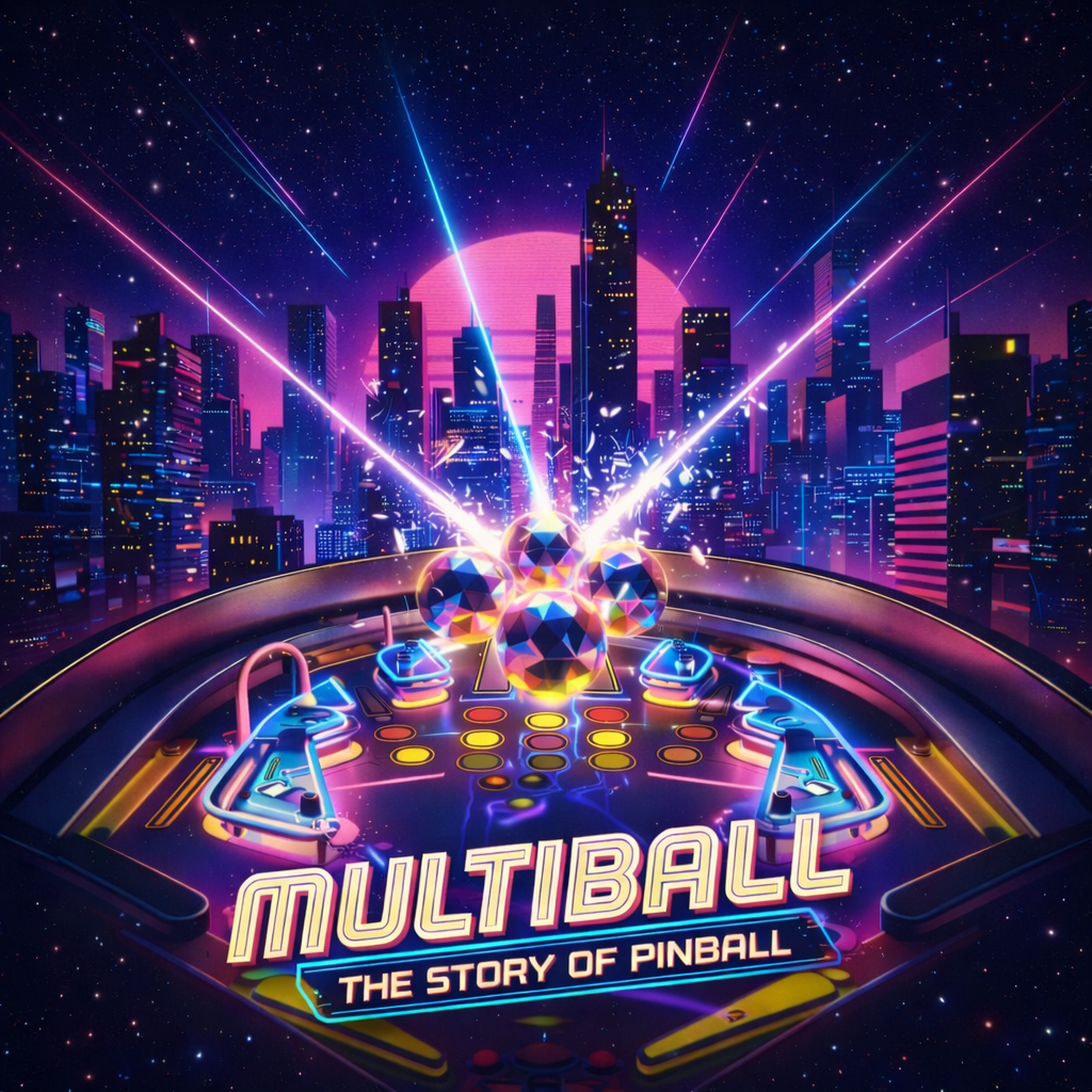
Multiball: The Story of Pinball
by Pinball Stories
Before the flippers, before the arcade boom, before anyone called it a classic — pinball had a criminal record. Multiball: The Story of Pinball digs into the full story of the silver ball: from 18th century French parlors to Depression-era Chicago back rooms, through the golden age of design, the near-death of an industry, and the unlikely modern renaissance that saved it. Each episode goes deep on the machines, the manufacturers, and the moments that made pinball one of the most fascinating — and most misunderstood — games ever built.
-
10
S1E9: The Solid State Revolution
In 1977, pinball stopped being a machine and started becoming a computer that happened to have a ball in it.Episode 9 is the story of the transition from electromechanical relay logic to solid-state microprocessors — the most complete technological transformation in pinball's history since the invention of the flipper. We dig into why the change was inevitable, what the first generation of solid-state machines got wrong, and how the microprocessor unlocked a design vocabulary that the EM era could never have imagined: multiball, modes, digitized speech, dot matrix displays. We also meet the designers who understood what the new technology made possible and built careers out of pushing it as far as it would go.The ceiling that EM machines had reached was gone. What replaced it was human imagination.
-
9
S1E8: Stern — The Survivor
In 1999, Williams closed its pinball division. Gottlieb was already gone. Bally had been absorbed years earlier. Every major manufacturer in the history of American pinball had exited, collapsed, or been swallowed whole.One company kept building.Episode 8 is the story of Stern Pinball and the man behind it — Gary Stern, son of Williams' own Sam Stern, who looked at a collapsing industry and decided it wasn't over. We trace the brutal wilderness years of the early 2000s, the licensed titles that kept the lights on, the barcade boom that changed the demand landscape, and the gradual, hard-won revival that proved Gary Stern right. It's one of the great acts of stubborn cultural stewardship in the history of American entertainment — and almost nobody outside the pinball world knows it happened.
-
8
S1E7: The EM Era — A Golden Age Retrospective
There is a sound no modern pinball machine makes. Not because designers haven't tried to recreate it — but because you simply cannot replicate a physical bell with a speaker. Not in a way that carries the same weight.Episode 7 steps back from the manufacturer stories to take the long view on the electromechanical golden age — roughly 1947 to 1977 — the thirty years when pinball ran on relays, score reels, chimes, and hand-painted backglass art. We look at how EM machines actually work, the landmark machines that defined the era across all three major manufacturers, the largely anonymous artists whose backglass paintings were small masterpieces of mid-century commercial illustration, and what was genuinely, irreversibly lost when the microchip arrived.This one is a love letter. Fair warning.
-
7
S1E6: Bally — The Showman
Every industry has a company that understands spectacle better than its competitors. In pinball, that company was Bally.Episode 6 is the story of Raymond Moloney — the Chicago showman who named his first machine Ballyhoo and spent the next fifty years living up to it. We trace Bally's journey from the coin-op explosion of the 1930s through the licensed theme revolution of the 1970s, when the company put Elton John, Evel Knievel, and KISS on pinball machines and invented an entirely new reason to play. We also give Bally its technical due — the bumper, the audio innovations, the solid-state transition — because behind all the flash was a company that genuinely knew how to build a machine.Bally didn't just make pinball louder. It changed what pinball was allowed to be.
-
6
S1E5: Williams — The Innovator
If Gottlieb was about perfecting what it had, Williams was always chasing the next idea.Episode 5 follows Williams Manufacturing from its founding by inventor Harry Williams through its transformation into the dominant force of the DMD era — the company that shipped the first solid state machine, assembled the greatest design team in the history of the medium, and produced a run of machines in the 1990s that the pinball world still talks about in reverent tones. The Addams Family. The Twilight Zone. Medieval Madness. Pat Lawlor. Steve Ritchie.And then we reckon with how it ended — why the greatest pinball manufacturer in history simply stopped making pinball machines in 1999, and what that loss meant for the game and the people who loved it.
-
5
S1E4: Gottlieb — The Gold Standard
There is a particular kind of pinball machine that collectors will tell you represents the purest expression of the form. Warm incandescent light. Hand-painted backglass art. The sound of actual bells. Score reels that click through digits with satisfying mechanical weight. And somewhere on the cabinet, almost certainly, a small oval logo: D. Gottlieb and Co., Chicago, Illinois.Episode 4 is the story of the most important company in the history of pinball. We meet David Gottlieb — the Lithuanian immigrant who built it all — and the designers and artists who made his machines into objects people still restore, collect, and obsess over seventy years later. Wayne Neyens. Ed Krynski. Artist Roy Parker. And the golden age they created together in the 1950s and 60s that set the template every manufacturer since has had to reckon with.
-
4
S1E3: The Flipper Changes Everything
Before 1947, pinball was something that happened to you. You pulled the plunger, watched the ball bounce, and waited for it to drain. There was nothing you could do about it — and that, as far as city councils and moral reformers were concerned, made it gambling.Then a designer at Gottlieb named Harry Mabs built a small bat-shaped piece of metal on a pivot, wired it to a button on the side of the cabinet, and changed everything.In Episode 3 we trace the invention of the flipper — from the six-flipper oddity of Humpty Dumpty in 1947 to the standardized two-flipper layout that every machine since has inherited. We look at what the flipper did to the geometry of the game, why it made the legal argument against pinball impossible to sustain, and why one small mechanical component is the reason the game is still alive today.
-
3
S1E2: The Ban Years
In 1942, New York City Mayor Fiorello La Guardia posed for press photographs with a sledgehammer — and declared war on pinball.In our second episode, we dig into one of the strangest and most consequential chapters in the history of American entertainment: the thirty-four year ban on pinball machines in New York City. We'll explore why the city — and dozens of others across the country — genuinely believed pinball was a criminal enterprise, how the game survived underground through the 1950s and 60s, and how a rock opera about a blind pinball champion helped shift the cultural tide. And we'll end in a city council chamber in 1976, where a young magazine editor named Roger Sharpe did something that should have been impossible — and in doing so, won pinball its freedom.It's a story about skill versus chance, law versus culture, and one called shot that changed everything.
-
2
S1E1: The Origin Story
Before the flippers. Before the arcades. Before anyone called it a classic — there was a wooden table, a cue stick, and a game played in the parlors of 18th century France.In our first episode, we trace pinball all the way back to its roots: the French game of Bagatelle, its journey across the Atlantic into American taverns, and the chaotic, coin-operated explosion of the 1930s that turned a parlor amusement into a Depression-era obsession. We'll meet the hustlers and manufacturers who built an industry almost overnight in Chicago, explore why cities across America began calling pinball a criminal enterprise, and end with the single invention that changed everything — and set up the battle that would define the next three decades.The silver ball didn't come from nowhere. This is where it all started.
We're indexing this podcast's transcripts for the first time — this can take a minute or two. We'll show results as soon as they're ready.
No matches for "" in this podcast's transcripts.
No topics indexed yet for this podcast.
Loading reviews...
ABOUT THIS SHOW
Before the flippers, before the arcade boom, before anyone called it a classic — pinball had a criminal record. Multiball: The Story of Pinball digs into the full story of the silver ball: from 18th century French parlors to Depression-era Chicago back rooms, through the golden age of design, the near-death of an industry, and the unlikely modern renaissance that saved it. Each episode goes deep on the machines, the manufacturers, and the moments that made pinball one of the most fascinating — and most misunderstood — games ever built.
HOSTED BY
Pinball Stories
CATEGORIES
Loading similar podcasts...
Frequently Asked Questions
How many episodes does Multiball: The Story of Pinball have?
Multiball: The Story of Pinball currently has 9 episodes available on PodParley. New episodes are automatically indexed when they're published to the podcast feed.
What is Multiball: The Story of Pinball about?
Before the flippers, before the arcade boom, before anyone called it a classic — pinball had a criminal record. Multiball: The Story of Pinball digs into the full story of the silver ball: from 18th century French parlors to Depression-era Chicago back rooms, through the golden age of design, the...
How often does Multiball: The Story of Pinball release new episodes?
Multiball: The Story of Pinball has 9 episodes. Check the episode list to see recent publication dates and frequency.
Where can I listen to Multiball: The Story of Pinball?
You can listen to Multiball: The Story of Pinball on PodParley by clicking any episode. We provide an embedded audio player for direct listening, and you can also subscribe via your preferred podcast app using the RSS feed.
Who hosts Multiball: The Story of Pinball?
Multiball: The Story of Pinball is created and hosted by Pinball Stories.
URL copied to clipboard!