
PODCAST · society
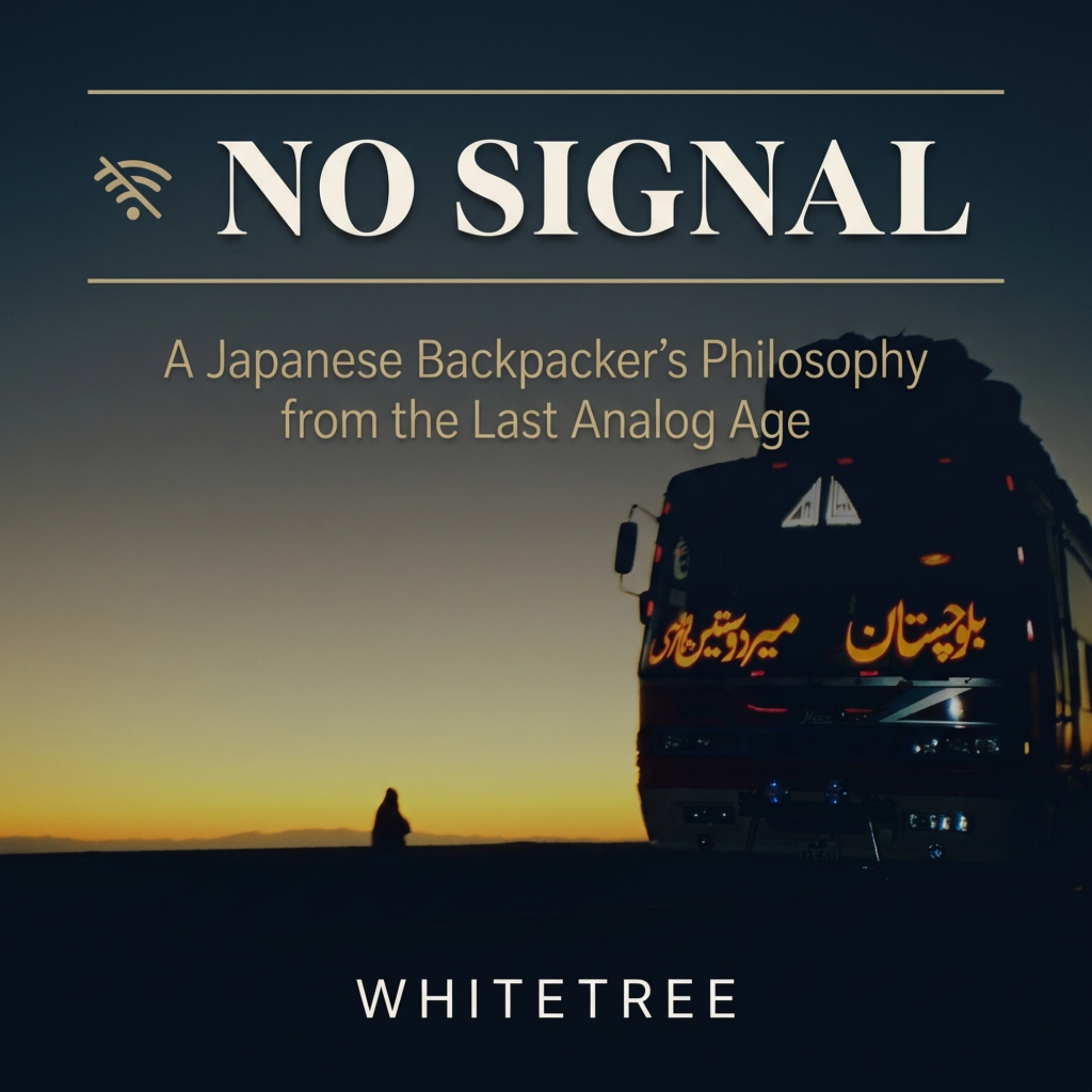
NO SIGNAL : A Japanese Backpacker's Philosophy from the Last Analog Age
by WHITETREE
Some journeys can't be Googled. Some lessons can't be streamed.In December 2000, Macy left Sapporo, Hokkaido with a rationed budget and zero digital safety net. Over 16 months, he hitchhiked Japan then crossed Asia overland — Korea, China, Southeast Asia, New Zealand, Turkey, Iran, Pakistan, and India.No Signal is a philosophical travel podcast unlike any other. The era: 2001, before smartphones, works as an antidote to our hyperconnected world. The perspective: a Japanese lens of surrendering to flow and finding meaning in friction. The tone: equal parts comedy and quiet philosophy.
-
11
Episode 8 — The Day He Mailed His Safety Net Away
It's 5:00 p.m. at Hakata Port ferry terminal. The phone is gone — boxed up and mailed back to his parents. The overnight ferry to Busan doesn't board for another 50 minutes. His newly ex-girlfriend sits beside him in silence. From somewhere in the line of Korean passengers drifts the sharp, unfamiliar smell of kimchi. The Asian continent is already arriving — before he's even moved.This episode explores:Surrender vs. control — what it means to stop forcing the journey and simply move within itThe razor-thin margins of analog travel — vulnerability, luck, and strangers with zero social filterThe physical act of untethering — why mailing a phone is not the same as airplane modeIn 2001, disconnecting wasn't a wellness practice. It was an irreversible act. What does it mean to remove every safety net — not just the digital ones, but the emotional ones too?Macy grew up in Hokkaido. He now guides small groups through its mountains, forests, and hidden cultural layers. Visit english.whitetree.jp
-
10
Episode 7 — The Night the Algorithm Couldn't Save Him
A warm home-cooked salmon breakfast. A freezing mountain highway with not a single car in sight. A stranger's bar, okonomiyaki, and laughter. This is one day in the life of a traveler with no digital safety net — and it contains more human experience than most of us encounter in a year.In Episode 7, Macy leaves the comfort of Dynaland Ski Resort — walking away from a tournament he could have won, a community he had built, and a life that was quietly becoming a beautiful cage. What follows is one of the most visceral days of his journey: stranded in the frozen dark of Hiroshima Prefecture, with no GPS, no app, and no plan except a bowl of hot soba and the decision to change his energy.Three themes explored in this episode: the danger of paradise and the Eastern philosophy of non-attachment; the collapse of the illusion of control and what raw surrender actually looks like; and the beautiful reciprocal economy of human connection that only friction can create.If an algorithm had optimized Macy's route that day, would the Hiroshima stranger have ever stopped?Macy grew up in Hokkaido. He now guides small groups through its mountains, forests, and hidden cultural layers. Visit english.whitetree.jp
-
9
Episode 6 — The Detour Actually Is the Path
What happens when your carefully planned map burns up — and the year is 2001?Macy is stranded in Osaka with an unexpected one-month gap, dwindling funds, and no smartphone to bail him out. What saves him isn't an app or a search engine. It's a single analog skill: the human connections forged through years of competitive mogul skiing. In just five hours, a chain of landline calls lands him a live-in job at a ski resort in Gifu Prefecture — proof that the Japanese proverb "art saves the body" is more than words.But getting there is another story. A massive Sea of Japan blizzard obliterates every plan, stranding friends across the country and forcing strangers into unexpected intimacy. A secret romance is revealed. A mountain pass is braved at dawn. And on the slopes, Macy's hidden physical prowess earns him instant respect — only to be tested again by an initiation ritual that blurs the line between bonding and endurance.This episode explores: the karmic safety net of dedicated craft, Eastern surrender to nature versus Western control, and why shared suffering builds unbreakable trust.If a digital blizzard wiped your phone tonight, what one raw analog skill would save you — and who would you call first?Macy grew up in Hokkaido. He now guides small groups through its mountains, forests, and hidden cultural layers. Visit english.whitetree.jp
-
8
Episode 5 — When the Universe Rewards You, Then Breaks You
He went to bed feeling at peace with the universe. Wild boar shared by a hearth. A crab that arrived in Osaka because of a love story that had nothing to do with him. Street-level enlightenment found in a sizzling okonomiyaki pancake — the exact joy the ancient temples of Kyoto had refused to give. Then the phone rang.This episode follows Macy through the final days of December 2000 and the first of January 2001 — from Nagoya to Osaka, through one of the most philosophically rich stretches of the journey. And then straight off a cliff.Three themes explored:The personal Y2K — what happens when you voluntarily strip away your own safety nets, and what older network you plug into insteadAnti-tourist enlightenment — why Macy felt nothing at the golden temples of Kyoto, and everything in front of a greasy iron griddleThe shadow side of surrender — when flowing with the universe means watching your entire plan dissolve in real timeWhen your most carefully laid plans collapse completely — who do you actually become in the silence that follows?Macy grew up in Hokkaido. He now guides small groups through its mountains, forests, and hidden cultural layers. Visit english.whitetree.jp
-
7
Episode 4 — The Ghost on the Mountain Pass
A man in a business suit and leather shoes is walking alone through a deserted mountain pass in the middle of winter. He hasn't been home in four days. He isn't lost — he made a choice. And that choice is about to collide with Macy's thumb on the side of the road.In this episode, three forces quietly reshape everything:En (縁) — the invisible thread that draws Macy back to the exact stretch of road in Kamakura where his journey truly began two years earlier, and delivers the precise stranger he needs at precisely the right momentMeiwaku (迷惑) — the weight of not asking — why a freezing, desperate man chose physical suffering over the social shame of accepting help, and what that reveals about a culture's deepest architectureIchigo Ichie (一期一会) — one encounter, one chance — what it means to save a stranger, then simply let him go into the dark without exchanging numbers, and why holding on would have ruined everythingIs our obsession with eliminating friction quietly eliminating fate itself?
-
6
Episode 3 — Lost on Purpose: The Case Against the Algorithm
You check out of your meticulously researched Airbnb. You follow the glowing blue line to a café rated exactly 4.8 stars. You order a ride from a driver whose license plate you already know. Safe. Efficient. And somehow, completely hollow.Episode 3 of No Signal asks the question that haunts modern travel: when we engineer every friction out of the journey, what exactly do we lose?Three themes explored:The serendipity paradox — why Macy's most memorable moments only happened because his plans completely fell apartThe emotional map — how burning a stranger's CDs in 2001 was an act of resistance against the algorithm before algorithms existedThe blank space — why getting hopelessly lost in the Tokyo subway was not a failure, but a practiceMacy carried an amulet from Yasukuni Shrine as he prepared to cross into Asia — not as a lucky charm, but as a conscious weight. A piece of his nation's unresolved history, held in his pocket as he walked toward it.What would happen if you turned off your GPS for just one hour?
-
5
Episode 2 — The Pride That Left Him Freezing in the Dark
It's December 23rd, 2000. A young backpacker stands shivering on a pitch-black Japanese highway, 30 kilograms on his back, lips turning blue — and twice refuses a warm bed offered by a stranger. Not because he can't accept it. But because accepting it would mean admitting who he isn't.This episode explores three interlocking themes: the hidden economy of hitchhiking — where miles are paid for in amateur therapy; the psychology of "perceived progress" and why we endure absurd hardship rather than take one step backward; and the moment Maslow's hierarchy of needs dismantles a carefully constructed identity in real time.From a heartbroken driver in snowy Niigata to a couple drowning in Christmas baby talk, to a convenience store bento box eaten like a wild animal — this is one freezing night that refuses to be forgotten.Is suffering a required ingredient for a memory to become foundational?
-
4
Episode 1 — Who Wrote the Script You're Living?
It's December 18, 2000. A hungover 22-year-old sprints through a port town, abandons his French fries, and barely makes the ferry — launching a 16-month journey across a continent. Not because of a burning philosophical vision. Because people kept asking if he was going to do it.This episode unpacks the beautifully chaotic, deeply unromantic truth of how grand adventures actually begin. Three themes explored:The Rocket Booster Theory — how one furious ski mentor accidentally rewrote a life trajectory through pure spite and a tantrumThe Jazz Session Economy — why hitchhiking is less about freedom and more about performing emotional intelligence under pressure for a stranger who controls your fateThe Hidden Mission — how rationed funds, a sleep-deprived cousin, and a painfully boring blind-date mixer reveal the unglamorous arithmetic of long-term travelHow many of the defining choices in your life — your career, your city, your path — were actually just a script that someone else accidentally wrote for you?
We're indexing this podcast's transcripts for the first time — this can take a minute or two. We'll show results as soon as they're ready.
No matches for "" in this podcast's transcripts.
No topics indexed yet for this podcast.
Loading reviews...
ABOUT THIS SHOW
Some journeys can't be Googled. Some lessons can't be streamed.In December 2000, Macy left Sapporo, Hokkaido with a rationed budget and zero digital safety net. Over 16 months, he hitchhiked Japan then crossed Asia overland — Korea, China, Southeast Asia, New Zealand, Turkey, Iran, Pakistan, and India.No Signal is a philosophical travel podcast unlike any other. The era: 2001, before smartphones, works as an antidote to our hyperconnected world. The perspective: a Japanese lens of surrendering to flow and finding meaning in friction. The tone: equal parts comedy and quiet philosophy.
HOSTED BY
WHITETREE
Loading similar podcasts...
Frequently Asked Questions
How many episodes does NO SIGNAL : A Japanese Backpacker's Philosophy from the Last Analog Age have?
NO SIGNAL : A Japanese Backpacker's Philosophy from the Last Analog Age currently has 8 episodes available on PodParley. New episodes are automatically indexed when they're published to the podcast feed.
What is NO SIGNAL : A Japanese Backpacker's Philosophy from the Last Analog Age about?
Some journeys can't be Googled. Some lessons can't be streamed.In December 2000, Macy left Sapporo, Hokkaido with a rationed budget and zero digital safety net. Over 16 months, he hitchhiked Japan then crossed Asia overland — Korea, China, Southeast Asia, New Zealand, Turkey, Iran, Pakistan, and...
How often does NO SIGNAL : A Japanese Backpacker's Philosophy from the Last Analog Age release new episodes?
NO SIGNAL : A Japanese Backpacker's Philosophy from the Last Analog Age has 8 episodes. Check the episode list to see recent publication dates and frequency.
Where can I listen to NO SIGNAL : A Japanese Backpacker's Philosophy from the Last Analog Age?
You can listen to NO SIGNAL : A Japanese Backpacker's Philosophy from the Last Analog Age on PodParley by clicking any episode. We provide an embedded audio player for direct listening, and you can also subscribe via your preferred podcast app using the RSS feed.
Who hosts NO SIGNAL : A Japanese Backpacker's Philosophy from the Last Analog Age?
NO SIGNAL : A Japanese Backpacker's Philosophy from the Last Analog Age is created and hosted by WHITETREE.
URL copied to clipboard!