
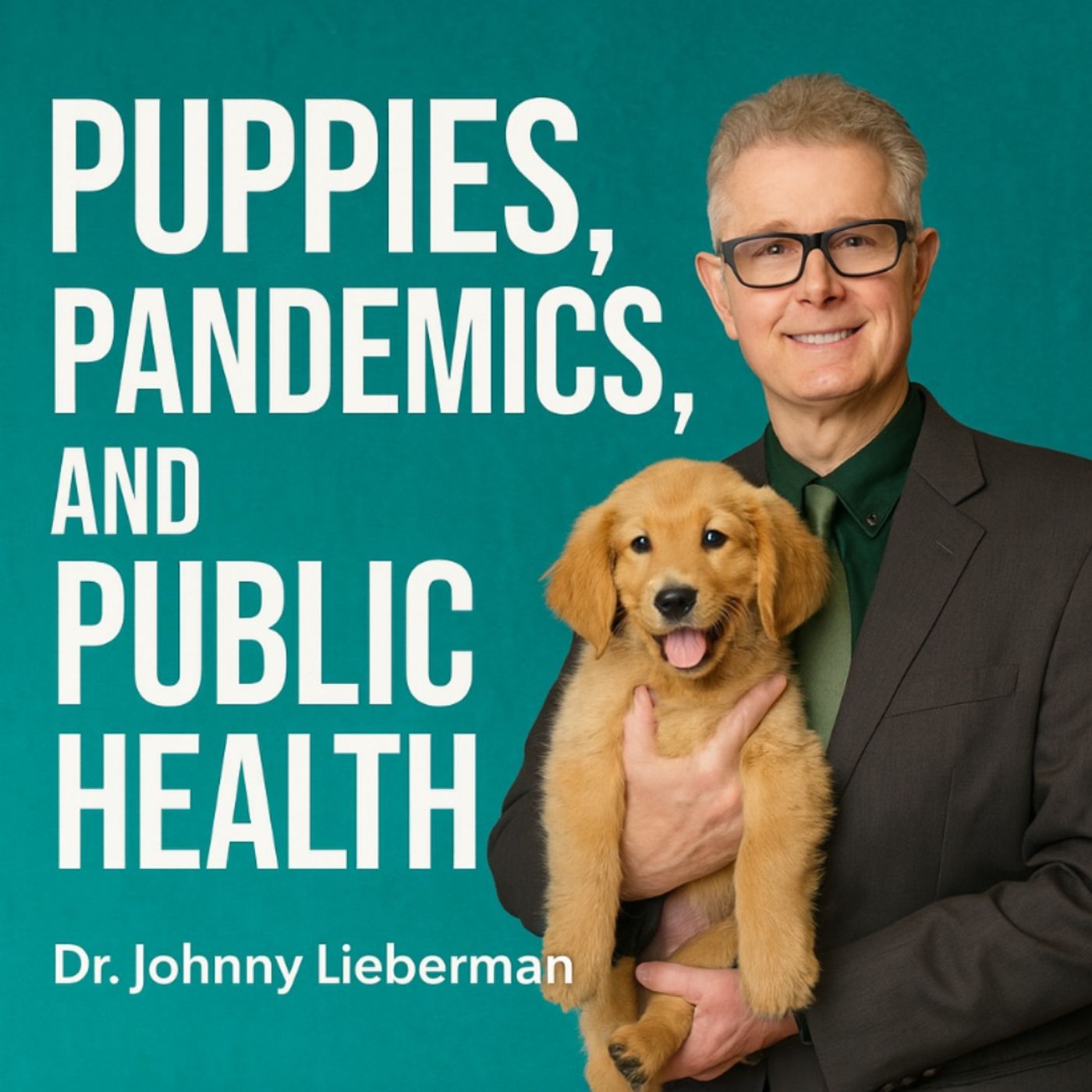
PODCAST · education
Puppies, Pandemics, and Public Health
by Dr. Johnny Lieberman
Welcome to Puppies, Pandemics, and Public Health—a podcast for smart, curious listeners who are tired of being misled by clickbait headlines and health fads. Hosted by Dr. Johnny Lieberman—internist, infectious diseases physician, accidental dog dad, and current law student—this show pulls back the curtain on the interconnected systems that shape our food, medicine, environment, and public health.From factory farms to pharmaceutical labs, from the dog in your home to the label on your lunch meat—what’s marketed as “healthy” or “humane” is often anything but. Each episode investigates the real stories behind the headlines: the science, the policy, the ethics, and the consequences.Dr. Lieberman brings a sharp, witty, no-fluff perspective—armed with over 20 years of medical experience and a deep drive to uncover truth. Through solo episodes, expert interviews, and roundtable discussions, you’ll learn how to navigate misinformation, advocate for better systems, and make decisions that al
-
17
Animal Research: Bad Science, and A Broken System: A Former Lab Researcher Speaks Out | Ep18
What if the system we rely on to develop life-saving medicines is fundamentally flawed, causing immense animal suffering while failing to produce reliable results for humans? In this powerful episode of Puppies, Pandemics, and Public Health, Dr. Johnny Lieberman speaks with Dr. Emily Trunnell, Director of Science Advancement and Outreach at PETA. A former neuroscience researcher who conducted experiments on rats and mice during her PhD, Dr. Trunnell reveals the shocking realities of lab animal research from dehydrated rats dying due to basic care failures and rats being forcibly intoxicated while lab workers joke about it, to Institutional Animal Care and Use Committees (IACUCs) acting as little more than rubber stamps. You’ll hear why more than 90% of drugs that pass animal tests still fail in human trials, the massive reproducibility crisis in animal research, species differences that make translation unreliable, and exciting non-animal methods (like organs-on-chips and AI modeling) that are already proving more human-relevant. This episode exposes a broken, self-regulated system and highlights the momentum toward modern, animal-free science that could accelerate medical progress while reducing harm. Top 3 Takeaways: The Animal Research Oversight System Is Broken and Self-Regulatory IACUCs are dominated by animal researchers who “police themselves.” They check minimal boxes under the Animal Welfare Act (which excludes 95–99% of animals like mice and rats), rarely question justifications for pain or multiple surgeries, and provide almost no real protection. Animal Experiments Are Poorly Reproducible and Rarely Translate to Humans Up to 89% of preclinical studies cannot be reproduced. 95% of drugs that succeed in animals fail in human clinical trials due to vast species differences, unnatural lab conditions, and publication bias that hides negative results. Modern Non-Animal Methods Are Superior and Already Available Technologies like organs-on-chips, organoids, and AI-driven in silico modeling use human cells and biology, deliver faster and more accurate results, and can replace animal tests with agencies like the FDA now actively working to make animal testing the exception rather than the rule. About the Guest: Dr. Emily Trunnell Dr. Emily Trunnell graduated Magna Cum Laude from the University of Georgia with a degree in Nutrition Science and earned her doctorate in Neuroscience from the University of Georgia in 2016. She is currently the Director of Science Advancement and Outreach at PETA, where she works to modernize science policy, scientific publishing practices, and university education to support the transition to animal-free research methods. A former animal researcher who conducted experiments on rats and mice during her PhD, Dr. Rinne lives with a passion for advancing human-relevant science that benefits both people and animals. 🔗 Learn more: scienceadvancement.org. About the Show: Puppies, Pandemics, and Public Health explores the intersection of animal welfare, public policy, and human health. Hosted by Dr. Johnny Lieberman, each episode invites changemakers, legal experts, and health advocates to shed light on what really impacts our communities and what we can do about it. About the Host: Dr. Johnny Lieberman is a physician, public health advocate, and lifelong animal lover with a passion for connecting the dots between animal welfare, human behavior, and the systems that shape our lives. With a background in both medicine and public health policy, Johnny brings a unique lens to conversations about how our treatment of animals impacts human health, the environment, and social justice. In Puppies, Pandemics, and Public Health, Johnny brings warmth, curiosity, and a dash of wit to tough conversations that matter. From exposing the realities of factory farming to uncovering the links between zoonotic diseases and our food systems, his goal is to empower listeners to be informed, compassionate, and engaged citizens while still keeping it real (and sometimes bringing in puppies). Whether he's discussing legislative loopholes or snuggling his rescue dog between recordings, Dr. Lieberman believes that creating a healthier world starts with how we treat its most vulnerable beings. Email: [email protected]
-
16
Foie Gras: Force-Feeding, Cruelty, and the Grassroots Fight to Ban a Diseased Delicacy | Ep17
What if the fancy appetizer on upscale menus is actually a diseased organ produced through daily torture? In this powerful episode of Puppies, Pandemics, and Public Health, host Dr. Johnny Lieberman sits down with Sam Schillinger, Oregon Campaign Director for Pro Animal Future. Sam shares his journey from growing up in Iowa’s factory farm heartland to becoming a full-time organizer fighting to end animal agriculture through policy change. The conversation dives deep into the hidden cruelty of foie gras production where birds are force fed via tubes multiple times a day, leading to organ perforation, extreme trauma, and mortality rates far higher than normal. Sam explains why Pro Animal Future is prioritizing bans on the sale and production of force fed foie gras through ballot initiatives and direct lobbying in Portland, Denver, and Washington DC. You’ll hear why political organizing and empowering people as voters (rather than just consumers) offers huge untapped potential for helping farmed animals, how public support often exceeds what legislators prioritize, and practical ways anyone can get involved from signing petitions and attending socials to joining signature gathering efforts like Goosapalooza in DC. Whether you’re concerned about animal suffering, food system ethics, or using democracy to create change, this episode is a compelling call to move beyond awareness into organized action. Top 3 Takeaways: Policy Change Through Political Organizing Has Massive Potential While many animal advocacy efforts focus on individual consumer choices, turning broad public support for animals into laws via ballot initiatives and lobbying is an underutilized but powerful lever that can create lasting systemic change. Foie Gras Is a Diseased Organ Produced Through Extreme Cruelty Ducks and geese are force fed massive amounts of food through tubes jammed down their throats up to three times daily until their livers become pathologically enlarged (up to 10x normal size), with high rates of organ perforation and mortality. This is not a natural or healthy product, it's a diseased liver marketed as a delicacy. Grassroots Power Works Even Against Industry Resistance Despite a recent committee setback in Portland, persistent advocacy is bringing the foie gras sales ban back to full city council. Meanwhile, Denver has already qualified a ban for the 2026 ballot, and DC is launching a major signature collection. Victories come from volunteers, community building, and sustained pressure on elected officials. About the Show: Puppies, Pandemics, and Public Health explores the intersection of animal welfare, public policy, and human health. Hosted by Dr. Johnny Lieberman, each episode invites changemakers, legal experts, and health advocates to shed light on what really impacts our communities and what we can do about it. About the Guest Sam Schillinger: Sam Schillinger is the Oregon Campaign Director for Pro Animal Future and a dedicated community organizer and animal advocate. Originally from Iowa, one of the nation’s top factory farming states, Sam studied philosophy in college, which prompted him to critically examine the ethics of our food system. After beginning as a petition circulator and briefly attending law school, he dropped out to pursue full-time advocacy for farmed animals. In his role with Pro Animal Future, Sam works with volunteers, voters, and elected officials to pass pro-animal policies, including efforts to ban the sale of force-fed foie gras in Portland. He is passionate about building political power for animals and turning public concern into enforceable laws. Outside of advocacy, Sam enjoys ultra-distance running, traveling, and theater. 🔗 Learn more: Pro Animal Oregon Pro-Animal Oregon Website: https://proanimaloregon.org/ Stampede: stampede.proanimal.org Meetup: https://www.meetup.com/pro-animal-oregon/ Link to join Signal Chat: https://signal.group/#CjQKIMcRPytTHn3iNlON_IlLUjUYBdTjdgP_l-8-lyY2vpIaEhCp7zIsQG99xu0j_9Kvlad7 Goosapalooza Registration: https://proanimal.org/goosa About the Host: Dr. Johnny Lieberman is a physician, public health advocate, and lifelong animal lover with a passion for connecting the dots between animal welfare, human behavior, and the systems that shape our lives. With a background in both medicine and public health policy, Johnny brings a unique lens to conversations about how our treatment of animals impacts human health, the environment, and social justice. In Puppies, Pandemics, and Public Health, Johnny brings warmth, curiosity, and a dash of wit to tough conversations that matter. From exposing the realities of factory farming to uncovering the links between zoonotic diseases and our food systems, his goal is to empower listeners to be informed, compassionate, and engaged citizens while still keeping it real (and sometimes bringing in puppies). Whether he's discussing legislative loopholes or snuggling his rescue dog between recordings, Dr. Lieberman believes that creating a healthier world starts with how we treat its most vulnerable beings. Email: [email protected]
-
15
Dogs in Research: Taxpayer Funded Suffering and the Push for Human Relevant Science | Ep16
What if the animal research you thought was saving lives was actually driven more by money and outdated methods than real scientific progress? In this powerful episode of Puppies, Pandemics, and Public Health, host Dr. Johnny Lieberman sits down with Jeremy Beckham, animal rights activist and third year law student at Lewis & Clark Law School. With over 20 years of advocacy experience including work with PETA, the Beagle Freedom Project, and the Physicians Committee for Responsible Medicine Jeremy reveals how the multi-billion-dollar animal research industry is disconnected from actual patient outcomes. From the shocking use of beagles in painful toxicity tests to the story of chimpanzees that led to a major policy shift, Jeremy explains why 92% of drugs that pass animal tests still fail in humans, how institutions prioritize grants and publications over results, and why non animal methods are often superior. He also shares hard-won victories, including campaigns that closed dog labs and shifted universities toward better science. Whether you’re a dog lover, a physician, a scientist, or simply someone who wants medical research that actually works, this episode is a must listen wake up call about where your tax dollars are going and how we can demand better for both animals and human health. Top 3 Takeaways: Animal Research Is Driven by Money, Not Results Research universities and breeding companies profit from massive federal grants and animal sales, but the system is untethered from delivering new therapies or cures for patients. Careers are built on publications, not real world outcomes. Most Drugs That Work in Animals Fail in Humans A shocking 92% of drugs deemed safe and effective in animal tests fail in human clinical trials. Meta analyses and real world examples like tobacco industry studies on beagles and monkeys show that animal data often misleads and delays progress. Public Pressure and Sunlight Work Campaigns exposing labs (including undercover footage from facilities like Ridglan Farms) and policy wins like ending chimpanzee research and the FDA Modernization Act show that scrutiny, advocacy, and shifting funding toward human relevant methods can create real change. About the Guest: Jeremy Beckham Jeremy Beckham is a third year law student at Lewis & Clark Law School in Portland, Oregon, and a dedicated animal rights activist with more than 20 years of experience. He has worked in various capacities for PETA’s laboratory investigations department, the Beagle Freedom Project (as Research Specialist), and the Physicians Committee for Responsible Medicine. Jeremy has managed major campaigns against dog labs (including at Texas A&M and the University of Utah), helped pass state legislation requiring labs to offer dogs for adoption instead of euthanasia, and participated in numerous Freedom of Information Act efforts to expose lab practices. He is passionate about using the law to advocate for better science and stronger protections for animals. After graduating, Jeremy plans to continue litigating on behalf of animal protection organizations and activists. LinkedIn: linkedin.com/in/jsbeckham About the Show: Puppies, Pandemics, and Public Health explores the intersection of animal welfare, public policy, and human health. Hosted by Dr. Johnny Lieberman, each episode invites changemakers, legal experts, and health advocates to shed light on what really impacts our communities and what we can do about it. About the Host: Dr. Johnny Lieberman is a physician, public health advocate, and lifelong animal lover with a passion for connecting the dots between animal welfare, human behavior, and the systems that shape our lives. With a background in both medicine and public health policy, Johnny brings a unique lens to conversations about how our treatment of animals impacts human health, the environment, and social justice. In Puppies, Pandemics, and Public Health, Johnny brings warmth, curiosity, and a dash of wit to tough conversations that matter. From exposing the realities of factory farming to uncovering the links between zoonotic diseases and our food systems, his goal is to empower listeners to be informed, compassionate, and engaged citizens while still keeping it real (and sometimes bringing in puppies). Whether he's discussing legislative loopholes or snuggling his rescue dog between recordings, Dr. Lieberman believes that creating a healthier world starts with how we treat its most vulnerable beings. Email: [email protected]
-
14
Making Your Voice Heard: Public Comments, Rulemaking, and Animal Welfare with Nicole Wood | Ep 15
What if you could directly shape the rules that govern factory farming, environmental protections, and more without ever running for office? In this eye-opening episode of Puppies, Pandemics, and Public Health, host Dr. Johnny Lieberman talks with Nicole Wood, a second-year law student at Lewis & Clark Law School focused on animal law and industrial agriculture reform. Nicole explains the rulemaking process, where agencies turn broad laws into enforceable details, and how anyone can submit public comments during open periods to make their perspective count. Drawing from their own journey from growing up around family farms to becoming a vegan advocate and active commenter on issues like feedlot pollution Nicole demystifies terms like "humane washing" and "greenwashing," exposes misleading industry labels, and offers practical steps: using regulations.gov and federalregister.gov, crafting persuasive comments with personal testimony and facts, and even building records for future legal challenges. Whether you're passionate about animal rights, the environment, public health, or any regulated issue, this episode empowers you to move beyond frustration and into action balancing industry influence with your voice as a consumer, parent, or concerned citizen. Top 3 Takeaways: Public Comment Periods Are Open to Everyone When agencies propose or update rules (under laws they've been tasked to implement), they must open a notice-and-comment period anyone can submit input via regulations.gov. No expertise or direct impact required; your perspective adds visibility and can influence outcomes. Persuasive Comments Combine Personal Testimony and Facts Start with who you are and why the issue matters to you (e.g., as a consumer or parent), then back it up with evidence, studies, or corrections to agency claims. Agencies review and often respond to comments in groups when finalizing rules; strong, fact-based input carries real weight. "Humane Washing" and "Greenwashing" Exploit Consumer Values Labels like "cage-free" or "climate-friendly" often mislead chickens may still be overcrowded and stressed, or companies claim net-zero goals without plans or tech to achieve them (as in Tyson's settled case). Research beyond marketing; public comments help challenge these gaps in regulation. About the Guest: Nicole Wood is a second year JD student at Lewis & Clark Law School, specializing in animal law with a focus on challenging industrial animal agriculture through regulatory advocacy, consumer protection, and environmental law. A longtime vegan advocate, Nicole serves as Symposium Editor for the Animal Law Review, External Projects Chair for the Animal Legal Defense Fund student chapter, and has contributed to public comments on issues like feedlot pollution permits. Their pre-law experience in financial compliance sharpened their eye for regulatory gaps, driving their commitment to corporate transparency and animal protection. Nicole is a 2025-26 Law Scholars for Change recipient for their dedication to farmed animal advocacy. Websites: ALDF: Animal Rights and Welfare : https://aldf.org/article/take-action/ Food and Water Watch: Clean Water, Climate Change, Wildlife Protection, Fighting Factory Farms: https://www.foodandwaterwatch.org/get-involved/ Center for Food Safety: Pesticides, Clean Water, Fighting Factory Farms, Wildlife Protection: https://www.centerforfoodsafety.org/policy-comments New comment opportunities in press releases: https://www.centerforfoodsafety.org/news Brooks Institute: Animal Rights and Welfare : https://thebrooksinstitute.org/subscribe About the Show: Puppies, Pandemics, and Public Health explores the intersection of animal welfare, public policy, and human health. Hosted by Dr. Johnny Lieberman, each episode invites changemakers, legal experts, and health advocates to shed light on what really impacts our communities—and what we can do about it. About the Host: Dr. Johnny Lieberman is a physician, public health advocate, and lifelong animal lover with a passion for connecting the dots between animal welfare, human behavior, and the systems that shape our lives. With a background in both medicine and public health policy, Johnny brings a unique lens to conversations about how our treatment of animals impacts human health, the environment, and social justice. In Puppies, Pandemics, and Public Health, Johnny brings warmth, curiosity, and a dash of wit to tough conversations that matter. From exposing the realities of factory farming to uncovering the links between zoonotic diseases and our food systems, his goal is to empower listeners to be informed, compassionate, and engaged citizens while still keeping it real (and sometimes bringing in puppies). Whether he's discussing legislative loopholes or snuggling his rescue dog between recordings, Dr. Lieberman believes that creating a healthier world starts with how we treat its most vulnerable beings. Connect with Dr. Johnny Lieberman Email: [email protected]
-
13
My Origin Story: From Infectious Disease Doctor to Animal Advocate | Ep14
What happens when a life-changing bond with a dog reshapes your entire career? In this intimate origin story episode of Puppies, Pandemics, and Public Health, host Dr. Johnny Lieberman opens up about his transformation from a thriving infectious disease physician in Colorado to a law student in Oregon focused on animal welfare. Drawing from over two decades in medicine, Johnny recounts how adopting his first dog, Celeste, ignited a passion for animal rights, leading him to confront issues like puppy mills, factory farming, and systemic flaws in healthcare. From navigating personal loss and depression to volunteering against animal exploitation and rebooting his life during the COVID-19 surge, Johnny reveals the tipping points that shifted his focus to One Health, a framework connecting animal welfare, human health, and the environment. He also exposes healthcare industry pitfalls, like profit-driven decisions that deny care to high-risk patients. Whether you're a healthcare professional, animal lover, or someone contemplating a career pivot, this episode inspires reflection on identity, compassion, and making systemic change for a better world. Top 3 Takeaways: The Power of the Human-Animal Bond: A deep connection with dogs like Celeste and Sienna can profoundly change your perspective, teaching presence, empathy, and the joys of rescue, while exposing hidden cruelties like puppy mills. Healthcare's Hidden Conflicts: Profit motives in medicine, such as value-based purchasing systems, often prioritize hospital scores over patient needs, leading to denied surgeries for high-risk individuals and a broken system driving early retirements. Embracing One Health for Systemic Change: Animal welfare, human health, and environmental management are interconnected; shifting careers to advocate in this space can leverage skills like medical expertise to reduce suffering and create a broader positive impact. About the Show Puppies, Pandemics, and Public Health explores the intersection of animal welfare, public policy, and human health. Hosted by Dr. Johnny Lieberman, each episode invites changemakers, legal experts, and health advocates to shed light on what really impacts our communities—and what we can do about it. About the Host Dr. Johnny Lieberman is a physician, public health advocate, and lifelong animal lover with a passion for connecting the dots between animal welfare, human behavior, and the systems that shape our lives. With a background in both medicine and public health policy, Johnny brings a unique lens to conversations about how our treatment of animals impacts human health, the environment, and social justice. In Puppies, Pandemics, and Public Health, Johnny brings warmth, curiosity, and a dash of wit to tough conversations that matter. From exposing the realities of factory farming to uncovering the links between zoonotic diseases and our food systems, his goal is to empower listeners to be informed, compassionate, and engaged citizens—while still keeping it real (and sometimes bringing in puppies). Whether he's discussing legislative loopholes or snuggling his rescue dog between recordings, Dr. Lieberman believes that creating a healthier world starts with how we treat its most vulnerable beings. Connect with Dr. Johnny Lieberman : Email: [email protected]
-
12
You Are What You Eat: One Health Plant Based Nutrition and How Your Food Choices Impact Others with Dr. Faraz Harsini | Ep13
What if your daily food choices could prevent pandemics, protect the planet, and end unnecessary animal suffering? In this eye-opening episode of Puppies, Pandemics, and Public Health, host Dr. Johnny Lieberman chats with Dr. Faraz Harsini, a biomedical scientist and CEO of Allied Scholars for Animal Protection. With a background in cancer research, zoonotic diseases, and sustainable food systems, Dr. Harsini shares his journey from a meat-eating background to vegan advocacy, exposing the hidden costs of animal farming, from environmental destruction and public health risks to the ethical horrors of factory farming. They dive into cognitive dissonance, the myth of "humane" animal products, and innovative solutions like cultivated meat that offer the same taste without the harm. Dr. Harsini emphasizes One Health: a way to live prosperously while respecting human, animal, and environmental well-being. Whether you're a health enthusiast, environmentalist, or animal lover, this episode empowers you to make informed, compassionate choices that align with your values, and shows how small changes can create massive impact. Top 3 Takeaways One Health Connects Us All Human health, animal welfare, and environmental sustainability are interconnected. We can thrive without harming animals or the planet by shifting to plant-based diets and sustainable alternatives. Cognitive Dissonance in Food Choices Many people love animals but consume products from industries that exploit them. Recognizing this hypocrisy, often rooted in marketing and habit, can lead to ethical, healthier decisions. Cultivated Meat: A Game-Changer Real meat grown from cells eliminates animal suffering, antibiotics, and environmental waste. It's a cruelty-free option that tastes the same, with massive potential for public health and sustainability. About the Guest – Dr. Faraz Harsini, PhD Dr. Faraz Harsini is a biomedical scientist and the Founder and CEO of Allied Scholars for Animal Protection (ASAP), a nonprofit that mentors students in animal advocacy, environmental protection, and public health. He also serves as a Senior Scientist in Bioprocessing at the Good Food Institute, focusing on cultivated meat. With a bachelor's in chemical engineering, a master's in biotechnology and cancer research, and a PhD in cell physiology and molecular biophysics, Dr. Harsini has worked on zoonotic diseases, pandemics, and sustainable food systems. A vegan for over a decade, he advocates for One Health and ethical living. 🔗 Read more about Dr. Harsini: https://farazharsini.com About the Show Puppies, Pandemics, and Public Health explores the intersection of animal welfare, public policy, and human health. Hosted by Dr. Johnny Lieberman, each episode invites changemakers, legal experts, and health advocates to shed light on what really impacts our communities—and what we can do about it. About the Host Dr. Johnny Lieberman is a physician, public health advocate, and lifelong animal lover with a passion for connecting the dots between animal welfare, human behavior, and the systems that shape our lives. With a background in both medicine and public health policy, Johnny brings a unique lens to conversations about how our treatment of animals impacts human health, the environment, and social justice. In Puppies, Pandemics, and Public Health, Johnny brings warmth, curiosity, and a dash of wit to tough conversations that matter. From exposing the realities of factory farming to uncovering the links between zoonotic diseases and our food systems, his goal is to empower listeners to be informed, compassionate, and engaged citizens—while still keeping it real (and sometimes bringing in puppies). Whether he's discussing legislative loopholes or snuggling his rescue dog between recordings, Dr. Lieberman believes that creating a healthier world starts with how we treat its most vulnerable beings.
-
11
Inside Animal Research Labs: The Hidden Human and Animal Costs with Madeline Krasno | Ep12
What if the "necessary" animal research we rely on is breaking the people who conduct it?In this episode of Puppies, Pandemics, and Public Health, host Dr. Johnny Lieberman speaks with Madeline Krasno, Executive Director of Justify and a former primate lab caretaker at UW Madison. Drawing from her two years caring for over 500 monkeys, preparing minimal "enrichment," administering meds, and witnessing daily stress and injuries. Madeline exposes the moral injury and compassion fatigue that plague lab workers. She shares how her experiences led to free speech lawsuits against UW Madison and the NIH, sparking national conversations on transparency. The discussion dives into systemic issues: stressed animals yielding unreliable data (with ~100% failure rates in human translation), lack of enforcement for violations, and the urgent need to shift toward animal-free technologies. Madeline also explains Justify's mission to support lab workers through confidential spaces, resources, and community-building to heal and advocate for change. This episode challenges assumptions about animal experimentation's validity and ethics, highlighting its links to human health, worker well-being, and public policy.Top 3 TakeawaysLab Workers Face Profound Psychological Harm: Caretakers in animal research endure moral injury and compassion fatigue from witnessing suffering, with little support, highlighting that humans, too, pay a heavy price in this system.Animal Suffering in Labs Undermines Scientific Validity: Monkeys and other animals live in tiny cages under constant stress, leading to unreliable data; nearly 100% of experiments fail to translate to humans, questioning the necessity of such research.Enforcement and Transparency Are Severely Lacking: Violations like injuries or poor conditions often go unpunished with just "slaps on the wrist," while whistleblowers face retaliation—calling for better oversight and a shift to ethical, non-animal methods. About the Guest – Madeline Krasno Madeline Krasno is a former primate lab worker turned advocate for compassion and transparency in science. Her successful free speech lawsuits against UW Madison and the NIH, featured in the Washington Post, sparked national dialogue about the hidden human and animal costs of experimentation. Today, she is Executive Director and co-founder of Justify, a nonprofit creating space for current and former animal research professionals to process their experiences, reclaim their voices, and help build a more ethical, human-relevant future in science. Madeline holds a master's degree in Humane Education from Valparaiso University and a dual bachelor's degree in Zoology and Child Development from the University of Wisconsin-Madison. Her background spans animal care, wildlife rehabilitation, curriculum development, public speaking, outreach, and community building. 🔗 Read more about Madeline Krasno:Website: https://whenwejustify.orgLinkedIn: https://www.linkedin.com/in/madelinekrasnoInstagram: @justify.globalAbout the ShowPuppies, Pandemics, and Public Health explores the intersection of animal welfare, public policy, and human health. Hosted by Dr. Johnny Lieberman, each episode invites changemakers, legal experts, and health advocates to shed light on what really impacts our communities—and what we can do about it.About the Host: Dr. Johnny Lieberman is a physician, public health advocate, and lifelong animal lover with a passion for connecting the dots between animal welfare, human behavior, and the systems that shape our lives. With a background in both medicine and public health policy, Johnny brings a unique lens to conversations about how our treatment of animals impacts human health, the environment, and social justice.In Puppies, Pandemics, and Public Health, Johnny brings warmth, curiosity, and a dash of wit to tough conversations that matter. From exposing the realities of factory farming to uncovering the links between zoonotic diseases and our food systems, his goal is to empower listeners to be informed, compassionate, and engaged citizens—while still keeping it real (and sometimes bringing in puppies).Whether he's discussing legislative loopholes or snuggling his rescue dog between recordings, Dr. Lieberman believes that creating a healthier world starts with how we treat its most vulnerable beings.
-
10
The Truth About Puppy Mills Pet Stores Don’t Want You to Know | Ep11
If you've ever considered buying a puppy from a pet store or online, this episode will change your perspective forever.Dr. Johnny Lieberman sits down with seasoned undercover investigator Pete Paxton to uncover the grim realities of puppy mills, the massive breeding operations that supply pet stores with dogs raised in filth, neglect, and suffering. Pete shares firsthand accounts from over two decades of investigations, including wire cages piled with feces, dogs driven "cage crazy," and breeders who prioritize profit over welfare. The conversation exposes how pet stores mislead consumers with glossy ads and false claims of "reputable breeders," while USDA inspections often fail to enforce even basic standards due to inherent conflicts of interest.Beyond the shock, Dr. Lieberman and Pete discuss the broader implications: the health risks to puppies (and buyers), the environmental ties to climate disasters increasing shelter overcrowding, and why adoption from shelters or fosters saves lives and provides better-matched, healthier pets. This episode empowers listeners to make compassionate choices, reject the "adopt don't shop" myths, and support real solutions like volunteering and fostering, without judgment, but with eye-opening facts.Top 3 TakeawaysAdopt, Don't Shop: When seeking a new dog, prioritize adoption from shelters or foster-based rescues over pet stores or online sellers. This saves lives from overcrowded shelters, avoids supporting puppy mills' cruelty, and often provides healthier, better-socialized pets with known personalities. Research local options, visit, and match based on your lifestyle for a fulfilling bond. Focus on Personality Over Breed: Ignore breed stereotypes when choosing a dog; emphasize personality traits that fit your family, like energy level or compatibility with kids/pets. Shelters assess and train dogs for better matches, reducing behavioral issues. Volunteer at rescues to observe firsthand, ensuring a happier, more suitable companion without fueling profit-driven breeding. Volunteer or Foster to Help: Combat puppy mill cruelty by volunteering at shelters: walk dogs, assist with training, or foster temporarily to free space and prepare pets for adoption. This directly saves lives amid rising disasters displacing animals. Start small, contact local groups like Humane Society, and contribute time over money for ethical impact. About the Guest:Pete Paxton is the Director of Investigations at SEED (Strategies for Ethical and Environmental Development), where he leads animal cruelty investigations focused on factory farms and pollution. With over two decades of experience since 2001, Pete has gone undercover at puppy mills, pet stores, slaughterhouses, and commercial fishing operations. His work has been featured in HBO documentaries like Dealing Dogs and Death on a Factory Farm, as well as National Geographic's Animal Undercover. He is co-author of the book Rescue Dogs, which outlines solutions to animal exploitation. Websites: ethicalstrategies.org, humaneworld.org, and capweb.org.About the ShowPuppies, Pandemics, and Public Health explores the intersection of animal welfare, public policy, and human health. Hosted by Dr. Johnny Lieberman, each episode invites changemakers, legal experts, and health advocates to shed light on what really impacts our communities—and what we can do about it.About the HostDr. Johnny Lieberman is a physician, public health advocate, and lifelong animal lover with a passion for connecting the dots between animal welfare, human behavior, and the systems that shape our lives. With a background in both medicine and public health policy, Johnny brings a unique lens to conversations about how our treatment of animals impacts human health, the environment, and social justice.In Puppies, Pandemics, and Public Health, Johnny brings warmth, curiosity, and a dash of wit to tough conversations that matter. From exposing the realities of factory farming to uncovering the links between zoonotic diseases and our food systems, his goal is to empower listeners to be informed, compassionate, and engaged citizens—while still keeping it real (and sometimes bringing in puppies).Whether he's discussing legislative loopholes or snuggling his rescue dog between recordings, Dr. Lieberman believes that creating a healthier world starts with how we treat its most vulnerable beings.
-
9
Eyewitness to Cruelty Inside Factory Farms and Fish Hatcheries | Ep10
If you’ve ever trusted a label at the grocery store—cage-free, humane, organic—this episode will challenge everything you think you know.Dr. Johnny Lieberman welcomes undercover investigator Erin Wing, who spent years working inside factory farms to document what the animal agriculture industry works aggressively to conceal. What Erin describes is not isolated abuse, but standard operating procedure: chickens packed by the tens of thousands into dark sheds filled with toxic ammonia fumes, dairy cows repeatedly impregnated, separated from their calves, beaten when their bodies give out, and salmon raised in overcrowded tanks swimming in their own waste while disease spreads unchecked.This conversation moves beyond shock value. It confronts the deeper systems at play—how animals are reduced to units of production, how consumer labels are engineered to soothe guilt rather than reflect reality, and how emotional distance allows cruelty to become normalized.Dr. Lieberman and Erin explore the moral cost of convenience, the public health implications of industrial farming, and the difficult but necessary role of undercover investigations in exposing truth. The episode doesn’t demand perfection—but it does insist on honesty, awareness, and informed choice.Key Themes & TakeawaysWhat undercover investigations reveal when no one thinks they’re being watchedWhy “humane,” “cage-free,” and “natural” labels often hide more than they revealThe physical and emotional suffering built into industrial chicken, dairy, and fish farmingHow dairy cows and their calves are systematically separated—and why it mattersThe hidden public health risks of animals raised in filth and overcrowdingWhy consumer ignorance is not accidental—but engineeredWhat informed choice really looks like when the truth is uncomfortableAbout the GuestErin Wing is an undercover investigator and animal advocate with Animal Outlook. Erin has spent years working inside chicken farms, dairy operations, and salmon hatcheries to document conditions the animal agriculture industry works aggressively to keep hidden. Their investigations have helped expose systemic cruelty, inform legal advocacy, and empower consumers with truth.To learn more about Erin’s work and ongoing investigations, visit animaloutlook.org.About the ShowPuppies, Pandemics, and Public Health explores the intersection of animal welfare, public policy, and human health. Hosted by Dr. Johnny Lieberman, each episode invites changemakers, legal experts, and health advocates to shed light on what really impacts our communities—and what we can do about it.About the HostDr. Johnny Lieberman is a physician, public health advocate, and lifelong animal lover with a passion for connecting the dots between animal welfare, human behavior, and the systems that shape our lives. With a background in both medicine and public health policy, Johnny brings a unique lens to conversations about how our treatment of animals impacts human health, the environment, and social justice.In Puppies, Pandemics, and Public Health, Johnny brings warmth, curiosity, and a dash of wit to tough conversations that matter. From exposing the realities of factory farming to uncovering the links between zoonotic diseases and our food systems, his goal is to empower listeners to be informed, compassionate, and engaged citizens—while still keeping it real (and sometimes bringing in puppies).Whether he's discussing legislative loopholes or snuggling his rescue dog between recordings, Dr. Lieberman believes that creating a healthier world starts with how we treat its most vulnerable beings.
-
8
Chickens Are Individuals: Inside the Hidden Costs of Industrial Egg Production | Ep9
What if the biggest problem with the egg industry isn’t just how chickens are housed—but how we’ve learned not to see them at all?Dr. Johnny Lieberman welcomes Joyce Tischler, Professor of Law and co-founder of the Animal Legal Defense Fund, to unpack the realities of modern industrial egg production. Drawing from decades of legal work—and a recent personal experience rescuing chickens from a closing egg facility—Joyce explains how breeding, confinement, and misleading consumer labels obscure the profound suffering embedded in “cheap” animal products.The conversation reframes chickens not as interchangeable units of production, but as individuals with personalities, social structures, and emotional responses—beings whose bodies have been genetically pushed beyond their limits to maximize output. Together, they challenge common assumptions about “organic,” “cage-free,” and “free-range” labels, exposing how little those terms actually improve animal welfare.This episode invites listeners to question long-held narratives, confront cognitive dissonance around food choices, and consider small, realistic ways to reduce harm—whether by rethinking egg consumption, seeking local sources, or simply seeing farm animals more clearly for who they are.Key Themes & TakeawaysChickens are individuals with distinct personalities and behaviorsHow selective breeding harms animals long before slaughterWhy “organic” and “cage-free” labels often mislead consumersThe physical toll of extreme egg production on hensHow factory farming depends on emotional and physical distancingThe role of cognitive dissonance in food choicesWhy true humane egg production is rare—and hard to verifyPractical ways consumers can reduce harm without perfectionAbout the GuestJoyce Tischler is a Professor of Law and co-founder of the Animal Legal Defense Fund. Her work focuses on animal law, industrial agriculture, and the legal systems that govern how animals are bred, raised, and commodified. Joyce has spent decades challenging factory farming practices and is currently co-authoring a first-of-its-kind casebook on industrial animal agriculture law.About the ShowPuppies, Pandemics, and Public Health explores the intersection of animal welfare, public policy, and human health. Hosted by Dr. Johnny Lieberman, each episode invites changemakers, legal experts, and health advocates to shed light on what really impacts our communities—and what we can do about it.About the HostDr. Johnny Lieberman is a physician, public health advocate, and lifelong animal lover with a passion for connecting the dots between animal welfare, human behavior, and the systems that shape our lives. With a background in both medicine and public health policy, Johnny brings a unique lens to conversations about how our treatment of animals impacts human health, the environment, and social justice.In Puppies, Pandemics, and Public Health, Johnny brings warmth, curiosity, and a dash of wit to tough conversations that matter. From exposing the realities of factory farming to uncovering the links between zoonotic diseases and our food systems, his goal is to empower listeners to be informed, compassionate, and engaged citizens—while still keeping it real (and sometimes bringing in puppies).Whether he's discussing legislative loopholes or snuggling his rescue dog between recordings, Dr. Lieberman believes that creating a healthier world starts with how we treat its most vulnerable beings.
-
7
Cultivated Meat, Consumer Choice, and the Politics of Food with Hira Jaleel | Ep8
What happens when innovation collides with politics, fear, and entrenched industry power?Dr. Johnny Lieberman welcomes Hira Jaleel—legal scholar and food systems researcher—to explore the rapidly evolving world of cultivated meat (also known as cell-cultured meat). Far from hype or sci‑fi fantasy, cultivated meat is positioned as one potential tool—not a silver bullet—for addressing the harms of industrial animal agriculture, including animal suffering, environmental pollution, and public health risks.The conversation walks listeners through how cultivated meat is produced, why it eliminates many systemic risks of conventional meat production, and why eight U.S. states have moved to ban its sale altogether. Hira explains the regulatory framework, the massive subsidy imbalance favoring conventional meat, and the constitutional challenges now unfolding in courts.Throughout the episode, Dr. Lieberman reframes the debate: not as “natural vs. unnatural,” but as a question of transparency, consumer sovereignty, and whether the public is being protected—or shielded from choice.Key Themes & TakeawaysWhy the U.S. food system is structurally broken—and what role industrial animal agriculture playsWhat cultivated meat actually is (and common misconceptions)The public health implications of conventional meat: zoonotic disease, antibiotics, and contaminationThe true scale of subsidies propping up factory farmingWhy state bans on cultivated meat may be unconstitutionalConsumer choice vs. agricultural protectionismWhy neutral, rigorous regulation matters more than political fear\About the Guest – Hira JaleelHira Jaleel is a legal scholar whose work focuses on food systems, animal law, and constitutional issues at the intersection of public policy and innovation. Her research examines how emerging food technologies—like cultivated meat—are regulated, challenged, and sometimes blocked by state and federal law. Hira brings a rigorous, non‑ideological lens to debates about consumer choice, competition, and the future of food.About the ShowPuppies, Pandemics, and Public Health explores the intersection of animal welfare, public policy, and human health. Hosted by Dr. Johnny Lieberman, each episode invites changemakers, legal experts, and health advocates to shed light on what really impacts our communities—and what we can do about it.About the HostDr. Johnny Lieberman is a physician, public health advocate, and lifelong animal lover with a passion for connecting the dots between animal welfare, human behavior, and the systems that shape our lives. With a background in both medicine and public health policy, Johnny brings a unique lens to conversations about how our treatment of animals impacts human health, the environment, and social justice.In Puppies, Pandemics, and Public Health, Johnny brings warmth, curiosity, and a dash of wit to tough conversations that matter. From exposing the realities of factory farming to uncovering the links between zoonotic diseases and our food systems, his goal is to empower listeners to be informed, compassionate, and engaged citizens—while still keeping it real (and sometimes bringing in puppies).Whether he's discussing legislative loopholes or snuggling his rescue dog between recordings, Dr. Lieberman believes that creating a healthier world starts with how we treat its most vulnerable beings.
-
6
Rethinking Farmed Animal Welfare — Laws, Loopholes & What the Public Doesn’t Know | Ep7
What protections do farmed animals actually have in the United States?As attorney and Farm Sanctuary General Counsel Cynthia Von Schlichten explains — far less than the public believes.In this eye-opening episode, Dr. Johnny Lieberman uncovers how federal laws governing farmed animals are filled with exclusions, loopholes, and industry-written exceptions that leave billions of chickens, pigs, cows, and turkeys without meaningful protection at any stage of their lives.Cynthia breaks down:Why 95%+ of animals slaughtered for food (birds) are excluded from the U.S. humane slaughter lawHow the 28-Hour Law — the only federal transport protection — is rarely enforced and excludes entire speciesWhy mass-execution methods like Ventilation Shutdown Plus are not only legal, but paid for by taxpayersHow industry standards allow painful procedures like tail docking, beak removal, castration, and forced molting without anesthesiaWhy government inspectors are being replaced with plant employees — and what that means for animals and food safetyThis episode challenges the assumptions most people carry about animal agriculture and offers practical steps listeners can take to reduce harm — from supporting local farms to advocating for stronger laws.Top 3 Takeaways1. Most Farmed Animals Aren’t Protected by Federal LawChickens — who make up 95% of all animals slaughtered for food — are excluded from the Humane Methods of Slaughter Act.2. Transport “Protections” Are Barely EnforcedThe 28-Hour Law sounds humane, but in practice, animals routinely travel long distances without food, water, or rest.3. Taxpayers Fund Mass-Kill EventsVentilation Shutdown Plus — which kills animals through heat and suffocation — is legal, widely used, and heavily subsidized by government payments.About the Guest – Cynthia Von Schlichten, LLMCynthia Von Schlichten is the Senior Manager of Legal Affairs for Farm Sanctuary, where she leads legal strategy on rescues, cruelty cases, and policy reform. A practicing attorney for over a decade, Cynthia has worked across the animal rights spectrum, including roles at the American Anti-Vivisection Society and Compassion in World Farming. She is an active member of the ABA’s Animal Law Committee and has drafted municipal legislation to protect animals.For over 20 years, Cynthia has been a vegan and fierce advocate for animal rights, with a mission to give animals a voice in our legal system.🔗 Read more about Cynthia About the ShowPuppies, Pandemics, and Public Health explores the intersection of animal welfare, public policy, and human health. Hosted by Dr. Johnny Lieberman, each episode invites changemakers, legal experts, and health advocates to shed light on what really impacts our communities—and what we can do about it. About the HostDr. Johnny Lieberman is a physician, public health advocate, and lifelong animal lover with a passion for connecting the dots between animal welfare, human behavior, and the systems that shape our lives. With a background in both medicine and public health policy, Johnny brings a unique lens to conversations about how our treatment of animals impacts human health, the environment, and social justice.In Puppies, Pandemics, and Public Health, Johnny brings warmth, curiosity, and a dash of wit to tough conversations that matter. From exposing the realities of factory farming to uncovering the links between zoonotic diseases and our food systems, his goal is to empower listeners to be informed, compassionate, and engaged citizens—while still keeping it real (and sometimes bringing in puppies).Whether he's discussing legislative loopholes or snuggling his rescue dog between recordings, Dr. Lieberman believes that creating a healthier world starts with how we treat its most vulnerable beings.
-
5
Rethinking Animal Testing — Innovation, Futility, and Hope with Dr. Zaher Nahle | Ep6
What if the research model we’ve trusted for nearly a century is holding back medical progress?In this powerful conversation, Dr. Johnny Lieberman speaks with Dr. Zaher Nahle, former lab scientist turned policy innovator, about how outdated animal testing continues to waste billions in taxpayer dollars, delay life-saving treatments, and perpetuate unnecessary suffering.Dr. Nahle shares his personal journey from leading animal-based studies to realizing their futility—highlighting the shocking 95% clinical failure rate for drugs that pass animal trials. Together, they unpack why this system persists, the political and financial barriers to change, and how non-animal testing methods (NAMs) are transforming drug development.From AI modeling and organ-on-a-chip technology to the FDA Modernization Act 2.0, this episode reveals a hopeful path forward—and calls on every listener to speak up for smarter, more humane science.Top 3 TakeawaysAnimal Testing Fails 95% of the TimeDespite decades of use, animal models rarely predict human outcomes. This inefficiency wastes time, money, and lives.Non-Animal Methods Are the FutureThe FDA now allows the use of NAMs—New Approach Methodologies—including AI modeling and organ-on-a-chip systems that mimic real human biology.Public Engagement Drives ChangeProgress depends on advocacy. Contact your lawmakers and support organizations like the Center for Humane Economy to demand funding for modern, human-relevant research.About the Guest – Dr. Zaher NahleDr. Zaher Nahle is a biomedical scientist and policy expert with a PhD in Physiology and Biophysics from Stony Brook University and Cold Spring Harbor Laboratory. A former lab leader at Weill Cornell and Vanderbilt, Dr. Nahle now serves as Senior Scientific Advisor to the Center for Humane Economy and Animal Wellness Action, championing innovation and ethics in science. His work has helped drive legislation like the FDA Modernization Act 2.0, advancing alternatives to animal testing.🔗 Learn more: Center for Humane EconomyAbout the ShowPuppies, Pandemics, and Public Health explores the intersection of animal welfare, public policy, and human health. Hosted by Dr. Johnny Lieberman, each episode invites changemakers, legal experts, and health advocates to shed light on what really impacts our communities—and what we can do about it.About the HostDr. Johnny Lieberman is a physician, public health advocate, and lifelong animal lover with a passion for connecting the dots between animal welfare, human behavior, and the systems that shape our lives. With a background in both medicine and public health policy, Johnny brings a unique lens to conversations about how our treatment of animals impacts human health, the environment, and social justice.In Puppies, Pandemics, and Public Health, Johnny brings warmth, curiosity, and a dash of wit to tough conversations that matter. From exposing the realities of factory farming to uncovering the links between zoonotic diseases and our food systems, his goal is to empower listeners to be informed, compassionate, and engaged citizens—while still keeping it real (and sometimes bringing in puppies).Whether he's discussing legislative loopholes or snuggling his rescue dog between recordings, Dr. Lieberman believes that creating a healthier world starts with how we treat its most vulnerable beings.
-
4
Daria Bednarczyk Returns: The Legal Loopholes Letting Factory Farms Pollute | Ep5
In this follow-up conversation, Dr. Johnny Lieberman welcomes Daria Bednarczyk, JD, for a deeper dive into agricultural exceptionalism—the legal concept that allows industrial farms to bypass environmental regulations that every other industry must follow.Daria unpacks how Concentrated Animal Feeding Operations (CAFOs) continue to contaminate air and water, release dangerous levels of methane and ammonia, and escape oversight under the Clean Water Act and Clean Air Act. Together, they reveal the public-health consequences—from blue baby syndrome and asthma to cancer risks—and discuss what can be done to close these loopholes.Whether you caught her first episode or are joining for the first time, you’ll leave this conversation understanding why our food system’s hidden policies affect everyone—and how everyday choices can drive change.Top 3 Takeaways: Agricultural Exceptionalism, Explained (Again)Large-scale animal operations enjoy special legal exemptions that let them self-regulate pollution—undermining decades of environmental progress.When Loopholes Become Health HazardsDaria connects the dots between lax regulation, nitrate-contaminated drinking water, and respiratory illness in communities near CAFOs.Action Starts LocalYou can make a difference: learn where CAFOs operate near you, contact local officials about enforcement, and support small farms practicing sustainable agriculture.About the Guest – Daria BednarczykDaria Bednarczyk is a graduate of Vermont Law and Graduate School (VLGS), holding a Juris Doctor with a concentration in Animal Law, plus a B.S. in Marine Science, an MBA, and a Master of Environmental Law and Policy (MELP). Her interdisciplinary background fuels her advocacy for stronger environmental protection and animal welfare.About the ShowPuppies, Pandemics, and Public Health explores the intersection of animal welfare, public policy, and human health. Hosted by Dr. Johnny Lieberman, each episode invites changemakers, legal experts, and health advocates to shed light on what really impacts our communities—and what we can do about it.About the HostDr. Johnny Lieberman is a physician, public health advocate, and lifelong animal lover with a passion for connecting the dots between animal welfare, human behavior, and the systems that shape our lives. With a background in both medicine and public health policy, Johnny brings a unique lens to conversations about how our treatment of animals impacts human health, the environment, and social justice.In Puppies, Pandemics, and Public Health, Johnny brings warmth, curiosity, and a dash of wit to tough conversations that matter. From exposing the realities of factory farming to uncovering the links between zoonotic diseases and our food systems, his goal is to empower listeners to be informed, compassionate, and engaged citizens—while still keeping it real (and sometimes bringing in puppies).Whether he's discussing legislative loopholes or snuggling his rescue dog between recordings, Dr. Lieberman believes that creating a healthier world starts with how we treat its most vulnerable beings.
-
3
Factory Farming’s Risks: Safeguard Your Health from Cancer and Antibiotics with Dr. Rajesh K. Reddy | Ep4
What if the milk and meat you buy are silently fueling cancer risks, antibiotic resistance, and the next pandemic?In this compelling episode of Puppies, Pandemics, and Public Health, host Dr. Johnny Lieberman sits down with Dr. Rajesh K. Reddy, a professor and expert in public health, to uncover the dark side of factory farming. Dr. Reddy exposes how dairy cows endure violent artificial insemination and calf separation, while beef cattle live in filthy feedlots—both pumped with antibiotics that breed resistant bacteria. These practices not only harm animals but also raise your risk of cancer and infections like livestock-associated MRSA.From choosing plant-based milks like oat or almond to cutting back on processed meats, Dr. Reddy offers practical ways to break this cycle. Whether you’re a parent, a health-conscious eater, or concerned about the environment, this episode will empower you to make choices that protect your family, animals, and the planet.Top 3 Takeaways: Factory Farming Fuels Antibiotic ResistanceOver 80% of U.S. antibiotics are used in livestock, often as “growth promoters” in cramped, unsanitary conditions. This breeds antibiotic-resistant bacteria like livestock-associated MRSA, which can infect workers, nearby communities, and consumers through contaminated meat.Meat and Dairy Increase Cancer RiskProcessed and red meats (bacon, sausage, beef) are linked to higher cancer risk, per the International Agency for Research on Cancer. Living near factory farms also raises cancer risks, including leukemia and lymphoma, especially for children of workers or nearby residents.Plant-Based Choices Are a Game-ChangerOpting for plant-based milks (soy, oat, almond) over dairy or reducing meat consumption can lower your health risks, reduce animal suffering, and combat environmental harm. Consumer demand drives change—your choices shape the market.About the Guest – Dr. Rajesh K. ReddyAn Assistant Professor of Law, Rajesh K. Reddy directs the Animal Law Program at the Center for Animal Law Studies at Lewis & Clark Law School in Portland, Oregon, where he teaches International Animal Law, Animal Legal Philosophy, and an emerging topics seminar dedicated to understanding and advancing the interest of insects. As part of his advocacy efforts, Rajesh also co-directs Lewis & Clark’s Animal Law Clinic. 🔗 Learn more about Dr. ReddyAbout the ShowPuppies, Pandemics, and Public Health explores the intersection of animal welfare, public policy, and human health. Hosted by Dr. Johnny Lieberman, each episode invites changemakers, legal experts, and health advocates to shed light on what really impacts our communities—and what we can do about it.About the HostDr. Johnny Lieberman is a physician, public health advocate, and lifelong animal lover with a passion for connecting the dots between animal welfare, human behavior, and the systems that shape our lives. With a background in both medicine and public health policy, Johnny brings a unique lens to conversations about how our treatment of animals impacts human health, the environment, and social justice.In Puppies, Pandemics, and Public Health, Johnny brings warmth, curiosity, and a dash of wit to tough conversations that matter. From exposing the realities of factory farming to uncovering the links between zoonotic diseases and our food systems, his goal is to empower listeners to be informed, compassionate, and engaged citizens—while still keeping it real (and sometimes bringing in puppies).Whether he's discussing legislative loopholes or snuggling his rescue dog between recordings, Dr. Lieberman believes that creating a healthier world starts with how we treat its most vulnerable beings.
-
2
Beyond the Pet Store: Tips for Finding a Healthy Dog with Koli Walker | Ep3
What if the adorable puppy you’re eyeing came from a life of unimaginable suffering—and you could prevent it with a few simple checks?In this episode of Puppies, Pandemics, and Public Health, host Dr. Johnny Lieberman chats with Koli Walker, manager at family-owned Healthy Pets Northwest in Portland, Oregon, about the hidden world of puppy mills and responsible dog breeding. Koli reveals how the first eight weeks of a puppy’s life shape its future health, from allergies to anxiety, and breaks down red flags like breeders who won’t let you meet the parents or facility.From the horrors of commercial breeding operations to the power of “adopt, don’t shop,” they discuss why pet stores may still source from mills, the flaws in USDA oversight, and how choosing adoption saves lives—while touching on better nutrition for longer, healthier pet lives.Whether you’re dreaming of a new furry family member or just love dogs, this episode arms you with the knowledge to make ethical, informed choices that prioritize animal welfare and public health. Top 3 Takeaways:The First Eight Weeks Are Critical for Lifelong HealthA puppy’s early life with its mother and littermates is essential for proper nutrition, socialization, and development. Removing them too soon leads to behavioral issues like severe anxiety and health problems like allergies or stunted growth—issues that can persist for life.Spot Red Flags in Breeders to Avoid Puppy MillsBeware if a breeder won’t let you visit the facility, meet the parents, or disclose litter history (e.g., a mom on her 8th+ litter signals overbreeding). Sponsored by big brands but inflexible on food? Another warning. Responsible breeders limit litters (3-5 max) and retire breeding dogs humanely.Adopt, Don’t Shop—And Demand Transparency from Pet StoresShelters euthanize 600,000+ dogs and cats yearly due to overcrowding, while puppy mills profit from misery. Opt for adoption to save lives and avoid funding abuse. In pet stores, ask for breeder details; USDA certification isn’t a guarantee of humane treatment due to lax enforcement. About the Guest – Koli WalkerKoli Walker - the inventory specialist for Healthy Pets Northwest and am part of the family that owns it. Every animal deserves a happy healthy life and we aim to help them achieve that.Website: https://healthypetsnw.com About the ShowPuppies, Pandemics, and Public Health explores the intersection of animal welfare, public policy, and human health. Hosted by Dr. Johnny Lieberman, each episode invites changemakers, legal experts, and health advocates to shed light on what really impacts our communities—and what we can do about it. About the HostDr. Johnny Lieberman is a physician, public health advocate, and lifelong animal lover with a passion for connecting the dots between animal welfare, human behavior, and the systems that shape our lives. With a background in both medicine and public health policy, Johnny brings a unique lens to conversations about how our treatment of animals impacts human health, the environment, and social justice.In Puppies, Pandemics, and Public Health, Johnny brings warmth, curiosity, and a dash of wit to tough conversations that matter. From exposing the realities of factory farming to uncovering the links between zoonotic diseases and our food systems, his goal is to empower listeners to be informed, compassionate, and engaged citizens—while still keeping it real (and sometimes bringing in puppies).Whether he's discussing legislative loopholes or snuggling his rescue dog between recordings, Dr. Lieberman believes that creating a healthier world starts with how we treat its most vulnerable beings.
-
1
Exposing Taxpayer-Funded Animal Experiments with Justin Goodman | Ep2
What if your taxes were funding billions in cruel, ineffective animal experiments with near-zero benefit to human health?In this eye-opening episode of Puppies, Pandemics, and Public Health, host Dr. Johnny Lieberman talks with Justin Goodman, Senior Vice President of Advocacy and Public Policy at White Coat Waste Project, about the hidden world of government-funded animal testing. With over 20 years in advocacy, Justin exposes how agencies like NIH, FDA, and DOD waste $20 billion annually on experiments that fail to translate to humans—often with 95% failure rates. From beagle vocal cord surgeries to primate sepsis tests and potential COVID origins in U.S.-funded Wuhan labs, Justin details campaigns that have shut down facilities and saved animals.He emphasizes shifting to human-relevant research, adopting lab survivors, and using tools like FOIA to drive change. Whether you're concerned about ethics, public health, or fiscal waste, this episode uncovers why taxpayer accountability is key—and how you can help end the cycle. Top 3 TakeawaysGovernment's Role in Animal Testing: Government Is the Biggest Funder of Animal Testing U.S. agencies like NIH and DOD spend $20 billion yearly on experiments—two-thirds of all U.S. animal testing—with failure rates up to 95%, yielding little human benefit.Wasteful and Cruel Practices: Experiments Are Wasteful and Cruel From beagle toxicity tests to primate sepsis models, most fail to translate to humans; campaigns have exposed and shut down labs, highlighting ethical and fiscal issues.Advocacy and Adoption for Change: Advocate for Change and Adoption Use FOIA for transparency, support laws for lab animal adoption, and push for human-relevant research to end waste and improve science. About the Guest – Justin Goodman, MAJustin Goodman is the Senior Vice President of Advocacy and Public Policy at non-profit government watchdog White Coat Waste. For more than 20 years, Justin has led high-profile, winning grassroots and lobbying campaigns to expose and end billions in wasteful and cruel taxpayer-funded experiments on dogs, cats, primates and other animals. Justin’s work has been covered by all major media outlets and awarded by the American Association of Political Consultants, LUSH Cosmetics, and others.Website: https://www.whitecoatwaste.org About the ShowPuppies, Pandemics, and Public Health explores the intersection of animal welfare, public policy, and human health. Hosted by Dr. Johnny Lieberman, each episode invites changemakers, legal experts, and health advocates to shed light on what really impacts our communities—and what we can do about it. About the HostDr. Johnny Lieberman is a physician, public health advocate, and lifelong animal lover with a passion for connecting the dots between animal welfare, human behavior, and the systems that shape our lives. With a background in both medicine and public health policy, Johnny brings a unique lens to conversations about how our treatment of animals impacts human health, the environment, and social justice.In Puppies, Pandemics, and Public Health, Johnny brings warmth, curiosity, and a dash of wit to tough conversations that matter. From exposing the realities of factory farming to uncovering the links between zoonotic diseases and our food systems, his goal is to empower listeners to be informed, compassionate, and engaged citizens—while still keeping it real (and sometimes bringing in puppies).Whether he's discussing legislative loopholes or snuggling his rescue dog between recordings, Dr. Lieberman believes that creating a healthier world starts with how we treat its most vulnerable beings.
-
0
CAFOs: The Hidden Dangers of Industrial Farming with Daria Bednarczyk, JD, MBA, MELP | Ep1
Most of us don’t think twice about where our food comes from—but what if the system behind it was quietly putting both people and the planet at risk?In this powerful debut of Puppies, Pandemics, and Public Health, Dr. Johnny Lieberman sits down with Daria Bednarczyk, a recent graduate of Vermont Law and Graduate School with degrees spanning Animal Law, Environmental Policy, Marine Science, and Business. Daria brings her unique interdisciplinary expertise to unpack the toxic realities of CAFOs.From manure lagoons leaking thousands of gallons of waste daily, to nitrate-contaminated drinking water and even deadly hydrogen sulfide gas exposures, Daria sheds light on the human, environmental, and animal costs of industrial farming. She shares insights from the groundbreaking CARE v. Cow Palace case, which revealed just how devastating these operations can be for surrounding communities.Whether you live near a farm or not, this episode underscores why awareness and consumer choices matter—and why reform is long overdue. Top 3 TakeawaysManure Lagoons = Public Health RiskCAFO waste storage pits can leak thousands of gallons of untreated manure daily, contaminating air and water with toxins like nitrates and hydrogen sulfide.Landmark Case Sets PrecedentCARE v. Cow Palace (2015) established that mismanaged manure could legally qualify as “solid waste” under the Resource Conservation and Recovery Act, opening the door for community lawsuits.Industrial Farming Impacts EveryoneFrom nitrate-linked health risks (like Blue Baby Syndrome and cancer) to air pollution and natural disaster fallout, CAFOs affect far more than animals—they affect entire communities. About the Guest – Daria Bednarczyk, JD, MBA, MELPDaria is a recent graduate of Vermont Law and Graduate School, where she earned her Juris Doctor with a concentration in Animal Law. She also holds a Bachelor of Science in Marine Science, an MBA, and a Master of Environmental Law and Policy (MELP).Passionate about leveraging her diverse educational background, Daria is committed to advancing animal welfare and raising awareness of the broader human and environmental harms tied to industrial agriculture. About the ShowPuppies, Pandemics, and Public Health explores the intersection of animal welfare, public policy, and human health. Hosted by Dr. Johnny Lieberman, each episode invites changemakers, legal experts, and health advocates to shed light on what really impacts our communities—and what we can do about it. About the HostDr. Johnny Lieberman is a physician, public health advocate, and lifelong animal lover with a passion for connecting the dots between animal welfare, human behavior, and the systems that shape our lives. With a background in both medicine and public health policy, Johnny brings a unique lens to conversations about how our treatment of animals impacts human health, the environment, and social justice.In Puppies, Pandemics, and Public Health, Johnny brings warmth, curiosity, and a dash of wit to tough conversations that matter. From exposing the realities of factory farming to uncovering the links between zoonotic diseases and our food systems, his goal is to empower listeners to be informed, compassionate, and engaged citizens—while still keeping it real (and sometimes bringing in puppies).Whether he's discussing legislative loopholes or snuggling his rescue dog between recordings, Dr. Lieberman believes that creating a healthier world starts with how we treat its most vulnerable beings. Learn more at www.doctorpodcastnetwork.co/johnnyliebermanmd
-
-1
The Lie on the Label: Why This Podcast Exists | Ep0
Ever stared at a label and wondered if any of it meant what it claimed? “Cage-free.” “Organic.” “Grass-fed.” What do these words really mean—and more importantly, who’s profiting from our confusion? Is using animals in biomedical research really the best way to discover medicines for humans?In this inaugural teaser episode of Puppies, Pandemics, and Public Health, Dr. Johnny Lieberman introduces the why behind this bold, truth-telling podcast. As an infectious diseases physician turned law student, Dr. Lieberman connects the dots explaining the close connection between how we treat animals as a society, and its direct impact on your health, the health of your family, and how you spend your money. From slaughterhouses to the shelf at your local grocery store, to puppy factories, and what really goes on behind the closed doors in research labs, Dr. Lieberman exposes how hidden systems shape our health, our environment, our wallet, and our lives, every day. This is not a conspiracy podcast. It’s a clarity podcast. The truth is we’re not being told the full story about our food, medicine, or the animals in our homes—and it’s not by accident. But you don’t need another scare tactic. You need facts with context, delivered by someone who knows how to cut through the noise.You’ll hear from scientists, lawyers, whistleblowers, and maybe even a tofu enthusiast or two. But most importantly, you’ll hear the stories that matter to your family, your choices, and your future.The show officially launches August 27th—hit subscribe now to make sure you don’t miss a beat.Top 3 TakeawaysYou’re Not Crazy for Feeling Confused – Labels lie. Headlines mislead. This show clears the fog.Everything is Connected – The food on your plate, the medicine in your cabinet, the dog in your home—none of it exists in a vacuum.Truth Requires Curiosity – You don’t need to be a doctor or a lawyer to understand what’s really going on. You just need to care—and be willing to look closer.About the ShowPuppies, Pandemics, and Public Health is a truth-seeking, BS-cutting, systems-exposing podcast for people who care about what’s really going on. Hosted by Dr. Johnny Lieberman, this show connects the dots between medicine, law, food systems, environmental health, and the industries that quietly shape our lives.If you’ve ever felt overwhelmed by conflicting health advice, misled by food packaging, or just want to understand what the heck a “puppy mill” really is—this podcast is for you.About the HostDr. Johnny Lieberman is not your average doctor. He’s a board-certified internist and infectious diseases physician who spent over two decades practicing medicine—only to trade the white coat for law books and a microphone. Johnny’s also a published author, lifelong learner, and accidental dog dad whose pets turned him into an animal welfare advocate.With one foot in medicine and the other in law, he brings an unmatched perspective on how policy, public health, and industry secrets collide. Johnny doesn’t do fluff. He does facts—with wit, warmth, and the occasional dig at corporate hypocrisy.🔗 Follow & Connect with Dr. Lieberman🌐 Website: [Coming Soon]🔗 LinkedIn: https://www.linkedin.com/in/john-lieberman-38739b30/📸 Instagram: @dr.lieberman.md 📺 YouTube: [Coming Soon]🐾 Facebook: [Coming Soon]✉️ Email: [email protected]
We're indexing this podcast's transcripts for the first time — this can take a minute or two. We'll show results as soon as they're ready.
No matches for "" in this podcast's transcripts.
No topics indexed yet for this podcast.
Loading reviews...
ABOUT THIS SHOW
Welcome to Puppies, Pandemics, and Public Health—a podcast for smart, curious listeners who are tired of being misled by clickbait headlines and health fads. Hosted by Dr. Johnny Lieberman—internist, infectious diseases physician, accidental dog dad, and current law student—this show pulls back the curtain on the interconnected systems that shape our food, medicine, environment, and public health.From factory farms to pharmaceutical labs, from the dog in your home to the label on your lunch meat—what’s marketed as “healthy” or “humane” is often anything but. Each episode investigates the real stories behind the headlines: the science, the policy, the ethics, and the consequences.Dr. Lieberman brings a sharp, witty, no-fluff perspective—armed with over 20 years of medical experience and a deep drive to uncover truth. Through solo episodes, expert interviews, and roundtable discussions, you’ll learn how to navigate misinformation, advocate for better systems, and make decisions that al
HOSTED BY
Dr. Johnny Lieberman
Loading similar podcasts...
Frequently Asked Questions
How many episodes does Puppies, Pandemics, and Public Health have?
Puppies, Pandemics, and Public Health currently has 19 episodes available on PodParley. New episodes are automatically indexed when they're published to the podcast feed.
What is Puppies, Pandemics, and Public Health about?
Welcome to Puppies, Pandemics, and Public Health—a podcast for smart, curious listeners who are tired of being misled by clickbait headlines and health fads. Hosted by Dr. Johnny Lieberman—internist, infectious diseases physician, accidental dog dad, and current law student—this show pulls back the...
How often does Puppies, Pandemics, and Public Health release new episodes?
Puppies, Pandemics, and Public Health has 19 episodes. Check the episode list to see recent publication dates and frequency.
Where can I listen to Puppies, Pandemics, and Public Health?
You can listen to Puppies, Pandemics, and Public Health on PodParley by clicking any episode. We provide an embedded audio player for direct listening, and you can also subscribe via your preferred podcast app using the RSS feed.
Who hosts Puppies, Pandemics, and Public Health?
Puppies, Pandemics, and Public Health is created and hosted by Dr. Johnny Lieberman.
URL copied to clipboard!