
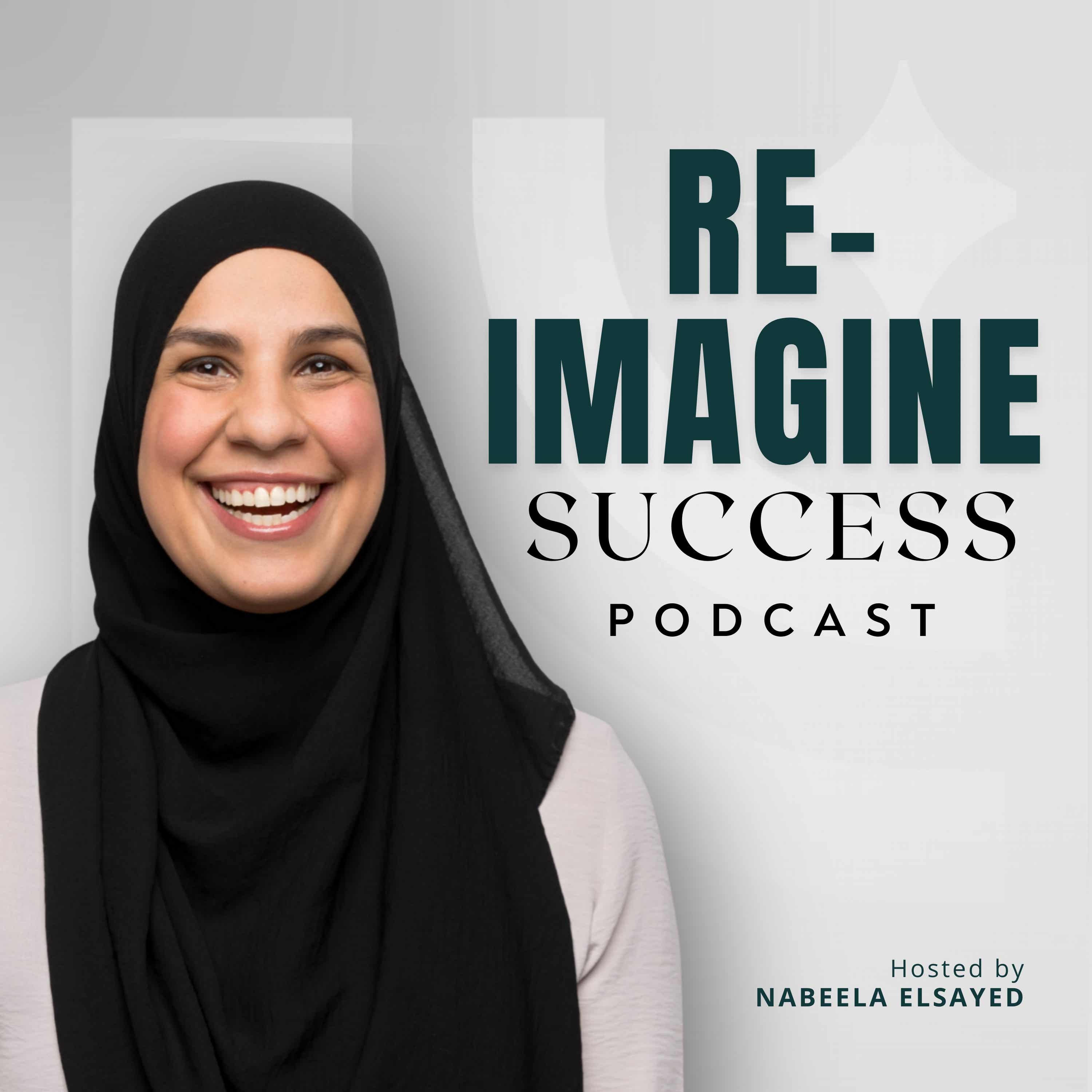
PODCAST · society
Re-Imagine Success Podcast
by Burnout ends here. Redefining work, worth, and what really matters.
What if success wasn’t something you chased but something you redesigned?Welcome to Re-Imagine Success, the podcast for ambitious, overworked professionals who are done performing hustle culture and ready to rewrite the rules. Hosted by Nabeela Elsayed a former C-suite executive turned leadership advisor and burnout rebel, this show dives deep into the messy truth behind achievement, productivity, and the modern obsession with being “on” all the time.Each week, we unravel the burnout loop, explore how our relationship with work got so broken, and offer real, honest strategies for building a life that actually feels like yours.Expect candid solo episodes, sharp insights, unfiltered conversations with bold thinkers, and the occasional twinkle of humor because clarity doesn’t have to be clinical.Whether you’re in mid-career mayhem, post-burnout recovery, or leading a team while secretly drowning, this podcast is your weekly permission slip to slow down, question everything, and reimag
-
33
The Gift of Struggle: Why Your Biggest Setbacks Might Be Your Greatest Advantages
What if your hardest moments weren’t setbacks — but preparation? In this powerful conversation, Nabeela Elsayed sits down with Bobby Herrera, author of The Gift of Struggle, to unpack how adversity shapes purpose, leadership, and character. Bobby shares the unforgettable story of a stranger’s kindness on a basketball bus that changed the trajectory of his life — and how that single act led him to build a multi-hundred-million-dollar company rooted in community, compassion, and gratitude. Together, they explore: • Why struggle is the most honest form of progress • How to find strength and clarity in hardship • The difference between being rich and being truly wealthy • How leaders can care more for people than what they do • Why boundaries and rest are essential forms of strength • The simple act that can change someone’s life forever 💬 “Your struggle isn’t your story’s villain — it’s your story’s hero maker.” If you’ve ever felt like an underdog, wrestled with burnout, or questioned whether your struggle has meaning — this episode will help you see challenge as fuel, not failure. 🎁 Challenge of the Week: Write down your biggest struggles and what each one taught you. You can download the free reflection worksheet here: https://stan.store/nelsayed/p/free--learning-from-your-struggles-tool 📰 Read more at reimaginesuccess.substack.com 📘 Learn more about Bobby’s book The Gift of Struggle at bobbyherrera.com Chapters: 00:00 The Bus Story That Changed Everything 02:00 The Gift of Struggle 06:00 Growing Up the Son of a Bracero10:00 Discovering Purpose Through Adversity 13:00 The Fine Line Between Hard Work and Overwork 17:00 Learning to Rest When You’re Wired to Work 22:00 Team One vs Team Two: Redefining Leadership 30:00 Family, Community, and Vulnerability in Leadership 40:00 The Power of One Kind Act 45:00 Hope, Heritage, and Generational Strength 55:00 Leadership That Puts People First 57:00 Final Reflections About Re-Imagine Success: A movement challenging toxic productivity and redefining what it means to thrive across all domains of life. Join us as we explore sustainable success through the lens of human sustainability. FREE TOOLS & RESOURCES 🧠 Achiever Persona- Discover what kind of Achiever You Are - Take the 5 min Quiz for Free → https://stan.store/nelsayed/p/free-achiever-persona-assessment Executive Presence Self Assessment - Download for Free → https://stan.store/nelsayed/p/get-your-free-executive-presence-self-assessment- EXPLORING EXECUTIVE COACHING 📕 Learn More Here: https://stan.store/nelsayed/p/executive-coaching-package- BOOK NABEELA FOR A KEYNOTE OR CONSULTING Email My Booking Agent Christy Here: [email protected] CONNECT WITH ME 💌 Join the Re-Imagine Success Community on Substack, where I share more tips, insight and research on how to re-imagine success: https://reimaginesuccess.substack.com/ 📸 Instagram: https://www.instagram.com/nabeelaelsayed/ 👨💻 LinkedIn: https://www.linkedin.com/in/nabeelaixtabalan/?originalSubdomain=ca 🌍 My website: https://www.nabeelaelsayed.com/ 💌 Email Me: https://www.nabeelaelsayed.com/contact 🎯 Key Insights: • Why we all need "spiritual defibrillators" to jolt us back to life • The difference between routine and self-destructive inertia • How intentional disruption prevents life from imposing pauses through crisis • Building daily, monthly, and yearly recalibration practices • The radical act of pausing in a productivity-obsessed world Get full access to Re-Imagine Success at reimaginesuccess.substack.com/subscribe
-
32
"I Want My Husband Back": When Success Starts Destroying Your Identity
Chester Elton: From Workaholic to Gratitude Guru "I want my husband back. This isn't who you are." Sometimes the most important career advice comes from the people who love us most. In this powerful conversation, Nabeela sits down with Chester Elton—bestselling author, executive coach, and the "Apostle of Appreciation"—to explore his journey from competitive workaholic to gratitude expert, and why he believes no success in business can compensate for failure at home. About Re-Imagine Success: A movement challenging toxic productivity and redefining what it means to thrive across all domains of life. Join us as we explore sustainable success through the lens of human sustainability. FREE TOOLS & RESOURCES Burnout Assessment Guide: Are you Burnt Out or Just Exhausted? This Free Assessment Tool Will help You Figure it out → https://stan.store/nelsayed/p/free-burnout-assessment-tool Achiever Persona- Discover what kind of Achiever You Are - Take the 5 min Quiz for Free → https://stan.store/nelsayed/p/free-achiever-persona-assessmentExecutive Presence Self Assessment - Download for Free → https://stan.store/nelsayed/p/get-your-free-executive-presence-self-assessment- EXPLORING EXECUTIVE COACHING 📕 Learn More Here: https://stan.store/nelsayed/p/executive-coaching-package- BOOK NABEELA FOR A KEYNOTE OR CONSULTING Email My Booking Agent Christy Here: [email protected] CONNECT WITH ME 📰 Join the Re-Imagine Success Community on Substack: https://reimaginesuccess.substack.com/ 📸 Instagram: https://www.instagram.com/nabeelaelsayed/ 👨💻 LinkedIn: https://www.linkedin.com/in/nabeelaixtabalan/?originalSubdomain=caMy website: https://www.nabeelaelsayed.com/ Email Me: https://www.nabeelaelsayed.com/contact 🎯 Key Insights: • Chester's transformation from competitive salesperson to abundance mindset leader • The intervention moment: "I want my husband back" - when work was changing who he was • Why "winners never quit" mentality can become toxic and when to move on • The Marshall Goldsmith lesson: Choose collaboration over competition • How Chester's upbringing with extraordinary parents shaped his gratitude philosophy• Why setting boundaries on work is essential, even when you love what you do • The power of rituals: meditation, faith, and "be kind, be grateful, be of service" • Clayton Christensen's boundary story: "I don't work on Sundays" • Why 95% of AI implementations fail (hint: they put technology before people) • The parable of the merchant at the gate: "You'll find what you're looking for" Additional Resources • Chester Elton's books: "All In," "The Carrot Principle," "Leading with Gratitude," "Anxiety at Work" • Marshall Goldsmith 100 Coaches program • Clayton Christensen's "How Will You Measure Your Life?" • The Culture Works consulting ⏰ Timestamps: 00:00 - How Chester became Nabeela's mentor and shared his wisdom 03:15 - Growing up surrounded by extraordinary people 06:30 - The competitive sales years and scarcity mindset 09:45 - The intervention: "I want my husband back" 13:00 - Why loving your job can become dangerous 16:30 - The Marshall Goldsmith abundance lesson 19:15 - Chester's daily mantra: "Be kind, be grateful, be of service" 22:45 - Clayton Christensen's Sunday boundary story 26:00 - Why workplace well-being apps often fail 29:30 - The loneliness epidemic and building rituals that ground you 33:15 - Setting boundaries on the thing that defines you 36:45 - What do you want on your gravestone? 40:00 - The merchant at the gate parable: You find what you're looking for Get full access to Re-Imagine Success at reimaginesuccess.substack.com/subscribe
-
31
Two Years Ago I Left the C-Suite. Here's What I've Learned About Success.
Welcome to Re-Imagine Success: Why This Movement Matters Now "My trauma response was not fight or flight—it was work or flight." In this inaugural episode, Nabeela introduces the Re-Imagine Success movement and shares her deeply personal journey from C-suite executive to recovering workaholic. Recorded from a hotel room in Atlanta, this raw, unfiltered conversation sets the stage for a podcast that will challenge everything you think you know about work, ambition, and achievement. About Re-Imagine Success: A movement challenging toxic productivity and redefining what it means to thrive across all domains of life. Join us as we explore sustainable success through the lens of human sustainability. FREE TOOLS & RESOURCES 🔥 Burnout Assessment Guide: Are you Burnt Out or Just Exhausted? This Free Assessment Tool Will help You Figure it out → https://stan.store/nelsayed/p/free-burnout-assessment-tool 🧠 Achiever Persona- Discover what kind of Achiever You Are - Take the 5 min Quiz for Free → https://stan.store/nelsayed/p/free-achiever-persona-assessment 💼 Executive Presence Self Assessment - Download for Free → https://stan.store/nelsayed/p/get-your-free-executive-presence-self-assessment- EXPLORING EXECUTIVE COACHING 📕 Learn More Here: https://stan.store/nelsayed/p/executive-coaching-package- BOOK NABEELA FOR A KEYNOTE OR CONSULTING Email My Booking Agent Christy Here: [email protected] CONNECT WITH ME 📰 Join the Re-Imagine Success Community on Substack: https://reimaginesuccess.substack.com/ 📸 Instagram: https://www.instagram.com/nabeelaelsayed/ 👨💻 LinkedIn: https://www.linkedin.com/in/nabeelaixtabalan/?originalSubdomain=ca 🌍 My website: https://www.nabeelaelsayed.com/ 💌 Email Me: https://www.nabeelaelsayed.com/contact 🎯 Key Insights: • Why this podcast is recorded everywhere—hotels, cars, kitchens—not just studios • The lies we've been told about success: hard work guarantees results, sacrifice humanity for achievement, productivity equals worth • Global burnout crisis: 62% disengaged at work, 41% experience daily high stress, 20% feel lonely at work • What "human sustainability" means: success with net positive impact on individuals, families, and communities • Why this conversation will be bilingual (English with Arabic subtitles) • The difference between being a "tech bro" and a first-generation immigrant who kicked through doors • What's coming: debunking success myths, exploring burnout science, redefining winning across all life domains • Why learning without action is meaningless—every episode ends with a challenge Additional Resources • Join the Substack community for behind-the-scenes content and exercises • Upcoming interviews from Atlanta, Riyadh, London, and beyond • Science-backed frameworks for sustainable success ⏰ Timestamps: 00:00 - Intro 02:30 - My LinkedIn profile vs. the real story 05:15 - Reclaiming my heritage 07:45 - Learning happens through action Get full access to Re-Imagine Success at reimaginesuccess.substack.com/subscribe
-
30
Parental Burnout | Dr. Samaiya Mushtaq (A Psychiatrist's Take)
Parental Burnout Explored: A Psychiatrist's Take on the Crisis Is parenting work? Should it be compensated? And how do you know if you've crossed from normal exhaustion into dangerous burnout territory? In this essential conversation, Nabeela sits down with Dr. Samya Mushtaq—psychiatrist, mental health advocate, and author of The Middle Path—for an uncensored discussion about the parental burnout crisis that's affecting nearly half of all parents. About Re-Imagine Success: A movement challenging toxic productivity and redefining what it means to thrive across all domains of life. Join us as we explore sustainable success through the lens of human sustainability. FREE TOOLS & RESOURCES 🔥 Burnout Assessment Guide: Are you Burnt Out or Just Exhausted? This Free Assessment Tool Will help You Figure it out → https://stan.store/nelsayed/p/free-bu... 🧠 Achiever Persona- Discover what kind of Achiever You Are - Take the 5 min Quiz for Free → https://stan.store/nelsayed/p/free-ac... 💼 Executive Presence Self Assessment - Download for Free → https://stan.store/nelsayed/p/get-you... EXPLORING EXECUTIVE COACHING 📕 Learn More Here: https://stan.store/nelsayed/p/executi... BOOK NABEELA FOR A KEYNOTE OR CONSULTING Email My Booking Agent Christy Here: [email protected] CONNECT WITH ME 📰 Join the Re-Imagine Success Community on Substack: https://reimaginesuccess.substack.com/ 📸 Instagram: / nabeelaelsayed 👨💻 LinkedIn: https://www.linkedin.com/in/nabeelaix... 🌍 My website: https://www.nabeelaelsayed.com/ 💌 Email Me: https://www.nabeelaelsayed.com/contact 🎯 Key Insights: Why parenting should be recognized as legitimate work deserving compensation • How to differentiate between normal exhaustion and clinical burnout • The three WHO criteria: emotional exhaustion, depersonalization, loss of meaning • Why parental burnout symptoms mirror depression (anhedonia, sleep issues, concentration problems) • The "autoimmune parenting" phenomenon - catastrophizing over minor incidents • Social media's role in elevating unrealistic parenting expectations • Why there's no perfect time to have children - every scenario is hard • The importance of flexibility and adaptability in parenting plans • When to seek help: patterns vs. individual incidents • How parental burnout affects the entire family system Additional Resources • Dr. Samya Mushtaq's Substack: The Middle Path : https://smushtalk.substack.com/?utm_s... • WHO Guidelines on Mental Health at Work: https://www.who.int/news/item/28-05-2... • U.S. Surgean Generals Report on Parnetal Burnout: https://www.hhs.gov/surgeongeneral/re... ⏰ Timestamps: 00:00 - Introduction: The parental burnout crisis 03:15 - How to tell exhaustion from burnout 09:45 - Parental Burnout is a Mental Health Crisis 15:30 - Social media's impact on parenting expectations 18:45 - The truth about parental attachment 21:00 - Keeping an overview on the parenting journey 27:30 - The most common question from working women 30:45 - Be open to figuring it out as you go 33:00 - Red flags, when to ask for help 38:36 - The healthiest thing you can do for your child 42:08 - Its about the quality not quantity of time spent Get full access to Re-Imagine Success at reimaginesuccess.substack.com/subscribe
-
29
Parenting is a Sacred Act, But You're not Superhuman
Parenting: The Sacred Act We're Failing to Support"How do you do it all?" It's the question every working parent gets asked, and it's really a white flag—a quiet cry for help from parents drowning under impossible expectations. In this deeply personal episode, Nabeela unpacks the alarming findings from the US Surgeon General's "Parents Under Pressure" report and shares her own journey through two decades of parenting across different financial circumstances.About Re-Imagine Success: A movement challenging toxic productivity and redefining what it means to thrive across all domains of life. Join us as we explore sustainable success through the lens of human sustainability.FREE TOOLS & RESOURCES🔥 Burnout Assessment Guide: Are you Burnt Out or Just Exhausted? This Free Assessment Tool Will help You Figure it out → https://stan.store/nelsayed/p/free-burnout-assessment-tool🧠 Achiever Persona- Discover what kind of Achiever You Are - Take the 5 min Quiz for Free → https://stan.store/nelsayed/p/free-achiever-persona-assessment💼 Executive Presence Self Assessment - Download for Free → https://stan.store/nelsayed/p/get-your-free-executive-presence-self-assessment-EXPLORING EXECUTIVE COACHING📕 Learn More Here: https://stan.store/nelsayed/p/executive-coaching-package-BOOK NABEELA FOR A KEYNOTE OR CONSULTING Email My Booking Agent Christy Here: [email protected] WITH ME📰 Join the Re-Imagine Success Community on Substack: https://reimaginesuccess.substack.com/📸 Instagram: https://www.instagram.com/nabeelaelsayed/👨💻 LinkedIn: https://www.linkedin.com/in/nabeelaixtabalan/?originalSubdomain=ca🌍 My website: https://www.nabeelaelsayed.com/💌 Email Me: https://www.nabeelaelsayed.com/contact🎯 Key Insights:• 41% of parents say they can't function most days (vs. 20% of other adults)• 48% of parents report completely overwhelming stress (vs. 26% of other adults)• Parental burnout vs. work burnout: unique features and consequences• Why parental burnout harms both parent and child, unlike work burnout• Nabeela's personal story: parenting in her 20s vs. late 30s• The financial reality: $80K annually just for support systems• Why "the village has been burnt down" and we need to rebuild it• Islamic perspective: parenting as sacred act and form of worship• Khalil Gibran's wisdom: "Your children are not your children"Additional Resources• US Surgeon General's "Parents Under Pressure" Report• Parental Burnout Assessment tools and research• Upcoming Substack Live with Dr. Samaiya Mushtaq (Sept 30, 12 PM)• Khalil Gibran's "On Children" poem⏰ Timestamps:0:00 - The white flag question: "How do you do it all?"1:25 - The Myth of doing it all?3:53- What makes parental burnout different from work burnout6:45 - Parenting is a spectrum of struggle 9:53 - Why do this parenting thing at all11:43 - Lets start asking tougher more profound questions 13: 28- Khalil Gibran's wisdom on children as trust, not possessionTags:parenting burnout, working parents, parental stress, US surgeon general report, parents under pressure, work life balance, parenting struggles, sacred parenting, islamic parenting, khalil gibran, nabeela elsayed, reimagine success, modern parenting, parental support, family stress Get full access to Re-Imagine Success at reimaginesuccess.substack.com/subscribe
-
28
The Phantom Jury
Whose Voice is Steering Your Life?What if some of the voices shaping your biggest decisions aren't even real? In this eye-opening episode, Nabeela shares three powerful client stories about "phantom voices"—the imaginary opinions that keep us stuck, second-guessing, and living for approval that doesn't even exist. Learn the simple 2-question framework that separates whispers from wisdom and helps you make decisions with clarity and confidence.About Re-Imagine Success: A movement challenging toxic productivity and redefining what it means to thrive across all domains of life. Join us as we explore sustainable success through the lens of human sustainability.FREE TOOLS & RESOURCES🔥 Burnout Assessment Guide: Are you Burnt Out or Just Exhausted? This Free Assessment Tool Will help You Figure it out → https://stan.store/nelsayed/p/free-burnout-assessment-tool🧠 Achiever Persona- Discover what kind of Achiever You Are - Take the 5 min Quiz for Free → https://stan.store/nelsayed/p/free-achiever-persona-assessment💼 Executive Presence Self Assessment - Download for Free → https://stan.store/nelsayed/p/get-your-free-executive-presence-self-assessment-EXPLORING EXECUTIVE COACHING📕 Learn More Here: https://stan.store/nelsayed/p/executive-coaching-package-BOOK NABEELA FOR A KEYNOTE OR CONSULTING Email My Booking Agent Christy Here: [email protected] WITH ME📰 Join the Re-Imagine Success Community on Substack: https://reimaginesuccess.substack.com/📸 Instagram: https://www.instagram.com/nabeelaelsayed/👨💻 LinkedIn: https://www.linkedin.com/in/nabeelaixtabalan/?originalSubdomain=ca🌍 My website: https://www.nabeelaelsayed.com/💌 Email Me: https://www.nabeelaelsayed.com/contact🎯 Key Insights:• Three real client stories about phantom voices controlling major life decisions • The accomplished executive haunted by her late father's PhD expectations • The people-pleaser paralyzed by imaginary judgment from strangers • The thriving mother worried about her 8-year-old's future opinion • The 2-question framework: "How do you know?" and "What evidence do you actually have?" • Step 1: Deciding who gets a seat at your decision-making table • Step 2: Using evidence to guide choices instead of phantom fears • Why fears are often hypothetical while evidence is hopefulAdditional Resources• Decision Matrix Guide (PDF + Google Sheet) - Link in show notes • Personal board of directors framework • Evidence-based decision making toolsTags:phantom voices, decision making, self doubt, people pleasing, evidence based decisions, inner critic, whose opinion matters, life decisions, confidence, clarity, nabeela elsayed, reimagine success, personal growth, overcoming fear, decision framework Get full access to Re-Imagine Success at reimaginesuccess.substack.com/subscribe
-
27
Burnout or Just Exhaustion? How to Tell the Difference
Burnout or Just Exhaustion? How to Tell the Difference"Burnout is what happens when you try to avoid being human for too long." - Michael GungorIn this critical episode, Nabeela explores one of the most important questions facing modern professionals: How do you know if you're just tired or dealing with something more serious?Sparked by a conversation with a client experiencing heavy fogginess and persistent fatigue, this episode dives deep into the differences between normal exhaustion and clinical burnout. You'll learn about the three main reasons people struggle to differentiate between the two, including how exhaustion has become normalized in our culture and the stigma that prevents us from seeking help.What You'll Learn:The evolution of burnout research from the 1970s to WHO recognition in 2019The 12 stages of burnout progression and where you might find yourselfKey differences between the classic MBI and modern BAT-23 assessment toolsA simple reflection question to assess your current stateSpecific action steps whether you're facing exhaustion or burnoutWhy up to 66% of Americans are experiencing burnout symptomsThis episode includes access to a FREE Burnout Assessment Tool and practical guidance on when to seek professional support versus implementing self-care strategies.Essential listening for anyone feeling overwhelmed, exhausted, or questioning whether their stress levels have crossed into dangerous territory.If you are interested in joining the waitlist for the Re-Imagine Success Course, you can express interest here: LINK Get full access to Re-Imagine Success at reimaginesuccess.substack.com/subscribe
-
26
Stop Thinking Executive Presence Is a Gift — It’s a Skill.
“Executive presence isn’t about commanding a room in someone else’s style — it’s about owning your presence and letting it work for you.”The Lesson I Didn’t See Coming in Laguna BeachEarly in my career I found myself in Laguna Beach, California, sitting in a small executive presence training called The Power of Your Presence. I wasn’t even supposed to be there- I was literally there by chance because my boss had to cancel at the last minute, and I went in his place. At the time, I was a Director leading talent acquisition at Starbucks, and the training was primarily targeted towards VPs and C-suite executives. It was a very intimate training - there were only six of us, and though I don’t remember who the other five people were in the room, I remember I had the smallest title in the room, I was the only woman in the room, and the only person of color, so surely I was in the wrong place.However, the facilitator, Marie Moran, always made me feel that I belonged there. Her one-on-one coaching, set against the backdrop of beautiful Laguna, became a pivotal moment in my career. I realized that I could hold my own in a room full of people much more senior than I. Marie helped me realize that my source of internal power was unique, that my story was unique, and that my potential was real. She saw me, and at the same time, I saw myself. The fact that my boss sent me in his place was evidence that I had sponsors and great mentors, but Laguna Beach is where I started to really believe in myself. Marie’s approach was groundbreaking for the time: she videotaped our interactions, dissecting everything from where we sat to how we spoke, when we spoke and what we did with our hands. She applied the same logic that athletes used to review their game tapes, but instead of plays, we were dissecting our presence, our confidence, our delivery - our ability to hold space. It was terrifying and absolutely transformative.Two lessons from that week still shape how I lead today:* Identifying my sources of power* Be intentional in how I show up The Power Behind Your PresenceMarie taught us that everyone draws influence from different sources of power.* Intellectual Power — connecting dots quickly, synthesizing ideas, being the “problem solver” others rely on.* Relational Power — connecting effortlessly, reading a room, making people feel seen and included, harnessing the power of social harmony.* Emotional Power — staying calm in crisis, telling stories that move people, creating psychological safety.My natural sources of power were intellectual and relational: I prided myself on being the ultimate problem solver, and because I am genuinely curious about others, I leveraged my curiosity and cultural intelligence to be a positive energizer amongst people. My growth edge was emotional power, because before Marie’s coaching, I was very private and guarded—storytelling, vulnerability, and bringing people along with heart were not my strengths. I would over-rely on facts and charisma, but keep things fairly shallow when it came to emotional connection.Knowing this about myself at a young age gave me a compass: lean on my strengths, but also build muscles where I was weak.WAIT: The Habit That Changed How I SpokeOne of the first shifts I made after that training was deceptively simple. I had a habit of being the first to speak in meetings and often spoke too much. Someone once told me, “If you’re always the one talking, people stop listening.”Marie gave me a tool that I implemented immediately. It was an ingenious little acronym called W.A.I.T., which I would write at the top of my Levenger CIRCA Disc notebook (remember those- they were all the rage back then, and apparently they are still in business), but I digress. The acronym stood for:Why Am I Talking? However, the acronym also served another purpose. It reminded me to WAIT before I spoke, and I forced myself to pause for five minutes before weighing in. This allowed me to centre my intention, spend more time connecting the dots, which meant leveraging one of my powers and being more strategic about the situational context. The pause also gave others space. The result was immediate: people noticed. My contributions landed with more weight. I went from being the eager voice in the room to the one who could move the entire conversation forward with impact.The Myth of Executive PresenceWhen you Google “executive presence,” the words you’ll see are things like command a room, gravitas, and poise.I would agree with the components above, but too often, executive presence is reduced to a stereotype: a 6’2 “white male who looks like he belongs on the cover of GQ and speaks like a rockstar front man. Yes, bias plays a role in how presence is perceived. But here’s the truth: executive presence isn’t about fitting a mould, it’s about knowing and harnessing your unique presence.Warmth and Strength: The Real Balancing ActAnother overlooked dimension of executive presence is the balance between warmth and strength.Lean too far into strength and you risk being seen as intimidating or unapproachable. Lean too far into warmth and you risk being underestimated or overlooked. The leaders who embody true presence know how to hold both at once.The superpower that allows you to do this? Emotional Intelligence (EQ) + Social Intelligence (SQ) + Cultural Intelligence (CQ) * EQ is your ability to understand and regulate your own emotions while staying attuned to the emotions of others. It’s what allows you to stay grounded in a crisis and adapt your communication with compassion and wisdom.* SQ is your ability to read the room and navigate social context- understanding group dynamics, knowing when to speak, when to listen, and how to bring people along.* CQ is your ability to adapt to cultural tendencies, norms and customs. As a senior leader, you will likely be working in a global context. If you can layer cultural intelligence into your presence, you will garner even greater respect, credibility, and trust. Together, EQ, SQ and CQ create the invisible thread that makes people want to follow you. They help you project confidence without arrogance, authority without coldness, and authenticity without oversharing.And here’s an important truth: projecting warmth doesn’t mean going over the top.If you’re an introvert reading this and sinking deeper into your chair, take heart. Some of the most powerful executives I’ve witnessed have come from leaders who were deeply introverted. They weren’t the loudest voices in the room, but they had extraordinary EQ, SQ and CQ. They projected warmth by making others feel seen and heard. They knew what to say, how to say it, and — most importantly — when to say it. Often, their vocal warmth came through in a lower pitch and softer volume, which set a calm, congenial tone.You don’t need to be the rockstar front person to master this balance. Warmth and strength can be expressed in a style that’s authentic to you. However, there is a caveat - you can be an introvert and command a room, but you can’t be a silent leader. Meaning, if you struggle to have a voice, use your voice, and know how to harness the power of your perspective - this will always be an issue. My Definition of Executive PresenceIf I had to boil it down:Executive presence is harnessing your unique personhood and personality with confidence and humility. It’s the ability to carry and navigate conversations across various contexts successfully, thereby enhancing performance and conveying intentional authenticity. How to Strengthen Your PresenceSo how do you build it? Start with these steps:* Identify your source of power.* Are you naturally intellectual, relational, or emotional? Which do you lean on most? Which feels least natural?* Observe how you show up.* How do you sit? Where do you place your hands? What’s your pacing when you speak? Try recording yourself in a presentation and watch it back. I know it’s a major cringe, but trust me - do it. * Experiment with intentional practices* Write W.A.I.T. in your notebook before meetings to identify/clarify your intention- why are you in the room? Where? How do you add value? * Pause before speaking. * Use storytelling to bring warmth and relatability.* Test small physical shifts, posture, eye contact, and tone.* Stretch into your growth edges.* If you’re intellectual, practice being more relational.* If you’re relational, practice slowing down and anchoring ideas.* If you’re emotional, practice blending vulnerability with clarity.Presence Before Executive PresenceHere’s the real takeaway: before you can improve your executive presence, you need to understand your presence.It’s about being intentional with what makes you powerful and learning to flex beyond your default. Executive presence isn’t about commanding a room in someone else’s style. It’s about carrying yourself in a way that reflects who you truly are, with confidence and care, in every room you walk into.To get you started on your executive presence journey, I have created an easy “Executive Presence- Self Assessment” adapted from Sylvia Ann Hewlett’s HBR Article, The New Rules of Executive Presence. It's not a three-day intensive training with 1:1 feedback, but it will get you started. You can download it below. Until Next Time. Take Care of Yourselves and Those Around you.In Partnership, Nabeela Was this helpful? Let me know what you think? Leave a comment, like or share. I love learning from reader feedback. 🎙️BIG NEWS: The Re-Imagine Success Podcast is (almost) here!I’m so excited to have spent last week recording the first five episodes of the Re-Imagine Success Podcast. I was in Atlanta with some fantastic people, where we explored how we define and navigate success across the domains of our lives. In just a few weeks, I’ll officially launch The Re-Imagine Success Podcast a bold, human, and honest conversation about redefining our relationship with work, success, and achievement.I started Re-Imagine Success nearly a year ago as a movement, a vision for work that doesn’t burn us out, betray our values, or trade our well-being for a paycheck. This podcast takes that mission further: tackling the global disengagement crisis, the mental health epidemic, and the unsustainable pace of modern ambition.This show is for anyone who believes that human sustainability and business success can coexist and that it’s time to build something better.💥 If that sounds like your kind of conversation, now’s the time: Like, comment, share, and hit follow wherever you get your podcasts. Stay tuned for the official drop.This is just the beginning.Stay tuned, exciting things are on the way. 🚀Join the Group ChatStarting now, the chat is open to all subscribers, free and paid.If you’ve been reading quietly, this is your cue to join the conversation. Bring your thoughts, your questions, your uncertainty.Let’s make this space one where we can wrestle with significant shifts together with honesty, curiosity, and a bit of hope. I’d genuinely love to see you there.’Re-Imagine Success is a reader-supported publication. To receive new posts and support my work, consider becoming a free or paid subscriber. Get full access to Re-Imagine Success at reimaginesuccess.substack.com/subscribe
-
25
Prepare for an Interview Like You Would Prepare for a Pitch to Investors | Step 3
"If the thought of preparing drains you, imagine doing the job every day."-Nabeela ElsayedThis is the third article in my Career Transitions and Decisions Series. In the previous articles, we laid the groundwork with two foundational steps: first, zooming out to gain a big-picture overview of your life and career landscape and second, turning inward for a deep dive into introspection so you could align what you want in life. If you missed the first two articles in this series, you can listen or read them below: Now we arrive at the third step in your Career Transition Toolkit: Preparation.And here, we need to shift our mindset even further, because even the most experienced individuals get this part wrong. The first step in shifting your mindset is to NOT think of yourself as a job applicant. Instead, you should think of yourself like an entrepreneur pitching a business to investors or someone walking into a bank asking for a $250,000 loan. Suppose you were asking someone to invest $250,000 in your startup or business. In that case, you’d need to know your market, your competitors, your differentiators, and your go-to-market strategy- and that, folks, is the kind of preparation I coach my clients to have when preparing for an interview. Now you might be thinking, 'That's a bit much.' Yes, it is, but that is how you stand out - you stand out by going above and beyond, by doing things that others wouldn't think of or would be too lazy to do. However, there is another reason why you should prepare as if you are an entrepreneur. Why? Because when a company hires you, they’re not just giving you a paycheck. They’re buying something from you- the potential value you can add to the company. And to stand out, you need to do more than recite your resume. You need to understand your story- and how that story illustrates the value you will create in the job. So how do you do that? Let’s break it down: The 10-Step Investor-Level Interview Preparation Plan1. Problem Statement: What problems are they hiring you to solve? Research the job description, the company’s recent news, and its industry landscape. What key problem is this role trying to solve? Is it growth? Retention? Innovation? Efficiency? Write down each major challenge the company might be facing- and draw up some high-level solutions and ways you could impact those challenges. 2. Your Unique Solution: Why you? This is your unique value proposition. How have you solved this problem before? What combination of experience, perspective, and personality makes you the best-fit candidate for this role at this moment in this company’s journey? Often the best candidate is the person who brings the right solutions and experience at the time the company needs those solutions and experiences. 3. Market Awareness: Why now? In the real estate market, the saying is: 'location, location, location.' In the job market, the equivalent is: timing, timing, timing. Understand the timing. Are they growing fast? Navigating layoffs? Expanding markets? Rebranding? Could you speak to their context? It shows that you’re not just looking for a job- you understand the moment in time that the company is in. 4. Competitive Landscape: What makes you different? The reality is that the job market is and will likely continue to be flooded with qualified or overly qualified candidates. So what makes you stand out? Think beyond titles and years of experience. Maybe it's how you lead during crises. It could be your cross-industry adaptability. Get specific. What is your unique value proposition? This could be your personal alignment with the mission and vision, the connection to the product/service, your experience, or your education. You need to draw this out and articulate it clearly. 5. Your Operating Model: How do you work? Now folks. I can’t say this bluntly enough- if you show up with stuff like- “I am a servant leader” or “I like to give people space to do their thing” or “I am just passionate about developing people” you will automatically get thrown into a bucket of folks who don’t know themselves well enough to be able to form an original thought. Please don’t say, “Well, I can get impatient and move too fast into action.” You need to possess leadership maturity and emotional intelligence to understand yourself. It’s a determinant of accountability- that you know your internal operating model. If you struggle with talking about yourself- then you’re normal- but that’s not an excuse- do the work. How do you build teams? How do you make decisions? Handle conflict? What’s your leadership style? Articulate this clearly, not as a buzzword, but as a philosophy, a clear point of view backed up with examples. And for the sake of extreme clarity, let me give you an example: If I were asked to give an example of my leadership style or approach, I would say: I thrive on building followership by clarifying a compelling vision and rallying a team around that vision.A specific example of this was:Situation:When I led a $XYZ billion dollar transformation for a large global retailer, I had to align, support, and communicate a compelling narrative that would rally the entire organization around the future.Action:This involved developing a deep communication approach that included message houses, decision trees, and communications collateral designed to resonate across multiple countries. It also involved identifying and establishing evangelists who could carry the message forward, and continuously aligning both operators and the governance committee around how we were communicating, tracking, and uniting people around the transformation.Result:We tracked several transformation metrics through regular pulse surveys. One of the key questions was, “I understand why the company is transforming and I trust leadership to lead this transformation.” We consistently scored in the 70–80% range on this measure. In countries or teams where we didn’t meet that benchmark, we implemented hyper-care service—including flying into those locations and being on the ground with the leadership team to reinforce the messaging and address concerns directly.Interesting Fact:I’m the kind of leader who can directly, honestly communicate across an organization with trust and credibility. If I know something, I’ll tell you.If I can’t tell you, I’ll say that too.And if I don’t know? You’ll hear that straight from me.Learning/Close: I’ve learned that trust isn’t just earned through results, it’s built in the moments when you choose to be honest, even when it’s uncomfortable. During a massive global transformation, I didn’t just cascade communications from the top. I built a system to ensure that people across continents could hear, feel, and trust the “why” behind every change. And when the trust metrics dropped in a specific region, I didn’t send an email. I got on a plane.That’s the leadership I practice. That’s the standard I hold. In the example above, can you feel what I believe in, stand for, how I lead? Here is where people get stuck: Too many leaders say “I believe in trust, communication, and integrity” — but those are table stakes. You need to tell me how you do those things, and through the example you share, demonstrate the depth behind those values. Okay, enough of that - this is probably an article in its own right. Let’s move to step 6, which is Proof of Concept. 6. Proof of Concept: Where have you done this before? Here’s where your past results come in. Use the SARIL method I demonstrated above: Situation, Action, Result, Interesting Fact, Learning. Write out the relevant examples you have based on the job description of the role. Yes, I literally mean go line by line of the job description and list out your examples. Make your examples measurable and memorable. Don’t just list tasks, tell stories with outcomes.7. Personal Brand: Who are you beyond the resume? This is where authenticity matters. What are your core values? What drives you? What kind of legacy do you want to leave in your work? Who are you outside of work? Everyone has a different comfort level with personal disclosure - so know yours and have some personal stories to share if the question arises. 8. Support System: Leadership can be lonely- knowing this and preparing for it shows your leadership expertise and maturity. What kind of support system have you built for yourself? How do you get the support you need? How do you leverage your network, mentors, coaches, peers, or advisors who challenge and support you? It reflects emotional intelligence and a growth mindset. 9. Investment Readiness: Can you articulate ROI? How will hiring you generate results? Whether it’s revenue, retention, engagement, or innovation, connect the dots between your skills and their strategic goals. Make it easy for them to say yes. 10. Mindset and Emotional Readiness: Are you grounded? This is often the missing piece. Career transitions are emotional. They shake our confidence and stir up doubt. But the most compelling candidates have done the inner work. They’re clear on their values, and they lead from a place of purpose, not panic. This will come out in how you carry yourself, your confidence, and your energy. Final Thoughts: Preparation is a Love Letter to Your Future SelfThis kind of preparation takes time. It requires research, doing your homework, honesty, and clarity. If you think you haven’t gone deep enough, you haven’t. If you think you have overdone it, you are probably at the right place. But if you do this work, you’ll not only stand out as a candidate, you’ll step into your next role with the kind of confidence that can’t be faked. Here’s a simple litmus test:If you’re not eager or energized to do this level of preparation for a job… It’s probably the wrong job.Because if you can’t commit a few focused hours — maybe a day or two — to prepare for the opportunity, how are you going to show up for it 40+ hours a week, every week?Your energy during preparation is revealing.If your curiosity grows, if your excitement builds as you dig into the company, the problems they’re solving, and how you might fit — that’s a green flag.But if the more you research, the more drained or disinterested you feel, that’s a signal too. Should you do this kind of preparation for every job?No. Only for the ones you actually want.And if you don’t want it enough to prepare at this level, then maybe you have your answer. So here’s your call to action: * Get a coach, a mentor, a mirror and rehearse.* Practice your stories using the SARIL method.* Prepare like you're pitching to an investor.Because, whether you are applying for a job, starting a company which will require investors or taking out a loan, the bottom line is that if the job, the solopreneur or the start-up is what you want, preparing for it is just as much an investment in you as it is in landing the interview. Until next time, take care of yourselves and those around you. In Partnership, Nabeela 🎙️BIG NEWS: The Re-Imagine Success Podcast is (almost) here! While I’ve quietly been recording my Substack essays as mini-podcast episodes, behind the scenes, I’ve been building something bigger — and I’m thrilled to share it with you finally.In just a few weeks, I’ll officially launch The Re-Imagine Success Podcast a bold, human, and honest conversation about redefining our relationship with work, success, and achievement.Next week, I’m flying to Atlanta to kick off the first round of in-person interviews with some incredible thinkers, builders, and brave voices who are challenging the status quo, and I can’t wait to bring you those stories.I started Re-Imagine Success nearly a year ago as a movement, a vision for work that doesn’t burn us out, betray our values, or trade our well-being for a paycheck. This podcast takes that mission further: tackling the global disengagement crisis, the mental health epidemic, and the unsustainable pace of modern ambition.This show is for anyone who believes that human sustainability and business success can coexist and that it’s time to build something better.💥 If that sounds like your kind of conversation, now’s the time: Like, comment, share, and hit follow wherever you get your podcasts. Stay tuned for the official drop.Join the Group ChatStarting now, the chat is open to all subscribers, free and paid.If you’ve been reading quietly, this is your cue to join the conversation. Bring your thoughts, your questions, your uncertainty.Let’s make this space one where we can wrestle with significant shifts together with honesty, curiosity, and a bit of hope. I’d genuinely love to see you there.’Re-Imagine Success is a reader-supported publication. To receive new posts and support my work, consider becoming a free or paid subscriber. Get full access to Re-Imagine Success at reimaginesuccess.substack.com/subscribe
-
24
Mentor Hour | Live Q&A About the Dizzying Career Marketplace
Get full access to Re-Imagine Success at reimaginesuccess.substack.com/subscribe
-
23
Pause Before You Pivot | Step 2
Any type of success that is not sustainable is just a delayed failure. - Nabeela ElsayedThis article is part two of a three-part career advice series. If you missed last week’s article, you can find it here. In this week’s article, we are going to focus on step two, which is all about the process of introspection in a career transition or major life decision.Have you ever created a plan for your life?Not a business plan, a workout regime, or a five-year career development roadmap but a real plan for your actual life? One that asks:* How is my life working for me today?* What do I want to feel, build, and experience tomorrow?* What does success look like on my terms?Before you can answer the question, What kind of career do I want? you need to answer a more foundational one: What kind of life do I want?The problem is, very few people stop to ask that question because we’ve allowed our careers to disproportionately if not entirely, shape our lives.The Default PathIn childhood and adolescence, you start to understand the concepts of work, money, and careers. You could be heavily shaped by your parents, meaning there is a high level of grooming and preparation for what you will “be” when you grow up, as well as which types of careers hold value and which do not. Alternatively, you could have little to no preparation, and in that case, you are essentially being influenced by school or friends. As you move out of HS and into college, you fumble through what to study- uncertain and confused about how it will all fit together, what type of job you will actually be able to find and how you’re going to “make it” in life. After college, you struggle to find a job, and when you finally get one, you are eternally grateful. You feel like all that struggle up to this point has been “Worth it,” and you have made it into the so-called “adult world,” but the euphoria wears off quickly. That job you were dreaming of soon starts to feel suffocating. You start missing family dinners, and you give up hobbies so that you can stay focused, work weekends, and put your head down to hustle. Other aspects of your life start to suffer, you're not sleeping well, your social health is non existent, and before you know it, you start to feel contentment, burnout, and under-appreciation, but you push through anyway. However, the workload continues to grow, life at home becomes increasingly demanding, and you're unsure what to do. Maybe you should change jobs? Maybe you should change industries? Perhaps you should consider starting your own business? Sound familiar? So often, when we find ourselves on the relentless wheel of overwork, burnout, and toxic productivity, it’s because we’ve allowed our work to define the shape of our entire lives. It’s no wonder so many people assume that switching companies, changing industries, or starting a business will bring relief.But here’s the truth: changing your job isn’t what gets you off the default path. Redefining success is.What’s the Alternative? 'The alternative is to be intentional. To have a plan that allows you to see your life in its totality so that you have a counterweight to the default, where work defines our lives. To pause and do the deep work of introspection of questioning the stories, beliefs, and inherited definitions of success that have guided us.Because if we want to make meaningful career decisions, we have to begin with a more expansive question:What does success mean across the entirety of my life?I know I’m asking a lot, because we live in an era of uncertainty and anxiousness where figuring out even the simplest of tasks feels overwhelming, but I assure you this activity will start to help you see things more clearly. A Multi-Dimensional Definition of SuccessSo, how do you do this? The first step is to broaden the domains of your life that you are intentionally and actively planning. Below is a wheel of the seven life domains - these are areas of your life that are essential for long-term happiness, fulfillment, and success. The seven domains of life are mental & emotional, physical, spiritual, relational, financial, environmental, and professional. You may not relate to every domain equally, and that’s okay. The point is to broaden your sense of identity, fulfillment, and investment. To move from a one-dimensional definition to a portfolio life where you intentionally invest, grow and plan each domain.How do You Plan a Domain? There are eight building blocks to thinking about your life plan- and each can be applied to every life domain. * Define Current State* Define Future State* Define Urgency/Importance* Do A Gap Analysis * Do A Root Cause Analysis* Define Personal Commitments * Identify potential RoadBlocks* Define Accountability MechanismsSounds like a business plan- well, that's precisely the point. It's about applying the same level of due diligence to your life that you do to your career. As you work through the eight building blocks, you will ask yourself questions like: * Who do I want to be?* What do I want to do?* What must be true for me to feel fulfilled?Then you keep digging deeper by exploring:* What is my baseline, the non-negotiables I must protect?* What challenges or transitions can I anticipate?Below is an example of what this would look like for the Mental/Emotional Domain. A Real Example: Mental & Emotional DomainBE: Present, connected, generousDO: Bi-weekly therapy, daily journaling, morning emotional check-insTRUE: I feel emotionally regulated and have tools to manage stress. I have emotional reserve for my kids and partner.BASELINE: 15 minutes of quiet alone time before bed, no matter what.ANTICIPATED CHALLENGE: Family visiting for two weeks. I’ll skip journaling but protect my check-ins and baseline time. To guide you through each of the eight building blocks, I have developed a life canvas that allows you to explore and process your ideas, thoughts, and beliefs. Important note: You don’t need to plan all seven domains of your life at once, but you should never plan your career or finances without at least two other domains in mind.* For some, that’s Career + Spiritual + Relational. * For others, it’s Career + Physical + Mental Health.The key is to hold a counterweight to the gravitational pull of professional ambition so you don’t martyr your whole self at the altar of work.Download your Free Life Canvas Template Below: 👇🏽How does this impact or influence a career decision or transition? Imagine you are in a stable position at work, but there have been a few rounds of layoffs, and the workload has become more challenging to manage. As a result of the changes, you were offered a promotion; you feel grateful to even have a job and are compelled to take the promotion. It sounds reasonable on paper, but your mom has recently been diagnosed with a serious illness, and your emotional and physical bandwidth is already stretched. Instead of allowing a sense of duty, gratitude, or fear to drive you into a decision, you pause before you say yes. You map out your priorities and recognize that taking this promotion will further compromise your health and presence at home.Now you’re not deciding in isolation. You’re deciding with clarity.It’s not a “no” out of fear. It’s a “no” that invests in another part of your life that needs you right now.That’s the power of a life plan.It reframes trade-offs. It quiets the scarcity mindset. It gives you a broader perspective.Anchor Your Decisions in AlignmentCareer clarity doesn’t start with your resume. It starts with your life in focus. When you root your career choices in the life you want to live, everything changes. You make braver decisions. You trade fear for focus. You stop outsourcing your worth.This isn’t about overhauling your life overnight. It’s about building an intentional, insourced, and personal compass for your life one that encompasses the entirety of your life. In next week’s article, I will zoom in specifically on the job search and professional growth domain. I know that things are difficult out there, and everyone is looking for some guidance, so stay tuned. Until Next Time. Take care of yourself and those around you.In partnership,Nabeela Join the Group ChatStarting now, the chat is open to all subscribers, free and paid.If you’ve been reading quietly, this is your cue to join the conversation. Bring your thoughts, your questions, your uncertainty.Let’s make this space one where we can wrestle with significant shifts together with honesty, curiosity, and a bit of hope. I’d genuinely love to see you there.’Get Your Career Questions Answered | Mentor HourI’m excited to host my first Substack live with some seriously talented, thoughtful humans I’ve invited into the Re-Imagine Success orbit: We’ll be addressing your questions about work, transitions, burnout, purpose, ambition, and more.Nothing is off-limits. So make sure you're subscribed, stay tuned… and yes, bring your questions. I can't wait.If you made it to the end, you’ve got range.For more content on redefining leadership and getting off the burnout loop, you can:👉 Follow me on LinkedIn, YouTube or Instagram🎙️ Listen to the article on the Substack or wherever you get your podcast: Re-Imagine Success Podcast📨 Or just forward this to a colleague who needs a little perspective (and maybe a little permission to let go of the balancing act). Get full access to Re-Imagine Success at reimaginesuccess.substack.com/subscribe
-
22
Should I stay or Should I Go: Step 1
“Fear is the price of admission to a meaningful life. But preparation? That’s your power.” - Nabeela Elsayed This week’s article was inspired by a question I got in our community chat: Noha asked what is by far one of the most common questions I get from most professionals today: Should I stay or should I go? What steps should someone take to prepare for a career transition?How do you manage the fear and still take action? I will answer this question in a multi-part series of articles. Unlike many of my other posts, I will delve into the technical details here, so please bear with me. Think of this like a mini tutorial on how to plan your career. And as a warning, in case you’re tired of all the AI talk, we cannot discuss career transitions without addressing the significant AI elephant in the room. So, yes, this will be very AI-esq, but I promise to do my best to make it practical and meaningful. The Career Dilemma At any given moment in your career, you may be standing at a professional crossroads, whether by design or by default. And regardless of how successful your career may be, or how powerful or influential you are, there will be moments when something just feels off. I have also found this applies universally, whether you’re in a corporate role, a small business owner, or a successful founder. At multiple points in your work life, you’ll have a nagging thought swirling in your mind: Should I stay the course, make a pivot, or take a giant leap?This is a challenging question by default, but for high achievers, it can be downright debilitating. That’s because part of the high achiever mindset is this instinct to persevere and protect what we’ve built; this preservation instinct is then coupled with a drive to push through discomfort and a desire to perform regardless of the cost.Until inevitably, the cost becomes too high. The antidote to avoiding what I call the preserve and protect freeze is three things: 1. Maintaining an overview 2. Introspection 3. And Preparation But how does one apply an overview, and what needs to be prepared? Well, that's exactly what I want to walk you through in this series of articles so that you can move with context, foresight, and alignment to your inner truths. Its a process that will allow you to * Examine the big picture (Maintain an overview) * Align personal Intentions (Introspection)* Define your Path (Preparation) To be done correctly, though, it requires rolling up your sleeves, doing some solid thinking and research. To keep it simple and digestible, I will tackle one step at a time over the coming weeks. This week, we will focus solely on Step 1: Maintain an Overview. Step One: Scan the Horizon & Maintain an Overview This is the step most people sense but don’t take the time to understand fully. To make the right career and life decisions, you always need to start by zooming out. Zooming out allows you to gain a better understanding of the broader terrain, including developments in your industry, the economy, and the disruptive trends shaping the world of work.Now, you might be thinking: "This is pointless, we’re always in a state of disruption." And yes, that’s true. However, when it comes to disruptive events, especially those triggered by technology, it's essential to understand where we are in the technology maturity curve and how specific sectors will be impacted. This curve is often referred to as the “Technology Adoption Lifecycle” or the “Gartner Hype Cycle”, which is basically a fairly predictable cycle that articulates the journey technology will take from being considered disruptive to becoming widely adopted to business as usual. Just a quick distinction between these two models * The Technology Adoption Lifecycle explains who adopts technology and when.* The Gartner Hype Cycle explains how public perception evolves from hype to reality.Both of these things are important indicators of how customer behaviour will shift and, thereby, how companies will react or be affected. I know it’s overused, but my favorite example is Uber. There was a time in the early 2000s when the idea of using your phone to call a random stranger to pick you up and take you somewhere for a fee was considered wild and disruptive - now we don't even think about it; it has become business as usual. We allow complete strangers to drive us around, drop off our dinner and stock our fridges without a second thought. Another important consideration is that different technologies have varying adoption curves. Consumer technology, such as smartphones and social media, has a shorter adoption curve, typically spanning 3-7 years, while enterprise technology, including cloud computing, CRM tools, and SaaS tools, may take 5-10 years. Deep tech solutions, like AI or blockchain, may require 7-15 years. Here are some concrete examples: * Cloud computing took ~10 years (AWS launched in 2006, broad enterprise adoption ~2016).* Smartphones took ~5 years (from the iPhone’s launch in 2007 to full market penetration).* Generative AI is still in its early stages. We are in years 1–3, we’re still on the curve.Okay, this is not a tech blog, so you are probably asking where am I going with this? Technology, along with other major social events—such as the 2008 Financial Crisis or COVID-19 — are the macroeconomic changes that have the most significant impact on careers by far. Technology changes consumer behaviour, which in turn changes business strategy, leading to business transformations and subsequently impacting jobs, which then drive the adoption of more technology, ultimately continuing to influence consumer behaviour. Let me illustrate this example further: Below is a graph that illustrates the Consumer Tech Adoption Curve and Its Impact on Jobs and Society: While 2007 was the breakthrough of consumer tech, its influence was already growing in the late 90s and early 2000s - now imagine you were paying attention to the technology, its maturity curve and anticipating how it might affect jobs and careers. Imagine if, in 2000, you were keeping an overview, strategizing, and planning what you might do professionally, entrepreneurially, or from a skill development perspective. What decisions could you have made?What trade-offs would have made more sense? What businesses could you have built? But here is the thing, most people are not paying attention to the slow swell of disruptive change or anticipating its peak or when it will crash. Most people are merely being carried along by the current, relatively passive about what it will mean for their careers or lives. Because this is the thing most people don't realize, disruption is rarely sudden; it builds quietly before breaking out. To continue demonstrating the importance of paying attention to macroeconomic factors, the following graph illustrates the technology adoption lifecycle of Consumer tech, enterprise tech, and deep tech across a timeline from 2000 to 2050. Now, let's zoom in one more time to the dot.com and personal tech era of the early 2000s to 2010. During this period, traditional industries, including newspapers, bookstores, and magazines, underwent significant disruption. Newsrooms and media outlets had to shrink and reinvent themselves; some survived, but most didn't. There was a complete disintegration of traditional news-telling roles, and in its place, it gave rise to public relations and communications-related jobs. Below is a graph of this shift based on BLS data from 2012. In 2012, if you were a journalist, you were looking at a median salary of $ 37,000, as well as a 13% decline in job growth. On the other hand, PR professionals earned a median salary of $54,000 and were projected to experience 12% growth in the job market. Now, let’s layer the industry data on top of the tech adoption curve. Okay, now in my opinion, this is an extremely powerful and compelling picture. Now, place yourself as a high-performing journalist or news media professional back in 2012. You knew things were shifting; you saw the budget cuts, the layoffs, the hiring freezes, but imagine if you took the time to zoom out and do the research. And with the graph above in hand, had taken an intentional approach. What could that pivot have looked like in real terms? Well, several things: * Pursuing additional education and certifications in Public Relations* Working as a contractor and freelancer in PR to build up a portfolio. * Clearly articulating how your skills as a journalist, news professional, or media professional translate into PR. For example, the savvy journalist brought their newsroom networks into the corporate world, which proved to be a very compelling competitive advantage. * Rebranding yourself online in every way possible * Connecting with others who were making the pivot for references, referrals and inside network access Now, let’s use a more timely and relevant example. Someone recently approached me and mentioned that they had just graduated from university with a degree in data science and are now looking for an entry-level data analyst role. I grimaced a bit before I told them- that won't be nearly enough and that they needed to rethink their entire career. Below are the career growth prospects for Data Analysts in Toronto according to StatsCanada Job Bank Site. Now, keep in mind that government data has a significant lag, so in this case, the Canadian data does not yet reflect the actual impact of AI. Even so, a data analyst shows moderate growth prospects, so if you are in a job with low to moderate growth, that is a significant signal to consider planning a pivot. Though the maturity model of AI is still in its early stages, adoption is happening at an unprecedented rate, and the next five years will be dizzying. The hiring slowdowns, the restructuring, the workforce reductions you’re seeing? That’s companies changing their business strategies and preparing for organizational transformations. Okay, back to my Data scientist student. They have two things to do: * AI’ify their skills, which includes upskilling themselves for how Data science will change with AI. * And/or focus on trying to get experience in a more stable industryHere is what a development plan would look like if I were them: AI Career Development PlanGoal:To build a future-proof, AI-enhanced career path by deepening technical skills, gaining real-world experience, and strengthening uniquely human capabilities that AI cannot replace.Strategic Focus Areas:· Strengthen technical fluency in machine learning and LLM development· Apply AI to real-world domains and problems· Cultivate human power skills (communication, ethics, critical thinking)· Build a public portfolio and professional presence· Track emerging AI roles and adjust trajectory accordingly6-Month Development Roadmap:Months 1–2 – Core Skills· Complete a structured ML course · Do a Kaggle mini-project to apply conceptsMonths 2–3 – LLM Literacy· Build a GPT-powered project using OpenAI or Hugging Face· Learn prompt engineering and chain-of-thought promptingMonths 3–4 – Domain Application· Join a hackathon or volunteer project in a real-world domain (health, education, etc.)· Conduct a case study applying AI to a domain-specific issueMonths 4–5 – Showcase & Ship· Build a personal portfolio site (GitHub + Notion + blog)· Write and publish 1–2 project writeups or tutorialsMonths 5–6 – Visibility & Career Prep· Start posting weekly on LinkedIn or Medium/Substack· Apply for internships, fellowships, or junior AI/DS rolesFuture Career Paths to Explore:· AI Product Manager· Prompt Engineer / LLM Developer· AI Safety or Ethics Specialist· AI + Domain Expert (e.g., AI + climate, healthcare)· Human-AI Interaction DesignerAnd even all of that won’t be enough: Now, you might be thinking the data science student has it easy. After all, they’re already a technologist. Surely, they can just learn AI and ride the wave?Unfortunately, that won’t be enough.Just like journalists back in 2010, hundreds of thousands of data scientists will flood the job market, all trying to pivot, adapt, and stay relevant. But when everyone’s playing the same game, the rules change, and so does the advantage.Microsoft recently commissioned a major study on the impact of AI on jobs. The results are sobering. Below is a table based on their findings, highlighting the top 40 occupations with the highest AI applicability score—the roles most likely to be disrupted. Scan the far-right column and you’ll see the number of people currently employed in those roles. Data scientists made the list of top 40 roles with high Applicability - all 192,000 of them.Here is the list of jobs with the lowest AI applicability score, meaning the least to be impacted by AI. Which brings us to the bigger truth: learning AI is necessary, but it’s not sufficient. Along with the AI fluency required to do the jobs of the future, we also need to deepen the skills that make us distinctly human, the things AI will struggle to replicate.Because no matter how much disruption the world throws at us, one thing remains true: humans will still need and want other humans to do certain kinds of work.The individuals who thrive in this era will be those who can adapt to technology not by competing with it, but by collaborating with it. They’ll use AI to augment their abilities while leaning into the human aspects of work that matter most:* Nurturing trust and relationships* Being physically and emotionally present* Applying emotional intelligence* Exercising ethical judgment under uncertaintyThese are the differentiators.Jobs rooted in care, creativity, crisis, or culture where nuance, unpredictability, and human connection are essential will remain far more resilient than those built on repetition or rote cognition.In the age of AI, your employability won’t hinge on technical proficiency alone. It will depend on your capacity to center the human experience. Those who can blend AI fluency with human fluency, who can master the tech, and who remain uniquely human, won’t just survive this shift. They’ll lead it.Now What? To answer Noha’s question: it starts with lifting your head above water—moving from being dragged by the current to learning how to ride the wave.Yes, it’s overwhelming. But it’s not unknowable.The future isn’t some abstract storm barreling toward us; it’s unfolding in real time. The data is out there. The patterns are visible. The shifts are already underway. You don’t need to predict the future perfectly you just need to stop outsourcing your awareness of it.So take a breath.Look at the terrain.Then start moving with intention.We won’t all become electricians or psychotherapists. But we can all become better navigators. We can take responsibility for preparing ourselves eyes wide open, sleeves rolled up.Below are some of the best tools to help you get started:* Bureau of Labor Statistics Occupational Outlook Handbook (U.S. job trends)* Stats Canada Job Market Predictions (Canada-specific forecasts)* Microsoft Research on AI's Job Impact* AI Maturity by Industry* Gartner Hype Cycle (to understand where tech sits on the adoption curve)In my next article, I’ll help you zoom in, moving from external context to internal clarity. Once you understand the landscape, the next step is figuring out where you want to go and how to get there.P.S. This week’s article was a departure from my usual format, and I’d love to hear what you think. Did this help? Was it overwhelming? Empowering? Leave a comment or share it with someone who's feeling lost in the noise. P.S.S. We’re almost 1,000 strong in the Re-Imagine Success community which is honestly so humbling. Up until now, the group chat was just for paid subscribers, but I don’t just want to spark conversation I want to help create a movement.So starting now, the chat is open to all subscribers free and paid.If you’ve been reading quietly, this is your cue to join the conversation. Bring your thoughts, your questions, your uncertainty. Let’s make this space one where we can wrestle with big shifts together with honesty, curiosity, and a bit of hope. I’d truly love to see you there.P.S.S.S. (Okay, I know we’re getting into ridiculous territory with these P.S.’s. I promise this is the last one.)I’m launching a new “Ask Us Anything” series! Live conversations with some seriously talented, thoughtful humans I’ve invited into the Re-Imagine Success orbit.We’ll be tackling your questions about work, transitions, burnout, purpose, ambition, you name it. Nothing is off-limits.Our first session will be on August 12th, and I’ll be sending out more details soon.So make sure you're subscribed, stay tuned… and yes, bring your questions. I can't wait.If you made it to the end, you’ve got range.For more content on redefining leadership and getting off the burnout loop, you can:👉 Follow me on LinkedIn, YouTube or Instagram🎙️ Listen to the article on the Substack or wherever you get your podcast: Re-Imagine Success Podcast📨 Or just forward this to a colleague who needs a little perspective (and maybe a little permission to let go of the balancing act).Re-Imagine Success is a reader-supported publication. To receive new posts and support my work, consider becoming a free or paid subscriber. Get full access to Re-Imagine Success at reimaginesuccess.substack.com/subscribe
-
21
I Tried to Build an App with AI and it Ended Up Rebuilding My Perspective
“You can’t ignore or outrun a wave. You either ride it or it knocks you flat.”-Nabeela ElsayedBack when I worked at IKEA, the founder, Ingvar Kamprad, famously made a bold declaration:“People are not going to buy furniture sitting on the toilet.”He meant it. He didn’t believe people wanted to sit on the toilet and shop for a couch. And because of that belief, for years, he resisted IKEA’s evolution into an e-commerce retail giant. Despite his brilliance as a business leader, he genuinely believed there were limits to what people would do with technology.Eventually, IKEA’s leadership team and board were able to convince him otherwise. However, by then, other global retailers had already been years into the e-commerce game, and IKEA was playing catch-up.Not only did phones make it to the bathroom (unfortunately), they have made it everywhere. We shop, grieve, date, bank, and build almost everything through a screen.Technology hasn’t stayed in its lane.It’s taken the wheel.And now, it feels like those were the easy days. The calm before the acceleration.From Assistant to BuilderIf you’re like most professionals, you’re already using AI to augment your work.It’s helping you synthesize data. Transcribe your Zoom meetings. Summarize 300-page board decks. Provide you with templates for emails, job descriptions, and social media posts.You're prompting your way into a pretty committed relationship.But have you tried to actually build something from scratch with it yet? Like… an app?Because that’s what I spent the first two days of this week doing.I Just Wanted to See How Far I Could GoHere’s a little backstory.Most of my time is spent advising, coaching, and consulting high-achieving professionals. And I’m constantly shocked by how few of them have an actual life development plan. So I’ve created my own framework a Google Form, a set of assessments, and some structured reflection tools I walk clients through.One of my ambitions has been to turn that process into a simple, accessible app.Now, I have an amazing web team talented designers, developers, and copywriters. I could have just called them and kicked off a Statement of Work. But I was curious.I wanted to see how far I could get with a natural language AI App development tool just me, my documents, and a bit of courage.A few YouTube tutorials later, I landed on Bolt, a no-code AI app builder. I started feeding Bolt everything I had: assessments, Google Sheets, customer personas, a brand book, and real content, not just ideas. Then, almost instantly, it started creating. The Honeymoon PhaseAt first? It felt like magic. Bolt started building screens, mapping flows, and creating onboarding logic. I wrote in my own voice, with real user interfaces, everything being populated on my screen and on my phone simultaneously.No developers. No meetings. No fighting over tech resources or tech budgets. I kept thinking about all those boardroom discussions about how to prioritize our tech roadmap, as well as arguments about tech resources and how to allocate scarce talent. This could eliminate all of that noise. So I kept typing as screen after screen got added to my app. Just me and AI… vibing. I thought I was falling in love.I thought I was unstoppable. But a few hours in things got complicated. I couuld’t get my AI API to work no matter what I tried. Then there were the endless terminal errors with their evil red exclamation mark and “x” teasing me: Before I knew it, I had one screen open with Bolt, full of bugs, and another with ChatGPT, trying to troubleshoot what had gone wrong. I was copying code back and forth, asking ChatGPT to coach me through fixing it. When it told me to “open the developer console,” I knew I was in trouble.I kept reminding ChatGPT that I was not a developer. That I had never done this before and that I needed it to explain things to me like I was a five year old.The Breakup Came EarlySuddenly, my workflow stopped working. Logic was glitching. I couldn’t move past a white screen. I tried everything: ChatGPT, Claude, Google, YouTube tutorials, even whispering sweet nothings to my JSON like, “Come on, baby, don’t do this to me.”Nothing worked.So I did what any rational person would do in a moment of digital crisis. I gave up on Bold and tried a different tool. Bolt and I were on a temporary breakup as I moved over to Glide. Now, Glide promised to make things even easier - just upload a bunch of Google Docs, and it would do the rest. Glide was a liar. Glide catfished me with sweet videos and promised a bright future, but it was very obvious that Glide was not as good as Bolt, and I didn't even experience the initial euphoria that comes with a new relationship. I quickly cancelled my Glide subscription and did the only thing left to do after 1.5 days and a lot of heartbreak. I called in my development team.Full 911 mode. Phone-a-friend. Summon Batman.The Developer DebriefWe jumped on Zoom, and I walked them through my rom-com-meets-horror-film relationship with Bolt: the infatuation, the crash, the ghosting.And to my surprise, they were impressed.“Honestly? You got pretty far,” one of them said.They weren’t threatened. They weren’t skeptical.They were curious. Open. Even excited.“Yeah, we’re already using tools like this,” my DevOps guy said.“It’s going to make development exponentially cheaper. Sure, it’ll replace parts of what we do, but we’ll just evolve and do other things. That’s how tech works.”They weren’t scared; they were already evolving, already augmenting and then retooling and reskilling themselves. They were adaptive. These folks had a remarkable growth mindset because they know that the real game isn't resisting the wave it’s about learning how to surf it. The Democratization of Creation As someone who sits on the board of a tech incubator, I couldn’t help but think about what this means not just for seasoned engineers, but for early-stage founders, especially women and underrepresented groups.There are so many people with brilliant ideas who can’t afford to bootstrap a $50K digital product.But now? Natural language AI tools and others are collapsing that barrier.They’re making it possible, not necessarily easy, but possible to get an MVP off the ground for a fraction of the cost. Just as the World Wide Web and the dot-com boom, these tools as flawed as they are still have the potential to be great equalizers.But Let’s Be Clear: The Process Still MattersEven if the tools get faster, the thinking behind them still matters.One of the biggest risks associated with AI tools is the potential for a 'rabbit hole' effect. Because you can prompt your way into confusion if you’re not grounded.That’s why product thinking is still critical:* Define the problem you’re solving.* Map the customer journey.* Clarify who it’s for and what matters most.* Decide what to leave out.These are the muscles that keep you focused. Because honestly? It’s easy to get obsessed. On Day One, I found myself lying in bed, putting my kids to sleep, while trying to log into Bolt on my phone. (That didn’t work, by the way.)Yes, I was that person. In the dark. Whispering to the universe, “Just one more try.”The Real Shift Isn’t Technical. It’s Psychological.I’ve been a Chief HR Officer. A Chief Operating Officer. I’ve hired entire product teams and led billion-dollar transformations. And yet, in a matter of mere hours, I watched AI do imperfectly, but impressively, what used to take weeks. It wrote onboarding flows. Built screen logic. Corrected its own code.Drafted a user journey. And gave me the beginning of a functioning prototype. That’s not assistance. That’s co-creation. And it changes everything.Thought Leadership Is Cute. Real Leadership Is Getting In the Arena.In retail, one of the oldest principles is: Get on the shop floor. Run the registers. Stock the shelves. Talk to the customer. The same applies here. The biggest threat to leadership today is that it won't adapt quickly enough, and that is likely very true. However, you can help yourself by getting on the shop floor. You don’t have to be an AI expert. But if you’re still only dabbling in ChatGPT and reading consultancy reports, you’re missing the point. Try building something. A basic agent. A rough app. A presentation powered by AI. Because there’s a massive difference between reading about change and experiencing it in your own hands.Now what? I’ve handed my work in Bolt to the experts. They now have everything they need:A developer brief, a strategic identity, customer personas, AI system proposal, brand book, and core MVP features.They’ll take it to the finish line. I didn’t set out to become an expert. But I’m walking away with something even better, a greater perspective. So here’s my advice:If AI hasn’t yet made your brain hurt and humbled you in equal measure, you probably haven’t gone deep enough. Learn what is possible and challenge your assumptions. Because AI isn’t just disrupting how we work. It’s reshaping who gets to build. Who gets to lead. And who gets left behindAnd that should light a fire under you if it hasn’t already. Until next time, take care of yourself and those around you. In Partnership,Nabeela If you made it to the end, you’ve got range.For more content on redefining leadership and getting off the the burnout loop, you can:👉 Follow me on LinkedIn, YouTube or Instagram🎙️ Listen to the article on the Substack or wherever you get your podcast: Re-Imagine Success Podcast📨 Or just forward this to a colleague who needs a little perspective (and maybe a little permission to let go of the balancing act).Want to learn more?If you would like to learn more about the world's unhealthy relationship with work, success, and achievement and discover ways to escape the burnout loop, check out some of my other posts below:Re-Imagine Success is a reader-supported publication. To receive new posts and support my work, consider becoming a free or paid subscriber. Get full access to Re-Imagine Success at reimaginesuccess.substack.com/subscribe
-
20
Should You Be Loud About Your Boundaries or Keep Them Quiet?
“We’re told to take care of ourselves, but rewarded for burning out quietly. That’s not a culture of wellbeing. That’s a contradiction we’ve normalized.”— Nabeela ElsayedWhen I started at IKEA, I didn’t know how to log off.I had come from a traditional American corporate culture where success was synonymous with self-sacrifice. First one in. Last one out. Inbox always open. Vacation days unused.So when I entered a workplace where leaders openly took four-week holidays and didn’t check in once, I felt a strange kind of whiplash. Was this real? Was this safe?At first, I didn’t trust it. I stuck to my old rhythm. One week off, maybe ten days. It wasn’t until my fourth year that I gave myself permission to take a whole month off.IKEA had created the conditions for boundaries to be respected, even rewarded. But unlearning the internalized rules of overwork took years. This is an essential lesson to all of the people out there who think that changing companies or industries is the solution to their overworking tendencies- believe me when I tell you that it can be a good step if you're in the wrong place, but it is by no means the way out of the burnout loop. Because for many of us, the real tension isn’t between us and our company. It’s between the life we want to live and the person we’ve been trained to be.The Mixed Signals of Modern WorkThe science supporting the detrimental effects of overwork is undisputed; check out my article “Your Brain on 55 Hours of Work” if you missed it. And every company out there wants to espouse caring about its people- we would all be rich if we had a dollar for every time sone said we are in the “people business” yet people are still struggling and one of the biggest struggles that exists is around how to establish healthy boundaries around our work. There are many reasons for this, but I will distill it down to the top three: 1. Technology - we are addicted to our phones, emails, and hitting the refresh button; clicking the arrow is like a tic. 2. Society, both inside and outside of organizations, continues to glorify and reward overwork. 3. We have conditioned ourselves to be like this, and most people don't go deep enough to question the belief systems that make them addicted to success, achievement, and work. As I continue to coach high achievers and leaders, one thing that consistently emerges is a need for clarity around boundary setting: I commonly get questions like: “How do I navigate setting boundaries?” “ What if my leader doesn’t respect my boundaries?” “ What if I work in a company that glorifies toxic productivity?” “What if people talk about boundaries, but I don’t see anyone role modelling them?” And as much as I would love to give people a simple answer to these questions, like most things in life, the answer is often, it depends. Because we live in a world of tensions, and that tension also exists around boundaries. Even the research disagrees on how setting boundaries at work can affect your career.On one hand, a study published in Harvard Business Review found that employees who took all of their vacation days were actually 6.5% more likely to get promoted. Time off was linked to happiness, and managers associated happiness with performance and promotability.On the other hand, a recent study from Hong Kong and IE Business School found the opposite: employees who visibly detach from work by taking vacations, setting out-of-office replies, or refusing after-hours emails are often penalized. The researchers referred to this as the Detachment Paradox: leaders are aware that rest improves performance, yet they still penalize those who pursue it. The result? A kind of workplace gaslighting. We’re told to take care of ourselves, but are rewarded for burning out quietly.Why Leaders Talk About Boundaries But Still Penalize ThemIt’s tempting to label this as hypocrisy. But there’s a deeper cultural story at play, which sociologist Mary Blair-Loy calls the Work Devotion Schema.This schema defines the “ideal worker” as someone who exhibits total allegiance to their job:* They work nights and weekends without complaint.* They answer emails immediately, even on vacation.* They never let personal obligations get in the way of professional onesThis ideal is deeply embedded in many organizational cultures. It’s the legacy code of hustle culture and success, defined by relentless availability, where one gives everything to their profession, passion, and ambition.And despite the discussion about well-being, the ideal worker who sacrifices everything for the company still prevails. Leaders may promote wellness, but they’re often trapped by the same invisible standards. They know that rest is productive, but struggle to model it. They don’t model it because they are themselves held hostage by the ideal worker schema. Because in the subconscious playbook of professional identity, boundaries still signal disloyalty. Until that schema is rewritten, we will continue to live in this contradiction.Culture Isn’t a Policy. It’s a Pattern.So what can you do?Before deciding whether to be quiet or vocal about your boundaries, the first thing you need to determine is: What kind of culture am I working in?In her book Never Not Working, Malissa Clark provides a simple but powerful tool to help decode your organization’s relationship to work.She advises taking an audit and heeding the visible cues an organization sends. These clues include physical artifacts, such as the words on the walls, posters, and the culture and values, as well as the norms and rituals, which are the behaviours that are observed, and what gets rewarded. Paying attention to these organizational cues allows you to assess if you’re in a workaholic culture. These clues, the physical artifacts, norms, rituals and rewards, reveal what your organization really values. They help you understand whether your culture still worships the ideal worker, or is trying to make space for real, human lives.The Boundary Culture SpectrumOver time, I’ve also come to see that most organizations fall into one of three categories:1. The Burnout FactoryBoundaries are ignored or punished. Overwork is the norm, and detachment is interpreted as a lack of commitment which makes boundary setting a high career risk. 2. The Hustle and Holiday Culture Hustle is real, but rest is tolerated if you communicate it carefully. These cultures are either in transition or toggling between an ambition to promote a wellness culture, but have yet to operationalize it or make it the cultural norm. In these types of organizations, whether or not boundary setting is a career risk largely depends on your leader.3. The Rest is Wisdom OrganizationBoundaries are expected, and the rest is seen as a leadership strength. These companies have decoupled hustle from value, and as a result, boundary setting is low risk. IKEA, for me, was a rest is wisdom environment. But even in that context, I had to dismantle years of internalized programming. The real work wasn’t taking the time off. It was permitting myself to do it.Now, one additional warning to those of us who struggle with overwork - I still burned myself out even though I was working in a Rest is Wisdom Organization. And that is because I was able to differentiate myself as the “ideal worker more easily,” my over-achieving workaholic tendencies allowed me to do multiple jobs at once, work on overdrive and artfully hide the implications on my personal wellbeing and life. It's once again a personal warning that the type of organization you are in is only one piece of this complex relationship we have with work and achievement.So… Should You Be Loud About Your Boundaries?Here’s my “it depends” framework for you to use: Observe the cues.What gets rewarded? What do leaders model? What’s considered heroic behavior?* Do a State of the Union: Is Your Organization Operating Under the Ideal Worker Schema? Or is it moving toward a new definition of leadership, sustainability or success? * Be intentional about your approach: If you’re in a hustle-holiday or rest-is-wisdom culture, speak up. Set the tone. Normalize your boundaries. If you’re in a burnout factory, you might choose to stay for a period of time and be strategic and quiet about your boundaries, but don’t abandon them altogether. Final Thought: Success Requires a ReckoningIt took me four years at IKEA before I allowed myself to use all my paid time off.Not because I lacked support. But because I was still running on an outdated script, one that told me rest was risky, and overwork was how I earned my place.And here's what I’ve learned: even in a culture that celebrates boundaries, you can still burn out if your identity is wrapped up in being indispensable.Because boundaries are not just about workload. They’re about worthiness. About untangling who you are from what you produce. About believing that your value doesn’t disappear when your out-of-office turns on.So before you decide whether to whisper or declare your boundaries, ask yourself a deeper question:What are you sacrificing by not setting boundaries? What will happen in one year, three years or five years if you continue to make those sacrifices? If you zoom out, are the sacrifices worth it? Because this isn’t just about managing hours, it’s about rewriting the code that defines who gets to thrive and what thriving even means.You don’t need to earn your rest with exhaustion.You don’t need to prove your worth by running yourself empty.The future of leadership isn’t built on a blind devotion to work. It’s built on devotion to building a multi-dimensional life for yourself and the lives of those you lead.And if your boundaries threaten your promotability, then it’s not your boundaries that need to change; it’s the definition of success and leadership that needs to change.Until next time, take care of yourself and those around you. In Partnership, Nabeela If you made it to the end, you’ve got range.For more content on redefining leadership and getting off the the burnout loop, you can:👉 Follow me on LinkedIn, YouTube or Instagram🎙️ Listen to the article on the Substack or wherever you get your podcast: Re-Imagine Success Podcast📨 Or just forward this to a colleague who needs a little perspective (and maybe a little permission to let go of the balancing act).Want to learn more?If you would like to learn more about the world's unhealthy relationship with work, success, and achievement and discover ways to escape the burnout loop, check out some of my most popular posts below:Re-Imagine Success is a reader-supported publication. To receive new posts and support my work, consider becoming a free or paid subscriber. Get full access to Re-Imagine Success at reimaginesuccess.substack.com/subscribe
-
19
Unlearning Distance
“You can’t reclaim what you won’t admit you’ve lost.”— Nabeela ElsayedI’ve travelled to 48 countries and counting. Travel has always been more than leisure for me; it’s a spiritual act. A reminder that we are, in fact, travelers through this temporary life. From South America to the South Pacific and everything in between, travelling has always been my way of stirring the soul and awakening the senses.But my recent three-week journey through the Middle East, in particular, felt different. Not because of what I did. My itinerary was relatively uneventful.But because of who I started to become.I’ve travelled across the Middle East many times, but always at arm’s length. I consumed the culture without claiming it, admired the architecture, but didn’t see myself in it. If I’m honest, I kept a deliberate distance. Like many children of immigrants, I internalized the message that survival meant assimilation and that 'success' required shedding the parts of ourselves that didn’t fit the Western mold. I had been taught, both subtly and explicitly, that Arabness was something to downplay. Too loud, too dramatic, too traditional, too much. So I buried it. But on this trip, something cracked open. Not because the region changed, but because I had. I was finally willing to face what I had been avoiding: the cost of that distance.Inside the Al-Hakim Mosque, as I stood beneath a grand chandelier and gazed through the parting of a green curtain into the open courtyard, something ancient stirred. A sense of identity emerged that had long been ignored. A longing to rekindle my Arab roots, my mother tongue, my heritage and lineage. The Middle East, like any part of the world, is not a monolith; it is a complex and diverse region. It can embody every aspect of this chaotic existence, from the glittering high rises of Dubai to the wadis of Oman. I have seen the Middle East in all its glory and across its many challenges, but never before have I felt it calling me like it has recently. And not the physical place as much as its history and heritage, like a siren singing Fairuz and Um Kulthum, inviting me to finally embrace my heritage. For most of my life, if you asked me where I was from, I’d say I’m first generation American. If pressed, as most immigrants are when we get the inevitable “but where are you from?” question, I’d add: “My parents are from Lebanon.” I would never say, “I’m Lebanese.” And that’s because I’ve spent most of my life distancing myself from my Arab roots. There are many reasons, but part of it was not liking what I saw in the “Arabness” growing up. I now know that it was most often a child who was internalizing Islamophobia and being “embarrassed” to be brown. That internalized Islamophobia got rationalized as I got older. I would tell myself that I didn’t need cultural influences; all I needed was my faith. I tried to adopt a purist form of my faith, one that wasn’t shaped by cultural habits, which I often felt were burdensome and unnecessary. But here’s the thing, it has taken me until now to realize. I need my culture, it is part of me. I am Arab; my mother tongue is Arabic, and my heritage and lineage are deeply rooted in the Levant, a region in the Arab world. And for the first time, I sat with how much of my identity I had avoided or instead had somewhat unconsciously allowed to be taken from me.My parents grew up in a Lebanon, still brewing under a French colonial influence. French immersion schools, European culture and fashion, and an ideal of modernity that was intentionally pitted against religion or tradition. Though my parents came from a family rooted in the land and anchored in faith, when they immigrated to the U.S., they didn’t emphasize returning home. They didn’t insist on speaking Arabic, and they didn’t foreground our faith. They were, like many immigrants, caught between survival and assimilation- trained to be submissive and grateful, even if it meant erasing parts of themselves.I grew up in the suburban-rural blur of Houston, without elders or cultural references. I didn’t feel connected to American culture, but I had no guidance to embrace my own heritage either. So I chose to live as culturally agnostic as possible. Faith became my only compass. But now, I’m beginning to see that faith and culture were never meant to be divorced; they were meant to enrich each other.In the Sayyida Nafisa Mosque, I placed my hand on the intricate metal lattice surrounding her tomb, and tears came before any thoughts did. My soul was remembering what my mind had tried to forget. That being Arab was something beautiful; that the culture and its richness were something to carry with joy and pride. Too often, burnout is discussed as if it’s simply a productivity issue. However, the exhaustion does not just come from doing too much; we are exhausted from covering up, from trying to be something we are not. We’re exhausted from abandoning who we are.I have often said that I am an unsettled soul, a traveller—physically, spiritually, and emotionally—removed from being connected to any place on earth. However, that was a convenient narrative to cover the real one: I had felt forcefully divorced from my tribe, my language, my culture, and my identity. And all the while I know its not that simple. That boundaries and borders change, that no place is perfect, that every place is flawed and that belonging won’t be found in the physical soil of this earth. Honestly, I am still trying to figure it all out myself, but my heart says that belonging is a return to the truth that lives in your bones.As I sat staring at the courtyard of Al Azhar, struggling to wrap my head around the centuries of knowledge and wisdom that have echoed its walls, I felt the weight of erasure and the grace of return. I felt gratitude for the parts of my lineage I’m just beginning to reclaim their beauty, their messiness, their hospitality, their kindness, and their resilience.We talk about self-care as if it’s all about bubble baths and better boundaries. But what the deepest self-care is, is remembrance.Remembrance of where you come from of the people who carried you here. Of the sacred names, you’ve forgotten how to pronounce. Of the mother tongue that shaped your lullabies, even if no one ever sang them.Standing in the shadow of minarets older than many nations, I realized: I wasn’t visiting something foreign. I was returning to something that was part of me.And so I ask not just to you, but to myself: What have you forgotten? What have you hidden, silenced, or let go of to fit in?And is it time to return?Because success isn’t just what you build, it’s also what you remember, what you preserve. And what you allow yourself to reclaim.Sometimes, the journey forward requires a look back. Not to dwell but to strengthen and honour your root.And when you find that place, or language, or sound that reminds you of who you were before the world told you who to be, don’t let it go.Until next time, take care of yourself and those around you. In Partnership, Nabeela If you made it to the end, you’ve got range.For more content on redefining leadership and getting off the the burnout loop, you can:👉 Follow me on LinkedIn, YouTube or Instagram🎙️ Listen to the article on the Substack or wherever you get your podcast: Re-Imagine Success Podcast📨 Or just forward this to a colleague who needs a little perspective (and maybe a little permission to let go of the balancing act).Want to learn more?If you would like to learn more about the world's unhealthy relationship with work, success, and achievement and discover ways to escape the burnout loop, check out some of my other posts below:Re-Imagine Success is a reader-supported publication. To receive new posts and support my work, consider becoming a free or paid subscriber. Get full access to Re-Imagine Success at reimaginesuccess.substack.com/subscribe
-
18
The Tension Trap: Why Leading Today Feels So Hard (And What to Do About It)
“Leadership today isn’t about balance, it’s about staying upright in motion. It’s about knowing when to pivot, when to pause, and when to push forward.” — Nabeela ElsayedIf you're a leader in the workplace today, chances are, you're tired.Not just tired in the “I need more sleep” way, but tired in the deeper, more complicated way, like your nervous system has been in a tug-of-war for too long. Like your mind is juggling five priorities while your heart is quietly breaking over decisions that feel impossible.If your workplace has felt more tense lately, you’re not imagining it.According to Deloitte’s 2025 Global Human Capital Trends report, we’re leading in a pressure cooker. And today’s leaders aren’t just dealing with one or two challenges. They’re navigating a complex web of competing forces that can’t be easily solved or “balanced.”The Myth of Balance Is Burning Us OutLet’s get one thing clear: whether it’s in the workplace or life more broadly, this is not a question of finding balance between two competing priorities. Balance implies an equal split. A static scale. A mythical equilibrium where competing priorities coexist peacefully. But in today’s workplace, that’s a fantasy.When your board is demanding better returns and a significant reduction in cost, how do you “balance” that with your team’s need for psychological safety and job stability?Spoiler: You don’t. You can’t. Because the nature of cost-cutting creates instability and fear, no matter how carefully we craft the corporate narrative. The moment that optimization, streamlining or financial efficiency gets prioritized at the top of the strategic imperatives, you ripple uncertainty across the organization. And that’s not inherently bad; it is the nature of a corporate organism. And this is something that people need to come to expect, just like the leaves fall off the tree in the fall. Companies will inevitably find a time and place, whether annually or every other year, or during an economic downturn or a change in leadership, when financial performance gets prioritized. And yes, we all like to believe that every business is a people business, and every business is also striving for growth and, at some level, financial stability and health. So, as a leader, the goal isn’t to balance competing demands like a Zen master in a glass office. The goal is to juggle them. To oscillate between them. To understand that leadership today is more like standing on a moving surfboard than standing on solid ground.Oscillation > BalanceRather than aiming for the impossible ideal of balancing people and business, consider this: what leaders need is the capacity for course correction. In some phases of an organization, financial performance will reign supreme, while in other cases, investments in people and culture will take precedence. Rarely, if ever, are they in equilibrium at the same time. It’s the ability to move along a spectrum between control and empowerment, cost and care, output and outcome and know when to shift, when to pause, and when to recalibrate. Deloitte captures this perfectly in the tensions they outline:* Augmentation ↔ Automation* Personalization ↔ Standardization * Agility ↔ Stability* Outcome ↔ Output * Empowerment ↔ Control* Potential↔ Predictability These aren’t decisions to resolve. They’re paradoxes to navigate. And navigating them well means letting go of the guilt of not getting it “right” and developing the reflexes to respond wisely to what’s unfolding.What’s Fueling the Exhaustion?This is why leadership feels so mentally and emotionally taxing right now.According to Deloitte’s research:* Most leaders acknowledge their organizations need to become more agile, yet their people are desperately craving more stability.* Leaders are being called to hold two truths at once: move faster and care deeper. Deliver more and burn out less.* And, only 6% of leaders feel confident they’re making substantial progress toward human sustainability.This is a no-win game if you approach it through the outdated lens of “balance” or simple cause-and-effect strategies. It requires something more advanced: high DI (Decision Intelligence), inner agility, and the ability to lead within the paradox- to lead while holding two competing beliefs at the same time. So, How Do You DO this? Stop trying to find a balance between people and business, and start thinking about how you calibrate your approach as a leader. * Calibration is the quiet leadership skill of knowing when to shift gears, when to slow down and when to hold steady. * Calibration is the inner ability to regulate your emotions, successfully holding tensions without panicking, allowing yourself to be emotionally stable and avoid being emotionally hijacked or falling into unhealthy empathy and people pleasing.* Calibration is what is required so that you can oscillate between tensions and lead through ambiguity while still inspire clarity.* Calibration is about being attuned to the degree to which you can influence change or make an impact, so that you don’t lose yourself in the process. It’s not about getting to the “right” answer. It’s about expanding your capacity to live inside the polarities, the ambiguity, the tension.Sounds exhausting. Well it can be at first, but once you accept what is in your control and what isn’t, you start to oscillate intelligently- reserving your energy for the things that matter, fighting the battles that you can win, standing your ground when necessary and knowing when to step back and follow because no matter what you might do the outcome wont change. Re-Imagining Leadership as Tension ManagementI recall a time during a massive transformation when the leadership team was overwhelmed. There were countless competing priorities, the organization was in a bit of a tailspin, and people were on the verge of burnout. What people wanted more than anything was clarity, direction, and some stability. Still, the reality is that, as a leader, you can no longer offer stability, and clarity is also becoming increasingly rare. Amongst the leadership team, it became clear that we couldn’t remove the ambiguity or the competing priorities. Still, we could help people figure out how to eat the elephant, so to speak, how to tackle the big, hairy problem in smaller, more manageable steps, break things down to the lowest common denominator. Were we able to remove the tension? - No Were we able to prioritize so there were no competing priorities - No What if leadership success isn’t about fixing the tension, but holding it with more grace?What if the real work of leadership is:* Not perfecting a decision, but recognizing when it needs to evolve.* Not protecting people from uncertainty, but teaching them how to navigate it.* Not balancing every demand, but making peace with the impossibility of doing it all.So if you’re feeling stretched, conflicted, or disoriented, know this: you’re not failing. You’re just standing in the leadership fire of the moment we’re all in. And maybe that fire is the crucible for a different kind of leader to emergeUntil next time. Take care of yourself and those around you.In Partnership,NabeelaIf you made it to the end, you’ve got range.For more content on redefining leadership and getting off the the burnout loop, you can:👉 Follow me on LinkedIn, YouTube or Instagram🎙️ Listen to the article on the Substack or wherever you get your podcast: Re-Imagine Success Podcast📨 Or just forward this to a colleague who needs a little perspective (and maybe a little permission to let go of the balancing act).Want to learn more?If you would like to learn more about the world's unhealthy relationship with work, success, and achievement and discover ways to escape the burnout loop, check out some of my other posts below:Re-Imagine Success is a reader-supported publication. To receive new posts and support my work, consider becoming a free or paid subscriber. Get full access to Re-Imagine Success at reimaginesuccess.substack.com/subscribe
-
17
Nafsi Ta'bani: When the Soul is Tired
"You don’t have a soul. You are a soul. You have a body."— C.S. LewisA Sacred Phrase, A Deeper AcheI recently coached a client who used a phrase that reached deeper than the normal language of burnout. Like me, she’s Lebanese, and her parents immigrated to Canada to offer her and her siblings a better future. And like many of us who carry the hopes of a generation on our backs, she did everything right. She got married, raised three remarkable children, earned an education, and built a successful business. As she sat across from me now, in her forties, having checked all the boxes in life, she wore a shroud of exhaustion. I asked her what was weighing on her heart and occupying her thoughts and she responded with heavy eyes and an ache in her voice. She paused, then said:"نَفْسِي تَعْبَان (Nafsi Ta'bani).""My soul is tired."What Has Exhausted Your Soul?In many faith traditions, the soul is considered the eternal essence of one's being. Our bodies will return to the earth, but our souls will live on. And the soul has a right over us just as our bodies do. But in a world that measures worth by output, we rarely ask: What nourishes the soul, what replenishes it, what keeps it healthy and flourishing?This phrase, "نَفْسِي تَعْبَان (Nafsi Ta'bani)" is an Arabic phrase that expresses a deep sense of exhaustion, one I’ve heard many times, especially from women. But this time, it landed differently. It felt sacred. Weighty. I stopped her and myself. We both sat in silence, absorbing the truth of what she had said. Then I asked her the only question that mattered: “What is exhausting your soul?”What followed was not a checklist of to-dos or stressors. It was a quiet unpeeling. The weariness wasn’t physical, though she was tired. It wasn’t mental, though her mind was always racing. It was something more profound, an aching that went to the root of her being.She described her longing for stillness. For a slower life. A place where she could be. Not the business owner. Not the mother. Not the strong woman who holds it all together. Just herself. A person in a place where she could exhale, where her soul could blend into the fabric of life without constantly swimming upstream.“But I am not the person to give up", she said. “I don’t want to be the type of person who gives up on something I have built. So many women give up. I don’t want to give up,”she said. And here is a belief that many of us get entrapped by: the idea that letting go of something is quitting, and saying “no more” means we have failed.My next questions were about how she could explore an alternative path without blaming herself. So I asked her: * What would it feel like if quitting were okay?* How do you explore the type of life you want without assigning yourself blame?* What feels blameworthy for saying NO to a life that is making you miserable? That is malnourishing your mind, body and soul?* What are you afraid of? Throughout our excavation of the type of life she wanted, she talked about moving to a place where her family could live without struggling financially, where her identity as a visible minority wasn’t an exception but where she could live in anonymity, a place where she could explore the long list of things she loved but has given up along the way. A place where she could rekindle her spiritual identity. And then she said something that I hear so often from people who dream of this alternative existence: “But that life feels like a Pinterest board,” she said. Not something I could actually build.”I reminded her that our parents crossed oceans for the dream of something better. Why do we believe we can’t do the same? What would it take to move closer to the life she quietly dreamed about? Sell the business. Rent the house. Sell her stuff, move abroad. What feels impossible about that? She blinked at me. For the first time, someone was treating her dream not as a fantasy, but as a real, viable possibility, and a sparkle of hope filled her eyes as the idea of living a life where peace and stillness weren’t buried beneath an exhausted soul could become a reality.It’s Not Logistical. It’s SpiritualBecause what she was really asking wasn’t logistical, it was multi-dimensional, it was about how to reposition her life so she could nourish herself socially, environmentally, spiritually, financially, mentally and physically.Because for so many people, the exhaustion runs past the fake smiles, the curated profiles, past the autopilot of life, and sits buried in a heart and soul that are malnourished. And for most people, we don’t even know it. This is why the occasional massage, vacation, or yoga doesn't ever do the trick. We are sleep-deprived, overstimulated, overconnected and undernourished spiritually and socially. We live in a state of subtle torture, numbing ourselves with dopamine and distraction, but still waking up empty. We scroll but don’t connect. We sleep but don’t rest. We succeed, but don’t feel whole. Our days are so full, yet our hearts are vacant and aching.Every limb is a tunnel into the soul. What we eat, what we see, what we hear, what we do, it all passes through to the soul. So when we binge on screens, consume empty words, chase validation, or force our bodies into punishing routines, we are not just harming our minds. We are bruising our souls.The soul has a right to quiet. To beauty. To connection. To stillness. To remembrance. It has a right not to be overloaded with images, noise, anxiety, and pressure. Because the soul is the ultimate dream catcher, it catches everything we subject our minds and bodies to.And we’ve forgotten that attention is worship. That what we give our gaze to shapes us. That which we allow into our ears seeps into our hearts. That the foods we eat affect not just our bodies, but also our clarity. That the hands we shake, the places we walk, and the things we type all flow into the soul. Nothing is neutral.So what happens when we ignore this?We begin to feed our souls in the same way we fuel machines: with caffeine, content, and cortisol. But the soul was never meant to run like a machine. The soul needs something else entirely. It needs meaning. It needs rhythm. It needs beauty and connection and love and nature and poetry and prayer. It needs time to be, not just time to do.The soul also needs to be tempered, trained, and refined.When the soul is underfed, we begin to feel it on a spectrum. It might start with low energy, short tempers, and foggy thoughts. Then comes the dread, even when nothing is wrong. The sadness even when everything looks right. The craving to disappear. The emptiness after achievement. The inability to feel joy in moments that used to be fulfilling. Eventually, even rest doesn’t restore us. Because what’s tired is not just the body, it’s the soul.The Soul’s Quiet ReclamationAnd yet, there’s hope. Because the soul is resilient, so imagine what would happen if we treated ourselves and all of creation as something sacred? As a trust? As a being to be invested in for the long term. Imagine if we stopped discounting our future selves for the sake of the present. But to do that, we need to resist the anthem of modern existence. The pressure to try to outrun our minds, our bodies and our souls- as if such a thing were possible. But it’s not. So, maybe we should stop running and start tearing down the false barriers that keep us trapped in the status quo. Remember, you built the life you have today; you can redirect it, reshape it, uproot it, mould it and change it. Everything in this life is temporary and temporal- none of it is as permanent and as fixed as we make it out to be. One of my teachers once told me: “If you knew you were only going to stay in a hotel for the weekend, would you spend all your time and money redecorating it?”Would you repaint the walls, replace the furniture, obsess over the curtains, and invest every ounce of your energy making that room perfect, knowing you’d be checking out in two days?Of course not. It sounds absurd.And yet, that’s exactly what so many of us do with this life.We know it’s temporary. We know, deep down, that none of this is ours to keep. And still, we pour our lifeblood into curating the ideal lifestyle, chasing the perfect version of success, designing lives we’ll inevitably leave behind. We lose ourselves furnishing the hotel room, forgetting we’re just passing through.What’s permanent, what will live on, is not the curated feed or the corner office or even the legacy brand. It’s the soul. And somehow, tragically, that is the one thing we so often forget to nurture.So maybe today is your invitation to flip the script.Stop furnishing the hotel room.Start furnishing your soul.What would change if you woke up each day with the perspective that your soul is the most permanent thing about you? That this life is not the destination, but the transit lounge?How would you spend your time, your energy, your heart?What would you stop obsessing over, and what would you finally start tending to?My client is still in discernment. She may sell the business, or she may not. But now she sees her dream as valid, not as a retreat from ambition, but as a reclamation of life.We are souls, housed in human bodies. Our lives are not defined by where we start, but by what we make sacred. And the soul? It’s asking us to make different things sacred again.We can nourish our souls to be wolves forever on the hunt, tense, territorial, ready to conquer.Or we can nourish our souls to be gardens, resilient to the different seasons of life, rooted, alive, generous in bloom.The choice, as always, is ours.Until next time. Take care of yourself and those around you. In Partnership, Nabeela Want to learn more?If you would like to learn more about the world's unhealthy relationship with work, success, and achievement and discover ways to escape the burnout loop, check out some of my other posts below:Still There? Wow, I’m honored. Let’s keep it going:Follow me on social where I spill more wisdom, drink lots of coffee and share all kinds of life lessons I am still learning.Re-Imagine Success is a reader-supported publication. To receive new posts and support my work, consider becoming a free or paid subscriber. Get full access to Re-Imagine Success at reimaginesuccess.substack.com/subscribe
-
16
How to Stay Standing When the Ground Keeps Shifting
“The ground will keep shifting. What matters is not how still it stays, but how well we build to move with it.” — Nabeela ElsayedOne of the hardest days in my career came when IKEA announced it would be laying off 7,500 people worldwide. I was leading the retail and digital transformation office in Malmö at the time. It was a period of immense pressure, responsibility, and emotion.In an unconventional but courageous move, IKEA’s global leadership team chose full transparency. Rather than dragging out the pain with announcement after announcement over a multi-year transformation, we opted to pull the bandage off in one sharp motion. People knew their jobs were at risk. There was no hiding from it. As we said back then: “Everything is going to change, almost.”What helped me sleep at night was the knowledge that this transformation wasn’t a dead end. The jobs we were eliminating would be replaced, in part, by new roles shaped for a different kind of future. There was a visible path forward for the company and for many of the people. And perhaps more importantly, those affected would have a safety net, whether through IKEA’s transition support or government programs. There was loss, yes, but also some scaffolding to soften the fall, which doesn't often exist for most people facing job loss.That was five years ago. Back when large-scale organizational transformations happened, maybe once a decade. Today, they are perpetual. The change never ends. The layoffs feel endless. And the ground beneath all of us just won’t hold still. Whiplashed by ChangeIf you're a millennial like me, you’re on your 13th round of layoffs and reorganizations.You survived the 2008 Great Recession, when job offers were rescinded and 2.1 million Americans were laid off. In the decade that followed, you moved back in with your parents and took anything you could get to make ends meet and pay for that $100K degree, which bought you little protection. You managed, you kept yourself afloat, you started to make some progress, you got some experience, and you found a foothold in your chosen fields, only to get hit by the pandemic.And I won’t rehash that one. We all lived it.Then came the "great workplace reimagining," which was supposed to bring flexibility, humanity, and well-being. But instead, now in a post-pandemic world, we are experiencing a great retraction of what makes work cultures bearable. Well-being is being de-prioritized, inclusion no longer matters, and CEOs are being emboldened to care less. No wonder there is a global decline in engagement. Productivity is slipping. People feel that they matter less, and most people are financially less well off. It’s not hard to understand why people are less happy and more stressed.And just when it felt like it couldn’t get more volatile, generative AI walks into the room like a new character in a show already overloaded with plot twists.This is the moment when I am telling people to keep your arms and legs inside the vehicle at all times, and I hope you took some Dramamine. Because the ride is only getting wilder.The Stats That Should Stop Us in Our TracksIn March 2025, layoffs in the US and globally surged again, making it the third-highest month of job cuts on record. According to the outplacement firm Challenger, Gray & Christmas, only April and May 2020 saw higher numbers, both triggered by the pandemic’s economic shock.Yes, a large portion of the March layoffs came from U.S. government downsizing, led by the person who will go unnamed. But the ripple effects were immediate. The private sector took notice. Confidence sank. Hiring plans tightened. And companies plan to decrease hiring by 16%.The new and foreseeable reality is a state of perpetual contraction-disruption-expansion-disruption. And few are prepared for it.It is against this backdrop that I find myself navigating a very different kind of transition—not mine but my son’s. There is a point in parenting when the worry shifts from raising little kids to worrying about the future of your adult children. As someone who gives advice and counsel to both people and companies for a living, I also constantly ask myself how to counsel and advise my own kids as they prepare for the future. How to Help the Next Generation Withstand the Earthquake My son was just accepted into McGill University to study engineering. He’s passionate about architecture and city planning and like any proud mum, I’m thrilled. But I’m also anxious. Not for his abilities, which are strong, but for the world he’s stepping into. A world where career trajectories are less like ladders and more like an episode of American Ninja Warrior. Where job security is an illusion and the pace of change is like being on the world's oldest wooden roller coaster, where you're basically on the verge of constantly throwing up. Before my son decided he wanted to study architectural engineering, I didn’t know much about the field, and to help guide him, I did what I always do when I don’t know something - I study it. So I’ve been reading and learning about the structures my son will one day help design, about how buildings are developed in places where the ground is, quite literally, unstable. I’ve become fascinated by how engineers approach the challenge of constructing stability in a world of unpredictability.What struck me most wasn’t the strength of these buildings, but their flexibility. In places prone to earthquakes, skyscrapers aren’t built to resist movement; they’re built to move with it. Engineers design flexible foundations that can absorb shock. They install massive pendulums high in towers, called tuned mass dampers, that swing in opposition to tremors, counterbalancing the sway. Buildings bend without breaking because they are built to flex, not to fight.All of it made me wonder: why don’t we think about our work lives this way?The education system is built for an age where someone could have a lifelong career in a single industry or domain, and that is no longer the case - it hasn't been the case for a long time. We are falsely told to build rigid plans and that careers follow a straight line. This is also not true; most people experience a multitude of turns, setbacks, and significant disruptions. We are conditioned to believe that our identities should be fixed to our job titles- also a trap because doing this is a formula for unhappiness and unfulfillment, especially when we sacrifice our health and relationships to pursue professional achievement.The reality is that we are building our careers on tectonic plates surrounded by active volcanoes about to erupt. Layoffs, automation, and economic volatility are the tremors of our professional lives. And if we try to stand stiffly against them, we risk snapping under the pressure.Just like buildings need foundations that absorb shock, people need support systems that can help cushion the impact when the ground shifts beneath them. That might mean strong communities, savings, mentors, or a deep well of emotional resilience. Just like skyscrapers rely on hidden dampers to steady their core, we need quiet rituals, writing, prayer, therapy and sleep to counterbalance the noise of our spinning worlds. And just like structures are designed to sway and shift, we must learn to adapt without seeing change as failure.This is not a simple time to come of age, nor is it easy to lead, parent, or persist in a world that feels like a fault line. Every week brings another tremor, layoffs, AI disruptions, a retreat from workplace wellbeing or equality. We are told to be agile but asked to remain productive; to transform but never break stride. Former Canadian Prime Minister Justin Trudeau once said, “The pace of change has never been this fast and it will never be this slow again.” That was back in 2018. Now, it feels like we’re all strapped into a high-speed cycle with no off-ramp, no reprieve. But if we can take anything from the world of architecture, it’s this: we can’t expect the ground to stay still. Instead, we must build our lives with the expectation that it won’t.The Conversations I’m Having Like my son, our children will inherit a world where the blueprint is constantly evolving. So we need to help them build a flexible foundation—the “base isolators” of their lives—that allows them to absorb shock. This could be a strong support network, financial planning, or emotional intelligence.We need to teach them to think about their personal “mass dampers.” In a structure, tuned mass dampers are massive pendulums that sway opposite to the building’s motion, reducing oscillations during earthquakes. I think about this as the counterbalance to our work lives, encouraging us to identify and engage in activities that reduce stress and bring joy across the domains of our lives. Be it hobbies, exercise, or strengthening our faith, these are what help maintain our equilibrium during turbulent times.We need to help the next generation build a “reinforced framework,” the cross-braces that allow them to withstand the blows of life. This means helping them see their work as something that will change and evolve. It means having them think about a Plan B and a Plan C, and understanding that none of it should feel like failure. We need to help them think about their lives as something designed to flex and sway—so they can absorb energy without compromising their structural integrity. This is the power of multiple intelligences: emotional, social, and spiritual.These are the conversations I’m having with my son as I look at the few months ahead of me, which will likely be the last summer I’ve him under my roof. These are the skills I want to equip him with.When we build a flexible foundation rooted in values, community, and a multidimensional identity and remove the blinders, letting go of the illusion of stability and security through work alone, we will all be more prepared.We will have the capacity to keep standing upright, even when everything around us is shaking.And that, more than any GPA or job title, might be the truest measure of success in the world to come.As always, take care of yourself and the people around you. Until next time. In Partnership, Nabeela Want to learn more?If you would like to learn more about the world's unhealthy relationship with work, success, and achievement and discover ways to escape the burnout loop, check out some of my other posts below:Still There? Wow, I’m honored. Let’s keep it going: Follow me on social where I spill more wisdom, drink lots of coffee and share all kinds of life lessons I am still learning. Re-Imagine Success is a reader-supported publication. To receive new posts and support my work, consider becoming a free or paid subscriber. Get full access to Re-Imagine Success at reimaginesuccess.substack.com/subscribe
-
15
This Is Your Brain on 55-Hour Workweeks
“Overworking isn’t just ineffective, it’s altering our brains.”Growing up in the 90s, there was this famous commercial that aired on repeat, it was part of a campaign by the Partnership for a Drug-Free America. If you’re an ‘80s or ‘90s baby, you probably have the tagline stuck in your head.This is drugs… this is your brain on drugs… any questions? The scene opens with a pan of hot oil. A voice says, “This is drugs.” Then an egg is cracked into the oil, sizzles violently, and the voice declares: “This is your brain on drugs.”The metaphor was clear and haunting: doing drugs would fry your brain and leave it forever altered. It became one of the most memorable ads in television history.Now, decades later, we might need a new version: this is your brain on overwork.For years, we’ve discussed overwork in terms of its effects on our bodies: stress, fatigue, brain fog, and burnout. However, science is now taking us even deeper. A new pilot study out of South Korea is the first to provide neuroimaging evidence showing that chronic overwork is not just a psychological phenomenon, but it has structural consequences in the brain.Conducted by researchers at Yonsei University and Chung-Ang University, the study compared MRI scans of 110 healthcare workers. Some worked more than 52 hours a week (considered the legal upper limit in Korea); others worked more typical hours. The findings? Overwork can be linked to significant changes in the volume of brain regions responsible for executive functioning and emotional regulation.In other words, our jobs may literally be rewiring our brains and not for the better.How Overworking Affects the BrainThe researchers discovered that the brains of overworked individuals looked noticeably different. Certain parts of the brain, especially those that help us plan, make decisions, stay focused, and manage our emotions, were physically larger in people who worked long hours.This might sound like a good thing at first, but it isn’t necessarily. These changes don’t suggest that the brain is getting stronger. Instead, it suggests that the brain is working harder than it should, as it attempts to compensate for stress, sleep deprivation, and the cognitive and emotional strain of overexertion. It’s like a muscle that’s being overused; it grows, but that growth can signal strain, not strength. Similar to other muscles in the body, after regular strain, the brain needs to rest. However, people who overwork regularly, rarely get that rest. Why Bigger Isn’t Always BetterIncreases in grey matter volume in the brain are often seen in learning or skill-building contexts. But they’re also observed in people with anxiety and mild depression. In this study, the volume increases may be a result of the brain compensating for ongoing stress, emotional suppression, and inadequate recovery time. The larger areas of the brain are the brain’s way of saying, “I’m under pressure.”And here’s the twist: other studies have linked these same brain regions to impaired performance when overstimulated. So, more volume doesn’t mean better functioning, just harder, more effortful processing because the brain is working overtime as well.It’s not resilience. It’s survival.This dovetails with the well-known economic principle: the law of diminishing returns. It tells us that after a certain point, putting in more effort leads to less output, not more. When applied to work hours, research has shown that productivity sharply declines after 50 hours per week, and after 55, it essentially falls off a cliff. And now we have the brain research to back up why this is- our brains are literally and physically strained, no wonder we become less effective, more irritable, and more prone to mistakes. Additional hours don’t lead to more effectiveness; they lead to mental depletion.The Burnout Loop, in Brain FormYou have felt it, I have felt it, the world has felt it, and now the science is catching up with more evidence to prove that working more doesn’t mean achieving more. What this study reveals is eerily aligned with what many of us have known but struggle to accept: the reality that the longer we push through exhaustion and overwork, the more disconnected we become from our cognition, our bodies, and emotions. This is the burnout loop at the neurological level. Chronic overwork leads to emotional dysregulation, mental fatigue, and impaired executive function, which makes us less able to prioritize, less able to rest, and more likely to keep pushing through. That is because, to a large degree, we have to ignore the headaches, the exhaustion, the depletion, the loneliness, to keep overworking.A closed circuit of exhaustion.This isn’t just about individual well-being. It’s about our collective capacity to lead, create, and care.What this Means for Workplaces and Workers Now that we have a pilot study that says overwork may be a biomarker of brain strain. Leaders and organizations need to stop ignoring the science. For employers, this study highlights a crucial truth that organizations and leaders still struggle to accept: long hours are not only ineffective but also harmful to workers, teams and work cultures.Leadership needs to shift the success metric from face time to functional time, and from endurance to impact.For individuals, it serves as yet another wake-up call. If the risks of burnout, anxiety, depression, loneliness, and cardiovascular disease weren’t enough to spark a moment of pause, now you have MRI data to tell you that overworking isn't working.Rest is not a luxury. It’s the only way to sustainable effectiveness.Re-Imagining Success: From the Inside OutWe live in a culture that still treats burnout as a personal failure and overwork as a virtue. However, this study reinforces what we have long known: our biology is pushing back. The brain is adapting to survive an unsustainable way of working. And that adaptation comes at the cost not only of our health but also of clarity, creativity, and connection.Success reimagined isn’t about pushing through until we break. It’s about creating a rhythm of work and rest that honours the miracle of our bodies and nurtures human sustainability.This isn’t just a call to slow down. It’s a call to protect what makes us who we are: human beings, not machines. If you’re interested in reading the research, I have put the link below in the citation: Sources: Jang, W. et al. (2025). Overwork and changes in brain structure: a pilot study. Occupational and Environmental Medicine. https://doi.org/10.1136/oemed-2025-110057And as always, take care of yourself and those around you. Until next time. Nabeela Like, Share & Comment!If you found this post helpful and feel so inclined, please hit the ❤️ button at the top or bottom of this email to help others discover Re-Imagine Success.And.. don’t be shy! Please share your thoughts by commenting.Your support means a lot!Want to learn more? If you would like to learn more about the world's unhealthy relationship with work, success, and achievement and discover ways to escape the burnout loop, check out some of my other posts below:Want to be Social Media BFF’S? You can connect with me on some of my other platforms: Re-Imagine Success is a reader-supported publication. To receive new posts and support my work, consider becoming a free or paid subscriber. Get full access to Re-Imagine Success at reimaginesuccess.substack.com/subscribe
-
14
Failure Isn't The Opposite of Success
“Some failures sting. Some scar. Some set us free. The work is in knowing which is which.” - Nabeela ElsayedI was recently coaching someone who struggled with communicating upward. They expressed to me that when it came to leading and managing their team, they had confidence, they could connect, they could motivate- but when they were put in a room with someone more senior, they froze.The individual went on to share that their confidence was significantly different when dealing with someone more senior than them. The questions I asked them revolved around their ideas about success, failure, and judgment. As we unpacked it, the sense of fear they were describing was very familiar to the type of fear someone may experience before stepping on stage, or the fear of public speaking or giving a presentation. It is a fear rooted in judgment, a fear rooted in the idea that instead of applause, we will meet an audience that is going to throw eggs and rotten tomatoes at us. It is the fear of judgment, fear of seeming incompetent, the fear of failing in front of someone who wields significant influence and power.But what if we took that power back?What if we could wrestle down the fear?And what do we need to do to reframe fear?Lots of organizations talk about creating cultures where people can fail and learn fast, but few organizations actually nurture a culture where failure can happen without shame or consequences.While I was at IKEA, we wanted to nurture such a culture and in order to do so, we had to start by de-stigmatizing failure and positioning it in a new light. To do that, we launched a program called Failure Friday. It was simple: leaders were invited to share their most epic failures without the spin or polish. Just honest stories of missteps, stumbles, and things that didn’t go as planned. The goal was to take the fear out of failure, or at least loosen its grip.Because the fear of failure is often what holds our ambition, our creativity, our dreams, and our fulfillment hostage.Failure as the Opposite of Success?If you ask Google to define failure, you’ll get something like “lack of success.” The synonyms? “Non-success,” “defeat,” “losing.” The fear of failure is defined as the propensity to experience shame in response to failure, and it has long been studied for its psychological and behavioral impacts. This type of fear often leads individuals to adopt avoidance-based goals, which result in lower effort, diminished persistence, poorer performance, and ultimately, lower life satisfaction.So failure is the lack of “success,” and fear of failure happens when we associate shame with failure. Our belief systems about success cannot be rewired without unlearning the myths around failure. How we handle failure—both as individuals and as leaders—is rooted in the shame associated with failing.So the steps here are simple in theory: first, we need to move from a binary approach to success and failure and instead see them as intertwined characteristics. Second, we need to remove the shame associated with failure.Most successes are built on a trail of failed experiments, wrong turns, and lessons that only come through trial and error. Failure isn’t the opposite of success—it’s part of it, and often, it’s success’s prerequisite.An Alternative Failure FrameworkAmy Edmondson, a Harvard professor and leading voice on failure in organizations, talks about failure on a continuum that is really helpful. In her Harvard Business Review article on failure, she outlines three categories of failure:1. Preventable failures in predictable operations 2. Complexity-related failures in unpredictable systems 3. Intelligent failures at the frontier of experimentationMost people are raised to believe all failure is bad, hence the association with shame. And then we enter workforces where we echo this belief by treating failures as blameworthy, reinforcing the fear of failure as something shameful. In fact, when Edmondson asked leaders how many failures are actually blameworthy, they usually say 2–5%. But when they are asked how many failures are treated as blameworthy? The answer jumps to 70–90%.To change our thinking, we need to believe that failure lives on a spectrum. There is failure that is neutral, think about a child who is still learning and spills their milk. It just is. It’s a byproduct of their growth and development. No need to make it a lesson or assign blame. You might just move on, downplay it, clean up the spill with a smile.Then there is failure that is clearly blameworthy think about driving under the influence or texting while driving. These failures are negligent, not only putting your own life at risk but the lives of others as well. Less dramatic, perhaps, are low-quality failures: the preventable kind. When the playbook is clear, the processes are well-established, but something still falls apart. These are execution errors. Think: missing a critical step, ignoring the checklist, or dropping the ball out of neglect. The learning here is important, but often limited.And here is where most people stop when we think about failure. But we shouldn’t. We also need to think of failures as praiseworthy.Praiseworthy failures are high-quality failures. Edmondson argues that failures can be praiseworthy when they are the product of “thoughtful experimentation that generates valuable information.”High-quality, praiseworthy failures happen when you take a leap into the unknown. You test a bold hypothesis, you design a new way of working, or you try something that’s never been done before. The chance of failure is high, but the learnings are worth it because it expands your understanding. These are the kinds of failures that Edmondson says should be celebrated, not shamed.Reframe #1- Not all failures are created equal. Some are reckless. Some are avoidable. But others? They’re the prize of playing at the edge of possibility.Reframe #2- We need to think about failures as neutral, blameworthy, and praiseworthy. I also want to note that not all failure’s have to be a lesson- so you can put your agile retrospective notion template away. Some failures just plane suck and in those cases people don’t need a trite quotes or toxic productivity what they need is the ability to handle the failure as a grieving process because failure involves real grief. Grieving the Hard OnesSome failures hurt because they cost us time, money, confidence, relationships and our health. They leave a dent. And in those moments, most people don’t need someone telling them that there is a lesson in the failure, they don’t need a pep talk that one door closes and another door opens. What they need is space. People need the permission to grieve.Entrepreneur Steve Blank, the co-founder of the lean startup movements outlines what he calls the six stages of failure and his steps closely mirror the grief process:1. Shock and surprise2. Denial3. Anger and blame4. Depression5. Acceptance6. Insight and changeFailure is emotional. It should be, to think that it wont be is naive. But if we let ourselves process it fully, we can move through the pain and into wisdom.Reframe #3 is when failure hits hard, let yourself do the grieving process before you try to garner any life lessons. Why Failure Hits Harder for WomenThe last note I want to make on the topic of failure is that gender differences exist on haw failure is viewed and handled. Women often internalize failure and blame a failure on them, where men will often blame a failure on some type of external factor around them. Girls and women consistently report higher levels of fear of failure than boys and men. Traditionally, these differences were explained through the lens of sex role socialization which is the idea that girls are socialized to be compliant, risk-averse, and perfectionistic.However, a more recent and striking finding described as the gender-equality paradox reveals that this gender gap in fear of failure is more pronounced in countries with higher levels of gender equality. What that means is that in societies where girls have more formal opportunities, they also tend to report higher levels of internalized fear of failure compared to boys.The researchers suggest that this paradox may be explained by the dual burden faced by girls in gender-equal societies: while they gain access to expanded educational and career opportunities, they are also met with heightened societal expectations to succeed in both traditionally feminine and masculine domains. In essence the shame of not being able to handle it all increases the fear of failure. This creates a psychological bind: girls may feel less able to attribute failure to external systems, are therefore more likely to blame themselves, increasing the emotional cost of failure and deepening their fear of failure, shaping how girls approach risk, leadership, and identity formation over time.Turn Your Failure Hall of Shame into a Failure Hall of Fame Now that we have reframed failure, it’s your turn. This is a simple exercise to deepen your own insights. Here’s how to do the exercise:Sit down with yourself and ask yourself to list out your EPIC failures. Once you have written them all down, use Steve Blank’s six steps to ask yourself: how do you feel about that failure? Go through the list one by one and ask yourself - does the failure evoke shame, anger, or blame? Or does it bring about insight and has it led to meaningful change?Depending on how you feel about that failure you may need to sit with it. If it evokes shame, anger, or blame let yourself go through the process to come to peace with it.Once you have processed the failure, you can then evaluate the insights or changes that have come as a result of it.Then I want you to literally type or write out the failure and print it out yes, I know, pretty old school but trust me, this step is important. Print it out, frame the failure, and stick it on your wall. Create a literal Failure Hall of Fame. Put it somewhere where you can look at the failure regularly until you can confidently celebrate the failure. Openly talk about the failure with people who ask. Find the beauty in it. Take back the power. Tackle the fear of failure down staring it straight in the face.It is only when we reframe our fear of failure and build the ability to celebrate it that we will stop allowing the fear of failure to overpower us. You don’t need to fear your failures. You don’t need to hide them. In fact, the more you face them, grieve them properly, honor them the more remarkable you become. Not in spite of them, but because of them. Let your Failure Hall of Fame be a mirror not of your flaws, but of your budding fearlessness.As always, take care of yourself and those around you.In partnership, NabeelaLike, Share & Comment!If you found this post helpful and feel so inclined, please hit the ❤️ button at the top or bottom of this email to help others discover Re-Imagine Success.And.. don’t be shy! Please let me know your thoughts by commenting.Your support means a lot!If you would like to learn more about the world's unhealthy relationship with work, success, and achievement and discover ways to escape the burnout loop, check out some of my other posts below:Re-Imagine Success is a reader-supported publication. To receive new posts and support my work, consider becoming a free or paid subscriber. Get full access to Re-Imagine Success at reimaginesuccess.substack.com/subscribe
-
13
When Cancer Interrupts Your Career: Lessons from the Frontlines of Resilience
Disclaimer: I must start by stating that nothing I write on these pages will justify this conversation or honour this person’s story. I hope the words do my friends’ experience even a sliver of justice.I recently met a former colleague for coffee. I arrived early, and shortly after, a car pulled up beside me. I kept waiting, not recognizing her in the car next to me.Then my phone buzzed with a text: "Here. Parked to your left. I have to go to the washroom. So, I’ll have to do a mad dash in."I stepped out of the car to greet her and immediately sensed she had been through something life-altering.The Choreography of ReunionWe walked inside. She headed to the washroom while I ordered a latte for myself and a hot chocolate for her. We settled into a quiet corner of the newly opened café, its morning emptiness providing an unintentional sanctuary for what was to come.We engaged in the ritual of catching up. I told her about my family, what I had been up to since we last spoke, subconsciously knowing that everything coming out of my mouth seemed frivolous and insignificant, considering what she was likely about to tell me. I asked about her family. All the while, I waited for her to bring up what seemed painfully obvious.And then it came."Nabeela, shortly after we stopped working together, I was diagnosed with breast cancer. I've been on leave since then. I'm doing better. I'm winning. I'm nearing the end of my treatment, but I had to have a double mastectomy, and it has taken me to some dark places, but I am grateful."I felt tears welling behind my eyes. I leaned in, giving her my full attention, tuning in as if this might be my one and only chance to sit in front of her and hear her story.The Corporate Executive's Cancer CurriculumWhat followed was a master class in resilience, one no leadership retreat could ever deliver. As a senior executive, she was accustomed to developing others, advocating for others, and working for others, and then she unexpectedly became the student in a curriculum no one volunteers for.Here's what cancer taught her about life and work:1. The Myth of Independence"We think we're independent, we think we can manage on our own," she told me. "But when your body is sick, you can't manage alone, no one can. I had a team taking care of me around the clock, from doctors and nurses to family and friends."In an era where self-sufficiency is celebrated as a professional virtue, her experience reveals a fundamental truth: our carefully constructed facades of independence all crumble when faced with a serious life event.2. Identity Beyond the Org ChartShe kept telling me how frustrating it was that work is always the primary way we speak about ourselves. It’s the first thing that someone asks when they meet, and it’s the prominent conversation at the dinner table.“There is more to me than my work, and I have more to talk about than just work.”But like the people she is frustrated with today, before cancer, work had been her primary source of identity, a common affliction among high-achievers. Her diagnosis forced a reckoning with the question: Who am I when I can't be the professional I've always been?"I've learned to define myself in so many more ways than my work," she said, with a level of self-assurance that suggested this wasn't merely philosophy but hard-won wisdom.Nothing she said was lost on me.Instead, each word was like a hyper tunnel to my heart because it often takes being forcibly removed from our professional roles to recognize how unhealthily we've fused our identities to them.3. The Orchestra of CareShe also shared something with me that I didn’t expect, as she was going through chemo, sitting in that chair getting toxins injected into her body, she also spent hours observing the health care workers around her.In those observations, she noticed something that is often lost in the corporate world: dependence.Providing treatment to cancer patients is highly prescribed, requires a lot of skill, and the risks are high. Yet despite all the regular stuff that healthcare workers deal with (call-ins, understaffing, overwork), never did a healthcare worker make her feel like a number. She never saw ego take precedence over care or see the healthcare workers rely solely on themselves. Her observations about healthcare workers contained profound implications for corporate culture.She described a choreographed orchestra where "no one works alone." There is “structure” and “autonomy,” and she could see the need for efficiency and productivity. However, efficiency still felt human, and the need for productivity never superseded the need to treat people kindly.The contrast with typical corporate environments was striking.While we celebrate individual achievement and competition, these healthcare professionals demonstrate how actual effectiveness emerges from collective, ego-free coordination that puts the person at the centre.4. The Pressure to ReturnPerhaps most troubling was her admission about nearly returning to work prematurely. "The social, organizational, and internal pressure to return was strong," she confessed. "I almost pushed myself before I was ready because I felt like I needed to go back and contribute."We talked about the intoxicating pull of feeling productive, of having control, of feeling like we are contributing and that battling cancer didn’t feel like enough- “my body is weak but my mind is strong, I thought I could go back to work but then I faced a complication in my treatment.”Only a medical complication prevented her premature return—a sobering reminder that even in the face of life-threatening illness, many professionals require external permission to prioritize wellbeing over workplace expectations.What that experience helped her realize is that even getting cancer and going through chemotherapy wasn’t enough to stop her from prioritizing her work over her health."I thought I had learned important lessons about taking care of myself and boundaries," she said, "but I still had a lot to learn."Missed Signals: The Warning Signs We IgnoreAs our conversation deepened, I felt a need to ask two selfish questions, one about the signs she might have seen prior to being diagnosed and another about how faith played a role in her journey. So, I asked her: "Were there signs your body was signaling you before the diagnosis? How did you find out you had cancer?"Her answer should be required reading for every professional who's ever dismissed fatigue as "just stress" or normalized pain as part of the job:“There was blood in my urine, but it was intermittent, so I didn’t take it seriously. I am not the type of person who googles something and gets freaked out about it, so I just ignored it, and I didn’t give it a second thought.”“I was also just exhausted; there were days when I would get home after the work week and just have to lie in bed. It’s fascinating how I paid so much attention to some things, too much attention and then ignored the signals my body was sending me. What I’ve come to understand is that our bodies are remarkable systems of intelligence, communicating through clear signals when balance is disturbed. These physical messages—whether subtle or pronounced—serve as vital information from our inner landscape.” I found myself mentally cataloging the dismissed symptoms I’ve heard so many people describe over the years as she spoke—the headaches we attribute to screen time, the insomnia we blame on caffeine consumption, the persistent exhaustion we’ve accepted as the price of success.By developing the wisdom to truly listen to these communications, we honor our body's sophisticated monitoring systems and become active participants in our wellbeing rather than distant inhabitants of our most intimate home.The Faith Factor: Finding Meaning in CrisisSelfish as it might seem, I needed to know if faith had played the same pivotal role in her recovery that it had in my burnout journey. "How did faith show up for you during treatment?" I asked.Her response transcended religious differences, reaching into the universal human need for meaning beyond quarterly results:Faith became her nightshift support system, she said. "I had a team of people helping me around the clock, but at 2 am when I woke up in pain and everyone was asleep, I didn’t want to wake them. Instead, I just lay there in the dark, talking to God. There were some dark moments, and the night takes you to places you wouldn’t usually go to in the day.”She described a profound relationship with God, one where she knew God was in charge and that He had a plan – one that she relied on. She described how her symptoms improved in medically unexplainable ways and how she knew that was God sending her a sign to continue her treatment, to keep going. Her belief in a higher power, in a higher being, helped her make sense of it all and gave her hope.So many of us compartmentalize our lives: work mode, family mode, faith mode. But when something like cancer shows up, it demolishes those artificial boundaries. When you're staring at mortality, you realize that fragmentation itself is the problem. Our lives are multi-dimensional and integrated, and trying to bifurcate them or suppress parts of ourselves no longer makes sense.As professionals at work, we would likely never get to this conversation about faith, hope, life, and mortality. Still, in this coffee shop with my latte and her hot chocolate, it felt like not talking about faith would have left a critical piece of her journey out of the conversation.Lessons for the Rest of UsMust we all face such extreme disruptions to recalibrate our relationship with work? Her journey offers insights for those fortunate enough to have the choice still:* Question your independence narrative. Who would constitute your "team around the clock" if a crisis struck? Are you nurturing those relationships now, or perpetually postponing them for after the next deadline?* Diversify your identity portfolio. If your professional role vanished tomorrow, what would remain? Start investing in the non-work dimensions of your selfhood before circumstances force a fire sale.* Reframe vulnerability as strength. The willingness to acknowledge limitations and accept help isn't weakness, it's the prerequisite for sustainable success.* Recognize the warning signs. Are you dismissing physical symptoms that deserve attention? What bodily whispers are you ignoring while waiting for a scream? Give yourself permission to investigate subtle changes before they become medical emergencies.* Integrate your core values and beliefs. What principles guide your life outside the office? How might acknowledging these values and beliefs, rather than compartmentalizing them, transform your life? How might your life evolve if you embraced them fully?As we finished our drinks, I realized that our coffee shop reunion wasn't just catching up. It was a recalibration of perspective, an affirmation that these are also the stories we need to tell, a confirmation that her story and so many others like hers can be a lighthouse for the countless people struggling with something similar, a reminder that the most important measurements of success in our lives won't be found on any quarterly review.The person across from me sat not just a person battling cancer, a survivor, but a messenger from life's frontlines, bearing wisdom that many of us learn too late: that work, no matter how meaningful or well-compensated, is just one instrument in the orchestra of a well-lived life.This article is dedicated to all professionals navigating serious illness while balancing career expectations. Your journey matters, and your insights are invaluable to those of us still defining success in too-narrow terms.As always, take care of yourself and those around you.In Partnership,NabeelaLike, Share & Comment!If you found this post helpful and feel so inclined, please hit the ❤️ button at the top or bottom of this email to help others discover Re-Imagine Success.And.. don’t be shy! Please let me know your thoughts by commenting.Your support means a lot!Re-Imagine Success is a reader-supported publication. To receive new posts and support my work, consider becoming a free or paid subscriber. Get full access to Re-Imagine Success at reimaginesuccess.substack.com/subscribe
-
12
The Gift of Witnessing: Lessons from a Beautifully Busy Week
"In a world full of noise, witnessing someone’s humanity is a radical act of hope."- Nabeela Elsayed This week was busy, the busy that can stir up my anxiousness, but can be equally exciting. Big weeks filled with meetings, events, speaking engagements, and connecting with many people always leave me buzzing and I’ve learned that whenever I have a full week like this, I need to give myself a day to recover, to reflect, and to catch my breath.So today’s article is just that — a simple reflection.If you’ve been following my writing for a while, you’ll recognize that I generally believe that work should occupy less of our lives. And we do this by:* Holding work at a healthy distance from our identity.* By not tethering our self-worth to our professional success.* By fitting our lives into our work and not the other way around.* And by ensuring our deepest sustenance comes primarily from relationships outside of work.These are themes you’ve probably heard on repeat because I believe they are essential to human sustainability and to any success worth having. That all being said, this week, I was reminded of something else: With the right intention, work can facilitate real human connection.I know it’s not surprising, I’m not going to get an award for calling out, but I found it important to say out because of how easily and often we fail to connect as human beings in a work setting. It’s also essential to call out because if we want to connect as people, we have to show up as humans first and as representatives of our employers second, and that shouldn’t be controversial, yet it is.When we show up as people first, our lives and work don’t compete- they harmonize, and deep down, that is what most people want: to live in congruence with who they are and to work in a way that allows them to be seen, heard, and valued.This week, I was blessed to experience the richness of human exchange through a series of work meetings that reminded me of recently depleted beliefs.Let me explain.Not Your Average CEOThe week started with a meeting with the CEO of a financial industry company, someone I didn’t know personally. The invitation came through a referral, and I was asked to meet with the CEO to explore how I could support their organization's continued transformation.As I often do, I tried to get more information ahead of time, details, context, anything to ease my anxious, over-prepared mind. But the information was scarce, and against every fibre of my overachieving instincts, I went into the meeting feeling unprepared.And I did get blindsided, but not in the way I expected.I was blindsided by how vulnerable, open, authentic, and honest the CEO was.The meeting was held in a beautiful boardroom adorned in deep greens and warm orange tones. A long, elegant rectangular table stood at the center, with lunch thoughtfully laid out. Pre-made bowls were available: I ordered a veggie one, while the CEO and their colleague opted for chicken and salmon. The meeting opened with them laughing and negotiating to split their meals, going half-and-half on chicken and salmon. I sat there smiling, thinking to myself, when your CEO goes halves with you on their lunch, that’s a good sign, it was like trading bites with friends at a lunch table.The conversation flowed easily, not about KPIs or shareholder returns, but about life.About people. About passions. About vulnerabilities.The CEO shared, openly and without hesitation, that they are neurodivergent.They spoke about their journey to becoming a CEO, the dark moments, the profound self-discovery, and their ultimate ambition: to build a truly human-centred organization built on compassion and sustainable growth. I was floored. This isn’t corporate social responsibility speak - this CEO was deeply honest - their ambition whole-hearted. Wow, these are my people, I thought.The kind of people we dream of working with and for.It wasn’t the sterile, stoic atmosphere often associated with the financial sector — boardrooms filled with grey-haired men in stiff suits. Instead, the warmth of the burnt orange decor matched the room’s spirit: honest, human, alive.It was an unexpectedly beautiful conversation. Which brings me to reminder #1: There are people in every corner of every industry who are striving to build human-centred, sustainable workplaces. They exist, even if we don’t always see them.A Lesson in AllyshipMidweek, I had the honour of moderating a panel featuring the CEO and President of a notable Swedish company. We immediately connected over our shared history and familiarity with Swedish culture. Her warm smile, grounded energy, and familiar accent struck me from the moment we met. She was real. She was curious. She cared.The panel discussed relationships, investments, and building the infrastructure needed to continue advancing women in leadership. When I asked about allyship, her answer was so natural and so beautifully simple that it made me smile."Advocating for others, inside and outside of work, is just a way of being," she said."It’s not a role we play. It’s who we are."I agreed wholeheartedly.But it also made me reflect: In a world where the microphone often seems to be held by divisive voices, it’s easy to forget that there are countless good, kind people who live this way. People who wake up daily committed to service, advocacy, and standing up for those who need it most.They’re not always on the front page of the New York Times.They’re not always trending on LinkedIn.But they are out there quietly, steadily, holding up the world.Which brings me to reminder #2: The world is still filled with people who live for equality, service, and solidarity. They haven't given up, even if you can't always see them. They're still doing the work.The Circle of Real LifeLater in the week, I launched a leadership development program for senior women in the communications and technology sectors.We sat in a circle, and I asked them a simple question:“Tell me something I wouldn’t learn from your LinkedIn profile.”In other words, tell me who you are, not what you do.What followed was one of the most beautiful hours of my week.One woman spoke about her passion for hot sauce. Another shared the joy of taking a tap dancing class with her teenage daughter. Stories spilled out, stories of children, marriages, divorces, of life as newcomers to Canada, of being raised by deaf parents, of the struggle to know when to speed up and when to slow down, of learning to care for ourselves while caring for others.Real life. Real hearts. Real humanity.No resumes. No corporate speak. No pretenses. No competition.Just raw, beautiful, human connection.Before that hour, we had been strangers.Had we met in another setting, we likely would have exchanged job titles, discussed the weather, and maybe the Stanley Cup finals. But we would have missed this — the depth, the humanity, the wholeness.Every woman in that circle had been nominated because her company saw her as a high-potential leader. And yet, what made them extraordinary wasn’t their LinkedIn profiles. It was their fullness. Their complexity. Their lives.Which brings me to reminder #3: When we make the time and the intention to connect on a human level within the context of work, real magic happens.Final Reflection: The Gift of WitnessingWhen I look back on this week, what stays with me isn’t the busyness.It’s the realness—the realness of seeing people’s hearts, the realness of witnessing their ambitions, vulnerabilities, strengths, and, yes, their fears. It's the privilege of seeing people not as problems to solve, trophies to win, or roles to impress but simply as human beings, worthy of being seen, heard, and held in their fullness.No agenda.No manipulation.No judgment.Just the sacred act of witnessing.And what a profound, hopeful thing that is.In every room I sat in this week, whether it was a bank boardroom, a technology innovation hub, or a ballroom lit up by the energy of women supporting women, I was reminded of one profound truth:People are hungry for authentic connection, and the work of kindness, inclusion, and humanity continues. All the division, chaos, and uncertainty don’t make us less in need—they make our need greater. It was a much-needed reminder:Don’t be fooled by the loudest voices.The people doing the work are still here. They advocate, ally, promote, and sponsor. They aren’t always the ones holding the microphone, but they are there. This week, through conversations that ranged from deeply emotional to quietly hopeful, my hope bucket was filled to the brim, watering truths within me that had wilted a bit.Now, those beliefs are back in full bloom. Leaning toward the sunshine once again.Until next time, take care of yourself and those around you. In Partnership, Nabeela Like, Share & Comment!If you found this post helpful and feel so inclined, please hit the ❤️ button at the top or bottom of this email to help others discover Re-Imagine Success.And.. don’t be shy! Please let me know your thoughts by commenting.Your support means a lot!If you would like to learn more about the world's unhealthy relationship with work, success, and achievement and discover ways to escape the burnout loop, check out some of my other posts below:Re-Imagine Success is a reader-supported publication. To receive new posts and support my work, consider becoming a free or paid subscriber. Get full access to Re-Imagine Success at reimaginesuccess.substack.com/subscribe
-
11
Lost Boys, Loud Men and The Silence In Between
“The opposite of patriarchy isn’t matriarchy—it’s partnership.” — Gloria SteinemThe Coffee Shop Confession That Echoes Everywhere“I look at my girls and they are flourishing, but my son is struggling.”These were the words of a dear friend I recently caught up with. She has four adult children, three girls and one boy, and coffee in hand, she quietly confessed the weight on her heart—her son, in his early twenties, was stuck in a space that felt like quicksand. He had no job, no partner, no passion, no hobbies, no friends, no clear path forward, and no ambition to seek one out.Their relationship, too, had grown strained. She felt lost and frustrated, torn between tough love and support. “Do I cut him off and let him fend for himself, or do I keep trying to help him? I don’t know what to do,” she said, looking at me as if I had the answer, which of course I didn’t.Later that same week, another mother in a WhatsApp group shared a heart-wrenching confession. Her son, now 18, had been diagnosed with Autism and ADHD years earlier, something she hadn’t shared before. But now, feeling fear and uncertainty, she reached out. Her son was increasingly isolated, struggling at school, and showed no interest in anything beyond playing video games alone in his bedroom.“I can’t force him to see a therapist. I can’t force him to do anything,” she said. “I just want him to be happy, to have a path. I don’t care if it’s one class at community college or a trade.” Her words were laced with a mother’s love and fear, this was the first time she had let the weight of it all out.Maybe these conversations have long been happening in other circles, but they’re just emerging in mine now—perhaps because, as Millennial parents, many of us are entering the chapter of parenting young adults.We will spend more years parenting our children as adults than we ever did while they were kids—yet this stage still hasn’t gotten the shelf space it deserves in parenting sections or advice columns. The most extended phase of parenting remains one of the least discussed.Every stage of parenting is hard; I haven’t found an easy one yet. But there’s something uniquely painful about watching a young man drift through early adulthood like a plastic bag caught in the wind. Maybe it’s because in every other stage of parenting, we feel our influence and authority has more impact. Or maybe it’s because by the time our children become twenty-three or twenty-five and are struggling, our parental empathy has been worn thin, or maybe our expectations of men are harsher and unrealistic?But what struck me most in both conversations wasn’t just the parents’ turmoil. It was the quiet, aching crisis of the boys themselves.In recent months, I’ve heard this story repeatedly- young men who feel stuck, invisible, confused, unmotivated. Boys who once had promise are now floating in the margins of a society that doesn’t know how to support them.A Generational DriftI’m not here to wade into the gender wars. That’s not my goal. Instead, I want to make a personal admission, one I’m actually embarrassed to share.The truth is, I’ve known for a long time that boys were struggling.The first time I confronted that truth was back in 2008 after the birth of my first son. As a new “boy mom,” I wanted to be an informed parent and among the many books I picked up was the book The Trouble with Boys by Peg Tyre. Peg is an investigative journalist who interviewed hundreds of teachers, parents, and experts to learn what was happening with boys. The book was a wake-up call, laying out a troubling picture:* Boys are expelled from preschool nearly five times more than girls* Elementary-aged boys are diagnosed with a learning disorder four times as often as girls* By eighth grade, a widening achievement gap in reading and writing emerges* At the time, boys made up only 43% of college enrollmentAnd this wasn’t just an American issue. Globally, boys were falling behind. In the UK, as early as 1998, the British government launched a national boys’ initiative. Stephen Bryers, then the school standards minister, warned:“Failure to raise the educational achievement of boys will mean that thousands of young men will face a bleak future in which a lack of qualifications and basic skills will mean unemployment and little hope of finding work.”We are now watching Stephen Bryer’s warning and Peg Tyre’s predictions come to life.Now Hear Me OutYes, it’s true that young men today are being drawn into the darker corners of the internet, the manosphere, extremist ideologies, and influencers selling distorted visions of masculinity. But we have to ask ourselves: how did we get here?Most forms of radicalization aren’t born from ideology but from unmet needs. From a hunger to be seen. To matter. To belong.The Netflix documentary Adolescence illustrated just how easily a seemingly “normal” teen can get swept into these currents. But that’s the extreme end of a much wider and quieter crisis.We’re watching a generation of boys grow up amidst economic instability, shifting social norms, and fractured communities. They are facing this terrain without a roadmap and without enough adults offering them an alternative vision of what healthy masculinity, purpose, and belonging can look like.And here’s what hasn’t left me: I let this slide off my radar.I saw the signs back in 2008. I read the stats, felt the nudge of awareness, but filed it away. Life was moving fast. There were bigger, louder inequities to confront: the gender pay gap, the underrepresentation of women in leadership, the systemic lack of safety for women, the exhaustion of proving ourselves in spaces never designed for us—especially for racialized women. That fight was urgent. It was personal. And it was everywhere.So no, it’s not that I didn’t know boys were struggling. I just didn’t hear the alarm bells loud enough.When Equity Work Needs a Wider LensAnd here’s the question I’ve had to ask myself lately:* In all my years of advocating for equality, how often have I created space to listen to men explicitly?* How many times have I asked about their lived experiences?* How often have I researched or reflected on what is happening to boys and young men and dug into the social, emotional, and systemic issues that explain their struggles?Yes, I know that men are more likely to die by suicide than women, but what did I do with that knowledge?Yes, I know that young men enroll in and graduate from college at lower rates, but how did I consider that? Maybe I believed men didn’t need advocacy. Maybe I assumed the sea of male faces at the top meant they were all doing fine. Maybe I thought they’d figure it out.But leaving that coffee shop and that WhatsApp chat, I couldn’t shake the feeling that we’ve been trying to fix one half of a broken system while ignoring the other.And neither half can truly thrive without the other.True inclusion doesn’t ask us to pick sides.It asks us to hold the whole picture, even when it’s complicated.Especially when it’s complicated.Why Extremes Are Filling the SilenceAnd now? It’s clear things are breaking down across the board.Women are still battling for respect, safety, fair pay, and representation.Men are falling behind in education, emotional health, and economic participation.Into this vacuum step the extremes.Loud voices. Simplistic answers. Influencers are selling toxic masculinity disguised as strength. They promise certainty in a time of chaos, belonging in a world of fragmentation, power in a place of powerlessness.We see it in the backlash against DEI. In nostalgic calls for “the good old days.”In the rise of “masculine energy” rhetoric in leadership forums.And we see it in the parallel erosion of women’s safety and rights—rising femicide, declining respect, and attacks on women’s autonomy. This isn’t a pendulum swing. It’s a collective unraveling.The Future Demands a New FrameworkParents are struggling.Boys are confused.Girls are, too.And none of us have been handed a playbook for raising emotionally intelligent, mentally resilient, and spiritually grounded men in this current world.What we need is a both/and approach. Not the erasure of women’s fight for equity, it’s real and far from over, but the expansion of our lens.One that lets us hold multiple truths at once:That women deserve safety, representation, and choice. And that both men and women need help navigating identity, purpose, and belonging in a rapidly shifting world.If we don’t make room for that, we risk letting the gaps grow between genders, generations, between reality and illusion.We don’t need to debate or decide whose struggling the most. We need to recognize that everyone is searching for their place. And we can only get there if we walk toward the future together.I, for one, know I need to do more.I should have been doing more all along.As Always. Take Care of yourself and those around you. In Partnership,Nabeela An Additional Note: Advocating for others shouldn’t hinge on our own personal revelations, it should begin with listening deeply to the lived experiences of those most affected.I share my realization in this article not to center myself, but in the hope that it might unlock a similar “ah-ha” moment for someone else. Still, awareness is just the starting point. What matters most is what we do with it.So, in that spirit, I want to turn the spotlight toward someone whose work is already making a difference—a powerful male voice who is putting men’s mental health front and center:I met Samir last summer when he moderated a panel I was on, and I have learned more about him and his work since then. Samir’s podcast is regularly ranked among the Top 10 self-help / mental health podcasts in North America and in the Top 5% globally on Spotify in 2024. Check out the podcast! Like, Share & Comment!If you found this post helpful and feel so inclined, please hit the ❤️ button at the top or bottom of this email to help others discover Re-Imagine Success.And.. don’t be shy! Please let me know what you think by commenting.Your support means a lot!If you would like to learn more about the world's unhealthy relationship with work, success, and achievement and discover ways to escape the burnout loop, check out some of my other posts below:Re-Imagine Success is a reader-supported publication. To receive new posts and support my work, consider becoming a free or paid subscriber. Get full access to Re-Imagine Success at reimaginesuccess.substack.com/subscribe
-
10
Be the Door-Opener: The Quiet Power of Sponsorship
“A mentor talks with you. A sponsor talks about you.”— Sylvia Ann Hewlett(Note: The name of the individual in this story has been changed to protect their privacy, but their story is very real)The Power of a Well-Timed Door OpeningI met Mary a few years ago. She was ambitious, compassionate, and excellent at following through, but above all, she was deeply human. Her wisdom was direct and well-rounded, and her presence was always thoughtful.It was easy to spot her potential.At the time, she just needed a few things to round out her portfolio: international experience, field exposure, and more interaction with senior leadership.We discussed her ambition and the experience I felt she needed, and explored ways she could get it. Soon after, she started to make some big moves. First into a field role, which she excelled in. Then into an international assignment. With each move, she not only gained experience but also grew her strategic exposure and organizational savviness. Though our conversations became infrequent, as is often the case when managing large teams, I always kept my eye on her growth.Sponsorship Isn't Always Hands-OnPeople often misunderstand sponsorship. It doesn’t require daily exposure or deep, continuous coaching. A sponsor is more like a guiding hand, someone who nudges you in the right direction and opens doors you wouldn't have access to on your own.When Mary returned after her international assignment, her work spoke for itself. Colleagues across the organization shared nothing but praise, reinforcing my own assessment. And that kind of collective endorsement matters. It ensures that your support isn’t just a personal bias but instead is echoed by the broader system.Then, as they always do, things change. I moved functions, then left the organization, but knew Mary was continuing to grow. Mary and I hadn't spoken since we stopped working together, but her development, our conversations, and my belief in her potential remained.Then came the call.The Referral That Changed EverythingA recruiter looking to fill a CHRO position asked me if I knew anyone in my network who would be a good fit for the role. As soon as I heard the description, I thought of Mary. She had done the work. She had all the pieces. I made the referral, not out of obligation or any expectation in return, but for a simple reason: because I thought she would be perfect for the role and I truly believed she would thrive.So you can imagine my excitement when I got a message from Mary that she had just accepted her first C-suite position, the position I had referred her to. I referred her without telling her, and the recruiter wouldn’t disclose how they got her name, but somehow she knew it was me. In her words, my referral had “changed her life.”Sponsorship is Not About Hours. It’s About IntentionHere’s the truth: Being a sponsor doesn’t require endless hours. It requires awareness, an antenna for talent, and the willingness to leverage your network and influence for someone else’s growth.Mary became the fifth person I’ve supported into a C-suite role, and I am immensely proud of that, especially since three of the five people I have supported in making that transition are women. That leap from VP to C-suite is hard and nearly impossible without sponsorship.As someone who has been sponsored and who takes the role of sponsoring others seriously, one of the greatest joys I experience is seeing someone else succeed.When you sponsor someone, their wins feel like your wins, too.Sponsorship is transformative.It changes lives.But it’s not something you find on LinkedIn or pluck out of a networking event. It requires trust built through authentic experiences and a genuine belief in another person. Strip away the jargon, and sponsorship is simply a meaningful relationship. Where one person who has influence, access, network and the opportunity opens a door, guides or advocates for another person and true sponsorship happens for no other reason but to see a deserving person succeed.A More Nuanced Take on MentorshipNow, while we’re here, let’s talk about mentorship. This may be controversial, but I believe traditional mentorship is overrated. In my C-suite positions, I didn’t do it very often. I sponsored and coached, but I rarely mentored.The model where an up-and-coming professional is paired with a seasoned executive to transfer wisdom across decades rarely results in promotion of the person being mentored. And it's not because there isn’t a lot of wisdom and experience that can be exchanged, I just haven’t seen it help people take leaps.Not only is the traditional mentor-mentee relationship challenging, but it's also hard to find a mentor several positions removed from the one you are in who has the time, interest, and relevance to help you get where you want to go.A More Practical Alternative: Build a Personal Board of AdvisorsSo, let me suggest a more realistic alternative:Build a personal board of advisors. Think about people you admire and have complementary and supplementary skills—people who may be one year ahead of you or one year behind you. Think about people with diverse experiences and build a personal board of advisors.How do you do this? Well, it’s pretty simple.When you're in high school, invest in one relationship with a teacher, advisor, or peer one or two years ahead of you, maybe even a friend’s older sibling. Someone you are impressed with. Do the same thing in university: pick a favorite professor, advisor, or teaching assistant that resonates with you and invest in building genuine relationships on common ground and shared interest. Ask if they are comfortable with you staying in touch or reaching out. If they say yes, then actually do this.Get to know them as people and make an effort to show that your relationship with them matters. Send a happy birthday text, and if they invite you to something, show up and then follow up with a sentiment of appreciation.When you enter the workforce, make friends with the people responsible for onboarding you and get to know the HR person who helps you settle into the organization. Find the people in your function who are the informal leaders and who you are paired up with to learn the ropes, same thing: get to know them, invest in them, show up, show appreciation.Building Relationships That Last and MatterAs you walk through life, think about the opportunities to nurture relationships with people who add value to your life, and where you can add value to theirs.Not just professionally but as people. You don’t have to be best friends. You can be colleagues or acquaintances. But over time, you will form bonds with a handful of people who will be in your corner, who you feel comfortable calling on for advice, a referral, a recommendation, a personal board of advisors. They know you, you know them, there is trust.Now, you can take this a step further. Identify two or three people from your board of advisors and establish a cadence to touch base with them regularly—once a quarter or twice a year. Share what you’re learning. Open doors for each other. Refer to each other. Learn in real-time, together.Instead of chasing a mentor one or two decades removed from your context, build a cohort of people with whom you can grow. Surround yourself with people you meet throughout your life who want to see you succeed, want to refer you, and want to advocate for you. Because you never know: someone on your board of advisors might get a call from a recruiter.And they might just give them your name.Supporting others to see them succeed is one of the most meaningful forms of leadership we can offer. It doesn’t require a title, just a little effort, the right intention, trust, and the courage to act when the opportunity arises.So here’s my invitation: Look around. Who in your orbit? Who could use a nudge, an opening, or a word of advocacy? Be the door-opener. Be the recommender. Be the reason someone else gets a shot.And as always, take care of yourself and those around you. In Partnership, Nabeela Like, Share & Comment!If you found this post helpful and feel so inclined, please hit the ❤️ button at the top or bottom of this email to help others discover Re-Imagine Success.And.. don’t be shy! Please let me know what you think by commenting.Your support means a lot!If you would like to learn more about the world's unhealthy relationship with work, success, and achievement and discover ways to escape the burnout loop, check out some of my other posts below:Re-Imagine Success is a reader-supported publication. To receive new posts and support my work, consider becoming a free or paid subscriber. Get full access to Re-Imagine Success at reimaginesuccess.substack.com/subscribe
-
9
The Wisdom of One Slice of Bread
“The best of affairs are those that are moderate.”— Prophet Muhammad (peace be upon him)The Culture of “Just Right”Twelve years working for a Swedish company. Two years living in Sweden. One lifelong journey trying to figure out what “enough” actually means.It was during that chapter of my life that I was introduced to Lagom a deeply Swedish word that doesn’t translate easily into English. Logom is not about balance in the trendy wellness way. It’s about just right. Not too much and not too little. Logom is about finding the middle way.And Lagom isn’t just a quirky cultural trait. It’s a way of life.I gained many memories and lessons moving to Sweden, but one of the earliest lessons I learned was about how the Swedes approach waste and excess. I still remember needing a tutorial on how to take out the recycling. In Sweden, every piece of trash had a proper home, and the level of sorting required in the recycling process felt like a college-level matrix of materials. It wasn’t just how the Swedes recycled, it was the compliance, the communal commitment and the level of cleanliness in the process. The complex we lived in had a recycling hub, which, upon entering, was clean, well-organized, and communally maintained- no rubbish on the floor, everything in its proper place, sorted, organized, and cared for. I recall walking into it for the first time and being shocked; a similar setup in the US or Canada, if used at all, would likely not be as well-maintained or well-kept. I later came to realize that part of the reason it was possible to maintain such an elaborate system of sorting was not only the commitment to recycling, but also because there was less total consumption, thereby less waste. You see, the recycling hub wasn’t just about being green—it was a reflection of something more profound. A culture where excess is avoided not just for the planet, but as a principle. Nothing is wasted. Everything is intentional.That same mindset showed up in the food.I’ll never forget my first open-faced sandwich. I didn't only find myself asking, 'How do I eat this?' (with a fork or use my hands), but also, 'Where's the other slice of bread? ' In North America, sandwiches are about layers of stuff, double decker’s, double the meat, double the cheese. Pile it high, drench it in condiments. And add a third slice of bread if you're feeling bold. But in Sweden, I was met with a simple question:“Why do you need two slices of bread?”One slice was enough. Actually, it was just enough. A piece of hearty rye bread, a slice of cheese, maybe some avocado or smoked salmon, a few crisp cucumbers and a sprinkle of dill and that was lunch. Light by design. The effort of cooking was reserved for dinner, when the family came together. It wasn’t just about food, it was a way of thinking. A meal that served its purpose without overreaching.That tiny moment, a sandwich, held a quiet philosophy: enough is enough.Lagom is evident in everyday life: from the clean, practical lines of IKEA furniture to the way people dress, the homes they inhabit, and the way they work. It’s about function over flash. Comfort without clutter. Presence without pressure.And here’s the thing: Lagom isn’t about withholding joy, it’s about redefining where joy comes from.The Swedes' philosophy of "just enough" is paired with a concept known as “mys," (mees) or coziness. Think candles, warm socks, fuzzy blankets, shared meals, and slow Friday evenings with people you love. They even have a term for it—fredagsmys—“cozy Friday.” It’s the feeling of being wrapped in sheep’s wool, emotionally and physically. And it turns out, when you stop chasing more, you have space for connection. You make room for comfort, community, and quiet.The Islamic version of Logom: Wasatiyyah As a Muslim, I found all of this profoundly familiar.In Islam, there is a concept known as wasatiyyah, which refers to the middle path. Scholars describe the concept of wasatiyyah as the space between excessiveness and laxity, and it's a term often translated as “moderation”, or “middle way”. It's a concept central to Islamic teachings, but, in my opinion, extremely difficult to bring to life. I honestly hadn't seen it practiced on a large scale until I moved to Sweden. Wasatiyyah is emphasized not because it’s easier, but because it’s wiser. Finding the middle way, the moderate way keeps you grounded. Think about walking on a balance beam - lean too far to one side or the other, and you will lose your balance, falling off the right path. When you lean too far into extremes, whether it’s ambition, consumption, or even pursuing what is good and beneficial, you risk losing your center.The middle way is where sustainability lives. It’s the place where we can give everyone and ourselves our due rights. It's where you can respect the needs of your family, your body, your mind, your spirit, and your community. It’s where your relationships thrive. It’s where you’re most human.Modern success worships the “all in” mindset—go big, go fast, go hard. But what if the real wisdom lies in knowing when to not go all in? When to pull back. When to leave space. When to say, “This is enough.”While living in Sweden, I could feel the Logom, the wasatiyyah. People were not running around feverishly competing, racing, over-consuming and over-producing. There was a subtle contentment with just enough, with the middle way, the moderate way, with giving everyone and everything its due right. This translates into fewer pieces of clothing in the closet, smaller homes, modest and practical furnishings, respect for the environment, and it even manifests in conversation - Swedes don't engage in unnecessary idle conversation. You get on a bus in Malmo and it will be serenely quiet. Get on a bus in NYC or London and you can’t hear yourself think. Lagom, like wasatiyyah, invites us to stop performing and start living. To stop filling our lives with more stuff and start filling them with more people. Less flash, more warmth. Less striving, more arriving. Less hustle, more genuine moments with the people you love.If you’re interested in learning about the Swedish concept of Logom, here is a little book from my bookshelf that does a good job explaining it: Logom: The Swedish Art of Balanced Living by Linnea Dunne. And the next time you make a sandwich, ask yourself— do I really need two slices of bread?Not just on your plate, but in your day, your schedule, your ambitions.Where are you adding more by default, when one slice is right?Lagom isn’t about living with less, it’s about living with what's just right and filling the space left with coziness and joy.And maybe the middle way isn’t the compromise we tell ourselves it is.Maybe it’s the clarity we’ve been craving.Until next time. Take care of yourself and those around you. In Partnership, Nabeela Like, Share & Comment!If you found this post helpful and feel so inclined, please hit the ❤️ button at the top or bottom of this email to help others discover Re-Imagine Success.And.. don’t be shy! Please let me know your thoughts by commenting.Your support means a lot!If you would like to learn more about the world's unhealthy relationship with work, success, and achievement and discover ways to escape the burnout loop, check out some of my other posts below:Re-Imagine Success is a reader-supported publication. To receive new posts and support my work, consider becoming a free or paid subscriber. Get full access to Re-Imagine Success at reimaginesuccess.substack.com/subscribe
-
8
What We Leave Behind
“The influence of a beautiful, kind soul can never be measured.” — A.D. WilliamsThe Letter I Didn't Know I NeededI was rummaging through my bookshelves the other day, the way you do when you're looking for something and find everything else instead. I pulled out an old book, The Faith Club, a gift from a colleague I received more than fifteen years ago. It's a book about three women- a Muslim, a Christian, and a Jew who began meeting after 9/11 to bridge the distance between their faiths and stories. It was already meaningful to me when I first received it, but what stopped me in my tracks wasn’t the book itself. It was the letter tucked inside.The note was from Adam.More Than Just a ColleagueAdam was a colleague during my early days as a store manager at Starbucks. But to just call him a “colleague” feels too small. He is a philosopher, a seeker, and a deeply spiritual person. He grew up Christian, his father was a pastor, but later discovered his Jewish heritage and embraced it. We connected on faith, family, politics, philosophy and everything in between, especially during a time when the world was learning to navigate difference with fear instead of curiosity.In a post-9/11 world, we did something simple but radical: we talked. We talked about faith, about meaning, about identity. And we listened. There was something healing in that. Not loud, not dramatic, just two people exchanging truths over coffee and work.A Gift and a SeedWhen I eventually moved on from that job, Adam gave me The Faith Club as a parting gift. But it was the letter inside that left the mark. In it, he thanked me for our conversations. But he also wrote something that, at the time, felt so far from who I believed myself to be. He said he believed I’d become an author someday. That I had a voice worth sharing. That I had something to say.I don’t know that I fully received those words at the time. But they nestled somewhere quietly inside me. And in the years since, others have echoed similar sentiments. Still, it was rereading Adam’s letter that I found now, in the middle of writing my first book that cracked something open.It reminded me how powerful one sentence can be. One belief. One seed planted with no guarantee of bloom. Adam’s Battle with Brain Cancer Adam and I don’t speak in person, but I think of him and his family often and I watch his story from afar. 8.5 years ago, Adam was diagnosed with glioblastoma, a rare and aggressive form of brain cancer. A cancer that is not curable. And yet, he continues to work, think, and write with astonishing depth. He’s become a powerful advocate for others facing terminal illness, speaking candidly about mortality, meaning, and what it truly means to live. Watching him now and reading his writing, I see the same clarity that I saw back then, the same ability to sit inside the mystery of things and offer something beautiful. And I’m reminded again: this is what real success looks like. Not the metrics or the milestones, but the marks we leave on one another’s hearts. Success in the MarginsIn a culture obsessed with climbing, optimizing, and achieving, we often forget that some of the most impactful things we do aren’t listed on a résumé. They’re found in the margins, in the letters we write, the kindness we offer, the belief we extend when someone else can’t quite see it for themselves.Finding that letter reminded me that there can be a sacredness to the connections we make even in passing, even if it seems fleeting. We underestimate just how much power we have to build someone up, or tear them down. Adam didn’t just make an impression on me; he opened a possibility. One I’m finally stepping into. He was the first person to say, you have a story others will want to hear. Be Someone’s AdamBecause what Adam has done and is doing flies in the face of every award every given, every corporate ladder climbed or titled achieved, he lives life fighting and challenging a disease that isn’t curable. And he not only battles for himself and his family, he battles for all those who have come before him and will unfortunately come after him. So if you have made it this far, do yourself a favor and follow and subscribe to Adam’s Substack, LinkedIn, and everything else Adam writes, publishes or shares. By doing so you will get to see the heart, kindness, brilliance and insight that Adam selflessly offers the world. 👇🏽And weather your slinging coffee as a barista or leading boards and research on brain cancer you can also be someone’s Adam. Plant a seed, take the time to instill encouragement, grant hope- you never know what it will blossom into. Until next time, take care of yourselves and those around you. In Partnership, Nabeela Like, Share & Comment!If you found this post helpful and feel so inclined, please hit the ❤️ button at the top or bottom of this email to help others discover Re-Imagine Success.And.. don’t be shy! Please let me know what you think by commenting.Your support means a lot!If you would like to learn more about the world's unhealthy relationship with work, success, and achievement and discover ways to escape the burnout loop, check out some of my other posts below:Re-Imagine Success is a reader-supported publication. To receive new posts and support my work, consider becoming a free or paid subscriber. Get full access to Re-Imagine Success at reimaginesuccess.substack.com/subscribe
-
7
The Fool's Game: Pleasing People in the Pursuit of Success
“He who trims himself to suit everyone will soon whittle himself away.” — Raymond HullThere’s an old parable about a man, his son, and their donkey. As they set off on their journey, the father, elderly and wise, allowed his young son to ride the donkey while he walked alongside. As they entered the first town, whispers spread through the streets. The townspeople gossiped, criticizing the boy for his lack of respect.“How unkind,” they murmured. “What kind of child lets his frail father walk while he enjoys the ride?”Hearing this, the father and son swapped places before heading to the next town. Upon their arrival, the townspeople again whispered and judged.“What kind of father is this?” they scoffed. “A parent with no mercy, making his young son travel on foot while he rides comfortably?”Determined to silence the criticism, the father and son decided neither of them would ride the donkey as they continued on their journey. Yet, in the next town, they were met with even more scorn.“How foolish they are!” the people chuckled. “Why bring a donkey and not even ride it? What a waste of an animal designed to carry a load.”And so, the man and his son learned an important truth: no matter what they did, people would always have something to say.I love this parable because it illustrates a fundamental reality: trying to please everyone is impossible. Yet, so much of our lives, especially our careers and our sense of self-worth, are entangled with the approval of others.The Weight of ExpectationsOne of my kids is 18 and has just accepted his spot at university to study civil engineering. But a few years ago, when I first asked him what he wanted to pursue, his answer was different.“Computer science,” he told me.“Why?” I asked.“I don’t know,” he shrugged. “That’s what you do if you’re smart. You go into CompSci.”(Yes, my son is quite smart.)When I dug deeper, I realized he didn’t actually like any of the potential jobs that a computer science degree would lead to. After two summers of intentional exploration, deep reflection, and countless conversations, he made an entirely different decision one rooted in what genuinely sparked his interest. Now, when people ask him about his studies, he lights up. He owns his choice. He understands why he’s pursuing civil engineering, and he speaks about it with conviction.Yet, when I meet other young people, the majority don’t have that same clarity. Many are simply following the expectations laid out for them by parents, society, or outdated notions of success.Parents, We Are Part of the ProblemToo many parents push their children toward high-status careers in medicine, law, and finance not out of proper understanding but because of ingrained beliefs about prestige and security. We assume success lies in these paths without questioning whether they align with our children’s unique interests and strengths.We spend more time at work than on any other activity besides sleep. We sacrifice years of our lives in pursuit of careers. Shouldn’t that warrant more careful thought and more intentional decision-making?Yet far too often, careers are chosen based on external validation rather than internal fulfillment. We chase titles, salaries, and admiration instead of meaning, joy, and purpose. This inevitably leads to discontent, burnout, and a life filled with regret.The Courage to Choose Your Own PathThe reality is this: if you live your life trying to meet everyone’s expectations, you’ll end up pleasing no one, including yourself. The world will always have an opinion. There will always be whispers of judgment, no matter what you choose.So, why not choose for yourself?True success isn’t about meeting external expectations. It’s about living a life that feels aligned, meaningful, and worth the sacrifices it demands. It’s about knowing why you do what you do, owning your choices, and finding fulfillment in them regardless of what the townspeople may say.As always, take care of yourself and those around you. In Partnership,NabeelaLike, Share & Comment!If you found this post helpful and feel so inclined, please hit the ❤️ button at the top or bottom of this email to help others discover Re-Imagine Success.And.. don’t be shy! Please let me know what you think by commenting. Your support means a lot! If you would like to learn more about the world's unhealthy relationship with work, success, and achievement and discover ways to escape the burnout loop, check out some of my other posts below:Re-Imagine Success is a reader-supported publication. To receive new posts and support my work, consider becoming a free or paid subscriber. Get full access to Re-Imagine Success at reimaginesuccess.substack.com/subscribe
-
6
Breaking Free: Why Feeling Stuck is a Cycle And How to Escape It
Photo by Tim Mossholder on Unsplash"You are not stuck where you are unless you decide to be." — Wayne DyerI spent International Women’s Day in a room filled with bold, risk-taker women who had left certainty behind to chase something new. Some were pitching their startups, hoping to secure investment to accelerate their businesses. Others had recently walked away from high-powered careers, not to build more prominence but to live better. There was this beautiful feeling in each of the people I met, a feeling of agency. No one was a victim of their circumstances- it was as if everyone had a shot of possibility before showing up. In a world that can feel heavy and daunting, that air of possibility was refreshing and energizing. Despite their very different circumstances and stories, each woman I met had made intentional choices—some were accelerating, some were working to slow down, and others were in a full-on pivot, but none of them were stuck. Yes, I know I was at an International Women’s Day event for innovators and start-up founders, so you can argue such an event would attract a crowd of people who believed they could change their own circumstances and the world. That being so, this idea of how to break free from feeling stuck is what stuck with me afterwards. But what about the people who feel like they can’t move? What about the ones who wake up every day feeling like they’re trapped in the same routine, the same job, the same expectations?Feeling stuck isn’t just frustrating it’s exhausting. And the worst part? The longer you stay in that mindset, the harder it becomes to believe you can break free.Why We Get StuckFeeling stuck isn’t about laziness or lack of ambition. In fact, even when you are stuck, you are still moving; it's like marching in place, exerting mental and emotional energy, but not making any progress. This cycle is often fueled by three things: the fear of change, perfectionism, and external validation.The fear of change keeps you feeling stuck because the unknown is terrifying. Even if what you’re doing now isn’t working, at least it’s familiar. The risk of change feels greater than the discomfort of staying the same. Perfectionism keeps you stuck because the perfectionist tendency is that voice that says you must have the perfect plan, timing, and next step before you can move forward. And we all know perfection is impossible, so you never make a move. External validation keeps you stuck because you keep waiting for someone else to give you permission to make a move, whether it’s a boss, a loved one, or a parent. Disappointing someone else's expectations or the need for approval keeps you in the same place while knowing that no one else can break free from the cycle other than you.The Science of Feeling Stuck: Learned Helplessness & Learned OptimismPsychologist Martin Seligman introduced the concept of learned helplessness through a series of experiments in the 1960s. He found that when people (or animals) repeatedly experience situations where they have no control, they begin to believe that no action will change their circumstances, even when opportunities for change do arise. This mental trap is a key reason why people feel stuck.But just like you can learn helplessness, you can also learn optimism.Seligman later developed the theory of learned optimism, which showed that people can retrain their minds to recognize opportunities for change. Instead of seeing setbacks as permanent or personal failures, individuals who develop learned optimism begin to see them as temporary and changeable.Going back to the people in the room at the DMZ pitch competition, I guarantee you that at some point, they found themselves at a crossroads, working on something that no longer resonated with them, spending time in roles that drained them rather than helping them thrive. But instead of staying the course, as so many people do, they made a different choice. They took control. They believed that the potential of something better was worth the risk.And that’s the key: they weren’t waiting for permission. They weren’t waiting to feel ready. They simply decided to take the first step, not knowing exactly where it would lead.How to Break FreeIf you feel stuck in a cycle, breaking free is easier than you think because it doesn’t have to be a leap—you aren’t going to go from feeling stuck to pitching for $100K overnight. But you can disrupt the loop. It just requires you to stop marching in place and take one small step in the direction you want to go.Seven Tactics To Help You Break the Cycle:* Treat roadblocks like questions – When you hit a roadblock, challenge your inner dialogue. Instead of “This is just how things are,” ask, “What is one thing I can change?”* Identify small wins – Recognizing even small successes helps rewire the brain to expect and believe in positive outcomes.* Take action despite doubt – Action disrupts the helplessness cycle. Even a minor shift, like applying for a new role, taking a class, or reaching out to a mentor, can shift your perception of control.* Stop asking for permission – No one is coming to rescue you. The shift you’re waiting for starts with you. Instead of waiting for someone to tell you it’s okay to make a move, decide for yourself.* Redefine progress – Progress isn’t always forward—it’s sometimes sideways, messy, and unexpected. Reframe what movement looks like so you don’t stay trapped by an outdated definition of success.* Get comfortable with discomfort – Moving in a new direction will feel awkward. Expect resistance—from yourself, from others. That discomfort isn’t a sign to stop; it’s proof you’re breaking the cycle.* Take action before you feel ready – Clarity, confidence, and security come from action, not the other way around. If you wait to feel ready, you’ll stay stuck. Often, as you move, the path will reveal itself.You’re Not Actually StuckThe truth is, you’re never truly stuck. You just believe you are. The cycle of feeling stuck is a compelling, exhausting story, but it is nonetheless a story. And like the founders in that room, you have the power to rewrite it.The question is, will you take that first step?Until next time, take care of yourself and those around you.In partnership,NabeelaLike, Share & Comment!If you found this post helpful and feel so inclined, please hit the ❤️ button at the top or bottom of this email to help others discover Re-Imagine Success.And.. don’t be shy! Please let me know what you think by commenting. Your support means a lot!If you would like to learn more about the world's unhealthy relationship with work, success, and achievement and discover ways to escape the burnout loop, check out some of my other posts below:Re-Imagine Success is a reader-supported publication. To receive new posts and support my work, consider becoming a free or paid subscriber. Get full access to Re-Imagine Success at reimaginesuccess.substack.com/subscribe
-
5
Fasting from More Than Food: Ramadan’s Lesson on Intentional Living
“Almost everything will work again if you unplug it for a few minutes, including you.” — Anne Lamott"I like you better while you’re fasting."It was a half-joke, half-backhanded comment from a colleague who was in a meeting with me a few years back. That day had been particularly challenging because I was running on empty—in a calorie deficit, waking up at 4 a.m. and staying up throughout the night. No, I wasn't on some fad diet, and I was absolutely not part of the 4 a.m. club so many C-suites claim to believe in (though I doubt that is real). I was halfway through Ramadan when this colleague said this to me, and my body was tired. "When you’re fasting, you have a more normal pace," they added. At the time, I didn’t know how to respond. Was this supposed to be a compliment? Whether it was a compliment or criticism, the comment sat uncomfortably with me. As much as I wanted to get annoyed at the observation, there was truth in what they said.A Month That Forces a PauseWhat might surprise many non-Muslims is that most Muslims don’t just observe Ramadan—we long for it. And I am one of those people. Every year, I pray to reach Ramadan, and when it ends, I feel a quiet sadness, like saying goodbye to a dear friend.Not because it’s easy or convenient—far from it. But because Ramadan is always the reset, I didn’t realize I was craving.It’s like an old friend, the kind you don’t see often but whose presence feels like home. The kind of friend who sees right through you—past the busyness, past the excuses, past the distractions—and, with the utmost sincerity, gives you a firm but loving shake. The one who looks you in the eye asks, Are you living the way you were meant to?And in that moment, you know they’re right. And you wake up. Wake up from the spiritual fogWake up from the monotony Wake up from the distractions Wake up from the dopamine addictions Wake up from overconsumption Ramadan is —a spiritual defibrillator that jolts the heart and soul back to life, reminding it to beat in the right rhythm so that the body, mind, and spirit can breathe in harmony once again.A Divine Speed Bump Ramadan reminds us to slow down and recalibrate. It is an intentional disruption—a divine speed bump placed in our path once a year, commanding us to halt, rethink, reset, refocus, and recenter.It forces us to pause. And that pause reveals what we’ve been too busy to see: Most of us live day in and day out in an inertia that is too comfortable to disrupt while simultaneously soul-crushing. And that is the way that life is. We need meta-wiring, shortcuts, rhythm, certainty, and routine—life without them would be unbearable. But when the routines we build are simultaneously self-destructive, we need something- a stick in the wheel, an intervention moment, a wake-up call to disrupt that inertia. Ramadan is one of those intervention moments but by no means the only one. Islam is full of intentional pauses, restarts and opportunities to recalibrate. As Muslims, we are called to prayer five times a day. The adhan, the call to prayer, isn’t just a reminder to pray—it’s a disruption—a built-in speed bump inviting us to stop whatever we’re doing, to recenter ourselves, to remember God, to remember why we’re here. These acts of pause are a way of stepping away from work, distraction, and endless pursuit of more. In a world that glorifies nonstop productivity, this rhythm of pause is radical. It’s an act of defiance against the idea that our output measures our worth.And Ramadan? Ramadan is a grand recalibration, an opportunity to reevaluate every aspect of our lives—how we care for our bodies, our minds, our hearts, our communities, how we show gratitude, and how we care for others. Nothing is untouched by the month of Ramadan. Recalibrating More Than Just FaithRamadan doesn’t just ask us to abstain from food and drink. It asks us to fast from excess in all its harmful forms. It is a detox of every one of our senses- an opportunity to operate at a higher frequency. * We step back from overconsumption—of food, distractions, social media, and harmful inputs. * We try to break unhealthy habits, such as mindless scrolling and indulgences that control us more than we control them.* We attempt to reset—through spiritual remembrance, prayer, and giving charity. And the real test?It’s not just making it through the month. It’s what happens after.Because Ramadan isn’t meant to be a one-time recalibration. It’s meant to be a model that we apply beyond these thirty days.The Power of Building a Cycle of PauseIn a world that moves at an unsustainable pace, we all need structured pauses.* Daily: The moments where we step away, reset, and remind ourselves what really matters.* Monthly or Quarterly: The intentional reflection points—whether that’s a digital detox, a weekend of solitude, or a reassessment of goals.* Yearly: The bigger recalibrations, the times we slow down long enough to ask: Am I living in alignment with what I truly value?These pauses are more than just moments of rest—they are lifelines. They slow us down just enough to prevent us from careening off course. They force us to look up, look around, and ensure we’re still headed in the right direction.Because here’s the truth: if we don’t build in these pauses, life will impose them on us.Through burnout, crisis, and exhaustion so deep that it pulls us under, forcing us to stop, whether we want to or not.So find a friend like Ramadan who loves you enough to shake you awake. The kind that will pull you out of the autopilot of overwork, overconsumption, and overcommitment. The kind that will remind you that life is not meant to be lived in a blur.Use that pause—not just to catch your breath but to realign your steps, to recenter not just your body but your mind, your priorities, and your connection to something greater than yourself.And whether or not you fast, whether or not you observe Ramadan, the question remains:Where in your life have you built an intentional pause?Because we weren’t meant to run endlessly.We were meant to move with rhythm, with moments of stillness that allow us to return to what truly matters again and again.Until next time take care of yourself and those around you. In partnership, Nabeela Like, Share & Comment!If you found this post helpful and feel so inclined, please hit the ❤️ button at the top or bottom of this email to help others discover Re-Imagine Success.And.. don’t be shy! Please let me know what you think by commenting. Your support means a lot!If you would like to learn more about the world's unhealthy relationship with work, success, and achievement and discover ways to escape the burnout loop, check out some of my other posts below: Re-Imagine Success is a reader-supported publication. To receive new posts and support my work, consider becoming a free or paid subscriber. Get full access to Re-Imagine Success at reimaginesuccess.substack.com/subscribe
-
4
Searching, Sensing, and the Stories We Tell Ourselves
“There is a voice that doesn’t use words. Listen.” — Mevlana Jalal ad-Din Muhammad Rumi The Prince’s Search for Something MoreIn the fairy tale, the prince scours the earth looking for a “true princess,” someone who will cure his loneliness and complete his story. But no matter how far he travels, he never finds what he’s looking for. Sound familiar? His search feels like the same restless pursuit so many of us are on—whether it’s happiness, success, purpose, or love. We chase it through degrees, jobs, promotions, cities, relationships, all with the quiet hope that the next thing will be the thing. But at some point, the journey circles back home. And then, something unexpected enters our lives—something we didn’t plan for, didn’t design, and maybe wouldn’t have even chosen.The question is: can we see the potential in what appears before us, even if it doesn’t fit the vision we had? Can we accept the forces beyond our control, the disruptions to our carefully laid plans? Or do we reject them outright, thinking, this isn’t what I wanted?The Princess Who Knew Something Was WrongWhile the prince’s story is about searching, the princess’s story is about sensing. The thing I keep coming back to is not her so-called “fragility” but her intuition. Her body told her something was wrong. She couldn’t sleep and she didn’t pretend otherwise.This part sticks with me. Because how many of us ignore our own discomfort, ignore our bodies and go through day after day pretending we are fine, when we are not.How often do we feel the small, persistent discomfort—the exhaustion, the unease, the nagging sense that something is off—but dismiss it? How often do we override the signals our body gives us, convincing ourselves we’re fine, when really, we are anything but?The princess didn’t gaslight herself into believing she was comfortable. She didn’t silence herself to please the queen. Had she lied and said she slept just fine, she would have failed the test. Life is an endless series of trials and transitions, we are constantly presented with choices: do we listen to what our body, our intuition, what our gut is telling us, or do we push through and pretend everything is fine?The Queen’s Skepticism: Two Women, Two Ways of KnowingThen there is the queen. In many retellings, she is controlling, setting up elaborate tests to prove or disprove another woman’s worth. But I see something else here—caution, skepticism, a woman who doesn’t take things at face value. And I don’t blame her. If someone arrived at my door drenched from a storm, claiming to be something extraordinary, I’d be doubtful too.So here we have two women, each protecting themselves in their own way. The princess trusts her own discomfort; the queen trusts her own scrutiny. Neither is blindly accepting. Neither is forcing themselves to say what others want to hear. And in a world that so often demands we perform, whether it’s pretending we’re fine when we’re not or accepting things as they are when we know they shouldn’t be, there’s something powerful in that.What Is the “Pea” You’ve Been Ignoring?The story has lingered in my mind because it’s asking me a question: What is the pea in my own life? What is the small, persistent thing disrupting my rest, the thing I’ve convinced myself I should just ignore? What have I trained myself to tolerate, even as it wears me down?And what if, instead of dismissing it, I acknowledged it? What if I stopped explaining it away and started listening?Maybe this is what The Princess and the Pea has been trying to tell us all along—not about sensitivity, not about who is worthy, but about what happens when we stop pretending we are fine when we really are not. About what happens when we listen to the signals and signs our body is telling us, about what happens when we are honest and sincere about how we feel, first and foremost with ourselves and then with the people around us.So my question to you is what is the pea under your mattress? And are you finally ready to stop sleeping through it?Until next time, take care of yourself and those around you. In Partnership, Nabeela Like, Share & Comment!If you found this post helpful and feel so inclined, please hit the ❤️ button at the top or bottom of this email to help others discover Re-Imagine Success.And.. don’t be shy! Please let me know what you think by commenting. Your support means a lot!If you want to learn more about the world's unhealthy relationship with work, success, and achievement and discover ways you can re-imagine success, check out my other posts below: Get full access to Re-Imagine Success at reimaginesuccess.substack.com/subscribe
-
3
The Long-Term Investment You Can't Afford to Ignore
I remember being asked to speak at my son’s high school; the administration asked if I could come in and talk to kids about careers, career planning and what it’s like to work in a large organization. After what I am sure they thought was an invigorating speech about business (okay, they didn’t fall asleep or throw anything at me), a young girl raised her hand and said, “ I want to be successful. What’s the one thing I need to do to be successful?” So I asked her to define “success.” She proceeded to say, “ I want to be a millionaire,” and then I said, “Okay, what else?” She said, “That’s it; I want to be rich.” I then said: “Okay, if you are rich but lonely and never find love or have your own family- will you still be successful? If you are rich but are detested and despised by the people around you - will you still be successful? If you are rich but lose your mental or physical health, will you still be successful? If you are rich but become estranged from your parents and closest friends- will you still be successful? If you are rich but lose yourself completely, will you be successful?”She looked stunned at my questions. The room went quiet. Young people know that success is not just money, fame, and status, yet they are still mesmerized by the rich and miserable. The situation reminded me of one of a quote by Jim Carrey when he said: "I hope everybody can get rich and famous and will have everything they ever dreamed of, so they will know that it’s not the answer."-Jim Carrey Pleasure vs. Happiness When we think about what will bring us happiness in life, the first thoughts often center on material gains, financial wealth, or social status but these are instruments of pleasure not happiness. We believe that success is something we build brick by brick through hard work, promotions, and accolades. But research from a seventy-five-year Harvard study, chronicled in The Good Life, tells a different story. The biggest determinant of happiness and health in old age isn’t wealth, fame, social status or genetics—it’s the strength of our relationships.In fact, people with the strongest relationships at age fifty are the happiest and healthiest in their eighties. Yet many of us, particularly in our twenties, thirties, and forties, sacrifice relationships in the name of career ambitions. We put in long hours, take on more responsibility, and accept the hustle as a necessary rite of passage—all while friendships, family time, and community connections fall by the wayside. And even when we succeed in the traditional sense, we often feel isolated, wondering why the fulfillment we were promised seems so elusive.The Loneliness You Don’t See ComingMany professionals, especially in the early and middle stages of their careers, don’t recognize how profoundly lonely they’ve become. The constant cycle of overwork, exhaustion, and fight-or-flight mode keeps them distracted. They’re so focused on growing, providing, and achieving that they don’t have the capacity to notice how disconnected they are from the relationships that matter most. Burnout numbs them to this reality, layering exhaustion over any chance for meaningful introspection.By the time they pause to catch their breath—if they ever do—they might see how little time and energy they've been able to invest in those connections. They were too focused on providing, climbing the ladder, or chasing the next promotion to notice the growing distance between themselves and their loved ones.Stopping this cycle means digging deep—taking the time to ask yourself the tough questions. What are the relationships that matter most to me? What state are they in? Are they healthy, thriving, or barely hanging on? Are they on life support? Have I let them deteriorate to the point where repair feels impossible? How do I resuscitate them?This kind of audit is essential. Once you understand where your relationships stand, you can begin to reinvest in them. It’s not an overnight process, but it starts by facing the truth about how much—or how little—you’ve nurtured the connections that sustain you.Relationships Are a Long-Term InvestmentInvesting in relationships is a lot like investing in the stock market. When you invest for the long haul, you understand that not every year will yield great returns. Some years will be prosperous, filled with joy and connection, while others will be challenging—full of setbacks, misunderstandings, or periods of emotional distance. But just as we stay the course with financial investments, knowing that markets fluctuate, we need the same patience and resilience when nurturing relationships. Over time, the cumulative investment pays off in the form of deeper trust, companionship, and mutual support.There are also parallels to risk tolerance in financial portfolios. Some relationships may feel like high-risk stocks—volatile, uncertain, and emotionally taxing. They may not always yield immediate or visible returns. Sometimes those relationships don't pay off at all. But other times, they can bring transformative growth and deeper understanding. It’s about knowing which relationships are worth the effort and which risks, ultimately, won't serve your well-being.The key is to take a long-term view. Just as we prepare for financial security in retirement through consistent saving and wise investment choices, we should approach our relationships with the same mindset. The people who are happiest and healthiest later in life are those who steadily invested in their relationships—even through tough times—understanding that short-term discomfort often leads to long-term fulfillment.The Downside of "Protect Your Peace" CultureIn today’s culture, there's a growing narrative around "protecting your peace"—an idea that encourages cutting out difficult relationships to avoid discomfort. On the surface, it seems like healthy advice, especially for those recovering from toxic environments. But when taken too far, it risks creating a mindset where any relationship that involves conflict, compromise, or emotional labor is seen as not worth the effort.This is particularly concerning for younger generations, many of whom have been raised in a world that prioritizes instant gratification and curated experiences. The truth is, meaningful relationships are anything but easy. They take effort, patience, and resilience. Real connections come with disagreements, disappointments, and moments of discomfort. Boundaries will get tested, and conflicts will arise—not because the relationships are toxic, but because vulnerability and growth require both parties to navigate those challenges together.If we think we can build long-lasting, meaningful relationships without confronting discomfort, we’re fooling ourselves. The relationships that bring happiness and health later in life are forged through the hard work of communication, empathy, and forgiveness. This isn’t about staying in unhealthy dynamics but about learning to discern between discomfort that fosters growth and discomfort that causes harm.So alongside the call to audit your relationships, there's another question to reflect on: Have I been too quick to walk away from relationships that were hard but worth nurturing? Am I willing to lean into discomfort to create and maintain the connections that will sustain me in the future?Without this willingness to invest deeply and sometimes painfully, we risk not only loneliness but also the erosion of the very support systems that will define our long-term well-being.Happiness is about Healthy Connections Ultimately, happiness and success aren’t about reaching the top of a corporate ladder or amassing a fortune. They’re about having strong, enduring relationships that enrich your life. If you want a fulfilling future, start investing in your relationships today. You’ll thank yourself later—not just in retirement but in every season of life that follows.Until next time, take care of yourselves and those around you.In Partnership,NabeelaLike, Share & Comment!If you found this post helpful and feel so inclined, please hit the ❤️ button at the top or bottom of this email to help others discover Re-Imagine Success.And.. don’t be shy! Please let me know what you think by commenting. Your support means a lot!If you want to learn more about the world's unhealthy relationship with work, success, and achievement and discover ways to escape the burnout loop, check out my other posts below.Re-Imagine Success is a reader-supported publication. To receive new posts and support my work, consider becoming a free or paid subscriber. Get full access to Re-Imagine Success at reimaginesuccess.substack.com/subscribe
-
2
Outgrowing a Dream Company
“Even dream jobs are meant to be outgrown”-NabeelaYou’ve made it to the top of your field. You work for one of those iconic companies—the kind that people clamor to get into. The company is well-loved, the leadership is respected, and on paper, everything looks perfect. Yet here you are, contemplating your next move. Maybe you’ve outgrown the place.That’s exactly where a senior executive I know found herself recently. She had spent her entire career climbing to an executive role at a company people dream of working for. But after years of the same leadership, slow processes, and diminishing opportunities, she knew it was time for something new.So, she began her search, casually at first. Interviews came, but so did the rejections. The roadblock? A deceptively simple question: Why are you leaving your current employer?Recruiters and interviewers couldn’t wrap their heads around her desire to leave. It didn’t make sense to them—why leave a company that’s so prestigious, so beloved? And the executive, despite her deep expertise, wasn’t sure how to answer. She felt stuck. That’s when she reached out to me.The Perception Problem: Why Prestige Can Be a TrapFrom the outside looking in, success at a top-tier company should be enough. The cachet of a high-profile employer gives you credibility, network access, and opportunities most people can only imagine. However, external success doesn’t always align with your internal experience.I’ve seen it happen to countless high-performing leaders. They stay in roles long after their curiosity and ambition have been dulled by slow-moving bureaucracy or stale leadership structures. The result? They outgrow the role—but have trouble articulating that growth in a way that others understand.That’s where this executive was. People assumed that leaving a "dream" company meant she was unhappy or that something was deeply wrong. But her reasons were subtler and more nuanced. She wanted a faster pace, new challenges, and fresh perspectives. The problem was explaining this without sounding like she was complaining or burning bridges.Step One: Focus on Where You’re Going, Not Where You’ve BeenThe first piece of advice I gave her was to shift her mindset entirely. In interviews, it’s tempting to explain what’s not working at your current company. But that can backfire. Employers don’t want to hear a laundry list of grievances. Instead, you need to lead with where you’re going and why the new role excites you.In her case, she wasn’t running from her current role—she was running toward something better. She wanted a culture that valued agility, where decisions weren’t bogged down by layers of approval. That’s what she needed to emphasize: the opportunities she saw at the new company, not the frustrations of her current one.This kind of positive framing can make all the difference. It shifts the conversation from “why are you leaving” to “what’s driving you forward?” And that’s a much more compelling narrative.Step Two: Create a Common ThreadNext, we focused on crafting a career story that connected her past experiences with her future aspirations. It’s not enough to say you want a new challenge. You have to show potential employers how your skills, values, and leadership style align with their goals.For this executive, the common thread in her career was connection. She had worked in both the food and beverage and retail industries, always striving to create meaningful experiences that brought people together. Whether she was building talent pipelines or driving organizational culture, her work centered on fostering connection.We used that theme to bridge the gap between her current role and the one she was pursuing. She spoke about how she could help the new company strengthen its internal and external relationships in ways that aligned with its mission and values.By creating this narrative thread, she could turn the interview into a conversation about shared goals and future potential rather than a defense of why she wanted to leave.Step Three: Frame Challenges ConstructivelyOf course, not every recruiter will drop the question of why you’re leaving. Some want a direct answer. But even then, you have to be strategic. No one wants to hear a tirade about poor leadership or bureaucracy. Yet honesty is important too. The key is to balance candor with professionalism.I advised the executive to reframe her frustrations in terms of growth. Instead of saying, "The company is too bureaucratic," she could explain:"I’ve gained valuable experience working within a highly structured organization, but now I’m eager to bring those skills to an environment where I can have a more immediate impact."This approach acknowledges the challenge without sounding critical or bitter. It also reinforces the narrative of seeking growth rather than fleeing a bad situation.Step Four: Prepare Like You’re Pitching an InvestorFinally, we tackled her interview preparation. For someone so senior, her preparation was... underwhelming. When I asked how she prepared for interviews, she admitted it was mostly surface-level research—visiting the company website, scanning a few news articles.That wasn’t going to cut it.I told her to consider the interview a high-stakes pitch to an investor. Imagine you’re asking someone to invest $300,000+ in you—that’s the equivalent of a senior leader’s base salary. How much preparation would you do for that meeting?This reframing clicked for her. I asked whether she’d read the company’s ESG reports from the past three years. She hadn’t. Had she dug into their 10K filings to understand their business model and financials? No. Did she have Google alerts set to track the company’s press releases and news? Also no.I explained that these steps are non-negotiable for a senior leader. You need to know the company’s strategy, challenges, and leadership inside and out. The more prepared you are, the more confidently you can articulate your value in the context of their business.The Power of Intentional Career GrowthLeaving a prestigious company isn’t a failure; it’s a sign of growth. Careers are dynamic, and the roles that once fueled your ambition won’t always fit forever. What matters is how you navigate that transition.By focusing on your future, crafting a cohesive narrative, framing challenges with grace, and doing deep research, you can position yourself for success. And in the process, you’ll remind recruiters and hiring managers of an important truth: even dream jobs are meant to be outgrown.Until next time, take care of yourselves and those around you. In Partnership, Nabeela Like, Share & Comment!If you found this post helpful and feel so inclined, please hit the ❤️ button at the top or bottom of this email to help others discover Re-Imagine Success.And.. don’t be shy! Please let me know what you think by commenting. Your support means a lot!If you want to learn more about the world's unhealthy relationship with work, success, and achievement and discover ways to escape the burnout loop, check out my other posts below.Re-Imagine Success is a reader-supported publication. To receive new posts and support my work, consider becoming a free or paid subscriber. Get full access to Re-Imagine Success at reimaginesuccess.substack.com/subscribe
-
1
Avoiding Yes Regret: The Art of Saying "No"
“The road to burnout is paved with yeses we regret.”-Nabeela Let’s face it: a lot of us struggle with saying no. We want to be helpful, available, and agreeable. But that knee-jerk “yes” often leads to yes regret — that sinking feeling when the thing you committed to gets closer, and you’re spending your time plotting how to get out of it.I’ve been there. I remember agreeing to speak at a conference over the weekend. I didn’t think through the implications—two full days away from my family for an event I was doing pro bono. As the weekend approached, regret kicked in hard. I felt overwhelmed by guilt, stress, and the wish that I had just said no. Ironically, I was relieved when my husband had an unexpected situation arise. It sounds terrible, but the unexpected situation (which wasn't great) became my escape hatch. That moment forced me to confront my pattern of overcommitting and reevaluate how I make decisions.Here’s what I’ve learned about overcommitting and what can help you avoid yes regret.Ask Yourself Three Key QuestionsNext time you’re tempted to say yes, pause and ask yourself these questions:1. Am I the right person for this?Sometimes, we say yes out of obligation, even when we’re not the best fit. Maybe someone else is better equipped for the task. Or maybe you’re simply not interested. Let me make this clear—if you're not interested, you're not the right person. So, if you’re not the right person, just say no.2. What’s in it for me?Yes, we need to do things that are not self-serving. Service to others and our community is essential, but this isn’t about being selfish; it’s about being intentional. If the opportunity doesn’t directly benefit you, that’s fine, but be clear on your reasons. Are you volunteering your time? Is it something you genuinely care about? I get pro bono and volunteer requests all the time- so I have had to be very specific about the type of organizations and efforts I want to volunteer my time to. Ensure you’re not blindly committing to things that don’t align with your priorities.3. What’s the cost of saying yes?Every yes is a no to something else. By agreeing to that conference, I was saying no to a weekend with my family. Ask yourself: What am I giving up by saying yes to this? Is it worth it? Recognizing the trade-offs can help you make better decisions.The Spectrum of Yes and NoPeople often think of decisions as binary—a strict yes or no. But I’ve found that decisions actually fall along a spectrum. This spectrum is something I use all the time in both big and small decisions, personal and professional:* A Hard and Clear NO: This is an easy one. It doesn’t serve you, you’re not interested, the timing is all wrong, or the trade-off is too high. Just say no.* I Don’t Know: You’re on the fence. There are some benefits but also some complex trade-offs. In these cases, reflect on the key questions above to gain clarity. If the answer is still not clear, listen to your gut. If your gut says NO, say NO. If your gut says- yes, then figure out if it is a clear yes or a yes, but not now.* Yes, But Not Now: It’s a good opportunity, but the timing isn’t right. Communicate that clearly. For example, “I’d love to do this, but I’m fully committed right now. Can we revisit in a few months?”* A Clear Yes: It’s a resounding yes—the opportunity aligns with your goals, you have the capacity, it’s a beneficial opportunity, and you’re excited about it.Understanding this spectrum gives you more control and flexibility. It’s not just about saying no—it’s about making intentional choices about exerting your time, talent and energy across your personal, professional and communal responsibilities.Okay, once you’ve decided whether it’s a yes or a no, you still have to communicate that decision, and that’s where most people get stuck. Below are a few go-to phrases to have in your pocket for the “no” discussion. Practical Models for Saying NoWays to “No” with confidence:The Absolute No:If it’s a clear no, be direct. For example, “Thanks for thinking of me, but I can’t take this on right now.” Avoid saying anything more. Ladies, this is important because women often feel the need to explain/justify decisions, so especially for all the women out there, you don’t have to justify this decision. No long explanations are needed.The Delegation No:If you’re not the right person, suggest someone else: “I’m not the best fit for this, but have you considered [Person X]?”The Smaller Scope No:If you need to set boundaries but want to maintain goodwill, say: “I can’t commit to that right now, but I’m happy to support in [a smaller, defined way].”The Delayed Yes:If you’re interested but busy, try: “This sounds great, but my schedule’s packed. Can we touch base in a few months?”Final ThoughtsI am a huge advocate for protecting your peace. I also firmly believe that we need to exert more effort and energy on social good and communal benefit, even if it doesn’t serve a specific individual. There is no hard rule on when to be selfish for self-care and when to exert yourself for the benefit of others. What’s important to know is that for the overachiever or people-pleaser, the yes guilt is real, and not being comfortable with saying “No” can create a damaging rabbit hole of self-sacrifice. The trick is to find a process that helps you have peace with your yeses and noes. It’s not just about avoiding overwhelm; it’s about creating space for the things that truly matter. So next time you’re faced with a decision, take a breath, ask the right questions, and remember: your time and energy are valuable. Choose wisely.Until next time, take care of yourself and those around you.In Partnership, Nabeela BONUS! For those reading this on the Substack app, playing the audio, and wondering what the heck that is, this is the sound that comes from my “NO button.” It's an actual button I bought several years ago when I was CHRO at IKEA in the US and running an absolutely gigantic and all-consuming project. It was and still is a visual and verbal reminder to say NO, not now, or I don’t know; I have had it for years, and it still sits proudly on my desk. As an extra perk, it's also great to use with the kids—you can easily find it on Amazon. Like, Share & Comment!If you found this post helpful and feel so inclined, please hit the ❤️ button at the top or bottom of this email to help others discover Re-Imagine Success.And.. don’t be shy! Please let me know what you think by commenting. Your support means a lot!If you want to learn more about the world's unhealthy relationship with work, success, and achievement and discover ways to escape the burnout loop, check out my other posts below. Get full access to Re-Imagine Success at reimaginesuccess.substack.com/subscribe
We're indexing this podcast's transcripts for the first time — this can take a minute or two. We'll show results as soon as they're ready.
No matches for "" in this podcast's transcripts.
No topics indexed yet for this podcast.
Loading reviews...
ABOUT THIS SHOW
What if success wasn’t something you chased but something you redesigned?Welcome to Re-Imagine Success, the podcast for ambitious, overworked professionals who are done performing hustle culture and ready to rewrite the rules. Hosted by Nabeela Elsayed a former C-suite executive turned leadership advisor and burnout rebel, this show dives deep into the messy truth behind achievement, productivity, and the modern obsession with being “on” all the time.Each week, we unravel the burnout loop, explore how our relationship with work got so broken, and offer real, honest strategies for building a life that actually feels like yours.Expect candid solo episodes, sharp insights, unfiltered conversations with bold thinkers, and the occasional twinkle of humor because clarity doesn’t have to be clinical.Whether you’re in mid-career mayhem, post-burnout recovery, or leading a team while secretly drowning, this podcast is your weekly permission slip to slow down, question everything, and reimag
HOSTED BY
Burnout ends here. Redefining work, worth, and what really matters.
Loading similar podcasts...
Frequently Asked Questions
How many episodes does Re-Imagine Success Podcast have?
Re-Imagine Success Podcast currently has 33 episodes available on PodParley. New episodes are automatically indexed when they're published to the podcast feed.
What is Re-Imagine Success Podcast about?
What if success wasn’t something you chased but something you redesigned?Welcome to Re-Imagine Success, the podcast for ambitious, overworked professionals who are done performing hustle culture and ready to rewrite the rules. Hosted by Nabeela Elsayed a former C-suite executive turned leadership...
How often does Re-Imagine Success Podcast release new episodes?
Re-Imagine Success Podcast has 33 episodes. Check the episode list to see recent publication dates and frequency.
Where can I listen to Re-Imagine Success Podcast?
You can listen to Re-Imagine Success Podcast on PodParley by clicking any episode. We provide an embedded audio player for direct listening, and you can also subscribe via your preferred podcast app using the RSS feed.
Who hosts Re-Imagine Success Podcast?
Re-Imagine Success Podcast is created and hosted by Burnout ends here. Redefining work, worth, and what really matters..
URL copied to clipboard!