
PODCAST · education
SEND IT
by John Campini
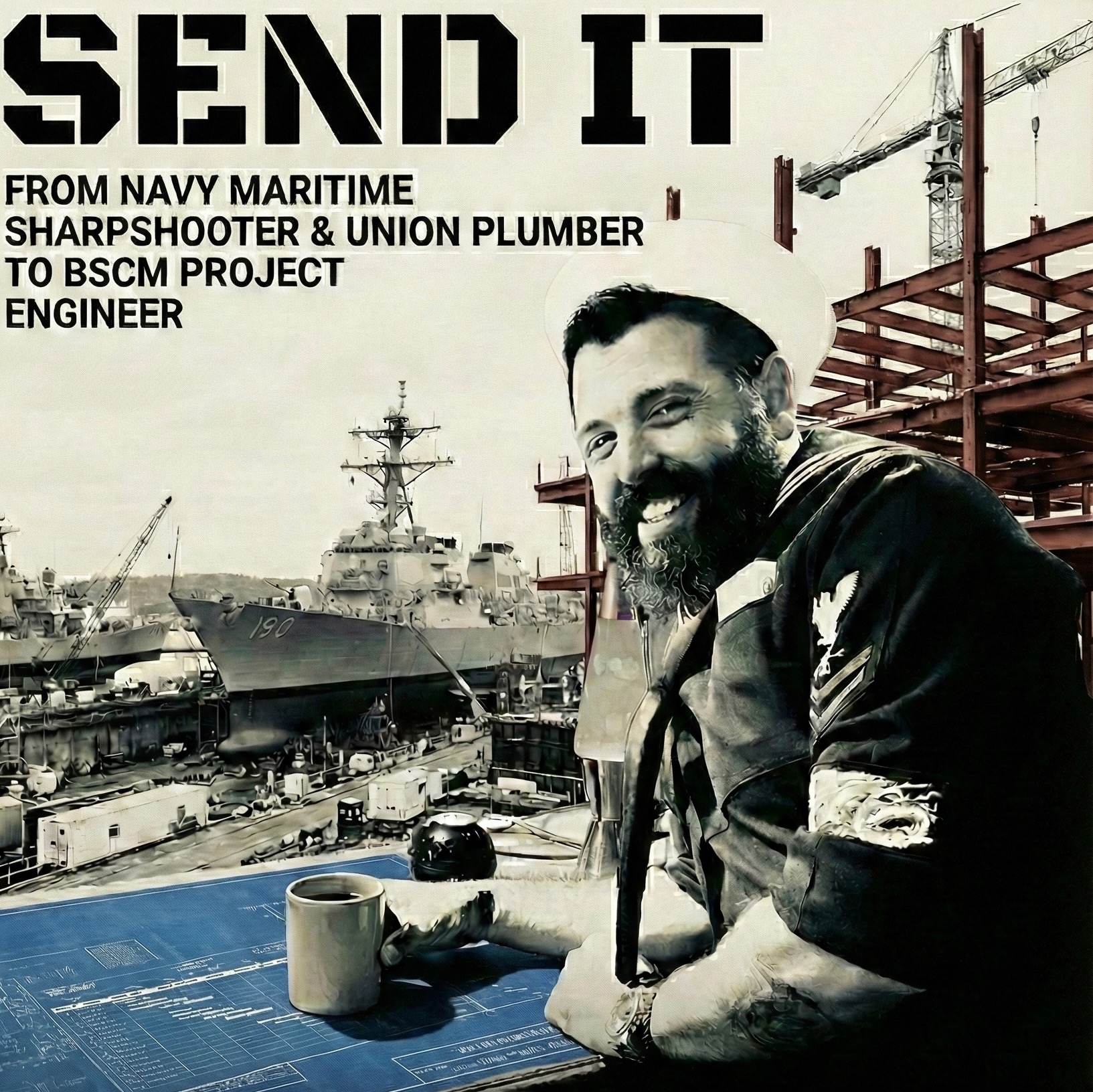
"SEND IT." In the Navy, it’s the command to take the shot. In the trades, it’s the moment you commit to the build. Now, it’s the mindset needed to crush a degree while balancing a full-time career and a family.Welcome to the audio companion for the Bachelor of Science in Construction Management (BSCM). Hosted by JC—a 20-year Navy veteran (Sonar Tech, Boatswain’s Mate, and Long-Range Engagement Specialist), former lead Union Plumber, and current Project Support Engineer for NAVSEA SWRMC.This podcast leverages the power of modern technology to transform dense academic reading into engaging audio "Deep Dives." We bypass the reading fatigue and get straight to the tactical knowledge of Construction Concepts, from Site Work to Punch List and everything in between.From the deck plates to the job site to the classroom, we’re taking the complex theory of construction management and translating it into something
-
36
The Metrics – Life-Cycle Assessment & Carbon (Mod 3)
On this episode of Send It, JC gets into the math. If you can't measure it, you can't manage it.We are diving into Module 3 to decode the complex world of Life-Cycle Assessments (LCA) and Carbon Footprints. We cut through the red tape of carbon accounting to focus on what actually impacts the project: material selection, waste reduction, and the massive carbon penalty of your structural choices.In this Deep Dive, we cover:Life-Cycle Assessment (LCA): Tracking heavy-duty materials from cradle to grave, and why buying quality upfront lowers your overall life-cycle cost.The Embodied Carbon Culprits: Why structural systems and massive glass building enclosures do the most damage to your carbon budget.The 350.org Reality: Why the global atmospheric carbon target is actually sitting below our current reality.Engineering Wins: How electric arc furnaces have legitimately slashed the steel industry's carbon footprint by 36% since 1990.www.BattleBuddyBackup.com
-
35
MIDTERM EXAM CRAM (Modules 1-3)
We have reached the first major checkpoint of Season 2. On this special Midterm Edition of Send It, JC strips away the theory and focuses purely on the mission: passing the exam.We are compressing Modules 1, 2, and 3 into one high-intensity tactical review. Remember the Golden Rule: It doesn't matter how we do it in the field; if the manual says it, that is the exact answer we feed the test.The "Stumpers" We Cover:The Energy Trap: Why "Scheduling the time of use" is NOT considered one of the standard building energy consumption stages.The Social Benefit: Why the textbook rigidly classifies "enhancing occupant comfort" as a social benefit, not an environmental one.The Bureaucracy of Carbon: Why the exam wants you to say assigning "ownership" of emissions is a "good first step."Upstream vs. Downstream: Nailing the timeline of environmental impacts in a Life-Cycle Assessment.Clear the decks. It's Game Day.www.BattleBuddyBackup.com
-
34
The SOP – Environmental Justice & ISO 14001 (Mod 2)
On this episode of Send It, JC tackles the bureaucracy. We are looking at the policies, the SOPs, and the human behavior that drives sustainable construction in Module 2.A policy on paper means nothing if the crew on the ground doesn't execute. We discuss how international targets eventually become local building codes, why "Prevailing Conditions" dictate your build strategy, and the gold standard of continuous improvement.In this Deep Dive, we cover:ISO 14001: The ultimate engineering standard for quality control—the "Plan – Do – Check – Act" cycle.Environmental Justice: A hard look at industrial zoning using the real-world textbook case study of Louisiana's "Cancer Alley."Human Behavior: The "Tragedy of the Commons" on the job site and why "Product Semantics" (user-friendly design) is crucial for execution.Policy Evaluation: Why operational performance monitoring is the only textbook-approved way to measure success.www.BattleBuddyBackup.com
-
33
The Baseline – Energy Cycles & Global Directives (Mod 1)
On this episode of Send It, JC establishes the baseline for sustainable construction.We are breaking down Module 1, stripping away the academic fluff to focus on the heavy-duty logistics of how a building actually consumes energy. We cover the UN’s Global Directives, the Brundtland Commission’s definition of sustainability, and the Battelle Top 10 Green Trends that are actively reshaping the modern job site.In this Deep Dive, we cover:The Energy Cycle: The critical difference between Embodied (manufacturing), Grey (transport), Induced (construction), and Operational energy.The 33% Rule: Why the building sector is responsible for a massive one-third of global greenhouse gas emissions.The Future Job Site: How water resource management and upcoming carbon regulations are becoming major compliance risks for Project Managers.www.BattleBuddyBackup.com
-
32
Send It: Season 2 Intro – The Sustainability Shift
Welcome to Season 2 of Send It. We survived Contracts and Law; now it is time to pivot.On this deployment, JC takes on a massive operational shift in the Architecture, Engineering, and Construction (AEC) industry: Sustainable Buildings and Infrastructure. This isn't about hugging trees; this is about resource efficiency, supply chain logistics, and navigating the new wave of global compliance directives that every Project Manager is going to face. We are setting the baseline, defining the doctrine, and laying out the roadmap for Modules 1 through 3.
-
31
FINAL EXAM CRAM (Modules 5-7)
This is it. The ultimate review for the back half of the semester. On this special Final Exam Edition of Send It, JC reviews the "Game Tape" for Modules 5, 6, and 7.We are taking the hardest legal concepts and project management realities—from EPC contracts to Labor Laws—and breaking them down so you can ace this exam.The "Stumpers" We Cover:The 35% Rule: Why a third of all projects experience major changes, and why both parties must sign the change order.EPC vs. EPCM: Understanding the difference between a "Turnkey/Lump Sum" contract and a strictly "Management/Design" role.Labor Law Traps: How the FSLA trumps state law on the 40-hour overtime rule, and the specific thresholds for school leave (16 hours) and pregnancy leave (25 employees).The 4 Typical Claims: We break down Delay, Damage, Price Acceleration, and Site Condition claims so you never mix them up.The Float Fight: Why project schedule "Float" is actually one of the leading causes of construction disputes.From Advanced Work Packaging (AWP) to Site Safety Liability, this is your final check before you log in to take the test.
-
30
Show Me the Money – Construction Claims (Ch. 22)
On this Deep Dive of Chapter 22, JC gets into the weeds of the Construction Claim. We explain the two pillars of every claim: Entitlement (Liability) and Quantum (Damages). Plus, we teach you the "Measured Mile" method—the only way to truly prove that the owner's chaos destroyed your productivity.
-
29
The Pressure Cooker – Constructive Acceleration (Ch. 19)
On this Deep Dive of Chapter 19, JC breaks down one of the hardest claims to prove: Constructive Acceleration. Learn what happens when the Owner says "No" to a time extension but still demands the original completion date—and how to make them pay for the overtime.
-
28
The Blame Game – Allocating Concurrent Delay (Ch. 18)
On this Deep Dive of Chapter 18, JC untangles the knot of Concurrent Delay. When the Owner is late approving plans AND your truck breaks down on the same day, who pays? We explain the "But-For" test and why concurrent delay usually results in a "draw" (Time but no Money).
-
27
It’s Not a Penalty – Liquidated Damages (Ch. 17)
On this Deep Dive of Chapter 17, JC explains the most misunderstood term in the contract: Liquidated Damages. We explain why courts hate "penalties" but love LDs, and how Force Majeure (Acts of God) can save you from paying them.
-
26
The Fight for Payment – Claims, Acceleration & LDs (Mod 7)
On this episode of Send It, JC teaches you how to get paid when the job goes sideways. We cover Module 7 (Chapters 17, 18, 19, & 22). Learn why Liquidated Damages aren't technically a penalty, what happens when both sides delay the job (Concurrent Delay), and how to prove a Constructive Acceleration claim when the owner refuses to give you more time.
-
25
Reading Between the Lines – Contract Interpretation (Ch. 20)
On this Deep Dive of Chapter 20, JC puts on the judge's robe. When the contract is unclear, who wins? We break down the "Hierarchy of Intent", the Parol Evidence Rule, and the critical doctrine of Contra Proferentem—the rule that says if you wrote the confusing clause, you lose the argument.
-
24
If It Isn't Written, It Didn't Happen (Ch. 21)
On this Deep Dive of Chapter 21, JC explains why the "pen is mightier than the shovel." We discuss the "Put-It-In-Writing" Rule and the legal concept of Hearsay. Learn why your daily job logs are admissible in court (the Business Records Exception) and why waiting until the end of the week to write your reports destroys your credibility.
-
23
Organized Labor & Union Agreements (Ch. 6)
On this Deep Dive of Chapter 6, JC navigates the complex world of Labor Agreements. We explain the Hiring Hall, the Subcontracting Clause (and why it’s controversial), and the strategic difference between a Strike and a Lockout. Whether you are Open Shop or Union, you need to know the rules of the road.
-
22
Unions, Paperwork & The Fine Print (Mod 6)
On this episode of Send It, JC covers the "Admin Trinity": Labor, Law, and Logs. We break down Module 6 (Chapters 6, 20, & 21). Learn why Union "Hiring Halls" matter, how judges interpret ambiguous contracts (hint: if you wrote it, you lose), and why your daily job logs are the only thing keeping you out of the "Hearsay" trap in court.
-
21
The "Game Changers" – Changes, Delays & Hidden Conditions (Mod 5)
Description: On this episode of Send It, JC enters the "fog of war." The perfect plan meets reality. We break down Module 5 (Chapters 14, 15, & 16), covering the three things that destroy schedules and budgets: Change Orders, Differing Site Conditions, and Delays. Learn the legal difference between a "Type I" and "Type II" condition, why "Constructive Changes" are a trap, and how to use Earned Value to track the damage.www.battlebuddybackup.com
-
20
The Hidden Danger – Differing Site Conditions (Ch. 15)
Description: On this Deep Dive of Chapter 15, JC digs into what lies beneath. What happens when your excavator hits rock that wasn't on the geo-report? We break down the legal difference between Type I (Contract vs. Reality) and Type II (Reality vs. Normal) conditions, and why Prompt Written Notice is the only thing standing between you and a denied claim.www.battlebuddybackup.com
-
19
Hurry Up & Wait – Delays, Suspensions & Termination (Ch. 16)
Description: On this Deep Dive of Chapter 16, JC analyzes the most expensive resource on the job: Time. We explain the legal hierarchy of delays: Excusable (Mother Nature), Non-Excusable (Your Fault), and Compensable (Owner's Fault). Plus, we discuss the "No-Damages-For-Delay" clause and the difference between getting fired for Default versus Convenience.www.battlebuddybackup.com
-
18
Scope Creep & Cardinal Changes (Ch. 14)
Description: On this Deep Dive of Chapter 14, JC tackles the "Change Order." We discuss the Changes Clause, which gives the owner the power to alter the deal, and the Cardinal Change, which protects the contractor from being forced to build a completely different project. Plus, we analyze the Constructive Change—the silent killer of profit margins where the owner acts like it's a change but won't sign the paper.www.battlebuddybackup.com
-
17
MIDTERM EXAM CRAM (Mid_Term_Modules_1-4)
We have reached the halfway point. On this special Midterm Edition of Send It, JC reviews the "Game Tape" for the first half of the semester.We are compressing four modules of material into one high-intensity review session. We aren't just reciting definitions; we are answering the specific quiz questions that are most likely to show up on the test.www.battlebuddybackup.com
-
16
Surety Bonds & The Miller Act (CM4210_Ch9)
On this episode of Send It, JC breaks down the financial backbone of the construction industry: The Surety Bond.We are covering Chapter 9 and the second half of Module 4. Most people confuse bonds with insurance, but they are opposites. Insurance pays for your accidents; Bonds guarantee your word—and if you break it, you pay the Surety back.www.battlebuddybackup.com
-
15
Insurance Contracts & Liability (CM4210_Ch8)
On this episode of Send It, we isolate the single biggest line item in your overhead: Insurance.We are taking a Deep Dive into Chapter 8 and Module 4, stripping away the confusion between coverage and liability. Before we talk about Bonds (which guarantee performance), we have to talk about Insurance (which covers disaster).www.battlebuddybackup.com
-
14
Insurance vs. Surety Bonds (CM4210_Ch8,&9_review)
On this episode of Send It, JC tackles the two financial pillars that keep a construction company from going under: Insurance and Surety Bonds.Covering Chapters 8 & 9 and Module 4, we break down the "Safety Net" of the industry. Many people confuse insurance with bonds, but they function completely differently. One pays for accidents; the other guarantees you do what you promised.www.battlebuddybackup.com
-
13
The Aftermath: Litigation, Arbitration, & ADR (CM4210_Ch23)
This is a voyage through a B.S. in Construction Management. Welcome to Send It. When the smoke clears on the job site, the legal battle begins. In this final deep dive of Module 3, JC compares the costs of Litigation (Total War) against Arbitration (Private Special Ops). We break down the discovery process, the role of expert witnesses, and why the industry is shifting toward Alternative Dispute Resolution (ADR). Learn how Mediation, Mini-Trials, and Dispute Review Boards (DRBs) can act as peacekeepers to resolve conflicts before they destroy your project’s budget.www.battlebuddybackup.com
-
12
Broken Treaties: Material Breach & The Spearin Doctrine (CM4210_Ch13)
This is a voyage through a B.S. in Construction Management. Welcome to Send It. What happens when the other side violates the treaty? In this episode, we analyze Breach of Contract. JC explains the tactical difference between a Minor Breach (a flesh wound) and a Material Breach (a casualty event), and warns against the "Nuclear Option" of walking off the job. We discuss the Owner's implied warranty not to interfere with your work and conduct a full briefing on the Spearin Doctrine—the "Magna Carta" of construction law that protects you when the Owner's blueprints are defective.www.battlebuddybackup.com
-
11
Friendly Fire: Recovering from Bid Mistakes (CM4210_Ch12)
This is a voyage through a B.S. in Construction Management. Welcome to Send It. The Firm Bid Rule means that once you pull the trigger on a bid, you can't call the bullet back—unless you know the Doctrine of Mistake. In this episode, JC explains the critical difference between a Clerical Error (which might get you out of jail) and a Judgmental Error (which leaves you holding the bag). We also execute a deep dive into Promissory Estoppel—the legal doctrine that prevents your subcontractors from backing out of their quotes at the last minute. Learn the "Six Tests for Withdrawal" and how to protect your bottom line from self-inflicted wounds.www.battlebuddybackup.com
-
10
Target Acquisition: Winning the Bid Legally (CM4210_Ch11)
This is a voyage through a B.S. in Construction Management. Welcome to Send It. Before you can build, you have to win the war for the contract. In this deep dive, JC breaks down the strict "Rules of Engagement" for Public vs. Private bidding. We define the "Golden Standard" of government contracting: being the Lowest Responsive and Responsible Bidder. We explain how to avoid "Material Improprieties" like bid rigging, how to utilize the Pre-Bid Meeting for intelligence gathering, and the tactical process of filing a Bid Protest. If you don't understand the difference between a "Responsive" bid (the paperwork) and a "Responsible" bidder (the capacity), you are going to get disqualified before the race even starts.www.battlebuddybackup.com
-
9
Mission Briefing: Bids, Breaches, and Battlefields (CM4210_Ch11,12,13,&23_review)
Description: This is a voyage through a B.S. in Construction Management. Welcome to Send It. In this strategic briefing, JC provides a high-level tactical overview of the entire "Lifecycle of Conflict" covered in Module 3. We trace the trajectory of a project from the initial Target Acquisition (Bidding - Ch. 11) to the danger of Friendly Fire (Mistakes - Ch. 12). We analyze what happens when the Rules of Engagement are violated (Breach - Ch. 13) and how to handle the Aftermath (Dispute Resolution - Ch. 23). This is your flight plan for the entire unit—getting you responsive, responsible, and ready to audit the process.www.battlebuddybackup.com
-
8
Force Multipliers: Tactical Analysis of Joint Ventures (New_CM4210_Ch10)
Sometimes the mission objective is too large for a single unit. In this episode, JC breaks down the "Force Multiplier" of the construction world: the Joint Venture (JV). We analyze the command structure of Conventional vs. Item Joint Ventures and the strategic advantages of pooling resources to attack larger targets. We discuss the "Kill Switch" of Joint and Several Liability, where a partner's failure becomes your total responsibility. We also cover the logistics of the Capital Call, the role of the Managing Partner, and the specific Bonding and Insurance packages required to armor the JV entity. If you are looking to combine forces to enter new markets or share risk, this is your briefing.www.battlebuddybackup.com
-
7
Logistics & Liability: Purchase Orders vs. Subcontracts (New_CM4210_Ch07)
JC takes you on a talk about strategy and logistics. In this episode of Send It, JC analyzes the critical supply line documents: Purchase Orders and Subcontracts. We define the tactical distinction between the "Sale of Goods" and "Labor at the Site" to ensure you are standing on the right legal battlefield. We expose the "Red Flags" of procurement, including the "Battle of the Forms," the F.O.B. (Free on Board) risk traps, and the "No Pay Until Paid" clauses that threaten your cash flow. We also integrate intelligence on proper Invoicing Protocols and the strategic advantages of outsourcing for Risk Aversion. Whether you are buying steel or hiring a welder, learn how to establish operational control and ensure liability flows down, not up.www.battlebuddybackup.com
-
6
Targeting the "Red Flags": Mission-Critical Contract Clauses (New_CM4210_Ch05)
Host JC takes you on a tactical deep dive into the "Red Flag" clauses of prime construction contracts. In this episode, we audit the "Rules of Engagement" that can sink your project before you even break ground. We analyze the Dispute Resolution battlefield (Arbitration vs. Litigation) and the dangers of Sovereign Immunity. We break down the "Kill Switches"—Terminations for Default vs. Convenience—and how to handle the "unknowns" through Differing Site Conditions and Geotechnical Baseline Reports. Finally, we execute a risk transfer analysis, defining the critical differences between Insurance and Surety Bonds (Bid, Performance, and Payment) and navigating federal Set-Aside Programs (DBE, 8(a), and HUBZone). Don't let your ego write checks your contract can't cash—audit the process.www.battlebuddybackup.com
-
5
Send It: Bidding Strategy, Bonds & Contract Conditions (New_CM4210_Ch5,7,10_review)
On this episode of Send It, JC breaks down the high-pressure phase before the work even starts: The Bidding Process.We are covering a massive chunk of the CM4210 curriculum (Chapters 5, 7, & 10). Knowing how to build is one thing; knowing how to price it, secure it, and insure it is what keeps your doors open. We discuss the critical difference between "boilerplate" rules and project-specific ones, how to legally withdraw a bid without losing your shirt, and why Surety Bonds are the credit card of construction.From the surety agent's office to the bid opening room, this is your tactical guide to securing the work."This has been Send It, Now get out there and build something."www.battlebuddybackup.com
-
4
Send It: Privity of Contract & The Third-Party Trap (CM4210_Ch04)
On this episode of Send It, JC navigates the tangled web of relationships that exist outside the direct contract.We are tackling Chapter 4 of Construction Contracts to understand "Privity of Contract"—the rule that usually protects you from being sued by someone you didn't hire, and prevents you from suing someone who didn't hire you. But as with everything in law, there are major exceptions that every Project Engineer needs to know.In this Deep Dive, we cover:Privity of Contract: The fundamental rule that contractual rights generally only exist between the parties who signed the deal (e.g., Owner and Prime).Third-Party Beneficiaries: The exception where someone outside the contract (like an Owner suing a Sub) might actually have a case if they were the "intended" beneficiary.The "Multiple Prime" Problem: The chaos that ensues when an Owner hires several Prime contractors who have no contract with each other—and who pays when one delays the other.Promissory Estoppel: The "fairness" doctrine that stops a Sub from pulling their bid after the Prime has already relied on it to win the job.Sovereign Immunity: The reality that you generally can't sue the government unless they grant you permission to do so.Understanding these relationships is key to knowing who you can lean on, who can lean on you, and when you need to call the lawyers.www.battlebuddybackup.com
-
3
Send It: Contract Formation & The Rules of Acceptance (CM4210_Ch03)
On this episode of Send It, JC dives into the legal mechanics of how a contract is actually born.We are moving past the general concepts and drilling down into Chapter 3 of Construction Contracts (Contract Formation). You might have a "meeting of the minds," but if you don't have the specific legal pillars in place, that agreement isn't worth the paper it's printed on.In this Deep Dive, we cover:The Three Pillars: Why every binding contract requires Offer, Acceptance, and Consideration.The Rules of Acceptance: Understanding that acceptance must be absolute and unconditional—if you change the terms, you haven't accepted; you've made a counteroffer.Consideration: It’s not just about money. It’s about the exchange of value—one party gives up a right or provides a benefit in exchange for the other doing the same.Legal Capacity: Why contracts with minors, intoxicated persons, or those declared mentally incompetent are often voidable.The "Mirror Image" Rule: Why your acceptance has to match the offer exactly, or else you are just restarting negotiations.From the classroom to the job site, knowing when you are legally "on the hook" is critical for every project engineer and manager.www.battlebuddybackup.com
-
2
Send It: Design-Bid-Build & The Legal Chain of Command (CM4210_Ch02)
On this tactical episode of Send It, JC breaks down the "Rules of Engagement" for construction project delivery.Navigating a project isn't just about moving dirt; it's about understanding the legal hierarchy that keeps the job site running. We dive into Chapter 2 of Construction Contracting and Module 1 to clarify exactly who works for whom—and who carries the risk.In this Deep Dive, we cover:Design-Bid-Build (DBB): Defining the traditional "three-phase" delivery method and why it matters.The Chain of Command: Clarifying that the Prime/General Contractor—not the Owner—is solely responsible for selecting and managing subcontractors.Privity of Contract: The legal concept that connects the Owner to the Prime, but shields the Owner from the Subs.The Owner's Risk: Why Design-Build methods might result in a higher price tag for the Owner compared to traditional bidding.Defining the Players: Clear, legal definitions for the General Contractor (the overseer) and the Owner (the one paying the bills).Whether you are studying for your BSCM exams or managing a crew on site, you need to know where the buck stops.www.battlebuddybackup.com
-
1
Navigating Construction Contracts (CM4210 CH2,3,4 Review)
On this episode of Send It, JC takes a tactical look at the backbone of the entire industry: the construction contract.Moving from the trades to management means trading your hammer for the "legal stack"—the hierarchy of documents that dictate risk, liability, and profit. We break down Chapters 2, 3, and 4 of Construction Contracting to understand exactly what you are signing before you mobilize a single crew.In this Deep Dive, we cover:The Prime Contract: Why it’s the "Big Domino" that triggers every other agreement on the project.Contract Formation: The three non-negotiables—Offer, Acceptance, and Consideration—that make a handshake legally binding (or not).Privity of Contract: Understanding the "legal chain of command" for liability and why you can’t just sue anyone on the job site.Delivery Methods & Risk: How Design-Bid-Build vs. Design-Build shifts the financial risk between the owner and the contractor.The "Red Flags": Critical clauses like "No Damages for Delay" and "Liquidated Damages" that can destroy your margins if ignored.Whether you are a sub, a prime, or an owner's rep, understanding the rules of engagement is the only way to protect the project.Keywords: Construction Contracts, Construction Management, PRIME CONTRACT, CONTRACT FORMATION, PRIVITY OF CONTRACT, OTHER CONTRACT RELATIONSHIPS, Contract Acceptance and Consideration, CM4210.Source Material: Construction Contracting, Chapters 2, 3, & 4; Module 1.www.battlebuddybackup.com
We're indexing this podcast's transcripts for the first time — this can take a minute or two. We'll show results as soon as they're ready.
No matches for "" in this podcast's transcripts.
No topics indexed yet for this podcast.
Loading reviews...
ABOUT THIS SHOW
"SEND IT." In the Navy, it’s the command to take the shot. In the trades, it’s the moment you commit to the build. Now, it’s the mindset needed to crush a degree while balancing a full-time career and a family.Welcome to the audio companion for the Bachelor of Science in Construction Management (BSCM). Hosted by JC—a 20-year Navy veteran (Sonar Tech, Boatswain’s Mate, and Long-Range Engagement Specialist), former lead Union Plumber, and current Project Support Engineer for NAVSEA SWRMC.This podcast leverages the power of modern technology to transform dense academic reading into engaging audio "Deep Dives." We bypass the reading fatigue and get straight to the tactical knowledge of Construction Concepts, from Site Work to Punch List and everything in between.From the deck plates to the job site to the classroom, we’re taking the complex theory of construction management and translating it into something
HOSTED BY
John Campini
CATEGORIES
Loading similar podcasts...
Frequently Asked Questions
How many episodes does SEND IT have?
SEND IT currently has 36 episodes available on PodParley. New episodes are automatically indexed when they're published to the podcast feed.
What is SEND IT about?
"SEND IT." In the Navy, it’s the command to take the shot. In the trades, it’s the moment you commit to the build. Now, it’s the mindset needed to crush a degree while balancing a full-time career and a family.Welcome to the audio companion for the Bachelor of Science in Construction Management...
How often does SEND IT release new episodes?
SEND IT has 36 episodes. Check the episode list to see recent publication dates and frequency.
Where can I listen to SEND IT?
You can listen to SEND IT on PodParley by clicking any episode. We provide an embedded audio player for direct listening, and you can also subscribe via your preferred podcast app using the RSS feed.
Who hosts SEND IT?
SEND IT is created and hosted by John Campini.
URL copied to clipboard!