
PODCAST · business
Series 20 - The Governance Layer: What Human Oversight of Autonomous Finance AI Actually Requires
by Ryigit
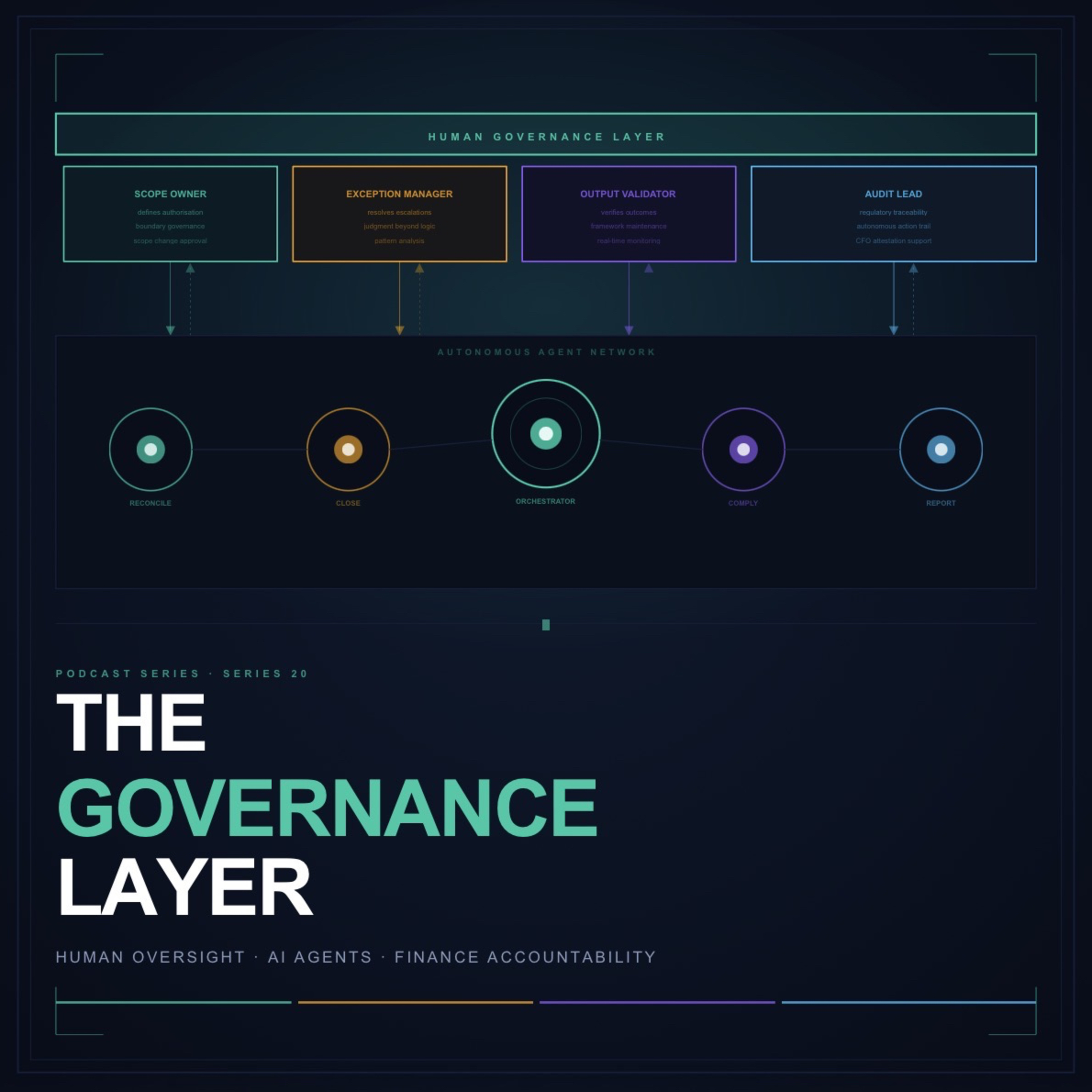
Autonomous AI agents in finance can process transactions, file submissions, reconcile positions, and close books without waiting for human approval. What they cannot do is govern themselves. The governance layer — the human roles, decision frameworks, escalation structures, and attestation models that make autonomous action safe, auditable, and organisationally accountable — does not emerge from the technology. It has to be designed. Hosted by Rıdvan Yiğit | Founder & CEO, RTC Suitertcsuite.com · [email protected] · linkedin.com/in/yigitridvan
-
4
Series 20 - The Deep Dive: Human Governance for Autonomous Finance Agents
The human governance of autonomous finance agents is not a compliance overhead that sits alongside the agent deployment. It is the architectural component that makes autonomous deployment viable — the layer that converts an unmonitored system into an accountable one, and the framework that allows the CFO to sign off on outcomes produced by a system rather than a person. This deep dive builds the complete governance architecture for autonomous finance agents: the roles, the frameworks, the escalation structures, the attestation models, and the organisational design that makes human oversight of autonomous action operationally sustainable.We begin with the governance architecture at the role level. The four roles that autonomous finance agents require — scope owner, exception manager, output validator, and audit lead — are defined in full: their specific accountabilities, the capabilities each requires, the processes each must maintain, and the failure modes that result when each is absent or inadequately resourced. We examine how these roles interact with each other and with the agent system, and how the governance team is structured for different deployment scales — from a single agent handling one finance process to a multi-agent environment where multiple autonomous systems are operating across the full finance function simultaneously.We then examine the scope governance framework: how the boundaries of agent authorisation are defined, documented, and maintained; how scope changes are assessed and approved; and how the governance team identifies the boundary drift that occurs when business conditions change faster than the agent's decision logic is updated. We address the exception management architecture: what the escalation protocol looks like, how exception patterns are analysed to identify systematic gaps in the agent's scope or logic, and how exception volume is monitored as a leading indicator of governance health. We examine the output validation framework: the difference between the agent's own verification layer and the governance team's independent validation of whether the agent's actions are producing the intended outcomes, and why both are required. We address the audit architecture: what the regulatory and internal audit requirements that apply to autonomous finance actions actually demand, how the agent's action trail is structured to satisfy those requirements, and how the governance team maintains the documentation that demonstrates that the human oversight of autonomous action was genuine rather than nominal.Finally, we address the systemic governance question: what happens when multiple agents are operating simultaneously, when the outputs of one agent become the inputs of another, and when the failure of one agent's governance framework propagates through the network of autonomous systems that depends on it. The governance architecture that handles single-agent deployment does not automatically scale to multi-agent environments — and the organisations that design their governance frameworks now for the single-agent case without anticipating the multi-agent future are building a governance architecture they will need to redesign at the point of greatest operational exposure.Keywords: autonomous finance agent governance complete, human governance AI agents deep dive, finance AI governance architecture, scope owner AI finance governance, exception manager finance AI, output validator autonomous agent, audit lead AI finance, CFO attest autonomous finance, AI agent governance framework complete, finance governance multi-agent, autonomous finance agent escalationAbout the HostRıdvan Yiğit is the Founder & CEO of RTC Suite — the world's first Autonomous Compliance and Payment Intelligence platform, built natively on SAP BTP and operating across 80+ countries.Connect with Rıdvan:🔗 linkedin.com/in/yigitridvan✉ [email protected]📞 +90 545 319 93 44Learn more about RTC Suite:🌐 rtcsuite.com
-
3
Series 20 - The Debate: Closing the AI Agent Governance Gap
The AI agent governance gap is the distance between the governance frameworks that organisations currently have and the governance frameworks that autonomous finance agents actually require. Most organisations are aware that the gap exists. The debate is about how to close it — and the two positions in this debate reflect genuinely different assessments of what the gap consists of and where the closure effort should be directed.One side argues that the governance gap is primarily a process design problem. The existing finance governance framework — the roles, the sign-off structures, the audit trail requirements — is fundamentally sound, and the gap can be closed by extending it to cover autonomous agent behaviour: defining which existing roles are accountable for which aspects of agent governance, updating the sign-off structures to include agent outputs, and extending the audit trail requirements to capture the information that autonomous actions generate. On this view, the governance gap is real but tractable — a design and configuration challenge that does not require the invention of new governance concepts, only the application of existing ones to a new context.The other side argues that the governance gap is not a process design problem but an accountability model problem. The existing finance governance framework was designed around human decision-makers — people who can be questioned, who can explain their reasoning, who can be held personally accountable for the decisions they made. An autonomous agent is none of these things. Extending a framework designed for human accountability to cover an autonomous system does not close the governance gap — it papers over it. What is required is a new accountability model that addresses directly the questions that autonomous action raises: who is accountable when an agent acts correctly within its scope but the scope was wrong? Who is accountable when the agent's output validation framework failed to detect a problem that a human reviewer would have caught? Who is accountable for the systemic risk that accumulates when multiple agents are operating simultaneously across multiple finance processes?The resolution of this debate matters because the governance design that organisations implement now will be the framework that regulators and auditors scrutinise when the first significant failure of an autonomous finance agent occurs — and the organisations that closed the gap by extending the old framework rather than designing the new one will be the least prepared for that scrutiny.Keywords: AI agent governance gap, closing AI governance gap finance, autonomous finance agent accountability, AI agent governance debate, finance AI governance accountability model, human governance AI finance debate, autonomous agent governance framework, AI agent finance regulatory, governance gap autonomous finance, finance AI agent risk, AI governance accountability finance, autonomous finance agent governance design, AI agent governance regulatory scrutiny, finance AI governance model, human accountability AI agent financeAbout the HostRıdvan Yiğit is the Founder & CEO of RTC Suite — the world's first Autonomous Compliance and Payment Intelligence platform, built natively on SAP BTP and operating across 80+ countries.Connect with Rıdvan:🔗 linkedin.com/in/yigitridvan✉ [email protected]📞 +90 545 319 93 44Learn more about RTC Suite:🌐 rtcsuite.com
-
2
Series 20 - The Critique: Human Governance Roles for Finance AI Agents
The governance frameworks that most organisations are applying to their AI agent deployments were not designed for autonomous systems. They were designed for human processes — and the assumptions embedded in those frameworks, about who makes decisions, how decisions are documented, and what constitutes a satisfactory audit trail, do not translate straightforwardly to an environment where the decision-maker is a system rather than a person.The critique this episode makes is specific: the four governance roles that autonomous finance agents require are not simply renamings of existing finance roles. The scope owner is not the system owner from the IT governance framework — the system owner is accountable for the technology; the scope owner is accountable for the business decisions the technology is authorised to make. The exception manager is not the finance manager who previously approved the transactions the agent now processes — the exception manager is accountable for the cases where the agent's encoded logic is insufficient, which requires a different kind of judgment than transaction approval. The output validator is not the internal audit function — the output validator is accountable for the ongoing verification that the agent's actions are producing the intended outcomes, in real time, not at the point of annual audit. And the audit lead is not the compliance officer who signs off on the period-end reports — the audit lead is accountable for the regulatory traceability of autonomous actions that a framework designed for human decision-making may not natively accommodate.Each of these roles requires specific capabilities that existing finance governance structures do not consistently develop. The scope owner needs to understand both the business process and the agent's decision logic well enough to know where the boundary between them should sit. The exception manager needs to be able to make rapid, well-reasoned judgments on cases that the agent has already determined are outside its competence. The output validator needs to understand what the agent's verification layer is checking and what it is not. The audit lead needs to understand what the regulatory frameworks that apply to the finance process actually require of an audit trail produced by an autonomous system. These are new capabilities. They require deliberate development — and the organisations that assume existing roles can absorb them without development are the ones whose governance frameworks will fail at the point of the first regulatory inquiry.Keywords: finance AI governance roles critique, AI agent scope owner finance, exception manager AI finance, output validator AI agent, audit lead autonomous finance, human governance AI finance roles, AI agent governance framework critique, finance AI governance capability, autonomous agent finance governance, AI agent decision boundary finance, governance roles AI deployment finance, finance AI agent regulatory, human oversight autonomous finance critique, AI governance finance function, autonomous finance agent human rolesAbout the HostRıdvan Yiğit is the Founder & CEO of RTC Suite — the world's first Autonomous Compliance and Payment Intelligence platform, built natively on SAP BTP and operating across 80+ countries.Connect with Rıdvan:🔗 linkedin.com/in/yigitridvan✉ [email protected]📞 +90 545 319 93 44Learn more about RTC Suite:🌐 rtcsuite.com
-
1
Series 20 - The Brief: Human Teams to Govern AI Agents
The deployment of autonomous AI agents in finance does not reduce the need for human judgment. It relocates it. The humans who previously spent their time processing transactions, routing approvals, and assembling period-end reports are no longer needed for those tasks — the agent handles them. The humans who are needed, and whose roles most organisations have not yet formally defined, are the ones who decide what the agent is authorised to do, monitor whether it is doing it correctly, resolve the situations it cannot handle, and attest to the outcomes it produces.This is the governance team. And in most organisations, it does not exist yet — not because the need has not been recognised, but because the agent deployment has been treated as a technology implementation rather than an organisational redesign. The technology team configured the agent. The finance team was told what it would handle. Nobody formally defined the role of the person who is responsible for the agent's behaviour when the agent encounters a situation its configuration did not anticipate.The brief this episode makes is structural: every autonomous finance agent requires a governance team with four defined roles. The scope owner defines and maintains the boundaries of what the agent is authorised to do, and updates those boundaries as the business changes. The exception manager receives the cases the agent escalates and makes the judgment calls that the agent's decision logic cannot resolve. The output validator maintains the framework for verifying that the agent's actions are producing the outcomes they were designed to produce, and identifies when the framework needs to change. The audit lead ensures that the agent's action trail satisfies the regulatory and internal audit requirements that apply to the finance processes the agent is executing. These four roles do not require four full-time employees in every organisation. But they require four defined accountabilities — and the organisation that deploys an autonomous finance agent without defining them has not deployed an agent. It has deployed an unmonitored system.Keywords: AI agent governance team finance, human governance AI agents, finance AI agent oversight roles, autonomous agent governance finance, AI agent scope owner, finance AI exception manager, autonomous finance agent audit, human oversight AI finance, AI agent governance roles defined, finance governance autonomous AI, AI agent attestation finance, human team AI agent finance, governance framework autonomous finance, finance AI agentAbout the HostRıdvan Yiğit is the Founder & CEO of RTC Suite — the world's first Autonomous Compliance and Payment Intelligence platform, built natively on SAP BTP and operating across 80+ countries.Connect with Rıdvan:🔗 linkedin.com/in/yigitridvan✉ [email protected]📞 +90 545 319 93 44Learn more about RTC Suite:🌐 rtcsuite.com
No matches for "" in this podcast's transcripts.
No topics indexed yet for this podcast.
Loading reviews...
ABOUT THIS SHOW
Autonomous AI agents in finance can process transactions, file submissions, reconcile positions, and close books without waiting for human approval. What they cannot do is govern themselves. The governance layer — the human roles, decision frameworks, escalation structures, and attestation models that make autonomous action safe, auditable, and organisationally accountable — does not emerge from the technology. It has to be designed. Hosted by Rıdvan Yiğit | Founder & CEO, RTC Suitertcsuite.com · [email protected] · linkedin.com/in/yigitridvan
HOSTED BY
Ryigit
CATEGORIES
Loading similar podcasts...
URL copied to clipboard!