
PODCAST · business
Series 25 - The Real-Time Tax Shift: When Continuous Controls Replace the Tax Calendar
by Ryigit
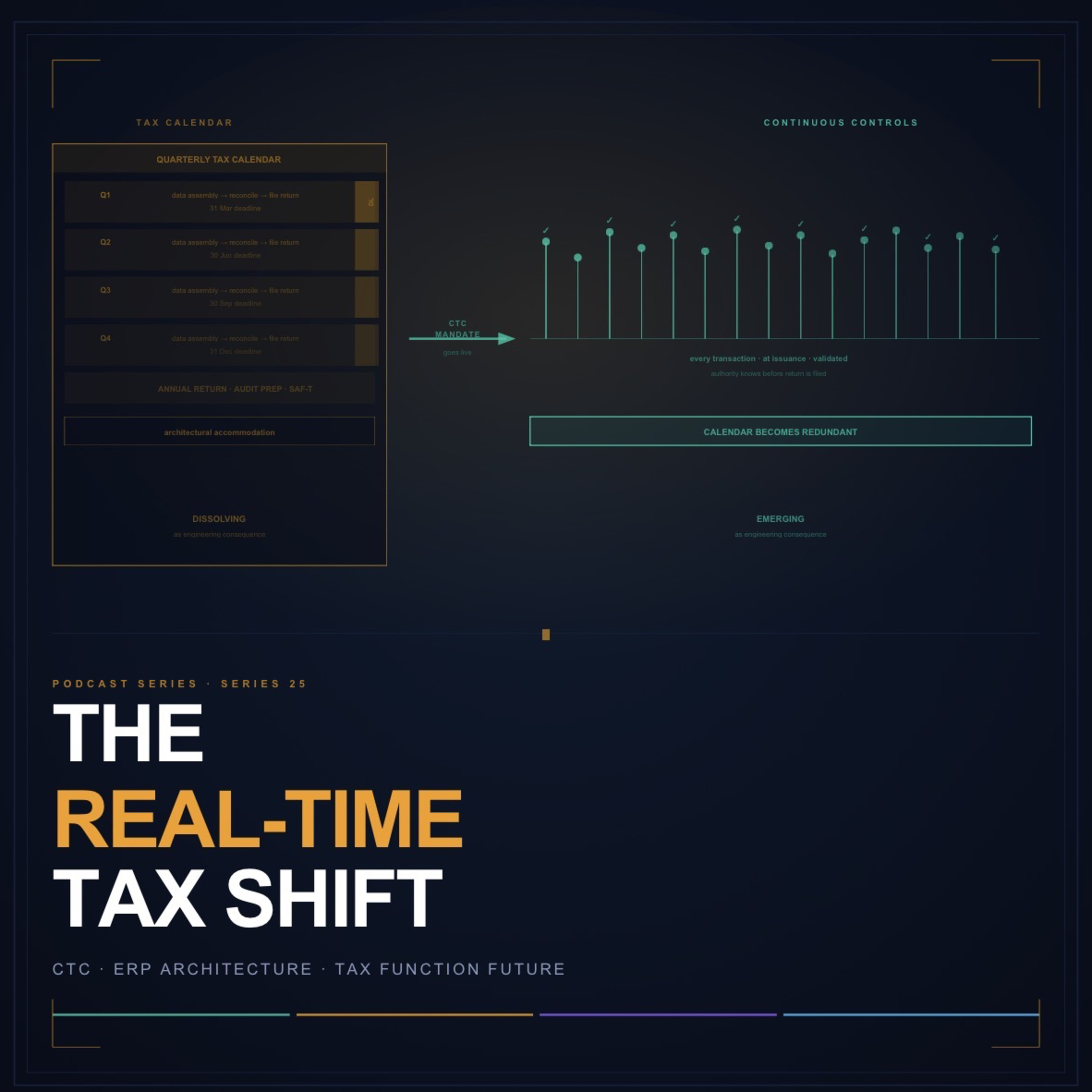
The tax calendar was designed for a world that no longer exists. Quarterly returns, period-end reconciliations, and annual compliance cycles were built on the assumption that tax data moves at human speed through systems designed for financial reporting. Continuous transaction controls have ended that assumption. When every transaction is validated at the moment of issuance, the return is not a submission — it is a confirmation of what the authority already knows. Hosted by Rıdvan Yiğit | Founder & CEO, RTC Suitertcsuite.com · [email protected] · linkedin.com/in/yigitridvan
-
4
Series 25 - The Deep Dive: Real-Time Tax Replaces the VAT Return
The VAT return is dying. Not as a regulatory instrument — tax authorities will continue to require periodic reconciliation submissions for years, and in many jurisdictions for decades, after the underlying transaction data has moved to continuous transmission. But as a compliance process, as an organisational event, as the rhythm around which tax functions organise their work and their people, the VAT return is being replaced. This deep dive builds the complete picture of what replaces it: the data architecture, the compliance execution model, the tax team structure, and the regulatory interface that together constitute the post-return compliance environment.We begin with the anatomy of what the VAT return actually does — separated into the components that real-time data replaces and the components that remain. Transaction reporting — the submission of invoice-level data to the tax authority — is the component that CTC mandates most directly replace. When every invoice has been transmitted to the authority at the point of issuance, the return is not reporting transactions. It is confirming a position that both parties already know. The reconciliation work that traditionally consumed the largest share of period-end tax resource is becoming a system-generated output rather than a human-assembled one.The components that survive are different. Adjustment processing — the correction of transactions that were reported with errors, the application of bad debt relief, the treatment of credit notes and cancellations — requires judgment that no clearance system provides. Position optimisation — the identification of input tax recovery opportunities, the application of partial exemption methodologies, the management of capital goods scheme obligations — requires analysis that continuous transaction feeds make more visible but do not resolve. And regulatory interpretation — the application of emerging guidance to transaction types that the automated system cannot classify without human input — remains a fundamentally human activity regardless of how sophisticated the underlying infrastructure becomes.We then build the post-return compliance architecture: the continuous transaction monitoring layer that replaces the period-end data assembly process, the exception management system that routes classification anomalies to tax professionals before they enter the compliance record, the automated reconciliation engine that produces the authority submission as a system output rather than a team effort, and the strategic advisory layer where the tax function deploys its human capital in the post-return environment. We address the tax team transition: the specific capabilities the post-return tax function requires, the roles that are eliminated and the roles that must be created, and the organisational design that allows the tax function to operate as both a real-time compliance system and a strategic advisory capability simultaneously.Keywords: VAT return replacement real-time, real-time tax replaces VAT return, CTC VAT return end, continuous tax compliance architecture, VAT return future real-time, post-return tax compliance, real-time VAT architecture complete, CTC VAT return replacement, tax function post-return, continuous VAT compliance, real-time tax filing architecture, VAT return transformation, CTC compliance post-return, real-time tax deep dive, post-return tax team, VAT return continuous data, real-time compliance VAT architecture, CTC VAT return deep dive, tax function real-time architecture, continuous transaction VAT returnAbout the HostRıdvan Yiğit is the Founder & CEO of RTC Suite — the world's first Autonomous Compliance and Payment Intelligence platform, built natively on SAP BTP and operating across 80+ countries.Connect with Rıdvan:🔗 linkedin.com/in/yigitridvan✉ [email protected]📞 +90 545 319 93 44Learn more about RTC Suite:🌐 rtcsuite.com
-
3
Series 25 - The Debate: Continuous Transaction Controls Redefine Tax Roles
The continuous transaction control mandate is arriving in jurisdiction after jurisdiction — and with it, a question that tax functions have not yet formally answered: what does a tax professional do when the transaction has already been validated by a government system before the tax team has seen it?The traditional tax compliance role was built around three core activities: assembling the data, validating the position, and filing the return. CTC mandates automate all three. The data is assembled by the ERP. The position is validated by the government's clearance system. The return is a reconciliation of what the authority already holds. The tax professional who spent their career doing these three things is not being made redundant. They are being reassigned — to a role that has not been formally defined, in a function that has not yet decided what it is for in a continuous compliance environment.One side of this debate argues that the redefinition is an opportunity. The tax professional freed from manual data assembly and periodic return preparation has time and attention for the work that automation cannot do: interpreting the implications of regulatory change before it goes live, identifying the structural tax risk that continuous data makes visible, and advising the business on the strategic dimensions of tax positions that the compliance system handles operationally. The tax function moves up the value chain. The calendar activities were never the highest-value work. Automation clearing them is addition by subtraction.The other side argues that the transition is harder than this framing suggests. The skills required for strategic tax advisory are not the skills that compliance-focused tax professionals have developed. The judgment, the business context, the ability to translate tax risk into commercial language — these are capabilities that take years to develop and cannot be unlocked simply by removing the compliance workload. The organisations that assume the calendar clearance and the strategic capability upgrade will happen simultaneously are likely to find themselves with a tax function that is neither doing the old job nor equipped for the new one.Keywords: CTC tax roles redefine, continuous transaction controls tax function, CTC tax professional future, real-time tax role change, tax function automation, CTC compliance tax team, continuous compliance tax role, real-time tax professional, CTC tax advisory, tax function future real-time, continuous controls tax career, CTC tax skills, real-time compliance tax team, tax role transformation CTC, continuous transaction tax advisoryAbout the HostRıdvan Yiğit is the Founder & CEO of RTC Suite — the world's first Autonomous Compliance and Payment Intelligence platform, built natively on SAP BTP and operating across 80+ countries.Connect with Rıdvan:🔗 linkedin.com/in/yigitridvan✉ [email protected]📞 +90 545 319 93 44Learn more about RTC Suite:🌐 rtcsuite.com
-
2
Series 25 - The Critique: Tax Must Lead ERP Data Architecture
About the HostRıdvan Yiğit is the Founder & CEO of RTC Suite — the world's first Autonomous Compliance and Payment Intelligence platform, built natively on SAP BTP and operating across 80+ countries.For the past thirty years, the ERP has led and the tax function has followed. The ERP team defines the data model. The finance team configures the processes. The tax function receives whatever data the ERP produces and builds compliance processes around it — around its field structure, its timing, its completeness, its limitations. This is the order of operations that has produced every data quality problem the tax function is currently managing: the miscoded supply types, the missing VAT registration numbers, the timestamp inconsistencies, the intercompany positions that never reconcile cleanly. None of these are tax problems. They are ERP design problems that the tax function inherited because nobody asked the tax question at the point of ERP design.Real-time compliance mandates are reversing this order — not by choice but by consequence. When a CTC mandate requires a digitally signed invoice to be transmitted to the tax authority within seconds of issuance, the ERP cannot produce a non-compliant invoice and fix it later. The tax validation must happen before the transaction is committed, which means the data model must support tax validation from the point of design. The tax function is no longer a downstream consumer of ERP data. It is a design requirement of the ERP data architecture — and the organisations that have not yet restructured the relationship between tax and ERP will discover this through compliance failures rather than through foresight.The critique this episode makes is of the IT governance model that continues to treat tax as a late-stage configuration requirement rather than a first-principles design input. The ERP data model that is designed without tax at the table will require remediation. The question is whether that remediation happens proactively, during the design phase, or reactively, after the first CTC filing fails.Keywords: tax lead ERP architecture, tax ERP data model, CTC ERP design, real-time tax ERP architecture, tax function ERP design input, ERP tax data quality, continuous transaction controls ERP, tax data model ERP, real-time compliance ERP, tax ERP relationship, ERP tax configuration, CTC ERP data, tax architecture ERP design, real-time tax data ERP, ERP tax compliance architectureConnect with Rıdvan:🔗 linkedin.com/in/yigitridvan✉ [email protected]📞 +90 545 319 93 44Learn more about RTC Suite:🌐 rtcsuite.com
-
1
Series 25 - The Brief: Real-Time Validation Ends the Tax Calendar
The tax calendar is not a compliance requirement. It is an architectural accommodation — a scheduled rhythm of returns, reconciliations, and filings that exists because the systems processing tax data were not designed to do it continuously. The monthly VAT return does not exist because tax authorities want monthly data. It exists because the organisation's systems can only assemble and validate the transaction data once a month. Change the architecture, and the calendar changes with it.Continuous transaction controls are changing the architecture whether organisations are ready or not. When a CTC mandate requires every invoice to be digitally signed and transmitted to the tax authority at the moment of issuance, the authority does not wait for the monthly return to know what the organisation's VAT position is. It knows in real time. The monthly return that follows is not a submission of new information — it is a reconciliation of information the authority already holds. The calendar has not been abolished by regulation. It has been made redundant by data.The brief this episode makes is architectural: the tax calendar is the visible symptom of a data architecture that cannot validate transactions continuously. Every element of the calendar — the return filing date, the reconciliation window, the audit preparation period — exists because something in the upstream data process is periodic rather than continuous. Identify the periodic steps, make them continuous, and the calendar collapses not as a regulatory reform but as an engineering consequence. The organisations doing this are not redesigning their compliance processes. They are redesigning their data infrastructure — and the calendar is dissolving as a side effect.Keywords: real-time tax validation calendar, continuous transaction controls tax, CTC tax calendar end, real-time VAT validation, tax calendar architecture, continuous tax compliance, CTC mandate real-time, real-time tax return, tax validation continuous, CTC VAT calendar, real-time tax filing, continuous compliance architecture, tax calendar dissolve, real-time validation tax data, CTC calendar replacementAbout the HostRıdvan Yiğit is the Founder & CEO of RTC Suite — the world's first Autonomous Compliance and Payment Intelligence platform, built natively on SAP BTP and operating across 80+ countries.Connect with Rıdvan:🔗 linkedin.com/in/yigitridvan✉ [email protected]📞 +90 545 319 93 44Learn more about RTC Suite:🌐 rtcsuite.com
No matches for "" in this podcast's transcripts.
No topics indexed yet for this podcast.
Loading reviews...
ABOUT THIS SHOW
The tax calendar was designed for a world that no longer exists. Quarterly returns, period-end reconciliations, and annual compliance cycles were built on the assumption that tax data moves at human speed through systems designed for financial reporting. Continuous transaction controls have ended that assumption. When every transaction is validated at the moment of issuance, the return is not a submission — it is a confirmation of what the authority already knows. Hosted by Rıdvan Yiğit | Founder & CEO, RTC Suitertcsuite.com · [email protected] · linkedin.com/in/yigitridvan
HOSTED BY
Ryigit
CATEGORIES
Loading similar podcasts...
URL copied to clipboard!