
PODCAST · business
Series 30 - The Three-Layer SAP Compliance Architecture: Built for Global Regulatory Velocity
by Ryigit
Global regulatory velocity has outpaced the change management process of every large SAP implementation. Mandates arrive faster than SAP projects can respond. Jurisdictions extend requirements before the previous implementation is fully stable. And the organisations that are still managing compliance inside the SAP core are discovering that the architecture they built for last decade's regulatory environment cannot keep pace with this one. Hosted by Rıdvan Yiğit | Founder & CEO, RTC Suitertcsuite.com · [email protected] · linkedin.com/in/yigitridvan
-
4
Series 30 - The Deep Dive: Architecting SAP for Global Regulatory Velocity
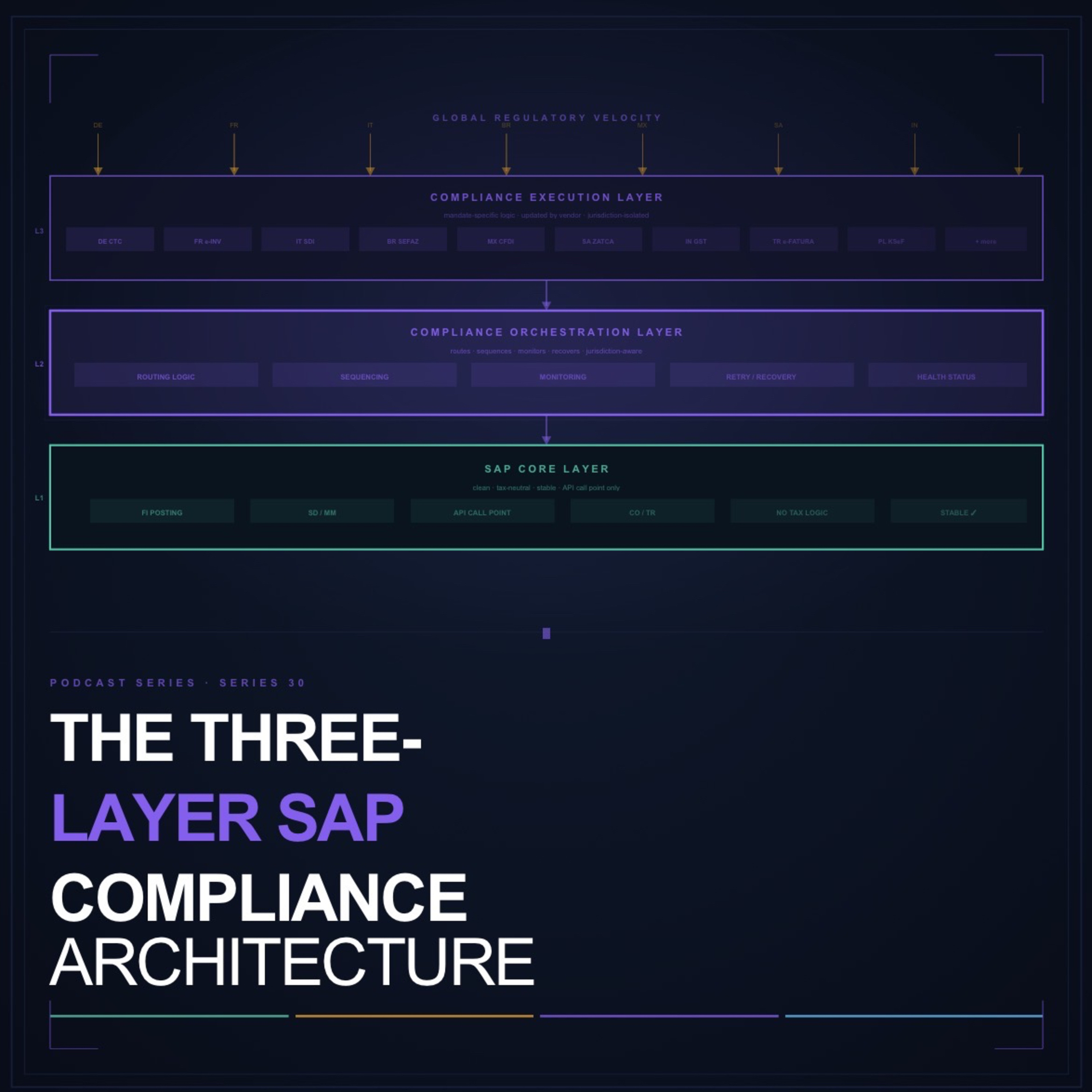
Architecting SAP for global regulatory velocity means building a compliance architecture that can respond to mandate changes faster than mandates change — and mandates, in the current regulatory environment, are changing faster than any IT project can comfortably absorb. This deep dive builds the complete three-layer SAP compliance architecture specification: what each layer contains, how the layers interact, how the architecture is governed, and how it scales as the mandate portfolio grows.We begin with the SAP core layer design. A SAP core designed for regulatory velocity has one compliance-related responsibility: exposing a stable, well-documented API at the point of transaction creation that passes the transaction data to the orchestration layer and accepts back the compliance determination. Everything else — the tax code assignment, the mandate validation, the document format production, the authority submission — is delegated. The SAP core does not know which jurisdiction's mandate applies to this transaction. It does not know whether a CTC clearance is required. It does not know whether the mandate requirements changed last week. It knows that the orchestration layer will answer all of these questions and return a result that the SAP posting logic can use. This design makes the SAP core immune to mandate change: adding a new jurisdiction, updating a mandate requirement, or switching compliance execution vendors are all changes that happen in other layers.We then build the orchestration layer specification: the routing logic that determines which compliance execution module handles each transaction, the sequencing logic that manages multi-step compliance workflows — determination, then validation, then signature, then transmission, then confirmation — across multiple jurisdictions simultaneously, the monitoring logic that tracks the real-time status of every compliance operation and surfaces failures to the appropriate escalation path, and the retry and recovery logic that handles transient failures without blocking the transaction flow. The orchestration layer is the architectural component that makes the three-layer model different from a two-layer model: it is the place where compliance workflow logic is managed independently of compliance execution logic, which is the structural capability that makes global scale achievable.We examine the execution layer in full: the mandate library that contains the current version of every active mandate's determination rules, document format requirements, and authority interface specifications; the certification framework that validates each mandate module against the authority's test environment before it is deployed to productionKeywords: SAP global regulatory velocity architecture, architecting SAP global compliance, three-layer SAP architecture deep dive, SAP compliance orchestration layer architecture, SAP compliance execution layer, SAP core compliance API architecture, SAP global mandate architecture complete, SAP compliance architecture deep dive, SAP three-layer compliance complete, global SAP compliance architecture, SAP compliance orchestration specification, SAP mandate library architecture, SAP compliance governance architecture, SAP global compliance architecture design, SAP compliance velocity architecture, SAP three layer compliance deep dive, SAP global regulatory compliance, SAP compliance architecture complete, architecting SAP compliance global, SAP compliance architecture governanceAbout the HostRıdvan Yiğit is the Founder & CEO of RTC Suite — the world's first Autonomous Compliance and Payment Intelligence platform, built natively on SAP BTP and operating across 80+ countries.Connect with Rıdvan:🔗 linkedin.com/in/yigitridvan✉ [email protected]📞 +90 545 319 93 44Learn more about RTC Suite:🌐 rtcsuite.com
-
3
Series 30 - The Debate: Three-Layer SAP Global Compliance Architecture
The debate about the three-layer SAP compliance architecture has a specific form: most participants agree that the three-layer model is architecturally sound, but disagree about whether the complexity it introduces is justified by the benefits it delivers for organisations at different scales and with different mandate exposures. The debate is not about whether the architecture is correct. It is about whether it is necessary.The case for three layers argues from long-term maintenance economics. A two-layer architecture — SAP core plus a single external compliance engine — works well for a manageable number of mandates. It begins to break down when the number of mandates exceeds the configuration capacity of a single external engine, when mandate changes in one jurisdiction affect the configuration of another through shared components, or when the governance overhead of a monolithic compliance configuration becomes comparable to the governance overhead of the SAP core it was supposed to replace. At this point, the absence of an orchestration layer becomes the bottleneck: there is no place in the architecture where mandate routing logic can be updated independently of mandate execution logic, which means that every mandate change potentially touches the entire compliance configuration.The case against three layers argues from implementation complexity. A three-layer architecture requires three integration boundaries, three governance frameworks, three monitoring systems, and a team that understands how all three interact. For organisations with limited mandate exposure — ten or fewer active jurisdictions, relatively stable regulatory requirements — the orchestration layer adds complexity without adding proportionate value. The two-layer architecture is not a stepping stone to the three-layer architecture. For these organisations, it is the right architecture — and the cost of implementing a three-layer model they do not need is not just the implementation cost but the ongoing operational cost of maintaining a layer of abstraction that solves a problem they do not have.The resolution: the three-layer architecture is the right target for organisations with significant global mandate exposure. The two-layer architecture is the right starting point for organisations building their first external compliance capability. The architectural decision is not which model is correct in the abstract but at what point in the organisation's mandate exposure trajectory the cost of the orchestration layer becomes smaller than the cost of the complexity it manages.Keywords: three-layer SAP compliance debate, SAP compliance architecture debate, two vs three layer SAP compliance, SAP compliance three layer debate, SAP global compliance architecture debate, three layer SAP compliance necessity, SAP compliance orchestration debate, SAP global mandate architecture, two layer three layer SAP, SAP compliance architecture layers debate, SAP compliance architecture choice, global SAP compliance layers, SAP compliance architecture scale, three layer SAP debate, SAP compliance layer choiceAbout the HostRıdvan Yiğit is the Founder & CEO of RTC Suite — the world's first Autonomous Compliance and Payment Intelligence platform, built natively on SAP BTP and operating across 80+ countries.Connect with Rıdvan:🔗 linkedin.com/in/yigitridvan✉ [email protected]📞 +90 545 319 93 44Learn more about RTC Suite:🌐 rtcsuite.com
-
2
Series 30 - The Critique: Scalable Three-Layer SAP Compliance Architecture
The scalability problem in SAP compliance architecture is not a capacity problem. It is a structure problem. Most SAP compliance architectures that fail at scale do not fail because the system runs out of processing capacity. They fail because the compliance logic is structured in a way that makes adding a new jurisdiction, responding to a mandate change, or surviving a SAP upgrade a disruptive event rather than a routine operation. The architecture that is scalable is the one where none of those events require a SAP project.The three-layer architecture this episode describes is not a new concept. It is the application of a standard software engineering principle — separation of concerns — to the specific problem of global SAP compliance. The three layers are: the SAP core, which handles financial accounting and is deliberately kept free of compliance-specific logic; the compliance orchestration layer, which sits between the SAP core and the compliance execution layer and manages the routing, sequencing, and monitoring of compliance operations across jurisdictions; and the compliance execution layer, which contains the mandate-specific logic — the determination rules, the document formats, the authority interfaces — that varies by jurisdiction and changes with regulatory updates.The critique this episode makes is of the two-layer architectures that most organisations currently operate: SAP core with compliance logic embedded, or SAP core with a single external tax engine that is configured mandate by mandate. Both of these architectures have the same fundamental problem: every new mandate requires a change to the compliance configuration, and every compliance configuration change is subject to the same governance overhead as a change to the SAP core. The three-layer architecture separates the orchestration concern — which mandate applies to this transaction in this jurisdiction — from the execution concern — how does that mandate's logic run — and makes it possible to add a new mandate or a new jurisdiction without changing anything in the orchestration layer or the SAP core.Keywords: three-layer SAP compliance architecture, SAP compliance three layer, scalable SAP compliance architecture, SAP compliance layer architecture, three layer SAP architecture, SAP compliance architecture scalable, SAP global compliance architecture, SAP compliance orchestration layer, SAP three-layer compliance, scalable global SAP compliance, SAP compliance architecture three layer critique, SAP compliance execution layer, SAP compliance orchestration, three layer compliance SAP critique, SAP global three layer architectureAbout the HostRıdvan Yiğit is the Founder & CEO of RTC Suite — the world's first Autonomous Compliance and Payment Intelligence platform, built natively on SAP BTP and operating across 80+ countries.Connect with Rıdvan:🔗 linkedin.com/in/yigitridvan✉ [email protected]📞 +90 545 319 93 44Learn more about RTC Suite:🌐 rtcsuite.com
-
1
Series 30 - The Brief: Decouple Compliance Logic From Your SAP Core
The case for decoupling compliance logic from the SAP core is not primarily a technology argument. It is a velocity argument. Compliance requirements change at the speed of government policy. SAP core changes at the speed of enterprise IT governance. These two velocities are structurally incompatible — and the organisations that are attempting to manage global compliance inside the SAP core are paying the cost of that incompatibility every time a mandate changes, every time a new jurisdiction goes live, and every time a SAP release threatens to invalidate the configuration that the last compliance project built.Decoupling means that the compliance logic — the rules that determine whether a transaction meets the requirements of the applicable mandate in the applicable jurisdiction at the moment it is created — lives outside the SAP core, in a layer that can be updated, tested, and deployed on the compliance timeline rather than the IT project timeline. The SAP core remains stable. It exposes an API at the point of transaction creation, receives the compliance determination from the external layer, and posts the result. The compliance layer changes as mandates change. The SAP layer does not change at all.This architecture is not new in principle — it is the standard pattern for externalising domain-specific logic from a general-purpose enterprise system. What is new is the urgency. The global rollout of continuous transaction controls, the extension of e-invoicing mandates to new jurisdictions on an accelerating schedule, and the increasing granularity of real-time reporting requirements have made the compliance velocity problem acute. The organisations that do not decouple now will be attempting to decouple under compliance pressure — which is the most expensive time to make an architectural change.Keywords: decouple SAP compliance logic, SAP compliance decoupling, SAP core compliance decoupling, decouple SAP tax compliance, SAP compliance architecture decouple, SAP compliance logic external, decouple compliance SAP, SAP compliance velocity decouple, SAP core compliance external, compliance logic SAP decouple, SAP compliance layer decouple, real-time SAP compliance decouple, SAP compliance decoupling architecture, decouple SAP compliance mandate, SAP compliance external layerAbout the HostRıdvan Yiğit is the Founder & CEO of RTC Suite — the world's first Autonomous Compliance and Payment Intelligence platform, built natively on SAP BTP and operating across 80+ countries.Connect with Rıdvan:🔗 linkedin.com/in/yigitridvan✉ [email protected]📞 +90 545 319 93 44Learn more about RTC Suite:🌐 rtcsuite.com
No matches for "" in this podcast's transcripts.
No topics indexed yet for this podcast.
Loading reviews...
ABOUT THIS SHOW
Global regulatory velocity has outpaced the change management process of every large SAP implementation. Mandates arrive faster than SAP projects can respond. Jurisdictions extend requirements before the previous implementation is fully stable. And the organisations that are still managing compliance inside the SAP core are discovering that the architecture they built for last decade's regulatory environment cannot keep pace with this one. Hosted by Rıdvan Yiğit | Founder & CEO, RTC Suitertcsuite.com · [email protected] · linkedin.com/in/yigitridvan
HOSTED BY
Ryigit
CATEGORIES
Loading similar podcasts...
URL copied to clipboard!