
PODCAST · business
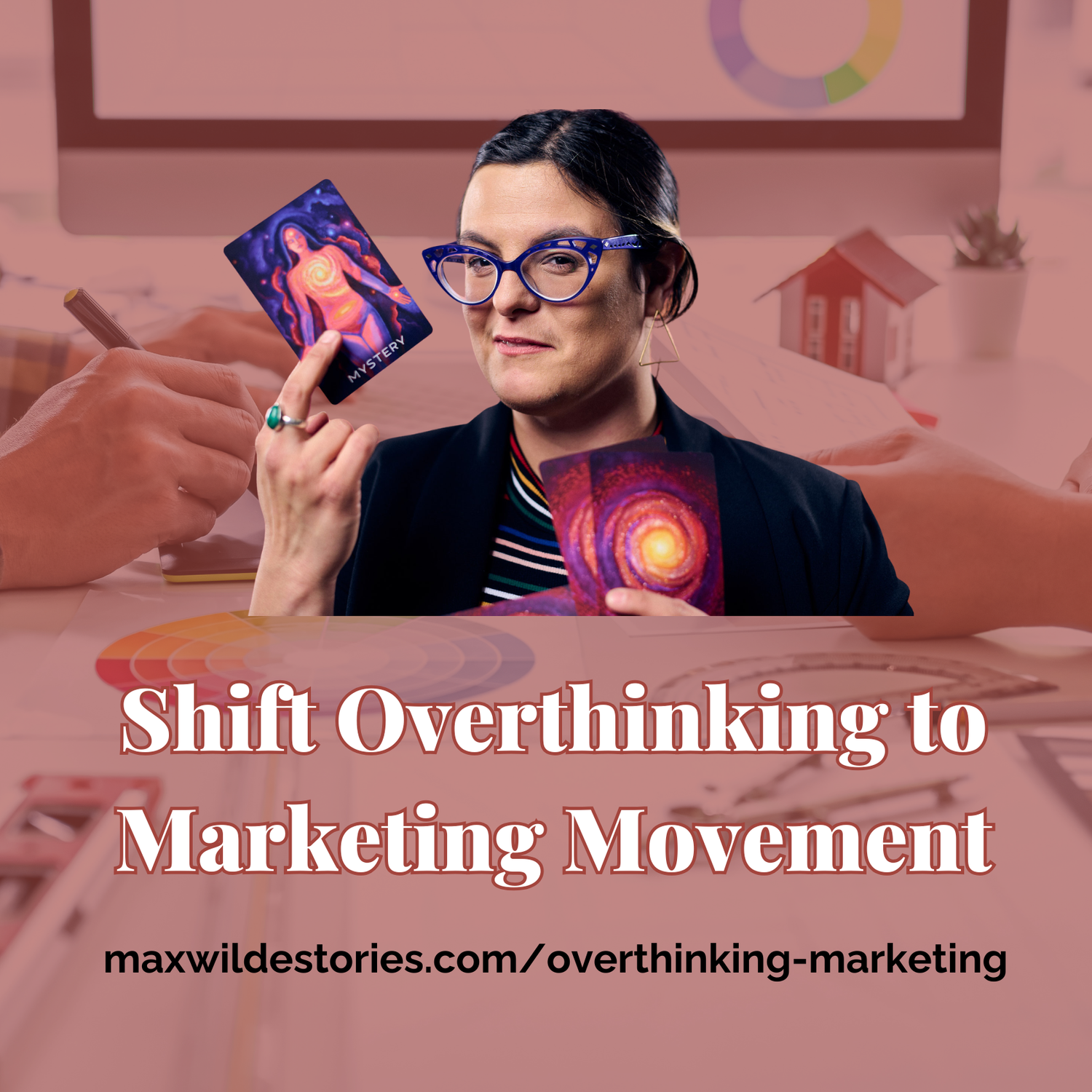
Shift Overthinking to Marketing Movement
by Max Sheffield
A limited audio series approaching analysis paralysis with clarity by examining the core systems of your marketing and sales. We explore messaging, marketing strategy, sales, and content topics to address your bottlenecks in your creative, equity-driven business head-on.
-
11
Ep. 10: Priorities and Milestones to Personalize Your Marketing Roadmap and Move Forward
In this final episode of the audio series, we’re breaking down the Storyspark Roadmap and how to apply the milestones and systems to prioritize action step in your business. If you haven’t yet downloaded this, I have a printable and Editable version over at https://www.maxwildestories.com/overthinking-marketing/. Go get it and come back. Is It Shiny Objects or is It Overstimulation: the Neurodivergent Entrepreneur’s DilemmaWhen you spend any amount of time in online entrepreneurial space, you get hit with the education firehose. You need a VIP day, no wait, a digital product, no wait, you need to sign corporate contracts, it’s better to productize your offer, go build a course, and that’s just on what to sell, now how to do it.I said this in a reel before but I want to say it in on this series: is it shiny object syndrome or are you just overstimulated? The algorithm, our inbox, these all make us feel scattered and unfocused by design.I want to be clear that I’m not saying folks are trying to mislead you. I believe that everything works, but not everything works for you.This is why I am platform or format-agnostic. I’m not a podcast producer, or a video strategist, or a Pinterest manager. When you are ready to build flagship or ongoing nurture content, it should be connected to what you find enjoyable and what you are strong in.I have a YouTube channel because I do believe in using video to repurpose, and I do reasonably well with scripting and recording, but at the editing stage I got hit with insane blocks and resistance. I have never managed to be consistent for longer than a month.Yes, I can outsource it to a video editor but in my early stages, I needed to be able to DIY to get initial traction. On the flip side, editing the audio for this series feels like a breeze and I don’t think I’ve procrastinated on doing this at all. Harnessing your strengths may take experimentation, and I give you permission to abandon the projects or ongoing tasks that feel draining or you don’t feel pulled or passionate about being consistent with or completing.Priorities & Milestones to Personalize Your Marketing RoadmapSo looking at the Storyspark Roadmap, I have four phases or systems that I build with or alongside my clients. We’ve discussed them through this series and I’ve given you action steps to take throughout, but I also wanted to use this episode as a way to decide for yourself what comes next and where you want to prioritize your spoons.PHASE 1 - Uncover Your Unique ValueYou’re probably now tired of hearing me talk about messaging, so I’ll keep this as brief as possible. Clarifying your core message, if you haven’t already, is one of the most impactful aspects you can focus on. It doesn’t have to be intricate; you can have a Google document with elevator pitches and positioning statements or ways to describe your work & offers. In fact, I have one that I copy and paste from all the time. You can also make an external-facing touchpoint to get feedback, like a capabilities deck or one-pager. This is also where an outside perspective really comes in handy. We’re so close to our own work it becomes hard to explain it to others. You know you’ll have a good command of the when you have people remembering your business unprompted, having folks approach you for your subject matter of expertise for visibility opportunities, and you start to feel proud of (or at least not embarrassed by) your website copy.PHASE 2 - Cultivate a Content EcosystemI love the Content Ecosystem building phase because it reminds me of my tabletop gaming days and the “choose your own adventure” books from when we were younger. You get to build the sandbox that your ideal clients play in to feel supported and educated.Here’s where it’s easy to get stuck. This is more on the strategy side; it’s the blueprint that helps you to decide what structures to build. You don’t have to move on from this only after everything has been written and published. The goal here is to know what topics and potentially even titles will serve on the different levels to your content ecosystem: the surface-level topics or questions that serve as a way to introduce your work (and topics to pitch for visibility), deeper ways to engage in your work including flagship content and resources, and start to think through the themes or pillars that will show up in your ongoing nurture content.You’re not married to these choices, but the big-picture helps your marketing and sales come together more intentionally and feel interconnected because it is. Without this, reactively created content takes so much more energy and isn’t as effective because it’s disjointed.You’ll know that this is working not because every branch or tree on the content ecosystem is filled out, but your pathway forward for what to write or record becomes clear.Here, I started on writing my pinned 3-grid of Instagram posts because I wanted an external place to direct people to and grouped it to be about me and my story, then about the process I take folks through, and the third being my offers and how to work with me, and the why.It took the external pressure off of ongoing social because they were pinned, but it was also a bite-sized version of the content I planned to create for my flagship content that became this audio series. This also helped give me feedback, so I wasn’t tinkering by myself without getting feedback from the people I was trying to talk to.PHASE 3 - SPARK Repeatable Sales StrategyThis is the point where we’re moving out of the strategy and into creating and implementing the plan we’ve created. I’ve talked enough about sales for two episodes, so I’ll just say that you’ll know you are on your way when you have flagship content with a clear call to action toward your services and somewhere to point folks when they’re not quite ready yet.This doesn’t have to be intricate with a bunch of email sequences and automations. I keep it all in my project management system: folks I’m currently talking to, where they’re at in the process, and set due dates when to follow up with them. You can layer in complexity or polish your flagship content once it’s already out there, and you get feedback on it. More than anything, it just needs to be published and put out there first.PHASE 4 - Capacity-Building Marketing ProcessesI put this at the end, but this is something that throughout the process, really helps prevent us from exhausting or pushing ourselves too far. It just needs to be in place before we’re committing to any big projects or creating ongoing nurture content.We talked about this last episode, but getting a flare or falling off isn’t a sign that you have “failed” here; it’s part of the cycle and, honestly, part of being a human being.In my experience, you never master this system, but you know you are prioritizing capacity when you listen to your body signals and adjust your schedule appropriately. When you are further along, you have a media library you can dip into during your slow periods.Pulling it into a RoadmapAll of these come together for prioritizing marketing that feeds your business instead of algorithms and tech billionaires. We’re giving ideal clients a way to engage in our body of work in ways that feel good for them and are more effective to sustain our businesses and give us lives that don’t rely on an endless stream of content to keep afloat.You don’t have to do all of this at first. Look at what would make a difference to your business. Take this in order, or use the energy tracking you’ve done as a guide for what feels doable to you or what to work on once you’re feeling up to it so you can shift out of overthinking your next steps.How You Can Get Continuing Support (Free & Paid)I plan to walk my talk. I discussed asking for the sale without anxiety and how to feel good about your pitch, so if you’ll bear with me, I’m going to discuss how to work with me to continue the work if you decide we’re a good fit.If you like the idea of creating flagship content to promote your business but know you don’t have the spoons, you can have me write this. For this audio series, I’m going to discuss Storyspark Connection, which is my offer that gives you support so you have everything you need to write and implement for yourself with me in your back pocket.We do this through 1x1 strategy sessions, a robust resource library, async feedback, and personalized integration time. In the thIs Storyspark Connection a copywriting offer? Is it coaching?But for the specific offer I’ve been promoting this month, it’s a done-with-you offer that isn’t coaching, more like guided strategy while having your hand held through the process. I hand over templates and resources for each aspect of the journey: messaging, content strategy, sales process, and marketing implementation. We have three strategy calls that discuss a plan on these growth systems and how to weave in your uniqueness, values, and capacity. From there, we have a monthly integration session that gives you space to develop impactful marketing materials and feedback to break out of overthinking. Call this role what makes most sense to you: strategist, advisor, coach, mentor. I just want to give you every tool possible to build a sustainable marketing practice that you can iterate on and evolve with as your needs change.What deliverables do I get? What do they help me to do?In Storyspark Connection, you walk away with a roadmap that helps you prioritize which steps to take that are going to have the most impact. This could be revamping your messaging, updating your website to reflect a pivot in offerings or who you serve, or creating a follow up process for inquiries/sales calls to explain your offers.But more than this, we work through your messaging, content ecosystem, and sales strategy to help you talk about your work with more ease and less confusion. You’re given the templates to build marketing systems with time to implement and feedback so you’re not spending weeks on getting it “just right.”In three months, you have one system ready to go released into the world to promote your work and a comprehensive playbook that outlines the steps to continue the work (and how to plan for your fluctuating capacity).Saving you spoons is priceless.Unless you’re neurodivergent, chronically ill, or disabled, you probably don’t think about how much of our mental load goes into making decisions. But we are. And believe me, it sucks.This is especially true if you’re self-employed and wearing all of the hats in your business.It’s why I created the Shifting Overthinking audio series to begin with, but don’t underestimate the power of a back pocket marketing strategist that you can offload some of the creative problem solving to.Need validation that you’re on the right track (with best practices and data to back it up)? I can do that.Need encouragement to do the damn thing? I can help find ways to make it feel enjoyable instead of a drag.Need to be told to go sit on the couch because you have a migraine but still convinced you should be working? Oh goodness, can I do that.If you are ready to: Co-create a unique marketing plan that matches your capacityLay groundwork strategies that your marketing can build onTake marketing off your back burner without burning out through clear, prioritized action stepsGrow your audience and attract clients, but not at a price of your well-being or valuesWho’s in? Let’s discuss what this could look like for you at bit.ly/story-chat And, if now’s not the right time, that’s okay. Join us over at the Storyspark Lounge where we gather and discuss balancing our lives and obligations with building a creative business in a place you don’t have to perform.I’m holding a bonus session where we gather and discuss the three most common places we overthink: topics, titles, and tech. If you have the roadmap you’ll get all of the details for that.
-
10
Ep. 09: Why Planning for Low Capacity is a Momentum Must
Last episode, we talked about understanding your own energy patterns and building rest or buffer time into your days, weeks, and general plans.I’d love to be able to tell you that that solves all your capacity problems, but I still get knocked on my ass. We all do. We get the flu, and our kid brings a bug home from school. We have busy periods, which can lead to exhaustion or worse, burnout.Because I didn’t heed the lesson from the last episode, I now realize that by resisting the needed rest and buffer time, I myself was in a cycle of burnout for the two years after that initial collapse and the severe flare that came afterward.Let’s face it, though — the longer you walk away from creating or working on your business, the harder it can be to return. I felt like there had to be a way to weave in and out, depending on how I felt.Preparing for and Managing a Low-Capacity PeriodI regret to inform you that some of this will depend on you being in a more “up” phase energy-wise. Future you will thank you for the things you do now. Going back to the flagship concept, I feel like that is a major way that you can set yourself up for dipping energy levels. It’s more substantial and has a longer life cycle than social media. This is the slow and steady system-building piece of my capacity-building marketing processes.Like in previous episodes, we’re not expecting to have all of these little pieces all set up and put together at once. We’re building a roadmap that helps us pick back up when we’re in the creation and higher-capacity part of the cycle.I’ve always found the word “systems” an icky word to my neurodivergent brain, but I’ve started to come to peace with the necessity of them with a reframe. Systems are just me making decisions about things ahead of time. I have to remind myself that it’s not an external structure I need to rebel against. It’s compiling the ways I know my brain works and giving it breaks, so I’m not worried that I have forgotten something.I’ve lost my keys and wallet more times than I dare count. I’ve had to have IDs replaced and called locksmiths to let me back into my car. To avoid losing my keys, I gave a backup to 1-2 trusted friends and installed hooks by my front door to keep them at all times when not using them. I also utilize carabiners for my bag or pants when I’m outside of the house, so I can physically feel them on my person.These are systems, and they work because I don’t have to physically think about them anymore. If you’re a service provider or you engage in creative work of any kind, the less brainpower you can devote on what to work on or how to work on it, the more you’ll be able to devote to creating itself.When I start to feel like I’m going to feel bad or have extended myself further than I normally would, I know that starting later and rearranging my work environment help me to rest, but tasks that I do often change as well.How Minimum Viable Promotion Dispels an “All or Nothing” MindsetI call it minimum viable promotion. How do I show signs of life when I don’t feel like it? Do I post or repost to my Instagram stories? Comment on my friends’ posts/stories? Or do I give myself permission to completely unplug? Depending on your situation, all are valid. But if anything, it’s being a bit more granular helps. Marketing often lends itself to an “all or nothing” mindset that if you didn’t create a reel, send a newsletter, or hit record this week, then there’s no point in posting. But just because you don’t have the spoons to create a longer, more in-depth piece doesn’t mean you can’t post a picture to your stories or respond to others’ content. There are levels, and if we don’t hit the high standard for ourselves, we often get paralyzed or decide not to try. But then on the flip side, if we don’t do anything, we use it to beat ourselves up. I’ve been here when recovering from my flare, and it felt like I couldn’t win either way.If you’re recovering from deep burnout, the best thing you can do is to give yourself permission to go on a pause. Minimum Viable Promotion can be nothing. But acknowledging that’s where you’re at right now can feel freeing. I eventually want to do a live event on coming back from a marketing pause, so if that interests you, get on my email list.ACTION STEPThis feels self-evident, but give yourself a couple of options for what’s the minimum promotion you can get away with when you’re not feeling productive. Being present in your community counts. Reposting others’ content counts. Completing client work counts. Going back to what I said, nothing also counts because you’re respecting what part of the cycle you’re in.Building & Organizing Your Content LibraryOne thing that’s low-lift and you can do to help yourself is build what I call my content asset library. I say you can do it during lower energy periods because it doesn’t take much in the way of active, creative thinking power. It can be as simple and copy pasting content snippets from your Notes app into Google Doc or your project management system. It can be creating folders in Canva to categorize your stock and uploaded photos. Or you can save inspiration to create a moodboard. Some people call it productive procrastination, but it’s just using your capacity wisely.You are giving the future you the tools to keep the momentum going without pushing yourself.I keep a Google Drive with many folders. If you want to see how I organize it, let me know, and I can make a video. To give you an idea, my library includes my email sequences, testimonials, website copy, opt-ins, slide decks from workshops, landing page copy, and client deliverable templates among other things.This does need regular cleanup and maintenance as you start a creation cycle to keep it up to date. What’s nice is this can be a part of your minimum viable promotion plan. Go through your notes app or content library for work that may be good but either hasn’t been seen for a while or got left in your drafts.Let’s say you’re not in deep burnout or depletion but are coming back from that. Hopefully, this series is giving you an idea of where to get started, but if not, I’m going to discuss the Storyspark Roadmap and how to prioritize your next few steps in the next episode.
-
9
Ep. 08: Cycles of Creation & Rest
We were never meant to be productive 5 days a week, 8 hours a day, 52 weeks a year.Nothing in nature works like that. Capitalism is an inherently unnatural way to structure a society, and it’s not your fault if the system failed you.It took me falling unconscious two blocks from my son’s school to realize that keeping things running on all cylinders was not something I could sustain.In this episode and the next, we’re going to talk about the day-to-day implementation. The planning, writing, recording, posting, and all of the things we’re supposed to do to keep things running.I swore for the longest time that “operations was my weakness,” but I think what it really was I felt trapped in my business. And it was because, as I planned my quarters, I didn’t realize that not every week or month or quarter itself needed to be packed full of projects.Reframing Rest as an Essential Part of Creating a Sustainable BusinessBreathing room is a necessary part of the process. I took Lindsay Mack’s Heart of Service course, which talks about these cycles and connected it to the Tarot. She refers to Sacred Gestation, Creation, Transition, and Death. I did this back in 2021, so I’m not sure if this is still available, but if I find any resources on this, I’ll link them in the show notes.You can also think of it like the cycles of the seasons or the moon. However you choose to define it for yourself, there is always a winter, a dark side of the moon, a time for quiet and integration.Unfortunately, when you’re disabled or chronically ill, your body chooses those cycles FOR us instead of the other way around. I’ll talk about that more in the next episode, but I’ve noticed I get fewer severe flares when I’m building in those rest periods after big pushes.The final and arguably most integral part of the framework I developed was “Capacity-Building Content Processes.” I knew it was important, but beyond repurposing the lengthy, more meatier content or batching like tasks, I didn’t know how to define this in a way that made my plans doable and not just another way to beat myself up or doubt if I was cut out for this whole entrepreneurship thing.For the last two years, I’ve let January be a period of integration and processing the previous year instead of jumping into the high-gear planning season. Other ways can be giving yourself a week off a month from client calls, or taking a month off in the summer, like Tracy Stanger. I’ve seen folks using the 13th week of the quarter as their reset week. Me? I’m going to try to take what I’ve created over the last couple of months and schedule throughout the summer and see if while my kid is out of school, I can stick to 4-hour workdays.Building in joy and rest is what’s going to keep your work sustainable. And we need you and the work you do.ACTION STEPYou may not understand your energy patterns yet. We all have dips and times where we’re most creative. The first aspect that I look at both with myself and clients is understanding these energy patterns better. For a few weeks, track your time by the hour. You can use paper or a digital tool, but paper is what I use to remind me to track all of the small chores and offline tasks that I do, instead of just purely “work” tasks. Use this as information. I realized through this that it takes me at least an hour to “warm up” and get ready for deeply creative work; I can’t just jump in as some other folks do. Build in buffer or rest time into your routines and use some of the earlier examples as inspiration. Deciding on Your Own Mix of Structure & FlexibilityI had a post queued up at the beginning of April that went through what I was able to accomplish in quarter one. Despite having the flu and taking January to process 2025 before committing to any plan.There was no intent to shame, but I also didn’t want to come across as “I’m chronically ill and can do it, why can’t you?”So I held back.But the one thing I WILL say is that a major life-changing insight that helped me these last few months is realizing that we all need varying levels of structure and we all need varying levels of flexibility BUILT IN.Those levels will be different based on your own personal situation, but just “winging it” didn’t work. When capacity did open up for me, I flailed for hours, not knowing what direction to go in, and overthinking hit me HARD. But it’s deceptively easy to go all in on building a structure that’s more confining than helpful. I used my plans as a way to beat myself up, which just made me lose motivation because if I wasn’t going to follow a plan 100% or only have a good week maybe a third of the time, why did any of it matter?The true shift out of overwhelm & overthinking was seeing adjusting my plan not as a failure, but a feature. Something inherent to running my business, just as much as making sales or sending emails.When there are days where everything hurts, and my brain doesn’t want to work, I decide on whether its a work from bed/couch day, if it’s a sleep later day, or if it’s just a minimum “let everyone know I’m alive” day. When a whole week starts to spin out of control, what’s one action I can take that would make me feel inspired, energized, or accomplished?Looking at my roadmap or list of projects, which one do I have the energy for? Do I not have deep work capacity, but maybe I have admin, mindless task capacity? Let me go ahead and organize photos on my phone or in Canva.What’s a way I can save energy/work for future me?A weird thing happened as I tempered my expectations: instead of doing less, I did MORE. I’m really not trying to flex, just report this observation. Client projects stayed on track, and big projects I’d been putting off started getting done. People talk about getting rid of their should to the point it kind of feels cliche, but when I realized: ‘Hey, I can’t sit at my desk today due to pain, but I could still write’ or ‘it’s hard for my brain to boot up immediately after waking up’ I realized that there was usually a SHOULD behind it.You should be at your desk otherwise, people will think you’re not really working. Or, you should be ready to work directly at 8-8:30 AM. Who decided that? If I’m doing what I need to do, why does it matter?Freeing myself from the expectation of what a productive week should look like was what actually helped me to see momentum that hasn’t happened in years.ACTION STEPNow that you know your own patterns for when you’re creative and able to take action, use this as a guide to plan your week. Not with what you think you should be able to get done, but realistic with the time and energy you have.This week, something may come up that forces you to adjust; that’s okay. What can you take off your plate? Or what’s the simplest way to do the thing that you can make pretty or optimize later? Or can you adapt your environment to what you need to get the work done?In the next episode, we’re going to tackle the weeks when even existing feels overwhelming. Planning for your low capacity, or at least giving yourself an out, helps take the pressure off so you can come back to work when you’re ready without overthinking it.
-
8
Ep. 7.5: Asking for the Sale Without Anxiety Pt. II
Okay, so that was the first half of the part, and I was already at 12 and a half minutes when I was recording this. So this is almost certainly going to be a two-parter. And that's okay because sales is kind of a big beast.And there are a lot of different components that we overthink and ways to approach your sales. This process has to make sense for you.Making Offers Irresistible (for YOU)My business friend Casey Eade, she's @caseyconnects on Instagram and Threads. I will link if you want to view some of their work. But they said something on Threads, and like they always tend to do, they verbalized something that was kind of vaguely already in my head, but I think that I never heard it out loud said in the way that I'm like, "Oh, this makes sense. I also agree with this.” The one that I'm going to talk about today with this is a lot of folks in the online entrepreneur space, especially those that are helping people craft offers, use the word irresistible, like create an irresistible offer.Casey rightfully called this term out because if you're like me and you're equity-led, you are anti-capitalist. And the very minimum, just like, hey, we want to be ethical about this. We want folks to make responsible decisions, not feel helpless to resist the allure of our flashy titles and our marketing when making sales. We want folks to have weighed their options and feel confident that this is the right decision for them based on shared values and trust that our approach is a good fit for what they're trying to achieve or where they want to go.But in thinking about their post, I thought about a reframe for myself.What if instead of trying to make an offer irresistible to clients, I structured an offer that makes it irresistible to me as the service provider to talk about. Because sales breeds so much anxiety and overthinking, you know, for me and for other people, how can I find ways that make it enjoyable and fun to talk about what I do?I'm not the best person to talk about offers. But I'll talk a little bit about this because sometimes this is what we're overthinking and we may need to address some blocks that are offer or operations specific that maybe are making us not want to talk about our offer or, you know, or make sales on it:Are you being realistic with your capacity?Are you undercharging and you're feeling resentful to folks because of what you're being asked to do?Have you felt like maybe you've been pushed into doing work that you are good at but you're maybe not thrilled about doing, you know, AKA your zone of excellence.This was me with monthly social media management. I could do it, but I really preferred working in the more meatier content like email sequences, web pages and the flagship content so that folks had that solid foundation for their social media and their other nurture content could lead to I'm not the authoritative person like I already said on this subject, so I'm going to look into adding resources in the show notes for this if this is something that you do want to explore.Some books that come to mind for this are like The Big Leap, Worth Every Penny and I will, like I said, I'll try to come up with a couple of resources that will help you. So for example, this audio series, it really felt like a natural way for me to talk about and segue into a done with you offer. Framing it around, overthinking around my own mental health stuff, my own low capacity stuff, and then using my own framework to structure the series. This makes this enjoyable for me to like the point that I am considering doing more than one season or finding ways to add to this because I don't feel like I'm really like selling.I'm just sharing “Hey, this is how my brain works. This is what I've learned and this is what I've noticed with clients about the best way to get results in marketing without sacrificing our well being and while sticking to our values.” If you are neurodivergent, I try to frame sales as showing you “Hey, this is the cool rock I found on my walk. Do you want it or not?”Structuring Marketing & Sales for Diverse Decision Makers: Being Ethical with Scarcity & UrgencyIf we're prioritizing client autonomy, that means we also have to give folks an easy out to say not right now while still engaging in our content ecosystem. Going back to earlier, that could be a community, that could be networking hours. It could be lower commitment offers like maybe a paid template. It could be directing them to like a podcast or your email list.We all make decisions differently and it took a lot for me to not take that personally if someone ended up working with someone else or told me no or they'll think about it. In my own decision making process for courses, coaches and service providers, I take months, sometimes years before I'm ready to commit to working with someone you know.As you build out your sales process, I recommending you know, incorporating different methods of different for different types of decision makers and start off with thinking about your own and how you make decisions. A not right now may come back way later and that's okay.But also, you know, as a procrastinator, I need last minute reminder emails for things because I forget I intend to do the thing, I intend to buy the thing and then I forget and then the time has passed me by. Can often be done to an extreme where people are emailing you like every hour before like a cart close and that gets annoying. But some of us do appreciate those last minute reminder emails.So if you are doing something time sensitive, that can be helpful. Speaking of deadlines, I want to tackle the matter of scarcity and urgency. We all have probably seen them used in gross ways like cutoff dates for self paced courses or like only so many of like a digital product. It's just to pressure you into saying yes right in that moment. Or the math doesn't maybe quite work out when someone said, oh, there's only X amount of spots left. And you're like, was that what you said a week ago? And you're saying something different now. Interesting.Because of people who do it grossly, we forget that there are legitimate reasons to be upfront about scarcity or having a deadline in place for your offer. Like if you are doing an event, the venue needs a headcount by a certain day. That is something that like is beyond your control. You need to RSVP, you need to buy your ticket before this time so I can get that information to like catering or the venue or whoever it is in a group cohort where everyone is starting at the same time.You may only be able to give that level of like attention and specialization to maybe only six or seven people at a time or other factors.I had worked with someone and we'll talk about her in a later episode, but I work with someone because they were about to go on maternity leave. So like I didn't know when they would be able to come back, if they would, that offer would come back again. And they were upfront about that. So then I decided, hey, I've been wanting to do this. I've been waiting on it until I thought I was ready. They're on, they're about to go on maternity leave. That is a true deadline. You know, like that's, that's okay to just be upfront about that.You know, if you're like me you know, you have to look after your own capacity. You can only do so many projects at once. You don't want to over commit yourself and then everybody is stressed out Again. Going back to how sales helps folks make a decision, this is information, not manipulation.You are just being like, hey, this is how, this is what's going on. This is when we're all going to start or whatever those other factors are that require some sort of scarcity or urgency that is built in. Just don't go back on what you said, right? Be as transparent as possible.I also just urge folks, do not go so far the other way that folks feel blindsided, that when they want to work with you, you no longer have room or you've run out of capacity or that like hey, 2025's price that you had shared is no longer 2026's price. ACTION STEPSo for this action step today, it'll be twofold yet again. The first part is what will your not right now like option B?Those who want to kind of, you want to keep in contact and have them stay in your content ecosystem. I know that some folks have social media, so that is an option. But I would also have you consider what would an option be that doesn't require you to have that constant content creation and have you have to show up online all of the time.The second part of the call to action or the action step, I should say is think about your offer. You know, is it still some work that you are aligned to do in with your capacity and with, you know, where you're at currently.But think about the legitimate constraints or deadlines that are like inherent to your current offer and what information would help folks make that right decision for themselves at the right time and kind of start to frame it in that way and think about that information that would be helpful to share with them.
-
7
Ep. 07: Asking for Sales Without Anxiety Pt. I
Adding Value to Earn Asking for a SaleIt’s not a revolutionary act to say “hey, offer as much value as possible,” but let’s go a bit further because that’s been warped to the point of being manipulative.What does “value” mean? I found out recently there’s a whole sub field in philosophy called axiology that discusses this, which is weird but also makes sense. Value is subjective. However you choose to define it, and we will in a few moments, is what the bad actors don’t realize. They’re trying to extract from something that’s not there. They believe they’re entitled to our time, attention, and money.That’s why they get left on read or blocked.Instead of entitlement, we want to earn that from the people who were trying to reach with our message. The way that I approach that is by offering:✦ Support and encouragement when they’re going through a hard time✦ A new way of thinking about or approaching a new problem✦ Help getting a quick win that builds momentum toward their desired result✦ Keep them aware of new and developing news in your subject of expertise and analyzing the context and why it’s relevant for them✦ Building connection by showing the person behind their business so folks can gauge whether there’s a fit based on shared values and vibesI’m sure you can probably think of a few more, but for the purposes of sales, there are two I want to focus on. One often precipitates the other: getting someone to consider a new perspective to what they’re struggling with, and momentum toward their desired result.When I was a tech consultant and nurse and on the fast path to burnout, I knew I wanted to pursue entrepreneurship. But I didn’t know what that would look like. I went through a certification program from the National Society of Health Coaches.While I don’t have that credential anymore, I learned models and techniques I still carry forward in marketing and sales.The model is called the transtheoretical model of behavior change. You don’t have to know all of the details, but it says that people do not make changes in their lives, even health changes, because they should. We need to connect what we’re trying to change with what’s important to us and discover our own motivation.Marketing helps them get to this point. I have a content series about taking this model and translating it to marketing that I will release soon because it’s already mostly completed. If you’ve downloaded my companion reaource, you’ll be notified.In sales, we are not convincing people that they need to act. They should already know that and be ready to take action. With sales, we should be identifying those who are ready to take the next step and giving them the information they need to make the right decision for themselves.Which brings me to my concept of flagship content. We already talked about this in the last episode on the content ecosystem. I was talking about focusing on framework building content first, and your flagship content is your content and comprehensive, intentionally structured to provide a smaller result that naturally leads to the larger transformation your paid work provides.The issue here is we often see what others do and think we need to do something as elaborate or resource-intensive, but it’s really up to us.I’ve seen folks do a free revenue calculator. I’ve seen folks hold weekly coffee chats and create community that way. What matters is that it’s substantial enough that people have real actionable takeaways and give them a sense of your approach, method, unique teaching style. It’s the free trial or the test drive. The main decision you should make as you decide what will be your flagship content is whether it will be time-sensitive or evergreen. This will often depend on the offer and your capacity.Workshops, summits, and 5-day challenges inherently have a timed component so lend themselves well to having a call to action that’s also time sensitive like a group cohort. They can be a lot easier to set up, but then you have to do a lot of promotion to fill it and Evergreen flagship content is great for us low-capacity folks who don’t have predictable capacity to host a monthly workshop or office hours. It can be a lot to set up, ,but once it’s done, all you have to do is polish and optimize when you have the spoons.Examples of evergreen flagship content are:✦ Private podcast or audio series✦ Video series ✦ Email course✦ A community space on Skool or Discord (among others)✦ Quiz✦ Book✦ Asset collection like stock photos or Canva templates✦ App or templateACTION STEPSo this one is going to be twofold: first, we’re going to plan what will make for good flagship content. Think about your offers and the transformation they provide in your clients’ lives, businesses, relationships, and finances.➤ What’s the first thing you work on together?➤ What insight or perspective helps folks shift out of surface-level thinking into understanding the root cause of the issue they’re struggling with?➤ Do you have a resource, workshop, or template you use with clients that could stand alone? Then, notate somewhere whether you plan to do a time-sensitive or evergreen. Mark it down in your calendar and start telling your business besties or shout it out in the Storyspark Lounge. Give yourself a 4-6 week buffer if you need to create new content. This is why it helps to take something you’ve already created, but often you’ll still need a landing page, follow ups, and maybe other logistics. Don’t overcommit and then beat yourself up, something apparently I still need to be told because it’s what I did with this audio series.
-
6
Ep. 06: Designing Content that Leads to Paid Offers
Types of Content Have Different PurposesI think this feels common sense and intuitive, but this is what can often lead folks to give up on their marketing because they’re expecting a particular type of content to do something it’s not designed for. Let’s use reels for example. While some people will talk about how they’re signing clients with them, and let me be clear, I believe them, but it’s just so rare. And in my mind, it says more about the person and their readiness than the content itself. Remember last episode and when we talked about how the right content can hit someone at the exact right time. This has happened to me with people googling me or watching a couple of my YouTube videos and they booked a call with me. Be grateful when that happens, but don’t expect it.At least, don’t beat yourself up if some content doesn’t instantly lead to inquiries. You cannot weigh success based on using it as a sales tool. Reels are a tool for discovering you, that’s their purpose. And it for a lot of us, the capacity requirement to make this work may be too high for us to pay.When you’re devising a marketing strategy, either by yourself or in collaboration with someone like me, there are three questions to answer:➤ How will new people discover me? ➤ How will I build a relationship with folks who are still considering who to work with?➤ How will I share next steps for working together to the people who are ready?One main exception is your website because it serves as a hub. It should have pages for each purpose and, of course, the home page that will hit all of these notes, which is what makes it so tricky.This ties into overthinking because of the way platform or format-specific marketers, whether intentional or not, can make us feel like we have to choose a silver bullet one type of content that will satisfy all of these purposes. This gets us stuck: we keep searching for that one all-in-one strategy and refuse to commit and let ongoing content build on itself or hold each thing we create to an impossible standard that makes us want to give up.ACTION STEPLook at what you’re currently sharing or creating, if anything. We’ll talk about the minimum levels of promotion toward the end of this series, but engaging in folks’ stories or commenting on people’s Threads counts. But we do need to be realistic with the purpose of what we’re currently doing. Out of those three questions, what are you currently doing, and what are you overthinking the most? Prioritizing Your Content by Working BackwardsI know that this can feel overwhelming, like I’m asking you to create three types of content every week, but this is just to illustrate how the content ecosystem looks at a high-level. You’re not expected to do all of them at once. Even folks who DON’T have the constraints we do can’t implement all at once. This is where a roadmap comes in. Software companies use them to prioritize what features they want to add. Features with a bigger impact come first and they’re often needed to be in place before the smaller or lower priority features come later.This is a concept we can bring to our businesses and marketing. This is why I always start with messaging, because it creates a ripple effect and helps everything else come after it stay consistent and distinctive. We’re actually going to come back to messaging as we look at our content ecosystem. In the last episodes, we clarified our unique differentiators, but let’s go a step further. Can you explain your unique approach to the work you do? You can call it your framework, process, or methodology. It can be one you’ve developed yourself, or a blend of others that you’ve trained under or incorporated. Think folks who use the Enneagram, Human Design, Internal Family Systems, Clifton StrengthsFinder, tarot, or design thinking. I often see it as a mix of these two but any combination is valid.The first part of your content ecosystem you should prioritize, if you haven’t already done this, is to have pieces that explain the process that you take clients through. If you think you don’t have a process, it wasn’t until I watched the steps I did with clients that I realized I do have stages and systems I go through to ensure I’m not missing anything. Take note of the patterns you see with clients, the problems they face, and how you address them or tailor your approach. You’d be surprised.There are several ways you can represent your process:➤ Page on your website, I’ll link mine in the show notes so you can see one in action➤ Workshop (don’t have to go in depth here, can just be a high level overview)➤ Pinned post on Instagram (Featured post on LinkedIn)➤ Private podcast/video series➤ Capabilities deck you send to referrals or with proposals➤ Infographic and visual elements (I’ve included mine in show notes when they’re relevant to what we’re talking about)Why are these important? From the software example from earlier, having these in place serves a few purposes. You can send some of these to people who are looking to work with you to help them decide if your approach is a good fit for them. I also include a section on my framework on each of my sales pages for this purpose.More comprehensive pieces of content can be repurposed into smaller chunks. Creating things like visuals, especially, can be used over and over, as I’m demonstrating in my show notes. As you define your own process, you also develop that unique spin we discussed in the last episode for your nurture content and get angles to approach your discovery content for podcasts, guest teaching, or speaking.If messaging is the soil, your approach assets are the seeds that will continue to grow as you work your way through your roadmap.ACTION STEPChoose ONE of the above in the list of approach assets to create in the next week or two. It can be as comprehensive or as simple as it needs to be. I mentioned visual elements because when I was struggling to define some of my own processes for myself, I found that using sketching or opening Canva made my brain think differently about it when I was stuck on how to explain it to someone else. It also helps explain for folks that audio or written may not be the way they process things.Let’s say you’re not quite there yet. If you’re in the beginning stages of defining this for yourself, use sticky notes, whiteboard, or mind map it. You can design it in a way that’s shareable later.We’ll talk more about the sales process in the next episode, because after framework design this is the next logical step on the roadmap and maybe the BIGGEST overthinking block us folks that care about our people deal with.
-
5
Ep. 05 - Why Pressing “Publish” is So Hard
Hopefully, you’re feeling more confident in your message from the last episodes. If not, that’s okay. The confidence can build from repeating it. Once I’m comfortable with how it sounds when I say it to others, I then start to use it more concrete places like my website and my social media bios.Which brings up to the topic of this episode. Why pressing publish can feel so hard.Why We Hesitate to PublishDo you have entire offers, lead magnets, articles, video scripts sitting on your hard drive? Everyone I’ve ever worked with, even those who were just starting off, had SOMETHING that they’d been sitting on but hadn’t yet released.Let’s talk about why BEFORE we start designing our content ecosystem so when we have the structure around creation, we feel confident sharing our unique perspective.An easy answer to WHY is perfectionism, but I think, while that may be part of it, there’s something deeper to consider.The internet can (not always) be the opposite of a welcoming place. And frankly, it tests our own worth in ways that therapy wishes.In many parts of the internet, folks are committed to misunderstanding either by taking work out of context, or by insisting you include a very specific situation, or by claiming someone else said it first/better, or just being a general troll.While this is very unlikely to happen to you, we’ve all observed it if we’ve spent any amount of time online. And I find in some ways, it creates hesitation in us. Maybe not all of the time, but in sharing the type of content people need to see.Not just generic educational stuff, but sharing content that showcases your voice and experiences. The content that lets folks see the sides of us that help them to vibe check and make a decision on whether to work with us.When we overthink our content, what we’re really doing is questioning our worth. Whether to lend our voices to the conversation.Our creativity and our businesses are a part of us. Fear of rejection makes sense. And sure, other people will say similar things to you. But as we discussed in the earlier episodes on messaging, no one shares the exact set of qualities that you do or able to explain it in the same way.The Other Issue with Content: Effort vs. ResultsWhen working with folks, one of my least favorite parts is discussing how realistic it is to see immediate results.The answer? Not very. Especially if you’re value-driven and don’t want to push people who aren’t ready.Going back to the gardening analogy from last episode, long-form content, solace your YouTube channel, podcast, or blog is like planting a tree. There are plants that have a much quicker return: herbs, flowers, and annuals. We’ll discuss that more in the next episode.But overthinking pressing publish and sharing your work with the world doesn’t make the results come faster. Waiting to plant your seeds just pushes out the timeline when your ecosystem comes together.It’s a cliche but it’s true: the best time to plant a tree was 20 years ago. The second best time is now.And in honesty, it’s the reps that help you to find your voice and improve every time you record or write.ACTION STEPThis episode’s action step is going to be pretty simple. Check your notes app, your hard drive, your Canva, and find one post or article that may be finished, but no less than 90% there. Format and schedule it. Get it out there. Start exercising your publishing muscle.I’m going to do the same, which is part of why I didn’t drop all of these episodes all at once. I did a couple at a time because I didn’t want to give myself the opportunity to overthink and tweak.Next time, we’ll get more into how to intentionally build not a customer journey, but a content ecosystem that gives folks options in how they engage in our work.
-
4
Ep. 04 - Finding the Right Words to Express Your Story & Expertise
One of the things that frustrates me about this aspect of marketing is that we often see messaging as this disembodied concept from the rest of your marketing. So let me say here and now: messaging is one way we talk about it, but the concept in the marketing world is really POSITIONING. In the old days, it was how to position yourself AGAINST your competitors. Now I see it more about how to position yourself in the MIND of your ideal clients, especially in a world that’s so saturated with advertising and content that’s competing for our attention.People will market helping you construct a tagline or polish your pitch, but not explain the process for when it’s time to revamp or tweak. Which as we said in the last episode is not only inevitable, but encouraged.This may be due to a lot of folks who have not gone to marketing school and so don’t have the comprehensive view of how it all fits together. This is why I look at the big-picture goals and strategy with my clients in the initial session of Storyspark Connection. Uncovering Your Unique Value —One of the hardest aspects of messaging is recognizing in yourself the things that make you unique to clients. It’s often not even a confidence issue (though it can be). I think it’s more because it’s YOUR life, YOUR strengths, YOUR education, it feels normal. Mundane even. Like why would anyone care?What seems boring to you can be THE THING that captures the attention of your ideal clients. Being able to look at them individually and write about them separately helps you to be more objective about the different factors that go into why someone would want to work with you.ACTION STEPThis is an exercise that I found from Austin L. Church of Freelance Cake that I use a lot now. I hope you like free writing because I want you to set a timer for 15 minutes and write out all of your possible differentiators. Use the above to help you if you get stuck, but think through all of the projects, trainings, certifications, industries, personality types, your previous corporate career, and anything else that makes you the service provider you are. We’ll come back to that in the next section.Clarifying Your Core Message —In the beginning of this episode, I mentioned positioning and how this isn’t just a deliverable. What we’re doing is clarifying how we explain our business as a whole and creating a system of repeatable language that strengthens the associations we want folks to have around our business.Messaging consistency will trump content frequency every time. It may seem redundant, but the reality is that people are seeing at least 10 thousand marketing advertisements every day. No one is thinking as hard about you as you think. Using the same phrases is going to make it far more likely that you will be remembered. Think of it like a refrain in a poem. It’s repeated intentionally as a literary device.Looking at all we’ve written for the first exercise, this is where overthinking can creep in. Because we can’t just wordvomit all over our ideal clients. We have to distill it down into what is relevant. But how do we know what to include? The action step later will help with this, but if you’re like me and everything feels very precious, this is how I justify what to leave out.What factors are similar enough they can be combined? What aspects can make for good content but not necessarily make it into the core themes?Is this just interesting lore about me or does it offer context into the way I approach my work, the people I work with, and/or the results they can expect?ACTION STEPRemember last episode, how we got feedback on our elevator pitch from business owner friends and community members? We’re coming back to that. Pull up your reviews or testimonials. If you don’t have these all in one place, do yourself a favor and create a Google Drive folder and keep these in one easy-to-access place.As you read through them, start highlighting the common themes that come up: what they struggled with, why they chose you, and how they talk about their results. Start to look for patterns. Compare this to the free writing exercise from earlier and look to see where these patterns came from: is it related to your previous career as a nurse or tech consultant, like for me? Can you point to how you leverage your Clifton Strengths? Does being neurodivergent change how you approach the work? Tie their outcomes to your differentiators.ConclusionIn my done-with-you offer Storyspark Connection, we discuss the unique differentiators from this episode and how to weave them throughout your message, content ecosystem, and sales process. Each month we co-create a system that feels enjoyable and works with your capacity instead of trying to stretch it.
-
3
Ep. 03 - Giving Yourself a Foundation to Iterate On & Evolve With
What stops people from committing to messaging (or branding)?Messaging is lowkey a vortex. We’re now told that we need to nail it, but often the particulars feel so subjective that it’s easy to get lost in a vortex.It’s deceptively easy to tell yourself, “If I can get the exact elevator pitch or positioning statement or tagline” that explains what I do that this will be the key that brings in leads and clients.I’ve fallen into this trap for myself and let me tell you: the inevitable result is that your message will never feel ready and you won’t actually commit to any specific marketing direction without this in place.In short, I was afraid to show up.And it’s not just me, I see it in my community, on social, and with my clients. When we decide to show up, we’re committing to a way to represent ourselves and our business. And this rightfully feels scary.What if we change our minds? What if people don’t understand how we can help them? What if I sound the same as other people in my industry?The truth is that some of these things will inevitably happen, AND that’s okay. Preferred even. Because how else will you know that? When you work on messaging in a vacuum without outside input, the risk is actually a bit higher that you’re missing the mark when you launch it.Reframing your messaging workThat’s why I wanted to start talking about messaging in the context of reframing both the point of messaging work and the process itself. Next episode, I’ll get more systemized with it, because I absolutely believe that this is lacking online. Two things I want to point out before we get there:You are not married to your current messaging ANDAdjusting based on feedback is an integral part of the process.I call it a foundation, but not like one that builds a house. Housing foundations are put in and you can’t change them. They’re rebar and concrete, unyielding. Messaging is the soil of the tree that is your marketing. I have a graphic that explains my content ecosystem concept I’ll discuss in a later episode, but I find this a better way to look at it.I’m recording this in spring and it’s the first time I’ve tried to grow anything. My partner is far better at that sort of thing. But one thing I know is that the plant tells you what it needs by how the leaves look, if they’re discolored, if there are holes, if it’s wilting, and all of these other clues.If your content ecosystem is a plant or tree that you’re tending, then the response to your marketing and sales process is what tells you where to adjust.Some plants need acidic soil, you can add coffee grounds. Some need vermiculite or coconut husks to soak up excess moisture. If messaging is your soil, and it turns out that folks are misunderstanding a part of it, or your are values evolve, that’s fine! We can just tweak elements in the soil and the plants & your customers will respond better.Btw do not listen to me for gardening advice of any kind, I’m just using it as an example to illustrate.ACTION STEPSo if you’re overthinking messaging right now, get out of your own head. Find a few trusted business besties (and if none come to mind, that’s what the Storyspark Lounge is for) and share your elevator pitch of 1-3 sentences about what you do. Specifically, get feedback on what piqued their interest and what confused them. Start tweaking the language based on feedback, but in general I’d wait until you have 3-5 pieces of feedback and see where folks agree.Don’t worry — in the next episode, we’re going to go more in depth with working on messaging and honing in on the language that reaches potential clients and stands out.Before we get into the nitty gritty, here’s the link to grab the companion resource: https://www.maxwildestories.com/overthinking-marketing/
-
2
Ep. 02 - What is Overthinking and Why Do We Do It?
Welcome back to Shifting Overthinking to Marketing Movement, a limited audio series for creative, equity-led solopreneurs with a story and expertise to share, this gets you out of your own head to find clarity & direction to find sustainable marketing processes that fit your body, brain, and capacity.Housekeeping on Sales —One thing I’m going to add is that this series will include mentions of my done-with-you offer Storyspark Connection when it’s relevant and a bigger mention of it at the very end. I want to be upfront, but let me assure you, anything I build is meant to be valuable enough that , and that’s not to mention the fact that my Discord community is currently free and active for those who aren’t ready to work fully together but needed continued support after they work through the series. But as we talk abut sales later in the series, my goal it to walk the talk but also show how it can be clear for folks without being overly pushy. Defining Overthinking for Our Purposes — I’m not going to be boring and pull out a dictionary, but because we all make think of overthinking differently, I did want us to all start from a shared definition that we operate from through the series. Especially as it relates to our businesses and marketing.Here’s my simple definition: Business overthinking is the fear and/or anxiety around either committing to strategy or making decisions subject to public perception or scrutiny. All of which results in inertia or stillness in marketing and sales. This is not to say that stillness is always bad. We’ll discuss the natural cycles of growth in a later episode. It’s more about holding yourself back from committing to a project, publishing, or putting yourself out here. I see overthinking from a content or writing perspective most often, given what it is that I do. It can either be a full on block where folks struggle with knowing what to say, or having marketing content or other projects that they can get partway done but never across the finish line or they sit on hard drives without being published.But there are also many different ways this shows up. Another common one that I’ve experienced off and on for years is this idea that I must have this signature, productized offer that will solve all of my capacity and cash flow issues. For you, it could be pitching for visibility, sitting on an idea for a podcast for years, stopping and starting writing a book for months, waiting to hire an assistant, not choosing a course or membership platform for a new offer, or thinking you need to wait until you have a new certification before raising your prices.ACTION STEP How does this show up for you? Feel free to pause this episode and free write on all of the ways fear or worry about how you’ll be perceived or rejected comes up in your business and when promoting it.Exploring the Psychology Behind Overthinking —So, if it’s not helpful, why do we do it? First let me put up a quick disclaimer that I’m not a therapist, and that this section is meant to be more of about general psychology and my observations with myself, colleagues, biz besties, clients, and in my community. It’s not meant to diagnose and some of this may be helpful to process with a trained professional.I want to address the systemic and cultural factors right out of the gate, because a lot of this can feel like blaming the individual for a toxic culture we have all internalized. I’m not trying to shame you because that doesn’t actually fix anything or help us feel empowered to move forward.Culturally and in the online entrepreneur space, there are so many factors that add to a cycle of overthinking. One of the people in my community, Bre Hamilton, is a religious trauma recovery coach and has stated that there is a dread in those of us who have had religion in our childhoods that our decisions would have eternal consequences and even when you deconstruct, some of those lingering issues can be there.Even without the religious undertones, you see it culturally as well. As a millennial I was told the only way I can be happy as an adult is follow a specific set of instructions: go to college, get married, have children, make enough money to go on vacation, etc.Culturally, we’re told that it’s all or nothing— you’re either successful right away, or any sign of failure shows you’re not cut out for this and it’s YOU who needs to change to fit the mold.Online entrepreneurs also face a similar type of capitalist programming: coaches and marketers are telling you you MUST do reels to get clients, or build a YouTube channel, or use AI to clone you, or steal my system, or the exact steps to a six-figure launch. What this implies to our subconscious is there’s a one right way to being successful and that it is up to US to discern it. Which means, when capacity is at a minimum and we still have to pay our bills, most of our creative & mental energy goes to making the exact right decision and have it all figured out.Given these circumstances, it really is no wonder that we OVERthink and UNDER implement.On a more personal note, there’s imposter syndrome, self-doubt, and a fear of rejection. There’s a question of “Who am *I* to say this?” or “What if I spent all of this time and no one even looks at it?” With an offer we’ve built that may take us hours of recording or designing, this is a serious blow for us low-capacity folks who could have used that time and energy differently.When I post on social media, I can’t really win: I feel dejected when no one views a reel I spent a lot of time on, but also, then when something blows up I hate being perceived or worry that my content will be taken differently than I meant it.A good resource for any person who creates is the book “The War of Art” by Stephen Pressfield which expands on the concept of Resistance, which is interconnected with overthinking and holding ourselves back from what we want to accomplish.To reiterate, there’s nothing wrong with you if you’re in this cycle or struggle with overthinking and not taking concrete actions.I’m recording this in April 2026, and I’ve recently did my quarterly planning. Maybe later I’ll break down the process, but when I transition from reviewing the previous quarter and I plan the new, I decide on a theme.It’s a statement meant to help focus my energy and attention, so even when I get ill or have a flare and inevitably I have to change my plans. I have a theme that brings me back and gives me that balance of structure and flexibility we’ve talked about last episode. It’s usually a short statement. Fittingly for this, my current one means “Momentum means imperfect action.”ACTION STEPSo my action step here is, no matter where in the quarter or year you are when you listen to this, that you choose a theme for this series or for your current stage of your creative business. You can pick one similar to mine, or remind yourself how what you to share is fortifying and inspiring to the people you’re meant to serve. A current subtheme of mine is “Finish what you started.” You can make it longer like an affirmation if you like, but I find it’s best have it displayed in places you know you’ll see it — my calendar, project management system, above my computer monitor, stuff like that.SHARED ACCOUNTABILITYFeel free to share your theme in the dedicated channel in the Storyspark Lounge Discord communityLinks Mentioned ::Storyspark Connection - https://www.maxwildestories.com/storyspark-connection/ Bre Hamilton Soulful You — https://www.soulfulyou.space/The War of Art - https://bookshop.org/p/books/the-war-of-art-break-through-the-blocks-and-win-your-inner-creative-battles-steven-pressfield/0a9974970e9bb833?ean=9781936891023&next=tJoin the Storyspark Lounge discord community — https://www.maxwildestories.com/community
-
1
Shift Overthinking to Marketing Movement - Introduction
In this introductory episode, I explain the audience for this audio series, my own story and how my chronic illness required me to build back my health and business brick by brick, what to expect from future episodes, and resources that will put audio episodes into action.Folks (like me, not meant to shame) who often experience overthinking:> Value-driven (anti-oppression, pro-equity)> People in the “messy middle” of business, around 1-6 years> Lower capacity individuals: neurodivergent, disabled, chronically ill, caregivers, parents> Consultant, coaches, service providers, therapists, speakers, authors: basically anyone with a story & expertise to share, because when your thoughts are the product it’s easy to doubt yourselfWho am I to talk about this?I’m Max Sheffield, Owner of Max Wilde Stories. Pronouns are they/he. I’m a marketing strategist that blends storytelling & capacity-building processes so the content you create makes clients feel seen, not sold to.I started my business in 2018 and wiped my slate clean in my business almost exactly two years ago because of the above. I was speaking & consulting multiple times a week and hit such a bad chronic health flare I was couch & bed bound for weeks. It made me question everything, which in some ways was good, because I walked away from what wasn’t serving me, but it also put me into a severe overthinking cycle that paralyzed me for over a year as I struggled to choose a new direction for myself and my business.Episodes are meant to be quick, bit-size, with an action step attached to keep momentum going. With that in mind, I created a roadmap template and I have a community on Discord for support, feedback, and gentle accountability (if you ask for it).For a more thorough breakdown and where to grab your companion resource, visit https://www.maxwildestories.com/overthinking-audio-series/Show notes and future episodes can be found at https://www.maxwildestories.com/overthinking-marketing/
No matches for "" in this podcast's transcripts.
No topics indexed yet for this podcast.
Loading reviews...
ABOUT THIS SHOW
A limited audio series approaching analysis paralysis with clarity by examining the core systems of your marketing and sales. We explore messaging, marketing strategy, sales, and content topics to address your bottlenecks in your creative, equity-driven business head-on.
HOSTED BY
Max Sheffield
CATEGORIES
Loading similar podcasts...
URL copied to clipboard!