
PODCAST · news
Shifting Terrain
by Shifting Terrain Productions
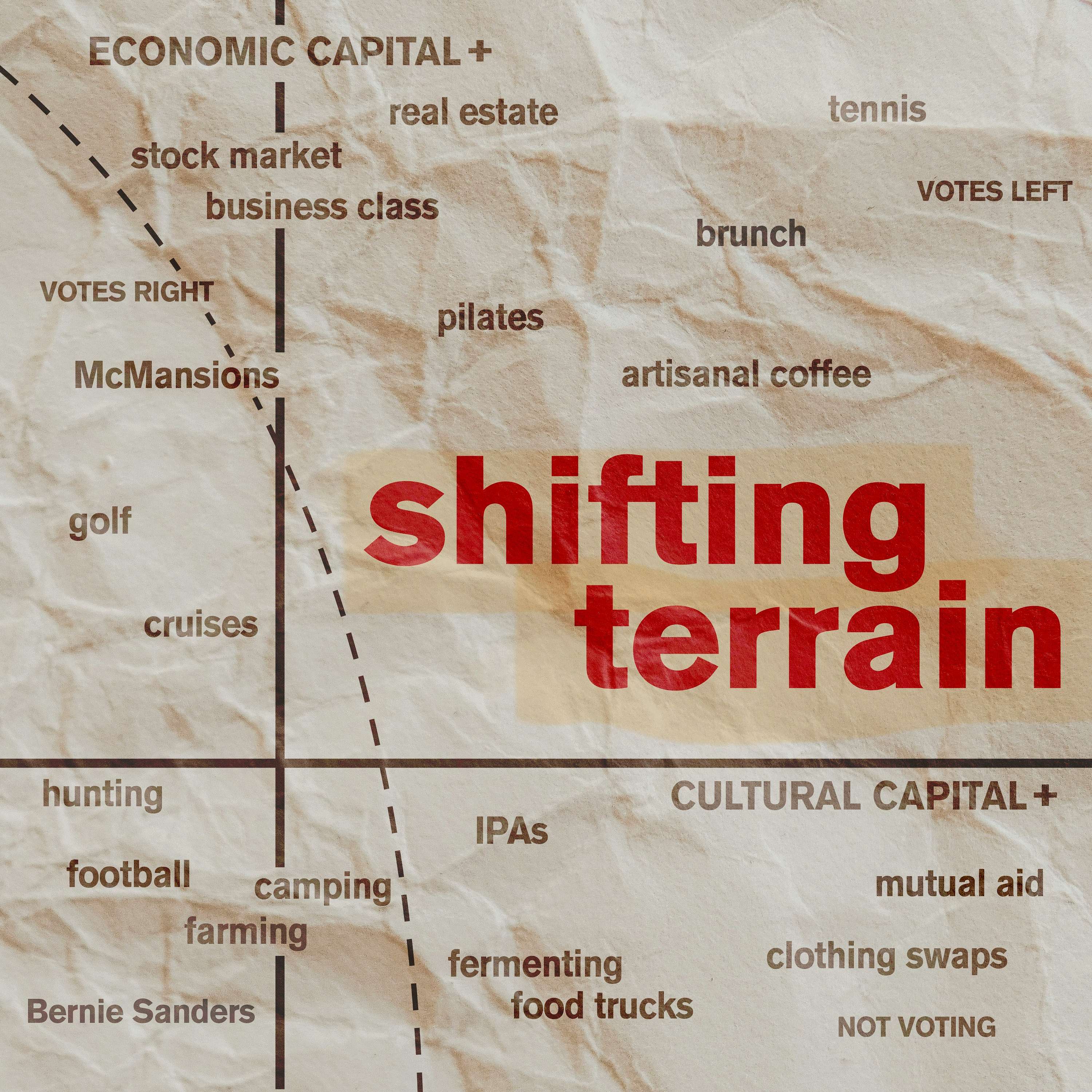
Shifting Terrain is back for a new season to explore the forces both capturing and dividing the working class. Hosted by sociologist Rachel Rybaczuk, she’ll talk with experts and everyday people about everything from the alarming reach of Christian nationalism to the inescapable influence of the manosphere, whether unions are actually the way to build power and if immigrants are really taking your job. Shifting Terrain moves beyond simplistic stereotypes to amplify the cultural, political, and economic issues facing America's working class today.
-
17
AI is About to Make The Working Class a Lot Bigger
You’ve probably heard that AI is coming for your job. That it will replace you. And probably ruin a lot of our lives. Or, that it’s going to make life, and especially work, easier. Ushering in a new age of productivity, efficiency, and therefore, leisure. What’s going on beyond the hype cycle?Ava, a worker training AI, shares details from inside an industry shrouded in secrecy - including a very unusual interview process, what happens when you have bots for coworkers, and how to manage the rollercoaster of precarious employment.Josh Dzieza, feature writer at The Verge, reveals the patterns we can’t see, based on years of reporting on tech, science, business, and their human impacts. And more specifically, about the hidden labor behind artificial intelligence and what this signals about the future of work.But what is AI’s real threat given all the projected promises and perils of technology that have resurfaced again and again? Aaron Benanav, assistant professor at Cornell University and author of “Automation and the Future of Work”, has an answer that might surprise you. Though maybe not as much as what renowned economist Richard Wolff has to say. He’s got a clear vision of how AI could be the long-awaited turning point for the working class.Josh Dzieza: WebsiteAaron Benanav: WebsiteRichard D. Wolff: WebsiteFollow Shifting Terrain on InstagramDrop us a line: [email protected]
-
16
Who Is The Working Class, Actually?
How do you define the working class? Is it based on education, income, job, or taste? Is there even a definitive answer?Several guests are on the show to help figure it out. Starting with Rachel Sherman, a professor of Sociology at The New School in New York City, who lays out the many possible ways to define class. We also hear from Joan Williams, Founding Director of the Equality Action Center at UC Law San Francisco and a prominent public intellectual. Joan returns to talk numbers, a particularly important detail for a certain group looking toward one end of the income distribution.Marbella Eboni Hill, Assistant Professor of Sociology at North Carolina State University, speaks about the intersection of race and class; and how understanding their relationship makes the murky waters of the class conversation much more clear. We also hear from Río, Olive, and Colin. Between their jobs cooking, bartending, and personal training, they talk with a lot of people. And, arguably, have the most expert things to say about class in the United States today. Not surprisingly, they’ve got some clear ideas that reflect the reality of being a working class person in these increasingly unaffordable times. Rachel Sherman: WebsiteJoan C. Williams: WebsiteMarbella Eboni Hill: WebsiteColin Davis: InstagramFollow Shifting Terrain on InstagramDrop us a line: [email protected]
-
15
Laughing When You Want to Cry: Comedy for Class Struggle
This season focuses on what’s capturing and dividing the working class. But if we’re interested in more unity, what’s a good way to bring everyone together? How about a joke?Rachel invited Gavin Matts onto this episode after seeing his standup set where he joked about debt, unemployment, and other class issues from a real-world perspective that are rarely seen on stage. She also speaks with Kenice Mobley, another NYC-based stand up, who talks about the realities of having a career in comedy without the financial or personal connections that are often needed to get ahead.And Caty Borum, the executive director of the Center for Media and Social Impact and co-founder of the Yes And Laughter Lab, offers a big-picture view of the class contours of comedy - both for comics and the industry. She explains how comedy effectively meets universal human needs, and how class could be the next big topic in the entertainment industry.Kenice Mobley: Instagram Caty Borum: Yes And Laughter Lab (Y’ALL) Center for Media and Social ImpactGavin Matts: InstagramShifting Terrain: [email protected]
-
14
Working Class Voters One Year Later: Was It Economic Policy Or the Culture War?
Shifting Terrain had its finger on the pulse of working class voters in 2024, but a lot of people were shocked by the outcome of the presidential election. A lot of analysis has gone into what exactly moved millions of voters to the right. Was it proposed economic policies or emphasis on the culture wars?Instead of clear answers, even more questions emerged: Will the Democrats forever have a toxic brand? Can the Republicans keep up their glaring contradictions? Is there a trustworthy politician who actually cares about working class people?Our guests have a definitive take on what went down. And what this means for the future of politics.Jared Abbott, Director of the Center for Working-Class Politics, has extensive data about working class voters in the Rust Belt, with both insight into the motivation behind their votes and clear directives for future candidates. Professor René Rojas’ co-authored paper “The Latino Rebuke” challenges the typical story about Latino working class voters' surprising right-ward trajectory, and why this move is distinct from their white neighbors. And we’ll also hear from Drew, a union electrician from Ohio, whose co-workers have gotten quiet since Trump was elected. Jared Abbott: Center for Working-Class PoliticsRené Rojas: The Latino Rebuke
-
13
Future Hindsight | How Underdogs Build Power: Stephanie Luce
We discuss Practical Radicals: Seven Strategies to Change the World—a guide for a new generation of activists seeking not just to understand power, but to build it.Stephanie's civic action toolkit recommendations are:1) Learn a new skill, like non cooperation or mutual aid2) Find organizations that align with your values and check if they offer trainingsStephanie Luce is Professor of Labor Studies at the School of Labor and Urban Studies and Professor of Sociology at the Graduate Center, City University of New York. She's also the co-author of Practical Radicals: Seven Strategies to Change the World.Let's connect! Follow Future Hindsight on Instagram:https://www.instagram.com/futurehindsightpod/Discover new ways to #BetheSpark:https://www.futurehindsight.com/sparkFollow Mila on X:https://x.com/milaatmosFollow Stephanie on X:https://x.com/stephanie_luce_Sponsor:Thank you to Shopify! Sign up for a $1/month trial at shopify.com/hopeful.Early episodes for Patreon supporters:https://patreon.com/futurehindsightCredits:Host: Mila AtmosGuests: Stephanie LuceExecutive Producer: Mila AtmosProducer: Zack Travis
-
12
How Workers Will Win the Class War
Think the recent wave of Starbucks and Amazon unionizing signals a tidal shift in worker power? A new wave of labor movement activity to take down corporations?Our guests have some news for you. While unions have long been considered the best way to build worker power, what’s really happening on the ground right now as the workforce increasingly moves towards a gig economy? And what does this mean for your future? Yes, you.Whether you’re an office worker on a salary, or a delivery driver on an app, we’re in a new era of labor organizing. Hear from Italo Medelius, an “Amazonian” and union organizer at an Amazon warehouse in North Carolina; Brian Dolber, researcher and organizer, who reveals the ways you can organize people who have the same job, but not the same workspace; and Ligia Guallpa, director of the Workers Justice Project in Brooklyn, who shares more than we know about the costs of convenience behind an app like Grub Hub.You’ll also hear about a controversial, but bold idea, from Les Leopold, that might just be the thing that actually turns the tide for workers.Italo Medelius: Amazon CAUSEBrian Dolber: Rideshare Drivers United and co-editor of The Gig Economy: Workers and Media in the Age of ConvergenceLigia Guallpa: The Workers Justice ProjectLes Leopold: The Labor Institute and author of the popular substack (and book by the same title) Wall Street’s War on WorkersHave questions about the gig economy? Check out the Gig Economy Data Hub, a project of the Workers Lab in collaboration with the SNF Agora Institute at John Hopkins University.
-
11
The Policies, Tactics, and Desperation of Immigration Today
What is happening with immigration policy and enforcement? Are we witnessing an unprecedented level of surveillance and violence? Or does social media just make people more aware of what’s always been happening? Sociologist Shannon Gleeson helps us untangle the knot of immigration policy and modern day tactics to reveal the bipartisan roots of strategies designed to snarl legal migration; what $40,000 gets if you’re navigating possible deportation; and the unlikely allies in this fight. Jorge Torres, national organizing director of the National Day Laborer Organizing Network (NDLON), shares on-the-ground experiences confronting day laborers, along with the interventions you don’t always see in viral clips online. And Maria describes just how much the quintessential immigrant story of her childhood has changed in America. Shannon Gleeson: Legalized Inequalities: Immigration and Race in the Low-Wage WorkplaceJorge Torres: National Day Laborer Organizing NetworkExecutive Producers: Rachel Rybaczuk and Amanda CowperAudio Mixing: Tina Tobey Mack
-
10
The Simplicity of Christian Nationalism in a Complicated Time
There is a noticeable discussion of Christian Nationalism in popular culture. Is its growing influence actually undermining democracy? In this episode, Samuel Perry reveals the surprising relationship between capitalism and Christianity; Jack Delehanty identifies how the church gives working people more than just a sermon on Sundays; and a former Evangelical speaks about the impact of political preaching. You’ll also hear from Jeanné Lewis, a Christian faith leader working to counter the influence of Christian Nationalism, who speaks candidly about how her faith is in direct opposition with much of the rhetoric swirling around the Church today.Samuel Perry: The Flag and the Cross: White Christian Nationalism and the Threat to American Democracy; Religion for Realists: Why We All Need the Scientific Study of ReligionJack Delehanty: Making Moral Citizens: How Faith-Based Organizers Use Vocation for Public ActionJeanné Lewis: Faith in Public LifeExecutive Producers: Rachel Rybaczuk and Amanda CowperAudio Mixing: Tina Tobey MackMusic: BlueDot Sessions and Epidemic Sound
-
9
What the Manosphere Tells Us About Working Class Politics
What happens when you combine the political opinions of a weightlifting social media star with the analysis of a professor who researches Fox News and political Youtube? A conversation that reveals some uncomfortable truths about the media. Colin Davis and Reece Peck discuss why liberal messaging continues to fail, where to find the Joe Rogan of the left, and how to actually reach working class men. Plus we’ll hear from author Joan Williams about how class cluelessness led to the downfall of the left’s power. Colin Davis: InstagramReece Peck: WebsiteJoan C. Williams: WebsiteShifting Terrain Executive Producers: Amanda Cowper and Rachel RybaczukAudio Mixing: Tina Tobey MackMusic: BlueDot Sessions and Epidemic Sound
-
8
-
7
Burn Away Billions or Build Real Power Between Elections: Organizing to Win
Building power to win for the working class isn’t simply a theory. People have been doing it for years. JaNaé Bates, Co-Executive Director of ISAIAH and Faith In Minnesota, explains the strategy for improving the lives of working people that put Minnesota on the political map. We talk about the work behind a miracle; how risk and failure are necessary for success; flanking imperfect politicians with power not money; and how the Minnesota Miracle is available for working people everywhere. And ultimately, why organizing over the long haul, not simply mobilizing for urgent political moments, will lead to a more unified multi-racial, working class electorate.Please reach out to us for suggestions for Season Two, or ways that we can collaborate by sending a message to: [email protected] learn more about the organizations mentioned in the episode, check out: Faith in Minnesota and ISAIAH.Credits:Shifting Terrain Executive Producers: Amanda Cowper and Rachel RybaczukProduction Consulting and Audio Mixing: Karen GivenMusic from BlueDot Sessions Hosted on Acast. See acast.com/privacy for more information.
-
6
Move From Elitist to Working Class With the Candidates Who’ll Reshape the Democratic Party
There’s a real reckoning going on in the Democratic Party. Their reputation for being the party of the working class had been waning for years. It took a crushing defeat - emotionally and electorally - for the party establishment to get on the page some people have been on for years: a majority of the electorate see the Democrats as the party of the elite. Congresswoman Delia Ramirez of Illinois, a proudly working class Latina, makes clear the obvious antidote: recruit, support, and elect more working class people to political office. Elected officials who are determined to deliver for working people. And Graciela Guzman, Senator Elect for IL District 20 underscores the power of authenticity in Ramirez’s path to victory.You’ll hear Ramirez speak candidly about the challenging path to political office for working class candidates, including a car catching on fire; being haunted by credit checks; intel on the identity crisis happening in the Democratic Party; and how if you want to win, you’ve got to bring the receipts. Shifting Terrain Executive Producers: Amanda Cowper and Rachel RybaczukProduction Consulting and Audio Mixing: Karen Given Music: BlueDot Sessions Hosted on Acast. See acast.com/privacy for more information.
-
5
Mega Money, Messy Maps and Our Need For Working Class Candidates
If you had to guess how many politicians are working class, what would you say? Ten percent? Five?In this episode we talk to Eric Hansen, a researcher who ran the data to determine how many working class politicians represent the working class majority. Along with the on-the-ground experience of Angelina Cruz and William Walter, two working class candidates who ran for state assembly in Wisconsin - a swing state with a reputation for having some of the most gerrymandered voting maps in the country. We learn why working class candidates are more rare than you’d imagine and a singular thing that could profoundly change politics. Shifting Terrain Executive Producers: Amanda Cowper and Rachel Rybaczuk; Assistant Producer: Emilce Quiroz; Production Consulting and Audio Mixing: Karen Given; and Music from BlueDot Sessions Hosted on Acast. See acast.com/privacy for more information.
-
4
How Right-Wing Media is Winning the Culture War
There’s a lot of finger pointing about which media outlet is to blame for the rise in political polarization, racism, and the class war. The brash boldness of Fox News is a likely target, but what about the hushed tones of liberal news? In this episode, researcher Reece Peck reveals what makes some media, like YouTube, a compelling place for news; how we can’t sidestep the culture war with facts; and why we can’t educate disinformation away.Show Notes:Find more of Reece Peck’s work at his website along with information about his book Fox Populism: Branding Conservatism As Working Class Also mentioned in this episode: Heartland TV: Prime Time Television and the Struggle for U.S. Identity by Victoria E. JohnsonShifting Terrain Executive Producers: Amanda Cowper and Rachel Rybaczuk; Assistant Producer: Emilce Quiroz; Production Consulting and Audio Mixing: Karen Given; and Music from BlueDot Sessions Hosted on Acast. See acast.com/privacy for more information.
-
3
Coastal Elites & Country Bumpkins: Bridging the Rural-Urban Political Divide
Damaging stereotypes about rural and urban voters abound in politics. What’s really going on in the charged landscape known as the rural-urban divide? Are rural voters actually voting against their interests when they elect a Republican? And are urban voters so immersed in the culture war they’re out of touch with the everyday concerns of working people? Is there any commonality across this geographical chasm?In today’s episode, Sarah Jaynes of the Rural Democracy Initiative, and Bonnie Dobson from Down Home North Carolina, share insights and anecdotes from long-term organizing with working class voters. Despite how it might feel out here, there is a way to bridge the rural urban divide for a more unified working class electorate.Down Home North Carolina https://downhomenc.org/Rural Democracy Initiative https://ruraldemocracyinitiative.org/Executive Producers: Amanda Cowper and Rachel RybaczukAssociate Producer: Emilce QuirozProduction Consulting and Audio Mixing: Karen GivenMusic from Blue Dot Sessions Hosted on Acast. See acast.com/privacy for more information.
-
2
Polls Are %&!* and Working Class Voters Will Decide Elections
Political strategists Jordan Berg Powers and Mike Lux discuss how major political campaigns have abandoned working class voters, the undeserved power of polls, and why you should never play Trump’s voice in a Democratic political ad. Hosted on Acast. See acast.com/privacy for more information.
-
1
Shifting Terrain Season 1 Trailer
In Shifting Terrain, we explore race and class in politics, beyond the simplistic stereotypes in the news, and between election cycles. Voters, political strategists, organizers, and politicians will speak to the ways race and class are playing out in voting patterns, campaigns, the news, and election outcomes. And, ultimately, how we navigate America’s multiracial, cross-class democracy. We highlight voices across the country to interrupt misconceptions fueling political polarization in American politics. Hosted on Acast. See acast.com/privacy for more information.
We're indexing this podcast's transcripts for the first time — this can take a minute or two. We'll show results as soon as they're ready.
No matches for "" in this podcast's transcripts.
No topics indexed yet for this podcast.
Loading reviews...
ABOUT THIS SHOW
Shifting Terrain is back for a new season to explore the forces both capturing and dividing the working class. Hosted by sociologist Rachel Rybaczuk, she’ll talk with experts and everyday people about everything from the alarming reach of Christian nationalism to the inescapable influence of the manosphere, whether unions are actually the way to build power and if immigrants are really taking your job. Shifting Terrain moves beyond simplistic stereotypes to amplify the cultural, political, and economic issues facing America's working class today.
HOSTED BY
Shifting Terrain Productions
CATEGORIES
Loading similar podcasts...
URL copied to clipboard!