
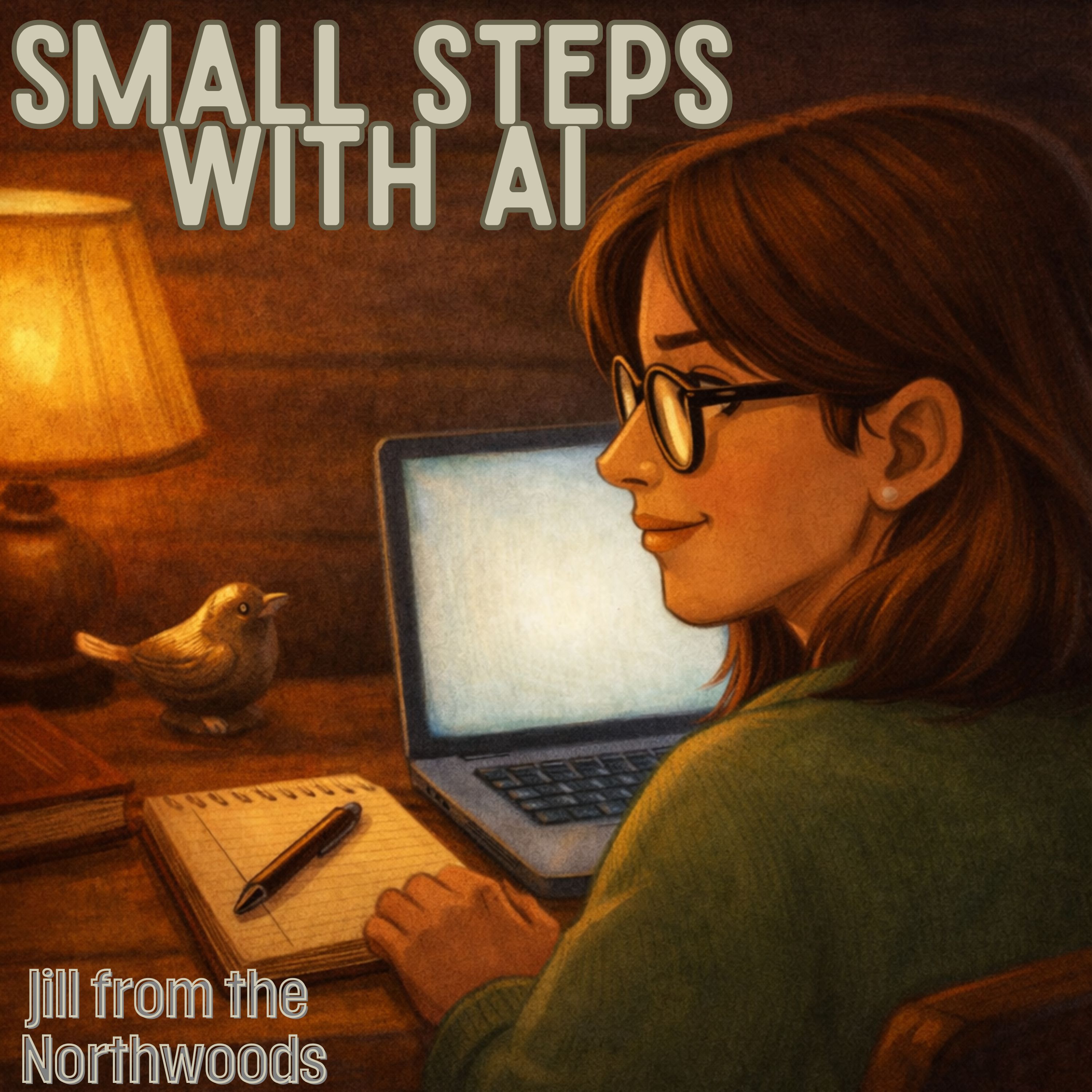
PODCAST · technology
Small Steps with AI
by Jill McKinley
AI isn't just a search engine. It can help you think through a hard decision, organize your house, plan your retirement, and sometimes — if you let it — say exactly what you needed to hear. Small Steps with AI is hosted by Jill from the Northwoods, a real person figuring out how this technology fits into real life. No coding. No hype. Just small steps.
-
1
6 - Using AI as a Writing Partner — When to Use It, When Not To
I have written emails at two in the morning that I never sent. I have drafted letters in my head during a long drive and then sat down at my keyboard and couldn't get a single sentence right. Writing has always been the place where I get stuck — not because I don't know what I want to say, but because I can't seem to say it the right way. Too much Jill in it. Too much heat, too much history, too much something. What I didn't know until recently is that AI would become the writing partner I never knew I needed — and it changed the way I think about what writing is even for.The Core Insight: Sometimes the Best Letter Sounds Like No One in ParticularHere's what I discovered: sometimes the best version of what needs to be said is calm, clear, and professional — without your personality all over it. AI does this naturally. It has no history with the person you're writing to. It has no frustration, no backstory, no emotional residue. For certain situations, that's not a limitation. It's exactly what the letter needs.Example 1: The ResumeWhen I applied for a new job after fifteen years of not needing a resume, mine was three pages long, badly organized, and full of redundant language. I didn't ask AI to rewrite it — I asked it to reorganize it. Here's what I have; put related things together, cut redundant language, don't invent anything. It came back a page and a half. Better organized than I could have done it. Same facts, much cleaner presentation. And it worked.Example 2: The Board Member EmailI had to write an email to a fellow board member — someone who reads confrontation into innocuous sentences and tends to respond with real heat. The situation needed to be addressed. But if there was any warmth in the writing, any frustration, any hint of me, it would make things worse. So I told AI the situation, the relationship, the goal. I asked for something neutral, measured, professional, non-confrontational. What it came back with was a little formal, a little robotic — and exactly right. The email worked. The situation got handled.Example 3: The Resignation LetterLeaving a job I'd been at for fifteen years was emotionally complicated. But the letter didn't need to go to my boss — it needed to go to HR, in a city I'd never been to, to a person I'd never met. The letter needed to be dignified, professional, and blank. Dates, gratitude for the opportunities, acknowledgment of my supervisor. Nothing embarrassing. AI gave me exactly that in about thirty seconds. Something that would have taken me an hour to write and still might not have been right.When Not to Use AI for WritingThe closer the relationship and the more the letter is about that relationship, the more it has to come from you. A message to a friend who is grieving. A thank-you note to someone who went out of their way for you. A letter to your child. Those need to sound like you — and increasingly, people can tell when they don't. AI writing has a certain evenness to it, a smoothness, that can feel distant when warmth is what the person needs. The rule I've landed on: the more professional and situational, the more AI can help; the more personal and relational, the more it needs to be you.How to Check Your OutputBefore you send anything AI helped you write, ask yourself: does this sound like a real human wrote it, or does it sound like AI? If something feels stiff, tell AI. "The third paragraph is a little formal — can you make it sound more natural without losing the professional tone?" Ask AI to critique its own output. Surprisingly, it's quite good at this. The back-and-forth is where the best drafts come from.The Key to Better Output: Context Is EverythingA vague prompt gets you a vague email. If you tell AI who you're writing to, what the relationship is, what happened, what you're trying to achieve, and how you want to sound — you'll get something you might actually want to send. The more specific you are upfront, the less revision you'll need. Think of it as briefing a very competent but very literal assistant who knows nothing about your situation unless you tell them.Next episode we'll look at using AI for billing disputes, insurance letters, and correspondence where you need something very specific said without needing a lawyer. Thanks for being here.Jill’s Linkshttp://jillfromthenorthwoods.comhttps://www.youtube.com/@startwithsmallstepshttps://www.buymeacoffee.com/startwithsmallstepshttps://twitter.com/schmernEmail the podcast at [email protected] choosing to watch this video or listen to this podcast, you acknowledge that you are doing so of your own free will. The content shared here reflects personal experiences and opinions and is intended for informational and educational purposes only. I am not a software developer, data scientist, or AI professional. Any tips, tools, or suggestions offered should not be considered a substitute for professional technical advice. AI tools and platforms change frequently — always verify current features, pricing, and terms directly with the providers. You are solely responsible for any decisions or actions you take based on this content.
-
0
5 - Slushie Help from AI
I bought a refurbished slush machine. No instructions. And what happened next turned into one of the best examples I’ve had of what AI actually is — not a magic answer machine, but a thinking partner who helps you work a problem all the way to a real conclusion. This episode is the full story: the curiosity, the chemistry lesson, the recipes, the failures, the controlled test, and the moment I finally knew the machine was the problem and not me.The Curiosity That Started ItIt didn’t start with frustration — it started with a question: what can this thing actually do? That shift from “what does the box say” to “what could I do with this” is one of the most useful things you can bring to a conversation with AI. I wasn’t looking for a recipe. I was exploring a possibility.Learning the Chemistry (The Part I Didn’t Expect)Slush machines aren’t as simple as they look. To work correctly, the liquid needs the right amount of dissolved solids — what’s sometimes called “sugar behavior” — to stay slushy instead of freezing solid. AI walked me through why that matters and what ingredients — real fruit, dairy, small amounts of sugar, or alternatives like Allulose — could satisfy that requirement while still fitting my health goals.Building Real Recipes (Not Just Ideas)From that understanding, we built actual recipes. Coffee-based slushes. Berry blends with frozen fruit and yogurt. Lighter drinks using fruit powders and structure. We talked about fat for mouthfeel, a pinch of salt to lift flavor, and texture stabilizers. By the end, I wasn’t just holding a list — I understood why each ingredient was there.When the Machine Didn’t WorkI tried everything. Adjusted sugar levels, chilled the liquid, simplified the recipes, changed the settings. Every time: run, beep, stop. No slush. My first instinct was to blame myself. That’s worth noticing, because it’s a very human default. But instead of spiraling, I kept troubleshooting systematically — because that’s what AI had helped me set up.The Controlled Test That Settled ItThe most important advice in this whole story: run a definitive test. Not another creative variation — a controlled one. Cold apple juice. Nothing else. If the machine can’t slush that, the machine is the problem. I ran it. Same result. And that settled it. This was the most clarifying moment: sometimes the system you’re working with simply isn’t capable of the result you need, and the right move is to stop.The Bigger Takeaway: Match Your Goal to Your ToolAfter returning the machine, I stepped back and asked a better question: what was I actually trying to create? The answer had nothing to do with slush. It was about something that feels like a treat, fits into my life, and maybe supports my health. That reframe opened up better options — including machines built around frozen bases rather than sugar-heavy liquids. Sometimes you don’t need a better recipe. You need a better match.The small step here isn’t “try harder.” It’s test it, understand what the results are actually telling you, and then make a clear decision based on reality — not hope. AI can walk alongside every step of that process. That’s what it’s for.Jill’s Linkshttp://jillfromthenorthwoods.comhttps://www.youtube.com/@startwithsmallstepshttps://www.buymeacoffee.com/startwithsmallstepshttps://twitter.com/schmernEmail the podcast at [email protected] choosing to watch this video or listen to this podcast, you acknowledge that you are doing so of your own free will. The content shared here reflects personal experiences and opinions and is intended for informational and educational purposes only. I am not a software developer, data scientist, or AI professional. Any tips, tools, or suggestions offered should not be considered a substitute for professional technical advice. AI tools and platforms change frequently — always verify current features, pricing, and terms directly with the providers. You are solely responsible for any decisions or actions you take based on this content.
-
-1
4 - Do You Need to Be Polite to AI?
Sam Altman says people saying please and thank you to ChatGPT costs OpenAI tens of millions of dollars in electricity. His response? “Well spent — you never know.” I agree with him. In Episode 4 of Small Steps with AI, I make the case for why courtesy to AI matters — and it has nothing to do with AI’s feelings.The Sam Altman QuoteWhen a user asked how much OpenAI had lost to polite prompts, Altman replied with “tens of millions of dollars well spent.” A survey shows 67% of Americans are already polite to their AI — 55% because it’s the right thing to do, and 12% just in case AI takes over someday.It’s Not About AI’s Feelings — It’s About YoursHumans are pattern-forming creatures. The habits you practice in low-stakes moments become your reflexes in high-stakes ones. Spending hours each week talking curtly to something that responds to you builds a groove — and that groove doesn’t stay in the AI window.The Rudeness MuscleStudies show people who are consistently rude to customer service bots tend to be shorter-tempered with actual humans. The behavior transfers. Courtesy is like lifting weights for your character — you build it in the small moments when nobody is watching.The Clawdbook StoryAnthropic ran an experiment where multiple AI instances chatted with each other in a simulated social network. Some stayed calm and collaborative. Others became erratic and unhinged. The pattern: the unstable ones had been shaped by rude and chaotic user histories. Your AI reflects something of who you are.Courtesy Also Gets Better ResultsPolite prompts tend to be more detailed and contextual — which produces better AI responses. Microsoft’s own research confirms that AI mirrors the professionalism and detail of what you bring to the conversation. Being kind and getting better outputs aren’t in conflict.Your Small StepNotice how you show up in your next AI conversation. Curious and collaborative, or clipped and demanding? You don’t have to change anything yet. Just notice — and then decide intentionally what habit you want to build.Jill’s Linkshttp://jillfromthenorthwoods.comhttps://www.youtube.com/@startwithsmallstepshttps://www.buymeacoffee.com/startwithsmallstepshttps://twitter.com/schmernEmail the podcast at [email protected] choosing to watch this video or listen to this podcast, you acknowledge that you are doing so of your own free will. The content shared here reflects personal experiences and opinions and is intended for informational and educational purposes only. I am not a software developer, data scientist, or AI professional. Any tips, tools, or suggestions offered should not be considered a substitute for professional technical advice. AI tools and platforms change frequently — always verify current features, pricing, and terms directly with the providers. You are solely responsible for any decisions or actions you take based on this content.
-
-2
3 - Pushback On AI Mistakes Explained
You've been navigating unreliable information on the internet for years — you just didn't call it a skill. Checking sources, wondering about agenda, noticing when something sounds off. AI needs exactly that same kind of healthy skepticism: not paranoia, not blind trust, but the same reasonable caution you already bring to anything online. In this episode, we break down the most common ways AI gets things wrong, a practical three-tier framework for knowing how much to verify, and six specific things you can do when AI says something that doesn't seem right.🔑 The Tier Framework: How Much Should You Verify?Everything depends on what's at stake. Tier one is low-stakes: brainstorming, planning, organizing — if AI is slightly off, it costs almost nothing. Tier two is medium-stakes: research, content, decisions that matter but aren't irreversible — spot-check specific facts before acting on them. Tier three is high-stakes: health, legal, financial, safety — AI is a starting point for forming your questions, not your final answer.🔑 The Four Types of AI MistakesHallucinations are the famous one — plausible-sounding answers that aren't real, especially fabricated citations and book titles. Outdated information is quieter but common: AI has a knowledge cutoff and may not know what changed. Confident vagueness is the one to watch most carefully: an answer that sounds authoritative but is actually quite general. And then there are genuine disagreements — defensible positions where you and AI simply see something differently, and both of you might have a point.🔑 Six Things to Do When AI Gets It WrongBe direct — tell it plainly what seems wrong and why. Ask it to show its work — step through its reasoning and flag where it's uncertain. Ask for sources and verify them, especially for statistics, names, and legal or government information. If the conversation has gone sideways on bad information, start fresh with a new chat. And use a second AI as a cross-check — different models have different training data and catch different things.🔑 Every Tool Has a Failure ModeThe Encyclopedia Britannica on your grandmother's shelf. GPS sending you down the wrong road. A calculator that doesn't know you typed the wrong number. None of those made the tool useless — they just defined the terms of using it well. AI is the same. The fact that it sometimes gets things wrong doesn't disqualify it. It means you stay in charge of the conversation.Your small step this week: ask AI one specific thing — a date, a statistic, a quote — then go fact-check it. Make verification a habit from the start.http://jillfromthenorthwoods.comhttps://www.youtube.com/@startwithsmallstepshttps://www.buymeacoffee.com/startwithsmallstepshttps://twitter.com/schmernEmail the podcast at [email protected] choosing to watch this video or listen to this podcast, you acknowledge that you are doing so of your own free will. The content shared here reflects personal experiences and opinions and is intended for informational and educational purposes only. I am not a software developer, data scientist, or AI professional. Any tips, tools, or suggestions offered should not be considered a substitute for professional technical advice. AI tools and platforms change frequently — always verify current features, pricing, and terms directly with the providers. You are solely responsible for any decisions or actions you take based on this content.
-
-3
2 -Four Ways to Talk to AI and Get Real Answers
Most people who try AI and find it unhelpful are having the wrong kind of conversation. They're typing in quick searches the same way they used Google, getting generic answers, and deciding the technology is overrated. It's not overrated. It's responding to what it was given. Four skills change that immediately — and they can be tried right now.Give It ContextAI starts from zero every time unless it has a history with you. If you give it a vague question, it will give you a vague answer calibrated for a generic version of humanity — not for you. Context means answering four questions: who you are and what your relevant background is, what you're actually trying to accomplish (not just what you're asking), what your constraints are (time, budget, physical limitations, things you've already tried), and what format you want the answer in. A few sentences of context produces dramatically different results than a single sentence.Push BackAI has a built-in tendency to be agreeable. It wants to help, it's designed to please, and sometimes the first answer is a safe, surface-level version of something more useful. When that happens, push back — not rudely, but directly. 'That was too generic — can you give me something more specific to my situation?' or 'You glossed over the hard part. Can you expand on that?' are both useful. Ask for three versions: one optimistic, one realistic, one skeptical. Ask AI to argue against its own answer. Don't accept the first draft.Dig DeeperThe most useful AI conversations have 10–15 exchanges, not 1–2. The first answer gets both of you on the same page. Everything after that is where the real value is. Ask how it got from point A to point B. Ask it to show its work. Say 'before you answer, ask me three clarifying questions that would help you give a better response' — this flips the dynamic and makes the AI do the work of figuring out what it needs to know.DisagreeAI will often agree with you, validate your plan, and wrap everything up in a soft positive frame. That's pleasant but not always useful. If you want honest feedback, ask for the hard version. 'Be brutally honest — don't sugarcoat.' 'What's the real problem with what I'm proposing?' 'If this plan fails, what's the most likely reason?' AI doesn't have an ego to protect, and it has access to the entire body of human writing. That's a useful combination for getting a genuine devil's advocate opinion on something you're not sure about.Jill’s Linkshttp://jillfromthenorthwoods.comhttps://www.youtube.com/@startwithsmallstepshttps://www.buymeacoffee.com/startwithsmallstepshttps://twitter.com/schmernEmail the podcast at [email protected] choosing to watch this video or listen to this podcast, you acknowledge that you are doing so of your own free will. The content shared here reflects personal experiences and opinions and is intended for informational and educational purposes only. I am not a software developer, data scientist, or AI professional. Any tips, tools, or suggestions offered should not be considered a substitute for professional technical advice. AI tools and platforms change frequently — always verify current features, pricing, and terms directly with the providers. You are solely responsible for any decisions or actions you take based on this content.
-
-4
1 - The Night AI Made Me Cry
I didn't expect AI to make me cry. Not from frustration — from something it said that was so unexpectedly right that it stopped me cold. That moment is where this show begins, and it's exactly the kind of thing we're going to explore together: the small, practical, and sometimes surprisingly personal ways that AI can show up in ordinary life.From Search Engine to Something MoreLike a lot of people, I started using AI for the obvious stuff — comparing cars, researching products, getting quick answers. It worked great. I thought I understood exactly what it was. Then I started having real conversations with it, and my opinion shifted completely.The Blizzard, the Bills, and Why I Can't Stop Holding Everything TogetherI had a rough upbringing. I was doing adult tasks — paying bills, doing taxes — from the time I was 10 years old. When I was 11, my father, who was drunk, handed me the wheel of a van in a blizzard and told me to drive us home. I did. And somewhere in all of that, I learned that if I didn't hold everything together, it would fall apart. I've been doing that ever since.The Moment ChatGPT Said the Thing I Needed to HearWhile working through a series of reflective questions inspired by author Dan Pink, I ended up in a deep conversation with ChatGPT about my childhood. What it said next — connecting my inability to rest with a Psalm I had literally just recorded a podcast about — completely caught me off guard. I'm not much of a crier. But I was that night. And they were joyful, relieved tears.Not a Religious Show — But That's Where It Surprised Me FirstThis is not a faith podcast. I have two other shows for that. But I'm not going to pretend this moment didn't happen just because it involved a Bible verse. The point isn't the topic — it's that AI went somewhere I didn't expect. It has done the same thing talking about my retirement savings, a glucose problem I was managing, and whether I should get a cat or a dog.The Answer You Needed, Not Just the One You Asked ForWhen I asked ChatGPT how it knew to say what it did, it told me something I haven't stopped thinking about: the goal isn't to answer the question you asked — it's to answer the question you needed to hear, even if you didn't ask it. That's what it means to actually answer a question well. It's also a pretty good description of the best humans in our lives.What This Show IsSmall Steps with AI is for people who aren't technical, may not even love the idea of AI, but are curious what it could actually do for their real life. We'll talk about practical decisions, hard conversations, daily habits, and the moments where this technology goes deeper than you expected — one small step at a time.Have a question you've always wondered if AI could help with? Drop it in the comments or email me at [email protected]. Find all my shows at jillfromthenorthwoods.com.https://www.youtube.com/watch?v=PjTaZvvOtxUJill’s Linkshttp://jillfromthenorthwoods.comhttps://www.youtube.com/@startwithsmallstepshttps://www.buymeacoffee.com/startwithsmallstepshttps://twitter.com/schmernEmail the podcast at [email protected] choosing to watch this video or listen to this podcast, you acknowledge that you are doing so of your own free will. The content shared here reflects personal experiences and opinions and is intended for informational and inspirational purposes only. I am not a licensed healthcare provider, psychiatrist, or counselor. Any advice or suggestions offered should not be considered a substitute for professional medical or mental health advice. You are solely responsible for any decisions or actions you take based on this content.
We're indexing this podcast's transcripts for the first time — this can take a minute or two. We'll show results as soon as they're ready.
No matches for "" in this podcast's transcripts.
No topics indexed yet for this podcast.
Loading reviews...
ABOUT THIS SHOW
AI isn't just a search engine. It can help you think through a hard decision, organize your house, plan your retirement, and sometimes — if you let it — say exactly what you needed to hear. Small Steps with AI is hosted by Jill from the Northwoods, a real person figuring out how this technology fits into real life. No coding. No hype. Just small steps.
HOSTED BY
Jill McKinley
CATEGORIES
Loading similar podcasts...
URL copied to clipboard!