
PODCAST · education
Speaking Body (via Substack)
by Neil Gorman
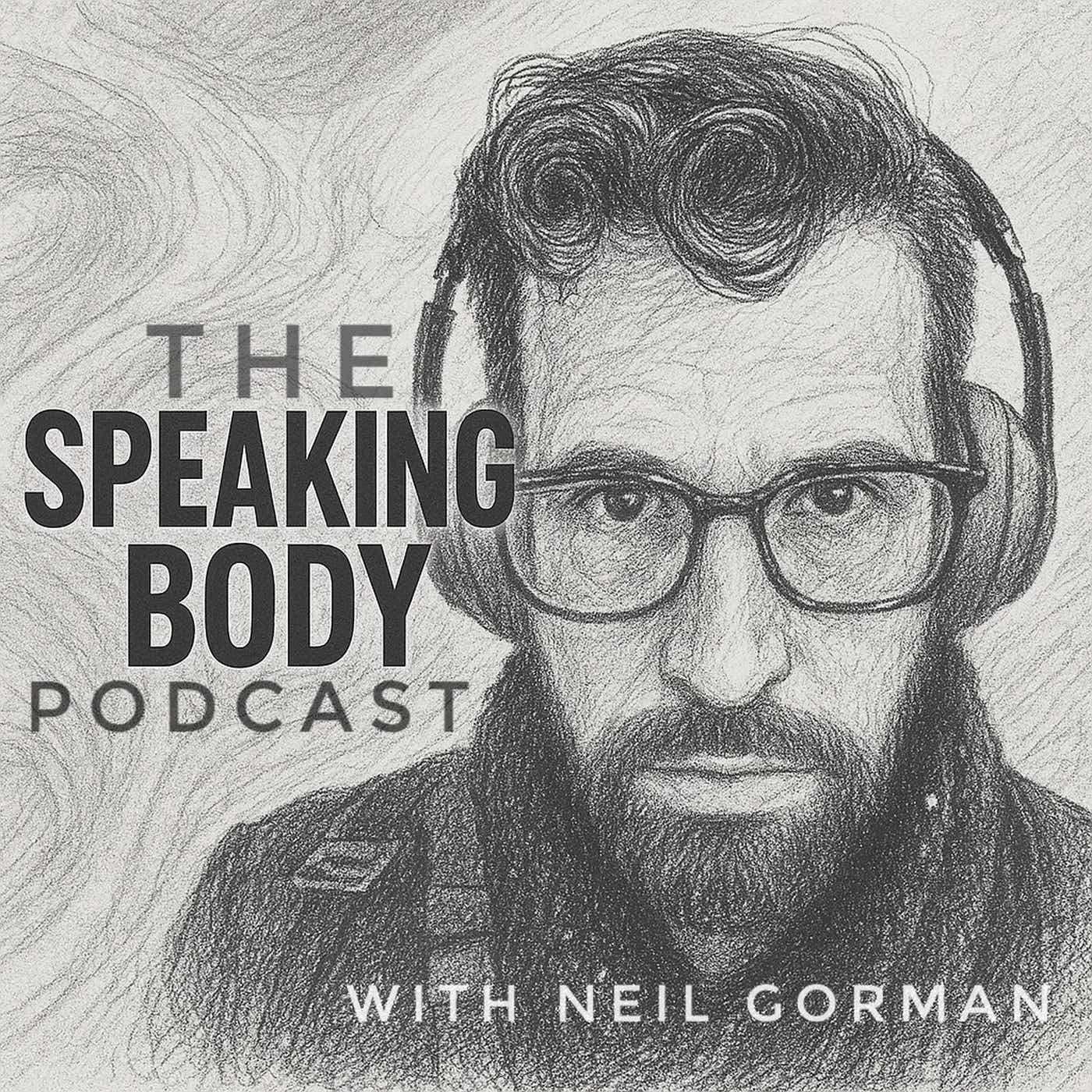
Speaking Body is a podcast hosted by Neil Gorman that approaches culture, relationships, and everyday life through the lens of Lacanian psychoanalysis, treating it not as a closed theory but as a living clinical practice. It explores how subjectivity speaks through the body—through symptoms, desire, impasses, and enjoyment—while engaging art, politics, and contemporary life with rigor, openness, and a touch of irony. speakingbody.substack.com
-
16
Noticing Without Knowing
In this short solo episode, I continue my exploration of what distinguishes psychoanalysis from other therapeutic practices. Building on earlier discussions about an “ethic of not knowing,” I introduce a key clinical distinction: the difference between judging and noticing.Rather than positioning the analyst as someone who knows and interprets, this episode argues for a different stance—one that privileges observation without certainty, and intervention without a predetermined aim.Through simple clinical examples, I try to show how shifting from judgment to noticing changes the structure of the analytic encounter. Instead of trying to produce insight, the analyst proposes something and remains open to what unfolds.This episode is an invitation to rethink what it means to listen, to intervene, and to practice psychoanalysis.The Episode SummarizedPsychoanalysis is not about applying what the analyst knows. It is about noticing something without knowing what it means—and without knowing what effect it will have.An Example from the EpisodeA patient repeatedly says they want to stop procrastinating but continues to do so.* A judgmental intervention might assert:“You don’t actually want to stop procrastinating.”* A noticing intervention might say:“You’ve been saying this for a long time, and yet nothing seems to change. That’s interesting.”The difference is not just in tone—it’s in structure.One tries to produce insight; the other opens a space to see what emerges.Key Topics* Psychoanalysis as a practice oriented by not knowing* The role of lack and desire in analytic work* A contrast between psychoanalysis and knowledge-driven therapies* Connections between psychoanalysis, science, and ethnography* The clinical distinction between judging vs. noticing* Why trying to make something happen can interrupt the analytic process* Noticing as a way of proposing rather than asserting* How uncertainty functions as a clinical toolFinI hope you find this episode interesting and useful. If you’d like to support the podcast, you can leave a star rating or review wherever you listen, or tell a friend about the show. And, of course, you become a paid subscriber. Till next time, take care. -N This is a public episode. If you'd like to discuss this with other subscribers or get access to bonus episodes, visit speakingbody.substack.com/subscribe
-
15
Psychoanalysis & Ethnography
IntroHello and welcome to the Speaking Body Podcast. I’m your host, Neil Gorman.This is another short, solo episode—just me talking directly to you.I want to start off today with a short recap of what I presented in the last episode, where I tried to lay out what I see as a really essential aspect of how psychoanalysis is practiced.Recap & ReviewWhen you last heard from me on this podcast, I made the claim that a psychoanalyst does not take up the knowledge that is supposed to them, which also means a psychoanalyst does not take up the authority that comes with the knowledge an analysand provides them via transference by assuming that the analyst knows something that the analysand does not know. So all of this is a description of what a psychoanalyst does not do. So what do they do? What does an analyst offer an analysand?* My claim is that a psychoanalyst offers something like curiosity.* Which is another way of saying the psychoanalyst gives what they don’t have.* Or, the psychoanalyst does not give what they have; they give what they lack, which is a weird idea.* And what makes echo analysis unique in the therapeutic marketplaceSet up this episodeWhat I want to do in today’s episode is build up the argument from the last episode by doing something that I think is different, because I haven’t seen anybody else do it.This way of operating—this position of not knowing, this refusal to rush into understanding— might be unique to psychoanalysis in what I call the psychotherapeutic marketplace (the sorts of therapeutic experiences people can buy), BUT it’s not unique to psychoanalysis.There’s another practice, where something very similar shows up. And that field is ethnography.Science: Another unlikely companionBefore I get to ethnography, I want to start with something that might seem a little unexpected: science.Now, I want to be clear upfront — I’m not a trained scientist. So take what I’m about to say with that in mind. But here’s how I think about what scientists actually do when they run experiments.Scientists know a lot. They’ve studied. They’ve read. They’ve trained. But when they sit down to design an experiment, they’re not doing it to prove what they already know. They’re doing it because there is a question they genuinely don’t have the answer to.Take a simple example: a scientist wants to know what happens when a particular substance is given to mice before they run through a maze. They don’t know if it will make the mice faster, slower, or have no effect at all. So they run the experiment. They observe. They learn something.And then another scientist, somewhere else, runs the same experiment. It might look like they’re trying to prove the first result — but they’re not. They’re actually asking a new question: Is this replicatable? Was the first result a fluke?And sometimes, the third run of the same experiment produces a totally different result. Suddenly, a whole new set of questions opens up. Why did it work differently this time? What does that mean?This is actually very similar to how psychoanalysis works. When an analyst offers an interpretation to a patient, it’s not meant to be a final answer that unlocks everything. It’s more like running an experiment. You offer something, and then you see what happens. And if it lands — if it creates a new connection, opens something up — that new knowledge doesn’t close things down. It opens up more questions.In this respect, I think science and clinical psychoanalysis share a similar ethic.Moving on to EthnographyNow, before I go any further, I want to keep this simple. I’m not going to get into a technical definition of ethnography or anything like that. Instead, I want you to imagine something.Imagine a person leaving their home base, where most things make sense relatively easily, and traveling into another place (another culture, location, or community) where what is natural and normal is, to some degree, different than what is natural and normal in the traveler’s home. And imagine that this traveler’s goal is to understand: * How do people in that place live? * How do they organize their lives? * What’s natural and normal for them?* What’s polite vs whats rude?* What matters to them?* Etc.This is, in a very simple way, what an ethnographer does.What an ethnographer does not do is assume that they already understand, because they know that assuming that you understand tends to lead to the mistake of projecting what you already know onto something new, and that is a good way to misunderstand. Additionally, when someone assumes they know all about something, they tend to pay less attention to it, making them more likely that they will miss something interesting. An ethnographer wants to learn, and to learn, they have to start from the belief that they don’t know about what they are witnessing. So what does a good ethnographer do instead?* They slow down* They listen.* They observe.* They do their best to resist the urge to jump to a conclusion.* They allow themselves to not understand.* They let things be confusing for a while.In short, they use their lack of knowledge productively by taking their time and letting important connections and insights unfold slowly. A shared ethicIf that sounds familiar, it should. Because it’s another way of describing what I believe is the ethic that orients the practice of psychoanalysis.In both cases, there’s an encounter with something.* For the ethnographer, it’s another culture, another group of people, a different place, another way of life.* For the psychoanalyst, it’s another person’s unconscious. Another person’s way of speaking, desiring, suffering, and enjoying.And in both cases, there’s a temptation.* The temptation to assume we already know and understand what we are witnessing. * And in both cases, the practice depends on resisting that temptation.Not because knowing is bad! But because knowing too much or arriving at understanding too quickly can actually get in the way of the emergence of:* What psychoanalyst would call “formations of the unconscious” or just “the unconscious.”* and what the pop-ethnographer Chris Arnade has described as “thick culture” as opposed to the more visible “thin culture.”I’ll quote Arnade here:Thick culture is the plot we follow, while thin culture is the stage settings.And I’ll rephrase that into psychoanalytic language by sayingThe unconscious is the plot we follow, while the way we consciously go about it is the stage setting.Another way to say this might be that both ethnography and psychoanalysis are practices that require a certain degree of respect for the patient for what is at the core of the subjectivity of what is Other to them. They understand that what lies in the depths is shrouded in layers of opacity. And instead of trying to eliminate that opacity right away, both practices, at their best, make room for it.* They allow it to be there.* They don’t get overly frustrated by it.* They work through it slowly.They are not exactly the sameNow, I also want to be clear—these two practices are not the same.An ethnographer, at the end of the day, is usually trying to produce some kind of knowledge. They might write something. They might describe what they’ve learned. They might try to make sense of a shared way of life, then take that understanding and turn it into a book, a presentation, or something along those lines. A psychoanalyst is doing something different.The goal is not to produce a description of the person sitting in front of them, which will then be shared with others. What happens in psychoanalysis is the production of an experience that has more to do with the patient/analysand coming into contact with their unconscious and learning something from that encounter. And in psychoanalysis, all of this remains private. What happens in the session stays there; it is not shared with others outside that session. ConclusionBut even though the aims are different, I think the ethical practices of ethnography and psychoanalysis have a lot in common.* Both practices depend on a kind of restraint.* A willingness to not know.* A refusal to reduce the other person to what is already known or understood.And I would go even a step further: I think that when this ethical position is lost, something goes wrong in both practices.So what I’m trying to lay out across these episodes is something pretty simple.Psychoanalysis is not defined by what the analyst knows. It’s defined, at least in part, by how the analyst relates to what they don’t know.And what I’m proposing today is that this way of relating—to not knowing, to the other, to meaning—is not unique to psychoanalysis.It shows up in other places, too. Ethnography is one of the clearest examples of it.I’m going to leave it there for today.Wrap upAs always, I want to say thank you for your time and attention. I really do appreciate it.If you want to learn more about the podcast, you can head over to speakingbody.substack.com. You’ll find episodes, writing, and ways to support the work if that’s something you’re interested in.And until next time, I’m in your ears.Take care.-N This is a public episode. If you'd like to discuss this with other subscribers or get access to bonus episodes, visit speakingbody.substack.com/subscribe
-
14
Psychoanalytic Curiosity
In this short solo episode of The Speaking Body Podcast, I (Neil Gorman) try a new format and invite listeners to email feedback about whether they like it. I explain a key difference between how psychoanalysis is practiced versus many forms of psychotherapy, coaching, or other helping relationships: when someone seeks help, they often engage in transference by supposing the helper has knowledge, authority, and power. In many cases, the helper accepts this supposition and provides advice, tools, or a treatment plan, which can be helpful. By contrast, I argue that psychoanalysts do not take up this supposition of knowledge; instead, they adopt a position of not knowing and respond with curiosity, offering hypotheses and questions rather than prescriptions. I close by noting this stance is essential to psychoanalytic work and share where to learn more at speakingbody.substack.com.---Table of contents00:00 Welcome and Format00:37 Big Idea Setup02:02 Psychotherapy Side Explained03:34 Transference and Authority05:32 Helper Model Benefits06:46 Switch to Psychoanalysis07:58 Not Taking Transference09:19 Curiosity Over Knowing11:41 Interpretations as Hypotheses13:02 Continuum Not Binary13:54 Key Takeaway and Wrap15:17 Thanks and Where to Find This is a public episode. If you'd like to discuss this with other subscribers or get access to bonus episodes, visit speakingbody.substack.com/subscribe
-
13
Intro Music
The intro music I use for the Speaking Body Podcast is something I threw together in Logic Pro. If anyone would like to listen to the track in its entirety, here it is. This is a public episode. If you'd like to discuss this with other subscribers or get access to bonus episodes, visit speakingbody.substack.com/subscribe
-
12
Episode 001: Hello!
Introducing Speaking Body: A Relaunch of Neil Gorman’s Psychoanalysis PodcastI announce a relaunch and rebrand of my podcast, formerly The Informed Podcast, explaining that my views and relationships to psychoanalysis, theory, practice, and institutions have changed over the years. He renames the show Speaking Body and expands it into a broader project, including a website (speakingbody.com) that will archive my writing, offer a newsletter, and sometimes include video episodes on YouTube while keeping the same RSS feed for existing subscribers. Going forward, the podcast will focus less on applying psychoanalytic theory to topics like film or literature and more on psychoanalysis as lived practice: (1) the clinical perspective from my work with patients, (2) the experience of being an analysand as essential to practicing psychoanalysis, and (3) how psychoanalytic work extends beyond the consulting room into everyday life and subjectivity. I will sometimes use specialized Lacanian terminology, but aim to restate ideas in more everyday language.00:00 Welcome + Why the Podcast Needed to Change01:11 Outgrowing the Old Format: How Neil’s Relationship to Psychoanalysis Shifted02:50 Should I End It? The Decision to Rebrand Instead03:31 Introducing the New Name: Speaking Body (Podcast, Site, Newsletter)04:24 Audio to Video: Expanding to YouTube05:06 What to Expect: A Practice-Focused Psychoanalysis Podcast06:47 Three Angles, Part 1: Clinical Work in the Consulting Room07:24 Three Angles, Part 2: The Analysand Experience (Why It’s Essential)08:39 Three Angles, Part 3: Taking Psychoanalysis Out Into Everyday Life09:54 Keeping Lacanian Terms Accessible: Less Jargon, More Plain Language11:29 Wrap-Up: Thanks for Listening + Welcome to Speaking Body This is a public episode. If you'd like to discuss this with other subscribers or get access to bonus episodes, visit speakingbody.substack.com/subscribe
-
11
Peter Rollins on Psychoanalysis, Theology, Community, and the Work He Does
In this episode of the InForm: Podcast, I speak with Peter Rollins, the man behind pyro-theology, the Wake festival, the Spark retreat, Atheism for Lent, and many more things that can provoke all sorts of interesting experiences and elaborations. I first became aware of Pete's work many years back as I was attempting to build up my own understanding of Lacan. I don't remember exactly how it happened, but I found a video of him discussing Lacanian ideas, in which he explained them in ways I found intelligible and useful. This led me to watch more of his videos, listen to his podcast, and then read his books. Today, what interests me about Pete's work is the way that he goes about building engaged communities that work and struggle together to acknowledge, experience, and communicate about the lacks and antagonisms that are at the center of human subjectivity (or the human condition if you prefer that language), which is the main thing I speak with him about in this informal but hopefully informative conversation.We do, of course, go in other directions as well; we even tell a few jokes, which I hope you all find amusing. One last thing: near the end of the interview. REFERENCED: 1. Pete's Patreon & his Website2. Todd McGowan's YouTube3. Analysis Laid Bear 3. The Aims of Analysis This is a public episode. If you'd like to discuss this with other subscribers or get access to bonus episodes, visit speakingbody.substack.com/subscribe
We're indexing this podcast's transcripts for the first time — this can take a minute or two. We'll show results as soon as they're ready.
No matches for "" in this podcast's transcripts.
No topics indexed yet for this podcast.
Loading reviews...
ABOUT THIS SHOW
Speaking Body is a podcast hosted by Neil Gorman that approaches culture, relationships, and everyday life through the lens of Lacanian psychoanalysis, treating it not as a closed theory but as a living clinical practice. It explores how subjectivity speaks through the body—through symptoms, desire, impasses, and enjoyment—while engaging art, politics, and contemporary life with rigor, openness, and a touch of irony. speakingbody.substack.com
HOSTED BY
Neil Gorman
Loading similar podcasts...
URL copied to clipboard!