
PODCAST · health
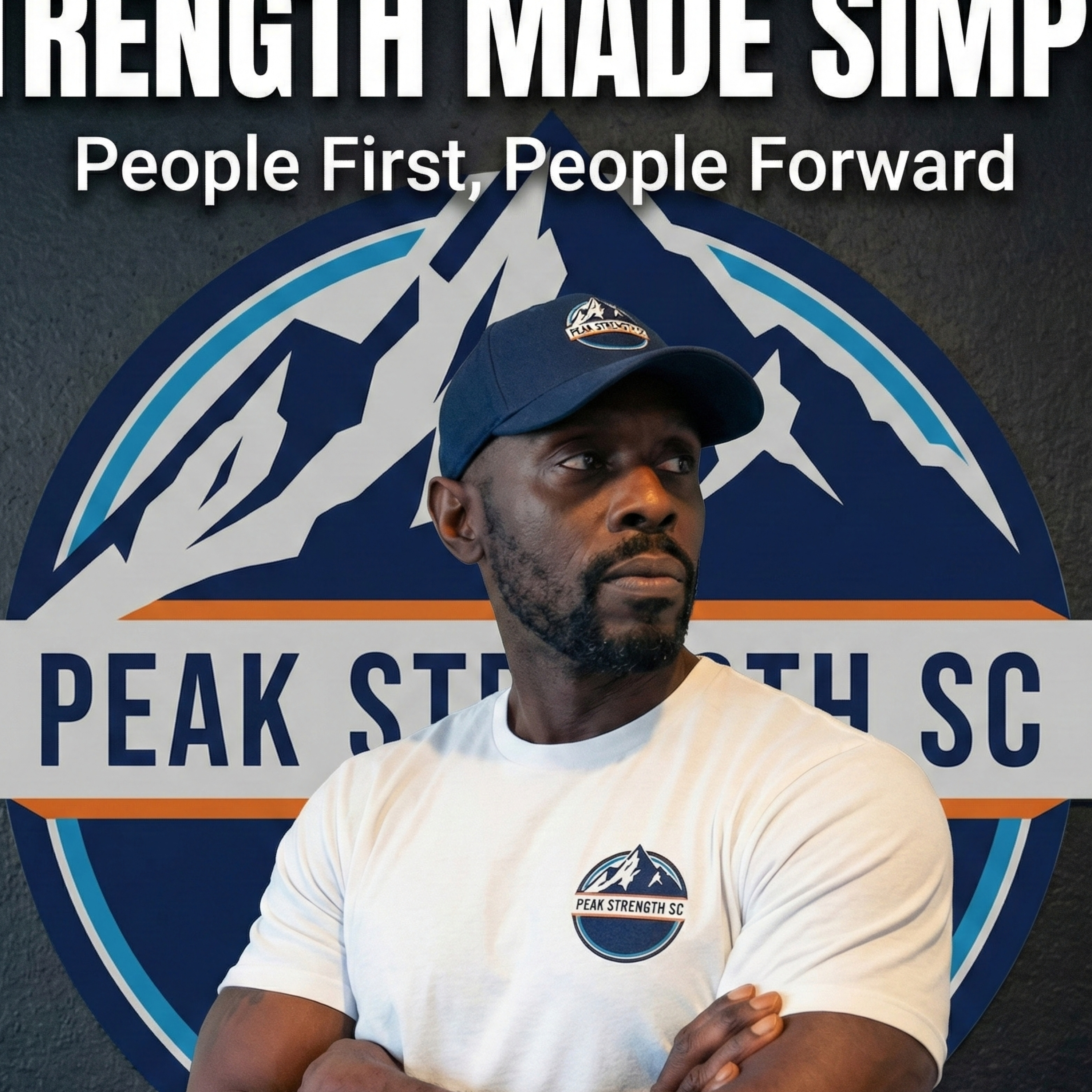
Strength Made Simple
by William "Coach" Webb
Simple fitness solutions for a complicated world.Strength Made Simple cuts through the noise of the fitness industry to deliver practical, science-backed strategies you can implement today.We focus on the "Big Rocks": Strength Training, Protein, Sleep, and Consistency. If you want to look better, feel stronger, and live longer without sacrificing your entire life to the gym, you’re in the right place.Subscribe for weekly episodes on:-> Efficient Strength Training-> Fat Loss for Busy Professionals-> Longevity & Healthspan-> Building Unbreakable Habits
-
13
Episode 13: The Ledger of Strength: Why You Must Track Your Training Data
You wouldn't run a business without a balance sheet, and you wouldn't manage a million-dollar project without a timeline. So why are you trying to build your body without a logbook? In this deep-dive episode, Coach Webb explains why "Training by Feel" is a guaranteed recipe for stagnation. We explore the "Amnesia of Effort"—how your brain tricks you into thinking you worked harder than you actually did to save energy. We break down the psychological power of data, why a $2 notebook is the most valuable piece of gym equipment you will ever own, and how to turn your workouts from a "chore" into a "game" you can win every single week.Citations:Psychological Bulletin. (2016). "Does monitoring goal progress promote goal attainment? A meta-analysis of the experimental evidence." (Shows that recording progress significantly increases the likelihood of achieving goals).New England Journal of Medicine. (1992). "Discrepancy between Self-Reported and Actual Caloric Intake and Exercise in Obese Subjects." (Proves humans drastically overestimate their physical effort).Journal of Strength and Conditioning Research. (2004). "Fundamentals of Resistance Training: Progression and Exercise Prescription."
-
12
Episode 12: The Target Trap: Why "Losing 10 Pounds" is a Terrible Goal
"I just want to lose 20 pounds." It is the most common goal Coach Webb hears, and it is also the least effective. In this deep-dive episode, we explore the psychology of Goal Selection and why most people set themselves up for failure before they even step foot in a gym. We break down the "Arrival Fallacy"—the empty feeling you get when you finally hit your target number—and why "Outcome Goals" often lead to anxiety and rebounding. We introduce a better way: The Capability Framework. Learn how to shift from "Lag Measures" (the scale) to "Lead Measures" (the habits), and why chasing a performance metric is the secret code to unlocking the physique you actually want.Citations:Journal of Consumer Research. (2011). "The dynamics of goal progress: Process evidence." (Focusing on the process maintains motivation longer than focusing on the outcome).American Psychological Association. (2015). "The psychology of goal setting." (Locke & Latham’s theory on challenge vs. complexity).International Journal of Sport and Exercise Psychology. (2019). "The effects of goal setting on performance."
-
11
Episode 11: The Architect vs. The Gambler: Why Random Workouts Get Random Results
Are you training with a plan, or are you just "exercising" and hoping for the best? In this deep-dive episode, Coach Webb dismantles the pervasive myth of "muscle confusion" and explains why walking into the gym without a program is like building a house without blueprints—eventually, the roof is going to collapse. We break down the massive difference between Exercise (burning calories/entertainment) and Training (building capacity/engineering). We explore the physiological law of the "General Adaptation Syndrome" and provide a detailed masterclass on the fundamental pillars of programming: Frequency, Intensity, and Progressive Overload. Stop gambling with your sweat equity. It’s time to become the Architect of your own biology.Citations:Medicine & Science in Sports & Exercise. (2009). "Progression Models in Resistance Training for Healthy Adults."Selye, H. (1950). "The Physiology and Pathology of Exposure to Stress." (The General Adaptation Syndrome).Journal of Strength and Conditioning Research. (2015). "The effect of training volume and intensity on improvements in muscular strength and size."
-
10
Episode 10: The Infinite Game: Why "Getting in Shape" is the Wrong Goal
Why do you train? If the answer is "to lose 10 pounds" or "to look good for vacation," you are playing a finite game with an expiration date. In this deeply personal episode, Coach Webb pulls back the curtain on his own "WHY." This isn't just about gym routines; it’s a philosophical manifesto for a life well-lived. We explore why Consistency beats Intensity every time, why your fitness should enhance your life rather than becoming a restrictive religion, and the ultimate functional goal: To run, jump, carry, and move with lethal capability well into your 70s and 80s. Stop training for a deadline. Start training for a lifetime.Citations:British Journal of Sports Medicine. (2018). "Grip strength as a marker of aging and mortality." (Supports the "Carry" goal).International Journal of Behavioral Nutrition and Physical Activity. (2012). "Intrinsic vs. Extrinsic Goals for Exercise." (Purpose over temporary goals).European Journal of Social Psychology. (2009). "How are habits formed: Modelling habit formation in the real world." (Consistency over intensity).
-
9
Episode 9: The "I’m Fine" Fallacy: Why You Aren't as Healthy as You Think You Are
"I feel fine." It is the three-word phrase that kills more dreams (and people) than any disease. In this episode, Coach Webb confronts the uncomfortable gap between our perceived health and our biological reality. We explore the "Dunning-Kruger Effect" of fitness—why we tend to grade ourselves on a curve against a sick society rather than an objective standard. This isn't about shaming you for where you are; it’s about loving you enough to tell you the truth. We discuss why "Average" is actually a failing grade in modern health and provide the objective metrics you need to audit your body before it forces a shutdown.Citations:Mayo Clinic Proceedings. (2016). "Prevalence of Optimal Metabolic Health in American Adults." (Startling stat: Only 12% of Americans are metabolically healthy).Archives of Internal Medicine. (2012). "Discrepancy between self-rated health and actual cardiovascular risk."Psychology and Health. (2015). "Optimistic bias in health risk perception."
-
8
Episode 8: The Motivation Trap: Why You Need to S.T.A.R.T. Small to Win Big
"I'm just waiting to feel motivated." Coach Webb hears this every January, and he sees the result every February: Failure. In this episode, we expose Motivation for what it truly is—an unreliable emotion that will abandon you when things get hard. We introduce the S.T.A.R.T. Protocol (Simple Tasks Are Repeatable Tasks). This isn't about setting moonshot goals that burn you out in week one. It’s about leveraging the psychology of "Activation Energy" to trick your brain into consistency. Stop waiting to feel like a superhero, and start acting like a professional.Citations:- Health Psychology Review. (2020). "Habit formation and behavior change." (Shows small changes are 3x more sustainable).- BJ Fogg, PhD, Stanford Behavior Design Lab. "The Fogg Behavior Model: Ability vs. Motivation."- James Clear. "Atomic Habits: The 1% Rule."
-
7
Episode 7: The Spotlight Lie: Why Your Fear of the Gym is Just Ego in Disguise
"I’ll join a gym once I get in shape." It is the most backward, self-sabotaging lie we tell ourselves. In this episode, Coach Webb dissects "Gymtimidation"—the paralyzing fear that everyone in the weight room is watching, judging, and laughing at you. We break down the psychology of the "Spotlight Effect," expose the reality that most gym-goers are actually narcissistically focused on themselves, and provide a mental framework to walk into any room with your head high. It’s time to stop letting the fear of judgment rob you of your physical freedom.Citations:- Journal of Health Psychology. (2018). "Social physique anxiety and physical activity: A comprehensive review."- OnePoll / Isopure Survey. (2019). "Gymtimidation: 50% of Americans are intimidated by the gym."- Current Directions in Psychological Science. (2000). "The Spotlight Effect in Social Judgment." (Gilovich et al.)
-
6
Episode 6: The Body Budget: Why "Intuitive Eating" is keeping you Broke and Broken
"I eat pretty healthy, so why can't I lose the weight?" It’s the most common frustration Coach Webb hears. In this episode, we expose the gap between what you think you eat and what you actually eat. We dismantle the "Intuitive Eating" trap—explaining why you can't trust your gut when your gut is addicted to processed sugar. We break down Macro Tracking not as an obsession, but as a temporary financial audit for your metabolism. Learn how to treat calories like currency, protein like your savings account, and finally get the ROI on your sweat equity.Citations:- New England Journal of Medicine. (1992). "Discrepancy between Self-Reported and Actual Caloric Intake and Exercise in Obese Subjects." (Shows people underreport by up to 47%).- American Journal of Clinical Nutrition. (2015). "Protein leverage and energy intake."- Journal of the Academy of Nutrition and Dietetics. (2021). " dietary self-monitoring and weight loss."
-
5
Episode 5: Stop Feeding, Start Fueling: The Difference Between Being Full and Being Powered
Most adults eat like unsupervised toddlers—we eat what tastes good, what’s convenient, and what pacifies us in the moment. We are "feeding" an appetite, but we aren't "fueling" the machine. In this episode, Coach Webb draws a hard line in the sand between Feeding (eating for pleasure or survival) and Fueling (eating for performance and longevity). We discuss why you can be calorically stuffed but nutritionally starving, how to structure your daily plate to stabilize your mood and libido, and why protein is the non-negotiable anchor for anyone over 30 who wants to stay dangerous.Citations:Nutrients. (2020). "The Role of Protein in Aging and Sarcopenia."American Journal of Clinical Nutrition. (2016). "Glycemic Index, Glycemic Load, and Chronic Disease Risk."Frontiers in Psychology. (2018). "The Effects of Diet on Mood and Mental Health."
-
4
Episode 4: The Reset Button - Why Your Body Needs a Break from Eating
We live in a culture that tells us to snack constantly to "keep our metabolism up," but what if that advice is actually breaking us down? In this episode, Coach Webb explores the ancient, biological power of fasting. We aren't talking about starvation; we are talking about strategic restoration. We break down the differences between daily Intermittent Fasting (the oil change), the 36-Hour Fast (the deep clean), and the 72-Hour Fast (the factory reset). Learn how to use these protocols to fix insulin resistance, trigger autophagy (cellular cleanup), and reclaim your freedom from the "hangry" cycle.Citations:New England Journal of Medicine. (2019). Effects of Intermittent Fasting on Health, Aging, and Disease.Cell Stem Cell. (2014). Prolonged Fasting Reduces IGF-1/PKA to Promote Hematopoietic-Stem-Cell-Based Regeneration.Johns Hopkins Medicine. (2024). Intermittent Fasting: What is it, and how does it work?
-
3
Episode 3: The "Too Expensive" Lie: Calculating the Real Cost of Your Diet
We constantly hear that "eating healthy is too expensive," but have you ever calculated the cost of being tired, sick, and physically checked out of your own life? In this episode, Coach Webb tackles the "Budget-Health Paradox." We move beyond the grocery receipt and look at the hidden tax processed food levies on your marriage, your energy with your kids, and your long-term medical bills. We break down the math of nutrient density and provide a tactical battle plan for fueling your body like a high-performance machine without breaking the bank.Citations:Harvard T.H. Chan School of Public Health. (2023). The cost of healthy eating vs. unhealthy eating.Centers for Disease Control and Prevention (CDC). (2022). Health and Economic Costs of Chronic Diseases.U.S. Department of Agriculture (USDA). (2024). Tips for Healthy Eating on a Budget.
-
2
Episode 2: Breakfast: The What, The When, The How
Coach Webb shares his views on “The Most Important Meal of the Day”. Spoiler alert, don’t take it too seriously. Comment below with any questions you might have or just say hello 👋
-
1
Episode 1: Welcome to the Podcast!
Today we introduce you to Peak Strength SC and their Head Strength & Conditioning Coach, William Webb
No matches for "" in this podcast's transcripts.
No topics indexed yet for this podcast.
Loading reviews...
ABOUT THIS SHOW
Simple fitness solutions for a complicated world.Strength Made Simple cuts through the noise of the fitness industry to deliver practical, science-backed strategies you can implement today.We focus on the "Big Rocks": Strength Training, Protein, Sleep, and Consistency. If you want to look better, feel stronger, and live longer without sacrificing your entire life to the gym, you’re in the right place.Subscribe for weekly episodes on:-> Efficient Strength Training-> Fat Loss for Busy Professionals-> Longevity & Healthspan-> Building Unbreakable Habits
HOSTED BY
William "Coach" Webb
Loading similar podcasts...
URL copied to clipboard!