
PODCAST · history
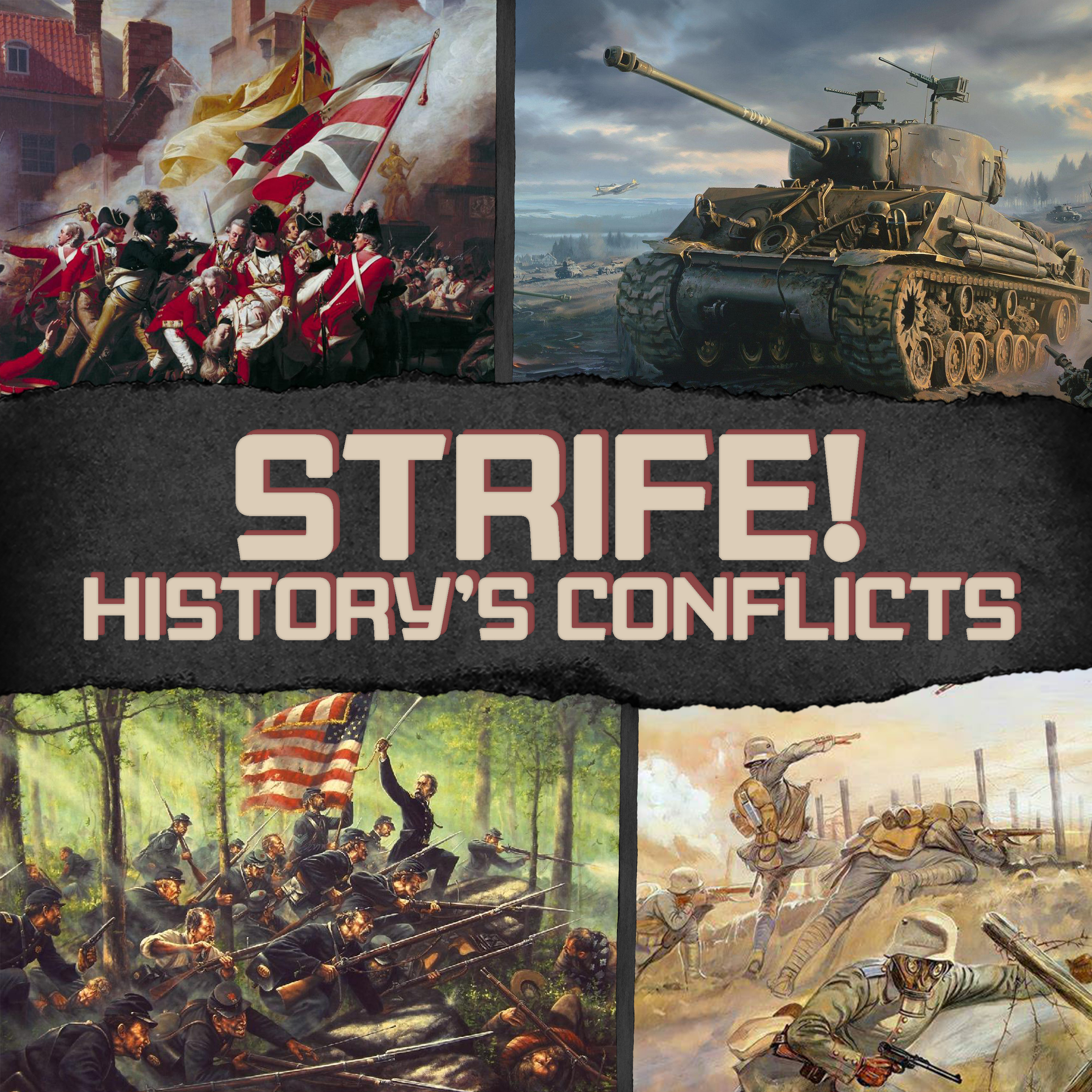
Strife! History's Conflicts
by John R. Huber
Strife! History’s Conflicts immerses you in the chain reactions that shape nations, fuel wars, and ignite revolutions. Each episode kicks off with a gripping narrative, breathing life into the past through the eyes of those who experience it—beyond the cold dates and battlefield stats. Blending sharp historical insight, decision-making analysis, and deeply human stories, it provides a richer, more empathetic view of how history shapes lives.
-
40
Charlottesville: Between Heritage and Hate (2017–Today)
Strife! History’s Conflicts. Charlottesville, 2017, becomes the stage for a national debate over memory, morality, and history itself. A statue of Robert E. Lee, a figure of moral complexity, ignites protests, torchlight marches, and violent confrontation, exposing a nation still grappling with the legacy of its past. The events force a reckoning with how monuments shape identity, transmit values, and carry contested meanings across generations. They reveal the tension between remembering and erasing, between honoring heritage and acknowledging oppression. Beyond the headlines and hashtags, the story asks deeper questions about how Americans confront moral ambiguity, contextualize historical figures, and engage with uncomfortable truths. This episode explores the human experiences behind the controversy—the teachers, students, protesters, and bystanders caught in the storm. It examines how history, when misrepresented or misunderstood, becomes a battlefield in itself. By the end, listeners are invited to reflect on the role memory plays in shaping society and the importance of facing history honestly, without simplification or censorship.
-
39
Between Two Fires: Jerry Potts and the Crisis of the Canadian West (1840–1896)
STRIFE! History’s Conflicts Podcast. What is the cost of a world? The plains of the Canadian West are not empty—they are a living map of stories, kinship, and spirit, a world that is about to be erased. As bison herds vanish into robes and whiskey floods the land, a single man stands on the fracture line: Jerry Potts, born of a Kainai mother and a Scottish trader. He is the translator, the guide, the rope in a tug-of-war between two fires—one of ancient reciprocity, the other of cold, encroaching empire. Every decision he makes—to guide the red-coated Mounties, to soften a treaty’s cruel terms, to whisper an escape—ripples through a collapsing world. This is not just the conquest of land, but the unraveling of a cosmology, where survival becomes a desperate, contradictory art. Listen, and walk the impossible line between loyalty and betrayal, where a man’s soul becomes the battlefield for the future of a continent.
-
38
The Silk Road War: Tang China vs. The Arab Empire (751 CE)
STRIFE! History's Conflicts Podcast: In the year 751 CE, on a remote frontier in Central Asia, the armies of two global superpowers—the expansionist Tang Dynasty of China and the ascendant Abbasid Caliphate—clashed near the Talas River. This fierce but little-known battle was a brutal stalemate decided by the shocking betrayal of a nomadic ally, resulting in a catastrophic defeat for the Chinese. Yet, its true significance lies not in the immediate military outcome, but in its profound and unintended consequences. The battle inadvertently triggered the westward transmission of papermaking technology, a development that would fuel the Islamic Golden Age and later the European Renaissance. Simultaneously, it halted Chinese westward expansion, clearing the way for the gradual Islamization of Central Asia and permanently altering the cultural and intellectual map of Eurasia. The Battle of Talas stands as a powerful reminder that history’s most pivotal moments are often not planned, but emerge from the chaotic interplay of ambition, accident, and the choices of those forgotten by time.
-
37
A Legacy of Fury: The Fall of the Witch of the East (1900)
STRIFE! History's Conflicts Podcast: A house falls from a clear sky, and a ruler is erased not by a rival, but by an accident. Her citadel, a monument to order and power, now stands leaderless, its guardians circling in silent, furious grief. They are the loyalists of a system just declared wicked, their world unraveling as a strange girl steals their sacred symbols and calls it destiny. This is the moment where history fractures, where victory for one side becomes a catastrophic invasion for the other. The conquerors write the story, branding the fallen as evil and their own cause as just. But from the shadows of the shattered throne, a new truth crystallizes—not from magic, but from a vow of enduring hate. This is the hidden history of a collapse, a story that challenges everything we remember about good, evil, and the bitter price of a happy ending.
-
36
Williamsburg: The Crucible of Revolution and the Founding Fathers' Legacy (1769-1787)
STRIFE! History's Conflicts Podcast: The town of Williamsburg, Virginia, stands as a pivotal chapter in the narrative of America's founding, a place where the personal and political lives of the nation's founding fathers intertwined with the burgeoning spirit of revolution. Beyond the grand narratives of history, Williamsburg was a crucible of human drama, where passions, ambitions, and moral dilemmas played out against the backdrop of a nation in the making. The stories of figures like Thomas Jefferson and Patrick Henry are not just tales of political intrigue but of personal journeys marked by love, loss, and the relentless pursuit of liberty. Understanding Williamsburg means delving into the complex tapestry of colonial life, where the ideals of the Enlightenment clashed with the realities of slavery and the struggle for self-governance. This exploration reveals a past that is as flawed as it is inspiring, offering timeless lessons about the human condition and the ongoing quest for a more perfect union. By examining the personal and political dimensions of Williamsburg, we gain a deeper appreciation for the sacrifices and compromises that shaped the United States, and we are reminded of the enduring relevance of these historical lessons in our contemporary struggles for justice and equality.
-
35
Stimulants of War: The Hidden Battlefront of World War II (1939-1945)
STRIFE! History's Conflicts Podcast: World War II is often remembered as a conflict of industrial might and moral clarity, but a hidden battlefront raged within the very bloodstreams of the soldiers. Across every major theater, from the frozen Eastern Front to the vast skies over Europe, militaries systematically issued millions of doses of stimulants to their troops. This was not a peripheral anecdote but a central, deliberate strategy to chemically engineer endurance, suppress fear, and push human beings beyond their natural limits. The widespread use of drugs like Germany's Pervitin, the Allies' Benzedrine, and Japan's Hiropon fundamentally altered the experience and psychology of combat. The immediate tactical advantages, however, came at a profound and lasting human cost, creating legacies of addiction and trauma that followed veterans home. This story challenges our traditional understanding of the war, revealing it as a massive, unregulated medical experiment that reshaped the very nature of the soldier. The ethical and tactical dilemmas born in this chemical arms race continue to resonate powerfully in modern warfare today.
-
34
Operation Torch: Forging an Army in the Crucible of North Africa (1942)
STRIFE! History's Conflicts Podcast: Operation Torch, the Allied invasion of North Africa in November 1942, is a chaotic and brutal birth for the American war machine in Europe. This chapter explores the campaign not just as a military landing, but as a painful and essential education. It follows the journey of green soldiers and conflicted defenders, whose clash on the beaches of Morocco is as much a political tragedy as a battle. Through their eyes, we see the raw shock of combat against an unexpected foe—Vichy French forces—and the moral confusion that follows. Beyond the bullets, the narrative reveals how this messy, costly operation becomes the indispensable crucible that forges a victorious army. The lessons learned in blood and fire on those distant shores ultimately pave the road to Rome and Normandy, transforming a strategic gamble into the first, decisive step toward liberation.
-
33
Feathers and Folly: The Emu War (1932)
STRIFE! History's Conflicts Podcast: The Great Emu War of 1932 stands as one of history's most surreal and humbling conflicts. It is a brief, bizarre military operation in which the Australian government, armed with machine guns and a WWI veteran, declares war on the nation’s native emu population. This is not a mere comedy of errors but a profound collision between human ambition and the immutable forces of nature. The event reveals a desperate government trying to support its struggling veterans, a military utterly confounded by an unconventional enemy, and a press corps that turns tragedy into a national joke. Its legacy is not one of victory or defeat, but of a hard-learned lesson in humility, a timeless allegory for the folly of applying simplistic, technological solutions to complex ecological and social problems. The story continues to resonate because it is, at its heart, a deeply human tale of resilience in the face of the absurd.
-
32
Patton’s Warning: Confronting the Soviet Threat (1945)
STRIFE! History's Conflicts Podcast: In the aftermath of World War II, victory in Europe brings no peace for General George S. Patton. While the Allied armies celebrate the fall of Nazi Germany, Patton senses the rise of a new and potentially greater threat: the Soviet Union. Observing their rapid advance and ruthless consolidation of Eastern Europe, he urges immediate action to counter their influence, warning that delay could cost the West strategic advantage. His views clash with political leaders and fellow commanders, who prioritize diplomacy, occupation, and stability over confrontation. Through his letters, personal reflections, and confrontations with Eisenhower, Patton emerges as a soldier out of step with the cautious world of postwar politics. This chapter explores the tension between military instinct and political restraint, showing how foresight, frustration, and unheeded warnings can shape the course of history. Patton’s story illuminates the origins of the Cold War and the difficult choices leaders face when immediate peace conflicts with long-term security. It is a study of ambition, foresight, and the high stakes of power in a fragile postwar world.
-
31
The Legend of Sleepy Hollow: Forging American Myth in the Hudson Valley (1819)
STRIFE! History's Conflicts Podcast: A headless soldier from a European war gallops through the American night, chasing a superstitious schoolmaster. But this is more than a campfire tale; it is a nation’s dream of its own past, a ghost drafted into service to haunt a specific, contested piece of ground. In the wake of revolution and a second war with Britain, the United States possesses its independence but aches for a history, a folklore to call its own. Into this void steps Washington Irving, a man facing personal ruin, who discovers that the future of American storytelling lies not in inventing new heroes, but in weaponizing local memories. He transforms the real trauma of the Revolutionary War and the simmering tensions of a changing society into a narrative that feels ancient overnight. The resulting story gives a young country a thrilling, manageable past, but its creation demands a price—silencing the messy, complex truths upon which it was built. Listen, and you will never hear the thunder of phantom hooves in the same way again.
-
30
The Silent Front: Audie Murphy and Italy’s Hidden War (1943-1945)
STRIFE! History's Conflicts Podcast: Explore the secret front of Italy’s “shadow desertion,” where nearly sixty percent of POWs refuse to fight for Mussolini’s puppet army, instead undermining the Axis from within. Through declassified OSS files, we see partisans derailing trains, cutting communication lines, and delaying German reinforcements, directly shaping battles like Anzio. Italian gunners, labor conscripts, and civilians perform acts of strategic defiance—burying ammunition, misfiring artillery, or sabotaging supply chains—risking execution to save countless Allied lives. Audie Murphy’s celebrated heroism intersects with these unseen efforts, highlighting the irony of courage and the complexity of wartime ethics. The narrative emphasizes the blurred line between cowardice and bravery, showing how quiet acts of resistance can carry consequences as profound as open combat. Through diary entries, mission reports, and firsthand accounts, this story illuminates the calculated risks and moral decisions behind every missed shot and every delayed convoy. Witness a war fought in shadows, where choices to fail or to withhold fire become acts of survival and humanity. By revealing the invisible contributions of the Italians, the conventional understanding of heroism is reframed, showing that courage sometimes means choosing not to fire.
-
29
Betrayed on Jackson Heights: The Borinqueneers and Korea’s Largest Court-Martial (October 1952)
STRIFE! History's Conflicts Podcast: In October 1952, the Battle of Jackson Heights became a defining trial for the65th Infantry Regiment, the Borinqueneers. This Puerto Rican unit was orderedto hold a contested outpost complex against determined Chinese assaults. Thefighting was a brutal, close-quarters struggle for tactically insignificanthills that commanded a high cost in blood. The ordeal of the 65th at Jackson Heights and the subsequent mass court-martial of its soldiers laid bare the harsh realities of a stalemated war, where immense human sacrifice was weighed against obscure tactical gains, and where the loyalties of colonial subjects were tested by the pressures of combat and discrimination.
-
28
The Cuban Missile Crisis: Thirteen Days of Tension (October 15 - October 28, 1962)
STRIFE! History's Conflicts Podcast: The Cuban Missile Crisis stands as the single most terrifying confrontation in human history, a thirteen-day stretch in October 1962 when the world balanced on the razor's edge of nuclear annihilation. It is not merely a story of political posturing between John F. Kennedy and Nikita Khrushchev, but a deeply human drama of miscalculation, fear, and stunning luck. This event exposes the terrifying fragility of our systems of control, revealing how the fate of millions rested on the split-second decisions of exhausted men in smoky rooms and sweltering submarines. The crisis was born from a volatile cocktail of strategic insecurity, personal vendetta, and catastrophic miscommunication, pushing both superpowers toward a war neither truly wanted. Its resolution did not come from a clear victory, but from a last-minute retreat forged in secret deals and a shared, visceral dread of the abyss. The enduring importance of those thirteen days lies in the profound and permanent scar they left on the global psyche, fundamentally altering the course of the Cold War and serving as an eternal warning of how close we came to ending our own story. It is a masterclass in the perils of brinkmanship and the absolute necessity of diplomacy, even with one's greatest enemy.
-
27
The Business Plot: The Time American Tycoons Tried to Overthrow FDR (1933-1934)
STRIFE! History's Conflicts Podcast: The year is 1933, and the Great Depression has brought the United States to its knees. In this atmosphere of profound desperation, a cabal of wealthy industrialists and Wall Street tycoons, fearing Franklin Roosevelt's New Deal, conceives an unthinkable solution: a coup d'état. Their plan is to overthrow the president and install a fascist dictatorship with a beloved war hero, Marine Corps General Smedley Butler, as its figurehead. Butler, however, stunningly agrees to play along only to expose the conspiracy, testifying before Congress about the plot. The public revelation should have caused a seismic political earthquake, yet the affair was swiftly dismissed as a fantasy and faded from history. This near-forgotten event, known as the Business Plot, reveals a moment when American democracy hung in the balance. It forces us to confront the fragility of republican institutions when threatened by concentrated wealth and ideological extremism. The story is a gripping tale of one man's moral courage and a chilling lesson in how power protects itself from scandal.
-
26
The Sorcerer's Apprentices: Weaponizing Nazi Mysticism (1940 to 1945)
In the shadow of the Blitz, a different kind of war is waged not with bullets, but with beliefs. British intelligence discovers the Third Reich's Achilles' heel: an ideological obsession with the occult and a desperate search for mythical artifacts like the Holy Grail and the Spear of Destiny. This is the story of the sorcerer's apprentices—a clandestine unit of psychologists, forgers, and strategists who learn to mimic the dark arts of their enemy. They craft an elaborate world of fake rituals, cursed relics, and magical threats, feeding the paranoia of the Nazi high command. Their goal is not to destroy tanks, but to corrupt strategy, waste resources, and turn the regime's greatest strength—its unifying mythology—into its most devastating liability. This clandestine struggle redefines the battlefield, proving that in modern warfare, the most powerful weapon is often a perfectly tailored lie.
-
25
How World War I Forged Middle-Earth: J.R.R. Tolkien in the Trenches (1914-1918)
J.R.R. Tolkien’s experience in the trenches of the Somme is the great, unspoken catalyst behind the entire world of Middle-earth. The First World War shatters the Edwardian world of his youth, transforming a promising academic into a lieutenant who witnesses the full, industrial horror of modern combat. This personal trauma becomes the foundational bedrock of his legendarium, providing its emotional weight and moral architecture. The desolation of Mordor, the relentless machinery of its evil, and the profound sense of irreversible loss are not mere fantasy but a direct transfiguration of the battlefield. In response, Tolkien forges a new kind of heroism, one defined not by glory but by the resilience, loyalty, and simple decency of the hobbit-like soldiers he led. His work becomes a profound act of therapeutic world-building, a conscious rejection of despair that offers a timeless lesson in endurance. By processing a generation’s catastrophe through the language of myth, he creates a story that resonates with the universal human experience of confronting darkness, making his personal history a part of our collective imagination.
-
24
The Jasmine Scent of Gunpowder: A Story of War and Resilience in Sri Lanka (1983-2009)
The Sri Lankan Civil War, a brutal and protracted conflict that lasted from 1983 to 2009, is a stark reminder of the devastating human cost of ethnic tensions and political strife. This war, fought between the Sinhalese-majority government and the Tamil Tigers, a separatist group advocating for an independent Tamil state, has left an indelible mark on the island nation. The conflict has resulted in widespread displacement, loss of life, and the shattering of countless families, with civilians often bearing the brunt of the violence. The use of child soldiers, sexual exploitation, and forced marriages are just a few of the horrific practices that have emerged from this war, highlighting the vulnerability of minors in conflict zones. As we delve into the personal stories of those affected, such as Thamizh and Nimal, we gain a deeper understanding of the emotional and psychological toll that war takes on individuals and communities. Their journey from childhood friends to rebels fighting for a better future reflects the resilience of the human spirit and the power of love to endure even in the darkest of times. The Sri Lankan Civil War serves as a poignant reminder of the importance of seeking peace and reconciliation, and the need to protect the most vulnerable members of society from the ravages of conflict.
-
23
Manifest Destiny's Shadow: Bullets and Benevolence in the Philippines (1899-1902)
The U.S. seizes the Philippines after the Spanish-American War, promising liberation but delivering conquest. This episode uncovers the brutal conflict that follows, as American troops enforce "benevolent assimilation" through scorched-earth campaigns, concentration camps, and massacres. Through survivor accounts and suppressed documents, we expose the gap between imperial rhetoric and the reality of bloodshed. From Mark Twain's scathing condemnations to the war's half-million dead, this is the story America tries to forget—and why its ghosts still haunt U.S.-Philippine relations today.If you’re hooked on the untold stories behind history’s turning points, don’t stop here—step into the complete Strife! series, where the full, chronological journey unfolds with depth you won’t get on the podcast. I’ll be sharing a handful of stories here, but most of the powerful narratives—the ones that really pull back the curtain—are only in the books and audiobooks.Start with Strife! Asia’s Inevitable and Unavoidable Descent into World War II—a gripping account from the Opium Wars to Japan’s brutal expansion, brought to life through raw firsthand stories and the latest historical research.Then take on Strife! Europe’s (Un)Avoidable Descent into World War II—where the ghosts of Versailles, rising fascism, and one diplomatic failure after another lead to catastrophe. Each chapter begins with a cinematic moment before unraveling the deeper political chaos behind it.And for strategy buffs, The Ardennes (Counter) Offensive: A Decision Analysis of Allied and German Strategy Leading Up to the Greatest Battle of World War II offers a bold, decision theory–infused retelling of the Battle of the Bulge. See how split-second choices shaped the course of the war—what looked like madness was often high-stakes calculation.All three books are available exclusively on Amazon in print and ebook. Want the full experience? The Strife! audiobooks—narrated by the outstanding Ty Lasky—and The Ardennes (Counter) Offensive, voiced by Anthony Proctor, are available now on Audible.And if you want to master decision-making yourself—whether for business, personal life, or any high-stakes moment—Think Fresh, Decide Best: Mastering Decisions Without Losing Your Cool is highly recommended. This practical guide blends real-world examples, proven tools, and a touch of humor to help you turn uncertainty into clarity and make the best choices with confidence.The stories you hear on this podcast are just the beginning. The ones you don’t hear? They’re waiting for you in Strife! and Think Fresh, Decide Best.Strife! Asia's Inevitable and (Un)Avoidable Descent into World War IIhttps://www.amazon.com/Strife-Asias-Inevitable-Avoidable-Descent/dp/B0F2ZZ2BP1Strife!: Europe's Inevitable and (Un)Avoidable Descent Into World War IIhttps://www.amazon.com/Strife-Europes-Inevitable-Avoidable-Descent/dp/B0FJ83LL6WThe Ardennes (Counter) Offensive: A Decision Analysis of Allied and German Strategy Leading Up to the Greatest Battle of World War II https://www.amazon.com/Ardennes-Counter-Offensive-Decision-Analysis-ebook/dp/B0C659QKD9Think Fresh, Decide Best: Mastering Decisions Without Losing Your Coolhttps://www.amazon.com/Think-Fresh-Decide-Best-Mastering-ebook/dp/B0DJ8RY8V4
-
22
Michigan vs. Ohio: Before the Helmet, There Was the Musket — The Toledo War (1835–1836)
Before Michigan and Ohio faced off on the gridiron, they clashed over a swamp. In this episode of Strife! History’s Conflicts, we dive into the Toledo War (1835–1836)—a territorial dispute that involved pride, politics, mismatched militias, and one unfortunate barroom stabbing.Through vivid narrative and sharp analysis, we explore how a butter knife becomes a war relic, how governors duel with legislation instead of swords, and how the Upper Peninsula ends up Michigan’s unlikely prize. It’s a story of theatrical defiance, federal compromise, and statehood shaped by surveyor errors and tavern bravado.No shots fired. No winners declared. Just the rivalry that echoes from swamp to stadium.If you’re hooked on the untold stories behind history’s turning points, don’t stop here—step into the complete Strife! series, where the full, chronological journey unfolds with depth you won’t get on the podcast. I’ll be sharing a handful of stories here, but most of the powerful narratives—the ones that really pull back the curtain—are only in the books and audiobooks.Start with Strife! Asia’s Inevitable and Unavoidable Descent into World War II—a gripping account from the Opium Wars to Japan’s brutal expansion, brought to life through raw firsthand stories and the latest historical research.Then take on Strife! Europe’s (Un)Avoidable Descent into World War II—where the ghosts of Versailles, rising fascism, and one diplomatic failure after another lead to catastrophe. Each chapter begins with a cinematic moment before unraveling the deeper political chaos behind it.And for strategy buffs, The Ardennes (Counter) Offensive: A Decision Analysis of Allied and German Strategy Leading Up to the Greatest Battle of World War II offers a bold, decision theory–infused retelling of the Battle of the Bulge. See how split-second choices shaped the course of the war—what looked like madness was often high-stakes calculation.All three books are available exclusively on Amazon in print and ebook. Want the full experience? The Strife! audiobooks—narrated by the outstanding Ty Lasky—and The Ardennes (Counter) Offensive, voiced by Anthony Proctor, are available now on Audible.And if you want to master decision-making yourself—whether for business, personal life, or any high-stakes moment—Think Fresh, Decide Best: Mastering Decisions Without Losing Your Cool is highly recommended. This practical guide blends real-world examples, proven tools, and a touch of humor to help you turn uncertainty into clarity and make the best choices with confidence.The stories you hear on this podcast are just the beginning. The ones you don’t hear? They’re waiting for you in Strife! and Think Fresh, Decide Best.Strife! Asia's Inevitable and (Un)Avoidable Descent into World War IIhttps://www.amazon.com/Strife-Asias-Inevitable-Avoidable-Descent/dp/B0F2ZZ2BP1Strife!: Europe's Inevitable and (Un)Avoidable Descent Into World War IIhttps://www.amazon.com/Strife-Europes-Inevitable-Avoidable-Descent/dp/B0FJ83LL6WThe Ardennes (Counter) Offensive: A Decision Analysis of Allied and German Strategy Leading Up to the Greatest Battle of World War II https://www.amazon.com/Ardennes-Counter-Offensive-Decision-Analysis-ebook/dp/B0C659QKD9Think Fresh, Decide Best: Mastering Decisions Without Losing Your Coolhttps://www.amazon.com/Think-Fresh-Decide-Best-Mastering-ebook/dp/B0DJ8RY8V4
-
21
The Boys Who Cried For Their Mothers: Denmark's Mine-Clearance Tragedy (May to August 1945)
In the summer of 1945, as Europe celebrates peace, a different horror unfolds along Denmark’s western coast. Thousands of German boys—some as young as thirteen—are forced at gunpoint to clear over a million landmines with their bare hands. They are children who have been fed Nazi lies, now paying for a war they barely understand.This is the story of the mine rats: starving, terrified boys who weep for their mothers as they crawl through the dunes, disarming explosives with little more than a stick and a prayer. Nearly half will die or be maimed. Those who survive carry the scars forever.In this harrowing episode, we examine history’s most shameful postscript—where the victors become tormentors, and children become casualties of peace.If you’re hooked on the untold stories behind history’s turning points, don’t stop here—step into the complete Strife! series, where the full, chronological journey unfolds with depth you won’t get on the podcast. I’ll be sharing a handful of stories here, but most of the powerful narratives—the ones that really pull back the curtain—are only in the books and audiobooks.Start with Strife! Asia’s Inevitable and Unavoidable Descent into World War II—a gripping account from the Opium Wars to Japan’s brutal expansion, brought to life through raw firsthand stories and the latest historical research.Then take on Strife! Europe’s (Un)Avoidable Descent into World War II—where the ghosts of Versailles, rising fascism, and one diplomatic failure after another lead to catastrophe. Each chapter begins with a cinematic moment before unraveling the deeper political chaos behind it.And for strategy buffs, The Ardennes (Counter) Offensive: A Decision Analysis of Allied and German Strategy Leading Up to the Greatest Battle of World War II offers a bold, decision theory–infused retelling of the Battle of the Bulge. See how split-second choices shaped the course of the war—what looked like madness was often high-stakes calculation.All three books are available exclusively on Amazon in print and ebook. Want the full experience? The Strife! audiobooks—narrated by the outstanding Ty Lasky—and The Ardennes (Counter) Offensive, voiced by Anthony Proctor, are available now on Audible.And if you want to master decision-making yourself—whether for business, personal life, or any high-stakes moment—Think Fresh, Decide Best: Mastering Decisions Without Losing Your Cool is highly recommended. This practical guide blends real-world examples, proven tools, and a touch of humor to help you turn uncertainty into clarity and make the best choices with confidence.The stories you hear on this podcast are just the beginning. The ones you don’t hear? They’re waiting for you in Strife! and Think Fresh, Decide Best.Strife! Asia's Inevitable and (Un)Avoidable Descent into World War IIhttps://www.amazon.com/Strife-Asias-Inevitable-Avoidable-Descent/dp/B0F2ZZ2BP1Strife!: Europe's Inevitable and (Un)Avoidable Descent Into World War IIhttps://www.amazon.com/Strife-Europes-Inevitable-Avoidable-Descent/dp/B0FJ83LL6WThe Ardennes (Counter) Offensive: A Decision Analysis of Allied and German Strategy Leading Up to the Greatest Battle of World War II https://www.amazon.com/Ardennes-Counter-Offensive-Decision-Analysis-ebook/dp/B0C659QKD9Think Fresh, Decide Best: Mastering Decisions Without Losing Your Coolhttps://www.amazon.com/Think-Fresh-Decide-Best-Mastering-ebook/dp/B0DJ8RY8V4
-
20
Barking Up the Wrong Border: The War of the Stray Dog (1925)
Uncover the surprisingly tense—and surprisingly canine—border clash known as the War of the Stray Dog. When a single dog crosses the border between Greece and Bulgaria in 1925, it triggers a deadly skirmish that spirals into a diplomatic crisis—testing the fragile peace between two nations still haunted by past conflicts. Join us as we explore the human stories behind the headlines, the political pressures that fueled the conflict, and the absurd yet profound lessons this unusual incident offers about nationalism, pride, and the unpredictable sparks of history. Whether you’re a history buff or just here for the bizarre, this episode will show you how sometimes, a simple bark can echo through the corridors of power.If you’re hooked on the untold stories behind history’s turning points, don’t stop here—step into the complete Strife! series, where the full, chronological journey unfolds with depth you won’t get on the podcast. I’ll be sharing a handful of stories here, but most of the powerful narratives—the ones that really pull back the curtain—are only in the books and audiobooks.Start with Strife! Asia’s Inevitable and Unavoidable Descent into World War II—a gripping account from the Opium Wars to Japan’s brutal expansion, brought to life through raw firsthand stories and the latest historical research.Then take on Strife! Europe’s (Un)Avoidable Descent into World War II—where the ghosts of Versailles, rising fascism, and one diplomatic failure after another lead to catastrophe. Each chapter begins with a cinematic moment before unraveling the deeper political chaos behind it.And for strategy buffs, The Ardennes (Counter) Offensive: A Decision Analysis of Allied and German Strategy Leading Up to the Greatest Battle of World War II offers a bold, decision theory–infused retelling of the Battle of the Bulge. See how split-second choices shaped the course of the war—what looked like madness was often high-stakes calculation.All three books are available exclusively on Amazon in print and ebook. Want the full experience? The Strife! audiobooks—narrated by the outstanding Ty Lasky—and The Ardennes (Counter) Offensive, voiced by Anthony Proctor, are available now on Audible.And if you want to master decision-making yourself—whether for business, personal life, or any high-stakes moment—Think Fresh, Decide Best: Mastering Decisions Without Losing Your Cool is highly recommended. This practical guide blends real-world examples, proven tools, and a touch of humor to help you turn uncertainty into clarity and make the best choices with confidence.The stories you hear on this podcast are just the beginning. The ones you don’t hear? They’re waiting for you in Strife! and Think Fresh, Decide Best.Strife! Asia's Inevitable and (Un)Avoidable Descent into World War IIhttps://www.amazon.com/Strife-Asias-Inevitable-Avoidable-Descent/dp/B0F2ZZ2BP1Strife!: Europe's Inevitable and (Un)Avoidable Descent Into World War IIhttps://www.amazon.com/Strife-Europes-Inevitable-Avoidable-Descent/dp/B0FJ83LL6WThe Ardennes (Counter) Offensive: A Decision Analysis of Allied and German Strategy Leading Up to the Greatest Battle of World War II https://www.amazon.com/Ardennes-Counter-Offensive-Decision-Analysis-ebook/dp/B0C659QKD9Think Fresh, Decide Best: Mastering Decisions Without Losing Your Coolhttps://www.amazon.com/Think-Fresh-Decide-Best-Mastering-ebook/dp/B0DJ8RY8V4
-
19
The Bear Flag Revolt: From Flour Sack to State Emblem, an Unlikely Birth to a Republic (1846)
Explore the Bear Flag Revolt of 1846, a pivotal and often overlooked event in California's history. Through a blend of narrative and historical analysis, it delves into the chaotic and humorous origins of the revolt, the political and cultural forces at play, and its lasting impact on California's identity and development. The chapter examines how the revolt accelerated American control of California, set the stage for the Mexican-American War, and paved the way for the California Gold Rush, ultimately transforming the region into an economic and political powerhouse. By exploring the motivations, fears, and strategies of key players, the chapter offers a fresh perspective on this foundational moment in American expansion and its enduring legacy on California's culture and politics.
-
18
Citizens Behind Wire: The Truth of America’s Internment Camps (1942–1945)
In February 1942, three sharp knocks interrupted a quiet morning in coastal California. A Japanese American family—a fisherman, his wife, and their two children—were given forty-eight hours to abandon their home. Their crime? Looking like the enemy.This episode traces their journey from the horse stalls of Santa Anita to the dust-choked barracks of Manzanar, where privacy vanished and dignity became a relic of the past. Through a daughter’s hidden diary, a son’s silent rage, and a mother’s quiet defiance, their story exposes the human cost of America’s wartime hysteria.Decades later, their testimony before Congress would force a reckoning. But the questions linger: How does a nation repair what it tried to erase? And when fear strikes again, who will pay the price?
-
17
The War That Oinked: Diplomacy, Ego, and the Pig That Changed a Border (1859–1872)
In the summer of 1859, a pig crosses an invisible line on San Juan Island—and gets shot. What follows isn’t just a neighborly dispute gone wrong; it’s a full-blown international standoff between the United States and Britain. Troops land. Warships arrive. Flags are raised. And yet, for twelve years, no one fires another shot. If you’re hooked on the untold stories behind history’s turning points, don’t stop here—step into the complete Strife! series, where the full, chronological journey unfolds with depth you won’t get on the podcast. I’ll be sharing a handful of stories here, but most of the powerful narratives—the ones that really pull back the curtain—are only in the books and audiobooks.Start with Strife! Asia’s Inevitable and Unavoidable Descent into World War II—a gripping account from the Opium Wars to Japan’s brutal expansion, brought to life through raw firsthand stories and the latest historical research.Then take on Strife! Europe’s (Un)Avoidable Descent into World War II—where the ghosts of Versailles, rising fascism, and one diplomatic failure after another lead to catastrophe. Each chapter begins with a cinematic moment before unraveling the deeper political chaos behind it.And for strategy buffs, The Ardennes (Counter) Offensive: A Decision Analysis of Allied and German Strategy Leading Up to the Greatest Battle of World War II offers a bold, decision theory–infused retelling of the Battle of the Bulge. See how split-second choices shaped the course of the war—what looked like madness was often high-stakes calculation.All three books are available exclusively on Amazon in print and ebook. Want the full experience? The Strife! audiobooks—narrated by the outstanding Ty Lasky—and The Ardennes (Counter) Offensive, voiced by Anthony Proctor, are available now on Audible.And if you want to master decision-making yourself—whether for business, personal life, or any high-stakes moment—Think Fresh, Decide Best: Mastering Decisions Without Losing Your Cool is highly recommended. This practical guide blends real-world examples, proven tools, and a touch of humor to help you turn uncertainty into clarity and make the best choices with confidence.The stories you hear on this podcast are just the beginning. The ones you don’t hear? They’re waiting for you in Strife! and Think Fresh, Decide Best.Strife! Asia's Inevitable and (Un)Avoidable Descent into World War IIhttps://www.amazon.com/Strife-Asias-Inevitable-Avoidable-Descent/dp/B0F2ZZ2BP1Strife!: Europe's Inevitable and (Un)Avoidable Descent Into World War IIhttps://www.amazon.com/Strife-Europes-Inevitbale-Avoidable-Descent-ebook/dp/B0F8NZPGBVThe Ardennes (Counter) Offensive: A Decision Analysis of Allied and German Strategy Leading Up to the Greatest Battle of World War II https://www.amazon.com/Ardennes-Counter-Offensive-Decision-Analysis-ebook/dp/B0C659QKD9Think Fresh, Decide Best: Mastering Decisions Without Losing Your Coolhttps://www.amazon.com/Think-Fresh-Decide-Best-Mastering-ebook/dp/B0DJ8RY8V4
-
16
Collateral Souls: The Zoo at the End of the World (1940-1945)
STRIFE! History's Conflicts Podcast: Summer 1940. As the Battle of Britain rages, the war takes an unexpected turn when bombs begin falling on an unlikely target – the Berlin Zoo. This is the story of how Europe's greatest menagerie became both witness and casualty to total war.Amid the ruins, an elephant named Siam stands motionless as the world burns around him. A nameless elephant perishes in the first air raid. A newborn hippo named Knautschke takes his first breath in a shattered enclosure. As the zoo's population plummets from 4,000 animals to just 91, their keepers wage a desperate battle to preserve life while civilization crumbles.From the eight million horses slaughtered in the trenches of WWI to Sarajevo's starving bears in the 1990s siege, this episode examines war's forgotten victims. It asks why history remembers some animals as heroes while millions vanish without record – and what survival truly costs when innocence becomes collateral damage.A haunting meditation on the uncomfortable truths of war, told through the lens of those who had no voice in the conflict but paid its price in full.If you’re hooked on the untold stories behind history’s turning points, don’t stop here—step into the complete Strife! series, where the full, chronological journey unfolds with depth you won’t get on the podcast. I’ll be sharing a handful of stories here, but most of the powerful narratives—the ones that really pull back the curtain—are only in the books and audiobooks.Start with Strife!: Asia’s Inevitable and Unavoidable Descent into World War II—a gripping account from the Opium Wars to Japan’s brutal expansion, brought to life through raw firsthand stories and the latest historical research.Then take on Strife!: Europe’s (Un)Avoidable Descent into World War II—where the ghosts of Versailles, rising fascism, and one diplomatic failure after another lead to catastrophe. Each chapter begins with a cinematic moment before unraveling the deeper political chaos behind it.And for strategy buffs, The Ardennes (Counter) Offensive: A Decision Analysis of Allied and German Strategy Leading Up to the Greatest Battle of World War II offers a bold, decision theory–infused retelling of the Battle of the Bulge. See how split-second choices shaped the course of the war—what looked like madness was often high-stakes calculation.All three books are available exclusively on Amazon in print and ebook. Want the full experience? The Strife! audiobooks—narrated by the outstanding Ty Lasky—and The Ardennes (Counter) Offensive, voiced by Anthony Proctor, are available now on Audible.And if you want to master decision-making yourself—whether for business, personal life, or any high-stakes moment—Think Fresh, Decide Best: Mastering Decisions Without Losing Your Cool is highly recommended. This practical guide blends real-world examples, proven tools, and a touch of humor to help you turn uncertainty into clarity and make the best choices with confidence.The stories you hear on this podcast are just the beginning. The ones you don’t hear? They’re waiting for you in Strife! and Think Fresh, Decide Best.Strife! Asia's Inevitable and (Un)Avoidable Descent into World War IIhttps://www.amazon.com/Strife-Asias-Inevitable-Avoidable-Descent/dp/B0F2ZZ2BP1Strife!: Europe's Inevitable and (Un)Avoidable Descent Into World War IIhttps://www.amazon.com/Strife-Europes-Inevitbale-Avoidable-Descent-ebook/dp/B0F8NZPGBVThe Ardennes (Counter) Offensive: A Decision Analysis of Allied and German Strategy Leading Up to the Greatest Battle of World War II https://www.amazon.com/Ardennes-Counter-Offensive-Decision-Analysis-ebook/dp/B0C659QKD9Think Fresh, Decide Best: Mastering Decisions Without Losing Your Coolhttps://www.amazon.com/Think-Fresh-Decide-Best-Mastering-ebook/dp/B0DJ8RY8V4
-
15
Stonewall’s Stand: Jackson at Manassas and the Battle That Shaped the War (July 21, 1861)
On a scorching July day in 1861, the Civil War's first major battle erupted along the banks of Bull Run, transforming an obscure Virginia professor into the legendary "Stonewall" Jackson. This episode transports you to the smoke-choked fields of Manassas, where the reality of war shattered Northern dreams of quick victory and gave birth to the South's most enduring icon.Witness the chaos through multiple perspectives: panicked Union recruits fleeing in disorder, Confederate reinforcements arriving by the first wartime troop trains in history, and civilian spectators whose picnic outing turns to horror. At the center stands Thomas Jackson - a man whose pre-battle drills and unshakable defense of Henry House Hill would change military history, yet whose famous "Stonewall" moment was far more complex than the legend suggests.The battle's aftermath reveals deeper truths: how Confederate propaganda transformed desperation into myth, why Union hesitation at critical moments became a recurring weakness, and how the Rebel Yell's psychological terror was born from equal parts calculation and chaos. Most importantly, we examine how this single afternoon's violence exposed the grim reality that would define the next four years - this would be a war of attrition, not glory.If you’re hooked on the untold stories behind history’s turning points, don’t stop here—step into the complete Strife! series, where the full, chronological journey unfolds with depth you won’t get on the podcast. I’ll be sharing a handful of stories here, but most of the powerful narratives—the ones that really pull back the curtain—are only in the books and audiobooks.Start with Strife!: Asia’s Inevitable and Unavoidable Descent into World War II—a gripping account from the Opium Wars to Japan’s brutal expansion, brought to life through raw firsthand stories and the latest historical research.Then take on Strife!: Europe’s (Un)Avoidable Descent into World War II—where the ghosts of Versailles, rising fascism, and one diplomatic failure after another lead to catastrophe. Each chapter begins with a cinematic moment before unraveling the deeper political chaos behind it.And for strategy buffs, The Ardennes (Counter) Offensive: A Decision Analysis of Allied and German Strategy Leading Up to the Greatest Battle of World War II offers a bold, decision theory–infused retelling of the Battle of the Bulge. See how split-second choices shaped the course of the war—what looked like madness was often high-stakes calculation.All three books are available exclusively on Amazon in print and ebook. Want the full experience? The Strife! audiobooks—narrated by the outstanding Ty Lasky—and The Ardennes (Counter) Offensive, voiced by Anthony Proctor, are available now on Audible.And if you want to master decision-making yourself—whether for business, personal life, or any high-stakes moment—Think Fresh, Decide Best: Mastering Decisions Without Losing Your Cool is highly recommended. This practical guide blends real-world examples, proven tools, and a touch of humor to help you turn uncertainty into clarity and make the best choices with confidence.The stories you hear on this podcast are just the beginning. The ones you don’t hear? They’re waiting for you in Strife! and Think Fresh, Decide Best.Strife! Asia's Inevitable and (Un)Avoidable Descent into World War IIhttps://www.amazon.com/Strife-Asias-Inevitable-Avoidable-Descent/dp/B0F2ZZ2BP1Strife!: Europe's Inevitable and (Un)Avoidable Descent Into World War IIhttps://www.amazon.com/Strife-Europes-Inevitbale-Avoidable-Descent-ebook/dp/B0F8NZPGBVThe Ardennes (Counter) Offensive: A Decision Analysis of Allied and German Strategy Leading Up to the Greatest Battle of World War II https://www.amazon.com/Ardennes-Counter-Offensive-Decision-Analysis-ebook/dp/B0C659QKD9Think Fresh, Decide Best: Mastering Decisions Without Losing Your Coolhttps://www.amazon.com/Think-Fresh-Decide-Best-Mastering-ebook/dp/B0DJ8RY8V4
-
14
The Queen's Gambit: The Political Genius of Cleopatra VII (69 BC - 30 BC)
Cleopatra VII is history’s most misunderstood queen, remembered as a seductress but ruling as a master strategist. She inherits a kingdom on the brink of collapse, its treasury drained by corruption and its sovereignty throttled by Roman ambition. Yet, she refuses to let Egypt fade into oblivion. Using her brilliant intellect, linguistic prowess, and profound understanding of power, she maneuvers to save her nation from annexation. Her legendary alliances with Julius Caesar and Mark Antony are not affairs of the heart but calculated political gambits for survival. This is the story of a woman who dared to challenge Rome’s expanding empire, not with armies, but with unmatched cunning and resolve. Her tragic end marks the fall of the last Pharaoh, but her fight reveals the breathtaking power of one voice against the tide of history.
-
13
A City of Ash: Dresden Between Strategy and Tragedy (January–February 1945)
In the final winter of World War II, as Allied and Soviet forces closed in on Nazi Germany, a single question haunted military planners: How do you break a nation already on its knees? The answer would lead to one of the war’s most controversial decisions—the firebombing of Dresden, a Baroque jewel known as "the Florence of the Elbe."Through haunting narrative storytelling and incisive historical analysis, this podcast unravels the calculus behind the inferno. We follow Elisabeth Schneider, a ballerina dancing in the doomed Semperoper, as her city balances between defiance and oblivion. Meanwhile, in war rooms from London to Yalta, strategists weigh morality against military necessity, forging a plan that will leave tens of thousands dead and a cultural legacy in ruins.A story of beauty and brutality, A City of Ash asks what happens when strategy collides with tragedy—and who pays the price when history’s gears turn.
-
12
Pickett's Charge: The Slaughter That Broke Robert E. Lee at Gettysburg (July 1st – July 3rd, 1863)
In the summer of 1863, Robert E. Lee’s Confederate Army of Northern Virginia marches into Pennsylvania, aiming to deliver a knockout blow to Union morale. But what begins as a bold invasion unravels into the bloodiest battle of the Civil War—Gettysburg. Over three brutal days, Lee’s tactical genius clashes with flawed intelligence, missed opportunities, and the grim arithmetic of war.This episode dissects the pivotal decisions that shaped the battle:• The Price of Overconfidence: Lee’s belief in his army’s invincibility after Chancellorsville—and why he ignored Longstreet’s warnings.• The Flank That Never Was: How J.E.B. Stuart’s absent cavalry and Longstreet’s delayed assault crippled Confederate chances.• Pickett’s Charge: Glory or Futility? The doomed frontal attack that became a symbol of Southern hubris.• The Roads Not Taken: What if Lee had listened to Longstreet’s defensive plan? Or flanked the Union left?
-
11
Pitch of Tensions: When Borders Bleed onto the Field (June 8, 1969 - July 18, 1969)
It starts as a football match. It ends as a war.In 1969, simmering tensions between Honduras and El Salvador explode onto the pitch—and then into open conflict. Decades of land disputes, economic hardship, and a migration crisis set the stage. Honduras, five times the size of El Salvador, hosts hundreds of thousands of Salvadoran migrants seeking farmland and work. When Honduran authorities begin enforcing land reforms, Salvadorans are uprooted, sparking outrage and resentment.What begins as a heated World Cup qualifier between these two neighbors quickly becomes a fierce battleground for national pride—and something far more dangerous. The first match in Tegucigalpa is a hostile siege. Salvadoran players face relentless abuse from hostile fans. The scoreline—a narrow Honduran win—feels like more than defeat; it’s an insult, a declaration of war in all but name.The second match in San Salvador turns brutal as Salvadoran fans retaliate, and violence erupts both inside and outside the stadium. The 3-0 Salvadoran victory is no celebration—it’s a reckoning, a statement of resistance. The third match in neutral Mexico City becomes a tense standoff, but El Salvador’s victory only fans the flames. Diplomatic ties snap, troops mobilize, and warplanes roar.In just 100 hours, football sparks a full-scale conflict now known as the Football War. Air strikes, ground invasions, and casualties mount as two nations teeter on the brink. The ceasefire comes swiftly but leaves deep scars on both countries, fueling decades of animosity and shaping the region’s future.Join us as we unpack this explosive clash where the beautiful game becomes a trigger for brutal conflict—and explore how sport, politics, identity, and survival collide in one of history’s most unforgettable—and unusual—wars.
-
10
Blood And Olive Roots: The British Mandate for Palestine (1923 – 1936)
"A land promised twice, a friendship torn at the roots."As the British tighten their grip on Palestine, Jerusalem simmers under the weight of competing dreams. Jewish immigrants arrive with deeds to land they call redemption; Arab farmers watch their fields vanish into the hands of strangers. Amidst the rising tension, two children—Amir, the quick-witted son of an Arab shopkeeper, and Leila, the curious daughter of a Jewish scholar—forge a secret friendship under the branches of an ancient olive tree.But when a letter arrives from the Jewish National Fund, and British officers boast of "empty fields" soon to be wheat and orange groves, the crack between their worlds widens. A beating. A hanging. A riot. By 1926, the tree that once sheltered their laughter is reduced to a stump, carved with a single word: Traitor.In this episode, we trace how the Mandate’s policies—land sales, immigration, and divide-and-rule governance—transformed political tensions into personal ruptures. Through Amir and Leila’s eyes, we witness the moment when coexistence curdles into conflict, and the land they both love becomes a battleground for futures they cannot share.History echoes underfoot. The roots remember.
-
9
The Pastry War: How a Crumbled Croissant Sparked a Conflict (November 1838 – March 1839)
A shattered glass case. A destroyed éclair. And one very determined French pastry chef.In this riveting episode, we explore one of history’s most bizarre and underrated wars—The Pastry War. Set against the turbulent backdrop of 1830s Mexico, this tale of ruined tarts and wounded pride spirals into a full-blown international conflict between France and Mexico. When Monsieur Remontel's bakery is vandalized during a local skirmish, his demand for reparations triggers diplomatic uproar, military blockades, and the bombardment of Veracruz.What unfolds is a masterclass in 19th-century gunboat diplomacy, where the scent of fresh croissants lingers alongside the smoke of cannon fire. Through vivid narration and gripping historical insight, this episode reveals how even the smallest grievances—when kneaded into national interests—can rise into war.Because sometimes, war really is about pastries.
-
8
The Halls of Montezuma: The Battle of Chapultepec (September 1847)
The Valley of Mexico, September 1847. The last great fortress before Mexico City looms like a stone giant atop Chapultepec Hill—an ancient Aztec retreat turned military stronghold. Inside its walls, a handful of teenage cadets stand beside grizzled veterans, ready to die for a crumbling nation. Outside, General Winfield Scott’s army prepares for the final assault, spearheaded by the U.S. Marines. Among them, Captain John Reynolds sharpens his sword, unaware that the lessons of this battle will follow him to a Pennsylvania ridge fourteen years later.This is the story of The Battle of Chapultepec—a clash of empires, a crucible for future Civil War legends, and the origin of the immortal Marine Corps hymn: "From the Halls of Montezuma.
-
7
A Broom, a Cannon, and a Lot of Nerve: The Battle of Stonington (August 1814)
In the summer of 1814, with Washington in ashes and the British tightening their grip on the American coast, a tiny Connecticut fishing village became the unlikely stage for one of the most audacious stands in U.S. history. When a Royal Navy squadron—led by a battle-hardened captain fresh from the burning of the White House—demanded Stonington’s surrender, the townspeople had one rusted cannon, a blacksmith’s stubbornness, and the unshakable defiance of a 73-year-old widow armed with a broom.For three days, against impossible odds, Stonington fought back—rolling their lone gun between positions, recycling British cannonballs, and enduring a storm of rockets and broadsides. And at the center of it all stood "Aunt Nancy" Freeman, whose razor-sharp tongue proved more accurate than the Royal Navy’s gunners. By the time the smoke cleared, the British would limp away in humiliation, and a forgotten village would etch its name into legend.This is the story of how a handful of farmers, fishermen, and a woman with a corn-bristle broom turned the tide of the War of 1812’s darkest hour—not with an army, but with sheer, unbreakable nerve.
-
6
Flames in the Dark: Gold Metals and Iron Fists at the 1936 Berlin Olympics (August 1936)
August 1936. The world descends upon Berlin for the Olympics—a spectacle meticulously crafted to showcase the Reich’s power and prestige. But behind the gleaming stadiums and choreographed pageantry, a darker truth festers.In this gripping episode of Strife! History’s Conflicts, we expose the brutal reality hidden beneath the Olympic flame. From Jesse Owens’ earth-shattering victories to the cruel exclusion of Jewish athletes like Gretel Bergmann, we unravel how the Games became a battleground for propaganda, defiance, and survival.You’ll hear:The Illusion: How the Nazis scrubbed Berlin clean of persecution—while terror raged just out of sight.The Rebels: The athletes who shattered Hitler’s myth of supremacy, from Owens’ four gold medals to a German high jumper’s silent protest.The Cost: What happened when the world looked away—and how the Olympics emboldened the regime’s march toward war.Adapted from Strife! Europe’s Inevitable and Unavoidable Descent into World War 2 by John Huber, this is the story of the Olympics that weren’t about sports at all. They were about lies, resistance, and the warning the world ignored.Subscribe to Strife! wherever you get your podcasts.
-
5
A Professor Holds the Line: Chamberlain at Little Round Top (July 2nd, 1863)
Before the Civil War, Joshua Lawrence Chamberlain was a Bowdoin professor who breathed poetry, lectured on Goethe, and knew muskets only as metaphors. But when war came, the scholar traded his fountain pen for a colonel’s commission, leading the 20th Maine into the furnace of battle.By July 1863, Chamberlain had already faced the horrors of Antietam, Fredericksburg, and Chancellorsville—but Gettysburg would demand everything. When 120 mutineers from the disbanded 2nd Maine were dumped into his camp, condemned as deserters, Chamberlain made a fateful choice: He refused to execute them. Instead, he appealed to their honor, their shared Maine roots, and their duty to a cause greater than themselves. By dawn, they marched with him—not as prisoners, but as soldiers.Days later, on the rocky slopes of Little Round Top, Chamberlain’s decision would be tested in blood. Outnumbered, low on ammunition, and holding the Union’s vulnerable left flank, the 20th Maine faced annihilation. As Confederate forces surged uphill, Chamberlain gambled everything on a desperate bayonet charge—a moment that would cement his place in history.This is the story of a professor turned warrior, of mutineers turned heroes, and of the desperate fight that helped decide the fate of a nation. A Professor Holds the Line is a gripping tale of leadership, moral courage, and the unbreakable will of men who stood where the Union nearly broke—and did not yield.Subscribe now to witness Chamberlain’s crucible at Gettysburg—where poetry met gunpowder, and a scholar’s resolve turned the tide of war.
-
4
White Death: The Winter War (November 1939 – March 1940)
In the bone-cracking cold of the Arctic Circle, where the snow devours the living and silence kills faster than bullets, a war raged that defied logic and shattered expectations. White Death plunges listeners deep into the harrowing winter of 1939, when Finland, outnumbered and outgunned, stood against the Soviet Union in a brutal struggle for survival.Through immersive storytelling and visceral detail, this series explores the haunting legend of Simo Häyhä—the farmer-turned-sniper who became the deadliest marksman in history—and the frozen hellscape that became his hunting ground. From whispered myths and blood-soaked snowdrifts to the desperate clash of ideologies in a land where the sun barely rises, White Death is more than history—it's the icy breath of war, exhaled one bullet at a time.Bundle up. Silence your fear. And don’t blink.
-
3
Japan’s Awakening: The Meiji Restoration (January 1868 – October 1912)
In 1868, Japan stands at a crossroads. Emperor Meiji’s Charter Oath promises a new era—one of modernization, knowledge, and equality. But for families like Kazuo’s, the fall of the shogunate shatters the world they knew. His father, a loyal Tokugawa retainer, clings to the samurai code, while his brother embraces the imperial cause, tearing their family apart. As Tokyo rises from the ashes of Edo, Kazuo wrestles with a burning question: Can Japan honor its past while racing toward an uncertain future?From the abolition of the samurai class to the rise of industrial giants, the Meiji Restoration reshapes a nation—but at what cost? Through the eyes of a divided family, we explore the triumphs and tragedies of Japan’s breakneck modernization. How do you rebuild a country without losing its soul? And what does it mean to be Japanese when everything is changing?Join us for a gripping historical drama, where personal loyalties collide with national transformation, and the fate of a culture hangs in the balance. "Meiji Awakening" is a story of rebellion, resilience, and the birth of modern Japan.If you’re hooked on theuntold stories behind history’s turning points, don’t stop here—step into thecomplete Strife! series, where the full, chronological journey unfoldswith depth you won’t get on the podcast. I’ll be sharing a handful of storieshere, but most of the powerful narratives—the ones that really pull back thecurtain—are only in the books and audiobooks. Start with Strife! Asia’s Inevitable andUnavoidable Descent into World War II—a gripping account from the Opium Wars to Japan’sbrutal expansion, brought to life through raw firsthand stories and the latesthistorical research. Then take on Strife! Europe’s (Un)AvoidableDescent into World War II—where the ghosts of Versailles, rising fascism, and onediplomatic failure after another lead to catastrophe. Each chapter begins witha cinematic moment before unraveling the deeper political chaos behind it. And for strategy buffs, The Ardennes (Counter) Offensive: ADecision Analysis of Allied and German Strategy Leading Up to the GreatestBattle of World War II offers a bold, decision theory–infused retelling of the Battle of theBulge. See how split-second choices shaped the course of the war—what lookedlike madness was often high-stakes calculation. All three books areavailable exclusively on Amazon in print and ebook. Want the full experience?The Strife! audiobooks—narrated by the outstanding Ty Lasky—and TheArdennes (Counter) Offensive, voiced by Anthony Proctor, are available nowon Audible. And if you want to masterdecision-making yourself—whether for business, personal life, or anyhigh-stakes moment—Think Fresh, Decide Best: MasteringDecisions Without Losing Your Cool is highly recommended. This practical guide blendsreal-world examples, proven tools, and a touch of humor to help you turnuncertainty into clarity and make the best choices with confidence. The stories you hear onthis podcast are just the beginning. The ones you don’t hear? They’re waitingfor you in Strife! and Think Fresh, Decide Best. Strife! Asia's Inevitable and(Un)Avoidable Descent into World War IIhttps://www.amazon.com/Strife-Asias-Inevitable-Avoidable-Descent/dp/B0F2ZZ2BP1 Strife!: Europe's Inevitable and(Un)Avoidable Descent Into World War IIhttps://www.amazon.com/Strife-Europes-Inevitable-Avoidable-Descent/dp/B0FJ83LL6W The Ardennes (Counter) Offensive: ADecision Analysis of Allied and German Strategy Leading Up to the GreatestBattle of World War II https://www.amazon.com/Ardennes-Counter-Offensive-Decision-Analysis-ebook/dp/B0C659QKD9 Think Fresh, Decide Best: MasteringDecisions Without Losing Your Coolhttps://www.amazon.com/Think-Fresh-Decide-Best-Mastering-ebook/dp/B0DJ8RY8V4
-
2
Winds of Change: Japan Opens to the West (July 1853 – March 1854)
Fourteen-year-old Eiko watches the horizon, her heart as restless as the sea. Her father, a samurai envoy, has left to negotiate with Commodore Perry’s Black Ships—a mission that could force Japan’s closed doors open forever. As the wind carries salt and uncertainty, Eiko grapples with her own looming fate: a future penned by tradition, where women are wives and mothers, never explorers of their own desires.But the foreign ships aren’t just bringing threats—they carry echoes of Japan’s fraught history with the West. From the Portuguese guns that revolutionized warfare, to the Spanish missionaries whose zeal sparked rebellion, to the Dutch traders who became Japan’s only window to a changing world. For 200 years, the Tokugawa shogunate held the line, purging Christianity and sealing borders—until Perry’s steamships arrived, exposing Japan’s vulnerability.Now, as Eiko secretly questions her body, her desires, and the rigid codes of purity that bind her, her nation too stands at a crossroads. Will Japan—and Eiko—submit to the old ways, or dare to navigate the storm of modernity?A haunting blend of personal awakening and historical reckoning, this episode traces one girl’s quiet rebellion alongside her country’s turbulent pivot toward an uncertain future.
-
1
Shadows of the Poppy: The Opium Wars (March 1839 – October 1860)
In the smoky dens of Guangzhou, fortunes are made and lives are destroyed as opium tightens its grip on China. The British Empire’s insatiable demand for tea and silk has tipped the trade balance, and now, opium flows into China like a poison—weakening a proud nation from within.This is the story of Wang Lian, a young woman whose life shatters when her father’s debts bind her to the opium trade. Once a scholar’s daughter, she becomes "Dragonfly," a musician in the dens, her guqin melodies drowned out by the whispers of the pipe. But when Commissioner Lin Zexu strikes back, burning mountains of British opium, the clash between empires ignites—and Lian must fight for her freedom amid the chaos.Through her eyes, we witness the devastating toll of addiction, the corruption of the Qing Dynasty, and the ruthless calculus of British imperialism. As war looms, China’s fate hangs in the balance—will it resist, or collapse under the weight of exploitation?In this episode, we explore:The human cost of the opium trade—families ruined, lives enslaved.The moral hypocrisy of British merchants and the political firestorm in Parliament.Lin Zexu’s desperate stand—and how his defiance sparks a war.The Treaty of Nanjing’s betrayal, and the dawn of China’s "Century of Humiliation."A story of greed, resistance, and redemption—where empires rise and fall, but one woman fights to reclaim her soul.
We're indexing this podcast's transcripts for the first time — this can take a minute or two. We'll show results as soon as they're ready.
No matches for "" in this podcast's transcripts.
No topics indexed yet for this podcast.
Loading reviews...
ABOUT THIS SHOW
Strife! History’s Conflicts immerses you in the chain reactions that shape nations, fuel wars, and ignite revolutions. Each episode kicks off with a gripping narrative, breathing life into the past through the eyes of those who experience it—beyond the cold dates and battlefield stats. Blending sharp historical insight, decision-making analysis, and deeply human stories, it provides a richer, more empathetic view of how history shapes lives.
HOSTED BY
John R. Huber
CATEGORIES
Loading similar podcasts...
URL copied to clipboard!