
PODCAST · science
Tesla Matrix 3_6_9 Discovery!!!
by Antonio Víctor Salas Dual
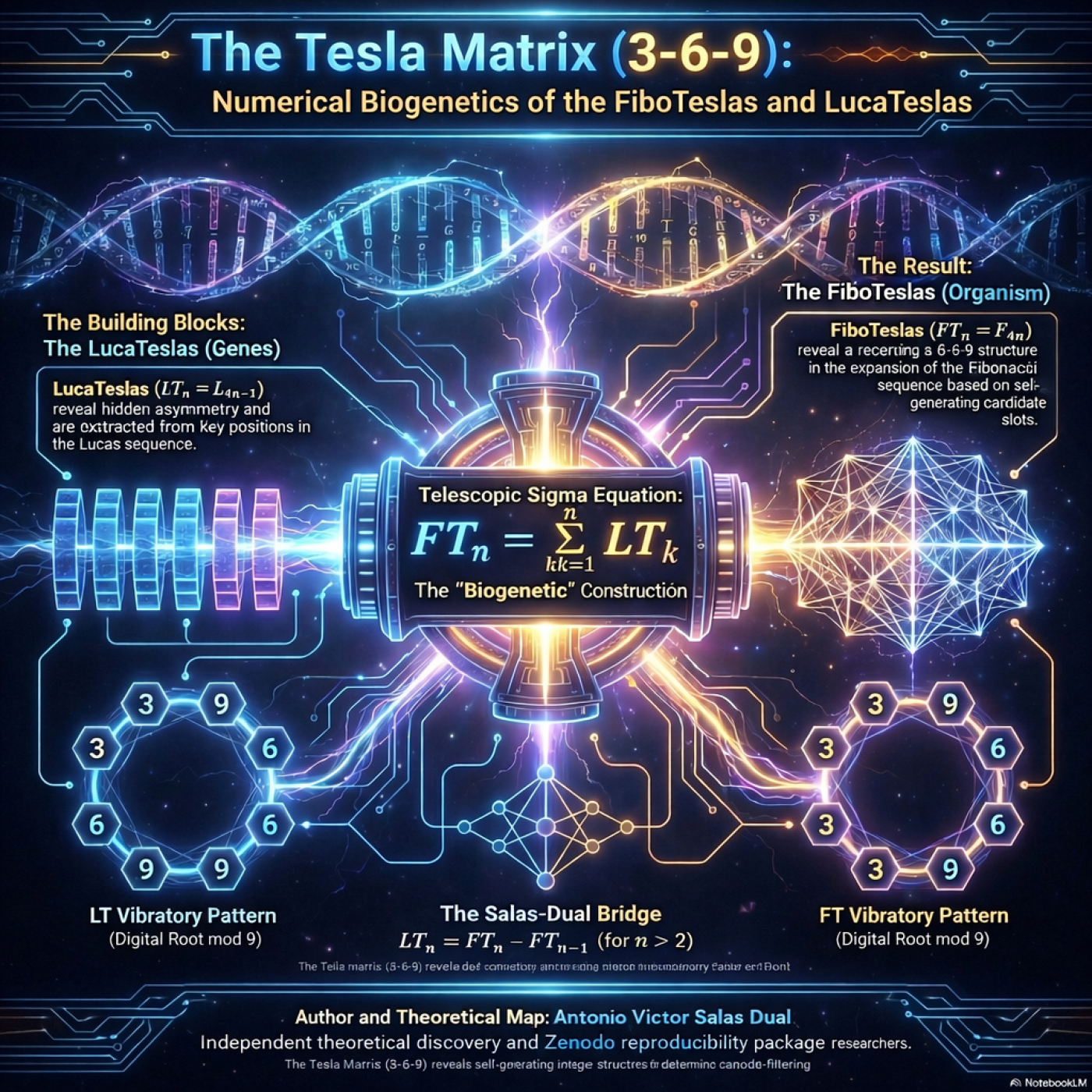
Welcome to this new deep-dive podcast on **The Tesla Matrix (3-6-9)**, a mathematical framework developed by **Antonio Víctor Salas Dual** at the crossroads of **number theory, modular arithmetic, Fibonacci, Lucas, and computational exploration**.In this episode, we explore a central idea: that certain step-4 branches of Fibonacci and Lucas reveal a remarkably stable modular structure when read through **digital root modulo 9**. In this framework, *vibration* does **not** mean physics or mysticism; it is a **Tesla-inspired conceptual label** for repeating modular behaviour. From that perspective emerge the **FiboTeslas** and **LucaTeslas**, defined under a 1-based convention as **FTₙ := F₄ₙ** and **LTₙ := L₄ₙ₋₁**, together with their exact repeating cycles, their internal integer recurrences, and the elegant **Salas–Dual Bridge** linking both branches.The episode also follows the corrected **v27.3.2 SAFE** interpretation, including one of its most important clarifications: in the *
-
1
Tesla Matrix 3_6_9 Discovery!!!
Welcome to this new deep-dive podcast on **The Tesla Matrix (3-6-9)**, a mathematical framework developed by **Antonio Víctor Salas Dual** at the crossroads of **number theory, modular arithmetic, Fibonacci, Lucas, and computational exploration**. In this episode, we explore a central idea: that certain step-4 branches of Fibonacci and Lucas reveal a remarkably stable modular structure when read through **digital root modulo 9**. In this framework, *vibration* does **not** mean physics or mysticism; it is a **Tesla-inspired conceptual label** for repeating modular behaviour. From that perspective emerge the **FiboTeslas** and **LucaTeslas**, defined under a 1-based convention as **FTₙ := F₄ₙ** and **LTₙ := L₄ₙ₋₁**, together with their exact repeating cycles, their internal integer recurrences, and the elegant **Salas–Dual Bridge** linking both branches. The episode also follows the corrected **v27.3.2 SAFE** interpretation, including one of its most important clarifications: in the **LucaTesla** branch, the candidate slots are occupied by digital-root vibrations **3 and 9**, while **6 remains structurally present in the cycle but does not occupy candidate positions for n > 3**. We also explain why **a jump of 3 Tesla sub-indices corresponds to a jump of 12 indices** in the original Fibonacci or Lucas sequence, and how the internal **7-engine** allows exact integer generation of consecutive Tesla terms without relying on floating-point approximations. From there, the discussion opens out into the classical **6k±1 prime-candidate rails**, where the Tesla Matrix is connected to a **deterministic pre-filtering architecture for prime candidates**, organised through rails, masks, periodic composite columns, and CRT-based composition. The goal is not to replace primality testing, but to provide a more structured and reproducible way of narrowing the field before heavier tests are applied. This podcast is therefore both an exploration and an invitation: an exploration of hidden numerical architecture inside Fibonacci and Lucas, and an invitation to verify everything independently through the paper and the publicly available reproducibility package. **Scientific paper (Zenodo):** https://zenodo.org/records/19153796 **Supplementary reproducibility package (Zenodo):** https://zenodo.org/records/18761627 If you would like short research notes, updates, and further explanations connected with the Tesla Matrix and related discoveries, you can also visit my Substack: https://tonysalas369.substack.com I hope this episode encourages you not only to listen, but to calculate, test, discuss, and examine the framework for yourself. Important note: in this audio, vibration means digital root (mod 9), not physics. The paper uses a 1-based convention. In the LucaTesla branch, candidate slots correspond to vibrations 3 and 9, not 6. In addition, 3 Tesla-index jumps = 12 original-sequence indices refers only to index displacement. The sieve described is a deterministic pre-filter for prime candidates, not a complete primality test.
No matches for "" in this podcast's transcripts.
No topics indexed yet for this podcast.
Loading reviews...
ABOUT THIS SHOW
Welcome to this new deep-dive podcast on **The Tesla Matrix (3-6-9)**, a mathematical framework developed by **Antonio Víctor Salas Dual** at the crossroads of **number theory, modular arithmetic, Fibonacci, Lucas, and computational exploration**.In this episode, we explore a central idea: that certain step-4 branches of Fibonacci and Lucas reveal a remarkably stable modular structure when read through **digital root modulo 9**. In this framework, *vibration* does **not** mean physics or mysticism; it is a **Tesla-inspired conceptual label** for repeating modular behaviour. From that perspective emerge the **FiboTeslas** and **LucaTeslas**, defined under a 1-based convention as **FTₙ := F₄ₙ** and **LTₙ := L₄ₙ₋₁**, together with their exact repeating cycles, their internal integer recurrences, and the elegant **Salas–Dual Bridge** linking both branches.The episode also follows the corrected **v27.3.2 SAFE** interpretation, including one of its most important clarifications: in the *
HOSTED BY
Antonio Víctor Salas Dual
CATEGORIES
Loading similar podcasts...
URL copied to clipboard!