
PODCAST · society
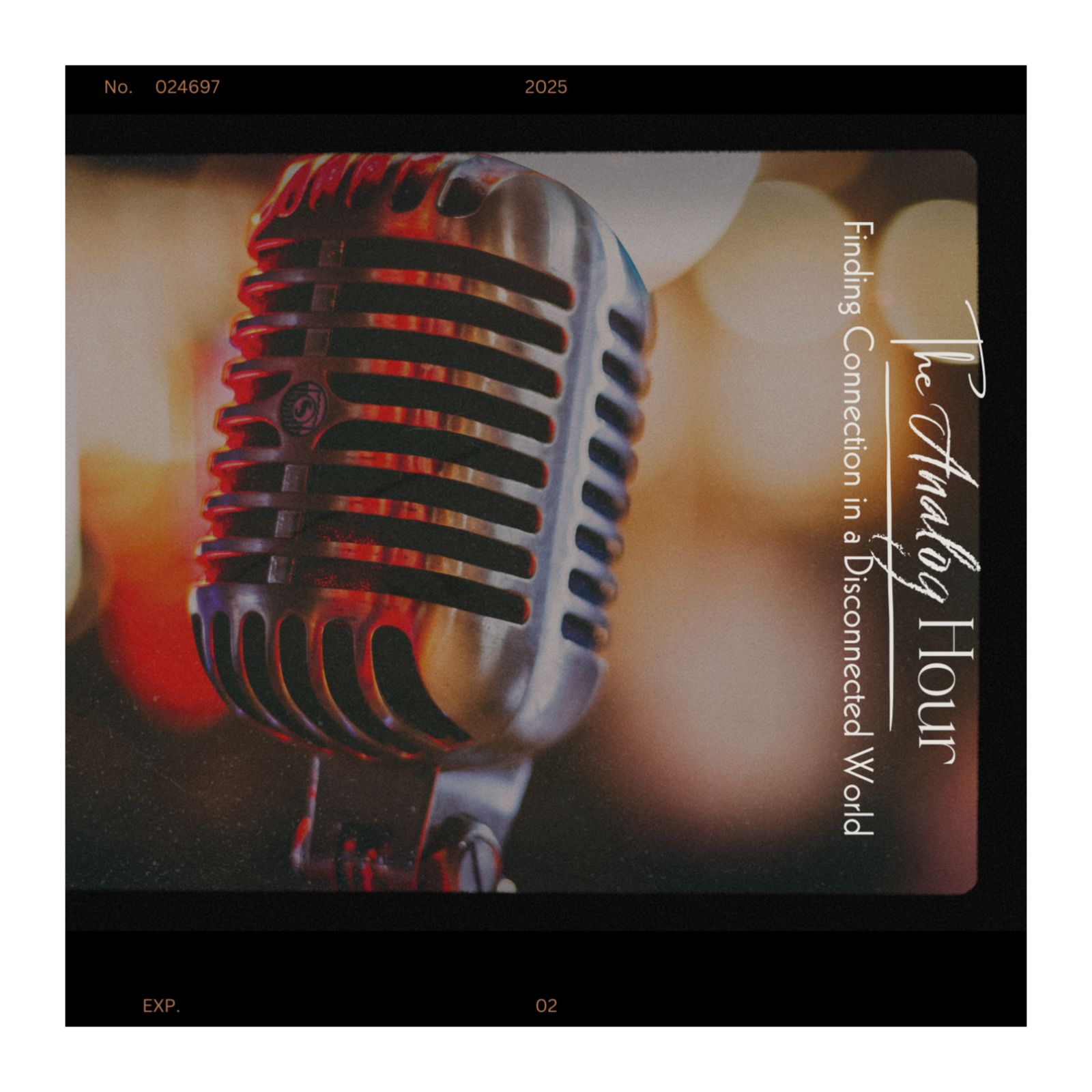
The Analog Hour
by Michelle Henery
In a world of endless content, The Analog Hour offers focused, meaningful conversations about media literacy, human connection, and finding our way back to each other.
-
11
What Our Phones Stop Us From Doing
A parent trying imperfectly to look at his kids instead of his screen.Instagram eating into reading time. Everything seeming urgent when it's not. The simple act of listening to the world go by.This week, no expert interview - just real people answering four honest questions about their phones:When did you get your first smartphone? What daily phone habit would have shocked you 10 years ago? Ever tried unplugging? What does your phone stop you from doing?The average American checks their phone 205 times a day. Over 43% of us admit we're addicted. In these confessions, you'll hear what we're missing: presence, books, conversation, silence, the sounds of life.This Week's Analog Assignment: Push aside all that your phone offers and identify what it's taking away. Take it back.The Analog Hour: analoginadigitalworld.net
-
10
Why We Can't Tell Fact from Opinion Anymore
When you scroll through news online, can you tell what's fact and what's opinion? If you're struggling, you're not alone - and it's not your fault.Lynn Walsh is an Emmy Award-winning investigative journalist, former national president of the Society of Professional Journalists, and former ethics chair. In 2016, at the peak of "fake news" claims, Lynn started taking phone calls from Americans who'd lost faith in journalism. What she learned during those conversations changed the trajectory of her career.In this episode, Lynn explains:The labeling problem that's impacting trust in the mediaHow sensationalism and bias complaints reveal deeper misunderstandingsWhat happens when good journalists go independentWhy we're all "committing acts of journalism" - and the responsibility that goes with thatPractical steps to rebuild trust and restore faith in the mediaThis Week's Analog Assignment: The next time you're about to share something online, pause and ask yourself: Is this accurate? Do I trust this source? Is this news or opinion? If you're not sure, either don't share it - or add context.Connect with Lynn Walsh: on LinkedIn and at Trusting News Resources:Everyone Should Help Minimize HarmSPJ Code of EthicsFAQ About Journalism EthicsSubscribe wherever you listen to podcasts and find out more: analoginadigitalworld.net
-
9
Humpty Dumpty Culture: How Television United America — And Then Broke It Apart
There was a time when half of America sat down at the same hour and watched the same tv show. When a moonwalk or a moon landing or a series finale wasn't just an event — it was a shared experience, a cultural reference point that connected strangers at bus stops and colleagues at water coolers and kids on the playground.That era is over. But what exactly did we lose when it ended — and was it really as good as we remember?This week on The Analog Hour, I'm joined by Professor Bob Thompson, one of America's leading authorities on television and popular culture, who has spent more than 40 years at Syracuse University studying how what we watch shapes who we are.We cover a lot of ground — and Bob has a gift for reframing things you thought you understood. We talk about why the age of shared mass culture was actually a case of social engineering; how shows like Leave It to Beaver presented a perfectly polished version of America while the country was immense upheaval.; and why the same technology that once pulled us together is now pulling us apart.We also talk about I Dream of Jeannie in a way that will ruin it for you slightly. You're welcome.In this episode:Why the era of shared mass culture — from roughly 1890 to 1990 — may be the greatest cultural consensus in human historyHow cable didn't just add channels; it ended the shared cultural conversationWhat All in the Family, MASH, and The Cosby Show reveal about television's complicated relationship with social progressProfessor Bob Thompson is the founding director of the Bleier Center for Television and Popular Culture at Syracuse University's Newhouse School of Public Communications. He makes regular media appearances worldwide — from the BBC to the New York Times — to explain what pop culture says about society.New episodes of The Analog Hour drop weekly (every Friday). Subscribe wherever you listen to podcasts, and find us at analoginadigitalworld.net.If this episode resonated, please leave a review and share it with someone who still remembers exactly where they were when an event unfolded that touched all of us.
-
8
AI Took Her Job But Not Her Humanity: Wanjiku Kamau, the Human Guide to AI
Wanjiku Kamau was laid off from Google — during one of the biggest AI investment booms in history — and realized she'd barely used the technology her own company was betting everything on.So she taught herself and wrote a book about it: Out of the Loop, Into the Algorithm: How I Finally Made Friends with AI.But this conversation isn't really about AI. It's about what Wanjiku lost when she lost her job — the barista who remembered her dog's name, the colleagues she spoke to every day for years, the quiet rituals that made her feel like she belonged somewhere. She calls it "an unintended colleague breakup." And if you've ever left a job and been surprised by the grief, you'll know exactly what she means.About our guest: Wanjiku Kamau is the author of Out of the Loop, Into the Algorithm: How I Finally Made Friends with AI. A former executive at Intel and employee at Google, she now works as a consultant and educator helping professionals understand and work with artificial intelligence without needing to code. Today she speaks and teaches about practical AI literacy, career transitions, and the human skills that matter more as technology accelerates.Find her book: Amazon or TikTok ShopYour analog assignment: Find a place where someone knows your name — or, at the very least, your dog's name. Show up and invest in the people there. We are slowly realizing we cannot take these seemingly minor encounters for granted.
-
7
Dating Is Supposed to Be Messy... and Fun with Myisha Battle
What happens when love comes with upgrades, your best matches are behind a paywall, and a chatbot that never disagrees with you starts to feel like the safer option?Myisha Battle is a certified clinical sexologist, dating coach, and author of This Is Supposed to Be Fun and Sexual Pleasure for Dummies. Based in San Francisco — the tech capital of the world — she has a front-row seat to what technology is doing to intimacy. Her expertise has been featured in the Washington Post, New York Magazine's The Cut, Oprah Magazine, and the San Francisco Chronicle.In this episode, Myisha and I talk about why Gen Z is rejecting dating apps, our increasing skills deficit in face-to-face connection, why our tolerance for the messiness of human interaction is at an all-time low, the rise of AI chatbots as romantic partners, and what she's seeing on the ground — from singles mixers in Oakland to clients learning to meet people "in the wild" again.Your analog assignment this week: Put your phone away and be present in your own life. Take the earbuds out, look around you, make eye contact.Links to Myisha Battle's website and books: myishabattle.comThis Is Supposed to Be Fun: How to Find Joy in DatingSexual Pleasure for Dummies
-
6
Finding Friends in the Friction with Fabio Bin
Fabio Bin couldn't find anyone to travel with. So he co-founded WeRoad — a company that puts 15 strangers together on 10-day trips with no algorithm, no matching, no profiles. Just people who don't know each other, sharing rooms and roads and the kind of discomfort that turns out to be the secret ingredient for real connection.In this episode, we talk about friction-maxxing — the growing rejection of frictionless convenience — and why half the people at Fabio's 50th birthday were strangers he met on trips.About Fabio Bin: Co-founder and CMO of WeRoad. Effie Award winner. His recent Fortune op-ed on friction-maxxing and the IRL economy argues the next major consumer market will be built on belonging, not screens. Based in Milan.Links: WeRoadFortune article: Why My $150 Million Startup Thinks It Can Solve the $406 Billion Loneliness ProblemYour analog assignment this week: Find someone who thinks differently from you — and just listen. Not to convert or convince, only to understand.
-
5
The Disappearance of Third Places with Dr. Gwendolyn Purifoye
When was the last time you lingered somewhere that wasn't home and wasn't work? A coffee shop, a park bench, a barbershop, a library — a place where you could just be around other people?Those places are disappearing. And Dr. Gwendolyn Purifoye, an urban ethnographer and Assistant Professor of Racial Justice and Conflict Transformation at the University of Notre Dame, has spent years studying why — and what it's costing us.In this episode, Gwendolyn takes us from Cherry Lane — the street in her childhood neighborhood where dozens of kids would gather every summer to play — to a present where we can go an entire day without seeing, smelling, or touching another human being. She explains how we formalized play, overscheduled our children, and automated our errands until we quietly lost the spaces where civilization gets practiced. And she offers a thesis I haven't been able to shake: the more we have to be around each other, the better we get at it. The less we have to, the worse we become.Resources:Race on the Move: Public Transportation and Unequal Spaces by Dr. Gwendolyn Purifoye — forthcoming from NYU Press, available for pre-order at NYU Press and Amazon"Where Have All the 'Third Places' Gone?" — The New York Times, February 2025"Seeing a Pandemic: How COVID Changed Urban Spaces and Places" — Gwendolyn Purifoye, Visual Studies, 2024The Great Good Place by Ray Oldenburg — the 1989 book that coined the term "third place"Your analog assignment this week: Find your third place. A library, a park, a bench, a coffee shop — somewhere in the actual world. Go there. Go back. And keep going back. You don't have to say a word. Just let yourself be seen.
-
4
Your Brain Is Shrinking: The Science of Why We Stopped Talking with Dr. Maryellen MacDonald
When did we stop talking to each other — and what is it costing us? Dr. Maryellen MacDonald is a psycholinguist and professor emerita of psychology and language sciences at the University of Wisconsin-Madison and author of More Than Words: How Talking Sharpens the Mind and Shapes Our World.What she's found is startling: speaking is far more cognitively demanding than listening, reading, or scrolling — and that difficulty is exactly what makes it essential brain exercise. Yet, we're doing it less than ever.In this episode, we talk about why Gen Z is lonelier and dating less, what helicopter parenting has to do with it, and why the person you've been meaning to call is probably hoping you will.Resources:More Than Words: How Talking Sharpens the Mind and Shapes Our World by Maryellen MacDonaldMaryellen's essay in the Washington Post: Gen Zers aren't talking and it could cost themYour analog assignment this week: Call someone. Not a text. Not a voice note. An actual phone call. It'll be awkward for a few seconds. And then it won't.
-
3
Facts and Opinions in One Box: How We Lost Our Common Ground with Dr. Aimee Edmondson
When did we stop trusting the news? Was there ever really a golden age — or have we been romanticizing something that was always more complicated?Dr. Aimee Edmondson, Associate Dean of the Scripps College of Communication at Ohio University, spent a dozen years in newsrooms before dedicating her career to studying how the powerful have tried to silence the press. In this episode, Aimee takes us on a journey from the partisan press of the 1790s through the Fairness Doctrine, the rise of cable news, and into the algorithmic present — revealing that the crisis we're living through has deeper roots than most of us realize. We talk about what we've lost (shared sources of truth), what's at stake (corporate pressure on editorial independence), and what gives her hope (a generation of young journalists she calls "truth tellers").If you've ever wondered how we went from Walter Cronkite as "the most trusted man in America" to "fake news" as a rallying cry, this is the episode.In this episode, we discuss:The partisan press of the 1790s and why today's media fracture isn't as new as it feelsThe Fairness Doctrine — what it was and what happened when it disappearedThe rise of talk radio, cable news, and the algorithmic echo chamberWhat Marty Baron told a ballroom full of reporters seeking answersThe one thing you can do this week to become a better consumer of informationResources mentioned in this episode:In Sullivan's Shadow: The Use and Abuse of Libel Law During the Long Civil Rights Struggle by Aimee Edmondson — University of Massachusetts PressThe Social Dilemma (2020 documentary) — available on NetflixNational Association for Media Literacy Education (NAMLE) — namle.netInvestigative Reporters and Editors (IRE) — ire.orgAbout Dr. Aimee Edmondson:Dr. Aimee Edmondson is a professor of media law and journalism history and Associate Dean of the Scripps College of Communication at Ohio University. Her research focuses on civil-rights-related libel law, First Amendment issues, and free expression. She is the author of In Sullivan's Shadow and the creator of Ohio University's Media and Civil Rights course, which includes a 10-day bus trip through civil rights sites in Alabama, Mississippi, and Tennessee. Your analog assignment this week: Hang out with someone who doesn't think like you. Not online. In person. Listen more than you talk.
-
2
You're Not Stuck in the Past — You're Mining It: The Science of Nostalgia with Dr. Clay Routledge
Episode 2 — You're Not Stuck in the Past — You're Mining It: The Science of Nostalgia with Dr. Clay Routledge Nostalgia, loneliness, and the shared experiences we've lost — an existential psychologist explains why missing the past is actually good for youHave you ever been told to stop living in the past? What if that impulse — that pull toward old songs, childhood memories, and the way things used to feel — is actually one of the healthiest things your brain does?In this episode of The Analog Hour, host Michelle Henery sits down with Dr. Clay Routledge, an existential psychologist and one of the world's leading researchers on nostalgia, to explore why we're so drawn to the past in times of uncertainty, and why instead of it being a weakness, it's a resource.Clay explains what existential psychology actually is, how our brains use memories to stabilize us when the future feels threatening, and why nostalgia is not a tape recorder — it's a story-making machine designed to help us find meaning, courage, and connection. He shares research showing that nostalgic memories are remarkably similar across cultures, ages, and languages — and nearly all of them are social at their core.Michelle and Clay dig into why the loss of shared cultural experiences — from trick-or-treating with neighbors you actually knew to watching the same television shows as everyone else — has left us feeling more divided than ever. They explore how Gen Z is leading a surprising hybrid approach, embracing both streaming playlists and vinyl record stores, and what older generations can learn from that balance. In this episode:What existential psychology is and why it matters right nowHow our brains use the past to cope with an uncertain future — and why that's not the same as wanting to go backWhy nostalgia isn't rosy retrospection — lessons from World War II survivors in Southampton, EnglandHow pandemic memories are already becoming a source of nostalgic meaningThe hybrid approach: why Gen Z buys vinyl records without canceling SpotifyHistorical nostalgia — how borrowing other people's memories builds intergenerational connectionThe stunning research finding that less than 3% of users are responsible for toxic online behavior — and most people want a kinder internetAbout the guest:Dr. Clay Routledge is an existential psychologist, behavioral scientist, and leading expert on nostalgia and the human search for meaning. His research explores how people use memories, meaning, and purpose to navigate life's biggest questions. He is the author of Past Forward: How Nostalgia Can Help You Live a More Meaningful Life and writes the weekly newsletter Flourishing Friday, where he covers the psychology of meaning, connection, and human flourishing.Connect with The Analog Hour:Follow us on Instagram @analoginadigitalworld and subscribe on your favorite podcast platform so you never miss an episode. If this conversation resonated with you, share it with someone who needs a reason to feel hopeful.
-
1
Heterosexual Man-Dates and the Midlife Loneliness Crisis
When was the last time someone called you and you didn't immediately assume something terrible had happened?In the debut episode of The Analog Hour, host Michelle Henery sits down with Dr. Phil Higgins, a licensed clinical social worker with more than 20 years of experience working with clients, to unpack a question most of us are afraid to ask out loud: why am I so lonely?Phil explains why loneliness almost never shows up as the presenting problem in therapy — it hides behind depression, anxiety, and marital conflict. He describes what isolation actually looks like for people in their 30s, 40s, and 50s who have full lives on paper but no one to call. And he makes a surprising case for worrying less about teenagers' screen time and more about our own.Together, Michelle and Phil explore why younger generations use technology to expand their worlds while older generations use it to shrink theirs, why men are particularly at risk for social isolation, and what actually works to rebuild connection — from volunteering to community hubs to what one of Phil's clients memorably named "heterosexual man-dates".In this episode:Why clients rarely walk into therapy saying "I'm lonely" — and what they say insteadThe generational connection gap: how a 17-year-old and a 47-year-old define friendship and connection differentlyWhat the lost art of answering the kitchen phone taught us about communicationWhy Phil sends his male clients on friendship dates — and what happens when they come backVolunteering, community spaces, and the case for building new 'ships' in real lifeAbout the guest: Dr. Phil Higgins is a licensed clinical social worker based outside Boston, specializing in issues surrounding identity, relationships, and connection. He serves on the board of his local YMCA and, at 49, took up burlesque dancing — because connection takes many forms.Connect: Share this episode with someone you've been meaning to call.
-
0
The Analog Hour - Trailer
Welcome to The Analog Hour - where we explore our increasingly divided society, the erosion of trust in institutions from government to media, and the isolation we feel from each other... and how we find our way back to connection.Hosted by Michelle, a "professional talker" and former journalist who reported across continents for almost 20 years. If you're yearning for clarity, conversation, and community - you're not alone.Subscribe now. Episode 1 drops in early January 2026.
We're indexing this podcast's transcripts for the first time — this can take a minute or two. We'll show results as soon as they're ready.
No matches for "" in this podcast's transcripts.
No topics indexed yet for this podcast.
Loading reviews...
Loading similar podcasts...
URL copied to clipboard!