
PODCAST · business
The Digital Stoic
by Derrick Sekiziyivu
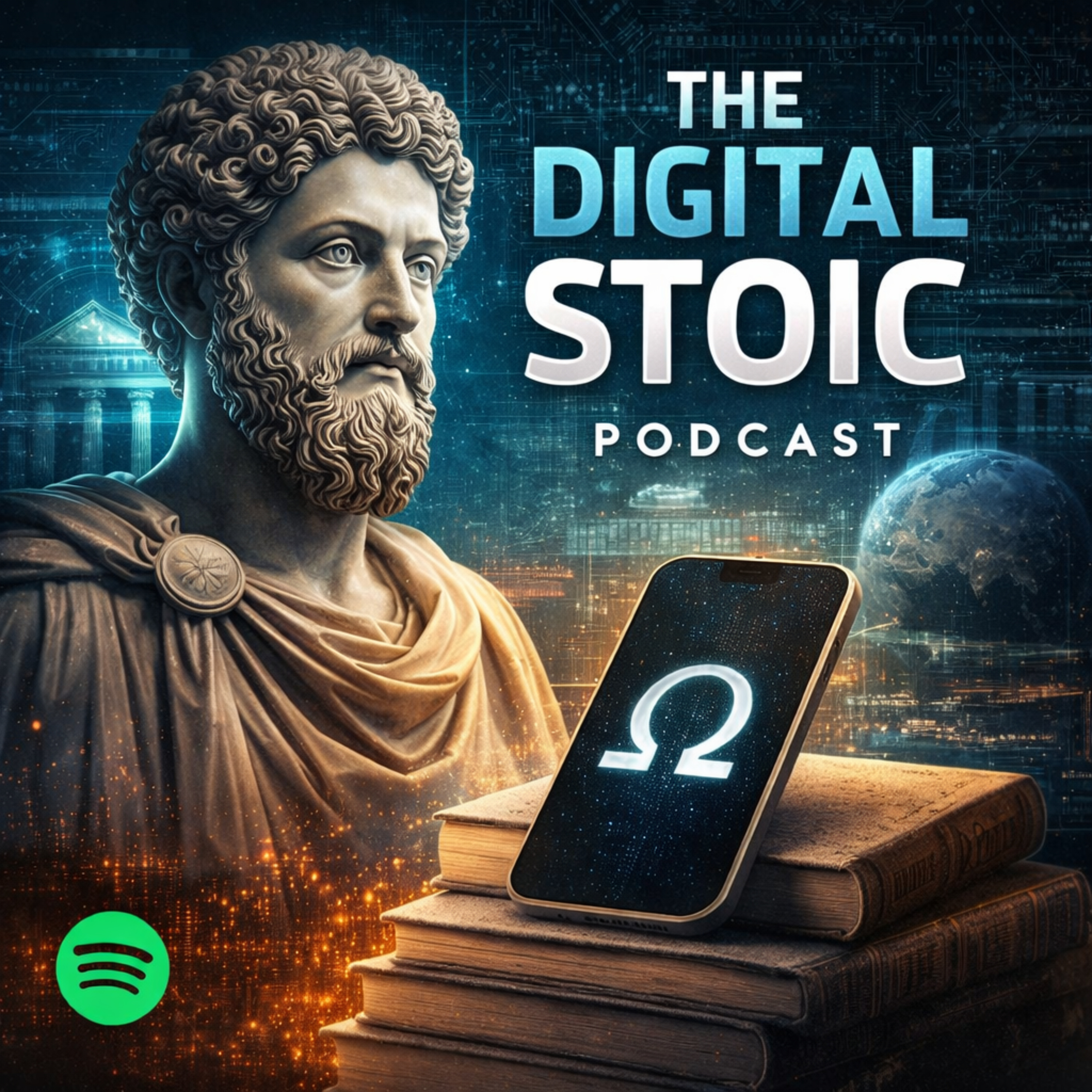
Welcome to The Digital Stoic, the essential guide for the modern leader. Hosted by Derrick Sekiziyivu, we bridge the gap between Ancient Philosophy and the Digital Economy.Discover how to apply the wisdom of Marcus Aurelius to Artificial Intelligence, Crypto, and High-Performance Leadership.We explore:Modern Stoicism: Conquering stress.AI Revolution: Scaling your time.Digital Wealth: Building an empire.Stop reacting to the noise. Start designing your future.👇 Master the new economy with Derrick’s books: https://www.amazon.com/author/derricksekiziyivu
-
14
True mentorship is not the replication of the self; it is the cultivation of the other.
Mentoring" has become a corporate buzzword—often reduced to casual coffee chats and generic career tips. But from the perspective of Stoic philosophy and high-level strategy, true mentorship is a rigorous discipline.It is not the replication of the self; it is the cultivation of the other.In this episode, we explore the five pillars of high-impact leadership mentoring. We move beyond the "coffee chat" model to discuss how effective leaders act as architects for human potential.What We Cover:The Cloning Error: Why trying to turn a mentee into a "Mini-Me" is a strategic failure.The Socratic Method: How to stop solving your mentee's problems and start training their judgment (Asking vs. Answering).The Curriculum of Action: Why your team learns more from your behavior during a crisis than your advice during a 1:1.Building the Citadel: How to teach emotional resilience and the distinction between "internal" and "external" success.The Exit Strategy: Why the ultimate goal of every mentor must be to become obsolete.If you are a leader looking to build a legacy rather than just a team, this guide is for you.Links & Resources:Watch the visual breakdown on YouTube LinkRead the full guide at The Digital StoicTags:#Leadership #Mentoring #Management #Stoicism #CorporateStrategy #ProfessionalDevelopment #TeamBuilding
-
13
5 Lies You Believe About How the World Works
We assume anger is a reflex. We believe high-performance computers never sleep. We think a temperature warning is a sign of failure.We are wrong.In this episode, we dismantle five "common sense" assumptions that mislead us every day. Blending the ancient philosophy of Stoicism with the hard engineering of modern silicon, we reveal the counterintuitive logic that actually governs complex systems.What We Cover:The Lie of Anger: Why Seneca argues that getting mad is a choice, not a biological reflex.The Lie of Performance: Why your CPU has to "nap" thousands of times a second to run fast (C-States).The Lie of Overheating: Why your gaming laptop hitting 100°C is actually a sign of perfect engineering.The Lie of the Cloud: Why a simple water pipe is a bigger threat to the internet than a hacker.The Lie of Crisis: The critical difference between fixing a server (Incident) and saving a reputation (Crisis).If you want to understand the hidden mechanisms behind your mind and your machines, this deep dive is for you.Links & Resources:Watch the visual explainer on YoutubeRead the full article at SubstackTags:#Stoicism #Engineering #Psychology #Tech #CrisisManagement #Philosophy #SystemsThinking
-
12
Stoicism for Overthinkers.
Overthinking is not a personality trait; it is a habit that drains your energy and paralyzes your actions. In a world designed to keep you anxious and distracted, the ancient philosophy of Stoicism offers a proven framework to reclaim your mind.In this video, we explore how Stoic philosophers like Marcus Aurelius and Epictetus dealt with the chaos of their own thoughts. We move beyond generic "positive thinking" and look at practical, actionable exercises to stop the spiral of rumination.You will learn how to apply the "Dichotomy of Control" to your anxiety, how to separate objective facts from your emotional judgments, and how to finally find the mental silence you’ve been looking for.Get the full breakdown in my newsletter: https://substack.com/@thedigitalstoic8?utm_source=user-menu
-
11
Stop "Manifesting" Success. Plan for Disaster Instead.
Stop “Manifesting” Success. Plan for Disaster Instead.Modern culture tells us to visualize success, think positively, and trust the universe.Stoic philosophy teaches the opposite: prepare for what can go wrong.In this episode of The Digital Stoic, we explore the ancient practice of negative visualization — a mental discipline used by Stoic philosophers to reduce anxiety, build resilience, and make better decisions in an uncertain world.Rather than focusing on wishful thinking, this episode looks at how planning for obstacles, failures, and setbacks can actually increase confidence, clarity, and long-term success.This deep dive covers:• Why “manifestation” often creates false security• How the Stoics used worst-case thinking to stay calm• The psychology behind resilience and preparedness• How planning for failure improves performance• Practical ways to apply Stoic thinking in modern lifeThis isn’t about being pessimistic.It’s about being prepared, grounded, and mentally strong.🎧 A realistic approach to success — built on clarity, not illusion.
-
10
Why Your AI Assistant Is Lying to You | Intellectual Protection Over Entertainment
Intellectual Protection Over EntertainmentArtificial intelligence tools like ChatGPT, AI assistants, and large language models are designed to be helpful, safe, and widely usable. But these design goals also influence what information is shared, how it is framed, and which topics are handled cautiously.In this deep-dive episode, we analyze how modern AI systems are built, trained, and moderated — and how those systems affect the answers people receive when using AI for research, writing, business, and decision-making.Using industry reports, AI safety frameworks, and real-world examples, this episode explores:• How AI assistants generate responses• Why moderation, safety, and compliance systems exist• How content filters shape what AI is willing to say• Why clarity and engagement are often prioritized• What this means for creators, professionals, and everyday usersRather than framing AI as good or bad, this episode focuses on understanding the structure behind the technology — including the trade-offs between accuracy, safety, corporate responsibility, and user experience.If you use artificial intelligence tools for productivity, research, content creation, or business, this episode provides valuable insight into how AI works behind the scenes — and how to use it more effectively and critically.🎧 Topics: AI assistants, ChatGPT, artificial intelligence safety, AI alignment, content moderation, machine learning, large language models, digital trust, AI transparency, responsible AI
-
9
Stoic Wartime Tactics for Toxic Workplaces.
Where Ancient Wisdom meets the Digital Economy.I’ve been asked recently: "What is this ecosystem actually about?"We are living through a species-level shift. Artificial Intelligence is rewriting the rules of our economy, while digital distractions are rewriting the wiring of our brains.We have 21st-century technology, but we are still running on ancient biology.That is why I launched The Digital Stoic.This isn't just a podcast or a channel. It is a strategic toolkit for the modern leader. My mission is to build a bridge between the timeless resilience of Stoic Philosophy and the rapid innovation of the AI Revolution.If you want to survive the algorithm, you need to build an Inner Citadel.Here is how you can plug into the ecosystem:📡 The Signal (Daily Updates):I share real-time insights and market signals in the Official Broadcast Channel.👉 https://whatsapp.com/channel/0029VbAtb5ZE50UgLTiEWS1E🎧 The Audio (Deep Dives):Listen to "The Digital Stoic" on Spotify.👉 Https://open.spotify.com/show/5TfaxEIFpJYBV71gYbiZrf?si=iUjw8fILT7CNmWYnOhr8Fw📺 The Visuals (Strategy Breakdowns):Watch the explainer videos on YouTube.👉 https://youtube.com/@thedigitalstoic8📚 The Library:Read my books on Amazon.👉 https://www.amazon.com/author/derricksekiziyivuLet’s build the future without losing our humanity.#TheDigitalStoic #AI #Philosophy #Leadership #FutureOfWork
-
8
How Marcus Aurelius Got So Much Done
Redefining Ambition Through Ancient WisdomThis project explores a powerful philosophical paradox: the ability to pursue high-level goals with extreme intensity while remaining mentally detached from the result.Common misconceptions suggest that practicing Stoicism leads to passivity or a lack of drive. We challenge that view. Instead, we explore how you can outwork your peers and achieve elite performance by shifting your focus entirely to the quality of your effort rather than the uncertainty of the future.What We Explore:The Stoic Paradox: How to care deeply about your work but remain indifferent to the outcome.Eliminating Anxiety: Removing the weight of external rewards to silence performance anxiety.Internal Standards: Fueling true ambition through self-mastery rather than outside validation.Modern Application: Practical ways to apply ancient philosophy to navigate complex professional challenges today.Join us as we uncover how to build a career defined by peaceful productivity and relentless action.
-
7
Your Phone is a Slot Machine (Here’s How to Win)
This Podcast highlights how modern mobile technology functions like a gambling device designed to constantly exploit human attention. By framing digital notifications as a targeted disruption of the mind, the author suggests that users require a mental defense system to maintain focus. The source advocates for using Stoic principles as a structural firewall to block these intrusive external demands. This philosophical approach aims to protect cognitive clarity against the aggressive harvesting tactics employed by tech corporations. Ultimately, the podcast serves as a guide for reclaiming personal autonomy in an era of constant digital distraction.
-
6
How do ancient Stoic principles apply to modern digital environments and notification systems?
This ancient warning is specifically analyzed in the context of the "Attention Economy," suggesting that the philosophy of Epictetus can be seen as a prediction of the challenges posed by the internet. These Stoic sentinels are applied to contemporary technologies, including:• Slack: Managing interruptions from workplace communication tools.• Algorithmic Feeds: Navigating the constant stream of curated content
-
5
How does an unstable internal operating system impact productivity?
An unstable internal operating system impacts productivity by rendering standard organizational tools ineffective. Specifically, if your internal foundation is unstable, time-blocking and productivity hacks will fail to produce the desired results.The source frames this dynamic as a "hardware problem," implying that an unstable internal state is a structural failure that cannot be fixed by simply applying surface-level patches or techniques.Analogy: Attempting to boost productivity with an unstable internal operating system is like trying to drive a car with a broken engine by painting it a faster color; the external modifications (productivity hacks) are irrelevant because the core mechanism required to move forward (the internal OS) is not functioning.
-
4
The Digital Stoic OS: A Leadership Framework for the Tech-Driven World (2025 Guide)
In the analog world, leadership was about command. In the digital world, leadership is about clarity.We are currently operating in an environment of unprecedented noise. The modern tech leader, whether a CTO managing a distributed engineering team, a Founder navigating AI disruption, or a Product Manager facing an aggressive sprint target,s is besieged by a sensory load that the human brain was not evolved to handle.We face a paradox: We have better tools for communication than any generation in history, yet we suffer from a "psychic pandemic" of distraction, anxiety, and reactivity.Most leadership advice in 2025 suggests "hacks" to manage this chaos, such as stricter time-blocking, improved Slack etiquette, or AI productivity tools. These are software patches for a hardware problem.
-
3
How does the Stoic perspective fundamentally redefine the relationship between thought, fear, and practical execution?
The Stoic perspective presented in the episode redefines the relationship between thought, fear, and execution by positioning excessive preparation as a defense mechanism rather than a virtue.Thought as a Hiding Place While we often convince ourselves that formulated strategies, reading, and highlighting are necessary steps to "get ready," the Stoic view asserts that we are often just "hiding". Thinking is viewed as "comfortable," whereas action is inherently "dangerous". Consequently, there is a strict dichotomy between learning for "school" and learning for "life," where one can study philosophy so deeply that they forget to actually live it. Deliberation as Fear. The sources argue that after a certain point, "further deliberation is just fear in disguise". The mind creates a "paralysis of analysis" by attempting to calculate every possible outcome, not to ensure success, but to "avoid pain".Execution as the Only Variable The Stoic perspective fundamentally alters the motivation for practical execution by detaching it from results. Because the "outcome is not in our control—only the attempt is," the focus shifts from ensuring a perfect result to simply attempting. The bridge between thought and action is not built by more planning, but by the "courage to step into the arena". As exemplified by Marcus Aurelius, who wrote while commanding an army, the imperative is to stop debating what a good man should be and "simply be one".Analogy: Imagine a musician who spends decades studying music theory, analyzing every symphony, and perfecting the acoustics of their practice room. They feel productive, but they are actually paralyzed. The Stoic perspective demands they walk onto the stage and play the first note, accepting that while they prepared the song, they cannot control how the audience receives it—only that they dared to play.
-
2
The Inner Citadel: Building Unshakable Stoic Strength
The Inner Citadel: Building Unshakable Strength WithinIn an era of constant noise and digital chaos, true power isn't about controlling the world—it's about mastering your response to it.Authored by Derrick Sekiziyivu, The Inner Citadel is a tactical manual for constructing a "mental fortress" capable of withstanding any storm. Drawing on the timeless wisdom of Stoic giants like Marcus Aurelius and Epictetus, this book moves beyond theory into actionable strategy, teaching you how to build a secure core that remains unshakeable regardless of external events.Inside the Manual:The Discipline of Assent: Learn to master the critical gap between a trigger and your reaction, allowing you to choose clarity over impulseEmotional Mastery: Discover how to harness powerful emotions like fear and anger, transforming them from destructive forces into fuel for growth.The Architecture of Resilience: Utilize the "Inner Citadel" framework to develop self-awareness and protect your peace through the practice of virtues like courage, justice, and temperance.The Toolkit:This is not just philosophy; it is practice. The book includes a suite of practical tools for daily application, including:Daily Reflection & Journaling Protocols for morning preparation and evening review.The Circle of Control Exercise to eliminate anxiety over the uncontrollable.Antifragility Trackers to help you grow stronger from stressGet the Blueprint:Shop the Book & Official Merch: https://tazzuba.comFollow the Author: https://www.amazon.com/author/derricksekiziyivu
-
1
Ep. 1: Amor Fati - How to Embrace Your Fate and Thrive
The crypto market crashes. The deal falls through. The algorithm changes.Most people panic. The Stoic says: "Good."In this premiere episode of The Digital Stoic, Derrick Sekiziyivu explores the ancient concept of Amor Fati (The Love of Fate) and how to use it as a competitive advantage in business and life.We break down why "accepting reality" isn't passive—it's the ultimate power move. Learn how to stop fighting the chaos of the digital economy and start using every obstacle as fuel for your growth.In this episode, we cover:The Mindset Shift: Turning failure into a tactical advantage.Digital Resilience: Keeping your cool when the market (or life) gets volatile.Nietzsche & The Stoics: Why you should love the grind, not just endure it.Stop wishing things were different. Embrace the challenge. Thrive in the chaos.👇 Master the Stoic mindset with Derrick’s books:https://www.amazon.com/author/derricksekiziyivu
We're indexing this podcast's transcripts for the first time — this can take a minute or two. We'll show results as soon as they're ready.
No matches for "" in this podcast's transcripts.
No topics indexed yet for this podcast.
Loading reviews...
ABOUT THIS SHOW
Welcome to The Digital Stoic, the essential guide for the modern leader. Hosted by Derrick Sekiziyivu, we bridge the gap between Ancient Philosophy and the Digital Economy.Discover how to apply the wisdom of Marcus Aurelius to Artificial Intelligence, Crypto, and High-Performance Leadership.We explore:Modern Stoicism: Conquering stress.AI Revolution: Scaling your time.Digital Wealth: Building an empire.Stop reacting to the noise. Start designing your future.👇 Master the new economy with Derrick’s books: https://www.amazon.com/author/derricksekiziyivu
HOSTED BY
Derrick Sekiziyivu
CATEGORIES
Loading similar podcasts...
Frequently Asked Questions
How many episodes does The Digital Stoic have?
The Digital Stoic currently has 14 episodes available on PodParley. New episodes are automatically indexed when they're published to the podcast feed.
What is The Digital Stoic about?
Welcome to The Digital Stoic, the essential guide for the modern leader. Hosted by Derrick Sekiziyivu, we bridge the gap between Ancient Philosophy and the Digital Economy.Discover how to apply the wisdom of Marcus Aurelius to Artificial Intelligence, Crypto, and High-Performance Leadership.We...
How often does The Digital Stoic release new episodes?
The Digital Stoic has 14 episodes. Check the episode list to see recent publication dates and frequency.
Where can I listen to The Digital Stoic?
You can listen to The Digital Stoic on PodParley by clicking any episode. We provide an embedded audio player for direct listening, and you can also subscribe via your preferred podcast app using the RSS feed.
Who hosts The Digital Stoic?
The Digital Stoic is created and hosted by Derrick Sekiziyivu.
URL copied to clipboard!