
PODCAST · news
The EcoPolitics Podcast
by The Ecopolitics Podcast
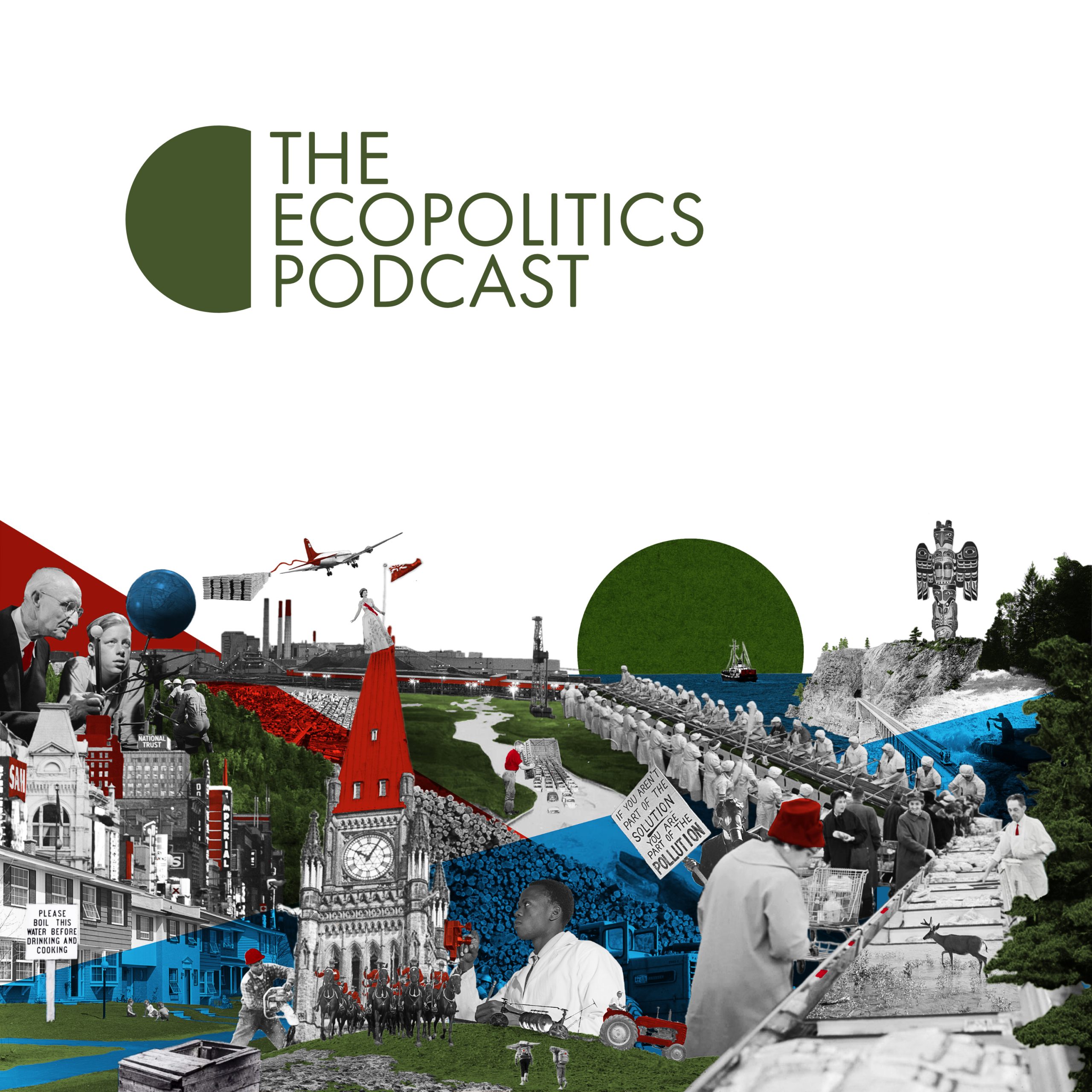
The Ecopolitics Podcast is a 30-episode audio series offering core content for university students studying environmental politics in Canada. The show is created and co-hosted by Dr. Ryan Katz-Rosene (University of Ottawa) and Dr. Peter Andrée (Carleton University), and funded by the Shared Online Projects Initiative. All episodes are freely available for use under a Creative Commons Licence 4.0 (CC BY-NC-ND). Instructors and students of environmental politics everywhere are invited to use the podcasts in their own teaching and learning. Episodes cover a range of themes central to the study of environmental politics in a Canadian context, from environmental justice to federalism to climate action and more! Enjoy the show, and let us know what you think.
-
49
Episode 4.12: Hope as Practice
In this episode, host Peter Andrée and guests Leah Penniman and Jan Hania explore how inner spiritual work and personal transformation are inextricably linked to the outer work of social and environmental change. At a time when reactionary, right-wing parties or coalitions are in power in both their countries, they discuss the value of moving beyond anger toward non-violent resistance based in compassion. Building Episode 4.8 themes (“Mindful Approaches to Ecopolitics”), they also explore the importance of "hope as a practice," and how grounding oneself in awe of the earth can support the long-game work of environmental activism in the Anthropocene.
-
48
Episode 4.11: Canadian Ecopolitics in the Anthropocene
In this episode, host Peter Andrée revisits the roots of The Ecopolitics Podcast by examining the dynamics of Canadian environmental politics in the mid-2020s. Joined by Dr. Rosalind Warner (Okanagan College), Dr. Will Greaves (University of Victoria), and Dr. Peter Stoett (Ontario Tech University), the conversation explores themes from their new co-authored book, Canadian Ecopolitics (University of Toronto Press, 2025). Together, they unpack how the politics of resource extraction, federalism, and settler colonialism continue to shape Canada’s environmental landscape. They also reflect on sources of hope, including the rise of civil society movements, Indigenous environmental leadership, and the growing recognition of the rights of nature. The guests offer candid insights on bridging activism and policymaking, listening across divides, and inspiring new generations to think long-term about sustainability in an era of planetary limits.
-
47
Episode 4.10: Living Relations – Part 2
This episode is our second installment on the Living Relations partnership, focusing on transnational collaboration between Indigenous and settler partners from Canada and Aotearoa (New Zealand). Hosts Peter Andrée and Tehya Quachegan are joined by project co-director John Reid to share insights from members of its Indigenous Advisory Circle and Research Circle. Building on the themes introduced in part 1, this conversation turns to the connections between land, water, and language; the role of Indigenous rights and governance in shaping climate-resilient futures; and the revitalization of food systems rooted in Indigenous values and knowledge. Together, the voices in this episode reflect on what it means to revitalize food systems through Indigenous governance, community-led research, and cross-cultural partnerships — and why revitalizing Indigenous food systems matters not only for Indigenous peoples but for all of us navigating the challenges of the Anthropocene.
-
46
Episode 4.9: Living Relations – Part 1
In this episode, Peter Andrée and guest host Tehya Quachegan (Lakehead University) introduce listeners to the Living Relations Project, a collaboration between Indigenous and settler partners in Aotearoa New Zealand and Canada. The project brings together researchers, community activists, and Indigenous leaders to strengthen food sovereignty, address colonial legacies, and build resilience in the face of climate change and biodiversity loss. Through stories and reflections from members of its Indigenous Advisory Circle and Research Circle, the episode delves into relationship-based research, intergenerational knowledge sharing, and the exchange of solutions across two similar yet distinct settler-colonial contexts.
-
45
Episode 4.8: Mindful Approaches to Ecopolitics
In this powerful and personal episode, host Peter Andrée is joined by Dr. Jeff Ganohalidoh Corntassel (University of Victoria, Cherokee Nation) and Dr. James Rowe (University of Victoria, author of Radical Mindfulness) to explore how mindfulness, ceremony, and heart-centred practices offer resources for witnessing and metabolizing the emotional grief associated with environmental and social injustice. Together, they discuss how inner awareness, land-based ritual, and work with psychedelic medicine can support healing and resilience in the face of climate anxiety, ecological grief, and systemic injustice. Drawing on Indigenous teachings, contemplative practice, and personal experience, this episode invites listeners to reflect on what it means to walk with feeling in ecopolitical spaces—and how relational and embodied approaches can help us build a more grounded, compassionate politics in the Anthropocene.
-
44
Episode 4.7: The Growth-Environment Debate – Part 2
In this second half of our two-part series on The Growth-Environment Debate, Ryan and Peter explore two of the more provocative discourses in the debate over sustainability and economic growth. What if growth is the problem? And what if it's already too late? First, they examine the “Overthrow Growth” discourse through the work of Indigenous activist and economist Winona LaDuke, the principles of degrowth, and the rise of eco-Marxist critiques of capitalism. Then, they delve into a final, sobering discourse: “The Damage of Growth is Done,” featuring voices like Jem Bendell, who argues that societal collapse is already underway, and that the focus should now be on adaptation and resilience. This episode continues to unpack the diverse, and at times conflicting, visions for ecological sustainability and economic futures in the Anthropocene. If you haven’t listened to Part 1, we recommend starting there.
-
43
Episode 4.6: Becoming an Ecopolitical Researcher
In this episode, host Peter Andrée sits down with two doctoral students and a postdoc on the path to becoming ecopolitical researchers: Devon Cantwell-Chavez, Kaleigh McIntosh, and Obed Asamoah. They talk about their unique projects, how they came to pursue this work, and unexpected lessons learned in graduate school. This episode explores the importance of relationships, humility, and a commitment to social and environmental justice for anyone seeking to become an ecopolitical researcher.
-
42
Episode 4.5: The Growth-Environment Debate – Part 1
In the first of a two-part series, co-hosts Ryan Katz-Rosene and Peter Andrée dive deep into the complex and often controversial relationship between economic growth and environmental sustainability - the subject of Ryan’s recently published book! Kicking off with the story of Dennis and Dana Meadows and their landmark 1972 report, The Limits to Growth, the episode sets the stage for the "Growth-Environmental Debate" by exploring three major discourses: Growth is Green, Growth Can Be Green, and Growth Misses the Point. Through compelling storytelling and archival audio clips, Ryan shares with us the histories and intellectual trajectories of key figures such as Julian Simon, Mostafa Tolba, and Kate Raworth. From debates over population and scarcity to global environmental diplomacy and reimagining economics through the lens of doughnuts, this episode challenges listeners to reconsider how growth is understood, valued, and contested in environmental politics.
-
41
Episode 4.4: Geoengineering
In this episode, we delve into the world of climate intervention and geoengineering, specifically focusing on solar geoengineering, also known as solar radiation modification (SRM). Host Ryan Katz-Rosene as he explores the complexities of this technology with two leading experts. First, we hear from Dr. Pete Irvine, as he breaks down the science behind SRM, particularly stratospheric aerosol injection (SAI), and discusses the potential benefits and risks, and addresses the current state of research and the ongoing debate surrounding field experiments. Then, we shift gears to hear from Dr. Aarti Gupta, who provides a crucial counterpoint, highlighting the voices of many in the academic community and beyond who are deeply concerned about the potential deployment of solar geoengineering. She emphasizes the growing opposition from the Global South, the disproportionate impact concerning vulnerable nations and Indigenous communities, and the governance challenges that this technology presents.
-
40
Episode 4.3: Sustainability through Philanthropy?
Join Dr. Peter Andrée as he explores the critical role of philanthropic organizations in advancing sustainability with two leading experts: Beth Hunter, Director at FoodBridge, and Lorne Johnson, Vice President at the IVEY Foundation. In this insightful conversation, Beth and Lorne share their expertise and experience, offering valuable insights for students, researchers, and anyone interested in the intersection of philanthropy and environmental responsibility. Discover how successful philanthropic efforts can be aligned with ecological goals, such as promoting sustainable agriculture in Canada. Learn about the unique challenges and opportunities facing philanthropic organizations as they strive to create a more sustainable future for all.
-
39
Episode 4.2: Axe the Tax, or Face the Facts?
In this episode of the Ecopolitics Podcast, our host, Dr. Ryan Katz-Rosene, is joined by Dr. Kathryn Harrison and Dr. Andrew Leach to delve into the intricacies of the federal carbon tax in Canada. We explore the mechanics of the carbon tax—how it sets a price on emissions and the variations in its application across provinces, and how the tax impacts consumers and add the context by examining the current political climate surrounding the carbon tax and its role in the larger debates on environmental policy in Canada. Listening to this episode will help us unpack the complexities of this politically contentious policy tool and its implications for Canadian politics and climate change initiatives.
-
38
Episode 4.1: We’re Back! Talking about the Anthropocene
We’re back and excited to share where the Ecopolitics Podcast is going with Season 4. Hosts Peter Andree and Ryan Katz-Rosene reflect on where we’ve gone over the last three seasons. Together, they explore how many of the themes and topics of the podcast remain relevant and continuously changing, from the Carbon Tax and Sustainable Food Systems to Indigenous Environmental Politics. Tune in to hear Ryan and Peter introduce Season 4: Politics of the Anthropocene! We are excited to share a series of episodes that put today’s politics into the longer-term context of how our societies engage with the more-than-human world with expert insights, thought-provoking discussions, and practical solutions.
-
37
Episode 3.6: Is the local a romantic eco-myth? A critical appraisal of ‘Thinking Globally, Acting Locally’
Does the environmentalist motto, ‘Think Globally, Act Locally’, point us towards sustainable food systems’ solutions? In this episode, Dr. Navin Ramankutty from UBC and Ken Meter from the Crossroads Resource Center in Minneapolis explore whether locally produced foods, provided by small-scale farmers, are inherently more sustainable than that which comes from larger producers many miles away. The discussion suggests that scale and proximity are not necessarily correlated with better environmental performance across the board, but that there are still good reasons for building strong food systems at the community level, and ensuring that small scale farmers can earn a sustainable livelihood.
-
36
Episode 3.5: How can we confront the environmental challenges associated with Canadian mining?
Mining is an essential component to our everyday lives, providing us with the raw materials we need to create a wide variety of products. However, while mining contributes to our technological progress, it comes with an often hidden dark side rife with environmental and human rights abuses. When more than 60% of the world's mining companies are based in Canada, what does this mean for us as everyday ecocitizens? What responsibilities do we have with respect to holding these companies to account for their use and abuse of people and planet? These are some of the questions we drill into today with guests Chandu Claver, International Spokesperson for the Cordillera Peoples' Alliance, Teresa Kramarz, Associate Professor at the University of Toronto, and Sheri Meyerhoffer, Canadian Ombudsperson for Responsible Enterprise (CORE).
-
35
Episode 3.4: What does a just transition really entail? From green jobs to decolonization
Climate change and its impacts on the economy, the planet, and, of course, us, is top of mind for a lot of folks these days. One potential solution that merges economic and climate needs is the transition away from fossil fuels as an energy source, to greener options. But with so many people relying on the fossil fuel industry for their livelihoods, how do we ensure a transition to a whole new energy source is just? This is one of the many questions we touch on in today's episode. Our guests, Luisa Da Silva, Executive Director of Iron and Earth, and Heather Milton-Lightening, a long-time Indigenous climate activist and current student, share with us their different views on just transition, and what we need to consider if we're really going to make it work.
-
34
Episode 3.3: How do we confront capitalism’s excesses? Between revolution and reform
How do we confront capitalism's ecological record? In this episode we get some answers from Dianne Saxe (Deputy Leader of the Green Party of Ontario), and Professor Matt Huber (Syracuse Univer“How do we confront capitalism’s ecological record?” In today's episode, we tackle this question with help from Dianne Saxe, President of SaxeFacts, and Deputy Leader of the Green Party of Ontario and Matt Huber, Professor in the Department of Geography and the Environment at Syracuse University. From two unique perspectives -- that of an environmental lawyer and a Marxist Geographer -- we dig into the ways in which capitalism is implicated in climate change, and how capitalistic forces might be influenced for the betterment of people and planet.
-
33
Episode 3.2: Can we eat our way to sustainability? A deep dive into sustainable protein
To consume or not consume meat? That is the question plaguing many an environmentally conscious person as we grapple with our personal responsibilites in the face of a warming climate. However, as our guests Paige Stanley, PhD Candidate at the University of California, Berkeley and Tara Garnett, Director of TABLE, a platform for informed discussion about food systems at University of Oxford point out, the answer isn't so black and white. In today's episode, we dive into the nuances of protein production, exploring both the macro and micro ways that farmers, scientists, and everyday people are tackling sustainable food systems. Ultimately, we strive to answer the question: Can we truly eat our way to sustainability?
-
32
Episode 3.1: What does it mean to be an Eco-Citizen? Intro to Everyday Ecopolitics Season Three
What is eco-citizenship and what does it entail? These are the overarching questions that guide this episode's discussions with Manvi Bhalla, Graduate Student and Co-Founder of Shake Up The Establishment & missINFORMED, and Kimberly Nicholas, Associate Professor of Sustainability Science at Lund University. From an introduction to intersectionality and its importance in climate justice action, to the Eat Lancet Report's rough guidelines for how to reduce one's carbon footprint, this wide-ranging discussion explores all the facets of what it means to be an eco-citizen, and who bears the most responsibility for taking action to slow climate change.
-
31
Episode 2.14: Global Cities, Environmental Politics, and Low Carbon Transition
Just over a decade ago, the world’s urban population surpassed its rural population in a trend of urbanization that is expected to continue for decades to come. This trend has raised some interesting questions with respect to how cities can participate in global sustainability efforts and how they might have a say in the governance of environmental politics. In this episode, we dive into these questions with Dr. Harriet Bulkeley, Professor in the Department of Geography at Durham University and at the Copernicus Institute of Sustainable Development at Utrecht University.
-
30
Episode 2.13: Resources, Population and the Global Environment: A Case Study in Water
Recorded on World Water Day, in this episode, we speak with Dr. Farhana Sultana, Associate Professor in the Department of Geography and the Environment and the Maxwell School of Citizenship and Public Affairs at Syracuse University to discuss all things water. Our conversation touches on the human right to water and sanitation, the ways in which water is a cross-cutting, multisectoral entity, and how governance of water, and further, privatization, is complicated, and can often be detrimental, to ensuring our rights to water.
-
29
Episode 2.12: Metaphors for Climate Governance
In this episode, which is a re-broadcast of an episode from Season 1, we speak with Steven Bernstein, Distinguished Professor of Global Environmental and Sustainability Governance, University of Toronto, and Matthew Hoffmann, Professor of Political Science, University of Toronto, about carbon lock-in (the ways in which our culture currently reinforces our use of fossil fuels) and two different metaphors for thinking about how we might challenge the carbon lock-in mindset both locally and internationally.
-
28
Episode 2.11: Growth, Degrowth, Agrowth
What is the relationship between economic growth and the environment? What is 'green growth' and why does the degrowth movement oppose it? And what does it mean to be agnostic about growth in the context of sustainability? In this episode we speak with two scholars who approach these questions from a degrowth perspective - Dr. Susan Paulson from the University of Florida, and Dr. Bengi Akbulut, from Concordia University in Canada. The episode also delves into Global South perspecitves on the growth-environment debate.
-
27
Episode 2.10: Dairy Cows, Climate Change and Settler Colonialism: Insights from Aotearoa/New Zealand
Aotearoa/New Zealand's dairy sector contributes 1/4 of that country's greenhouse gas emissions. Dr John Reid (University of Canterbury), and Dr. Hugh Campbell (University of Otago), show us how Māori sustainability values are having a growing influence on the sector's response to the challenge of net-zero carbon emissions by 2050.
-
26
Episode 2.9: Indigenous Environmental Rights: The Maya of Belize
In this episode we speak to Cristina Coc, Executive Director of the Julian Cho Society and Spokesperson for the Toledo Alcaldes Association/Maya Leaders Alliance, and Filiberto Penados, Chair, Julian Cho Society about the connections between indigenous rights and land conservation. Together, we take a closer look at the fight for recognition of the Maya people's rights to land in Belize. Overall, we conclude that this struggle is a global struggle, not just for indigenous rights to land, but for survival of all on a just and healthy planet.
-
25
Episode 2.8: Environmental Justice and the Anthropocene
In this episode we talk about Indigenous environmental justice with Dr. Kyle Whyte (University of Michigan, and citizen of the Potawatomi Nation). Dr. Whyte explains how indigenous knowledge, identity, and kinship networks can reshape contemporary ecological politics.
-
24
Episode 2.7: Multilateral Agreements and Institutions in Global Ecopolitics
In this episode we talk with Dr. Radoslav Dimitrov, Associate Professor at Western University to learn more about multilateral environmental agreements. How are they created? How are they enforced? Dr. Dimitrov also explains why some MEAs are essentially "hollow" or "empty" despite appearing to onlookers as legitimate institutions.
-
23
Episode 2.6: Great Power Politics and the Environment
Dr. Yixian Sun (University of Bath), and Dr. Matthew Paterson (University of Manchester), explain how the world's most powerful countries - from Great Powers in the G7 to emerging powers in the BRICS - shape ecopolitical outcomes on the global stage.
-
22
Episode 2.5: Global Ecopolitics After COVID-19: Social Movements and International ENGOs
There's no denying COVID-19 has had a major impact on the climate movement. After non-governmental organizations worked so hard to access global climate decision-making, being without the ability to organize protests and the like has left the movement disconnected from the major decision-makers again. But it's an important year for climate decisions. In this episode, we speak with Dr. Jen Allan, Lecturer in the School of Law and Politics at Cardiff University to get a better sense of how NGOs are navigating COVID, and the potential opportunities that may arise for climate decisions post-COVID.
-
21
Episode 2.4: Eco-colonialism and Environmental Justice in the Global South
In this episode, we explore the theme of wildlife conservation and the tensions that exist between how people in the global north tend to view these issues versus how they are perceived and experienced by the rural people who live alongside wild animals in countries like Botswana in southern Africa. To discuss these themes, we speak with Joseph E. Mbaiwa, Professor of Tourism Studies at University of Botswana, and Chris Brown, Associate Professor in the Department of Political Science at Carleton University about Botswana's 2014 hunting ban on African elephants. Through this example, we explore the political and eco-colonial contexts that influenced both the institution of the ban, as well as the ban's impact on communities within Botswana.
-
20
Episode 2.3: Theory and Method in Global Environmental Politics
What are some of the main theoretical approaches and methods used in the study of Global Ecopolitics? In this episode Dr. Raul Pacheco-Vega (FLACSO) provides some very helpful answers and further explains the relationship between theory and method for students of Global Ecopolitics.
-
19
Episode 2.2: Introduction to Global Ecopolitics – Part 2
In this episode, we speak with Dr. Hayley Stevenson, Associate Professor in the Department of Political Science and International Relations at l’Universidad Torcuato Di Tella in Buenos Aires, and Dr. Simon Dalby, Professor at the Balsillie School of International Affairs, Wilfrid Laurier University. From defining the field of global ecopolitics to delving into the concept of environmental security (and calling 'bullshit' on the greenwashing policies in between), this wide-ranging conversation helps set the scene for Season 2 of The EcoPolitics Podcast.
-
18
Episode 2.1: Introduction to Global EcoPolitics – Part 1
In this episode, Peter and Ryan give listeners a sneak peak at what's in store for Season 2 of The EcoPolitics Podcast!
-
17
Episode 1.16: Pathways to Sustainable Food Systems
The global food system is a very complex set of systems that look incredibly different in different parts of the world. In this episode, we take a look at food systems in Nairobi, Kenya, and in Newfoundland, Canada with our guests, Helena Shilomboleni, PhD, CGIAR Research Program on Climate Change, Agriculture, and Food Security (CCAFS) East Africa at the International Livestock Research Institute in Nairobi, Kenya, and Sarah J. Martin, Assistant Professor in the Department of Political Science at Memorial University.
-
16
Episode 1.15: Climate Action in and by Canada: ENGO Voices
What role do ENGOs, or Environmental Non-Governmental Organizations, play in the Canadian ecopolitical sphere? In this episode, we ask this question of Catherine Abreu, Executive Director of Climate Action Network Canada, and Colleen Thorpe, Executive Director of Équiterre. Together they walk us through the roles that their respective organizations play in fighting for climate policy and shifting the cultural norms of Canadian citizens toward a greener and more just society.
-
15
Episode 1.14: Corporate Social Responsibility
Greenwashing, or legitimate Corporate Social Responsibility? Dr. Hamish van der Ven (McGill) helps us understand these concepts before walking us through two case studies.
-
14
Episode 1.13: Corporate Sustainability in Canada
In this episode we get real about corporate social responsibility, or what Rory MacAlpine of Maple Leaf Foods calls his company's "shared value" for all its stakeholders.
-
13
Episode 1.12: The Politics of Decarbonization
Proposing a new metaphor for decarbonization, Dr. Steven Bernstein (Toronto) and Dr. Matthew Hoffmann (Toronto) discuss how we might challenge carbon lock-in from local action to global governance.
-
12
Episode 1.11: Environmental Political Economy
What is the relationship between capitalism and the environment? In this episode Dr. Laurie Adkin, Professor of Political Science at the University of Alberta, provides some answers by guiding us on a journey through the world of 'environmental political economy'.
-
11
Episode 1.10: Treaty Relations and Environmental Politics in Canada
Reflecting on the history and relationships that underpin two documentary films they made together, Dr. Sherry Pictou and Dr. Martha Stiegman discuss how the Mi’kmaq work to assert treaty rights over their land and fisheries in the face of colonialism and neoliberalism.
-
10
Episode 1.9: Ecofeminism and Queer Ecology
Dr. Catriona Sandilands and Dr. Sherilyn McGregor share with us the ways in which ecofeminism, and queer ecology, serve to diversify and deepen how we look at the policies and day-to-day practices of environmental politics.
-
9
Episode 1.8: Indigenous Environmental Knowledge and Politics
Larry McDermott (Shabot Obaadjiwan First Nation and ED of Plenty Canada) and Dr. Dan Longboat (Turtle Clan member of the Mohawk Nation and Associate Professor at Trent University) discuss lessons for sustainability inherent in Indigenous knowledges as well as Indigenous interpretations of the Royal Proclamation of 1763 and other early treaties.
-
8
Episode 1.7: Canadian Environmental Law and Policy
Environmental law touches all parts of our lives. In this episode, we speak with Dr. Angela Lee, Assistant Professor of Law at Ryerson University, and Dr. Heather McLeod-Kilmurray, Professor of Law at the University of Ottawa, about Canada's environmental laws and the ways in which they successfully (or not so successfully) help protect the environment.
-
7
Episode 1.6: Federalism, Party Politics and Environment
The environmental policy process in Canada is complicated. With its division of powers between provinces and the federal government, Canada's federalist structure has tended to serve as a barrier to achieving consistent nation-wide environmental policy change. In this episode, Dr. Kathryn Harrison and Dr. Andrea Olive walk us through the various factors and players influencing policy development and implementation in Canada. Using carbon pricing as an example, they go into detail regarding how the federal system influences environmental policy in Canada.
-
6
Episode 1.5: Environmental Political History in Canada
From ecopolitical history to tips on environmental activism techniques, this episode is the perfect primer on ecopolitics in Canada. Guided by the seasoned Robert Paehlke -- one of the founding voices in the field of environmental politics -- we discuss the environmental movement, and the ways in which the movement has changed over the past five decades.
-
5
Episode 1.4: Environmental Racism & Justice in Canada
Racism and colonialism are deeply entrenched in the field of ecopolitics. In this episode, we talk with Dr. Andil Gosine, professor in the Faculty of Environmental and Urban Change at York University, and Tzazná Miranda Leal, Workers Rights Organizer and Community Artist with Justice For Migrant Workers about the ways in which racism is woven throughout Canadian environmental history and its impacts on Canadian environmental policy and research.
-
4
Episode 1.3: Environmental Change in Canada: Plastics Case Study
Plastics are everywhere - in the air we breathe, the water we drink, and even the food we eat. As products that essentially never disappear, plastics have a huge impact on both our environment and our health. In this episode, we talk plastic pollution, regulating waste, and green entrepreneurship with Jay Sinha, Author and Co-founder of Life Without Plastic. He shares with us the ways businesses, government, and even individuals can impact our plastic use, in Canada and abroad.
-
3
Episode 1.2: Introduction to EcoPolitics
In this episode, we speak with Dr. James Meadowcroft, Professor in both the School of Public Policy and Administration and in the Department of Political Science at Carleton University. He sheds some light on how the environment became a defining issue in the discipline of Political Science, and shares how an organization called the Transition Accelerator works to advance technological, business and social change for a more sustainable future.
-
2
Episode 1.1: Introducing the EcoPolitics Podcast
In this episode, co-hosts Peter and Ryan share how they got involved in ecopolitics, what inspired them to create the EcoPolitics Podcast, and themes they're excited to explore in the coming episodes.
We're indexing this podcast's transcripts for the first time — this can take a minute or two. We'll show results as soon as they're ready.
No matches for "" in this podcast's transcripts.
No topics indexed yet for this podcast.
Loading reviews...
ABOUT THIS SHOW
The Ecopolitics Podcast is a 30-episode audio series offering core content for university students studying environmental politics in Canada. The show is created and co-hosted by Dr. Ryan Katz-Rosene (University of Ottawa) and Dr. Peter Andrée (Carleton University), and funded by the Shared Online Projects Initiative. All episodes are freely available for use under a Creative Commons Licence 4.0 (CC BY-NC-ND). Instructors and students of environmental politics everywhere are invited to use the podcasts in their own teaching and learning. Episodes cover a range of themes central to the study of environmental politics in a Canadian context, from environmental justice to federalism to climate action and more! Enjoy the show, and let us know what you think.
HOSTED BY
The Ecopolitics Podcast
Loading similar podcasts...
Frequently Asked Questions
How many episodes does The EcoPolitics Podcast have?
The EcoPolitics Podcast currently has 48 episodes available on PodParley. New episodes are automatically indexed when they're published to the podcast feed.
What is The EcoPolitics Podcast about?
The Ecopolitics Podcast is a 30-episode audio series offering core content for university students studying environmental politics in Canada. The show is created and co-hosted by Dr. Ryan Katz-Rosene (University of Ottawa) and Dr. Peter Andrée (Carleton University), and funded by the Shared Online...
How often does The EcoPolitics Podcast release new episodes?
The EcoPolitics Podcast has 48 episodes. Check the episode list to see recent publication dates and frequency.
Where can I listen to The EcoPolitics Podcast?
You can listen to The EcoPolitics Podcast on PodParley by clicking any episode. We provide an embedded audio player for direct listening, and you can also subscribe via your preferred podcast app using the RSS feed.
Who hosts The EcoPolitics Podcast?
The EcoPolitics Podcast is created and hosted by The Ecopolitics Podcast.
URL copied to clipboard!