
PODCAST · society
The Great RomCon?
by Jim Clark
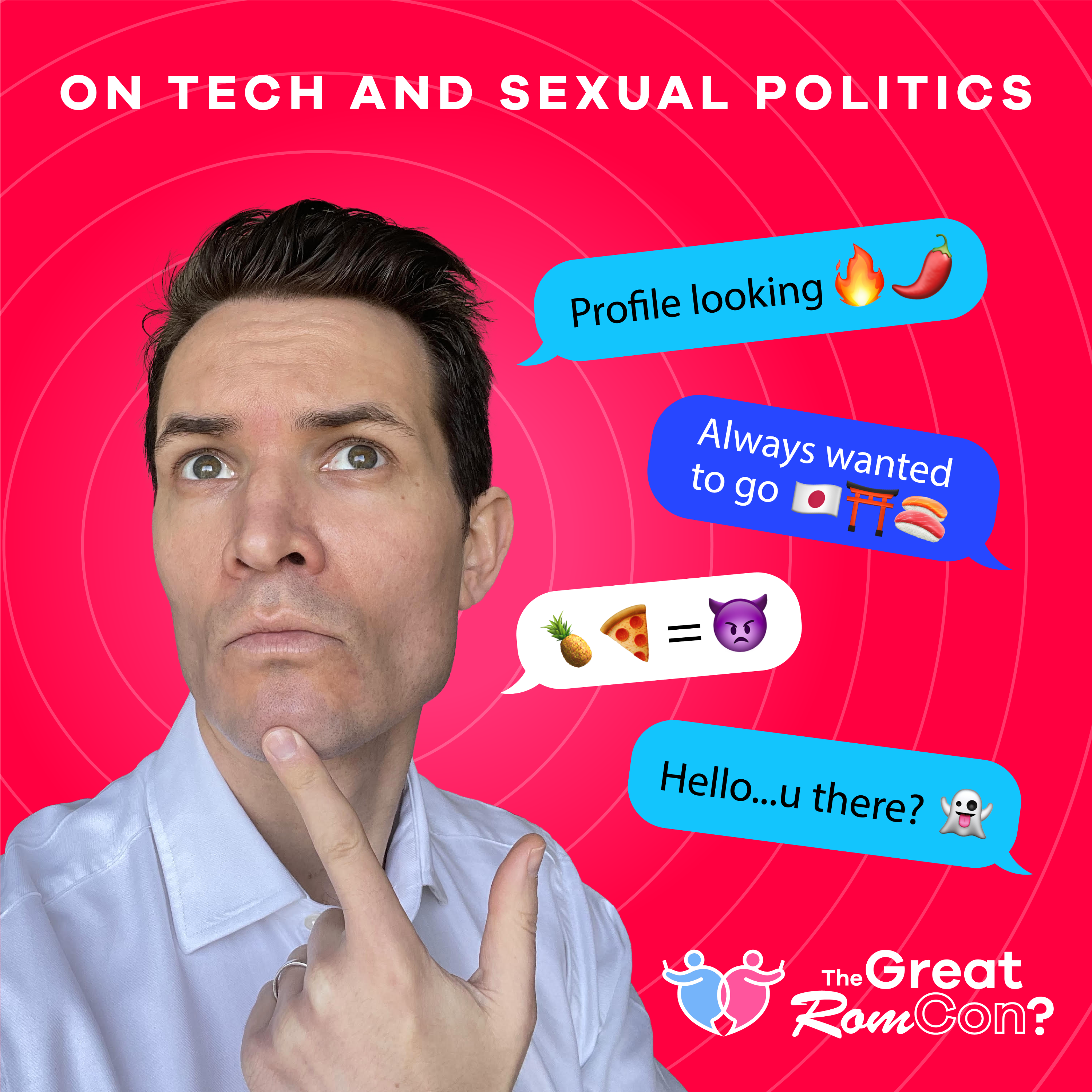
On Tech and Sexual Politics: The Great RomCon? examines the impact of technology and online platforms on our personal and professional relationships. From digital hobby communities to AI-generated romantic partners, we will shed light on whether this brave new world of relationships has room for more human connection.
-
16
The Therapist Is Online Now: How is technology changing the way we view ourselves?
"Why don’t you like me?" No, not the beginning line of a progressive one-woman show, but one of many questions that we may ask ourselves about our friends, colleagues and lovers. If we have the time (and money), we may even pay someone to listen to us, in the form of talking therapy, in an effort to better understand ourselves and other people. Therapy has now gone mainstream - but what does that actually mean for how we understand ourselves, our relationships, and the digital world we now live in?In this episode, we are speaking to Dr Aaron Balick, a psychotherapist, clinical supervisor, author, psychological consultant, honorary senior lecturer at The Department for Psychoanalytic and Psychosocial Studies at the University of Essex, and cultural theorist and one of the UK’s most thoughtful voices on how psychological ideas shape everyday life. Aaron’s work has long examined what happens when therapy leaves the consulting room and enters the public sphere: from the rise of therapy-speak, to the boom in online counselling, to the way digital culture reshapes our expectations of intimacy. He is a speaker, writes for GQ, and has written three books: ‘The Psychodynamics of Social Networking’ in 2013 and 'The Little Book of Calm' in 2018.Produced by the Bloomsbury Institute London.
-
15
Botocracy: Is AI going to take over all aspects of public life?
Artificial intelligence has moved from a niche technical field to a force shaping how we work, communicate and even participate in democracy. As governments and organisations increasingly rely on automated systems in the name of efficiency and convenience, questions about trust, transparency and public understanding have become impossible to ignore. What does it mean for everyday life when decisions that affect us are mediated by technologies most people (including the people who created them) don’t fully understand?In this episode, I speak to Dr Susan Oman, Senior Lecturer in Data, AI and Society at the University of Sheffield. Susan’s research explores how data and evidence operate in practice, and what this means for policy areas such as well‑being, loneliness, inequality and class. Together we unpack the public’s uneasy relationship with AI, and the democratic implications of experiments like the AI avatar launched by Mark Sewards MP. From dystopian parallels to the realities of digital public engagement, Susan offers a grounded and nuanced perspective on what happens when technology starts to stand in for human judgement and understanding.Produced by the Bloomsbury Institute London.
-
14
Love is Blind: How is tech helping when dating with a disability?
Technology has transformed almost every aspect of modern romance, but for many disabled people, the digital world can be both a gateway to connection and a barrier to it. Dating apps promise opportunity, yet often overlook the needs of those who rely on them most. At the same time, our online lives have reshaped how we think about infidelity, financial imbalance, and even the boundaries of flirting.To explore these questions, I speak to writer and broadcaster Rob Crossan, who has spent over two decades covering travel, culture and disability affairs. Drawing on his personal experiences as a visually impaired man navigating the dating world, Rob offers a candid and funny account of how technology can help, and hinder, the search for intimacy. They discuss everything from accessibility failures in app design, to the emotional politics of digital temptation, to why going analogue sometimes feels like the only option when looking for love.Produced by the Bloomsbury Institute London.
-
13
Spill the Tea: Are online spaces affecting men and women differently?
Gossip, since our pre-tribal dawn, has been a useful way of regulating social standings and ensuring community cohesion. In the online social media and dating app sphere, however, all this has changed, with men and women responding to this new age differently. Some women are finding online spaces becoming increasingly misogynistic and threatening, with some men finding themselves excluded and frustrated.Today’s guest, Dr Jenny van Hooff, is a sociologist at Manchester University specialising in personal life and contemporary intimacies. Dr van Hooff’s research explores the dynamics of couple relationships, love, commitment, infidelity, and break-ups across different stages of life, including examining the significance of friendships and the experiences of dating app users.She co-directs the Contemporary Intimacies, Sexualities, and Genders Research Group, an interdisciplinary network that investigates the evolving landscape of personal relationships and intimacies. The Research Group challenges how we think about intimate relationships, gender relations, eroticism and sexuality to advance social justice. Jenny’s current projects focus on midlife intimacy, relationship breakdown, and digital dating practices. Dr van Hooff wrote a 2013 book entitled: Modern Couples?: Continuity and Change in Heterosexual.In the episode we reference the books The Value of Others and Cold Intimacies: The Making of Emotional Capitalism. Produced by the Bloomsbury Institute London.
-
12
AI Demystified: What will the next technological revolution mean for our relationships?
‘There is undoubtedly a huge amount of hype that surrounds this latest development in AI. The remarkable ambition of Sam Altman and others to create artificial general intelligence may or may not come to pass. Depending on who you listen to, it is either going to destroy the world, take your job or be your best friend (or even lover).’That was a quote from the book ‘AI Demystified’. Today’s guest, Dr Antonio Weiss, helpfully wrote that book and is here to talk about it. Antonio is an award-winning technology expert and best-selling author. He has advised the Office for Artificial Intelligence, the UK Space Agency and NHS AI Lab, the Government Digital Service, and other pioneering organisations on AI adoption and digital transformation. He was previously Senior Advisor on Digital, Data & Technology to the Office of the UK Prime Minister Keir Starmer.Antonio is the author of four other books: Key Business Solution (2023), The Practical Guide to Digital Transformation (2022), Management Consultancy and the British State (2019), 101 Business Ideas That Will Change The Way You Work (2013). He is also an Affiliated Researcher at the University of Cambridge's Digital State programme and the co-founder of Thomas Clipper, which has featured in GQ, The Guardian and The Telegraph. He holds a PhD from Birkbeck, University of London.Produced by the Bloomsbury Institute London.
-
11
Anxious Generation: What impact is technology having on young people?
What effect are devices and platforms having on children and young people? The American social scientist, Jonathan Haidt, published his seminal 2024 study on the cohort effect of the use of technology, particularly on girls.I am hoping today’s guest, Nina Moyano, will be able to shed some light on this from her experience of working with children and parents. She is an ICF and EMCC-Accredited Coach - founding Life Coach London. Nina’s work focuses on digital wellbeing, confidence and mindset. In particular, she supports individuals and organisations in navigating the challenges of digital overload and screen addiction to create healthier, more intentional relationships with technology - such as managing screen time, improving focus and attention, or creating a culture that values disconnection and balance. You can see more of Nina's work on LinkedIn and Instagram.Produced by the Bloomsbury Institute London.
-
10
Silver Vixen: How can you find love later in life?
The traditional romantic story has a couple in puberty, not their pension. However, finding love later in life has become more and more prevalent due to increased divorce rates and longer life expectancies. Using tech platforms and dating apps can feel daunting, however. Can a leopard change its spots, and have fun being single at 60?That's what I will be asking Fiona Lambert, an author and entrepreneur. After a successful career in fashion, including working in senior positions at brands at Asda, M&S, River Island and Next, she took to the pen and the punchbag to get fit. Her 2024 book, ‘Invincible not Invisible - Change Your Body and Mindset in 90 days’, I hope, she has left the boxing gloves at home, as we are here to discuss her new book: ‘SAS: Sexy and Single - Your Survival Guide to Dating’.Produced by the Bloomsbury Institute London.
-
9
Open Source to Empire: Can AI ever be an ethical actor?
Ever since the Hal 3000 supercomputer in ‘2001: A Space Odyssey’ went rogue, the public has worried about the practical and ethical implications of a new race of intelligent machines. Can a computer, that doesn’t know what a person really is, really be trusted to make ethical decisions in high-moral-implication sectors, such as healthcare and crime & justice? Machine learning may be able to accurately predict what I might be interested in watching next on Netflix, but can we trust AI to pick who I might want to be friends with, or even love?That’s what I want to discuss with our guest, Joe Parker. We talk about the effect that technology is having on young people on this podcast so much that I thought that I’d better finally speak to one. Joe is a student and a Zoomer (Gen Z). His undergraduate degree was in Philosophy and Politics at the University of Southampton, and he is currently pursuing a Master’s in ‘Legal and Political Theory’ at UCL, where his dissertation focuses on AI ethics and its impact on individual behaviour and our ability to act.Produced by the Bloomsbury Institute London.
-
8
People and Publications: How do in-person events build connection and community?
While we once enjoyed community and literature in person, perhaps through a book club, now, with online platforms, people are finding more like-minded individuals online, as shown by the popularity of 'BookTok' on TikTok. However, can you form a real bond with someone on a shared passion online?To help us explore this, I went on the road to speak to Richard Kilgariff. Richard is a former television journalist, producer and television executive. He then moved into the world of books, running a series of initiatives (Books For Breakfast, bookomi., Author Insights) that discuss wide-ranging topics in a collaborative conversation with the author and the audience.We discuss the beginnings of digital television (long before YouTube), social media regulation, the attention economy and the magic of in-person events for connecting and sharing insights. Books and programmes we referenced during the conversation include: The Social Dilemma, Smartphone Nation, Tiny Experiments, Love Factually, and Why Information Grows.Produced by me!
-
7
Divine or Devil: How tech platforms are shaping our lives and relationships
Tech platforms have changed our lives, in many ways for the better. Email and digital platforms have revolutionised business, as social media and dating apps have transformed our personal lives. While tech solutions have promised to make our lives easier, they have also affected wider society - and not always positively.That’s what I want to discuss with today’s guest, Russ Shaw CBE. Russ had a high-profile career in telecoms, before founding Tech London Advocates in 2013 to promote and support startups and scale-ups and be an independent, grassroots voice for the community. This went global in 2015 with Global Tech Advocates (GTA), which is now present in over 40 hubs around the globe, with over 40,000 members. In 2019, Russ launched the inaugural GTA Festival, taking place in China and bringing the international network together for the first time. The second edition of the Festival was held in India in 2022.Russ has been championing London and the UK as a global tech hub and campaigning to address some of the biggest challenges and opportunities facing tech companies in the UK. Russ will be speaking and hosting events at the upcoming SXSW London and London Tech Week conferences, so look out for him there.Produced by the Bloomsbury Institute London.
-
6
Swipe No More: Why we need to be careful what we wish for online
Hope and excitement are powerful human emotions. We all hope for a better tomorrow, whether in our personal or professional lives. Dating apps and social media play into our optimism by showing us aspirational lifestyles, complete with the people that we might want to live them with. But sometimes this promise can turn disappointing, and even dark.That’s what I want to discuss with today’s guest, Jemma Forte (Instagram, X). Jemma is an author, broadcast journalist, presenter, and public speaking coach. She writes about romance and relationships, having published five books: Be Careful What You Swipe For (2020), Me and Miss M (2020), Mad Wife Crisis (2020), When I Met You (2015), and From London With Love (2011).Jemma also works as a broadcaster and a fellow podcaster (satirical current affairs and social media show: The Trawl), appearing regularly on TV politics and current affairs shows Jeremy Vine, Sky News, LBC, BBC Papers, Talk TV and Good Morning Britain. She started her presenting career at Nickelodeon and the Disney Channel, where she was an anchor for five years and interviewed everyone from Britney Spears to David Beckham.Produced by the Bloomsbury Institute London.
-
5
Who Killed the Night: Are our cities providing the right canvas for forming new relationships?
Are our cities and their nightlife changing for the worse, or just evolving to meet modern tastes? When they were first launched, dating apps were originally intended to augment and supplement the existing ways that we might meet someone. One of the challenges of this is that some of the places that would traditionally be fruitful hunting grounds in the West for looking for a date - bars, pubs and nightclubs - have seemingly been in decline.I’m expecting a forthright debate with today’s guest, Julieta Cuneo. Julieta is a public policy expert, specialising in cities and the night-time economy. She has worked as a journalist and in several think tanks researching and developing urban policy. She has also worked in Parliament and currently works for the Mayor of London on night-time policy and strategy. I want to ask her about how much government should intervene in sculpting the spaces that are often the backdrop to city life and love.Produced by the Bloomsbury Institute London.
-
4
Get Over It: How can therapy help in recovering from relationship trauma?
Introspection and self-reflection may have become modern-day virtues, but at times we will require an independent, impartial sounding board to truly understand how our past affects our current feelings and behaviour. This is the role of the therapist.We have all experienced painful memories that have harmed our relationships. So, how can we come to terms with trauma and move forward positively? This is what we will be exploring with our guest, Sue Cowan-Jenssen. Sue is an integrative psychotherapist and EMDR (Eye Movement Desensitation and Reprocessing) consultant with over twenty years of experience working with adults.Sue has worked at the Trauma Unit of Watford General Hospital, specialising in trauma and bereavement. She is a member of the Relational School and the London Psychotherapy and Trauma Centre. Sue has also written about a wide range of issues from how psychotherapy works, to understanding the impact of our competitive culture on our sense of self.Produced by the Bloomsbury Institute London.
-
3
Online Isolation: Are digital platforms making us lonely?
In our modern society, we have unparalleled access to other like-minded people and limitless potential for social connection through technological platforms. Yet there is widespread concern that our society is becoming more fragmented and lonely, with time spent on social media making us feel depressed. Dating apps now play a huge role in looking for love, but are they hampering the making of genuine connections?To discuss this, my guest for this episode is Dr Carolina Bandinelli. Carolina is an Associate Professor in Media and Creative Industries at the Centre for Cultural and Media Policy Studies at the University of Warwick. Her research has focused on the analysis of discourses and the digital culture of love, investigating digital technologies of love and the ways in which these shape emerging cultural tropes in the dimensions of romance, sexuality and intimacy. In 2021, she curated the series of events entitled ‘Summer of Love: dialogues on digital romance', hosted by Warwick's Centre for Digital Inquiry.Some of her papers include: ‘Romantic opportunism: Doing the work of structures in post-feminist creative industries (2024)’, ‘Bye bye romance, welcome reputation: An analysis of the digital enclosure of dating’ (2023), and ‘Dating apps: towards post-romantic love in digital societies’ (2022).Dr Bandinelli has also published on the organisation and significance of work in the creative industries: self-branding, coworking and collaborative economies. Some pieces include: ‘Social Entrepreneurship and Neoliberalism: Making Money While Doing Good’ and ‘The Production of Subjectivities in Neoliberal Culture Industries: The Case of Coworking Spaces’. She also published a book last year: ‘The post-romantics: on new ways of loving’, where Dr Bandinelli makes the case that, ‘The new ideal is that of a love that does not hurt. But how can we love without ever suffering?’Produced by the Bloomsbury Institute London.
-
2
Putting your 'Worst' foot forward: How can we make dating apps more honest?
When we are looking for a date, people often say how important it is that they can make you laugh. This is especially true when looking for a long-term relationship - you want to be with someone who is funny if you are in for the long haul! But wit is often difficult (and sometimes dangerous) to get across online, where tone, timing and accentuation are lost. How can humour win you love, and can you 'laugh someone into bed'?These are among the serious and silly questions that I will address with our guests, Jonny Ford and Jared Fryer. They are professional writers and comedians who formed their business by providing comedy writing workshops to copywriters and creatives in the advertising sector: Just Ad Comedy. Who doesn't enjoy a funny ad?For this episode, I also wanted to focus on the lack of honesty often displayed by users on dating apps. Jonny and Jared believe that they have found the solution to this, with their dating app 'Worst'.Produced by the Bloomsbury Institute London.
-
1
Paying Attention: Are dating apps selling us short?
It is sometimes said that we now live in the 'attention' economy, where the real product being sold by free or freemium services is us: what we are looking at, watching and engaging with. We call it paying attention as we are giving something of ourselves to our subject. Contrary to popular belief, we are not good multi-taskers, so our attention is necessarily a limited resource. I wanted to look at what our seemingly increasing addiction to screens and online platforms has done to us when engaging in personal relationships.To help us explore this, I spoke to Dr Martin Graff from the University of South Wales about his work in social psychology, the psychology of relationships, and online interaction.Dr Graff’s research interests are in online relationships and interactions. Some of his publications include: ‘Effects of internet addiction scores on informational search by undergraduate students’ (2023), 'How can you persuade me online? The impact of goal-driven motivations on attention to online information' (2020) and 'Can time spent on Social Media Affect Thin-Ideal Internalisation, Objectified Body Consciousness and Exercise Motivation in Women? (2019), and ‘Tinder and location based dating’ (2017). He teaches a course at the university on ‘Virtual and parasocial relationships’.Produced by the Bloomsbury Institute in London.
-
0
Hollywood Ending: Has movie romance ruined modern love?
Has the constant diet of schmatlz and heart-warming fairytales piped in from LA affected our romantic culture in the UK, and if so - is that a problem?I speak to film and TV screenwriter Emily Carlton about how the depiction of love and romance has changed on the silver screen and what effect this is having on relationships in the real world.We discuss how women and relationships on film have changed over the past 30 years: from the classic rom-coms of the 1990s, to the modern representations of 'Anora', 'Challengers' and 'Bridget Jones: Mad About The Boy'. Emily references Nina Menkes's documentary 'Brainwashed', which explores the sexual politics of cinematic shot design and how male and female actors are treated differently by the camera.Emily mentions her work with 'Breaking Through The Lens', a non-profit initiative that advocates for gender equality in film by providing vital support at the financing stage. Their program is open to women and gender-expansive filmmakers, offering action grants, fiscal sponsorship, curated meetings and industry mentorship. They are taking applications, so do check in on their current projects in film.Produced by the Bloomsbury Institute in London.
We're indexing this podcast's transcripts for the first time — this can take a minute or two. We'll show results as soon as they're ready.
No matches for "" in this podcast's transcripts.
No topics indexed yet for this podcast.
Loading reviews...
ABOUT THIS SHOW
On Tech and Sexual Politics: The Great RomCon? examines the impact of technology and online platforms on our personal and professional relationships. From digital hobby communities to AI-generated romantic partners, we will shed light on whether this brave new world of relationships has room for more human connection.
HOSTED BY
Jim Clark
CATEGORIES
Loading similar podcasts...
Frequently Asked Questions
How many episodes does The Great RomCon? have?
The Great RomCon? currently has 17 episodes available on PodParley. New episodes are automatically indexed when they're published to the podcast feed.
What is The Great RomCon? about?
On Tech and Sexual Politics: The Great RomCon? examines the impact of technology and online platforms on our personal and professional relationships. From digital hobby communities to AI-generated romantic partners, we will shed light on whether this brave new world of relationships has room for...
How often does The Great RomCon? release new episodes?
The Great RomCon? has 17 episodes. Check the episode list to see recent publication dates and frequency.
Where can I listen to The Great RomCon??
You can listen to The Great RomCon? on PodParley by clicking any episode. We provide an embedded audio player for direct listening, and you can also subscribe via your preferred podcast app using the RSS feed.
Who hosts The Great RomCon??
The Great RomCon? is created and hosted by Jim Clark.
URL copied to clipboard!