
PODCAST · history
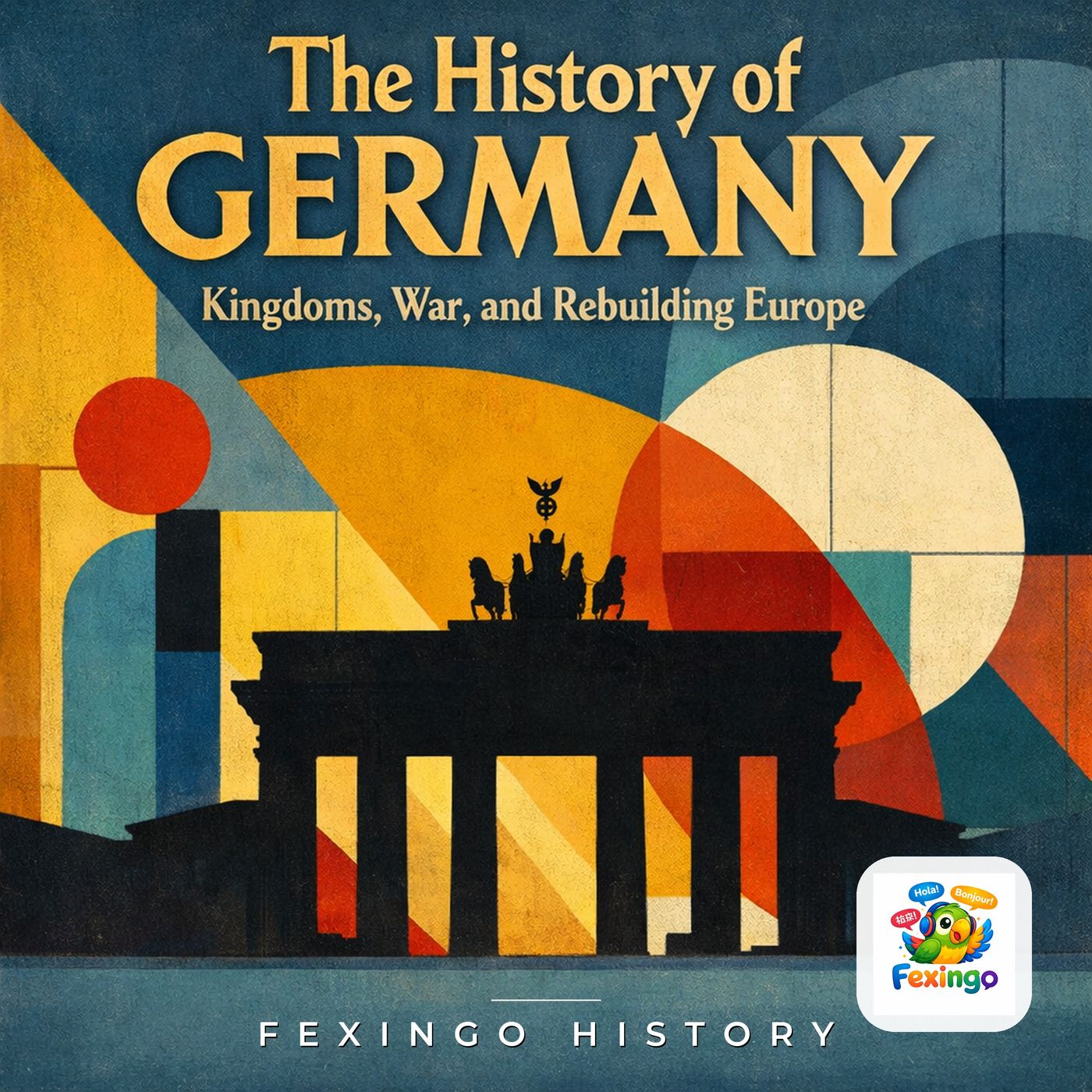
The History of Germany: Kingdoms, War, and Rebuilding Europe — Fexingo History
by Fexingo
From the Holy Roman Empire's fragmented principalities to the modern Federal Republic, Germany's story is a crucible of European history. Lucas and Luna guide listeners through over a millennium of transformation: the rise of the Ottonian dynasty, the Reformation sparked by Martin Luther, the Thirty Years' War that devastated the land, the unification under Otto von Bismarck in 1871, the catastrophic world wars, the Weimar Republic's cultural flowering, the Nazi regime's horrors, the division into East and West during the Cold War, and the reunification in 1990. Along the way, they examine the philosophies of Kant and Nietzsche, the music of Beethoven and Wagner, the Bauhaus movement's modernist legacy, and the economic miracle of the postwar years. The show explores how Germany's central location made it a battleground for European power struggles, from the Peace of Westphalia to the Berlin Airlift. It also delves into the long shadow of the Holocaust and Germany's ongoing reckoning w
-
35
The Zollverein: How Customs Union United Germany — Fexingo History
Before Bismarck’s wars and the 1871 proclamation, a quiet revolution was already stitching the German states together—not through blood and iron, but through tariffs and rails. This episode explores the Zollverein, the German Customs Union founded in 1834. We trace its roots to Prussia’s 1818 tariff law, its expansion under the leadership of Friedrich von Motz and Peter Beuth, and its role as a template for economic unification. We meet the skeptics: Austria, excluded by design; the southern states like Bavaria and Württemberg, wary of Prussian dominance; and the free-trade intellectuals like Friedrich List, who dreamed of a national railway. The Zollverein didn’t just move goods—it moved people, ideas, and loyalties. By 1866, the customs union had become the skeleton of a future nation, making Bismarck’s political unification almost inevitable. This is the story of how coal, cloth, and a common currency helped create modern Germany.#Zollverein #GermanCustomsUnion #EconomicHistory #Prussia #FriedrichList #FriedrichvonMotz #PeterBeuth #GermanUnification #FreeTrade #Railways #Bismarck #1834 #Customs #IndustrialRevolution #History #FexingoHistory #Germany #19thCentury #HolyRomanEmpire #LutheranReformationBecome a supporter of this podcast: https://www.spreaker.com/podcast/the-history-of-germany-kingdoms-war-and-rebuilding-europe-fexingo-history--6985228/support.
-
34
The Frankfurt Parliament: Germany's Failed Revolution of 1848 — Fexingo History
In 1848, revolution swept across Europe, and Germany saw its own uprising. Liberals and nationalists demanded a unified German state with a constitution. The Frankfurt Parliament, or Paulskirchenparlament, convened in Frankfurt's St. Paul's Church to draft a constitution. But internal divisions, the refusal of Prussian King Friedrich Wilhelm IV to accept the imperial crown, and the resurgence of conservative forces doomed the project. This episode explores the parliament's debates over German identity, the role of Austria versus Prussia (the Grossdeutschland vs. Kleindeutschland debate), and the revolutionary wars in Schleswig-Holstein. We meet key figures like Heinrich von Gagern, Robert Blum, and Archduke Johann of Austria, who served as imperial regent. The failure of 1848 had lasting consequences, paving the way for Bismarck's blood-and-iron unification two decades later. We also discuss the legacy of the Paulskirche constitution, which influenced later German democracy.#History #FexingoHistory #Germany #1848Revolutions #FrankfurtParliament #Paulskirche #HeinrichVonGagern #RobertBlum #FriedrichWilhelmIV #ArchdukeJohann #Grossdeutschland #Kleindeutschland #SchleswigHolstein #GermanUnification #Liberalism #Nationalism #1848 #GermanRevolution #HolyRomanEmpire #LutheranReformationBecome a supporter of this podcast: https://www.spreaker.com/podcast/the-history-of-germany-kingdoms-war-and-rebuilding-europe-fexingo-history--6985228/support.
-
33
The Weimar Hyperinflation: When Money Became Wallpaper — Fexingo History
In 1923, Germany experienced one of history's most extreme monetary collapses. Lucas and Luna explore how the Weimar Republic's hyperinflation devastated the middle class, created bizarre scenes of people carting wheelbarrows of cash for a loaf of bread, and sowed the seeds of political extremism. They discuss the reparations burden from Versailles, the passive resistance in the Ruhr that bankrupted the state, the printing presses that ran day and night, and the bizarre survival strategies people adopted. They also examine the Rentenmark reform that finally stabilized the currency, and reflect on how the trauma of hyperinflation shaped German attitudes toward money and authority for generations. Key figures include Reichsbank president Rudolf Havenstein, Finance Minister Matthias Erzberger, and Chancellor Gustav Stresemann. The episode draws on firsthand accounts, including those of writer Stefan Zweig and economist John Maynard Keynes.#WeimarRepublic #Hyperinflation #1923 #Rentenmark #GustavStresemann #RudolfHavenstein #MatthiasErzberger #StefanZweig #JohnMaynardKeynes #RuhrOccupation #VersaillesTreaty #GermanHistory #EconomicHistory #Papiermark #Notgeld #Inflation #History #FexingoHistory #HolyRomanEmpire #LutheranReformationBecome a supporter of this podcast: https://www.spreaker.com/podcast/the-history-of-germany-kingdoms-war-and-rebuilding-europe-fexingo-history--6985228/support.
-
32
Germany 1918: The Revolution That Never Was — Fexingo History
When the German Empire collapsed in November 1918, a revolution swept the country—but it wasn't the one the Spartacists wanted. In this episode, Lucas and Luna explore the overlooked story of the November Revolution: how sailors in Kiel sparked a nationwide uprising, how Friedrich Ebert and the Majority SPD struck a deal with the old military elite, and why Germany missed its chance for a true socialist republic. We follow the key figures: Philipp Scheidemann, who proclaimed the republic from a Reichstag window; Karl Liebknecht, who declared a free socialist republic hours later; and the secret phone call between Ebert and General Wilhelm Groener that sealed the fate of the revolution. We also examine the Stinnes-Legien Agreement, which gave unions an eight-hour day in exchange for cooperation, and the birth of the Weimar Coalition. Why did the revolution fail to create a new Germany? The answer lies in fear—of Bolshevism, of chaos, and of losing the war's legacy. This episode is essential for understanding the fragile foundation of the Weimar Republic.#Novemberrevolution #GermanRevolution1918 #FriedrichEbert #PhilippScheidemann #KarlLiebknecht #WilhelmGroener #StinnesLegien #WeimarRepublic #SailorsMutiny #Kiel #Spartacists #MajoritySPD #RTe #WorkersCouncils #EbertGroener #History #FexingoHistory #Germany #HolyRomanEmpire #LutheranReformationBecome a supporter of this podcast: https://www.spreaker.com/podcast/the-history-of-germany-kingdoms-war-and-rebuilding-europe-fexingo-history--6985228/support.
-
31
Charlemagne's Saxon Wars: Massacre at Verden and Forced Conversion — Fexingo History
In this episode of The History of Germany, Lucas and Luna explore the brutal Saxon Wars that shaped early medieval Germany. Charlemagne's campaign to conquer and Christianize the Saxons culminated in the 782 Massacre of Verden, where thousands were executed. The episode delves into the destruction of the Irminsul, the role of the Saxon leader Widukind, and the imposition of the Lex Saxonum. Lucas explains how Charlemagne used forced conversion, mass deportations, and the establishment of bishoprics to integrate Saxony into the Frankish Empire. The conversation examines the ethical implications, the resistance of the Saxons, and the long-term impact on German identity. Specific terms such as Verden, Irminsul, Widukind, and Lex Saxonum are discussed in context, offering a nuanced view of this pivotal period.#SaxonWars #Charlemagne #MassacreOfVerden #Widukind #Irminsul #LexSaxonum #ForcedConversion #FrankishEmpire #MedievalGermany #EarlyMiddleAges #GermanHistory #Christianization #Paderborn #DrangNachOsten #Einhard #AnnalesRegniFrancorum #History #FexingoHistory #HolyRomanEmpire #LutheranReformationBecome a supporter of this podcast: https://www.spreaker.com/podcast/the-history-of-germany-kingdoms-war-and-rebuilding-europe-fexingo-history--6985228/support.
-
30
Germany 1890s: How Industrial Might Forged a Nation — Fexingo History
In this episode, Lucas and Luna explore the explosive industrial transformation of Germany in the late 19th century. They focus on the Ruhr Valley's coal and steel boom, the rise of the chemical and electrical industries, and the social consequences of rapid urbanization. Key figures include industrialists like Alfred Krupp and Werner von Siemens, as well as the social reformer Wilhelm von Ketteler. The episode also covers the birth of the Social Democratic Party (SPD) and Otto von Bismarck's state socialism as a response to working-class unrest. Listeners will learn about the Krupp family's giant steelworks in Essen, the founding of Siemens & Halske, and how Germany overtook Britain in steel production by the 1890s. The conversation touches on the Zollverein customs union, the role of railways, and the emergence of a new middle class. It ends by connecting this industrial might to the tensions that would lead to World War I.#IndustrialRevolution #GermanyHistory #Krupp #Siemens #Ruhr #SPD #Bismarck #Steel #Coal #Zollverein #StateSocialism #Urbanization #19thCentury #GermanEmpire #WilhelmineGermany #WorkingClass #FexingoHistory #History #HolyRomanEmpire #LutheranReformationBecome a supporter of this podcast: https://www.spreaker.com/podcast/the-history-of-germany-kingdoms-war-and-rebuilding-europe-fexingo-history--6985228/support.
-
29
The Wartburg Festival: German Nationalism's Fiery Birth — Fexingo History
In 1817, following the Congress of Vienna that created the German Confederation, hundreds of students gathered at Wartburg Castle to celebrate liberty and national unity. This episode explores the Wartburg Festival, a key event in the rise of German nationalism. We delve into the Burschenschaften student fraternities, the liberal hopes of the post-Napoleonic era, the symbolic burning of books and symbols, and the backlash from conservative forces led by Metternich. The festival's call for a unified Germany and constitutional freedoms set the stage for later revolutionary movements. We examine key figures like Friedrich Ludwig Jahn, Heinrich Heine's ambivalence, and the Carlsbad Decrees that repressed such gatherings. The Wartburg Festival remains a flashpoint in German history, embodying the tension between liberal nationalism and reactionary power.#WartburgFestival #Burschenschaften #GermanNationalism #FriedrichLudwigJahn #CongressOfVienna #GermanConfederation #Liberalism #Nationalism #Metternich #CarlsbadDecrees #HeinrichHeine #Wartburg #Unification #1817 #GermanHistory #Students #Revolution #FexingoHistory #HolyRomanEmpire #LutheranReformationBecome a supporter of this podcast: https://www.spreaker.com/podcast/the-history-of-germany-kingdoms-war-and-rebuilding-europe-fexingo-history--6985228/support.
-
28
The Ems Telegram: How a Diplomatic Snub Sparked German Unification — Fexingo History
In this episode, Lucas and Luna revisit the final spark of German unification—the Ems Telegram of July 1870. You'll learn how Otto von Bismarck engineered a diplomatic crisis out of a mundane exchange between King Wilhelm I and the French ambassador, how he edited the infamous 'Ems Dispatch' to provoke France into declaring war, and how the resulting Franco-Prussian War led to the proclamation of the German Empire at Versailles. The episode also explores the telegram's original wording, the role of Helmuth von Moltke, and the war's lasting consequences for Germany and Europe. It's a case study in realpolitik and media manipulation that still resonates today.#EmsTelegram #Bismarck #FrancoPrussianWar #GermanUnification #WilhelmI #Realpolitik #HelmuthvonMoltke #NapoleonIII #Versailles #JulyCrisis1870 #GermanEmpire #1871 #History #EuropeanHistory #Diplomacy #MediaManipulation #FexingoHistory #GermanyHistory #HolyRomanEmpire #LutheranReformationBecome a supporter of this podcast: https://www.spreaker.com/podcast/the-history-of-germany-kingdoms-war-and-rebuilding-europe-fexingo-history--6985228/support.
-
27
The Mad King Who Built Neuschwanstein: Ludwig II of Bavaria — Fexingo History
In this episode of The History of Germany, Lucas and Luna explore the life and legacy of King Ludwig II of Bavaria, the 'Mad King' who built fairy-tale castles like Neuschwanstein. From his eccentric patronage of Richard Wagner to his mysterious death in Lake Starnberg, Ludwig's story is one of artistic obsession, political isolation, and a kingdom caught between tradition and modernity. The episode covers his early reign, his withdrawal from court life, the construction of his fantastical palaces, and the political maneuvers that led to his deposition. It also touches on the enduring mystery surrounding his death alongside his psychiatrist, Dr. Bernhard von Gudden. A tale of beauty, madness, and the price of dreaming.#LudwigII #Neuschwanstein #Bavaria #KingLudwig #Wagner #MRchenkNig #LakeStarnberg #GermanHistory #Castles #19thCentury #SchlossLinderhof #Herrenchiemsee #Royalty #Romanticism #History #FexingoHistory #Germany #ArtandPower #HolyRomanEmpire #LutheranReformationBecome a supporter of this podcast: https://www.spreaker.com/podcast/the-history-of-germany-kingdoms-war-and-rebuilding-europe-fexingo-history--6985228/support.
-
26
The Spartacist Uprising: Germany's Communist Revolution of 1919 — Fexingo History
It's January 1919. Germany is reeling from defeat in World War I, the Kaiser has fled, and a fragile republic is struggling to be born. In Berlin, radical socialists led by Rosa Luxemburg and Karl Liebknecht seize the moment, launching an armed uprising that will determine the future of German democracy — and cost them their lives. This episode dives into the Spartacist Uprising, a bloody week that pitted the newly formed Freikorps against revolutionary workers and set a pattern of political violence that would haunt the Weimar Republic for its entire existence. We explore the clash between Luxemburg's vision of a democratic socialism and the authoritarian drift of the Social Democratic leadership under Friedrich Ebert, the role of the Freikorps, and the brutal murders that turned Luxemburg and Liebknecht into martyrs. We also consider how this uprising shaped the later Nazi seizure of power. From the barricades of Berlin to the shadows of the Volksbühne, this is the story of a revolution that failed — and the legacy it left behind.#SpartacistUprising #RosaLuxemburg #KarlLiebknecht #WeimarRepublic #GermanRevolution1918 #Freikorps #FriedrichEbert #VolksbHne #LuxemburgMord #KPD #USPD #Berlin1919 #GermanHistory #Socialism #Revolution #PoliticalViolence #History #FexingoHistory #HolyRomanEmpire #LutheranReformationBecome a supporter of this podcast: https://www.spreaker.com/podcast/the-history-of-germany-kingdoms-war-and-rebuilding-europe-fexingo-history--6985228/support.
-
25
The Treaty of Versailles: Germany's Humiliation and Aftermath — Fexingo History
In this episode of The History of Germany, Lucas and Luna explore the Treaty of Versailles and its profound impact on German society. They discuss the treaty's key terms, including war guilt, reparations, territorial losses, and military restrictions, and how these fueled resentment and economic instability. The conversation covers the 'stab-in-the-back' myth (Dolchstoßlegende), the reaction of figures like Philipp Scheidemann and Matthias Erzberger, and the long-term consequences that contributed to the rise of extremism. Specific clauses from the treaty are examined, such as Article 231 (war guilt), the loss of Alsace-Lorraine, the Saar Basin, and the Rhineland demilitarization. The episode also touches on the Weimar Republic's fragile start and the public perception of humiliation.#TreatyOfVersailles #Versailles1919 #WeimarRepublic #DolchstoLegende #WarGuilt #Reparations #AlsaceLorraine #Rhineland #SaarBasin #PhilippScheidemann #MatthiasErzberger #History #FexingoHistory #GermanyHistory #WorldWarI #ParisPeaceConference #GermanPolitics #20thCenturyHistory #HolyRomanEmpire #LutheranReformationBecome a supporter of this podcast: https://www.spreaker.com/podcast/the-history-of-germany-kingdoms-war-and-rebuilding-europe-fexingo-history--6985228/support.
-
24
The Ruhr Occupation: Germany's Humiliation and Resistance — Fexingo History
In 1923, when Germany defaulted on reparations, France and Belgium invaded the Ruhr Valley, the industrial heart of the nation. The Weimar Republic called for passive resistance, leading to a dramatic showdown between German workers and French soldiers. This episode explores the occupation through the eyes of those who lived it: the 'Ruhrkampf' passive resistance, the hyperinflation that wiped out savings, and the emergence of a new kind of German nationalism. Historians still debate whether the occupation was a justified enforcement of Versailles or a deliberate humiliation that poisoned international relations. We unpack the role of the French Premier Raymond Poincaré, the German Chancellor Gustav Stresemann, and the American banker Charles Dawes. We also look at the cultural memory of the Ruhr occupation in German literature and film, from Hans Fallada to the paintings of Otto Dix. How did this crisis shape the fragile democracy of Weimar? And why did it pave the way for the rise of radical parties? Join Lucas and Luna for a deep dive into a turning point that often gets overlooked in the story of Germany.#RuhrOccupation #WeimarRepublic #Hyperinflation #PassiveResistance #GustavStresemann #RaymondPoincare #DawesPlan #VersaillesTreaty #Ruhrkampf #FrenchInvasion #GermanHistory #1923 #OttoDix #HansFallada #Reparations #FexingoHistory #History #Europe #HolyRomanEmpire #LutheranReformationBecome a supporter of this podcast: https://www.spreaker.com/podcast/the-history-of-germany-kingdoms-war-and-rebuilding-europe-fexingo-history--6985228/support.
-
23
Germany's Poison Gas: The First WMD and the Scientist Who Fought It — Fexingo History
In Episode 29 of The History of Germany, Lucas and Luna explore the harrowing birth of chemical warfare in World War I and the haunting moral legacy of one man: Fritz Haber. Haber, a German Jewish chemist and Nobel laureate, developed the Haber-Bosch process that feeds billions—but also pioneered poison gas for the Kaiser's army. From the first chlorine cloud at Ypres in 1915 to the gas mask, from the death of his wife Clara Immerwahr to the poison gas used in the Holocaust, this episode traces how Germany launched the age of weapons of mass destruction. We also meet Otto Hahn and Walther Nernst, and ask: can a single invention be both savior and sin? Warning: contains accounts of chemical warfare.#FritzHaber #PoisonGas #WWI #ChemicalWarfare #HaberBosch #ClaraImmerwahr #BattleofYpres #ChlorineGas #MustardGas #OttoHahn #WaltherNernst #KaiserWilhelmInstitute #GermanScience #EthicsOfScience #HistoryOfWar #Germany #History #FexingoHistory #HolyRomanEmpire #LutheranReformationBecome a supporter of this podcast: https://www.spreaker.com/podcast/the-history-of-germany-kingdoms-war-and-rebuilding-europe-fexingo-history--6985228/support.
-
22
The Berlin Wall: How a Wire Fence Became a Concrete Fortress — Fexingo History
In 1961, East Germany sealed off West Berlin with barbed wire, then concrete. This episode traces the Wall's construction, the escape attempts, and the human cost—from the first jump out of a window to the tunnel diggers and the border guards who defected. We explore Checkpoint Charlie, the death strip, and the political brinkmanship between Kennedy and Khrushchev. How did a temporary measure become a 28-year symbol of division? And what drove people to risk everything to cross it?#BerlinWall #ColdWar #EastGermany #WestBerlin #CheckpointCharlie #Stasi #Flucht #Tunnel #EscapeAttempts #Kennedy #Khrushchev #Zonenrandgebiet #Mauerbau #Todesstreifen #Grenzpolizei #History #FexingoHistory #GermanHistory #HolyRomanEmpire #LutheranReformationBecome a supporter of this podcast: https://www.spreaker.com/podcast/the-history-of-germany-kingdoms-war-and-rebuilding-europe-fexingo-history--6985228/support.
-
21
The Night of Broken Glass: When Nazi Terror Went Public — Fexingo History
On November 9, 1938, the Nazi regime orchestrated a nationwide pogrom against Jews that shattered the illusion of peaceful persecution. This episode examines the Kristallnacht pogrom in detail: the assassination of Ernst vom Rath in Paris by Herschel Grynszpan, the spontaneous-seeming but carefully coordinated attacks on synagogues, businesses, and homes, the murder of at least 91 Jews, and the deportation of 30,000 Jewish men to concentration camps. We discuss the legal aftermath—the Decree on the Exclusion of Jews from German Economic Life and the collective fine of one billion Reichsmarks—and the shift from discrimination to open violence. Lucas and Luna explore how ordinary Germans reacted, the role of the SS and SA, and why this night marked an irreversible turning point on the road to the Holocaust. The episode draws on eyewitness accounts, diplomatic reports from American and British consuls, and the chilling numbers: over 1,400 synagogues burned, 7,000 businesses destroyed. It's a story of state-sponsored terror in plain sight, heard around the world.#Kristallnacht #NightOfBrokenGlass #NovemberPogrom #1938 #NaziGermany #HerschelGrynszpan #ErnstvomRath #Holocaust #Antisemitism #Shoah #Gestapo #SS #SA #Propaganda #WorldWarII #History #FexingoHistory #GermanyHistory #HolyRomanEmpire #LutheranReformationBecome a supporter of this podcast: https://www.spreaker.com/podcast/the-history-of-germany-kingdoms-war-and-rebuilding-europe-fexingo-history--6985228/support.
-
20
The Congress of Vienna: How Germany Was Remade After Napoleon — Fexingo History
After Napoleon's defeat, Europe's powers gathered in Vienna to redraw the map. For Germany, the Congress of Vienna created the German Confederation, a loose union of 39 states that replaced the Holy Roman Empire. This episode explores the key figures—Metternich, Hardenberg, Humboldt—and the compromises that shaped German politics for the next half-century. We look at the territorial settlements, the rise of Austria and Prussia as rival powers, and the cultural stirrings of nationalism that the Congress tried to suppress. From the Carlsbad Decrees to the Wartburg Festival, we trace how Vienna's attempt to freeze Europe in place actually sowed the seeds of future upheaval. Specifics include the re-establishment of the Deutscher Bund, the role of the Bundestag in Frankfurt, and the influence of Metternich's system on German intellectual life.#CongressOfVienna #Metternich #GermanConfederation #DeutscherBund #WilhelmVonHumboldt #KarlAugustVonHardenberg #NapoleonicWars #Restoration #CarlsbadDecrees #WartburgFestival #ViennaSystem #HolyRomanEmpire #GermanNationalism #AustrianEmpire #KingdomOfPrussia #19thCentury #History #FexingoHistory #LutheranReformation #ThirtyYearsWarBecome a supporter of this podcast: https://www.spreaker.com/podcast/the-history-of-germany-kingdoms-war-and-rebuilding-europe-fexingo-history--6985228/support.
-
19
The Elbe Germanization: How Charlemagne Conquered the Saxons — Fexingo History
Long before the Hanseatic League or the Prussian state, the land east of the Rhine was shaped by fire and blood. In this episode, Lucas and Luna explore the Saxon Wars (772–804), when Charlemagne spent three decades crushing the pagan Saxons and forcing them into his Christian Frankish empire. We discuss the brutal massacre at Verden, where an estimated 4,500 Saxon nobles were executed in a single day; the role of the Irminsul, a sacred tree-shrine that the Saxons believed held up the sky; and the controversial Lex Saxonum law that made resistance a capital offense. We also touch on how this forced conversion and colonization set a pattern for later German expansion into the East, long before the Teutonic Order or the Drang nach Osten. Lucas brings the story to life with vivid details—Widukind the Saxon rebel who eventually surrendered and was baptized, the annual spring campaigns that Charlemagne used to systematically break Saxon resistance, and the lasting legacy of the Saxon Wars in creating a unified Germanic Christian kingdom. A must-listen for anyone who wants to understand the deep roots of German identity.#SaxonWars #Charlemagne #Widukind #VerdenMassacre #Irminsul #LexSaxonum #FrankishEmpire #Christianization #DrangNachOsten #MedievalGermany #HolyRomanEmpire #GermanicTribes #Saxony #EarlyMiddleAges #MilitaryHistory #ReligiousConversion #Colonization #FexingoHistory #LutheranReformation #ThirtyYearsWarBecome a supporter of this podcast: https://www.spreaker.com/podcast/the-history-of-germany-kingdoms-war-and-rebuilding-europe-fexingo-history--6985228/support.
-
18
The Beer Hall Putsch: Hitler's Trial That Launched a Dictator — Fexingo History
In November 1923, Adolf Hitler and the Nazi Party attempted to seize power in Munich with a dramatic coup known as the Beer Hall Putsch. The plot failed, Hitler was arrested, and his movement seemed finished. But at his trial, Hitler turned the courtroom into a stage, delivering fiery speeches that gained him national fame. This episode explores the putsch itself—the storming of the Bürgerbraukeller, the march through Munich, and the bloody showdown at the Feldherrnhalle. We examine the key figures: General Erich Ludendorff, Rudolf Hess, and the police who stopped them. We also look at the aftermath: Hitler's lenient sentence, his time at Landsberg Prison where he wrote Mein Kampf, and how the failure set the stage for his later rise. Why did Bavarian authorities go easy on him? And how did a failed coup become a propaganda victory? The answers lie in the tangled politics of Weimar Germany.#BeerHallPutsch #Hitler #Munich #WeimarRepublic #LandsbergPrison #MeinKampf #RudolfHess #ErichLudendorff #BRgerbraukeller #Feldherrnhalle #NSDAP #Bavaria #1923 #WeimarGermany #GermanHistory #FailedCoup #Trial #FexingoHistory #HolyRomanEmpire #LutheranReformationBecome a supporter of this podcast: https://www.spreaker.com/podcast/the-history-of-germany-kingdoms-war-and-rebuilding-europe-fexingo-history--6985228/support.
-
17
Germany's Nuclear Ambitions: The Uranium Project and Kaiser Wilhelm — Fexingo History
In this episode of The History of Germany, Lucas and Luna explore a little-known chapter of World War II: the German nuclear weapons program, codenamed the Uranium Project. They discuss how German physicists like Werner Heisenberg, Otto Hahn, and Fritz Strassmann made groundbreaking discoveries in nuclear fission, only to see their research entangled with the Nazi regime. Lucas explains the role of the Kaiser Wilhelm Institute, the failed attempts to produce heavy water at Vemork in Norway, and the sabotage missions by Allied commandos. He also covers the mysterious Farm Hall transcripts, where interned German scientists reacted to Hiroshima. Luna asks whether German scientists deliberately stalled the program or simply miscalculated. The conversation reflects on the moral complexities of scientific discovery under dictatorship and the lasting legacy of the Uranium Project for postwar German science.#UraniumProject #WernerHeisenberg #OttoHahn #FritzStrassmann #KaiserWilhelmInstitute #HeavyWater #Vemork #FarmHall #OperationGunnerside #NuclearFission #NaziScience #WorldWarII #Hiroshima #ThirdReich #GermanHistory #History #FexingoHistory #ScienceAndWar #HolyRomanEmpire #LutheranReformationBecome a supporter of this podcast: https://www.spreaker.com/podcast/the-history-of-germany-kingdoms-war-and-rebuilding-europe-fexingo-history--6985228/support.
-
16
The Bauhaus Revolution: How Germany Redesigned the Modern World — Fexingo History
In 1919, in the wake of Germany's defeat in World War I, architect Walter Gropius founded a radical new school in Weimar: the Bauhaus. Its mission was to bridge the gap between art and industry, creating functional, beautiful objects for the masses. This episode explores the Bauhaus's tumultuous journey through Weimar, Dessau, and Berlin, its visionary teachers like Paul Klee, Wassily Kandinsky, and László Moholy-Nagy, and its iconic innovations from the Barcelona chair to the Fagus Factory. We delve into the political pressures that forced its closure under the Nazis, who saw it as a symbol of 'degenerate art,' and trace its lasting influence on mid-century modernism, corporate design, and everyday aesthetics. From Marcel Breuer's tubular steel furniture to the Bauhaus's pioneering graphic design and typography, discover how a small German school created a visual language that still shapes our world today.#Bauhaus #WalterGropius #WeimarGermany #ModernistDesign #PaulKlee #WassilyKandinsky #LaszloMoholyNagy #MarcelBreuer #LudwigMiesVanDerRohe #FagusFactory #Dessau #Gropius #BauhausSchool #AvantGarde #IndustrialDesign #Typography #GermanHistory #FexingoHistory #HolyRomanEmpire #LutheranReformationBecome a supporter of this podcast: https://www.spreaker.com/podcast/the-history-of-germany-kingdoms-war-and-rebuilding-europe-fexingo-history--6985228/support.
-
15
The Berlin Airlift: How Candy Bombers Saved a City — Fexingo History
In June 1948, the Soviet Union blockaded all land and water routes into West Berlin, hoping to starve the city into submission. Western allies faced a choice: abandon Berlin or fight a war. Instead, they launched the Berlin Airlift, a colossal operation that flew in food, coal, and medicine around the clock for nearly a year. This episode tells the story of that unprecedented humanitarian effort—the logistics, the pilots known as 'Candy Bombers' who dropped handkerchief parachutes with sweets for children, and the Berliners who rebuilt Tempelhof Airport by hand. We look at the men and women who made it possible, like General Lucius D. Clay and pilot Gail Halvorsen, and how the airlift became a symbol of Western resolve. From the first flights to the Soviet surrender in May 1949, discover how the Berlin Airlift turned a potential disaster into a triumph of cooperation and ingenuity.#BerlinAirlift #ColdWar #GailHalvorsen #CandyBomber #LuciusClay #Tempelhof #LuftbrCke #Stalin #Blockade #Rosinenbomber #WestBerlin #PostwarGermany #History #FexingoHistory #20thCentury #Aviation #Humanitarian #Berlin #HolyRomanEmpire #LutheranReformationBecome a supporter of this podcast: https://www.spreaker.com/podcast/the-history-of-germany-kingdoms-war-and-rebuilding-europe-fexingo-history--6985228/support.
-
14
The Stasi State: East Germany’s Surveillance Apparatus — Fexingo History
In this episode, Lucas and Luna dive into the Stasi, East Germany’s secret police, exploring its origins in the post-WWII Soviet occupation, its legendary surveillance methods, and its devastating impact on everyday life. From the founding by Wilhelm Zaisser to the leadership of Erich Mielke, they trace how the Stasi grew from a small political watchdog into one of the most pervasive spy agencies in history. They discuss the iconic Zersetzung psychological warfare tactics, the use of IMs (unofficial informants), and the staggering scale of file-keeping—over 100 miles of shelves. Lucas explains the Stasi’s role in suppressing the 1953 Uprising and the 1961 Berlin Wall construction, and how it penetrated every facet of society, from churches to workplaces to bedrooms. The conversation also covers the peaceful revolution of 1989, the storming of Stasi headquarters, and the post-unification reckoning with the Stasi files. With specifics like the Normannenstrasse complex, the BSU agency, and the Stasi’s infamous smell of stale coffee, this episode offers a chilling yet vital look at a surveillance state that touched millions.#Stasi #EastGermany #Surveillance #SecretPolice #ColdWar #ErichMielke #Zersetzung #BerlinWall #1953Uprising #BStU #Normannenstrasse #Informants #StasiFiles #GDR #Repression #PeacefulRevolution #History #FexingoHistory #HolyRomanEmpire #LutheranReformationBecome a supporter of this podcast: https://www.spreaker.com/podcast/the-history-of-germany-kingdoms-war-and-rebuilding-europe-fexingo-history--6985228/support.
-
13
Operation Valkyrie and the German Resistance — Fexingo History
In this episode, Lucas and Luna explore the story of the German resistance to Hitler, focusing on the key figures and events leading up to the July 20, 1944, assassination attempt known as Operation Valkyrie. They discuss the moral dilemma faced by officers like Claus von Stauffenberg, the broader network of conspirators including Ludwig Beck, Carl Goerdeler, and Henning von Tresckow, and the failed attempts that preceded Stauffenberg's bomb plot. The conversation delves into the tensions between civilian and military wings of the resistance, the role of the Kreisau Circle, and the reasons why the plot ultimately failed. They also reflect on the legacy of the resistance and how it is remembered in Germany today, touching on the post-war debate over whether these men were traitors or heroes. This episode provides a nuanced look at a courageous but tragically unsuccessful chapter in German history.#OperationValkyrie #ClausvonStauffenberg #GermanResistance #July20Plot #NaziGermany #LudwigBeck #CarlGoerdeler #HenningvonTresckow #KreisauCircle #Bendlerblock #Wolfsschanze #WorldWarII #GermanHistory #MilitaryConspiracy #Resistance #FexingoHistory #History #20Juli1944 #HolyRomanEmpire #LutheranReformationBecome a supporter of this podcast: https://www.spreaker.com/podcast/the-history-of-germany-kingdoms-war-and-rebuilding-europe-fexingo-history--6985228/support.
-
12
The Night of the Long Knives: Hitler Purges the SA — Fexingo History
In June 1934, Adolf Hitler ordered the murder of his own paramilitary leaders in the SA, including Ernst Röhm. This episode explores how the Night of the Long Knives consolidated Nazi power by eliminating internal rivals, securing army loyalty, and erasing any threat to Hitler's authority. We delve into the political maneuvering, the key figures like Hermann Göring and Heinrich Himmler, the role of the SS and Gestapo, and the legal cover-up that followed. Discover why Röhm's revolutionary socialism clashed with Hitler's need for business and military support, and how this purge paved the way for unchecked Nazi rule.#NightOfTheLongKnives #ErnstRHm #SA #SS #Gestapo #AdolfHitler #HermannGRing #HeinrichHimmler #NaziGermany #1934 #WeimarRepublic #BlombergFritschAffair #RHmPurge #GermanHistory #Totalitarianism #History #FexingoHistory #PoliticalViolence #HolyRomanEmpire #LutheranReformationBecome a supporter of this podcast: https://www.spreaker.com/podcast/the-history-of-germany-kingdoms-war-and-rebuilding-europe-fexingo-history--6985228/support.
-
11
The Day Germany Burned Books: 1933 and the Death of Ideas — Fexingo History
On May 10, 1933, students and professors in 34 German cities gathered to burn tens of thousands of books. This episode zooms in on the Berlin book burning at Opernplatz, where Joseph Goebbels gave a chilling speech as flames consumed works by Freud, Einstein, Mann, Remarque, and others. We explore how the Nazi regime orchestrated these fires as a purification ritual, targeting 'un-German' thought. We meet the student leaders who organized the purges, the authors who fled or were silenced, and the librarian who watched in horror. We ask: what did the Nazis actually burn (not just the famous names, but the entire landscape of modern thought), and what did they want to replace it with? The episode also traces the longer history of book burning in Germany, from medieval times to the 1817 Wartburg Festival, showing how the 1933 fires were a perversion of older traditions. We end with a reflection on what it means to burn ideas — and what survived despite the flames.#BookBurning #1933 #NaziGermany #JosephGoebbels #Opernplatz #Berlin #WeimarRepublic #Censorship #IntellectualHistory #Freud #Einstein #ThomasMann #WartburgFestival #Feuer #Propaganda #History #FexingoHistory #Germany #HolyRomanEmpire #LutheranReformationBecome a supporter of this podcast: https://www.spreaker.com/podcast/the-history-of-germany-kingdoms-war-and-rebuilding-europe-fexingo-history--6985228/support.
-
10
The Weimar Republic: Germany's Fragile Democracy — Fexingo History
After the collapse of the German Empire in 1918, a new democratic experiment was born: the Weimar Republic. In this episode, Lucas and Luna explore the republic's turbulent birth, from the abdication of Kaiser Wilhelm II and the Spartacist uprising to the drafting of its groundbreaking constitution. They discuss the contentious Treaty of Versailles and the war guilt clause, the hyperinflation crisis of 1923, and the cultural golden age that flourished in the mid-1920s—the Bauhaus movement, the films of Fritz Lang, and the cabarets of Berlin. But beneath the surface, the republic faced constant threats from both the far-left and far-right, including the Beer Hall Putsch and the rise of extremist parties. Lucas explains how Gustav Stresemann's diplomacy briefly stabilized Germany, only for the Great Depression to shatter confidence and pave the way for authoritarianism. This episode covers key figures like Friedrich Ebert, Rosa Luxemburg, and Walther Rathenau, and examines the fatal weakness of Article 48. A story of hope, creativity, and tragedy—the Weimar Republic remains a powerful lesson in democracy's fragility.#WeimarRepublic #GermanHistory #TreatyOfVersailles #Hyperinflation #Bauhaus #SpartacistUprising #FriedrichEbert #GustavStresemann #Article48 #BeerHallPutsch #RosaLuxemburg #WaltherRathenau #FritzLang #GoldenTwenties #GreatDepression #NovemberRevolution #FexingoHistory #History #HolyRomanEmpire #LutheranReformationBecome a supporter of this podcast: https://www.spreaker.com/podcast/the-history-of-germany-kingdoms-war-and-rebuilding-europe-fexingo-history--6985228/support.
-
9
Wilhelmine Germany: Krupp, Navalism, and the Road to Armageddon — Fexingo History
Episode 15 of The History of Germany jumps from Bismarck's dismissal in 1890 into the frantic, glittering, and dangerous world of Wilhelmine Germany. Lucas and Luna explore how Kaiser Wilhelm II's 'New Course' dismantled Bismarck's careful diplomacy, launched a ruinous naval arms race with Britain, and let industrial giants like Krupp shape national policy. They discuss the Tirpitz Plan, the Daily Telegraph affair, the rise of Pan-Germanism and Social Democracy, and the fateful blank check to Austria-Hungary in 1914. This episode uncovers the contradictions of a nation that produced both the Bauhaus and the Schlieffen Plan, where Beethoven and battleships coexisted uneasily. It explains how Germany's search for a 'place in the sun' pushed Europe toward the First World War.#WilhelmineGermany #KaiserWilhelmII #Krupp #AlfredvonTirpitz #NavalRace #DailyTelegraphAffair #PanGermanism #SPD #ZabernAffair #Weltpolitik #BlankCheck1914 #SchlieffenPlan #Bauhaus #GermanHistory #History #FexingoHistory #ImperialGermany #FirstWorldWar #HolyRomanEmpire #LutheranReformationBecome a supporter of this podcast: https://www.spreaker.com/podcast/the-history-of-germany-kingdoms-war-and-rebuilding-europe-fexingo-history--6985228/support.
-
8
Bismarck's Blood and Iron: The Unification of Germany — Fexingo History
In this episode, Lucas and Luna explore the dramatic unification of Germany under Otto von Bismarck, Chancellor of Prussia. They cover the 1862 Blood and Iron speech, the Danish War of 1864, the Austro-Prussian War of 1866 (including the Battle of Königgrätz), the creation of the North German Confederation, the Ems Dispatch and the Franco-Prussian War of 1870-71, the Siege of Paris, and the Proclamation of the German Empire at Versailles in 1871. The conversation reveals Bismarck's strategic genius, his use of Realpolitik, and the role of the Prussian military and King Wilhelm I. It also touches on the exclusion of Austria and the formation of the German Empire as a federal state under Prussian hegemony.#OttoVonBismarck #UnificationOfGermany #Prussia #BloodAndIron #FrancoPrussianWar #BattleOfKoniggratz #NorthGermanConfederation #EmsDispatch #WilhelmI #Realpolitik #GermanEmpire #Versailles #DanishWar1864 #AustroPrussianWar #Krupp #MilitaryHistory #History #FexingoHistory #HolyRomanEmpire #LutheranReformationBecome a supporter of this podcast: https://www.spreaker.com/podcast/the-history-of-germany-kingdoms-war-and-rebuilding-europe-fexingo-history--6985228/support.
-
7
The Frankfurt Parliament: Germany's Failed Democratic Moment — Fexingo History
In 1848, as revolutions swept Europe, German liberals and nationalists gathered in Frankfurt's Paulskirche to draft a constitution and unify the German states under a democratic, constitutional monarchy. This episode of The History of Germany follows the Frankfurt Parliament from its hopeful beginnings to its bitter collapse. Lucas and Luna explore the assembly's key figures—like Heinrich von Gagern, the moderate liberal president—and the bitter debates over whether to include Austria (the großdeutsch vs. kleindeutsch question). They discuss the parliament's greatest achievement, the Grundrechte or Basic Rights, which guaranteed freedoms like speech, press, and assembly. But the parliament lacked real military power and relied on the goodwill of princes. When King Frederick William IV of Prussia refused the imperial crown offered by the parliament—calling it a 'crown from the gutter'—the dream died. The reactionary forces reasserted control, the parliament was dispersed, and many liberals fled or were imprisoned. Yet the Frankfurt Parliament left a lasting legacy: its constitution and Basic Rights influenced the Weimar Constitution and Germany's modern Grundgesetz. This is the story of Germany's first real attempt at democracy, long before the Bundesrepublik.#FrankfurtParliament #Paulskirche #1848Revolutions #GermanUnification #HeinrichvonGagern #GroDeutsch #Kleindeutsch #BasicRights #Grundrechte #FrederickWilliamIV #Prussia #GermanLiberalism #Nationalism #Constitution #19thCentury #Germany #History #FexingoHistory #HolyRomanEmpire #LutheranReformationBecome a supporter of this podcast: https://www.spreaker.com/podcast/the-history-of-germany-kingdoms-war-and-rebuilding-europe-fexingo-history--6985228/support.
-
6
Germany's Napoleonic Reckoning and the Birth of Nationalism — Fexingo History
In the aftermath of the French Revolution, Napoleon Bonaparte reshaped Germany forever. This episode traces how the Holy Roman Empire crumbled under French military pressure, how the Confederation of the Rhine replaced centuries-old structures, and how figures like Johann Gottlieb Fichte and the Prussian reformers—Stein, Hardenberg, Scharnhorst, Gneisenau—sparked a cultural and military revival. We cover the Battle of Jena-Auerstedt in 1806, the humiliating Peace of Tilsit, the rise of the Tugendbund secret society, and the Wars of Liberation (Befreiungskriege) that culminated at Leipzig in 1813. We'll also explore the Wartburg Festival of 1817 and the Carlsbad Decrees that followed—a tale of hope, repression, and the birth of modern German nationalism.#Napoleon #HolyRomanEmpire #ConfederationOfTheRhine #BattleOfJenaAuerstedt #PeaceOfTilsit #JohannGottliebFichte #PrussianReforms #SteinHardenberg #Scharnhorst #WarsOfLiberation #BattleOfLeipzig #WartburgFestival #CarlsbadDecrees #GermanNationalism #19thCentury #EuropeanHistory #NapoleonicWars #FexingoHistory #LutheranReformation #ThirtyYearsWarBecome a supporter of this podcast: https://www.spreaker.com/podcast/the-history-of-germany-kingdoms-war-and-rebuilding-europe-fexingo-history--6985228/support.
-
5
Frederick the Great: Enlightened Despot or Ruthless Warrior — Fexingo History
In this episode, Lucas and Luna explore the life and legacy of Frederick the Great of Prussia. From his harsh upbringing under the 'Soldier King' to his love of philosophy and music, Frederick's reign marked a turning point for Prussia. We delve into his military campaigns, including the War of Austrian Succession and the Seven Years' War, where he achieved victory against overwhelming odds. His domestic reforms, such as codifying laws, promoting religious tolerance, and reviving the Prussian Academy of Sciences, earned him the title of 'enlightened despot'. But behind the philosopher-king image lies a ruthless strategist who invaded Silesia without provocation and forged the Prussian military state. We also discuss his relationship with his father, his friendship with Voltaire, and the long-term consequences of his militarism for Germany and Europe.#FrederickTheGreat #Prussia #EnlightenedDespot #SevenYearsWar #WarOfAustrianSuccession #Voltaire #BattleOfLeuthen #BattleOfRossbach #Silesia #Hohenzollern #MilitaryHistory #18thCentury #Absolutism #HistoryOfGermany #Enlightenment #PrussianArmy #FrederickII #FexingoHistory #HolyRomanEmpire #LutheranReformationBecome a supporter of this podcast: https://www.spreaker.com/podcast/the-history-of-germany-kingdoms-war-and-rebuilding-europe-fexingo-history--6985228/support.
-
4
Prussia Rising: How a Sandbox Became a Powerhouse — Fexingo History
From the ashes of the Thirty Years' War, a new German power emerged: Brandenburg-Prussia. This episode traces the unlikely rise of the Hohenzollern dynasty from a sandy, impoverished territory into a formidable European state. We focus on Frederick William, the 'Great Elector,' who built a standing army, welcomed religious refugees like the Huguenots, and laid the foundations for Prussian absolutism. We explore the political cunning behind the 'Great Elector's' neutrality in the Peace of Westphalia, his brutal suppression of the Prussian estates, and the creation of a military state that would one day unify Germany. Key figures include Frederick William, his son Frederick I (the first King in Prussia), and the Junker nobility who formed the officer corps. We'll also discuss the social and economic transformations—the rise of the 'Soldier King' mentality, the integration of Calvinist and Lutheran subjects, and the seeds of Prussia's later militarism. This is the story of a small state that changed Europe.#Prussia #Brandenburg #Hohenzollern #GreatElector #FrederickWilliam #ThirtyYearsWar #PeaceOfWestphalia #Huguenots #Junkers #StandingArmy #Militarism #Absolutism #Germany #17thCentury #History #FexingoHistory #EarlyModernEurope #SoldierKing #HolyRomanEmpire #LutheranReformationBecome a supporter of this podcast: https://www.spreaker.com/podcast/the-history-of-germany-kingdoms-war-and-rebuilding-europe-fexingo-history--6985228/support.
-
3
The Thirty Years War: How Religious Peace Collapsed into Catastrophe — Fexingo History
In 1618, the fragile religious truce of the Peace of Augsburg shattered when Protestant nobles in Prague threw two Catholic imperial officials out a window. That defenestration sparked the Thirty Years War, a conflict that would consume the Holy Roman Empire and much of Europe for three decades. Lucas and Luna explore how a seemingly local dispute in Bohemia drew in the Spanish Habsburgs, the Dutch Republic, Denmark's King Christian IV, Sweden's warrior king Gustavus Adolphus, and finally France's Cardinal Richelieu—who backed Protestants despite being a Catholic cardinal. They discuss the brutal sack of Magdeburg, the tactical innovations of the Swedish brigade, and the war's staggering toll: perhaps eight million dead, Germany's population reduced by a third, and landscapes depopulated for generations. The conversation also covers the Peace of Westphalia, which redrew borders, weakened Habsburg power, and established the modern principle of state sovereignty. Lucas reflects on how the war's trauma shaped German memory and culture, from Grimmelshausen's novel 'Simplicissimus' to the lasting wariness of religious conflict in German identity. This is the episode where the fragile unity of the Holy Roman Empire finally shatters.#ThirtyYearsWar #DefenestrationOfPrague #PeaceOfWestphalia #GustavusAdolphus #HolyRomanEmpire #BohemianRevolt #Magdeburg #CardinalRichelieu #AlbrechtVonWallenstein #BattleOfBreitenfeld #SwedishIntervention #DanishIntervention #GermanHistory #EarlyModernEurope #ReligiousWar #PeaceOfAugsburg #FexingoHistory #History #LutheranReformation #BismarckBecome a supporter of this podcast: https://www.spreaker.com/podcast/the-history-of-germany-kingdoms-war-and-rebuilding-europe-fexingo-history--6985228/support.
-
2
The Reformation: How a Monk Split Germany and Europe — Fexingo History
Episode 8 of 'The History of Germany' follows the seismic rupture of the Reformation, beginning with Martin Luther's 95 Theses in 1517. Lucas and Luna explore how a single monk's challenge to indulgences spiraled into a movement that shattered the Holy Roman Empire's religious unity. They trace Luther's dramatic confrontation at the Diet of Worms (1521), his exile at the Wartburg Castle, and the explosive spread of his ideas through the printing press — building on Gutenberg's revolution from Episode 6. The conversation highlights key figures like Elector Frederick the Wise, who protected Luther, and theologian Philipp Melanchthon, who codified Lutheran doctrine in the Augsburg Confession (1530). They also examine the Knights' Revolt (1522–23) and the simmering tensions that would soon erupt into the Peasants' War (covered in Episode 7). Lucas contrasts Luther's theology of justification by faith alone with the Catholic Church's emphasis on sacraments and papal authority, and notes the political fragmentation that followed: the formation of the Schmalkaldic League, the Peace of Augsburg (1555), and the principle of 'cuius regio, eius religio.' The episode ends by reflecting on how a theological dispute became a catalyst for modern statehood and nationalism.#Reformation #MartinLuther #95Theses #DietOfWorms #Wartburg #FrederickTheWise #PhilippMelanchthon #AugsburgConfession #Indulgences #PrintingPress #KnightsRevolt #SchmalkaldicLeague #PeaceOfAugsburg #CuiusRegioEiusReligio #JustificationByFaith #HolyRomanEmpire #History #FexingoHistory #LutheranReformation #ThirtyYearsWarBecome a supporter of this podcast: https://www.spreaker.com/podcast/the-history-of-germany-kingdoms-war-and-rebuilding-europe-fexingo-history--6985228/support.
-
1
The Peasant Revolt: When German Farmers Shook the Empire — Fexingo History
In 1524, a wave of uprisings swept across the German lands, as peasants and townspeople demanded an end to centuries of feudal oppression. Inspired by the radical theology of Thomas Müntzer and the pamphlets of the Reformation, they drafted the Twelve Articles, a remarkable document that combined social and religious grievances. The revolt reached its bloody climax at the Battle of Frankenhausen, where Müntzer was captured and executed. Lucas and Luna explore the causes of the rebellion, from rising taxes and land enclosure to the printing press's role in spreading revolutionary ideas. They discuss the complex relationship between Martin Luther and the rebels—Luther initially sympathetic but ultimately horrified by the violence, leading him to write his infamous tract Against the Murderous, Thieving Hordes of the Peasants. The episode also examines the aftermath: the crushing of the uprising, the strengthening of princely power, and how the memory of the Peasant War haunted German society for centuries, resurfacing in modern movements from Marxism to the Nazi 'blood and soil' ideology. A story of hope, betrayal, and the brutal cost of social change.#GermanPeasantsWar #ThomasMNtzer #TwelveArticles #MartinLuther #Frankenhausen #Reformation #PeasantRevolt #Feudalism #PrintingPress #AgainstTheMurderousThievingHordes #MHlhausen #FlorianGeyer #BattleOfFrankenhausen #GermanHistory #RadicalReformation #SocialRevolt #History #FexingoHistory #HolyRomanEmpire #LutheranReformationBecome a supporter of this podcast: https://www.spreaker.com/podcast/the-history-of-germany-kingdoms-war-and-rebuilding-europe-fexingo-history--6985228/support.
-
0
The Printing Press: How Gutenberg Changed Germany and the World — Fexingo History
In this episode of The History of Germany, Lucas and Luna explore the invention that transformed Europe: Johannes Gutenberg's movable-type printing press. They dive into Gutenberg's life in Mainz, his financial struggles with Johann Fust, and the creation of the Gutenberg Bible. The conversation covers the technical innovations—from the hand mold to oil-based ink—and the explosive spread of printing across German cities like Strasbourg, Augsburg, and Nuremberg. They discuss how printing fueled the Renaissance, the Reformation, and the rise of vernacular literature, but also the anxieties it sparked among authorities. Lucas explains why the press was called 'the German art' and how it laid the groundwork for modern mass communication. This episode is rich with specific details: the 42-line Bible, the 1455 lawsuit, the Black Art, and the role of Albrecht Dürer and Martin Luther in harnessing the new medium. Perfect for listeners who want to understand how a single invention reshaped history.#Gutenberg #PrintingPress #Mainz #GutenbergBible #JohannFust #HandMold #Incunabula #Reformation #MartinLuther #AlbrechtDRer #Strasbourg #Augsburg #Nuremberg #History #FexingoHistory #GermanHistory #MedievalTechnology #EarlyModern #HolyRomanEmpire #LutheranReformationBecome a supporter of this podcast: https://www.spreaker.com/podcast/the-history-of-germany-kingdoms-war-and-rebuilding-europe-fexingo-history--6985228/support.
-
-1
The Hanseatic League: Germany's Medieval Trade Empire — Fexingo History
In this episode, Lucas and Luna explore the rise and fall of the Hanseatic League, a powerful medieval trade network that linked German cities from Lübeck to Novgorod. They discuss the league's origins in the 12th century, its key figures like the merchants of Visby and the city of Hamburg, and its unique political structure—a confederation of cities that operated without a central government. Lucas explains how the Hanse controlled the Baltic and North Sea trade routes, dealing in goods like herring, salt, and amber, and how they fought wars with Denmark and other rivals. The episode also delves into the league's decline in the 15th and 16th centuries due to the rise of nation-states, shifting trade routes, and internal divisions. Along the way, listeners learn about the Kontore (overseas trading posts) in Bergen, Bruges, and London, and the legacy of the Hanse in shaping German urban identity and economic history.#HanseaticLeague #LBeck #BalticTrade #MedievalGermany #Hamburg #Novgorod #Kontore #HerringTrade #TeutonicOrder #Visby #Bruges #Bergen #DanishWars #TradeNetworks #MedievalEconomy #GermanHistory #FexingoHistory #History #HolyRomanEmpire #LutheranReformationBecome a supporter of this podcast: https://www.spreaker.com/podcast/the-history-of-germany-kingdoms-war-and-rebuilding-europe-fexingo-history--6985228/support.
-
-2
The Hohenstaufen Dream: Frederick Barbarossa and Empire — Fexingo History
Lucas and Luna dive into the tumultuous 12th century, when the Hohenstaufen dynasty rose to power under Frederick I, known as Barbarossa. They explore his campaigns in Italy, his rivalry with Pope Alexander III, the disastrous Battle of Legnano where the Lombard League broke imperial cavalry, and the Peace of Venice that forced a compromise. The episode also covers Barbarossa's death in the Saleph River during the Third Crusade, his transformation into a German legend, and how his reign foreshadowed the long struggle between empire and papacy. Along the way, they touch on the concept of 'Honor Imperii,' the Diet of Roncaglia, and the rise of the Hohenstaufen administrative state.#FrederickBarbarossa #Hohenstaufen #HolyRomanEmpire #BattleOfLegnano #LombardLeague #PopeAlexanderIII #PeaceOfVenice #DietOfRoncaglia #ThirdCrusade #SalephRiver #HonorImperii #GuelphsAndGhibellines #12thCentury #MedievalGermany #ImperialItaly #Crusades #History #FexingoHistory #LutheranReformation #ThirtyYearsWarBecome a supporter of this podcast: https://www.spreaker.com/podcast/the-history-of-germany-kingdoms-war-and-rebuilding-europe-fexingo-history--6985228/support.
-
-3
The Investiture Controversy: Emperors vs. Popes in Medieval Germany — Fexingo History
In this episode of The History of Germany, Lucas and Luna explore the Investiture Controversy, a pivotal conflict between the Holy Roman Emperors and the Papacy over the power to appoint bishops and abbots. They delve into the dramatic confrontation between Emperor Henry IV and Pope Gregory VII, including Henry's humiliating walk to Canossa in 1077. The discussion covers the origins of the dispute in the Gregorian Reforms, the role of figures like Hildebrand, and the lasting impact on the relationship between church and state in medieval Europe. Lucas explains the political and theological stakes, the excommunication of Henry IV, and the eventual compromise at the Concordat of Worms in 1122. The episode also touches on the broader consequences for German unity and imperial power, setting the stage for future conflicts. With a focus on specific events, dates, and personalities, this conversation brings to life a critical turning point in German history.#InvestitureControversy #HenryIV #GregoryVII #Canossa #HolyRomanEmpire #Pope #Emperor #GregorianReforms #Hildebrand #ConcordatOfWorms #MedievalGermany #ChurchAndState #Excommunication #LayInvestiture #GermanyHistory #History #FexingoHistory #MedievalEurope #LutheranReformation #ThirtyYearsWarBecome a supporter of this podcast: https://www.spreaker.com/podcast/the-history-of-germany-kingdoms-war-and-rebuilding-europe-fexingo-history--6985228/support.
-
-4
Charlemagne and the Birth of the Holy Roman Empire — Fexingo History
In this episode, Lucas and Luna explore the rise of Charlemagne and the foundation of the Holy Roman Empire. They discuss Charlemagne's military campaigns, his coronation by Pope Leo III in 800 AD, and the administrative and cultural reforms that shaped medieval Europe. The episode covers the Saxon Wars, the role of the Church, and the Carolingian Renaissance, highlighting how Charlemagne's empire laid the groundwork for modern Germany. Learn about key figures like Pope Leo III and the significance of Aachen as Charlemagne's capital.#Charlemagne #HolyRomanEmpire #CarolingianRenaissance #SaxonWars #PopeLeoIII #Aachen #MiddleAges #FrankishEmpire #800AD #MedievalHistory #GermanHistory #EuropeanHistory #EmpireBuilding #CatholicChurch #MissiDominici #Feudalism #History #FexingoHistory #LutheranReformation #ThirtyYearsWarBecome a supporter of this podcast: https://www.spreaker.com/podcast/the-history-of-germany-kingdoms-war-and-rebuilding-europe-fexingo-history--6985228/support.
-
-5
The Unmaking of Tribes: Germany Before Germany — Fexingo History
We begin at the edge of a forest in 9 AD, where a Roman governor named Publius Quinctilius Varus is about to lose three legions in the mud and mist of the Teutoburg Forest. This episode introduces the deep, fractured history of the lands that would become Germany — a place of shifting tribes, Roman ambition, and a long memory of independence. We meet the Cherusci chieftain Arminius, who united Germanic warriors to ambush the Romans, and explore why the Rhine became an enduring cultural and political border. From the free tribes of Germania Magna to the first written accounts by Tacitus, we set the stage for a story defined not by unity, but by fragmentation. Lucas and Luna consider how geography, language, and a persistent resistance to empire shaped a region that would, centuries later, give rise to the Holy Roman Empire, the Reformation, and modern Europe's most powerful nation-state. This is the foundation: a land without a name, a people with a shared sense of what they were not.#TeutoburgForest #Arminius #Varus #RomanEmpire #Germania #Cherusci #Rhine #Tacitus #BattleOfTheTeutoburgForest #9AD #Augustus #GermanicTribes #FreeGermania #FexingoHistory #HistoryOfGermany #AncientHistory #Europe #MilitaryHistory #HolyRomanEmpire #LutheranReformationBecome a supporter of this podcast: https://www.spreaker.com/podcast/the-history-of-germany-kingdoms-war-and-rebuilding-europe-fexingo-history--6985228/support.
No matches for "" in this podcast's transcripts.
No topics indexed yet for this podcast.
Loading reviews...
ABOUT THIS SHOW
From the Holy Roman Empire's fragmented principalities to the modern Federal Republic, Germany's story is a crucible of European history. Lucas and Luna guide listeners through over a millennium of transformation: the rise of the Ottonian dynasty, the Reformation sparked by Martin Luther, the Thirty Years' War that devastated the land, the unification under Otto von Bismarck in 1871, the catastrophic world wars, the Weimar Republic's cultural flowering, the Nazi regime's horrors, the division into East and West during the Cold War, and the reunification in 1990. Along the way, they examine the philosophies of Kant and Nietzsche, the music of Beethoven and Wagner, the Bauhaus movement's modernist legacy, and the economic miracle of the postwar years. The show explores how Germany's central location made it a battleground for European power struggles, from the Peace of Westphalia to the Berlin Airlift. It also delves into the long shadow of the Holocaust and Germany's ongoing reckoning w
HOSTED BY
Fexingo
Loading similar podcasts...
URL copied to clipboard!