
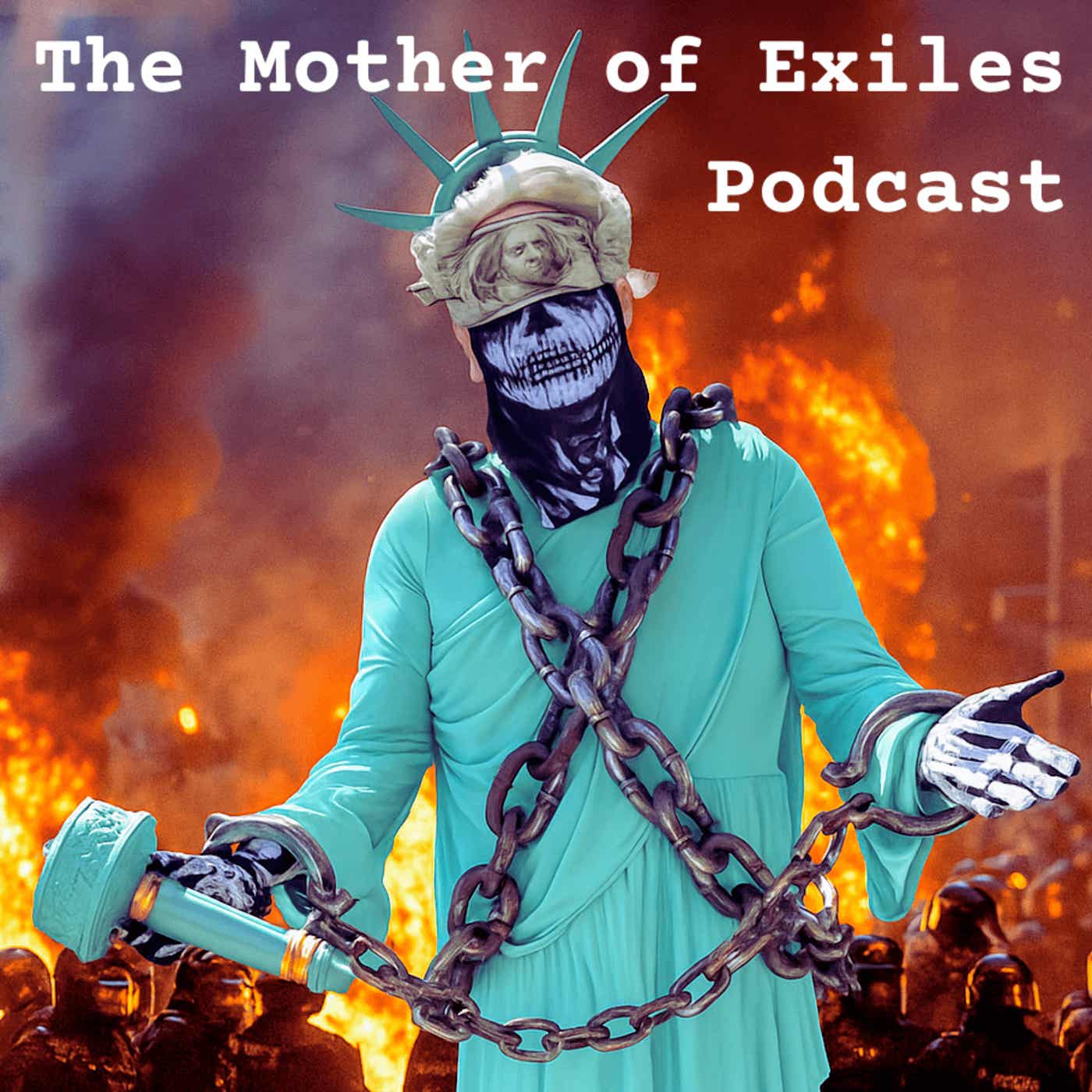
PODCAST · society
The Mother of Exiles
by Her beacon burns brightly, igniting the Counter-Attack.
Each episode of The Mother of Exiles exposes Donald J. Trump’s authoritarian regime and reveals the strategies, ideas, and actions that fuel the Counter-Attack. Learn, defy, and rise against the regime. robinliberte.substack.com
-
28
Chronicle 7: The Security State Doesn’t Begin With Force
Reading Time: 30 minsTL;DR* Authoritarian systems do not begin with open force; they begin with quiet legal and administrative changes that weaken oversight and normalize expanded authority.* Federal enforcement deployments over the past year functioned as tests, teaching the state how much force it could use without triggering effective democratic restraint.* Minnesota marks the point where those precedents are applied directly, bringing enforcement, resistance, and institutional conflict into everyday civic life.* Democratic backsliding advances through delay and normalization, not sudden rupture, allowing power to operate through existing institutions rather than breaking them.* The United States now sits in an enforcement phase of democratic backsliding, where reversal remains possible but becomes harder as enforcement becomes routine. This is a public episode. If you would like to discuss this with other subscribers or get access to bonus episodes, visit robinliberte.substack.com
-
27
Series 04: Order, Authority, and the Promise of Stability
DescriptionThis is Episode 04 of the 10-episode After The In-Between Time series.This episode examines how political systems respond when democratic participation becomes strained, and how promises of order and stability gain force under those conditions. It traces how authority consolidates, how legitimacy is redefined, and how democracy is repositioned rather than removed.By treating fascism as a mode of systemic reconfiguration rather than an ideological exception, the episode shows how continuity is maintained beneath apparent political change, and how the range of available responses narrows once order becomes the governing priority.Runtime: 12:30 minutesReading Time: 10 minutesTL;DR* Democratic fatigue establishes the conditions under which democracy is repositioned within the system.* As participation strains, political legitimacy shifts toward order, stability, and performance as organizing priorities.* Authority consolidates in response to delay, fragmentation, and coordination pressure within existing institutions.* Fascism is analyzed as a systemic reconfiguration of authority and legitimacy within continuity, rather than as an ideological anomaly.* Once order becomes the governing priority, the range of available political responses narrows even as democratic forms remain visible.TranscriptSECTION 1 — Democratic FatigueDemocratic fatigue was fully discussed in Episode 03, Democracy Inside the System, which provides the foundation for this episode.Under a state of democratic fatigue, public participation in democracy continues, but its ability to influence has narrowed. Democratic processes repeat, but outcomes feel limited. The effort required to remain engaged exceeds what engagement can reliably provide.When sustained participation produces limited change, expectations adjust. People remain inside democratic systems, but they lower what they expect those systems to deliver.That adjustment creates the conditions this episode examines. Fatigue does not remove democracy from view. It changes how democracy is positioned within a society and opens space for other forms of authority to claim effectiveness, coherence, and stability. That’s what we’re experiencing with the Trump regime.SECTION 2 — The Promise ShiftsAs democratic participation becomes harder to sustain, the language used to justify political authority changes. Legitimacy becomes associated less with involvement and more with performance. Process gives way to results. Deliberation is retained within constraints set by coordination and execution.Stability becomes a primary political promise. Order is framed as a condition required for systems to function without interruption. Continuity is treated as a public good in itself. These promises respond directly to the strain experienced by citizens. When decision-making appears stalled, speed becomes valuable. When outcomes feel uncertain, predictability becomes reassuring. When participation feels burdensome, authority that reduces complexity appears efficient.Democratic language continues to circulate within the changing system. Elections continue. Institutions remain in place. Legitimacy is still described using familiar terms. What changes is which qualities are treated as essential. Participation becomes conditional. Debate is increasingly procedural. Dissent is tolerated so long as it does not interfere with the system’s operations. Order is treated as a condition that democratic processes must abide by.As this logic settles in, heavy-handed authority is justified as necessary for continuity. Concentrated decision-making is presented as practical and efficient. Limitation is presented as protective. The promise offered is the continuation of existing arrangements with less interruption: fewer delays, fewer visible conflicts, and fewer demands on participation.Because these promises emphasize continuity, they align with existing institutional and economic arrangements. Capital continues to circulate throughout the system. Administrative systems continue to operate. Risk is managed rather than redistributed. At this stage, democracy remains visible while its operational role narrows.SECTION 3 — Authority as SolutionAs order and continuity become governing priorities, authority is reframed as a solution. Concentrated decision-making at the top is treated as a response to accumulated delays, institutional bottlenecks, and systemic failures within democratic systems. The response focuses on decision speed and enforceability: the ability to decide quickly, implement consistently, and maintain alignment across administrative and economic systems. Authority is presented as a way to keep such systems operating under pressure.Legislative processes are described as too slow for the pace of deregulated markets, infrastructure management, and crisis response. Deliberation is framed as incompatible with urgency. Negotiation is recast as an obstacle to execution. Decision-making is centralized within executive offices and insulated institutions. Executives acquire broader discretion as long as their vision and management align with those above them. Regulatory and judicial bodies are encouraged to coordinate with executive direction rather than challenge it. Each shift is described as necessary to maintain continuity.Authority is framed as an administrative response to systemic stress. Its language emphasizes decisiveness, discipline, and command. Control is treated as a requirement for stability, and compliance is framed as necessary.Democracy remains present, but its role in the political process changes. Participation primarily supplies legitimacy after decisions are made. Elections function as mechanisms of selection rather than direction. Accountability is evaluated through output, order, and continuity rather than shared control. This reconfiguration limits where democratic participation can meaningfully affect outcomes. Authority fills the space created by fatigue and delay, promising coherence and continuity. The result is structural. Authority becomes the organizing principle around which democratic forms are repositioned.SECTION 4 — Fascism as Systemic ReconfigurationUnder sustained pressure, some systems reorganize authority more completely. Fascism is one such form of reorganization. It develops through changes in how authority is held, how legitimacy is defined, and how organization is enforced across political, economic, and social institutions.Under fascism, authority is concentrated and unified. Decision-making is centralized. Institutional plurality is reduced in favor of a single commanding center. Legitimacy is tied to performance, order, and national coherence. Stability functions as proof of correctness. Continuity becomes the primary measure of success.Democratic forms may remain visible, while their role is altered. Participation is directed toward affirming unity, and opposition to the system is treated as a source of radicalism. Pluralism is managed as a condition requiring control. This arrangement narrows the range of acceptable outcomes.Economic and social coordination are brought under tighter control. Labor, capital, and institutions are aligned toward centralized objectives. Conflict is handled through discipline and enforcement. This form of reorganization typically follows periods of instability. It presents itself as a restoration of the nation, with command and control of most aspects of life positioned as a way to reduce delay and uncertainty.The defining feature of fascism is the consolidation and insulation of authority. Decision-making becomes durable. Legitimacy is anchored in continuity. Change proceeds only within limits set by centralized power. It functions as a mode of continuity beneath apparent rupture. Structures are rearranged, authority is intensified, and stability within the existing system remains the objective.SECTION 5 — Democracy Deferred or DisplacedAs authority consolidates, democracy changes position within the system. It remains formally present while decision-making moves into insulated institutional settings. Its public-facing role centers on validating outcomes rather than shaping them.Democratic participation is organized around discrete moments. Electoral procedures continue on formal schedules, with their competitive scope and consequences increasingly constrained. Public input is invited after agendas and boundaries have already been set. The public’s ability to shape outcomes shrinks even as democratic forms remain visible.Decisions with the greatest structural impact are developed earlier in the process, within executive offices, security frameworks, and aligned institutions. Participation occurs after those decisions have been narrowed. Under these conditions, democracy functions as confirmation. Participation registers acceptance. Consent follows action. Legitimacy accumulates through acknowledgment rather than authorship.The burden of legitimacy shifts onto the public, even as its capacity to shape outcomes continues to contract. Democracy remains embedded in the structure. Its public-facing role continues to center on registering consent. Power is organized within insulated decision-making centers, and democratic processes record public alignment with decisions made within those centers.SECTION 6 — Structural ContinuityAs authority consolidates and democratic participation is repositioned, continuity becomes easier to identify. Existing arrangements of ownership, administration, and economic coordination persist. The relationship between state authority and economic power remains intact, even as political form changes.Institutions adjust their posture rather than their basic composition. Personnel rotate through leadership roles. Procedures are modified to support centralized decision-making. Structural relationships endure. This persistence reflects the system’s capacity to reorganize while preserving its core functions. Administrative systems continue to manage labor, resources, and compliance. Markets continue to operate, and capital continues to circulate.Decision-making becomes more insulated. Authority is buffered from disruption. Reversal becomes less frequent. Uncertainty is reduced through centralized command and enforced coordination. Visible changes can be substantial. New symbols appear. New language circulates. Authority becomes more explicit and more concentrated.At the same time, the operating environment remains familiar. Economic hierarchies persist. Production continues. Extraction and accumulation proceed under revised political conditions. Continuity operates at the structural level. Political form adapts to preserve system function. Authority intensifies to secure stability. Democracy is repositioned to sustain legitimacy.The tension between stability and participation remains present and is managed through containment, insulation, and control.SECTION 7 — EndingBy the time authority consolidates to this degree, the shift appears procedural and routine. It is embedded in the everyday mechanisms through which decisions are made, justified, and enforced. Order has been delivered as a governing priority. Stability organizes political evaluation. Continuity is maintained through insulation, coordination, and command.Democracy remains present within this arrangement. Its language circulates. Its rituals persist. Power moves through narrower channels. Decisions take shape earlier, within restricted settings, and across fewer points of challenge. Participation follows those decisions, and legitimacy is sustained through public alignment and acceptance.Once these patterns take hold, they become self-reinforcing. Authority organizes decision-making. Stability becomes the standard by which outcomes are judged. Democratic forms remain in circulation, but they operate within boundaries already set.From inside this arrangement, the system appears settled. Choices narrow. Alternatives feel abstract. Power moves along established channels, and legitimacy follows behind it. The significance of this structure lies in how it shapes the range of responses that remain available after order has been restored.If this piece shook something in you, please subscribe and share, but also talk to your family, friends, and neighbors. This fight to save democracy ends when people stop engaging. This is a public episode. If you would like to discuss this with other subscribers or get access to bonus episodes, visit robinliberte.substack.com
-
26
Chronicle 06: What Happens When Leaders Seize The Economy
PreviewThis 10-minute audio blog examines what happens when economic policies stall growth and political leaders face a choice: change course or find someone else to blame. This Chronicle traces how attacks on the Federal Reserve follow a familiar historical pattern in which leaders seize economic authority to avoid responsibility—and what that choice has produced before.Reading Time: ~9 minutesTL;DR* Trump’s escalating attacks on the Federal Reserve are rooted in economic stagnation and the need to assign blame for policy-driven failures.* Independent economic institutions often become targets when leaders seek control without accepting responsibility.* History shows this pattern clearly in Nazi Germany, military-dictatorship–era Chile, and post-Soviet Russia.* Politicizing economic authority weakens institutions, distorts markets, and deepens long-term instability before collapse is visible.* Naming the pattern and resisting normalization matter while institutional independence still exists.1. What Is Happening NowIn recent weeks, Donald Trump has escalated his public and institutional attacks on Federal Reserve Chair Jerome Powell. He has accused Powell of incompetence, openly discussed removing him, and allowed a criminal investigation into the Federal Reserve’s headquarters renovation to be framed as mismanagement and dishonesty. At the same time, his administration has intensified its broader campaign against the Federal Reserve’s independence.These events are not isolated. They are happening in the context of a stagnant economy, rising uncertainty, and growing public frustration with the cost of living and economic instability.2. The Pressure to Assign BlameWhen an economy stalls, political power looks for somewhere to place responsibility. In this case, the White House has chosen the Federal Reserve.This episode is about that choice.3. Policy, Consequences, and ScapegoatsThe administration’s economic agenda has relied heavily on tariffs, trade disruption, and aggressive political intervention in markets. Those policies have slowed growth, raised costs, and undermined confidence. Rather than acknowledge those effects, the administration has redirected blame toward the institution responsible for monetary policy.The Federal Reserve is a convenient target because it sits at the intersection of visibility and insulation. It has immense influence over economic conditions, but it is designed to operate independently of day-to-day politics. That independence makes it easy to portray as unaccountable when outcomes disappoint. By attacking the Fed Chair, political leadership can project decisiveness, claim economic control, and redirect public anger away from its own policy choices without formally owning responsibility for the results.4. A Familiar Authoritarian PatternThis tactic is not unique to this regime or this moment. When leaders confront economic stagnation created by their own policies, they often move to subordinate independent economic institutions rather than revise those policies. Central banks, finance institutions, and regulatory bodies become targets because they stand between political authority and economic control. History shows that once those institutions are brought to heel, blame can be reassigned and power can be consolidated, even as underlying economic problems deepen.This is not new, and it has appeared before when leaders facing economic failure sought to bring independent economic institutions under political control.5. Historical Case Study: Nazi GermanyIn Nazi Germany in the early 1930s, severe economic hardship preceded political consolidation. The collapse of the Weimar economy, driven by the Great Depression, mass unemployment, debt crises, and the destabilizing effects of earlier reparations and austerity, produced widespread public discontent and fear. That economic distress created the conditions under which Adolf Hitler and the Nazi regime moved to bring the economy under centralized political control. Independent financial institutions were subordinated to the state, monetary and industrial policy were aligned with regime priorities, and economic management became an instrument of political authority. In the long term, this consolidation distorted markets, militarized production, suppressed corrective feedback, and contributed to economic collapse alongside catastrophic human consequences.6. Historical Case Study: Military Dictatorship–Era ChileIn military dictatorship–era Chile, economic hardship and instability were used to justify centralized political control over the economy. Inflation, capital instability, and public fear were framed as existential threats requiring authoritarian intervention. Under Augusto Pinochet, the military regime dismantled democratic oversight and brought economic power under direct state and military control by banning independent unions, suspending collective bargaining, fixing labor conditions by decree, and restructuring the economy through privatization enforced without public consent. Central economic decisions were insulated from accountability and backed by military repression. In the long term, this consolidation produced extreme inequality, entrenched elite control, social repression, and lasting damage to Chile’s democratic and economic resilience.7. Historical Case Study: Post-Soviet RussiaIn post-Soviet Russia, prolonged economic hardship and instability created the conditions for centralized political control over the economy. The economic collapse of the 1990s, marked by hyperinflation, asset stripping, wage arrears, and public insecurity, generated widespread demand for order and stability. Under Vladimir Putin, the state reasserted control over key economic sectors by subordinating the central bank, bringing major energy companies under political authority, and using taxation, regulation, and criminal prosecution to discipline or remove independent economic actors. Markets were reorganized to serve regime priorities, and economic power became inseparable from political loyalty. In the long term, this consolidation produced stagnation, corruption, capital flight, and an economy highly vulnerable to shocks, sanctions, and political miscalculation.8. The Pattern Reappears in the United StatesIn the United States today, economic stagnation and rising public frustration have created pressure on political leadership to explain deteriorating conditions. Trade disruption driven by tariffs, elevated prices, and policy uncertainty has weakened growth and confidence, producing the same kind of public unease seen in earlier cases. Rather than confront the role of those policies, the Trump regime has moved to place economic authority under tighter political control by targeting the independence of the Federal Reserve and its chair. Investigations, threats of removal, and performance-based accusations function to subordinate monetary authority to executive power. The result, already visible, is institutional weakening, loss of credibility, and an economic system increasingly shaped by political loyalty rather than corrective feedback.9. What Changes When Economic Authority Is PoliticizedWhen economic authority is politicized, damage occurs long before any visible collapse. Independent institutions lose credibility, policy signals become unreliable, and decision-making shifts from corrective feedback to loyalty and fear. Markets respond to uncertainty rather than confidence, and households absorb the cost through higher prices, reduced investment, and prolonged instability. Over time, the system becomes less capable of self-correction because dissent and expertise are treated as obstacles rather than safeguards. The result is an economy that appears controlled in the short term while becoming more fragile, more distorted, and harder to repair.10. Drawing the LineWhat is happening here has a name, and refusing to name it is how it takes hold.When political power damages the economy through its own policies and then moves to seize control of the institutions designed to limit that damage, accountability collapses inward. Authority no longer answers to the public; it answers to itself. That is the boundary that has been crossed, and crossing it turns neutrality into complicity.This moment will not announce itself as a crisis. It will normalize through repetition and fatigue, and it will condition people to accept control as correction and punishment as management. That normalization is the danger.The framing deserves public resistance. Language that disguises blame as oversight and power grabs as accountability deserves refusal. What is being done warrants clear naming, and the reasons for it warrant a clear statement.This conversation belongs in public life and private life alike, among family members, coworkers, and neighbors. It belongs in circulation, repetition, and defense wherever it is pressured into silence. Investigations and threats should not be permitted to launder responsibility for economic failure.This does not end when indicators improve or markets recover. It ends when people refuse to surrender economic authority to political fear.Remain engaged and remain defiant. Do not let this become normal.In defiance and in solidarity, I am, Robin Liberte’, The Mother of Exiles. Activist. Artist. Author.If this piece shook something in you, please subscribe and share, but also talk to your family, friends, and neighbors. This fight to save democracy ends when people stop engaging. This is a public episode. If you would like to discuss this with other subscribers or get access to bonus episodes, visit robinliberte.substack.com
-
25
Series 03: Democracy and the Price of Engagement
DescriptionThis is Episode 03 of the 10-episode After The In-Between Time series.This episode examines how democracy operates inside an existing economic system: how participation is shaped in advance by time, cost, risk, and institutional sequencing.Rather than asking whether democracy exists or should exist, this episode traces how engagement functions under constraint, why outcomes arrive late, and why strain accumulates even when democratic procedures remain intact.Runtime: ~5:30 minutesReading Time: 5 minutesTL;DR* Democracy operates inside an economic system that shapes time, risk, and survival before participation ever begins.* Participation isn’t a single act; it requires sustained involvement that carries uneven and cumulative costs.* Democratic processes move episodically, while economic systems move continuously, causing participation to arrive late.* Outcomes persist across cycles due to institutional buffering, memory, and momentum, not conspiracy or intent.* As strain accumulates, disengagement and volatility emerge as predictable structural responses, not moral failures.TranscriptDemocracy and the Price of EngagementHow participation is shaped by time, cost, and sequencingPeople talk about democracy as if it floats above the economy.As if it exists on its own terms.Democracy operates within an existing system. It lives inside an economic structure that shapes time, risk, attention, and survival long before anyone reaches a ballot. That system does not cancel democracy. It conditions it.Before a single vote is cast, participation has already been shaped: Who has time to show up. Who can afford to lose a day’s wages. Who can take a risk without catastrophic consequences. Who must keep working to stay alive.These conditions function as structural filters on participation. Participation is often imagined as a single act: A vote cast. A meeting attended. A form signed.In practice, participation requires sustained involvement. It asks people to return again and again: to hearings scheduled during work hours, to processes that move slowly, to systems that demand persistence without guaranteeing return.Each encounter carries a cost: Missed income. Administrative risk.Employer scrutiny. Fatigue that accumulates rather than resolves. Those costs are not evenly distributed. For some, participation is inconvenient. For others, it is destabilizing.Participation carries measurable and unequal costs within the system. Over time, those costs shape who remains engagedand who exits, not all at once,but gradually.Democracy promises equal voice. Capitalism distributes unequal capacity. These two realities coexist in lived political practice. This is why participation declines without anyone banning it. Why turnout falls without repression. Why disengagement looks like apathy but functions like exhaustion.When survival depends on private capacity, civic engagement becomes unevenly distributed. And this is where democracy begins to strain.Belief alone does not generate time, security, or leverage.Inside the system, democracy becomes procedural: You can vote. You can speak. You can assemble. But those acts occur on a schedule.Democratic time is segmented. Episodic. Bound by calendars, deadlines, and delayed implementation.Economic time is different. It is continuous. Responsive. Anticipatory.Markets adjust before votes are cast. Institutions adapt before reforms arrive. Decisions are priced in long before participation registers.So democratic input often arrives after trajectories have already been set. Outcomes carry forward through institutional buffering. Capital maintains momentum across cycles. Institutions accumulate memory. Markets absorb shock faster than publics do. Policies move through layers of procedure. Conditions shift underneath them.By the time corrections arrive, effects are already distributed. This lag is structural. The dynamic is driven by timingrather than intent.Democracy operates episodically. Capitalism operates continuously. One responds. The other preconfigures. This is why reform feels real but limited. Why victories arrive narrow and fragile. Why reversals happen quickly.The system proceeds without adjusting its pace to democratic processes. And so democratic ideals mutate. Participation becomes symbolic. Choice becomes constrained. Representation becomes distant. The field of available options is narrowed before participation even occurs.What remains viable is what fits existing incentives, existing constraints, and existing momentum. Choice persists, but its scope contracts.Inside the system, democracy becomes a stress test. It reveals where power actually sits. Who can wait. Who can absorb loss. Who can exit, and who cannot.Strain accumulates quietly. Dissatisfaction grows without rupture. Legitimacy erodes without collapse. Everything appears functional—until it doesn’t.And when democracy fails to deliver material change, disengagement emerges when participation no longer produces intelligible outcomes. Some withdraw. Some radicalize. Some look for authority that promises speed instead of consent.This response follows predictably from structural conditions. Democratic decisions are made inside processes that continue moving without waiting for participation, consent, or legitimacy. That tension never resolves. It only becomes more visible. That visibility is the condition we are now in.If this piece shook something in you, please subscribe and share, but also talk to your family, friends, and neighbors. This fight to save democracy ends when people stop engaging. This is a public episode. If you would like to discuss this with other subscribers or get access to bonus episodes, visit robinliberte.substack.com
-
24
Chronicle 05: How Power Is Being Reorganized
This 7-3/4 minutes audio blog examines how three separate developments: elite ideological shifts, withdrawal from international institutions, and the normalization of unilateral pressure, fit together as part of a broader reorganization of power in U.S. governance. Rather than treating these moves as isolated or routine, it traces the structure they form when read side by side and places that structure in historical context. The focus is not prediction or prescription, but clarity: how power is being exercised in the United States now, and what becomes visible when the pattern is seen as a whole.Reading Time: 7 minutesTL;DR* Three recent developments: elite anti-democratic ideology, withdrawal from international institutions, and unilateral pressure on other states, form a coherent pattern when read together.* Ideas associated with the Dark Enlightenment gained influence among political and technological elites, narrowing how legitimacy and accountability are defined.* The United States withdrew from sixty-six long-standing international agreements, reducing external constraint and shared obligation.* Pressure toward other countries increasingly emphasized resources, strategic position, and hemispheric dominance rather than cooperation.* Read structurally and historically, these moves reveal how power is being reorganized in U.S. governance without spectacle or crisis framing.Chronicle 05: How Power Is Being ReorganizedDemocratic rejection, institutional withdrawal, and the use of unilateral force in U.S. governancePart 1: Present Signals A pattern emerged last week: three developments reported separately pointed in the same direction. An ideology that rejects democratic legitimacy circulated among political and technological elites. Often referred to as the Dark Enlightenment, it treats democracy as a failure rather than a value. Popular participation in it is framed as noise. Elections are treated as destabilizing rather than legitimizing. Governance is recast as an engineering problem, best handled by insulated decision-makers, technical expertise, and concentrated authority. Order, speed, and hierarchy are elevated as virtues. Accountability narrows to performance rather than public consent, and legitimacy is measured by output rather than representation. At the same time, the United States formally withdrew from 66 international organizations and agreements it had participated in for decades. The administration announced exits from United Nations affiliated bodies and international climate institutions through executive action. The decisions were implemented quickly, without extended legislative process or multilateral consultation. Membership was terminated. Funding was halted. Participation in shared decision-making structures ended. The result was immediate and concrete. Fewer binding commitments, fewer venues for coordination, and fewer external constraints on U.S. policy.Alongside those withdrawals, the language of the U.S. toward other countries hardened. The administration publicly signaled willingness to use force beyond Venezuela with Greenland, Colombia and Mexico repeatedly appearing in a similar threatening way. The posture was framed inside a revived Monroe Doctrine, branded as “The Donroe Doctrine.” It aligned with the 2025 National Security Strategy’s stated intent to reassert U.S. political and economic interests, and protect access to key geographies and strategically vital assets. Venezuela’s oil and Greenland’s strategic location were treated as key assets to secure, and Mexico and Canada, where border security, trade leverage and geography were framed in terms of pressure and dominance.Taken individually, each of these actions could be treated as routine. Read together, they reveal a shift in how power is being exercised. Long-standing anti-democratic ideas gained institutional relevance within the regime. What matters is not any single decision it’s made, but how these moves fit together while still being described as ordinary. Part 2. Historical ExamplesThe alignment of theory, policy, and action is not unprecedented. In fact, it’s the standard operating principle for how government should work, until government works against the better interests of its people and their neighbors.In the early 1930s, Nazi Germany rejected liberal democracy as illegitimate and destabilizing. Authority was centralized, and legitimacy shifted toward order and national performance. In 1933, the country withdrew from the League of Nations, casting international oversight as incompatible with national renewal. Expansion followed. Germany annexed Austria and dismantled Czechoslovakia through pressure and threat, securing industrial capacity, labor, and strategic depth.During the same period, Imperial Japan elevated hierarchy and national unity over democratic participation as military elites gained influence. After criticism of its occupation of Manchuria, Japan withdrew from the League of Nations. Expansion across East Asia followed. Access to oil, rubber and raw materials was treated as essential to economic stability and military readiness. Territorial control was pursued as a necessity tied to survival.Fascist Italy pursued a parallel sequence. Liberal democracy was rejected in favor of centralized authority and national hierarchy. When international institutions condemned Italy’s invasion of Ethiopia, sanctions were dismissed as illegitimate interference. Expansion pursued territory, resources and prestige through open military force and disregard for international norms.Taken together, these cases reveal a shared structure rather than a shared ideology. Governing ideas hostile to democratic constraint gained authority first. International systems were exited or rejected next, removing shared rules and external scrutiny. Pressure followed outward, focused on territory, resources, and strategic position.These regimes did not coordinate their actions but the sequence aligned and reshaped how power was exercised while each step was still presented as reasonable and limited. Part 3: The Present DifferenceHistory clarifies structure rather than outcome. It shows how the alignment of governing ideas withdrawal from international institutions and pressure on foreign countries has reshaped systems before without dictating how it must unfold again. What distinguishes the present moment is the distribution of power.The United States now operates from a position of global economic, military, and institutional dominance. Its capacity to shape markets, project force, and set terms extends across regions and systems limiting other nations’ ability to constrain it.In the 1930s, Germany, Japan and Italy acted in a multipolar world. Withdrawal from international institutions increased friction. Expansion into other sovereign nations provoked resistance. Power was contested. Pressure escalated into confrontation because no single country could enforce its will without consequence.The present day operates differently. Withdrawal from international institutions does not generate an immediate response, particularly if it’s the United States withdrawing. Pressure can be applied through tariffs, sanctions, security threats, and unilateral policy changes without producing immediate military confrontation. These tools allow strategic objectives to be pursued incrementally, through leverage and procedure, but who is willing and able to take such action against the U.S.?Today, power is enforced through unilateral action, but international rules are followed when they align with US interests and ignored when they do not. International bodies are used to legitimize decisions already made or bypassed entirely, leaving outcomes to be determined by those who can impose economic, political, or military costs, not by who has agreed to them.What is happening now does not arrive as a crisis. It’s unfolding slowly through institutional withdrawals, policy decisions, and public threats that appear manageable, if not reasonable, when viewed as separate stories. Read together, they show how power is being organized and exercised at the global scale, a new world order unfolding before our very eyes. In defiance, and in solidarity, I am, Robin Liberté, The Mother of Exiles. Activist. Artist. Author.If this piece shook something in you, please subscribe and share, but also talk to your family, friends, and neighbors. This fight to save democracy ends when people stop engaging. This is a public episode. If you would like to discuss this with other subscribers or get access to bonus episodes, visit robinliberte.substack.com
-
23
Chronicle 04: Warehouses
Last week, the United States began laying the groundwork to hold tens of thousands of people in warehouse-style detention facilities.Not as an emergency measure. Not as a temporary overflow. As infrastructure.This episode is not about a single policy announcement or a spike in arrests. It is about a historical sequence — one that repeats across regimes and decades — in which detention expands faster than resolution, and containment becomes an acceptable substitute for decision.History does not repeat itself exactly. It repeats its order of operations.This 8-minute audio blog examines that pattern — in Germany, in the United States, in France — and asks what it means to recognize it while construction is still underway.Listen closely. Pay attention to what is being built, and do not mistake this phase for something procedural.(Photo Credit: Public Domain: WWII: Concentration Camp Victims, 1945 (HD-SN-99-02762 DOD/NARA)" by pingnews.com is marked with Public Domain Mark 1.0.)Reading Time: 7 minutesTL;DR* The U.S. is expanding detention capacity to hold tens of thousands of people in warehouse-style facilities, signaling a shift from deportation toward long-term containment.* This pattern is not new: historically, states build detention infrastructure before they decide what to do with the people inside it.* In Nazi Germany, camps and ghettos normalized containment long before extermination was formalized.* In the United States, Japanese American incarceration showed how legality can replace evidence, allowing detention to persist even as justifications collapse.* In France’s Algerian War, a modern democracy detained millions under “security” logic, proving mass detention can become normal governance without ending democracy outright.Chronicle: Warehouses - The Quiet Normalization of Mass DetentionThere are weeks when history moves quietly, and then there are weeks when it begins laying foundation for what’s to come.This is one of those weeks, and the good people of the United States must go into it with eyes wide open. Do not look away from this moment in history.The federal government is preparing to hold up to eighty thousand human beings in warehouse-style detention facilities.Not tents. Not overflow shelters. Warehouses. Structures designed for storage, not care. For duration, not passage.That number is not incidental. It is declarative. You do not build space for eighty thousand people unless you are preparing for something that does not resolve quickly.And that is the first truth of this moment: detention is moving faster than deportation, faster than law, faster than justification.Arrests are rising. Deportations are not.People are being pulled into custody at a rate the system cannot complete, cannot process, and cannot conclude.So the system does the thing states always do when resolution fails: it holds.This is not chaos. This is not incompetence. This is the emergence of a new normal, and we have seen this before. Not in detail, in sequence.When people think about Nazi Germany, they usually start at the end: the extermination camps. But that is not how it began.It began in 1933, when the regime did not yet know what it would ultimately do with the people it labeled dangerous. What it wanted first was control, removal from public life.So it created protective custody: detention without trial, without charges, without timelines. Political opponents, labor organizers, dissidents, and Jews, were taken out of circulation and held in improvised camps.Detention came before decisions about fate.That mattered, because it taught the public something new: that holding people indefinitely could be normal governance, not an emergency.Then the regime expanded. After 1939, Nazi Germany controlled millions of Jews. Camps alone could not manage entire populations. So ghettos were created — sealed districts inside cities — justified as security, order, disease control.Camps removed individuals. Ghettos contained populations.Both were framed as temporary. Both were administrative. And both were built before the regime decided what it would ultimately do with the people inside.The catastrophe did not begin when killing started. It began when containment itself became acceptable. That is the pattern. You can see it again when the language shifts from people to capacity.The story being told today is still about enforcement: removal, borders, law. But the infrastructure being built tells a different story. A colder one. A more honest one.Warehouses are not built for quick outcomes; they are built for waiting. And waiting, in fascist systems like this, is never neutral.The United States learned this the hard way.In 1942, after Pearl Harbor, the U.S. government ordered the incarceration of more than 120,000 Japanese Americans, most of them citizens. There was no evidence of mass espionage. Intelligence agencies said so. Military leaders said so.But the absence of evidence did not stop the policy. The problem was reframed. This was no longer about guilt or innocence. It was about risk. People were not being punished; they were being relocated. Temporarily. For security.The mechanism was legal. Executive orders were issued. Courts deferred. Bureaucracy took over.Families were given days to leave their homes and businesses. They were first held in racetracks and fairgrounds, then transferred to more permanent camps.Here is the critical point: the camps were built before the government knew how long people would be held, or what would justify their release.When that question became unavoidable, the state improvised. Loyalty questionnaires appeared after incarceration had already begun. Temporary became indefinite. And because every step followed legal process, detention no longer needed evidence to sustain itself.That is the lesson: legality can stabilize injustice, especially when fear replaces proof.The same logic appears when detention is framed as management rather than punishment. France demonstrated this within living memory.During the Algerian War in the 1950s, the French state faced an insurgency it could not easily separate from civilian life. The challenge was not identifying perpetrators after attacks.It was controlling populations before violence could be proven.So France turned to administrative internment. Under emergency powers, authorities forcibly relocated and detained more than two million Algerian civilians, nearly a quarter of the population, into camps and regroupment centers.These people were not convicted of crimes. They were classified as security risks. Courts still existed. Elections still happened. Democracy formally remained intact. Internment was framed as temporary. Preventative. Necessary. The mechanism was bureaucratic. Police assessments replaced evidence. Suspicion replaced charges. Administrators, not judges, signed detention orders. Camps expanded while officials debated how long the emergency would last.Internment did not resolve the conflict, it managed it. And because it was legal, because it operated inside a democratic framework, it became normal.Millions were held not because it worked, but because it was easier than deciding what came next. That is the throughline.Containment first. Justification later. Normalization always.Which brings us back to now. We are not watching deportations accelerate. We are watching detention normalize. We are watching a country decide — quietly, administratively — that holding tens of thousands of people without resolution is acceptable.That decision is being made now. Not later. Not after the facilities are full. Now.History will not ask whether this was meant to be temporary. It will ask why the warehouses were allowed to go up without resistance.And it will ask who recognized the moment when containment stopped being a step and became the outcome.Pay attention to what is being built. Say what it means. Do not pretend this is procedural. This is history entering its construction phase.In defiance, and in solidarity, I am, Robin Liberte, The Mother of Exiles. Activist. Artist. Author.If this piece shook something in you, please subscribe and share, but also talk to your family, friends, and neighbors. This fight to save democracy ends when people stop engaging. This is a public episode. If you would like to discuss this with other subscribers or get access to bonus episodes, visit robinliberte.substack.com
-
22
After The In-Between Time: Ep 01 & 02
Listening Time: 12:30 minutesSeries NoteThis is After The In-Between Time, a 10-episode spoken series examining the system we already inhabit and what becomes visible once it is named.These first two episodes are presented together as an opening. The first names the system. The second looks at what that system does to participation, power, and outcomes.New series episodes will follow on a weekly cadence.Episode 01: The System We’re Already InThis episode marks the beginning of the series proper.After returning to earlier audio blogs that named the moment we are in and revealed the structure beneath it, the series now steps back to examine the system shaping modern political life.Episode 01 focuses on capitalism as the baseline environment we all live inside—how it organizes ownership, power, and expectation before political arguments begin. The episode treats capitalism as a background system that shapes what feels normal, realistic, or inevitable, often without announcing itself as a system at all.This is a spoken episode designed for close listening. Its purpose is orientation. By making the terrain visible, it prepares the ground for understanding the responses explored in later episodes.Episode 02 — Democracy Under ConstraintIn the first episode of After The In-Between Time, the system we already inhabit is named.This episode stays inside that environment and looks at what it does to democracy.Rather than asking whether democracy exists or matters, Episode 02 examines how democratic participation actually operates under capitalism. It traces the conditions that shape who can participate, how influence moves through institutions, and why outcomes often feel smaller than the effort that produced them.The episode follows participation as it encounters cost, procedure, economic leverage, and durability. Decisions are made. Outcomes are produced. But they are filtered, bounded, and compressed by systems designed to stabilize continuity over time.This is not an argument against democracy, and it is not a search for alternatives or solutions. It is a diagnostic episode, focused on recognition rather than prescription.Episode 02 concludes by naming the gap many people experience between participation and outcome, and by surfacing the time-based question that emerges when constrained systems are asked, repeatedly, to absorb pressure without changing shape. This is a public episode. If you would like to discuss this with other subscribers or get access to bonus episodes, visit robinliberte.substack.com
-
21
After The In-Between Time: A New Series for 2026
Preview text: A new audio series on the system we inhabit, and what comes after it.Over the past year, this Substack has been a place to sit with uncertainty, to name what I called the in-between time: a moment when the old story no longer holds, the next one hasn’t fully arrived, and the ground beneath us feels unstable. Much of that work, whether demonstrated as photomontage or performance art, video or slideshows, or audio and written blogs, has been developed from inside the moment itself, as events accelerated and familiar explanations stopped keeping pace. As a new year begins under a fascist regime, that uncertainty has sharpened, shaped by events that are no longer abstract, no longer distant, and no longer deniable. We are witnessing the consolidation of authoritarian power even as unexpected political ruptures emerge within it. Some developments escalate visibly. Others challenge what has long been treated as unchangeable.One such rupture arrived quietly: the swearing-in of Zohran Mamdani, a Muslim-American democratic socialist, as Mayor of New York City. In another political moment, this might have been read as a local story. In this case, it serves as a signal: pressure within a system that has been insisting that no alternatives exist.Together, these conditions raise a question that no longer feels abstract: what system are we actually living inside, and more importantly, given this moment, what comes after it?After The In-Between Time is an audio series that grows directly out of that question.The series steps back from the pace of daily events to examine the economic and political system we already inhabit; its strengths, its failures, and the subtle ways it shapes what feels normal, inevitable, or beyond challenge. The work here is clarity. Making these structures visible allows us to recognize where they no longer hold and where new possibilities begin to emerge.The series opens by returning to two earlier audio blogs: The In-Between Time and The Architecture of Fascism. These pieces were written as part of this Substack’s ongoing chronicle, and together they mark a threshold. One names the moment we are in. The other reveals the structure beneath it. They form the ground from which the series proceeds.From there, After The In-Between Time moves forward deliberately. New series episodes examine capitalism as the baseline system shaping modern political life and explore other political traditions as responses to the tensions produced by that system. These traditions are approached through the questions they ask about power, ownership, authority, and social organization. Each episode builds on the last. Understanding accumulates rather than resets.This is a spoken series designed for close listening. It moves slowly by design. The aim is recognition, staying with patterns long enough to see how they repeat, how they normalize, and how they train expectations over time.Some pieces on this Substack respond directly to events as they unfold. They are a chronicle of fascism unfolding in the United States. Other pieces step back to examine the system producing those events. Both are part of the same project.Once certain patterns are seen clearly, they tend not to disappear.For readers looking for recent chronicle context, check out:Warehouses — The Quiet Normalization of Mass DetentionIn defiance and in solidarity, I am, Robin Liberte’, The Mother of Exiles. Activist. Artist. Author.If this piece shook something in you, please subscribe and share, but also talk to your family, friends, and neighbors. This fight to save democracy ends when people stop engaging. This is a public episode. If you would like to discuss this with other subscribers or get access to bonus episodes, visit robinliberte.substack.com
-
20
Chronicle 03: The Undeclared War - The First Enforcement of the Trump Corollary
Listening Time: 11 minutesPreview: The United States has carried out an undeclared act of war by seizing the leader of Venezuela, marking the first enforcement of the Trump administration’s revived Monroe Doctrine. This audio chronicle places the action in historical context, tracing how undeclared force has been used by authoritarian regimes to consolidate regional power. Venezuela is not an isolated case, it is the opening test of a broader hemispheric strategy.Reading Time: 11 minutesTL;DR* The United States has carried out an undeclared act of war by seizing the sitting leader of a sovereign nation without extradition, declaration, or multilateral authorization.* This action is the first visible enforcement of the 2025 National Security Strategy’s revived Monroe Doctrine, rebranded as the “Trump Corollary,” which asserts U.S. dominance over the Western Hemisphere.* History shows that authoritarian regimes repeatedly use undeclared external force to consolidate regional control and stabilize power at home before formal wars are announced.* Comparable strategies appear in Nazi Germany’s prewar expansions, Argentina’s military junta, Russia’s annexation of Crimea, and U.S. interventions in Central America, such as El Salvador.* Venezuela is not an isolated case: if this doctrine is applied consistently, similar actions should be expected across the region as enforcement, not exception.Chronicle: The Undeclared War - The First Enforcement of the “Trump Corollary” and the U.S.’s Return to Hemispheric Rule1. A Line CrossedThis episode is about a line that has now been crossed.Not rhetorically. Not symbolically. Operationally.Late last week, the United States carried out a military operation inside a sovereign nation. It seized that nation’s sitting head of state, and it transported him to U.S. custody.There was no declaration of war. No extradition process. No multilateral authorization.That action did not emerge from nowhere.2. The Trump Corollary DoctrineIn December 2025, the Trump regime published its National Security Strategy, a formal, public document outlining how it intends to wield American power.At the center of that document is a clear claim: The Western Hemisphere is to be treated as a strategic domain in which U.S. preeminence must be restored and enforced. The strategy explicitly invokes a modernized Monroe Doctrine, rebranded as the “Trump Corollary.”This is not rhetorical nostalgia.The document defines foreign infrastructure projects, military partnerships, and economic influence in Latin America as strategic encroachments. Rival presence is not framed as competition. It is framed as a threat. One that must be removed. In effect, the hemisphere is redefined as a managed sphere of influence, not a community of sovereign equals.That matters.Because doctrines are not descriptive, they are operational. They exist to justify action in advance. So when a state publishes a doctrine asserting regional dominance, the real question is never whether it will be enforced. The question is where enforcement will begin.3. Enforcement: VenezuelaThe seizure of Venezuela’s president answers that question.It is not an aberration. It is not an improvisation. It is the first visible enforcement of that doctrine.I lived in Venezuela during the years leading up to the Chávez revolution. My daughter was born there. Members of my extended family still live in the country. I watched the nationalization of oil framed inside Venezuela as sovereignty, and outside it as a strategic threat. That was in the mid-1990s.What is happening now did not start with Maduro, or even with Chávez. It began when control over Venezuela’s oil shifted away from foreign interests. The current operation is not one authoritarian intervening against another. It is the reassertion of hemispheric control over a strategic resource, now carried out under the language of doctrine rather than diplomacy. And it was carried out in a very specific way.There was no extradition request. No international arrest warrant. No appeal to multilateral institutions. No regional consensus process. Force came first. Explanation followed. That sequence matters more than any press statement, because it marks a shift: away from process, and toward administrative violence.Power exercised without declaration. Without debate. Without reciprocal obligation.4. Pattern: How Undeclared War FunctionsThis episode is about what that kind of move has meant historically and what it is usually for.When states abandon declarations and treaties in favor of direct seizure, they are not improvising. They are following a pattern.History gives us repeated examples of authoritarian regimes using undeclared external violence to secure regional control and domestic authority at the same time. The logic is consistent, even when the ideologies differ.The following four historical cases show how undeclared force has been used before, and why it matters now.Case Study: Nazi Germany, 1936–1938Before Europe was formally at war, Adolf Hitler tested the limits of international restraint. In 1936, German troops marched into the Rhineland, in direct violation of the Treaty of Versailles. In 1938, Germany annexed Austria through coercion backed by military threat, framed as reunification rather than invasion.In neither case was war declared. In neither case was international law enforced.These actions were justified as historical correction and regional stabilization, but their function was strategic. Externally, they dismantled postwar constraints on German expansion. Internally, they demonstrated that the regime could reshape borders and defy norms without consequence.Each success lowered the cost of the next move. By the time war was declared, undeclared force had already been normalized. The lesson here is not ideology. It is threshold testing.Authoritarian regimes probe limits not to provoke immediate war, but to discover how much can be done without one.Case Study: Argentina’s Military Dictatorship, late 1970s–1982Argentina’s military dictatorship used the same logic.Throughout the late 1970s, the junta engaged in cross-border intimidation and covert operations, justified as hemispheric security. That logic culminated in 1982 with the invasion of the Falkland Islands. The operation was not primarily about territory. It was about legitimacy.Facing economic collapse and mass dissent, the regime used foreign conflict to rally nationalism, suppress opposition, and recast itself as defender rather than oppressor.Even though the war ended in defeat, the strategy followed a familiar authoritarian logic: foreign force used to consolidate domestic authority.Case Study: Russia’s Centralized, Personalistic Dictatorship, 2014–TodayModern Russia offers the clearest contemporary parallel.In 2014, Russian forces entered Crimea without a declaration of war. The operation combined military presence, legal ambiguity, and political theater. The annexation was justified as protection, reunification, and security.The objective was dual. Externally, it reasserted regional dominance and blocked rival influence. Internally, it reinforced regime authority through decisiveness and defiance of constraint.Subsequent operations followed the same model. Undeclared force. Legal ambiguity. Normalization through repetition. Each step made the next easier. Aggression was reframed as administration.Case Study: The United States Neoconservative Democracy, 1980sThe United States has its own history with this pattern.In El Salvador in the 1980s, the U.S. did not declare war. Instead, it provided military aid, training, intelligence support, and political cover to a regime engaged in mass repression. The justification was hemispheric security: the prevention of foreign influence.This was framed as stabilization. The outcome was catastrophic. More than seventy-five thousand people were killed. Death squads operated with impunity. Civilian massacres were minimized or denied.Domestically, this policy normalized secrecy, executive discretion, and the outsourcing of violence, while insulating leadership from accountability.El Salvador was not an anomaly. It was a template. Undeclared force. Indirect control. Hemispheric justification.5. Where We Are Now: The Enforcement PhaseWhich brings us back to now.The 2025 National Security Strategy makes its intentions explicit. It revives hemispheric dominance as policy. It frames Latin America as a zone to be secured. It identifies foreign presence as a threat to be removed. The seizure of Venezuela’s president fits that doctrine precisely.It bypassed international law. It bypassed regional process. It relied on force first, and justification later. And it signals something else just as important. This was not about Venezuela alone. If this doctrine is enforced consistently, Venezuela will not be the last test case. That is how doctrines work. They are not explanations of what has already happened. They are blueprints for repetition.6. The Precedent Is SetThe question is not whether this action will be defended. It already has been. The question is how often it will be used, because when undeclared war becomes policy, restraint becomes optional; and history shows that once that threshold is crossed, it is almost never crossed only once.This is where we are now. Not at the end of something, but at the beginning of its enforcement phase.We will know this moment mattered not by how it is justified today,but by how routinely it is invoked tomorrow.This is not speculation. It is precedent.In defiance, and in solidarity, I am, Robin Liberte’, The Mother of Exiles. Activist. Artist. Author.If this piece shook something in you, please subscribe and share, but also talk to your family, friends, and neighbors. This fight to save democracy ends when people stop engaging. This is a public episode. If you would like to discuss this with other subscribers or get access to bonus episodes, visit robinliberte.substack.com
-
19
Chronicle 02: The Architecture of Fascism
Listening Time: 18:30 minutesReading Time: 14 minutesTL;DR—* Dictators don’t just seize power; they reshape everyday space: maps, buildings, names, and symbols; until the nation itself reflects them.* From Stalin to Mao to Mussolini to Trujillo, cults of personality turned cities and landscapes into tools of loyalty and permanence.* These monuments aren’t vanity; they are strategies to outlive accountability and make removal feel unnatural.* Trump’s first year follows the same pattern: banners on federal buildings, the White House altered, institutions renamed, his face on the parks pass, and a battleship class bearing his name.* This is fascism taking form in real time, and it demands refusal, not patience.I. When Dictators Try to Become the NationThere is a moment in the life of a country when the symbols begin to shift. It doesn’t arrive with tanks or decrees. It comes quietly, in names, in portraits, in banners and buildings. The dictator’s face appears where a flag once was. His name replaces a place that used to belong to everyone. At first, it feels like vanity. Then it starts to feel like something much more.History shows us this moment clearly.It is the moment when a man stops wanting simply to govern a nation and begins trying to stand in for it. When his image, his name, his presence start to substitute for the country’s own symbols, institutions, and story.I have been thinking about that moment a lot lately, because I have watched it arrive here, in the world’s oldest continuous democracy, and it’s weighed heavily upon me.In the summer of 2025, standing as my street performance character, The Mother of Exiles, I stared in disbelief at the Department of Labor and the massive banner of Donald Trump’s face hanging from its façade. A federal building meant to represent workers and public service had become, at least for a time, another surface for a single man’s image. The photograph of that moment, captured by Geoff Livingston, still captures what it felt like: something shared amongst the American people being quietly overwritten.At the time, it might have been dismissed as branding. A provocation. A spectacle.Six months later, that same man was announcing a new class of battleships to bear his name.This is how it begins. Not all at once, but step by step.The question is not whether any single act is unprecedented. The question is what it means when they start to form a pattern, one that history has taught us how to recognize.II. The Old Pattern: Power That Demands a FaceLong before banners and buildings, before maps and monuments, there is a simpler instinct at work. Power wants to be seen. It resists remaining abstract. It wants a face.Across history, when dictators slide from governing into self-myth, they do not just issue orders. They insert themselves into the world people can see: onto walls and gates, coins and posters, plazas and street names. The state stops being an idea and starts being a person.Historians have a name for this: the cult of personality. Hannah Arendt warned that such regimes seek not only obedience, but emotional identification: a bond in which the dictator comes to stand in for the meaning of the state itself.What unites these cases is not just vanity, but a strategy of legitimacy. When authority begins to wobble, dictators respond not by strengthening institutions, but by making themselves unavoidable.This is the ground self-monument grows from, before statues rise, before cities are renamed, before the country is carved into a mirror. Here’s seven quick examples from history.Stalin: Writing Himself Onto the MapAfter Lenin’s death, Joseph Stalin (b: 1878; d: 1953) rewrote the Soviet Union’s geography in his own image.In 1925, Tsaritsyn became Stalingrad, and it was only the beginning. Cities, streets, factories, and entire regions across the USSR took his name, turning the map itself into a ledger of loyalty.Portraits and statues filled offices, schools, and public squares. His face followed citizens through daily life, fixed in stone and paint.By attaching himself to places people lived and worked, Stalin made his rule feel rooted in the land itself. The revolution was taught to look like one man.Long before terror consumed millions, the country had already been trained to see him as part of its landscape.Mao: The Face on the WallIn China, Mao Zedong (b: 1893; d: 1976) carried his image into the most intimate spaces of life.His portrait hung in classrooms, factories, village halls, and private homes. In Tiananmen Square, his face loomed over the political heart of the nation.Power moved into kitchens and classrooms, into places where daily life was supposed to be private.Children recited his quotations. Families were expected to display his image as proof of loyalty.The revolution became presence. To doubt Mao meant doubting the world you lived in.By the time the Cultural Revolution tore through society, Mao’s face had already been woven into homes and habits across China.The Kim Dynasty: The Capital as ShrineIn North Korea, under Kim Il-sung (b: 1912; d: 1994) and his successors, Pyongyang was rebuilt into a shrine to the ruling family.Wide boulevards and vast plazas organized the city around monuments to the Kims. At the Mansudae Grand Monument, citizens bowed before towering bronze statues.Mandatory portraits hung in every home. Inspectors ensured they were clean and displayed.The city was designed to direct how people moved, gathered, and looked.Parades and mass games turned human bodies into choreography for the regime.To live in the capital was to move through a landscape that taught permanence, training citizens to see the Kim family as inseparable from the nation itself.Saddam: Writing Himself into AntiquityIn Iraq, Saddam Hussein (b: 1937; d: 2006) tied his rule to the country’s ancient past.At the ruins of Babylon, he rebuilt walls stamped with inscriptions bearing his name, pressing a modern dictator into stone thousands of years old.Palaces rose above Baghdad, dominating skylines and sightlines.Murals cast him as a warrior and heir to ancient kings.Saddam recruited history into his rule, framing himself as the continuation of Iraq’s story.By the time war hollowed out the state, his image had already fused modern streets with ancient stone.Mussolini: Remaking RomeIn Italy, Benito Mussolini (b: 1883; d: 1945) reshaped Rome to claim imperial inheritance.Medieval neighborhoods were demolished to frame the Colosseum and Roman Forum as backdrops for fascist spectacle.The Via dei Fori Imperiali cut a parade route through the city, binding marches to imperial ruins.New marble districts like EUR projected order and destiny.Power embedded itself in streets and movement.Rome was forced to tell a story in which fascism appeared as the return of empire.Trujillo: Renaming a CapitalIn the Dominican Republic, Rafael Trujillo (b: 1891; d: 1961) turned the nation’s capital into his monument.In 1936, Santo Domingo became Ciudad Trujillo.Street signs, maps, documents, and passports carried his name. Saying where you lived meant repeating it.Portraits filled public buildings. Schools taught loyalty to the man whose name marked the city.Power replaced space itself.For twenty-five years, the country’s political heart beat under his name.Napoleon: When a Republic Crowns a ManIn France, Napoleon Bonaparte (b: 1769; d: 1821) rose from revolution through popular acclaim.He presented himself as defender of the republic, won plebiscites confirming his authority, and promised stability after chaos.Only later did he crown himself emperor.Triumphal arches, columns, coins, and portraits reshaped Paris into a monument to his victories.The rituals of empire followed the rituals of consent.Napoleon absorbed the revolution into himself, presenting personal rule as its fulfillment.He showed how easily a people who overthrow kings can still be taught to accept one.III. Turning HomeI used to read about these places and feel the comfort of distance.That was there. That was then.I told myself those stories belonged to other countries, other histories, warnings meant to be studied, not relived.Then I watched the White House itself begin to come apart.Trump came promising to “drain the swamp.” He cast himself as a right-wing populist; the man who would tear down a corrupt order and return the country to its people. Like Napoleon, he did not present himself as the enemy of the system, but as its savior.It began with a promise of renewal and rescue.Instead of dismantling power, he rebuilt it in his own image, binding his rise not to institutions, but to private loyalty and oligarch money.That recognition settled in when the East Wing was torn down to make way for a ballroom built to his taste.It marked a commitment to remaking the seat of government in his own image.The distance collapsed.It stopped feeling like history.It started feeling like home.IV. The PatternOnce you start looking, the pattern becomes impossible to unsee.It shows up as a timeline.As the slow realization that what you learned to recognize in other countries is now being written into your own. Here’s the current tally of Trump making America him.June 14, 2025 — A military parade.On his birthday, which also marked the 250th anniversary of the U.S. Army, tanks rolled and troops marched in the streets of Washington, D.C., folding military ritual into personal celebration.August 26, 2025 — A portrait banner hung from the Department of Labor.That summer, Trump’s face stretched across the façade of the Department of Labor, a federal building meant to stand for workers, labor rights, and public service to the American people.October 20, 2025 — Demolition of the East Wing begins.The White House started to come apart as crews tore down the East Wing to clear space for a new ballroom—paid for largely by private donations from major tech companies, defense contractors, cryptocurrency firms, and wealthy patrons. Trump also pledged personal funds, shaping the project to suit his own taste.November 25, 2025 — The redesign of the America the Beautiful National Parks Pass.Images of sweeping landscapes and wildlife of our National Parks were replaced by Trump’s scowling face beside iconic statesman, George Washington, breaking a long tradition of honoring the nation’s shared natural inheritance. December 3, 2025 — The Institute of Peace is renamed.The United States Institute of Peace became the Donald J. Trump Institute of Peace.December 18, 2025 — The Kennedy Center is renamed.The John F. Kennedy Center for the Performing Arts became the Donald J. Trump and John F. Kennedy Memorial Center for the Performing Arts.December 22, 2025 — A battleship class is named.Trump announced a new class of U.S. Navy battleships to be named after himself, referred to as the “Trump-class” with the lead ship designated as the USS Defiant. Secretary of the Navy John Phelan described the USS Defiant as the largest, deadliest, and most versatile warship ever conceived. Each of these can be defended. Each can be explained away.Together, they stop feeling like coincidence.From banner,to building,to institution,to monument,to fleet.From using the symbols of the nation to claiming them as his own.You have already seen this story. The only difference now is that it is happening here.And it is only the first year.V. Naming ItAt a certain point, the pattern stops being subtle.When a dictator’s face hangs on buildings, replaces landscapes, reshapes the people’s house, and brands institutions and steel, history gives us a name.This is how cults of personality are built.What Stalin did with cities.What Mao did with walls.What the Kims did with a capital.What Saddam did with antiquity.What Mussolini did with Rome.What Trujillo did with a capital’s name.What Napoleon did with a republic.And now, in the world’s oldest constitutional democracy, a president is inscribing himself onto its most visible institutions.The materials are different. The language is American. But the impulse is the same.This is not just self-love. It is appropriation: the quiet conversion of shared institutions into personal monuments, converting public inheritance into private legacy.Because once your name is on buildings and ships, once your vision has altered the White House, you are no longer just governing the present. You are trying to pre-write the future.This is how dictators try to outlive accountability.Impeachment, elections, and revolutions can remove a man from office, but stone and steel are harder to undo.We like to believe that voting is enough, but history is full of dictators who kept elections while emptying them of risk.Stalin staged votes that offered confirmation, not choice.Saddam ran referendums that returned near-unanimous approval.The Kims preserved rituals of acclamation.Napoleon wrapped the empire in plebiscites that made domination look like consent.They did not abolish elections. They hollowed them out.Max Weber, a German Sociologist, called this charismatic authority—power justified not by law or tradition, but by the supposed exceptional nature of the man himself. When that authority is carved into buildings and steel, it becomes an environment.Self-monument is preparation. It teaches people that the dictator is permanent. And that is what makes watching it unfold so unsettling. Because this is a man who has already shown his willingness to reject an election he lost. So, when he begins inscribing himself onto the nation, history tells us to treat it as architecture for a future where ordinary remedies may no longer apply.VI. Anger and UneaseThere is anger in seeing this happen.Anger at the brazenness of it. Anger at the casual way buildings, symbols, and public spaces are taken.There is also unease.Because this doesn’t just threaten laws. It threatens the sense that the country you live in will still recognize itself tomorrow.Dictators do not only seek loyalty. They seek resignation.Unease comes from recognizing that this works.Each step feels survivable on its own, until one day you realize you are living inside something you would have sworn could never happen here.Anger says: this is wrong. Unease says: this is working.Holding both at once is what it feels like to watch a democracy tested from the inside.VII. Refuse the MirrorEvery dictator who tries to carve himself into a nation is chasing the same illusion: that stone and steel can make him permanent.History shows how fragile that hope really is. None of them escaped history. They only delayed it.What does not fade on its own has to be confronted.Because the mirror they build is not just about how they want to be seen. It is about how they want the country to see itself.To accept that mirror is to accept that the nation and the dictator are the same thing.Refusing it is an act of citizenship, and also an act of resistance.It means saying this ends. Here. Now.It means naming what is happening while it is still happening; and here, right now, it’s fascism.It is fascism that personalizes power.It is fascism that demands loyalty over law.It is fascism that replaces institutions with a man.It is fascism that converts public inheritance into private legacy.It is fascism that teaches people to stop imagining removal.If the people who can see it will not say it, who will?Refusal is not symbolic. Refusal is what keeps this from becoming permanent. Because once maps change and rituals harden, undoing them becomes generational.That is what is being decided now.This is why anger matters. Why unease matters.They are alarms.History recognizes its own shapes.And so should we.This is not a suggestion.It is a line.Refuse the mirror.Refuse fascism.Join the resistance.In defiance, and in solidarity,I am, Robin Liberte’, The Mother of Exiles. Activist. Artist. Author.If this piece shook something in you, please subscribe and share, but also talk to your family, friends, and neighbors. This fight to save democracy ends when people stop engaging. This is a public episode. If you would like to discuss this with other subscribers or get access to bonus episodes, visit robinliberte.substack.com
-
18
Chronicle 01: The In-Between Time - Building a People’s Revolution That Lasts
Listening Time: 24:30 minutesReading Time: 21 minutesTL;DR* I went to Washington to help launch sustained, nonviolent resistance against an illegitimate regime, and to see if people power could really take root.* What we found wasn’t a single turning point, but the beginning of something fragile and real: thousands showing up, hundreds returning, learning how to last.* A people’s revolution isn’t spectacle, it’s a disciplined, collective withdrawal of consent, built on shared responsibility and care.* History and experience show that change depends on preparation: reliable participation, organizational maturity, coalition building, and readiness for transition.* We’re in the in-between time now, when the quiet work of building decides whether democracy can be renewed.I. Prologue: Leaving for WashingtonI left for Washington in early October with a backpack that was too heavy and a heart heavier still. Not because I thought I was going to change history. Not because I had a plan. But because staying home had begun to feel like its own kind of surrender.The country was in free fall. Every headline felt like another door slamming shut. Courts bending. Institutions blinking. A regime tightening its grip while pretending it was all still normal. And in that narrowing space, the same question kept rising, quieter each time but harder to ignore: If not now, then when? If not us, then who?So, I went.I told people I was going to volunteer. Which was true, in the plainest sense. Refuse Fascism and the Trump Must Go movement were calling for sustained nonviolent resistance beginning November 5, and I wanted to help however I could: pass out flyers, carry signs, hold space, and listen. I wasn’t arriving as anything more than another body willing to work. Another pair of hands. Another voice in the crowd.But inside, I knew it was more than that. It felt like crossing a line you can’t uncross.There comes a moment when watching is no longer enough. When posting, arguing, and doomscrolling start to feel like motion without movement. When the only way to find out what’s real is to step into it, even if you don’t know what waits on the other side.There comes a moment when watching is no longer enough.On the flight in, the city crept closer on the map while everything else grew less certain. I didn’t know who I would meet. I didn’t know what the streets would feel like once the chants began, or whether anyone would really show up. I didn’t know if this would be a spark or just another brief flare swallowed by the dark.What I did know was this: something in me had already shifted. The choice had been made. I was no longer asking what they were going to do. I was asking what we might be able to do together.Washington, DC, waited.And so did whatever came next.II. The Horizon: Why I Call It a People’s RevolutionI didn’t go to DC chasing a slogan. But somewhere between packing my bag and stepping onto that plane, I realized I needed a name for what I was hoping for, not just an action, not just a protest, but a different kind of future.I started calling it a people’s revolution. Original, right?Not because it sounds dramatic, and not because it promises something fast or easy, but because it names the only force I still believe can meet this moment: ordinary people, acting together, with discipline and courage, withdrawing their consent from a regime that no longer deserves it.When institutions fail to stop what is plainly wrong, when laws are twisted to protect power instead of restrain it, the burden doesn’t disappear. It shifts. It lands on people, on whether we are willing to show up for each other and insist, without violence but without apology, that this is not acceptable.A people’s revolution, as I mean it, isn’t chaos in the streets. It’s collective refusal. It’s saying: we will not normalize this, we will not collaborate with it, and we will not look away while the foundations of democracy are hollowed out.It’s also not about tearing everything down. Maybe some of it, but not all of it. The Constitution is not a relic to discard. It’s an inheritance, unfinished, imperfect, but rooted in the idea that power comes from the people and must answer to them. What makes this regime illegitimate isn’t that the promise is broken beyond repair. It’s that it violates that inheritance while daring the country to pretend otherwise.So when I say people’s revolution, I mean a nonviolent struggle to force democratic possibility open again; to clear space for renewal, for repair, for a future where rules mean what they say and those who govern do so with our consent, not our resignation.That horizon is what pulled me east. Not a guarantee. Not a blueprint. Just the belief that if anything is going to change, it will begin with people deciding, together, that this is the line.III. Crisis of Legitimacy and an American PrecedentWhat I felt most before leaving wasn’t just anger, it was something colder. The sense that the ground rules themselves were giving way. This wasn’t about one bad law or one outrageous decision. It was a pattern: power consolidating, accountability thinning, institutions signaling they could be bent without breaking, and then bent again. The language of democracy was still everywhere, but its substance was draining out.A crisis of legitimacy doesn’t announce itself with a siren. It creeps in. It shows up when people stop arguing about what’s right and start wondering whether it even matters anymore. When the system still speaks the words, but fewer and fewer people believe they mean anything.That feeling is old now. It’s commonplace. And that’s a problem.In the 1770s, the colonies didn’t leap straight to independence. First came Britain’s Intolerable Acts, proof that power would be imposed upon the colonies, not negotiated. Then, the First Continental Congress, an attempt to stand together and be heard. Only after that did the Declaration of Independence appear, naming a pattern of abuses and drawing the line from grievance to refusal.What made that moment revolutionary wasn’t just the courage of the words. It was the shift in claim: legitimacy no longer flowed from the crown. It flowed from the people.That same question hangs over our moment now. Not whether we like who’s in power, but whether this regime still deserves to govern at all.On December 13, in front of the White House, that question was spoken out loud in the form of The People’s Indictment of Donald Trump, a unified declaration that what we are living under is not merely unjust, but illegitimate. It didn’t pretend to be a court. It didn’t need to be. Like its historical echo, it was an assertion of standing: when institutions refuse to hold power to account, people can still name what they see.I don’t put these moments, The People’s Indictment and The Declaration of Independence, on the same scale. History doesn’t repeat that neatly, but the rhythm is familiar: grievance becoming coordination, coordination becoming declaration, and declaration pointing toward collective action.A crisis of legitimacy isn’t resolved by better messaging or a single election. It’s resolved when enough people decide that the story they’ve been told no longer matches the reality they’re living, and are willing to act on that difference.That was the deeper current pulling me to Washington. Not just resistance, but the old, unsettling question returning again: Who has the right to rule, and, which side are you on?IV. The Test: What The Movement Was Meant to BeThe Trump Must Go movement wasn’t built as a single protest or symbolic outcry. From the beginning, it was framed as something harder: a sustained campaign of nonviolent resistance meant to confront an illegitimate regime and force a political rupture.That distinction mattered. Many were already marching, filing lawsuits, organizing voters, sounding alarms. Trump Must Go Now asked a different question: what would it take to move from episodic protest to continuous pressure, pressure that couldn’t be ignored, waited out, or easily absorbed?The answer, at least in theory, was simple and daunting: show up. Keep showing up. Bring more people with you. Do it nonviolently, visibly, in a public space tied to power. Make withdrawal of consent not an idea, but a lived reality.November 5 was named as the starting line, not the finish. The goal wasn’t catharsis. It was durability.That made Trump Must Go Now a test. A test of whether outrage could become commitment. A test of whether discipline could hold, and whether strangers could cohere under pressure.I didn’t go to DC believing this test would automatically succeed, but I believed it was the right one to run. Because without trying to build sustained people power, in public, in daylight, together, everything else felt like rehearsal.What followed would show us both how much was already possible and how much still had to be built.V. On the Ground: What It Looked and Felt LikeNovember 5 arrived warm and bright, the kind of fall day that makes every sound carry. By the time people began gathering, the air already held that mix of nerves and resolve, strangers greeting each other, banners unfolding, chants tested like instruments finding their pitch.About three thousand of us came.From the ground, it felt like faces stacking into waves, voices rising into something wider than any one throat, footsteps echoing as we moved together through the city.A rally. Outbeat music. Then a march. Not as a spectacle, but as a declaration.We were here. We were many. And we weren’t pretending this was normal anymore.What stayed with me wasn’t any single speech. It was the moment when you realize you’re no longer just participating, you’re being carried, by the rhythm of chanting, by bodies moving in step, by the simple, startling fact that you are not alone. After that, the work didn’t stop. It narrowed. It focused.On November 15, then again on November 17 and November 24, we came back to the White House. Smaller numbers, hundreds each day, but with an even sharper edge. Crime scene tape wrapped the perimeter, bright and unforgiving: this place, this power, marked as the site of a political crime that continues to take place.Standing there, you could feel the difference between a mass gathering and sustained presence. Fewer people meant you could see each other more clearly. Learn names, share chants, or hold a sign for someone whose arms were shaking. It felt less like an event and more like a vigil, not mourning what was lost, but refusing to let it pass quietly.Then, on December 13, we returned again.This time, the action carried a different weight. The People’s Indictment of Donald Trump was read aloud, a collective naming of what so many of us had been carrying: that this wasn’t just a bad administration, but a regime that had forfeited its claim to rule. And once more, the White House was encircled with tape, the words made visible in space.Listening to the indictment, with traffic humming and tourists stopping to stare, I felt the strange collision of the ordinary and the historic. No thunder. No rupture in the sky. Just people, standing in public, saying: this is not legitimate, and we are here to call it out.Between those days were countless smaller moments: handing out flyers at Metro, quick conversations with passersby on cold sidewalks, lots of laughter over coffee and drinks, quiet check-ins when someone looked exhausted, and another person stepped in. None of it glamorous, but all of it necessary in building a movement.From the outside, it might have looked modest. From the inside, it felt like learning how to breathe together.“From the inside, it felt like learning how to breathe together.”Not a victory, but a beginning.VI. What Held: Seeds of Future People PowerPeople showed up again and again. In the cold. After long days. Despite illness. With tired legs and hoarse voices. There was no guarantee waiting at the end, just the knowledge that if this was going to mean anything, it had to be carried by real bodies in real space.Discipline held as practice: in how conflict was handled, how lines were held, how we treated each other as already living the future we were trying to build.And people stepped into what needed doing. No titles required. If flyers needed wheatpasting, hands appeared. If a gap opened in our line, bodies moved. What mattered wasn’t perfection. It was the instinct: that this is ours to carry.We also weren’t alone.On October 18, before the larger No Kings 2 mobilization, we hosted a rally at 14th and U streets, then marched about a thousand people to join the broader coalition on Pennsylvania Ave. On November 22, we joined the Remove the Regime rally and march at the Lincoln Memorial. Different banners, different approaches, but shared resolve.What held across all of this was recognition. Strangers realizing they weren’t strangers anymore. Fear finding names and faces just like ours, and the sense that the ground beneath us was forever changed, even if just a little.These were seeds. Not a harvest. But you could see them in exchanged numbers, in promises to return, in the feeling that something fragile but real had begun to take root.VII. What This Moment Taught Us: We Still Have to BuildAbout three thousand people came on November 5. In the weeks that followed, it was closer to three to five hundred per action. That isn’t a failure, it’s a fact, and facts are gifts if we’re willing to learn from them.“Facts are gifts if we’re willing to learn from them.”They showed us that urgency alone doesn’t become mass participation. That moving from sympathy to sustained commitment is a harder bridge to cross. That people power is built less like a switch, and more like a track that’s laid one section at a time.Out of those weeks, four lessons came to mind:* Participation has to be reliable, not just inspired.* Organization has to mature alongside passion.* Fracture has to be made possible, and a path forward visible.* Consolidation has to be prepared for from the start.None of these were abstract. You could feel them in what could or could not be coordinated, in how much depended on too few, and in the question hanging over everything: what comes after the regime falls?What last Fall gave us was clarity. About the gap between outrage and capacity, and the patience people power demands. About the movement we would have to become if the next wave is to be larger, steadier, harder to ignore.VIII. What a People’s Revolution Actually RequiresA people’s revolution isn’t just about how many show up. It’s about how much a movement can hold.It starts with protecting people: sharing the burden so no one carries everything alone, building ways for the work to be distributed, supported, sustained.“A movement that can grow without breaking those who built it is a movement with a future.”It requires organizational maturity: clear rhythms, communication that reaches everyone who needs it, a culture where stepping into responsibility is normal and supported.And it requires a coalition: no single organization can win this war alone. “We the people” is diverse by definition. Solidarity doesn’t mean sameness. It means choosing to stand together without demanding purity.Pulling that off is a design challenge, not a grievance. Holding all of that together points toward a three-pronged discipline:* Build durable internal capacity.* Weave coalitions that can move together.* Focus collective pressure where legitimacy, or lack thereof, is decided.Not stages. Muscle. This is what people power actually requires: courage and craft; anger and architecture; moments and muscles built over time.Demanding, and hopeful at the same time.IX. Two Sides of the Same CoinVision without practice burns out. Practice without vision dries up. A people’s revolution needs both. The horizon gives the work its direction. The work gives the horizon its weight.In DC, you could feel that braid forming in chants that carried meaning, in arguments people stayed engaged in, in exhaustion that didn’t cancel resolve.Together, vision and practice become momentum.And once you feel that weight, you start asking not just what you want, but how others have learned to carry it before you.X. Lessons from History: How People Power Forces Democratic OpeningsSouth Africa. Poland. The Philippines. Chile. Serbia. Tunisia. Different nonviolent movements. Different paths. Similar pressures but different approaches.History doesn’t give formulas, but it does give us orientation. Openings to depose dictators are rarely accidents; they are made thoughtfully, strategically, in a well-coordinated, coalition-based way.XI. What We Learned: The How, What, and When of ChangeBy December, the story wasn’t just what had happened. It was what it had taught us. Not in theory, but in practice.Change grows out of participation that is reliable, not just inspired; people coming back when the cameras are gone. Change depends on organizational maturity; sharing the load so energy doesn’t burn itself out. Change becomes possible when fracture meets legitimacy; when loyalty to a regime costs more than stepping away. And change is not finished at the fall of a regime; consolidation decides whether courage becomes renewal or just another chapter of loss.All of it brings us back to what we saw in DC: Build durable internal capacity. Weave coalitions that can move together. Focus collective pressure where legitimacy is decided. Not as slogans, but as disciplined action.The “how” is patient construction. The “what” is legitimacy reclaimed. The “when” is preparation meeting opportunity. Not a promise of speed, but a promise of direction.What we were given last Fall wasn’t victory, it was orientation.XII. From Emergency to PreparationFor weeks, everything felt like emergency, but emergency can’t be the only posture. Emergency mobilizes, but it also exhausts.What those weeks offer is a pivot: from reacting to preparing; from measuring moments to building capacity. That shift only becomes real after the alarms fade.It looks like setting up the next meeting, even when you’re not sure who will come. Like writing notes from the last one, so the work doesn’t vanish when people go home.XIII. The In-Between Time Is the Real Work“The in-between time is where movements are actually made.”The real work looks like smaller rooms, longer conversations, fewer people.It looks like a handful of people sitting around a scratched table, trading calendar dates and Signal numbers. Like someone bringing half-finished signs and asking if anyone can help paint. Like a late-night message checking in on someone who seemed quiet, and a reply that says, “Yeah. I’m still here.”Nothing heroic. Just the slow, human work of becoming real to each other. It looks like turning showing up into habit. Clarifying roles. Building trust across difference. Learning to move together when no one is watching.From the outside, it can look like nothing is happening. From the inside, everything is.This is where movements are made.XIV. From Stopping the Regime to Rebuilding DemocracyStopping an illegitimate regime matters, but people don’t risk everything just to end something. They do it to open something.Rebuilding democracy means taking our inheritance seriously again: empowering the people and being answerable to them. It means cutting the ties between government and oligarchy. Opening space for new leadership. Restoring meaningful choice in how we vote, if we ever vote again. Insisting on economic dignity for all. And ending the dominance of money in politics once and for all.Not as a manifesto, as a direction of travel.Stopping the regime is necessary. Rebuilding democracy is what follows us home.XV. Reframing December 13December 13 was a line drawn. The question that opened this story, “Who has the right to rule and which side are you on?”, still hangs in the air. December 13 didn’t answer the question; it proclaimed it for each of us to answer as free-thinking Americans, like our forefathers and mothers before us.XVI. What Comes NextWhat comes next isn’t waiting, it’s being born: Deepening participation, sharing the burden, weaving coalitions, keeping pressure focused where legitimacy is decided, making our withdrawal of consent visible again and again.Not louder. Better prepared.XVII. Epilogue: The Work Worth DoingI left for DC with a backpack that was too heavy, a heart full of emotion, and a mind full of questions. I didn’t know what I would find. I didn’t know who would be there. I didn’t know whether any of it would be enough. What I knew was that staying had begun to feel like surrender. I know now, that line can’t be uncrossed.When I got home, I set my backpack down by the door and realized it felt lighter, not because it held less, but because my own burden was lessened.If you’re still here, still listening, it’s because something in you already knows this too.You’re not alone.There is a place for you in this work; not someday, not after you’re “ready,” but now…especially now, in the in-between time where movements are actually made. A place to show up. To help carry the load. To learn alongside others. To grow into whatever leadership this moment asks of you, as it emerges through doing the work together.Come build with us. Come prepare with us. Come be part of the people who refuse to let this story end where it is. Not a single march, not a single day, but a long, shared commitment to do the work worth doing, until democracy is not just defended, but renewed.We’ll meet each other in the in-between time, and stay, until the opening comes.In defiance, and in solidarity,I am, Robin Liberte’, The Mother of Exiles. Activist. Artist. Author. This is a public episode. If you would like to discuss this with other subscribers or get access to bonus episodes, visit robinliberte.substack.com
-
17
Communique' 10: Final Transmission
This is a public episode. If you would like to discuss this with other subscribers or get access to bonus episodes, visit robinliberte.substack.com
-
16
I Am ANTIFA and Proud
In honor of all who fought fascism — then and now.TL;DRAntifascism isn’t a slur. It’s a remembrance of the 400,000+ Americans and 40 million+ Europeans who gave their lives defeating fascism in World War II. To honor them is to continue that fight — through organization, nonviolent resistance, and economic boycotts.Sources: U.S. Department of Defense, National WWII Museum, Encyclopaedia Britannica, and U.S. Holocaust Memorial Museum.*The Fall of the Trump Fascist Regime (Nov 5)*Blackout The System, 2nd Wave (Nov 25)***U.S. figures reflect total global WWII deaths; European figures reflect the European theater only. This is a public episode. If you would like to discuss this with other subscribers or get access to bonus episodes, visit robinliberte.substack.com
-
15
Video: 7 Days - The People Are Coming
Seven days.That’s all that stands between us and the moment we’ve been building toward for months.Across this country, people are coordinating with friends and preparing for departure.Volunteers are already arriving from every direction. The movement is in motion.The regime thinks fear will keep us home.But the people are coming.From every city, every coast, every conscience still awake.This isn’t politics.It’s survival… and solidarity.On November 5, The Fall of the Trump Fascist Regime begins.Sustained, nonviolent resistance; thousands standing shoulder to shoulder until this illegitimate regime falls.The future is watching.For more information, including trip planning and how to get involved, visit refusefascism.org. This is a public episode. If you would like to discuss this with other subscribers or get access to bonus episodes, visit robinliberte.substack.com
-
14
Video: 8 Days - The Signal is Spreading
The signal is spreading.From Los Angeles to Philly, from Chicago to Atlanta, people are on the move.Every flyer, every poster, every conversation on the street — it’s a signal that the people will not submit.On November 5, The Fall of the Trump Fascist Regime begins.We will not be silenced. We will not back down.Join us in DC. Stand shoulder to shoulder in sustained, nonviolent resistance until this fascist regime is driven from power.The world is watching. The people are rising.Attend. Donate. Share.RefuseFascism.orgWe’ll see you in Washington, DC, November 5, 11 AM at the Washington Monument.Trump Must Go Now! This is a public episode. If you would like to discuss this with other subscribers or get access to bonus episodes, visit robinliberte.substack.com
-
13
Video: 9 Days - The Line is Drawn
There comes a moment when history stops asking for patience. It demands courage.November 5 is that moment. The Fall of the Trump Fascist Regime begins, not with violence, but with us standing shoulder to shoulder in sustained, nonviolent resistance against the regime and the oligarchs who support it.The line is drawn.Between freedom and fear.Between truth and tyranny.Which side will history find you on?Join us in Washington.Join the millions refusing to comply.Because silence… is complicity.November 5: The Fall of the Trump Fascist Regime, 11 AM, Washington Monument, Washington, DC. Be there. #resistance #TheFallOfTheRegime #Nov5 This is a public episode. If you would like to discuss this with other subscribers or get access to bonus episodes, visit robinliberte.substack.com
-
12
Video: 10 Days to History
Sources: Scan these QR Codes This is a public episode. If you would like to discuss this with other subscribers or get access to bonus episodes, visit robinliberte.substack.com
-
11
November 5: The Fall of the Regime Begins
This is a public episode. If you would like to discuss this with other subscribers or get access to bonus episodes, visit robinliberte.substack.com
-
10
The People Rise, The Regime Falls
On November 5, the people rise — peacefully, relentlessly — to demand one thing: Trump Must Go Now.At 11:00 AM, at the Washington Monument, National Mall, we gather to begin what history will remember as the day the people refused to be ruled by tyranny.This is not a one-day protest. It’s a sustained, nonviolent gathering — a stand for truth, justice, and the future of democracy.Below you’ll find a Mobilization Packet:📰 One-Page Flyer📱 Social Media Graphics🎙️ Mobilization Script🧭 QR CodesUse it. Share it. Print it. Spread it.Because the fall of the Trump fascist regime begins when the people rise — together.THE FALL OF THE TRUMP FASCIST REGIMEA Sustained, Nonviolent Gathering to Depose the DictatorBegins: Tuesday, November 5, 2025 — 11:00 AMLocation: The Washington Monument, National Mall — Washington, D.C.WHY WE GATHERThe fascist regime of Donald J. Trump has trampled truth, justice, and human dignity. Now it seeks to rule without restraint. Every day it remains in power, more lives are threatened, more freedoms erased, more violence normalized.History warns us: tyranny falls only when the people refuse to be ruled by it. Beginning November 5, we will gather — peacefully, relentlessly — at the Washington Monument on the National Mall to surround the centers of power and demand the fall of this illegitimate regime.This is not a one-day protest. It is a sustained gathering to demand: Trump Must Go Now! — an ongoing stand until the regime falls.WHAT WE’RE CALLING FOR* The removal of the fascist regime and all enablers from power.* Restoration of democratic norms and the rule of law.* Accountability for crimes against humanity, corruption, and repression.* A renewed commitment to truth, justice, and equality.HOW YOU CAN PARTICIPATE1. COME TO D.C.Stand with hundreds of thousands at 11:00 AM, November 5, at the Washington Monument.Bring courage and conviction.Pledge to attend2. ORGANIZE LOCALLY.Form or join a caravan, pod, or solidarity hub. Coordinate travel, housing, and supplies with others in your city, campus, or community.Reserve a seat on a bus → Rally.coSet up a local meeting before departure — assign roles, plan arrival by 11:00 AM, November 5, and travel together.Find guidance and coordination tools → Refuse Fascism3. SUPPORT REMOTELY.Donate to supply networks. Share verified updates. Amplify across your platforms.4. BRING OTHERS.Every person you invite doubles our strength.5. STAY NONVIOLENT.Our power is moral discipline — no provocations, no chaos.SAFETY & SUPPORT* Volunteer medics and peacekeepers will be present.* Orientation points will offer information and basic assistance.* Legal-aid numbers and emergency contacts will be available on-site.* Everyone is encouraged to act with care, cooperation, and nonviolent discipline.COMMUNICATION CHANNELS* Website: refusefascism.org* Email: [email protected]* Transportation: rally.co/the-fall* Updates & Hashtags: #FallOfTheTrumpFascistRegime #Nov5DC #UntilTheRegimeFalls“We will stay — unrelenting, unbowed, unafraid — until the regime falls.”— The Mother of ExilesCLOSINGIf this piece shook something in you, please subscribe and share — but also talk to your family, friends, and neighbors.This fight to save democracy ends when people stop engaging.In defiance, and in solidarity,I am — The Mother of Exiles This is a public episode. If you would like to discuss this with other subscribers or get access to bonus episodes, visit robinliberte.substack.com
-
9
An Open Letter to General Strike U.S.
Sources:*How Do You Make a General Strike Happen in the U.S. (Armitage, 2025)*General Strike US*3.5% Rule*Why Civil Resistance Works (Chenoweth and Stephan, 2011)*History Says Most Trump Supporters Will Never Turn On Him. No Matter What. (Armitage, 2025)*No Kings 1*No Kings 2*The Fall of the Trump Fascist RegimeAddendum: Pathways to Activation for General Strike U.S.To support your consideration, here’s a range of ways General Strike US could activate its members for November 5, based on capacity and alignment with your strategy.1. All In! — Full Activation1.1 Issue a nationwide call for all chapter offices and 383,000 strike signers to join The Fall of the Trump Fascist Regime in Washington, D.C.1.2 Coordinate transportation, housing, and safety networks with allied organizations.1.3 Establish mutual-aid pods and legal-observer teams to support a sustained presence.1.4 Frame this as a demonstration of the General Strike US’s infrastructure in motion — a real-time proof of concept.2. Coordinated Mobilization2.1 Encourage regional caravans or solidarity departures from each chapter heading to D.C.2.2 Designate local spokespeople or streamers to amplify the event through your digital platforms.2.3 Launch a short social-media campaign around Nov 5 — “I Signed / I Showed Up / We Acted.”2.4 Use the mobilization as a membership test-run for coordination, communication, and logistics systems.3. Symbolic Support3.1 Issue an official statement of solidarity with the Nov 5 mobilization and its nonviolent aims.3.2 Share event information and logistics links across your channels.3.3 Invite strike-card signers who can’t travel to participate remotely — digital amplification, art drops, teach-ins, or livestream support.Each action, large or small, strengthens the same principle — that collective readiness becomes power when it moves together. This is a public episode. If you would like to discuss this with other subscribers or get access to bonus episodes, visit robinliberte.substack.com
-
8
Communiqué #10 — After NO KINGS: All Out for Nov 5
Sources:*Refuse Fascism*Waking Stone (DC-based resistance music)*Chicago Mayor Brandon Johnson (calls for a General Strike)*General Strike US*Nov 5 Organizing Zoom (registration link)*Nov 5: The Fall of the Trump Fascist Regime*Find a Bus to Washington, DC (registration link) This is a public episode. If you would like to discuss this with other subscribers or get access to bonus episodes, visit robinliberte.substack.com
-
7
Communique' #9: Seven Weeks That Break the Regime
Resources:*No Kings 2: https://www.nokings.org/*The Fall of the Trump Fascist Regime: https://refusefascism.org/events/nov5/*Blackout The System: https://blackoutthesystem.com This is a public episode. If you would like to discuss this with other subscribers or get access to bonus episodes, visit robinliberte.substack.com
-
6
Communique' #7: We Rise Without Fear!
Communique' #7: A message from The Mother of Exiles to The Resistance.Title: November 5 - We Rise Without Fear!Duration: 3:40 minsResources: Book: From Dictatorship to Democracy: A Conceptual Framework for Liberation, 4th Edition (Sharp, 2010)Film: How to Start a Revolution (2012)Organization: The Albert Einstein Institution More information about November 5: refusefascism.org This is a public episode. If you would like to discuss this with other subscribers or get access to bonus episodes, visit robinliberte.substack.com
-
5
Communique' #6: General Strikes
This is the sixth communique’ from The Mother of Exiles to members of the Counter-Attack, specifically those who wish to know more about General Strikes.A General Strike is not just a non-violent work stoppage. It’s a societal vote of no confidence, a way for ordinary people to say: We are the economy. Without our consent, nothing moves.It is the people’s veto, a collective refusal that stops the machinery of profit and power until those who rule are forced to reckon with the will of the governed.Why does it matter? Because labor is leverage.When millions withdraw their labor, profits halt and governments feel pressure that protest marches and petitions can never create.It shows, in real time, that ordinary people—not oligarchs, not politicians—are the true engine of the economy.A General Strike hits quickly and visibly.Transit stops. Deliveries stall. Markets tremble.The message is unmistakable: our grievances are not whispers, they are a roar.General Strikes also unite movements.Teachers link arms with tech workers, gig drivers with nurses.Different struggles — pro-democracy, anti-oligarchy, civil rights, women’s rights, animal rights — stand together, stronger than any single cause.History proves the power.From the sit-down strikes that won the eight-hour work day, to Poland’s Solidarity movement that cracked a dictatorship, mass stoppages have bent the arc of history toward freedom.A General Strike is resistance in its purest, most peaceful form.No weapons. No blood. Only the quiet thunder of millions refusing to make the world turn for those who betray it.Each network of care, each mutual-aid kitchen, each rising chorus of resolve becomes rehearsal for a freer society. Proof that the power to stop the machine is also the power to remake it.And when those in power ignore the people and choke off every avenue for meaningful change, a General Strike stands as one of the last great peaceful tools of a free society: a way to reclaim agency, disrupt injustice, and remind the powerful that governance requires the governed.Remember this truth: When the people stop, the regime stops.Prepare. Organize. Withdraw consent.In defiance and solidarity,I am…The Mother of Exiles.Learn More……at: https://generalstrikeus.com/aboutusIf this piece shook something in you, please subscribe and share, but also talk to your family, friends, and neighbors. This fight to save democracy ends when people stop engaging. This is a public episode. If you would like to discuss this with other subscribers or get access to bonus episodes, visit robinliberte.substack.com
-
4
Communique' #5: Nov 5 Mass Mobilization
Release Date: September 18, 2025Length: 3 minsEpisode SummaryThe Mother of Exiles issues the fifth communiqué and calls for a mass mobilization in Washington, D.C. beginning November 5, 2025—the one-year mark of Trump’s seizure of power.This episode lays out the plan: daily non-violent action, street occupations, and the steps you must take this week to prepare.This Week’s AssignmentCommit to participate → https://actionnetwork.org/forms/november-5-the-fall-of-the-trump-fascist-regime?source=direct_link&Travel plans → Be in D.C. Nov 5 and stay as long as possible.Secure lodging → Contact friends in D.C./MD/VA or book alternative housing.Donate if you can’t attend → refusefascism.org.causevox.comAmplify → Share this episode and printable resources found at: refusefascism.org/resources-for-printKey Quote“We build the force now—or we watch democracy die forever.”Credits & ContactWritten and performed by Robin Liberté / The Mother of ExilesFollow on [Substack], [Twitter/X], [Instagram] for updates and next actions. This is a public episode. If you would like to discuss this with other subscribers or get access to bonus episodes, visit robinliberte.substack.com
-
3
Communique' #4: Nov 5 Mass Mobilization
📅 Release Date: September 10, 2025📝 Episode SummaryIn this fourth Communiqué, the Mother of Exiles addresses the Counter-Attack on the 309th day of Trump’s fascist regime. Previous messages urged the shift from symbolic resistance to active non-cooperation. Now, the call escalates: a mass General Strike and occupation of Washington, D.C., beginning on November 5, the anniversary of Trump’s rise to power.This episode is a call to mobilize. To surround the White House, Congress, and the Supreme Court. To shut down the capital. And to persist until the regime falls.The time for symbolic gestures is over. The Counter-Attack begins now.🔑 Key Points309 days under the Trump regime.Why symbolic resistance is no longer enough.The November 5th General Strike and Occupation of D.C.Surrounding the centers of power until the dictatorship collapses.Every network, every hand, every body is needed.📌 Call to Action👉 Learn how to get involved: Refuse Fascism – Organizing ToolkitsRefuse. Disrupt. Endure. Until tyranny falls.🎧 About The Mother of ExilesThe Mother of Exiles is a voice of defiance against the rise of fascism in America. Each Communiqué speaks directly to the Counter-Attack: the networks of resistance building a future beyond tyranny. This is a public episode. If you would like to discuss this with other subscribers or get access to bonus episodes, visit robinliberte.substack.com
-
2
Communique #1
This is the first communique with the resistance. More will follow over the weeks and months ahead. For now, I wish to inform those living in the Nation’s Capitol and surrounding area, that a DC Music Festival is scheduled for Saturday, August 16, 2PM at Dupont Circle.Until next time, take inspiration from the poem The New Colossus by Emma Lazarus, which reads in part, “Give me your tired, your poor, your huddled masses yearning to breathe free.”#dcmusicfestival2025 This is a public episode. If you would like to discuss this with other subscribers or get access to bonus episodes, visit robinliberte.substack.com
-
1
Mamdani
I’m breaking loose in support of Zohran Mamdani, a Democratic Socialist running for NYC Mayor. Help me support his campaign against the Oligarchy and for average everyday Americans. If Zohran wins, progressive politics wins!https://www.zohranfornyc.com/ This is a public episode. If you would like to discuss this with other subscribers or get access to bonus episodes, visit robinliberte.substack.com
We're indexing this podcast's transcripts for the first time — this can take a minute or two. We'll show results as soon as they're ready.
No matches for "" in this podcast's transcripts.
No topics indexed yet for this podcast.
Loading reviews...
ABOUT THIS SHOW
Each episode of The Mother of Exiles exposes Donald J. Trump’s authoritarian regime and reveals the strategies, ideas, and actions that fuel the Counter-Attack. Learn, defy, and rise against the regime. robinliberte.substack.com
HOSTED BY
Her beacon burns brightly, igniting the Counter-Attack.
Loading similar podcasts...
Frequently Asked Questions
How many episodes does The Mother of Exiles have?
The Mother of Exiles currently has 28 episodes available on PodParley. New episodes are automatically indexed when they're published to the podcast feed.
What is The Mother of Exiles about?
Each episode of The Mother of Exiles exposes Donald J. Trump’s authoritarian regime and reveals the strategies, ideas, and actions that fuel the Counter-Attack. Learn, defy, and rise against the regime. robinliberte.substack.com
How often does The Mother of Exiles release new episodes?
The Mother of Exiles has 28 episodes. Check the episode list to see recent publication dates and frequency.
Where can I listen to The Mother of Exiles?
You can listen to The Mother of Exiles on PodParley by clicking any episode. We provide an embedded audio player for direct listening, and you can also subscribe via your preferred podcast app using the RSS feed.
Who hosts The Mother of Exiles?
The Mother of Exiles is created and hosted by Her beacon burns brightly, igniting the Counter-Attack..
URL copied to clipboard!