
PODCAST · arts
The New Science of Fighting Infectious Diseases
by FedericaGazzelloni
It is a podcast series derived from the book Health Metrics and the Spread of Infectious Diseases. It extracts key ideas from the book into short, accessible discussions on how modern data, modelling, and epidemiological methods are changing the way infectious diseases are studied, interpreted, and managed in public health practice.
-
5
The Accounting of Human Suffering
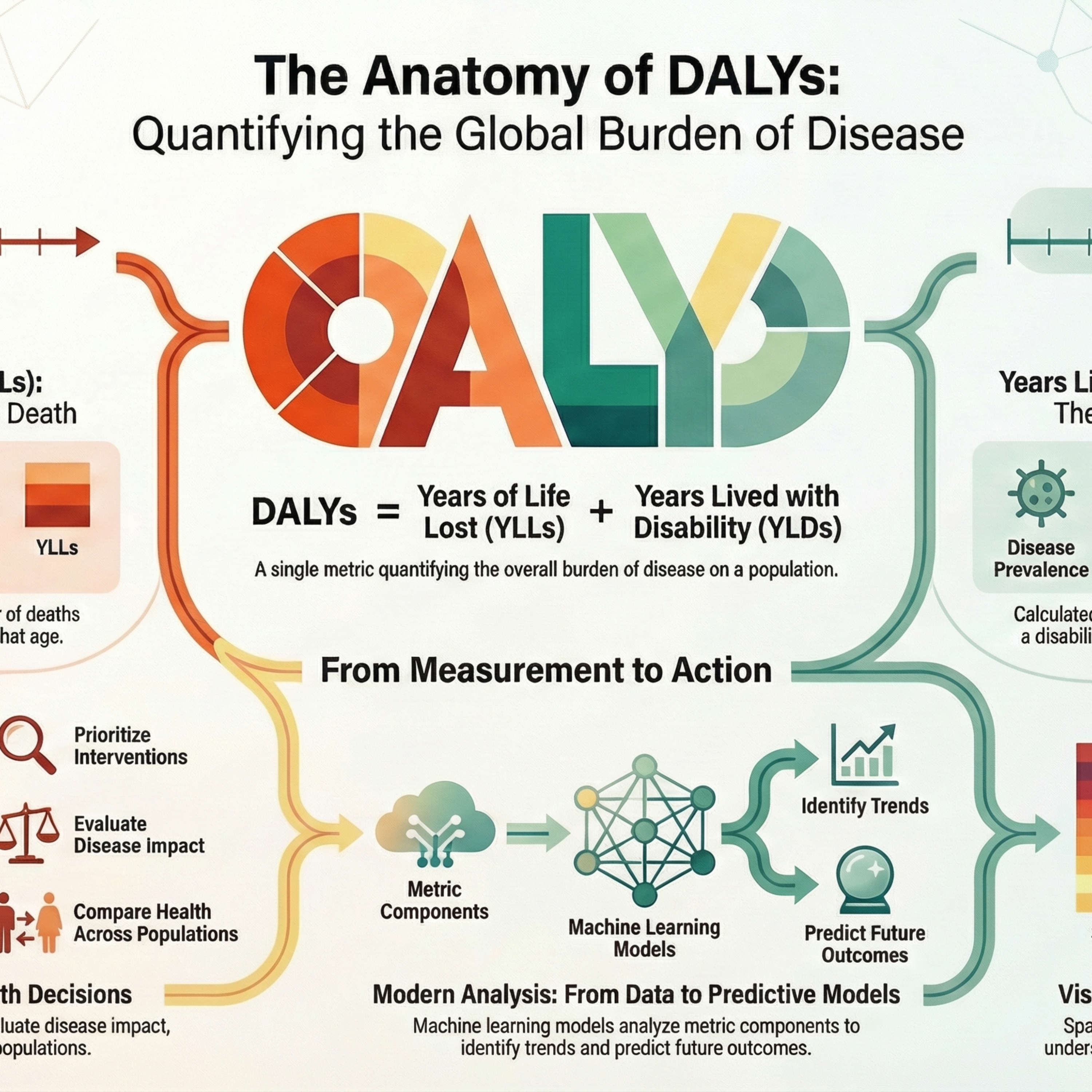
"The Accounting of Human Suffering" refers to the core mission of health metrics to quantify the total human toll of diseases, injuries, and risk factors. This process is centered on the Disability-Adjusted Life Year (DALY), a composite metric that measures one lost year of healthy life.The discussion involves two primary pillars: morbidity and mortality. Years of Life Lost (YLLs) are calculated by comparing the age at death to a standard life expectancy to measure the impact of premature death. Years Lived with Disability (YLDs) are determined by multiplying the prevalence of a condition by a specific disability weight, which represents the severity of health loss on a scale from 0 to 1.Key technical "ingredients" for this accounting include standardized life tables, mortality rates, and incidence vs. prevalence data. The sources emphasize that these metrics provide a standardized language to compare the burden of diverse conditions—such as the immediate mortality of a stroke versus the long-term impact of chronic respiratory disease—across different global populations.Ultimately, this accounting is used to identify health priorities, evaluate the effectiveness of interventions, and guide public health policy to achieve greater global health equity. The discussion also extends to emerging metrics like Well-being-Adjusted Health Expectancy (WAHE), which incorporate happiness, life satisfaction, and social connectedness into the traditional clinical framework.
-
4
Valuing Human Life in a Spreadsheet
Life expectancies, simulated data and health metrics in a fascinating discussion about how to apply raw data to wel estimated formula.
-
3
Bills of Mortality to AI
17th Century: The Bills of Mortality. John Graunt, the "father of demography," uses London's weekly death records to identify the first statistical patterns in human longevity and disease.
-
2
From Plague Bills To Predictive Algorithms
From death records to predictive algorithms.This episode traces 400 years of health intelligence—from counting who died to forecasting what comes next.We move from John Graunt’s 17th-century Bills of Mortality, through modern burden-of-disease metrics like DALYs, to today’s machine-learning models that learn from data to anticipate outbreaks and inform prevention.
-
1
The New Science of Fighting Infectious Disease
The new science of fighting infectious disease is a multidisciplinary field that integrates health metrics, machine learning, and spatial modeling to predict, track, and mitigate the spread of pathogens. Rather than relying solely on traditional medicine, this approach utilizes advanced data science to understand the "invisible enemies" that threaten global health.Key pillars of this modern approach include:Quantitative Health Metrics: The foundation of this science involves using metrics like Disability-Adjusted Life Years (DALYs) to quantify the total human toll of a disease, combining years lost to premature death (YLLs) with years lived with disability (YLDs).Machine Learning and Predictive Modeling: Modern researchers use machine learning algorithms—such as Random Forests, Neural Networks, and Gradient Boosting—to learn patterns from historical data and predict future outbreaks. This allows for parameter auto-calibration, where models automatically adjust to minimize prediction errors based on real-world observations.Spatial and Spatiotemporal Analysis: By using Geographic Information Systems (GIS) and techniques like Kriging, scientists can map infection hotspots and visualize how diseases like COVID-19 or Malaria move across a landscape. This helps identify high-risk areas for targeted interventions, such as vaccination or resource allocation.The One Health Perspective: This science recognizes that human, animal, and environmental health are interconnected. It focuses on the zoonotic origins of viruses (like those moving from bats or pangolins to humans) to prevent pandemics before they start.Transfer Learning: An emerging technique in this field involves model transfer, where insights and models built from one outbreak (like a past cholera epidemic) are adapted to predict and manage new, similar diseases in low-data settings.Analogy for Understanding the New ScienceThink of this field as a "High-Tech Biological Radar." Traditional medicine is like a lighthouse—it helps you see the danger when it is already close. This new science, however, is a sophisticated radar system that tracks the weather (pathogen spread), predicts where a storm will hit (outbreak forecasting), and calculates the exact amount of damage expected (health metrics), allowing cities to prepare long before the first raindrop falls.Buy your hardcover here: https://amzn.to/3N7zZjH
We're indexing this podcast's transcripts for the first time — this can take a minute or two. We'll show results as soon as they're ready.
No matches for "" in this podcast's transcripts.
No topics indexed yet for this podcast.
Loading reviews...
ABOUT THIS SHOW
It is a podcast series derived from the book Health Metrics and the Spread of Infectious Diseases. It extracts key ideas from the book into short, accessible discussions on how modern data, modelling, and epidemiological methods are changing the way infectious diseases are studied, interpreted, and managed in public health practice.
HOSTED BY
FedericaGazzelloni
Loading similar podcasts...
Frequently Asked Questions
How many episodes does The New Science of Fighting Infectious Diseases have?
The New Science of Fighting Infectious Diseases currently has 5 episodes available on PodParley. New episodes are automatically indexed when they're published to the podcast feed.
What is The New Science of Fighting Infectious Diseases about?
It is a podcast series derived from the book Health Metrics and the Spread of Infectious Diseases. It extracts key ideas from the book into short, accessible discussions on how modern data, modelling, and epidemiological methods are changing the way infectious diseases are studied, interpreted, and...
How often does The New Science of Fighting Infectious Diseases release new episodes?
The New Science of Fighting Infectious Diseases has 5 episodes. Check the episode list to see recent publication dates and frequency.
Where can I listen to The New Science of Fighting Infectious Diseases?
You can listen to The New Science of Fighting Infectious Diseases on PodParley by clicking any episode. We provide an embedded audio player for direct listening, and you can also subscribe via your preferred podcast app using the RSS feed.
Who hosts The New Science of Fighting Infectious Diseases?
The New Science of Fighting Infectious Diseases is created and hosted by FedericaGazzelloni.
URL copied to clipboard!