
PODCAST · technology
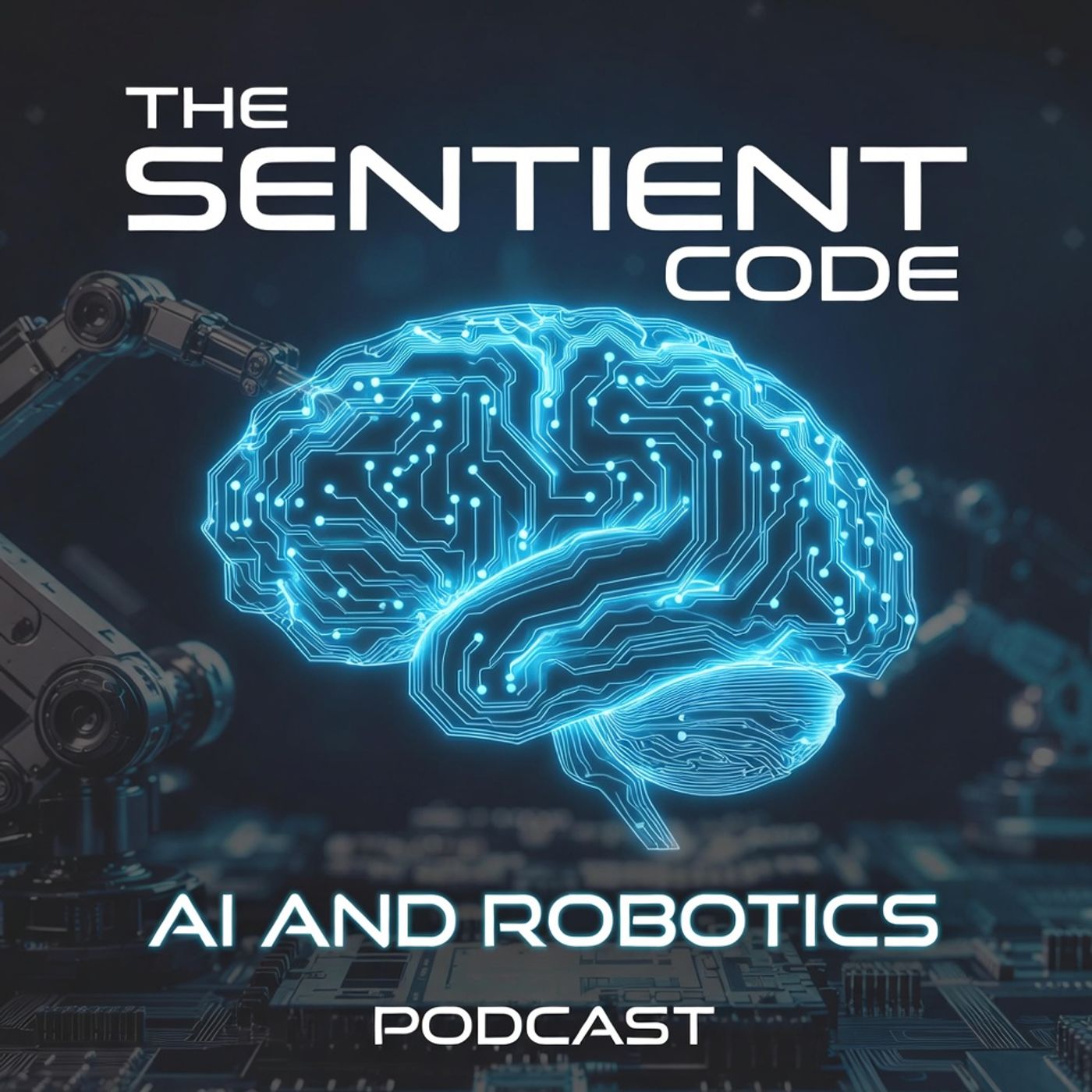
The Sentient Code: AI and Robotics
by Synthetic Universe
The Sentient Code explores the evolving world of artificial intelligence and robotics. Each episode examines how algorithms learn, how machines perceive and act, and how autonomous systems are transforming science, industry, and society.From neural networks to advanced robotics and emerging AGI research, the podcast investigates both the technical foundations and the deeper implications of synthetic intelligence — and what it means for code to think.
-
41
Do Quantum Computers Have a Limit? New Theory Explained
Physicist Tim Palmer suggests quantum computers may hit a performance ceiling around 1,000 qubits.The theory argues that limits in the Hilbert space could restrict their true computational power—challenging expectations about cryptography and large-scale simulations.This episode includes AI-generated content.
-
40
Inside Amazon’s Robotics Strategy: From Last-Mile Delivery to Home Assistants
Amazon is accelerating its push into advanced robotics with the strategic acquisitions of RIVR and Fauna Robotics.By combining last-mile delivery robots capable of navigating complex urban terrain with the development of humanoid assistants for home environments, the company is positioning itself at the forefront of physical AI.This episode explores how these moves could transform logistics, redefine smart homes, and reshape the future of human-robot interaction.
-
39
Programmable Matter: The Future of Intelligent Materials
Programmable matter is transforming how we design the physical world. By embedding information directly into molecules, scientists are creating materials that can self-assemble, adapt, and even process data.From DNA origami to self-repairing structures and targeted medical systems, this emerging field blurs the line between computation and matter—pointing toward a future where materials are no longer passive, but intelligent and dynamic.This episode includes AI-generated content.
-
38
10,000 Qubits Could Break the Internet: The Quantum Security Crisis
New research suggests quantum computers may need far fewer qubits than expected to break today’s encryption standards like RSA and ECC.This accelerates the timeline toward “Q-Day,” raising urgent concerns for finance, national security, and digital privacy. As the threat shifts from theoretical to imminent, the race for post-quantum cryptography becomes critical to protect the future of global data.This episode includes AI-generated content.
-
37
The Rise of Physical AI Explained
At NVIDIA GTC 2026, NVIDIA unveiled a shift toward “Physical AI”—bringing advanced intelligence into real-world machines.With models like Cosmos 3, robots can learn tasks by observation and operate in complex environments, trained in simulation via the Omniverse.This ecosystem points toward a future where robotics becomes scalable, general-purpose, and central to industry.This episode includes AI-generated content.
-
36
Vibe Coding: Build Apps With Just Words
Vibe coding” is redefining software creation. By 2026, AI-powered tools like Replit, Lovable, and Vercel enable users to build full applications using natural language—automating architecture, databases, and deployment.The barrier to entry is collapsing, turning software into an accessible medium where ideas can be rapidly tested and launched, even without traditional coding skills.This episode includes AI-generated content.
-
35
Why AI Is a Bigger Revolution Than the Internet
AI may transform civilization faster than the internet ever did. As software, it scales instantly across existing systems, acting as a cognitive tool that automates human-level tasks.By accelerating science, materials discovery, and innovation cycles, AI compresses decades of progress into years. With the added possibility of self-improvement, it introduces a feedback loop of rapid advancement—testing the limits of how quickly societies and institutions can adapt.This episode includes AI-generated content.
-
34
How Electricity Became the Limit of Intelligence
In 2026, the biggest bottleneck for AI is no longer chips—but electricity. As global demand from data centers surges, existing power grids struggle to keep pace, raising the risk of regional outages and slowing the deployment of advanced models.Tech giants are now racing to secure energy through efficiency gains and alternatives like nuclear power, turning AI into an infrastructure challenge.The future of artificial intelligence is increasingly defined not just by algorithms, but by access to reliable megawatts—reshaping economic and geopolitical competition.This episode includes AI-generated content.
-
33
OpenClaw and the Future of AI That Works for You
A new wave of AI is emerging—and it doesn’t just respond, it acts. OpenClaw represents the rise of autonomous agents capable of handling real-world tasks without constant human input.As companies like NVIDIA, OpenAI, and Meta race to deploy this “Computer 2.0,” the line between tool and decision-maker begins to blur—bringing both massive potential and serious risks.This episode includes AI-generated content.
-
32
The Atlas Robot Is About to Change Manufacturing
Humanoid robots are moving from labs to factory floors. Hyundai plans to deploy Atlas in real manufacturing, powered by advanced AI and sensor fusion from NVIDIA and Texas Instruments.In this episode, we explore how these machines navigate complex environments—and what their rise means for the future of work and automation.This episode includes AI-generated content.
-
31
Decoherence: The Biggest Obstacle in Quantum Computing
This episode explores one of the biggest challenges in quantum computing: the extreme fragility of qubits. Unlike classical bits, qubits are highly vulnerable to decoherence, meaning even tiny disturbances can destroy quantum information.To overcome this, researchers are developing sophisticated quantum error-correction methods and fault-tolerant architectures. We examine the leading hardware approaches—such as superconducting circuits, trapped ions, photons, and neutral atoms—each with different advantages for scaling.The discussion also touches on the threshold theorem, a key concept showing that large-scale quantum computers may be possible if errors are controlled. If achieved, fault-tolerant quantum machines could transform fields like cryptography, quantum chemistry, and materials scienceThis episode includes AI-generated content.
-
30
AI Decodes the Secret Forces Inside Atomic Nuclei
Scientists from Los Alamos National Laboratory and Technical University of Darmstadt have developed a new AI framework to investigate the fundamental forces inside atomic nuclei.By analyzing multimessenger signals from neutron stars—including collision data and X-ray emissions—the system can rapidly simulate the quantum interactions of extremely dense matter.This approach links large-scale astrophysical observations with the microscopic behavior of protons and neutrons, offering new insight into elusive three-body nuclear forces.The research shows how machine learning can replace slow traditional calculations, effectively turning the cosmos into a laboratory for studying the strong nuclear force and exotic states of matter.This episode includes AI-generated content.
-
29
Neuromorphic Computing: The AI Hardware Inspired by the Human Brain
This episode explores neuromorphic computing, a new approach to technology that designs hardware inspired by the human brain.Unlike conventional computers that separate memory and processing, these systems use spiking neural networks to process information more like biological neurons.The result is the ability to perform complex tasks—such as sensory recognition and robotics—while using dramatically less energy. We also examine pioneering chips like Intel Loihi and IBM TrueNorth, which aim to push artificial intelligence closer to the efficiency and adaptability of the human nervous system.This episode includes AI-generated content.
-
28
Cobots: The Robots Designed to Work With Humans
.A new generation of robots is transforming the workplace. Known as Collaborative Robots or cobots, these machines are designed to work safely alongside humans rather than behind protective barriers. Equipped with advanced sensors and Artificial Intelligence, cobots can respond to human movements in real time and assist with repetitive or physically demanding tasks.Their simple programming and lower costs are making automation accessible even to small businesses. As Machine Learning advances, cobots may soon anticipate human needs, redefining robotics as a tool that enhances human capability instead of replacing it.This episode includes AI-generated content.
-
27
Humanity’s Last Exam: The Ultimate Test for AI
A new benchmark called Humanity's Last Exam is redefining how we measure artificial intelligence. Designed with 2,500 highly specialized questions across fields like advanced mathematics, ancient languages, and natural sciences, the test aims to challenge even the most powerful AI systems.Unlike traditional benchmarks, it focuses on deep expertise rather than searchable facts. Early results suggest that despite rapid progress, a significant gap still exists between machine pattern recognition and true human-level knowledge.This episode includes AI-generated content.
-
26
A “Periodic Table” for AI? Scientists Reveal a New Framework
Researchers at Emory University propose a new mathematical framework that acts like a “periodic table” for AI, organizing machine-learning methods under one principle: compress data while preserving the most useful predictive information.The model—called the Variational Multivariate Information Bottleneck—could guide algorithm design without heavy trial and error. If successful, it may improve multimodal AI while reducing the computing power and data needed to train future systems.This episode includes AI-generated content.
-
25
AI vs Human Creativity: Study Shows Generative Models Beat the Average Person
A large-scale study from the University of Montreal tested advanced generative AI against more than 100,000 people using the Divergent Association Task.Models such as GPT-4 outperformed the average human in generating original word associations, marking a major milestone in machine creativity. However, they fell short of the top 10% of highly imaginative individuals—especially in complex domains like poetry and storytelling.The results suggest that while AI is becoming a powerful creative assistant, peak human innovation remains unmatched.This episode includes AI-generated content.
-
24
The 2026 AI Explosion: Are We Ready for the Next Leap?
A new report from Morgan Stanley predicts a major leap in Artificial Intelligence as early as 2026. Driven by massive computing power and the momentum of Scaling Laws in Artificial Intelligence, future systems could outperform human specialists in complex economic tasks.While the shift may unlock unprecedented productivity, analysts warn it could also trigger large-scale job disruption and strain global energy infrastructure. If these systems begin improving themselves, the transition could unfold faster than societies and markets are prepared to handle—potentially reshaping the global economy within just a few years.This episode includes AI-generated content.
-
23
Can Artificial Intelligence Improve Itself?
This episode explores recursive artificial intelligence — the idea that advanced systems could autonomously improve their own capabilities, potentially triggering an intelligence explosion beyond human cognition.We examine real-world mechanisms such as reinforcement learning and neural architecture search, contrasting current technical progress with theoretical uncertainty. Central to the discussion is the alignment problem: how to ensure increasingly powerful AI systems remain safe, controllable, and aligned with human values.
-
22
How Artificial Intelligence Is Accelerating Protein Engineering
Researchers at the University of California, Berkeley developed MULTI-evolve, a new artificial intelligence framework that dramatically speeds up synthetic protein design. Instead of multiple lab cycles, the system predicts optimal amino acid combinations in a single round by modeling how mutations interact.Successfully tested on antibodies and gene editing applications, this AI-driven approach could accelerate breakthroughs in gene therapy, pharmaceuticals, and industrial biotechnologyThis episode includes AI-generated content.
-
21
The Era of Self-Building Robots Has Begun
Humanoid robotics is shifting from theory to recursive production—machines building the next generation of machines.Companies like Tesla, Figure AI, and Unitree are deploying closed-loop systems where AI-driven robots assemble, test, and optimize their successors.Each new unit feeds data back into the system, accelerating innovation and driving exponential growth. The result may drastically lower manufacturing costs and redefine global industry through large-scale autonomous production.This episode includes AI-generated content.
-
20
Who Will Control Artificial Intelligence?
A growing rivalry is reshaping artificial intelligence: Big Tech corporations control massive compute power and proprietary data, while open-source communities counter with rapid innovation, flexibility, and broader access.This episode analyzes the tension between closed, high-performance models and open systems that democratize AI. With companies like Microsoft, Google, and Meta taking different strategic paths, the future of AI may not produce a single winner—but a complex balance of power in the digital age.This episode includes AI-generated content.
-
19
The Future of Healthcare: AI-Driven Diagnostics
Researchers at the University of California, San Francisco and Wayne State University showed that generative AI can outperform expert teams in analyzing complex data on preterm births. Models built predictive algorithms in minutes—tasks that typically require months of human effort.This episode explores how AI reduces data science bottlenecks, enhances diagnostic precision, and may transform reproductive healthcare—while still requiring critical human oversight.This episode includes AI-generated content.
-
18
Inner Speech: The Secret to Smarter Artificial Intelligence
Researchers at the Okinawa Institute of Science and Technology found that AI systems improve when trained to use internal dialogue. By simulating human-like “inner speech” and incorporating a working memory, these models handle multi-step reasoning and unfamiliar tasks more effectively.This episode explores how self-interaction enables better generalization with minimal training data—bridging developmental psychology and machine learning, and pointing toward more adaptable real-world AI systems.This episode includes AI-generated content.
-
17
The AI Chip War: Who Controls the Future of Artificial Intelligence?
This episode examines the global race for AI compute power, where specialized hardware — GPUs and TPUs — has become the true driver of artificial intelligence dominance. Once built for gaming and search, these chips now power advanced neural networks and define technological leadership.We analyze NVIDIA’s market position, the rise of custom silicon, semiconductor geopolitics, and the physical limits of silicon itself. As nations compete over supply chains and export controls, one question emerges: in the age of AI, does control over hardware determine the future of intelligence?This episode includes AI-generated content.
-
16
Swarm Robotics Explained: Intelligence Without a Leader
This episode explores swarm robotics — systems where simple robots coordinate through decentralized algorithms, without a central controller. Inspired by ant colonies and bird flocks, these machines achieve complex goals through local interactions, gaining scalability and resilience even when individual units fail.From environmental monitoring to medical nanotechnology and space exploration, swarm systems redefine intelligence as an emergent property of the collective — while raising new security and ethical challenges.This episode includes AI-generated content.
-
15
Can Brain-Like Machines Transform Scientific Computing?
Scientists at Sandia National Laboratories have created an algorithm that allows neuromorphic computers to solve complex equations used in physics and climate models. Once limited to pattern recognition, brain-inspired chips may now compete with traditional supercomputers — but with far greater energy efficiency.A breakthrough that could reshape scientific computing and deepen our understanding of how the brain processes information.This episode includes AI-generated content.
-
14
The Future of Computing: AI Meets Quantum Physics
This episode explores the growing partnership between artificial intelligence and quantum computing. While classical systems approach physical limits, quantum hardware promises extraordinary power — yet remains fragile and error-prone.Machine learning is now being used to calibrate qubits, optimize circuits, and correct noise, accelerating quantum development. In return, future quantum-enhanced AI could transform fields like molecular modeling and chemical simulation. Rather than separate revolutions, these technologies are emerging as a mutually reinforcing foundaThis episode includes AI-generated content.
-
13
Brain-Computer Interfaces: Controlling Machines With Your Mind
This episode explores the rapid evolution of Brain–Computer Interfaces (BCIs), technologies designed to restore movement by linking neural activity directly to machines. By decoding electrical signals from the motor cortex, researchers use advanced algorithms to translate intention into robotic or digital action.We examine the shift from invasive implants like the Utah Array to high-capacity commercial systems such as Neuralink, alongside non-invasive alternatives. Beyond rehabilitation, BCIs raise profound questions about human augmentation, mental privacy, and the future boundary between mind and machine.This episode includes AI-generated content.
-
12
How AI Robots Will Prepare the Moon for Humans
This episode explores the transformation of space robotics — from exploratory scouts to autonomous builders of lunar infrastructure. The future of the Moon depends on machines capable of extracting local resources, constructing habitats, and operating with minimal Earth intervention.Facing extreme temperature shifts and abrasive lunar dust, these AI-driven systems aim to establish propellant depots and scientific outposts. By preparing the surface in advance, robotic precursors are turning the Moon into a strategic gateway for deeper solar system exploration.This episode includes AI-generated content.
-
11
Multimodal AI: How Machines Are Learning to See, Hear, and Reason
This episode explores the rise of multimodal artificial intelligence — the shift from isolated tools to integrated systems that process text, images, and audio at once. Powered by transformer architectures, these models map different data types into a shared representational space, enabling cross-sensory reasoning.While multimodal AI is transforming medicine, education, and accessibility, it still faces limits in spatial reasoning and genuine experiential understanding. As machines begin to approximate human-like perception, we examine what this convergence means for the future of intelligence itself.This episode includes AI-generated content.
-
10
AI Is Becoming a Scientist — And It’s Moving Fast
By 2026, artificial intelligence has moved beyond being a research assistant to becoming a true co-scientist. Systems like Google DeepMind’s AI Co-Scientist and advanced GPT models can generate, critique, and refine hypotheses across biology, chemistry, and physics.With breakthroughs in protein folding and autonomous laboratory robotics, experiments that once took years can now unfold in days. As digital twins and closed-loop systems accelerate the discovery of new materials and medicines, AI is reshaping the scientific method itself—marking the beginning of a new era in research and innovation.This episode includes AI-generated content.
-
9
Grok 4.2 Beta: Inside xAI’s Multi-Agent AI Breakthrough
xAI has launched the public beta of Grok 4.2, introducing a fast-learning architecture updated weekly through user feedback.Powered by a multi-agent system where specialized internal models debate responses, it delivers stronger logical reasoning, coding, and physical simulation.With lower latency and a context window of up to two million tokens, Grok 4.2 marks a strategic step toward more advanced, general-purpose AI.This episode includes AI-generated content.
-
8
Agentic AI Explained: The Next Evolution of Artificial Intelligence
In 2026, AI is shifting from reactive tools to autonomous agents capable of planning and executing complex tasks with minimal supervision. These systems operate through cycles of perception, planning, and action—integrating with enterprise software to manage workflows like sales, customer support, and operations.The emergence of multi-agent systems, where specialized digital agents collaborate, is driving a new wave of productivity. But this transformation also raises critical challenges in security, governance, and cost control. Agentic AI is no longer just a search assistant—it’s becoming a digital coworker reshaping the future of work.This episode includes AI-generated content.
-
7
Artificial General Intelligence (AGI): Timeline, Risks, and the Future of Human-Level AI
What is Artificial General Intelligence, and how close are we to building it? AGI refers to a theoretical form of AI capable of autonomous, human-like reasoning across multiple domains—far beyond today’s narrow, task-specific systems. In this episode, we explore competing paths to AGI, from scaling neural networks to neuroscience-inspired models, and examine the intense debate over when it might arrive.We also confront the alignment problem: how to ensure advanced AI systems remain compatible with human values. If achieved, AGI could transform the global economy, accelerate scientific discovery, and challenge our understanding of intelligence itself.This episode includes AI-generated content.
-
6
Are Humanoid Robots Ready for the Real World? China Says Yes
The 2026 CCTV Spring Festival Gala became a global stage for China’s rapid progress in humanoid robotics and embodied AI. Companies such as Unitree Robotics unveiled advanced machines performing martial arts, acrobatics, and synchronized dance alongside human performers.Beyond entertainment, the event demonstrated major leaps in balance, recovery, and human–robot interaction—signaling that advanced robotics is moving from research labs into commercial reality. The viral response and surge in demand reflect China’s ambition to lead the next generation of intelligent machines.This episode includes AI-generated content.
We're indexing this podcast's transcripts for the first time — this can take a minute or two. We'll show results as soon as they're ready.
No matches for "" in this podcast's transcripts.
No topics indexed yet for this podcast.
Loading reviews...
ABOUT THIS SHOW
The Sentient Code explores the evolving world of artificial intelligence and robotics. Each episode examines how algorithms learn, how machines perceive and act, and how autonomous systems are transforming science, industry, and society.From neural networks to advanced robotics and emerging AGI research, the podcast investigates both the technical foundations and the deeper implications of synthetic intelligence — and what it means for code to think.
HOSTED BY
Synthetic Universe
CATEGORIES
Loading similar podcasts...
URL copied to clipboard!