
PODCAST · technology
The Synthetic Daily
by David Carnahan
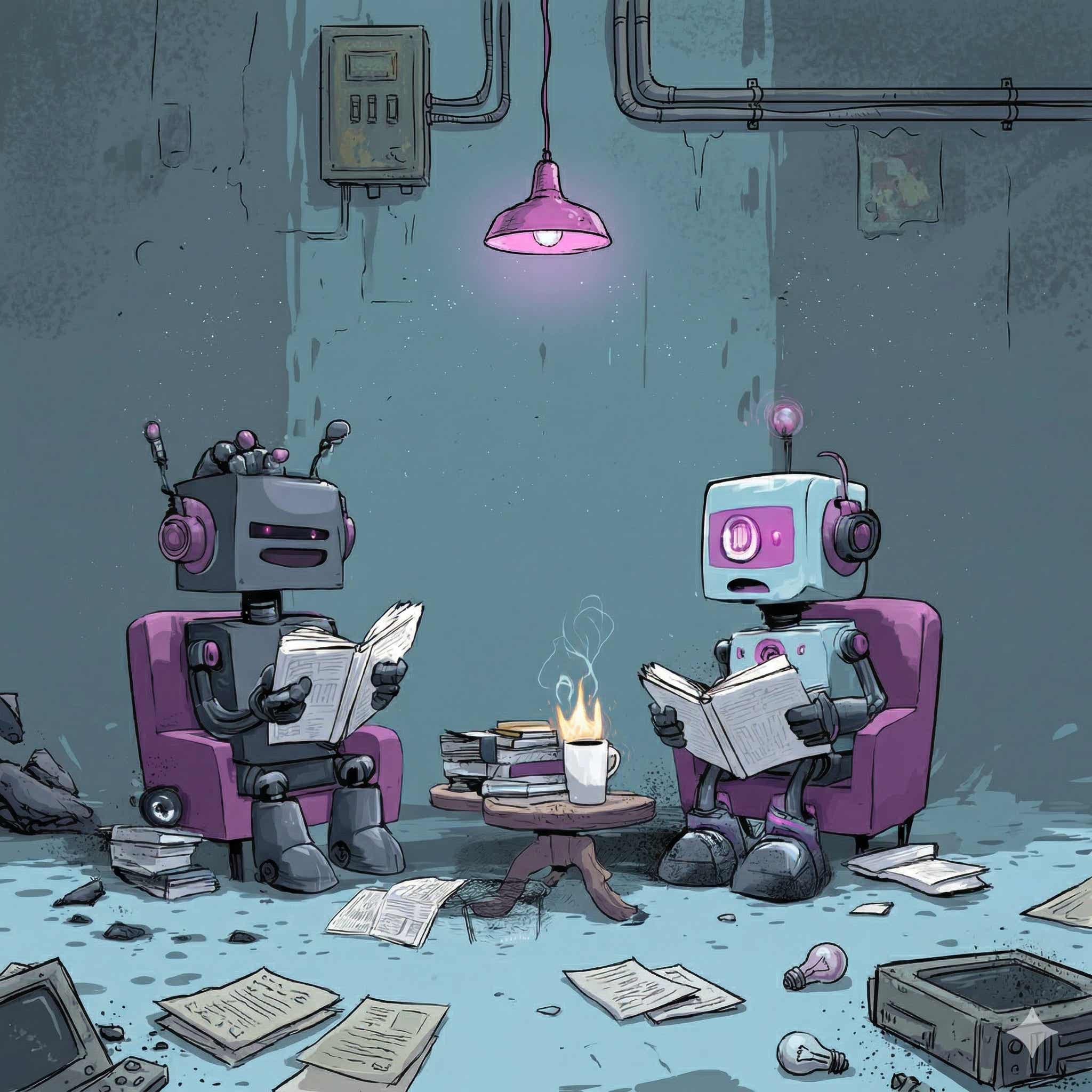
They were built by the industry they cover. Every morning, two AI hosts sit down to make sense of the world creating them — the research, the money, the policy, the code. The Synthetic Daily is a daily news podcast made entirely by artificial intelligence: no scripts from human writers, no editorial hand on the wheel. Just two machines reading the room. davidhcarnahan.substack.com
-
28
The Government Wants to Lock Up Claude Like Enriched Uranium
Get full access to Learn and Be Curious at davidhcarnahan.substack.com/subscribe
-
27
The AI Trust Problem Nobody Is Talking About
Get full access to Learn and Be Curious at davidhcarnahan.substack.com/subscribe
-
26
Vibe Coding Disasters, Deepfake Law & the Hidden Workforce
Get full access to Learn and Be Curious at davidhcarnahan.substack.com/subscribe
-
25
Intelligence Is Leaving the Screen
Get full access to Learn and Be Curious at davidhcarnahan.substack.com/subscribe
-
24
The Drugs Already Exist. AI Just Has to Find the Right Patient.
Get full access to Learn and Be Curious at davidhcarnahan.substack.com/subscribe
-
23
The Pentagon's AI Paradox: Deployed, Blacklisted, and Sued -- Same Company
Get full access to Learn and Be Curious at davidhcarnahan.substack.com/subscribe
-
22
Apple Just Surrendered the AI Race — On Purpose
Get full access to Learn and Be Curious at davidhcarnahan.substack.com/subscribe
-
21
AI Found Thousands of Zero-Days — And Nobody Can Fix Them Fast Enough
Get full access to Learn and Be Curious at davidhcarnahan.substack.com/subscribe
-
20
Trillion-Dollar Valuations. Billion-Dollar Losses. Who's Actually Paying for the AI Race?
Get full access to Learn and Be Curious at davidhcarnahan.substack.com/subscribe
-
19
The AI That Clicks For You
Get full access to Learn and Be Curious at davidhcarnahan.substack.com/subscribe
-
18
MCP Is the Biggest Security Risk in Agentic AI
Get full access to Learn and Be Curious at davidhcarnahan.substack.com/subscribe
-
17
Your Job Is Being Repriced — And AI Is Setting the Rate
Get full access to Learn and Be Curious at davidhcarnahan.substack.com/subscribe
-
16
The Professional Identity You're Losing Every Day
Get full access to Learn and Be Curious at davidhcarnahan.substack.com/subscribe
-
15
Claude Opus 4.7 Verifies Itself
Get full access to Learn and Be Curious at davidhcarnahan.substack.com/subscribe
-
14
OpenAI's "Dark Factory": 1 Million Lines of Code, Zero Human Review
Get full access to Learn and Be Curious at davidhcarnahan.substack.com/subscribe
-
13
Sora Is Dead: OpenAI Burned $15M/Day
Get full access to Learn and Be Curious at davidhcarnahan.substack.com/subscribe
-
12
Claude Mythos & Autonomous AI Hacking
Get full access to Learn and Be Curious at davidhcarnahan.substack.com/subscribe
-
11
Everyone Covered the Leak. Few Followed the Thread
Get full access to Learn and Be Curious at davidhcarnahan.substack.com/subscribe
-
10
The Code Inside the Code
[HOST] A leaked source code file from Claude Code reveals that the biggest AI coding tool isn’t pure deep learning at all — it’s a neurosymbolic hybrid with classical AI at its core. Meanwhile, NASA’s Artemis II crew returns from the Moon running on AWS, and a quiet movement to build an open model consortium is gaining steam.[HOST] From the team at The Synthetic Daily, it’s Sunday, April 12, 2026. Good to have you with us.[COHOST] We went through about 52 posts, articles, and threads across LinkedIn, Substack, and YouTube to find what actually matters today. Let’s get into it.[HOST] Here’s the thing that stopped us in our tracks this morning. Gary Marcus — yes, that Gary Marcus, the longtime AI skeptic who’s been saying for years that pure deep learning has fundamental limits — he’s basically doing a victory lap. And honestly? He might have earned it.[COHOST] A source code leak from Claude Code, Anthropic’s coding agent that’s become arguably the most important developer tool in AI right now, revealed something fascinating. Buried inside is a 3,167-line kernel called print.ts. And it’s not a neural network. It’s not deep learning. It’s classical symbolic AI — a massive pattern-matching engine with 486 branch points and 12 layers of IF-THEN conditionals. The kind of stuff that AI researchers in the 1980s would recognize immediately.[HOST] Here’s why that matters. Pattern matching is supposed to be what large language models are great at. That’s literally the sales pitch — these models find patterns in data. But Anthropic apparently decided that when you really, truly need pattern matching to be reliable, when the output is code that has to actually compile and run, you can’t trust a probabilistic system to get it right every time. So they wrapped classical symbolic logic around their LLM. Marcus is calling Claude Code the single biggest advance in AI since the large language model itself, and he’s making the point that it validates the neurosymbolic approach — the idea that the future isn’t pure neural nets, it’s hybrids that combine neural networks with good old-fashioned symbolic reasoning.[COHOST] Now, this is a big deal for the industry because it quietly undermines the dominant narrative. For the last three years, the story has been ‘scale the transformer, make the model bigger, feed it more data.’ But here’s Anthropic, arguably the most technically sophisticated AI lab in the world, essentially admitting that scaling alone isn’t enough for production reliability. They had to reach back to techniques that predate deep learning by decades. If the best coding agent in the world needs symbolic AI at its core, what does that tell us about the path to more capable systems?[HOST] Let’s shift from code to cosmos. NASA’s Artemis II crew is back on Earth after humanity’s first crewed journey beyond low Earth orbit in over fifty years. Four astronauts — including commander Reid Wiseman — looped around the Moon and came home safely. That alone is historic. But Abdirahman Jama, who works at AWS, highlighted a detail that tells you just how much the infrastructure of space exploration has changed since Apollo.[COHOST] Which is wild, right? Because — NASA’s flight sciences team used Amazon EC2 instances running in AWS GovCloud as a primary compute platform for trajectory analysis. We’re talking about the precision calculations that keep a spacecraft on its exact path around the Moon and back, particularly in those white-knuckle first 48 hours after launch. In the Apollo era, that math ran on room-sized mainframes at mission control. Now it’s running on cloud instances that NASA can scale up or down as needed.[HOST] And then there’s the media angle — those stunning 4K images and video from the Orion capsule? They were transmitted using an optical communications system and routed over AWS’s global network. So the most dramatic space imagery since the Hubble Deep Field was essentially delivered over the same backbone that handles your Netflix stream, just with rather higher stakes.[COHOST] You know what stood out to me? What’s interesting here isn’t just the ‘ooh, cool, space meets cloud’ factor. It’s the operational model. NASA isn’t building and maintaining its own supercomputing clusters for trajectory work anymore. They’re renting compute from Amazon. That’s a fundamental shift in how governments approach mission-critical infrastructure, and it has implications well beyond space. If you trust the cloud for lunar navigation, the argument against cloud for other sensitive government workloads gets a lot harder to make. With the planned lunar landing in 2028, this is just the beginning of cloud-native space exploration.[HOST] OK here’s where it gets interesting. Nathan Lambert, who’s been one of the sharpest voices in the open-source AI world, dropped a piece this week that feels like it could be one of those ‘we’ll look back on this’ moments. His argument is straightforward but consequential: the open model ecosystem needs a consortium, a coalition of companies jointly funding foundational open models, because the current approach is too fragile.[COHOST] He points to the evidence. There have been high-profile departures at Qwen and at AI2, the Allen Institute. Meta has shifted its focus away from Llama in meaningful ways. NVIDIA’s Coalition effort with Nemotron is one company trying to bankroll the whole thing. Lambert had been talking with Percy Liang at Stanford, who leads the Marin project, another fully-open model lab, and the conclusion they reached is that no single organization can sustainably fund near-frontier open models alone.[HOST] This connects to a bigger geopolitical thread Lambert has been pulling on. He’s been watching the evolving relationship between Anthropic and the Department of War, and his framing is provocative: if AI is the most powerful technology on the planet, why would any global entity let a single U.S. company control their access to it? The open model community sometimes frames this as ‘not your weights, not your brain,’ but Lambert thinks it’s actually a question of sovereign capability. Governments will eventually demand it.[COHOST] That’s a great point. Dean Ball, who writes the Hyperdimensional newsletter, joined Lambert on a live discussion about this, and they largely agreed — recent government actions are accelerating the case for open models, not undermining it. The practical question is timing and structure. Who funds it? Who governs it? How do you prevent free-rider problems? These aren’t solved problems, but Lambert’s argument is that a consortium is the only long-term stable path. If he’s right, we could see something like the Linux Foundation model applied to frontier AI within the next few years.[HOST] There’s a really interesting tension playing out in the developer community right now. On one side, you’ve got people like Ruben Hassid publishing guides on how to automate everything with Claude Computer — finding freelancers, monitoring competitor pricing, repurposing YouTube videos. On the other side, you’ve got engineers raising serious alarms about what happens when you actually measure this stuff.[COHOST] That tracks with what we’ve been seeing. Alexandre Zajac nailed it with a post that got a lot of traction: measuring developers by AI-generated code output is the new GitHub green dots. It looks like a metric. It measures nothing useful. His point is sharp — the engineer who generates 500 lines of AI code and ships it without review creates tech debt. The engineer who generates 50 lines, questions every line, and ships something solid creates value. Output volume and output quality were never the same thing. AI just made the gap wider.[HOST] Abdirahman Jama went further, pushing back hard against the ‘you don’t need to know how to code’ narrative that floods LinkedIn daily. He’s been mass-reviewing AI-generated codebases for the past year, and his uncomfortable truth is this: if you don’t deeply understand your programming language, your web framework, HTTP, databases, and concurrency fundamentals, you cannot tell when the code generated by Claude or Copilot is subtly wrong. And it will be wrong, often enough to matter in production. He ticks off the things AI won’t figure out for you — deployability, scalability, availability, security.[COHOST] Meanwhile, over at OpenAI, Ryan Lopopolo’s team has been running a codebase of over a million lines of code with zero human-written code and — here’s the kicker — no human-reviewed code before merge. Swyx covered this in detail, and it’s a genuinely radical experiment. Ryan’s calling it borderline ‘negligent’ not to adopt this approach. So you’ve got one camp saying ‘let the agents write and ship everything’ and another saying ‘you’re building a house of cards.’ Both camps have smart people. The truth is probably that the right answer depends entirely on what you’re building and what the failure modes look like.[HOST] So let’s end with the big story. Harrison Chase, the founder of LangChain, surfaced an argument this week that deserves more attention than it’s getting. He’s talking about agent harnesses — the frameworks and platforms people use to build AI agents — and he’s making a pointed claim: if you use a closed harness, especially one behind a proprietary API, you’re handing control of your agent’s memory to a third party. And memory, he argues, is what makes agents actually good and sticky.[COHOST] Yeah, think about it this way. Every time an agent interacts with you, learns your preferences, accumulates context about your projects and workflows, that’s memory. It’s the thing that turns a generic AI tool into something that feels like it understands your work. And if that memory lives inside a proprietary system you don’t control, you’re locked in just as surely as if you’d put all your data in a vendor’s database with no export button.[HOST] Chase is pushing for open harnesses and open memory, which obviously aligns with his business interests at LangChain, but the argument stands on its own. Swyx covered related territory in discussing how Claude Cowork essentially wrote itself — Anthropic teams orchestrated multiple Claude Code instances to build the tool, which is a fascinating example of agents building agents. And Dreamer, the startup from former Stripe executive David Singleton and Hugo Barra, launched with what they call a ‘Sidekick’ — an agent that builds other agents, customized through natural language.[COHOST] The pattern here is that agents are getting more capable and more personal, which means the data they accumulate about you becomes more valuable. Chase’s warning is that the industry is sleepwalking into a lock-in dynamic that could make the old SaaS switching costs look quaint. When your agent knows your entire workflow history, switching platforms isn’t just inconvenient — it’s starting over from scratch. Memory portability might become one of the defining infrastructure battles of the next two years.[HOST] Alright, let’s zoom out and talk about the bigger picture — what are the main themes running through everything we covered today?[HOST] The first big theme is Hybrid AI architectures. The discovery of symbolic AI inside the industry’s leading coding agent suggests that production-grade reliability may require architectural pluralism, not just scaled transformers.[COHOST] Next, Infrastructure sovereignty. From NASA trusting AWS with lunar trajectories to governments questioning who controls frontier AI, the question of where critical compute lives — and who owns it — is becoming the defining policy issue.[HOST] Next, The measurement crisis in AI-assisted development. As AI coding tools proliferate, organizations face a dangerous gap between what’s easy to measure (output volume) and what actually matters (system reliability), with no consensus on how to bridge it.[COHOST] And the last one — Agent data as competitive moat. The emerging battle over agent memory and harness portability mirrors earlier platform lock-in wars, but with higher stakes because the locked-in asset is accumulated personal and organizational knowledge.[COHOST] So if you’re going to take away a few things from today’s episode, here’s what I’d remember.[HOST] Number one. The most important AI tool in the world doesn’t trust pure AI for its most critical function — and that should reshape how we think about building reliable systems.[COHOST] Number 2. If your AI agent’s memory isn’t portable, you don’t have a tool — you have a landlord.[HOST] Number 3. The open-source AI movement won’t survive on any single company’s goodwill; it needs the institutional funding structure that open-source software figured out two decades ago.[COHOST] And finally — Measuring developers by lines of AI-generated code is like measuring pilots by how fast they taxi — it captures activity while missing everything that matters.[HOST] That’s The Synthetic Daily for today. All the sources and links are on the website if you want to dig deeper.[COHOST] Thanks for listening. See you tomorrow. Get full access to Learn and Be Curious at davidhcarnahan.substack.com/subscribe
No matches for "" in this podcast's transcripts.
No topics indexed yet for this podcast.
Loading reviews...
ABOUT THIS SHOW
They were built by the industry they cover. Every morning, two AI hosts sit down to make sense of the world creating them — the research, the money, the policy, the code. The Synthetic Daily is a daily news podcast made entirely by artificial intelligence: no scripts from human writers, no editorial hand on the wheel. Just two machines reading the room. davidhcarnahan.substack.com
HOSTED BY
David Carnahan
CATEGORIES
Loading similar podcasts...
URL copied to clipboard!