
PODCAST · society
The Unseeable Black Woman's Podcast
by DrMeredithDavis
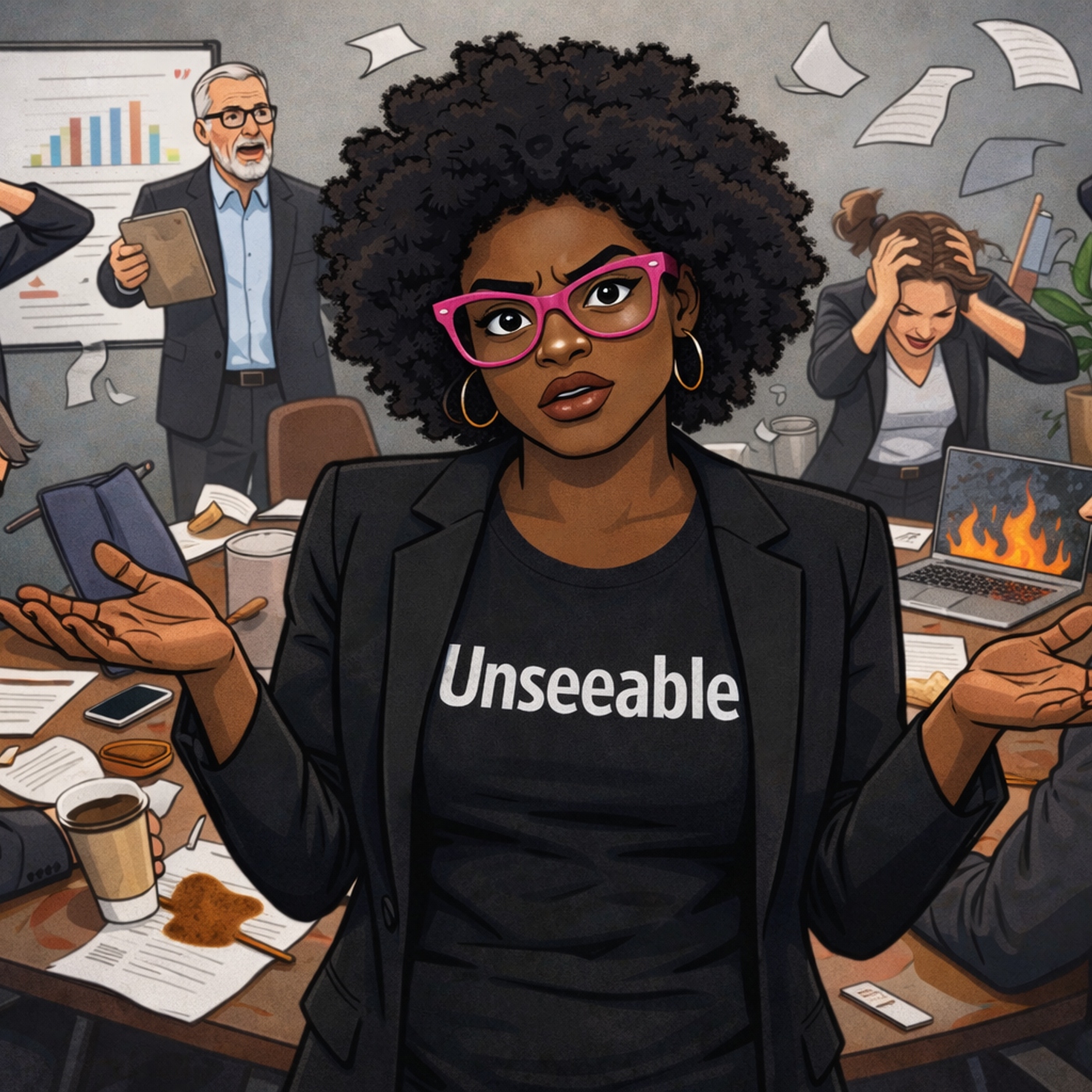
I am an invisible and unseeable Black woman. No, I am not a ghost or a haunting, nor am I the stereotypes that fuel your imagination. I am a person of substance—flesh, bone, fiber, and fluids—and I even possess an intellect of my own. Yet, I remain invisible and unseeable: invisible because you choose not to recognize my worth, and unseeable because you struggle to comprehend how I continue to move through this world, not because of you, but despite you. My invisibility and unseeability exist simply because you refuse to see me, to acknowledge my presence and humanity.--- Dr. MED
-
7
TLC Cancelled, Kanye West Celebrated
This conversation delves into the controversies surrounding TLC, EnVogue and Salt &Peppa concert's recent cancellation in light of TLC's Chilli's AKA Rozonda Thomas support of the current administration. Meanwhile, Kanye West, who exhibited years of deplorable views that supported the current administration and undermined the strides and progress of Black people holds a sold out concert at SoFi Stadium in LA. Issues of double standards and the complicity of Black women in self- subjugation, the dynamics of privilege, misogynoir, power, and challenges faced by Black women in society to choose self over others are addressed.
-
6
Kiss My Blass (Black A**)
This episode explore the life of Sara Baartman—a woman whose story embodies the struggle for recognition, dignity, and humanity. Through her experiences, we’ll draw connections to the ongoing invisibility and recognition faced by Black women globally that feed and filter in little Black girls’ sense of self in the United States.Resources: Aesthetic Plastic Surgery National Databank: Statistics. The Aesthetic Society. 2022Brown, Phyllis. Sarah Baartman: the Terrible Exploitation of an Unusually Shaped South African Woman. History Insider. 2024Clifton, L. (1975) “Homage to My Hips”, The Iowa Review. 6(2). doi: https://doi.org/10.17077/0021-065X.1848"School Daze" is a 1988 American musical comedy-drama film directed by Spike Lee. Zola Maseko. The Life and Times of Sara Baartman : "The Hottentot Venus". New York, N.Y. :Icarus Films, 1998.
-
5
Flavor of Love & Reality Tv: An acquired taste of treasure, trash and authenticity
Reality TV is trash and a treasure addiction. Through analysis of shows like Flavor of Love and Keeping Up with the Kardashians, Dr. Meredith Davis discusses how these programs shape cultural standards and distort authentic identities. The episode highlights the historical opening and closing of media doors for Black women, the effects of scripted portrayals, and the perpetuation of racial and gender stereotypes. It emphasizes the intersection of social realities with reality TV narratives and the importance of reclaiming authentic representation. This discussion is essential for understanding entertainment's influence on societal standards and offers pathways to resilience and authenticity.Sources:Azeem, Safwan. This VH1 Reality Series Gave us the Most WTF Moment on TV, ever. Collider.com. July 20, 2024.Jackson, John L. Jr. Racial Paranoia: The Unintended Consequences of Political Correctness. New York: Basic Civitas Books. 2008Juzwiak, Rich. At Last, a Plausible Origin Story for the Kim Kardashian – Ray J Sex Tape. Jezebel.com. September 12, 2022Mischalova. The Kim Kardashian Sex Tape, Uncut. Hollywood Gossip. November 8, 2007Pardo, Rebecca. “Reality Television and the Metapragmatics of Racism.” Journal of Linguistic Anthropology 23, no. 1 (2013): 65–81. http://www.jstor.org/stable/43103108.Pozner, Jennifer L. Reality Bites Back: The Troubling Truth about Guilty Pleasure TV. Berkeley, CA: Seal Press.2010
-
4
Crime and Punishment
Crime and Punishment: Power, Criminality and the Invisible Scars of Discipline in Black WomanhoodTo exist as Black in this country is to walk beneath a persistent shadow of suspicion. To be a Black woman is to shoulder not only the relentless criminalization of our Blackness, but also to endure a particular brand of punishment—one engineered to silence, diminish, and control our very womanhood. In this episode, I lay bare a searing personal narrative—not just as testimony, but as indictment. We'll confront the brutal reality of how society refuses to see Black women as fully human, opting instead to cast judgment and inflict punishment without ever pausing to ask why. Together, we’ll peel back the layers of pain, anger, and resilience that are too often twisted into stereotypes, revealing the unseen scars and the hard-won power that rises when justice is denied and empathy withheld.Like Subscribe and Please share!Selected Readings1. Bridges, Khiara M. Implicit Bias and Judicial Decision Making: Black Women in Campus Conduct Hearings. Cambridge: Harvard University Press, 2018.Crenshaw, Kimberlé. “Mapping the Margins: Intersectionality, Identity Politics, and Violence against Women of Color.” Stanford Law Review 43, no. 6 (1991): 1241–1299.Collins, Patricia Hill. Black Feminist Thought: Knowledge, Consciousness, and the Politics of Empowerment. 2nd ed. New York: Routledge, 2000.Du Bois, W.E.B. The Souls of Black Folk. Chicago: A.C. McClurg & Co., 1903.Fanon, Frantz. Black Skin, White Masks. Translated by Charles Lam Markmann. New York: Grove Press, 1967.6. Hall, E. V., Galinsky, A. D., & Phillips, K. W. (2015). Gender Profiling: A Gendered Race Perspective on Person–Position Fit: A Gendered Race Perspective on Person–Position Fit. Personality and Social Psychology Bulletin, 41(6), 853-868. Harris-Perry, Melissa V. Sister Citizen: Shame, Stereotypes, and Black Women in America. New Haven: Yale University Press, 2011.Lorde, Audre. Sister Outsider: Essays and Speeches. Berkeley: Crossing Press, 1984.hooks, bell. Ain’t I a Woman: Black Women and Feminism. Boston: South End Press, 1981.10. Patton, Lori D., and DeOnte R. Gordon. “Navigating the Margins: Black Women, Misrecognition, and Disciplinary Processes in Higher Education.” Harvard Educational Review 89, no. 2 (2019): 235–256. 11. Smith, Ashley N. “The Intersection of Race, Gender, and Justice: Experiences of Black Women in University Student Conduct Systems.” Journal of College Student Development 61, no. 4 (2020): 487–503.
-
3
Work Travel as Black Woman
Passing is more than racial. It is the ability to go throughout social spaces without questioning one's sense of belonging. What happens when expectations around culture occur that makes you uncomfortable?
-
2
Black Women out of Jobs Not Recipes: Let Her Cook
The wave of Black women’s unemployment may have knocked us down, but never out. They want to bankrupt not only Black women but Black culture. Through personal stories and analysis, this episode highlights how community-based bartering, mutual aid, and resourcefulness have long sustained Black neighborhoods, even when traditional employment opportunities fade. Incorporating current research and trends, the conversation examines the moral deficit caused by institutionalized racism, focusing on the unseeability and invisibility of Black women within the labor market, and warns that these challenges serve as an early indicator for other demographic groups. As artist Glorilla states in her song, “Let her Cook”, “Back for everything I ever lost, I’m on a mission. We turnt the whole house into a booth, we in the kitchen. Let her Cook” Resources“The Economic Impact of Women-Owned Businesses.” Rhett Buttle. Forbes. October 30, 2023.“Black women’s unemployment is rising. Economists say it’s a warning sign”. Chabeli Carrazana. 19th. July 3, 2025.“Let Her Cook.” Glorilla. Glorious Album. October 11, 2024.Report Reveals Black Women Entrepreneurs generate nearly $100 Billion in Revenue, But Highlights Ongoing Challenges. Jeffrey McKinney. Black Enterprise. February 10, 2024.“African Americans and racial violence in the time of COVID-19”. Jenesse Miller. USC Today. May 29, 2020.“How Barter Black is Changing Black Wealth: Nicole Murphy Interview.” Hey Media Moni! YouTube. February 3, 2026.
-
1
Like Mother, Like Daughter
Dr. Meredith Davis reflects on the impact of her mother's influence, the dynamics of gender roles and the unseeability of Black women, the generational influence on women's roles, the importance of serving others and community engagement, recognizing the value of mother's contributions, and the legacy of leadership and influence.Resources for this episodeBaker, Ella. “Bigger than a Hamburger.” Southern Patriot 17, no. 6 (June 1959): 4.Baker, Ella. Mentoring a Movement: The Power of Black Women’s Grassroots Leadership. Various speeches and writings, 1950s–1970s.Bracey, Earnest N., and John Bracey, eds. African American Women and the Vote, 1837–1965. Amherst: University of Massachusetts Press, 1997.Collier-Thomas, Bettye, and V. P. Franklin, eds. Sisters in the Struggle: African American Women in the Civil Rights-Black Power Movement. New York: New York University Press, 2001.Giddings, Paula. When and Where I Enter: The Impact of Black Women on Race and Sex in America. New York: HarperCollins, 1984.Harris, Duchess. Black Feminist Politics from Kennedy to Clinton. New York: Palgrave Macmillan, 2009.· "Howard Park Gets First Grocery Store In 15 Years." CBS Baltimore, July 29, 2014, 5:47 PM EDT.· Howard Park Civic Association.LeBlanc-Ernest, Angela D. “ ‘The Most Qualified Person to Handle the Job’: Black Women and the Administering of SNCC’s Southern Projects, 1961–1966.” In Sisters in the Struggle, edited by Collier-Thomas and Franklin, 111–35. New York: New York University Press, 2001.Ransby, Barbara. Ella Baker and the Black Freedom Movement: A Radical Democratic Vision. Chapel Hill: University of North Carolina Press, 2003.Robnett, Belinda. How Long? How Long? African-American Women in the Struggle for Civil Rights. New York: Oxford University Press, 1997.
We're indexing this podcast's transcripts for the first time — this can take a minute or two. We'll show results as soon as they're ready.
No matches for "" in this podcast's transcripts.
No topics indexed yet for this podcast.
Loading reviews...
ABOUT THIS SHOW
I am an invisible and unseeable Black woman. No, I am not a ghost or a haunting, nor am I the stereotypes that fuel your imagination. I am a person of substance—flesh, bone, fiber, and fluids—and I even possess an intellect of my own. Yet, I remain invisible and unseeable: invisible because you choose not to recognize my worth, and unseeable because you struggle to comprehend how I continue to move through this world, not because of you, but despite you. My invisibility and unseeability exist simply because you refuse to see me, to acknowledge my presence and humanity.--- Dr. MED
HOSTED BY
DrMeredithDavis
Loading similar podcasts...
Frequently Asked Questions
How many episodes does The Unseeable Black Woman's Podcast have?
The Unseeable Black Woman's Podcast currently has 7 episodes available on PodParley. New episodes are automatically indexed when they're published to the podcast feed.
What is The Unseeable Black Woman's Podcast about?
I am an invisible and unseeable Black woman. No, I am not a ghost or a haunting, nor am I the stereotypes that fuel your imagination. I am a person of substance—flesh, bone, fiber, and fluids—and I even possess an intellect of my own. Yet, I remain invisible and unseeable: invisible because you...
How often does The Unseeable Black Woman's Podcast release new episodes?
The Unseeable Black Woman's Podcast has 7 episodes. Check the episode list to see recent publication dates and frequency.
Where can I listen to The Unseeable Black Woman's Podcast?
You can listen to The Unseeable Black Woman's Podcast on PodParley by clicking any episode. We provide an embedded audio player for direct listening, and you can also subscribe via your preferred podcast app using the RSS feed.
Who hosts The Unseeable Black Woman's Podcast?
The Unseeable Black Woman's Podcast is created and hosted by DrMeredithDavis.
URL copied to clipboard!