
PODCAST · history
Unintended Consequences
by Jesse Hendon
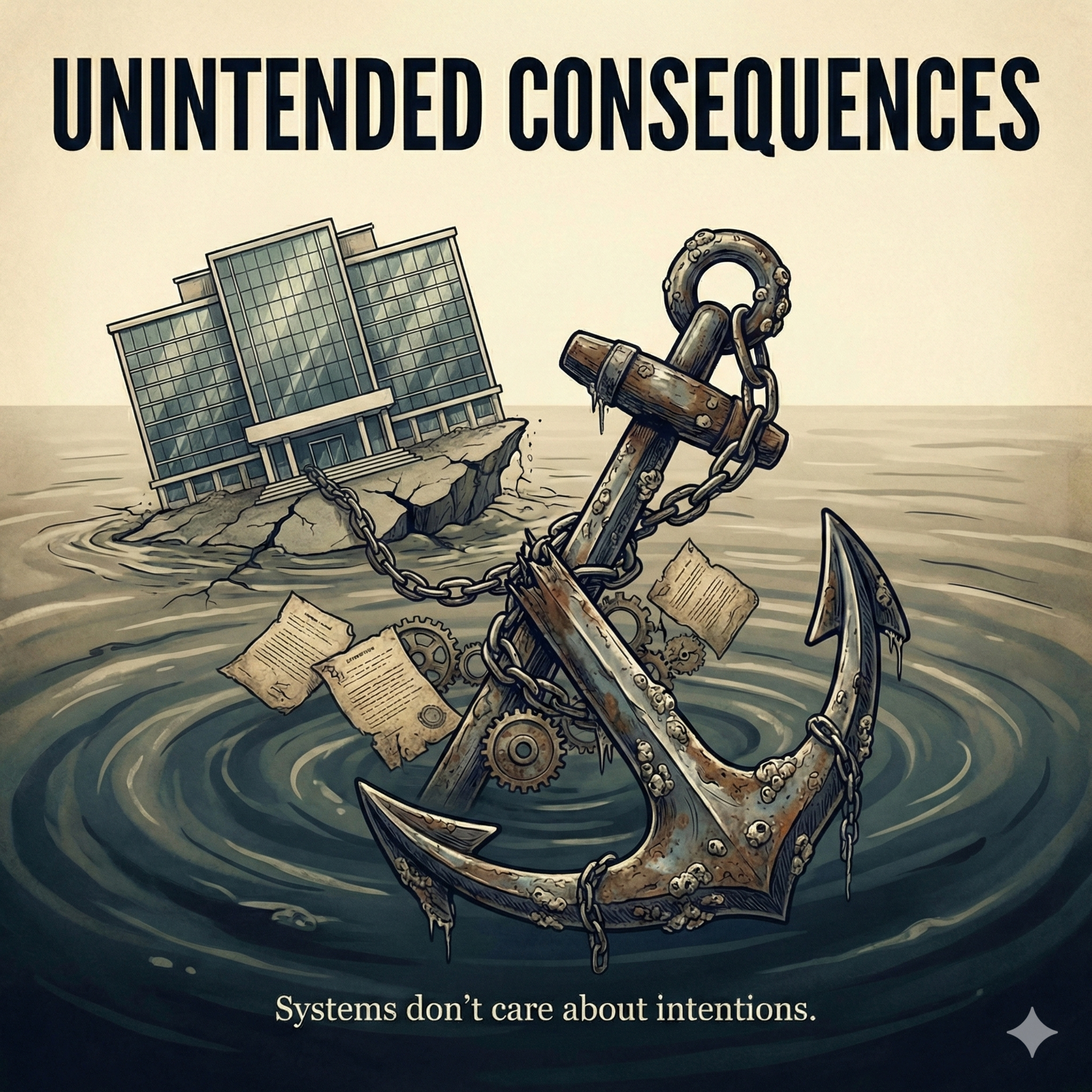
Unintended Consequences explores the accidental architectures that define our lives. Hosted by Jesse Hendon, this show dissects how well-meaning decisions in history created the structural traps of today —starting with the US healthcare system.We look past the politics and the "villains" to focus on the mechanics: the incentives, the obscure regulations, and the third-party transactions that broke the price signal. It’s not about mistakes; it’s about the inevitable outcomes of flawed systems.
-
16
Price Transparency and your Employer-Sponsored Health Insurance
Learn how price transparency in employer-sponsored health insurance can significantly reduce costs and improve healthcare access. Essential insights for HR professionals and employers.In today's complex healthcare landscape, many employers are grappling with rising costs and opaque pricing structures. One pivotal study by the Rand Corporation revealed a staggering finding: commercial health insurance pays hospitals an average of **224%** of what Medicare pays for the same services. This episode delves into the implications of price transparency for employer-sponsored health insurance and how it empowers employers to make informed decisions about their healthcare plans.
-
15
HR vs Big Insurance - The Fight to Get the Data
Ever wondered why your health insurance premiums keep rising? Here's what you need to know about the hidden costs.Tag someone who needs to understand this! Meet Sandra, an HR director caught in a web of insurance complexities. Last November, her premium jumped 11%. Why? Because she didn’t know to ask for the claims data!Her carrier holds the keys to the data, while she’s left in the dark about what her employees are really spending on healthcare. This lack of transparency isn't just frustrating; it can be costly.Self-funded vs. fully insured plans: the difference is crucial! Self-funded plans give employers insight into claims, but they also come with risks and lack of state protections. Don't get caught in the cycle of rising premiums without understanding your plan. Knowledge is power.What’s your experience with healthcare costs? Let’s discuss!#HealthInsurance #InsuranceTransparency #EmployerSponsored #SelfFunding #HRInsights
-
14
You and Your Employer are Paying for Everyone's Healthcare
Employer based health insurance covers over 1/2 of all Americans, however, they're single handedly covering the entire bill! Medicare is subsidized by you and your employer. Medicaid is subsidized by you and your employer. Even charity care is subsidized by you and your employer! It's time that we address the elephant in the room. The reason wages have been stagnant for decades has more to do with the rising cost of insurance than anything else! And why do those premiums keep going up? Because they can. No one knows! It has nothing to do with YOUR cost, it has everything to do with EVERYONE elses cost that you are subsiding!In this episode of Unintended Consequences, we dive into how we got here and expose the elephant in the room of healthfcare economics. That elephant is your employer and you are subsidizing all of this!
-
13
The Hidden Negotiability of Hospital Bills
In the final part of our 3 part series on Hospital Pricing, we go into something practical to finish it all up! We explore how you can actually negotiate your bills, like I did! One of the most surprising revelations about hospital billing is that many bills are negotiable. This is a fact that many patients are unaware of, leading them to accept charges without question. If you're facing a medical bill, the first step is to inquire about financial assistance programs offered by hospitals. According to Jesse Hendon, a healthcare expert, simply asking, "Is this bill negotiable?" can open doors to potential savings.It's a complex system that isn't designed to be transparent and easily navigated, now you have the tools to help save money! We're exposing a light today, got let it shine!
-
12
How A Bag Of Salt Water Became A $700 Bill
A liter of saline solution costs about $1 to manufacture. You can buy one on Amazon for $1.50. In an American hospital, that same bag shows up on your bill at anywhere from $100 to $700. This episode is the origin story of that gap. In Part 2 of our hospital pricing series, Jesse goes back to 1983 — to a Reagan-era Medicare reform that was genuinely smart, measurably effective, and accidentally engineered every absurdity on your current hospital bill. Then we follow the money through the hospital consolidation wave of the 90s and 2000s, and into a federal drug program called 340B — created to help the poorest patients, expanded to cover sixty percent of all hospitals, and now generating hundreds of millions in revenue through a pricing mechanism that looks almost identical to PBM spread pricing. Different industry. Different program. Same math. If Episode 11 was about the bill, Episode 12 is about who built the machine that produced it.
-
11
I Work in Healthcare and Still Got Played!
In December 2023, Jesse hurt his back. Badly. Slipped disc, fractured lumbar spine, six months of sciatica — and a crash course in everything wrong with how Americans get billed for healthcare. One phone call saved him $1,500 on a single MRI. Three epidural injections failed, and the system's answer was a fourth one. A trip to the ER produced a CT scan that cost four times what the cash MRI did. Jesse works in healthcare. He knew what questions to ask, knew cash pricing was an option, knew to get second opinions. And he still probably got taken somewhere in the process. In Part 1 of our hospital pricing series, Jesse uses his own experience to pull back the curtain on facility fees, the chargemaster — the secret price list hospitals never meant for you to see — and the federal transparency rule that 70% of hospitals are simply ignoring. If you've ever gotten a hospital bill that made no sense, this episode is for you. Spoiler: the bill wasn't confusing by accident.
-
10
The People Who Fought Back
For fifty years, the PBM system grew in the dark — processing trillions in drug transactions while staying invisible to the people paying the bills. Then a few unlikely fighters decided enough was enough. In the finale of our three-part PBM series, Jesse traces the rebellion that nobody saw coming: a state government that fired its PBM and saved $54 million in year one, a coalition of employers who made one radical demand — show us the math — and a billionaire who built a pharmacy from scratch just to prove what drugs actually cost. This episode is about what happens when people who understand a broken system get angry enough to do something about it. And it ends with a question that leads somewhere even darker than where we started.
-
9
PBM's Episode 2 of 3 - Vertical Integration
Spread pricing, rebates and vertical integration has created structure in drug distribution that's incentivized the increase in prices to the end point consumer. In today's episode we follow the money. We look at states that have legally paid hundreds of millions of dollars from their medicaid coffers to PBM's because of spread pricing. We look at medications that cost multiples more in the US versus Europe because of rebates. We look at the vertical octopus that has resulted in the US paying WAY more than anywhere else in the world for our drugs. A process, by the way, written into the contracts...
-
8
Pharmacy Benefit Managers - Plastic Cards to World Domination
This conversation explores the complexities of the American healthcare system, focusing on the role of Pharmacy Benefit Managers (PBMs) in drug pricing. It highlights the hidden costs associated with insurance and the evolution of PBMs from service providers to powerful intermediaries that control drug prices and access. The discussion also touches on the implications of vertical integration in healthcare and the challenges it poses for consumers.
-
7
ACA Episode 3 - Leading to 2027
When the ACA started, a pregnant woman with no insurance from her job couldn't get covered. Today she can! However we're also going into 2027 with $12,000 MOOP's, plans changing, enrollment avenues changing and the times are changing! It's a new day for the ACA, but it definitely doesn't look like it was intended to look like.
-
6
ACA Episode 2 - Silver Loading
In 2017 we'd just had a crazy election, the ACA was a thumbs up away from John McCain from going away and we thought the elimination of Cost Sharing Reduction funding would blow everything up. That was until a clever actuary realized we could raise prices on silver plans and save everything! On today's episode we explore what happens we explore the mechanism that saved the ACA and at some point, when fueled up with additional steroids from covid funding, almost blew everything up! Welcome to our episode on Silver Loading!
-
5
ACA Part 1 - How the ACA Rewired Individual Insurance
In this episode of Unintended Consequences, Jesse Hendon walks through why the ACA had to exist, why it chose a market-based solution instead of socialized care, and how a series of well-intended design choices reshaped the incentives of the entire system.This is the story of underwriting before 2010, the introduction of guaranteed issue, the 80/20 Medical Loss Ratio rule, age-rating compression, and the bet on the “Young Invincibles.” It’s also the story of what happened when that bet didn’t pay off.By the end of the episode, you’ll understand why underwriting never disappeared — it just changed form — and why narrow networks, prior authorization, and utilization management became the new tools of control.This is Episode 1 of a three-part series on how healthcare policy changed the system’s incentives — and why those incentives still shape coverage, cost, and access today.
-
4
The Star Reset
This episode traces the changing of the Medicare Advantage incentive machine. When risk scores, star bonuses, and vendor ecosystems pushed the system past sustainability, CMS responds with course correction: payment model rewrites, diagnosis weight reductions, compliance tightening, audit pressure, and litigation. The bonus economy is changing. When the stars change how the pay, the system is forced back to reality, and the industry has to relearn the difference between healthcare and optimization.
-
3
How measuring quality turned healthcare into a scoring system
This episode explains how Medicare Advantage shifted from care delivery to score optimization. Star Ratings were introduced as simple transparency tools, similar to reviews, not outcome measures. When money was tied to them under the ACA, they became economic levers. Combined with Risk Adjustment, they turned sickness into revenue and documentation into strategy. Plans built vendor ecosystems to optimize metrics, not medicine. What began as quality measurement became performance theater, market consolidation, and a system vulnerable to fraud, waste, and abuse. This is the moment Medicare Advantage stops being healthcare infrastructure and becomes a scoring economy.
-
2
Unintended Consequences: Medicare Star Ratings - How did we get here?
This episode unpacks how this payment model changed everything for American seniors, leading to some surprising outcomes.
-
1
How Pearl Harbor tied your health insurance to your job
The moment healthcare became a third-party transaction, cost discipline disappeared—and it never returned.In this inaugural episode of Unintended Consequences, we track the origin story of the American health insurance crisis. It wasn't a master plan; it was a wartime workaround that hardened into infrastructure.We cover:The Wartime Decision: How WWII wage controls accidentally invented employer-sponsored insurance.The Third-Party Problem: Why prices skyrocket when the patient isn't the payer.The Risk Pool Trap: Why tying long-term health risk to short-term employment guarantees friction (and higher costs).Nothing about your health changes when you quit a job, but your access to care does. That outcome wasn’t planned. But it was inevitable.
We're indexing this podcast's transcripts for the first time — this can take a minute or two. We'll show results as soon as they're ready.
No matches for "" in this podcast's transcripts.
No topics indexed yet for this podcast.
Loading reviews...
ABOUT THIS SHOW
Unintended Consequences explores the accidental architectures that define our lives. Hosted by Jesse Hendon, this show dissects how well-meaning decisions in history created the structural traps of today —starting with the US healthcare system.We look past the politics and the "villains" to focus on the mechanics: the incentives, the obscure regulations, and the third-party transactions that broke the price signal. It’s not about mistakes; it’s about the inevitable outcomes of flawed systems.
HOSTED BY
Jesse Hendon
CATEGORIES
Loading similar podcasts...
URL copied to clipboard!