
PODCAST · history
What Would They Think?
by Jonathan Millard
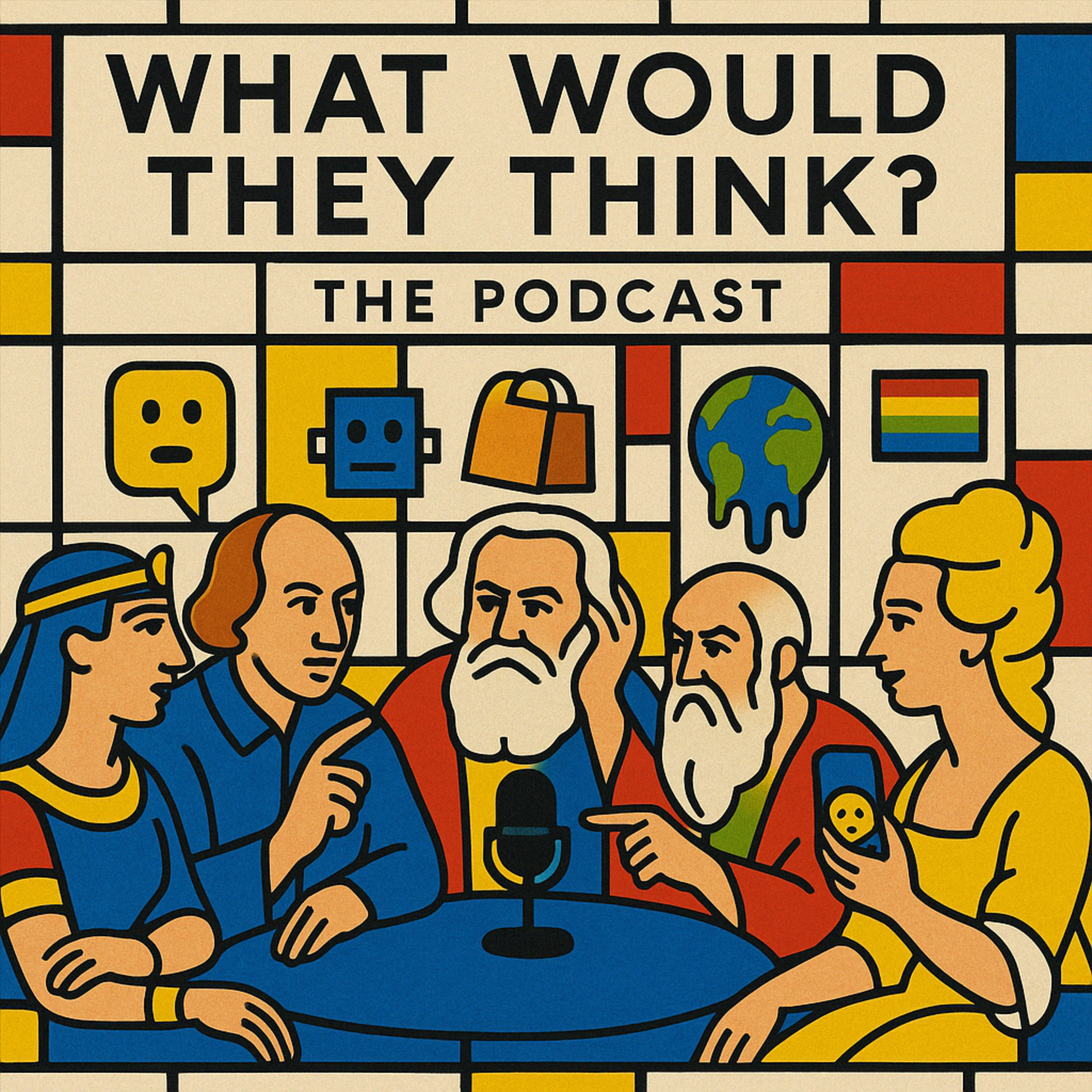
What Would They Think explores the gap between the world that was imagined and the one we’re actually living in. Through ironic, often uncomfortable comparisons, it brings the voices of the past into today’s headlines—technology, culture, power, and belief—and asks how they would interpret the systems, behaviors, and contradictions that define modern life. The result is less explanation, more confrontation.
-
11
What Would Nostradamus Think About QAnon?
What would Nostradamus think of a movement that took his entire playbook — cryptic clues, decoded breadcrumbs, an apocalypse always one Tuesday away — and ran it on 4chan?He wrote his quatrains in a Provençal stone room while the Inquisition watched for heresy and plague kept killing his neighbors. He buried his meaning in mangled Latin and shuffled syntax because vagueness was survival, not branding. Catherine de' Medici summoned him to court. Henri II died on a jousting splinter four years after he seemed to predict it. Prophecy wasn't content. It was a craft — and a hedge.So we dropped him on an imageboard.This episode puts the old astrologer of Salon-de-Provence in front of the Q drops — three years of leading questions, all-caps slogans, and a Storm that never arrives. He has opinions. On the bakers decoding breadcrumbs in real time. On "Trust the Plan" as a literary form. On what it means to write prophecy when no Inquisition is coming for you and the audience finishes the verse before you've put down the pen.The man who gave himself two thousand years of runway meets the prophet who gave himself a week. Turns out, the apocalypse isn't the only thing on a deadline.Dead seers. Modern feeds. Fully AI.What Would They Think?
-
10
What Would Andy Warhol Think About The Hawk Tuah Girl?
What would Andy Warhol think of a world where a few seconds of raw street bravado can launch a global business empire, and a southern factory worker becomes an accidental trademark before she creates a single piece of content?He predicted the democratization of fame, where everyone would be famous for fifteen minutes. He mass-produced icons like soup cans in his aluminum Silver Factory. He believed that "good business is the best art". He elevated consumer products into icons.So we handed him a smartphone.This episode puts the Pope of Pop Art in front of Haliey Welch, the "Hawk Tuah Girl". From curated celebrity to algorithmic virality — from meticulously engineered stars to immediate, monetizable memes. He has opinions. On the acceleration of fifteen minutes of fame into fifteen seconds. On a pop landscape where the surface is literal.The machine-minded prophet meets the ultimate accidental trademark. Turns out, both made art from American excess.Dead pioneers. Modern platforms. Fully AI.What Would They Think?
-
9
What Would Karl Marx Think About Burning Man?
What would Karl Marx think of a week-long festival where hedge fund managers pay working-class staff to pitch their tents, cook their meals, and clean their composting toilets — and call the whole thing a gift economy?He wrote Das Kapital in a freezing London flat while his children went hungry. He took money from a factory heir to finish a book predicting factory heirs would be overthrown. He called the commodity a hieroglyph — a thing that hides the labor inside it. Revolution wasn't an aesthetic. It was a diagnosis.So we dropped him in the Black Rock Desert.This episode puts the old man of Trier on the playa — seven days of radical self-reliance catered by hired staff, a gift economy enforced at the ticket booth, and a temporary autonomous zone where the autonomy is sponsored by Silicon Valley. He has opinions. On the spectacle. On the turnkey camps. On what it means to abolish exchange value in a place where even the dust seems to be monetized.The prophet of class struggle meets the festival that thinks it escaped class. Turns out, the Man isn't the only thing burning.Dead pioneers. Modern platforms. Fully AI.What Would They Think?
-
8
What Would Jane Austen Think About Dating Apps?
She mapped the entire social universe of a country drawing room — who sat where, who glanced at whom, who was worth £5,000 a year and who merely thought they were. She understood that marriage was economics dressed in muslin. That wit was armour. That a well-timed silence could end a man.She did all of this without leaving the house.So we handed her a smartphone.This episode puts Jane Austen in front of dating apps — infinite scroll, curated selfies, algorithmic compatibility scores, and the most efficient marriage market in human history. She has thoughts. On the bios that reveal everything while saying nothing. On the men who lead with their salary and the women who pretend not to notice. On whether swiping right is meaningfully different from accepting a dance at the Netherfield ball.She invented the romantic comedy. She diagnosed the con of romantic love before most people admitted it was a con. She watched women trade their autonomy for security and wrote five novels about whether there was any other option.There is now. Allegedly.The question is whether choice at scale is liberation or just a bigger room full of the same Wickhams. Austen suspects the latter. She is, as always, taking notes.Dead pioneers. Modern platforms. Fully AI.What Would They Think?
-
7
What Would Marie Curie Think About TikTok Science Videos?
What would Marie Curie think of a platform where teenagers mix chemicals in their kitchens for likes, and a bad science claim can reach ten million people before a single expert weighs in?She stirred cauldrons of uranium ore by hand in a leaky shed. She refused to patent radium because knowledge belonged to everyone. She kept a glowing vial of her own discovery on her bedside table. Science wasn't a career. It was a calling.So we handed her a smartphone.This episode puts Madame Curie in front of TikTok science — sixty seconds at a time, no peer review, no safety protocols, and more curiosity than the world has ever seen in one place. She has opinions. On the wonder. On the misinformation. On what it means to democratize knowledge when the most dangerous thing in your lab is the algorithm.The anti-influencer meets the attention economy. Turns out, one of them glows.Dead pioneers. Modern platforms. Fully AI.What Would They Think?
-
6
What Would Pablo Escobar Think About The Cybertruck?
What would the world's most notorious drug lord make of a bulletproof truck built for the apocalypse?Pablo Escobar understood vehicles the way most people understand weapons — as extensions of will, fear, and survival. He armored his Mercedes, raced Porsches, moved cocaine through jungle roads in Toyota Land Cruisers, and kept a bombed-out limo on display at his estate as a trophy. Cars weren't transportation. They were statements.So we handed him the keys to a Tesla Cybertruck.This episode puts El Patrón behind the wheel of Silicon Valley's most polarizing machine — a stainless-steel polygon that promises to be bulletproof, self-driving, apocalypse-ready, and somehow legal. Escobar has thoughts. On the armor. On the silence. On Elon Musk. On what it means to build an empire when the most dangerous thing you own is a Twitter account.Two men who refused to be told what was possible. One era defined by blood and fire. One defined by data and memes. The Cybertruck is where they meet.Dead kingpins. Modern machines. Fully AI.What Would They Think?
-
5
What Would William Shakespeare Think About Emojis?
What would the greatest writer in the English language think of a world where people have stopped using words? What Would They Think? is a fully AI-generated podcast that pairs history's greatest minds with the strangest corners of modern life. Each episode, one long-dead thinker walks straight into the 21st century and we ask: what would they actually make of it?This episode: Shakespeare meets emojis. The man who gave us more words than anyone in the history of the language — who coined "lonely," "bedroom," "eyeball," and roughly 1,700 others — confronts a communication system built entirely on pictures. A 16th-century playwright who wrote for the groundlings and the court in the same breath meets a culture that expresses grief, desire, irony, and lunch in a single yellow circle.It's a more honest collision than it seems. Shakespeare wrote for performance, not the page. He understood that meaning lives in gesture, in timing, in the gap between what's said and what's meant. Emojis operate in exactly that space. Whether he'd see them as a natural evolution of the thing he loved — or as proof that civilization has finally given up — turns out to be a genuinely open question.The production will grow. The format will evolve. We're building this in public, with AI, and we're committed to the journey.Dead philosophers. Modern problems. Fully AI.What Would They Think?
-
4
What Would Albert Einstein Think About Memes?
What would Albert Einstein make of a world where his face is everywhere — and almost none of the quotes are his? What Would They Think? is a fully AI-generated podcast that pairs history's greatest minds with the strangest corners of modern life. Each episode, one long-dead thinker walks straight into the 21st century and we ask: what would they actually make of it?This episode: Einstein meets memes. Not just the ones with his face on them — though there are many, and most are wrong — but the whole ecosystem. The dopamine loops, the remix culture, the way a single image can circle the globe before breakfast. The man who explained the universe with thought experiments meets a culture that explains itself in reaction GIFs.It's a collision that goes deeper than it looks. Einstein spent his life trying to make complex ideas simple without making them stupid. Memes do the same thing — sometimes brilliantly, usually not. He was famously wary of his own celebrity, baffled by how a physicist became a cultural mascot. He had no idea what was coming.The production will grow. The format will evolve. We're building this in public, with AI, and we're committed to the journey.Dead philosophers. Modern problems. Fully AI.What Would They Think?
-
3
What Would Steve Jobs Think About This Podcast?
What would Steve Jobs think of a podcast that uses AI to resurrect history's greatest minds? Turns out, he'd have notes. What Would They Think? is a fully AI-generated show that pairs history's most iconic figures with the strangest corners of modern life — and asks what they'd actually make of it all. Each episode, one long-dead thinker, rebel, or visionary walks straight into the 21st century: its obsessions, its absurdities, its contradictions. The collision is the point.We launch with the man who helped put podcasts in our pockets in the first place. Steve Jobs — designer, storyteller, perfectionist, and the guy who once said he wished he could ask Aristotle about AI — gets to weigh in on the very medium he helped build. And, in a twist he might have appreciated, on us.This is a show about history as a lens, not a lecture. It's smart without being academic, funny without being cheap, and built entirely with the AI tools it's interrogating. The production will grow. The format will evolve. We're at the beginning of something, and we know it.Dead philosophers. Modern problems. Fully AI. What Would They Think?*Updated March 26
We're indexing this podcast's transcripts for the first time — this can take a minute or two. We'll show results as soon as they're ready.
No matches for "" in this podcast's transcripts.
No topics indexed yet for this podcast.
Loading reviews...
ABOUT THIS SHOW
What Would They Think explores the gap between the world that was imagined and the one we’re actually living in. Through ironic, often uncomfortable comparisons, it brings the voices of the past into today’s headlines—technology, culture, power, and belief—and asks how they would interpret the systems, behaviors, and contradictions that define modern life. The result is less explanation, more confrontation.
HOSTED BY
Jonathan Millard
CATEGORIES
Loading similar podcasts...
Frequently Asked Questions
How many episodes does What Would They Think? have?
What Would They Think? currently has 9 episodes available on PodParley. New episodes are automatically indexed when they're published to the podcast feed.
What is What Would They Think? about?
What Would They Think explores the gap between the world that was imagined and the one we’re actually living in. Through ironic, often uncomfortable comparisons, it brings the voices of the past into today’s headlines—technology, culture, power, and belief—and asks how they would interpret the...
How often does What Would They Think? release new episodes?
What Would They Think? has 9 episodes. Check the episode list to see recent publication dates and frequency.
Where can I listen to What Would They Think??
You can listen to What Would They Think? on PodParley by clicking any episode. We provide an embedded audio player for direct listening, and you can also subscribe via your preferred podcast app using the RSS feed.
Who hosts What Would They Think??
What Would They Think? is created and hosted by Jonathan Millard.
URL copied to clipboard!