
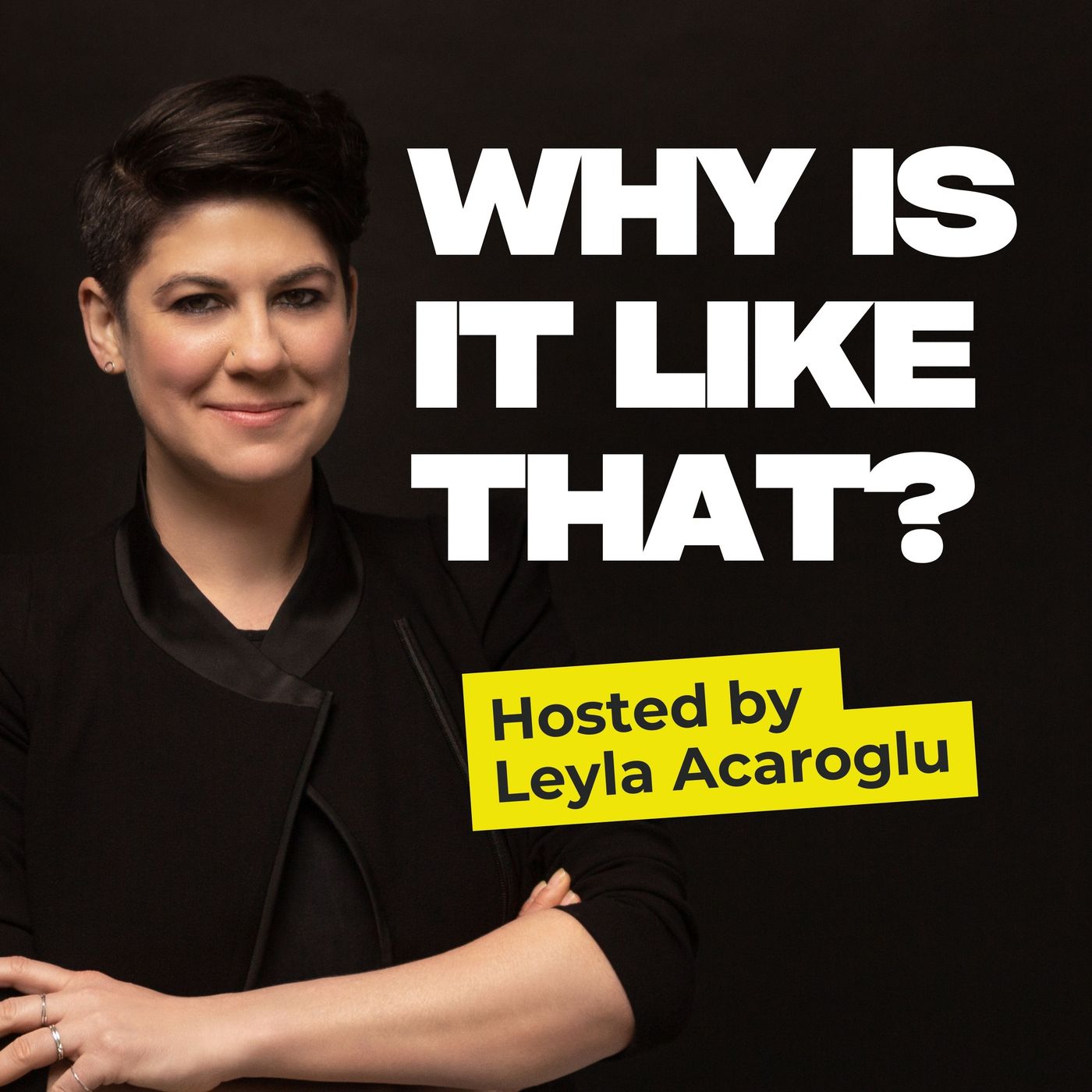
PODCAST · education
Why is it Like That?
by Leyla Acaroglu
Why Is It Like That? is a curiosity podcast hosted by designer, social scientist and sustainability provocateur Leyla Acaroglu. Each episode takes you on a wild ride through science, design, innovation, nature, and the quirks of everyday life. In every episode, Leyla sits down with fascinating thinkers — scientists, designers, explorers, philosophers, and innovators — to unravel counterintuitive questions about the world around us. Expect surprising insights, humour, and more as she digs into the big and small things that shape our lives and our planet. Curious, thought-provoking, and always entertaining, Why Is It Like That? invites you to see the world differently, one question at a time.
-
13
Could Doughnut Economics Fix What Growth Has Broken? With Kate Raworth
What if the economy wasn’t something we had to endlessly grow, but something we had to balance? In this episode, economist Kate Raworth challenges the way we’ve been taught to think about economic success and introduces the idea of Doughnut Economics, a model that focuses on meeting human needs while staying within the planet’s ecological limits. Kate explains why endless growth has become the misguided goal and how the economy affects everything from housing and inflation to inequality and environmental destruction.This conversation explores how cities, businesses, and individuals can rethink success, redesign systems, and build an economy that allows both people and the planet to thrive. From redefining progress to understanding sufficiency, sustainability, and systemic change, this episode offers a hopeful and practical look at how we can move from an economy focused on growth to one focused on balance, wellbeing, and long-term resilience.For more information, click here Kate’s WebsiteDoughnut Economic Action LabUnSchoolsLand recognition
-
12
Happiness, How Do We Get It? With Lhatu Lhatu
How do we measure a good life, and what if we’ve been getting it wrong? In this episode, Lhatu Lhatu, Director of Bhutan’s Gross National Happiness Centre explores a radically different approach to progress—one that prioritises wellbeing, community, and environmental balance over economic output. Lhatu shares how Bhutan measures national happiness across multiple domains, why GDP falls short, and what happens when governments design policies around people, not just productivity.This conversation challenges the idea that more consumption leads to more fulfilment, offering us all practical ideas around time use, social connection, and mindful living as pathways to deeper, more sustainable happiness. It’s a powerful look at how individuals, communities, and leaders can rethink success and what it really means to live well.For more information, click here Lhatu’s LinkedInGross National Happiness Centre BhutanUnSchoolsLand recognition
-
11
What Makes Indigenous Knowledge Systems So Timeless? With Alison Page
How do narratives of the past affect our understanding of the present? Designer and filmmaker Alison Page explores reframes the first encounter between Captain Cook and the Dharawal people at Kamay through an Aboriginal lens, showing how story, ceremony and connection to Country carry deep environmental and systems knowledge. This episode looks at how two worldviews collided, then and now, what was and is still misunderstood, and why Indigenous knowledge has always been a science of its own, and one we should all embrace.Alison is a descendant of the Dharawal and Yuin people and is an award-winning multi-dimentional creative at the forefront of the contemporary Australian Aboriginal cultural movement. Her award winning work spans film, design, public art, exhibitions and major urban design projects across Australia. She is Professor of Practice at UTS, has created landmark works at Barangaroo and Kamay, and co-authored Design: Building on Country.For more information, click here Alison’s Website Alison’s LinkedInUnSchoolsLand recognition
-
10
Have Designers Ruined Everything? With Mike Monteiro
What if the apps you continuously scroll through and the products you use every day are quietly shaping your choices and changing your mind? Designer Mike Monteiro pokes and prodes at the deisgn world, unpacking the hidden impact of the design world, from digital screens to everyday objects. This episode explores how design can manipulate (or empower) each and every one of us, and asks why do designers not consider the ethics of the things they do and create? Mike is the co-founder and Design Director of Mule Design. He writes and speaks frequently about the craft, ethics, and business of design. Mike’s book Ruined by Design asks designers to consider the ethical implications of their work. Previous talks include How Designers Destroyed the World, and How to Fight Fascism.For more information, click here Mike’s WebsiteMike’s LinkedInUnSchoolsLand recognition
-
9
What’s the Deal With Mushrooms and Death? With Yasmine Ostendorf-Rodriguez
What if the answers to our biggest human challenges, from loneliness, death and sustainability, were hidden in the soil? Artist and author Yasmine Ostendorf-Rodriguez explores how fungi-model communication, cooperation, and resilience reveal telling lessons for humans that stretch far beyond the forest floor or mushroom sauce. Yasmine is the founder of Futures Materials Bank and director of the Green Art Lab Alliance, whose mission is to foster relationships that contribute to social and environmental justice, akin to the interconnected nature of mycelium. She is a self-proclaimed "mycophile", interested in exploring the application of a mycological lens in defining fair models of collaboration and (self) organization. Her debut book, "Let's Become Fungal! Mycelium Teachings and the Arts," shares twelve teachings of the world of fungi.For more information, click here Yasmine’s WebsiteYasmine’s LinkedInFuture Materials BankLet's Become Fungal! Mycelium Teachings and the ArtsGreen Art Lab AllianceNature Research DepartmentUnSchoolsLand recognition
-
8
The Wisdom of Indigenous Thinking: Can It Change Your Life? With Dr Paul Callaghan
Please note: This episode contains discussions of depression and suicidal thoughts, which may be distressing to some listeners. If you need to reach out for support, you can contact Lifeline 24 hours a day on 13-11-14.After facing deep personal despair, Dr Paul Callaghan found healing and purpose through Aboriginal law, culture, and connection to Country. In this powerful conversation, Paul shares how Indigenous wisdom reframes life around care, unity, and responsibility rather than rights and competition. Through stories of self-discovery and cultural insight, he reveals that true wellbeing comes when all things (people, nature, and community) are well. Paul reminds us that leadership begins with love, healing begins with connection, and that to live the best story possible, we must first remember who we are and where we come from.Paul is an Aboriginal man belonging to the land of the Worimi people, now called Port Stephens. He occupies Professor roles at the University of Melbourne, RMIT University and Charles Sturt University. Paul’s best-selling book, The Dreaming Path, received the Australian Book Industry Award for ‘Small Publisher’s Adult Book of the Year’ in 2023, and his children’s book, Adventures on the Dreaming Path, was published on 1 July 2025.For more information, click here Paul’s WebsiteThe Dreaming PathAdventures on the Dreaming PathUnSchoolsLand recognition
-
7
How Can We Have a Fashion Revolution? With Orsola de Castro
Please note: This episode was recorded on the road, so the audio may sound a little different from our usual in-studio recordings.Clothes are worn by everyone, yet the fashion industry is built on systems of exploitation and exclusion. Co-founder of Fashion Revolution, Orsola de Castro, exposes the industry's dark history, from the chemical-laden disaster of distressed denim to the human misery hidden in the price tag of fast fashion. She argues that the system isn't broken, it was designed this way for profit. She shares anecdotes about anatomically ridiculous jeans and champions the simple, revolutionary act of mending and repairing to strengthen the bond with our clothes and keep them out of waste streams around the world.Orsola is a world-leading advocate for sustainable fashion. She is a designer, author, and lifelong mender. Her career started as a designer with the pioneering upcycling label From Somewhere, and has collaborated with Jigsaw, Topshop and Speedo. She co-founded Fashion Revolution and is the author of Loved Clothes Last. Orsola is an Associate Lecturer at UAL, and a Central Saint Martins Visiting Fellow.For more information, click here: https://leylaacaroglu.com/podcast-orsola-de-castro/ Orsola’s SubstackFashion Revolution Orsola’s Instagram UnSchools
-
6
Do We Need Interspecies Design? With Damian Lutz
Humans have a tendency to be stuck in their own perspective of the world, and when it comes to designing products and services, this means excluding all the other species that share the Earth with us. But what if we could design for all species and include all the more-than-humans? Damian Lutz is a multidisciplinary designer helping to pioneer a new approach to design called life-centric design that moves beyond human-centric perspectives to incorporate nature-inclusive approaches. A life-centered design pioneer, Damien Lutz is a multidisciplinary designer, author, teacher, and speaker based in Sydney, Australia. He develops nature-inclusive and future-thinking design tools and methods, teaching them to students, designers and innovators so that their work causes less planetary harm and more regenerative good.For more information, click here: https://leylaacaroglu.com/podcast-damien-lutz/ Damien's WebsiteLife-centred Design LabLife-centred Design AcademyLife-centred Design GuideUnSchoolsLand recognition
-
5
What is the Hidden Cost of AI? With Thorston Jonas
We are living our lives more and more online, outsourcing our thinking to Artificial Intelligence (AI) and being sucked into digital systems designed to keep us enthralled, but how are the hidden costs of these systems and why should we all be more considerate of the impacts that they are having on our lives, and the planet? In this episode, UX designer Thorston Jonas exposes many of the insidious ways digital technologies are affecting us.Thorsten is Sustainable UX and Responsible AI advocate, Keynote Speaker and Founder of the SUX Network and SUX Academy. He is guiding and teaching designers and product people, teams and companies in crafting sustainable, responsible and ethical digital products and using AI responsibly. Thorsten is co-author of the W3C Sustainable Web Design Guidelines and is the host of the SUX Podcast. His passion for the outdoors and mountaineering drives his commitment to making sustainability a fundamental aspect of design and digital product building and he believes that it is our first responsibility to create digital products and experiences that do not harm other beings or the planet. ---For more information, click here: https://leylaacaroglu.com/podcast-thorsten-jonas/ Thorsten’s WebsiteSustainable UX NetworkSUX AcademyUnSchoolsLand recognition
-
4
Are We Post Human Yet? With Francesca Fernando
We live in a very human-centric world, which can become myopic at times. Philosopher Francesca Fernando helps us push through anthropocentrism into the macro world of the possibility of what posthumanism can offer us. Expect your mind to melt in this episode as we explore the world we are in, and the ways we can all envisage better modes of being within it. Dr. Francesca Ferrando is an Award-Winning Philosopher, Professor at NYU, founder of the Global Posthuman Network and a leading voice in the field of Posthuman Studies. Francesca was named "One of the 100 Top Creatives Making Change in the World" by ‘ORIGIN’ Magazine and is committed to existential well-being and mindfulness, justice and diversity for humans and non-humans alike. They are the author of several books, including The Art of Being Posthuman. ---For more information, click here: https://leylaacaroglu.com/podcast-francesca-ferrando/Francesca’s Website The Posthumanism Explainer Videos Global Posthumanism UnSchoolsLand recognition
-
3
Waste Colonization, Are You Doing It? With Betty Adjei
Waste is a luxury for some that comes at the cost of others. For many people, waste is so externalised that they have very little knowledge of just how bad the global waste crisis is and where the things we discard end up. But Betty Adjei knows firsthand and is leading pivotal projects across Africa to change the way people relate to waste. Betty Adjei is a storyteller and leading voice in the circular economy movement. She is the Director of Operations and Programs at Green Africa Youth Organisation and founder of B.Inspired with Stories from Africa (B.ISA). Betty is committed to amplifying indigenous knowledge and solutions, empowering communities to contribute to a more diverse and enriching storytelling landscape for a positive planet. --For more information, click here: https://leylaacaroglu.com/podcast-betty-osei-bonsu-adjei/B. Inspired with Stories from Africa (B.ISA)Green Youth Africa Organisation Betty’s LinkedinUnSchoolsLand recognition
-
2
Why is Whale Poop in Perfume? With Joe Roman
According to Marine conservationist Joe Roman, whale poop is like snowflakes—no two poops are the same, and they are all individually beautiful. In this episode, we explore the many ways whales are a keystone species for the oceans, helping to fight climate change, cycle nutrients and even helping humans smell better! Joe Roman is a conservation biologist and author of Eat, Poop, Die: How Animals Make Our World and Listed: Dispatches from America’s Endangered Species Act, winner of the Rachel Carson Environment Book Award. He is a fellow at the Gund Institute for Environment at the University of Vermont, with his research focusing on endangered species conservation and marine ecology.For more information, click here: https://leylaacaroglu.com/podcast-joe-roman/ Joe's website UnSchoolsLand recognition
-
1
Introducing Why is it Like That?
Welcome to Why Is It Like That? hosted by designer and social scientist Leyla Acaroglu. Join fascinating thinkers from science, design, and beyond as we explore quirky, counterintuitive questions about the world. Surprising insights, humour, and big ideas, all in one show that invites you to see life differently, one question at a time.
We're indexing this podcast's transcripts for the first time — this can take a minute or two. We'll show results as soon as they're ready.
No matches for "" in this podcast's transcripts.
No topics indexed yet for this podcast.
Loading reviews...
ABOUT THIS SHOW
Why Is It Like That? is a curiosity podcast hosted by designer, social scientist and sustainability provocateur Leyla Acaroglu. Each episode takes you on a wild ride through science, design, innovation, nature, and the quirks of everyday life. In every episode, Leyla sits down with fascinating thinkers — scientists, designers, explorers, philosophers, and innovators — to unravel counterintuitive questions about the world around us. Expect surprising insights, humour, and more as she digs into the big and small things that shape our lives and our planet. Curious, thought-provoking, and always entertaining, Why Is It Like That? invites you to see the world differently, one question at a time.
HOSTED BY
Leyla Acaroglu
Loading similar podcasts...
URL copied to clipboard!