
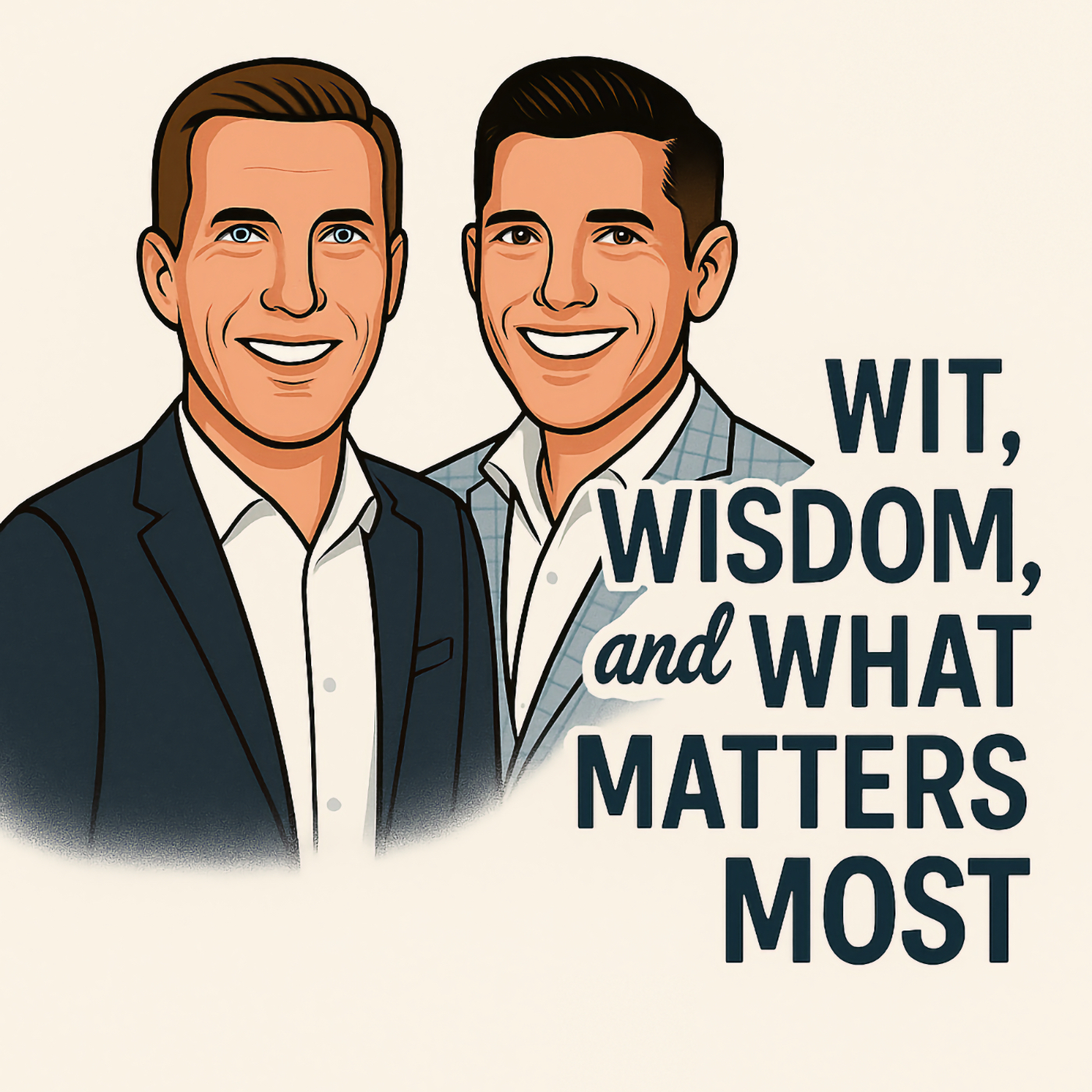
PODCAST · business
Wit, Wisdom, & What Matters Most
by Danton Troyer and Kyle Luetters
Stories that go beyond financial planning to what matters most!
-
22
The Conversations That Shape Family Wealth(Ep. 21)
Family conversations about money are rarely just about money. They’re about expectations, relationships, and decisions that can shape generations. In this episode, Danton Troyer and Kyle Luetters share real stories from guiding families navigating complex financial and emotional dynamics. They explore what separates families who move through these situations with clarity from those who struggle, and why communication, flexibility, and respect often matter more than any strategy. Key Takeaways: Clear, early communication helps avoid confusion and family conflict later Family meetings create space for alignment, not just decision-making How wealth is built often shapes how decisions are made Flexibility is essential; plans should evolve as life changes Respect and shared understanding are critical in multi-generational planning And more! Connect With Danton Troyer: Moneta Group LinkedIn: Danton Troyer [email protected] (314) 735-9087 Connect with Kyle Luetters: Moneta Group LinkedIn: Kyle Luetters [email protected] (314) 536-8297
-
21
The Psychology of Spending After Success (Ep. 20)
What happens to your mindset about money after you’ve achieved career success? In this conversation, retired global biotech executive Tony Bower, PhD, shares how ambition, family, and financial clarity reshape the way we think about spending and purpose in retirement. This episode explores the psychology of spending after success. Tony reflects on growing up in a family shaped by Depression-era frugality, building a career in economics and the pharmaceutical industry, and navigating the transition into retirement. Together, Tony, Danton, and Kyle discuss how early money beliefs shape our financial habits, why retirement requires emotional preparation as well as financial planning, and how parents can pass meaningful financial lessons to the next generation. The conversation highlights the balance between enjoying financial success today and remaining thoughtful about long-term goals, family, and what truly matters most. Key Takeaways: Early money habits often reflect family history and can shape how we spend and save throughout life. Retirement decisions involve both numbers and emotions, and financial planning tools can help bring clarity and confidence. Teaching children about money early, through jobs, responsibility, and transparency about costs, builds long-term financial awareness. Ambition can be a powerful tool early in life, but purpose and relationships often take center stage later. Financial success creates opportunities to focus on what truly matters most, including family, faith, relationships, and meaningful experiences. And more! Resources: Monte Carlo financial planning simulations Connect With Danton Troyer: GFT Team Moneta Group LinkedIn: Danton Troyer [email protected] (314) 735-9087 Connect with Kyle Luetters: GFT Team Moneta Group LinkedIn: Kyle Luetters [email protected] (314) 536-8297 Connect with Tony Bower, PhD: LinkedIn: Tony Bower   About Our Guest: Tony Bower, PhD, is a retired global biotech executive with a background in applied mathematics and economics from Stanford University. Over the course of his career, Tony worked in consulting, research economics at the RAND Corporation, and held leadership roles in the global pharmaceutical industry, including work in market access, health economics, and pricing for rare disease treatments. After decades of professional success, Tony now focuses on family, mentorship, and thoughtful financial decision-making in retirement. His perspective blends academic insight, real-world leadership experience, and a reflective approach to what matters most in life after a demanding career.
-
20
What It Means to Be a Family CFO (Ep. 19)
What does it really mean for a financial advisor to act as a “Family CFO?” In this episode of Wit, Wisdom, and What Matters Most, Danton Troyer and Kyle Luetters explain how financial planning goes far beyond investments and into the real decisions that shape a person’s life. Danton and Kyle discuss their “Family CFO” approach to financial planning and how it helps clients navigate complex financial decisions throughout different stages of life. They explore how financial complexity often grows gradually as careers advance and compensation structures evolve. What begins as simple retirement savings can eventually include stock compensation, deferred compensation plans, tax planning strategies, and legacy considerations. Without coordination, these pieces can quickly become overwhelming. Danton and Kyle also explain why effective financial planning begins with understanding a client’s personal goals and values. Through stories and real client experiences, they share how meaningful conversations, thoughtful questions, and long-term accountability can help clients align their financial decisions with what truly matters most. Key Takeaways: The “Family CFO” approach to financial planning How financial complexity grows as careers advance Why planning starts with understanding personal goals The long-term ripple effects of financial decisions The value of accountability and guidance in financial planning And more! Resources: Visit us at witwisdomandwhatmattersmost.com Connect With Danton Troyer: GFT Team Moneta Group LinkedIn: Danton Troyer [email protected] (314) 735-9087 Connect with Kyle Luetters: GFT Team Moneta Group LinkedIn: Kyle Luetters [email protected] (314) 536-8297 About The Hosts: Danton Troyer brought his individual practice to Moneta in 2018, after more than a decade on his own. Adding the support of our team, backed by an Enterprise Service Team, to Danton’s personal expertise and care for his clients created quite the dynamic combination. As your Family CFO, Danton and our team deliver high-level service and advice while giving you and your personal financial circumstances the individual attention you deserve. You can trust our team to help you navigate life’s many major financial transitions while protecting your savings and assets. He excels in developing sophisticated solutions for complex tax challenges, education expenses, business ventures, philanthropy, retirement, and multigenerational legacies. Danton earned his bachelor’s degree from Missouri State University in 2005 before moving back to St. Louis to start his career as a Financial Advisor. He then went on to earn his CFP® credentials in 2010. Danton and his wife have two children who keep them busy with all their activities, from volleyball to BMX racing. Outside the office, Danton enjoys golfing, traveling, and hunting. Throughout his adult life, Kyle Luetters has had a passion for financial literacy and complex problem solving. Kyle has experience in investment model management, alternative investments, insurance strategies, and tax planning. He lends this expertise to a diverse client base, which includes multigenerational families, business owners, and farmers and ranchers. Kyle joined Moneta’s GFT team as an Advisor in 2022. Prior to that, Kyle was involved in financial planning and investment management at Northwestern Mutual and Stifel Nicolaus. In 2019, Kyle obtained the CERTIFIED FINANCIAL PLANNER® (CFP®) certification. Kyle earned his CFP® because of his deep love of working with people and the knowledge gained in comprehensive financial planning, ensuring he is able to deliver world-class solutions to his clients and prospects. The ongoing continuing education keeps him sharp and on top of changes in the industry. The high ethical standards set forth by the CFP® Board provides great reassurance to his clients and prospects. Kyle became an Enrolled Agent (EA) in 2024. The highest credential awarded by the Internal Revenue Service, EAs earn the privilege of representing taxpayers by passing a three-part, comprehensive test covering individual and business tax returns, as well as IRS procedures and rulings. Kyle became an EA to further his knowledge and understanding of taxes while helping people navigate their financial life as tax-efficiently as possible. Kyle graduated from Cameron University with a Bachelor of Arts degree in communications. Kyle and his wife have two children. He is active in his local church, participates in a men’s organization called F3, and is an active do-it-yourselfer. He also enjoys craft beer, motorsports, wood-fired BBQ, and is a proud Kansas City Chiefs fan.
-
19
Meet Danton & Kyle: Your Guides Through Complex Wealth and Life Decisions (Ep. 18)
The most powerful lessons in wealth and leadership rarely come from spreadsheets or market charts. They come from real experiences, difficult decisions, and the stories people carry with them along the way. In this episode, Danton Troyer and Kyle Luetters share the story behind Wit, Wisdom, and What Matters Most and the reason they chose to create a podcast focused on the human side of financial planning. Together with producer RJ Malyk, they discuss how their partnership began, why storytelling matters in wealth conversations, and what executives often face behind the scenes while navigating career, family, and financial decisions. Drawing from years of experience working with business leaders and corporate executives, Danton and Kyle explore the emotional realities that come with success, responsibility, and major life transitions. From the “weight of wealth” to pivotal moments that change everything, they highlight the importance of perspective, community, and thoughtful guidance. The goal of the podcast is simple: create a space where listeners can hear authentic stories, learn from shared experiences, and realize they are not alone in the challenges or opportunities they face. Key Takeaways: Why real-life stories often resonate more deeply than financial charts or technical explanations How Danton and Kyle’s partnership began over a simple Starbucks coffee conversation The role perspective and diverse backgrounds play in stronger financial planning conversations What many executives quietly experience as they navigate responsibility, career pressure, and wealth How shared experiences and community help leaders feel less isolated in major life decisions The powerful impact financial guidance can have during life’s most meaningful moments And more! Connect With Danton Troyer: GFT Team Moneta Group LinkedIn: Danton Troyer [email protected] (314) 735-9087 Connect with Kyle Luetters: GFT Team Moneta Group LinkedIn: Kyle Luetters [email protected] (314) 536-8297
-
18
Wit, Wisdom, and What Matters Most
Welcome to Wit, Wisdom, and What Matters Most with Danton Troyer and Kyle Luetters from Moneta. In this podcast, we help corporate executives and business leaders navigate uncertainty around various life stages, including complex benefits, career transitions, and planning for what comes next. Join us for this journey as we explore the moments that shape careers, leadership, retirement, and legacy. Drawing from years of experience and conversations with guest experts, Danton and Kyle help listeners gain clarity, confidence, and perspective during pivotal transitions, allowing them to focus on what matters most.
-
17
Episode 17: Beyond the peanut butter method of philanthropy
Wit, Wisdom, and What Matters Most Beyond on peanut butter method of philanthropy Podcast Episode 17 with guest Dub Dubin Kyle: And welcome to another edition of Wit, Wisdom, and What Matters Most. It’s a podcast with Moneta’s Gast Freeman Troyer Racen Team. My name is Kyle Luetters. I’m joined by Danton Troyer, Danton talking a lot about very honorable, amazing, exciting gifting today with a very unique resource that we happen to have right here at the firm. Danton: Yeah, I think Deb’s going to provide some insights, maybe just another way of thinking and maybe more in-depth thinking as far as just the philosophy around giving away money. Kyle: It was a far-ranging conversation. You’re going to hear quite a bit about who Deb is, Deb Dubin, Chief Philanthropy Officer here at Moneta, who she is, what she does, and some of the ways that you start to really begin to think beyond just the dollar sign when it comes to giving. So with that being said, here’s our conversation with Deb Dubin. And we’re back with Deb Dubin here on Wit, Wisdom, and What Matters Most. Deb, you are our Chief Philanthropy Officer here at Moneta. And first and foremost, that’s a really cool title, if I think about it, but how did you get to Moneta? I want to start at the very beginning. How did you get here before we get into the nitty gritty of what you do? Deb: Sure. Sure. Well, I mean, there’s personal and professional reasons why I’m here, but yes, Chief Philanthropy Officer, super unique to Moneta, which of course we know is an RIA. Most investment firms don’t have an in-house person who’s an expert on philanthropy. So I feel very privileged and lucky that the folks at Moneta decided we needed to have someone who could talk to clients about their interests and aspirations around philanthropy. So how I got here was I was running the Regional Association of Grantmakers in Missouri. Very glamorous title of Philanthropy Missouri. Danton: That was an upgrade, I think, from the title, at least. Deb: Yeah. Yeah, Philanthropy Missouri. I was the CEO for eight years, and that was a collection of funders around the state. We started in St. Louis 50 years ago, and I grew it across the state. And we had about 70 members who were corporations here in town and in Springfield and in Kansas City – foundations, high net worth families, tax-supported foundations…all giving money away and wanting to do it in ways that were impactful. Sometimes they want to collaborate, sometimes they don’t, but they all have a hunger for connection. So I ran that organization for eight years here in town, and during that time had the opportunity to interact with some of the partners here at Moneta when folks had questions and really kind of came to an obvious point, which is you guys could use someone in-house to work with clients on these things. So one thing led to another. I can name off partners who deserve the most credit, I’ve already taken them all to lunch. But the idea is really thinking through how we help our clients. We know from studies that have been done nationwide that clients want to talk about philanthropy, and that advisors like you are the most trusted source of information about philanthropy after spouse, which puts pressure on you and also creates an opportunity for you. Moneta also recognizes that multi-generational wealth, we have a lot of families who we steward their wealth, we help them navigate life’s path, that are multi-generational in nature. And one of the things that really works well when teaching stewardship to families is to have a conversation about philanthropy. Even when families aren’t ready to sort of open the kimono on inheritance, you guys talk about retirement, you guys talk about sort of thinking through what the future looks like and what legacy looks like. Some families aren’t ready to talk strictly about finances. Philanthropy can be a really nice entree into talking about stewardship, using language around we’re grateful, we’re thankful, we’re lucky, we’ve worked hard, and here’s your opportunity to help us do some really amazing things. Danton: Yeah, I think you touched on a couple of things that I want to certainly dive into. Sure. But why philanthropy? How did you… Deb: Yeah, how did I get to philanthropy? Well, you know, again, personal and professional. I’ve had a lot of opportunities. I’m a lawyer by training and practiced law in a big law firm for years in San Francisco. And I also worked in government there. When we moved to St. Louis 20 years ago to raise our family, I made the segue to work…taught a little bit at Wash U. And I also worked on some political campaigns, but the bulk of my work was really working with an investment firm that invested in low-income communities through tax credits. Then went into philanthropy because it seemed like a really neat way to merge knowledge of finance with impact in a broad way. And to help families to do so, I did some training. I have a CAP, which is a Chartered Advisor in Philanthropy degree. And I also did some other training. One course in particular is called 2164, working with multi-generational families. So I pivoted from working with organizations in my previous role that were giving money away to now working with families. It was a really nice progression. So why philanthropy? That’s on a professional level. On a personal level, I was a young widow. I lost my husband seven years ago to cancer. And think a lot about legacy and think a lot about stewardship and how you memorialize people and how you keep them alive through impact. So one of the things we did when my husband passed away was set up a donor-advised fund in his memory. Folks contributed. And then I have two boys now in their 20s and we are able to say to ourselves, you know, what do you want to do this year that reflects dad’s values and interests and beliefs and reflects our family’s interest in impacting the world and telling stories, right? Because we always want to tell stories. So on a personal level, philanthropy feels like a great fit because I’ve spent a lot of time thinking about legacy. Kyle: No doubt. And what a powerful personal story as well, too, to really drive that. And that’s what we hear a lot of from folks. You have brought, and folks are listening to this, they won’t be able to see it. You brought something with you. Deb: Oh, today for those at home and the home audience as opposed to the studio audience today. I did, I did. Kyle: Can you go through what you brought here? Because it’s a very unique piece. Deb: Well, thank you. Yes. Well, thank you. It’s a big ampersand. It’s made out of wood. If you think about that character on the keyboard that we’re all not sure what to use it for except for it represents the word “and,” right? The ampersand represents something really big for me with respect to philanthropy. And so I lug this wooden ampersand, here’s what it sounds like, around, it’s heavy. I lug it around with me and I have smaller ones that I give to clients when I think they’re going to be fidgety in a meeting so they can take it home. I have a stack of them I got at Michael’s. The idea of the ampersand is something that I actually learned from improv. I don’t know if either of you have done improv comedy, but you learn to say “yes, and…” In other words, you take a situation that’s been given to you and you make it better. And you try to keep it funny and warm and keep the motion moving forward, but you’re not allowed to say no or pretend that that’s not what they just told you. You have to keep it going. It’s “yes, and.” Kyle: Okay. Deb: You’re elaborating on and you’re making better a situation. It’s the same with philanthropy. We’re acknowledging that there’s abundance in the world. Those of us who are lucky enough to be clients at Moneta and are lucky enough to talk about philanthropy generally have, if not assets to give, we have time and we have talent. Right? Time, talent, and treasure. The idea is “yes and.” It’s yes, I can be well stewarded by my wealth advisors at Moneta and I can also be a generous person. And it will be different for every family. Some families that’s a couple hundred dollars or a couple thousand dollars a year. Other families it’s larger increments. Really, every family is different when they think about how they’re going to prioritize and we’ll get deeper into values alignment and how families think about their strategy around philanthropy. There is abundance in the world. I do believe that. So, the idea is “yes, and…how can I be generous?” “Yes and…how can I do things that are both purposeful and purpose filled?” When I meet with clients I tell them I really want you to walk out of here feeling purposeful, deliberate, thoughtful, tax-incentivized giving. Your financial advisor’s here because they’re hearing different things. They need to know what needs to be available and when, right? When the assets need to be available. So purposeful, thoughtfull, and purpose-filled to me means meaningful. The idea is that what we’re doing is meaningful for you, for your family, for your legacy. It’s also meaningful for the nonprofits that you want to work with. Some folks come to us and want to impose things on nonprofits that aren’t ready or don’t have a mission that aligns with what they want to do, and we take a deep breath and we say I love your enthusiasm and… let’s go talk to the experts because the nonprofit leaders are the ones in proximity to the problems and they know best what needs, what’s needed. So. we have a conversation. We really view our grantees, the folks we’re giving those dollars to, as funded partners and when you can have a conversation with an executive director and say, for example, “What can’t you get funded? I’d love to help you with something.” It’s a whole new conversation and their heads explode if you offer general operating support which is, you know, giving them dollars to do what they need to do, what their priorities are. Kyle: Yeah, run the organization. Deb: And we learned a lot about that during COVID and we had to make some changes. Some funders had to make a lot of changes around how they allocated dollars and the idea again is doing it in consultation, making it a meaningful and transformational gift. Again, the amount may range. It just shows that you hear, you hear that executive director telling you here’s what we really need and I’ll give you an example. We had a client who really loves early childhood education and feels that if you can intervene when kids are tiny, those little brains are still developing, you can change the trajectory of a child’s life by making sure you’re investing in early childhood, right? And those of us with kids understand that that actually is a really powerful time. So they wanted to give healthy snacks to a preschool located in a low-income neighborhood that they thought was doing really well. They wanted to give healthy snacks. I said, great, and I touched my ampersand. They said, well, maybe a, maybe a tricycle for the large motor room. I said, great, and…and I explained to them that you can be an immediate donor. You can give something that’s going to help kids today. That’s great. You can think about capacity building and help them. If you think this is such a great preschool, you want to help them build another classroom, right? Where they can have another teacher; they can serve 15 more kids. And if you believe in systems change and you’re looking a generation into the future or maybe hopefully a decade into the future, you can work on advocacy and policy. You can lobby in Jefferson City or support organizations working in DC to create more affordable, safe childcare seats. And every client has an idea about what their time horizon is for change. So you have to match and help them think about that alignment. So for many of us, it’s immediate. We want to touch and see and feel the impact. And that’s great. Others are more patient. You know, it’s the whole idea about when the best time is to plant a tree, right? And people say, well, 25 years ago. What’s the next best time? Today, right? So, some folks have a longer time horizon. When I worked as the CEO at Philanthropy Missouri and many of my clients were corporate, they needed more immediate impact. They were rolling up that data into a corporate social responsibility report and they wanted to tell their shareholders, right? And their other stakeholders, here’s what we were able to do this year. This is how many trees we planted. We know that some people with family foundations or donor advised funds, and we’ll get into that in a minute, have more patience about outcomes and they can wait five years or eight years or 10 years to see the fruits of their labor. Back to the story about the early child care center, we talked to the executive director. We called her and said, we have a client that wants to give you healthy snacks. How do you feel? She said, “That’s fantastic, thank you. And… I can do a GoFundMe and get healthy snacks,” which by the way, they did; I was a contributor. What they can’t get, we said to her, what is it that you can’t fund? And she said, “I can’t find anyone to fund professional development for my teachers.” She said,”They make $12 an hour. They could make $18 at Arby’s down the street, but they stay here because they love kids and they love what they do. And if I could get a small grant for professional development, a couple of things will happen.” She said, “Number one, we invest in their career and they know that we care, that they are professionals and that they are growing their skillset. Number two, they’re better with the kids. They know more about child development, right? And number three, we stay accredited.” You know, all these things. So, the idea is that when you ask an executive director, what is it you need, and you say to them that you maybe can’t get funded elsewhere, it creates this whole new situation, this whole new dialogue. And I have a client who’s doing a lot of this. Maybe we’ll tell some stories later about the nuns. Bring it up. But we’ve had some really, really neat nun stories this year. I have a client who loves nuns. Danton: I mean, it sounds like your approach is definitely tailored to the individual, for sure. Not only the family, but also the organization that needs the help, as well. Deb: For sure. Danton: And, you know, I’m probably, we were talking about the peanut butter analogy, I mean, I just donate, but I, yeah, I give thought to it, but certainly not at that level. And so how do you help families really start to just think maybe deeper about their giving? Deb: Sure. Sure, that’s a great question. And I think peanut butter might’ve been off camera. So I’m going to tell folks about that right now. We have a lot of clients who come to us and they feel either guilty or dismayed or upset that they’re doing what they call, what I call peanut butter giving. And if you could see me right now, you would have, see one hand that’s flat out and I’m showing what this smushing of peanut butter is. It makes it thin, right? It spreads it thin, like on a piece of bread. And so that’s because we’re giving $150 to a cancer charity because someone asks us to. We’re giving $150 to the Girl Scouts. We’re supporting our kids’ PTO. We’re doing a quick check to the symphony. Those are all transactional gifts and they are wonderful, right? Our community needs those to thrive. And I always encourage our clients to realize we want our community to thrive. So we keep making those transactional gifts. And… the other hand is out now and I’m going from a transactional hand to a transformational hand. The idea is that we are going to make some gifts that are transformational in nature. And I’m not talking necessarily just about assets, right? We’re talking about time, talent, treasure. Maybe you serve on a board, or you donate a lot of hours to an organization. The idea is you’re making a transformational gift that is unique to you, to your family, and to the nonprofit. That they’re able to use that gift in a way that you are the best person in the world, best situated to kind of make that gift. So again, it could be $5,000, it could be $50,000, or it could be $50 million. We have clients that do that. The idea is you’re doing something transformational in addition to your smaller transactional gifts. And don’t ever feel guilty about those things. With respect to each family, thinking about their focus, that’s sort of where we start. When folks come in, you have to be a client of Moneta, and I’m sort of a value-added benefit. You come to me and we talk about…we do a discovery. You know, not unlike your financial discovery, but in this case, it’s a philanthropy discovery. We talk about a family. We talk about your roots. We talk about the base of your tree. We talk about the branches and what you carry, based on the history of your family and the stories that you’ve been told and the stories you want to tell. So we’ll talk through discovery looks like, tell me about the things you’re involved in now and what’s been satisfying for you. We’ll talk about what concerns you might have about, you know, inheritance issues or legacy issues. We’ll talk about whether you have done some planning and there’s planning in place. And we’ll talk about vehicles. It’s really important for your financial advisors to be part of that initial discovery because they are the ones who are thinking about everything from tax-incentivized and using the right vehicle, right? That purposeful stuff we discussed, to making sure that the right resources are in the right place at the right time when you need those. So, we do a discovery process and we go from talking a little bit generically about their family and their stories to talking about what values they carry, right? What are the things that are most important to you? And I have some exercises that we do that are fun. We talk about values, what values you carry. Some families immediately say faith or patriotism or they say things like, you know, social justice, or they say conservation. Every family is different, right? What we try to do is triangulate around some values. And then we also talk about buckets of interests. Some families are really interested in the cancer moonshot, helping to cure cancer. Some of them have been affected by it. Other families are focused on the environment or they’re focused on young kids, safety net issues, or adoption or a specific disease their family has been affected by. The idea is every family is different and what we try to do is define those buckets in a mission statement. And we try to pull that together in alignment with those values. And then we test it. We test the theory. Many clients have thought about what they want to do after they’re gone with their philanthropy, right? And what I always encourage them to do is kick the tires while they’re living, right? First of all, we see the need in the world where we are today. And second of all, it’s really fun. And I will say that that is the most important thing. If I leave you with nothing else today is we want to make this joyful, right? For some people, it feels like a burden. You don’t want to make the wrong decision and you’re afraid to take that first step. We encourage folks to try it. I mean, philanthropy is so joyful and so much fun, and it is a risk – you’re giving money away. And if you do the work ahead of time and the best work you can do is, I always say you want nonprofits to be sustainable, transparent, and well-led. And I teach clients what those mean and how to figure that out. The best homework you can do is to literally go and touch and feel and see it in person, right? You can always look on a website and see how something’s evaluated. Charity Navigator is one of those, if those folks aren’t on the ground here in your community. And when I say your community, we’re not limiting this to St. Louis. Clearly, we work with clients across the country. You have clients across the country and we’re able to personalize this and customize this to those folks, as well. So, going and kicking the tires in person, knowing someone on the board, getting to know the executive director over coffee and asking those questions, right? What’s going on? What are your latest initiatives and how can I help? Kyle: Perfect. So that was a great overview as to like how you get spooled up working with folks and kind of taking a look at the, you know, kind of the underpinnings of this. Walk us through, like maybe some stories here. We’re going to get to the nuns here in a minute. I’m not going to walk away. Deb: I’m just putting an image in your head of nuns at a winery. We’ll take it from there. Kyle: There you go. Deb: Yeah. Kyle: Long-term, like what do the relationships look like? What do they form over time as you work with these families over, over years and maybe generations? Deb: Sure, yeah. Kyle: How do you walk with them in that regard? Cause I think that’s one of the most fascinating aspects of what you do. Deb: It’s really fun when you do the multigenerational work and oftentimes it starts with a family meeting and we set some ground rules that everyone generates about how we’re going to participate; how we, how we trust each other, how we learn, how we give everybody time and space. And then we jump in and we do a family tree exercise so that everyone knows who everyone else is in the space, what we carry. A lot of times families have different ideas, even generationally, about what’s important. And so we try to find, you know, I’m a big fan of Venn diagrams. Like what’s that overlap between the dad who’s a big entrepreneur and believes in making sure everyone can learn how to fish and maybe the next generation that feels really strongly about supporting entrepreneurs who maybe wouldn’t get it, wouldn’t get an opportunity – opportunities in underserved areas. I mean, you can find commonality or conservation is often a great one for a family with hunters and a family that loves clean air, clean water. You know, you find a spot that is that Venn diagram of overlap if they want to work collectively. And the best families, the families that seem to do this the best, are the ones that allow individuals to make choices on their own, too, and recommend them back to the family for giving. Danton: Yeah. So I mean I was, that was what I was curious, kind of reading your one page here is on the family meetings. What would a family expect to get out, especially with multi-generational and what does that process look like when you’re starting to include, I mean you talked a little bit about it, but just what’s the goal of this? Deb: Yeah. Well, the goal is to get everyone on the same page around stewardship and the idea is for the, if it’s grandparents, for them to talk a little bit about how, how, what’s the source of this wealth, right? Not just in wealth, not just money, but wellbeing and what their wishes are. Our wish for you is that this money be used to enhance lives, right? And never to be used as a weapon, but to be used as something that keeps us together and allows us to have a flourishing, healthy, happy life. For some families, it’s going to be about faith. They’re going to talk about their faith. For other families, it’s going to be about the source of wealth, or the location or the place where grandma and grandpa grew up. They want to have some ties. They want to have a fruitful, healthy, happy… Remember, you know, by third or fourth generation, a lot is owned in trust, a lot is owned collectively in these wealthy families. And the idea is let’s teach folks how to work together. Um, and philanthropy can be a great way to start working together to a common end. So we develop a mission statement. People kick the tires on the mission statement and decide if it fits. And then we just cover whether or not giving, you know, is something that the family wants to do. And if so, we’ll set a budget. A family will go out and do their research and their due diligence. And every family operates differently. Some will have the kids come back and make presentations. Um, there’ll be a vote and then they’ll deploy the money and they learn. You always want to look back and say, what did we learn from this experience? And you revise the system the next time around. So ideally, the families are doing this themselves with a little bit of help from us. And certainly there’s tons of resources out there that we can give them. There’s workbooks, there’s, you know, exercises we can help to get them on their way. Some folks are really eager to jump in and others just kind of want to soak on it, soak it in. So, you can’t, you can’t really want it more than they do. In the beginning, I remember when I started, I was so impatient for people to start getting going. And sometimes it takes time. I have clients – I’ve been here a little more than four years now – and I have clients who are circling back. We met two or three years ago and they’re like, okay, we’re ready now. I had a client meeting like that last week. They said, we talked in 2023, we weren’t ready. We’d love to get going now. And let’s talk about some of the ideas we have. So again, it’s letting it sit for some time to let people absorb it. It’s also not always a priority, which is understandable. So the idea is that you’re creating a platform and a method for folks to engage if they want to engage. And they’re really driving what that engagement looks like. Again, if it’s time, if it’s talent, if it’s treasure, if it’s some combination of all those things, helping them navigate that with the primary relationship, being their wealth advisor. I’m here to support. Danton: Perfect. Have you tried, the best way, you know, maybe not importance, but between working with first generational wealth and you also mentioned the generational coming through a trust, as well. And does that change the process or the way you work with them? Or what’s the differences you’ve seen there? Deb: Yeah. You know, there’s some generalizations that you can make about the earning generation and then sort of the maintaining and then sort of the spending generation. I do think though that every family is different and it really, I see that over and over. We have a lot of first time, first generation entrepreneurs who are clients here who have incredible humility. They’ve worked incredibly hard and they’re incredibly generous, right? Others who feel it’s their job to kind of keep the capital together to support the family. And it’s really a lot about, it is about money messages that we receive as young children about what money is for and how to use money. And a lot of us have ideas about abundance and scarcity. And generationally, if you grew up with your parents having gone through the depression. And so you’re in your 70s now or 80s, now you have a very different idea about what money is because you were raised differently in abundance versus scarcity mentality. But again, I think it really just comes down to individuals. And so part of my job, and our job as advisors, is to understand that really underlying approach to money, whether there’s anxiety, whether there’s not enough attention being paid, right. Once in four years, I’ve had to tell a client to stop giving money away and we didn’t want her to run out, you know, but that’s pretty rare. Mostly the clients we have are pretty well-aware that they are able to allocate money fairly freely. There is abundance and they also are being advised by their wealth advisors, like folks on your team, what is the best way to do this from a tax standpoint and from a strategy standpoint? And so they’re well-served. Moneta is really well-equipped to help them understand both sides of that equation. Kyle: I’d like to drive back just a second. We’ve talked quite a bit, with giving money. I’d like to see if you have some stories of how you have worked with folks where it started out as, Hey, I think I’m going to give some money and then maybe it morphed into, Hey, this is really cool. Now I’m going to start to give some more of the other Ts, the time and the talent. Have you, have you kind of seen a genesis in that in some people? Deb: It works both ways. Kyle: Okay. Deb: Folks who have been involved for a long time as volunteers somewhere are really convinced that it is an organization that they want to bring some capital, bring some assets. Or they’ve inherited money and now they’re ready and capable of being a donor in that way. And then yes, the other way works, too. A lot of times I’ll take clients on site visits. We’ll go in person to go meet an executive director to take a tour. Um, in the past three months, I think I’ve been to, you know, half a dozen different nonprofits to walk that path with a client who wants to see it, touch it, feel it, meet the people involved. All of them have culminated in gifts. I think it makes a big difference when you find an organization that understands that trust-based approach. I call them ahead of time and I say, we don’t want a song and dance. You don’t need to show us a PowerPoint. We really want to walk and talk. We want to see what you’re doing on the ground and also make it really clear I’m not trying to create more work for you. You’re a nonprofit executive director. You have plenty to do. Please don’t do anything special for us, right? We want to come in. We want to see Ranken Jordan Pediatric Hospital, just what you do all day. We want to come see Ronald McDonald House and what you’re doing for families every day. We want to go, you know, walk this, this park that you’re talking about doing a, doing a playground. And we want to see without having to be a burden on your operations. So we go and we see, and we look and we touch and we feel, and sometimes clients will decide they want to become a volunteer there or they want to serve on a board. If there’s availability to do so, the nonprofits love it. And other times they’re like, I want to make a gift and I don’t even want anyone to know it was me. So part of the approach is talking to the clients about what they want because sometimes these gifts are anonymous, right? So you have to always make it really clear that with the client, what kind of attribution are you interested in, if any? Some folks want their name on a building. Other folks don’t even want to have their name on a gift that would go in a brochure. It just depends. And sometimes people differ depending on the organization. So, we find people come to us a lot wanting to do things out of gratefulness, for example, for the hospital, for a specific disease, for a specific organization that helped them in a time of need. And that’s always really interesting too. And then you have people who love to read and they want to know what are all the literacy organizations in town. I’d love to buy books for kids. I think reading is the most important thing that ever happened to me. So people have different preferences. One of the exercises I do with clients, and I could have brought the deck with me today, but you know, you may have seen it before. It’s an image deck; it’s about 62. It’s from the group called 2164, just a group of images. And we’ll spread it out on the table and I ask everybody to pick two or three that resonate with them. Don’t overthink it; it doesn’t have to be literal. But it’s everything from a hot air balloon to a dictionary, to a megaphone, to a beautiful park. And it’s just a whole mix, cats and dogs, you know, kids running a road race and pick a few cards that resonate with you and then we’ll talk about how that’s showing up in your life. And what comes out of that conversation, especially if you have members of the family who maybe are shy or maybe are younger and they don’t speak, everybody can participate in it. It’s called Picture your Legacy; everybody can participate in an exercise like that. And what happens is they’ll pick a card and they’ll all of a sudden say, I was drawn to this because this is a person getting healthcare at a nonprofit health clinic. And I think that’s really important. Health is really important. Well, what does that look like in your life right now? And how can we find a way, how can Moneta help you think about a way that you could be a contributor in that way? So, we do the Picture your Legacy card exercise and a lot of those discovery meetings to enable people to really think through from an initial standpoint, what resonates with you. Art supplies, there’s a picture of art supplies – a lot of times people will pick that one or the cats and dogs is probably the most popular. You know, everyone who’s a kid picks a cat and dog one. And we talk about how you can, even at a young age, you can be a volunteer at the Humane Society and things like that. We also help families integrate, in addition to talking to them about the vocabulary that they use around their kids by saying grateful, blessed, lucky, whatever your tradition is, we worked hard. We have many resources because we are a lucky family and we want you to be able to be aware of that. We also have exercises people can do with kids starting at a very young age. Kids can start being exposed to philanthropic adventures, I would say. So sometimes that’s like grandma and grandpa take you to the bookstore and while you’re there, you pick out your favorite book and they also pick out a book that you pick. They purchase a book that you buy and you guys donate it. So when you go to the bookstore with grandma and grandpa, that’s the activity is picking an extra book. Cause not everybody can afford to buy a new book for themselves. You can drop it in one of those little tiny libraries or find another way to donate it. Another one is apple picking. My clients really like this one. When you’re going over to Eckert’s in Illinois – that’s where people go from here in St. Louis, there’s a lot of other places to go – and you’re picking apples, pick an extra bushel; have the kids pick an extra bushel. First of all, you have to explain to them what a bushel is, right? None of us really know. Danton: Yeah Deb: And they love picking the apples. And you say to them, you know, we’re going to pick an extra bushel of apples when we go to the apple orchard. Cause not everybody can get fresh apples and we love apples. So we’re going to share. So you’re not beating them over the head with an activity that becomes forced; it’s something they’re already doing anyway. On the way home – and I know this is possible cause I called around to a bunch of the food pantries – with them in the car, you drop off the bushel of apples at the food pantry. Now maybe you don’t go inside if they’re not capable or if you can’t, but the idea is that you are showing them, we got these extra apples and we’re now donating these apples because you picked them. I had a client who shared with me six months ago, they were on the highway getting off the off ramp at Kingshighway and 40. And there was a homeless person who had a sign and they heard a little voice pop up from the back seat and said, mommy, do you think he got one of our apples? This was months after the family had done that activity. The kids listen, they remember, and they understand if you explain it to them. And again, it’s not beating them over the head. It’s not saying, you know, you need to constantly be thinking about this. It’s, we’re going to integrate this very lightly and genuinely and authentically into activities we’re already doing. So some people use the Heifer catalog. I don’t know if you’ve ever seen that, it’s a catalog where you can adopt chicks or goat for families abroad and the kids get excited about picking something in the catalog. The eggs from the chickens allow the kids to get school fees and go to school. And so those are things some families use and some families will do. World Wildlife Federation that you can get a stuffed animal and then you’re sponsoring that seal or you’re sponsoring the manta ray or the whatever. Some of the animals are really, really gross, but the kids love them. They love them! And then you get the stuffed animal in the mail and it’s just a representation of something that you did a good deed. So there’s ways to do that with families and, and I will just end by saying that’s something else we work with families on is how do I get my kids to understand this is pretty special. They are special. We are special and the world is a special place and we want to make sure that we’re helping them walk on that planet in ways that are gentle to the earth. And so we talk about, again, sustainability, making sure organizations that we pick have a plan and if they don’t, maybe that’s what you fund is a development director or a fund for them to be strategically transparent. We want to look at their tax returns. You know, every nonprofit has to file a tax return every year. If they’re making over a certain amount of money, they have to disclose a lot of information, including salaries. Anyone who’s paid over a hundred thousand dollars, it needs to be disclosed. So you can take a look and see, some people are trapped in this mentality of overhead ratio, like I’m not going to ever give to an organization that has, you know… And I think that’s a good red flag, but I also want to caution people that models look different. If you’re paying for a mammogram van with medical professionals to go around and deliver free mammograms, that’s going to be different overhead ratio than if you’re distributing free books from an organization that gave them to you for free. Your models are going to look different. So you have to weigh a lot of different things when you’re thinking through what that overhead looks like. And the last thing I’ll say is every organization needs overhead. You know, you need professionals who are really good at what they do. You need electricity, you need heat, you need an office in some cases. You have to really think through what that looks like. Now, if all they’re doing is fundraising, that’s a red flag. So again, that transparency is about things like tax returns and when you ask questions, they’re really forthcoming, happy to show you their budget. And then well-led is that third leg to that stool. Leadership’s everything. I trust good leaders to make good decisions. Even if it’s not a decision I would have made, they’re basing it on facts; they’re basing it on proximity to the issue. And hopefully if they’re seasoned and robust, they’re not basing it on ego. They’re basing it on what’s best for the clients, ultimately. So that’s why when I’m with our clients, I try to make sure if they’re interested in meeting with the organization that’s going to be the beneficiary of their grant, that we arrange that. And there are some leaders in town who I really believe are just true, head and shoulders above leaders, I would even say in some of the private sector industries that we know and we appreciate and we invest in. And you know, these people are doing really complicated things with a lot less money. It’s amazing to see. Kyle: Oh, that’s fun. Yeah. Before we drive on out of here, I, we’re going to drive back to the nun stories. Deb: Yeah, I will. Kyle: So take us on out of here with some of these nun stories that you eluded to earlier. Deb: Well, so that’s just one of many stories, but this happened last week. I happened to be able to see some pictures which really moved me. I have a wonderful client, a longtime client of the firm, who has sold a business and would like to distribute the bulk of that in charitable gifting. And is aiming to give away a couple million dollars a year. He’s grateful, he’s super grateful, and totally surprised that he was able to build a company and sell it. And so he wants to do the bulk of this in generous charitable gifting and he came to me three years ago and said, I don’t know what I don’t know. And I’d love to have someone help me navigate this. So I did this whole discovery process, figured out what was important to him. And slowly but surely we’ve been inviting him to meet with organizations that are aligned with his giving. One of the things he felt really strongly about was honoring the memory of a great aunt and an aunt who both became women religious and entered into different orders of nuns back in the day. He grew up in South City, came of age in the sixties, and was benefited greatly by family members. He, at one point his family needed to send the boys away because of a family crisis and he lived, they actually lived, in the nunnery. So we tracked down the order that his great aunt worked for. We talked to the lay leader and he said, how are they doing? How are these women doing? Well, they’re all in their eighties at this point. Sadly, the nuns aren’t replenished as much and they’re tough ladies. They’re so smart and they’re so wonderful. And they, this particular order lives in a, what I’ll call a mother house, with many of them are wheelchair bound. And we went and met with the lay leader and said, what do they – he’d like to do a gift for the sisters, he’d like to do something special for them. What do they need? And she said, I’ll ask them. She went back and asked the sisters. She came back to us and she said, they said, if you gave them a six-figure gift that they would distribute it to the poor, because that’s their mission. And he said, no. Instead of listening, which we always teach people to do, he said, I want to do something for them. I want to do something that no one else is going to do that really would help them with quality of life. So she went back to the sisters and said, we want to do something for YOU. So they came up with the idea of a handicap accessible van, which you can wheel roll wheelchairs into the back. So you’ve got an 80-year old nun driving at the steering wheel, and the ones who rolled in the back, and they are the nicest, most interesting people. And he goes that day, he said, DONE! He bought them a van, a handicap accessible van and with a little extra money for maintenance and fees and registration. He went to visit them the day that the van was being delivered and they were so grateful. And he said, sisters, where are you going to go? And they said, we’re going to Dunkin Donuts. Subsequently, and this is what makes it so much fun, it’s been a year. They sent him an album at Christmas with pictures from every field trip. There are 25 different field trips that they went on with this van. They kept track of everywhere they were able to go because of his gift. And there’s pictures of them at a winery in Augusta. There’s pictures of nuns at the Anheuser Busch Brewery with – no, sorry – at Grant’s Farm with a Clydesdale. There’s pictures of them at the art museum. There are pictures of Dunkin Donuts. They are, you could see where they went a couple of times by like what they really liked. You know, they went to Kaldi’s three times, they went a couple of places three times. But they also went to doctor’s appointments, which they couldn’t have done in the wheelchair transfer, the ones on oxygen. They also went to do mission-driven work and they took a trip to Cleveland to see their long – they would never have seen these women again – these sisters of theirs, part of their order, who live in Cleveland. So they took a picture of the road sign on the way to Cleveland in the van. So they are able to do something really remarkable that honors their service, their life of service, because this gentleman took the time to listen. What do you really need? And so his gift, I mean the fact that they took pictures and all wrote him thank you notes, by the way, not all nuns have great handwriting, some of them were not, but they’re in their eighties and nineties. But they were so lovely. The fact that they wrote these letters to him and took time to really say to him and his wife, you did something that is meaningful for us and that has lifted us and we bless you. That’s a great example of something that’s, I’m so proud for him and I’m so proud for Moneta for helping facilitate this. And you know, that’s just one example of many, many examples of things we’re able to help clients do when we listen. Kyle: Well, Deb, I can’t think of a better, more fitting way to kind of close this out than that story right there. Just from the sheer impact of that and getting to see the entire thing come to fruition. Deb: That’s right. That’s right. And you know, we obviously hold these conversations in confidentiality, which is why I haven’t revealed the client or the order of nuns. I asked for permission to share the story, of course, today. But I want to also remind you that with our clients, it’s a sacred trust. And I start every meeting by saying it’s a small town; we may know people. I want you to know that what happens in this conversation is completely confidential until you’re ready or until you tell me you want to talk about it more publicly. And I think that’s really important, too, is to recognize that some families are very private and don’t want, and they’ll use us as buffers for example, or as the liaison, because they don’t want to be upfront. So I want to also just mention really quickly that it’s a privilege and an honor to have these conversations with clients. And just as you wouldn’t be discussing their finances, we’re not discussing their philanthropy outside the house until the families are ready or choose to do so. Kyle: That’s a good point. Well, it’s been a privilege and honor. Thank you for being with us today. This is awesome and so insightful. Deb: My pleasure, thank you. Kyle: And you just heard from Deb Dubin. And Danton, what a conversation! So far-ranging and I really wish folks could have seen, not to be a little bit too crazy here, but the sparkle in her eye when she really got the chance to dive into the process that she goes through with these families and how this entire thing comes together. It’s really, just really cool. Yeah. I mean, there’s so much more to just philanthropy and I’ve worked with nonprofits and boards across the table, and there’s just so much more to it. And having someone like Deb here at Moneta and just to be able to help clients. And I was talking to her after we got done talking with her, as well about my personal stuff and it’s just a great resource in someone that can really help them just put more thought behind it because we’re all busy in our day-to-day lives. And really, we want to be impactful, but sometimes, you know we just write the check because your friend asked you for a sponsorship, but there’s more you can do if you want to. Kyle: And what I really liked was she talked about, among many things was, we spend so much time on the dollar figure or the way she put it, the treasure, but there’s also time and talent. And oftentimes to your point, there’s several organizations we’ve given money to. I really have to watch when I do home improvement projects because the Boy Scouts are hanging out right outside the exit of Lowe’s, among other places. And, and we’ve all done and given money to when it’s there and it’s transactional. But really, when you start thinking about true impact and, generationally it’s the planned giving, but it’s also giving of your time and your talents, like you’re serving on a board, like what we were talking about her. I thought some of those were some of the most interesting and fruitful conversations, honestly. Danton: Yeah. I mean, I would just add the having those conversations with children in a fun way, as well. And the ideas she provided, they’re great. I mean, I could easily go home and do those with my kids. And again, you just get busy and sometimes you just lose sight of those opportunities. Kyle: Yeah. Speaking of, there were a ton of opportunities that Deb presented here. If it’s ever on your heart and whatnot, seek someone like Deb out that can help kind of galvanize and put a plan in place around that charitable giving. Danton as we kind of head for home, any final thoughts on this one? I mean, I thought the nun story was just a perfect way to land the plane. Danton: Yeah, I mean, just the impact that he was able to have with those dollars rather than, he could have easily just written a check and kind of said, do whatever you want and we’re done here. But to go that step further and just really that impact was above and beyond. Kyle: Yeah, hopefully and that’s a key whole memory, at least for me on this podcast, and hopefully for you all as well, too. This edition of Wit, Wisdom, and What Matters Most is a production of Moneta’s Gast Freeman Troyer Racen team, headquartered in St. Louis, Missouri. Until next time enjoy what matters most! Investment advisory services offered by Moneta Group Investment Advisors, LLC, an investment adviser registered with the Securities and Exchange Commission. Registration does not imply a certain level of skill or training. The information discussed in this podcast is for informational and educational purposes only. You should consult with an appropriately credentialed professional before making any financial, investment, tax, or legal decision. © 2026 Advisory services offered by Moneta Group Investment Advisors, LLC, 190 Carondelet Plaza, Suite 1200, St. Louis, MO 63105 (“MGIA”), an investment adviser registered with the Securities and Exchange Commission (“SEC”). MGIA is a wholly owned subsidiary of Moneta Group, LLC. Registration as an investment adviser does not imply a certain level of skill or training. This is an advertisement. The information contained herein is for informational purposes only, is not intended to be comprehensive or exclusive, and is based on materials deemed reliable, but the accuracy of which has not been verified. Examples contained herein are for illustrative purposes only based on generic assumptions. Given the dynamic nature of the subject matter and the environment in which this communication was written, the information contained herein is subject to change. This is not an offer to sell or buy securities, nor does it represent any specific recommendation. You should consult with an appropriately credentialed professional before making any financial, investment, tax, or legal decision. Past performance is not indicative of future returns. You cannot invest directly in an index. All investments are subject to a risk of loss. Diversification and strategic asset allocation do not assure profit or protect against loss in declining markets. These materials do not take into consideration your personal circumstances, financial or otherwise. Trademarks and copyrights of materials linked herein are the property of their respective owners.
-
16
Episode 16 How a stop sign can cost you a job
Episode 16 with guest Sarah Renieri Kyle: Investment advisory services offered by Moneta Group Investment Advisors, LLC, an investment adviser registered with the Securities and Exchange Commission. Registration does not imply a certain level of skill or training. The information discussed in this podcast is for informational and educational purposes only and any endorsements were those of the hosts and not a guarantee of employment. No compensation was provided. You should consult with an appropriately credentialed professional before making any financial, investment, tax, or legal decisions. And welcome to another edition of Wit, Wisdom, and What Matters Most. It’s a podcast by Moneta’s Gast Freeman Troyer Racen Team. My name is Kyle Luetters, an advisor on the team, joined by Danton Troyer, one of the partners. Uh, Danton, it is a new year. Everything’s bright, shiny, fresh, new, and today’s guest I think is someone that many folks, as they’ve gotten through the holiday season and have contemplated a full 12-months slate in front of them, potentially a job change is on the horizon and Sarah Renieri, who is the manager of talent acquisition here at Moneta, joins us today for a very far reaching conversation. Danton: Yeah. We’ll talk about everything from how to use AI on your job search to how not to use AI on your job search, as well. Then everything again, from internship programs to a C-suite and what’s the best steps to really lock down a job there. And, starting the new year, a lot of people will be either looking to hire and fill out a team and also maybe some RC suite clients might be, you know, looking to make a change as well into the new year. Kyle: And with that being said, here’s our conversation with Sarah Renieri. And we are now joined by Sarah Ranieri here on Wit, Wisdom. and What Matters Most. Sarah, first off, welcome to the podcast and thank you so much for sitting down with us today. Sarah: Yeah, thank you so much, Kyle and Danton. I’m so happy to be here. I’m very excited to be here today. Kyle: Oh, perfect. We’re going to cover a lot of topics today, but, but really before we get started, we like to dig into the backstory and the personal side of things. So, you are in talent acquisition here at Moneta. So how did you get into that? Because I don’t necessarily remember going to orientation at college and that being one of the choices there. You know in all transparency, there was a guy that I knew that tested the windshields of airplanes by like firing chickens at them. That also wasn’t on those, but how did you get into talent acquisition? Kind of give us the arc of your career. Sarah: Yeah, absolutely. So it’s interesting. I listened to a podcast called the talent acquisition leaders podcast. Every person that they interview are experts, senior level in talent acquisition, and they all fell into it. That’s always their story. And I would say mine is similar. However, something that’s unique about my story is that when I decided I wanted to be in talent acquisition, I was very intentional. I knew that that was game changing for me. I wanted to go into that, that arena. So my story, I actually started within accounting. So I got an accounting degree out of college and I worked for a couple of different internal corporations. So I actually did work for a nonprofit organization; I did work for a large commercial real estate company, all within accounting. So, at the time I was really able to start articulating the type of company I wanted to work for. I got a really good exposure of all different arenas. And so that’s what really brought me to Moneta. It checked all of the boxes for me in terms of the size of the company, culture, the structure that it provided, the training, and long-term career opportunities. So when I started at Moneta, I started as a client service manager. So I was helping to support financial advisors, such as yourselves on client-facing teams, managing existing client relationships and really becoming an expert at the foundational business of what we do. After doing that for about six years, I was actually given the opportunity, for my team specifically, to help with our recruiting efforts. And I loved that opportunity. I kind of volunteered. I raised my hand. I said, I’ll be the one to vet the resumes. I’ll be on the side Googling what are appropriate interview questions to ask these people. And the advisors on my team loved it. They really wanted nothing to do with the process; it’s tedious, it’s not their expertise, and they had better things to do. Their priority was the clients. And from that, an opportunity arose within the firm to help lead and develop our internal recruiting team. So I happily took that opportunity. It was a unique career path as most client service managers proceed into that financial advising path. But for me, I really knew that this was a really strong fit for me, given my skillset, what I enjoy doing, coupled with the expertise that I had grown up within the firm. I knew the culture, I knew the skillsets we needed to do all of the roles across the organization. This was also a time when Moneta was expanding outside of St. Louis for the first time. So this was about 2018, when we made that transition. So that was also really wonderful time and where I got to make an impact, not only for our hiring needs in St. Louis, but across the nation. So our first office in Denver is when I got a taste of how to, how to recruit for a company where no one really knew who we were, what we did. Kyle: Wow. And how long at Moneta now? Sarah: So it’ll be 13 years this month. Kyle: Holy moly. Danton: Yeah. Well, I think one of the things that I found maybe a little unique and interesting was you’re certified in the Workplace Big Five. And so maybe talk a little about that. And first off, you know, why that one? And then how do you really see personality fit and developing a team, and how does that really play a role? Sarah: Yeah, absolutely. So the Workplace Big Five is a personality assessment and it’s one of those assessments that Moneta has used for a long, long time. It itself has evolved over the years. I actually – this was pre-COVID, I had just, I was celebrating my daughter’s first birthday and I was actually, on her birthday I was traveling to North Carolina for a three-day seminar certification training to get this certification. So that was very memorable. It’s something people aren’t really doing that much of anymore, that kind of travel. And yeah, so it was very involved, very rigorous learning more about personality types and more importantly about people’s motivations and competencies. So we all have kind of these natural tendencies, natural personality types, such as introversion versus extroversion, your ability to be curious, or maybe you’re more narrow-minded and these all are just what come natural to you. But it doesn’t necessarily mean that that’s what you want or that’s your motivation. It doesn’t always correlate to the things that you want to be doing where you’ll find fulfillment. So, the Big Five assessment is something that we do administer to all of our senior-level advisors, any kind of executive-level hiring needs. So we do use that to really dive into a candidate’s motivation and skill set. For all of our candidates across the board, we do use the Wunderlich assessment. And that’s another one that Moneta has always kind of consistently used over the years. And it takes it one step further. It’s like a high level Big Five, but it also measures a candidate’s cognitive ability. And we do, as a firm, we’ve always placed a lot of emphasis on the cognitive piece in terms of best fit and how long-term success you’ll have in the role, given the challenges that we face on the day-to-day in terms of our analytical, critical thinking skill set. Kyle: I remember taking that test on the way in here going, wow, this is the same test they give the NFL quarterbacks at the Combine. Sarah: It is exactly the same one. Kyle: Perfect. I did reasonably well on it, but I don’t have the physical attributes that they do. So that’s why we do this. Danton: We didn’t test your 40-yard dash. Kyle: Oh, gosh. Danton: I mean, we got the hallway going, though, right? Kyle: Yeah, we could do that. I just got to change my shoes. No, I mean, that’s a fascinating way to peek behind the curtain, because one thing I will say, candidly, it is tough to get in here as a job seeker. So, you know, talk about how you go about recruiting for this firm, knowing that you’re really looking for a very specific skill set. And that’s got to be a challenge. I mean, there’s a lot of people out there, but finding the right people to basically bring in through the door…walk us through the challenge of that. Sarah: Yeah, absolutely. And to give you more context on that, as a company, every year we typically receive about 4,800 applications to the firm. We typically hire about 100 people year after year. And so our acceptance rate, if you will, is right about 2.9 percent, which is lower than Harvard’s. So we have a higher standard than an Ivy League school when it comes to the talent that we hire here at the firm. So, yes, it is an extreme challenge, probably one of the more challenging things about my job. And a lot of it is the partnerships we develop with our hiring team. So I’ve learned so much from our hiring managers in terms of what they look for and what’s going to really make a successful hiring decision. So their feedback is integral into what I do. So I compile that feedback and I’m learning and growing with every candidate that I talk to, kind of hearing from the hiring managers what they’re needing right now – and that market kind of shifts and changes as well; that evolves. Maybe they have several people on their team that have this skill set, but they’re lacking this skill set. So now we’re trying to find that missing puzzle piece. So all of those little factors come into play. The assessments test, we do help and we kind of do that upfront screening. So while we’re managing this volume, we have to do that efficiently and effectively and timely. And we’re also a very small but mighty team of three doing this work. So, you know, filtering through the candidate inbox and then identifying the key traits from a resume. We’re looking for professionalism first and foremost, that will always narrow down the pool a little bit, as well as then we provide these assessment tests and that will, you know, gauging on those scores coupled with other things we might know about them. Often, too, I would say the our most common and successful pool and pipeline of candidates come from our referrals; about over 50 percent of our candidates come from referrals. So that is also a really wonderful network that we’ve established. So any referral I get across my desk, I’m always going to be reaching out to that person. Danton: I guess my question, where are you getting these referrals? I mean, that seems like the best place, but obviously there’s a limit to that as well. So I’m curious where your most successful referrals – is it internal? External? How’s that been beneficial for you guys? Sarah: Yeah, certainly internal. And it’s always a good validation because we will get internal referrals from existing employees, maybe in the role already. So they are clearly very fulfilled and loving their job in the company enough to refer a close family member or a friend. And a lot of times, it is family members. So I think that’s really a great testament to our teams and the work that they’re doing, and the kind of career paths they’re providing. So those are often the most successful – our internal. We will occasionally get external people within our network, sending people our way. We’ll have competitors share candidates with us that might not have been a good fit for them, but they said, hey, you should check out Moneta. So we’ll look into that. I have recruiters – right now I have an email from a recruiter who said she has an intern candidate that she was hoping to find a good home. And she prefaced with this: I’m not expecting a fee at all. I just want to find a good spot for her. And I know your firm will deliver on that. So, again, I think that’s a really cool thing to have. Kyle: I really want to commend you having been involved with the interns the last two years. You all do an excellent job of getting a lot of very curious, young, motivated people through the door. Again, knowing that a lot of folks apply for this thing, we really do get a great number of candidates that ultimately become interns here. And really the amount of work you all have put into the selection process, but also to the build out of that entire process so that they leave here – in fact, one of them got hired here at the end of it, which I think has got to be a cool feeling for you all just to kind of see that ecosystem or that circle fully complete itself. Sarah: Yeah, absolutely. And that’s our main goal of that intern program, right. So for summer of ’25, about 40 percent of our interns were either hired full-time or came on in another internship capacity for the firm going forward. So huge success there. We’re hoping that we continue to increase that momentum. To us, that’s the whole point of the program. And it’s to your point, Kyle, we see some incredible talent at that new college grad level. Those interns are one of our strongest assessment test scores. They’re already in it; they’re used to that kind of environment. And, you know, we’ve had our own interns on our team and they’re just an incredible talent. They’re very eager to work. They really want to contribute to the company, make an impact. They’re phenomenal with technology in ways I never dreamed of. So it’s certainly a wonderful talent pool. And it’s one of our largest. So if you think about interns at the undergraduate level, there’s a lot of those people. The pool narrows as we grow in experience and tenure. So trying to find someone with three to four years of direct industry experience is a lot harder than tapping into a new college grad. So we’re always promoting to hire that new college grad if you can. Kyle: Yeah, 100 percent there. And like I’m going to start to age myself just a little bit, but when they do come in, to your point, number one, they’re very good with technology. Two, they also bring an energy into the workplace that sometimes, not necessarily always, is missing. But when you have someone new and someone that’s really got a lot of giddy up and go, if you will, just such a cool thing. We were talking a little bit before we got started about busy times of the year. So as we’re having conversations with folks, we work with clients all the time that maybe they, in fact, I’m thinking of a conversation that Danton and I had yesterday with a client that says, I think I’m probably going to start looking for a different job. Kind of walk us through now maybe sitting on the other side of things like you do amazing social media content around job searching, negotiations, recruiting. Walk us through what are some of the things like if you were talking to that client that we had in here the other day, professional, has done very well, but just looking for a different role. What are some of the tips or what are some of the things that you would recommend someone in those shoes do to make themselves an attractive candidate? Sarah: Yeah, absolutely. I would say, too, there’s a lot of noise about the market activity. When’s the candidates’ – right now it’s a strong candidate market versus a strong hiring team market. I would say try to block that out as much as you can. And you really need to be intentional throughout this process for your own benefit. So come to the job search with your own game plan, your own strategy. We’re not trying to time the market, just like we wouldn’t try to time the market with our investments. So very similar to that. There’s a lot of media, a lot of misinformation as well, so try not to get overwhelmed. And I would block out all that noise, especially if you are needing to take this seriously in terms of pursuing something new. And my first recommendation to get started is revisit your own personal brand. So to your point, Kyle, talking about the online social media videos I like to post out there, that’s just been a natural involvement for me as I have been in this business now for seven years. All of the really interesting feedback and best practices I’ve learned over the years from candidates and hiring managers alike, it’s created this library of content that I’m kind of like, someone has to hear this. So I like to put it that out there. And so I would say focus on what is your personal brand look like right now? What is your reputation? Do people know what your expertise is? Is your network aware of your career goals long term? And if not, we need to really start there. The unique thing about an executive level career search is that it’s not as tactical as you would see for like a mid-entry level type person. Those people are applying to job boards; their jobs are posted. The interview questions are competency based, pretty cut and dry. This situation, like with your client, I would recommend they avoid job boards altogether. Most of the time, the type of role that they’re looking for or seeking, that’s not going to be posted. For example, at Moneta, we don’t ever post a partnership level role. We’ve never posted a chief or executive level role, and yet we’ve hired several of those people in the last two years. So it’s for our purposes, we’re really already kind of identifying that person that we wanted to add to the firm. We might have a problem for them, but we also are more like, no, we know your skill set, we know your reputation, and we want you to come contribute to Moneta and see what you can do here with us. So that’s going to be how this type of transaction for this person is going to evolve. So, if they don’t already have that strong network, I would recommend starting there and that will further set them up for success when they are in that job market. Danton: Part of our conversation with him was that he had two offers and he was evaluating, and it sounds like he made the wrong choice. So, you know, are there things that you see – either just questions or things to look for, to avoid kind of that picking the wrong spot, especially in that type of role? It’s not easy to make a change. So you want to be right the first time, but that’s not always…maybe easier said than done. Sarah: Yeah, absolutely. And that’s great advice. So I would say in this type of search, it could be a six to eighth month process for someone with this level of experience. And that’s why I would recommend before you’re even thinking about the actual taking action on your job search, you really need to be very clear about what it is that you want to do next. So be able to articulate that. Think about your strengths and your weaknesses, your areas of development. Think about the goals you want to achieve, the impact you want to have going forward somewhere else. And it might not be a job that’s out there right now. It might be you talking to people and that person taking a risk on you and saying, no, let’s see what you can do and we’ll talk about the job title and job description afterwards. And that’s how a lot of those people are hired here at Moneta. And so that’s the homework that I would start with first is being really strategic about what it is that you want to do next. And if you’re kind of lost, or maybe this is an individual that’s been in the same career, the same company for 15 years, this is brand new. So in those situations, I would absolutely recommend look at assessment testing. Often those tests will help clearly define what your strengths are. And even in some cases, in my perspective, I have some weaknesses that I consider weaknesses. Well, these assessments tell me, no, that’s actually a strength; no one else is good at this, but you. So that does help shift that perspective. Another really great resource I would recommend to this type of level would be enlisting a life coach. So again, if you’re struggling with, I don’t really know what’s next for me. I know I have a lot more to offer and I’ve kind of run my course where I’m currently at. I have talked to several great professionals that are life coaches and they bring in those assessments. They do a lot of surveys. They prep you for the interview process to really build your confidence and really help narrow down your focus. Danton: That’s interesting; I wouldn’t have thought of a life coach as far as, …but it makes perfect sense when you’re saying it, but that’s not what I would have thought of. Kyle: So I think those are all fantastic. I agree with Danton, bringing in the life coach, taking various assessments. I know here at Moneta we use DISC a lot to identify strengths, weaknesses, so on and so forth. Walk us through, let’s say the hypothetical person has identified a role or a company has identified them. Let’s go into the negotiation table. So what are perhaps some negotiating tips? I hesitate to say tricks. We just got done with Halloween not too long ago. But what are some of the things as someone sitting down to negotiate a job offer should be aware of or that you’re seeing out of the marketplace now? Sarah: Yeah. And I mean, like we all know everything is negotiable. So start there. The other place I would start with is when you’re going into this process. Okay, once we’ve narrowed down, I know what I want to do next, put some monetary number to your value. Really have a clearly defined expectation of what you’re worth, what the type of role and the work you’ll be doing, what that’s valued at. And you can do that through several different ways. You can start with asking ChatGPT and look at the market you’re in. I would also recommend in addition to that, maybe paying a service or a fee to find that information out. You could even reach out to other professionals that are in that industry. Maybe it’s a different market, too. So you’re kind of understanding what’s the cost of living and ask if they would be transparent and share the range that they’re at and making sure that that aligns with what you are thinking about. So have that number, that range up front. And I would say, you know, stick to that. And as you’re having conversations then with future employers, you can be really clear about this is my expectation. I would also, when you get to those informational interviews, be very upfront about that as well. Don’t wait to the very last minute when you’re in that kind of negotiating phase to articulate what it is that you’re seeking. And it’s a little bit trickier at this stage too, right? Because we’re not going off of a job description where there might be a range posted on it. It’s probably a natural evolution. It might be an opportunity that they’re really crafting and creating for you. And you might come across some organizations that are kind of like, we don’t really know what we should pay you, but you tell us what you want to make. So you’re kind of in charge there as well. So for all these reasons, I would do a lot of research on the front end, be ready to talk about it earlier than later. And so when you are in that negotiation phase, it’s not so argumentative. It’s really kind of a natural evolution of we both want this to work out for both sides. And then when you think about those negotiation factors, think about what’s going to be your priorities. And it might not be all tied to compensation. So I’m curious, have you had conversations with clients or had any kind of feedback or guidance you’ve given to them when they’ve gotten into the negotiation phase? Danton: Yeah. I mean, we’ll get offer, we usually get maybe asked questions a little bit at the end where they’re kind of like, is this a good deal or not? And maybe more importantly too is like, does my financial plan work with this or not? That’s a big thing that we get brought into. I’ll shorten the story, but I had a gentleman, he was a C-suite and I met him in between jobs. So he was actively looking and he got a job and I forget the details, but the salary was well below his expectation. But then we started walking through all the other perks, if you will. The location was where he wanted to retire. The job was exactly what he wanted. The pay was just not there. And we took a step back and said, does the pay really matter at this point in your career? And the answer was, well, no, I’ve already, …he could have literally retired that day and it would have been fine. So he took a step back and, I won’t take all the credit, but he was able to take that job and basically then enter into retirement in a way that made sense for him because he was still making good money and he got to move closer to where he wanted to retire. So I think taking a step back and, certainly compensation matters, but there’s other factors as well. Making sure it fits in with what you actually want. So I think that was one of the times where I was able to maybe influence it more than others. Kyle: Yeah. And then I think to Danton’s point, especially when you get to this level, money is one thing, but to what you were alluding to, what’s the quality of life look like, the perks, so to speak, equity compensation also to factors in in a big way, because it’s not necessarily maybe money right up front that a company has to give out. It almost can be tied to performance in a way as well, too, so it’s an easier way for the company to add that in there as well. So, you know, those are the types of things that we see -is very similar to we may get brought in very early in the process, or we may get brought into, for lack of a better term, bless, if you will, what they’re seeing on the piece of paper. So, just fascinating conversations. I’m going to ask a little bit of an oddball question, so don’t be alarmed. To the extent that you can, what are some of the oddest things you’ve seen in your time in recruiting and trying to bring on talent? Either things that folks have sent you or things that you’ve observed? Is there anything that really jumps up that was just odd? Sarah: Oh, several things, unlimited things. Absolutely. And probably not so much at this level, the executive C-suite level where that’s not nearly the volume that we’re encountering as we would entry to mid level. So the entry to mid level, we’re seeing candidates, one thing that we’re really passionate about is visiting college campuses and having conversations with our internship program. We do a talent acquisition, learning lesson/learning session with our internship program every summer. Most of that is all centered around how you act professionally within an interview presence. So your presence professionally – in person or over video. That’s a big – can be an immediate write-off if you’re not careful with how you’re coming across, whether you’re in person or on video. So we’ve had several instances of crazy hair and makeup and really poor, unprofessional backgrounds. I talked to an intern candidate who, he was calling me from his college dorm room, which that’s totally fine. Just, you know, please make your bed behind you or maybe blur your background. Well, this individual had a stop sign proudly displayed against his window and sure, we were all in college, everyone knows we steal stop signs, you know, street signs. But I pointed it out and asked him about it directly. Like, what’s the meaning of this behind you? He kind of glazed over, gave me some vague response, it was not his, but it was an immediate no for him. Everything else was great, but he immediately lost the opportunity with Moneta because it’s kind of like, well, I’m not going to hold it against you that you’re a college student, but I am going to hold against you that you’re not smart enough to have a professional background behind you when you’re having this video call with me. So it’s those, the small details that really make a big difference in what is always a very competitive market wherever you are. So the candidates that really shine, they’re the ones that are taking this process very seriously. Every interaction that they have, they really set themselves apart because they’re professionally dressed or prepared. They can clearly articulate their elevator pitch, what they’re looking for. They’re not telling me, oh, I’m just open for opportunities. But that’s really hard for me to go on and we want people that want to be here. So, yes, I could go on about the stories, but yeah, I think it’s the small details that really, really matter. Yeah. Danton: Well, I think maybe my last question is, and you kind of hinted on a little bit, but what have you seen as far as just changing? I mean, we talk about like video interviews. I mean, when I started interviewing, that wasn’t, you showed up. The world has changed just from an interview perspective and I would think there’s different difficulties. Like that guy has a stop sign in the background – that wasn’t an issue for me in college; you went to the place and it was fine. So what are some of the changes you’ve seen over the years and how can people who, especially in that case, maybe it just wasn’t thinking and obviously that’s part of the problem… but what have you seen that people should keep in mind as the interview process has changed and adapted to that? Sarah: Yeah, I would say now more than ever, we’re all very accessible, so I rarely hold it against somebody if they’re running a little bit late or if they’re a no show, but they are apologetic on the front end about it. You know, life is busy. I understand often these are gainfully employed people that might have children at home and maybe they’re even taking time off to have a 30-minute conversation with me. So I’m going to be really respectful of their time as well. However, that being said, a quick, we can text back and forth. We send text messages out to our candidates. So there’s a lot of great, easy mediums to be able to get ahold of somebody right away. And I would say too, so those video calls, they’re really efficient. So we tripled the amount of screen calls we were having with candidates during COVID because we switched everything to virtual. And so I was able to have that many more calls during the day. And so to get a lot more work done from that perspective, but it did twist – it’s very rare that I have an in-person interview with a candidate. The hiring teams are always having the in-person. In the screening process, it’s very rare that that’s an in-person opportunity. So as a candidate, when you do get that opportunity to meet a professional in-person, I would say, treat that, be very intentional with that entire process. Do those things like maybe I’m going to drive to the location the day before to get familiarized with the area and make sure I know where to park. And we’re in Clayton and downtown, and it’s very chaotic to park around here. So those are some things where it’s going to be, again all about taking advantage of that one opportunity that you have and making sure that nothing goes wrong and being very, very prepared for it. Yeah. Kyle: I love that. And as we go to land the plane here, I would be remiss if I didn’t ask. AI is everywhere in the headlines. It’s everywhere seemingly that we turn right now. How do you see, or how have you seen AI impact what you do in talent acquisition? Sarah: Yeah, I mean, it’s been game changing. I would say from an internal perspective, it’s really helped with efficiencies for us. And so we use it for our note-taking for screen calls, which has been so nice that the AI function is recording the call, summarizing the notes, it can then shift it to, okay, now here’s feedback for the candidate, here’s feedback to the hiring manager…all of this lift that I would have had to do manually frees up a lot more of my time to be focused on the candidate during that conversation. So those are things that we’re using it for. We, from time to time, depending on the role, we will use AI to filter through our candidate application. We posted a data engineer role. We received probably 900 applications in an hour because it’s scheduled. These candidates, a lot of them are international, have it set up to where their AI bots or agents will automatically submit a resume for any data engineer role that posts. So our technology team got involved with that and they said, we’ll filter this and find the person we need. Of that 900 resumes, we literally only found one person that was local, a US citizen, and could do the job. So just that was interesting in itself. So we are seeing a lot more AI written resumes, AI written cover letters, and it’s really easy to spot them. They all are written the same way. So I still, I tell our young college population, if you’re going to use it, use it wisely. And I think use it again to make the best use of your time. So start, have it help you build the content, but then revise it. Have it help you practice for your interviews. So you can do a Q and A back and forth with AI. Hey, I’m interviewing for this job. What are some questions I should expect to answer? So those are all really great uses of it, but don’t let it try to do the whole process for you. We’ll have candidates that will be reading off of their AI script to the side during the screen call. And we’re kind of like, okay, well, this is going nowhere. So there’s things, situations like that where you use it as a crutch and you need to be able, thoughtful with it. And, you certainly should be using it to build that skillset, but use it in a very intentional way. Yeah. Kyle: Well, I, I am infinitely smarter than I was at the beginning of this conversation and that’s kind of the point here, but Sarah, I really want to thank you for joining us today. This has been incredibly insightful and especially helpful for a lot of folks that are listening out there that may be contemplating a job change or that want to be an intern at Moneta, which we would highly recommend and endorse. So again, thank you very much. Sarah: Thank you both. It was a pleasure. Thank you. Kyle: And that was our conversation with Sarah Renieri, talent acquisition extraordinaire here at Moneta. And Danton, I found the conversation wide ranging, but also incredibly insightful. I mean, we talked interns, we talked C-suite job seekers, we also talked AI. What are some of the big things that jumped out at you from this conversation? Danton: I would have to go with the AI and I knew she would have some examples, but I think going through and listening to some of the specific ways people have maybe abused AI in their job search, as well as how to use that more efficiently. So, and I think that’s in general, just how to use AI; you can’t use it to as a crutch to solve your problem, but you can get some pointed in the right direction. And I think that’s how you need to look at AI as it relates to the job search as well. Kyle: I would agree there, too. I also found too, when she turned the tables on us and asked us questions, especially the things that we had sen, and I wanted to drive back to that because I think many times in negotiations, we, I think it’s human nature, we always focus on like what the dollar figure is, what is the compensation coming to me in exchange for the task. But we really dove into some of the perks and you also dove into things like quality of life, and so on and so forth and, and where a financial plan integrates in with that. And we see that often. Danton: Yeah. I mean, certainly helping people think beyond just the numbers there. They’re very important and that is definitely part of the conversation. Most C-suites can figure out a dollar amount of their salaries, that that’s not the difficult part. But can they make that in the position they want? And then it’s usually not as straightforward as a salary. There’s usually many components to it and trying to evaluate that can get complicated. Kyle: It can get very complicated when you start talking about just the regular compensation, as well as potentially equity compensation, additional perks. Do you get a company car? Is there a car allowance? A whole host of things that really can roll into it. But, again, a far reaching and very informative conversation. And, please be sure, we alluded to it in the podcast and mentioned it, but go ahead and connect with Sarah on social media channels. It’s Sarah Renieri. Last name is spelled R E N I E R I. Her social media content is exceptional. She does a lot of videos, a lot of informative posts. So whether you’re someone in HR looking to recruit talent, or if you’re actually out there seeking a new role yourself, her tips are extremely timely and helpful. Danton: I think just following her on social media, you’re going to get some extra tips and this conversation alone was extremely valuable – from anybody looking for an internship, but then also those C-suites who may be influencing their own internship program. She’s got a lot of resources around both sides of the spectrum. Kyle: Couldn’t have said it better myself. And Wit, Wisdom, and What Matters Most is produced by Moneta’s Gast Freeman Troyer Racen Team headquartered in St. Louis, Missouri. Until next time, enjoy what matters most! © 2026 Advisory services offered by Moneta Group Investment Advisors, LLC, 190 Carondelet Plaza, Suite 1200, St. Louis, MO 63105 (“MGIA”), an investment adviser registered with the Securities and Exchange Commission (“SEC”). MGIA is a wholly owned subsidiary of Moneta Group, LLC. Registration as an investment adviser does not imply a certain level of skill or training. This is an advertisement. The information contained herein is for informational purposes only, is not intended to be comprehensive or exclusive, and is based on materials deemed reliable, but the accuracy of which has not been verified. Examples contained herein are for illustrative purposes only based on generic assumptions. Given the dynamic nature of the subject matter and the environment in which this communication was written, the information contained herein is subject to change. This is not an offer to sell or buy securities, nor does it represent any specific recommendation. You should consult with an appropriately credentialed professional before making any financial, investment, tax, or legal decision. Past performance is not indicative of future returns. You cannot invest directly in an index. All investments are subject to a risk of loss. Diversification and strategic asset allocation do not assure profit or protect against loss in declining markets. These materials do not take into consideration your personal circumstances, financial or otherwise. Trademarks and copyrights of materials linked herein are the property of their respective owners.
-
15
Episode 15: Year-end tips & pitfalls
Wit, Wisdom, and What Matters Most Episode 15 Year-end tips & pitfalls Kyle: Investment advisory services offered by Moneta Group Investment Advisors, LLC, an investment adviser registered with the Securities and Exchange Commission. Registration does not imply a certain level of skill or training. The information discussed in this podcast is for informational and educational purposes only. You should consult with an appropriately credentialed professional before making any financial, investment, tax, or legal decision And welcome to another edition of Wit, Wisdom, and What Matters Most. It’s a podcast by Moneta’s Gast Freeman Troyer Racen Team. My name is Kyle Luetters, an advisor on the team. I am joined by Danton Troyer, one of the partners. And Danton, it is very, very difficult to believe, and I know we say this every year, but it’s very difficult to believe we are at the end of another year; 2025 is coming to an end. And what a year it was, especially in Q1 and Q2. Danton: Yeah, it’s kind of crazy to think about all the different things we’ve kind of seen and gone through. From tariff talk to, obviously, leading into a presidential term, and we’re at the end of it. So it’ll be interesting to see. But we want to talk about some of the year-end planning tips that we typically talk through with clients, but also some of the pitfalls we see in trying to implement those. Kyle: 100%. And to add a caveat into that, tariffs, Liberation Day trades, and then, by the way, we just really overhauled large bits of the tax code, literally on the 4th of July. I remember reading the summary of what they passed at the pool this summer going, this is going to make for some unique year-end planning opportunities. And we’re going to kind of go through some of those. So first and foremost, I think we should talk about why it’s crucial to have a plan, why it is crucial to be organized going into this time of year. Danton: Yeah, we’ve seen lots of mistakes made, especially heading into year-end because there is a very definite deadline to a lot of these things and it’s December 31st. And so if we’re not getting these things done by that date, they don’t count, they don’t happen. So there is a hard stop in a lot of these. So being organized to your point and getting started earlier than later are all things that can help not run past that deadline. And once you’re passed, you’re passed. Kyle: And I think another thing, too, to back that up as well in this line of thought is 12-31 is the deadline for a lot of this. And if you’ve ever been to the DMV on the last day of the month, you know that it is not the most opportune time to try to get something done. In fact, many of our custodial partners will actually tell us that by about mid-December, anything submitted after a certain date is on a best- efforts basis. They will do their best, but they only have, there’s only so much manpower. There’s only so many hours left in the year in order to get these things done. And then also too, if you think about it from like our perspective as well too, it’s the holiday season and taking a look at the holiday schedule this year, Christmas is on a Thursday. You’re probably going to be reduced manpower the day after and probably the following week. So it really starts to back up when some of these things need to be done into late November, early December. And that’s why the timing and having a plan around this is crucial. We actually, several members on our team, started this work right after Labor Day of pulling together spreadsheets, figuring out what needed to be done, making sure that we talked to clients well enough in advance because there’s not a lot of people that really want to talk numbers with their financial planner at the Thanksgiving table. They want to talk about it with their brother-in-law. That was a joke. But anyway, so going through the why and the importance of it a little bit, but we’re just going to go through and break down some things that you should probably be considering. And I’m going to be unashamed and say that this is prime time for tax planning. I mean, it’s year end. Uh, we harvested, uh, hopefully some losses earlier this year when the markets were down. Uh, one of the things – do we need to offset some gains? Danton: Yeah. I remember the 2018, we had a market correction right there at year end. And it’s not like you can go place those trades on January 1st and say, I want those losses back for me. You got to get it done by December 31st. So, that was a fun holiday, uh, surprise. Kyle: I was late to church on Christmas Eve that day because of that. My wife will never forget that. Danton: Yeah, I think it’s burned in everybody’s mind. It was at least around here. We’re all hands on deck trying to get clients that loss, that no one saw it coming. And then all of a sudden the market was down significantly. Um, and then I guess to pour salt on it, it did it again and went down again. So we were in here like two different days were significant losses in the stock market. So you don’t know when that’s going to come, but you need to be prepared to take advantage, potentially, the tax loss harvesting even at year end. But to your point, that deadline is December 31st. Kyle: It has to happen in that year, has to be timestamped as happening in that year to help you out. Now, if you have more losses than you do gains – so basically if you have unused losses – they can roll forward into future years to be able to use. And that’s why in years such as 2025, the tax loss harvesting that we do is so valuable. We may not utilize the full extent of those losses this year, but they’ll carry forward. And we may need to use them in 2026, 2027, so on and so forth until we use them up. Speaking of taxes, this is another area that we’ve been spending a lot of time on here recently. It is making sure that withholding – if you’re a W2 employee – is fairly accurate. Or if you’re self-employed or retired, kind of getting some hands around an estimated payment that’s due January 15th, by the way. And, really trying to make sure the tax picture is as true as what we can make it. Danton: Yeah, at least here you get, well, two weeks of reprieve. It’s not December 31st, but the reality is, again, you need to be on this almost right now to make sure that you are in; a lot of our clients it’s not as simple as, I’m just getting a salary. There’s other income sources, maybe there’s some executive compensation that was under-withheld as far as taxes go – that’s very common, and just maybe a year-end bonus. I mean, whatever it is, making sure accounting for all these different sources of income, how they’re taxed, and then that you paid enough taxes on those because a lot of times, the payroll is only going to do so much. Kyle: Uh, I will say as an employee, I love a year-end bonus. As a tax planner, I love a year-end bonus that’s paid in March of the next year, right? It gives us just a little more flexibility of time, but please don’t hear. I am a huge fan of the year-end bonus, but to Danton’s point, it does bring in an additional element. And if you’ve been laying the framework, if you’ve been laying the foundation for a lot of this work well in advance, then we get to these pivotal moments of the year and it’s small tweaks. Basically, the entire projections built out and we can go and we can tweak numbers and do a little true up. And sometimes with the withholding or the estimated tax payments, especially on withholding, we can go in and, and kind of mitigate if we need to maybe withhold more, or if we need to send some more back to the paycheck, we can, we have more payroll periods to break that up across because nobody really wants to go into December, realize that they’re going to owe a lot in tax and their last paycheck for the year is dramatically reduced. I will tell you, that is like a hard candy Christmas if I’ve ever seen one. Other tax moves to consider – using up HSA or not HSA, but FSA funds. So Danton, you kind of want to go through like the difference between HSAs and FSAs as far as it comes to a year-end planning. Danton: Yeah, the biggest thing there is that the HSA, we can roll forward and definitely you don’t need to worry about that. And in fact, we’d probably advise you not to spend those dollars. The FSA is, you know, a whole different animal. You have to get those dollars. I know there’s a little bit of reprieve on that, but for right now, you basically, you do have a deadline to spend those dollars as well. So if you’re not, if you don’t have a handle on that and you didn’t get those dollars out, hopefully we’re not waiting until December 31st to try and get those dollars out, but that would be something you need to be creative with potentially and trying to figure out how we can get those dollars out before year-end, at least to the extent that we can’t roll over. Kyle: Yeah. You bring up a very important part about the year-end deadline, and we’ve done some talking on charitable giving. Go check out another episode here in the podcast that discusses that more in depth. But walk us through just a little bit some of the pitfalls that can occur if you do some gifting, specifically like directly to charities, if you don’t get it done soon enough before year-end. Danton: Yeah, I was, I guess, shocked myself one year. A client, we were going through their year-end giving and we were assisting them and sending out the checks directly from their account, and they just sent them out probably November. We were shocked to find out come January, some of those checks weren’t cashed. You would think that with some of these charities, they’re, especially a year in, they’re needing money, which is definitely true. But they also, especially some of these smaller charities, just, they may have the same issues. They may not be staffed-up and they may be processing checks because everybody’s sending checks in right now. They may not get through all of these and that’s going to hurt you from a tax standpoint. Kyle: Very much so, because again, it has to occur in the year that you’re intending it to occur. And that ends on December 31st. And to that point as well, backing up with the custodial side of things, if those requests aren’t in soon enough, not only could the charity not cash the check, they also may not get sent out due to a deluge or an overwhelming force or wave of those requests coming in. Danton, as far as the portfolio goes, year-end, what are some of the things like as clients come in that we’re really kind of talking about from a portfolio perspective as we head towards the end of 2025? Danton: Well, I think just cause some of the tried and true conversations of making sure that they’re still comfortable, we’re heading into a new year. It’s a good time to kind of revisit your risk tolerance, make sure you’re still comfortable. Hopefully you are. And then, we talked about tax loss harvesting, but on the tax side too, I think it’s important to, as an advisor, understanding where your tax bracket’s going to land that year, because that can also implement some of the strategies we want to use here at year end. I mean, maybe it does make sense to take some gains if you’re in a lower tax bracket, again, talking about resetting your cost basis in those positions, that can make sense, as well. And especially hopefully by now we’ve got a pretty good understanding of income and you’re not winning the Christmas day Ameristar winnings and throwing our whole tax strategy off. But, hopefully now we’ve gotten to the point where we kind of have a pretty good, clear picture of what your tax bracket is going to be, and can make some adjustments from a tax standpoint in the portfolio. Kyle: It’s a very wise thing. I know it sounds strange to say we’re thinking about realizing gains, but to Danton’s point, especially in some of those years of retirement, if you’ve retired early before you’ve started taking social security, I would say that is probably the maximum time or the maximum benefit time you have to play with the tax brackets. And so that’s why this work is extremely important. More work that’s extremely important, too, and we bring this up throughout the year, but really like there’s something about the holidays and being around family that brings this topic close to top of mind is your estate planning. And double checking, do I need to update my beneficiaries? Do I need to get that, either get that estate document work done or get it updated? It really just seems like this time of the year, people are having a lot of conversations with family and families usually tied into that, so… Danton: It depends on who showed up to Thanksgiving and who’s out. We’ve had some interesting Thanksgiving conversations and, you know, that might change the beneficiary designations. Kyle: The term I’m writing you out of the will tends to get spoken more often than not. And we’re kind of saying that in jest, but it is a good time for self-reflection. And on that topic of self-reflection, we are at an end of a year and it’s a good time to review what the goals were for 2025. And did we hit those goals? Did the goals need to change? And did we hit the amended goals? And then also to talk about setting goals for 2026, if you are contemplating a job change or retirement or something of that nature, it’s a really good time of year to plan for those new goals in 2026. Danton: Yeah, that’s our job is sitting down with folks and understanding their goals and what’s most important to them. And we put this front and center more often than not. But especially right now, taking that time to really make sure that you’re not just in the routine of doing the same thing over and over and you say, yeah, I want to retire this and I want to, you know, these are the goals. But maybe taking a step back and say like, is that still the goal? And the answer hopefully is yes, but I think it’s okay if it’s no. And so I think, you know, having that conversation, you know, maybe internally or maybe with family and making sure that the things that were important are still important. It’s a good time to kind of take inventory of that. Kyle: 100%; on the topic of retirement and/or if you’re looking at making a job change, you’re coming to the end of the year. And particularly if you find yourself using a credit card or some type of budget tracking app, December, especially December 31st, you get an entire year’s worth of data to help solve some of these goals going forward into 2026. So, we work with a number of clients that will actually give us a year-end spending summary from their credit card. And then we’ll add in things like a mortgage and the other things that are not showing up there, but it helps inform and make a better decision, a better goal target inside their financial goal plan. If they are going to contemplate a job shift, because we did have that conversation just the other day, or if someone’s going to retire, it gives them some more trust in the integrity of the number that we’re targeting as we head for the new year. So, and then also too, planning for major life events is anything in 2026 on the horizon? Weddings, which my goodness. Danton: They’re a little pricey these days. Kyle: They’re very rich these days. You know, do we need to start kind of setting aside cash for that? And that’s another good part of this year, is we’ve had a good year in the markets. Do we start setting aside some money for big ticket things like weddings? You know, college is maybe on the horizon. And/or retirement, do we need to take some chips off the table just to start building up that income stream in retirement? So, Danton, as we head for home here, kind of give me some bullet-pointed items. If you’re sitting here and I’m one of your clients, give me like three or four bullet listed things that we should be making sure we knock out in the coming weeks. Danton: Yeah, I think the charitable contributions – don’t wait till the last minute as we talked about. That should have already probably happened. And if not, I would not hesitate to potentially follow up with those checks even after they’re sent, just making sure the charity got them and they get cashed on time. Kyle: And get a receipt. Danton: And get a receipt. So don’t wait till January. I mean, you know, especially if you’re close with that charity, you can make sure that that gets done for yourself. And, there’s a whole slew of additional things that head up on that December 31st deadline. So, kind of going through your own personal checklist, working with your advisor, going through, just making sure you’ve hit everything. So you can go into the holidays resting assured that you’ve got everything off your financial checklist. Kyle: You want to get a lot of these numbers-based things taken care of so that you can truly enjoy and be present during the holiday season instead of worrying about whether or not things are going to get done by the end of the year. And honestly, that’s where someone like us, someone like our team comes into play is to putting a process in place that can be applied across multiple families. And various entities. So this was fun; I really like it. We did not do an ugly Christmas sweater deal here. We’re not on video, at least not yet anyway. But this has been another phenomenal year of the podcast. We turned one and now we’re well into what we’re calling season two. There’ll be even more guests, more conversations, hopefully more myths to debunk as we head into 2026. But I want to just say a special thank you to Danton for being willing to do this. And also, to the folks that have come up to us and said, hey, we listen and we enjoy it. We get something out of it. Just really want to give a shout out and a shot of gratitude to those folks out there. Danton: Yeah, the thanks that needs to go out to everybody that’s helped with this podcast is great. And especially guests. We were talking about it, I think, before this. I think we’ve learned a lot just from our guests in different areas. I think our biggest example was learning that there’s a retirement class. Kyle: An actual class on retirement that’s not dollars. It’s like mentally and emotionally how to retire. Danton: Yeah. I mean, we talk about it all the time. I had no idea there was a class down at SLU. So, you know listening to one of our clients who’s a business owner talk about his Starlink. And he’s basically running his company from his fishing boat. I have aspirations now. I don’t fish, but, you know, I mean, I’ll learn for that, I think. So, it’s just been great stories throughout the year. And I really just appreciate hearing those stories. And I’m thankful that we get this opportunity. Kyle: A hundred percent. And for the last time in 2025, Wit, Wisdom, and What Matters Most is produced by Moneta’s Gast Freeman Troyer Racen Team, headquartered in St. Louis, Missouri. Until next time, enjoy what matters most and happy holidays. © 2025 Advisory services offered by Moneta Group Investment Advisors, LLC, 100 South Brentwood Blvd., St. Louis, MO 63105 (“MGIA”), an investment adviser registered with the Securities and Exchange Commission (“SEC”). MGIA is a wholly owned subsidiary of Moneta Group, LLC. Registration as an investment adviser does not imply a certain level of skill or training. This is an advertisement. The information contained herein is for informational purposes only, is not intended to be comprehensive or exclusive, and is based on materials deemed reliable, but the accuracy of which has not been verified. Examples contained herein are for illustrative purposes only based on generic assumptions. Given the dynamic nature of the subject matter and the environment in which this communication was written, the information contained herein is subject to change. This is not an offer to sell or buy securities, nor does it represent any specific recommendation. You should consult with an appropriately credentialed professional before making any financial, investment, tax, or legal decision. Past performance is not indicative of future returns. You cannot invest directly in an index. All investments are subject to a risk of loss. Diversification and strategic asset allocation do not assure profit or protect against loss in declining markets. These materials do not take into consideration your personal circumstances, financial or otherwise. Trademarks and copyrights of materials linked herein are the property of their respective owners.
-
14
Episode 14: Giving Thanks
Wit, Wisdom, and What Matters Most Podcast Episode 14 Giving Thanks Kyle: Investment advisory services offered by Moneta Group Investment Advisors, LLC, an investment adviser registered with the Securities and Exchange Commission. Registration does not imply a certain level of skill or training. The information discussed in this podcast is for informational and educational purposes only. You should consult with an appropriately credentialed professional before making any financial, investment, tax, or legal decision. Past performance is not indicative of future returns. All investments are subject to risk of loss. And welcome to another edition of Wit to Wisdom and What Matters Most. It is a podcast by Moneta’s Gast Freeman Troyer Racen Team. My name is Kyle Luetters, an advisor on the team, joined by Danton Troyer, one of the partners. Danton, we are literally falling into the back half of this year and really the back two months. It is holiday season, and we wanted to take this edition of the podcast to talk about things that we’re thankful for. Thankful for you, thankful for this podcast, but in addition to that, it also really causes us to think about maybe giving, especially this time of year, you’ll start to see maybe some more requests for giving. And we wanted to touch on a couple of things as we get to this part of the year about maybe some ways that folks could do some gifting and giving, so we’ll just kind of dive on into that. But as clients continue to grow, charitable giving really seems like it’s one of the most fun and most rewarding things that clients get to do with their money. Danton: Yeah, and I think we’re seeing more people put more thought into it than we ever have in the past. You know, churches are always a big recipient of donations, and that’s certainly not the easy button, but I mean, people are affiliated with the church, they kind of know where to go. But then beyond that, they want to have an impact, and it’s not just, you know, donate to United Way; they do great things, but they want to have their own personal impact, and how are they evaluating that? I think it’s changed more so, especially over the last several years, I’ve seen more and more people want to be more involved. Kyle: They want to be more involved, and then giving really speaks to causes or even stories that are deeply personal. You know, if you’re a cancer survivor, there may be an organization that targets the type of cancer that you survived, or there may be an organization that really did a lot of good for your children. There’s one couple that I’m aware of that they love Shriners Children’s Hospital because of what Shriners has done for their child, and they tell all of their friends, this is what this organization did for us. But you know, there’s obviously the emotional side of giving, but then there’s also, too, a mechanical tax-efficiency side, a financial side to giving, if you will. And we wanted to go over a few of those ideas and those topics today, so really, you know, the place for anyone to start with charitable giving is as a cause that speaks to them. You know, first and foremost, there’s got to be a desire because you are parting with these dollars, and the intention, your hope, is these dollars go to further that cause’s mission and their goals. Beyond that, then we start to get into the weeds and start to get more to the technical side of how all this works. And so one of the things I wanted to bring up first and foremost is donor-advised funds. So up until maybe a handful of years ago, there was this thought that if we were going to do maybe some large gifting or some ongoing gifting that maybe like a family foundation or something like that would be the thing that we have to have. But really, donor-advised funds have kind of come onto the scene here lately, and they’ve really opened up a lot of opportunity for a lot of folks. Before we get any deeper in the weeds, do you want to kind of go over what the concept of a donor-advised fund is, kind of what it is and how it works? Danton: Yeah, I think just to keep it at a high level, it allows folks, I think historically everyone thought you needed to be millions upon millions of dollars to start, quote-unquote, your trust to potentially help these charities. But now they simplified that process and administration, especially the administration, so you’re able to contribute dollars into this account, and you still get to direct those dollars to the charity that means the most to you, or charities as well, but it doesn’t have to be given right then. So you’re allowed to take those dollars, invest them, and let that grow and basically create a fund to support the charities that mean the most to you and have a greater impact for a longer period of time, potentially. Kyle: These are fantastic vehicles. There’s a number of conversations we’re having with clients right now, clients really that are at all stages of their giving, they’re either just starting out, or they’ve been gifting for a long time through other methods, and now they’ve found this vehicle, that to your point, does allow them to contribute dollars or appreciated securities into the donor-advised fund, have those funds be invested and carry over year after year until you’re ready to make the gift. And then by the way, as long as it’s a 501c3 organization, you direct the funds back out of the donor-advised fund to the charities to make the impact. Danton: Yeah, we’ve seen a lot. This has become more popular obviously just with the increase in the standard deductions, so you’re not getting as much benefit just from donating the $1,000 gift anymore, but if you’re able to lump these all together, you get a little bit more benefit at least in your tax return. So it’s just we’re never really advocating to obviously donate money to increase your net worth, but if you’re going to donate money, let’s do it in the most efficient way possible. And then how you use specifically this type of tool is different for everybody, and that’s kind of why we like it, is it is fairly flexible in how it is used. So it’s become probably one of the easiest ways to manage your donations in a tax-efficient way. Kyle: 100%, and there’s a story that rattles around in the back of my mind where prior to the last handful of years, we had a client that sold his business and had a very large capital gain in that year. He went ahead and contributed a portion of those proceeds into a donor advised fund to help offset his tax liability that year. I won’t give the exact number that he contributed, yet I will say it was a healthy six-figure sum, and this was in 2019. And he went ahead and he invested those funds inside the donor advised fund, and 2020, 2021 are very robust years in the equities markets, and he remained aggressive with those funds. He was able to give away the amount that he had put in, but he still had that original principal left over. So if you think about that, the leveraging power of growth with those investments, and he was able to basically double the amount that he gave, and he got his tax write-off and all these other things, but it brought him and his wife so much joy, so much joy, and what he shared with us was it is so fulfilling to be able to say yes. When they would meet someone out at a function or they would see something either in the news or this or that, think of any time a natural disaster strikes and the Red Cross or someone’s organizing relief efforts, to be able to say yes in those times of needs because you already, by the way, with the donor advised fund, have a set-aside bucket. You don’t really necessarily have to think about, oh, well, do I give this out of checking or my investments? No, there is a dedicated bucket that is set aside for these types of things. It makes giving, it almost gives you permission to give. Danton: Yeah, in that case too, if you’re able to put in a large enough dollar amount where the growth on that alone is going to be a substantial donation, it’s kind of paying for itself and creating that income stream, if you will, within the donor advised fund to fund these charities. So, especially in that type of situation, it makes it pretty easy to continue to give those dollars and feel good about it and know also it’s not really even pulling from your assets that you’re using for just day-to-day life. Kyle: Yeah, so donor advised funds, I think that’s a very good starting place and that’s accessible to just nearly anybody. Now let’s talk about something that is pretty effective as well too, the scope, the population that can utilize it is a bit smaller, and that is the Qualified Charitable Distribution or QCD for short. This really kicks in when you get to age 70 and a half. That is the minimum age on it. And it basically allows you to gift directly from your IRA to a charity and not have that income come to your tax return as taxable income. Danton: Yeah, I remember when I think I started my career, I used to always tell people, once it’s in that IRA, there’s no way to get it out without paying taxes. So, I kind of got to eat my words now because there is a way to get it out of your IRA and not pay taxes. We always say eventually you got to pay tax on those, but I guess it’s not entirely true. But the caveat is you don’t get to use those dollars necessarily, they do need to be directed. But if you’re already going to be directing dollars to that charity, again, let’s do it more officially with pre-tax dollars that you would have had to pay taxes on. Kyle: And there is a cap on this one as well to the amount of money you can direct out of it. It’s $108,000 per taxpayer in 2025. So if you’re a married couple, that’s $216,000. But we do anticipate now with some recent legislation passed that that will inflate over time. It used to just be for the longest time that I was doing this, it was a flat $100,000. Danton: Yeah, obviously, inflation, especially here recently, has been a little bit higher than we’re used to, and there’s no reason for that not to increase as well, hopefully. And we’re seeing that as well with people trying to donate to charities. I think that’s one of the best things we can do as populations can continue to support these charities and providing these tax benefits, I think is a good thing. Kyle: And speaking of tax benefits, the QCD works whether you take the standard deduction or an itemized deduction. And I think it’s a very powerful tool if you look at the way things land on the tax return. It’s certainly an above-the-line deal because it is dollar-for-dollar reducing taxable income. You don’t have to go through the deductions or this or that, so it is an extremely powerful tool. And what we will actually advise a number of clients to do if they are that charitably inclined once they get to that age, they may have been contributing to a donor-advised fund for years, but once they hit 70 and a half, this gateway’s kind of opened. Danton: This is even easier than the donor-advised fund in many ways because you just go straight there and you get the tax benefit and it doesn’t even hit your tax return. So yeah, it’s certainly a smaller population because you have to be at that RMD age. But for the ease of use, it’s a great tool to kind of keep in mind, especially as you get towards this time of year and you’re thinking about, oh, I’ve got to take this money out by December 31st, it’s going to hit my tax return, what is it going to do? This is a way you can maybe mitigate some of that risk. You don’t have to do the full amount. If your requirement of distribution is $100,000, you can do as much under that as you would like. Kyle: Exactly. And I would say one thing that is extremely important with a QCD, when custodians, so Schwab, Fidelity, any number of these folks, Vanguard, when they send out tax documents, 1099Rs for a distribution from a retirement account, they don’t list out where everything went. They just show you, hey, what left? It is on the taxpayer to make sure that they obtain a receipt from the charity once they receive those dollars. That way, your tax preparer can match up the distribution with a charitable contribution. Otherwise, it’s considered taxable, and we have seen instances in going through tax returns where the client will say, look, I made a QCD. Why am I paying this much more in tax? And when you dig into the weeds, as we do, you’ll find out that the receipt was not passed along to the preparer, they weren’t able to match that up, and we amend the return if we need to. Danton: I think the other pitfall we’ve seen, especially when we’re talking about year-end giving here, but waiting to year-end may not always be the greatest strategy, especially waiting until the very end. We’ve seen charities just sit on checks, not cash them. That’s been a huge issue, where if you’re sending out checks on December 31st, they’re not going to get there. And even if you’re sending them out now in November, end of the year, some of these charities, their staff is not huge, and they do need the money, and they want the money, but they got to work to process those. So it can be slower, especially on those smaller charities, and you run the risk of them not getting those dollars before year-end as well. Kyle: Exactly. And the checks must be cashed in the year that you are trying to make all of this happen. We were speaking with a client the other day, and really, as Danton alluded to, this time of year, everybody’s thinking about gifting as well as giving, you can kind of use those words interchangeably. We actually asked the gentleman to go to some of the charities that he supports and say, hey, I was going to gift anyway. Is there a certain time of the year that there might be a low linear giving? If everybody else is doing it right now, could you really benefit from these funds maybe in May, when things are a little leaner? Maybe I’ll just orient my giving around then. That helps you kind of spread it out across the calendar year and make sure that everything happens the way that you want it to. So Danton, those are, I would say, the acronyms, DAF, QCD. Now let’s talk about, if you don’t really necessarily want to go through a mechanism or go through something, one idea that I think makes more sense than giving cash, especially if you have a large non-retirement account, is gifting appreciated assets directly to an organization. Do you want to kind of walk through how that process goes? Danton: Yeah, we’ve seen a nice run up in the market over the last couple of years for sure. Especially working with a lot of executives, they may have employer stock, they may have other positions in their portfolio that have substantial gains. This is a simple way to essentially reset your basis, or how much you would pay in gains, on the stock down the road by simply donating shares of employer stock, as an example. S&P 500 is setting new highs almost every day, it seems like. You could gift those shares to the charity, and the charity’s not going to have to pay taxes on them, but you will if you were to sell them. So, it’s an easy way to get around those taxes. If you still want to keep those dollars, if you were going to give the charity cash, just go buy that, in this example, S&P 500 fund with the cash, give them the stock, and it resets for you. Kyle: That is an extremely effective tax strategy that we utilize quite often. And again, too, we’ve seen this, or witnessed this personally with, I’ll use the example of charitables with capital campaigns. They’re going to build a building, they’re going to acquire a piece of land, they’re going to retire some debt. Folks will take shares of an individually held stock, or they’ll take shares of something like an S&P 500 index fund, and gift them directly. They might have 130, 140, 150% gain, I’m just kind of ballparking some numbers. But by gifting that, the charity gets the fair market value of the gift, and in a sense, the taxable gain for the client is removed. Danton: Correct. Kyle: And so it becomes a much more powerful gift from a tax standpoint than just cash, and then to Danton’s point, using the cash that you were going to give to go ahead and buy the same position, but now your basis – your floor- is much, much higher. So if you’re doing one of those transactions, it’s very important to understand the backoffice side of things, and that’s where working with somebody, a financial planning firm or something like that, really comes into play because they have to be sent electronically, they have to be done so in the right way. There are a lot of big eight- and nine-digit numbers that are involved in these things, and you want to make sure it’s done right. So that is one of the things that’s very key to remember there. One of the final bullet points that I wanted to really hit here from Danton’s earlier comment about the standard deduction versus the itemized deduction is this concept of bunching donations, and do you kind of want to maybe go through that concept just a little bit, Danton? Danton: Yeah, we talk about a little bit with the donor-advised funds kind of easy example where if you’re going to, every year you give $10,000 to a charity, but you’re just under that standard deduction, you’re not getting a tax break, well, why don’t we take the next five years of donations, in this case, throw them in the donor-advised fund, it’s already counted as your complete gift, but you’re actually going to get some benefit to making that gift on your tax return as well. So it’s just a simple-ish way to be able to pre-fund those donations, but you’re actually going to get a tax benefit versus just giving it to the charity directly and staying under that deduction for the next five years. Kyle: I love that as well, too. It’s a strategy that’s really become more in vogue since the standard deduction did double and then some, over the past several pieces of legislation. One thing to keep an eye out for in 2026, as a part of the Big Beautiful Bill legislation, there now will be a $2,000 charitable, basically a write-off, if you will, above the line on the 1040. So that will change up some gifting strategies a little bit, again, this is where working with a planning team really can come into play in sequencing some of these things. So, do we contribute cash for the first $2,000,. and then do we do a QCD for a certain amount, and then do we do some out of a donor? There’s a lot of sequencing that can go into this, but I don’t want folks to hear that this has to be overly complicated. It really should just be as simple as if you want to give, give, and you have the means to do it and it matters to you. Danton: Yeah, I think that’s a good summary of all of this. There’s all these different strategies you can use, but at the end of the day, making the donation that’s meaningful to you is going to be the most important part of it. Obviously, we’re here to help from the tax strategies and figure all that behind the scenes, but the reality is we want you to be making donations that are meaningful to you. Kyle: Yeah, 100%. If you do get down the line and there’s a lot of gifting going on, someone that I do want to have on a future episode of the podcast is here at Moneta, her name is Deb Durbin, and she helps a lot of families codify their giving strategy and that’s a concept that we’re going to expand upon a little bit more, but really what Danton and I wanted to do today is, like I said, it’s a charitable time of year, it’s a giving time of the year. We wanted to just take some time here before we sit down at the holidays and really kind of go through some of these various strategies of how you can bless others. Danton: Yeah, I agree. Kyle: All right. Well, that’ll do it for this edition of Wit, Wisdom, and What Matters Most. It is produced by Moneta’s Gast Freeman Troyer Racen Team, headquartered in St. Louis, Missouri. Until next time, enjoy what matters most. © 2025 Advisory services offered by Moneta Group Investment Advisors, LLC, 100 South Brentwood Blvd., St. Louis, MO 63105 (“MGIA”), an investment adviser registered with the Securities and Exchange Commission (“SEC”). MGIA is a wholly owned subsidiary of Moneta Group, LLC. Registration as an investment adviser does not imply a certain level of skill or training. This is an advertisement. The information contained herein is for informational purposes only, is not intended to be comprehensive or exclusive, and is based on materials deemed reliable, but the accuracy of which has not been verified. Examples contained herein are for illustrative purposes only based on generic assumptions. Given the dynamic nature of the subject matter and the environment in which this communication was written, the information contained herein is subject to change. This is not an offer to sell or buy securities, nor does it represent any specific recommendation. You should consult with an appropriately credentialed professional before making any financial, investment, tax, or legal decision. Past performance is not indicative of future returns. You cannot invest directly in an index. All investments are subject to a risk of loss. Diversification and strategic asset allocation do not assure profit or protect against loss in declining markets. These materials do not take into consideration your personal circumstances, financial or otherwise. Trademarks and copyrights of materials linked herein are the property of their respective owners.
-
13
Episode 13: Debunking financial myths from social media
Wit, Wisdom, and What Matters Most Episode 13 Debunking social media myths Investment advisory services offered by Moneta Group Investment Advisors, LLC, an investment adviser registered with the Securities and Exchange Commission. Registration does not imply a certain level of skill or training. The information discussed in this podcast is for informational and educational purposes only. You should consult with an appropriately credentialed professional before making any financial, investment, tax, or legal decision. Kyle: And welcome to this edition of Wit, Wisdom, and What Matters Most. It’s a podcast by Moneta’s Gast Freeman Troyer Racen Team. My name is Kyle Luetters, an advisor on the team, and I am joined by Danton Troyer, one of the partners. So ,Danton, no guest on this episode, but actually when we’ve been prepping for what is now season two, that’s hard to believe, we were talking about some of the shows that we wanted to do and some of the guests that we wanted to have. And this show really kind of came up as an idea from something we were talking about in passing, which is just financial myths or financial topics that come up on social media, and really wanting to dive into some of these things. Because, as you very well know, in this industry, it is very, very difficult to paint with a broad brush and to paint in absolutes. Danton: Yeah, I think that’s, you hit the nail on the head there. I mean, and social media is obviously not a great place for these types of conversations because they’re very nuanced and very individual. But nonetheless, I can’t tell you how many times a year I get financial advice forwarded from an Instagram clip or some sort of social media presence, and it’s a guru who can solve all your problems just through social media posts. So it’s definitely a topic that’s worth exploring. Kyle: I can debunk one without much talking, it’s somehow, someway, somebody pays taxes. It’s like watching the movie National Treasure, where the Harvey Keitel character comes in and he goes, Ben, somebody’s got to go to jail. So we can just debunk that one right off the word go. But you know, there are different things, different mitigation strategies, but really let’s do this. Let’s kind of have you set this up, and we’ve picked out a couple of them that we’re going to kind of talk through. And we’re going to go banter back and forth on these. But before we get started, do you have anything else that you wanted to add before we kind of jump into that first myth? Danton: No, let’s jump right in. Kyle: Okay, go ahead for it. Danton: All right. So the first one we’re going to talk about is a strategy called infinite banking. And just broad picture, we’ll dive into more of the details as we talk through this, but it’s using a life insurance policy with a cash value, typically. We see this with a whole life policy. And so the thought here is, why do I need a bank when I can use this as my savings account and just borrow money from the cash value or the insurance company, paying myself interest? Everything sounds great. I don’t have to pay the bank any interest, I’m paying myself, that sounds reasonable. I’m using the money that I put in and so everything, you know, kind of checks a box that is this easy solution to bank yourself and who needs the big bad banks? Kyle: I think, and I hear what you’re saying there, what’s the oldest profession in the world? Sales and persuasion. And I think that’s key in taking a look at a lot of these. So let’s take this one and go through it just a bit. So you’re going to have a permanent life insurance policy that is going to build cash value. So permanent life insurance policy, as long as the premiums are paid, stays in force over the course of your entire lifetime. And different from term insurance, whole life insurance builds cash value. Now that’s what you are, in a sense, borrowing against or paying yourself on is the cash value in that policy. First and foremost, whole life insurance is a whole lot more expensive. I think that’s where they get the name – whole is a whole lot more expensive than term insurance. And rightfully so, you are building a cash value. They are doing a calculation based on you keeping this coverage in place over the course of your entire lifetime. But you’re paying somewhere between 15 to 20 times the cost for that permanent life insurance policy. So I think if you’re going to make this case for having this bank of your own, you have to factor in the cost of insurance, because that’s a very big key in all of this. And that’s where some of the higher costs do come from. Now there are a ton, and I mean a ton of different types of policies out there, the way the policies are structured. And be very clear when I say this, I do believe there is a case for these types of products in certain scenarios. And again, each individual scenario is individualized. But by and large, these things are expensive policies. They kind of fit a narrow gap for folks. And the costs are just astronomically high between, the cost of insurance, the cost of riders that are honestly associated with them, and they have a slower growth rate than what you would at other normal investments. So you know, in a lot of cases I’ve seen in-force illustrations where permanent policies don’t really go cash flow positive until about year 14 or 15. Danton: I think that’s exactly a couple of the main points that are maybe intentionally left out of that sales pitch is a lot of people see this as kind of a silver bullet that can work right away. And as you said, this is very narrow on when it actually can work partially, I mean, that’s part of the issue. And then you do have the higher costs associated with just insurance in general, which it makes sense you’re paying for that death benefit. So for it to work, there’s got to be a lot of things that line up perfectly for you. But I think the other caveat is too, those things have to be lined up for a long period of time. This is not something that just you snap your fingers and you’re taking loans to pay for your kids’ college the next year. It’s not the way it works. Kyle: You have to have built up enough cash value in the policy in order to loan against it. And typically, in the first few years, cash value growth is very slow unless you structure it in a certain way. And again, these are very complex products, and I do say that word products, Danton, emphatically, they are complex products. And it may take a while before the cash values get to a point where they could really be a good source of lending. That’s why if you’re older and you’re listening to this and you do have a policy that’s been around for 20 or 30 years and has accumulated a lot of cash value, this might make sense. But think about that a second. It’s going to take 20 to 30 years for you to, quote unquote, build your bank. Why not go ahead and just borrow from a regular institution? Because there is another thing, because I know something I will get from other folks is, well, they’ll say, well, you know, you could front load a whole life policy. As Lee Corso, said, not so fast, my friend. There is something called the Modified Endowment Contract. And if you stuff too much money into the policy from the word go and then think you can borrow against it, you might actually turn this thing into a taxable time bomb that is going to strip away a lot of the tax-deferred or tax-free benefits of a life insurance policy. And again, you have to ask yourself in these deals, in any one of these types of social media financial topics, who benefits the most? Who benefits the most from doing this? And insurance products, like the whole life policies, have very high commission rates. Now, again, I’m not necessarily saying that that is the case for everybody, but it’s another question to ask as you’re taking a look at potentially employing the strategy. Danton: Yeah. And it’s going through, as you said, just the full picture of it. And then the other side is, what’s the opportunity cost out there? This isn’t the only strategy or way of running your personal finances. So I think that’s part of it too, is there’s definitely an opportunity cost by doing it in a specific way. And it’s just not flexible is the other part with this. I mean, once you’re in, you’re kind of in, so if your life changes, if the world changes, it’s pretty difficult to unravel as versus a bank. I mean, yeah, you may or may not need to pay off that loan right away, but that’s the same thing with this life insurance policy. Plus, you’re potentially going to get hit with a big tax bill too, if you don’t do it appropriately. So you could get hit maybe twice as hard on the backside if you’re not doing it the right way. Kyle: You know, one thing in working with a lot of families that I do see on these policies, and then that this was a personal story from someone that I knew very closely, is that when you’re young, cashflow is still a major concern you’re trying to build. You need life insurance coverage, but if someone comes along and says, hey, you know, do this permanent policy, it’s 15 to 20 times more expensive than a term policy, and you get into a tight spell where you’re trying to pay the mortgage, pay groceries, keep shoes on the kids, so to speak, you probably are sitting there going, you know what, this month it’s down between the life insurance premium and Hamburger Helper. And I can guarantee you which one falls by the wayside. Danton: Yeah, yeah, I mean, it’s tough because when you need the most life insurance, you’re probably younger and you’ll have less assets to make up that gap. And so something like this might sound appealing, especially before you have kids and maybe your cashflow is feeling pretty good for that short period of time before you to have a couple kids, and that’ll take that away. But that illustrates a point. There’s just life cycles and life changes you go through, and to think that everything’s kind of straight line going to be just better than it was the day before, unfortunately, isn’t always the case. We do have setbacks. I mean, it’s just, it’s life. And these products if you don’t pay the premium, they don’t care. So, there’s just more flexibility and you may be able to maybe try something different if the bank loan system isn’t working for you. Hopefully, you start saving money. There’s just so many different ways to do this that are more flexible. Kyle: And you and I have been doing this now long enough, Danton, I think you would agree with this, in our profession and in what we do, what we’re always trying to find for folks is how many options they can have by controlling their cashflow and giving them the ability to conform their financial plan to updated goals, updated dreams, updated desires over the course of their life. And again, when we see this being done or propagated, so to speak, it’s usually to a younger crowd. And that’s why we’re kind of beating up on the younger folks here anyways. Again, if you’re older and you’ve had a policy for 20 to 30 years, you’ve built up a decent amount of cash value, there’s not a lot that’s going to be probably changing in your picture. Probably could make sense, I wouldn’t necessarily utilize it all the time. I’ve seen them blow up on retirees from time to time, especially when they get involved in buying other risk assets or buying real estate with some of these dollars. So just something to keep in mind there. But again, there’s a lot of nuance here, but what we wanted to do was really kind of paint the picture on this one as we wrap it up. It’s not as plug and play, nor is it as immediate as what you might see on an Instagram or YouTube or something like that. Danton: Yeah. That’s a great summary. Kyle: So another myth that we wanted to talk about here is that the stock market is just gambling. So again, if you could picture it, Danton and I rolling into the casinos out in Vegas, we’re putting it all on black, maybe he’s a red guy, and that’s really how this is going. And to a degree, maybe there is some element of that. I don’t know for sure, depending upon what you see in the headlines and what the markets do and react, one can be led to believe that. However, I think to just paint with a broad brush, saying that it’s gambling, like in its purest sense, is not truly accurate because of all the information that goes behind it. Danton: Yeah, there’s definitely similarities, if you will. I was a nerd and was watching, I think it was a PBS special on the Monte Carlo simulations and we use that a lot in ours. I was interested to find out they do use it in gambling and they do use it in predicting the weather. So to say there’s no correlation is obviously not correct. And I think if I had to say one thing about it, day-to-day, yeah, there’s a lot of gambling. I mean, the odds are closer to 50/50 on if you’re going to have a positive day or a down day in the stock market. But once you start to add time to that equation, you’re going to come out ahead. With gambling when you start to add time to that equation, you’re not going to come out ahead. So I think that’s the biggest difference. We as financial advisors, we’re not trying to speculate on the day-to-day, because we just know that that is closer to gambling. But if we take this long-term approach, statistically speaking, we’re going to win. It’s not to say it’s bulletproof, just like anything else. So, I think that’s where it draws the comparisons to gambling, but obviously there’s a lot of difference there as well. Kyle: There really is. And I think this is where asset allocation and diversification come into play as well, too. If you think about it, when you go and you gamble, unless you’re really getting into sports betting and like parlays and stuff like this and that, let’s just take blackjack for instance. You are going and playing basically against the dealer, okay? Asset diversification is that you’re putting a little bit of money everywhere. I mean, that might be, I am not an expert on things like craps or parlay bets or anything like this or that. Maybe you do put a little money everywhere. But again, that’s some diversification. But there’s at least some data that is helping to back up what you’re doing with your investing. You’re investing in an economy that is hopefully growing. I always loved the picture of what our economy is, is if you look out the window and you see cars driving around and you see delivery trucks, and you see construction workers, and all of this and that, you don’t really have that with gambling. At least in sports betting, you’re just really dependent upon sports officiating, which is a field I would not want to be in these days. I definitely would not want to be an umpire or an official at this point. There’s so much writing on this. But I think it’s really true that risk can be managed inside of a portfolio and inside of a financial picture. It can’t really be managed, in my opinion, at the blackjack table unless you’re going to be overly conservative or overly aggressive or the same thing too. You and I can’t…if we put some money on the Chiefs, we’re not hopping into uniforms and going out there and making sure, but we can do some research and so on and so forth there. But I really think that there might be some elements of gambling to it, but I would say that it’s much more informed, much more of a longer-term picture with all of this stuff. Danton: I think the bottom line is the odds are statistically in your favor to be investing. And if you think about the reason behind that, you’re basically investing in a company. The company wants to do good. I mean, you know, they want profit. Kyle: It’s not adversarial. Danton: Yeah, it’s not like when you’re at the table playing blackjack, they do not want you to win. And in fact, they will comp you to stay there longer because they know if they can get you to stay longer, you’re probably going to lose eventually. So it’s just, yeah, to your point, I think adversarial is the correct way to look at it. You’re in theory on the same side of the table when you’re investing with a company. Where at the casino, you’re trying to take money from them and they’re trying to keep their money. Kyle: Exactly, exactly. So I think that’s a good place to be on that one. Kind of the last one that I want to wrap up with today, and the funny thing about this is we came up with a lot of these. Maybe it’s an indictment on how much social media we are ingesting on this topic. But one that I wanted to talk about, we see this one probably the most in real life out of the three myths. Danton: For sure. Kyle: And that is the idea of passive real estate investing. And the pitch here is just, hey, go buy a few rental properties, sit back, and watch the checks roll on in. One of the partners here calls it mailbox money. And that’s in theory, a nice idea. But in practice, it’s not always the case, is it? Danton: No, of course not. And everyone thinks real estate, and there are some very positive things of why you should be invested in real estate, but when you take it to the extreme, which is social media in general, of you should only be invested in real estate and every dollar you need, and it’s the easiest thing in the world, that’s when you start to have maybe some of the myths start to creep in with it. It’s certainly not easy. And I think the biggest thing that is maybe under told about real estate is, versus just investing in stocks, for example, you can lose more than you put in on real estate. Kyle: You’ve always said this. Danton: Yes. Yeah. I mean, if you put $10,000 in the stock market and you just pick a bad company, they go out of business, you lost 10 grand. You buy a house, you get a mortgage, you put $10,000 into it. The bank’s going to want their money. Your renters who trash the house, they don’t care. You’re going to have to put money into the house to get it fixed up. So that 10 grand not only is out of your pocket, but you need to put more money back into that real estate property just so you can get back to hopefully even at that point. Kyle: There is one correlation I would make with real estate investing and regular investing, and that’s when you introduce margin in short selling. That’s when, back to your point, if you buy $10,000 worth of a stock and it goes to zero, you’re out the $10,000. If you start writing options and short selling stocks against those positions, you in theory can owe a lot more and lose a lot more. That’s the same way that I would look at real estate as well, too. And again, there’s a hassle factor with real estate. If you own a house, you already know that real estate is a hassle if you own a personal residence. And then imagine transferring that similar type of a headache to properties that you own that you don’t live in and that you don’t maybe have as much of an attachment to. And by the way, you also have folks potentially occupying, whether it’s commercial or residential or industrial, they don’t care as much as you do. That’s a dirty little secret, but they don’t care as much as you do. That’s also another thing too, like we, in many cases, we’ll tell folks if they move on to not rent out a home that used to be their primary residence for the very reason you’re going to show up a couple, two or three years later, look around and go, oh my God, what did you do? Danton: We did that exact thing. We rented out our first house. I didn’t lose. Well, I did. If I had a spreadsheet to put all together, but we stayed at it long enough to where we might’ve broke even, but from an opportunity cost, we definitely lost money on the deal. But yeah, my wife couldn’t go back to the house. After the first tenants moved in, she was like, you have to go. I cannot see it like that. And they did leave it and they did destroy it and they did not pay rent and I was out of a good amount of money. And when I first went up there, I had a full-time job and now I basically had to take off work for a week to go clean up this place. And we rented the dumpster, the whole nine yards. And I was sending her pictures, she’s like, I’m so glad I didn’t come with you cause I probably would be crying right now if I had to see it like this. And you know, it was hard. It was our first house. We spent a bunch of time and money fixing up the way we wanted it and we thought it was very nice. And obviously when they moved in, they thought it was nice cause they wanted to live there as well. But at some point, that disconnect – to your point – was they can leave whenever they want with no recourse, basically. So what’s the incentive for them to take care of it? Kyle: Yeah. And again, like that upfront cost, whether you’re putting cash into it or if you’re borrowing a lot. So if we can drive this back to the very beginning of the conversation, talking about borrowing, you might be borrowing a lot of money from various entities, banks, credit unions..you might have investors that you’re answering to; it gets to be very stressful and it gets to be so stressful, in some cases, that folks kind of panic about it, especially when interest rates hiccup one way or the other, or they lose a tenant. A lot of the folks, if you really do a deep dive into real estate investing actually really, really are, are a big fans of 100 percent cashflow because once you can get a cashflow or once you get a property paid for, and you can cashflow the next one, cashflow the next one, you’re getting those full dollars coming in. Then you can really start to take a look at the return and go, wow, this is great. Until then…we’ve done a number of scenarios where we’ve taken a look at cap rates for our clients when they come in and say, I kept this property and it’s doing really, really well. But then when you run the actual numbers through a spreadsheet impartially, you realize that you maybe actually could do better with a professionally-managed fund than you could do with the actual property. And guess what, Danton? You don’t have the hassle of dealing with a water leak or someone clogging a toilet at 2:00 in the morning, or the heater going out, or the parking lot coming apart if you have a commercial building. And also, too, people that don’t pay. You don’t have to deal with that either. So those are some things to consider. And again, these are not necessarily all things that should just make you run for the doors with this; there are legitimate folks that just love this. And if you love it and you’re willing to sign up for all of these things, have at it, go for it. I mean, if that’s what you love doing, go for it. Danton: Yeah, I think the myth of this is that it is a kind of, to your point, go to the mailbox and collect your money type of situation. I think any serious real estate investor 100% will tell you that that’s not the case. There’s going to be a lot of work in this and there’s going to be a lot of work along the way, as well that you’re not going to be just mailing…Even with a property management company, that it’s the same story. Then still you have to get to the point where you’re scaled enough to make those dollars. And it’s not a get rich quick scheme, like a lot of people think it’s going to be. Kyle: Yeah, my funny thing, too, is just watching these things and talking about how hey, in two to three years we built this real estate empire. And, you know, when we go back to the first one, you know, who benefits from this is if we’re doing so good at real estate and why are we like sharing our secrets? You know, that’s just the cynic in me, maybe just a little bit, and I get that. But at the same token, too, in any one of these things, in any marketing, you have to figure out, okay, who’s benefiting at the end of this. And that doesn’t necessarily have to always be a negative thing, by the way. You know, there’s always services we need. I’m glad that there is a company out there that is marketing their plumbing services when I need something done. Or, you know, we had someone come by and take a look at the roof on our house the other day. He had a lot better shoes to be climbing up there than I did. I’ll just tell you that he did not look like he was getting ready to fall off; I did. And so, you have to market and you have to ask the question, who’s ultimately going to benefit from this? And that’s where I’m a little suspicious, if you will, in some of these instances. And also, too, there’s an entire area of this that we could jump into about tax code and tax loopholes. I think there is a lot of misinformation when it comes to this out there. We’re not really going to dive into that because it is very nuanced and delicate. But again, going back up to the top of the show, somebody somewhere is going to pay the taxes. Somebody somewhere is going to have to go to jail. And again, I make that as a joke, if you’ve watched the National Treasure movies, but, you there is going to come a time where that is taken care of there. Danton: Yeah, and that’s what we said from the beginning. All of these are rooted in truth in some way. So that’s a hard part with these and why it’s so hard to discern: does this make sense for me? is basically what it comes down to. So when we say myth, part of it is, yeah, there’s some truth to this, but if you put it all together, it’s not quite exactly as it may seem, especially in a 30-second social media clip. Kyle: I think also, too, when we say myth, the myth being that these scenarios or these lines of thought apply 100% of the time. I think that is probably the biggest thing, because in a given scenario, I know we talked about the stock market being gambling, some people may view it that way and that may be their MO, that’s fine. Same thing with the infinite banking, as well as the mailbox money. It’s just very, very difficult with personal finance. And I’ll say that again slowly – personal finance – to say that certain things work or a certain thought pattern works or applies 100% of the time. Danton: Correct. And I think as an individual going to social media and then taking that and running with it and applying and going down that rabbit hole is where we see it just be very dangerous for someone’s personal financial picture, they took that and ran with it sometimes too far. Kyle: Yeah, and so what I would always just lament to you, too, is if you’re ever finding yourself taking a look at this, find someone you trust and just, hey, what do you think about this? There are certain people in our lives that we know that we can go to to discern through some of these things. If you’re ever considering something like this, something that you do see, find someone that you trust and just run it by them and have that impartial party look at both sides and go, hey, you know, based on what I know, maybe this makes sense. Maybe it doesn’t. Danton: Yeah, and I think letting somebody that knows you personally from a personality standpoint, and then also, if we’re talking about finances, someone who knows you from a financial standpoint, so they can at least help you know, am I mentally equipped to take this on and also am I financially equipped to take this on? Because the guy on Instagram has no idea, anything about you. Kyle: Nope, nope, nope, nope, does not, does not. So, uh, Danton, this was actually a lot of fun. I think we’ve laughed and chuckled a bit. And I hope that everybody that hears this understands that we’re not necessarily saying these are all wrong. What we are saying is peer under the hood a little bit more and see if it really applies in your situation. Maybe if all of it doesn’t apply, maybe does some of it apply, and really have an honest conversation with yourself before you head down some of these paths. Yep, alrighty folks. Well, Wit, Wisdom, and What Matters Most is produced by Moneta’s Gast Freeman Troyer Racen team, headquartered in St. Louis, Missouri. Until next time, enjoy what matters most. © 2025 Advisory services offered by Moneta Group Investment Advisors, LLC, 100 South Brentwood Blvd., St. Louis, MO 63105 (“MGIA”), an investment adviser registered with the Securities and Exchange Commission (“SEC”). MGIA is a wholly owned subsidiary of Moneta Group, LLC. Registration as an investment adviser does not imply a certain level of skill or training. This is an advertisement. The information contained herein is for informational purposes only, is not intended to be comprehensive or exclusive, and is based on materials deemed reliable, but the accuracy of which has not been verified. Examples contained herein are for illustrative purposes only based on generic assumptions. Given the dynamic nature of the subject matter and the environment in which this communication was written, the information contained herein is subject to change. This is not an offer to sell or buy securities, nor does it represent any specific recommendation. You should consult with an appropriately credentialed professional before making any financial, investment, tax, or legal decision. Past performance is not indicative of future returns. You cannot invest directly in an index. All investments are subject to a risk of loss. Diversification and strategic asset allocation do not assure profit or protect against loss in declining markets. These materials do not take into consideration your personal circumstances, financial or otherwise. Trademarks and copyrights of materials linked herein are the property of their respective owners.
-
12
Episode 12: Navigating business from family station wagon to World Champion
Wit, Wisdom, & What Matters Most podcast Episode 12 featuring Peter Biondo Kyle: And welcome to another edition of Wit, Wisdom, and What Matters Most. It’s a podcast with Moneta’s Gast Freeman Troyer Racen Team. My name is Kyle Luetters. I’m joined by Danton Troyer. And Danton, a bit of a blast from the past for me on today’s episode; someone that I used to get to work very closely with: a gentleman by the name of Peter Biondo. And Peter is a champion drag racer, family man, and wildly successful event promoter. And this conversation kind of went all over the place, like we talk about nicknames, we talk about economics, all sorts of stuff. It was fascinating. Danton: Yeah, I have no background in racing. So for me, it was just, you know, it’s good to hear that side of things and just learn about a new area that I had no idea about. Kyle: So like I said, we’ll cover how he got started in racing, the family background, his racing career, what has meant the most to him. And then the genesis of how one event back in 2010 has now led to arguably one of the most, if not THE most successful brand of bracket races out there. So without further ado, here’s our conversation with Peter Biondo. And welcome to Wit, Wisdom, and What Matters Most, Peter Biondo. Peter, joining us from New York. How are you doing today, my friend? Peter: Doing good, doing good. Definitely can’t complain. Kyle: Well, obviously not. It looks like it’s a sunny day there, at least from what we can see, and we were catching up before we got started here – a lot of positives going on in life. But you and I have known each other for quite some time. We’ve worked together for a good chunk of that time. And then we were in a small group together and really did life together for a while. And I’ve always found your story, both in life and racing and business, to be very fascinating. So I wanted to see if you would kind of start at the beginning and talk about how you and your family got involved in drag racing and then kind of the genesis forward as you’ve now become a successful racer, a successful entrepreneur. And anyone nicknamed the Terminator has to be tops in what they do. Peter: Well, I appreciate that. So, yeah, guys, my father…I was born into it. My father in the late ’60s was in a street gang, not really a gang, but street racers. And after the cops got them off the street in the early to mid-’70s, which I was born in the early ’70s, my father started going to the racetrack and my mother passed away when I was born, so my father had a three year old, a two year old and a newborn. So we were forced to spend time together and that time was at the racetrack. Kyle: And then your dad, there’s a real interesting story, too, I think, about the family station wagon, too. Talk about how dad got started with the racing and how Biondo Racing Products really got going too. Peter: Yeah, so that that’s interesting you said that because the station wagon. And so basically, we grew up at the racetrack. Like I said, as a toddler, I had no choice. But as we grew up and got into our early teen years, my father gave us a choice and we played sports and did some other stuff, but we always gravitated to the track – we loved it – to the sport of drag racing. And so the way the business started, we would race the family station wagon. We would literally tow – the family station wagon would tow the race car on an open trailer. We would get there. Of course, the station wagon was 200 degrees by the time we got there, we’d unhook the trailer, and my brother or I would go race it when we were of age. First, my brother; my father would unload the race car, and that was our weekends. Now, to beyond the racing products part of it, my father, I didn’t really know what he was doing. He was very, I mean, we spent a lot of time together, but he didn’t tell me that much about business when I was 13 years old. But all of a sudden he writes “Practice trees for sale,” on the side of the station wagon. And I’m racing. And he goes, yeah, if anyone asks you, just tell them we have practice trees for sale $299. And he really was the pioneer of that. And a practice tree, for those who don’t know, are basically the starting line simulation of a drag race and which is very important to master. So we started selling them. His best friend was making them out of his bedroom and we started going to UPS from my one car garage, which I live in that house now, and as a team, my brother, as we were in our teen years we just stayed as a group, stayed together and worked together. And that’s how the business started. Kyle: So your genesis to there’s the family business you started talking about racing with your brother. How did your racing career progress from those days going with the family in the station wagon to really being like a multi-time NHRA (National Hot Rod Association) champion, getting the nickname that we referred earlier, and really being known as one of the IT guys for a long period in NHRA racing? Peter: Yes, so you know, I was very passionate about it. And whenever you’re passionate about something, whenever I’m passionate about something, I tend to go all in, and I practiced a lot. I’d say right around the early 1990s, I was dominating locally. And I told my father, I said, “Dad, I want to try. I want to travel nationally and see how I can do.” And right around the mid-’90s is when I made my mark in NHRA. Danton: It’s kind of impressive. There’s one thing that’s to me is that, I think about my kids and I like to golf and do some things. And they seem to…anything I say that they should do like golf or other activities, they run away from. But seems like it had the opposite effect for you. So I was just curious how your dad was able to still keep racing, make it fun for you, even though it was maybe something you quote unquote, “had to do.” Peter: That’s a great question. And my father was very careful in not forcing us to do it and leaving the road wide open. And he told us that over and over. I mean, I started playing hockey. I started playing some sports. But as he just kept saying, “You want to come next weekend?” And I would just say, Yes, yes, yes.” So it was totally my option. You’re right, though, you’ve got to be careful as a parent myself, as we all are with young children, when they’re in their early teenage years you don’t want to hold them captive to one thing and you want to let them grow. And I just gravitated towards it, man. I’m a competitor. I love the competition aspect of it. I love the fact that it’s not all about speed, although speed is definitely an adrenaline rush. But it’s also about a lot of logic. It’s a lot of figuring out the weather and how it’s going to affect your car, and putting all the pieces together. Whoever can do that the best and then execute on the racetrack. That’s what really drew me to it – it’s very challenging. Kyle: Peter, you mentioned something that was pretty interesting there. All the elements that go in there. You meet folks that are not necessarily in the racing industry or they’re not necessarily familiar as much with drag racing. How do you describe it to them all the work that goes into things? Like what if someone comes up to you and says, “Well, you guys are just going down a straight line when the light turns green.” How do you describe all the intricacies that go into it in a short, compact way? Peter: The best way to describe it is just like I just did. It’s basically there’s a lot of elements, factors that come into play, and you have to mix them all together. And the big thing is, like anything else in life, you have to know what to listen to and what to put your effort toward and what not to. And what not to is more important because you could easily go down the trick-of-the-week avenue and you’re wasting time and you’re wasting your mental energy. So, yeah, I mean, I will say this…a good friend of mine who grew up in the neighborhood asked me to teach him how to race about 15 years ago. He was getting back into it; he never really raced on a high level. And I sat with him and I explained everything over a whole eight-hour period. But then we went to the track and I drove his car at a national event. And after the weekend, he said, “I cannot believe, like I would have never guessed all this goes into that.” So to answer your question, guys, you’d have to kind of be on my arm for a weekend to really know everything that goes into it. Danton: Yeah, you already explained more than I would have ever known that goes into the car. I mean, I certainly knew it was more than meets the eye, but just the extra steps that go into it. I think most of us watching who don’t know anything about it think it’s push the pedal and go. But obviously it’s a lot more. Kyle: Peter, as you look back on your driving career, there’s obviously got to be a lot of highlights. Is there like a couple, two or three, that really just stand out to you? Big wins or weekends that really stand out that you’re awfully proud of from a driving aspect? Peter: Yeah, I would say the two that stand out the most was in the mid ’90s, I went to the U.S. Nationals for my first time. And that’s the granddaddy – that’s like the Daytona 500 or the PGA Tour. I don’t know, everyone can relate to golf, so Danton, what’s the biggest golf tournament? Danton: I mean, you might have the Open, it’s coming up pretty soon, it’s pretty big. Peter: Yeah. So, it’s in Indianapolis, so it’s like West Coast and East Coast. All the talk during the year. Who’s the best? Who’s who meets at this granddaddy race. And I won it in 1993 as a 21-year-old, a 22-year-old. And my father was there, and it was my first national – that win at that race. And him being there and there’s a picture of him on the starting line, like with tears you could see in his eyes. He’s old school Italian; he moved here from Sicily. He was a tough man and didn’t show emotion. But you could see tears in his eyes; that was the biggest one. Kyle: Now, kind of the next thing in the genesis, I think, in your story and where I want to go to. So you’re a driver working in the family business as well, too. You and your best friend, Kyle Seipel, competed together for a long time, you on the East Coast, him on the West Coast, so it’s kind of that East versus West type of a deal. But you guys became best friends. And from being around the two of you, very opposite…alike, but very different. How did the Spring Fling brand bracket races start between the two of you? Peter: Yeah, so you hit it right on the head, Kyle. Kyle Seipel and I were, I’m not going to say we were enemies, but we were rivals. We were the same age, I was doing well on the East Coast, he was doing well on the West Coast. And when we saw each other at the events, we would kind of snarl at each other like I’m better than you and blah, blah, blah. But then we became the best of friends. And in 2010, my girlfriend at the time, Emily, and Kyle and his wife went to Lake Tahoe and we were drawing up, I’m sorry, we were sitting down trying to draw up a schedule that we can…We said we need to – he’s from California, I’m from New York City area – let’s find at least two or three races a year we could race together at and spend time together. And we couldn’t find one. It seemed like the fun was taken out of the sport at that time. Some of the really fun races were vanished due to neglect. And we said, we just looked at each other and said, “Why don’t we try it?” And that was it. 2010, January 1st, we started drawing on those sheets of paper some ideas, and three months later, we put on our first Spring Fling event. Kyle: And talk about what you all went through to plan and then pull off that event, because that was in Bristol, Tennessee. And just describe everything that went into that event, because here you guys are, two racers and now you’re going to kind of what I’d say, go on to the other side of the fence. You’re going to put your promoters’ hats on. Walk us through what that experience was like with that very first one. Peter: Well, we had a built-in advantage, let’s say, over our competitors, because for one thing, we were very well, we were very successful as racers, so we had a lot of company support, a lot of manufacturer sponsor support jump right on board with us. But what we didn’t know is we thought, we’re going to go to these racetracks. I’m going to rent Bristol Motor Speedway, Bristol Dragway, and we’re going to go there and they’re going to run the event and we’re just going to kind of watch. That wasn’t the case. We learned really quickly that if we wanted it to be our event and our recipe, we were going to have to be hands on every minute of every day. And that that was an eye-opener. Danton: One of the things that caught me was you said all the fun events had kind of gone away for whatever reason. I’m curious, from a racer’s perspective, what makes the events fun? Peter: What makes the events fun is it’s like any other entertainment business. I mean, first and foremost, they come to race, so you have to remember they want to go up and down the racetrack. Danton: Yeah. Peter: But aside from that, they’re sitting around, Danton, for more than a few hours at a time and you really want to keep them engaged. And that’s what we found. And Kyle and I, I was more of the – as Kyle Luetters would say – I was more of the head down, figure it out guy. But Kyle was the people person. So we made an incredible, incredible partnership together. And together I would draw things up and he would engage with the people. And so to answer your question in a shorter version, just keep the people from getting bored and keep them entertained, and let them know that you want them there and just keep it fun. Danton: Yeah. Peter: And it takes a lot of energy to do that as the race is going on. But fortunately, Kyle was able to see some of it -Kyle Luetters, he worked with us for a while and it’s a lot of work. But like anything else, when it’s fun and you love it and you’re passionate about it, it’s not as hard as it looks. Danton: Yeah. And so it sounds like you guys were able to expand that series from one to two. And tell me, how did that happen? Were you something you kind of, not necessarily on a whim, but, started a series and then it took off. Peter: Yeah, well, we didn’t have any plans on that being our business. I was in the family business selling racing products, which that business was growing and I was heavily involved with. Kyle was selling helmets on the West Coast, which was a successful business in itself. So we both had a nine-to-five job. We said we’re going to try this once. We had never even talked about doing a second one after the first one. I would have never dreamed we would have did a second one because the first one was that we had a horrible weather forecast, which is the biggest variable that can make or break your event in a racing event. A horrible weather forecast, so we lost a good amount of money after working hard. And we were taking the banners down and I remember him, Kyle, looking at me to this day I remember where we were standing and he goes, “You think we’re ever going to use these again?” I said, “No, I think we could throw them out.” But weeks passed and it didn’t rain a bit, it didn’t rain one drop until except for one night out of five nights. And it called for 90 percent, 80 percent every day. And we didn’t even think about canceling it, we just move forward, but whatever. The bottom line is, we put on an event that was taken well, taken too well by our customers because they called us and “Hey, you gonna do another one? You gonna do another one?” And a couple of months later, we did a 180 and said, yeah, let’s try again next year. Kyle: And so then that success in Bristol, you guys eventually go to the West Coast-ish. You go to Las Vegas and that one has to this day probably the most unique potential pay structure. Talk about the million a little bit, because that’s an event in of itself, especially with where it’s located and then and how the atmosphere of that event is just different, I think. Peter: Yeah, well, that was the biggest risk we’ve ever taken as a business, because every racer told us there is no way it will work out there. Vegas is in the middle of no man’s land. It’s great for entertainment with other things, obviously. But if you draw a circle and you try to find 500 racers, that circle is going to be 10 to 20 times larger than, let’s say, North Carolina or Tennessee. So they all said there’s no way it’s going to work out there. But, you know, it’s definitely a high risk, high reward type business. It can go either way. But we took a , and we took a big shot. We started off a little on the smaller side to hedge our bets, so to speak. But then after a couple of years, people were coming from all across the country and it became a pinnacle event. And we raised the stakes to call it the Spring Fling Million, where it has the potential to pay a million dollars to one winner. And it’s guaranteed a quarter of a million dollars, but it goes up from there. Kyle: I, this is just me having my memories, but like Jeff Verdi, you talk about racers coming from all over. But the very first Spring Fling Million with the big payday, Jeff Verdi towing across the country from Virginia with a cabinetmaker and a Camaro with – I forget the year that it was, but it wasn’t exactly a spring chicken crew cab truck – goes off with against all odds, maybe, I mean, a great racer, don’t get me wrong. But that story I just remember was like you couldn’t script it in Hollywood the way that one went down. And the number of people that were engaged with the event after that was just insane. Peter: That definitely put a spark into the event and caught a lot of eyes. Everyone saw the Rocky movie I’m sure, you guys saw Rocky movies as did everyone probably watching this podcast. With that said, it was an absolute, like you said, scripted Rocky movie. There was the underdog from the East Coast, far Virginia, going towing with an open trailer, which everyone these days has these fancy motorhomes and double trailers. He tows the whole way, it really should have been on Hollywood because he on the way there, he almost got bit by a snake being under the car trying to fix a muffler or something. And it goes on and on and on. And then he races one of the dragsters from the West Coast, one of the big names from the West Coast, and beats him. And it really was a true underdog story. You guys got to realize how long it takes to drive and tow a car from Virginia to Vegas. Danton: I don’t want to know. Peter: From a cabinetmaker, you know, who has a nine to five job and how much money it was. Kyle: You guys, again, the success continues to compound. You guys start going to three events, four events…now you guys are up to five events now. What do you think is the secret sauce here? Like I know, you guys may not say this, your family may not say this, but you guys in a way kind of have a Midas touch here. With the racing, the family business, and now this Fling brand, what do you attribute the success that you all have had in motorsports to? Peter: Well, I’d say the passion that we have for the sport itself and the love that we have for the sport itself really was a driving force. Aside from that, Kyle and I, my father would say – my father passed away a few years ago – but he would say that you guys have the best synergy. We were opposite, yet we got along so well and that combination really catapulted us into the front. And to stay there, it was just about finding the right people and working hard and not being afraid to take risks. That’s one thing that we’ve done all across the board, all across the way, all across the years. Not be afraid to take the risk – that’s where our advantage, I think, comes from. Kyle: With all of this going on, what do you think, if you dream to the future… what do you think the future holds for you all? Because, I mean, I knew you guys when it was two events and you said, I can’t imagine we do anymore. I just mentioned that you’re going to five this year on the calendar. Like as you dream, Peter, what’s still out there? What’s still something that you want to achieve in doing what you’re doing? Peter: Well, I’ll answer that question, but I want to just rewind a quick bit because it just came to mind what we really have a knack for and what’s important in any aspect of any business is the supply and demand. That you’ll hear when you’re in economics when you’re in 10th grade. And that is the biggest thing in any business. And we were very slow to grow. So we always made sure we had more demand than we did supply. So, it took us three/four years to go to two and another three/four years to go to three. And I had no intention on going to five, but Bill Bader, one of the most respected track owners in the country, if not the most respected, gave us the opportunity. So I wasn’t going to turn that down. I don’t know if that answered your question. I went in reverse there a little bit, but that’s the supply and demand. It sounds so, so simple, but just knowing, like when we have it, when we sell pre-entries, we have a cap on how many entries can come in. And if I go on Google Analytics while it’s happening, I can see if there’s 2,000 people trying to get in a 400-entry event. I know where the supply is. If now it’s getting more diluted so I got to be careful. There’s a lot of promoters just throwing stuff out there, so the numbers aren’t as high. But to answer your question as for the future, I’m getting older now. I took a step back from racing for a few years to raise my family, I’m into sports with them. And I don’t know, man, I don’t really have any future plans to grow any more than this. I really like our team. I really like the size we are. But I will say there is going to be a day, just like our family business, that I’m going to want to walk away just because I burned myself out with it. But I feel like I have a really good team to pick up my slack when that happens. Danton: That’s good. Well, I think one thing that was on my mind that we didn’t talk about was how you got the nickname, the Terminator. We started off with it, but I’m not sure I actually know how you got that nickname. Peter: Yeah, so I was a punk kid like in New York with the shaved sides and a rat tail in the back. And I would not talk, I was very shy. I would just walk around the racetrack and I would I was winning every week. So the announcer just said, oh, look, I had like a no-sleeve shirt on and he goes, “There he is, the Terminator.” And that was probably 1988, and it just stuck. Danton: It stuck. That’s good; that’s good. Kyle: And I think that is a wonderful note to close out on. What a story. Peter, thank you so very much. Number one for doing this, but two for the friendship and the wisdom that you’ve dispensed over the years. It’s been amazing to watch how everything has grown. And it’s been even more amazing now to see your family, Emily, and then now your kids getting involved in the business. So thank you again for doing this. And kudos to you. Peter: Yeah, I appreciate it. I had a lot of fun with you guys. Danton: Thanks, Peter! Kyle: And we just heard from Peter Biondo, racing extraordinaire, event promoter extraordinaire from Bracket Races, the Spring Fling brand of races. And Danton, didn’t know you so much as a race fan before this. But I think going through Peter’s journey and kind of hearing where he started in New York, to being a racer with a family, and then to really kind of getting into being a successful entrepreneur on the promoter side. It’s kind of a contagious story for a bunch of gearheads, right? Danton: Yeah, I mean, I certainly had no background knowledge as far as racing goes, so I probably had some silly questions about racing. But, you know, he did a great job explaining it even to me. But also just outside the track and everything he had to do and kind of go through to get where he is today. Kyle: You know, we talk a little bit about it. His business partner and best friend, Kyle Seipel, passed away a handful of years ago. And, you know, one thing we didn’t kind of really delve into was kind of that transition from him and Kyle running the business together to to him now really carrying the mantle. And his lovely wife Emily’s involved; mentioned his kids. Now, if you see on social media, his kids are up there in race control with them working the event. So it’s now really that family, that family business aspect is now carried from Peter and his dad and his brothers, now to Peter, his wife, and his kids as they continue to build out this brand, which is really cool to see. Danton: Mm hmm. Kyle: You know, a couple of things I learned, you know I had always heard the Terminator nickname, but never knew that that was kind of the start of it, so that was interesting to learn. And then, you know, getting to rehash the Jeff Verdi story, being lucky enough to be there that night was pretty cool. But any other final takeaways from this one? It might be a little step out of the norm from our normal guests, but nonetheless, an interesting story. Danton: Yeah, it was just great to hear his story. And we even talked about some economics there in supply and demand, so I think we talked about a wide variety of subjects, and it was really good to hear. Kyle: Yeah, we definitely appreciate Peter being on the show and appreciate you all for listening. We get a lot of positive compliments about this show and as long as we have those, we’ll continue to do these as there are many stories out there to tell. Wit, Wisdom, and What Matters Most is a production of Moneta’s Gast Freeman Troyer Racen Team, headquartered in St. Louis, Missouri. Until next time, enjoy What Matters Most. © 2025 Advisory services offered by Moneta Group Investment Advisors, LLC, 100 South Brentwood Blvd., St. Louis, MO 63105 (“MGIA”), an investment adviser registered with the Securities and Exchange Commission (“SEC”). MGIA is a wholly owned subsidiary of Moneta Group, LLC. Registration as an investment adviser does not imply a certain level of skill or training. This is an advertisement. The information contained herein is for informational purposes only, is not intended to be comprehensive or exclusive, and is based on materials deemed reliable, but the accuracy of which has not been verified. Examples contained herein are for illustrative purposes only based on generic assumptions. Given the dynamic nature of the subject matter and the environment in which this communication was written, the information contained herein is subject to change. This is not an offer to sell or buy securities, nor does it represent any specific recommendation. You should consult with an appropriately credentialed professional before making any financial, investment, tax, or legal decision. Past performance is not indicative of future returns. You cannot invest directly in an index. All investments are subject to a risk of loss. Diversification and strategic asset allocation do not assure profit or protect against loss in declining markets. These materials do not take into consideration your personal circumstances, financial or otherwise. Trademarks and copyrights of materials linked herein are the property of their respective owners.
-
11
Episode 10: What matters most in the Big Beautiful Bill
Wit, Wisdom, and What Matters Most Podcast episode 10 Kyle: Welcome to another edition of Wit, Wisdom, and What Matters Most. It’s a podcast with Moneta’s Gast Freeman Troyer Racen Team. My name is Kyle Luetters. I’m joined by Danton Troyer. Danton, coming off of a holiday weekend where the fireworks weren’t the hottest thing maybe that was going on throughout the weekend. The One Big Beautiful Bill signed into law on Independence Day itself. For a juxtaposition of numbers, America celebrating 249 years of independence with a bill that’s 1,116 pages long. Danton: It’ll be interesting. We get a lot of questions over what’s going to be in the bill and a lot of news. And so now we know. Sort of. Kyle: It’s sort of. To that point, that’s why we emphasize the 1,116 pages to it. What we really wanted to do here with this edition of the podcast, though, was really look at this bill, you know, obviously the political situation in Washington is very distinct, but really taking a look at this solely through the eyes of two CERTIFIED FINANCIAL PLANNERS.® What are some of the opportunities? What are some of the key provisions of this tax bill that will affect a lot of different people? Because there are individual tax provisions. There’s changes to the estate tax as well as certain things for business owners to be aware of and to keep their eyes on as well, too. So we’re not going to cover it all. There’s no possible way. And obviously to check in with CPAs and other tax professionals as well, too, before making any final moves. But we wanted to go through some of the things that as we read through this bill and summaries of this bill, some of the things that just kind of jumped out to us as unique kind of planning opportunities. Danton: Yeah, and also discuss what were some of the things that made it into the bill and what were some of the things that got cut last minute and how that might have affected some of the folks that maybe didn’t get everything they wanted to or at least the devil being in the details. Kyle: A hundred percent. And Danton, one of the things that I thought was the most unique about this bill versus the Tax Cuts and Jobs Act of 2017 was there,and it has to do with when the bill is passed. I remember Tax Cuts and Jobs Act was passed right at the end of the year. A lot of CPAs and tax professionals were literally pulling their hair out as the final bill gets passed in December and goes into effect January 1st. This bill passed more at the midpoint of the year. So there’s some provisions that affect 2025 and we’ll get into those. And then there’s also some that don’t start until 2026. But I think one of the biggest things for us to talk about here real quick is the impetus for this bill. Or one of the big ones was that the TCJA, the Tax Cuts and Jobs Act, like we referred to, was scheduled to sunset at the end of 2025, so that’s really what kind of kick started a lot this legislative process. Danton: Yeah, so what do you see as the things that are going to be continuing and what’s getting cut from there? Kyle: There was a lot in this bill that really codified the changes that were temporary and made them permanent. One of the biggest things is keeping the rate and brackets that we currently have in making them permanent and adjusting them for inflation every year. So, it is definitely more solid footing, if you will, on tax strategy as we’re having conversations about things like Roth conversions, charitable giving, knowing where people are going to end up in the tax brackets. We were honestly having quite a few conversations and modeling sessions with folks had the election gone the other way at the end of 2024. Fortunately or unfortunately, we wadded up a lot of those and threw them in the waste paper basket. But now we know at least for a while, because we never know what politically will happen, but we at least know for the foreseeable future what brackets we are dealing with. And a couple of other things that made this permanent, the standard deduction, that was a big leap back in 2017. And it increased a little bit for 2025. It will be indexed for inflation, but we’ve made that increased standard deduction permanent. Personal exemptions, which used to be a big thing in the tax code, are still removed. And another thing that was kind of codified in this was an Expanded Child Tax Credit. Now the House bill originally was $2,500 per kid. The Senate’s decided on $2,200, starting next year is kind of the final lay of the land. But you got to remember, the Tax Cuts and Jobs Act basically doubled that. And we saw a much higher one during the pandemic as well, too. And that was also, too, when we got into the situation where they kind of doled out that child tax credit early via direct deposit under the Biden administration. So those are a couple of things there. And we’re going to kind of hop around here a little bit, but some other provisions that are permanent through this, and I think this is a huge one, especially with some of the families that we end up working with quite a bit, is the permanent increase of the estate and lifetime gift tax exemption to an inflation indexed amount of $15 million for single filers and $30 million for joint filers beginning in 2026. So in 2025, it’s about $13.99 million, so a healthy jump into 2026, and then increased for inflation after that, which is a very big planning opportunity. Danton: Yeah, it seems like, at least as it relates to the 2017 tax cuts, we kept a lot of the major pieces in place. I mean, there’s some nuance there, but it’s just nice to have kind of at least some clarity on how long this is going to go for and be able to do a little bit more than a year at a time planning, it feels like a lot of these times. Kyle: I don’t know if you felt this way, but as a planner, I kind of thought that we were kind of playing with one hand tied behind our back with a sunset. And it was always kind of this weird thing when you were sitting down with someone and saying, hey, now that we know what this is, this is probably 2018, we know that it’s going to sunset at the end of 2025 unless Congress acts, but you may not be ready to do something. And so it was kind of a non-conversation. And now that changes a little bit to say, hey, unless there is another major bill, major piece of sweeping legislation, these are the rules. And so we have a much longer runway. A couple of other things here on the business side of things, 100% bonus depreciation for short-lived investments, very key for business owners. And then permanently reinstating the EBITDA-based limitation on business net interest deductions is a huge one that comes into play here. There’s some international tax provisions. I don’t want everyone to go to sleep that’s listening to this. We won’t dive into those. Danton: Talk about the taxes and how that will be addressed as it relates to Social Security, because I think that’s a lot of people’s maybe concern and on their mind is, is it going away? But the taxes, it doesn’t really affect that so much, but it may affect their bottom line and how much they’re receiving. Kyle: Very good question because on the campaign trail, we heard a campaign pledge of no taxes on Social Security. We also heard no taxes on tips and overtime, which by the way, did make it into the final bill, there are some pretty low caps on that. But as far as Social Security goes, that was not addressed specifically in the bill. However, I think the compromise though was added with a temporary senior deduction of $6,000 for each qualifying individual for both itemizers and non-itemizers that phases out when modified adjusted gross income exceeds $75,000. Now that’s temporary; it’s available from 2025 through 2028. And I think as we always talk about in Washington, D.C., you never want to see how the sausage is made. That was one of the compromises to providing some relief in that arena without necessarily completely saying Social Security is not taxed. A number of the states have it on their ballots to take a look at that. I know Missouri is looking at it; that’s where we are. But I thought that was kind of like a unique compromise, if you will. Another thing that I thought was very contentious, and I’ll have you chime in on here, was the SALT tax deduction cap. In the old bill, it was $10,000. And the Senate initially said, we’re not raising it from $10,000. The House bill passed at $40,000. There was a lot of handling behind closed doors, but eventually they did increase it to $40,000, and that cap will go up by 1 percent through 2029. And it is subject to a phase-out with taxpayers with incomes above $500,000. Danton: Yeah, it seems like this is another political football back and forth where the Democrats want to benefit their potentially higher-income state taxes. So, it’s nice to see that there is a deduction that is increased. So anytime from our perspective, we’re legally able to pay less in taxes, it’s probably a good thing. So, it’s nice to see. It would be nice to have maybe a little bit longer timeframe as far as clarity goes, but it’s better than nothing. Kyle: Well, and another thing to point out, too, is that above that $500,000 income, there’s a cap to the flat $10,000 thereafter. So, I mean, it’s not like a use it or a lose it type of a deal, so, but there is some kind of parameters around it. Another thing that I thought was very interesting was charitable giving was addressed in this bill in two ways. One, it creates a half a percent floor on itemized deductions for charitable contributions. So you need to be aware of that as you’re giving things away. But then also, too, and this is a unique planning opportunity for the vast majority of people that take the standard deduction, is there is now a permanent $1,000 above the line deduction for charitable contributions if you’re a single filer and $2,000 for joint filers. You know, for a long time, we’ve heard folks coming in saying, hey, you know, the standard deduction just makes the most sense for me, so why should I give? Well, now there’s an increased incentive because with this above-the-line deduction, even if not itemizing you can still see some benefit for your charitable giving. Danton: Yeah, I think that, from our perspective, it may take away some of the planning opportunities we do with Donor Advised Funds for those larger gifts. But overall, that’s great to be able to get, quote-unquote “credit” for donating to these charities, especially churches and the kind of one-off donations that people don’t always account for even. So it is nice that they’ll be able to at least get some sort of credit from a tax perspective on those smaller donations. Kyle: Well, and I think, not diving too much into the tax weeds here as a nerd, but very similar in the way that you kind of stack the American Opportunity Tax Credit with college expenses, i.e., you have to pay the first $2,000 out of pocket and then spend out of the 529 account. I wonder, and this is something to suss out over the long term is if you don’t take that first $2,000 paid out of pocket, and then your Donor Advised Fund comes in after that to continue doing your giving, because that above-the-line deduction for charitable contributions is for both itemizers and non-itemizers. Danton: Yeah, that’ll be another devil in the details of how these things actually get implemented. So, like I said, we have clarity, but it’s not…there’s always additional follow-up questions, it seems like. Kyle: Another one that kind of came up here that was for some a bit of a head-scratcher on kind of the individual side, it’s a temporary deal, but making auto loan interest deductible for itemizers and non-itemizers for new autos with final assembly in the United States for tax years from 2025 through 2028. You can deduct up to $10,000 and it phases out at a 20% rate when income exceeds $100,000 for single filers or $200,000 for joint filers. You know, for retirees, somebody that maybe has done a great job planning, they’re not ready to turn on Social Security or take things out of their IRA yet, they might have a year or two where they’re living on kind of savings, if you will, and this might be an effective play if they want to finance a vehicle during that period of time. But again, it’s just temporary, it’s a smaller window, it’s 2025 through 2028, so we’re really, we get two and a half years where this is really kind of taking into a play, but it’s just one of these carved out nuances that I thought was interesting. Danton: Yeah, I think that sums it up. I mean, it’s interesting, but the effect from a planning perspective is probably not that much. But, you know, you see that with a lot of these things where they put them in there because they get headlines and then they kind of take it back a little bit with the, even with the no taxes on Social Security is promised, no tax on tips is promised, but then you get the details and they weren’t necessarily not telling the truth, but again, there’s a little detail to it. Kyle: Yeah, speaking of that tip income, up to $25,000 of tip income is deductible for individuals in traditionally and customarily tipped industries, define that?, per tax years 2025 through 2028. The deduction phases out at a 10% rate when adjusted gross income exceeds $150,000 for single filers or $300,000 for joint filers. You know, so again, as Danton has always said in this podcast, the devil is in the details and broad brush, it sounds great, but now when we really kind of get into it now, it’s a lot more substantiation on the taxpayers’ side of things. And to me, the thing that would be most worrisome is traditionally and customarily tipped industries. Danton, I don’t know about you, but it feels like after COVID, like everywhere I go and I place my card in the machine, it asks me if I want to leave a tip. So do they all qualify now? So that’s just something interesting. Speaking of, to drive back a second to automobiles for a second, another thing that came out in this bill was the repeal of a lot of the Inflation Reduction Act green energy initiatives, namely with the automotives, the $7,500 – up to $7,500 I should say – EV tax credit and how that’s going to affect some folks that made use of that to get an EV here in the past number of years. Danton: I think another thing, not as big of an audience, but just those green for your home improvements, those credits are going away at the end of the year. So, you know, if you’re kind of holding off and maybe thinking you had a little more time, you don’t. You probably need to get that on the calendar this year to get those credits on your taxes or those are going away at the end of the year. Kyle: So, Danton, referring to the Energy Efficient Home Improvement tax credits, if you’ve got an HVAC system that, and I don’t know why this, but my wife always is convinced that our HVAC system is like two teardrops away from dying. And I think some people are like that. You know, if you are going to replace and do need to replace this year might be advantageous because those tax credits now will, set to, expire at the end of the year. Same thing too for exterior doors and windows. There are tax credits available if you replace those, keep your receipts. I’m not going to go ahead and put the caps here in the podcast, but we will link to some articles that will.1 But, you know, that’s another great way that if there was some things you were going to do this year from a home improvement standpoint, get them done and save a little tax as we go. Because remember that a credit is a dollar-for-dollar reduction in tax liabilities. And Danton, as we’ve mentioned, there’s no possible way to cover every single provision in this 1,116-page bill. I’m going to continue to lament that just to show you, or convey how, large of a piece of legislation this was. It did live up to its name. I haven’t seen it in physical representation, but I can say that it is a big bill. But Danton, you and I now have been doing this long enough that administrations change, legislative agendas change. What we do as planners is try to have as long a term outlook as we can and look for opportunities as the rules are updated. I’m not necessarily going to say change, but as rules are updated, because now this seems to be, I’m not going to say a frequent thing, but, we’ve seen a lot of major shifts in tax policy here in the last couple of decades. And so that’s really what we’re after. Danton: Yeah, it certainly feels like every four years we get a whole new set of rules. And maybe with this bill, it probably wasn’t as much as the hype kind of leading up to it. It doesn’t seem like there was really that much change. If more of anything, it was just keeping it consistent, which overall I think is good. But if we were looking for a simplified tax code or a change in the way we do things, that certainly wasn’t this. I mean, it’s more of just continuing on the path we were on. Kyle: I think you’re spot on there. And I think that this is not going to be, there’s no provision in here that is just absolutely earth-shattering or completely changes the trajectory of someone’s life or their retirement or really their ability to save. I guess the one thing we really didn’t hit on was Trump account for babies. But there’s enough things that I think Treasury needs to sort out there that I don’t feel confident speaking on those quite yet. But yeah, you nailed it right there. It’s like, it seems like this does change. But I think the key thing is having someone in your corner that’s taking a look at these types of things, distilling them out, and then applying what the new rules, guidelines, regulations are to unique planning opportunities for everyone’s individual picture, because they’re all different. The way that these are applied to achieve goals and objectives is very different. Sometimes they’ll help, and sometimes it’s maybe not worth messing with. Danton: Yeah, I think that’s exactly it. Just, a thousand pages, then what does that mean for me?, is what we try to get to. And I mean, that’s obviously what people want out of this. And then also, most people aren’t going to want to read a thousand-page bill when 99% of it doesn’t even apply to them. Kyle: Or are you trying to say that my idea of a date night didn’t work? I kid, I kid. But no joke, it was an interesting weekend to see everything that came out of it. And as always, if you have questions, or if there’s anything further that you want to hear about, please be sure to follow our social channels. We continue to put out content to help distill some of the things that are going on. But, you know, Danton, we’ll continue to chug along and keep doing the things that we’re doing. Well, What Matters Most is a production of Moneta’s Gast Freeman Troyer Racen team, headquartered in St. Louis, Missouri. Until next time, enjoy what matters most. 1. IRS. “Home energy tax credits,” IRS.gov – https://www.irs.gov/credits-deductions/home-energy-tax-credits Watson, Garrett; Li, Huaqun; York, Erica; Muresianu, Alex; Cole, Alan; Van Ness, Peter; Durante, Alex. “‘One Big Beautiful Bill Act’ Tax Policies: Details and Analysis” Tax Foundation. July 4, 2025 https://taxfoundation.org/research/all/federal/big-beautiful-bill-senate-gop-tax-plan/ © 2025 Advisory services offered by Moneta Group Investment Advisors, LLC, 100 South Brentwood Blvd., St. Louis, MO 63105 (“MGIA”), an investment adviser registered with the Securities and Exchange Commission (“SEC”). MGIA is a wholly owned subsidiary of Moneta Group, LLC. Registration as an investment adviser does not imply a certain level of skill or training. This is an advertisement. The information contained herein is for informational purposes only, is not intended to be comprehensive or exclusive, and is based on materials deemed reliable, but the accuracy of which has not been verified. Examples contained herein are for illustrative purposes only based on generic assumptions. Given the dynamic nature of the subject matter and the environment in which this communication was written, the information contained herein is subject to change. This is not an offer to sell or buy securities, nor does it represent any specific recommendation. You should consult with an appropriately credentialed professional before making any financial, investment, tax, or legal decision. Past performance is not indicative of future returns. You cannot invest directly in an index. All investments are subject to a risk of loss. Diversification and strategic asset allocation do not assure profit or protect against loss in declining markets. These materials do not take into consideration your personal circumstances, financial or otherwise. Trademarks and copyrights of materials linked herein are the property of their respective owners.
-
10
Episode 11 Leave room for the other important things in life
Wit, Wisdom, & What Matters Most podcast Episode 11 featuring Scott Stork Kyle: Welcome to another edition of Wit, Wisdom, and What Matters Most. It’s a podcast with Moneta’s Gast Freeman Troyer Racen Team. My name is Kyle Luetters; I am joined by Danton Troyer. And, Danton, on this episode, someone that we’ve gotten to know here as of late, we’ve been able to work together a bit, is Scott Stork, an estate planning attorney with Polaris Law Group here in the St. Louis area. And I thought a really interesting conversation with a key moment that folks will hear about, about how he decided to truly pursue estate planning. Danton: Yeah, it’s one of the most chilling and maybe motivating “whys” out there, especially for a career and kind of getting that going as well. And then talking about how you balance that with family and just the day-to-day that is life. So, a great, great interview with Scott and just talking about how he’s been able to achieve his success. Kyle: And here’s our conversation with Scott Stork. And welcoming to Wit, Wisdom, and What Matters Most, it is Mr. Scott Stork. Scott, welcome to the podcast today. Scott: Thank you very much. I appreciate being here. Kyle: This has been a long time coming. We met each other here a while back, had a wonderful cup of coffee at Picasso’s, talking shop. And then, kind of throughout our journeys together, we got to learn more about one another’s businesses and our practices. So, you know, for everyone that is taking the time to listen to this, kind of describe your background, like where you came from, how did you get into estate planning, and how did basically, how did we get here? Scott: Okay, yeah, absolutely. So, I’ve been a lawyer for longer than I care to admit. So, since 2002, which I think makes me very officially middle-aged. So, I actually didn’t start out my career doing this. I never had any idea I would be doing this. I spent the first half of my legal career as a prosecuting attorney between Virginia and here in Missouri, and did that for quite a long time and did a lot of trial work and litigation and things like that. And when I went into private practice, I had anticipated I was going to stay doing litigation and trials and all of the things that I really liked to do. But through kind of a confluence of events, I started to do, to dabble, I would say, in estate planning, which a lot of people in private general practice do. And I had a friend that got very sick. He was 35, so he was certainly not old. He got cancer. And kind of a long story short, we ended up signing some of his estate planning documents the day he passed away in the hospital. And that had an enormous effect on my complete outlook on everything. I realized that nothing that I had done up to that point with him made any difference as far as his family’s future or anything like that. And so I made the decision basically right there that I wanted to focus on estate planning and not do litigation anymore. And that was pretty much the change in my practice and I’ve been doing estate planning as the only thing that I that I do ever since. Kyle: Yeah, that’s incredible that you have that story. And for a lot of people that get into business, especially entrepreneurs, there’s like a seminal moment that you really, that like a switch flips. And you may not become an entrepreneur right at that point, but there’s usually something, an event you can tie back to that really kind of flips that switch into getting you on the path that you’re on now. Scott: Yeah, absolutely. And it really was the kind of the moment where, again, my worldview changed. I also realized I didn’t know enough to really do good estate planning for clients. And so it caused me to join some organizations where I basically got a post-secondary, so to speak, education in estate planning. And it’s really changed the way that my partner and I practice and that our law firm practices. So yeah, that was kind of the, that’s my background and that’s my why of what I do. Danton: Yeah. So with that, that’s a pretty big transition. And I know you have a family. How are they affected or how are they able to support you through that? Scott: Yeah, so it’s actually, I didn’t have kids when I started this. Danton: Makes it easier. Scott: Yeah, right. So like, hey, I can make a, make a shift and not a big deal. I think it’s actually made a very positive transition. So when you’re doing litigation and, and lawyers who do litigation and you’re off to different courtrooms and in different municipalities or, you know, St. Charles or St. Louis County or the city or wherever you’re at…it tends to just kind of be hair on fire, even though I don’t have any. Kyle: That’s where it went! Scott: Yeah, that’s right. Yeah, exactly. So when you do that, it’s really difficult to do a lot of the work-life balance. One of the things that being kind of full-time in estate planning and having a more steady clientele and a cadence to how we plan with people has actually been to make it easier to really have that work-life balance. And that was something that was really important to my partner, Ray, and I because we both have young kids now and families, is how can we make sure that not only we have work life balance, but everybody that we work with has the same. So it’s really informed and shaped how we have developed our law firm. Kyle: You, you mentioned Ray and I want you to – we’ve been talking about you – now talk about Polaris as a firm, so describe, you’ve mentioned Ray…give us the lay of the land of the firm. I know you guys are growing. We were able to go to you guys’ open house late last year, which was a wonderful thing. it’s a beautiful facility. But tell us a little bit about the firm as it sits today and maybe a little bit where it started. Cause those are always a good story. Scott: Yeah, it started with me. 2013 it was basically me striking out on my own in about a 1,500 square feet office in St. Charles County. And it was kind of just trying to start getting clients. Right. And it’s grown steadily over the years. So my partner and I both were in the St. Charles County prosecutor’s office back in the mid two thousands, and we’d been friends for a long time. I started my estate planning firm and for the first four years or so it was me and an assistant. And then Ray and I complement each other very well, as hopefully lots of teams do. He’s strong in areas that I’m weak in and vice versa. And so we joined up in 2017 after about a year of talking about whether or not it would make sense, and started Polaris in St. Charles off of I-70. And we have grown our practice over the years and brought on staff and things like that. Our practice is a little bit different than a lot of estate planning firms. We aren’t kind of a transactional type of firm. So we have ongoing relationships just like you all do with, with clients where we keep their plans up-to-date and make sure that they still work. And so that’s for us, we have about 350 ongoing clients on that program. And it also caused us at the beginning of this year, as you talked about, to open a second location in Creve Coeur so that we can increase the amount of people that we’re able to help, and it’s increased the amount of staff that we’ve got. So we’ve got about 10 people currently in our firm plus the two of us, so over the two locations, that’s kind of our setup right now. Kyle: Very neat. Danton: Yeah. What would you say, I mean 2013 wasn’t that long ago, and going from a one-man-show to 10 people to two locations…what would you say is the biggest driver of being able to do that? Scott: Um, the biggest driver…So most law firms aren’t run like the businesses that they are. And so, lawyers tend to, we aren’t trained – just like most other people – on how to run a business. I joined a coaching program a couple of years ago, three years ago now, we joined and that’s been really instrumental in finding weak spots within the firm. You know, one of the reasons that we have so many staff is because we have so many different things we’re helping clients with along their estate planning journey and after they’re done. And so it’s putting the right people in place to do that because when you get a lot of firms where it’s just the lawyers who are doing the work, so to speak, you know, lawyers aren’t good at managing time a lot of times. And so, Kyle: Really? Scott: Yeah, right? That there, there’s your nugget for today. Danton: We didn’t say it; wasn’t us. Scott: Nope; nope. Kyle: And I just was inspired to dig deeper… Scott: Yeah, and so, you have lawyers who for whatever reason are in court or out of town or whatever, if they’re the only ones with their fingers on a certain case, it’s going to be weeks sometimes before they get back with clients. And we don’t want that. That’s not how we want the client experience to be. And it’s really kind of driven a lot of our growth, by having so many loyal, ongoing clients. And I think we’re able to give them a good product and a great experience -and we do that on an ongoing basis. And, and so between word of mouth and everything else, that’s kind of allowed us to grow the way we have. Kyle: Sure. You mentioned when we were kind of chatting before this whole thing kicked off, like, you know, getting your marketing, it was, it was going, and then there were some changes, and then now you’re getting going back again. It feels like in marketing, especially in small businesses, in professional services, it is so much about the day-to-day blocking and tackling and showing up. Scott: Absolutely. Kyle: Can you guys describe some of the ways that you all market to get the word out about your business in your chosen industry? Scott: Yeah, it can be difficult, as you all know, because what you really have to do is – people don’t like to talk about sometimes, especially the things I do. So, when you’re talking about what happens when I pass away or if I become disabled or what happens to my family, those are conversations that can be pretty heavy. Clients don’t want to engage in that a lot of times, unless they’ve had something that’s really kind of pushed them to do so. Whether that’s, they’ve got a personal thing that’s happened in their family or to them, or they’ve got somebody kind of knowing that how important this is and pushing them to do it. And so when we talk about marketing, really what we’re marketing towards is apathy on clients’ parts. Because a lot of times they don’t know they need to do this, they don’t know that they need to do estate planning. Or even if they do, they’re, they’re reluctant to get it started. I’ve had so many people tell me that they’re just afraid. Karma is going to give them, you know, something’s bad is going to happen to them if they go down this road, which is always interesting to me. Kyle: Coming from a life insurance company. I empathize. Scott: It’s the exact same, you have the exact same issues on that end as, and even on your part of, people know they should do it, but sometimes they’re just reluctant to pull that trigger. And so when we market, it’s making sure that we market in the right way to tell people this is an important thing that needs to be done without being preachy, right? And so it can be difficult. You know, you want to get clients who buy in, and who understand what you’re doing, and have the same kinds of values that you do or that I do, and so making sure that that message goes out and making sure that it doesn’t get stale when people see the same thing on Facebook or LinkedIn or whatever that is, keeping that fresh and in front of people can be really important. Danton: Yeah, and you kind of hit on a couple of things there. I think a lot of people think about work-life balance and growth and not, maybe synonymous sometimes. So how have you been able to grow as well as you have, but still having that work-life balance, especially within, you said you like that across your whole firm, which again, I think a lot of people just hear work-life balance and think like, oh, you can’t be in super growth mode. You’ve got to dedicate one way or the other, but I don’t think that’s the case. Scott: Yeah, so for me, I think one of my strengths is probably, I know what I’m not good at. Kyle: That’s a good thing to have… Scott: And that’s not necessarily something that lawyers are good at admitting. So, lawyers tend to be control freaks, tend to think that they are the best at just about everything. If you’re going to grow, that’s something that you’ve got to be willing to give up. And if you’re going to have work-life balance, you have to realize that you can’t be in charge of everything. And so Ray and I both are very focused on putting, whether it’s a vendor that we have to come in and do marketing, let’s say, or other things, or joining a coaching program to help us understand where there’s gaps in our systems, and things like that…whatever that might be, we try to bring in others to help us on the things that we know we’re not experts at. I mean, I’m great at the law; I’m great at estate planning. I think I’m a decent business owner, but I certainly don’t have the answers when it comes to that. And frankly, even in estate planning, as should happen with most others, there are issues that I am not an expert at, even in that discipline, even though I do it and I do it very successfully. I know who to bring in, in any event, when there’s something that we need help with, Kyle: Estate planning, it seems like for a long time, it wasn’t changing up a whole lot; now, it seems like with taxes in an estate, like every couple of years, we just upset the apple cart or we change something big. How do you adapt your business and your messaging in a way where that’s, I don’t necessarily like to say constantly changing, but we see it in our industry where we didn’t really monkey with the tax code a lot until 1986, and then since then there’s been about three or four major bills where a lot of these long-term projections may just get wadded up and thrown out the deal. I think that kind of speaks to the subscription service that you’re talking about a little bit. Scott: Absolutely, it’s kind of a twofold thing. So our ongoing, we call it lifespan program, is designed with that in mind. So if there’s a legal change, so a great example, because on the estate tax side, that hasn’t been something that we’ve had to wrestle with very much for the last dozen years or so. It’s just, there’s not a lot of appetite, no matter what we think in Washington, to bring back small estate tax exemptions, but there are things like the Secure Act dealing with retirement accounts in the last five years over a couple of different segments of it that have really changed the way that people need to plan, and that we need to interact with financial professionals to make sure that clients are taken care of. Our ongoing program helps with that, but also leaving a lot of flexibility in the planning that we do is very important, too. So for instance, during the last administration, we really thought there might be some changes on the estate tax side and we had kind of talked to clients and prepared them that this is something that we may need to look at, but let’s not pull a trigger too quickly until we get a little bit of clarity. Kyle: Right. Scott: I think there’s a lot of people, especially lawyers who, either don’t do this regularly as kind of their only discipline, or maybe who have a different philosophy who are just like, well, here’s where we’re at now; we have a little uncertainty. Let’s just go ahead and pull the trigger now without really knowing where we’re going. We belonged to a pretty large estate planning organization. One of the things that we do in that is really try to look as a whole and maybe see where things are going. And then we can make some informed decisions on when we should pull triggers and when we shouldn’t. We’ve had a lot of clients obviously sitting on the sidelines on the estate tax side, and we’re glad that we, that we did that so we don’t have to unwind something that we put into place on a lark. And that said, if we can keep clients engaged and – kind of like the same with you all – make sure that they understand that we’re there to look out for it, then we can make some good decisions and not move too hastily. Danton: So, you know, we’ve talked a lot about the office and work. You do have a family, we started talking about it as well. So, and the work-life balance, I keep coming back to that, but with three kids – I only have two, so adding one more to the mix – how are you able to stay engaged with work fully? I mean, it’s more than a full-time job, and I’m assuming you do some activities with your kids every once in a while as well. So, I mean, I think that’s a very difficult thing, especially for business owners and lawyers and very busy folks. So, how are you managing that with your partners and your team? Scott: Yeah, so it’s been an interesting thing. I got divorced six years ago now, after being married for 18 years. I’ve got two kids that are younger, eight now and 11. But I got remarried, two years ago on Tuesday. So I have a 15 year-old stepson, and so it’s really been an interesting dynamic that’s caused us to move in between where both of our kids go to school and all sorts of things. So we’ve kind of had a lot of family, I don’t want to call it upheaval, but changes. I think my wife and I do a great job of managing those. We’ve got kids in sports and, assuming the weather holds out, I’m going to be going and coaching my 11-year old’s, or doing practice, for his baseball today. And so, it’s really important to put in the calendar so that staff can see, and everything else. These are the things where I know I’m going to be out. I’ve got lunch at my kid’s school next Tuesday. So, we talk a lot about boulders in our calendar and rocks and all of the things that we want to put in for, whether that’s work travel or whether that’s important ongoing calls, which we’ve got too, and family is really the first boulder I put in. So if it’s vacations, if it’s practices, if it’s games, if it’s all those things that I know are important and that I don’t want to be scheduled over, I’ve got to get them in there so that my staff knows exactly what to do. And, you know, when one of my assistants wants to schedule something… Danton: I like the boulder analogy. Yeah, that makes sense. I mean, sometimes especially family stuff you can’t reschedule, some of those things and it’s also important and maybe sometimes difficult to communicate with work and staff and making sure that everybody’s on the same page. So, I mean, we do the same thing. It’s like I have one calendar; my wife, she’s a kindergarten teacher, so it’s like, go to school and there’s less throughout the day as far as like the same schedule. But it’s very difficult to communicate that, and so I find it interesting, the boulder analogy, but I might have to start using that one. Scott: I didn’t come up with that one; as everything, I appropriated that into our conversation. Danton: I like it. Kyle: We call it stealing best practices. Scott: There you go; I like it. Kyle: As we head for home here, and this has been a wonderful conversation, what’s the future look like? Where do you guys want to go? How do you foresee your business growing and evolving? Because, we’re in an industry and we’re at a firm and a team that’s growing and evolving. And, you know, AI is changing a lot of things, especially in professional services. So put your, put your dreamer hat on just a second, Scott. Where do you foresee the firm and your partnership going? Scott: Yeah. So, Ray and I have those conversations quite often. I think where we foresee things going, moving into St. Louis County was a big step for us. You know, you bring on more staff, you bring on more attorneys, you bring on more overhead, all of those kinds of things that… Kyle: That’s what Danton calls me: overhead. Danton: Yeah. Once again, I did not say any of these things. Scott: You have to make the joke first. Kyle: Yeah, if he makes it first, then we have an uncomfortable conversation. Scott: So, it’s been good. I foresee our firm continuing to grow. So, bringing on attorneys, as you know, assuming marketing continues to work, assuming relationships continue to work, and word of mouth from clients, and things like that. One of our goals going forward is to maybe move into different markets in Missouri. So we’ve talked eventually about moving into Kansas City and some of those things. There’s not a lot of firms who practice the way we do. And we think that it’s a really good way to do that and so we want to bring that to more people. Kyle: Well, that sounds pretty awesome. We know that you can serve through a channel nationwide. But before we get out of here, there’s a mug here and that’s your gift for being on the podcast today. Scott: I appreciate that. Kyle: The last thing that we like to ask when we have guests here on the show, what wisdom or any wit would you pass on to the next generation? Scott: Ooh, boy, that’s a tough one. I think if I was going to…I’ll use my kids as an example. I think the wisdom I would pass on to kids is when you know what you want to do, 1. put your all into it, but also realize that if you put too much of yourself into one spot, everything else is going to suffer. And I think that’s for me knowing how important it is to have a life outside of my business – even though that’s the focus – has been really important and it’s shaped everything. And so I want my kids to do what they want to do, but also leave room for all of the other things that are so important in life. Kyle: Very, very well said. And Scott, thanks for joining us. Scott: Thank you for having me. Kyle: And that was our conversation with Scott Stork. And Danton, I thought as we were kind of debriefing a little bit about this episode, I really enjoyed Scott’s story, starting over East, prosecuting attorney, comes back over, settles into St. Charles County, goes through this…it’s a sad, but it’s a life-changing event for him with his buddy and getting those estate planning documents done, which kind of reorients the trajectory of his career and, and look what’s happened now with a couple of offices, 10 staff partners, the whole nine yards. It’s an incredible story to hear. Danton: Yeah, I think the thing that stuck to me, just in that story, what he said specifically was it changes everything. And, and I can’t imagine going through that. And, you know, you’re already maybe dabbling in estate planning, but now you’re like, oh my gosh, this is what I need to be doing in life. And I think that also comes through with his growth and being able to tell that story and just being able to be passionate about it with that story. I mean, it changes everything. Kyle: You know, Scott has also been real interesting and forthcoming about the challenges of growing a business, of needing to find the right people and talks about how he and Ray spent a year in conversations before Ray comes on over and becomes a partner in the practice. And, and then now they’re taking off and it’s very similar to a lot of what we deal with here, but also too, with what other guests we’ve had on the podcast deal with, is how to manage growth in such a way and, and staff for growth. It’s kind of a fine line, if you will, when it comes to running a practice of any sorts. Danton: I think a lot of times you kind of just see the successful product at the end. So it was kind of nice to talk about that journey of how did you get here? And a lot of people just see that you’ve got a 10-person firm and everything’s great at this moment. But, you forget about starting as a one-man show and then how you got here and all this stuff that had to happen in between, and it’s a lot. Kyle: Yeah. There, I think there was one time somebody said that the shining mountain of success, what’s really underneath your feet is years and years and years of a mess. But everybody always compliments the mountain. You know, I really want to touch on here before you and I get on out of here, what he said at the end about really pursuing, in a sense, not to be too on point, but what matters most, and pursuing it, but not putting yourself fully into it to where you lose yourself. Like have a goal, have vision, have drive, but don’t forget the reason why you’re doing it. Danton: Yeah, I think that’s a good summary and it’s hard when you’ve got very important things pulling you in very different directions. From we’re talking kids sports practice and, maybe a practice – one practice- isn’t that important, but it is and your kids will remember that. And, but also, he’s driven by that friend that passed away, unfortunately, as well. So it’s not to say that his work isn’t very important as well. So I think that’s the difficulty of trying to juggle those two. And I mean, it sounds like he’s doing a great job, but it can be challenging, especially in that line of work. Kyle: And we really appreciate Scott being here. And Wit, Wisdom, and What Matters Most is a production of Moneta’s Gast Freeman Troyer Racen Team, headquartered in St. Louis, Missouri. He’s Danton Troyer; my name is Kyle Luetters. Until next time, enjoy what matters most. © 2025 Advisory services offered by Moneta Group Investment Advisors, LLC, 100 South Brentwood Blvd., St. Louis, MO 63105 (“MGIA”), an investment adviser registered with the Securities and Exchange Commission (“SEC”). MGIA is a wholly owned subsidiary of Moneta Group, LLC. Registration as an investment adviser does not imply a certain level of skill or training. This is an advertisement. The information contained herein is for informational purposes only, is not intended to be comprehensive or exclusive, and is based on materials deemed reliable, but the accuracy of which has not been verified. Examples contained herein are for illustrative purposes only based on generic assumptions. Given the dynamic nature of the subject matter and the environment in which this communication was written, the information contained herein is subject to change. This is not an offer to sell or buy securities, nor does it represent any specific recommendation. You should consult with an appropriately credentialed professional before making any financial, investment, tax, or legal decision. Past performance is not indicative of future returns. You cannot invest directly in an index. All investments are subject to a risk of loss. Diversification and strategic asset allocation do not assure profit or protect against loss in declining markets. These materials do not take into consideration your personal circumstances, financial or otherwise. Trademarks and copyrights of materials linked herein are the property of their respective owners.
-
9
Episode 9: Look at the emotional side of the ledger
Wit, Wisdom, & What Matters Most podcast Episode 9 featuring Tim Hobart Kyle: The views expressed in this podcast are solely those of the hosts/guests and do not necessarily reflect the official policy or position of Moneta. Kyle: Welcome to another episode of Wit, Wisdom, and What Matters Most, a podcast with Moneta’s Gast Freeman Troyer Racen team. My name is Kyle Luetters, joined by Danton Troyer. And Danton, very excited for today’s guest, someone that you and your partner Travis Freeman have known for quite a while. It’s Tim Hobart with H&H Health Associates. You want to tell us a bit about Tim? Danton: Yeah, gosh I can’t remember when I first met Tim, but it had to have been at least 14 years ago. And I met him through Travis Freeman, our partner here. Tim has an employer assistance program. And so a lot of folks think about counseling services and he talks a little bit about flu shots, and there’s certainly the typical employer assistance program. But also, he brought us in as a financial resource. And so, that’s been our relationship for over the years. And now it’s interesting to see, he’s, you know, gotten older. We’ve all gotten older and transitioning to his kids, potentially, some of the duties. It’s been a long time knowing Tim and he certainly helped me with my career and hopefully we provided some value for him as well. It’s just great to see him doing so well. Kyle: Yeah, and so in this interview coming up, you guys are gonna hear about Tim, his business, how the business got started, whom he started a business with. And then probably the most interesting and unique thing to come out of the conversation was a class that Tim found after he went on a journey himself. And then it’ll kind of wrap up with how he has transitioned his business and how he has started to embrace more of what he’s going to do in retirement. So, it’s a great conversation and with that being said, here’s our conversation with Tim Hobart. And now joined by Tim Hobart. And Tim, you know, number one, thank you for coming here to visit with us today from HH Health Associates. Tim, if you could just describe what it is that you do. It’s a fascinating service. Tim: Well, thanks to all of you for letting me crash your podcast today. It’s good to be here. H&H Health Associates is a family-owned business. My wife and I started it about 39 years ago now. Donna, being a nurse by background, would go into companies and do such things as flu shots, OSHA reg screenings, blood work, and anything on the physical side of the ledger. Myself, having a background for almost 40 years in employee assistance services, counseling primarily, we decided to see if we could keep the marriage together and grow a company at the same time 38 years ago and decided let’s give it a whirl. And the good news is the marriage has thrived and so has the business. So, employee assistance and on-site wellness to corporate America is what we’ve been doing for these many, many years. That’s in a nutshell what we’ve been up to. Kyle: That’s a very interesting thing when you talk about it and describe, if you will, what is your typical work week like because there’s got to be some planning elements to this, there’s got to be some on-site elements to it. Kind of walk us through what like a typical work week would be for you. Tim: So on balance, a typical work week for our nurses and for our counselors are, obviously counselors will be seeing employees of the companies we contract with for the issues that they’re bringing to the table, whether it be family issues, kid issues, stress issues, trying to balance work and home issues. Nothing that you guys would be relatable to… Danton: Not at all (laughs) Tim: …but nonetheless the counselors are busy with helping folks get things back on track in their personal lives, their being the employees and family members. The nurses, lots of time spent on-site doing blood work, flu shots in the fall for example. Kyle: Okay. Tim: My typical work week has changed over the past five years because I’ve cut back from being the full-time CEO. And but it would be a lot around customer service, on-site presentations, management trainings, consulting with HRs on issues that come up in their world. Danton: So as you said, you started this business with your wife; how did you guys come to that conclusion to start a business together? I mean, I can’t imagine starting a business with my wife. Tim: I can’t either. And so you know that’s what we jokingly say, can the marriage last? Because we’re two different management styles, but we did talk about it long and thoroughly, and the good news is that we thought we were in both careers and our own work worlds, mine being employee assistance on the mental health side of the ledger and Donna being in the physical, the nursing side of the ledger, the physical – that these two had components and synergies that were helpful to companies. And so that’s how we came to the decision. Danton: So what were you guys doing career-wise prior to starting H&H? Tim: My background’s in sales and marketing, and I never wanted to be a counselor or a nurse. Danton: That’s usually the case. The follow-up question is what did you want to be when you grew up? So how did you get the… Tim: Well since I wasn’t gonna be a major league baseball player I guess, you know, I had not the skills. But in any event, I always liked marketing and sales, and management for that matter. You know I see what I do and what we do, is we’re at the intersection of an owner, a CEO, a company’s interest in the people that come in the door, employees, are okay. They’re okay here and they’re okay here. Well, what in the world could ever get in the way of that other than life? And so that cross street is labeled “issues,” whether they be physical or mental health. And then how can we, the competitive side of enterprise, I love the marketing, sales, and management…the human side of our enterprise being, quite frankly, is helping people get things back on track regardless of where they are. Kyle: I’d like to ask this question. You’ve had a long and successful career. How have you seen the services and the issues evolve and change from when you and your wife started this business to where you all are today and what you’re seeing today in the workplace? Tim: Well in one word, technology. And another word is COVID. That changed the game worldwide for how we go to work or don’t go to work and work at home. And just the rethinking of everything transactional. A lot for the good, quite frankly. So for the most part of our careers, very hands-on and on-site. So if you think about it, an employee that is dealing with an issue and they want to get some help from a counselor, primarily before COVID, would pick up a phone, call our office and say, hey I got an issue with my teenager and I want to talk to a counselor. Fine. What office would you like to go to and what day do you want to come? So okay, thank you very much. Next Tuesday 7 p.m. at this office. I get in my car, I go there, I see a therapist, I make another appointment for the following week; do that for a number of sessions. Kyle: Okay. Tim: Post-COVID, well with technology and virtual links, employees can get services in their own home, in their own place, in their own space, at their own time, whenever, 24/7. So that really is a godsend for people who were locked up and we all know that now that virtual health care is becoming more of the standard. I would say about 80% of 90% of all of the people that we helped were in person, face-to-face prior to COVID. Post COVID, it’s been flipped. Although we do find employees do appreciate a personal relationship, a one-on-one face-to-face. There’s something about even in offices that have been virtual, people, we have found a number of people, have missed that connection, that community building, if you will. That gee whiz, I haven’t seen Travis in six months and when I get in and I see Danton and there is something to be said about community building. And so now we’re seeing much, much more of a hybrid. Kyle: Okay. You know, Tim, it’s interesting that you mention that. Of course, Travis Freeman, Danton, one of your partners on the team, you all go way back, but speaking of our business, we have a lot of clients now that will request specifically virtual options. And then if they’ve been virtual for a little while and they come back in, I don’t know about you, but the tone and the feel of the meeting is just completely different. Not necessarily wrong that it’s virtual, but it’s just a different tone. It’s a different feel when we have clients that are typically virtual actually come into the office. Danton: Yeah, you definitely miss a little bit of that relationship building. As you said, that chit-chat before the meeting starts on Zoom or, you know, whatever you use, it’s basically right to business. Which is great for a review meeting with the client, but you certainly miss out on just the chit-chat and catching up with kids. It’s just not as robust. Tim: Exactly. Kyle: And I want to touch on something, Tim, that you had mentioned – that you have slowed down a little bit. You’re no longer full-time CEO. Kind of walk us through what your glide path here is. Because it seems to me like there’s a change coming or you’re in process of a change. What does that look like? Tim: So, I really haven’t slowed down, but I have made major adjustments. And then, like all of us, I mean, there’s gonna be a time where you’re gonna think, gee whiz, what’s my next chapter gonna look like after I work? Retire? And the synonym for retirement is unemployment. Kyle: That’s one of the best ways I’ve heard… Tim: Most of us haven’t been unemployed since we were teenagers probably. Kyle: Certainly. Tim: But it did begin, because I’m 75 now, so I don’t know why, but it was in my late 60s I started to think, what’s this next chapter gonna be for me? I love my work. I love the people. But yet, you know, there’s more to life than working lots. Kyle: I tell Danton that all the time. Tim: That’s right. So it was, and most people really do need to work, because they need a paycheck, and that’s important and keeps the game going. And fortunately, on that side of the ledger, we were doing okay. And it was more from the psychological standpoint of, what do I want to do, when I do, and if I do, retire? And so, I started to look for material, books, podcasts, anything that would talk about retirement, not from the financial standpoint, because that’s 99.9% of everything. Okay, retirement planning means financial; that’s your work. Kyle: A bunch of numbers on a screen or a piece of paper. Tim: And it’s really important. But there’s something else there too, is, well, okay, I can’t play golf every day. Well, I guess you could, but it’s going to get a little boring. Kyle: You just burst a bubble for Danton. Danton: Danton can do it. Tim: It just ain’t going to happen. And on the other side, you’re not going to be traveling every week. I mean, maybe you could, but that too, there’s got to be some mixture of what’s up in lots of different areas of your life. So, I could not find any books that were written that were looking at that psychological side of the ledger. Happened to be at a school reunion, and one of my friends, a contemporary, asked me, he said, hey, when are you going to retire? And I said, you know, I’ve been thinking about it. 70 sounds like a nice number, but I don’t know. And that’s about all I’m trying to think. And I told him, I’m trying to look at some materials, anything on the emotional side. And that too. His eyes got wide, he says, well, you have got to go take this course I just finished, because he had just retired. At St. Louis U, that they had just started, and he was in their first class, called The Next Chapter at St. Louis U. And it’s a retirement course for newly retired or to retire people to look exactly at developing, if you will, a strategic plan for the next chapter. Not financial planning. Danton: Correct. Right. Tim: So, I thought, wow, that sounds interesting. I’m intrigued and I’ll go, and I’m glad I did. Because from that did come a strategic plan, just like I did when I started the business. I had, at the end of the semester, put together, as all students do, my next chapter plan, and I had looked at four different pillars. The first pillar was, I really don’t think I want to retire completely. I’m too connected to the business. This means so much to me, starting it many, many years ago, and that’s my identity. What am I going to do? Kyle: Right. Tim: It really is. And come to find out that a lot of people that have had their own businesses, entrepreneurs or whatever, especially males, there’s a tendency for males to be much more connected to and have their identity with… Danton: Wrapped up in. Tim: Yeah, what have they been up to for the last 20, 30, 40 years? It’s really important. And to just come to a day where you say adios, thanks a lot. I’m out of here, it doesn’t work well and it doesn’t end well. Kyle: Right. Tim: So this class at St. Louis U, I’m giving a little plug for them, they start every fall and it goes the entire year. And it’s a once a week, about a three-hour session. Classes are about 15 to 20 in a class and there’s two different sessions. And it starts off with an inventory of a Readiness to Retire Index, kind of like a Myers-Briggs or a battery of questions. I recall there were about 300- 400 questions about retirement, which ends up coming to what’s your readiness to retire? Or are you ready to retire? So the psychologist that created and put the inventory together, when we met one-on-one after we took it, looked at me and said, Tim, you’re not ready to retire. I said, thanks a lot, Richard. I know that. But I do want to step back. And he says, well, fine; you can do that. So that’s exactly what I did. But the pillars that I based my next chapter strategic plan on was work to create a project that would keep me busy, that I would want to go in two to three days a week to work on a project, which I am still working on five years later. So that’s important. That’s one pillar. The other pillar was fitness and nutrition of all things. I didn’t want to be a couch potato, sit around and gain a whole bunch of weight and think, gosh, you know, not good. So developed a plan where I would go to the Y three days a week for fitness and then nutrition. So in specifics, without boring you with all of the detail of what does that look like and how is it carried out, a fitness and nutrition plan. That’s the next pillar. The other pillar was having fun and doing things that Donna and I always talked about we wanted to do. And we didn’t want to be 80-something and say, why didn’t we do it when we could? Because guess what? We can’t do that now. So fitness and fun was another pillar of that strategic plan. Yes, travel, but yes, there’s a lot of stuff right around our metro area we have never done. And we thought that’d be kind of neat to do. Kyle: Do you have an example of one of those? Just out of curiosity? Tim: How about the Arch? Since it’s been remodeled. Kyle: Kind of the reason I like to ask that question, Tim, is because we are lucky enough in St. Louis, there is a lot of unique things to do. And I think when folks mentioned traveling and retirement, it’s off to faraway lands or even within this country. But that was interesting you said that, because there’s so many things that we pass on, maybe not a daily basis, but on a semi frequent basis, that we just never stop in and do with the busyness of life. So I’m glad you shared that; that’s cool. Tim: Exactly. And the fourth pillar was spiritual. Wherever anyone is or is not, that happened to be important for me. So it was important to be connected to, for my example, our church with our feeding the hungry, and being a part of our church. So those are the four pillars. And, you know, to kind of let you know, hey, I really, really, really did do this. This is my strategic plan; it’s a multi-page. It’s now four or five years old, but it’s a multi-page strategic plan built on those four pillars. And I even put, okay, what do we want to do around here? Oh, I don’t know. How about let’s go to the Arch Soldiers Memorial, the Blues Museum, the Old Cathedral, New Cathedral, the ballgames, you name it. So there are things that we have that we both like to do that we’re doing. Danton: Yeah, that was my question. So did your wife attend the class with you? Or was that individually or separately? Tim: She was welcome to attend, but unlike me, she says, I really feel okay about retiring. And she did. She retired, stopped. And from now and again, when the business calls for needing yet another nurse, she’ll certainly jump in. But she didn’t have the problem I did with saying -I couldn’t just break away – I have no problem not doing this anymore. Danton: And how long has she been retired then? Tim: She’s been retired for about five years. Danton: Okay. So about the time you were doing this course. Yeah. Tim: Yeah. But she didn’t take the course. Kyle: Right, she just did it. Tim: She was doing well, too. Kyle: You know, some of us take the path of least resistance. Others of us take a little longer. It’s okay. Tim: Yeah. Well, I need that visual and a plan. Kyle: And that’s what I think is so cool. And this is an audio podcast, but you know, literally, Danton, right out in front of us on the table, Tim has this actual plan. It’s in a folder. And he’s got this all written out, which is a lot of what we talk to folks about, too, is having their plan written out. It almost gives permission, in a way, to do these types of things because you’ve planned for it. You’ve written it down. You said, hey, this is what’s important to me. And these are the things that I want to do or I need to do. Tim: True. Danton: Yeah, definitely, having it in writing where you can reference them back is key it sounds like. And but how you get there, obviously, as we just started talking about this, is different for everybody. And maybe different requirements where your wife was, she probably went through mentally a similar process, just not as in depth, and she was fine with it immediately. Whereas, you know, male or just different personality types, it might take some more time to really think through this. And it is a very large decision that you can’t really go back on very easily. So I applaud you for finding that class. I’m, you know, interested in learning more about it. It sounds like it can be helpful for a lot of folks. Tim: It’s really intriguing. And it’s already been five years since they started it, and I know it’s grown every year. So it’s just simply called the next chapter. And the St. Louis U sponsors it. Danton: Wow. So what do you see as the next chapter for your businesss, if you had the crystal ball? Tim: Well, going back about now, I think 15-20 years ago, our two sons never expressed any interest in our business growing up. They knew what we did. Yeah, that’s fine. And they went off to college, got the degrees. Both had really, really, really good jobs at Fortune 100 companies. And the oldest came to us probably 16-17 years ago and said, hey, I think I might like to kick the tires. Say what? We cannot pay you. And at the time, we do not have company cars. No, it’s for the long haul. I just want to really get a little bit more We didn’t see this coming at all. Right. And so, Scott joined us. And then two years later, his younger brother, same situation doing just fine out in corporate America, but again, the same words to him: we ain’t paying you this. No, it’s for the long-haul, dad. So they had come along and been really a godsend. And, you know, smarter than I ever hoped to be. You asked a little while ago, what was the major change I’ve seen in this – it’s technology, and it’s probably the same way here, as it is in a lot of places. They run rings around us on technology. And that’s fine. And they’re doing just fine. So, the business over the past 10 years, they’ve been more and more and more and more involved. And then at the five-year mark, when I did step back, they were ready to jump in and haven’t looked back. And it’s just really, I’m grateful. Kyle: We can tell in your, your body language here and taking a look at you, you are very proud of how this is all kind of laid out with having your sons. It was a surprise for them to come back. Tim: It was a shock. Sometimes, just because of my humor, people ask me, Oh, your sons work with you? I say, yeah, they’re unemployable anywhere else. We’ve got to give them a job. Danton: I gotta do something. Tim: Yeah, yeah. No, they’re responsible, really cool adults now; doing well. Kyle: I think that would be about the hope of any parent here. I mean, we talk about family business an awful lot around here with our clients and whatnot. And so we’ve seen it go very well. And it sounds like in your guys’ case, it’s gone very well with the transition and everything. We’ve also seen it not go so well. So that’s a godsend as well. But it was just really neat to have you bring that up and kind of just see your face light up a little bit when you started talking about your boys. Tim: Well, it is. We’re really proud. With our business, we deal with family-owned businesses over the years. And second, third generations can really go sideways, in fact, boy, mortality rates are pretty dismal, the further down the road you go. And you know that adage, well, they’re unemployable anywhere else, and they got to have a job here. There’s no faster way to take down a business than employ an unemployable adult kid. Danton: That’s true. Tim: Yeah. But ours and the other worked out well. Danton: You guys did all right, then. Tim: Grateful and proud. Kyle: I think that’s a wonderful place to kind of head for home a little bit. You know, you’ve given us so much of your time here today, Tim, we appreciate it a great deal. As a way to say thank you in a slight way, wanted to get you a coffee mug here, along with some goodies inside of that, for coming by to see us and, and just having a really neat conversation about retirement and how you guys do what you do. And there’s actually a class on retirement now, which is… Tim: Emotional side of the ledger. Kyle: Emotional side, yes. Tim: There’s hundreds of classes for financial and thousands of books, of which the guy next door has a couple of them. That are pretty good, actually. Kyle: I don’t know, Danton hasn’t read them yet. Danton: Shh…Ratting me out on the podcast, come on. Tim: You have to read? Danton: I’m asking for the audio to come out. Tim: Or the abridged version. Yeah. Well, wit, wisdom, and What Matters Most. And, you know, I’m grateful for the relationship we’ve had with you, with all of you guys. and gals, it’s been really good. And, um, advice? I would say if you’re anywhere near retirement or in retirement and struggling, whether you do a class or not, it’s, it’s really important to look at that emotional/ psychological side of the ledger and to have a plan. Because if you think about it, you know, I’m 75. I feel like, okay, this is a seventh inning stretch; this doesn’t go on forever. And as long as you’re healthy and you’ve got some wit and wisdom with you, you can have a remarkable retirement or partial retirement. Yeah, that’s different for everybody. Kyle: And Danton, and that was our conversation with Tim Hobart from H & H Associates. What a wonderful conversation that was. And, and what was your biggest takeaway? Cause I know what mine was. It’s probably the same thing. Danton: Uh, yeah, I want to sign up for the SLU class. He definitely really saw value in that. And that’s a lot of the work that we at least try. Certainly, I would go out on a limb and say they, they have a much better much more, uh, defined process for their class. But those are a lot of the same topics that we are talking about with clients as they’re approaching retirement so we see those struggles. And now to know there’s a class, or maybe if you’re struggling maybe a little bit more than others, to really put your thoughts into a plan outside of just the finances. Kyle: Yeah, because I think so much, and we’ve talked about it ad nauseum at times, is that so much of the conversation with retirement is driven by numbers. But more often than not, in our experiences, the numbers are usually okay. It’s the, what am I going to do? It’s the very things that Tim was bringing up, it’s like, this is my identity. How am I now going to drive that forward? How am I going to basically go from doing something, basically, I’ve been employed since a teenager, his words, to being unemployed? How do I transition that mentally and emotionally? And that, I think, was the coolest thing about the class. And then the other thing too was, I know I mentioned it in the interview, but he did perk up, he did light up a bit when he talked about this being a family business and his sons, who were otherwise uninterested in the business, by his admission had great jobs, Fortune 100 companies, but they still decided, they still felt this tug to come back and talk to mom and dad about joining the business. Which was really cool. Danton: Yeah, I mean, to have a family business maybe unintentionally work out that great? Yes, it’s amazing. I mean, you don’t typically see that. Usually that’s a recipe for, I don’t want to say disaster. necessarily…And we didn’t get into it too much; I’m sure it wasn’t a smooth ride the entire time, I’m just guessing. But overall, to have that much positive atmosphere with your whole family. I mean, it wasn’t just the kids… the wife, everybody was involved in it. That’s a tough… I couldn’t do it. But it’s a very unique situation. And you can tell he’s just happy in the situation that he’s in now. Kyle: And you can also see too, that that happiness, and I might be reading between the lines here, but we have some folks that when they retire, they want nothing to do with what they did prior, the company they did it prior with. I think for Tim, because his wife was involved, now she’s fully retired, sounds like she didn’t need the class. Like she just aced the exam, you know, without taking it. She tested out of the retirement class. Danton: She went straight to the final. Kyle: But it seemed to me like he was enjoying it so much because he got along with his family so well; that that’s what’s allowed him to kind of stay around two to three days a week. And really, in a sense, provide for a longer, smoother transition to the next generation. Because we know that transitions get messy in a hurry, whether it’s family or not, because sometimes the time frame is truncated. Danton: Yeah, it sounds like that class really helped define, you know, he kept saying, his project through work. And I’m assuming the sons are able then to step up and start taking over some of his other duties that he had. And I think having that plan, you know, we said they didn’t have a plan, but obviously they started to come up with how this transition would work. And it sounds like so far it’s been very successful. Kyle: Yeah, 100%. One of probably our most enjoyable conversations; that was Tim Hobart of H&H Health Associates. So, we appreciate Tim coming on by. He got himself a nice mug and some goodies inside of there. So, you know, Danton, again, these podcasts continue to be a joy. And Wit, Wisdom, and What Matters Most is a production of Moneta’s Gast Freeman Troyer Racen Team, headquartered in St. Louis, Missouri. And until next time, enjoy what matters most. © 2025 Advisory services offered by Moneta Group Investment Advisors, LLC, 100 South Brentwood Blvd., St. Louis, MO 63105 (“MGIA”), an investment adviser registered with the Securities and Exchange Commission (“SEC”). MGIA is a wholly owned subsidiary of Moneta Group, LLC. Registration as an investment adviser does not imply a certain level of skill or training. This is an advertisement. The information contained herein is for informational purposes only, is not intended to be comprehensive or exclusive, and is based on materials deemed reliable, but the accuracy of which has not been verified. Examples contained herein are for illustrative purposes only based on generic assumptions. Given the dynamic nature of the subject matter and the environment in which this communication was written, the information contained herein is subject to change. This is not an offer to sell or buy securities, nor does it represent any specific recommendation. You should consult with an appropriately credentialed professional before making any financial, investment, tax, or legal decision. Past performance is not indicative of future returns. You cannot invest directly in an index. All investments are subject to a risk of loss. Diversification and strategic asset allocation do not assure profit or protect against loss in declining markets. These materials do not take into consideration your personal circumstances, financial or otherwise. Trademarks and copyrights of materials linked herein are the property of their respective owners.
-
8
Episode 7: I knew I wanted to be the boss
Dr. Ellis is a current client and was not provided with any compensation for her participation in this podcast. Kyle: Welcome to Wit, Wisdom, and What Matters Most. It’s a podcast with Moneta’s Gast Freeman Troyer Racen Team. My name is Kyle Luetters, advisor on the team, and I am joined on this podcast by Danton Troyer, a partner on the team. Danton, a very energetic conversation today. We have Dr. Holly Ellis here of Ellis Dental and Ellis Sleep Center joining us on the show today. And I think what everybody’s going to hear here is a lot of passion, a lot of energy, and the exact way that you can get onto a game show while being a dental student. Danton: There’s definitely step-by-step instructions, so if anything else, you want to make some money on the Wheel of Fortune circuit, we can help you there. But yeah, it’s great to get an interview with Holly in here, just how she kind of grew over the years in her business, and I’m sure people will be able to get a lot of takeaways from that. Kyle: For sure. Well, without further ado, here’s our conversation with Dr. Holly Ellis. And now joining us here on Wit, Wisdom, and What Matters Most, perhaps one of the most lucky guests, and not just because she’s a guest on the show, but because of some of the things I found out about her in doing some research. Joining us today, Dr. Holly Ellis of Ellis Dental and Ellis Sleep Center. And Holly, before I kind of dive in, I know you maybe froze a little bit when I said that, because I did my homework for this interview. But number one, how are you doing? And you’re coming to us from your office, your dental practice, is that correct? Dr. Ellis: Yes. Yeah, I’m in my dental practice right now. It’s a busy day, but I’m excited to be here on the podcast. Kyle: Hopefully it’s more fun than filling cavities. You just have to let us know at the end. That will be for us as well. Dr. Ellis: Yes! Kyle: So Dr. Ellis is someone that Danton and I know, a successful entrepreneur, a wonderful smile if you go to ellisdental.com, you happen to notice everybody has a great smile, so it’s wonderful marketing. But what I wanted to lead into here was, where did your love of Wheel of Fortune come from? Dr. Ellis: You know, that show’s been on my entire life, Kyle. It’s been around so long. So I think I just grew up with it in the background. And then as I got older, I realized I was good at it, you know, but it’s kind of fun to play when you’re good at something. Kyle: Right… Dr. Ellis: So it could be on, Wheel of Fortune’s on in the background, so you could look at the TV and like, oh, solve a puzzle, then go back to making dinner type thing. But I love word games, stuff like that. And so yeah, I love that game. Kyle: And you were actually on the show. Dr. Ellis: I was on the show over 20 years ago, I think. But I had gone online when I was in dental school to look up how to get on there. And they had a form you could fill out for them to contact you if they came to your city for auditions. And at the time, I was in Kansas City. So, I filled out the form. And you know, maybe six months later, I got an email that said, you’re invited to an audition at the Marriott, downtown Kansas City. So, I skipped class because it was during class. Kyle: The attitude of limitations is gone. Yes. Dr. Ellis: Yeah. I wore my dental school scrubs. You know, I wanted to play the whole poor student aspect, got down there, ended up running into one of my instructors who was also positioning for Wheel of Fortune, and we both had a good laugh over that. Yeah, I got down there, they had about 250 people, they gave us paper tests and things on paper we had to fill out – like hangman almost, and had like a info sheet to fill out. And then they narrowed it down to 50 from that. And you had to write some interesting things about yourself, stuff like that. And then we had to play some mock games. And then they told us if you’re selected, you’ll be on the show within the year and you’ll get a letter. And sure enough, about three weeks later, I got a letter in the mail saying you’re invited out to record and yeah, it was a lot of fun. It all just kind of worked out perfect. You know, all the stars aligned, I guess. Kyle: That they did. Oh my goodness, that’s cool. And when you were on the show, what was, and we’re going to get to the rest of the story here, but I really kind of want to hone in on this because I think this is really interesting. What was that experience on the show like? Dr. Ellis: Super fun. So they record six shows in a day, and I was the first show and they just kind of get you out there and you’re in the recording studio meeting Pat and Vanna and you just start playing, just like it is on TV. They don’t make you take a lot of breaks, just for commercials and, you know, I hit bankrupt a couple times, but I solved two puzzles. I won a prize and about $3,600 in the end, I came in second. So it was a ton of fun. Kyle: Not a bad haul for a dental student. Not a bad haul, right? Dr. Ellis: It was great. So fun! And when I went, my class at dental school wished me off well and gave me all kinds of goody bags to go. So it was fun. Yeah, I highly recommend it, Kyle. Danton: We have Kyle on the Wheel of Fortune next. Dr. Ellis: Yeah. Kyle: We’ll have to make sure we give you a call. I don’t think I can use a lifeline on that show. You know, so what I wanted to go into that story and you had kind of mentioned Kansas City, but native of St. Louis, went to Missouri State and then over to the University of Missouri, Kansas City for dental school. So, let Dan and I kind of dive in here just a little bit, but what made you, what would foster the interest in wanting to go into the dental field? Let’s start there. Dr. Ellis: Well, I’m an odd bird; most dentists are. We have something about us that’s a little off, but I knew I wanted to be a dentist since I was very young and I was fortunate enough to have dental care when I was young. My parents took us every six months. So what I witnessed in the office was my dentist walking around whistling, having so much fun. I knew he had his own practice. And I remember just telling my parents when I was young, you know, this looks fun. Like I think this would be great, right? And of course, my parents were like, yes, you should do that! They were very encouraging. And it’s funny because I look back and I didn’t even know that like dental hygiene was a career opportunity I could have gone. I just went right to, I want to be the dentist. And my parents were very encouraging. So they would point out, yeah, how great would that be? If you could own your own business, run your own practice, you could take care of people and you like to talk to people… And it really just was a good fit and I knew that. And as I got older, I knew I wanted to be the boss. And I think that’s played out really well for me. But I knew my personality that I just wanted to lead something and have my own thing. And this was an opportunity and a career that I could actually do that. So I shadowed a lot of people in high school, college to make sure. But everybody I talked to was so kind and they all really enjoyed their job. So it just made sense to keep going down that track. Danton: So even from a young age, I mean, not only a dentist, but you knew you want to own your own practice on top of that as well. Dr. Ellis: Yeah, and I think that’s what’s a little different for me is when I talk to younger dentists now, they don’t go into it for that reason. You know, they want to do the dentistry; it seems like a good career. And I wanted all that too. It’s just I also knew I needed to do something where I was in charge. And maybe that’s just my personality. And I wanted, you know, the buck to stop with me at some point, whether I was managing people in a role or working towards being a manager. This one just panned out perfect, though, for my personality and my interest. Danton: And how does, you know, running your own business, I mean, it seems like, you know, that’s obviously very important to you. But the flip side is the buck does stop with you, so you got to make all the decisions and the day to day can be a little bit more stressful. So how are you managing that with…you’ve got family now, you’ve got a dental practice and now multiple businesses, really. So, I mean, how has that been for you guys? Dr. Ellis: Well, the good news is I didn’t graduate and walk into this big business. It was an evolution over time. If you would have asked me when I graduated 19 years ago, if this is what it would look like, I would have had no idea that this was possible for myself. Danton: Sure Dr. Ellis: It evolved over time. And I just luckily leaned on the people who had done it before me and who did it well, and took their advice when they would tell me, hey, you need to hire this person to help you with this, or you need to hire this person to help you with payroll, accounting, financials, because you don’t have to do it all by yourself. So even though I am at the top of the pyramid, and I make the decisions, the support team I have right next to me is probably equally as important to making this successful. So yeah, I started out small, I was an associate, I worked for another dentist at first, because you don’t get any business acumen in dental school. And I was green, very green, when I graduated, and I met a woman who said I could come work with her in her Kirkwood office in St. Louis. And she would teach me things she loved to teach. And she said, I don’t have a ton of patients for you, but come and you can build up your patient base here. And I did that, and she was so kind and taught me more than I could have imagined. She knew ultimately I wanted my own practice, so she was super supportive three years later when I decided to go do that, and purchased a practice, and took over for a dentist who was leaving the state and moving out of the area. So when I left, she let me take any of the files on the computer, and said she wanted me to succeed, so I could take the office manual, I could take the standard operating procedures and things with me if I wanted, which was really kind, because it helped me get set up. And I had four employees then, and they all stayed on board when I came, and that was another reason it worked out. And then I really got to do things the way I dreamed of doing, just designing things, treating people the way I wanted to treat them, and rewarding my team, and having just a ton of fun, really. Kyle: I want to, in birth order, Holly, and forgive me, are you the oldest, or where are you at in the order of the kids in your family? Dr. Ellis: The baby out of two. Kyle: You’re the baby! See, the reason I asked that is there’s always this misconception out there that it’s the firstborn that’s always, it’s got to be like, my way, and this, I want to do it my way, and yada, yada, yada. You’ve actually, again, odd bird, your words, not mine, but you flipped the script with that in kind of like, normally, my wife always likes to say, like, yeah, the secondborn’s the silent child here, or so on and so forth, the firstborn’s always the one making the noise. You were actually the one coming on the end, doing your thing, which is cool. Dr. Ellis: You know, I would love to tell you, it was all me that pointed out all the benefits of owning a business, but I think my parents were just like, when I said I had an interest in dentistry, they made sure I knew the benefits of if I ever had my own place. You could do all these things. And they aren’t business owners themselves, but they knew people who were, and they’d say, oh, Holly, you can actually own a practice if you go this route, and you could probably have X, Y, Z opportunities, which you cannot have when you don’t own your own business. So again, I would just listen to a lot of people along the way who just solidified my decision to go this route. Kyle: Goodness, for sure. You know, it kind of begs more questions, so really, since you purchased that practice, you went out on your own and started with that. You’ve obviously grown, because by the time our timelines have crossed and everything like that, it is definitely much larger than that. Can you describe overall what the practice looks like today? So kind of give folks the idea of where you came from to where you guys are at today, because there’s a big jump. Dr. Ellis: Sure, so Ellis Dental started in 2009, and when I bought that practice, I was the only dentist and one hygienist, one assistant, one front desk. So not many of us, four to five. And now we are four dentists strong with 25 total employees. So you can kind of do the math how we grew over time, and we grew in different ways. Organically, yes, new patients coming on board, treating patients really well, I’m big on getting out in the community and doing a lot of community events and getting to know people so that they know who to refer to. But I’ve also bought other dental practices to merge into mine, and that was a big key to my growth is purchasing practices of retiring dentists who didn’t have a buyer or who had smaller practices that they wanted to merge and they wanted a good dentist that they could trust and who had similar values. And that’s worked out really well to help the growth of the practice. Kyle: That’s really interesting because our industries, you know, we’re in financial planning and all that other things. They’re very service oriented. And so when you make those purchases, can you describe, you did a little bit, but describe a little bit, there has to be just a little bit of anxiety when you do purchase because there is no hard assets. There’s no, I mean, you’re buying essentially goodwill. And I think that’s very fascinating. Dr. Ellis: Yeah, and I think that’s like anything else. The way I purchase a practice now to merge is different than how I did it the first time because you just learn all the lessons along the way. But now I’m very, very specific with what I look at, whether it’s insurance plans that that person’s in, how far they are from me, verifying active patient records, whereas in the beginning, I didn’t necessarily do that. I paid a lump sum and, you know, it worked out fine, but I wouldn’t do that again. There’s just different ways to set up a purchase like this. And I’ve shared that with colleagues now and I’ve learned some of that from some of my other colleagues, the way they’ve done it, to make it a win-win for both parties, you know, because these dentists that I’ve purchased their practices, most of them remain patients of mine then. And I take care of them and their spouse at no cost and it becomes a good relationship and they get some money. I grow and it works out really well, but I’ve changed the way I’ve done it over the years just to benefit both parties a little bit better and do my due diligence. Kyle: So, again, very fascinating. Another thing, too, is like you and your husband both are very entrepreneurial. And is that something that kind of drew the two of you together? Did it just happen by accident? Or how did that go? Dr. Ellis: Oh, Kyle. No, that’s not what drew us together. Jungle Juice at the fraternity party drew us together. But he has an entrepreneurial spirit, too. It wasn’t always that way. But, you know, we kind of grew up together, if you think about it. We started dating when I was 18 and he was 19. So our goals then are different than they are now, but they just complement each other really well. And after he had been in corporate, I mean, I did try to get him to go to dental school. I thought he’d be really good at it. But he thought that was ridiculous. So he got into corporate America, got a lot of great experience. And then after he was working 60-hour work weeks, watching somebody do that is kind of hard because it takes the life out of them. And I would beg him for a couple of years to stop doing that. And finally, he ended that company and started his own consulting company. So now we really do complement each other really well. His position, what he does, complements my office. I’m fortunate in that way, not everyone has that. But he has great resources. I have different resources. And I think for both of us seeing the benefit of having our own businesses, the freedom, the opportunities it has afforded us, I don’t think we’d have otherwise in different careers. Kyle: 100% agree. And again, I figured there were other reasons why you guys came together. But sometimes, you know, kind of it takes a mindset to be an entrepreneur. And you knew very early on; he kind of got there over time. Dr. Ellis: Yeah. Kyle: So it’s just interesting how that fits together because there are some folks, like, I would say I’m very entrepreneurially oriented. My wife is not. She is super happy to be a public school teacher. You tell her when to be there, you tell her when her breaks are, you tell her what her pension is when she retires. She is happy. Dr. Ellis: Yeah, and most people are like that. Kyle: Correct. But if you told her, said, hey, you’re probably going to make no money. You can make your entire schedule the way that you want it to. She would look at you like you have three eyes in your head. Dr. Ellis: Of course. Kyle: Yes. So, I mean again, it’s kind of that mindset deal. Dr. Ellis: Yeah, I mean, I have three associates now and they have no desire to be owners. They know what I do above and beyond the clinical side. And they don’t really want any part of that. I don’t necessarily tell them all the benefits that I receive by being the owner. However, they make really good livings. They like to come to work three days a week and go home when they’re done. It’s been such a wonderful match because they take such great care of our patients. Well, two days a week, I’m doing management stuff, you know, but I enjoy that. And again, I don’t want them to want to be my partner because I’m not offering that. I still want at the end of the day, if a decision needs to be made, it’ll be mine. But they have been so helpful for me to open my eyes to see things a little bit differently. One of them is my age, the other two are 10 years younger so they bring a different perspective to decision making, which has been super valuable. But, yeah, most, I mean, they’re happy, super happy with their jobs and what they do. But, yeah, they don’t want anything to do with the management side, which is hard for sure, I’ve gone through so many things with management that I never thought I would have to. But at the end of the day, I feel like I learn something every time. And the next time I have to do it, it’s a little bit easier. Danton: Well, I mean, with us talking about what matters most, the name of the podcast, and things have changed a lot for you over the year. Has your mindset really shifted as a business owner and family, trying to balance the two as we talk about? But, as your mindset changes, as far as your priorities throughout this kind of journey. And then do you see that changing in the future as well? Dr. Ellis: You know, it’s tricky. I always knew I wanted to be the business owner, but I also knew I wanted to be a mom and have kids, so, I mean, that was part of the plan all along. It’s been a lot to juggle, but I think I just made sure I had a support system, whether it was I had enough people in my practice to take care of things when I couldn’t be there. So little things we changed along the way, you know, we used to have hours that were eight to five. Now we’re seven to four. Part of that was because I had kids and I wanted to be available sooner at the end of the day versus getting home at 530. I talked to the whole staff; everyone was on board, they all liked that also. So, honestly, we changed it one year and it was seven to four since then. Bringing on my associates, part of that reason was to free me up, but I felt bad taking vacation when I was all alone as the only provider, because if I was gone and someone had an emergency, I didn’t have a solution for them necessarily. And now we always have coverage here. No matter what, if somebody has an emergency, somebody is here. And with my admin time, as I got bigger and hired more associates, I was able to back off treating people in the chair a couple of days a week, which like today my daughter had an orthodontist appointment at 7:30. Well, because I don’t have patients I have to see on a Thursday, I can go take her to that, get her back to school, and come back to the office. So there is a lot of flexibility. I’m fortunate that my team and I try to just be really supportive of one another when we need stuff like that. And in dentistry, most offices work on four-day work weeks. So we are open five days a week, but each team member typically works only four of those five, so everyone has a day, a flex day, and we just ask that they make most of their appointments then and give them some time to take care of stuff like that. Kyle: It’s really neat. I never really realized that as far as the work week goes. Danton, maybe we should take some notes. Dr. Ellis: Come on, Danton. You can play more golf, you can do all that fun stuff. Danton: Hey, it’s the financial industry. We took away the tie mandate, so that was something, right? Dr. Ellis: That’s something. Baby steps, right? Danton: We’re working on it. Kyle: We kid a little bit here, but as we kind of head for home here, again, Dr. Ellis, number one, thank you for sharing your time. It’s obviously very valuable. And it was great to get to know more about you and really, what matters most to you. But anything else, any other words of wisdom or piece of advice? You’ve already dispensed a ton in our time together. But is there anything else out there that you would tell someone that’s thinking about becoming an entrepreneur, thinking about becoming a business owner, maybe to the young Dr. Ellis that might be out there for some odd reason listening to this podcast at a young age? I don’t know why. Is there anything else you have? Dr. Ellis: I would say the biggest reason I’m here is because people told me I could do it. You know, I’ve had a lot of colleagues who didn’t have that support, and they don’t end up in the same place. But I just feel like anyone can do this. If I can do this, anyone can do this. I did not graduate in the top of my dental class or college class. That’s not what makes a good business owner, in my opinion. You just have to want it. And the benefits far, far outweigh the hard times when it comes to ownership. You know, I would never have imagined the opportunities and the benefits I have now as an owner that you don’t get as an employee. And so you can do it. You just have to have the right people in your team. And it’s okay to hire vendors and partners to take care of certain aspects of your business for you. You just find trusted partners, much like you Danton and Kyle, you help my husband and I so much. But we just trust you. And if you just find the people you trust, you can do it. And it’s a beautiful way to live, in my opinion. Kyle: Well, number one, thank you for that. And that was Dr. Ellis on Wit, Wisdom and What Matters Most. And that was a very fun as well as enlightening conversation with Dr. Holly Ellis of Ellis Dental and Sleep Center. Danton, you know, number one, glad that we did a little homework and you remembered some stories because I thought learning how a dental student gets onto Wheel of Fortune was pretty awesome. But truly, and I want to turn the teller over to you…a fascinating conversation about perseverance and realizing a dream and pursuing it. And you get to see what the outcome is now. Danton: Yeah, I think to hear someone that kind of knew at such a young age that they want to be a dentist is certainly not not usual. And then on top of that, to say is, you know, a younger person that you want to be an entrepreneur as well is amazing. And then on top of it, to actually do it. And the reason behind it, I thought was really great: people telling her she could do it and having that support system. And, I think it helps people maybe realize that if you’re supporting someone, or you’re being supported, it does really matter. And to hear somebody so successful and really kind of give all the credit to that is pretty amazing. So I think that was my biggest takeaway, just the ability to be so humble and say, you know, a lot of this was because of other people supporting me and doing it. Kyle: I’m going to I’m going to piggyback on that and saying, you know, she mentioned often she gave credit to those that helped her along the way, but also to those that are helping her now. And the way that she has put people, blessed to have the right people in place at the right times. You know, obviously, shifting schedules and hours of operation is a big thing because it catches a lot of people out of routine. All it would have taken is one person raising their hand and saying, I don’t think this works or it just doesn’t work for me. And but everybody was on board and she kind of has those leadership qualities to galvanize a team to follow her. And, you know, to your point, knowing that she wanted to be an entrepreneur from an early age, pursuing it, her there was mentorship there with her parents saying that, hey, you can do this. As well as the dentist she mentioned in Kirkwood. Danton: Yeah. Kyle: You know, just somebody coming along. This is look, I don’t have many patients for you, but you’re allowed to come in here and learn. I will mentor you. And then the way that she kind of set Dr. Ellis up for success. Danton: And for Holly to be able to accept that opportunity, that could be intimidating to some people out of dental school. I don’t have very many patients for you, you can figure that part out. I mean, a lot of people go, yeah, I’m not. No, thanks. Kyle: Right. Danton: So I think that was a big leap of faith there on probably both of their parts. Kyle: I 100 percent agree. We touched a little bit on a wonderful husband, Justin, and then Reed and Ivy, her two kids. They’re really fun to watch and they’re on the go as well, too. But all in all, my friend, any last thoughts on this? This was just fun; it was a fun interview. Danton: Yeah. I mean, I think that that sums it up pretty good. I mean, they’re always fun and it’s just fun to go through these different guests and hear all the different stories of what matters most to them. And surprise, surprise, it’s different for everybody. Kyle: 100 percent. Well, Wit, Wisdom, and What Matters Most is a production of Moneta’s Gast Freeman Troyer Racen Team, headquartered in St. Louis, Missouri. So on behalf of Danton Troyer, I’m Kyle Luetters. And until next time, keep pursuing what matters most. © 2025 Advisory services offered by Moneta Group Investment Advisors, LLC, 100 South Brentwood Blvd., St. Louis, MO 63105 (“MGIA”), an investment adviser registered with the Securities and Exchange Commission (“SEC”). MGIA is a wholly owned subsidiary of Moneta Group, LLC. Registration as an investment adviser does not imply a certain level of skill or training. This is an advertisement. The information contained herein is for informational purposes only, is not intended to be comprehensive or exclusive, and is based on materials deemed reliable, but the accuracy of which has not been verified. Examples contained herein are for illustrative purposes only based on generic assumptions. Given the dynamic nature of the subject matter and the environment in which this communication was written, the information contained herein is subject to change. This is not an offer to sell or buy securities, nor does it represent any specific recommendation. You should consult with an appropriately credentialed professional before making any financial, investment, tax, or legal decision. Past performance is not indicative of future returns. You cannot invest directly in an index. All investments are subject to a risk of loss. Diversification and strategic asset allocation do not assure profit or protect against loss in declining markets. These materials do not take into consideration your personal circumstances, financial or otherwise. Trademarks and copyrights of materials linked herein are the property of their respective owners.
-
7
Episode 5: What do you want to BE in retirement?
Wit, Wisdom, & What Matters Most podcast Episode 5 featuring Steve Kyle: And welcome to another edition of Wit, Wisdom, and What Matters Most podcast with Moneta’s Gast, Freeman Troyer Racen team. My name is Kyle Luetters, joined alongside Danton Troyer. And Danton, very special guest on today’s show as we continue to talk about retirement and the conversations around this particular area and topic. Well, we have a wonderful guest; someone that you’ve known for a long time, his name is Steve, he works at Charles River and quite a unique story. I’ll bring you in to chat about him a little bit. Danton: I have known Steve for several years now and really got to know him both as a client and I’ve gone on a couple golf trips with him. So, you know, it’s quite a unique relationship as far as working with a client goes, but I’m definitely excited for this interview and to hear the stories that Steve will share with us. Kyle: And with no further ado, here’s our conversation with Steve. And jumping in here to our conversation, we have Steve with us here. Steve, welcome to the Wit, Wisdom, and What Matters Most podcast. It’s good to see you, good to talk to you today. Steve: Great, thanks for having me; appreciate it. Kyle: So, I know that I’m going to bring Danton in here on this one because you and Danton have had quite a relationship. I’ll let Danton kind of take over from here because Danton and Steve, you’ve known each other here for quite a while. Danton: Yes, Steve and I have known each other for several years now. It’s been a fun client relationship and even getting to go play some golf outside of the office, as well. So, we’ve definitely had some fun times over the last several years as well. And so hopefully today we just talk about as you approach retirement and what that feels like and looks like for you. And I’m sure we’ll get some good stories out there as well. Steve: Oh, good, yeah. Perfect. Kyle: Right, so Steve, you’re at your Charles River Labs. Steve: Yes. Kyle: How did you end up there because the fascinating stories are how do people end up in the situations and the places that they end up? So, give us the lay of the land, give us the journey, how did you get to where you are today? Steve: And it is kind of an interesting story. So, I’ve been working, I have a PhD in toxicology. I’ve been in the toxicology pharmaceutical business now for 25 plus years. I’ve worked at a number of major pharmaceutical companies throughout my tenure. And when I was at the last one, I was recruited to Charles River Labs. And they made me an offer to come and help set up a new facility and I took it. What’s funny about it is years later my boss at that pharmaceutical, that last pharmaceutical company, is the one who gave the recruiters my name. I found that he really wanted me to come. And through some offers they made that I basically couldn’t refuse, I took the job. Then I found out years later, he told me that, hey, I got you recruited here. Kyle: Oh, that’s quite the story. So, you mentioned a PhD in toxicology -describe kind of how you get that degree, what goes into your day-to-day world and lifestyle because we talk to folks that come from all sorts of different walks of life. This is not necessarily your run of the mill accountant or engineer or dog catcher. I mean, this is, this is a bit different. So, what does your day actually look like? Steve: So, my day or how I got here? So let’s start with how I got here. Like everybody else, I went to college and was one of those people who did very well in high school, graduated third my class in high school, knew I wanted to do more. At first, I wanted to do medical school, like many, many people do, but I spent time with my own physician. He allowed me to go in and see patients and I realized that medical school wasn’t for me. So, I started doing research as an undergraduate and that clicked and I knew that I wanted to go on. And so I ended up getting my PhD actually in molecular and cell biology from the University of Connecticut. And back then, everyone did what they called the postdoc, which is kind of like a residency or internship for PhDs, which I did at a very well-known lab at the University of Wisconsin. And then was recruited to my, unless my wife says it, my first job at what used to be called Park Davis Research in Ann Arbor, Michigan, where I was brought in to do a variety of toxicology jobs. I was then recruited to another major pharmaceutical, and then ended up at Charles River, as I mentioned. My day today is, now my title is chief scientific officer for safety assessment. I spend a lot of time working with our clients, many of my major pharmaceutical clients. I work on strategy, direction for the organization, general problem solving, and a lot of harmonization and alignment of our sites throughout our organization. I answer a lot of questions on a day-to-day basis. Danton: So, this is right up your alley then. Steve, you were talking about kind of high school on, but what was the thing you wanted to be when you grow up? How far off is it, or was it in the ballpark? Steve: Well jokingly, I don’t know if I should tell this story in my role, but when I was in graduate school, I always thought I wanted to go into an industry and do research and industries, discover new drugs and things of that nature. And we had a grant, we were a joint grant, basically my PhD is in biochemistry, molecular and cell biology, with a heavy emphasis on protein chemistry. And we shared a grant with a toxicology group, and I figured I would sit in on some tox courses just to see what that discipline is about. And I swore to myself, after just sitting in on the classes, that I would never be a toxicologist. And it’s kind of funny now that I am the head of or the lead toxicologist for the largest non-clinical CRO in the world. It’s kind of funny that I ended up in this role. So, you never know where life’s going to take you. Danton: Yeah, I definitely agree. Kyle: You make good mention of how you’ve gotten to the point that you’re at, it’s this fascinating journey. This is one of the reasons why I love having these conversations is the pathways are always really interesting. But we’ve talked about the past a whole lot, and let’s talk about the future a little bit, because part of what we’re doing on this podcast, at least in this series, is talking about retirement. It’s not just necessarily folks that have been in retirement for a while, or they’ve just gotten into retirement. Walk us through maybe a little bit, how much longer you potentially see yourself working, and would anything change that? Do you have an eye toward that? I mean, at a certain point, everybody’s going to kind of be done. But describe where you’re at these days. Steve: So last year, I turned 60, so I’ve reached that threshold. So, as you know, as you’re getting to your 60s, and you’re now in the age group and your peers and your friends and family are probably of similar age. They all either have or are looking at retirement as well. I’m in that same ballpark. When I exactly retire, Danton and I have kind of set a date on paper, but it’s not written in stone. I really still like what I’m doing. I like contributing to the organization. But it is on the horizon, I’m not going to say how far. I’ll say somewhere between four and seven years, right now. So what could change that? I think everybody who works, whether they just started or are in my shoes or a person a year from retirement wakes up every day and says, is today the day I retire? Danton: Yeah. Steve: You know, you open your first email and you’re like, oh, gee, I think I should retire today. Kyle: Today’s the day! Steve: But then there are successes and the things that work really well, and so you keep going. So, you know, that’s for me, but I do think about it because I am getting closer. I have, as I said, peers and friends and family who are either looking at retirement in a very short amount of time. But as I said, I really like what I’m doing right now. What could change that? Of course, winning the lottery. I always think about my first phone call after winning would be to Danton. Like, okay, how do we take this money and what do we do? You know, the industry is always changing. That could have an impact. Either one way I stay longer, leave earlier, whatever. But right now, it’s again, I really don’t know what could change that. Those are the probably the biggest things is what’s going on in the industry or if I don’t like what I’m doing anymore. But I don’t think I’m one of those people that can just stop. Danton: You mentioned a lot of people around you are contemplating retirement. Have you seen either family, friends, or co-workers who went into retirement and did it well, you thought? Or the other side of it, have you seen anybody who you were like, I’m not doing it that way; I think that was a big mistake? Steve: I’ve seen all of it. I’ve seen people who have retired and have walked away and never looked back. A friend of mine who I’ve known since my very early days at Parke-Davis retired. Said if he ever did go back, he would maybe join a biotech, but never in large pharma again. Within two weeks, he was back in large pharma. So, you know, I see people who, a friend of mine recently retired in the last year or two, retired, but now he’s off consulting. I think it’s just that most of the people I know and interact with are similar, similarly educated as I have, reached the same or similar levels or even higher in organizations, and they’re not people who can probably just walk away automatically. There’s always something; they’re going to do something. They’re not just going to sit and go play golf forever. Danton: How do you see that relating to you and your retirement then? Steve: Yeah, I’m thinking, you know, I always have thoughts. I’m going to have to do something, whether it’s…I think about food banks, volunteering at food banks, watering plants at a nursery, you know, anything just to keep me busy, you know. Will I consult? I don’t know, I think about it once in a while. But then again, I’ve been in our business, while we help companies develop drugs, we are a service provider and, you know, you get kind of tired of that. I’ve also talked, thought about, could I go work for another company, a small biotech and just say all I want to do is develop the next drug? No management, no decision making in that regard, just be a workhorse to keep my brain going, keep myself going. Danton: As you’re talking about that, I think the answer is yes, but are you looking forward to retirement? Steve: Yes and no. Yes, that the day-to-day, every day getting upmand going and doing it is one thing, but so that, yes, that from that part. But no, from a point of, as with many of my peers, is where we’ve gotten an education, where we’ve gotten our careers, it’s not just a job, it’s not just a career, it’s also a lifestyle and part of who you are. So, you know, tomorrow, you retire and now you’re not the global head of X or the chief scientific officer, you’re just Steve or Jeff or whoever, you’re just not that anymore, and that was a big part of who you were. Kyle: Mm-hmm, yeah, thank you. You touched on a big thing right there, Steve. So much when we’re working, our identity is tied up in our work. That’s an interesting thing to ponder and consider and you did a great job of kind of exploring that. To take it back to the family thing a little bit, we talked about family and friends and how does that impact? You’re married, your wife’s name is Sue, how does, what does she think about all of this stuff? For lack of a better term, is she wanting you to retire or is she fine doing her own thing? Or how do you think that’ll impact that or the relationship there when you retire? Steve: Well, we’re joking I know a lot of people, so one of my previous people in these jobs at our company, I do a lot of traveling. And the first thing that spouses want to do when you retire is travel, and I remember her saying like, really? I traveled so much in my career, next, I really don’t; I want to just stay home for a little bit. So, she’s looking forward, I think, she’s looking forward to it. She’s very supportive of any decision I make, a lot of it has to do with working with Danton and Moneta about when I can, how much will I have and that, so, but she’s looking forward to it, she thinks I deserve to do whatever I want to do. Danton: Do you think the dynamic will change and how do you see that changing with you? Not only with Sue, but you have kids and just family in general. Steve: I think it’ll change; like many parents as the US bank of dad, so you got to dinner, do you think they ever reach for the check once? No, they still expect that. So, when you’re retired, you start thinking a little more closely about finance because that new source of income isn’t there. It’s based on your investments and things and depending on how the market is, you may have a lot of money or not so much money. So, I think that’ll change, kids will have to get used to that. I think being home all the time, I’ll just say that just before COVID hit, my wife, my office that I’m sitting in right now, it basically didn’t have a doorway, it was a big frame before COVID. We built a door and she says that’s the greatest investment in the house she’s ever done is build a door with a lock on the outside. So, during COVID, when I went from traveling, the last year before COVID, I traveled 300,000 miles air miles, and went from that to zero. There were times where she said, just go stand in the front yard and get out of the house. So, I think it’ll take some getting used to, but, you know, I think it’ll be fine. Kyle: It really does sound like you got a good grasp on it, and we’re kind of coming up here on time a little bit, but Danton, you’ve obviously got the chance to work with and know Steve for a long time. Any other things that you think about here as we head for home in our time together? Danton: I think a good last question maybe is if you could give yourself advice when you were 18…? Now you’ve had a successful career and you’re approaching retirement, is there anything you would change and maybe go back and tell your 18-year-old self, don’t do that? Steve: I think it would be to invest early. I look at, when you see the statistics out there that most people have a small amount of money they have in savings or for what they’ve got for retirement. I know not everyone can do it, but I would look for ways to save because you want to retire, you want to be comfortable. I would tell myself that I would look at things more, the financials of my future a little differently. I think that would be the biggest thing I would do. You know, I think that’s probably it. Kyle: Solid, sage advice. Well, Steve, we appreciate it very much. Thank you so much for that time today, appreciate it very much. And that was Steve on Wit, Wisdom, and What Matters Most. That was our conversation with Steve and Danton, and what a conversation. The guy had a tremendous amount of energy, number one. One thing we didn’t get to is he still plays lacrosse and when we were talking with him offline a little bit, he talked about his knee and a few other things like that. So, he’s still quite an active guy, again, a lot of energy. But what was your big takeaway from this conversation? Because it was kind of fascinating to follow the entire story. Danton: It’s always good to talk with Steve, and the first time I heard he was still playing lacrosse and at a pretty high level, I was a very impressed. And I’ve definitely seen his war wounds and bruises from the competitions and tournaments he plays in. But, for me, the single thing that kind of stood out from our conversation was just that difficulty, potentially for especially high-level executives, is your job has really become your identity and that’s who you are. And that goes away in many ways when you retire. And so maybe thinking about it a different way, we always ask what are you going to do in retirement, but maybe it’s like, what do you want to be in retirement? So, that was really the, obviously there was a lot there, but that was the biggest thing that I took out of our conversation. Kyle: Yeah, I agree with you 100% because so much of what we do, when you think about it…you spend the most amount of your time doing something, it’s a job, a vocation, a career, whatever you want to call it. And when you retire, that kind of stops. And to your point, it becomes so wrapped up in our identity that I’m no longer X or no longer Y, you kind of have to redefine yourself, maybe. And I don’t want to get too flowery with it, but maybe there’s that period where you kind of redefine who you are and how you identify the contribution that you’re making to the world. And sounds like Steve’s got a wonderful perspective and some options that he’s floating around in his mind about what he may do when the time comes. Danton: Yeah, absolutely. I mean, we see it all the time where folks that are in those high-level positions, they have the retirement date kind of picked in their head and the date usually comes and goes, and that’s probably part of it – pulling the trigger and being certain that you’re actually going to be done. And I think it could be a scary part of retirement. Kyle: Certainly something to think through. So, Danton, as always, appreciate it, appreciate you. Wit Wisdom and What Matters Most is a production of Moneta’s Gast Freeman Troyer Racen Team, headquartered here in St. Louis, Missouri. And we appreciate each and every one of you for listening and until next time, enjoy what matters most! © 2024 Advisory services offered by Moneta Group Investment Advisors, LLC, 100 South Brentwood Blvd., St. Louis, MO 63105 (“MGIA”), an investment adviser registered with the Securities and Exchange Commission (“SEC”). MGIA is a wholly owned subsidiary of Moneta Group, LLC. Registration as an investment adviser does not imply a certain level of skill or training. This is an advertisement. The information contained herein is for informational purposes only, is not intended to be comprehensive or exclusive, and is based on materials deemed reliable, but the accuracy of which has not been verified. Examples contained herein are for illustrative purposes only based on generic assumptions. Given the dynamic nature of the subject matter and the environment in which this communication was written, the information contained herein is subject to change. This is not an offer to sell or buy securities, nor does it represent any specific recommendation. You should consult with an appropriately credentialed professional before making any financial, investment, tax, or legal decision. Past performance is not indicative of future returns. You cannot invest directly in an index. All investments are subject to a risk of loss. Diversification and strategic asset allocation do not assure profit or protect against loss in declining markets. These materials do not take into consideration your personal circumstances, financial or otherwise. Trademarks and copyrights of materials linked herein are the property of their respective owners.
-
6
Episode 4: They’ll take me out in a wheelbarrow!
featuring Bruce Williams Kyle: Welcome to Wit, Wisdom, and What Matters Most, a podcast with Moneta’s Gast Freeman Troyer Racen Team. My name is Kyle Luetters, joined alongside Danton Troyer. Very excited for this episode because it’s someone, Danton, that, you’ll hear me mention in the actual interview, but I’m kind of a fanboy of. His name is Bruce Williams, owns a very unique company down in Farmington, Missouri, called US Tool, and the conversation really spans a lot of different topics. Danton: Yeah, and I think when you first talk about US Tool, it doesn’t maybe sound terribly exciting. Kyle: Not on a script, yes. Danton: Yeah, but once you hear Bruce start talking about it and his passion around making tools, and it’s certainly more than that. I think the business is, what it’s doing obviously matters, but his culture and the story behind it is fascinating. From the culture he’s built, going from 20 employees to 1,200, and potentially having a fourth generation in the business, it’s not something you hear about every day. Kyle: It really is not, and in this interview, there were a number of things that I learned, like how all of this really did get started, and I won’t give it away right now, let Bruce take the punchline on this, but it’s definitely not what I originally thought it was. And he really starts to speak about the genesis of the company, how they transitioned amongst now two generations, and really what he’s kind of carved out for himself. Danton: Yeah, it’s really one of the more interesting stories from a family business that I’ve heard. Kyle: All right, without further ado, this is our conversation with Bruce Williams. At this time, it’s our pleasure to welcome Bruce Williams to Wit, Wisdom, and What Matters Most. Bruce, how are you doing today? Bruce: I am doing just great. It’s a pleasure to be here. Thank you for inviting me. Kyle: Awesome, and frankly, I’m gonna fanboy out here a little bit. This has been one of the guests I’ve been looking forward to the most, because I really find your and your family’s story interesting. Bruce: Well, good. Kyle: So, if you could kind of briefly describe the company that you and your family have, and describe a little bit of where you all are today, the area that you play in or work in, and kind of how you’ve integrated your family into the business. Bruce: Okay, yeah. Well, I’ll start out, my father actually started the business. He was in the shoe business in the early ’50s, right after the war. And he manufactured women’s shoes, of all things. And that was one of the first industries that kind of got shipped overseas and became very competitive. And one of his vice presidents came in his office one day and said, boy, this business really stinks. We need to do something different. And so they got into reconditioning cutting tools. And that was the origin of the company. It’s called U.S. Tool Grinding. And we started, my father started grinding twist drills and other cutting tools. And the company has grown, I joined the company, it’s grown over the years. And back in, I think it was 1974, I joined the company, and there was about 20 employees. We now have 1,000 employees, actually 1,200. And we’ve grown quite a bit over the years. And primarily our business now is reconditioning cutting tools for the aerospace industry, mostly fighter jet manufacturers and commercial jet manufacturers. And also, providing manufacturing supplies to our customers. We do that by having warehouses throughout North America. And we supply materials and supplies to our customers on the shop floor through vending solutions. We actually have vending machines, kind of like, you know the vending machines where you go up and you’ve got a sandwich in there and you press a button and the little wheel turns around. You say, that’s the sandwich I want. And then you put your money in and the door opens. Well, in this case, these are high-powered sandwich machines that have computers in them. And the mechanics go up to the machine and they punch in what material or supply they need…a precision micrometer, gloves, safety glasses, precision cutting tools, diamond cutting tools, those kinds of things, very sophisticated things. And they punch that in and then the wheel turns around and the appropriate door opens up and they take out that item. At that time, we charge the customer for it and we can track what program it’s being used on, who’s using it, and all that kind of stuff. So, then we keep track of the fact that they’ve used X number of these and then we buy replenishment for that and obviously refill our warehouses and make sure that they have the right tools, the right supplies and everything at the right time. Kyle: I told you it was interesting. Danton: That’s quite a jump from women’s shoes. Bruce: Very big jump, exactly, yes, yes. Danton: So, when did that transition really occur? I mean, women’s shoes to grinding tools is quite a jump. Bruce: It’s a big jump. Actually, the cutting tools, the women’s shoes was in the early ’50s. And when my father moved away from that and went into the drill reconditioning business, that’s when the shoe factory was closed and that was the end of that, of course. So that’s when my father started building the company up and getting various customers. And in the beginning, his thinking was he was gonna do business primarily with McDonnell Douglas, which is now Boeing, here in St. Louis. And that was his first customer. And then he realized that he could venture out into the other industries like automotive business and trailer body manufacturing, bus manufacturing, and so on. But most of our business now is aerospace, fighter jet manufacturing. Boeing is a big customer of ours. Northrop Grumman, General Electric..we have a number of customers spread out through North America. Kyle: Very cool. So, you had talked about that your dad got this business going after women’s shoes kind of went overseas and he got into the tool grinding. You’ve been instrumental in growing the business, and then now your son, or one of your children, has really now – third generation. And we talk a lot around here about succession planning and family business. There’s a lot of analogies…the first generation comes along and really blood, sweat and tears grinds it, the second generation grows it, and then the third one ruins it. Bruce: Your words, not mine. Kyle: We’ve had the pleasure of meeting your son, Brent, and kind of describe how you guys work in the business together. Because again, you were very instrumental in growing US Tool, and I got to imagine that the transition, the handoff to that, can’t necessarily be, all right, son, here’s the keys. I’ll see you later. It is much more involved in that. Bruce: Absolutely. And, first of all, Brent does a fantastic job. And that analogy of the third generation ruins the businesses, that really isn’t quite true. And certainly, in this case, it is not true. Brent is actually the president of the company now. He’s been with the company 15 years now. And he basically runs the business now. I’m still very involved. I’m concentrating more on the things that I like to do more and more. I like to design machinery and equipment and work on some of the technical aspects of the company. And that’s what I focus on. And I do training and training videos and those kinds of things. He basically runs the business as president; I’m the CEO, which is the title that you give to the person you kick upstairs to get them out of the way. Danton: Good to know. Bruce: Exactly, very good to know. Danton: So, you started working for your father… Bruce: Yes. Danton: And now your son is working for you. How has that dynamic changed? Or were there differences between working for your father and now obviously your son? Or did you try to take some takeaways from that? Kyle: Well, and too, and to piggyback on that, I’m curious to understand. There was a period of time where I worked with my dad in his business, and we are obviously not working in the same business anymore. So, was there, to piggyback on Danton’s question, were there lessons you learned in working with your dad, things that he did well, or things that you would change when you started to have Brent come along, and you kind of shifted roles from being the generation coming in to the generation doing the mentoring? Bruce: Well, first of all, when Brent first came into the… Well, let’s go back even earlier. When I came into the business, there were about 20, maybe 30 employees. And I was concerned about that: How are my father and I gonna get along? And we’re gonna work together well? and all that kind of stuff. And we did. And we did so because he basically gave me free reign. I’d say, I think we ought to do this, we ought to do that. And he’d say, that’s fine, that’s fine. I didn’t find out until many, many years later when my mother told me after he had passed away, when he was, unfortunately, when he was 61, he passed away after I’d been with the company about five years. And I found out many, many years later, she said, my father used to come home and say, you won’t believe what he’s doing now. Kyle: I can imagine. Bruce: But it was a different thinking process. When I first started there, I can remember the tools that we used to, the hand tools we used, there’s a hand tool called an Allen wrench. It’s a very inexpensive tool. Probably back then they cost 50 cents or a dollar or something like that. And when I first arrived at the company, the company was probably 2,000 square feet or something like that in size. But they only had one set of Allen wrenches. And everybody was running around, hey, do you have the Allen wrench? Do you have the 3 /32nds Allen wrench? I need it now. And so I thought, well, this is crazy. So I bought like eight sets of Allen wrenches. And when my father found out about it, he said, what do you think we’re made of money? Kyle: Spent a whopping $4. Bruce: Right, exactly. So, he really…at that time, we were running the business very much on a shoestring, you know, and all that. But he really gave me the…he didn’t second guess me on things, He let me do things and make my mistakes. I made mistakes and then he went back and corrected them. I remember the first day I walked in and I sat down and we chatted for a little while, and finally I said to my dad, what should I do? What do you think I ought to do? And he said, well, I don’t know. Why don’t you go out and watch the guys grind tools and you know, you’ll kind of figure it out. And that was the last time we had to sit down and lay out a strategy or say, dad, what should I do? I just went out there and started figuring things out and started making changes in the plant and that kind of stuff. But my mother, as I said, said many years later, he’d get furious at some of the crazy things I do, but they obviously worked, right? And we kind of had a different vision. I remember in the early days I said, dad, we’ve got, I think we should move these machines over to an area where we can accommodate more of these machines in the future. And he said, well, we got six of these now. Why would we? We don’t need any more. And I said, well, someday we’re going to have like 12; and we’ve got 40 of them now, so, you know, it’s that type of thing. So, then Brent, when he came into the business, he has his MBA. I have an engineering degree, but he has an engineering degree and an MBA. Kyle: All right. Bruce: And when he came into business, I thought, you know, I really didn’t have very many business classes and he’s going to come in here. He’s got his MBA and we’re probably going to be clashing on a lot of things. And so, but he would come in, he’d come in my office, and he’d say, well, dad, how do you, what’s your philosophy on how you set pricing? What’s your philosophy on how you do this, how you do that? And I’d give it to him, you know, and he’d come up and say, well, that’s pretty much what I learned in school. That’s pretty much what my professor said. And I thought, really? So, kind of out of the school of hard knocks, I figured some of those things out. Danton: You should have an honorary degree somewhere. Bruce: That’s exactly right. I should have. Yeah, absolutely. But Brent and I get along very well. And he’s got very good judgment and we are very much in agreement on many of the thought processes of running the business. And we have the same desire to have a really good culture in the company. And he’s very good at supporting that culture, as I think I have been too. And he makes, you know, really good business judgments and we’re building a great team, He’s building a great team around him. And, I built a good team around me and many of those people are the same people. But then as they are, as my team is kind of starting to age out and retire and so on and so forth or get close to that, he’s building his own team underneath and alongside that team. So, it’s been a really good process. Danton: So have you gone home, has there been a time when you’re like, what is he doing now? Bruce: You know, actually, no. There really has not been. You know, we agree on things. It’s almost scary how much. Danton: I was gonna say. Bruce: And, you know, in the beginning when he first became president, he’d sometimes come to my office and say, you know, the whole management team is thinking this way and I’m thinking we ought to go this way, a different direction here. And what do you think? And I’ll go, well, I agree with you, Brent, because it’s really hard when you’re a leader when all of your team agrees, and says, yeah, I think we should go this way, that makes it easy. But when they don’t agree and they don’t agree with your approach, now you’ve got to question, to say, well, am I right or wrong on this? And it’s really nice to have somebody there to go to and say, well, this is kind of what I’m thinking and get a little bit of confidence. That doesn’t happen very often because even the team gets along well and thinks similarly, although you don’t want a team that thinks always the same. You gotta have alternative views and other ideas and things that go like, whoa, I didn’t think of it that way. I need to reconsider my position. And you need to also be careful you don’t get locked into your way of thinking and not be open to other people’s suggestions, other ideas, and that sort of thing. So, I miss that with my father. And unfortunately, when he passed away, I’d only been with the company about four or five years, and I really did rely on him. I’d go and say, what do you think about doing this? Or what do you think about doing that? And he’d have an opinion. And sometimes I would say, well, I think I’m gonna go ahead and do it anyway. And that’s when he’d go home and say, well, I can’t believe he did this! Kyle: You bring up a fantastic point about leadership in that so much of this is we have a lot of data, we have a lot of analytics, we have great teams around us. There’s an element I still think, too, and you might be able to speak to this, sometimes you can take all of that in…you have an opinion, you have something formed and it might be deadlocked, but there’s almost like a gut feeling at times. The great leaders really, I think, listen to their gut. And has there been a time in the business with either with you or with Brent where maybe whether it was an acquisition, a product line or something in the marketplace where you kind of swam in a different direction just kind of based on a gut feeling? Bruce: Actually, I can tell you a specific story. This is actually before Brent came, but my team and I were meeting about, at that time Boeing was ramping up and we were needing to build some new equipment and to cope with this buildup, okay? And they came to me and said, well, we got together and said, well, what are we gonna do here? And I said, well, I think we ought to build this new piece of equipment that would be more versatile. So, and they said, no, I think we should build what we know works even though it’s not a versatile piece of equipment. So, we went back and forth and ran around for like a week or two on this. And I said, guys, I don’t think you’re thinking right about this. And I, but I couldn’t get any progress. And my gut told me, I think they’re making a mistake by thinking this way, okay? So, I really try to run the company on a consensus basis and it’s really unusual that we all don’t eventually work it out and finally decide. We kind of all agree on this path and either I would change my mind or they would, or we’d come up with better ideas. That happened all the time. So, I never liked to come in and say, okay, you all, we’re gonna go this direction and I don’t care what you say. That’s just not a team building thing. So, in this case, and I’ve done this only on rare occasions, but in this case, I came in the next day after we had had a long discussion and I said to them, you guys, I know we’re on opposite pages on this thought process, on this machine. I still feel very strongly that we need to go direction A, and you think we should go direction B. So, I said, I took it to the board of directors last night and I asked them to help resolve this. I told them and I gave them your point of view. I was completely fair, and I explained the whole thing. And they came back and said, no, Bruce, we agree with you. We should do A. So, I’m telling you now, we’re gonna go with the direction of the board of directors. We have no choice there. Of course, they knew that I WAS the board of directors. Danton: It was a unanimous vote though. Bruce: It was a unanimous vote. Kyle: Well, I mean, at least you took it to the board. Bruce: Right, exactly. So, it was my way of saying, hey, we’re still on the same team, but these big, ugly, terrible board of directors are making us make the decision that happens to favor my side of it. And they all said, we get it. This is your company and I understand you are the board of directors and you are the president at that time. And we made that decision. Interestingly, we ramped up and we built 10 of these machines, and we built them in a rapid succession. And then all of a sudden, the Boeing project slowed down, they went through a down cycle and we had 10 of these machines sitting there. And it took us about two years after that to get the versatility built into them where they could do other product. And those machines now are the backbone of part of our departments that really make us efficient, and it worked out. But there for the two years, it was like, I hope they don’t come in and say, we told you so. Those machines are sitting there doing nothing. Kyle: Well, at that point you say, the board of directors really just kind of messed us over. Bruce: There you go. So that’s a great idea, I never thought of that. It’s a wonderful idea. Danton: It kind of leads into, you said culture is very important and, obviously, you are the leader. You talk about the other board directors – it’s kind of a joke – but talk about the culture of your company and why that has been so important and instrumental to the growth. Bruce: Well, first of all, both Brent and I really believe in, and my father started this, the golden rule. You want to treat people the way you would want to be treated. So many companies miss out on an opportunity to treat their employees fairly and considerately and with respect, and it’s just bad business thinking. And besides, it’s just not the right thing to do. So we are very, very, feel like it’s very important to treat people like family members. And we promote that, and it’s not easy. The bigger you get, the more difficult that becomes and so we try to be fair. Many, many, many years ago, we would have department meetings and stuff like that, and somebody would say, I can’t believe the company has this policy that does this and that. And we’d stand up and be very defensive about, oh, well, we do that because of this and this. We started learning, I started learning, many years ago to quit being so defensive about that and go like, and now I can say, really, we have a policy like that? That happened to that person? We need to fix that. But we really work at having that, we have a good culture. We have a lot of events in the company to show appreciation. We have a picnic, a company picnic and we have an event pretty much every month, some kind of an event. We’ll bring in pizza during the day and just say, hey, great job last month on production. Appreciate it. We have the coffee truck come every once in a while and give everybody one of these $5 coffees. I can’t believe how expensive coffee is now. But the main thing is, our employees also care about each other. We have a Care and Share. Probably one of my favorite things about the company, we have a Care and Share where employees each week, if they choose to, put money in, you know, $1.50, $2, whatever they want. And that goes into a fund where if one employee runs into a difficult time, a health issue, a family issue, a housing issue or whatever, then a group of employees take that money and help out our fellow employees in the company, which is great. I really, really think that’s fantastic. We care about each other, and I think that’s important. You know, our employees have to be in there to earn a living for their families; they need to be there 40 to 45 hours a week. And we need to work hard, but we can have fun while we’re doing that. We have music piped in to the whole plant, we’re air conditioned, in fact, we just finished air conditioning. We had one third of our building, the biggest part where most people were, air conditioned for years. We just, this year, air conditioned the second part of the building, and in about two months, about October, when the weather turns good, our final air conditioner will come in and we’ll have all of our employees in air-conditioned comfort, which really makes a difference, I think. Kyle: Definitely does, especially in Missouri summers. Bruce: Absolutely. Kyle: We’ve talked a lot about the business. We’ve talked about your family, the lineage that you have, and how that is such a powerful thing for US Tool. But pivoting to you directly a little bit, you mentioned what your role is today, kind of working on what you want to work on. We’ve had some conversations, you’ve got a wonderful engineering mind. And so you’re working on those things. Is that what keeps you excited and engaged day to day? Bruce: Yeah, it really does. That’s for me, if you’re going to be involved in a company and in a leadership role, you’ve either got to be in or out, okay, you know. But most of the time when I’m, what I really enjoy doing is the design work and stuff like that. But you’ve got to go to meetings, and you’ve got to help manage the company, and you got to help make decisions, and stuff like that. But for many, many years, I pretty much solo made those decisions and ran the company and was very, very involved in every decision and that sort of thing. And about 25 years ago, actually Peter called me up and said, hey, we’re having a seminar here in St. Louis you may be interested in. And it was actually a seminar on preparing your company to sell, okay, which I have no interest in doing. I want to keep the company, I’m passing it on to, and we’ll talk about that later, I’m sure. But I want to keep it in the family, all right. But I went to the seminar, and it basically said there’s two types of entrepreneurs. There are entrepreneurs that build their company up to about $9 million and they continue to do everything, they continue to make all the decisions, and all that kind of stuff. And usually those companies just kind of fizzle out and decay. There’s other entrepreneurs that recognize the fact that they can’t do it all and that there are other people that are smarter than them and that they need to hire those people and have them help run the company. And that usually happens around $9 million, as I said. So, I went back and I looked at our sales and we were at $9 million, coincidentally. I think they actually said $10 million, but we were at $9 million, okay. And I thought, you know, I want to be one of those entrepreneurs, and so I said, I need to go out and start looking for people that are smarter than me to help run the business because you can’t do everything yourself. And I thought at first, well, there’s nobody smarter than me. And then I started hiring other people and realized everybody was smarter than me! So that’s when the company really started taking off, was when I started getting in good and promoting and passing on responsibility. And one of the things I learned in that seminar was quit making all the decisions yourself. So, by this time, emails were starting to come in and you kind of run your business by emails. And it used to be that somebody would say, we’ve got a big problem, and I’d get on there on my keyboard and boy, I’d answer that problem, say, this is what we need to do. This is what we’re going to do. And all discussion ended at that time. Once the boss speaks, that’s it, that’s the solution. So I learned to say, that an email would come out that there was some problem and I would say, I’m not going to answer that. I’m going to, I’m just going to see what the group says. And all of a sudden I started looking at the solutions that they came up with and I started realizing, you know, their solution is actually better than what I would have pounded out at the very beginning. And I started realizing I need to kind of just sit down and let things happen and let these skilled, smart people around me make the decisions in their areas. So gradually over about a 20-year period, I feel like I’ve gotten the company independent of me. In fact, I have. Twenty years ago, if I got a cold, the company got a cold, if you know what I’m saying. That isn’t true anymore. The company runs itself. I’m not involved in every decision. I don’t need to be involved in every decision. We have capable, competent people that are perfectly capable of doing that and they do it all day long. Danton: I guess that kind of leads into the next question of how long do you think you will continue to do this and what does that look like? I mean, if you’re doing what you like, why stop? Bruce: Well, I have a lot of friends and a lot of people and many employees, that that’s all they think about is how much longer till I retire. I actually have no interest in retiring. I could right now, I could retire. I could be very comfortable and all that. But I actually enjoy being involved and having a purpose and a need and the ability to help the company be better and grow and improve and all that sort of thing. And, you know, I’m not crazy about going to meetings all the time and answering emails. And, you know, you sit down at your desk and there’s 500 emails you got to answer and you go like, oh my gosh. So there’s good and bad with everything, but I enjoy getting up in the morning and having something that I need to do. I do have hobbies and I’m able to incorporate those with my work. I can be away from the plant and still, with the internet and everything like that, I can get my work done, do the parts that I like, and also go to the meetings and all that sort of thing. Obviously virtual meetings are very effective. So you asked, how long will I work? I actually don’t have any plans to officially retire. They will probably haul me out of the plant in a wheelbarrow. And I always joke and say, you know, I did the layout of the plant where we are now and I always say, well, I’m going to work until I’m driving around in my hover around thing. I’m driving around like that. I’m going like, I should have put more bathrooms in this place, they’re too far apart. But I probably will be working until I get to the point that I can’t, and more and more, I think I’ll do more of the design work and training videos and things that I enjoy doing and continue to take myself out of the day-to-day management and operations of things. Although I’ll always be somewhat involved. Kyle: You’ve done, like I said, at the top of this time together, definitely a fanboy type of a deal, because the way that you’ve structured the company, the way that you put things in place, the way you’ve kind of designed and carved out your role, very inspiring. There’s going to be a number of people that are, you know, maybe potentially at that $9 million mark and you’ve just given them like the golden ticket for business, I think, to a degree. But, you know, just so cool to hear the story and to hear family business continue on throughout the generations, which is something that we think is fantastic. It’s amazing to hear too, that your desire to have that continue to carry on. And frankly, your humility with it too is pretty awesome. Bruce: Well, I’m lucky too, because I have a son who is capable and interested and who also wants to carry it on through his family. And so many entrepreneurs build their business up and then, what do you do with it if you don’t have a lineage to pass it down to? You end up selling it. Well, I’ve seen, I’ve had a lot of friends who have built businesses up and they sell it and they work for the company for a while and then it just seldom works out. You know, the company comes in and starts making decisions that are totally financially-based, maybe not culturally-based, and the companies just change. And one of the benefits that I’ve got is I can ride off into the sunset and I have a very capable son that can do all the, run the company and keep it going, keep it healthy, and then I can just start doing the things that I like to do, which is design machines and stuff like that. And, you know, maybe here or maybe in Florida or wherever I wanna be, you know. Kyle: Well, it doesn’t have $5 coffee in it, but we do have a small token of our appreciation for you coming on the podcast today. It’s one of our mugs. Bruce: Well, thank you, appreciate that. Kyle: So the next time you do have the coffee truck on site, you just roll that up there, maybe that’ll only be $3.50. Bruce: Okay, very good, I appreciate it so much. Kyle: Well, Bruce, just wanted to say thank you again and appreciate you joining us here on Wit, Wisdom, and What Matters Most. Bruce: Okay, well, thank you. Thank you for having me. Thanks. Kyle: And Danton, that was a fascinating, and I mean fascinating, conversation with Bruce Williams about his family business, US Tool. A lot of things that I learned through that whole deal, mainly women’s shoes was the original genesis of where all this started. But also too, like, you know, how this business has now spanned three generations, the way they’ve set it up. And really to me, I’ll start off by sharing some takeaways, like really what Bruce’s inflection point was, and when the business really started to take off, what that kind of looked like. So I open it up to you. I mean, it was a fascinating conversation. Danton: Yeah, I think one of the things that I picked up on that I’ve seen across doing several of these, you know, podcast interviews, you know, and enjoying maybe later stages of work, and I won’t say retirement, because Bruce says he doesn’t ever really see himself retiring, but focusing on the things you like, and being able to have that flexibility within your work. And I’ve seen that for business owners, but I’ve also seen people, or just – it’s not just – but employees, where they’re able to maybe refocus their attention and their duties on the things that they like to do a little bit more. And I think just having the freedom to be able to do that is very empowering. And part of that is all the decisions you’re making along the way to save and put yourself in a position to really, if it doesn’t work out, you’re able to walk out the door. I think Bruce has done that with finding a good succession plan, which isn’t easy. But he’s able to kind of check all those boxes, which I think has given him the ability to keep working the way he wants. Kyle: Yeah, and he hit on something that was very important for a business owner, especially whether you sell the business, or in his case, keeping it in the family now, three generations sounds like it’s gonna go to four, is finding that successor and then also empowering. He learned that lesson from his dad; he’s passed that along to his son. So, it was interesting to hear kind of both sides. And I think the funniest part of the podcast was when his dad would come home and tell his mom, can you believe…? It’s so interesting, but that next generation feeling empowered to leave their mark on the business ultimately helps it grow and really got Bruce to the point where he was able to carve out what he really wants to do. And frankly, where he’s probably the most helpful and most useful to the business. Because that was the story he shared about bringing in the additional capabilities from the plant in California. Danton: Yeah, and that obviously, you know, all of this didn’t happen overnight. So, being able to think forward enough and not just say, I’m 65, I’m gonna retire. I think having that plan in place, it was key. I mean, just being able to think through what that’s gonna look like. And I’m sure it didn’t end up exactly the way he thought it was, but it seems to have worked out pretty well for him. Kyle: It definitely did. And to hear from him saying, you know, look, they’re basically gonna have to take me out of there in a wheelbarrow. So that speaks to if you’re really enjoying what you’re doing, if you’re using your God-given talents and you’re having fun and engagement, why retire? Danton: Yeah, and he’s the one who created that for himself. So you can’t look for other people to do that for you. I mean, you have to have that intention to be able to do that. Kyle: Again, any final thoughts from Bruce here as we kind of wrap up and head for home? Danton: Yeah, I think it just illustrates once again, having a plan and thinking through these things that are important to you. And we all get busy in the day-to-day life, but stopping to think about what truly is most important. Kyle: Yeah, I could not agree more. Wit, Wisdom, and What Matters Most is a production of Moneta’s Gast Freeman Troyer Racen Team, headquartered in St. Louis, Missouri. Until next time, enjoy what matters most. © 2024 Advisory services offered by Moneta Group Investment Advisors, LLC, 100 South Brentwood Blvd., St. Louis, MO 63105 (“MGIA”), an investment adviser registered with the Securities and Exchange Commission (“SEC”). MGIA is a wholly owned subsidiary of Moneta Group, LLC. Registration as an investment adviser does not imply a certain level of skill or training. This is an advertisement. The information contained herein is for informational purposes only, is not intended to be comprehensive or exclusive, and is based on materials deemed reliable, but the accuracy of which has not been verified. Examples contained herein are for illustrative purposes only based on generic assumptions. Given the dynamic nature of the subject matter and the environment in which this communication was written, the information contained herein is subject to change. This is not an offer to sell or buy securities, nor does it represent any specific recommendation. You should consult with an appropriately credentialed professional before making any financial, investment, tax, or legal decision. Past performance is not indicative of future returns. You cannot invest directly in an index. All investments are subject to a risk of loss. Diversification and strategic asset allocation do not assure profit or protect against loss in declining markets. These materials do not take into consideration your personal circumstances, financial or otherwise. Trademarks and copyrights of materials linked herein are the property of their respective owners.
-
5
Episode 6: What our happiest retirees have in common
Kyle: Welcome to another edition of Wit, Wisdom, and What Matters Most, a podcast about the nuances of life. I’m Kyle Luetters, joined by Danton Troyer, and we’re both on the Gast Freeman Troyer Racen Team at Moneta, a registered investment advisory firm. Danton, typically, we will have a guest on the show and we’re talking to someone about their experiences in life, their stories. But today…no guest, but we’re still sharing some of what I would say is the wisdom that you and I have gleaned over our time in the profession that we’re in. And we’re talking about retirement. We’re talking about some of the best practices that we’ve observed in retirement. And again, everybody’s story is different. Everybody’s story is unique. But we’ve kind of been talking about the things that we’ve noticed that the folks that seem most happy, most fulfilled in retirement, what they kind of do. Danton: Yeah, I mean, we’ve heard stories from different individuals. But there’s also stories that we just share from doing this over the last 17 years and seeing some folks have been more successful than others in their retirement; how they approach it matters. Kyle: And so that’s what we’re going to talk about today, just some of those stories. Yeah, and so we’ve kind of taken some of our observations here together and it will just kind of start rolling with those. But, you know, Danton, it’s been very interesting. You mentioned the time that you’ve been doing this. I’ll say that hasn’t been quite as long, but it’s now been long enough, I do have a few gray hairs to help mark the passage of time and I’ve had the privilege of working with a number of folks that were either retired when I started or have since retired. And one of the things I wanted to kind of toss out there was this idea of the folks that seem to be the most happy, most fulfilled in retirement…they have a good idea of the types of activities that they want to do when they get there. But they’re also open to changing them. You know, we hear the story all the time of like, if I could retire and just play golf every day, that would be great. And I know that’s probably right in your wheelhouse. Danton: It doesn’t sound too bad. Kyle: Exactly. But sometimes what we hear is, is that folks will retire, they think they’re going to do one thing, but then they end up doing other things and they kind of find themselves a little bit in retirement. Danton: Yeah. And we’ve seen folks that go in thinking, I’m going to have all this free time. I think that’s the biggest thing people maybe are surprised about as they start to plan out their activities is that they don’t have that much free time between, maybe volunteering and maybe golf and a couple other things. I mean, your schedule is pretty full. Hopefully it’s doing things that are more enjoyable than going to the office every day, but people are a lot busier than I think they anticipate being when they head into retirement. Kyle: You know, that was one of the funniest things. We have a client down, down in the Mid-South, I would say. And he says, gosh, I don’t know how I ever had the time to work! So, to your point, there is a lot that goes into the activities. And then we’ve seen, we’ve mentioned golf, so activity type stuff, taking more yoga classes or Pilates classes, volunteerism. Danton: Yeah. I think that’s a big one that we’ve seen a lot and also contributes to maybe filling up calendars potentially a little bit faster because there’s plenty of folks that need help out there and plenty of opportunities to volunteer. And so, if you are willing to volunteer for one of those organizations, they’ll use you as much time as you’ll let them. Kyle: Well, and also too, it does help fulfill this kind of innate human feeling of needing, or excuse me, wanting to feel needed, wanting to feel like you belong. And when you think about it, we work for the majority of our lifetime, we have a purpose when we get up in the morning and it’s usually to go and do a vocation. When you get into retirement, sometimes that volunteering, that having a place to go, that sense of being needed is actually very, very powerful. Danton: Yeah. And we’ve heard that from even guests talking about not quite being ready to retire simply because they feel like they have more to give. And I’ve heard that from especially higher level executives and they just feel like there’s more to give back into maybe the business world. And I think part of that is they haven’t figured out how they can give back in retirement as well and maybe in a different way. Kyle: And one thing that we’ve heard too is that a lot of folks will say, I want to retire from something, but really it’s retiring to something or somethings, so to speak. Danton: Absolutely. Well, I think one of the other ones that I’ve seen is folks trying to rely on their friends, family, coworkers, nowadays, social media, as they’re going into retirement or really any financial decision. And I think those folks that are able to be secure and confident in their financial plan have less distractions as it comes to making these very important decisions. And, unfortunately, we’ve seen people make some pretty poor decisions in doing that, but also folks that have been able to kind of block that out. And then they bring the questions to us all the time and I think in a good way, versus some folks maybe don’t bring them to us and just execute on them on their own. And a lot of times we end up cleaning up mistakes that they thought were a great idea, but potentially were not. Kyle: We call this brother-in-law at Thanksgiving dinner advice, and not to pick on brother-in-laws, I am a brother-in-law, and sometimes I do have bad ideas at Thanksgiving dinner. But, you bring up an excellent point in that one of the most beautiful things about what we do is each individual plan, each individual set of circumstances is customized to someone’s retirement, to someone’s goals and objectives. And frankly, selfishly, that’s one of the most fun things about what we get to do is that no financial plan is exactly the same. No set of circumstances is exactly the same. So, each day, each year by year, it’s different. Danton: Correct. Yeah. And I think my example, I won’t say which family, but I was at Thanksgiving one year and there was an argument over basically what Medicare supplement someone’s having. Someone said, I’m on a, well, they didn’t say exactly, but I’m on a Medicare Advantage and it’s free and you should definitely be on that one. And I always sit back quietly. I was like, well, they may have other health issues. I mean, you have no idea what their circumstances are to give them that advice, especially not at Thanksgiving dinner. So, I hope that person kind of went back and thought about it as it relates to themselves versus just taking blanket advice. And I may see that with social media, you know folks send us these -what seem like great ideas – but if you peel back a little bit, it doesn’t work for them in any way. And in fact, could potentially hurt them if they would have tried that strategy just because it didn’t work for them, but it may not have been necessarily wrong. Kyle: At times it’s very difficult to paint with a very broad brush. There’s a lot of little nuance and detail that some of those smaller brushes can help provide the color on. You know, one thing too, to bear in mind as well, that’s different for each and every plan and client and family is, and this is I think a best practice, is having a good idea on monthly and or annual spending numbers. Because when we’re working, we can continue to earn a paycheck. So, if we’re spending money, we know that we’re still going to work. Hopefully we’re getting a raise or we’re going to move to a different job and make additional money and that’s going to take care of that when you get into retirement. It is really kind of interesting because you’re no longer earning. You’re now shifting gears to spending rather than accumulating at that point. So, the vast majority of the time, when we’re taking a look at financial plans and projections and things like this and that, one of the biggest things that drives success is that expense and that spending number. Danton: Yeah. I feel like that’s something we talk about almost every meeting with a client and it’s either one or two ways where they have been a great saver their whole lives and they’re actually struggling to spend the dollars versus the other side where they’re calling up asking for more money every year. And they thought that they were only going to live on X amount of dollars, but it turned out to be quite a bit more and it was a surprise to them. And so I think having a good handle on that, going into retirement is one of the biggest keys, certainly for success. And obviously the goal is not running out of money. Kyle: Now, I think that’s very important to notate that. And one thing that is kind of like a subset best practice I would say is, is that in the maybe two to three years before someone fully retires is, is going through some sort of a tracking exercise to really kind of get an idea. A ballpark is really what we’re asking, like a ballpark because some years are going to be more expensive than others. Some months are more expensive than others. We both have kids so it seems to me like December’s always usually more expensive than June, but then again, who knows, depends on when you take a vacation. So, that’s definitely one I think we would like to share with everyone is just kind of having an idea of the spending amounts, just that way we can have confidence in the plan. Danton: Yeah, I agree. We see folks that have, like I said, done a good job saving on the flip side of that is allowing them to enjoy their retirement with the money that they’re spending. And we see so often where someone’s like, well, I can’t take that trip or I can’t, you know, do this home upgrade that I’ve always wanted to do. And the reality is once we run the numbers, they absolutely can and should. But then they also maybe say, well, I want to increase my spending on a monthly basis. And that has a much larger effect on their plan than that one-time spending. They should do that one thing, but maybe not increase their spending by 20% every month. That may not work out for them in the way that they think. Kyle: You hit on something that I think is one of the most fascinating aspects to retirement, which is we spend, again, the majority of our life working and saving. And then there’s a mindset shift where, and some folks handle it better than others, but kind of unpack a little bit what you’ve seen in your experiences, Danton, from when you have a really good saver that in the lead up to retirement has done a phenomenal job. The portfolio looks great, but then they struggle when they get to retirement about actually spending, because you touched on a little bit about, hey, doing that one thing or this or that. Danton: Yeah. I think of one client specifically, she recently retired and they had great pensions, which makes it easier. And they thought they couldn’t get a new house. There was no reason they couldn’t upgrade their house, math-wise. I think that was just a big stumbling block for them because they saw it as they almost didn’t deserve it. Like they just worked. I mean, she was a teacher and they just really saved really, really well, which they should be able to do those things that they worked their whole lives for. And so by having the conversation and showing kind of the numbers of how that would actually work out, we were able to make that happen for them. And, it’s not that we did anything necessarily different than we would for anybody else, but just giving them the confidence to move forward with that, I think is huge because they may still be living in the old house and not taking the trips that they wanted to do. But their monthly spending is fairly low, so that’s how they’re going to be able to afford that is because they did such a great job saving. And, but because they did such a great job saving, they’re not used to being able to spend and take those trips that they kind of put off until retirement. And there’s no right or wrong. I mean, some folks want to spend more of their money during their working years and maybe a little bit less in retirement. There’s no one way to do it, but in their case, they had basically put everything off and now we’re going to do it, but it’s hard to mentally get over that block of, I can do this now. Kyle: Yeah, what else you got on your list? Danton: I think that was some of the bigger topics that we covered actually. One of the other things I guess that I see kind of along the same lines though folks plan the retirement, not necessarily about what they want, but what maybe the government tells them that is available. So, everybody walks in and says I want to retire at…you should pick an age, like 65, 62, 70, even, and those are all numbers that have to do with social security payments, Medicare payments. So I think, maybe stepping back and asking the question of when do you actually want to retire? Not necessarily because of one of these deadlines. Does 63 makes sense? Then let’s figure out how to make that work versus, well, I’m going to wait until 65, just because that’s when I get Medicare. We can easily account for private insurance and those types of things. That’s probably scary for them. But I think once you have that plan in place, it allows you again, to have that confidence to be able to retire at 63 versus wait an extra two years that maybe you don’t even need to. And so I think that’s one thing I see a lot of folks target ages more around the government benefits versus what do they actually want? What makes sense for their life? Kyle: You bring up a very good point that it always just seems like there are these cultural, there’s these cultural flags in the sand, so to speak, and there’s these various ages. I was meeting with a couple the other day that are originally from Brazil and their view on retirement and their view on how we do retirement in this country fascinates them because it’s so culturally different than what they grew up with, what they saw their grandparents go through, what they’re seeing their parents now go through. So, again, because they’re asking all these questions about, Hey, well, we have these different types of accounts here in the United States, where in Brazil, there’s one and healthcare is basically a flat fee per month for the rest of your life. So Medicare, and all this other stuff is not even a consideration. Whereas in our society, in our culture, I mean, we’ve got these flags here. So, fascinating stuff. One thing I wanted to touch on, and this is kind of one of the final bigger pieces that I had was, there’s a word out there we try to use when we’re talking about retirement and goals and everything like that. And that word is contentment. And I think in this instance, contentment means that you’ve defined your goals, you know what you’re aiming at, and you’ve kind of designed this retirement and you’re at peace with it. And to your point about speaking with others and trying to do this and that, your plan may not support that, or your plan may more than support that. So having the contentment, not only to be happy with the plan, but also maybe you need to have the contentment and the confidence to adjust it up as well too, as if your desire is not to leave a large sum of money or a large sum of assets to the next generation, then, be content with not doing that and spending some more of it while you’re still walking the earth, so to speak. Danton: Yeah, I think having that plan, as we’ve talked about, is vital for a number of reasons. And really, we see kind of those different stages – that five years leading up to retirement is kind of a special stage of when people start to realize it’s coming. And I’ve seen many folks get to that date we said we were going to retire and are like, I can’t do it. And I think a lot of it is because it was this abstract in their mind, no matter how much we planned and put into it. When the date comes, it can be tough. And so I think the more time you spend talking through it certainly makes an easier transition. And then you’ve got those five years afterwards, where you’re still trying to figure out and everybody’s a little different, maybe it may not be fully five years, but people are adjusting to not going to work every day. We’ve heard some good stories about that transition from other folks on the podcast, and everybody’s a little different and how long it takes. I mean, some people jump right in and they’re fine. I would say that’s not typical. I mean usually at least a year to maybe on the short side maybe six months, then I think folks really start to settle into the retirement. And then again, they come back to the plan, they have a new perspective, again on the planning process. And then 10 years into retirement, they’re pretty comfortable with their plan. But even later in life, then there’s those questions of should I be gifting to kids, grandkids? What does that look like? So, I think there are phases even as you’re in retirement, that are important and take time to adjust to, Kyle: We had a couple in here earlier this week, the husband has been retired for a year and some change probably, and the wife just retired. And one comment she made that struck me, she looked at her husband and kind of grasped his hand and said, you took to retirement so easy, and are so content with your day-to-day reading, going here, taking a walk, this and that, and she’s really struggling. Now, she’s been retired less time. But she, by her own admission, said, I’m going to struggle with this for a while. And it’s really the way that she’s wired. You know, so I thought that one was an interesting story based on what had kind of happened today and what we’re talking about in this episode. Danton: Yeah, it is interesting, there’s two spouses and one is they don’t retire at the same time or close to the same time. And you know, maybe someone’s working five, 10 extra years additional years, right? And how that affects their transition. And, you know, I think that’s more common now that one spouse retires sooner than the other. And then maybe there’s a couple years of transition. And you always find it interesting to see how then that second transition goes where the second spouse retires, when then they’re both home, basically, you know, for a very long weekend. Kyle: Well, and it brings up a good point, because when someone retires, there’s a changing of the routine. And so it’s in a way where you talk about staggered retirements, it’s almost like going through a couple of routine changes, because you have the first spouse retiring, so that’s a little bit of a different routine from both spouses working full time. And then there gets to be a bit of a development going in that regard. And then the second spouse retires, and then the routine changes again, because now all the time is opened up. So that’s a good thing to think about. I’ve shared this story in some meetings, so I know you’ve heard it before. But my wife and I teach premarital, and one of the things that they teach us as facilitators to help share with newlywed couples, even couples that have been married for a while, is choose your ruts carefully, because they are difficult to get out of. Danton: Yes. Kyle: And so that can also kind of play into the retirement thing as well. Danton: Yeah, I agree. For sure. I mean, we see that, especially, like I said, with the spouses, and even, you know, single folks mean there’s different transitions that they’re going through with their life as well. So, it’s good to be able to help those folks from a financial standpoint, but also just thinking through those things and sharing these stories, because they help other folks make those choices as well. Kyle: So as we kind of head from home here, we’ve told a lot of stories, just kind of to recap a little bit, I’ll give my best practices, I’ll have Danton give his. But really, as we’re having this discussion around retirement, the idea behind this podcast episode, and the idea behind some of the stories we’ve been sharing is really to just give some perspective. And so that’s what we’re hopeful to be able to do with these. So again, I’ll recap mine, and I’ll turn it over to Danton to recap his. 1. I would say have a good idea of the types of activities you want to do, and be open to changing them. If you get to retirement, you say, Hey, I thought it was going to be this way, it’s really not I need to go find something different. 2. Having a good idea on your monthly and annual spending, because it’s going to be one of the biggest drivers of success of the plan. 3. And then lastly, for me is finding that contentment, you know, finding that peace. And when I think of the word contentment, I always think of the word peace, but kind of finding that in your overall retirement story. And for that season of life. Danton: Yeah, overall, the theme of this is having a plan and not necessarily just a plan around the money. I mean, obviously, that’s important; that’s what we do for a living. But having those conversations around what that’s going to mean for you mentally day-to-day, it can be a challenge on the psychological side and that’s what we want to talk about as well. When we’re making these plans, how do you actually make this work, as a spouse and a couple; you’re going from one mindset to another. So, I think having those conversations, in addition to the dollars and cents, that’s where you can have the most successful retirement. Kyle: I appreciate that very much. And, hey, this was kind of fun, you know, where we didn’t have a guest, we’d normally like having them, but it was nice to sit here and chat with you and talk about an interesting topic. So awesome. Any other final thoughts you have? Danton: Might have to do this format again. Kyle: Well, until next time, enjoy what matters most! Wit, Wisdom and What Matters Most is a production of Moneta’s Gast Freeman Troyer Racen Team, headquartered in St. Louis, Missouri. © 2024 Advisory services offered by Moneta Group Investment Advisors, LLC, 100 South Brentwood Blvd., St. Louis, MO 63105 (“MGIA”), an investment adviser registered with the Securities and Exchange Commission (“SEC”). MGIA is a wholly owned subsidiary of Moneta Group, LLC. Registration as an investment adviser does not imply a certain level of skill or training. This is an advertisement. The information contained herein is for informational purposes only, is not intended to be comprehensive or exclusive, and is based on materials deemed reliable, but the accuracy of which has not been verified. Examples contained herein are for illustrative purposes only based on generic assumptions. Given the dynamic nature of the subject matter and the environment in which this communication was written, the information contained herein is subject to change. This is not an offer to sell or buy securities, nor does it represent any specific recommendation. You should consult with an appropriately credentialed professional before making any financial, investment, tax, or legal decision. Past performance is not indicative of future returns. You cannot invest directly in an index. All investments are subject to a risk of loss. Diversification and strategic asset allocation do not assure profit or protect against loss in declining markets. These materials do not take into consideration your personal circumstances, financial or otherwise. Trademarks and copyrights of materials linked herein are the property of their respective owners.
-
4
Episode 3: An entrepreneur asks, “Where do you see yourself…”
Wit, Wisdom, & What Matters Most podcast Episode 3 featuring Sean Zalmanoff An entrepreneur asks, “Where do you see yourself…” Kyle: And welcome to another episode of Wit, Wisdom, and What Matters Most. It’s a podcast by Moneta’s Gast Freeman Troyer Racen Team. My name is Kyle Luetters, joined by Danton Troyer. And Danton, on this episode of the podcast, the way we met this guest, or the way I met this guest, you met him when he came into the studio, but I met him at 5:30 in the morning in a park in Kirkwood about three years ago. So the gentleman’s name here today is Sean Zalmanoff. And Sean owns a mortgage company, Better Rate Mortgage. And before we get into the mortgage industry, Sean and I do this thing, it’s a men’s workout group called F3, and you get together and you work out early in the morning. And you can tell a lot, I think, about someone’s drive and their goal setting by whether or not they’re going to show up at 5:30 in the morning, no matter rain or shine. And so in this episode, we kind of talk about how Sean got into this industry, the journey that he took to get to where he is today, because he was at one of the larger companies and won’t give away the entire thing, but there was a bit of a hard right turn, and a few other things that he brought up in his conversation about the industry itself. Danton: Yeah, and I found it interesting just from his perspective and working through different firms, as you mentioned, and then hearing some of the stories of what to avoid, especially as a consumer in the mortgage industry, and those free lunches you hear on the radio or the TV sometimes aren’t so free. And so it was good to hear how to avoid some of those pitfalls, as well as how he manages a business, but also works with his family and is able to take care of his kids and really have a good relationship with them and use that as a drive for his business as well. Kyle: It really was a story about an industry as well as entrepreneurship, but I think most importantly, and what I hope everyone takes away from this is the power of clear vision and what that means. And with that being said, here’s our conversation with Sean Zalmanoff. And back on Wit, Wisdom, and What Matters Most with Sean Zalmanoff, Sean, welcome to the podcast. Sean: Thanks for having me today. Kyle: Perfect. So, Sean, very interesting type of a conversation you and I had here a while back over a cup of coffee. We’ve been, I guess you could call it workout buddies, for quite a while through an organization called F3, and it was really the first time you and I had the chance to sit down and talk about business and what we did and how we do the things that we do. So, you know, Better Rate Mortgage, your firm now. Describe the genesis. How did you get started in the mortgage industry? And then kind of take us through the steps, because I found it to be a very interesting story of entrepreneurship. Sean: So I graduated college in ’00, and I wasn’t quite ready to leave school yet. So played in Columbia, Missouri for another year. 9-11 happened, and I basically become a professional job interviewer. I think I interviewed for like 60 or 70 different jobs. And so during the course of that time, what I really realized that I wanted to do, I wanted to help people and I wanted to solve problems. And sales was just a natural fit, because I like to talk to people. And there was a gentleman who came into the bar that I managed all the time, who was very successful in the mortgage industry. And then after 9-11 happened, interest rates dropped a lot, so there was even more opportunity. But it was really interesting from the restaurant standpoint. You know, everybody’s heard of Reagan and trickle-down economics. And so during the course of my entire college career, I mean, it was just faucet on economics. Kids had lots of money. Parents’ stock portfolios were doing really good. They spent lots of money. 9-11 happened and portfolios got cut in half and nobody spent money anymore. So, I was like, oh, you know, I think it’s time to go get a real job. Yeah. Kyle: And obviously, too, as we’re recording this, just coming up on 23 years of that. Sean: January 2nd will be 23 years. Yeah. Kyle: For you inside. OK. Wow, all right. Sorry. Go ahead. Sean: So he had an office in O’Fallon, Missouri. I worked there for a few short months. It was probably seven or eight months. I learned everything that was wrong with the industry. If you imagine like a boiler room set up where kids in the back were ripping pages out of phone books. This was before the do not call lists, and we’re just like calling people for refis and transferring up – that was what I was learning. I almost started a company that was just going to charge a flat fee and review people’s – we called them good faith estimates at the time – where terms were laid out and just consult them and be like, pick this deal, because what they were doing was terrible. Bounced around to a couple of different companies over the next four years. And then in 2005, I opened my own mortgage brokerage company at that time; ran that for four years. But I had never worked in a big corporate environment. Kyle: Okay. Sean: And so I didn’t have some of the experience that I felt that I really needed to grow and take my career to the next level. So, 2009 happens, great recession, end of days of our industry is upon us once again. And I had an opportunity from a company too, that didn’t have a presence where my office was in St. Louis City at the time. And so they asked if I would open up an office for them. And I did and I ran that for the next 13 years. And it was a great place to work; it was a great ride. But the last nine years that I was there, I grew my region, we were doing a lot of loans. I don’t need to share numbers, but we did a lot of loans, we helped a lot of people. But I was managing offices in five states, I was managing 70 plus people. And the interesting thing about loan officers is loan officers are typically sad when they’re sad. And then they’re sad when they’re happy, too. Danton: I haven’t heard that. Kyle: That’s a wide range of emotion right there. Sean: And so it just, it grinded on me. And so a few years ago, I was on a vacation sitting on a dock and I was just like, what do I like about the industry? What do I not like about the industry? So, I just took out the old scientific sheet of paper and I wrote everything that I liked on one side, what I didn’t like on the other. And what kept coming up was, you know, the same thing that I got me in the industry was helping people. And for a while, I was able to help a lot of loan officers. Maybe my time had just come. Maybe my message was a little bit dull, but I wasn’t helping them in the same way that I felt I used to. Some of them were grinding on my soul a little bit as well, too. And then I wasn’t forming any relationships. I hadn’t originated in nine years, so I wasn’t – an origination, that’s actually helping the individuals who need mortgages get mortgages. I was just managing the team. Kyle: It’s like boots on the ground, like meeting with actual clients. Sean: Meeting with actual people, yeah. And so I wasn’t doing that and I wasn’t forming relationships with financial planners, with realtors anymore. And it just kept coming up. These are the things that I like to do. So, I actually cut the vacation a little bit short and I went home and I wrote a business plan and then was like, well, what company fits this model that I want to do? And there really wasn’t one out there. And just with being in the industry at that time, 20 years, I knew that I could open a company to help individuals at a cost – I could close loans at a cost that most other companies couldn’t open their doors at. And one of the things that, I like listening to other successful people, and so something that Jeff Bezos said about a decade ago that I saw in an interview. Somebody asked him, Jeff, what do you do in your industry to prepare for the next 10 years? And what is changing and how are you adapting to those changes? And he said, great question. Very political answer, you know, great question. And then answered how he wanted to answer it. And he’s like, well, we really ask ourselves is what’s going to be the same five years from now? What are we doing better than everybody else? And how do we continue to do that better than everybody else? And in my industry, people like to call it something different, but we’re a commodity. People say you got to be, if you’re cheap and fast, you can’t be easy. I mean, in the mortgage world, if you’re not cheap, fast and easy, you’re dead. And if you’re not dead now, you will be in five years because technology helps us a lot. And when I coach other loan officers, one of the things that I often tell them is that there’s going to be a time, and it’s not in the very too distant future, where they measure the money that they make, not by how much they make a transaction, but by how much they make an hour. Because consulting people and then delivering AI and a lot of things takes a lot of work off of my plate. So I can close more loans now than I could 10 years ago in the same amount of time and in 10 years from now, I’ll still close more loans, but I will within the same amount of time. And so I wanted to build a company that 10 years from then would still be relevant, competitive, and industry leading in rates, because that’s what matters. And that’s why I just led with Better Rate Mortgage and opened the company that way. Danton: Wow. So, outside of the office, what do you have family that supports you or what else is there for you? Sean: So, I have two amazing boys; they get the majority of my time. A lot of my community outreach and things that I did in the past, they’re eight and ten, so it really revolves around them. I get to take the third grade Cub Scouts camping this weekend. I’m the den leader, I coach both my kids’ baseball teams, I help with volleyball, but there’s only so many head coaching jobs that one man can take on. So really, just a lot with them, and the outdoors is something that’s really important to me. So we go camping a lot and take them fishing, make sure to instill that in them with just hiking and anything that we can do to get outside and keep moving. Because, you know, Kyle, like we talked about in F3, I’m 46 right now and my mom passed away when she was 55 and I was a sophomore in college. And when I’m 55, my boys will either be just of college age or a year away from entering college. And like, it’s great to come home in the morning. like Both of my kids run a mile a week with me. And then my eight-year-old loves to work out with me in the basement. And so they’re like, hey, dad, let me see your muscles, dad. And it’s awesome. But when I’m 55, I want them to struggle to keep up with me or at least want it to be competitive. And so I can show them something different than, unfortunately, the health issues that my mother had at the time. So that’s a big motivation for how I lead and live my life and lead them. Kyle: I want to kind of touch on the cyclicality of your industry a little bit. We talk an awful lot as financial planners that markets go up, markets go down. You’re in a similar type of an industry where there’s always usually those same similar questions like what are rates going to do? When is this going to happen? How do you, having been in this industry for 20 plus years, how do you kind of manage the ups and downs, the ebbs and flows? Because you mentioned you’ve been through a couple of big downturns in your industry and now, we’re kind of like on a high from a rate standpoint, like people asking a lot of questions. So just how do you navigate through all of the ups and downs of the industry? Sean: You know, the mortgage industry gives a lot to people who put a lot into it. And so the good times are really good times. And unfortunately, when you’re able to do well financially in an industry, it also brings an element of people who shouldn’t be in the industry. And it also brings an element of poor planners. So sometimes those people buy an extra car and a boat and an extra vacation house because it’s like it’s always going to be like this. Like in ’20 and ’21, the industry did four trillion in loans. Kyle: Wow. Sean: It had never crested above 2.8 trillion before that. And everyone’s like, it’s going to be like this forever. And I’m like, it can’t be like this forever. And so, you know, you just have to save and budget during those times. But the good thing is, is that when you take care of people and you build a good business, there’s always business to have. You know, people are always buying houses. They’re always selling houses. You may have that two and a half percent rate, but you just got transferred from Philadelphia to St. Louis. You just had your second kid that you weren’t planning on having since buying that house. And, you know, those two bedrooms are really small; you need three bedrooms; you need four bedrooms. So, there’s always business to have. It definitely ebbs and flows in the volume, but it’s always there if you do a good job and put people first. Kyle: And then from an entrepreneurial standpoint, like what do you see? What do you experience as being the biggest challenges of being a business owner and maybe going up against some of these bigger name brand institutions? Sean: So that was a really big challenge in 2005 and 2006. Kyle: Okay. Sean: It’s not now. The experience I have, what I deliver and what I provide, it’s not a challenge. What is a challenge is misinformation. What is a challenge is there are mortgage companies, and even some great companies, but they just have some bad apples at them and they will tell people anything they want to hear. So one of the things that’s really prevalent right now is selling everybody on this free refinance. There’s a really good chance if you buy a house today, you’re going to refinance in the next 6, 8, 12, 18 months. Rates are probably going to come down. I mean, if you bought a house eight months ago, you’re probably refinancing right now because rates have come down. And so what happens with these nquote unquote free refinances is nothing in life is free, friends. And so, mortgage companies are marking up the rate and then crediting money back. And so, I can promise you a free refinance if that’s what you want to hear, but I’m also going to tell you you’re going to pay more to get that free refinance. And so some of that information, when I explain that to somebody, one of the things that I do that’s pretty unique is when a when a client meets, I will show them the rate stack, we’ll show them how much money we’re making on a loan. They’ll be able to see, hey, if your rate’s here, it costs this. If it’s here, we credit you that. And by the way, that free refinance, look how much we’d have to mark up your rate in order to do that. And so, you know, when people will go down that road, they understand how things work. Some people just they want to be right or they want to hear what they want to hear. And it’s great because they weren’t meant to be my client and it’s okay, too. Kyle: And, you know, that open hand. Yeah. The open hand. Yeah, it’s it’s just kind of a fascinating thing because we kind of see that in our industry as well, too. There’s a lot of promising at times. There can be a lot of different things that are open to interpretation. And you made a good point, too, like sometimes you’re not meant to work with everyone. Sean: Yeah. Kyle: And that can be as a challenge as a business owner, because you’re always trying to grow and you’ve obviously done a successful job with that. Sean: So I’m a big, I’m really into stoic philosophy. And one of the things in stoic philosophy is acceptance. There’s just sometimes even though I know I could provide somebody a better offer, I know the load that somebody is feeding them is not in their best interest. But I can only do so much. And if that’s what they want to buy, that’s what they want to buy. And we just weren’t meant to work together. But there’s other people I can really help. You know, one of the things that people don’t understand about a good mortgage professional, we work so much in tandem with financial planners because as you’re managing assets, my job is to manage their debt. People will come to me, they’ve sold a house. They want to put down 20 percent. I’m like, well, do you understand if you put down 5 percent? They’re like, oh, no, I can’t put down 5 percent. I’m going to have mortgage insurance. And like you have a 780 credit score, lthis mortgage insurance costs 50 bucks a month. We can take this other 80 grand you were going to use and all these credit cards, which, you know, consumer debt is once again at an all-time high, and other liabilities that they have. And I’m like, look, we can free up three thousand dollars a month in cash flow for you. How would that work for you? Would that be great to take to your financial planner and put some more money in that 529 plan that your college costs are probably going to be underfunded as college costs balloon. Or we show them, look, what if we put this back in your mortgage and then that 30 year mortgage you pay off in 16 and a half years. And so there’s really, you know, when people are just looking at a mortgage, they miss the fact that somebody who really is a nerd for numbers – and you really want to work with somebody who’s a nerd for numbers – understands that how they can put them in a situation for greater success versus just what’s the cheapest rate. I mean, we can always get you a cheaper rate. It’s just you’re going to pay to get that rate. And again, in an environment like we’re in today where rates are probably going to go down, you want to do a mortgage with some of the least cost possible because there’s not enough time to recoup the expenses if you’re paying extra points to get into those things. You know, the other thing, too, is the Fed, everybody’s worried talking about the Fed right now. We’re finally getting into a cycle of interest rate cutting. And, you know, so how much are rates going to drop when the Fed cuts rates? That’s what everybody wants to know. I’m like, we’re down a point and a half and the Fed hasn’t cut rates yet. I’m like, they only meet eight times a year. Rates move like Tesla stock every day. They’re moving up and down a little bit like the mortgage rates are not set eight times a year. And we could go into yield curves and all that of what it really affects. But that’s when, that’s the policy. It’s like when rates started to shoot up during Covid, rates were up two and a half to three points and the Fed had only had one meeting where they raised rates a quarter of a point. You know, it’s the inflation numbers. It’s the jobs report. It’s the consumer price index. It’s those things are what really matter in numbers. And if people understood that a little bit more, read my blogs a little bit more, they would understand. They’d have that information in their fingertips. Danton: It sounds like you spend a lot of time with your clients, which is, you know, I argue a good thing. How do you balance your time? And if you’re spending more time, I’m assuming than maybe most mortgage folks, how are you able to keep your business profitable and get the clients what they need as well? Sean: I believe in leverage. I’ve learned a lot about it over the course of years. I have great technology built out and I have an amazing team. The most important thing that I can do is build relationships and work with clients. Most of our technology collects the documents that we need on their behalf already for them. And then I just have people who follow up on those things. You know, my underwriter underwrites the loan. My processor works to package everything together to order the payoffs, order anything that we need. And so my time is really efficiently spent. Danton: Especially with two boys, I’ve got one boy and I know they take up just a little bit of time. Sean: You know, it’s a great business and like your guys’ business, because my schedule is really flexible. If I want to take off for three hours on a Wednesday because there’s a field trip, I can take off for three hours on a Wednesday. But I also sometimes answer the phone Saturday and Sunday afternoons and Tuesday nights because somebody wants to buy a house then. Kyle: Well, and life happens in your clients’ lives. There’s so much going on and you are so intimately intertwined with them, hopefully, because they’re really good clients, that they seek you out as that trusted advisor and they’re trying to make those decisions. And normally, decision making is not happening for most families like nine to five. It’s happening nights, weekends. It’s conversations around a dinner table. If you get a free night, if you’ve got kids, you get a free night with a spouse and a glass of wine. And those are the types of times where it makes most of that decision-making available. So you have to be available to talk through stuff if they have an idea. Sean: Yeah, they’re having that glass of wine; they just pulled up Realtor.com and they’re like, oh, my God, we need to buy this house. It just came on the market. And so, you know, Kyle: That’s when you’re working. Sean: Yeah. Kyle: As we kind of like head for home here, I’m kind of pivoting back and forth between mortgage industry and an entrepreneur. Danton asked a great question about how you keep all the balls spinning with the boys, your community involvement, your business. You talked about automation and AI a little bit. And then going back to the Bezos quote, where do you see yourself? Where do you want to see your business? Five, 10, 15 years. And I realize I’m asking the hard, opaque question. But do you have kind of that vision of what you want to see the next iteration of your business to be? Sean: Well, I have an amazing right hand who helps me with my mortgage business and a few other things that I do. I have an ops manager who runs the mortgage company and she’s fantastic as well, too. So, they understand there’s contracts on their lives if they ever decide to do anything else. So, we have we just have a great system set up, like my business from the mortgage side is set to win 10 years from now. So I we do need to continue to evolve. But if we can continue to provide the service that we are, at the margin that we are, it’s going to be very hard for others to compete. There was a time where I wanted to close a billion dollars in loans a year. And I again, just going back to the stoic principles, closing more…your clients come to you and they’re like, I want to have five million dollars when I retire. And you’re like, well, what do you want when you retire? you ask them. They’re like, what I really need is X amount of dollars per month. Well, if you have three million dollars and I can guarantee that you have X amount of dollars per month, do you really want five million dollars or do you want to have this lifestyle? And so, I’ll be 55. My kids are going to be of college age doing something. I’ll still have the mortgage company. I will have that rolling. But, I don’t know if I have a future electrician or a college professor on my hand, probably more so electricians. And, there’d be nothing better than when I’m in my late fifties and early sixties, to like have them graduate, get some skills, and then help them open a business. There’s just nothing better than being able to work for yourself and help others. And if I can instill a little bit of that in my boys and then help them succeed with that afterwards. Not only is it incredibly rewarding for myself, but I’m doing my part to help society and help build that next generation of people who we need to lead. Kyle: And that’s what sounds like is your what matters most: imparting what you’ve experienced in life, the things that you’ve enjoyed, and trying to pass that on to the next generation. Because you’re talking about this feeling of empowerment is working for yourself, and you’re trying to really pass that along to your boys, which is really, really cool. Sean: I mean, it’s great to have people who 10 years ago, 15 years ago, when we told them to…one of the things that I always do is I pull up the compound interest rate calculator when I’m talking to somebody. We’re always on Teams, I share my screen. And when we’re talking about these down payments, I’m like, here’s what 5 percent down is. Here’s what 20 percent down is. Now let’s take this other 15 percent. What if you just invested in the S&P? What if it gets the 10 percent that it’s gotten since 1957? What if it only gets 8 percent? And then they see over the course of 30 years, they see 20 grand, 40 grand, 100 grand. And they’re like, wait, this turns into hundreds of thousands, millions of dollars. And so I get the pleasure now of after doing this for a couple of decades that people are coming back to me and they’re like, Sean, I’m going to name my next kid after you. I can’t believe how much money I have because I invested this cash. And so there’s just a lot of things that I can do, those little microcosms to help an individual or, you know, maybe a lot more to help my sons down the road. Kyle: I think it’s really neat. You know, again, we got together, we’ve known each other for a while. We’ve done some really stupid things out in a park that were, by the way, all legal. Sean: Yes. Kyle: Nothing, nothing bad. Workout related, Danton: We need to clarify that a little bit… Kyle: All workout related, yes. But I wanted to have this conversation because on this podcast, we’re talking with folks, a good number of them entrepreneurs, a good number of folks that are trying to be money savvy. They’ve had stories. Your story of, and I learned even more today, about where you started from in college. You went through this and then you went and kind of climbed a peak. You sat on a dock. You decided, hey, I don’t really want that anymore. And then you, the empowerment that can come from you just said, hey, I want to design this. And you went out and you built it. Sean: Yeah. Kyle: That’s an inspiring thing. And I think that more and more people, if they hear those kinds of things…it’s a pretty awesome story to share and that’s what I really think a lot of the purpose of this podcast is. Thank you. So before you get out of here, we have a couple of gifts for you. Everybody that comes, you need another mug. Sean: This is a nice mug, too. Kyle: There you go. And then, I tried to find something healthy, but then this just caught my eye. So, enjoy some craft beer mix. If you are out there with a yellow legal pad again, trying to start another business or something, maybe it’s a little brain food. Sean: Thanks for having me, man. Danton: Yeah, it was great. Kyle: Yeah, I appreciate it very much. Sean, here on Wit, Wisdom, and What Matters Most. And that was our conversation with Sean Zalmanoff of Better Rate Mortgage. And Danton, we were kind of talking offline about takeaways from this episode. And really, Sean’s story is just, I think, a really neat case study in the power of clear vision, because the story he told about sitting on a dock, I’ll kind of let you run with it here anyway from the takeaway. But that’s not what normal people do on vacation, or at least it’s not something I’ve ever come back or ended the vacation with. Danton: Oh, yeah. I think we’ve all sat on vacation and whether it’s just dreaming of moving to that place because it’s so beautiful or you’ve got this great business idea, maybe you write it down. But I don’t know too many people that sit on the dock and then come up with a whole business plan. It usually stops there. But Sean decided he’s going to end his vacation early and go execute on this. I mean, that takes some dedication. But also, I mean, you could see that throughout his business is, you know, it’s well thought out. It’s not just kind of flying by the seat of his pants. He definitely has a plan to execute on these things. And that makes a difference. Kyle: You know, one thing that we didn’t really necessarily get into was more of the genesis of this conversation really started from when I got the chance to meet with Sean for a little bit. It was how much he has very intentionally designed his business and the systems and processes and even he mentioned a kernel of it with AI, but how he is really building this business that sees a lot of change, a lot of turnover. He’s really building it to last and get out of it what he’s looking to get out of it. Danton: Yeah, that business plan, he definitely has his why defined. And we talk about financial planning and obviously we are kind of biased that that’s important. But there’s other types of planning that people can do. And it typically goes back to the finances. But having that why defined makes a big difference in going to work every day and being able to execute that plan. If you don’t have a why, it really becomes difficult. Kyle: And that why, what he wants to get out of life. He is a very not only for the business, does he have a very crystal-clear vision for what he wants the business to be, but also to what he wants to impart in his sons. Which another thing I thought was really cool was he knows what he’s trying to help impart in the next generation. And whether that’s a business plan or even as we talk to folks at various stages of life, whether they’re in the accumulation phase or they’re kind of in their spend down phase. That clear of a vision, you could tell it by him sitting here, there was just that subtle confidence when he spoke as to what he was looking for. And in a certain way, I think, you know, calms the soul a little bit as well. So, but anyways, wonderful conversation with Sean. Wit, Wisdom, and What Matters Most is a production of Moneta’s Gast Freeman Troyer Racen Team, headquartered in St. Louis, Missouri. Until next time, enjoy What Matters Most. © 2024 Advisory services offered by Moneta Group Investment Advisors, LLC, 100 South Brentwood Blvd., St. Louis, MO 63105 (“MGIA”), an investment adviser registered with the Securities and Exchange Commission (“SEC”). MGIA is a wholly owned subsidiary of Moneta Group, LLC. Registration as an investment adviser does not imply a certain level of skill or training. This is an advertisement. The information contained herein is for informational purposes only, is not intended to be comprehensive or exclusive, and is based on materials deemed reliable, but the accuracy of which has not been verified. Examples contained herein are for illustrative purposes only based on generic assumptions. Given the dynamic nature of the subject matter and the environment in which this communication was written, the information contained herein is subject to change. This is not an offer to sell or buy securities, nor does it represent any specific recommendation. You should consult with an appropriately credentialed professional before making any financial, investment, tax, or legal decision. Past performance is not indicative of future returns. You cannot invest directly in an index. All investments are subject to a risk of loss. Diversification and strategic asset allocation do not assure profit or protect against loss in declining markets. These materials do not take into consideration your personal circumstances, financial or otherwise. Trademarks and copyrights of materials linked herein are the property of their respective owners.
-
3
Episode 8: Why the six layers of WHY create success
Wit, Wisdom, & What Matters Most podcast Episode 8 featuring Travis Freeman Kyle: This episode includes a book recommendation, which is intended to be helpful or interesting to the listener/reader of this podcast. The book is not intended to be a source of financial or legal advice, please consult a qualified professional before making any financial or legal decision. This is not an endorsement or confirmation of any of the content, opinions, or recommendations within the book, or from the author. The author, Travis Freeman, earns compensation from sales of the book. As he is a Partner with Moneta, this can be a conflict of interest when the book is recommended to clients of Moneta. Please contact Travis if you have any questions about this relationship. Any trademarks and copyrights of materials presented herein are the property of their respective owners. Kyle: Welcome to another edition of Wit, Wisdom, and What Matters Most. It’s a podcast with Moneta’s Gast Freeman Troyer Racen Team. What Matters Most is different for everyone, and of course, you need to make wise decisions to be sure you and your family are financially secure, but that’s only one aspect of your well-being. My name is Kyle Luetters, joined by Danton Troyer. And Danton, a guest on today’s show that is actually very close to us physically, he’s in the office next door. His name is Travis Freeman and he’s one of the partners here on the team. We sat down with Travis because he has now written another book. Again, spoiler alert, it’s about finance, but it goes much deeper than that. Kind of give us a little bit of a preview of what we ended up talking to Travis about. Danton: Yeah, it’s a fun interview. I’ve known Travis since college. Just talking to him and understanding he’s written one book, now he’s writing a different book, still finance-related, but completely different, which we’ll talk about in this podcast. But also just understanding his process, and how it was different from one book to the next, and the motivation was completely different as well. Really just understanding, why would you write another book? I had the, I don’t know if privilege is the right word, but I saw him in the time he was writing the first book, and it certainly didn’t create less stress in your life. It’s a big commitment to write a book. Why would you do it again? There’s obviously a good reason for that. Also, you see on TV, writer’s block. I guess it’s a real thing, apparently. Understanding how he was able to get through that quickly enough to keep the book on track without really just losing the entire book. Kyle: Exactly. The momentum thing, that was very interesting. He also gets into some of the nuances there of what’s included in this book that’s not included in your typical financial book, which I thought was really interesting. With that all being said in that primer, here’s our conversation with Travis Freeman. At this time, we’d like to welcome a partner on the team, Travis Freeman to Wit, Wisdom, and What Matters Most. Travis is here today to talk about a new book that he has written, the second book that you have written in your career. Travis, number one, welcome, and then two, tell us a little bit about the new book, the title, what’s the general gist of this new work? Travis: I appreciate you bringing up both books, but I will tell everybody don’t go out and buy my first one. My wife told me it’s boring and it was only about 92 pages long, but this one took me about four years, the new one, The Fortune of Youth. I’ve been told I cannot write a third one until the kids are grown because it took me four years of banging away at the computer for this one. Kyle: That’s what your agent and your business manager said, correct? Travis: Yeah, yeah, there you go. Something like that. Kyle: Got it. Travis: Yeah. But this was, it was really written to help tell the story of what people have done, right? Because in this industry, we are blessed to talk to a lot of people and many people have found significant success, financial success. So, the book was about what have people done to reach the fortunes that they sought out to have? Not everybody wants to be a billionaire. Some people are really happy when they get to the enough threshold, right? And what could you do early in life to position yourself to get to that point? And if somebody is in their twenties, thirties, early forties that reads it and uses even half of what’s in there, I think they’ll do just fine. Kyle: Perfect. And so you mentioned that first book and you referenced it a little bit. How is this book – beyond just looking at it here on table, you’re well beyond 90 pages – what’s the major difference between the two books? Travis: So, the first book was more of a niche. You know, years ago, Danton and I were doing a lot of corporate presentations and trainings, right? And it got to the point where literally I could not travel and do more. So, I wrote a book on how folks could have their own training at a place of employment. So it was more for managers, HR folks, maybe a small business owner to have, right? This is completely different focus. Danton: Yeah, true. So, you know, maybe what was the difference? I mean, obviously between the two books, but you know, when you go into this, what was maybe a different mindset? Because, you know, you had your first book and you’re like, I’m going to do this again. Why would you want to do this again? And what made it different? Travis: So, the first one I wrote in a year, this is BK, right? Before kids. Nice delineation there. Yeah, it was me at the computer pretty much every night after work. And I saw the first one as telling the story, but also just more of as a business card, frankly, to show that I have expertise in this area, to say I wrote the book on that. This one, I kept telling myself, okay, put together something that people are going to love and can practically use right away. And there were points where I had written an entire chapter and I’d go back over it and I’m like, this is silly. It’s very technical, but I need to be able to have someone not fall asleep, right? I’ve got to have more stories in here and figure out how to take this technical thing and make it real simple to where they can just start using it, right? So, there were multiple times over the last four years where I would actually go back and just erase a ton of material. And it was hard, but that didn’t answer your question, right? What was I thinking? I kept thinking, I have to make something that people are really going to appreciate and tell their friends about. And the hard part was having to hit backspace so many times and delete stuff, but it took some time and I think I got there. Kyle: I want to jump in here. So, four years of writing the book and you mentioned having to basically go back to maybe not a full blank page, but was there ever a point in that four-year period of time that you almost gave up on this pursuit? And maybe your wife had other words we can review later, but was there ever a time, did it mess with you mentally a little bit when you’re going through that many revisions as to wanting to get the whole thing done? Travis: There was a point where I had, there was a lot going on in life and I hadn’t touched the book in something like six or eight weeks. And then I went back down to the computer and had maybe an hour and I was just lost on where I stopped and had to go reread things. And I lost so much momentum that I ended up not even going back to it. I went back upstairs, got busy with the kids. I don’t think I touched the thing for four or five months. Kyle: Wow. Travis: And the hardest part of writing a book is the momentum part. The first one was great because I just had a pattern. I did it in one year. The pattern, if I broke that, I just lost my momentum, had to go backtrack and read about what I wrote. And once I got back into the pattern, then I was able to go through that. So that’s the one thing I’d recommend if anybody ever tries this is just carve out time and make sure you’re always doing that. I probably deviated a little bit from your question there, Kyle, but that’s something I learned a lot with the second one. Kyle: Yeah. Part of the reason why we ask the questions is we get the stories behind it once we get you talking. Danton: So yeah. I feel like you answered about six of my questions with that answer. But with the book, there were obviously different motivations for writing each of the books. What do you hope to get out of writing this book as compared to maybe the first one? But I mean, this is a completely different animal. Travis: What I hope to get out of this one is one of two things: One, let’s say a younger person, right? Let’s say someone just got out of college or high school. They read it. What would make me so happy is if I hear from them years or even a decade or so later and they go, hey, I read this book and I implemented these things and I can’t believe I just hit a million dollar net worth or just bought my second home. Whatever their goal is, right? That milestone. Kyle: Yeah, some milestone. Travis: That would be so neat. And I really hope that happens. Or, someone reads this book and says, hey, and this has actually started to happen, I bought four of these, one for each of my kids and my niece and nephew because they absolutely need this, right? So that’s started to happen. But I think the most fulfilling part will be when it comes full circle and people say, I did it; I followed it and it was life changing. Kyle: Yeah. There’s something about like, here’s the plan, follow the plan instead of trying to deviate too much. But if you actually work the plan, the result was what you were looking for. And that’s got to be gratifying because you are kind of the person that’s laying out the plan and providing that guidance. To get a little technical into the book, and then there’s a wealth of information in here, but I really was intrigued by how you started the book. Because again, there’s a lot of financial books out there that are very technical. You started with helping people shape what the why was. And can you talk about that and the six layers of why and why you chose to start the book that way? Travis: Yeah. I’ve read many books and many of them have a why section. And I worried a little bit that if somebody sees a why section in a wealth building book, they go, I don’t want to go through this. But you almost can’t exclude it. The reason I put why in here is if somebody wants to, let’s say, start a business and grow that business into what you might consider generational wealth, or they want to have so much wealth, they can give a ton away to charity or start their own, change the world… There is a lot of work and sweat and tears and sacrifice and complexity that goes into that. Now, this book, someone could just work at a company all their life and get promoted and save really well. They could do that, too. But if somebody ends up going the entrepreneur or intrapreneur route, there’s going to be a lot of headwinds ahead. So, to be able to have the staying power, to be able to have enough in the tank over time to go through all these things I’ve outlined, you have to have a solid why. It’s your foundation. And as soon as the ground shakes, if you don’t have that solid foundation, everything crumbles underneath you. And the six layers of why that you ask about, that’s an exercise I went through years ago. And I had done why exercises, you know, why do I want to have success in my life? Why do I want to do these things that are stressful, right? And I thought I didn’t need to go through another one. But when I went through the six layers of why, I got deeper than I had ever gone. And that’s why I wanted to share the message. A great quick example. If I, if you, let’s say you guys ask somebody, hey, why do you want to buy the second home? Or why do you want to reach a $5 million net worth? Whatever, whatever their goal is, right? They might give you an answer. And you ask them why again. And by the time you’ve asked why six times, either they’re going to be crying, and you got to get your tissues out, or they’re deeply frustrated. Danton: My six-year-old has his down for sure. He wants to know why for everything. But I get the point. Kyle: Hey, he’s just working the system that he saw in Travis’ book here. Travis: He’s a future author. Danton: He’s waiting for the audio book he can’t read yet. Travis: But you get it, right? You just peel away layers. And once I did that, and I peeled away all these layers, it was actually a moment, you know, the moment where you kind of get goosebumps in your skin, right? And you just feel it. That happened to me. That actually happened to me. And I did it. I wrote it on a piece of paper six times, the why answers, and then it hit me. That is my why, and I just never had peeled it back that far. Kyle: So, there was like a physical reaction when you peeled it that far. Travis: For sure. Kyle: That’s pretty interesting. Travis: It was neat. It was a neat experience. Kyle: Is there a certain way that you have ordered the book? Is there a specific reason to the chapters, is the way they go in sequence? Is there any thought behind the ordering of it? They should do these in these certain steps? Or, you know, kind of go through it. Because there’s a lot of tenants here that talk about our financial well-being, and it’s interesting the way that that’s kind of laid out. Travis: That was another time-consuming thing is I wrote the book in a certain order, and then when I thought it was done, I said, this doesn’t make any sense. And I started reordering it all, and then I would reference, you know, hey, by the time you get to chapter five, and I had to change all that. I mean, that took another probably three or four months. Kyle: Catching all of those. Travis: Oh, just to reorder it and then change it and cut things out. I mean, truly, and it was about trying to—it was a passion behind just trying to make the book as great as you could. But by the time I got all the chapters right, I got the foreword and 16 chapters in here, you get the why first, then there’s some history and going through the basics, and eventually you get into some of my favorite chapters, like the health-wealth connection and the compound career path. The compound career path is probably my favorite one. Kyle: Okay, why is that? Travis:: Even as financial professionals, anybody that understands the concept of compounding, for example, whenever—most people, they go through their life and their career, and they think about the next months or year ahead, or maybe their next performance review. But if you start thinking about your career as something that can be compounded over time, and you think about it over the course of five, 10, 20 years, all of a sudden, you can reshape and rethink the way that works. I’ll give you a quick math example. Take two 25-year-olds. One makes $70,000 a year. One makes $45,000. Actually, in the book, it’s $48,000 a year. Now, you might think, hey, good for the one that’s making $70,000 at the same age, right? But the one that’s making $70,000 only gets a 2% cost-of-living adjustment each year. The one that’s making $48,000 has a 4% cost-of-living adjustment. Not a big difference, right? The one at $48,000 that started out in a position with more growth potential, by the time these folks get into their mid-40s, they’ve actually crossed, and the person who started out on the lower end but had 4% growth winds up with almost $100,000 more of annual income. If I was talking to a group of college students, or they were about to graduate from college, I would say, look, yes, I get it, I know why you’d be going out and looking for the highest salary you can possibly find, but look for the growth potential. Look at your entire career, because that is life-changing, and you tie that into how you can save, and invest, and have the things you want, and give to the charities you want. Kyle: Amplifies it more. Travis: Oh, my gosh, right? That’s the reason that’s probably my favorite chapter, because I don’t want anyone to look back over their life and go, gosh, I wish I would have thought about it differently. It’s in the book Kyle:. You wrote the book on it. Travis: You got it. You got it. Danton: There’s a lot of those lessons that, as you get older, it’s common sense, but to your point, when you’re 20, that may not be common sense. You do, you think, well, I’m going to go get the highest-paying job, because that’s what everyone tells you to do. But thinking about it in a more broad picture, I’ve seen that with family members where it’s like, well, she had an opportunity to take a higher-paying job, but it was going to be a little more stress, and it wasn’t worth it to her because she was safe. But it was like, well, you’re going to be compounding off that higher salary for the rest of your life, so if you stay at this lower one, that opportunity to make that larger jump now may never happen again, and then we compound off that, to your point. So, I think a lot of times, we don’t think about these decisions and how they affect us in the broader impact, especially as we’re younger, it’s harder to have that context. I guess I’m 41 now, so I’m in the middle of the road, and to think I have all the answers is not correct either. So maybe we need another chapter once the kids are out of the house on the new set of life lessons. Travis: I would enjoy that. Kyle: An addendum to the book, that’s good. Danton: I’ll honor the no kids at home, though, so we’ll have to wait a little while for the next chapter. Travis: So ironically, right out of college, I stepped right into this industry, and rather than going and getting a salary somewhere, I decided to go directly into starting a practice, which as you guys know very well, is really tough. You have all these expenses and no income. There was a point where actually a friend of ours said, hey, I’m planning my bachelor party. It’s going to be in Las Vegas, and I’d love for you to be there. I was part of the wedding party, and my response was, look, I’m still living at home. I have no money and no income. What little money I do have, I’ve got to hold on to it. I can’t go to the bachelor party. And that was really tough to do at the time, and I imagine a lot of young people would have, it would be really tough. But we ended up having a local bachelor party, and I was able to go, and everything was fine, but there were many examples of where I decided to just sacrifice and focus on my goal, and over time, it helped, and now I don’t have to sacrifice those things. I planted the seeds early. Kyle: Exactly, and you farmed well, and that’s a lot of what I think the book is talking about, is cultivating this over time, and you talk about networking to wealth. You talk about side hustles. There’s a lot of things that go beyond what I would say are the basic core tenets of financial literacy and financial planning. Describe some of those at the end, because those were chapters that I had not seen in “financial books,” like Dave Ramsey’s Total Money Makeover comes to mind, and this and that. This went deeper, in my opinion, in those types of areas, so if you want to speak to that, why you included that in there. Travis: Sure, and feel free to jump in if there were some other examples. In the retirement section, I went through some of the history, and some of the history, whenever I went down that path, I didn’t know about. Obviously, we all know how and when Social Security came to pass, but a lot of the demographic reasons, and what was going on with the president at the time and the global economy, all kind of led into the way that we think about retirement. So part of this was just giving the history, giving people the technical aspects of what they could do to prepare for retirement long term, but also just reframing what it means. Some people think about retirement as, you know, Friday’s my last day at work, Saturday’s the party, and I never work again. But if you can plan out a life where you can find something that you really enjoy doing, ironically, you don’t have to end up saving so much, so a little bit of this was counter to what you might see with some of these other books: save like crazy, budget, and cut your expenses down. If somebody would rather not just go through all the stress of starting a business, and saving well, and everything, there’s another method, and that is that, look, manage your expenses, create this lifestyle you love, and as long as your health is there, and there’s a part on health in here, you can continue to do that until you’re 80 years old, because you took care of your body and your mind, right? So, it was fun to write some of that. Kyle: Yeah, it goes beyond a little bit to your point of what you typically see in a finance book, which is very cold, hard math, and usually is to the tune of just save, save, save, save, save, and work to get your investments to achieve x. But what it’s missing, though, is the personalization, and realizing, going back to the six layers of why, like why you would be doing this. Because, you know, any task, if you have to continue to do it monotonously, without a strong enough why, you just break. There’s only so long you can do it, but if that why is there, and you have a really clear picture of what you want, you can endure much longer. Travis: For sure, well said. Danton: Yeah, I think the why, and I think that’s a lot of what misses from a lot of just financial advisors that are trying to help clients. And then we see with clients when they come in, and kind of start asking them, maybe not six times why, but maybe we should get to that that point, but their answers start to evolve as we have more questions, and more discussions around their goals. So, it’s hard, I think, to your point, to have the answer going into it, but asking why maybe more than once, and asking the why over time, because it changes. I think that’s very important, and helps you ground these decisions, because as you kind of talked about it, there’s not one way to do this, and everybody wants the solution. They just want the easy button. This is how you do it. The little pill. Travis: Yeah. Danton: What pill do I take? As we’re talking about that, I said that to my doctor yesterday. I was like, could someone just put a box on my doorstep? This is what you need to eat. This is what you need to do. Just do that, and you’ll be fine. Kyle: Process, yeah. Danton: But it doesn’t, it’s not that simple. I’m learning that, as well. You know, health and wealth are very interconnected, and the process it goes through, and so I’m learning the health side a little bit more. But that’s, I think, what people come to us, and they just want us to just fix this. Kyle: Yep. Danton: But there’s not a fix, because we don’t know what is your why, and that’s what we have to get out of clients to better serve them better. And that’s the nuance. Kyle: Yes, that’s the nuance, and what all of this is about, and the things we talk about in the book, is that’s the nuance, and because, again, there are simple things that you can do, but they may not be the best thing for you, or you, or me, for what we’re trying to do. So, fascinating book. Travis, any other things that we have not covered about this book that you feel are pertinent, that you want people to hear, that you want them to understand? And then, finally, you know, where can they get the book? Travis: Sure. So, where they can find it is on Amazon, The Fortune of Youth: Create Wealth, Happiness, and Success Early in Life. And I’ll leave you guys with a parting story. Kyle: Okay, I like stories. Travis: So, my wife and I have identical twin boys, and when we were ready to put them in school, we were looking for some Montessori-style schools. Long story, but the Montessori-style was good for them. So, we go to this school, we meet some of the faculty, see the facility, it was beautiful. They sit down and hang out with the kids to assess them. So, a couple days later, they called us back and said, hey, we know that we told you guys when you were leaving that this is a good school for you, we’d love to have them come in, but we actually just talked to our consultant, and you and about five other families are all involved in this, and I’m so sorry to tell you, but your kids are too old to enter our school. I said, now, hang on a second. I know we held them back one year before we would try to get into kindergarten to let them age. I said, but you’re telling me because they weren’t in a Montessori pre-kindergarten program, that they’re too old to now enter kindergarten at your Montessori program? And they said, I realize how it sounds, but our program is so rigid in what we need them to understand and learn that since they haven’t learned what we think they should have already the last two years, unfortunately, we cannot allow anybody who doesn’t have that pre-kindergarten experience into the school. Kyle: Wow. Travis: Yes. So, we found another great school, and the school has wound up great. Kyle: They’re in school today, right? Okay, good. Okay, that wasn’t the end of school? Travis: Yeah. They’re thriving at the school they’re in, but the reason I tell you that story is that it sort of relates to the theme of this book. If somebody wants to have a certain definition of their own financial success in life, and they wait, and they wait, and they wait to begin it…eventually, they will time themselves out. Kyle: Oh, wow. Travis: And it is like the opening section of the book about the dentist drilling, filling, and billing. If somebody doesn’t employ these types of strategies, they will waste that precious commodity of time, and it will be near impossible, if not impossible, to reach the things they want because of the time aspect. Kyle: Wow, powerful stuff. Do you have anything else? Danton: I mean, yeah, we see it all the time with clients. It’s easier to have these broad goals the younger you are, but the difficulty is when you’re younger, you may not know what those goals are. So, it’s always a juggling act, and it sounds like this book can help folks at least start thinking of those things earlier than later. Because most of us, you get out of school, you hit the ground running, and you go, and you never stop and think about what you’re doing, and does it actually still align with the things that were actually important to you that started all of this. And I think we get too far down the road, and we’re like, oh, we didn’t stop and ask the six whys, and our choices are limited at that point. Kyle: So, again, everyone, The Fortune of Youth, Travis Freeman is the author. You can pick it up on Amazon.com. And with that, Travis, thank you so much for taking the time and sharing some of the stories and some of the wisdom in the book. It’s been a pleasure. Travis: Yeah, you bet. Thanks, guys. And that was Travis Freeman, writer and partner here on the Gast Freeman Troyer Racen team with The Fortune of Youth, his second book. Danton, and again, in the interview, number one, excellent guest, extremely well-spoken, and really covered a lot of ground inside of that book, and we alluded to it a little bit in the interview, but it really seemed to go beyond some of what I would maybe consider your blocking and tackling concepts in financial planning. It really delved into a lot of different areas. Danton: Yeah, I think as just people in general want to focus more, I think it’s seen as more exciting, what investments do I pick? What do I do as far as, do I get a Roth IRA or 401k? And they’re focusing on the individual tasks that need to be done without stepping back and really asking themselves, why is this important to them? Because you’re going to need to make probably some sacrifices along the way to be able to do this, and without discovering the why, the investments -they obviously matter – but it’s not going to actually move the needle for you as much as really defining that why. Kyle: I really enjoyed hearing his physical reaction when he went through that exercise with the six levels of why. We talk about the things in our life that make the hair stand up on our arms, they may trigger something in our brains, but to hear him describe him going through that exercise and eliciting a reaction like that was pretty cool. Again, the other things we’ve talked about, too, it was really unique to hear the difference between that first book that was very targeted and this one’s very broad. I thought that was pretty interesting as well too, as well as the story of going through the whole thing. Danton: Yeah, two completely different books for that matter. So I think this book is certainly, as you said, more of a broad audience that anybody can actually take something from this. Especially the younger you are, the better this book probably is going to be for you to be able to get that good foundation that a lot of times, like I say, you hit the ground running and you don’t take the time to build that foundation of why. Kyle: Correct. And this is a great book if you’ve got some young people in your life, it’s great to pick up a copy here or there and distribute that out. Because in Travis’s own words, the sooner this gets into someone’s hands and they can start working the process, the likelihood of them achieving their own defined success, I want to say that implicitly, their own defined success is different for everybody, the higher likelihood there is. So any final thoughts you have on this one? Danton: Yeah, you kind of just spurred a thought there. I think a lot of the typical financial books go in with the mindset that you want to be a multi-millionaire and you need to have lots of money and that’s going to buy you happiness. I can tell you firsthand, that is not true. We have clients with more money than they know what to do with and there’s not a direct correlation to happiness there. So, I’ve said it probably a hundred times and I apologize, but the why matters. Kyle: Very, very much so. So again, Travis Freeman, author and partner here on the Gast Freeman Troyer Racen Team at Moneta. The Fortune of Youth: Create Wealth, Happiness, and Success Early in Life is the full title of the book. Be sure to check that out on Amazon. And Wit, Wisdom, and What Matters Most is a production of Moneta’s Gast Freeman Troyer Racen Team, headquartered in St. Louis, Missouri. Until next time, enjoy what matters most. © 2024 Advisory services offered by Moneta Group Investment Advisors, LLC, 100 South Brentwood Blvd., St. Louis, MO 63105 (“MGIA”), an investment adviser registered with the Securities and Exchange Commission (“SEC”). MGIA is a wholly owned subsidiary of Moneta Group, LLC. Registration as an investment adviser does not imply a certain level of skill or training. This is an advertisement. The information contained herein is for informational purposes only, is not intended to be comprehensive or exclusive, and is based on materials deemed reliable, but the accuracy of which has not been verified. Examples contained herein are for illustrative purposes only based on generic assumptions. Given the dynamic nature of the subject matter and the environment in which this communication was written, the information contained herein is subject to change. This is not an offer to sell or buy securities, nor does it represent any specific recommendation. You should consult with an appropriately credentialed professional before making any financial, investment, tax, or legal decision. Past performance is not indicative of future returns. You cannot invest directly in an index. All investments are subject to a risk of loss. Diversification and strategic asset allocation do not assure profit or protect against loss in declining markets. These materials do not take into consideration your personal circumstances, financial or otherwise. Trademarks and copyrights of materials linked herein are the property of their respective owners.
-
2
Episode 2: My boss told me two words…
In this episode, a woman who retired several years ago reveals the two words that were the sign it was time to retire, and her path for transitioning out of full-time employment. She also discusses the ways her career skills have led her shift into an active, adventurous retirement. Episode 2 Kyle: Welcome to episode number two of Wit, Wisdom, and What Matters Most, a podcast with Moneta’s Gast, Freeman, Troyer, Racen Team. What matters most is different for everyone, and of course, you need to make wise decisions to be sure that you and your family are financially secure, but that’s only one aspect of your well-being. My name is Kyle Lutters, advisor on the team, and I’m joined by Danton Troyer, one of the partners here on the team. And Danton, very excited for the guest in this edition because we get the chance to meet a lot of folks, and today’s guest is probably one of the most full-of-energy people I think I’ve had the pleasure of coming across – it’s Judy Lampe today. Danton: Yeah, I’ve known Judy for, gosh, almost probably 15 years now, and it’s been interesting. I met her when she was actually working at Scottrade and doing some of their build-outs for their new buildings, or new offices, I should say, and so it was interesting to see her journey and help plan her and her husband’s retirement throughout the years. And now they’ve been retired for several years, so it’s been interesting, especially as she was really approaching that retirement deadline. Unique for her was her company was getting bought out, so Scottrade was getting purchased through TD Ameritrade, so it was interesting to see how that affected her, personally, and her retirement decisions as she was making those very important decisions. Kyle: Yeah, very much so, and we’ll get into a number of different topics in this interview, but we talk about TD Ameritrade, we talk about what it was like and what kind of precipitated her retirement, what she’s doing, and also, too, what skills that she had that transferred from her working lifetime to her retirement. So, with that all being said, here’s our conversation with Judy Lampe. Kyle: And now we’re sitting down here on Wit, Wisdom, and What Matters Most with Judy Lampe. Judy, welcome, and thanks for being here today. Judy: My pleasure. Kyle: Awesome, awesome. So, Danton and you have known one another for a long time? Judy: Yes. Kyle: And so, I kind of wanted to extrapolate a little bit and start kind of at base one, but when did you know that it was time to retire? Judy: Well, my boss told me two words, and with those two words, I knew it was time to retire. Many people said, you’ll get a sign, and for several years, I thought, boy, that’s interesting. I wonder if I’ll recognize the sign. I had a very demanding job, and my boss, who I had trained and used to do the same job as I did, she was now my boss, and she asked me if I would fill in for someone for a week. They had a very time-consuming job, as did I, so I thought that would be almost impossible for me to do both jobs, but I had a solution. So, I said, well, Susie Q just started working for us, and she was a temp, and she’s already done that job, and she doesn’t have any full responsibilities yet, because she’s new. Could we just have her fill in? And these are the two words she told me, absolutely not. And I just knew at that point, that’s the sign. I mean, to me, that was a big sign. So, I was very calm. I was 68 at the time, so I didn’t really have to keep working, and I made an appointment to see the vice president, who I used to job-share with; she knew what I did. I said, “Well, I could do my job from 7 a.m. to 5 pm, and I could do the other job from 5 pm to 11 pm, but I said, I just really don’t want to do that, and as a matter of fact, I’d like to go part-time.” And she said, “Well, I understand.” So, she asked the COO, and she said right away, “Well, Judy can’t go part-time; she’s too busy.” And they said we’d have to hire another person and that’s not in the budget. So, I was very at ease with all of this, because I was at the stage where I didn’t really have to work. I thought, it’s winter, I’m not going to resign at this time, I’ll wait until spring. And I’d written my letter, I didn’t tell anyone, except my husband, what I was going to do. And right before I was getting ready to turn in the two weeks resignation, my boss brought me into the conference room and said, “We decided to let you go part-time.” And I said, “Oh,” I said, “Well, that’s good. “And you can start Monday.” And I said, “Well, I’m going to have to check with HR to see about my insurance coverage.” So, it worked out, I went part-time at 68. And I asked one of the other bosses, I said, you know, I’m kind of surprised everyone changed their mind. What made them do so? He said, “Well, we decided if you would have left, it wouldn’t have been good.” So, my best advice is, you know, don’t get rid of the workhorse. And that’s the second time in my 40 years working that I asked to go part-time. And both times I was told no. And both times they came back and said, okay. Danton: How did, or I guess, how long did you end up working part-time then for them and continue to do that work for them? Judy: Well, there came a little wrinkle because our company, Scottrade, got bought out by TD Ameritrade. So then I was told, you can’t leave until we tell you we don’t need you anymore. Now, I could have walked, but I’d have to give up a year’s severance pay. So, I worked till I was 70 and a half. And I’m glad it was part-time instead; I worked three days a week. Danton: Do you regret extending your career through that part-time or do you think it was the right choice? Judy: No, I don’t. And by going part-time in my job, I would do like 30 buildouts at a time throughout the United States. So I had a lot going on, but once we were going to be sold, we stopped doing buildouts. So, there were a lot of jobs I could do because I had worked there 18 years. So they could tap me on the shoulder and ask me to do different projects or whatever. And that was fine; I was happy with that. Kyle: You mentioned buildouts. Help us understand a little bit about what you were doing. You’re talking about like building out different branch offices? Judy: That is correct. We had 506 offices. And when we started early on, I would actually do a schematic on graph paper. I would call people, does your door open in, does it open out? Can you measure this for me? Because I wasn’t there. I really didn’t have any expertise in this; it was on the job training. The president of the company just decided from what I was doing, he said, I think you can do this job. I go, okay, I’ll try. And that’s the type of person he was. He was an excellent believer in people. And so that is what I did. So, saying that I had 30 projects meant they were all throughout the United States at different stages. The year that we were told, the two of us, that we were going to build 100 offices, I thought, boy, that is just mind boggling. That is the year we hired an architectural group, which was fabulous. And then we also, once in a while, I’d go out and do site searches and then we’d hire a realtor. That was good, too. So I wore a lot of hats, but that was fine. And with the help of the architects, who would then give me big construction documents, and they would do the schematics professionally, it was good. But it was still fast-paced, though, because now we’re going to do 100 buildouts. And we probably brought on another person at that time, but it was a lot of responsibility. And I didn’t shy away from it, but I certainly embraced the help of the architectural firm and also, it was Sansone Group in the end, and they were very good. Kyle: Okay, so you mentioned something earlier that I wanted to circle back to. You mentioned that this was the second time in your career that you asked to go part-time. Can you tell us a little bit about the first time that you asked, and how your career genesis went from the first part-time back to then full-time? Judy: I first worked at Monsanto for five years, and this gentleman that I knew socially from St. Louis County government kept asking me to work for him in the Bureau of Finance, and that was Highways and Traffic. And I said, well, no, I really don’t want to do that. “Oh, I’ll pay you more money.” Well, you know, I was single, living in an apartment. He said, but you have to pass a test. You have to be one of the top three passing this test. So, I thought, oh, all right, I’ll just take the test. I thought, I’ll never be one of the top three. There were probably four people there that day, I don’t remember. But I passed the test, and I went to work for him. It really was a mistake, I feel, because Monsanto was a much better company to work for. But I worked for him five years. Then I got pregnant, I was a stay-at-home mom, but he kept calling me up. Oh, could you work? So-and-so needs surgery, and can you come in for five weeks? And this, he asked me five different times to come back in, and that would be five days a week. Finally, I said, “You know, I’m really trying to be a stay-at-home mom, but I will work part-time until I have my next child, if that’s okay.” And he goes, oh, no, the director, he would never say that’s okay. I said, “Well, you know, I’m sorry, but that’s my decision.” But he called the next day, and he said, “Now the director said you could.” So it just kind of happened organically. But part-time is a good gig, if you can get it. Danton: You stuck to your guns, and you got what you wanted in your career. Kyle: So you would be someone that we would not want to play poker with. Judy: Bridge, probably, bridge. Danton: As you’ve now transitioned, and you’ve been, how long have you been retired for now? Judy: I was 70 and a half, and I’ll be 77 in June, so that many years. Danton: Well, just generally speaking, how has that transition been for you and your husband? Judy: Right, I think it’s been good for both Bud and myself. The transition was going very smoothly until one major event occurred, COVID. So I go from carefree living, doing whatever you want, to now I’m sequestered. And I thought, boy, this is not going to rock well with me. So what I decided to do was get three people that I trusted to come to my house and play bridge, because I was in several bridge clubs, but a lot of them wouldn’t come out. So that worked out fine. We played bridge at my house. Then I also, I’m in a volunteer group, and there were like 50 people in my chapter. And I thought, you know, I’m going to start a walking group. We can go outside. That seems to be okay. We got up to 11 members, and we walked 18 months every week except Christmas and New Year’s, no matter what the temperature, because no one had anything to do. I would pick the best day and the best time of day, and everybody wanted me to pick the location. So I had to make sure that the locations were okay, and I would walk them ahead of time to make sure that I could say, well, you park over here and you walk to the right, because we were walking like three to five miles, do you didn’t want to get lost; it wouldn’t be too good. And we walked 58 different places. Danton: Oh, wow! Judy: Some were hikes, but we would tell them ahead of time, this is a hike if you don’t want to do it. Danton: Yeah, it sounds like you had a part-time job going even in retirement. Judy: You know, I just can’t stop working, yeah. But also, I kind of took over the book club. Kyle: Wait a minute, Judy, you said you retired, right? Judy: I know, yeah, I know. You know, there is a work mode, and I know you fellows are in the work mode, and it’s hard to get out of the work mode. Even my brother, who lives in the Villages, plays golf, and I was just visiting him, and he said to me, “Judy, aren’t you paying attention?” And I said, “No, I’m retired. What did you say?” But he’s still in the work mode part of the time, especially playing golf. Kyle: I can see that. And what’s interesting, I think, too, is that when you talk about your career and your jobs at TD Ameritrade and Scottrade, and then what you’re doing in retirement, it seems like there’s this gift of organization that you have has translated from work mode to retirement mode. Do you feel that that was kind of seamless in a way; that you just kind of naturally gravitated towards finding those types of things and using your skill set in retirement? Judy: Yes, absolutely. I think those are the perfect words. You use those skill sets if you have them. You don’t shy away from looking at something or being in a situation and thinking, oh, this is a trainwreck, maybe I could help. So I’m fine with that. I’d rather do something more organized than watch everything be haphazard when it doesn’t have to be. Danton: Have you had any challenges or things that you have found that have been beneficial for you and Bud as far as that transition? Because he retired before you. Judy: He retired before me, 11 years before me. He worked 30 year; I worked 40 years. Going part-time was a nice transition. And so we’re kind of like the tortoise and the hare. And that’s good. There really wasn’t a big transition because when I was still working , I’d come home and make dinner and do whatever. And one day I thought, well, this is silly. You should make dinner. You should do the wash. But I said, “If you don’t want to, I’ll just quit my job.” “Oh no, no, I’m happy to do those tasks.” So that made my life easier. And as far as transitioning, I get up about two hours before Bud, which is good. I drink my coffee, read the paper, you know, look at the news a little, read my email. And then when he gets up, I’m ready to do something else. Kyle: So that’s interesting because, one of the topics or the questions that we like to ask folks in retirement is, what does your day look like? And you’ve started to kind of describe that even in retirement, you still have a routine. Judy: Yes. Kyle: And do you think that that’s kind of key to getting the enjoyment out of retirement? Judy: Yes, I do like the routine of getting up and easing into the day. But I started playing bridge with people I didn’t know at community centers. So, I’d have to get up earlier and wouldn’t have time to read the paper. But I feel that since there’s eight billion people in this world, I’d like to meet more of them. I don’t have to play with the same people I played with for 30 years. And the people don’t care what you did for a living, they just care if you can play or not. But they’re interesting. The one guy was a CIA agent, but you would never guess it. Of course, I guess that’s a good thing. Well, that’s about all I could say. He said he flew a plane, but he didn’t have any dog tags or identification. And I thought, you know, this is fascinating, you know; I thought that was very cool. Also, I use my organization skills, especially since it was during COVID, to downsize my house. I would put items on Facebook Marketplace, and while my friends are having things carted away for $2,000, I am making $2,000. So that was very good and I did it gradually. It was a game. I’d turn to Bud, well, what can I sell today? I sold my chandelier, I sold my dining room set, my treadmill, my exercise bike, anything that you could carry out of my house that I couldn’t lift. That was a benefit. I’m still selling things; just give it a look-see. Danton: Well, it sounds like you have a lot of activities in your retirement. Other than walking, is there anything that you found has been beneficial as far as just staying active and keeping health at the top of mind? Judy: Health is very important. So, in addition to walking, for over 10 years I’ve taken a stretch and flexibility course once a week that seems like, well, how hard could that be? And I thought, it’s not hard. It’s about 10 minutes up and 40 minutes down on a mat. But it really helps with gardening, getting up, bending, stretching. I’ve taken some yoga classes, also. So, I do feel that’s a wonderful benefit and it makes you feel better. Danton: I was curious because I know you’re active and a lot of people, especially with work, it keeps them active. But when you’re retired, it can be difficult to continue that. Judy: But I do have one thing to say: don’t play pickleball! Because if you’re 70, because your body says go, but your mind says go, but your body says no. So you know, you pivot over to the right and left and all of a sudden your knee is still there or your ankle. Danton: I’m 40 and that happens to me. I tried to play sand volleyball with my daughters’ 14-year-old team. We won, I will point that out, but I’m not sure how much longer that will last. Judy: Right! Danton: So for you chiropractors listening to this… Kyle: Exactly! In getting to know you over the past year and a half or so, you like to travel. What have been some of the most memorable places that you’ve been since you’ve retired and had the opportunity to explore a bit more? Judy: Well, because of COVID, I didn’t get that opportunity until recently. So last year I did take a trip to Canada, landed in Calgary, went to Banff in Lake Louise, which is fabulous! Then got on a train for two days and went through the Canadian Rockies and ended up in Vancouver. And these, even my brother and the Villagers, now, Judy, those are really nice places. Yeah, I kind of figured that. And got to see the Northern Lights, which, you know, I never thought I’d see. But anywhere I have not been, would be exciting for me to travel to. Kyle: You have any trips planned right now? Judy: Yes, I do. I have six, which would be five little trips and a big trip is going on my birthday, June 26th, going to leave, fly to New York, for two days. This is a plane, a train, a bus and a boat. Kyle: Oh, wow, you’re just missing the automobile. Judy: Yeah, it sounds like a movie, doesn’t it? So, two days in New York, then you get on the train, go through the Adirondacks, and then you go to Quebec, Montreal. Then you get on the ship and you do Nova Scotia into Canada. I’ve done a lot of this trip before, but I’m going with some friends and I thought, well, you know, I’ll just kind of revisit it. Bud’s not up for traveling like that, but he’s seen a lot of it also, so that’ll be kind of fun for him to know where I am. He’s been there. Danton: Sure, yeah. As you’ve been retired for several years, have there been any big surprises that have really jumped out at you from the time you’ve been retired? Judy: Not really, because I always have low expectations and, therefore, then you’re not disappointed. I felt that it would probably be more relaxing. The first thing I did was I gave all my watches away; so I don’t wear a watch anymore and, yes, I was a big watch person. Oh, I’m going to do this, got to do that. But a friend of mine years ago told me when she retired and stayed home with her kids, she threw her watches away. And I thought, wow, I don’t think I could ever do that, but I did. And I’m not really a phone-aholic either. I don’t walk around with my phone, but it’s worked out fine. If I do need to be somewhere, I’ll write notes. I can set the alarm on my phone. But also watches, when you get older, you realize they don’t have any numbers on them; you can’t read them anymore. They’re fashion watches. So, I did buy a watch for the walkers, because there are some trails that aren’t loops and I’d be talking and talking. I thought, I’m going to get a little Timex $10 watch with numbers on it because ladies, we’ve just walked an hour. You have to go back. So that is the only time I would wear a watch. Danton: Makes sense. Kyle: Yeah. You know, as we kind of head for home here and wrap up our time together, I think in this series that we’re doing about retirement that Danton alluded to at the beginning, we’re getting perspective. And so what I’d like to ask you is, at the end of the day, what advice would you give the younger version of Judy in the lead up and the build up to retirement? What do you wish you could go back and tell yourself to be either prepared for or to do differently, anything like that? Judy: The best advice is live below your means. Because you’ll be a lot happier. And I even tell my children, I’ve lived both ways, you know, even as a young single person, live below your means. We paid off our house years ago. I felt very good about that. Danton has been a wonderful advisor for us. And I didn’t even know if it would be possible to retire. But Danton said, no, I think you’ll be okay. And I really don’t see any big changes in my lifestyle. Another hint I would say, be a volunteer. I’ve always volunteered. I’ve been the president of three different organizations for their chapters. One time, I was asked to run for the Parkway School Board, but I didn’t want to embrace that volunteer job. Danton: You don’t seem like the political type. Judy: Yes. But volunteerism is important, exercise is important, saving your money is important. Have a hobby. For me, it’s walking, gardening, bridge. But I also have always been wanting to write a book. At 19, my first book was Contemplations for a Tuesday Night. And I’d always think of the titles first. But I never finished these books. So my latest book is People Along the Way. And what I like to do is if I met a person I found special, they would get their own chapter, and that’s what the book would be. Then I decided, well, that’s kind of hard to write a book, I get about seven or eight chapters in. I think I’ll write a song first. So I wrote a song and my brother, one of my brothers, and my two sisters-in-law and myself recorded it. My other brother was recording it on the phone and I wrote the words and the melody. And my one brother, who’s a musician, and he goes, well, can you read music? And I said, no, but I can sing into my phone. That’s the melody. And so that was kind of fun. But I hope to someday finish that book. I think it would be kind of cool. Danton: It would be. Yeah, it’s great to hear all, I don’t know, the risk you kind of took throughout your life. In doing the things that maybe are less conventional and most people maybe think they want to write a book, but no one does it. So it’s great to hear that you actually took the time and do the things, and continue to do the things, that you want to do. I think a lot of people back down and get scared to do those things, so I’m glad to hear you’re doing them. Judy: Be a risk taker. I think that is good advice. Kyle: And I think that’s an excellent way to end our time together. Judy, thank you so much. We appreciate you stopping by and giving us a piece of your time. I know it’s pretty busy. Judy: It was my pleasure. Thank you very much. Kyle: Thank you. And again, Judy Lampe today on Wit, Wisdom, and What Matters Most. And Danton, I thought this was a fascinating conversation. You know, going part-time twice, that was interesting. And then also seeing too, how forces beyond your control can precipitate and facilitate the retirement story. Danton: And it’s always interesting for me to hear the more full story as we do these interviews because I hear bits and pieces through helping think about retirement, what that looks like, but to hear what’s kind of going on in the background is always interesting as well. Kyle: Right. And then, the way that she described – I still think it’s just amazing – it was those two words. And then she made the phone call to you to say, hey, you know, you’ve said that I can retire, but can I like really retire? Because it’s just something that triggered it, and that’s what I thought was very interesting about her story. And then too, the genesis, the transition of using the skills that made her successful in a 40-year working career – she didn’t shut them off in retirement; they naturally gravitated over really. Danton: And it was interesting to hear all the things that she’s doing in retirement and while it maybe doesn’t make you feel as busy, it absolutely sounds like she’s very busy, even in retirement. Kyle: And then the one thing that was touched on was when she retired, the world shut down. Danton: You don’t think about how COVID affected all these different nuances of our lives and not just our economy, but also people as an individual. And so it’s interesting; it’s been several years now, but it still is having a lasting effect on people. Kyle: There’s no doubt about that. And if you had to summarize a little bit, maybe two to three points, like what Judy’s story really can teach us about retirement, what would you say in that regard? Danton: Yeah. I think she had some good words as far as summarizing things, as far as just living below your means. And we see that all the time as professionals, but what that means kind of at the individual level is different as well. And so really trying to have that mantra, and as she said, from the start, because it’s very hard once you get out in front of it to pull it back. So from the start, when you’re young, to try and live below your means, which is always easier said than done, it is a challenge. So I think that was a big takeaway. And then maybe a surprise for me, it was all the, I called it, risk that Judy took. I don’t know that she saw it as risk necessarily, but I thought it was very interesting. Working over the years, you don’t always hear every story, or at least how they’re connected, and so that was very interesting for me to hear that side of things. Kyle: Really enjoying these conversations around retirement and, now that we’re getting some more of these in, I’m really just enjoying the storytelling and appreciative to Judy, appreciative to you, and appreciative to folks that are taking the time to go on this journey with us. So again, thank you very much. Wit, Wisdom, and What Matters Most is a production of Moneta’s Gast Freeman Troyer Racen Team, headquartered in St. Louis, Missouri. Until next time, he’s Danton Troyer and I’m Kyle Luetters. © 2024 Advisory services offered by Moneta Group Investment Advisors, LLC, 100 South Brentwood Blvd., St. Louis, MO 63105 (“MGIA”), an investment adviser registered with the Securities and Exchange Commission (“SEC”). MGIA is a wholly owned subsidiary of Moneta Group, LLC. Registration as an investment adviser does not imply a certain level of skill or training. This is an advertisement. The information contained herein is for informational purposes only, is not intended to be comprehensive or exclusive, and is based on materials deemed reliable, but the accuracy of which has not been verified. Examples contained herein are for illustrative purposes only based on generic assumptions. Given the dynamic nature of the subject matter and the environment in which this communication was written, the information contained herein is subject to change. This is not an offer to sell or buy securities, nor does it represent any specific recommendation. You should consult with an appropriately credentialed professional before making any financial, investment, tax, or legal decision. Past performance is not indicative of future returns. You cannot invest directly in an index. All investments are subject to a risk of loss. Diversification and strategic asset allocation do not assure profit or protect against loss in declining markets. These materials do not take into consideration your personal circumstances, financial or otherwise. Trademarks and copyrights of materials linked herein are the property of their respective owners.
-
1
Episode 1: Good partnerships lead to great retirements
In this episode, a recent retiree discusses how he knew it was time to retire and the shift in self-identity that transition causes. We also discuss what gets him out of bed in the morning and how he stays active, socially engaged, and mentally stimulated in retirement. Balancing his retirement while his wife is still working creates a somewhat unique situation for them as a couple. Kyle: Welcome to episode number one of Wit, Wisdom, and What Matters Most – a podcast with Moneta’s Gast Freeman Troyer Racen Team. My name is Kyle Luetters, I’m an advisor on the team, and I am joined on this podcast by Danton Troyer, a partner on the team. Danton, this is our debut episode…the mics still smell new; everything still works. But this has really been an idea that we have had for a while – to get together with folks and tell stories. At the end of the day, the big crux of what we’re trying to do here is tell some of these stories and there are some quite interesting ones. Danton: Yes, we do financial planning on a day-to-day basis. It’s looking at numbers. But the reality Is, that’s not why we do this. So, the point of this podcast is to go a little bit deeper in these conversations and really talk about what actually matters most. And that’s different for everyone. So obviously everyone needs to make wise decisions with their finances and be sure you’re financially secure. But that’s not the full equation. If you don’t have a plan going into retirement, it could be a bumpy ride and not everybody thinks about it in the same way. Kyle: Well, it’s funny you mentioned retirement because the first three episodes of our podcast are going to be devoted to that very topic. And we want to highlight retirement without recliners or rocking chairs, because I think there’s a cultural stigma that we experience that I’m going to retire and I’m just going to kind of sit around. I might play golf all day every day. I’m going to sit around and read or this or that. But you and I are going to find out in a lot of these conversations, there’s a number of folks that kind of wonder how they had time to work because now they’re so busy in retirement. Danton: I’ve heard everything from as simple as doing puzzles, to playing the piano, to traveling the world. So, the answer isn’t the same for everybody, but having that conversation and at least thought process, I think is very valuable for everyone. Kyle: Well, one of the folks that we’re going to talk to – the very first guest we’re going to have on here – is Charles Crossiant. Charles is someone that you have known for a while and just recently retired in the summer of 2023. Danton: Yeah, Charles recently retired in July from Saint Louis University, and we’ve been having conversations and he’s been a client for well over 10 years. So, it’s interesting to know someone for that long and work with them and now it’s happened. He’s actually retired. It’s great on the financial side of things, but it’s just great to hear the stories and his success while being able to achieve his goal of retirement. Kyle: Well, we’ll go on and get out of the way because now here’s our conversation with Charles Croissant. Kyle: Well, Charles, welcome to the podcast. It’s good to have you with us here today. Thanks for coming by. Charles: You’re welcome. It’s good to be here. Kyle: So, you know, kind of tell us a little bit about how did you know it was the right time for you to retire? Charles: I had planned, well, let’s see, I got into my long-term professional career. I got into that, you know, somewhat later in life and knew that I wanted to get as much earning time in as possible before I retired. So, I had always planned on working at least until 70. When I actually started at the place where I ended my career – St. Louis University – I started there in 2000. I would have been not quite 50 at that point, 48, I guess I was. I sort of knew going into that that I was going to want to work until I was 70. I had very good fortune at St. Louis University. I met my wife, Jackie, in 2002 and that was a terrific development because one thing that I do find is going into retirement as part of a couple, I think…well, I would not want to do it as a single person. I would much rather be part of a partnership. So that caused me to feel a good deal more stability about going into my later years and I think I would have felt different if I’d stayed single. But even so, I knew that I wanted to work past 65, and I’d sort of envisioned 70 as my target age. I turned 70 in 2022, and so at that point I was thinking, you know, this is time to make an exit and it turned out to be a good time in a number of ways. Things that had nothing to do with me personally, but there was a change in leadership at the library where I was employed and the new director who came in and took charge. I began to feel early on that she and I weren’t really on the same page. She was a younger woman and didn’t have much of a sense, I don’t think, of the kind of work that I did which on a high level, we call cataloging where you put records that go into the online catalog for the books in the collection. And I was dealing with mostly foreign language books, a lot of European imprints from Germany, France, Spain, and Italy and subject areas like church history, philosophy, and theology and that was, I think, rather foreign to her background and when we talked it was literally foreign to her. I didn’t feel like there was a great deal of appreciation for what I was doing. So that really settled for me that yes, sometime that year would be the time to retire. So, in the fall of 2022, right after I turned 70, I formally declared that I was going to retire on June 30th of 2023, and that’s what I did. So, it was knowing that basically I had spent as much time as I should in the place that I was and that it was time to step away from that. And also a feeling that things were changing and I see looking around me and other people of my age, you get the feeling that there’s a younger crowd moving in and beginning to take charge, and at least for me and I think also for my wife Jackie, there’s this feeling that that younger crowd doesn’t necessarily place a high value on the institutional knowledge that you have; they’d rather be left alone I think to do it their own way. So, it felt like it was a good time to leave and I was also affected in that whole process insofar as the colleague that I was closest to at the library was a man about my age I think he’s a year older than I am and similar academic background to mine, similar interests. He worked with the same subject areas that I did and he had let me know sometime before that he was going to be retiring in June of 2023, so we went out together. It felt good for both of us to be leaving at the same time and we had a joint party together to celebrate our going away and so it worked out really quite well. But mainly for me, it was that financial consideration that I wanted to work at least until 70. I was interested in being able to put off applying for Social Security until I was 70 in hopes of getting the maximum benefit, which I did. So those were the things that guided me. I just wanted to make sure that I had earned enough basically to have a hope of a good retirement. And then I will say that, you know, the last 10 years or so that we’ve worked with Danton and Mike, it’s been very comforting for both of us that the positive reports they give us so you know, yes, you have the funds that you need to retire, so that made it easy to do. Danton: I think as far as the time we’ve been working together, I think that has been your goal is age 70. So, as you approached that age of 70, you didn’t retire obviously on your birthday, but you did push it back a couple months. What was the thought process as you were just really in that final month? Charles: Well, actually when it came down to it, I turned 70 in August 2022, and I enjoyed doing what I was doing and it’s an intellectual activity, so I was physically able to do it and all that kind of thing. I had some thought of continuing on some kind of a reduced time basis or something like that and that’s where I came to realize that the new head of the library was not interested in that, so I just went ahead and said well, in that case, I’ll just name the date of June 30th and leave then. Kyle: You’ve done and mentioned a ton of things that we definitely need to unpack a little bit. There’s been moves, there’s been this and that, but I want to hone back in on your wife Jackie. Tell us about her story right now because I understand, is she still working right now? Charles: She is still working. We married in 2008 and it was the first marriage for both of us and later in life for both of us. And she’s also a librarian; we met at the library at St. Louis University and then after we had been colleagues for a couple of years she took a different position with the American Association of Orthodontists and became the librarian at their headquarters which is here in St. Louis. For most of the time, that’s been a really good position for her, and then recently not so much, so she’s now looking forward to retiring, but she’s not quite there yet. She is a number of years younger than I am and at this point she’s 62, so she wants to sort of make it to 65 before she actually leaves and that’s fine. As far as that goes, I think we would both prefer to both be retired, but she has projects that she wants to wrap up and then, of course, the main consideration for her, and I think for a lot of people, is making it to 65 so that she can get Medicare. Right if you don’t do that then you’re on the hook for all the money that needs to be spent on health insurance and she is not, you know neither one of us are, willing to pay what you’d have to pay if she retires early. so that’s the goal there it’s for her to work until she’s 65. Danton: So, with Jackie still working, how are you guys finding your time, because I mean obviously, you have a lot more free time now and she’s still working, so how are you guys still coming together to spend time together? Charles: Well, we still get up together and have breakfast together, part of our routine is that I always make breakfast, so I continue to do that and get her out of the house and on the way to work. And then you know I have to find ways to occupy my day, which is usually not a problem because there always seems to be chores to be done or some errands to run, that kind of thing. And then she gets home in the evenings and several times a week we go to the YMCA in Brentwood together and swim for 40 minutes or so, that’s our little exercise thing. Then we come home and get ready for bed. On weekends we’re just trying to get caught up with things and do a few errands, a little shopping, and occasionally maybe take a little trip somewhere just for the day. Danton: Did you find that that was just natural, it just happened, or did you guys have a conversation that this is what we’re going to do? Charles: I think it’s just sort of happened on its own. I wouldn’t say that we sat down and had a conversation about it. I can certainly always find things to do, that is definitely not a problem. In fact, I would say it’s more the opposite – that I’m still looking to balance things a little more so I have a little more time just to relax. I’m still busy with a number of things and, in particular, right now I’m on the council of the church that I’m a member of and have some committee responsibilities there that I’m dealing with. We’re working on upgrading the live streaming for our church services and I had to put together a little group to research what we were going to buy and who we were going to contract with, that kind of thing. So, there’s plenty to do around, things like that. I have at least one rehearsal, sometimes two rehearsals, a week for the choirs that I participate in and the other things that I enjoy doing. I’ve always played piano and for years I’ve had a good friend that we get together on a regular basis and we play piano duets together, and now that I’m retired we’re able to do that once a week which is nice. We used to do it well before COVID, and during COVID we had to stop for a while. But this past year we were able to get back into doing it. Back in the day, we often did it every other week, but now since I’m retired we’re able to do it once a week which I enjoy. So, I’ve got that and other little practicing and playing moments and, yeah, I find that really does a lot to fill up the time. Kyle: There’s a number of folks that you talk to and they say that in retirement they’re so busy, they don’t know how they had time to work. Charles: I do feel that too, and I go back and think about the work years and I don’t know how I managed back then because I certainly have plenty to do now and even now I could probably use a little more downtime than I actually have. I feel like I’m still seeking to find my way toward that kind of a balance. You know I’ve only been retired now since the beginning of July, so I look at it as it’s definitely a work in progress. I’ll find out how to best spend my time these next couple of years and then, of course, Jackie and I both know things will change a lot when she’s also retired. Then we’ll have to think about how to spend the entire day together which I look forward to and I know she does, too. But of course that’ll be a whole other adjustment on top of this one. Kyle: Does she have like any has she expressed to you anything that she really wants to do? I want to get back to the choir and the piano, I think that’s interesting, But has she expressed to you anything on the top of her mind that she really wants to do? Is it travel? Is it taking classes together? Has she expressed anything to you that when she’s done working, what she really wants to do? Charles: We’ve talked a good deal about the fact that we would both like to travel but I think that will be a few years away for both of us right now. We have to be thinking some about all of our parents being alive, my parents and her parents. Mine are in their mid-90s and we’re sort of focusing right now on being there to spend time with them. And Jackie’s parents are not far away in Cottleville, by St. Peter’s. But my parents are up near Chicago, so we travel up there three or four times a year to spend a week with my mom and dad. They’re in a very comfortable situation in a really nice three-stage senior community. Danton: What has been the biggest surprise or just over the last couple of months maybe for you in your retirement? Charles: It does feel different being retired and then trying to get your head around that I am retired, realizing that you have to figure out ways to spend your time trying to fit in the things that you want to get done around the house and that kind of thing. I would say just accepting the fact that all your questions don’t get answered right at once, as to how you’re supposed to be negotiating this. You just have to sort of let things be for a while and see how they develop on their own basically. Danton: We had talked a little bit, kind of leading up, about beyond the dollars, what you wanted to do. But how much thought did you actually give leading up to retirement about how you’re going to fill your day versus maybe the reality of how you are filling your day? Charles: I mean I had thought about a couple of things that I was interested in pursuing, and that hasn’t actually come to fruition yet. Like there was a friend who’s been retired for a number of years, and she years ago started volunteering at the St. Louis Art Museum as a docent and I thought that would be a really attractive thing to do. So I did make an attempt to get it to touch with somebody there, but so far that hasn’t borne any fruit. I think they’ve cut back on the number of training events they do for new volunteers in this program, so I’m still sort of waiting to see if anything comes of that. But in the meantime, I find that I’ve got more than enough to fill my time as it is and so I’m really okay with that. I’ve been glad that I have more time to play piano but I find that I’d like to be doing even more of that than I am and some of these other obligations that I’ve taken on are sort of pulling me away from some of these things I would actually prefer to be doing. So I’m sort of trying to figure out well what steps do I need to take – do I just need to accept that this is the way it is with my schedule right now and the level of responsibilities I have for some of these volunteer activities that will come and go, and I think I just need to relax and accept that. Kyle: We’ve had a wonderful conversation with you and so glad that you are into this journey now even if it is abbreviated what you’re into it so far it’s still good to hear. I have one last question but I would be remiss before we go – we have a gift for you. It’s that mug that’s right here on the table and there’s a little treat in there for you as well. And we know you love coffee so we wanted to make sure that you had a little gift from us for being on the show. But the last question I really wanted to ask is if you could go back in time, and I’ll let you pick however long that time is, what advice would you give the younger version of yourself heading into retirement that you wish you would have known? Charles: I think in terms of my younger self I think I would say it’s been a huge improvement to my life to get married and I was 56 when I got married and I’m very glad I worked out that way. My experience certainly is that life has been better since I’ve been part of a couple and I’m very glad that I waited till I did because I think I’ve found the right partner. But I would certainly, people who are single and just starting out in life, I think I would definitely give them that advice to look around them and look for the right partner to be with. I wouldn’t want to be going through this part of my life as a single man, most definitely. And looking toward retirement has become a much more secure prospect for me since I got married. When I was a single man, I really had no idea at that point whether I would ever have enough money to retire on comfortably. And that fear went away once Jackie and I were married and both contributing income into these retirement plans. But I think that partnership is a very important thing and I would certainly, if the younger version of me or other people who are still single are listening to this then, I would say definitely do your best to look around you for the right partner. Kyle: Good partnership leads to a great retirement. Charles, thank you very much for joining us today. I appreciate it. Charles: You’re most welcome. Thank you; it’s been a pleasure. Kyle: And Danton, that was a wonderful conversation with Charles Croissant. So great to sit down and talk to somebody that had really a unique story, working in library sciences for that long, met his wife in the same field. They find each other later on. And if you listen there at the end, them finding one another was really kind of one of the best pieces of advice he’d give a younger version of himself, was to do this together with somebody. Danton: Yeah. I mean he had a lot of unique aspects to his retirement. But I think we all deal with a lot of these same thoughts as we’re heading into our retirement. And really there’s three points I had that came out of that: The first one was just thinking about how do you stay active, socially engaged and just really mentally stimulated in retirement? Kyle: And you know for Charles that was, you know, he mentioned the piano and the choir. He also mentioned that he is on a committee at church or several committees at church. He mentioned that he and Jackie go swimming together. So he’s really kind of hitting all of these points. And frankly, you know, when he started talking about making breakfast every day, it got me to thinking what does this guy make? Danton: We should have asked him what his dish of choice is. We definitely missed out on the next time we see him. We’ll definitely have to ask. I mean that’s really the second point is, you know, what is going to get you out of bed in the morning? You know, you work for 20, 30, you know, sometimes 40 years and that’s your motivation to get up in the morning. And that all goes away. I mean if you haven’t thought about that, that can be life changing. Kyle: Yeah. And then kind of the last one that we had jotted down as well was, how does your self-identity shift in retirement? And Charles talked about it just a touch about, you know, from working, working, working to, he kind of realized that maybe his identity was his work, but he started to get shifted out a little bit. And then the landscape changed a little bit, so it forced him, to a degree, to look into retirement. And I think he’s still new in it.He mentioned himself, it’s going to take a little while for him to really kind of figure the thing out. Danton: Yeah. I mean, just as your working career has phases, I think so does your retirement. I mean, we think of, you know, the retirement is one phase, but there’s really different phases even throughout retirement. And we’re seeing that with, you know, Charles and I’m sure when Jackie retires, it’ll start a whole other phase for him. Kyle: You know, it’d be interesting, I think here on future episodes, to do this again and then have Jackie come in with him and do like a compare-contrast type of a deal. That to me would be something to be a worthwhile conversation. Danton: I agree. Kyle: Well, 100 percent. Well, Danton, episode number one in the books, this was fun. And I look forward to doing more of these. We’ve got more folks and more things to talk about retirement. But as we, you know, get ready to sign off here, what did you have the most fun? What stands out most to you from our conversation with Charles today? Danton: Well, I’ve known Charles and Jackie for over 10 years now. And it’s just always good to hear beyond the dollars and cents, what’s, you know, their life, their life story. I mean, it matters. And it affects the financial planning that we do as well as the why behind it. It really helps us do our job better as well. Kyle: Well, you nailed it, my friend. So, until next time, enjoy what matters most. Wit Wisdom, and What Matters Most is a production of Moneta’s Gast, Freeman Troyer, Racen team, headquartered in St. Louis, Missouri. © 2024 Advisory services offered by Moneta Group Investment Advisors, LLC, 100 South Brentwood Blvd., St. Louis, MO 63105 (“MGIA”), an investment adviser registered with the Securities and Exchange Commission (“SEC”). MGIA is a wholly owned subsidiary of Moneta Group, LLC. Registration as an investment adviser does not imply a certain level of skill or training. This is an advertisement. The information contained herein is for informational purposes only, is not intended to be comprehensive or exclusive, and is based on materials deemed reliable, but the accuracy of which has not been verified. Examples contained herein are for illustrative purposes only based on generic assumptions. Given the dynamic nature of the subject matter and the environment in which this communication was written, the information contained herein is subject to change. This is not an offer to sell or buy securities, nor does it represent any specific recommendation. You should consult with an appropriately credentialed professional before making any financial, investment, tax, or legal decision. Past performance is not indicative of future returns. You cannot invest directly in an index. All investments are subject to a risk of loss. Diversification and strategic asset allocation do not assure profit or protect against loss in declining markets. These materials do not take into consideration your personal circumstances, financial or otherwise. Trademarks and copyrights of materials linked herein are the property of their respective owners.
We're indexing this podcast's transcripts for the first time — this can take a minute or two. We'll show results as soon as they're ready.
No matches for "" in this podcast's transcripts.
No topics indexed yet for this podcast.
Loading reviews...
ABOUT THIS SHOW
Stories that go beyond financial planning to what matters most!
HOSTED BY
Danton Troyer and Kyle Luetters
CATEGORIES
Loading similar podcasts...
Frequently Asked Questions
How many episodes does Wit, Wisdom, & What Matters Most have?
Wit, Wisdom, & What Matters Most currently has 22 episodes available on PodParley. New episodes are automatically indexed when they're published to the podcast feed.
What is Wit, Wisdom, & What Matters Most about?
Stories that go beyond financial planning to what matters most!
How often does Wit, Wisdom, & What Matters Most release new episodes?
Wit, Wisdom, & What Matters Most has 22 episodes. Check the episode list to see recent publication dates and frequency.
Where can I listen to Wit, Wisdom, & What Matters Most?
You can listen to Wit, Wisdom, & What Matters Most on PodParley by clicking any episode. We provide an embedded audio player for direct listening, and you can also subscribe via your preferred podcast app using the RSS feed.
Who hosts Wit, Wisdom, & What Matters Most?
Wit, Wisdom, & What Matters Most is created and hosted by Danton Troyer and Kyle Luetters.
URL copied to clipboard!