
PODCAST · education
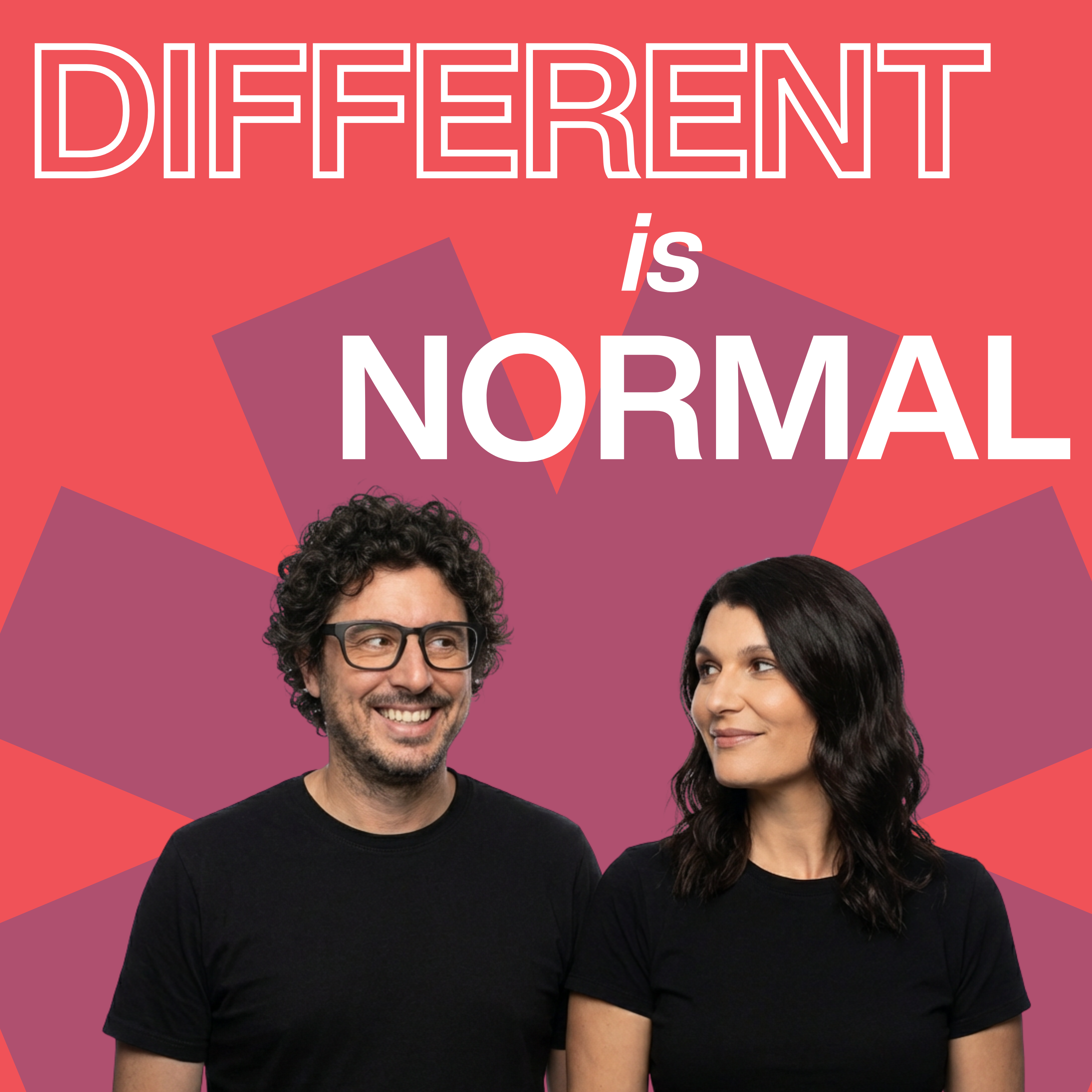
Different Is Normal
by Dave & Emily
Hosted by Emily and Dave, this show explores autism, ADHD, learning differences, mental health, parenting, education, work, identity, and everyday life through honest, grounded conversation. No fixing. No performative positivity. No expert jargon. Just real talk about what it actually means to live — or raise a child — in a neurodivergent world.We’re trained education support staff and parents of neurodivergent children. This isn’t theory — it’s lived experience. That means we talk about the wins, the struggles, the misunderstandings, the systems that don’t work, and the moments no one prepares you for — with empathy, humour, and zero judgement.Each episode blends story, reflection, and practical insight. Sometimes light. Sometimes heavy. Always human. Whether you’re neurodivergent, parenting a neurodivergent child, working in education, or trying to better understand someone you love, this podcast is a space where you can breathe, feel seen, and take som
-
12
I Thought I Was Fine… Until I Wasn’t | Ep 12 - part 2
This is the part people don’t always see.Growing up… coping… doing “fine”.Until one day, you realise you weren’t.In this episode of Different Is Normal, Emily shares what it was like growing up without a diagnosis — and what happens when the expectations increase but the support disappears.We talk about:• growing up alongside a sibling with significant needs• being the “capable one” — and what that actually means• why school can feel manageable… until it isn’t• what happens when support fades in high school and adulthood• the pressure to succeed when you’re expected to cope• becoming a parent and seeing things differently• why so many people aren’t diagnosed until laterThis episode is about something many people recognise:You weren’t “fine”.You just learned how to survive.This isn’t theory.It’s real life.Real reflection.And the moment things start to make sense.⏱️ CHAPTERS00:00 Finding a Common Language00:41 Growing Up Without a Diagnosis03:00 Living Alongside Complex Needs06:04 When Support Falls Away09:32 Becoming a Parent13:27 Understanding the Brain Differently16:19 Why This Podcast Exists18:34 The Power of Community20:54 Leaving the World Better🔗 MORE FROM USWatch more episodes here:https://www.youtube.com/@differentisnormal💬 JOIN THE CONVERSATIONDid you ever feel like you were coping… but something still didn’t fit?#neurodiversity #adhd #autism #parenting #differentisnormal
-
11
This Changed Everything for Our Family (And We Didn’t Expect It) | Ep 11 - part 1
This episode is different.We’re not breaking down behaviour.We’re not talking about strategies.We’re answering a question we’ve been asked a lot:Why does this matter so much to us?In this episode of Different Is Normal, we share the story behind the podcast.From a life-changing accident…to an autism diagnosis…to completely rethinking what matters.This is where everything started.We talk about:• what happened to Dave before his son was born• the moment everything changed• the guilt, confusion, and questions that followed• what an autism diagnosis actually means for a family• how perspective shifts everything• why understanding matters more than labelsThis isn’t about theory.It’s about real life.Real experiences.And the moments that change how you see everything.⏱️ CHAPTERS00:00 The Birth of a Podcast: Our Journey Begins00:56 Personal Stories: The Impact of Neurodiversity05:35 Navigating Autism: A Parent’s Perspective08:13 Life Changes: From Accident to Awakening17:45 Giving Back: Becoming an Aid in Education18:06 Perspective Shift: Understanding Neurodiversity26:52 Living with an Acquired Brain Injury30:12 Defining Moments: Friends, Family, and Support🔗 MORE FROM USWatch more episodes here:https://www.youtube.com/@differentisnormal💬 JOIN THE CONVERSATIONWhat changed how you see neurodiversity?#️⃣ #neurodiversity #autism #parenting #adhd #differentisnormal
-
10
Travelling with Neurodivergent Kids Is Hard — Here’s What Actually Helps | Ep 10
Travelling with neurodivergent kids can feel overwhelming.Airports. Queues. Noise. Delays.And the pressure of trying to keep everything calm while everything keeps moving.It is hard.But there are things that actually help.In this episode of Different Is Normal, we break down what is really happening during travel and what makes the biggest difference in real situations.No theory. No vague advice.Just practical strategies that work in planes, airports, and everyday travel.We cover:• the sunflower lanyard and how it can reduce stress in public spaces• why preparation matters more than you think• how to reduce overwhelm before it starts• what to bring so things do not fall apart mid trip• how to advocate without feeling like you are causing problems• why flexibility matters more than the perfect planThis is not about perfect travel.It is about making travel possible.⏱️ CHAPTERS00:00 Travelling with Neurodivergent Kids00:32 The Sunflower Lanyard Explained02:59 Why Preparation Changes Everything06:06 Making Flights Easier08:47 Managing Sensory Load11:28 Why Flexible Plans Work Better14:46 Advocating for Your Child17:35 What to Pack20:13 Safety and Backup Plans23:16 Final Tips That Actually Help🔗 LINKSWatch more episodes here:https://www.youtube.com/@differentisnormalWhat is the hardest part of travelling for you or your child?#neurodiversity #autism #adhd #parenting #traveltips
-
9
Why Are They Laughing? | The Hidden Rules No One Teaches | Ep 9
You walk into a room.People are laughing.And you don’t know why.No one explains the rules.But everyone notices when you miss them.In this episode, we break down what “reading the room” actually means, why it’s so hard for neurodivergent people, and what we can do instead.We talk about: • Hidden social rules no one teaches • Why humour and timing are hard to read • What it actually feels like in those moments • How small misunderstandings build up • Why we need to make expectations clearerThis is not about changing people.It’s about changing how we communicate.⸻Chapters00:00 Understanding Unwritten Social Rules02:47 Navigating Humor and Social Interactions05:57 The Complexity of Reading the Room08:49 The Challenge of Communication11:35 The Role of Explicit Communication14:44 Finding Balance in Conversations17:51 The Importance of Kindness in Communication20:30 Bridging the Gap Between Neurodiverse and Neurotypical23:36 Preparing for Independence and Safety28:39 Navigating School Challenges for Neurodiverse Children31:07 The Complexity of Reading Social Cues34:19 The Impact of Diagnosis on Social Interactions38:34 Understanding Social Situations and Communication42:29 Teaching Children About Social Dynamics46:47 Inclusion and Acceptance in Social Settings53:30 Making Social Cues Visible for Everyone⸻Watch more episodes here:https://www.youtube.com/@DiffIsNormal
-
8
Why the World Isn’t Built for Neurodiversity | Ep 8
In this episode of Different Is Normal, Dave and Emily explore a question that sits at the centre of many neurodivergent experiences.Why do we spend so much time teaching neurodivergent people how to navigate the world, but spend so little time teaching the world how to understand them?From classrooms to supermarkets, public spaces to government policy, many everyday environments are built around neurotypical experiences. Sound, lighting, routines, communication styles, and expectations can make ordinary places overwhelming for neurodivergent people.Dave and Emily talk about the gap between these two worlds and why understanding neurodiversity should not only sit with neurodivergent people and their families. They discuss education systems, the training of education support staff, sensory environments in public spaces, and how small changes in design and awareness can benefit everyone.They also reflect on their own experiences as parents and education support workers, and why creating environments that consider neurodiversity often improves life for all people, not just those with a diagnosis.If we want truly inclusive communities, we may need to stop expecting neurodivergent people to constantly adapt and start learning how to meet them where they are.Chapters00:00 Understanding Neurodiversity in Society05:54 Education and Training Gaps11:31 Creating Inclusive Environments14:30 Bridging the Gap Between WorldsWatch the full Different Is Normal serieshttps://www.youtube.com/@differentisnormalEpisode 1 – Navigating Diagnosis Dayhttps://youtu.be/BN3uU0H44ZsEpisode 2 – Normal Isn’t Realhttps://youtu.be/NUAMr90xumYEpisode 3 – When Everyday Things Are Too Muchhttps://youtu.be/hKjAP-lZJ_4Episode 4 – Why Stimming Helps Learninghttps://youtu.be/MIyn0QlpZ_EEpisode 5 – Every Behaviour Is a Messagehttps://youtu.be/Ip2Gz62thKA#Neurodiversity #Autism #Neurodivergent #InclusiveEducation #DifferentIsNormal
-
7
How to Choose the Right School for a Neurodivergent Child | What Parents Should Look For | Ep 7
Choosing the right school for your child is one of the biggest decisions parents make.But many families choose schools for familiar reasons:• that’s where friends from kinder are going• the school has the best reputation• it’s the closest schoolThe reality is that different schools are better for different children.The best school isn’t necessarily the most popular one or the one with the longest waiting list. The best school is the one where your child can participate, feel safe and grow.In this episode of Different Is Normal, Dave and Emily walk through how parents can make informed school decisions when raising neurodivergent children.They discuss:• the different types of schools in Australia• how school zones and out-of-zone enrolment work• what IQ testing actually means (and when it matters)• what “reasonable adjustments” look like in classrooms• Tier 1, Tier 2 and Tier 3 funding explained• what Student Support Groups (SSGs), IEPs and ILPs are• how schools support regulation and participation• what questions parents should ask during school tours• red flags to watch for when visiting schools• why school fit matters more than reputationThis episode is designed to help parents understand the system, advocate for their children, and find the environment where their child can thrive.Because choosing a school isn’t about ranking schools.It’s about finding the place where your child can breathe.Subscribe for more conversations about neurodiversity, education and parenting:https://www.youtube.com/@differentisnormalWatch this episode:https://youtu.be/bMpOEk_cp8UChapters00:00 Why choosing the right school matters01:28 Touring multiple schools before deciding02:20 The moment that helped us choose a primary school04:49 Choosing schools based on philosophy06:39 Types of schools in Australia explained08:21 Why school fit matters more than reputation11:18 Looking beyond NAPLAN and academic rankings16:27 What IQ testing actually means for schools17:31 Schools’ legal obligation to support students18:08 Examples of reasonable adjustments19:44 Tier 1, Tier 2 and Tier 3 funding explained25:18 Red flags to watch for during school tours30:34 Why changing schools is okay31:20 Student Support Groups (SSGs) explained33:28 IEPs, ILPs and setting meaningful goals38:22 Planning school transitions early45:18 Reducing cognitive load for students51:53 Fair vs equitable support in schools56:52 Why documenting everything matters58:22 Questions parents should ask schools1:04:07 Out-of-zone enrolment and appeals1:07:07 Final advice for parents#Neurodiversity #Autism #ADHD #InclusiveEducation #DifferentIsNormal
-
6
The Hidden Cost of Masking: Why “Good” Kids Fall Apart at Home | Ep 6
Why does a child look “fine” at school… then fall apart the second they get home?In this episode of Different Is Normal, Dave and Emily unpack masking (trying to behave like someone you’re not) and the very real cost it can have on a child’s brain and nervous system.Masking often looks like compliance: the quiet kid, the “good” kid, the student who’s sitting still and appearing to listen. But underneath, they may be spending all their energy on: “Am I sitting right? Am I listening right? Am I acting normal?” And when they finally reach their safe place (home) the cup overflows: shutdowns, meltdowns, stimming, exhaustion, or total withdrawal.We talk classroom signs educators often miss, why “coping” and “masking” get confused, how accommodations can make learning possible, and what parents can do when their child needs space after school.Chapters00:00 Masking and the after-school crash00:52 Masking can look like compliance01:20 “Looking like you’re listening” vs actually learning02:18 What ES staff can do (reduce input, support output)03:42 When teachers mistake stillness for engagement04:12 Laptop/music accommodation story (what good support can look like)07:07 Fairness vs equity in classrooms08:06 Home as the safe place to unmask09:28 Adults need decompression too10:40 Family story: touch, boundaries, and space12:28 Impact vs intention (hug expectations)13:38 Cognitive energy: constant self-monitoring15:26 Masking and health costs (exhaustion, pain, appetite)17:44 Advocating: “No more questions”19:15 Social energy, microsignals, and tone20:34 Why “How are you?” can be a huge question23:03 Pattern recognition and misunderstanding social cues23:53 Sarcasm and literal interpretation26:00 Why society doesn’t learn the other language27:43 Editing yourself in real time is exhausting29:01 Prioritising rest over “shoulds” at home30:53 Connection can be parallel, not always together31:53 Making home a safe space to be fully yourself33:36 School vs home: two different versions of the same child33:52 Camp planning and proactive supports36:45 Supporting participation (not forced sameness)40:24 Supporting expert maskers before it’s “too late”43:52 Building a strong parent-school relationship46:54 Adjustments that help one child often help everyone47:53 The real costs: joy, play, creativity, connection49:41 Unmasked autistic joy (and why it matters)55:47 Everyone masks sometimes, but the cost isn’t equal57:59 Shutdown in class: space + safety + time1:00:48 Hidden burnout signs (special interests disappearing)1:07:08 Sleep + dysregulation snowball1:14:36 Executive function collapse (“I can’t”)1:15:56 “School refusal” vs “school can’t”1:19:07 A social model approach to education1:21:02 Where we saw Different Is Normal this weekOther episodesEpisode 1 – Navigating Diagnosis Day: https://youtu.be/BN3uU0H44ZsEpisode 2 – Normal Isn’t Real: https://youtu.be/NUAMr90xumYEpisode 3 – When Everyday Things Are Too Much: https://youtu.be/hKjAP-lZJ_4#Autism #Neurodiversity #AutismParenting #AutisticBurnout #Masking #InclusiveEducation #DifferentIsNormal
-
5
Every Behaviour Is a Message | Autism, ADHD, Meltdowns and What Kids Are Communicating | Ep 5
In this episode of Different Is Normal, Dave and Emily unpack a powerful idea: all behaviour is communication. We talk about autism and ADHD behaviours in kids and teens, why meltdowns and “refusal” are often a sign of unmet needs, and how capacity, environment, and curiosity can change the way parents and educators respond.If you’re a parent, teacher, or education support worker supporting neurodivergent young people, this conversation will help you spot patterns, recognise triggers, and respond with empathy instead of punishment.Key moments:00:23 Welcome and why behaviour gets labelled “bad”04:52 Behaviour is communication for all humans08:53 Capacity and why patterns get missed22:07 Kids do well if they can (CPS, Ross Greene)23:31 The key question: “What need isn’t being met?”26:40 The neurodivergent backpack and after-school explosions33:42 Kids aren’t giving us a hard time, they’re having a hard time34:54 Fibromyalgia, burnout, and the power of restResources mentioned:The Explosive Child (Ross Greene)Collaborative and Proactive Solutions (CPS)NeuroWild: neurodivergent backpack illustrationIf this helped you feel less alone or more seen, share it with someone who needs it. Over and out.
-
4
Why Stimming Helps Learning (And Why We Keep Getting It Wrong) | Ep 4
Stimming, autism, ADHD, emotional regulation — what if the behaviour we’re trying to stop is actually what helps kids learn?In this episode of Different Is Normal, we unpack what stimming really is, why it matters, and how classrooms often misunderstand it.Stimming is not misbehaviour.It’s not disrespect.It’s not something to eliminate.It’s a nervous system regulating itself.We explore:• What stimming actually means (and why the definition matters)• The difference between neurotypical and neurodivergent stimming• Why “sit still and listen” can work against learning• How movement increases focus and engagement• What happens when stimming is allowed instead of suppressed• The impact of school rules on regulation• Why acceptance changes everythingWe also share real classroom stories, parenting moments, and practical examples of what happens when teachers choose regulation over compliance.If you’ve ever been told to stop tapping, stop rocking, stop moving — this conversation is for you.Stimming is super normal.We all do it.The difference is how visible it is.🧠 Key TakeawayWhen we allow regulation, learning improves.When we normalise difference, kids feel safe.⏱ Chapters00:00 What Is Stimming?02:43 Stimming and Emotional Regulation05:42 Home vs School Differences08:03 Does Stimming Help Learning?13:29 Individual Differences21:08 Creating Supportive Classrooms29:05 The Future of Stimming in Education👇 Join the ConversationWhat’s a stim you’ve noticed in yourself?Comment below and help us normalise it.🎙 Podcast: Different Is NormalReal talk about neurodivergent lives.Subscribe for honest conversations about autism, ADHD, sensory processing, education support, parenting, and regulation.
-
3
Sensory 101: When Everyday Things Are Too Much | Different Is Normal – Ep 3
Sensory overload isn’t being “picky”, “defiant”, or “difficult” — it’s a nervous system under pressure.In this episode of Different Is Normal, we unpack what sensory overload actually feels like for neurodivergent kids and adults, and why everyday things like food, clothing, noise, routines, and school environments can become overwhelming.As parents and education support workers, we share real-life experiences of sensory processing differences — from food sensitivities and clothing tags to showers, transitions, and classroom expectations — and how these are often misunderstood as behaviour problems.This is Sensory 101: neuro-affirming, practical, and grounded in lived experience.You’ll hear:What sensory overload actually feels like inside the bodyWhy food preferences and routines are often sensory, not behaviouralHow sensory needs show up differently at home and at schoolWhy behaviour is communication — not defianceSmall, realistic adjustments that make a big differenceWe also reference the Sensory Processing Wheel by Lindsay Braman, a simple, neuro-affirming visual that explains the full range of sensory systems — including proprioceptive and interoceptive senses — and why regulation looks different for every person.👉 Learn more about the Sensory Processing Wheel here:https://lindsaybraman.com/sensory-processing-wheel/If you’re a parent, education support worker, teacher, or neurodivergent adult, this episode will help you better understand sensory load — and why support starts with curiosity, not control.Different was never the problem. Pressure was.Chapters00:00 What Sensory Overload Really Is02:52 Food Sensitivities and Sensory Processing05:14 Why Daily Routines Can Be Overwhelming07:56 Clothing, Tags, and Comfort10:41 Sensory Needs and “Behaviour”15:54 Masking and Communication23:14 Sensory Load Across Environments26:14 Building Rapport and Safety at School31:34 Parent–School Collaboration34:09 Small Adjustments, Big Impact37:39 Choice, Autonomy, and Regulation49:12 Celebrating Small WinsKeywordssensory overload, sensory processing, neurodiversity, autism, sensory needs, interoception, proprioception, education support, inclusive classrooms, parenting neurodivergent children
-
2
Normal isn’t real - it’s just whatever gets rewarded the most. | Ep 2
In this episode of Different Is Normal, Dave and Emily unpack why “normal” is a social construct — and how it quietly harms neurodivergent kids in schools, families, and friendships.They explore how ideas of normal are shaped by environment, why compliance gets rewarded over wellbeing, and how small accommodations can radically improve learning and engagement for all students — not just neurodivergent ones.This is a real, practical conversation about neurodiversity, education, parenting, and what inclusion actually looks like in classrooms and homes.If you’ve ever wondered why your child thrives at home but crashes after school — or why “fitting in” feels exhausting — this episode is for you.In this episode, we discuss:Why there is no universal definition of “normal”How schools reward sameness (often unintentionally)Why accommodations benefit every learnerParenting neurodivergent children with dignity and understandingRecognition vs rewards in educationHow friendships are changing in a digital worldWhat inclusive classrooms actually look like in practiceKey takeawayNormal isn’t the goal.Understanding, flexibility, and acceptance are.⏱️ Chapters00:00 What “Normal” Really Means02:39 How Environment Shapes Behaviour05:16 Neurodiversity in Education08:28 Why Accommodations Matter10:43 Parenting Neurodivergent Kids12:55 Rethinking Success in School15:40 Digital Friendships & Social Change18:30 Recognising Effort, Not Compliance20:52 Flexible Learning Environments23:48 Inclusive Classrooms in Practice26:31 Recognition vs Rewards28:56 School Rules That Don’t Work31:33 Parent–School Communication34:21 Finding the Right Learning Environment36:50 Passion-Led Learning39:23 Adaptability in Teaching41:54 Behaviour as Communication44:32 Acceptance as a Process47:31 Defining a New Normal49:46 Why Difference Is Normal📌 About the podcastDifferent Is Normal is a podcast about neurodivergent lives — not theory, just what actually helps.Hosted by Dave and Emily, parents and education support workers having honest conversations about school, belonging, and wellbeing.
-
1
Diagnosis Day: What Changed and What Didn’t | Ep 1
The conversation delves into the experiences of parents navigating the journey to diagnosis for their neurodivergent children. It explores the emotional impact of diagnosis, the importance of community and support, and the role of advocacy and understanding in the process.TakeawaysDiagnosis Day: A Culmination of ExperiencesThe Importance of Community and SupportChapters00:13 The Journey to Diagnosis Day03:51 Experiences of Diagnosis Day08:38 Navigating the Medical System16:57 Sharing the Diagnosis with Others19:26 Impact on Social Dynamics29:06 The Importance of Community Support34:21 Conclusion and Final Thoughts
We're indexing this podcast's transcripts for the first time — this can take a minute or two. We'll show results as soon as they're ready.
No matches for "" in this podcast's transcripts.
No topics indexed yet for this podcast.
Loading reviews...
ABOUT THIS SHOW
Hosted by Emily and Dave, this show explores autism, ADHD, learning differences, mental health, parenting, education, work, identity, and everyday life through honest, grounded conversation. No fixing. No performative positivity. No expert jargon. Just real talk about what it actually means to live — or raise a child — in a neurodivergent world.We’re trained education support staff and parents of neurodivergent children. This isn’t theory — it’s lived experience. That means we talk about the wins, the struggles, the misunderstandings, the systems that don’t work, and the moments no one prepares you for — with empathy, humour, and zero judgement.Each episode blends story, reflection, and practical insight. Sometimes light. Sometimes heavy. Always human. Whether you’re neurodivergent, parenting a neurodivergent child, working in education, or trying to better understand someone you love, this podcast is a space where you can breathe, feel seen, and take som
HOSTED BY
Dave & Emily
Loading similar podcasts...
URL copied to clipboard!