
PODCAST · business
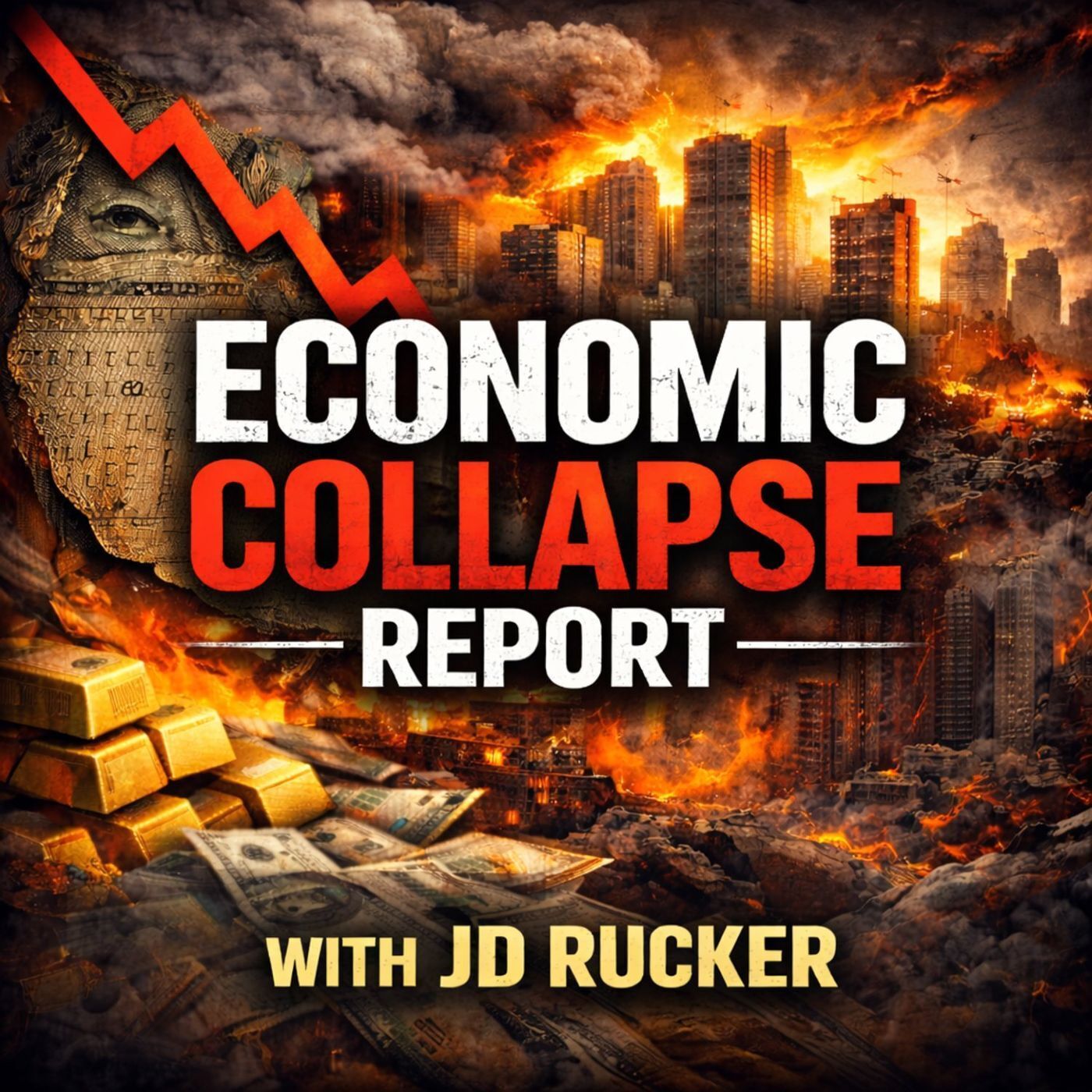
Economic Collapse Report
by JD Rucker
Whether the American economy thrives into the future or takes a downturn, one thing seems clear. The fiat- and debt-based economy driving the United States and the world will eventually collapse, not because it cannot be fixed but because the powers-that-be seem bent on collapsing it. On the Economic Collapse Report podcast with JD Rucker, we do not aim to be fearmongers or Chicken Littles. We do want to bring the truth about the economy to light and make sure people are prepared for what's to come. We are not financial advisors and do not give financial advice.
-
23
New York City's Mamdani Problem Is Growing While California's Democrat Problem Has a Solution
Zohran Mamdani’s face told the story before his words did. Standing beside City Council Speaker Julie Menin in the City Hall rotunda on Tuesday, New York City’s democratic socialist mayor announced what amounts to a confession dressed up as a policy proposal. The city he was elected to run is in a “budget crisis of historic magnitude,” he said, and the only acceptable solution involves someone else writing the check.Read More: https://economiccollapse.report/the-bailout-was-always-part-of-zohran-mamdanis-plan/See Privacy Policy at https://art19.com/privacy and California Privacy Notice at https://art19.com/privacy#do-not-sell-my-info.
-
22
10 Problems AI Should Be Solving — and the Risk of Outsourcing Our Stewardship
There is something deeply revealing about the way the left has chosen to use artificial intelligence. It has embraced the technology with great enthusiasm for surveilling political dissidents, flagging "misinformation" that contradicts official narratives, scoring social compliance, and automating ideological enforcement across digital platforms. What it has treated with considerably more skepticism — and often outright bureaucratic resistance — are the applications of AI that could actually save lives, end suffering, feed the hungry, and unlock the kind of human flourishing that no government program has ever managed to produce.This is not a coincidence. A philosophy that requires dependency cannot afford solutions that are too effective. And AI, deployed rightly, is nothing less than an extension of human capacity on a scale that would embarrass every federal agency and international body that has spent decades pretending to solve the same problems with more money and more meetings.Read More: https://economiccollapse.report/10-problems-ai-should-be-solving-and-the-risk-of-outsourcing-our-stewardship/See Privacy Policy at https://art19.com/privacy and California Privacy Notice at https://art19.com/privacy#do-not-sell-my-info.
-
21
Two Nations Under AI: What the Growing Divide Between the Techno-Elite and Everyone Else Means
A new fault line is running through American life, and it has nothing to do with the usual categories of race, class, or political affiliation — though it is beginning to absorb all of them. It is the divide between those who believe artificial intelligence is the most transformative tool since the printing press and those who think the whole enterprise is somewhere between overblown and genuinely dangerous.Axios recently put a name to what many have been sensing: AI is sorting the country into three distinct camps — power users, doubters, and resistors. What the headline missed is the deeper story. This is not really a debate about technology. It is a debate about who gets to define reality, who benefits from disruption, and whether the people running the AI revolution have any accountability to the rest of us.The technical community has its own vocabulary for this divide. Andrej Karpathy — the former Tesla AI director and OpenAI founding member who coined the term "vibe coding" — recently posted on X that AI's power users and skeptics are "speaking past each other." His diagnosis is astute: a person who briefly tried a free, outdated version of ChatGPT and found it unreliable is operating in an entirely different experiential universe than an engineer paying for Claude Code or OpenAI's Codex and watching it solve in minutes what used to take days."The thing is that these free and old/deprecated models don't reflect the capability in the latest round of state of the art agentic models of this year," Karpathy wrote.The gap, he explained, is partly technical — AI models have improved most dramatically in coding and mathematics, domains with verifiable right answers, rather than in writing or general search, which are the tasks most ordinary users associate with AI. The result is a bifurcated public: one group laughing at chatbot hallucinations, the other watching in something close to awe as machines solve PhD-level problems autonomously.But Karpathy's framing, while technically accurate, contains a buried assumption worth examining. It treats the power-user perspective as epistemically superior — as though the skeptics simply lack information and would come around if they could only afford the premium subscription. This is the classic Silicon Valley condescension dressed in empirical clothing. The ordinary American who watches a company replace customer service workers with a chatbot is not suffering from ignorance. He is suffering from proximity. He has seen the application. He knows who benefited and who didn't. His skepticism is not a measurement error; it is a data point that the techno-optimists prefer not to model.The polling confirms this at scale. A recent Fox News survey found that 67% of Americans carry serious concerns about AI's consequences. Global polling firm FGS Global, which surveyed 20,000 people across the U.S., U.K., Canada, the European Union, and Japan, found a consistent pattern across every nation: elites are more optimistic about AI and more hostile to regulating it, while non-elites favor oversight and fear job displacement.Young people in every country surveyed said they see their economic futures as threatened by the technology. A Pew Research Center report found that 56% of AI experts expect positive long-term outcomes for the country — while only 17% of the general public agrees. When the people building a technology and the people living with it disagree by 39 percentage points, that is not a communication problem. That is a legitimacy problem.What makes this cultural moment particularly revealing is the way the elite AI class has begun to respond to the skeptics. Former AI czar David Sacks — a venture capitalist turned White House official — has been blunt: "The Doomer narratives were wrong."Senior policy advisor Sriram Krishnan echoed that the notion of imminent catastrophic AI risk was "a distraction and harmful and now effectively proven wrong." The "doomers" they're dismissing were, in many cases, the researchers and ethicists who raised questions about accountability, job displacement, and the concentration of power in a handful of private labs. Whatever one thinks of their apocalyptic framing, their underlying concerns — about who controls AI, who profits from it, and what happens to workers in its wake — remain entirely unanswered. Declaring them wrong on the existential timeline is not the same as answering those questions.Meanwhile, OpenAI itself has quietly acknowledged the scale of the disruption ahead. The company released a policy paper it calls "Industrial Policy for the Intelligence Age," which proposes — among other things — a national wealth fund, shifting more of the tax burden from labor to capital, and broad social safety net expansions.Axios, reporting on the document, noted that its proposals resemble Progressive Era and New Deal thinking, and would only become politically viable if AI disruption proved severe enough to scramble existing political coalitions. Read that sentence again. The company building the technology is planning for a future disruption so severe that it might require a political revolution to manage. And the same company is arguing, publicly, that government should not slow it down. The internal contradiction is breathtaking — and almost no one is saying so directly.The Scripture speaks with precision to this kind of moment. In the book of James, chapter 5, the wealthy are warned: "Ye have heaped treasure together for the last days. Behold, the hire of the labourers who have reaped down your fields, which is of you kept back by fraud, crieth: and the cries of them which have reaped are entered into the ears of the Lord of sabaoth."The specific mechanism changes across centuries — field labor, factory work, white-collar employment — but the structure remains the same: productivity gains flow to those at the top, the workers bear the cost of transition, and the powerful spend considerable energy explaining why this is actually good for everyone. AI is not a new story. It is an old story told with new vocabulary.None of this means artificial intelligence is inherently malevolent or that the skeptics are right about everything. Karpathy is correct that there is a genuine capability gap between what casual users have seen and what professional power users are experiencing. The technology will likely do real good in medicine, scientific research, and fields where human attention is the bottleneck. The question is never whether a technology has benefits. The question is always who captures those benefits, who absorbs the costs, and whether the people making the decisions can be held accountable when they get it wrong.On all three counts, the current AI moment offers troubling answers. The benefits are flowing to a narrow class of investors and engineers. The costs — job displacement, wage stagnation, the psychological toll of a world reorganizing itself faster than human institutions can adapt — are being distributed broadly and borne disproportionately by those with the fewest options. And accountability is, to put it politely, not the industry's strong suit.What Axios captured in its three-camp framework is real, but it is incomplete. This is not simply a story about different levels of familiarity with technology. It is a story about power — about who gets to define what counts as progress, who decides the pace of change, and whether the rest of society has any say in those decisions. The AI elites are not wrong that the technology is transformative. They are wrong to treat that transformation as self-justifying. History has never vindicated the argument that disruption, simply because it is technologically impressive, is therefore good. The workers who built the railroads did not automatically share in the wealth of the Gilded Age. The factory hands of the Industrial Revolution did not thrive because the machines were remarkable. Progress without accountability is just power with better marketing.The divide Axios describes will not be closed by better onboarding tutorials or cheaper subscriptions. It will only close — if it closes — when the people steering this technology are required to answer to someone other than their investors. Until then, the three camps will keep drifting apart: the power users marveling at what the machines can do, the skeptics watching what the machines are doing, and the resistors concluding that no one at the top is asking the right questions. On that last point, at least, the resistors may have the clearest view of all.See Privacy Policy at https://art19.com/privacy and California Privacy Notice at https://art19.com/privacy#do-not-sell-my-info.
-
20
BlackRock Bets on America While the Strait of Hormuz Hangs in the Balance
BlackRock upgraded U.S. equities to "overweight" on April 13th, citing strong corporate earnings and what it considers limited lasting damage to global economic growth from the Iran conflict.The U.S.-Israel war against Iran began February 28th with airstrikes that killed Iran's Supreme Leader Ali Khamenei. Iran retaliated by closing the Strait of Hormuz, through which roughly 20% of the world's oil and natural gas normally flows.A Pakistan-brokered ceasefire was announced on April 8th and almost immediately came under strain. Weekend peace talks in Islamabad collapsed on April 12th when Iran refused to commit to ending uranium enrichment.Trump declared a U.S. naval blockade of Iranian ports following the failed talks. Oil prices climbed back above $100 per barrel and the IRGC warned any military vessels approaching the strait would face a "severe response."S&P 500 companies are expected to report first-quarter earnings growth of roughly 13-14%, with some forecasts suggesting that figure could climb to 19% if historical beat rates hold. Technology sector profits are projected to grow 43-45% in 2026.BlackRock's Jean Boivin noted that technology's valuation premium has eroded significantly even as earnings expectations for the sector have climbed sharply, creating what the firm sees as an attractive entry point.J.P. Morgan and Morgan Stanley issued similar guidance, arguing that geopolitical dips should ultimately prove to be buying opportunities for patient investors.The UN warned that a global food crisis could emerge if normal shipping traffic through the Strait of Hormuz is not restored soon, as fertilizers, fuel, and agricultural inputs remain choked off from global markets.Despite the backdrop of a hot war, the S&P 500 has recovered nearly 8% from its seven-month low struck in late March.Read More: https://economiccollapse.report/blackrock-bets-on-america-while-the-strait-of-hormuz-hangs-in-the-balance/See Privacy Policy at https://art19.com/privacy and California Privacy Notice at https://art19.com/privacy#do-not-sell-my-info.
-
19
What Amazon's 'Insane' AI Bet Reveals About the Price of Survival
The core argument: Amazon CEO Andy Jassy's 2025 shareholder letter isn't just a business update — it's a meditation on institutional courage, specifically the courage to tear down something that works rather than patch new technology onto old systems.The AI bet: Amazon is committing ~$200 billion in capital expenditures in 2026, primarily for AI infrastructure. Free cash flow dropped from $38B to $11B as a result, spooking Wall Street — but Jassy argues the demand is real, backed by a $100B+ OpenAI commitment and AWS AI revenue already running at $15B annually.Self-disruption: Jassy wants to rebuild the retail shopping experience from a blank page rather than layering AI onto existing systems. He calls going back to the starting line "one of the hardest decisions" a leader can make — and argues it's less risky than standing still.The parallel-paths philosophy: Amazon runs multiple bets simultaneously (same-day fulfillment centers, Prime Air drones, Amazon Now 20-minute delivery) not as redundancies but as complements. This tolerates short-term messiness in exchange for a higher probability of finding the breakthrough.The Washington parallel: The article draws a direct line between Amazon's institutional self-disruption and what the federal government should — but struggles to — do with its own obsolete systems. The resistance Amazon faces internally mirrors the political resistance to bureaucratic modernization.The broader lesson: Survival requires more than optimizing what already works. The article closes with Isaiah 43 as the grounding frame — the discipline of releasing what succeeded before because the new moment demands it.Read More: https://economiccollapse.report/what-amazons-ai-bet-reveals-about-the-price-of-survival/See Privacy Policy at https://art19.com/privacy and California Privacy Notice at https://art19.com/privacy#do-not-sell-my-info.
-
18
Mamdani's 'Racial Equity Plan' Is Pure Discrimination Wrapped in Modernized Marxism
New York City Mayor Zohran Mamdani stood before cameras at Medgar Evers College in Brooklyn on Monday and unveiled what his administration calls the city's first-ever "Preliminary Citywide Racial Equity Plan" — a sweeping, 45-agency framework built on the explicit premise that city government must view every policy decision, every spending allocation, and every programmatic goal through the lens of race. The Department of Justice, reviewing the plan the same day it dropped, is prepared to call it something else: discriminatory and potentially illegal.Both assessments are correct. The fact that anyone needs an explanation of why it's discriminatory and illegal should tell us something sobering about how far we have drifted from the foundational understanding that equal protection under the law means equal protection for everyone.Read More: https://economiccollapse.report/mamdanis-racial-equity-plan-is-pure-discrimination-wrapped-in-modernized-marxism/See Privacy Policy at https://art19.com/privacy and California Privacy Notice at https://art19.com/privacy#do-not-sell-my-info.
-
17
The New 'Millionaire's Tax' in Washington Is Already Terrifying Productive Residents
Democrat politicians, especially in far-left cities like Seattle, view people as members of three different groups. There are the ATMs, the combination of mega-donors and wealthy residents who can supply Democrat politicians with campaign funds, tax dollars for leftist policies, or both. Then, there are the enemies, middle class voters who lean right, who are being increasingly targeted for removal from public discourse. Last but not least, there are the useful idiots who vote for Democrats and therefore vote for their own suffering.That’s why the “millionaire’s tax” in Washington is pure perfection from a leftist perspective. It addresses all three groups of people in the state in ways that Democrats want. And it’s going to be the downfall of a city and state that once boasted prosperity as a feature.Read More: https://economiccollapse.report/the-new-millionaires-tax-in-washington-is-already-terrifying-productive-residents/See Privacy Policy at https://art19.com/privacy and California Privacy Notice at https://art19.com/privacy#do-not-sell-my-info.
-
16
The South Didn't Just Rise Again — It Took Wall Street With It
For generations, the conventional wisdom went something like this: serious money lives in New York. The serious decisions about who gets capital, who gets to list on an exchange, who gets to participate in the grand machinery of American finance — all of it emanated from a few square miles of lower Manhattan, governed by institutions so entrenched they seemed geological. Wall Street wasn’t just an address. It was a statement about where power lived and who held it.Read More: https://economiccollapse.report/the-south-didnt-just-rise-again-it-took-wall-street-with-it/See Privacy Policy at https://art19.com/privacy and California Privacy Notice at https://art19.com/privacy#do-not-sell-my-info.
-
15
David Sacks Forced Out of AI Czar Role, Now America's REAL AI Planning Can Begin
David Sacks has officially ended his 130-day tenure as President Trump's AI and crypto czar, a limit imposed by federal law on special government employees, and is transitioning to co-chair the President's Council of Advisors on Science and Technology (PCAST).The White House confirmed it will not appoint a replacement AI czar, and Sacks will continue advising President Trump on artificial intelligence and technology policy from his new PCAST role.PCAST's inaugural 13-member lineup reads like a Silicon Valley power summit, including NVIDIA's Jensen Huang, Meta's Mark Zuckerberg, Google co-founder Sergey Brin, Oracle's Larry Ellison, AMD's Lisa Su, Marc Andreessen, and early Coinbase backer Fred Ehrsam.During his czar tenure, Sacks advanced the stablecoin-focused GENIUS Act, supported a strategic bitcoin reserve, contributed to the Digital Assets Working Group report, and helped craft the Trump administration's newly released national AI legislative framework.Sacks' move raises legitimate structural questions, as PCAST is now composed almost entirely of CEOs from companies that stand to benefit directly from the federal AI and semiconductor policies the council will help shape.Earlier this month, Sacks publicly urged the Trump administration to pursue an exit from the U.S.-backed war with Iran on his "All In" podcast — comments he later distanced himself from — raising unanswered questions about whether the timing of his transition was entirely routine.In today's episode of Economic Collapse Report, JD breaks down how Sacks and his team could be the difference makers in the current AI war.Read More: https://economiccollapse.report/david-sacks-forced-out-of-ai-czar-role-now-americas-real-ai-planning-can-begin/See Privacy Policy at https://art19.com/privacy and California Privacy Notice at https://art19.com/privacy#do-not-sell-my-info.
-
14
The Great Gold Scam, Explained
Most Gold IRA companies operate on a model built around massive markups on numismatic coins, delivering enormous profits to dealers while leaving customers with overpriced assets that rarely hold or grow in real value.Tucker Carlson’s recent exposé, “The Great Gold Scam,” pulled back the curtain on an industry that has preyed on trusting Americans for decades.Carlson himself launched a precious-metals firm, yet every core claim in his video aligns with documented industry practices.Bullion coins and bars—priced close to the spot market—offer straightforward exposure to gold and silver without the hidden premiums that define most IRA sales pitches.Physical rounds or bars stored in a home safe provide the same purity and liquidity advantages without the custodial fees and restrictions of an IRA.The difference between bullion and numismatics is simple: one tracks the real price of metal by weight; the other inflates value through claims of rarity that rarely materialize for the average buyer.Regulators have warned for years about these tactics, yet the high-margin machine keeps turning because the incentives are stacked against the customer.This is not financial advice. It is a clear-eyed look at how the system works—and why ordinary people keep getting burned.Read More: https://economiccollapse.report/the-great-gold-scam-explained/See Privacy Policy at https://art19.com/privacy and California Privacy Notice at https://art19.com/privacy#do-not-sell-my-info.
-
13
Coincidence? Oil Jumps After Explosion and Massive Fire at One of the Largest Us Oil Refineries
An explosion and large plumes of smoke at the Valero refinery in Port Arthur prompted officials to order west-side residents to shelter in place according to 12 News Now. A fire broke out at a diesel hydrotreater, with the unit suffering severe damage, according to people familiar with the incident. The fire was near the plant’s fluid catalytic cracker, and part of the refinery has been shut down, according to the people, who said a decision hasn’t yet been made whether to shut the entire plant.Read More: https://economiccollapse.report/coincidence-oil-jumps-after-explosion-and-massive-fire-at-one-of-the-largest-us-oil-refineries/See Privacy Policy at https://art19.com/privacy and California Privacy Notice at https://art19.com/privacy#do-not-sell-my-info.
-
12
Kathy Hochul Begs Millionaires to Ask Their Friends Who Fled NY to Return So She Can Tax Them
New York Governor Kathy Hochul delivered a stark admission this week: the state's tax base is eroding as high-net-worth residents continue to depart for lower-tax destinations, leaving behind a funding gap for the expansive social programs that define the Empire State's approach to governance. Speaking at Politico's New York Agenda: Albany Summit, Hochul openly pleaded for wealthy individuals—many now residing in places like Florida and Texas—to return or persuade their peers to do so, acknowledging that these taxpayers are essential to sustaining the generous welfare framework New York has built.The governor's remarks came amid mounting pressure from progressive voices, including New York City Mayor Zohran Mamdani, who has pushed for significant tax increases on the rich to address budget shortfalls. Hochul resisted those calls, arguing instead for retention rather than coercion.Read More: https://economiccollapse.report/kathy-hochul-begs-millionaires-to-ask-their-friends-who-fled-ny-to-return-so-she-can-tax-them/See Privacy Policy at https://art19.com/privacy and California Privacy Notice at https://art19.com/privacy#do-not-sell-my-info.
-
11
Freedom-Loving Nations Should Heed President Trump's Call to Secure the Strait of Hormuz Together
For decades, the world's most consequential waterway has sat beneath the shadow of a hostile regime. The Strait of Hormuz — a sliver of water just 21 nautical miles wide at its narrowest point — serves as the jugular vein of the global economy. Approximately a fifth of the world's oil passes through it, carried by roughly 3,000 ships each month. And for decades, the Islamic Republic of Iran has held that jugular in its hands. The current war has finally shown the world what happens when that grip tightens.President Trump is right. He was right to call on allies to act, and he was right to frame it as a shared responsibility. More importantly, the principle behind his call — that no single hostile nation should ever again be permitted to weaponize the world's most critical maritime corridor — ought to become permanent doctrine for every freedom-loving nation on earth.Read More: https://economiccollapse.report/why-freedom-loving-nations-should-heed-president-trumps-call-to-secure-the-strait-of-hormuz-together/See Privacy Policy at https://art19.com/privacy and California Privacy Notice at https://art19.com/privacy#do-not-sell-my-info.
-
10
With California Gas Prices Ballooning, President Trump Orders Coastal Oil Drilling to Resume
The executive order directs the Secretary of Energy to facilitate resumption at Sable Offshore's facilities, potentially unlocking up to 50,000 barrels of daily production.It addresses vulnerabilities where California and U.S. military forces rely heavily on foreign oil due to local restrictions.The action follows a Justice Department opinion affirming presidential power to preempt state laws impeding critical energy resources.California officials, including the attorney general, have already filed lawsuits challenging federal overreach on pipelines and production permits.Environmental groups and coastal communities view the order as highly controversial, reviving memories of past spills that devastated marine ecosystems.Read More: https://economiccollapse.report/with-california-gas-prices-ballooning-president-trump-orders-coastal-oil-drilling-to-resume/See Privacy Policy at https://art19.com/privacy and California Privacy Notice at https://art19.com/privacy#do-not-sell-my-info.
-
9
The Farm Crisis Deepens as War, Energy Prices, and Debt Squeeze America’s Producers
Rising oil prices linked to Middle East tensions are increasing the cost of fuel, fertilizer, and transportation for American farmers.Fertilizer prices remain volatile because natural gas is a key input, tying agriculture directly to energy markets.Farm debt has climbed to record levels, putting many producers in a vulnerable financial position if commodity prices fall.Small and mid-size farms are under the greatest pressure as consolidation continues across the agriculture sector.Supply chain instability from global conflicts could raise costs for farm equipment and imported agricultural inputs.Food inflation may accelerate if farmers reduce planting or livestock production due to rising expenses.Biblical principles of stewardship remind believers that land and resources are entrusted by God and must be managed wisely in uncertain times.See Privacy Policy at https://art19.com/privacy and California Privacy Notice at https://art19.com/privacy#do-not-sell-my-info.
-
8
Interest Rates, Iran War, and Stagflation in Today's Economy
With all that's happening in America and across the globe today, there remains one overarching economic perspective that prevails. Interest rates impact everything and interest rates are impacted by everything, at least to some extent. Ira Bershatsky from https://advisorbullion.com joined us again today to discuss what's happening, warning of stagflation, and pointing to caution in the days, weeks, and months ahead. This is a public episode. If you would like to discuss this with other subscribers or get access to bonus episodes, visit economiccollapse.substack.comSee Privacy Policy at https://art19.com/privacy and California Privacy Notice at https://art19.com/privacy#do-not-sell-my-info.
-
7
Gold's Bright Future Gets Even Brighter and Iran Chokes the World for Oil
What Gold Numbers Are Telling Us That the Fed Won’t - https://economiccollapse.report/what-gold-numbers-are-telling-us-that-the-fed-wont/Iran Closes the Strait of Hormuz — and the World’s Energy Markets Are Holding Their Breath - https://economiccollapse.report/iran-closes-the-strait-of-hormuz-and-the-worlds-energy-markets-are-holding-their-breath/ This is a public episode. If you would like to discuss this with other subscribers or get access to bonus episodes, visit economiccollapse.substack.comSee Privacy Policy at https://art19.com/privacy and California Privacy Notice at https://art19.com/privacy#do-not-sell-my-info.
-
6
Paramount Skydance Wins the Battle for Warner Bros. Discovery as David Ellison Makes Huge Move
Warner Bros. Discovery's board declared Paramount Skydance's revised $31-per-share all-cash bid a "superior proposal" over Netflix's existing merger agreement, triggering a match window that Netflix ultimately declined.Netflix co-CEOs Ted Sarandos and Greg Peters stated the deal was "no longer financially attractive" at the price required to match Paramount Skydance's offer, effectively ending a months-long bidding war.Paramount Skydance, led by David Ellison — son of Trump ally and Oracle co-founder Larry Ellison — sweetened its offer multiple times, ultimately raising its bid 63% from its original September proposal to secure the deal.A combined Paramount-WBD entity would merge HBO Max with Paramount+, unite Warner Bros. and Paramount Skydance Studios, and place both CNN and CBS News under a single ownership structure.WBD shareholders emerged as the clear financial winners, with the stock surging 78% during the bidding war, while Paramount and Netflix shares fell 36% and 30% respectively.The deal includes a $7 billion regulatory termination fee and Paramount's agreement to absorb WBD's $2.8 billion Netflix breakup fee, giving WBD shareholders significant financial protection.Political undertones were prominent throughout the process — David Ellison attended Trump's State of the Union as a guest of Sen. Lindsey Graham while Netflix's Ted Sarandos was seen arriving at the White House on the same day Netflix declined to match the bid.The deal still faces a WBD shareholder vote scheduled for March 20 and significant regulatory review before it can be finalized.Read More: https://economiccollapse.report/paramount-skydance-wins-the-battle-for-warner-bros-discovery-as-david-ellison-remakes-the-media-landscape/ This is a public episode. If you would like to discuss this with other subscribers or get access to bonus episodes, visit economiccollapse.substack.comSee Privacy Policy at https://art19.com/privacy and California Privacy Notice at https://art19.com/privacy#do-not-sell-my-info.
-
5
How Will the SCOTUS Ruling on Tariffs Affect Americans' Finances?
Financial expert Ira Bershatsky from AdvisonBullion.com joined JD to talk about the tariff ruling from the Supreme Court as well as other factors that are going to impact the economy going forward. This is a public episode. If you would like to discuss this with other subscribers or get access to bonus episodes, visit economiccollapse.substack.comSee Privacy Policy at https://art19.com/privacy and California Privacy Notice at https://art19.com/privacy#do-not-sell-my-info.
-
4
Massive Japanese Investments and Palantir Moves to Florida
Japan has started its $550 billion investment promise by launching energy and minerals projects in the United States. Defense contractor Palantir is moving from Colorado to Florida in a move that makes them the biggest traded company in Southern Florida. This is a public episode. If you would like to discuss this with other subscribers or get access to bonus episodes, visit economiccollapse.substack.comSee Privacy Policy at https://art19.com/privacy and California Privacy Notice at https://art19.com/privacy#do-not-sell-my-info.
-
3
It Now Costs $3.4 Million to Live 'The American Dream'
(The Economic Collapse Blog)—For a long time, it has been clear that the middle class is being systematically destroyed. The cost of living has been rising faster than paychecks have for years, and this has pushed millions of Americans into poverty. As for those that were already impoverished, many of them have been pushed out into the streets. According to the Wall Street Journal, homelessness in the United States is increasing at the fastest rate ever recorded in 2023. Anyone that thinks that we do not have a major problem on our hands simply has not been paying attention. At one time, living “the American Dream” was a goal that the vast majority of Americans could aspire to achieve, but now it is out of reach for most of the country. In fact, a report that was just released concluded that it now takes 3.4 million dollars for the typical U.S. household to live “the American Dream” over the course of a lifetime…The so-called ‘American Dream’ is the benchmark that many people hope to achieve in their lifetime – getting married, buying a home and a car and raising children.But new analysis has found that achieving these milestones now costs a staggering $3,455,305 – much more than most Americans will make in their lifetime.One of the biggest amounts is for paying off a mortgage on a property. The average homebuyer will fork out $796,998, according to Investopedia – assuming a 10 percent down payment and a 30-year fixed loan at 7.2 percent interest.Are you going to make 3.4 million dollars during your working years?If not, “the American Dream” is not for you. Sorry.Today, it is only those that are at the very top of the economic food chain that are thriving.Once upon a time, America had the largest and most prosperous middle class in the history of the world, but now the top 1 percent controls more wealth than the entire middle class…Thirty years ago, America’s celebrated middle class commanded twice as much wealth as the upper 1%.Over the years, the rich have grown steadily richer. The top 1% caught and passed the middle class in collective wealth in late 2020, Fed data show.The top 1% of American earners now control more wealth than the nation’s entire middle class.This is what happens when power and wealth are highly centralized.The gap between the wealthy and the rest of us is now bigger than ever.So good luck trying to live a middle class lifestyle in this environment.Do you want to buy a couch? Well, the exact same couch that would have cost you $799 in 2019 will now cost you $1,599…An interior designer has revealed an IKEA couch that used to cost $799 in 2019 is now double the price four years later.Jilian Dee, a small business owner based in Los Angeles, went viral on TikTok after stitching @loljustmark’s video about the Swedish furniture giant’s ‘crazy’ prices.Mark, a construction and home décor expert, pointed out that IKEA’s Finnala sofa and chaise now costs a whopping $1,599, saying he wouldn’t pay more than $700 for it.And don’t even get me started on the price of food.Beef is already considered to be a “luxury meat”, and it is going to be even more expensive in 2024 because the USDA is projecting that beef production will be way down…The USDA projects beef production to be down by 180 million pounds over a six-month period by the end of 2023, while the Insider noted that the average size of herds is at 61-year record lows as farmers struggle to feed their animals.“A lot of our neighbors are selling … The cattle values in general are worth more than they’ve ever been worth before. And quite frankly they’re worth more than what we’re having to pay for hay,” Kent told the FT.And we are being warned that supplies of many other products in our grocery stores will be getting tighter as well…As we prepare to step into 2024, it’s important to know what changes are to come over the next year—including the changes that might come to the selection of items at grocery stores.In 2023, we faced scarcity of several products, from toilet paper to sriracha. Now, there are a few other items that may be become harder to find over the next 12 months.Factors like environmental challenges, labor shortages, and more could pose a risk to the availability, quality, and affordability of certain spices, dairy products, eggs, seafood, grains, fresh produce, and meat and poultry.Of course there are some things that you won’t be able to get at all.Members of Congress have been told that drug shortages in the U.S. recently reached a record high, and this is a problem that is not going away any time soon…Drug shortages in the U.S. have hit a record high and lawmakers warn they could mean life or death for millions of patients. A House committee is investigating what Congress can do to the supply chain to make sure doctors don’t have to keep rationing essential drugs like cancer treatments.Health experts agree the shortages of hundreds of generic drugs need urgent attention.But they’re still trying to build consensus on a remedy.If you go to the official FDA drug shortage list, you will see that there are 143 entries right now.And some of the drugs that are in short supply are used millions of times each year…Critical shortages in the US include albuterol, an asthma and allergy medication used to prevent and treat breathing difficulty; amoxicillin, a crucial antibiotic used to treat bacterial infections, including pneumonia, which is seeing rising cases in the US; epinephrine — or adrenaline — a drug used to treat life-threatening conditions like severe allergic reaction.According to the Centers for Disease Control and Prevention, there were 54 million prescriptions written for amoxicillin in 2019. In 2020, nearly 62 million albuterol prescriptions were handed out.I am not going to sugarcoat this for you.This is a crisis.In some cases, the lives of American kids are being put in danger because they can’t get the drugs that they desperately need…One teenage lymphoma patient from Indiana was forced to take a type of chemotherapy that had previously led to a life-threatening allergic reaction, because the medication he had tolerated was out of stock.Another Florida-based mother of a nine-year-old girl with aggressive Leukemia was told to expect a 15-month wait for a $10 drug that would save the young girl’s life.So why is this happening?Well, there are many factors that are contributing to this nightmare, but one of the biggest is the fact that we have become so dependent on China and India…Another factor driving the problem is the US’ reliance on key materials from China and India to make 95 percent of medicines used in emergency care.We should have never allowed this to happen.But we did. And now we will pay a very great price.If you think that shortages are bad now, just wait until China invades Taiwan. Things will get really crazy at that point.So I would very much encourage you to prepare in advance for the chaotic times that are rapidly approaching, but unfortunately most Americans still believe that everything will work out just fine somehow.Michael’s new book entitled “Chaos” is now available in paperback and for the Kindle on Amazon.com, and you can check out his new Substack newsletter right here. This is a public episode. If you would like to discuss this with other subscribers or get access to bonus episodes, visit economiccollapse.substack.comSee Privacy Policy at https://art19.com/privacy and California Privacy Notice at https://art19.com/privacy#do-not-sell-my-info.
-
2
The Government Debt Crisis That We Have Been Warned About for Decades Is Happening Right Now
(The Economic Collapse Blog)—For decades we were warned that someday our politicians would push things too far. We were warned that someday our national debt would spiral out of control, servicing that debt would become extremely oppressive due to soaring interest rates, existing bonds would crash thanks to the shift in interest rates, and foreign sources would start stepping back from buying any new debt that we would be issuing. Unfortunately, that time has arrived. The government debt crisis that we have been warned about is here, and it is going to be incredibly painful.At this moment, our national debt is sitting at $33,836,693,993,860.35. It is probably going to hit 34 trillion dollars by the end of the year.To put this into perspective, when Barack Obama first entered the White House we were about 10 trillion dollars in debt.We are literally committing national suicide, but for a long time most Americans didn’t really care because we were not experiencing any serious consequences. But now the party is ending.Thanks to rapidly rising interest rates, U.S. Treasury bonds “are in a bear market worse than the dot-com bust and almost as bad as 2008”…Elementary economic forces — too much supply and not enough demand — have collided to create the worst stretch for U.S. government bonds since the Civil War. The government keeps borrowing to cover its budget deficits, while once-reliable buyers of that debt, both at home and abroad, have pulled back.The result: Investors are demanding the steepest yields since 2007. Auctions of fresh bonds that were once routine are now going terribly. And bond portfolios are getting absolutely hammered. The longest-dated Treasury bonds are in a bear market worse than the dot-com bust and almost as bad as 2008.A bond crash normally precedes a stock market crash.That is exactly what happened in 2008, and it appears that the same pattern is being reproduced now.So if you have a lot of money in the stock market, you may want to brace yourself for what is ahead.In the past, we could always rely on China, Japan and other foreign buyers to keep the party going, but now they are not very interested in our bonds…China and Japan, once reliable buyers of Treasury bonds, have been selling them to prop up their weakening currencies. A decade ago they held more than 22% of U.S. government bonds; today it’s 7%.The Ukraine war has dampened demand among Eastern European buyers, said Steve Ricchiuto, the chief U.S. economist at Mizuho. Increasing U.S. oil production means fewer petrodollars in the Middle East to be reinvested through the Treasury market.U.S. banks, too, are stepping back.I certainly can’t blame our banks for “stepping back” from buying more bonds.Thanks to the dramatic shift in interest rates that we have witnessed, they are sitting on hundreds of billions of dollars in unrealized losses.So who is going to buy our debt in 2024 and beyond? That is a very good question. And servicing the debt that we have already accumulated is becoming a major problem.During the last year, the federal government “had to spend one-fifth of all the money it collected just on debt interest”…The U.S. federal government has borrowed so much money that, over the past year, it has had to spend one-fifth of all the money it collected just on debt interest—which came to almost $880 billion.Americans paid some $450 billion less in income taxes for the year, trapping the government in the pincers of a fiscal crunch.The country teeters on the brink of a debt spiral that could devolve into a fiscal crisis or hyperinflation, several economists told The Epoch Times.“The problem is serious because, any way you cut it, taxpayers are paying interest on the mountain of debt that has been accumulated,” said Steve Hanke, a professor of applied economics at Johns Hopkins University. “In short, they are paying something for nothing.”In 2024, the U.S. government will spend well over a trillion dollars just in interest on the national debt.That wasn’t supposed to happen until 2030.A day of reckoning has arrived, and it is just a matter of time before the entire system comes crashing down like a house of cards.This isn’t going to be just another “financial crisis”. As James Rickards has aptly noted, what we will soon experience will be “qualitatively different” from anything that we have ever experienced before…The next financial crisis will not be merely a bigger version of the 1998 and 2008 crises, it will be qualitatively different. It will encompass multiple asset classes on a global scale. It will exhibit inflation not seen since the 1970s, insolvency not seen since the 1930s and exchange shutdowns not seen since 1914. State power will be summoned to contain panic.What Rickards is describing is a full-blown economic collapse.So what will our society look like once such a scenario unfolds?Already, economic conditions have deteriorated so dramatically that demand at local food banks has risen to “unprecedented” levels in some cities…The demand for local food banks is on the rise as soaring prices impact average Americans under President Joe Biden.The increasing demand for food banks demonstrates how soaring inflation driven by “Bidenomics” negatively impacts lower income families.“We are seeing unprecedented demand,” Jackie DeCarlo, chief executive of Manna Food Center, told the Washington Post on Monday.If things are this bad now, what will we be facing a year or two from now? At this point, there is no escape.All our politicians can do is to keep the party going for as long as they possibly can. They knew that they were destroying our financial future, and they also knew that they couldn’t keep borrowing and spending insane amounts of money forever. Of course nobody can say that we weren’t warned.People like me have been relentlessly warning about our financial condition for years, and now I am warning about what is coming in the aftermath of the approaching financial meltdown.Our leaders tried to outrun the basic laws of economics for a long time, and for a while they were flying high. But now reality has caught up with them, and we are all going to pay a very bitter price for their crimes.Michael’s new book entitled “Chaos” is now available in paperback and for the Kindle on Amazon.com, and you can check out his new Substack newsletter right here. This is a public episode. If you would like to discuss this with other subscribers or get access to bonus episodes, visit economiccollapse.substack.comSee Privacy Policy at https://art19.com/privacy and California Privacy Notice at https://art19.com/privacy#do-not-sell-my-info.
No matches for "" in this podcast's transcripts.
No topics indexed yet for this podcast.
Loading reviews...
ABOUT THIS SHOW
Whether the American economy thrives into the future or takes a downturn, one thing seems clear. The fiat- and debt-based economy driving the United States and the world will eventually collapse, not because it cannot be fixed but because the powers-that-be seem bent on collapsing it. On the Economic Collapse Report podcast with JD Rucker, we do not aim to be fearmongers or Chicken Littles. We do want to bring the truth about the economy to light and make sure people are prepared for what's to come. We are not financial advisors and do not give financial advice.
HOSTED BY
JD Rucker
Loading similar podcasts...
URL copied to clipboard!