
PODCAST · business
Empathetic Presence
by Lee Bonvissuto
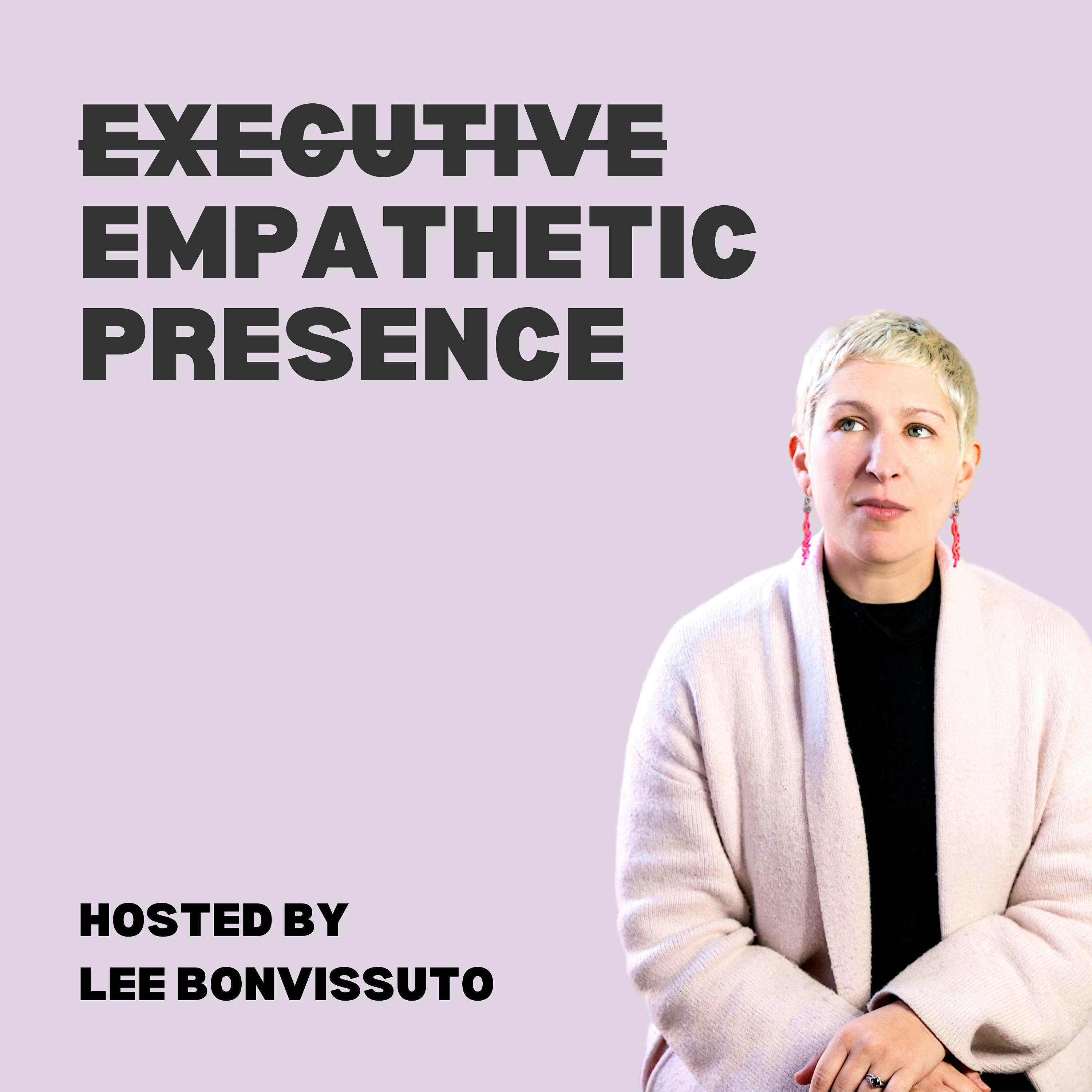
Empathetic Presence is a podcast to liberate our voices, from silencing systems, speaking anxiety, and over-thinking. We don’t need more Executive Presence. We need empathetic, present leadership more than ever. Hosted by Self-Expression Strategist Lee Bonvissuto, each episode will share tools to help us express ourselves in big moments and feature interviews with empathetic experts who are creating cultures where we can all be heard.
-
14
We Survive Through Connection with Toya Northington
I've been trying to have this conversation for over a year.Toya Northington was the very first person I wanted on this podcast. We set a date. The morning we were supposed to record, she texted me that she'd been laid off from her DEI role, one of the first waves of a pattern we've all now watched unfold across this country.We rescheduled. And I'm so glad we did, because the conversation we had this March is the one we were meant to have.Toya is an artist, social worker, and founder of Frameworks for Growth, a creative wellness practice that uses art-based experiences to help people process what they've been carrying silently, before they can even put it into words. She's also a longtime client and one of the people I admire most in this work.In this episode, we talk about what it means to build your identity around a title, and what happens when that title disappears. We talk about DE&I professionals being the advocates taken away first, about isolation feeding anxiety, about creativity as a tool for coming back to yourself, not for creating something pretty, but for your own transformation.In this conversation we talk about:What it means to rebuild your identity after a layoffCreativity as excavation, not performanceThe connection between speaking anxiety and the inability to hear your own inner voiceWhy isolation makes anxiety worse, and community is the antidoteHow grassroots movements have always been the thing that saves usWhy social work is the future of workAbout Toya Northington, MSSW:Toya Northington is an artist, social worker, and founder of Frameworks for Growth, a creative wellness practice built on the belief that creativity can help us understand our lives in ways words alone often can't. She works with people navigating seasons of change, caregiving, grief, burnout, or starting over, offering art-based experiences for reflection, expression, and reconnection. Guided by both clinical insight and lived experience, she creates space for people to process what they've been carrying silently before they can fully put it into words, strengthening their inner voice and supporting them in moving forward with clarity and intention. Her work has been featured on NPR, PBS, and Burnaway, and supported by the Kentucky Foundation for Women.Find Toya at frameworks4growth.com or on Instagram @toyaNorth.
-
13
Building a Care Society with Angelina Drake
In this moment when healthcare access feels increasingly precarious, Angelina Drake reminds us that care work is political work, and that our voices matter. A former home care worker who spent a decade working on care justice issues through long-term care policy and advocacy for nursing home and home care workers, Angelina now serves as Chief Development Officer at Protect Our Care, a healthcare policy organization working to lower healthcare costs, increase coverage, and improve health equity in the U.S.We talk about why care work is systematically undervalued, how the current political moment threatens healthcare access for millions, and what it means to build political will in your own community. Angelina shares how becoming a parent radicalized her understanding of care, why talking to each other is our most powerful tool, and how empathy can fuel—not drain—our advocacy work.Angelina Drake is a former home care worker who spent a decade working on care justice issues through long-term care policy and advocacy for nursing home and home care workers. In recent years, she focused on direct levers of political change supporting voter engagement, campaign, and other civic action research at the Analyst Institute. Angelina now serves as Chief Development Officer at Protect Our Care, a health care policy and narrative change organization that works to lower health care costs, increase health coverage, and improve health equity in the U.S. I spoke with Angelina about building the political will to improve care at a perilous moment for both health care and civic engagement.Learn more about Angelina’s work at protectourcare.org
-
12
Healing Through Ancestral Wisdom with Ssanyu Birigwa
Welcome back to Empathetic Presence. Today I'm sitting down with my dear friend Ssanyu Birigwa, a Columbia-trained narrative medicine clinician and 80th generation indigenous bone healer whose practice bridges ancestral wisdom with embodied presence.In this conversation, Ssanyu shares how deep listening creates reciprocity between ourselves and others, why taking off our masks is both necessary and sometimes unsafe, and how connecting with ancestral knowledge can help us slow down in this fast world.We explore the intersection of narrative medicine and indigenous healing practices, discuss why qualitative research matters as much as quantitative data, and examine how high-achieving individuals can access the tools within themselves to heal and accelerate beyond their wildest dreams.In This Episode:How Narrative Medicine teaches clinicians and leaders to be truly present with othersThe practice of unmasking and why safety must come firstWhat it means to be a bone healer and how this lineage guides Ssanyu's workWhy our evolution doesn't require more input—it requires wisdom about when to engage and when to simply beHow to leverage resources collectively so more of us can feel safe taking off the maskThe power of sharing lived stories as an antidote to institutional silencingSsanyu was born with healing hands—the proud descendant of Ugandan bone healers dating back more than 80 generations. Growing up between Newton, Massachusetts and East Africa, she witnessed the precision of Western medicine alongside the wisdom of ancestral healing practices that had sustained her lineage for centuries.After a health crisis left her partially paralyzed and the death of her uncle and surrogate father, she began asking the questions that would shape her life’s work: How do we listen to our bodies to understand the truth of our emotions? How do we heal physical pain by accessing the stories trapped within us? How do we bridge clinical rigor with ancestral knowing?This inquiry led her to Columbia University’s Narrative Medicine program, where she earned her master’s degree and received the 2016-2017 Narrative Medicine Fellowship. She now serves as Adjunct Professor at Columbia and lectures at Columbia Irving Medical Center on the intersection of spirituality and health.As Co-founder & CEO of Narrative Bridge, Ssanyu brings narrative medicine training to organizations seeking to integrate deep listening and embodied wisdom into leadership. She created the Pause3™ Method framework rooted in her lineage of bone healing and narrative medicine and leads the Resonance Lab, an annual practicum for leaders integrating these modalities into their own work.She has lectured and taught at institutions including the Sorbonne, Johns Hopkins, Kripalu, NYU, and led programs for the Soros Foundation in Uganda and Rwanda. She also maintains a private practice for leaders. This work is one of refinement, excavating what lives beneath burnout, disconnection, and inherited patterns to restore embodied presence and ancestral coherence.Through The Sunday Pause, her weekly newsletter, she shares contemplations on narrative medicine, ancestral healing, and what the bones already know.In Luganda, her father’s tongue, her name means “happiness, joy”—the energy she brings to this work and to the people she serves.www.ssanyubirigwa.comSubstack: @ssanyubirigwa & @resonancelab
-
11
The Power of Words with Christina Ferguson
In this episode of Empathetic Presence, I sit down with Christina Ferguson, founder and chief storyteller at Parable, to explore how words are "the primary vehicle in which we are human."Christina helps mission-driven organizations and leaders tap into their true identity—not by branding something external onto them, but by letting what's already inside come out. We dive deep into why so many of us struggle with our voices, whether written or spoken, and how we've lost the art of self-reflection in our hyper-connected world.What we explore:Why identity work must come before mission and visionHow AI is removing the essential friction from our creative processThe difference between branding (stamping something on) and authentic expression (letting what's in come out)How organizations can stay true to their values in challenging momentsPractical ways to develop self-knowing through reflection and spaciousnessChristina shares her process of helping clients excavate their mission through questions rather than quick fixes, and why she believes "the process is the point."This conversation will resonate with anyone who wants to express themselves more authentically—whether you're leading an organization or just trying to find your own voice in a noisy world.Christina is a storyteller and meaning-maker. As the Founder and Chief Storyteller at Parable, she empowers leaders to put fresh, compelling words to who they are, where they're headed, and how they'll get there. Christina's expertise in communications, strategy, sales, and change management makes her a powerful partner for leaders and teams looking to scale more authentically. Christina has held positions in both the for-profit and nonprofit sectors, including nonprofit fundraising firm Graham-Pelton, Georgetown University, and Ashoka. Christina holds a Bachelor of Science in Finance from Villanova University and a Master of Public Policy from Georgetown University. She is a graduate of the Leading Organizational Change program through Wharton Executive Education at the University of Pennsylvania.Learn more about ParableConnect with ChristinaRead Superbloom by Nicholas Carr
-
10
Finding Hope Through Gratitude with Abigail Somma
In times of rising authoritarianism and social upheaval, how do we find hope without falling into toxic positivity? This week, I sit down with my dear friend Abigail Somma, founder of Gratitude Buddies and mindfulness teacher, to explore gratitude as a tool for resistance and refocusing.Abbie taught me about loving-kindness meditation nearly a decade ago, and her approach to gratitude as a practice—not just a feeling—completely shifted how I understand presence and self-compassion.In this conversation, we explore:Why gratitude becomes accessible in moments of crisis (and why it's harder during prolonged depression)How to practice loving-kindness toward people who disagree with usThe difference between empathy and toxic positivityHow workplace gratitude has evolved from transaction to inner wellness—and what comes nextGratitude Buddies: a platform for skill-sharing and community building beyond traditional capitalismWhy we need "compassionate wise action" instead of judgmentUsing gratitude as a refocusing tool in moments of conflictAbigail Somma (Abbie) is the founder of Gratitude Buddies, a platform where people swap small joys and meaningful skills. She has coached and trained hundreds of people in mindfulness, gratitude and emotional wellbeing, and delivered workshops to international organizations, businesses, and leading universities. Previously, she worked in international policy as a speechwriter for business leaders, celebrities and multiple United Nations figureheads. Her writing has appeared in Scary Mommy, Foreign Policy, the Globe and Mail and others. She is also a poet and playwright, with degrees from Johns Hopkins University and Villanova University. Abbie lives in Vienna with her two children. Learn more at gratitudebuddies.com and abigailsomma.com.Timestamps:0:00 Introduction and how we met through Priya Parker3:00 Gratitude vs. toxic positivity8:00 Is gratitude innate or learned?11:00 Practicing loving-kindness toward difficult people15:00 Finding balance between empathy and effectiveness17:00 What is Gratitude Buddies?23:00 Europe vs. US: different responses to social regression28:00 Technology, AI, and staying human33:00 How to stay grounded in uncertain times
-
9
Why Visionaries Matter with Sehreen Noor Ali
Sehreen Noor Ali came on the podcast, and she shifted how I think about the word "visionary" forever. Turns out, way more of us are visionaries than we might believe.Sehreen runs Te Cura Labs where she helps leaders think about strategic visibility. But what I love about her is how she sees the world with both curiosity and empathy. Every time I sit down with her, I leave completely shifted.In this conversation, Sehreen talks about influence as "the marriage of inner clarity and external resonance"—which finally makes this loaded word feel tangible instead of manipulative.I especially loved our conversation about radicals versus diplomats. How some of us agitate by working within systems, others by standing outside them, and how we desperately need both right now.We also dove into:Why the gap between how others see us and how we see ourselves is so painfulThe cost of showing up authentically (and how to navigate it)Why knowing the playbook first actually helps you agitate betterHow AI is asking us fundamental questions about what it means to be humanWhy claiming your spot and putting down roots is the key to personal brandThis conversation reminded me that you don't have to be on a TED stage to be a visionary. You just need to see the world differently in a way that others need to understand.About Sehreen: Sehreen Noor Ali is the founder of Te Cura Labs, where she works with experienced leaders to turn hard-earned insight into clear, strategic visibility. After years spent building startups and working across government and tech, she now helps launch modern leaders into their next chapter—those looking to deepen their influence through resonance, not performance.Before Te Cura, Sehreen co-founded Sleuth, a pediatric AI company shaped by her journey navigating her daughter’s rare diagnosis. By gathering over 60,000 caregiver-contributed health stories, Sleuth surfaced patterns often missed by clinical systems and was recognized by Fast Company as a World-Changing Idea in 2024. The experience cemented her belief that AI and care—separately and together—can transform systems when surfaced with thoughtfulness and intention.Earlier in her career, Sehreen served at the U.S. Department of State, where she helped build its first Persian-language digital platforms. She later took on leadership roles in edtech and equity-focused networks, served as an Entrepreneur-in-Residence at Brown University, and leads VC-Backed Moms NYC.Through Te Cura, Sehreen brings care and clarity to the work of visibility—helping leaders show up fully and intentionally in an AI-saturated world, with depth that’s never diluted for optics and always aligned with ambitious impact.For more information about Sehreen's work, visit www.tecuralabs.com.
-
8
Bending Tools Towards Justice with Deepti Sharma
I sat down with entrepreneur, strategist, and community builder Deepti Sharma to explore what entrepreneurs can learn from organizers. From building FoodtoEat—a mission-driven platform that helped immigrant and underrepresented food vendors grow—to running for New York City Council and teaching the next generation of entrepreneurs, Deepti shares her journey of bending tools towards justice and creating opportunities for those who are systematically overlooked.As a daughter of immigrants and a New Yorker through and through, Deepti brings a unique perspective on collective action, community organizing, and how we can rebuild with care at the center during these exhausting times.Learn more about Deepti: https://www.deeptisharma.com/Timestamps00:00 Introduction and Deepti's multihyphenate identity02:00 Growing up in Queens and early community service05:00 From politics to starting FoodtoEat09:00 Why entrepreneurship keeps calling14:00 What entrepreneurs can learn from organizers21:00 How capitalism can be bent towards justice23:00 The line between entrepreneurship and politics26:00 Running for office and learning from constituents32:00 Bending tools towards justice in unjust times37:00 Dealing with exhaustion and rebuilding with care
-
7
Empathetic Practice with S. Leigh Thompson
In this timely conversation, I sit down with S. Leigh Thompson—a published and award-winning organizer, strategist, professional coach, and organizational development consultant who has spent over 20 years helping organizations and leaders "Do Good Work—BETTER." Leigh brings a unique perspective to transformation work, having guided everyone from Fortune 500 companies to grassroots organizations through strategic change that builds stronger, more cohesive cultures.We explore how empathy becomes a strategic tool for creating lasting change, why creativity is essential for transformation, and how empathetic practice can break us out of binary thinking to build truly inclusive cultures.Leigh shares insights from working with thousands of organizers, educators, and advocates worldwide—including at organizations like the ACLU, GLSEN, and Race Forward—on leadership development, movement strategy, and adaptive leadership.Leigh's approach is rooted in critical analysis, meaningful relationships, creative problem-solving, and transformative change. Their impressive client roster spans values-driven organizations, Fortune 500 companies, creative and cultural institutions, and leading educational institutions. With over 25 years of experience as a Theater of the Oppressed practitioner, Leigh specializes in supporting complex dialogue and learning through emergent, participatory facilitation that incorporates interactive and embodied engagement while fostering growth, movement, and joy in the workplace.Leigh holds an Individualized MA from NYU Gallatin, with coursework on change theory, community studies, nonprofit management, public policy, and campaign strategies.Links:sleighthompson.comlinkedin.com/in/sleighthompsoninstagram.com/sleighthompson00:00 Introduction to S. Leigh's work01:00 Theater of the Oppressed methodology04:00 Art and creativity in organizational change07:00 Moving beyond binary thinking09:00 Defining empathetic practice15:00 Individual vs. organizational empathy work18:00 How equity fits with empathetic presence24:00 Can you have equity without empathy?26:00 Building equitable movements and accountability35:00 Why we all need this work
-
6
Moving Our World Forward with Chana Ginelle Ewing
In this episode of Empathetic Presence, I sit down with Chana Ginelle Ewing, a storyteller, cultural entrepreneur, and Founder & Chief Creator at littlebigworld. We dive deep into how queer imagination and care-centered politics can inform strategic marketing to move our world forward.This conversation is personally meaningful during Pride month, as queer lives continue to be under attack. Chana shares how we can understand our identities as sources of power rather than limitations, and why bringing our whole selves to our work creates more authentic and effective leadership.Links & ResourcesConnect with Chana at littlebigworldLearn more about my work at PresentVoices.com
-
5
Reclaiming Empathy as a Revolutionary Act with Nicole Bauman
With so much dividing us right now, what if conflict could actually deepen our connections rather than tear us apart? I sit down with conflict facilitator and transformative justice practitioner Nicole Bauman to explore how empathy is not a weakness but a revolutionary tool for liberation.Nicole shares their journey from conflict avoidance to seeing conflict as an opportunity for growth, revealing how self-empathy becomes the foundation for navigating even the most challenging conversations. Together, we explore why empathy has been "stolen from us" by systems of domination, how we can reclaim our capacity to feel as an act of decolonization, and practical ways to stay grounded in our humanity even when the world feels overwhelming.My conversation with Nicole brought up both tender vulnerability and fierce wisdom if you are seeking to transform your relationship with conflict, in your community, workplace, or in movements for justice.We discuss:Self-empathy as the starting point for all conflict navigationThe weaponization of empathy and why disconnection serves power structuresSomatic practices for building safety and capacity in difficult conversationsMoving beyond binary thinking in a polarized worldPractical tools for staying embodied during conflictThe connection between personal healing and collective liberationAbout Nicole Bauman:Nicole is a facilitator working at the intersections of transformative justice, somatics, and nonviolent communication. They see building conflict resiliency as essential for the world to come and are passionate about creating spaces where personal and collective liberation feel possible.Links from Nicole:Learn more about their work at https://www.nicolebauman.comFree Assessments for Queer Folks during the month of JuneLearn more about Nicole’s one-on-one work hereNavigating Conflict: Building Resilience for Your Working RelationshipsNavigating Feedback: Deepening Collaboration in the Conversations We NeedUnraveling Whiteness: An Introduction to Embodied Antiracist PracticesWeaving New RitualTimestamps:[00:00] Introduction and Nicole's current work[02:00] How Nicole uses their voice and shows up in the world[06:00] Defining empathy and its role in conflict[10:00] Rethinking conflict as opportunity rather than threat[14:00] Cultivating safety in unsafe situations[18:00] Is empathy learned or stolen from us?[22:00] Empathy in corporate and dominating environments[26:00] Nicole's offerings and upcoming programs[31:00] Self-care and community care practices
-
4
Presence Not Perfection: Getting Out of Your Head and Into The Present Moment
In this episode of Empathetic Presence, I explore something that's helped my anxiety - how to find the present moment and return to it when we inevitably get lost in thought again.It's particularly challenging to be present right now. With the constant news cycle and daily overwhelm many of us experience, it's natural to slip into hyper-vigilance. Focusing on presence rather than perfection has been transformative for my confidence and reducing anxiety.I share my personal journey from being trapped in an endless cycle of anxiety to finding liberation through presence. For years, I experienced debilitating panic attacks that would send me to the emergency room convinced I was having heart attacks. Over a decade ago, I made a commitment to address my anxiety holistically, which became the foundation for the work I do today.In this episode, I discuss:How I define presence as "getting out of my head and into my body"The scientific connection between the vagus nerve and our "gut brain"Practical techniques I use daily to return to the present momentA guided practice for anchoring to sound that we can experience togetherThe importance of self-compassion when practicing presenceI would love to hear what helps you find presence and what presence means in your life. Please share your thoughts at [email protected] you'd like to practice presence with me directly, I host a complimentary live workshop via Zoom where we work on these techniques together. You can register at presentvoices.com/collective.Wishing you presence, not perfection. 00:00 Introduction to Empathetic Presence00:53 The Struggle with Anxiety and the Journey to Presence03:04 Understanding and Practicing Presence04:04 The Role of the Vagus Nerve and Gut Brain06:02 Practical Tools for Finding the Present Moment08:17 The Importance of Being Over Doing08:41 Guided Practice: Anchoring to Sound10:01 Managing Expectations and Using Tools to Stay Present13:38 Conclusion and Invitation to Connect
-
3
Redefining Leadership With Christina Blacken: Harnessing Narrative for Collective Change
In this episode of Empathetic Presence, I sit down with Christina Blacken, founder of The New Quo, to explore what leadership really means and how more of us can see ourselves as leaders. Christina talks about how storytelling and narrative shape our behaviors and leadership styles - something she's passionate about in her work. We dive into how true leadership isn't just about being in charge, but about influencing people toward goals that benefit everyone.Christina shares some powerful insights about navigating leadership challenges, bringing ethical and cultural wisdom into our decision-making, and how each of us can step into leadership in our everyday lives. What I love about our conversation is how Christina balances pragmatic optimism with the importance of collective action - reminding us that meaningful change rarely happens through individual efforts. If you're looking to expand your definition of leadership and find your own authentic way to lead, this episode is for you!Visit Christina's website: https://www.thenewquo.com/Learn about her learning community: https://courses.thenewquo.com/products/communities/tnqcommunity Want to experience Empathetic Presence in action? Join my free monthly workshop and learn tools to express yourself in every setting. Register here. 00:00 Introduction and Today's Topic00:29 Meet Christina Blacken01:44 The Power of Narrative in Leadership02:43 Redefining Leadership05:52 Understanding Narrative Intelligence11:17 Pragmatic Optimism and Collective Leadership20:54 Ethical and Cultural Wisdom24:40 Engaging with Christina's Work27:53 Conclusion and Farewell
-
2
Reject Executive Presence: Empathy is Your Strength
In this episode, I explore what's truly holding us back from speaking with confidence and introduce a powerful alternative to "executive presence" that can transform how we show up in our most important moments.What You'll Learn:The shocking data: 88-90% of professionals struggle speaking in high-pressure situationsWhy physical and psychological distractions during communication aren't personal failingsHow "executive presence" actually makes us less present and less confidentThe three components of Empathetic Presence: embodied confidence, harnessed empathy, and owned expertiseI've spent a decade collecting data from corporate workshops across nearly every industry, and the pattern is clear: dominant, disconnected leadership isn't helping people speak up. Even at a recent Google Developers event, only 12% of 500 engineers felt comfortable speaking in front of senior leaders.Empathetic Presence offers a different path. Instead of overthinking how we're perceived, we can focus on being fully embodied, leveraging our natural empathy as a strength, and owning our unique expertise - even if we're junior or new to our roles.I'm curious: What do you want to liberate your voice from? And how would you use your voice if you felt fully confident in every setting?Join me next time as we hear from empathetic leaders who are using their voices for impact.Want to experience Empathetic Presence in action? Join my free monthly workshop and learn tools to express yourself in every setting. Register here. 00:00 Introduction to Empathetic Presence 00:21 Understanding Speaking Anxiety 00:32 The Importance of Empathy in Leadership 00:52 Challenging Executive Presence 01:22 About the Host: Lee Bonvissuto 01:57 Data on Speaking Confidence 03:36 Physical and Emotional Distractions 05:09 Systemic and Situational Factors 06:27 Rejecting Executive Presence 07:27 Embracing Empathetic Presence 08:47 Harnessing Empathy and Expertise 11:32 Conclusion and Call to Action
-
1
Introducing Empathetic Presence: Liberating Our Voices
In this inaugural episode, I introduce the mission behind Empathetic Presence: creating a world where all voices are heard, especially those that have been systematically silenced.What You'll Learn:Why "executive presence" needs to be rejected in favor of authentic, empathetic leadershipHow overthinking and people-pleasing disconnect us from our natural communication abilitiesWhy empathy combined with expertise makes you an unstoppable leaderI believe we don't need to "find our voices" - they're already ours. What we need are cultures where we feel safe enough to use them. When you're comfortable, your confidence naturally emerges. When you're anxious about how you're being perceived, your attention splinters and your voice suffers.Throughout this podcast journey, I'll share practical tools to help you speak up even when afraid, and I'll interview empathetic experts who are creating cultures where everyone can be heard.Have a topic suggestion or know someone I should interview? Email me at [email protected]: Your voice matters. Your empathy is your strength. And together, we can create the leadership our world desperately needs right now.Want to experience Empathetic Presence in action? Join my free monthly practice lab and learn tools to express yourself in every setting. Register here.Learn about Lee’s work here. 00:00 Introduction to Empathetic Presence00:29 The Problem with Toxic Cultures01:19 Rejecting Executive Presence01:29 Embracing Empathy and Connection02:15 The Need for Empathetic Leadership03:05 Empathy as a Strength03:16 Conclusion and Call to Action
No matches for "" in this podcast's transcripts.
No topics indexed yet for this podcast.
Loading reviews...
ABOUT THIS SHOW
Empathetic Presence is a podcast to liberate our voices, from silencing systems, speaking anxiety, and over-thinking. We don’t need more Executive Presence. We need empathetic, present leadership more than ever. Hosted by Self-Expression Strategist Lee Bonvissuto, each episode will share tools to help us express ourselves in big moments and feature interviews with empathetic experts who are creating cultures where we can all be heard.
HOSTED BY
Lee Bonvissuto
Loading similar podcasts...
URL copied to clipboard!