
PODCAST · arts
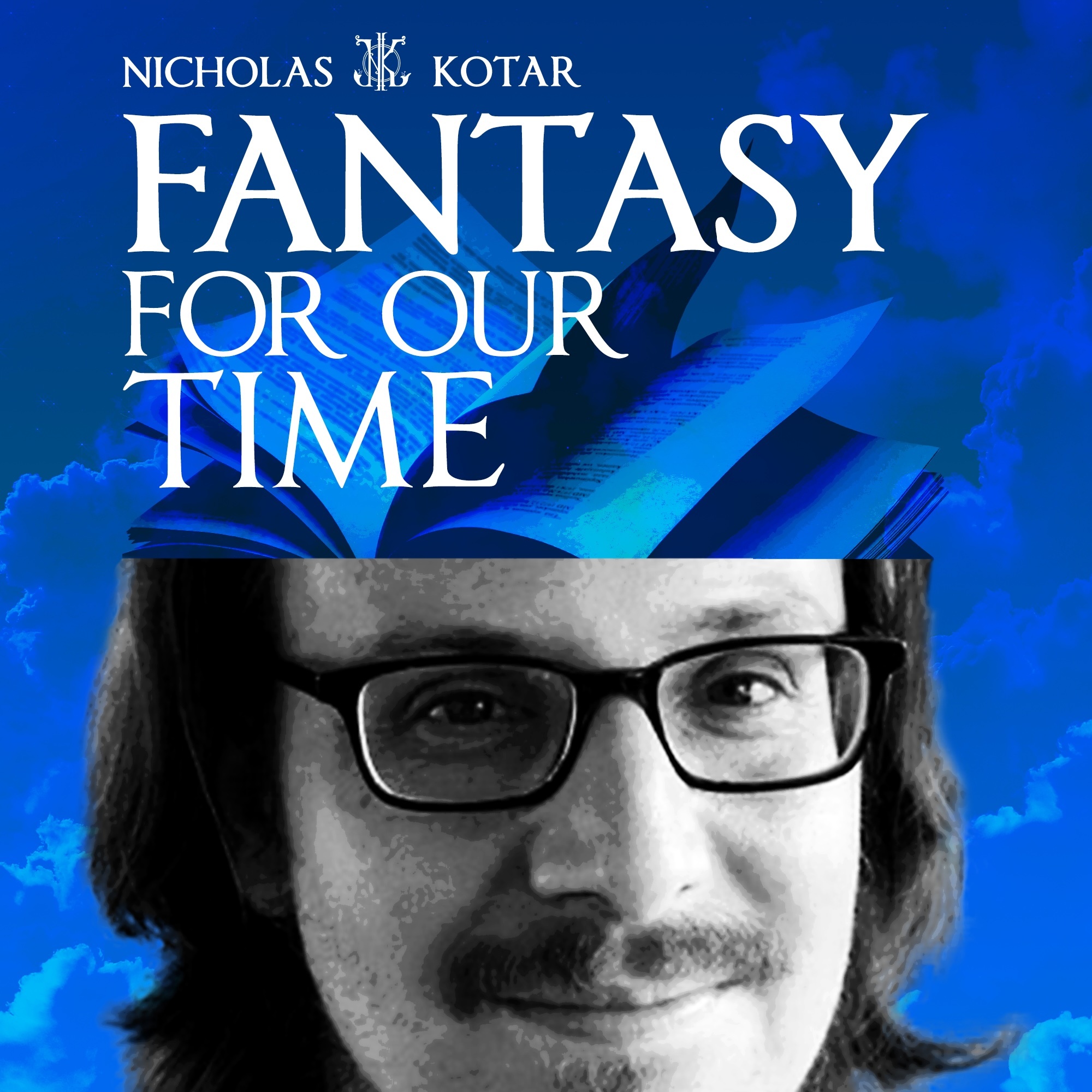
Fantasy For Our Time
by Nicholas Kotar
Fantasy stories have inspired readers for centuries, making them think and feel deeply, and offering them glimpses of the magical in mundane reality. Join fantasy author and storyteller Nicholas Kotar as he explores classic and new fantasy media, talks to fantasy authors and storytellers, and explores how these stories can help us all live a better, more fulfilling life.
-
42
The Unwitting Theology of Warhammer 40k
Behold, mortals and mech-fanatics! Welcome to the very first episode of our theological deep-dive into the grimdark future where there is only war... and apparently, a surprising amount of sacramental symbolism. 🕊️⚔️ In this gloriously over-caffeinated conversation, I (underdressed but spiritually overdressed) sit down with the ever-eloquent Father Deacon Seraphim to unravel the soul of Warhammer 40K — and maybe, just maybe, find a little grace in a galaxy on fire. We talk Orthodoxy, Horus Heresy, metaphysical mech lore, the martyrdom of the last priest on Terra, and how wargaming is actually a form of liturgical drama (I said what I said). Some say Warhammer is just space fascism with skulls. We say: it's an accidental cathedral, built by atheist Britons, that somehow describes actual spiritual awakening better than most Christian fiction. Yes, there are beards. Yes, there is laughter. Yes, there are Necrons, Imperial Knights, and a barn full of Orthodox dads praying compline before throwing dice. This is not a drill. This is Warhammer meets theosis. This is… whatever this is. You're welcome. ⏰ Timestamps: 00:00 The Geeky Deacons? A Bearded Beginning 02:00 First Contact with Warhammer via Flight of the Eisenstein 06:00 The Warhammer Store is a Personality Test (Seriously) 11:00 Orthodox Wargaming & Praying Before Battle 15:00 Narrative Roleplaying as Theology Practice 20:00 A Living Sector Map, Custom Code, and Warp-Fueled Strategy 26:00 Horus Heresy: A Story Written by a Council of Atheist Prophets? 31:00 Worship is Inevitable (And the Monsters Know It) 36:00 From Satire to Shakespeare: The Aesthetic Power of Warhammer 41:00 Theology of Awakening: From Empirical Truth to Divine Encounter 48:00 The Emperor vs. The Last Priest: A Hidden Martyrdom 54:00 Is the Emperor… Jesus? Saint George? The Antichrist? 59:00 The Divine in Warhammer: Still, Small Voices Amid Chainswords 1:04:00 The Rise of Living Saints & Involuntary Miracles 1:10:00 Why This British Atheist Setting Might Be Weirdly Orthodox 1:17:00 Wrapping Up: Pratchett, Tolkien, and a Cathedral in the Grimdark
-
41
Grimdark & the Godless Wheel: A Reflection on Abercrombie’s First Law
In this special (and long-promised) episode of Fantasy for Our Time, I dive helmet-first into the final installment of Joe Abercrombie’s First Law Trilogy—a.k.a. the Holy Scripture of Grimdark™ (depending who you ask). I wrestle with berserkers, battle ideologies, and gently poke the gnarled problem of evil with a theological stick. 🛡️ What is Grimdark really saying about human nature? 🎭 Can fantasy fiction offer consolation—or only cynicism? ⚖️ What happens when the divine is deleted from the narrative framework? We talk Logan Ninefingers, the Bastard King (whose name totally escaped me mid-video), and the ever-smirking torturer Sand dan Glokta. But we also unpack deeper themes: spiritual fragmentation, Orthodox Christian views on evil, and whether fantasy has lost the mythic courage to hope. 💬 Expect musings, a bit of rambling (forgive me—I hadn’t had coffee!), and sincere reflections on storytelling, suffering, and the wheel of despair that modern fantasy often rides without brakes. ⏰ Timestamps: 00:00 Intro & Life Update 01:30 Context: Grimdark, Joe Abercrombie, and First Law Trilogy 03:00 The Third Book: Final Reactions and Character Depth 04:30 The Northern War & Logan’s Inner Demon 06:00 Possession, Evil, and Fragmented Identity 08:30 Trial by Combat & Theological Implications 10:00 Evil as Lack: Orthodox and Philosophical Framing 17:00 Myths After Christ: The Hero's Journey vs. Grimdark 20:00 Characters as Pawns: Torturers, Kings & Cowards 25:00 No Catharsis, Just the Wheel: The End of Grimdark 29:00 What’s Next: Warhammer, Narnia & Summer Plans
-
40
How I’m Building the Next Inklings | Fantasy Publishing Behind the Scenes
Greetings, fellow fantasy fanatics and lore lovers! 🧙♂️✨ Ever wondered what happens behind the mystical curtain of indie fantasy publishing? In this rare “Craftsman’s Workshop” livestream, I reveal all the spellbinding chaos of my publishing plans for 2025 and beyond—straight from my candle-lit scriptorium (okay, maybe just my desk, but still magical). From delays with Cantos of Arcadia (curse you, structural edits!) to revealing stunning new cover art, launching Wood Between Worlds Press, and spilling the enchanted ink on my top-secret author coaching program, this video is jam-packed with writerly wizardry, publishing potions, and more than a few epic announcements. I’m also giving you a sneak peek at the illustrated Raven Son omnibus, new illustrators, Kickstarter plans, and a secret leatherbound edition that’ll make any collector swoon. If you’re an aspiring author, seasoned storyteller, or just love the backstage drama of fantasy lit, pull up a chair. This one’s for you. 🛡️📜 ⏳ Timestamps 0:00 – Welcome to the Workshop: The Madness Returns 1:45 – What’s Up with Cantos of Arcadia? Delay Update 4:22 – Introducing Wood Between Worlds Publishing 6:15 – Our First Authors Revealed 9:01 – Cover Art Magic: Goodbye Stuart, Hello Patrick Knowles 12:30 – The Mission Behind Phase One Publishing 15:48 – Phase Two and the St. Basil’s Writers Pipeline 18:33 – Epic Editions, Kickstarter Collectibles, and The Raven Son Omnibus 20:10 – Illustrators, Leatherbound Legends, and New Publishing Dates 22:00 – Secret Author Coaching Program: Indie Publishing from Zero to Hero 24:10 – Final Teases & What’s Coming Next (Including… Grimdark!)
-
39
What If Aliens Were Catholic? w/ M.R. Leonard
Imagine this: Catholic aliens show up on Earth, but instead of demanding our surrender, they want to set up a Mass. Yep, you heard that right. In today’s conversation, I sit down with debut author M.R. Leonard, the brilliant mind behind Pilgrims, a sci-fi novel that reimagines St. Augustine’s Confessions with aliens, interstellar drama, and a hearty dose of existential wonder. We dive into Michael’s journey from corporate law to creative writing, discuss the audacious concept of Catholic aliens, and unpack the philosophical depth and humor baked into his fast-paced thriller. From world religions to the meaning of life in the galaxy, this discussion is out of this world. Literally. ⏰ Timestamps: 0:00 – Welcome & Intro: Forks in the road—Star Trek or spirituality? 5:32 – Reading slumps & finding Pilgrims: A fresh narrative twist. 12:45 – Meet M.R. Leonard: From Boston College to self-published stardom. 18:12 – China, MBA life, and the big creative pivot. 25:10 – Catholic aliens?! The genesis of a groundbreaking premise. 35:47 – Virgil, Augustine, and writing the perfect “airport thriller.” 42:00 – Alien theology: Sacraments in space? 50:15 – The sci-fi genre’s future—grounded yet limitless.
-
38
Consolation of Grimdark: Why This Failed Quest Was More Satisfying Than Victory
Today, we embark on a perilous journey into the world of Grimdark fantasy, where heroes are fools, victories are tragic, and morality is as murky as a tavern’s back alley. After years of avoiding the genre, I finally took the plunge and read Joe Abercrombie’s Before They Are Hanged—the second book in The First Law trilogy. And what did I discover? A failed quest that somehow became one of the most unexpectedly profound fantasy narratives I’ve encountered. Why do we need failed quest narratives? How do they console us in a world obsessed with relentless achievement? And what does this mean for epic fantasy, The Hero’s Journey, and even my own book, The Song of the Sirin? Let’s discuss. ⏰ Timestamps: 0:00 – Welcome to the Studio: My Grimdark Adventure Continues 2:15 – Why I Avoided Grimdark for So Long 4:38 – Before They Are Hanged and the Quest That (Gloriously) Failed 8:22 – Giselle Dan Luthor: A Fool’s Journey to Something Like Wisdom 12:47 – The Unexpected Consolation of Grimdark 17:02 – Lord of the Rings as a Failed Quest (And Why That’s Brilliant) 20:10 – My Own Novel’s Failed Quest and Why It Matters 22:01 – Final Thoughts & What’s Next in the Grimdark Discussion
-
37
Cinema as Sacred Art: Why Tolkien’s World Needs Wes Anderson’s Touch w/ Reno Lauro
🎥 Ever wondered if The Lord of the Rings could feel both quirky and profound? Could Wes Anderson bring Tolkien’s world to life with meticulously composed shots, nostalgic hues, and objects that practically whisper stories of their own? In this week’s deep dive, I sit down with Reno Lauro—a cinephile, scholar, and someone who’s worked with none other than Terrence Malick—to explore the fascinating intersections of cinema, philosophy, and myth. From the roots of medieval optics to the philosophy of film as a thinking medium, Reno opens up a treasure trove of ideas. Together, we dive into The Tree of Life, Tarkovsky, and how cinema, at its best, isn’t just a spectacle but a profound exploration of being itself. 🌌 Along the way, we ask: What could Wes Anderson bring to The Lord of the Rings that Peter Jackson missed? Spoiler alert: Bright colors, stillness, and an aesthetic Tolkien himself may have approved of. Join us as we discuss: 🎞️ Why Wes Anderson’s approach might feel oddly at home in Middle-earth 🎭 The magic of minimalism in storytelling ✨ How the mechanical art of cinema bridges the real and the symbolic 👀 And yes, why Tarkovsky and popcorn cinema might be two sides of the same existential coin ⏰ Timestamps: 0:00 – Welcome to the deep magic of the basement 🪄 3:15 – Reno Lauro introduces himself: From Tolkien scholar to Terrence Malick collaborator ✍️ 8:45 – The roots of cinema in medieval optics and philosophy 🌟 15:10 – Verisimilitude vs. symbolic depth: What cinema really does best 🎨 22:30 – Robert Bresson and the minimalist philosophy of “thinking films” 🤔 30:20 – Wes Anderson, Tolkien, and the aesthetics of bright, mythic storytelling 37:50 – Objects that speak: How Tolkien’s world and Anderson’s style align 🔮 44:15 – Violence as interruption: Anderson’s unexpected narrative depth ⚔️ 50:30 – Could VR or AR revolutionize cinematic storytelling? 🥽 54:10 – Closing thoughts: Cinema as sacred and why it matters 🙌
-
36
A Dune Deep Dive w/ Richard Rohlin : Paul Atreides, Duncan Idaho, and Hollywood’s Religious Problem
At the time of this recording, it was my birthday, and - in true Hobbit fashion - I'm giving YOU the gift of diving into the vast deserts of Dune with the always insightful Richard Rohlin! In this impromptu episode, we’re unpacking Denis Villeneuve’s Dune films—praising the awe-inspiring visuals, iconic performances, and meticulous attention to detail in part one while grappling with the pacing, missing lore, and religious undertones in part two. From the pulse-pounding shield fighting to the enigma of spice and its place in Frank Herbert’s epic world-building, we tackle it all. We discuss Paul Atreides' journey, the complexities of messianic archetypes, and whether Dune truly captures Herbert’s layered philosophical and ecological themes—or if Hollywood just can’t do religion justice. Plus, there’s plenty of nerdery, from Warhammer 40K parallels to pondering the real Kwisatz Haderach (hint: Duncan Idaho fans, this one's for you). 📚 Whether you’re a hardcore fan of the Dune books, a movie buff, or just here for the spicy debates, this episode is a mix of thoughtful critique, playful banter, and celebratory vibes. So, grab your stillsuit and some spice coffee, and join us for this cinematic deep dive into Arrakis, its worms, and its warriors. ⏰ Timestamps: 0:00 – Intro & Birthday Announcement 🎉 2:45 – Why Dune: Part One was a transcendent cinematic experience 🌌 6:50 – The brilliance of Denis Villeneuve’s world-building 🏜️ 10:25 – Standout moments: shields, sandworms, and stellar sound design 🎶 16:10 – The complexities of Paul Atreides as a messianic figure ✝️ 22:30 – The Fremen’s ecological dilemma: water, spice, and survival 💧 30:45 – Dune: Part Two struggles: pacing, missing lore, and Stilgar’s arc 🎭 37:00 – Hollywood’s problem with portraying religion authentically 🙏 42:20 – Is Duncan Idaho the real Kwisatz Haderach? 🤔 46:35 – Final thoughts: the need for a director’s cut and Dune Messiah rumors 🎥 49:10 – Upcoming projects: Andor, fantasy literature courses, and more 📚
-
35
Surviving the Dark Forest: Lessons from Liu Cixin's Sci-Fi Masterpiece
What if the universe isn’t just vast and indifferent but actively hostile—a cosmic battlefield where silence is survival? Welcome, friends, to an exploration of The Dark Forest, the second volume in Liu Cixin’s masterful Three-Body Problem series. 🌠 In this episode, we journey into a future where humanity faces an alien threat so advanced they can intercept every communication—except our thoughts. Enter the Wallfacers, an elite group tasked with devising strategies in absolute secrecy. Sounds hopeful, right? Well, it’s complicated. 😬 We’ll unravel the chilling “Dark Forest Theory,” which reimagines the cosmos as a predator’s den where every signal is a death sentence, and explore the moral and existential dilemmas of survival in such a world. What happens when trust, love, and community collide with the cold logic of cosmic sociology? And does the series leave room for hope—or is this truly the bleakest vision of a post-human future? Grab a drink and let’s dive into the dark. ☕️
-
34
Inside the Kotarverse: Slow Productivity & Stories Worth Dying For
This is a special repost of one of my Craftsman’s Workshop Patreon streams, where I dive deep into a pivotal question: What makes a story truly life-giving? 🌱 Join me as I open up about how storytelling keeps us grounded, and share thoughts on what it means to build a meaningful creative life amidst a chaotic world. We cover everything from my evolving Patreon tiers (and why I shifted them) to my journey through Cal Newport’s Slow Productivity and how it’s reshaping my approach to writing, storytelling, and community. 📚✨ In this episode, I also reveal exciting plans for 2025, including the triumphant return of the Fantasy For Our Time podcast, new short stories through mentorship with celebrated author Kristine Kathryn Rusch, and a revitalized approach to the Patreon community. And, of course, a huge thanks to all of you who keep this journey alive. 🙏 Timestamps: 00:00 - Opening Remarks: What Makes a Story Life-Giving? 02:15 - Patreon Changes and a New Direction 05:30 - The Influence of Cal Newport’s Slow Productivity 08:45 - The Challenges of Creative Work and Family Life 12:00 - Introducing the Concept of a Deep Life 15:20 - Finding Purpose in Storytelling 18:40 - Rediscovering Focus and Quality in Creativity 22:00 - The Most Important Question: What Story Would You Die For? 25:30 - Update on the Podcast and Upcoming Themes 29:15 - Short Fiction Mentorship with Kristine Kathryn Rusch" 32:40 - Recommitting to Writing and Upcoming Works 36:10 - Cantos of Arcadia and the Future of Fantasy Sci-Fi 39:50 - The Revival of In A Certain Land Podcast 43:00 - Final Reflections
-
33
Cantos of Arcadia: Crafting America’s Post-Apocalyptic Myth
🔥 Imagine America’s collapse into myth. Today, we’re exploring “Cantos of Arcadia”—my sci-fi project that merges epic story, future-archaeology, and existential dread. This is the story behind the story, the uncharted process of weaving America’s “what if” into a future epic that merges apocalyptic ruin with ancient myth. Expect discussions on myth, storytelling’s power, and crafting worlds through sound, faith, and speculative history. Whether you’re a sci-fi fan, a storyteller, or just curious, prepare for the resonance between the old and the eerily possible. ⏰ Timestamps: 0:01 – Can a future civilization survive through story? A mythic retelling of a crumbling world 🌍 3:14 – How a composer’s commission and the Akathist prayer inspired a sci-fi novella about American mythology 🎶 12:45 – Translating faith, collapse, and survival into post-apocalyptic legend 🌌 22:30 – The weaving of America’s fractured past into an Arcadian future
-
32
Canon in Sci-Fi? The Case for Shards of Honor and The Vorkosigan Saga 📚
Join me as I dive into Shards of Honor, the first book in The Vorkosigan Saga by Lois McMaster Bujold! 🚀💫 From the depths of autocratic heroism to the ideals of speculative fiction, we'll explore it all: grimdark versus high fantasy ⚔️, reflections on repressive political systems 🛡️, and the intrigue of intergalactic escapades 🌌. If you’ve ever wondered about the possibility of a speculative fiction canon 📚 (yes, I’m serious), you’re in the right place! Stick around as I delve into characters who battle both societal expectations and personal demons, exploring everything from political dilemmas to daring prison escapes in a sci-fi romance setting. Don’t forget to check out my ongoing journey on The Wood Between Worlds Substack for all things speculative! 🌲✨ https://thewoodbetweentheworlds.substack.com/ Timestamps: 0:00 – 🔥 Intro to The Vorkosigan Saga and a speculative fiction canon 2:15 – 🎬 Why start with Shards of Honor? 5:35 – 💖 Sci-fi romance, plot, and initial impressions 9:25 – 🛡️ What defines heroism in a repressive society? 14:50 – ⚖️ Comparing autocratic and democratic extremes 20:15 – 🌐 Political parallels: Barrayar and our world today 24:05 – 🤝 Characters’ personal journeys and political alliances 28:30 – 📖 Key scenes: Violence, heroism, and implications for honor 35:10 – ⭐ Final thoughts: How fiction shapes our view of reality
-
31
Adrian Tchaikovsky on Giant Spiders, Sci-Fi, and the Unexpected Success of Children of Time
Welcome, fellow book lovers and sci-fi enthusiasts! In this video, I have the absolute pleasure of chatting with none other than Adrian Tchaikovsky—an international sensation and the brilliant mind behind Children of Time. This conversation is a treat as we dive into Adrian’s creative journey, his love for speculative fiction, and, of course, how a weird book about giant space spiders launched his entire career! From his science background to his fascination with spider evolution (yes, really!), Adrian shares how Children of Time almost didn’t see the light of day, but then skyrocketed to success, winning awards and readers' hearts alike. 🕷️ We also explore his thoughts on fantasy vs. sci-fi, why humor makes Grimdark more digestible, and what it’s like writing deeply relatable characters in the most epic of universes. Whether you’re an arachnophobe or an avid sci-fi reader, this conversation is packed with insights, laughter, and Tchaikovsky’s trademark brilliance. Come along as we talk about writing, world-building, and why you should always root for the spiders. 😉 Timestamps: 0:00 How Giant Spiders Launched Adrian Tchaikovsky’s Career 5:30 Children of Time and Why It Took a Year to Get Noticed 15:00 Fantasy vs. Sci-Fi: Adrian’s Unique Approach 25:20 Humor in Grimdark and What It Adds to Complex Worlds 35:10 Spiders, Evolution, and Writing Non-Human Characters
-
30
The Art of Fantasy, Grimdark, and Tolkien’s Vision: Why We Keep Escaping Into These Worlds
Hello, fellow wanderers! 🌟 In this video, we’re diving deep into the heart of fantasy and the curious intersection between Grimdark and Tolkien’s mythopoetic storytelling. Yes, you heard that right—me, the self-professed Grimdark skeptic, is about to unpack this genre that I once claimed was something we should avoid (gasp!). But things have changed, and I’m here to explain why. I recently dipped my toes into The Blade Itself by Joe Abercrombie, a book that was supposed to be drenched in moral grayness, blood, and nihilism, but it surprised me. I found characters I could root for, humor, and even empathy! So, what is Grimdark really? And does it belong in the canon of speculative fiction? Join me as we explore the nuances of modern fantasy, Tolkien’s lasting influence, and how these stories help us escape—not in the “dull the pain” kind of way, but in a way that strengthens us for the real world. We’ll touch on the works of Abercrombie, Richard Swan, and, of course, Tolkien himself. Expect musings on the nature of escapism, the moral compass of Grimdark, and whether we’re still capable of writing hopeful, heroic fiction today. Timestamps: 0:00 Let’s Talk About Escapism: Tolkien, Transcendence, and Resilience 5:10 My Grimdark Journey: From Skeptic to The Blade Itself 15:20 What Even Is Grimdark? A Look at Modern Fantasy’s Moral Landscape 25:45 Tolkien vs. Modern Fantasy: Heroic Escapes vs. Bleak Realities 35:30 The Justice of Kings & More Grimdark Reads: Where Does It All Lead?
-
29
Human-centric Sci Fi vs Lovecraftian Nightmares w/ Richard Rohlin
Hey dear friends! In this video, Richard and I dive deep into the evolving worlds of science fiction and fantasy. From Tolkien's carefully restrained magic to today's cosmic horror and existential threats, we explore how modern storytellers like Adrian Tchaikovsky are pushing the boundaries of what it means to be human in a vast, often terrifying universe. 🤯 Together, we’ll unpack how the "what if" scenarios of classic speculative fiction are running up against the limits of our current worldview, where space isn’t just empty—it’s often hostile, dark, and filled with lurking horrors straight out of Lovecraft’s nightmares. 🐙 But here’s the thing: amidst all the bleakness, we’re also talking about how these stories can still uncover beauty, hope, and purpose. I reflect on how storytelling, whether in epic space operas or grounded fantasy, is about rediscovering meaning beyond the nihilism, and how we might re-envision the cosmos not just as cold space, but as a light-filled place of mythic possibility. If you love world-building, cosmic philosophy, or just geeking out over sci-fi and fantasy, then grab a cup of tea (or something stronger, perhaps . . . ) and join us! ☕️ Timestamps: 0:00 Introduction & Overview 2:35 From Tolkien to Tchaikovsky: The Shift in Storytelling 8:50 Cosmic Nihilism & The Lovecraftian Turn in Sci-Fi 16:22 The Search for Meaning in Modern Fantasy and Sci-Fi 25:00 Why We Need to Re-Envision Space as the Light-Filled Cosmos 33:45 The Future of Sci-Fi: From Found Texts to New Mythic Worlds
-
28
Touch the Darkness Again...
Could this be the Star Wars of our time?! . . . . no. Definitely not. Together, Richard and I discuss the final episode of The Rings of Power and, yet again, it's mostly a ranting session. It seems as though this entire venture has been set up as a cinematic prequel to the Peter Jackson films, and - if that's the case - it's supremely disappointing. It's clear that the writers don't trust their audience. Between the wizard dual and the way in which Galadriel has done nothing essential to the plot, there seems to be a sense that, as long as they're writing about something "worthwhile", quality doesn't matter. There also seems to be some attempt to articulate a theological vision, but it's lacking. The pacing is arrhythmic and strange. Seemingly there is some effort to be reminiscent of medieval storytelling, but it falls short. Also, what's with all of the sympathy for the devil? This, above everything else, is a departure from Tolkien. This seems to be an issue of art vs propaganda disguised as entertainment. Will we watch season 2? We'll see . . . maybe we should just focus on Andor.
-
27
The Shadow is a Passing Thing... Or Is It?
In this episode, dear friend Richard Rohlin and I continue our discussion on The Rings of Power, picking up with episodes 6 and 7. We try to open up by focusing on the positives, but, as per usual, chaos ensues! While there does seem to be minimal progress in the maturation of the show and its characters, we still see forced romantic tensions where friendship would do - is this a painful display of our current culture? Yes. After a large detour where we blame Peter Jackson for everything, criticize cinematography, and obsess over Christian Bale for some reason, we finally get to the question of why the showrunners are so obsessed with the Orcs? The creators of the show are very keen on giving these characters, evil characters, a culture, and a story covered in optimism while they clearly give characters like the elves a pessimistic treatment, portraying them as the antagonist oppressors. Again, has society inverted so far as to make this a normal means of storytelling? Yes. At last, we close with some predictions and hot takes. Please, let us be wrong!
-
26
There Is a Tempest in Me . . .
Once again I'm joined by Richard Rohlin for a lively discussion about the Rings of Power! Together we discuss . . . well, many things; but, perhaps most peculiarly, whether elves are more like rechargeable batteries or glow-in-the-dark frisbees. While the series is wrought with problematic elements, we do manage to find genuine moments of delight. Design, art, music, and story - all give us some consolation. Seeing the writers allow an active god to be the motivation for a character is a huge deal! The ultimate question we must ask ourselves throughout this show is, would this authentically fit in the Tolkien legendarium? There are many issues within each episode where it seems that the writers are trying to build a tower with no foundation, reducing the mythos to the bare minimum and making tone-deaf statements about current politics. While we may be hyper-critical of the show, we hope you find some encouraging material to enhance your reading of Tolkien.
-
25
Without My Sword . . . What Am I?
At last, what you've all been waiting for . . . I discuss The Rings of Power! My friend Richard Rohlin joins me for a wonderful conversation about the new series: what we like, what we don't like. Like so many of us, I was set up to hate the show on the front end; however, I must say - it's not THAT bad. Sure, parts of it feel like an AI rendering of a Tolkien story. Sure, the show has little grasp on symbolism or transcendence. Sure, there are issues with conflicting types of journeys. But, all in all, I did find myself rooted in this world and even moved at certain points. If you've been hesitant to give it a watch, I say go for it. As this is the first installment of my series on The Rings of Power, make sure you come back to work through it with us next time. Oh, and, yes, every episode from here on out will be fresh, exciting content - I even open up with some life updates from yours truly. I will be having plenty of adventures coming up!
-
24
Resilience and Courage Through Story: Accept Your Quest with Humility and Purpose
This is the final video of my series on accepting unexpected hardships and using stories to help overcome them in a lasting way. Using Aragorn from The Lord of the Rings as our model, we've finally come to the crux of the matter. Time to accept our quest. But this is a delicate and difficult thing. It can only be done after you've finished the first six steps of becoming a deeper person. And there are plenty of temptations to power and pride along the way. As usual, Russian fairy tales give us subtle and wise guideposts on how to extend our deep hearts outward to others and accept our quest to live the deep life, as Aragorn did, with humility and purpose.
-
23
Resilience and Courage Through Story: Examining the Heart of Ideas You Hate
Welcome to week three of our series exploring how good stories can help us survive difficulty and come out stronger, living a deeper and more fulfilling life. In our first two videos, we discussed how to find a mentor and the importance of solitude for the deep life. Continuing using Aragorn's life as a model, we're entering the danger zone: how to engage with ideas you don't like or disagree with. This can be like entering the woods of Baba Yaga in the Russian fairy tales. And so, no surprise, the stories can help us a great deal in getting through this particularly dark wilderness...
-
22
Resilience and Courage Through Story: Finding Meaning in Solitude
Welcome to the second episode in my series on finding resilience and courage during unexpectedly difficult times, all through the wisdom of fairy tales and classic literature. Last week, we discussed how we can find a mentor. But find him or not, the next step in overcoming difficulties is harder. We must embrace solitude. The stories have much to say about this, but not all of what they say is easy to hear...
-
21
Resilience and Courage Through Story: Finding Your Mentor
In an age of information overload, we need, more than ever, to find someone to help us make sense of it all. But there are self-proclaimed experts, life coaches, and just plain hucksters everywhere! What're we to do? Well, maybe we need to take a page out of Russian fairy tales. Just as Ivan the Prince found his frog princess in a swamp, our answers just might be found in the place we least expect... In this episode, I talk about expert fatigue, our desire to optimize everything and how it might be impacting our lives negatively, and how stories teach us the proper way of working on ourselves so that when the mentor we need does show up, we're ready to listen.
-
20
What Aragorn Can Teach Us About the Deep Life
One of the biggest questions of our age is what we are to make of ourselves in a post-pandemic reality. If we allow it, hardship can unlock a deeply satisfying way of living; however, it requires an ability to live in the tension of survival and progress. When we are no longer reacting, there comes a moment where we commit to transforming our life into something deeper. In this episode, I'll look at Aragorn, son of Arathorn, King of Gondor and Arnor, and share 7 lessons from his life story that can help us complete this transformative quest.
-
19
What the Lord of the Rings Taught Me about Embracing Difficulty
We all have questions about what is the right way to live. Popular narratives seem to push a worldview of self-preservation no matter the cost. Is it better to avoid danger and difficulty? In our family lives? In our spiritual lives? Choosing the difficult path and engaging in self-sacrificial behavior benefits those around us. This is the story of history's greatest saints from time immemorial. As the world continuously goes deeper into insanity right outside our own windows, we need to rethink how we relate to it. Today I look back on what Lord of the Rings taught me about embracing difficulty. When we find Sam & Frodo in the seemingly hopeless situation of Mordor, they don't shy away from it. Why? Sam recognizes this path is the right one because of the stories he read growing up.
-
18
The Last Kingdom and The Green Monk
I've noticed a trend in entertainment recently. It seems as though some strange anachronistic lens has been placed over history regarding faith and religion. People of a Christian faith are often depicted as weak and feeble, while people of pagan religions are shown as powerful and successful. Why does entertainment depict the Christian God as effeminate and impotent but the pagan god(s) with power? Where is the honesty of history, showing the reality of faith in all people in the ancient world? Martyrdom and bravery - across the board - were rather ubiquitous. Don't get me wrong, I am a man of conviction; however, I think what we need is a nuanced, balanced approach to stories. We need to see an authentic battle between light and dark. We need to see the reality that all sides of the spiritual equation are laden with some level of power (for why else would anyone put their faith in them?) We need complex characters with a message of hope that doesn't preach.
-
17
When the Movie is Actually BETTER Than the Book
Today, I continue my examination of time in fantasy and sci-fi literature. What is time? Is it a line, a circle, or some combination thereof? Historically there are many ways to view it and interact with it; modernity seems to be much more concerned with managing it than experiencing it. Our current approach to time seems to be a revival of stoicism with a twist of fatalism. The 2016 movie Arrival has a fascinating treatment of time which left me pondering how God's relation to time comes into play and those classic questions of human free will. Ultimately, it seems that - given omniscience - it is still better to experience life as it is. The acceptance of reality is liberating and beautiful. When asked what we would do if we knew every event in our lives before it happened, I hope we would all answer the same: I think I would love everyone a little bit more.
-
16
Time and Identity in Fantasy Literature
Today, in this old recording from 2019, I present an honest look at the concept of time as I reflect on a few pieces of fantasy literature. More specifically, we look at the idea of cyclical time and how it presents a highly depressing worldview where there is little to no way to redeem your own personal journey or that of your society, race, or anything. One where you are doomed to repeat past mistakes and forced to adhere to the pattern woven by the wheel of time. The only way to escape it . . . is to destroy it. Now let's juxtapose this with, say, a Christian view of time (one which Tolkien espouses beautifully in LOTR, by the way) where time is a helix, a constant progression in a circular motion with an ultimate end in the eschaton. Here free will reigns and redemption is possible. I've found that most people today view time in the first way - a constricting reality that forces us into certain boxes. Yet, the irony is that we are more fixated on choice than ever before. What is identity? Is it fated or is it chosen? Perhaps this is why we need to read good fantasy literature more than ever. We don't need mere escapism; we need hope.
-
15
A Conversation with Bestselling Author Christian Cameron
Here's another throwback episode where I have an absolutely fascinating conversation with my friend Christian Cameron. Together we discuss a wide swath of topics including medieval cooking, wrestling, weapons, pilgrimages, pastries, armizare, and plenty of other fascinating stuff. We also dig into our shared love of history and some insider writing tips. Perhaps what makes this conversation so timely is the way that Christian interacts with the concepts of darkness and violence in storytelling right as I conclude my podcast series on the same thing.
-
14
Secular Sci-Fi & The Transcendent
What does it mean to be human? How do we interact with the Divine or find meaning in a universe that sometimes seems completely devoid of meaning? It used to be that fantasy was the genre that most aptly responded to these monumental questions, yet I've realized that this is no longer the case! I've found that it is actually the contemporary, secular, anti-Christian storytellers who are doing the best job right now at being honest and compelling about the questions of man’s encounter with the unknown, the Divine, the transcendent.
-
13
Violence and Catharsis in Fantasy Media
When is the violence we see on our screen or read in our books too much? There is no denying an increase in violence in our world and the usual scapegoat for such a thing is the media we consume; but, is modern media truly more violent than that of the past, or is it just of a different kind altogether? For example, The Iliad has more than its fair share of violent dismemberment, but it is considered a classic. The reaction to this - at least in American subculture - is a push for "clean media" where all traces of violence or overt sexuality are eradicated altogether. The problem with this is that exposure to only clean media leaves you devoid of an internal apparatus with which to deal with the very real violence you find yourself facing in life. The reality of literature (and media) allows us to connect to real life; however, the unreality of literature allows us to hold things like violence at a distance and examine, and assess them. Why do poets want to write tragedy when the world is so full of it anyway? The answer: in order to become authentically human, we must encounter the darkness in an environment that is controlled, which allows us to deal with it in a way that is far less dangerous than if we were to come up against it in real life. Add the layer in fantasy literature of having this fictional violence happen in a world that is wholly unlike the real world and now you have a vehicle for communal catharsis. The goal is to create an energy of repudiation in those who watch, read, and consume rather than one of titillation.
-
12
Cute Monsters and the Problem of Evil
Whatever happened to the good old days when we recognized that some things are ugly, some things are monsters and you can't fix them? In this episode, I address the increasingly prevalent phenomenon of cute monsters in fiction and why it is a symptom of a more significant breakdown of a concrete worldview in society. Monsters without teeth are really just a way to say that there is no such thing as evil; there is only misunderstanding. The minimization of all monstrosity to nothing but a lack of tolerant understanding removes the task of human self-examination, seeing the potential of evil inside of us, and having the hope for redemption. Malevolence is a force, simmering under the surface of all humans, and it is real.
-
11
Caped Crusaders and the Common Good
Should we avoid violence in media? Are certain portrayals of violence in media better for us than others? This week I continue our discussion on violence as I examine Mat Reeves’ The Batman. Every iteration of Batman is an expression of very different eras of American history, from the campy, sometimes silly Batman of the 60’s to the bleak and, dare I say, hopeless Batman of 2022. We live in a very strange time, and Reeves’ depiction of Batman directly reflects the zeitgeist in which we find ourselves. A loss of institutions, social capital, and shared stories has left us with a dark reality; however, as we see, any kind of encounter with the darkness cannot be successfully overcome, except by an act of self-sacrifice. Perhaps there is hope after all.
-
10
Special Episode: Sample Audiobook Chapter From Nicholas Kotar’s Raven Son series
Time, despite my best efforts to conquer it, has, yet again, conquered me! In all of my busyness, I wasn't able to sit down and record my next podcast so, in lieu of a fresh episode this week, I figured I would take this opportunity to share an audiobook chapter from my Raven Son series. Here is a description of the book: An evil omen clouds the sky. A song of power returns. Can one man's quest save the world? Voran, a young warrior of Vasyllia, lives in a dying world. As blight ravages the countryside and darkness covers the sun, he can't avoid hearing the rumors of an ancient spirit that devours souls. He feels powerless to fight the oncoming devastation until a mythical creature entrusts him with a long-forgotten song. Legend has it that such a song can heal the masses, overthrow kingdoms, and raise humans to divine beings… Armed with the power of the song, Voran must hunt down the dark spirit before it achieves its goal of immortality. His quest takes him through doorways to other worlds and puts him on a collision course with seductive nymphs and riddling giants. With each step of the journey, the strength of the villainous spirit grows, as does Voran’s fear that the only way to save his world… is to let it be destroyed. The Song of the Sirin is an epic fantasy retelling of the Russian fairy tale Prince Ivan and the Grey Wolf. If you like complex characters, creative twists on mythology, and cinematic world-building, then you’ll love Nicholas Kotar’s sweeping tale.
-
9
Empathy vs Compassion: What Game of Thrones gets wrong (among other things)
Isn't empathy a good thing? Well, yes. In moderation. But we seem to live in a world where immoderate empathy is causing widespread victimhood. And our stories are reflecting this strange reality.
-
8
Should We Be Inspired by the Masters or Subvert Them?
In this throwback episode, I officially get publicly and loudly angry about The Last Jedi. Seriously, though, paying homage to those masters who came before you is probably a better strategy than... whatever the heck the Last Jedi was... But this is more than Star Wars, people. I'm talking about the best new Sci-fi series I've read in a long time, the thing I WISH Star Wars would be more like. It's called The Sun Eater series by Christopher Ruochhio.
-
7
The Power of Story: A Conversation with Author and Illustrator Vesper Stamper
In this wide-ranging conversation with YA author Vesper Stamper, we talk about the power of story, the ways trauma can lead to suffering, but how it can be a gift and can make the sufferer a gift to others. We talked about falling into stories you never expected to write, about the wisdom of children in dark times, and about dealing with distraction and learning to be present for creativity. Believe me, you don't want to miss this conversation.
-
6
The Green Knight and the Secular Apocalypse
Generally, I like to focus on the ways that fantasy stories help form us and make us into better humans; but, is it possible for certain types of fantasy to be bad for us? In this episode, I unpack a recent trend to abandon the traditional hero's journey of pleasant catharsis for a new embracing of the beautiful chaos of reality - specifically, I focus on this trend in the film, The Green Knight. I don't know about you, but the reality I see in the world around me is, often, anything but beautiful. Opponents of the traditional view tend to criticize the characters for being morally simplistic and lean into the complexity of the individuals we may encounter in life. When we turn to fantasy, isn't part of the experience the safe fall into a world that gives us hope and life? Sadly, many of these "beautiful chaos" stories head only in one direction . . . death. No thanks, I'll just re-read Lord of the Rings for the 20th time.
-
5
The Best Epic Sci-fi of the Last Decade: An Interview with Christopher Ruocchio
Let's be honest: it's a golden age for speculative fiction. The most fantasy and sci-fi streaming shows in ages! But then again, there's the Last Jedi and Star Trek: Discovery... Thank goodness for books. And one of the best new series I've read in a long time is Christopher Ruocchio's Sun Eater. In this interview, we talk about his influences, why sci-fi is such an important genre for our time, why Jordan Peterson helped him write and live better, and what it means to be human in an increasingly post-human age.
-
4
Till We Have Faces: The Fulfillment of All Heroic Journeys
C. S. Lewis's final novel Till We Have Faces is a novelization and adaptation of the Roman myth "Cupid and Psyche." Rather than tell the story from Psyche's perspective, Lewis tells it from her sister's, a character with no name in the original myth. In this multi-layered and very difficult novel, the main character hears a strange pronouncement about her fate from the god of love. "You are also Psyche." This short sentence is one of several short pronouncements that acts like keys to unlocking the layers of meaning of the novel, which sometimes are multiple layers deep. I couldn't understand it for a long time. But then it hit me. Till We Have Faces is a novel about becoming truly human. Its answer to the "how" of that proposition is shocking, even provocative. But it is ultimately a hopeful one because it is the resolution of every journey, both of the hero and the heroine.
-
3
Communal Catharsis and the Last Unicorn
In this episode of "Fantasy for our Time," fantasy author Nicholas Kotar tackles the difficult task of addressing the war in Ukraine. As a creator of epic fantasy stories inspired by Russian fairy tales, and as someone with deep Russian roots, the complex narrative of the conflict has served to be a point of extreme internal tension. How can we resolve such internal tensions in a society of isolation, with no communal mechanism for inner healing and catharsis? Kotar explains how the stories we love can inspire us to go on our own hero’s journey, pass through heaven & hell, and come out slaying dragons - internal and external. Listen and see if you’re ready to take the hero’s journey and go back into your own community to be a source of communal catharsis!
-
2
The Consolation of Fantasy
In this first episode of "Fantasy for our Time," fantasy author Nicholas Kotar explains his premise for the podcast. This isn't a review podcast, though there will be discussions of fantasy books old and new. Using a framework developed on the Science Fiction podcast by Damien Walter, Kotar critiques works of classic and new fantasy (and occasionally, sci-fi) rather than reviews them. In other words, these stories that we read are more than our personal likes and dislikes (reviews). They have a capacity of affecting us at a profound level, for good or ill. So as Kotar critiques these stories, he will always consider how they reflect some aspect of our current society or what it means to be human in general. To start off, Kotar discusses Tolkien's wonderful essay "On Fairy Stories," where Tolkien discusses how the consolation that stories provide is one of the most important things we have as human beings. Far from being embarrassed by the escapism of stories, we should revel in it!
-
1
Fantasy For Our Time Teaser
Join me in my cozy corner of the internet to learn what you can expect from my new podcast!
No matches for "" in this podcast's transcripts.
No topics indexed yet for this podcast.
Loading reviews...
ABOUT THIS SHOW
Fantasy stories have inspired readers for centuries, making them think and feel deeply, and offering them glimpses of the magical in mundane reality. Join fantasy author and storyteller Nicholas Kotar as he explores classic and new fantasy media, talks to fantasy authors and storytellers, and explores how these stories can help us all live a better, more fulfilling life.
HOSTED BY
Nicholas Kotar
Loading similar podcasts...
URL copied to clipboard!