
PODCAST · news
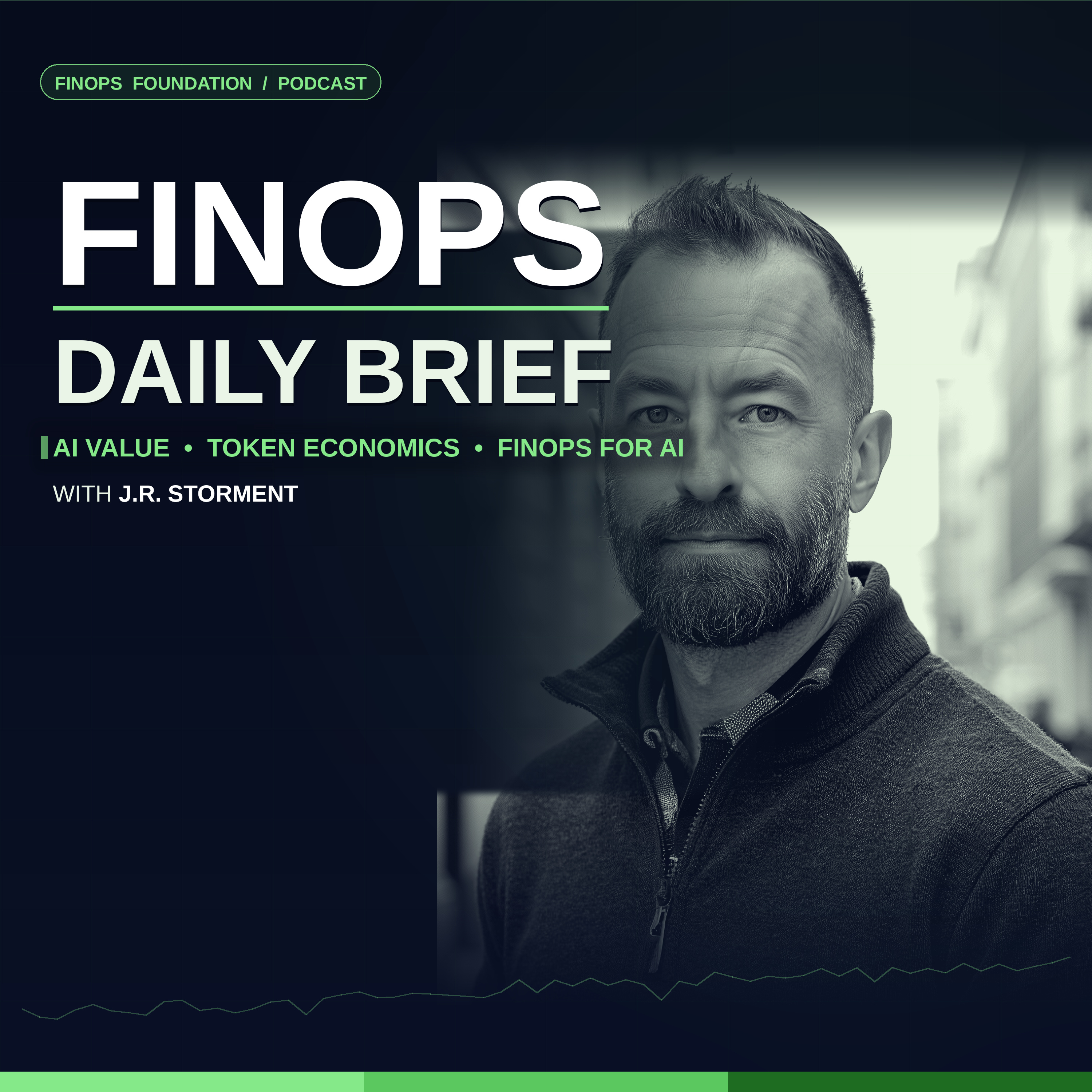
FinOps Daily Brief
by J.R. Storment
Mostly Daily Brief on AI Value, Token Economics, FinOps for AI and Technology Value with J.R. Storment from the FinOps Foundation.
-
5
EP005: Inside the Cost of Running Agents - Stories from the Rehearsal Room #2
**The FinOps Daily Brief: Inside the Cost of Running Agents**Intuit's accounting agent went live to ten million small businesses last year, and the cost curve looked like a wall. That's what AI agent cost looks like in production right now, and the practitioners closest to the problem are still figuring out the levers. J.R. sat in on three FinOpsX rehearsals last week from speakers wrestling with the same question, and this episode is what stood out.Eran Lador and Balachandra from Intuit walk through the QuickBooks Accounting Agent, which broke its cost into three buckets that every team running an AI product is going to recognize. LLM cost, vector DB cost, and ordinary cloud cost. The framework that lands is the accuracy / cost / latency triangle. You optimize for two of the three, and the third one suffers, which turns AI cost into a design decision per workload rather than an infrastructure number rolled up at the end of the month. Safi Siddiqui follows with the cleanest map of AI cost from a practitioner this year. Three layers. Infrastructure and data at the bottom, models in the middle, agents at the top. Each layer has its own attribution tools, and the agent layer is where unit economics finally become possible. Paul Abruzzo from Nvidia opens the lightning talk track at FinOpsX with the GPU economics underneath all of it, and the distinction most teams haven't drawn yet between training and inference cost shapes.Stack the three together and you get the new FinOps job description. Three cost groups, three layers, the triangle, build small, instrument with OpenTelemetry, and have an answer when the CFO asks.Three takeaways close the episode. FinOpsX is June 8 in San Diego, and all three speakers will be on stage live.
-
4
EP. 004: Four Talks, One Pattern. Rehearsal Room Stories #1
"We are trying to govern a stream with a snapshot." That's a practitioner story heard in a FinOpsX rehearsal last week, and it's the line that frames this episode. Over the past two weeks the team has been sitting in on rehearsals back-to-back. Five practitioners. Five completely different topics. One pattern emerging underneath all of them. AI is now in everything, even the talks that aren't ostensibly about AI, and this episode is what that convergence actually looks like.J.R. walks through four of the rehearsals in detail. Abhinav Lad and Kuntal Patel from Palo Alto Networks on what AI cost actually behaves like up close, including the surprise that RAG memory costs as much as the LLM itself, the growth in spend from agentic AI, and why "failed request now carries a cost." Aishwarya Korde on why annual budgets break in an AI-defined era and the living-forecast discipline that replaces them. Anastassia Storozhev on persona-aligned unit economics and why cost per token, cost per agent, and cost per AI use case are all the same shape of metric. And Rohit Mishra from Avaloq on why FOCUS as the data foundation is the layer that makes every other AI cost practice possible.Five takeaways close the episode, including the action item every team should take Monday morning. FinOpsX is June 8 in San Diego. Come hear all the practitioners tell it themselves.
-
3
EP. 003: The Token Factory and the New Job of FinOps
"Our job as a FinOps organization is to maximize the value of the token transformation. Jensen called it the token factory effectiveness, and that's what we all need to run." That's Frederik Pohl, head of FinOps and Data Solutions at SAP, articulating the new job of every FinOps team in this AI-defined era. This episode is a deep dive into the framework Frederik and his colleague Maida Nazifi have built at SAP to actually do that work, at multi-billion-dollar multi-cloud scale.J.R. walks through the substance of their day-one FinOpsX keynote. The two-phase journey every enterprise is on (make it work, then make it efficient). Why their first dashboard was a hand-built PowerPoint and why that beat any tool they had. The single email to the CTO that changed everything. Why AI cost optimization happens at the design layer, not the infrastructure layer. The Jevons paradox at SAP, where 100% month-over-month spend growth is happening even as cost-per-token falls. The marketplace pricing reset story every procurement playbook needs. And the three-pillar framework (Spend Visibility, Economics, Value) with the ten metrics that put it into practice, including the one that matters most right now: token-to-spend drift.The episode closes with the question Frederik leaves the audience with. The question is no longer whether AI creates value. That's clear, it does. The question is whether you have the visibility to prove it, the economics to optimize it, and the governance to sustain it. FinOpsX is June 8 in San Diego. Frederik and Maida are keynoting day one, and their full breakout stays on day two for the deep cut.
-
2
EP. 002: AI for FinOps: April Summit Recap (Agents and Tokens!)
Two years ago, 31% of FinOps practices managed AI spend. Today, that number is 98%. In this episode, J.R. Storment recaps the April 2026 FinOps Foundation Virtual Summit and the headline that should be on every practitioner's mind: token economics has officially arrived. SAP's Frederik Pohl reframed the job entirely with what Jensen Huang calls "token factory effectiveness," and that shift from cost minimization to value maximization is rewriting what FinOps teams do on a Monday morning.J.R. walks through the practitioner playbook coming out of the summit. The four-stage AI maturity path from Jonathan Morley. Amit Kinha's Crawl, Walk, Run framing and his warning that "the first thing AI does in FinOps isn't save you money — it shows you how much cleanup you have." Dann Berg's prompting pattern that turns plausible-looking garbage into something usable. The six AI use cases practitioners are running in production today, including Slack outreach to resource owners getting 40-50% action rates. Plus FOCUS 1.4 hitting in June, ITAM Forum joining the Linux Foundation, and Google Cloud's new spend caps and explainability agent.And then the moment that mattered most. When J.R. asked the panel for a single demonstrable outcome from applying AI to FinOps, the room went silent. He sits with what that means: we are very early, this is 2017 all over again, and the practice will get built in the open by the people who lean in now. Five takeaways to close, and an open invitation to FinOpsX in San Diego on June 8-11 to figure this out together.
-
1
EP. 001: Speed and Discipline: How Sonali Niswander Thinks About the Value of AI at MetLife
Sonali will be keynoting FinOps X in San Diego, June 8-11 2026. Attend to see her talk live.Key Insight: Sonali Niswander, SVP AI, Cloud and Data Platforms of the Global Technology Office at MetLife, offers a window into how the FinOps mandate is shifting at the world’s largest regulated enterprises. Her story spans infrastructure roots in early e-commerce, through leadership at some of the country’s most recognizable companies, to overseeing cloud, AI, and business applications at a $71 billion global insurer. It is a case study in what it means to be a “biz tech” leader in an era when the rules about spending, forecasting, and even job titles are being rewritten in real time.
No matches for "" in this podcast's transcripts.
No topics indexed yet for this podcast.
Loading reviews...
ABOUT THIS SHOW
Mostly Daily Brief on AI Value, Token Economics, FinOps for AI and Technology Value with J.R. Storment from the FinOps Foundation.
HOSTED BY
J.R. Storment
CATEGORIES
Loading similar podcasts...
URL copied to clipboard!