
PODCAST · health
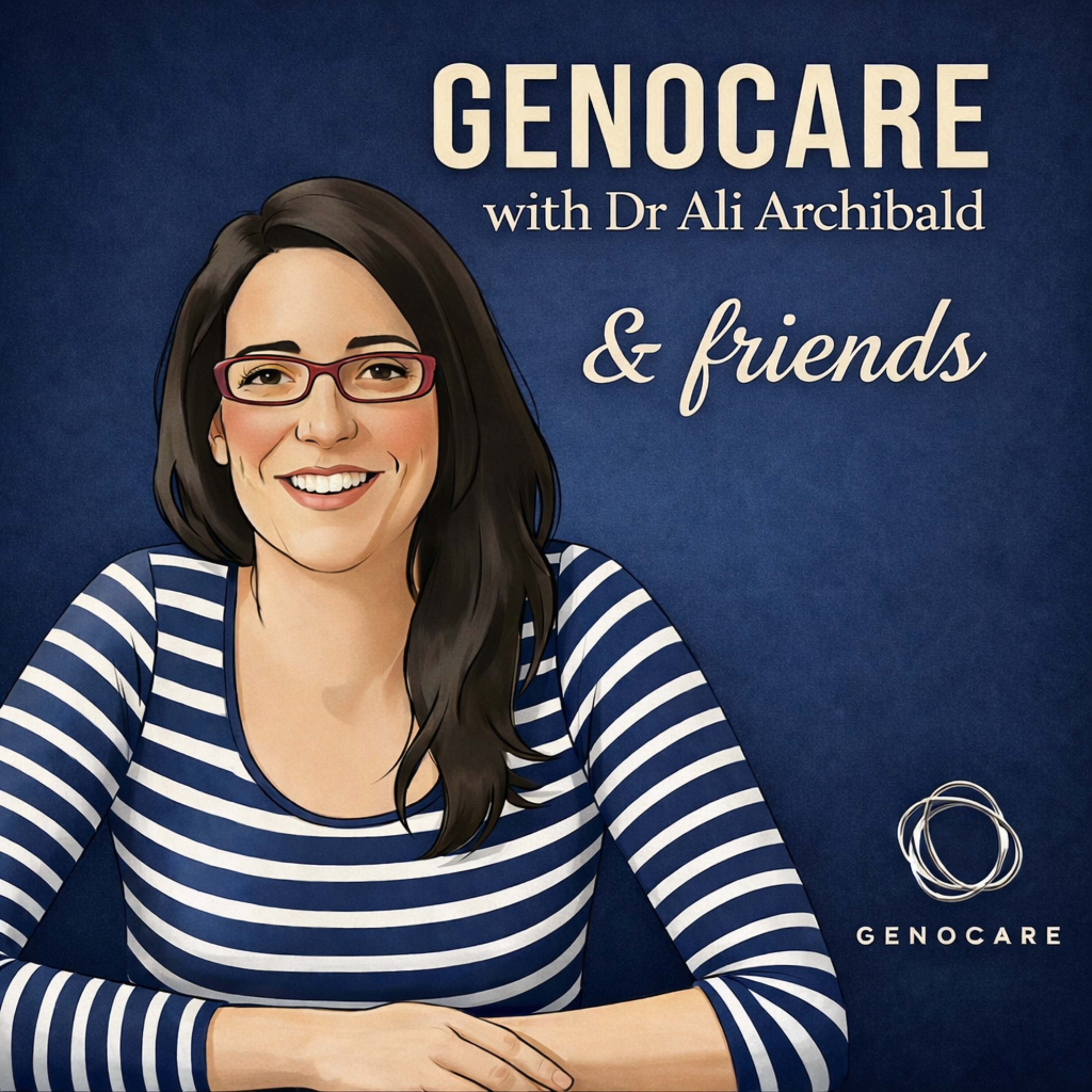
GenoCare— with Dr Ali Archibald & friends
by Dr Ali Archibald
GenoCare is a podcast for clinicians, patients, and anyone navigating genetic and genomic care. Hosted by Dr Ali Archibald, the series explores how genomic testing is used in real clinical practice — and what happens beyond the test result. Through conversations with clinicians, researchers, and people with lived experience, the podcast covers reproductive and cancer genomics, psychosocial impacts of testing, and how health systems can better support patients and families. Produced by GenoCare Pty Ltd for education and general information.
-
16
Embedding Genomics Into Everyday Care — Part 2 with A/Prof Amy Nisselle
Episode SummaryGenomics is ready. But are our health systems, clinical teams, and education frameworks ready to support it at scale? In this second episode with A/Prof Amy Nisselle, host Alison Archibald explores what it actually takes to embed genomics into routine clinical practice — from the evolving role of genetic counsellors to AI-powered tools that are changing the way patients and clinicians learn.GuestA/Prof Amy Nisselle is a genomics education, research, and evaluation expert across Murdoch Children's Research Institute, the University of Melbourne, and the University of Queensland. With over 20 years in the field, Amy is one of Australia's leading thinkers on translating genomic science into clinical practice.What We CoverThe genetic counsellor as systems glue — Genetic counsellors aren't just patient-facing. They play critical roles as lab liaisons, result interpreters, educator-clinician bridges, and confidence builders for mainstream practitioners who need a trusted expert to call.The lab liaison role — A genetic counsellor embedded between the referring doctor and the laboratory can uplift poor referrals, triage test complexity, and ensure results are understood and acted on correctly. There aren't enough of them — but evidence shows they're highly cost-effective.The confidence ladder — Research shows doctors need to cross a confidence dip before genomics becomes routine. The solution isn't more lectures. It's foundational knowledge paired with real clinical exposure — workplace learning that makes genomics relevant right now, to this patient, today.Just start the conversation — A concept from SMA Australia advocate Julie Sini that resonated strongly with both Amy and Ali: GPs don't need to know everything. They just need to start the conversation and know who to call. That alone builds confidence over time.The clinician personas — Amy's PhD student Alice identified six types of mainstream clinician attitudes toward genomics: from the self-directed champion to the skeptical pragmatist. Understanding which type you're talking to changes how you design education entirely.AI in the genomics workflow — AI has a clear and growing role: summarising patient information, guiding decision-making through tools like Genetics Advisor, generating personalised education videos before consultations, and creating safe simulations for clinicians to practice genomic conversations. The key insight: AI handles the standardised content so humans can focus on the emotional and complex.What good genomic care looks like — Amy's answer is elegant: every clinician and every patient has the competence and confidence to engage with genomics as relevant to their role. Not uniform mastery — contextual capability. The rural GP who can order a test and know who to call. The patient who feels informed and comfortable with the choices they're making.Key Quote"Good genomic care is everyone being informed and making an informed decision — the clinician and the patient. I want them to have the competence and confidence to do genomics in the context relevant to them."
-
15
Episode 12: Mainstreaming Genomics Part 1
Episode SummaryGenomics is moving into mainstream healthcare — but only if the right people understand it. Not just geneticists, but GPs, nurses, medical specialists, allied health practitioners, and patients. In this episode, host Alison Archibald speaks with A/Prof Amy Nisselle about the science and art of genomics education — who needs it, how to design it well, and why it's one of the most powerful levers we have for improving access to genetic testing in Australia.This is Part 1 of a two-part conversation. Part 2 explores what it actually takes to embed genomics into healthcare systems.GuestA/Prof Amy Nisselle is a genomics education, research, development, and evaluation expert at Murdoch Children's Research Institute, The University of Melbourne, and The University of Queensland. With over 20 years in the field, Amy is one of Australia's leading thinkers on communicating genomics to diverse audiences.What We CoverThe Babel fish of genomics — Amy's role is to sit between two disciplines and translate one for the other, helping scientists communicate to patients and clinicians communicate to families.Why genomics education is harder than it looks — Most education content asks readers to jump between the visible, the microscopic, and the symbolic without realising it. Understanding this framework is what separates education that lands from education that confuses.The step most people skip — Before creating any education, you need a needs assessment. Who is it for? What do they already know? How will they engage? Most well-meaning education in Australia has been created without this step.The logic model — Start with the goal, work backwards to the outcome, the required action, and the education that enables it. Always do an opportunity analysis first — what already exists that you can leverage?What mainstreaming genomics actually means — Getting the parts of genomic medicine that are practical and learnable into the hands of clinicians outside specialist genetics services. GPs can order an MRI without interpreting it. We're at the same point with genomics.The 17-year rule — Technology typically takes 17 years from bench to bedside. The genome was sequenced in 2000. By 2017 sequencing costs had dropped enough to make it clinically practical. NIPT and expanded carrier screening followed right on schedule.The confidence dip — A little genomics education actually drops clinicians' confidence before it builds it back. Understanding that changes how you design programs and support people through the transition.The workforce map — Genetic specialists in the bullseye, mainstream clinicians in the next ring, bioinformaticians and software developers in the outer ring. The trick isn't training the bullseye harder — it's bringing genomics out to the rings.
-
14
BONUS episode - Ali on the The StrongHer side podcast
Ali recently appeared on the the StongHer podcast, hosted by Hannah Gair. The podcast empowers, elevates, and unites mothers raising children with disabilitiesExploring the raw, real, and often unspoken side of caregiving—identity loss, emotional burnout, invisible labor, daily challenges, and the fierce resilience it takes to rise through it all.Hosted by Hannah Gair, a mother, advocate, and advisor, The StrongHER Side gives voice to the women behind the care plans, through expert interviews, solo deep dives, and the stories of other incredible mothers walking this journey.This isn’t just a podcast, it’s a lifeline, a transforming of the way mother's see themselves and their role, and creating ripple effects of hope, empowerment, and resilience across families worldwideConnect with the StrongHER Side:Instagram: https://www.instagram.com/strongherside/ Website: https://www.strongherside.com/ Podcast: https://stronghersidepodcast.podbean.com/
-
13
Episode 11: Informed consent in genetic testing with Dr Lisa Dive
Informed consent is the cornerstone of ethical genetic testing — but in a world of increasing genomic complexity, time-poor clinicians, and mainstreaming at scale, how do we make it work in practice?Ali speaks with Dr Lisa Dive, bioethicist at UTS, about what informed consent really means in the context of genetic testing — and why the standard model of ticking boxes and signing forms falls well short.This is a conversation about language, values, human connection, and the future of ethical genomic care.GuestDr Lisa Dive is a bioethics academic with a philosophy background and deep expertise in the ethical dimensions of genetics and genomics. She teaches ethics and research in the UTS Genetic Counseling program and has worked extensively with clinical colleagues on real-world ethical challenges in genomic medicine. Lisa played a key role in the ethics arm of Mackenzie's Mission — Australia's landmark reproductive genetic carrier screening study.What We CoverWhat informed consent actually is — and why it's a communication process, not a form. Lisa reframes consent as a dynamic interaction aimed at helping people understand whether a genetic test aligns with their values and will genuinely benefit their life.Why genetics is different — genetic information is complex, probabilistic, and often uncertain. Unlike a standard medical test, results rarely deliver a simple yes or no. Preparing people for that ambiguity is central to the consent process.Individual autonomy vs family implications — genetic results don't just affect the person tested. Lisa introduces the concept of relational autonomy — the idea that good decision-making is situated within family, social, and cultural contexts, not just individual preference.Cultural and social dimensions — decision-making norms vary. In some cultures, family elders are central. In others, individual choice is paramount. Adapting consent processes to those contexts isn't optional — it's essential.The "least worst decision" — a phrase coined by host Ali Archibald to describe the genuinely hard choices people face in prenatal and reproductive genetics. Lisa validates the concept and unpacks how skilled clinicians help people reason through it.The gap between how consent should work and how it actually does — time pressure, administrative burden, and tick-box forms all erode the quality of the consent conversation. Lisa identifies this as the central challenge.The Mackenzie's Mission decision aid — a standout example of digital tools done right. The decision aid didn't change most people's decisions, but it dramatically increased their confidence. Unexpectedly, it also prompted couples to discuss their values with each other — bringing male partners into the conversation in a way clinical consults rarely had.AI scribes and freeing up the human — removing the burden of note-taking during consults creates space for clinicians to be more present. Lisa sees this as one of several ways technology can amplify — rather than replace — the human elements of care.Scaling informed consent ethically — as genetic testing becomes mainstream and volumes grow, digital tools will be critical. But Lisa is clear: the goal is to deploy them where they add value, not to outsource the human interaction that sits at the heart of good consent.One thing she'd change — stop defaulting to "more information is better." Utility should be the lens. Does this test give this person information that will genuinely serve their life? That question should anchor every consent conversation.
-
12
Episode 10: Carrier screening is no longer risk-based — but many clinicians are still treating it that way.
Reproductive genetic carrier screening is often misunderstood — and that’s part of the problem.Despite now being recommended for all individuals planning or in early pregnancy, many clinicians still associate it with family history or specific ancestry. That thinking is outdated — and it’s limiting access to care.In this week's Genocare podcast, Ali is joined by CMH Nurse Emma to step back and unpack the fundamentals of reproductive genetic carrier screening — what it is, who it’s for, and why it matters now more than ever.• What reproductive genetic carrier screening actually tests for — and how it differs from other genetic tests• Why everyone is a carrier for something — and why screening is no longer just for high-risk groups• The critical shift from family history-based testing to population-level screening• How risk is determined at the couple level — not the individual level• Why most at-risk couples have no known family history, and what that means for clinical practiceWhat this episode coversWhy this matters nowGuidelines from major bodies — including the RACGP, RANZCOG, and HGSA — are clear:carrier screening should be offered to anyone planning or early in pregnancy.But recommendation alone isn’t enough.As genomics becomes embedded in routine care, the real challenge is ensuring clinicians have the confidence, tools, and systems to offer screening appropriately — and support patients through the process.Further resources• Reproductive carrier screening fact sheet (Centre for Genetics Education):https://www.genetics.edu.au/PDF/Reproductive_carrier_screening-fact_sheet-CGE.pdf• Australian resource hub for carrier screening: www.carrierscreening.org.au
-
11
Episode 9: From Mackenzie's Mission to MBS: The Carrier Screening Journey with Kirsten Boggs
GenoCare Podcast – Show NotesReproductive Genetic Carrier Screening: From Niche to MainstreamGuest: Kirsten Boggs | Senior Genetic Counsellor & Researcher Host: Ali (Dr Alison Archibald)What if you could know — before pregnancy — whether your child is at risk of a severe genetic condition? That's the promise of reproductive genetic carrier screening. And it's no longer a niche offering for the few. It's becoming part of routine reproductive healthcare for everyone.In this episode, Ali sits down with senior genetic counsellor and researcher Kirsten Boggs to trace the journey of carrier screening in Australia — from inaccessible and underfunded, to Medicare-listed and increasingly mainstream.Kirsten brings rare depth to this conversation. She's worked in clinical genetics at a children's hospital, was a lead genetic counsellor in the New South Wales arm of the Acute Care Genomics project, and was a key player in Mackenzie's Mission — the landmark national research program that tested expanded carrier screening at population scale. She's seen firsthand what it means for families to receive a devastating diagnosis and ask: could we have known?The landscape today. What's covered under Medicare (cystic fibrosis, spinal muscular atrophy, fragile X syndrome), where the gaps are, and why expanded screening — covering up to 1,000+ genes — remains out of reach for most Australians.Mackenzie's Mission. How a couple-based screening model, an online education and consent platform, and a home mouth-swab kit quietly revolutionised how we think about delivering genomic testing at scale. Launched in March 2020 — yes, that March — the program showed that population-level screening is not only possible, it works.The education gap. Why GPs are still telling patients carrier screening "doesn't apply" to them. Why that's wrong. And what needs to change.Trust as infrastructure. Kirsten's unexpected answer to what makes population screening programs succeed: public trust in data security, trust in the platform, and — crucially — trust in patients to make their own decisions.The future of genetic counselling. Kirsten's vision for a nationally funded, digitally accessible genetic counselling service that meets people where they are — not a two-to-five year waitlist.Carrier status is usually discovered when a child is diagnosed — not before. That's the problem carrier screening solves.Removing the cost barrier via Medicare has already dramatically improved equitable access across Australia.Digital platforms don't replace genetic counsellors — they free them up to do the work only humans can do.The next frontier isn't just expanding what we screen for. It's building the infrastructure to support every person who gets a result.Mackenzie's Mission — Australia's national reproductive carrier screening research programThree-gene Medicare carrier screen — CF, SMA, fragile XExpanded carrier screening — up to 1,000+ genes, currently privately fundedAcute Care Genomics Project — rapid whole genome sequencing for critically unwell newborns and infantsAustralian Genomics — national report on a future carrier screening programThe GenoCare Podcast explores the intersection of genomics, technology, and healthcare delivery. New episodes regularly.For more information on GenoCare and the Igentify platform, visit genocare.com.auEpisode Summary What You'll Hear Key Takeaways Mentioned in This Episode
-
10
Episode 7: The Emotional Side of Genetic Testing in Pregnancy — with Kathy Solanki
Pregnancy is often described as a joyful time. But for many women and their partners, the reality is can be more complex — and when an unexpected genetic testing result enters the picture, the emotional stakes can rise dramatically.In this episode, GenoCare Co-Founder A/Prof Ali Archibald is joined by Kathy Solanki — credentialed perinatal mental health nurse, midwife, and member of the GenoCare counselling team — for an illuminating conversation about the emotional landscape of pregnancy and early parenthood.Kathy draws on years of clinical experience to explore why pregnancy is such a psychologically heightened time, what happens in the body when stress and anxiety take hold, and how unexpected prenatal results can challenge a person's sense of what their future looks like.They discuss the science of co-regulation — how a calm clinical presence can help a patient's nervous system settle — and why psychosocial support shouldn't be reserved only for patients who are visibly struggling. As Kathy puts it, it should simply be woven into every clinical encounter as part of whole-person care.Symptoms of anxiety, depression, or both are common during pregnancy and the postnatal period. Yet the emotional impact of unexpected genomic results is still widely under recognised in clinical practice.One of the founding insights behind GenoCare — born from Ali's qualitative research — was that patients often don't show their distress on the surface. People can look fine. They often aren't. That's why GenoCare's model is built around proactive, preventative psychosocial support, available to every patient navigating genetic testing in pregnancy.In this episode you'll hear about:— Why pregnancy is an emotionally heightened time for most women— The physical stress response and what it means for patient care— How unexpected prenatal results can trigger shock, grief, and identity disruption— The role of co-regulation in clinical encounters— Why psychosocial support should be offered universally, not selectively— Practical strategies patients can use to manage anxiety and stress.About Kathy Solanki Kathy is a credentialed perinatal mental health nurse and midwife with extensive experience supporting women and families through the emotional complexities of pregnancy and early parenthood. She is part of the GenoCare counselling team.About GenoCare GenoCare delivers innovative models of care that integrate expert genetic counselling with psychosocial support, designed to be person-centred, scalable, and accessible.Utilising the Igentify platform, GenoCare delivers digital solutions that streamline education, consent, and care pathways, elevating genetic care.Learn more: www.genocare.com.au
-
9
Episode 6: Prenatal Genomic Sequencing Explained - How Exome & Genome Sequencing can Help Diagnose Conditions in Pregnancy
In this episode of the GenomeCare Podcast, we explore prenatal genomic sequencing and how technologies like whole exome sequencing and whole genome sequencing are transforming diagnosis when differences are detected during pregnancy.Ali interviews genetic counsellor Dr Sarah Long, who works in the public hospital system in Western Australia and has extensive experience in prenatal genomics, clinical genetics, and research. She completed her PhD studying prenatal genomic technologies and continues to research how genomic testing can be delivered in ways that best support families. Sarah was involved in the PREGEN study, which examined the implementation of genomic testing during pregnancy and demonstrated an increased diagnostic rate when genomic sequencing is used after ultrasound findings. Together Ali and Sarah unpack how genomic sequencing works in pregnancy, when it is used, and what the experience is like for people navigating testing after an unexpected ultrasound finding.The conversation explores the clinical and emotional dimensions of prenatal genomics, including how genetic counsellors support families through uncertainty and complex decision-making.What whole exome sequencing and whole genome sequencing are and how they workHow genomic sequencing is used when changes are detected on prenatal ultrasoundThe difference between exome sequencing and genome sequencingWhy testing is often done as a trio (baby and both parents)What a “negative” or uninformative result really meansHow clinicians interpret complex findings such as variants of uncertain significanceThe role of genetic counsellors in supporting families through uncertaintyReal patient experiences from the PREGEN prenatal genomics studyA remarkable case where prenatal sequencing enabled life-saving treatment immediately after birthSarah Long is a genetic counsellor working in the public hospital system in Western Australia. Her work spans clinical genetics, prenatal genomics, and research into patient experiences of genomic testing during pregnancy. Sarah is currently working on the GeneSafe study, exploring perspectives on invasive versus non-invasive genomic testing during pregnancy.If you’re interested in Sarah’s research or would like to participate in her study, you can connect with her on LinkedIn.ConnectIf you’d like to learn more about prenatal diagnostic procedures:🎧 Episode 3 – CVS and Amniocentesis ExplainedFeaturing genetic counsellor Jillian Kennedy, who discusses how these procedures work and when they are used.
-
8
Episode 5: When Unexpected News Changes Everything: Prenatal Diagnosis, Threat, and the Support Gap — with Dr Pieta Shakes
Receiving unexpected news about your developing baby during pregnancy can be one of the most profound and destabilising experiences a person goes through. Yet our healthcare systems are largely set up to deliver the test — not to support what comes after.In this episode, A/Prof Alison Archibald speaks with Pieta Shakes — credentialed mental health nurse, researcher at James Cook University, and founder of Through the Unexpected — about what parents experience when they receive unexpected news from prenatal testing, and why current models of care often fall short.Drawing on her own lived experience of receiving unexpected information about her baby's development at 31 weeks and her PhD research into psychosocial outcomes, Pieta unpacks the real impact of prenatal diagnosis — including the threat response it can trigger, the isolation, the disruption to identity and attachment, and the reality that many parents carry these impacts for years without adequate support.Together they explore:Why "shock" doesn't capture what's really happening — and what the threat response actually looks likeThe diversity of experiences and why there's no single way people respond to this newsHow medicalisation can sometimes overshadow the human experience for parentsThe growing gap between funded testing and funded support in AustraliaWhat good models of care could look like — accessible, flexible, and available over timeWhat practitioners can do right now to create safer spacesThis episode is for genetic counsellors, obstetricians, midwives, GPs, mental health professionals, and anyone working in prenatal or reproductive care. It's also for parents and families who have been through this experience and want to feel seen and understood.Guest: Dr Pieta Shakes — Founder, Through the Unexpected (throughtheunexpected.com) | Credentialed Mental Health Nurse | Teaching & Research Academic, James Cook UniversityGenoCare: genocare.com.au
-
7
Episode 3: Prenatal diagnosis with Ali and Jill Kennedy
Prenatal diagnosis can be a complex experience. In this episode, we speak with Jill Kennedy, a senior genetic counsellor working in the public hospital system in Western Australia, about what prenatal diagnosis is, why it may be offered, and what the process involves.Jill explains the common pathways that lead to prenatal diagnostic testing, including carrier screening, non-invasive prenatal testing (NIPT), ultrasound findings and family history. She outlines the two main procedures — chorionic villus sampling (CVS) and amniocentesis — and discusses timing, risks, and how clinicians support informed decision-making.This episode is designed to help listeners better understand prenatal diagnosis and the role of genetic counselling in supporting individuals and couples throughout the testing journey.
-
6
Fragile X Explained: Carrier Screening, Risk Assessment, and What the Results Really Mean
Fragile X syndrome is one of the most common inherited causes of intellectual disability — yet it’s also one of the most complex genetic conditions to understand.In this episode, Associate Professor Ali Archibald explains Fragile X in clear, practical terms, unpacking how the condition is inherited, what carrier screening looks for, and why results can vary so widely between individuals and families.The conversation covers:What Fragile X syndrome is and how it affects developmentThe difference between being a carrier and having the conditionCGG repeat numbers, premutations, and why “risk” is not one-size-fits-allThe role of AGG interrupts in refining risk assessmentWhy Fragile X carrier results require specialist genetic counsellingHow clinicians help people move from a result to informed next stepsThis episode highlights why Fragile X screening sits outside routine primary care conversations, and why time, expertise, and careful explanation are essential for people to feel informed rather than overwhelmed.This episode is relevant for clinicians, prospective parents, and anyone navigating reproductive carrier screening or Fragile X results.
-
5
Episode 2: Psychosocial Support After Genetic Testing - The Role of Mental Health Nurses
In this episode, Ali speaks with Emma, a Credentialed Perinatal Mental Health Nurse at GenoCare, about the emotional and psychological impact of genetic testing during pregnancy — and where mental health nursing can fit alongside genetic counselling.Emma shares her background in midwifery and perinatal mental health, and explains why genetic test results can feel destabilising, particularly for people encountering their first major challenge on the path to parenthood. Together, they explore how mental health nurses provide a safe, informed space to process anxiety, grief, trauma, and uncertainty — without patients needing to repeatedly explain their genetic results.The conversation covers trauma-informed care, perinatal mental health, coping strategies, and why ongoing psychosocial support can be critical as genetic information ripples through families over time.This episode is relevant for clinicians, patients, and families navigating reproductive genetic testing or supporting others through complex results.
-
4
Episode 1: Expanding Access to Genetic Counselling and Psychosocial Support
We flip the script in this episode with Ali interviewed by Emma, GenoCare Perinatal Mental Health Nurse. Emma and Ali discuss why GenoCare was created and how genetic care in Australia is evolving.Ali explains what genetic counsellors do, how access to genetic testing has expanded rapidly, and why support pathways haven’t kept pace. We discuss the growing gap between demand for genetic information and the availability of specialist services, particularly in reproductive and cancer genetics.This conversation also explores why genetic results can have long-lasting emotional and family impacts, and how GenoCare brings together genetic counselling and Medicare-funded mental health nursing to provide more accessible, ongoing psychosocial support.Finally, Ali shares GenoCare’s broader vision — using digital tools, education, and streamlined workflows to reduce administrative burden and allow clinicians to spend more time supporting patients.This episode is relevant for clinicians, patients, and families navigating genetic testing or working in genomics and reproductive care.
-
3
Episode 8: Sharing Genetic Results With Family - What Helps, What’s Hard, and Why It Matters with Associate Professor Belinda Dawson McClaren
When genetic testing reveals new information, the impact rarely stops with one person. In this episode, we’re joined by Associate Professor Belinda Dawson McClaren, researcher and academic at The University of Melbourne to explore how families share genetic information — and why these conversations can be complex, emotional, and deeply important.We discuss whether people have an obligation to tell relatives about genetic results, how family dynamics shape communication, and why timing matters. Drawing on research and clinical experience, Belinda and Ali unpack common challenges including guilt, anxiety, estrangement, and differing readiness to know.This conversation highlights the role of genetic counsellors in supporting families over time, the value of cascade testing, and why sharing genetic information is often an ongoing process rather than a single conversation.This episode is relevant for clinicians, patients, and families navigating genetic testing.
-
2
Episode 4: Pre-implantation Genetic Testing (PGT-M) - What Clinicians and Patients Need to Know with Ali and Alice Weeks
Pre-implantation Genetic Testing (PGT-M): What Clinicians and Patients Need to KnowIn this episode, A/Prof Alison Archibald, Certified Genetic Counsellor and Co-Founder of GenoCare, is joined by Alice Weeks, Genetic Counselling Manager at No.1 Fertility, to explore pre-implantation genetic testing (PGT) with a focus on PGT-M.They discuss how patients typically arrive at PGT-M following carrier screening or a known genetic diagnosis in the family, what the IVF and embryo testing process involves, how results are interpreted, and the limitations of testing. The conversation also covers the psychosocial impacts of IVF and genetic decision-making, and how clinicians can best support patients navigating these complex choices.This episode is designed for genetic counsellors, fertility specialists, GPs, and referrers involved in reproductive care and anyone considering or undergoing IVF with PGT-M who wants to understand more about the process and the patient experience.
We're indexing this podcast's transcripts for the first time — this can take a minute or two. We'll show results as soon as they're ready.
No matches for "" in this podcast's transcripts.
No topics indexed yet for this podcast.
Loading reviews...
ABOUT THIS SHOW
GenoCare is a podcast for clinicians, patients, and anyone navigating genetic and genomic care. Hosted by Dr Ali Archibald, the series explores how genomic testing is used in real clinical practice — and what happens beyond the test result. Through conversations with clinicians, researchers, and people with lived experience, the podcast covers reproductive and cancer genomics, psychosocial impacts of testing, and how health systems can better support patients and families. Produced by GenoCare Pty Ltd for education and general information.
HOSTED BY
Dr Ali Archibald
Loading similar podcasts...
URL copied to clipboard!