
PODCAST · business
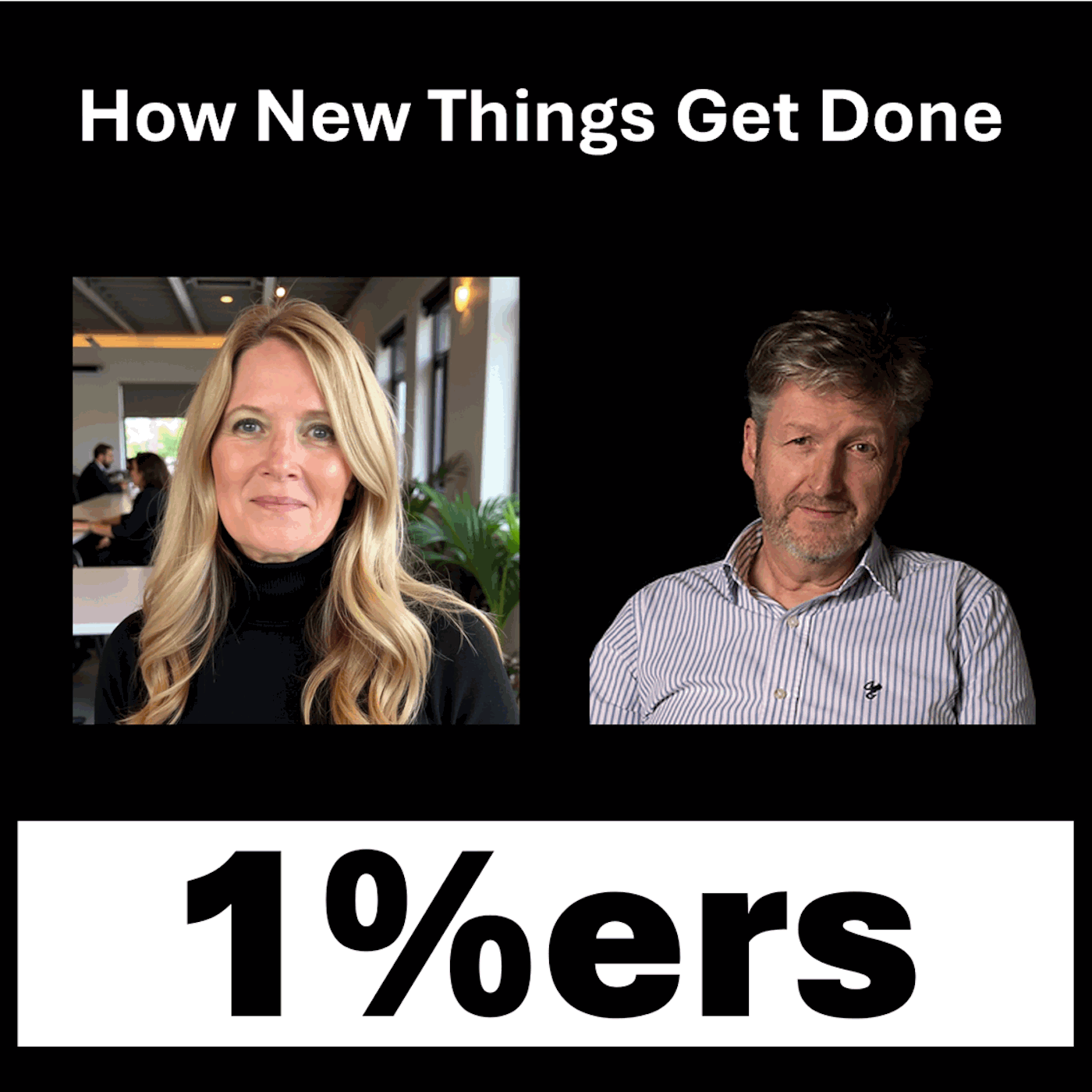
How New Things Get Done. The 1%ers
by powerandperspective
Every week real business cases are dissected by Shana and Darrell, showing how some people consistently get impossible things done... often through counter intuitive moves.
-
17
The Leadership Episode. Is Elevate and Delegate a good idea?
Is elevate and delegate actually good advice? In this leadership episode, Shana and Darrell challenge one of management's most repeated principles and ask the harder question underneath it. Better decisions require something most organizations don't have: leaders who can think horizontally across functions, not just vertically within them. They dig into why hiring for systems thinking is nearly invisible in most recruitment processes, why so many meetings exist just to compensate for its absence, and what changes when leaders can finally see the whole board.
-
16
Episode15: NEPTUNE Banking
Shana and Darrell use NEPTUNE to think about how traditional banking could be reimagined for someone wanting to do a new thing.
-
15
Episode 14: AI Mission Drift: Inevitable but is it beneficial?
As Open AI opens up for advertising revenue, what are the implications. It's a question of trust . What is the direction? Shana and Darrell examine the good and the bad.
-
14
Episode 13: Beating the AI Blues
Darrell and Shana assess the size of the AI iceberg and consider how to survive in a regime when none of the usual rules apply.
-
13
Episode 12: Beyond the Comfort Zone: Reinventing Yourself in the Age of AI
This episode of How New Things Get Done uses Oracle's layoff of 30,000 employees as a launching point for a wide-ranging conversation about what happens when the "invisible contracts" of the industrial age collapse and what individuals and organizations can do about it. The core argument is that we are entering a world where AI will handle the majority of routine left-brain work meaning the old playbook of losing a job and finding a similar one elsewhere is breaking down. There is no more cheese to find so people need to discover a different kind of value in themselves. Darrell introduces the "three C's" which are counterintuitive thinking and causality and complexity as the uniquely human skills AI cannot replicate and the ones people should lean into. Shana frames the book they co-wrote as sitting between the woo-woo world of vision and manifestation and the grind-it-out world of Atomic Habits offering a structured and math-grounded middle path to genuine reinvention. The hosts discuss Joseph Pine's transformation economy as a roadmap for where value is heading arguing that almost anyone laid off from a software or SaaS role could build a transformation business today with little more than an AI subscription. The conversation then broadens into the singularity debate and meaning-making as the core human drive and Norway as a case study in what people do when freed from necessity. The episode closes with a discussion of the ethics of contradictions at a societal level using UNESCO's failing sustainable development goals as an example and finally whether love reframed by Ian McGilchrist as the intersection of truth and beauty and goodness might be the compass for navigating what comes next.
-
12
Episode 11:Route to Market: Benches, Hugs and Fashion
In this episode, Darrell and Shana tackle the part of getting a new thing done that trips up almost everyone: route to market. Using real stories, an entrepreneur who sat outside a Walmart buyer's office for a day and a half with no appointment, a small automotive company whose breakthrough technology got bought and shelved by an incumbent, and Shana's own bruising experience of manufacturing in Hong Kong, they show why having a great idea is necessary but nowhere near sufficient. They unpack the Big Friendly Giant principle (if you're small, you need someone big who has your back), the Innovator's Dilemma as a strategic playbook rather than an academic concept, and why entering a market with an apparently inferior product can be smarter than leading with your best. The conversation then turns practical. Darrell breaks down a hypothetical "hugs business" in real time using the Law of System Completeness, showing how to inventory every piece a new venture needs before spending serious money. A story about a "happy to chat" bench in an English town that nobody would sit on becomes a masterclass in why context determines everything and why the cheapest resource you have is your ability to think before you act. Throughout, Shana makes the case that AI can now give individual entrepreneurs the kind of system thinking and domain awareness that used to be the exclusive advantage of large enterprises, provided you use it to run toward the difficult questions rather than to validate the answers you already want to hear.
-
11
Episode 10: Running Towards the Hard Things
In this episode, Shanna and Darrell explore the "1%er" mindset of running toward the difficult bits, the high impact, high discomfort challenges that define true breakthroughs. Using a 2x2 framework of impact versus comfort zones, the duo discuss how industry giants like Coca-Cola and Starbucks face existential disruption from GLP-1 medications, and how the "ideal final result" (such as self-cleaning clothes) can render entire sectors like detergent and appliance manufacturing obsolete. Shanna emphasizes that while AI serves as a powerful new utility for solving contradictions, the human element, characterized by grit, energy management, and the willingness to be wrong, remains the ultimate driver of innovation.
-
10
Episode 9:Reimagining Education for the AI Transformation Economy
Shana and Darrell dismantle the "locked-in" Prussian education system, rebuilding it for a future where AI renders rote answers obsolete. They identify that schools have historically functioned as a complex web of childcare and labor-market stabilizers rather than true centers of learning, creating a "sinkhole" where billions in EdTech have failed. The breakthrough comes from recognizing that the "Prussian" goal of creating order-followers must be traded for Systemic Inquiry—prioritizing curiosity and the human ability to navigate uncertainty over the increasingly automated ability to provide a "correct" fact. For the five displaced entrepreneurs in this scenario, the opportunity lies in the "Transformation Economy": leveraging AI to compress rote learning into two hours so the remaining six can be dedicated to play, socialization, and entrepreneurial skills. By shifting the compass from providing answers to mastering the "Is it true?" protocol, they outline a scalable model for anti-fragile education. It’s an essential signpost for anyone ready to stop hitting the "easy button" and start teaching the next generation how to ask the questions that AI can't yet imagine.
-
9
Episode 8:Shadow Leadership
Darrell and Shana discuss shadow leadership systems. How AI can help you see the system and what to do about it.
-
8
Episode 7: From Jobless to Industry Disruptor: A Real-Time Strategy Session on Building Win-Win Ecosystems
Shana and Darrell build a viable business model from scratch in real-time, starting with just three unemployed people and a simple goal: feed people healthy food. What emerges is a illustration of systems thinking, contradiction-solving, and ecosystem design that could scale to challenge billion-dollar incumbents. Watch out for the moment they identify the true compass that transforms charity into disruptive innovation. An opportunity signpost for founders thinking about their next venture.
-
7
Episode 6: Is Your Business Headed for Chaos? A CEO's Guide to the AI Inflection Point
AI is collapsing traditional work timelines from months to days. This conversation explores how CEOs can use AI to identify organizational contradictions, measure what truly matters, and iterate faster than competitors. The key isn't replacing humans with AI, 's asking better questions and developing the creativity skills that will define future success.
-
6
Episode 5:What Makes You Valuable in the Age of AI and How Leaders Can Spot It!
In this episode Darrell and Shana talk about 1%ers as rare birds to spot in your organization. We dismantle innovation theater, explain why brainstorming sessions fail, and use SaaS and pharmacy cases to show what actual AI innovation does or doesn't look like.
-
5
Episode 4: The Managed Decline Trap: Why AI Cost-Cutting Won't Save Your Business
The Clawbot craze exposes a critical question: Is your AI strategy innovating or just managing decline? Discover how to identify true step-change opportunities and find the 1%ers hiding in your organization before it's too late. From Clawdbot to Moltbook: Inside tech's new AI obsessions
-
4
Episode 3: Next Steps in the Age of AI
Calling all lonely leaders: What do you do when it's impossible to know what is going to happen next in the age of AI? In this POD, Darrell gets practical with "next steps" and how to get some direction in these turbulent times. This week's case is for all companies of all types!
-
3
Episode 1: The Art of Doing Less - How One Company Cut Its Way Back to Explosive Growth
Disruption in the market often kills legendary companies. In today's case study we see how experts urged a compelling and logical path. Instead, the company made the counter intuitive move against all recommendations and thrived. It shows how progress often comes not from trend-following, but from confronting the reality that each business is unique in where it is at, what it is facing and what it needs to do in order for a "new thing to get done." 1%ers: HOW NEW THINGS GET DONE #NEPTUNE, #AI, #Business
-
2
Episode 2: Trapped in the Ice - What Shackleton's Survival Story Reveals About Winning in AI Disruption
In 1915, Ernest Shackleton's ship was crushed by Antarctic ice. Nine months of impossible odds. Every crew member survived. Right now, you might be feeling a crushing imperative with AI disruption. Your team's morale is waning, and you're trying initiative after initiative without clear ROI. There is genuine uncertainty about what can and cannot be done and what comes next. This conversation gives you a different playbook. We break down what actually separated Shackleton's success from failure. The strategic approach: emotional risk management, the counterintuitive decision to bring the weakest crew member on the rescue boat, and why knowing your next move beats having a perfect long term plan. We also unpack why boards keep selecting the wrong CEO profile for the game that's actually being played. If you've already read the 1%ers: HOW NEW THINGS GET DONE book, this episode is about Empaths and Umbrellas.
No matches for "" in this podcast's transcripts.
No topics indexed yet for this podcast.
Loading reviews...
ABOUT THIS SHOW
Every week real business cases are dissected by Shana and Darrell, showing how some people consistently get impossible things done... often through counter intuitive moves.
HOSTED BY
powerandperspective
CATEGORIES
Loading similar podcasts...
URL copied to clipboard!