
PODCAST · history
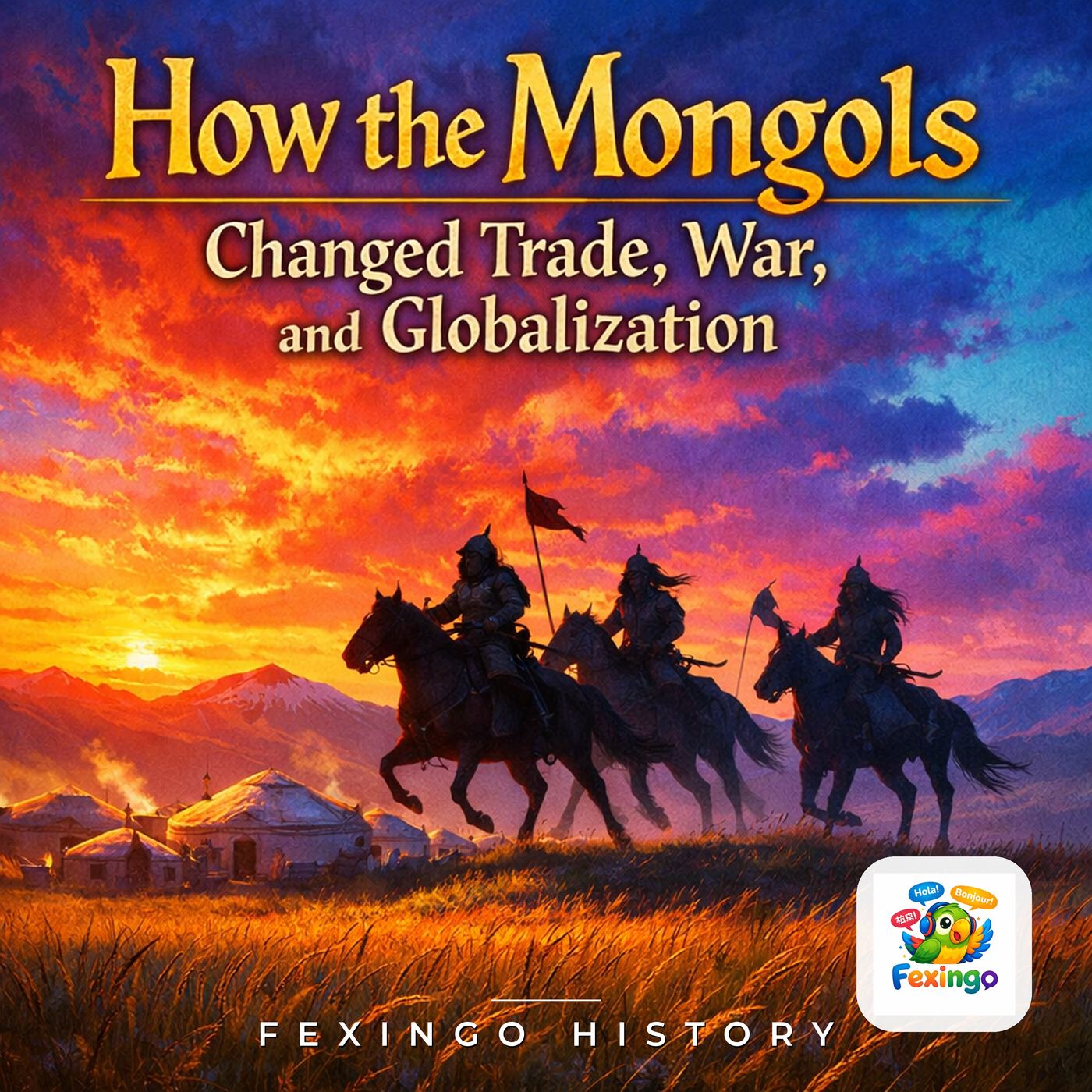
How the Mongols Changed Trade, War, and Globalization — Fexingo History
by Fexingo
How did a nomadic confederation from the Mongolian steppe forge the largest contiguous land empire in history—and in doing so, reshape trade, warfare, and globalization forever? Join hosts Lucas and Luna as they unravel the epic story of the Mongol Empire, from the rise of Temüjin (Genghis Khan) in the harsh steppes of Central Asia to the splendor of Kublai Khan's Yuan dynasty in China. This show explores the Mongols' revolutionary military tactics—mounted archers, feigned retreats, and siege warfare—that shattered armies from the Yellow Sea to the Danube. It traces the establishment of the Pax Mongolica, a century of relative peace that reopened the Silk Road and enabled the flow of goods, ideas, diseases, and peoples across Eurasia. Delve into the empire's complex legacy: the destruction of cities like Baghdad and Kiev, but also the promotion of religious tolerance, the spread of paper money and gunpowder, and the transmission of Chinese medical knowledge to the Islamic world. Examin
-
35
The Mongol Empire's Black Death: How the Pax Mongolica Spread a Pandemic — Fexingo History
The Mongol Empire is famous for connecting East and West, but that connection had a dark side. In this episode, Lucas and Luna explore how the Pax Mongolica facilitated the spread of the Black Death from the steppes of Central Asia to the ports of Crimea, and from there to Europe. They discuss the role of the Yam postal system in accelerating transmission, the siege of Caffa and the myth of biological warfare, the genetic evidence linking a Mongol-era outbreak in Tian Shan to the European pandemic, and how the empire's trade networks turned a local rodent disease into a global catastrophe. Along the way, they touch on the role of marmots and gerbils, the significance of the Chaghatayid khanate, and the debate over whether Mongol policies unwittingly created the perfect conditions for a pandemic. A sobering look at how globalization can backfire.#BlackDeath #PaxMongolica #YersiniaPestis #Caffa #TianShan #Chaghatayid #Marmots #Yam #BubonicPlague #BiologicalWarfare #Genoese #Karakorum #CentralAsia #Globalization #Epidemiology #History #FexingoHistory #MongolEmpire #GenghisKhan #KublaiKhanBecome a supporter of this podcast: https://www.spreaker.com/podcast/how-the-mongols-changed-trade-war-and-globalization-fexingo-history--6985242/support.
-
34
Temür's War: The Last Mongol Invasion of Vietnam — Fexingo History
In the late 13th century, the Mongol Empire, under Khubilai Khan's Yuan dynasty, launched three massive invasions of Đại Việt (modern-day Vietnam). While earlier Fexingo episodes covered Mongol campaigns in Japan, Java, and Song China, this episode focuses on the third and final invasion in 1287-88, led by Khubilai's grandson Temür (later Emperor Chengzong). We explore the brilliant defensive strategies of General Trần Hưng Đạo, the use of the Bạch Đằng River's tidal traps, and the devastating guerrilla warfare that forced the Mongols to retreat. Despite fielding a massive fleet that dwarfed the earlier invasions of Japan, the Yuan forces were defeated by a combination of tropical disease, supply line disruptions, and the Vietnamese mastery of riverine combat. The episode also examines the aftermath: how Đại Việt became a tributary state while preserving its autonomy, and how the Mongols' failure in Southeast Asia marked the limits of their expansion. Key figures include Trần Hưng Đạo, Khubilai Khan, Temür, and the Trần dynasty.#MongolEmpire #Vietnam #TranHungDao #KhubilaiKhan #TemRKhan #YuanDynasty #BachDangRiver #MongolInvasions #SoutheastAsia #DaiViet #MilitaryHistory #NavalWarfare #GuerrillaWarfare #MedievalHistory #History #FexingoHistory #AsianHistory #DecisiveBattles #GenghisKhan #KublaiKhanBecome a supporter of this podcast: https://www.spreaker.com/podcast/how-the-mongols-changed-trade-war-and-globalization-fexingo-history--6985242/support.
-
33
The Siege of Baghdad's Lesser Known Aftermath — Fexingo History
In this episode, Lucas and Luna explore the aftermath of the 1258 Mongol sack of Baghdad, focusing on how the city's destruction reshaped Islamic scholarship and the transmission of knowledge. They discuss the survival of key figures like Nasir al-Din al-Tusi and the transfer of scientific texts from Baghdad to Maragheh and Tabriz. The conversation also touches on the rise of the Ilkhanate's cultural policies under Ghazan Khan and the long-term impact on the Islamic world's intellectual centers.#Baghdad1258 #NasirAlDinAlTusi #MaraghehObservatory #Ilkhanate #IslamicGoldenAge #MongolEmpire #SiegeOfBaghdad #HouseOfWisdom #GhazanKhan #Tabriz #ScienceUnderMongols #HulaguKhan #TranslationMovement #History #MedievalHistory #FexingoHistory #IslamicScience #MongolCulture #GenghisKhan #KublaiKhanBecome a supporter of this podcast: https://www.spreaker.com/podcast/how-the-mongols-changed-trade-war-and-globalization-fexingo-history--6985242/support.
-
32
The Mongol Raid on Baghdad: A Prelude to Ruin — Fexingo History
In 1258, the Mongol army under Hulagu Khan sacked Baghdad, ending the Abbasid Caliphate and shocking the Islamic world. But the siege itself was preceded by a lesser-known Mongol raid on the city in 1245, during the reign of the caliph al-Mustansir. This episode explores that earlier incursion: why it happened, how the caliph prepared, and how it foreshadowed the coming catastrophe. Lucas and Luna discuss the role of the al-Mustansiriyya madrasa, the caliph's attempt to fortify Baghdad's walls, and the diplomatic mission of the Mongol general Baiju. They also examine the strategic miscalculations that left Baghdad vulnerable, and the devastating aftermath when Hulagu returned. Featuring details on the Tigris, the Round City, and the legendary library of the House of Wisdom, this episode offers a fresh look at a pivotal moment in world history.#MongolEmpire #Baghdad1258 #HulaguKhan #AbbasidCaliphate #AlMustansir #Baiju #MongolRaids #HouseOfWisdom #TigrisRiver #RoundCity #IslamicGoldenAge #SiegeOfBaghdad #MongolTactics #History #FexingoHistory #MedievalHistory #MiddleEastHistory #Globalization #GenghisKhan #KublaiKhanBecome a supporter of this podcast: https://www.spreaker.com/podcast/how-the-mongols-changed-trade-war-and-globalization-fexingo-history--6985242/support.
-
31
The Mongol Siege of Nishapur 1221 — Fexingo History
In 1221, the Mongol army under Genghis Khan's son-in-law Tokuchar and later his son Tolui besieged the city of Nishapur in Khorasan, a prosperous cultural and commercial center. After Tokuchar was killed in the initial assault, Tolui's forces besieged the city for three days, breaching its walls with catapults, siege towers, and mangonels. The Mongols massacred the population in retaliation, sparing only 400 artisans and some children. This episode explores the siege's brutality, its strategic context within the Mongol campaign against the Khwarazmian Empire, and the enduring legacy of Nishapur as a symbol of Mongol destruction. We discuss the city's famous residents—like the mathematician and poet Omar Khayyam and the mystic Attar of Nishapur—and how the sack contributed to the decline of the Islamic Golden Age. The episode also touches on the debate over casualty figures and the role of siege warfare in Mongol conquest.#Nishapur #Tolui #MongolSiege #KhwarazmianEmpire #GenghisKhan #ToluiKhan #Khorasan #IslamicGoldenAge #OmarKhayyam #AttarOfNishapur #SiegeWarfare #MongolMassacre #1221 #MongolCampaign #CentralAsia #History #FexingoHistory #MongolEmpire #KublaiKhan #SilkRoadBecome a supporter of this podcast: https://www.spreaker.com/podcast/how-the-mongols-changed-trade-war-and-globalization-fexingo-history--6985242/support.
-
30
The Mongol Siege of Xiangyang: Trebuchets That Changed History — Fexingo History
In this episode of How the Mongols Changed Trade, War, and Globalization, Lucas and Luna explore the pivotal six-year siege of Xiangyang (1267–1273), the final obstacle to Khubilai Khan's conquest of Song China. They delve into the Mongol adoption of Chinese and Persian siege technology—including the massive Muslim trebuchets (counterweight trebuchets) that shattered the city's walls. The episode highlights the roles of key figures like the Mongol commander Aju, the Song general Lü Wenhuan, and the Persian engineer Ismail, whose expertise turned the tide. Lucas explains how Khubilai's strategic patience and willingness to incorporate foreign technology secured the Yangzi River valley, leading to the fall of the Song dynasty. The conversation also touches on the human cost, the defenders' use of fire lances and early gunpowder weapons, and the siege's legacy as a turning point in military history. Perfect for history lovers who want a deep dive into a specific, game-changing event without the fluff.#XiangyangSiege #KhubilaiKhan #MongolSiege #Trebuchet #SongDynasty #Aju #LWenhuan #Ismail #CounterweightTrebuchet #Gunpowder #SiegeWarfare #YuanDynasty #YangziRiver #MedievalChina #MilitaryHistory #FexingoHistory #History #Podcast #MongolEmpire #GenghisKhanBecome a supporter of this podcast: https://www.spreaker.com/podcast/how-the-mongols-changed-trade-war-and-globalization-fexingo-history--6985242/support.
-
29
How Mongol Rule Created the First Global Economy — Fexingo History
Lucas and Luna explore how the Mongol Empire's Pax Mongolica transformed world trade, connecting China to Europe through a unified network of roads, passports, and legal codes. They discuss the role of the ortogh merchant guilds, the spread of paper money and gunpowder, and how Mongol policies laid the groundwork for globalization. The episode also examines the empire's environmental impact and the legacy of Genghis Khan's economic reforms.#MongolEmpire #PaxMongolica #SilkRoad #Globalization #Ortogh #Papermoney #Gunpowder #Yam #Yassa #GenghisKhan #KhubilaiKhan #MarcoPolo #RabbanBarSauma #History #FexingoHistory #TradeRoutes #EconomicHistory #MedievalTrade #KublaiKhan #SteppeNomadsBecome a supporter of this podcast: https://www.spreaker.com/podcast/how-the-mongols-changed-trade-war-and-globalization-fexingo-history--6985242/support.
-
28
Mongol Women: Nomadic Power and the Rise of Sorkaktani Beki — Fexingo History
In this episode, Lucas and Luna explore the remarkable power and influence of women within the Mongol Empire, focusing on Sorkaktani Beki, the Nestorian Christian princess who shaped the succession that led to Möngke, Khubilai, and Hulagu Khan. They discuss the relative freedoms of Mongol women compared to their Chinese and Persian counterparts, their roles in politics, economics, and military logistics, and the legal protections under the Yassa. The conversation examines how Sorkaktani navigated the treacherous male-dominated world of Mongol politics, managed her son's campaigns, and secured the empire's future by aligning with the Buddhist and Christian factions against the shamanistic intrigues of the Ögedeid line. They also touch on other influential women like Töregene and Mandukhai the Wise, and how the Pax Mongolica inadvertently spread women's influence across Eurasia.#SorkaktaniBeki #MongolWomen #MongolEmpire #Yassa #NestorianChristianity #KhubilaiKhan #MNgkeKhan #HulaguKhan #TRegene #Mandukhai #GenghisKhan #PaxMongolica #SteppeEmpire #WomenInHistory #NomadicCultures #MedievalAsia #FexingoHistory #History #KublaiKhan #SilkRoadBecome a supporter of this podcast: https://www.spreaker.com/podcast/how-the-mongols-changed-trade-war-and-globalization-fexingo-history--6985242/support.
-
27
The Mongol Empire's Paper Money Revolution — Fexingo History
In this episode, Lucas and Luna explore how the Mongol Empire, particularly under Khubilai Khan, pioneered the first large-scale paper money system, reshaping global economics. They discuss the Chinese roots of paper currency, the Yuan dynasty's use of fiat money backed by silk and silver reserves, and the role of the ortogh merchant associations. The conversation covers the collapse of the system due to overprinting during the reign of Khubilai's successors, the impact on trade along the Silk Road under the Pax Mongolica, and the echoes of Mongol monetary policy in later European and American experiments with paper currency. Specific figures mentioned include Khubilai Khan, Kublai's finance minister Ahmad Fanakati, and the Venetian merchant Marco Polo, who famously described the system. The episode also touches on the failure of paper money in Ilkhanate Persia under Gaykhatu and the broader lessons for modern central banking.#MongolEmpire #PaperMoney #KhubilaiKhan #YuanDynasty #EconomicHistory #SilkRoad #PaxMongolica #Ortogh #AhmadFanakati #MarcoPolo #Gaykhatu #Ilkhanate #ChineseHistory #HistoryOfMoney #FiatCurrency #CurrencyReform #GlobalTrade #FexingoHistory #GenghisKhan #KublaiKhanBecome a supporter of this podcast: https://www.spreaker.com/podcast/how-the-mongols-changed-trade-war-and-globalization-fexingo-history--6985242/support.
-
26
The Mongol Empire's Environmental Impact: Steppe Ecology and Climate Change — Fexingo History
In this episode, Lucas and Luna explore an often-overlooked aspect of the Mongol Empire: its profound impact on the environment. The Mongol conquests led to the repopulation of vast agricultural lands with forests, absorbing millions of tons of carbon dioxide. Studies suggest that the Mongol invasions may have contributed to the Little Ice Age, a period of global cooling centuries later. Lucas discusses how the collapse of the Song Dynasty, the depopulation of Central Asia, and the spread of bubonic plague via Mongol trade routes all played roles in reshaping global climate. The episode also touches on Genghis Khan's Yassa law and its conservationist elements, as well as modern debates about using rewilding as a climate solution. It's a fresh perspective that connects medieval history with contemporary environmental science.#MongolEmpire #ClimateChange #LittleIceAge #Rewilding #Yassa #SongDynasty #BubonicPlague #SilkRoad #PaxMongolica #GenghisKhan #KhubilaiKhan #SteppeEcology #CarbonSequestration #Depopulation #EnvironmentalHistory #History #FexingoHistory #MedievalHistory #KublaiKhan #SteppeNomadsBecome a supporter of this podcast: https://www.spreaker.com/podcast/how-the-mongols-changed-trade-war-and-globalization-fexingo-history--6985242/support.
-
25
The Mongol Invasion of Korea: A 30-Year War and Its Legacy — Fexingo History
Before the Mongols set their sights on Japan, they spent thirty years subjugating the Korean peninsula. This episode dives into the Goryeo dynasty's desperate resistance, from the capital at Ganghwa Island to the heroic but doomed Sambyeolcho rebellion. We meet King Gojong, the military ruler Choe U, and the Mongol generals Sartaq and Jalairtai. Discover how the Mongols turned a fierce foe into a loyal ally, integrating Goryeo into the Yuan dynasty's war machine, and how Korean culture—from celadon pottery to the Tripitaka Koreana—survived and even flourished under occupation. We also explore the legacy: how Korea became a launchpad for invasions of Japan, and how Mongol rule shaped Korean identity and institutions for centuries to come.#MongolInvasionofKorea #GoryeoDynasty #KingGojong #SambyeolchoRebellion #ChoeU #GanghwaIsland #Sartaq #Jalairtai #YuanDynasty #KoreaHistory #TripitakaKoreana #CeladonPottery #History #FexingoHistory #MedievalHistory #EastAsianHistory #MongolEmpire #Korea #GenghisKhan #KublaiKhanBecome a supporter of this podcast: https://www.spreaker.com/podcast/how-the-mongols-changed-trade-war-and-globalization-fexingo-history--6985242/support.
-
24
The Tatar Yoke: How Mongol Rule Reshaped Russia — Fexingo History
In this episode, Lucas and Luna explore the complex legacy of Mongol domination over the Russian principalities from 1240 to 1480. They examine the so-called 'Tatar Yoke'—a term coined by Russian historians to describe the Golden Horde's suzerainty. The conversation covers key figures like Batu Khan and Alexander Nevsky, the brutal sack of Kiev, the system of tribute collection by the Baskaki, and the political fragmentation that allowed Moscow to rise. They also discuss the revisionist view that Mongol rule was a 'catalyst' for Russian state-building, contrasting economic and cultural exchange under the Pax Mongolica with the devastation of invasions. Specifics include the census system, the paiza as a travel pass, the role of the Orthodox Church, and how Mongol military and administrative practices influenced later tsars. The episode ends by questioning the narrative of a monolithic 'yoke' versus a more nuanced relationship.#GoldenHorde #BatuKhan #AlexanderNevsky #Kiev #Baskaki #PaxMongolica #TatarYoke #Moscow #RussianHistory #Medieval #MongolEmpire #SilkRoad #OrthodoxChurch #Yam #Paiza #FeignedRetreat #History #FexingoHistory #GenghisKhan #KublaiKhanBecome a supporter of this podcast: https://www.spreaker.com/podcast/how-the-mongols-changed-trade-war-and-globalization-fexingo-history--6985242/support.
-
23
The Mongol Conquest of Song China: Khubilai's Longest War — Fexingo History
While the Mongol Empire is famous for swift conquests, the war against the Song Dynasty in southern China took over four decades. This episode follows Khubilai Khan's methodical campaign that began with his brother Möngke's invasion in 1258 and culminated in the 1279 Battle of Yamen. We explore key turning points like the siege of Xiangyang, where Chinese engineers and Persian artillerymen worked side by side, and the tragic end of the Song loyalist prime minister Lu Xiufu, who leaped into the sea holding the child emperor. Lucas and Luna unpack how the Mongols adapted to riverine warfare, why the Song naval forces initially held out, and how this conquest transformed China into a unified Yuan Dynasty. The episode also touches on the controversial figure of the Muslim architect Yeheidie'erding, who oversaw the construction of Khanbaliq (modern Beijing) as the new capital. A story of patience, adaptation, and the cost of empire.#MongolEmpire #SongDynasty #KhubilaiKhan #YuanDynasty #BattleOfYamen #SiegeOfXiangyang #LuXiufu #Yeheidieerding #ChineseMilitaryHistory #MedievalWarfare #Khanbaliq #MNgkeKhan #NavalWarfare #GlobalMiddleAges #History #FexingoHistory #Conquest #Asia #GenghisKhan #KublaiKhanBecome a supporter of this podcast: https://www.spreaker.com/podcast/how-the-mongols-changed-trade-war-and-globalization-fexingo-history--6985242/support.
-
22
The Mongol Siege of Aleppo and the Rise of the Mamluk Sultanate — Fexingo History
This episode dives into the Mongol invasion of Syria in 1260, focusing on the siege of Aleppo and the subsequent Battle of Ain Jalut. Lucas and Luna explore how Hulagu Khan's forces conquered Aleppo with the help of Armenian and Crusader allies, but then the Mongols' momentum was shattered by the Mamluks under Sultan Qutuz and his general Baybars. The Mamluk victory at Ain Jalut not only saved Egypt and the Islamic heartlands but also permanently halted Mongol expansion into North Africa. The episode reveals how internal Mongol succession struggles, particularly the death of Möngke Khan, forced Hulagu to withdraw key troops, setting the stage for the Mamluk triumph. It also examines the political calculus of the Crusader states, who made a fatal miscalculation by not allying with the Mongols against their common enemy. Listeners will learn about the decisive role of the Mamluk slave soldiers, the tactics of the battle, and the long-term consequences for regional power dynamics.#MongolSiegeOfAleppo #BattleOfAinJalut #HulaguKhan #Qutuz #Baybars #MamlukSultanate #Kitbuqa #Ilkhanate #MNgkeKhan #CrusaderStates #BohemondVI #HethumI #Syria1260 #MongolExpansion #IslamicHistory #MedievalWarfare #History #FexingoHistory #MongolEmpire #GenghisKhanBecome a supporter of this podcast: https://www.spreaker.com/podcast/how-the-mongols-changed-trade-war-and-globalization-fexingo-history--6985242/support.
-
21
Khubilai Khan's Forgotten Fleet: The Mongol Invasion of Java — Fexingo History
In 1292, Khubilai Khan launched a massive naval expedition not against Japan, but against the distant island kingdom of Singhasari on Java. This episode follows the Mongol fleet of over 1,000 ships as it sails from Quanzhou to the Indonesian archipelago, allied with the Srivijaya remnant state of Malayu Dharmasraya. We delve into the tangled politics of Java: the ambitious king Kertanagara, the rebel Jayakatwang who overthrew him, and the Mongol general Shi Bi caught in a web of alliances and betrayals. The invasion ends in a stunning Mongol defeat at the hands of Raden Wijaya, Kertanagara's son-in-law, who then founds the Majapahit Empire. Why did Khubilai send his armada so far south? What did the Mongols actually know about Java? And how did this failure reshape Southeast Asian history? This episode pieces together Chinese, Javanese, and Persian sources to tell the story of the Mongols' last great amphibious campaign.#MongolEmpire #KhubilaiKhan #Java #Singhasari #Kertanagara #RadenWijaya #Majapahit #ShiBi #MongolInvasionOfJava #SoutheastAsia #HistoryOfIndonesia #YuanDynasty #NavalHistory #13thCentury #PaxMongolica #SilkRoad #FexingoHistory #History #GenghisKhan #KublaiKhanBecome a supporter of this podcast: https://www.spreaker.com/podcast/how-the-mongols-changed-trade-war-and-globalization-fexingo-history--6985242/support.
-
20
Güyük Khan and the Rise of Mongol Christianity — Fexingo History
This episode explores the fascinating intersection of Mongol politics and Christianity through the life of Güyük Khan, Genghis Khan's grandson and the third Great Khan. We trace his upbringing under his mother Töregene's regency, his brief but consequential reign from 1246 to 1248, and his surprising correspondence with Pope Innocent IV. Güyük's letter, written in Persian and sealed with his imperial stamp, reveals a Mongol leader who saw Tengri and the Christian God as compatible, while demanding papal submission. We also examine the role of Nestorian Christians at the Mongol court, the conflicting accounts of Güyük's death—was it natural or poisoned by rivals?—and how his reign shaped the succession crisis that followed. Along the way, we visit the Franciscan friar Giovanni da Pian del Carpine, who traveled across Asia to deliver the pope's message and left us one of the earliest Western eyewitness accounts of the Mongol Empire. This episode offers a fresh perspective on how religious diplomacy and imperial ambition intertwined on the 13th-century steppe.#GYKKhan #MongolEmpire #NestorianChristianity #PopeInnocentIV #GiovanniDaPianDelCarpine #TRegene #MongolSuccession #Karakorum #Tengri #SilkRoad #MedievalDiplomacy #Khanbaliq #History #FexingoHistory #MongolChristianity #13thCentury #SteppePolitics #MongolWomen #GenghisKhan #KublaiKhanBecome a supporter of this podcast: https://www.spreaker.com/podcast/how-the-mongols-changed-trade-war-and-globalization-fexingo-history--6985242/support.
-
19
Mongol Influence on Russia: Yoke or Catalyst? — Fexingo History
In this episode, Lucas and Luna explore the controversial legacy of the Mongol invasion of the Kievan Rus', often called the 'Mongol Yoke.' They discuss the 1223 Battle of the Kalka River, where Mongol generals Jebe and Subutai defeated a coalition of Rus' princes using a feigned retreat. They cover the 1237–1240 invasion under Batu Khan, the destruction of cities like Ryazan and Kiev, and the establishment of the Golden Horde. The conversation examines Russian tribute payments, the role of the Orthodox Church, and how Mongol administrative practices—like the census and the yam postal system—influenced later Tsarist autocracy. They also touch on the debate among historians: did Mongol rule isolate Russia from Europe, or lay the groundwork for a centralized state? Figures like Prince Alexander Nevsky, who collaborated with the Mongols, are discussed. The episode ends with a reflection on the term 'Tatar yoke' and its modern resonance.#MongolEmpire #GoldenHorde #KievanRus #BattleOfKalka #BatuKhan #AlexanderNevsky #Subutai #Jebe #MongolYoke #Novgorod #Vladimir #Ryazan #Kiev #FeignedRetreat #RussianHistory #SilkRoad #SteppeWarfare #FexingoHistory #GenghisKhan #KublaiKhanBecome a supporter of this podcast: https://www.spreaker.com/podcast/how-the-mongols-changed-trade-war-and-globalization-fexingo-history--6985242/support.
-
18
The Mongol Art of War: How Steppe Tactics Conquered the World — Fexingo History
In this episode, Lucas and Luna dive deep into the military revolution sparked by the Mongols. They discuss the composite bow and its deadly range, the feigned retreat tactic that shattered armies from China to Hungary, and the sophisticated use of spies and psychological warfare. Lucas explains how Genghis Khan's decimal organization turned nomadic herders into a disciplined, mobile force, and how Mongol siege engineers—drawn from conquered subjects—breached the world's greatest fortifications. The episode covers specific battles like the 1221 defeat of the Khwarazmian army at the Indus and the 1241 Battle of Mohi in Hungary, where Subutai executed a brilliant night crossing. Luna asks about the role of Mongol women, and Lucas reveals how women managed herds and camps, freeing men for war, and even occasionally led troops. They touch on the legacy: the Mongol way of war influenced gunpowder empires and modern combined arms. No glorification—just a clear-eyed look at what made their war machine so effective and terrifying.#MongolTactics #CompositeBow #FeignedRetreat #GenghisKhan #Subutai #BattleOfMohi #SiegeWarfare #SteppeWarfare #DecimalOrganization #PsychologicalWarfare #MongolWomen #Khwarazm #Hungary1241 #Indus1221 #MongolSiege #MedievalWarfare #History #FexingoHistory #MongolEmpire #KublaiKhanBecome a supporter of this podcast: https://www.spreaker.com/podcast/how-the-mongols-changed-trade-war-and-globalization-fexingo-history--6985242/support.
-
17
The Mongol Empire's Trade Revolution: Pax Mongolica and Global Commerce — Fexingo History
In this episode, Lucas and Luna explore how the Mongol Empire transformed global trade, creating the first true Silk Road boom from the 13th to 14th centuries. They discuss the Pax Mongolica, the establishment of secure trade routes from China to Persia, the role of the ortogh merchant partnerships, the circulation of paper money under the Yuan dynasty, and the spread of technologies like papermaking, gunpowder, and the magnetic compass. The episode highlights key figures such as Khubilai Khan and Marco Polo, as well as lesser-known travelers like Rabban Bar Sauma. Lucas explains how Mongol policies standardized weights, measures, and postal systems, and how this interconnectedness led to cultural and epidemiological exchanges, including the Black Death. The conversation avoids rehashing Genghis Khan's conquests or the Yam postal system covered in earlier episodes, instead offering a fresh perspective on Mongol economic integration and its lasting impact on globalization.#PaxMongolica #SilkRoad #MongolEmpire #KhubilaiKhan #MarcoPolo #RabbanBarSauma #Ortogh #PaperMoney #YuanDynasty #BlackDeath #GlobalTrade #Gunpowder #Papermaking #Compass #13thcentury #14thcentury #History #FexingoHistory #GenghisKhan #KublaiKhanBecome a supporter of this podcast: https://www.spreaker.com/podcast/how-the-mongols-changed-trade-war-and-globalization-fexingo-history--6985242/support.
-
16
The Mongol Postal System How the Yam Connected an Empire — Fexingo History
Lucas and Luna explore the Yam, the Mongol Empire's extraordinary relay postal system that stretched from the Black Sea to the Pacific. Discover how Genghis Khan's nomadic traditions merged with Chinese and Persian administrative practices to create a network of relay stations, horses, and riders that could move messages at speeds rivaling the Pony Express centuries later. Learn about the paiza—the golden tablet that granted passage—and the strict Yassa laws that protected travelers. The Yam wasn't just for imperial decrees; it also facilitated trade, espionage, and cultural exchange along the Silk Road. From the frozen steppes to the deserts of Persia, this episode reveals how the Mongols built the information superhighway of the 13th century, enabling the Pax Mongolica and shaping global communication for centuries to come.#Yam #MongolEmpire #PostalSystem #GenghisKhan #PaxMongolica #SilkRoad #RelayStations #Paiza #Yassa #Steppe #Karakorum #HorseCulture #MedievalTrade #Globalization #History #FexingoHistory #Communication #NomadicEmpire #KublaiKhan #SteppeNomadsBecome a supporter of this podcast: https://www.spreaker.com/podcast/how-the-mongols-changed-trade-war-and-globalization-fexingo-history--6985242/support.
-
15
Khubilai Khan and the Mongol Invasion of Japan — Fexingo History
In this episode, Lucas and Luna explore the Mongol invasions of Japan under Khubilai Khan. They examine the diplomatic threats, the massive fleet assembled, the fierce samurai resistance, and the legendary kamikaze typhoons that destroyed the Mongol armadas. Learn about the role of the Kamakura shogunate, the defensive fortifications on Kyushu, and the political struggles within the Mongol court. Discover how these invasions reshaped Japan's military strategy and its view of itself as a divinely protected nation. Lucas also touches on the broader context of Khubilai's reign and the limits of Mongol expansion.#KhubilaiKhan #MongolInvasionsOfJapan #Kamikaze #KamakuraShogunate #Samurai #Kyushu #HakataBay #Tsushima #IkiIsland #Takauji #KublaiKhan #MongolEmpire #YuanDynasty #MedievalJapan #NavalHistory #DivineWind #History #FexingoHistory #GenghisKhan #SilkRoadBecome a supporter of this podcast: https://www.spreaker.com/podcast/how-the-mongols-changed-trade-war-and-globalization-fexingo-history--6985242/support.
-
14
Otrar’s Revenge: How a Silk Road Massacre Triggered Mongol Conquest — Fexingo History
In 1218, a Mongol trade caravan arrived at the Silk Road city of Otrar, only to be massacred on the orders of its governor, Inalchuq. This single act of defiance set in motion a chain of events that would reshape the medieval world. Episode 3 of our Mongols series dives into the Otrar Incident, the diplomatic crisis that followed, and the relentless military campaign Genghis Khan unleashed on the Khwarazmian Empire. We follow the Mongol army as it splits into multiple strike forces, the fall of cities like Bukhara and Samarkand, and the desperate flight of Sultan Muhammad II. Along the way, we explore Genghis’s innovative siege tactics, his use of terror as a weapon, and the lasting impact of his conquests on trade and globalization. Lucas and Luna also examine the controversial question of whether the Mongols were uniquely brutal or simply a product of their time. This episode offers a fresh look at a pivotal moment in world history, full of drama, strategy, and unintended consequences.#Otrar #Inalchuq #KhwarazmianEmpire #GenghisKhan #MongolEmpire #SilkRoad #CentralAsia #1218 #SiegeWarfare #MedievalHistory #Globalization #TradeRoutes #Bukhara #Samarkand #MongolConquests #History #FexingoHistory #WorldHistory #KublaiKhan #PaxMongolicaBecome a supporter of this podcast: https://www.spreaker.com/podcast/how-the-mongols-changed-trade-war-and-globalization-fexingo-history--6985242/support.
-
13
The Mongol Siege of Baghdad: How the World Capital Fell — Fexingo History
In 1258, the Mongol army under Hulagu Khan besieged Baghdad, the capital of the Abbasid Caliphate and the intellectual heart of the Islamic world. Using a combination of psychological warfare, engineering prowess, and sheer brutality, the Mongols broke through the city's defenses in just 12 days. In this episode, we explore the siege's specifics: the role of Hulagu's Chinese engineers, the Islamic astronomer Nasir al-Din al-Tusi who advised the Mongols, and the legendary tale of the caliph's treasures. We also discuss the long-term consequences of the sack, from the destruction of the legendary House of Wisdom to the shift in power toward new Islamic centers like Cairo and Samarkand. The episode examines the Mongols' unique siege tactics—including diverting the Tigris River and building a massive causeway—and asks whether the devastation was as total as the chroniclers claimed. Finally, we consider the siege's place in the broader story of Mongol globalization, connecting it to the rise of the Ilkhanate and the spread of ideas across Eurasia.#MongolSiegeOfBaghdad #HulaguKhan #AbbasidCaliphate #Siege1258 #HouseofWisdom #NasirAlDinAlTusi #Ilkhanate #ChineseEngineering #TigrisRiver #MongolTactics #IslamicGoldenAge #Samarkand #Cairo #PaxMongolica #MongolEmpire #SiegeWarfare #History #FexingoHistory #GenghisKhan #KublaiKhanBecome a supporter of this podcast: https://www.spreaker.com/podcast/how-the-mongols-changed-trade-war-and-globalization-fexingo-history--6985242/support.
-
12
The Mongol Empire: How Genghis Khan Forged a Global Age — Fexingo History
In the year 1219, a Mongol army led by Genghis Khan crossed the Syr Darya river and besieged the city of Otrar. What followed was not just a conquest but the birth of the first truly global system—the Mongol Empire. Join Lucas and Luna as they step onto the steppe, into the yurt of a nine-year-old boy named Temujin who would become Genghis Khan. We trace how a fractured confederation of herders and hunters built the largest contiguous land empire in history, linking China to Persia to Russia. Along the way, we glimpse the Mongol postal system (the Yam), the code of law called the Yassa, and the siege warfare that toppled cities from Bukhara to Baghdad. We also confront the human cost: the slaughter of tens of millions, the cities turned to ash. Yet from the ruins came the Pax Mongolica, a century of relative stability that reshaped trade, religion, and knowledge—sparking the first whispers of globalization. This episode sets the stage for a series exploring warfare, commerce, and cultural exchange under Mongol rule.#GenghisKhan #MongolEmpire #PaxMongolica #Yam #Yassa #Otrar #SiegeOfBukhara #SilkRoad #SteppeHistory #Globalization #MedievalAsia #Chinggisid #NomadicEmpire #SiegeWarfare #Karakorum #History #FexingoHistory #WorldHistory #KublaiKhan #SteppeNomadsBecome a supporter of this podcast: https://www.spreaker.com/podcast/how-the-mongols-changed-trade-war-and-globalization-fexingo-history--6985242/support.
No matches for "" in this podcast's transcripts.
No topics indexed yet for this podcast.
Loading reviews...
ABOUT THIS SHOW
How did a nomadic confederation from the Mongolian steppe forge the largest contiguous land empire in history—and in doing so, reshape trade, warfare, and globalization forever? Join hosts Lucas and Luna as they unravel the epic story of the Mongol Empire, from the rise of Temüjin (Genghis Khan) in the harsh steppes of Central Asia to the splendor of Kublai Khan's Yuan dynasty in China. This show explores the Mongols' revolutionary military tactics—mounted archers, feigned retreats, and siege warfare—that shattered armies from the Yellow Sea to the Danube. It traces the establishment of the Pax Mongolica, a century of relative peace that reopened the Silk Road and enabled the flow of goods, ideas, diseases, and peoples across Eurasia. Delve into the empire's complex legacy: the destruction of cities like Baghdad and Kiev, but also the promotion of religious tolerance, the spread of paper money and gunpowder, and the transmission of Chinese medical knowledge to the Islamic world. Examin
HOSTED BY
Fexingo
Loading similar podcasts...
URL copied to clipboard!