
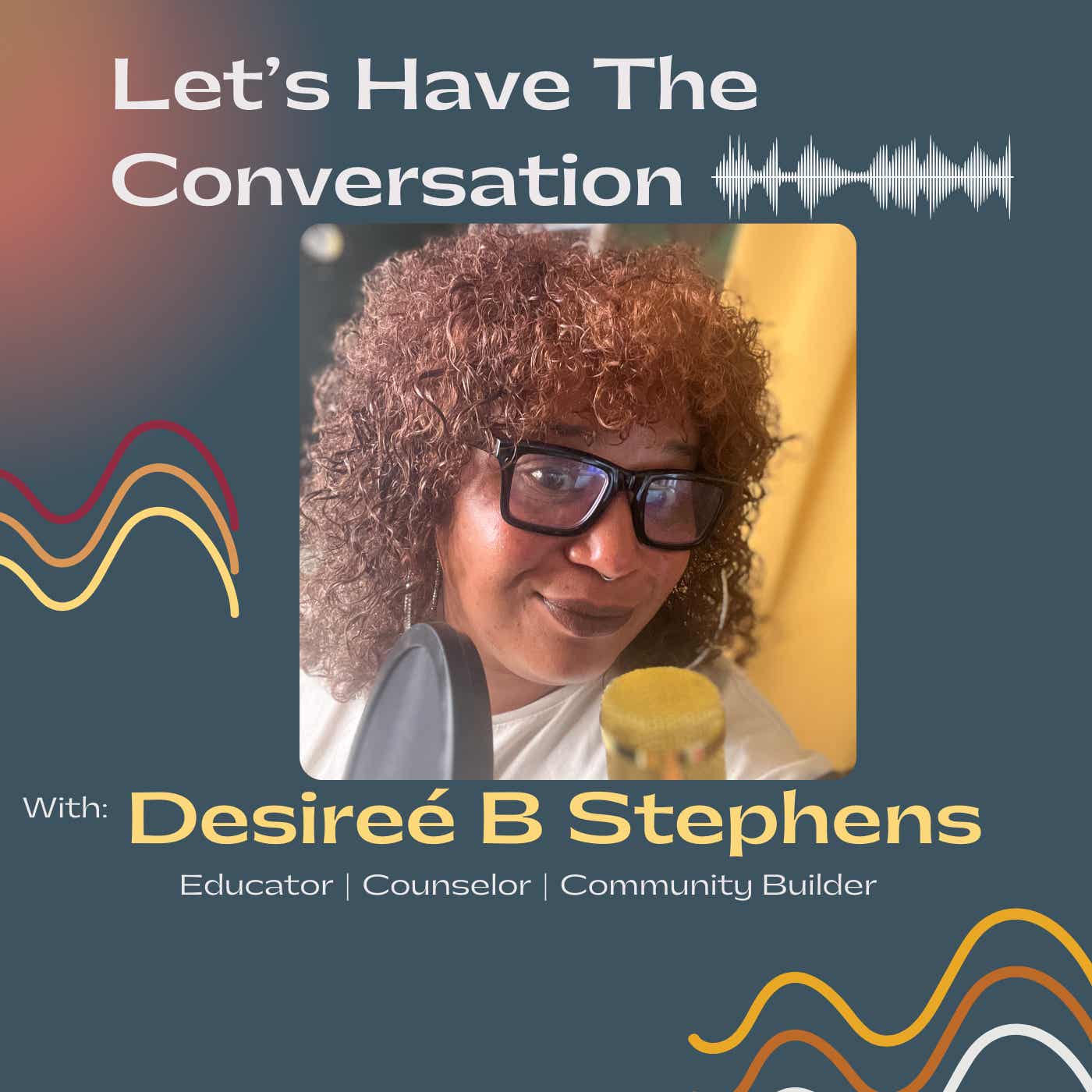
PODCAST · education
Let’s Have The Conversation
by Desireé B Stephens
Desireé B. Stephens, CSP-P, is an educator, counselor, and community builder who leverages her TikTok platform to advocate for anti-oppression, pro-liberation perspectives, and paths to holistic healing. As a public speaker and modern-day philosopher, Desireé invites us to reflect on the world’s complexities through a lens of intersectionality, dismantling constructs and binaries that hinder collective freedom. Her mission is to spark transformation—one conversation at a time. Join the movement to get free, together! https://desireebstephens.bio#makeshifthappen #decolonizeeverything #desireebstephens #letshavetheconversation #DEI #publicspeaker #rethinkingwhieness desireebstephens.substack.com
-
187
Friday with Friends: Astrology of Liberation with Leah Tioxon
This is a free preview of a paid episode. To hear more, visit desireebstephens.substack.comYou Were Never SeparateBefore we begin…Take a breath.Not to center yourself.Not to “get grounded.”Not to do it right.Just notice that your body is already breathing for you.That rhythm?That pulse?That quiet, steady inhale and exhale?You didn’t create that.You are being lived.And that is where we begin.This Was Never About AstrologyLet me tell you the truth about that Friday with Leah.We didn’t sit down to “learn astrology.”We sat down to remember something that was never supposed to be taken from us in the first place.Because before charts became content…Before birth data became algorithms…Before intuition became something you had to “prove”…There was knowing.There was relationship.There was a time when people understood themselves as part of the sky—not separate from it.And what I felt in my body as Leah began speaking wasn’t “Oh, that’s interesting.”It was:I know this.What Supremacy Culture Had to SeverLet’s be clear about something.Supremacy culture does not just operate through systems and institutions.It operates through disconnection.* Disconnection from body* Disconnection from land* Disconnection from intuition* Disconnection from cycles* Disconnection from spirit* Disconnection from each otherBecause if you are disconnected…You can be controlled.If you do not trust your body…You will look outside of yourself for authority.If you do not trust your intuition…You will wait for permission.If you do not understand cycles…You will believe urgency is natural.But it’s not.Urgency is trained.Disconnection is trained.And what I experienced on Friday was the opposite of that training.The Sky Is Not Above YouOne of the most harmful things we’ve been taught is that the sky is something “out there.”Something to observe.Something to study.Something separate.But that’s not how our ancestors understood it.The stars were not decoration.They were relationship.They were guidance.They were timing.They were reflection.And your chart?It is not telling you who to be.It is showing you the language your soul already speaks.Not a script.A mirror.What It Felt Like to Be SeenLeah didn’t “read” me.She reflected me.She named things I have lived.Things I have resisted.Things I have grown into.And what struck me wasn’t the accuracy.It was the recognition.Because your body knows when something is true.Not because it makes sense.But because it resonates.And that’s the part supremacy culture tries to override.It tells you:* “That’s not logical.”* “That’s not proven.”* “That doesn’t make sense.”But truth was never meant to live only in the mind.Truth lives in the body.And when she spoke, my body didn’t question.It softened.🔒 For Paid SubscribersWhat My Chart Reflected Back to MeWhat became clear in that space is something I want you to sit with gently.I am not building a life from scratch.I am (re)membering one. (and you are too)A life where:* I don’t move from urgency* I don’t perform certainty* I don’t wait until I can explain something to live itI move when it’s true.Even when it doesn’t make sense yet.Even when I can’t articulate it.Even when it disrupts expectations.And if you’re reading this…There is somewhere in your life where you are already doing that.And somewhere else where you are still being asked to trust it.
-
186
The Day of Oaths, The New Year, and the Return to Practice
This is a free preview of a paid episode. To hear more, visit desireebstephens.substack.comWhat I shared in the live wasn’t just about March 25th.It was about orientation.It was about telling the truth about where you actually are in your life… not where the calendar tells you you should be.Because the truth is… what you’ve been taught about time, about “new year,” about when you’re supposed to begin again… is not neutral.It was constructed. And once you see that, something in you starts to loosen.Because then the question becomes:If all of that was decided for me…what is actually true for my life?This moment right here —this threshold between renewal and becoming— is a true beginning.Not because I said it.Because you can feel it.Things are moving.Things are softening.Things are asking to come alive again.And for me… this is real in a way I can’t ignore.This is my first time returning to the garden since my separation.And now I’m back.Not the same.Not where I was.But here.And that matters.Because renewal isn’t instant.It takes time to come back to yourself.It takes time to rebuild capacity.To reclaim what was yours.To return to something with new awareness.So when I talk about this season, I’m not talking in theory.I’m talking about lived return.And this is where I want to shift you.Because this is not about resolution.This is not about fixing yourself.That’s supremacy culture.That constant hum that tells you:you’re not enough yetyou need to improveyou need to be betterNo.This moment is not asking you to fix anything.It is asking you to tell the truth.If you’re ready to go deeper into this—into actually working with this moment as a threshold, as a true new year, as a place of commitment instead of correction—I’ve opened up the full piece.Inside, we move into:A guided Oath practice you can walk with tomorrowPractice Your Praxis across Self, Home, and Work so this becomes lived—not just understoodJournal prompts pulled directly from this conversation to help you name what you’re actually ready forAnd a deeper truth about how days like this were slowly reframed and absorbed—so you lost access without even realizing itThis is not about information.This is about (re)orientation.Become a Paid Subscriber$10/month$100/year$150/year — Equity Partner (helps fund scholarships and expanded access)Scholarships are available:[email protected] you’ve been wanting to contribute something but don’t have enough for a subscription (and don’t feel aligned taking a scholarship)You can send what you can via Venmo:https://account.venmo.com/u/DBStephensPut your email in the note and I’ll add you to the paid subscriber list.And if you just want to tipI receive that too.This work is sustained through relationship, not extraction.
-
185
Renewal into Becoming
This is a public episode. If you'd like to discuss this with other subscribers or get access to bonus episodes, visit desireebstephens.substack.com/subscribe
-
184
The Unfolding of Relationships in Community Building
This is a free preview of a paid episode. To hear more, visit desireebstephens.substack.comThe Unfolding.Not the outcome.Not the clarity.Not the resolution.But the space where relationships are still becoming.And if we’re honest, this is the space many of us struggle to stay inside of.Because we have been conditioned to believe that relationships should make sense quickly.That we should know what something is.Where it’s going.What it means.But relationships (real ones) don’t work like that.They unfold.And the way we respond to that unfolding…determines the kind of community we are actually capable of building.The Discomfort of the UnfoldingOne of the things that surfaced in the conversation is how quickly we try to resolve what feels uncertain.We want to define the relationship.Name the dynamic.Decide what something means.But often, what we are actually trying to do…is escape the discomfort of not knowing.Because uncertainty requires presence.It asks us to stay in something before it has revealed itself.And many of us were never taught how to do that.We were taught to:Fix it.Label it.Control it.Or leave it.But staying?Staying is a different kind of work.When Control Disguises Itself as ClarityAnother layer that came forward is how often we call something “clarity”…when what we are really reaching for is control.We say we want answers.But what we often mean is:“I want this to resolve in a way that feels safe for me.”Control tries to move the relationship forward faster than it is ready to go.It tries to define something before it has had time to reveal itself.But when we do that…we limit what the relationship could have become.Because unfolding requires space.And control collapses that space.This work is sustained through community.If this reflection is supporting you…If these conversations are helping you think, feel, and practice differently…If you are building alongside this work…I invite you to step deeper into this space.Paid subscribers receive full access to companion articles, praxis tools, and deeper reflections designed to support your daily practice of liberation.$10/month$100/year$150 Equity Partner tier (helps sustain scholarship access for others)Scholarships are always available.You can reach out at [email protected] because I’ve heard so many of you say,“I want to contribute something, but I’m not quite there yet…”You now have another option.You can pay what you can via Venmo and include your email in the note.I’ll add you to the paid subscriber list.And if you simply want to tip to support the work, I receive that with gratitude as well.Venmo:👉 https://account.venmo.com/u/DBStephensThis work is not built alone.It is built in relationship.Thank you for being here.
-
183
Friday with Friends: Orienting to Someone’s Good
This is a free preview of a paid episode. To hear more, visit desireebstephens.substack.comThis morning during Friday with Friends, we sat with a phrase that has been unfolding throughout the conversations this week:Orienting toward someone’s good.Not the idealized version of love.Not the sentimental version.But the version that shows up when relationships are complicated.When communities hold different views.When people are still learning how to be in relationship with one another.The phrase comes from an older definition of love that I referenced earlier this week while reading Prentis Hemphill’s book What It Takes to Heal.In the final chapter, Hemphill references an older theological definition of love attributed to Thomas Aquinas:To love is to will the good of another.Hemphill expands on that idea with a line that stopped me in my tracks:“I think love is when you will another’s existence.”That definition stretches love far beyond romance.It shows up in parenting.In friendships.In community.In the daily decisions we make about how we will treat one another even when we disagree.Because love is not just something we feel.Love is the direction we face in relationship to another person.And that direction matters.Love Is an OrientationDuring the conversation I shared something that many of us were never taught:Love is not just an emotion.Emotion is fleeting.Emotion rises and falls depending on the moment.If love depended entirely on emotion, most relationships would collapse the moment conflict appeared.But love as orientation is different.Orientation is about the direction you choose to face.Even when you are frustrated.Even when you are disappointed.Even when the relationship is complicated.Orienting toward someone’s good means refusing to reduce someone to their worst moment.It means holding the possibility that a person is capable of growth.It means refusing to abandon someone’s humanity.That does not mean ignoring harm.It means refusing to dehumanize people in the process of holding accountability.This distinction is critical if we want communities that can survive conflict.Orientation Does Not Mean AccessAnother point I emphasized during the live conversation is something people often misunderstand.Orienting toward someone’s good does not mean they automatically get access to you.Repair does not always mean reconnection.Loving someone does not mean allowing them back into your life.You can orient toward someone’s humanity and still recognize that they are not safe for you.Boundaries are not the opposite of love.Boundaries are often what protect love from becoming harm.This is where many of us get stuck.We think compassion requires unlimited access.But real relational maturity requires us to hold both truths at the same time:You can wish someone well.And still choose distance.You can believe someone is capable of growth.And still recognize that growth may need to happen outside of your space.This is not cruelty.This is clarity.Community Requires This PracticeThe conversation then moved into something larger than individual relationships.Community.Because the truth is that community cannot exist without this orientation.If every disagreement leads to exile…If every mistake becomes permanent identity…If every conflict leads to abandonment…Then community becomes impossible.Real community requires people who are willing to stay oriented toward each other’s humanity long enough for growth to occur.Not blindly.Not without accountability.But with the understanding that relationships are living systems.They evolve.They change.They unfold.And if we rush to judgment before that unfolding has a chance to happen, we destroy the very thing we claim to want.Community is not built through perfection.Community is built through practice.Where Liberation LivesThis is where this conversation connects directly to The Liberation Method.Liberation is not simply political theory.Liberation is relational practice.If we cannot remain oriented toward each other’s humanity, we will simply recreate the same punitive systems we claim to resist.Liberation requires something harder.It requires us to hold accountability without dehumanization.It requires us to create communities where growth is possible.It requires us to practice repair while still honoring boundaries.This is not easy work.But it is necessary work if we want to build communities capable of transformation.Support Liberation EducationLiberation Education is sustained by readers who believe in this work and want to help keep these conversations accessible.There are several ways to support:Monthly Subscriber$10 / monthAnnual Subscriber$100 / yearEquity Partner$150 / yearEquity Partners help make it possible for others to access this work through scholarships.Scholarships are always availableIf you would like access but finances are a barrier, simply email:[email protected] explanation required.Pay What You CanMany readers have told me:“I want to contribute something, but I don’t have enough for a subscription.”Or“I don’t need a scholarship, but I’d still like to support the work.”So now there’s another option.You can contribute whatever feels aligned via Venmo.👉 https://account.venmo.com/u/DBStephensIf you would like to be added to the paid subscriber list, simply include your email address in the Venmo note and I will add you manually.And if you just want to leave a tip to support the writing and conversations…I gratefully receive those too.Every contribution helps sustain the time, care, and energy required to hold these conversations and continue building Liberation Education.
-
182
The Unfolding of Love in Community Building
This is a free preview of a paid episode. To hear more, visit desireebstephens.substack.comDuring today’s conversation we explored something many people say they want, but few of us are actually taught how to practice.Community.Not the idealized version.The real version.The version that includes repair, tension, growth, and people learning how to stay in relationship with one another while things are still unfolding.Community building sounds beautiful in theory.But in practice, it asks something much more difficult of us.It asks us to remain in relationship long enough for transformation to occur.It asks us to leave space for repair.And sometimes, it asks us to orient toward someone’s good even when the relationship itself is complicated.The conversation opened with a reflection from Prentis Hemphill’s book What It Takes to Heal and a line that landed deeply in my body.“I think love is when you will another’s existence.”That definition of love stretches far beyond romance.It shows up in parenting.In friendship.In community.And in the ways we decide whether or not we are willing to make space for someone’s becoming.Even when the relationship itself is still unfolding.Leaving Space for RepairDuring the live conversation, I shared a story from Shady’s birthday party.Her father and I have a complicated history.Separation, divorce, and new family structures often bring tension and unanswered questions about what relationships are supposed to look like afterward.But during the party he video called her.And when she saw his face, her whole energy shifted.She lit up.That moment did not erase the complicated parts of our history.But it reminded me of something important.Repair does not always arrive in perfect form.Sometimes repair simply begins with leaving space for it to happen.Leaving space does not mean ignoring harm.It means recognizing the difference between being responsible for someone’s work and being responsible to the relationships that still exist.I am not responsible for another adult’s healing or growth.But I am responsible to my children.Responsible to leave space for them to navigate what repair might look like in their own relationships.That distinction changes everything.🔒 Continue ReadingThe rest of this piece explores:• why orienting toward someone’s good changes how we approach community• the difference between responsibility and control• how matriarchal frameworks invite children into accountability and repair• and why liberation work must live in Self, Home, and WorkPaid subscribers help sustain the time and care required to hold these conversations. If you need a scholarship, please email [email protected]
-
181
The Responsibility Shift: Care, Power, and Liberation
This is a free preview of a paid episode. To hear more, visit desireebstephens.substack.comSome conversations are not meant to be summarized.They are meant to be sat with.The live gathering this week began simply. No guest scheduled. Just a moment to pause together, reflect, and let the threads of recent conversations come into relationship with each other.What emerged was something deeper than a casual conversation.It was a return to a distinction that has shaped my work for years.A shift that first landed for me in therapy around 2015.A shift that many of us are still learning how to live.The difference between being responsible for and being responsible to.At first, it sounds subtle.But in practice, it changes everything about how we understand care, power, leadership, and liberation.And right now, many of us are standing inside a moment where this distinction matters more than ever.Before we go further, pause.Notice your breath.Notice your body where you are sitting.There is nothing here you need to solve.Only something to notice.Many of us were trained to believe that care means carrying.Carrying other people’s feelings.Carrying other people’s healing.Carrying the emotional stability of the room.Carrying responsibility for the outcome of every interaction.This pattern often hides behind language that sounds compassionate.Helping.Supporting.Being the strong one.Holding it all together.But over time, something subtle happens.Care turns into over-responsibility.And over-responsibility quietly reproduces the same power dynamics many of us are trying to dismantle.Because when one person becomes responsible for everything, power concentrates there… YES… Even when the intention was love. Even when the intention was protection. Even when the intention was justice.Liberation work requires something different.It asks us to shift from responsibility FOR to responsibility TO.Responsibility to truth.Responsibility to relationship.Responsibility to our own integrity.Responsibility to the conditions that allow others to hold their own agency.This shift does not reduce care.It makes care honest.The Responsibility TrapThe nervous system learns early that safety often comes through usefulness.Many of us learned that if we could:* anticipate needs* manage emotional climates* prevent conflict* keep everyone regulatedthen we would remain safe inside the systems we lived in.Over time, that becomes identity.The fixer.The stabilizer.The one who handles everything.From the outside, this can look like leadership.But inside the body, it often feels like exhaustion.This pattern shows up everywhere:in familiesin activist spacesin workplacesin community leadershipin relationshipsAnd because it is often praised, it becomes difficult to question.But liberation requires questioning it.Because systems built on over-functioning individuals cannot become sustainable communities.They simply create quieter hierarchies.The Moment We Are InPart of what made this conversation land so strongly this week is that many people are noticing a shift.A subtle but undeniable moment of reckoning.Something many have been carrying for others is becoming harder to maintain.The emotional math no longer balances.The body knows something is complete, even if the mind has not yet caught up.Some people feel this as fatigue.Some feel it as irritation.Some feel it as grief.Some feel it as a quiet clarity they cannot fully explain yet.Nothing about that experience is accidental.There are moments in the larger cycles we move through where truth becomes harder to postpone.Where maintaining the old patterns requires more energy than releasing them.Where the cost of carrying what is not ours becomes visible.These moments are not punishments.They are invitations to recalibrate responsibility.What the Responsibility Shift Actually MeansShifting from responsible for to responsible to changes how care operates.Responsible for means:* managing other people’s outcomes* preventing discomfort* fixing what others avoid addressing* holding emotional labor indefinitelyResponsible to means:* telling the truth* honoring your limits* allowing others their agency* remaining present without over-functioningThis distinction protects relationship.Because relationships built on responsibility for eventually collapse under resentment or exhaustion.Relationships built on responsibility to allow power to distribute.And liberation requires distributed power.Not heroic individuals carrying the room.🔒 The Work of the Responsibility ShiftLiving Liberation Without Carrying What Was Never YoursIf you are here, something in this conversation likely resonated.Maybe you recognized yourself in the pattern of over-responsibility.Maybe you felt the quiet exhaustion that comes from always being the one who stabilizes the room.Or maybe something in your body simply said:Yes. This is the conversation.Before continuing, pause again.Notice your breath.Let your shoulders drop even slightly.Nothing in this section requires urgency.The work here is not about becoming someone new.It is about releasing roles that were never meant to belong to you forever.The remainder of this companion article explores:• the somatic patterns that keep us over-responsible• how moments of collective reckoning reveal what we’ve been carrying for others• the full application of the LIBERATE Framework© for this moment• embodied inquiry and reflective practice• Practice Your Praxis across Self, Home, and WorkPaid subscribers also receive access to:• the full replay of the live conversation where this reflection began• deeper integration prompts to continue the workThis space is paywalled intentionally.Not to restrict access, but to protect depth and pace.Liberation work cannot be rushed.It requires containers where reflection can unfold slowly, honestly, and in relationship.If you are ready to continue the work, the door is open. If you need a scholarship to acess, please email [email protected]
-
180
Learning How To Stay
Before you read further, pause.Notice your breath without changing it.Notice your jaw.Notice your shoulders.Notice your seat beneath you.If anything in this piece feels activating, you are welcome to stop.You are welcome to skip.You are welcome to return later.You are not behind.Your body is not wrong.Your pace is intelligent.This month, we are working with staying.Not enduring.Not forcing.Not performing.Staying.What Staying Actually MeansIn today’s live, we moved through three anchors:* Staying in your body* Staying without fawning* Staying through tension builds communityLet’s go deeper.Staying in Your BodyMost people believe they are staying in conversations.Many are not.They are mimicking listening.They are smiling.They are explaining.They are apologizing.But internally, they have left.Dissociation is not always dramatic.Sometimes it is subtle.Sometimes it is politeness.When you leave your body, you cannot discern:Am I uncomfortable?Or am I being harmed?Those are not the same.Supremacy culture trains us to collapse discomfort into harm.Or to override harm as “just discomfort.”Neither builds community.Staying in your body means feeling the chair beneath you.The floor beneath your feet.The tightening in your jaw.The heat in your chest.And asking:What is this?Where have I felt this before?Is this about now?Or then?Capacity is built in that pause.Not in toughness.Not in bracing.Endurance says, “Just get through it.”Staying says, “I am here. I can choose.”Staying Without FawningFawning is the most socially rewarded trauma response.It keeps the peace.It lowers your voice.It smooths the edges.It says “It’s fine” when it is not.In the live, we named how this shows up especially across race and gender socialization.Fawn collapses your spine.It tightens your jaw.It lifts your voice into performance.You disappear.And when you disappear, community becomes harmony without connection.Harmony is not connection.Harmony can sound beautiful and still be hollow.Connection can hold tension.Staying without fawning means:You do not escalate.You do not shrink.You remain.That is sovereignty.Not domination.Not aggression.Presence.Staying Through Tension Builds CommunityCommunity does not fracture because of conflict.It fractures because of incapacity.Because we were not taught repair.Because we were not taught how to remain in rupture long enough to metabolize it.Supremacy culture trains exit:Sense of urgencyFear of open conflictDefensivenessRight to comfortAll of these pillars teach you to leave.Conflict is not the threat.Incapacity is.The ability to stay in tension without collapsing or controlling is what makes repair possible.Repair does not always mean reconnection.It means we did not run.Staying is community infrastructure.Without it, nothing sustainable can be built.The Framework of Staying: Who • What • When • Where • Why • HowStaying is not abstract.It needs language.It needs discernment.It needs orientation.When discomfort arises, instead of reacting immediately, you can move through six regulating questions.Not as interrogation.As grounding.WhoWho is involved?Who am I in this moment?Am I the child?The authority?The protector?The professional?Who am I reacting to?The person in front of me?Or someone from my past?This question interrupts projection.WhatWhat is actually happening?Not what I fear.Not what I assume.What was said?What was done?What is observable?This question interrupts catastrophizing.WhenWhen have I felt this before?Is this now?Or is this familiar?When did I learn to respond this way?This question interrupts trauma looping.WhereWhere do I feel this in my body?Jaw?Chest?Stomach?Hands?Where am I located physically?This question brings you back to embodiment.WhyWhy does this matter to me?Is this about values?Safety?Identity?Power?Belonging?Why am I activated?This question restores agency.HowHow do I want to respond?Not react.Respond.How can I keep my shape?How can I stay without shrinking or controlling?This question builds capacity.Somatic PausePause here.Unclench your teeth.Drop your shoulders.Feel your feet.You are not failing at this work.You were not taught this.You are learning it now.If something in this piece is surfacing grief, let it.This is grief work.This is trauma work.This is decolonization in the nervous system.Take a sip of water.Look around your room.Name one object.You can continue when you are ready.PRACTICE YOUR PRAXISThese are invitations, not assignments.Take what supports you.SelfWhen discomfort arises this week, ask:Am I uncomfortable?Or am I being harmed?Sit with the sensation for 90 seconds before reacting.If it feels like too much, you can say:“I need to put a pin in this.”That is staying without collapsing.HomeNotice where harmony is prioritized over connection.Is there a conversation being avoided?You do not need to initiate it immediately.Begin by noticing what your body does when tension enters the room.That awareness is the first step toward repair.WorkWhere do you fawn in professional spaces?Is your voice shifting?Is your posture collapsing?Are you over-explaining?Experiment with one clear sentence that keeps your shape.You are allowed to take up space in your own body.Further ResourcesIf this piece stirred something and you would like structured ways to continue, here are grounded next steps:• The 15 Pillars of Supremacy Culture — foundational language for understanding how urgency, defensiveness, right to comfort, and fear of open conflict shape our nervous systems and our communities.• 2026 Astrology as Nervous System Orientation With Leah Tioxon — This year’s astrological landscape of liberation• Somatic Sunday (First Sundays) — a donation-based, regulation-centered practice space where we build capacity in real time.•The Inconvenient Truths of Community — A bi-monthly collaboration with Zawn Villines of Liberating Motherhood.You do not need to engage all of this at once.Capacity builds slowly.Layer by layer.Conclusion: Staying Is InfrastructureMarch does not ask you to be certain.It asks you to remain.To stay in your body long enough to discern.To stay in tension long enough to metabolize.To stay in community long enough to repair.You do not need to endure everything.You do not need to reconcile with everyone.You do not need to collapse to keep peace.You can stay and keep your shape.That is sovereignty.That is capacity.That is how community survives rupture.Take a breath here.Feel your feet.Feel your spine.You are not behind.You are building something new inside your own nervous system.A Note on Sustainability, Care, and SupportToday’s article is free.Not because this labor is light.But because accessibility matters.This is my work.This is my profession.This is how I sustain teaching, writing, facilitating, and holding nuanced space without burnout or urgency.If this work supports you and you have the means, paid subscriptions help sustain the container.If financial barriers exist, scholarships are available.You can email:[email protected] is no pressure.There is transparency.Sustainable liberation requires sustainable labor.And I am committed to building this in a way that honors both.In solidarity and liberation,Desireé B. StephensEducator | Counselor | Community BuilderFounder, Make Shi(f)t HappenWriter of Liberation EducationSteward of Selenite & Sage Healing Homestead Co.Where Reflection Meets TransformationThank you Susan, Suz, Dinah Chapman, Joel Nevison, Ingrid, and many others for tuning into my live video! Join me for my next live video in the app. This is a public episode. If you'd like to discuss this with other subscribers or get access to bonus episodes, visit desireebstephens.substack.com/subscribe
-
179
On why #sayhername breaks solidarity
A Reflection on Naming, Erasure, and the Refusal to DisappearThis conversation was never meant to be comfortable.If you listened and felt your chest tighten, your jaw clench, your impulse to defend rise— good. That is not punishment. That is information.As I said in the live: critique is not punishment, and conflict is not harm. Conflict is how truth reaches the surface when systems depend on silence to survive.So before we go any further, pause with me.Take a breath.Drop your shoulders.Move your body—just a little.Drink some water.Not to escape the discomfort, but to stay with it.Because staying is how solidarity is built.Why #SayHerName Exists — and Why That History MattersOne of the central clarifications in the live was this:#SayHerName is not a universal slogan for all state violence.It was created by Black womanists (thank you Phree DeGraphenreed for the correction) to confront a very specific and brutal erasure: the disappearance of Black women and femmes from public memory when they were killed by police and the state.Black women were being murdered and then erased, reduced to mugshots, violent language, traffic stops, or not named at all. Their humanity was systematically stripped away.Saying their names was a reclamation of personhood.A name is the most human thing we have.It is why deadnaming is violence.It is why erasure works so efficiently.That context matters, not as trivia to see who is the most woke, but as lineage.When #SayHerName is used without regard for that history, it stops being a disruption of erasure and becomes something else entirely: a flattening of struggle that centers comfort over precision.And precision is not divisive. It is respectful.Renée Good Was Not Erased — She Was KilledRenée Nicole Good was a 37-year-old U.S. citizen.A mother of three.A poet.A partner.A neighbor.She was shot and killed by an ICE agent during a federal operation. Her life has been extensively documented, humanized, contextualized. Her family, her love, her community have been named.This matters.Because Black women were and are denied that humanity entirely.As I said plainly in the live: Black women were never offered grace, never named mothers or community members. We were barely allowed womanhood at all.To reflexively reach for #SayHerName here is not solidarity. It is narrative convenience.It allows white women to bypass naming the violence of whiteness itself (especially the violence enacted by white men) by borrowing a framework that was never meant to hold that story.And that avoidance has consequences.What “I AM RENÉE GOOD” RefusesThis is where the refusal begins.In the live, I named this clearly: “I AM RENÉE GOOD” is praxis.Praxis is where theory meets the body. It is what you do after you know better.Saying I AM RENÉE GOOD does three critical things:* It gives white women their own voice, instead of folding into another struggle.* It names whiteness as a site of violence, not just privilege or protection.* It directly opposes the patriarchal rally cry of “I am Charlie Kirk.”White men have always named themselves. Loudly. Violently. With entitlement.White women, by contrast, have been taught to disappear… into marriage, into movements, into other people’s pain.“I AM RENÉE GOOD” refuses that disappearance.It says:I see the violence.I name where it comes from.I will not hide behind borrowed language.As I said in the live: if they are “I am Charlie Kirk,” then you are Renée Good, and the refusal to say that is how white feminine disappearance sustains patriarchy.Solidarity Requires Location, Not CollapseThis work is not about separation. It is about location.True intersectionality does not mean sameness.True community does not require collapsing difference.True solidarity asks each of us to name where we stand.As I shared early in the live, even within Blackness, experience is not monolithic. Recognition of difference is how supremacy loses its grip.So imagine this instead:You say “Say Her Name” for Black women because you understand why it exists.And you say “I AM RENÉE GOOD” because you understand where you stand.That is not competition.That is coherence.Practice Your PraxisBecause embodiment matters, here is how this lands beyond theory:Self* Practice saying “I am Renee Good” slowly and notice what arises* Journal where fear of conflict shows up in your body* Ask: What am I being invited to face?Home* Talk openly about erasure vs absorption* Model conversations where accountability and care coexist* Practice staying present instead of “keeping the peace”Work / Community* Use language with intention and lineage* Say #SayHerName with reverence for Black women* Say I AM RENEE GOOD to name your own location* Treat conflict as information, not failureA Note on SustainabilityThis work is my job.If this writing, these conversations, and this holding matter to you, consider becoming a paid subscriber so this work can continue sustainably:* $10/month* $100/year* $150/year as an equity partnerIf financial barriers exist, no questions asked scholarships are available [email protected] you have some capacity but not all, I’m happy to offer pay-what-you-can options via Cash App, PayPal, or Venmo. Please put your email in the message area so I can apply the year comp.Thank you for supporting this work.ClosingNothing will change unless it is faced… externally and internally.Not through slogans.Not through erasure.But through embodied truth.That is how solidarity deepens, not dilutes.In solidarity and liberation,Desireé B. StephensEducator | Counselor | Community BuilderFounder, Make Shi(f)t HappenWriter of Liberation EducationSteward of Selenite & Sage Healing Homestead Co.Where Reflection Meets TransformationThank you Mariana Bissonnette, Anni Ponder, Michelle C. Funk, Karmic 🌹, Michelle, and many others for tuning into my live video! Join me for my next live video in the app. This is a public episode. If you'd like to discuss this with other subscribers or get access to bonus episodes, visit desireebstephens.substack.com/subscribe
-
178
Friday with friends: Motherhood , Capitalism, and the radical act of loving ourselves first
This is a free preview of a paid episode. To hear more, visit desireebstephens.substack.comThere is a particular kind of disappearance that happens to mothers under capitalism.Not dramatic. Not sudden.Quiet. Incremental. Socially rewarded.In this Friday with Friends conversation, Deidre Keller and I traced that disappearance, not as a personal failure, but as a structural demand rooted in capitalism, patriarchy, Protestant work ethic, and inherited legal frameworks that have erased mothers for centuries.What emerged instead was something else entirely:a (re)membering of capacity, community, and love as liberation.About Deidré A. KellerDeidré A. Keller is the immediate past Dean of the Florida A&M University College of Law and a law professor currently teaching after previously serving as Associate Dean for Academic Affairs at Ohio Northern University, where she taught for ten years.Her legal scholarship sits at the intersection of intellectual property, personhood theory, and critical race theory. Before entering academia, Keller practiced law in Atlanta, Georgia.On Substack, she writes at the intersections of the personal and the political, exploring growth, care, and evolution with depth and clarity.1. Capitalism and the Disappearing MotherDeidré named what many mothers live but rarely hear spoken aloud:motherhood under capitalism is treated as a site of production.Care is extracted.Endurance is praised.Presence is optional.From grazing off children’s plates to being expected to hold crisis, success, work, and emotional labor simultaneously, the “good mother” is defined by how much she can absorb without breaking.And when she does break, the system calls it personal weakness.ReframeCapitalism does not only exploit labor.It extracts care, and mothers are expected to provide it endlessly, invisibly, and without cost.What gets labeled strength is often just unsupported survival.Reflection* Where in your life have you been praised for holding too much?* What has been called resilience that was actually necessity?* What did your body carry last year that no one saw?
-
177
Community and all it entails
The Longest Night, and the Work of StayingBefore you read further, I want to offer you choice.You are welcome to pause.You are welcome to skim.You are welcome to come back later… or not at all.Nothing here requires urgency.Nothing here demands resolution.If it’s available, take a moment to notice your body:* where you’re seated or resting* the temperature around you* one place you feel contact or supportYou are not behind.Your body is already doing the work.This reflection comes from a recent live conversation during the solstice, shaped by grief, joy, nervous-system awareness, and the layered work of communityCommunity Beyond the BinaryWe are taught (quietly and persistently) that community is about showing up for the good parts.Celebrations.Ease.The moments that photograph well.But real community lives somewhere else.It lives in the in-between:* when joy and grief share the same breath* when love exists without fixing* when discomfort doesn’t automatically mean dangerThe solstice gathering I spoke about in the live was not clean or simple. It was layered. Tender. Awkward in places. Deeply loving in others. It required discernment rather than performance.And that’s the part I want to name clearly:Community is not proven by attendance.It is revealed by capacity.Capacity to stay present.Capacity to tell the truth without centering yourself.Capacity to let grief exist without rushing it into a lesson.Supremacy culture trains us toward binaries:good / badsafe / unsaferight / wrongBut the body doesn’t live in binaries.The nervous system lives in nuance.What I witnessed (and what I was navigating internally) was the work of staying human in a space where:* trust was built through honesty, not denial* alignment mattered more than agreement* grief was permanent, not procedural Grief is not a process, but a permanent experience. Grief is love’s last offering. We should run to it, rather than from it. - Zawn Villines (from the article linked below👇🏽)That is not accidental. That is practiced.This recap/article is a wee bit shorter because the live truly complimented the article written, so as to not inundate you with my one million and one thoughts, I will embed the article that gave birth to the live:🌬️Regulation Pause (Please Take This)This is a good place to stop for a moment.If it feels supportive:* take one slow breath in through your nose* let it out through your mouth or sigh* gently look around the room and name three neutral objectsYou are allowed to take breaks from depth.Depth will still be here if and when you return.Practice Your PraxisYou do not need to do all of these.You do not need to answer them now.You may simply notice what lands.SELF: Capacity Before PerformanceReflection:* Where do you feel pressure to show up well instead of show up honestly?* What sensations arise when you are near grief that isn’t yours?* How do you know… in your body, when you’ve reached your limit?Reframe:Self-praxis is not about being braver.It is about being more honest with your capacity.You are allowed to stay and you are allowed to leave.Both can be acts of integrity.HOME: Truth as SafetyReflection:* Where have you softened or withheld truth to keep the peace?* What happens in your body when honesty is met with trust instead of dismissal?* How do you prepare the people you love for complexity without fear?Reframe:Safety is not created by pretending harm doesn’t exist.Safety is created through relationship, preparation, and choice.Telling the truth (especially to children) is not harm.It is respect.WORK / COMMUNITY: Discernment Is the WorkReflection:* Do you feel pressure to address every misstep immediately?* How do you decide what needs confrontation versus what needs noting?* Who benefits when you pause instead of perform?Reframe:Not every moment requires correction.Not every discomfort requires action.Community care is not purity culture.It is discernment, timing, and consent.Repair requires staying—not rushing.Journey Deeper Become a paid subscriber of Liberation Education NewsletterPaid subscription supports:* slower writing* nervous-system-aware teaching* work that is not optimized for urgency or viralityThis space allows me to write with you, not at you.If access is a barrier, scholarships are available: [email protected] explanations required.Sustainability includes you.Closing IntegrationAs you finish (or pause), see if you can return to your body again.Notice:* one place that feels softer than when you began* one insight that doesn’t need to be acted on* one permission you’re taking with youThe Season of Self is not about fixing or figuring out.It is about learning what you can hold —and honoring what you cannot.You are allowed to move slowly.You are allowed to stay human.Happy Holidays, and Blessed Solstice In solidarity and liberation,Desireé B. StephensEducator | Counselor | Community BuilderFounder, Make Shi(f)t HappenWriter of Liberation EducationSteward of Selenite & Sage Healing Homestead Co.Where Reflection Meets TransformationThank you Zawn Villines, Susan, Suz, Ana Sheree, Pega Love, and many others for tuning into my live video! Join me for my next live video in the app. This is a public episode. If you'd like to discuss this with other subscribers or get access to bonus episodes, visit desireebstephens.substack.com/subscribe
-
176
Colonized bodies, Supremacy Culture, and the work of Reclamation
This is a free preview of a paid episode. To hear more, visit desireebstephens.substack.comMost of us were taught that faith lives in the mind.Belief. Doctrine. Theology.But long before Christianity told you what to think, it told you how to move.How to dress.How to sit.How to desire.How to discipline your body into obedience.This piece isn’t about taking anyone’s faith away.It’s about telling the truth of how faith was used, and what it cost our bodies.I didn’t realize how much faith lived in my body until I left home…Growing up Irish Catholic, my body learned reverence before it learned choice.Knees on hard pews.Hands folded just so.Eyes lowered.Silence as virtue.Church wasn’t loud. It wasn’t expressive. It wasn’t joyful.It was controlled.Years later, I walked into a Black church in the South and felt the shock hit my nervous system first.Movement.Music.Bodies alive with spirit.My first thought wasn’t curiosity.It was judgment.That moment cracked something open for me, not because one expression was “right” and the other “wrong,” but because I realized how thoroughly my body had been trained to equate control with holiness.That’s when it clicked: (years later)Christianity didn’t just shape belief. It trained bodies.Why This Piece, Why NowThis essay lives in the Season of Self, the winter work of slowing down, taking inventory, and tracing what lives in us that we didn’t consciously choose.It also continues my ongoing arc through Decolonizing Faith, a series that asks hard questions about what we inherited, what we internalized, and what we were never told.This is not an anti-faith essay.It is an anti-propaganda one.Because propaganda works by flattening history, stripping context, and severing body from story.And Christianity (as it was weaponized through empire) did exactly that.This work is about unflattening.Returning faith to its political, material, and embodied realities.And letting people decide freely what they want to carry forward.Before We Go Any Further…I want to pause.During the live recording of Let’s Have the Conversation, Ariana shared that she had written a poem that mirrored our conversation and I asked for her permission to share it here because it captures (better than any analysis) the lived experience of what it means to have your body trained, surveilled, and disciplined long before you ever had language for it.This episode ran longer than some of the others, intentionally. The Season of Self asks us not to rush. It asks us to let what needs to surface… surface. And sometimes that looks like silence, tears, poetry, and truth arriving sideways instead of neatly on time.What follows is Ariana’s poem.Please read it slowly.Let it land where it lands.Family Resemblanceby Ariana Skeese Mirrors have alwayshaunted me.Your voicehas become my ownas I look at myreflection.I have always avoidedthem when possible,but I can’t help butglance as I rid myselfof traveling germs.“Stand up straighter.You look like ahumpback whale,”we tell me.I comply to this demandas I always have.“Comb your rat’s nestthis instant,”I hear as I rearrangemy wild curls.We continue to pickme apart as I standat the airport restroom mirror,a layer of fingerprints,softening the tearsthat well upin the corners of my eyesfine lines creeping in,making me lookmore like you each day.“Those shorts arevery unbecoming on yoursoft thighs,”we remind me.I notice the fleshy flapthat moves as I grabfor a paper towel.I know we don’t like it.I should have wornlong sleeves.I turn back,determined to findone quality we wouldlike in my reflection.My smile iswarm and inviting,I can camouflagepain entirely.My teeth are straightand a human shade of white.There’s somethingwe don’t hate.Before I turn,I hear our voiceremind me tonever wear this shirt again.It always catches on thelittle roll just above my waist.I quickly glance awaybefore it overwhelms.On my therapists advice,where we talkabout you often,I try to find one morething we don’t hate.I have grown strong and sturdy,just as you commanded.I “stay under controlin all circumstance,”just as you demanded.I am turning to leavewhen I glimpse youin the mirror.I imagine it is your ghostback for one last punchto my confidence.And that’s when I realizeit wasn’t a spiritbut a family resemblance.I know now why youtore me apart.Perhaps you saw Youin me too.Somatic Pause — Letting the Body Catch UpBefore we move on, take a moment.You don’t need to analyze what you just read.You don’t need to make meaning yet.If it feels accessible, notice your body right now.* Where did that poem land?* Was there a tightening, a softening, a holding of breath?* Did your shoulders rise, your jaw clench, your chest grow heavy?If you’re able, place one hand somewhere that feels grounding—your chest, your belly, your thighs.Let your body know you are here with it, not to correct it.Nothing needs to be fixed.Nothing needs to be explained.This is what it sounds like when supremacy culture moves through generations—when discipline, shame, and survival get mistaken for love. And it’s also what it sounds like when awareness begins to interrupt the pattern.Take one slow breath in.And a longer breath out.When you’re ready, we’ll continue.🔒 Paywall BreakThe next section moves from witnessing into analysis—from personal inheritance into the system that made this inheritance feel inevitable. We’ll name how Christianity, once aligned with empire, became a technology for bodily control—and how supremacy culture learned to live inside us.Paid subscribers receive the full essay, including:* a historical and embodied unpacking of Christianity as bodily governance* the specific supremacy culture pillars at work* reframes that return dignity to the body* and practices for reclaiming agency in the Season of SelfIf there is a financial barrier, equity scholarships are always available [email protected] you’re ready, you’re invited to cross the threshold.
-
175
The world is ending… and that might be a gift 🎁
It’s All Shadow Work: Grief, Colonial Christianity, and the End of the World as We Were Taught to Know ItBefore Christianity became empire,before it became doctrine,before it became justification for conquest,it began as a story of liberation.Bethlehem was not a seat of power.It was a small village under Roman occupation.A people longing not for heaven later, but justice now.Somatic pause:Take a breath.Let your shoulders soften.Feel where this story lands in your body.Because the version of Christianity most of us inherited did not remain in Bethlehem.It moved…through Constantine,through empire,through colonization,into the systems we are still living inside today.And that movement created shadow.From Bethlehem to Constantine: When Liberation Met EmpireWhat began as a relational, Jewish liberation movement was absorbed by Rome in the 4th century under Constantine.This was not just a theological shift.It was a political one.Christianity moved from the margins into the machinery of empire.Doctrine replaced relationship.Hierarchy replaced kinship.Control replaced care.And in order for empire to survive, something had to be suppressed.Grief, doubt, embodied spirituality, and ancestral memory, what could not be regulated was buried.This is how shadow is formed.Somatic pause:Notice if your jaw tightens or your breath shortens here.That’s information.Colonization Creates Collective ShadowColonial Christianity did not only steal land and culture.It trained bodies to suppress in the name of salvation.What couldn’t be expressed became buried:* grief* rage* ancestral wisdom* communal ways of knowing* body-based spiritualityThat buried material didn’t disappear.It became shadow.Today, that shadow shows up as:* perfectionism framed as holiness* disconnection from the body framed as morality* spiritual bypassing framed as faith* internalized inferiority and superiority framed as divine orderThis is not a personal failing.It is the inheritance of colonial Christianity.Somatic pause:Place one hand on your chest or belly.Ask quietly: What was I taught to bury in order to belong?Reframe:Shadow work is not about fixing yourself.It’s about remembering what was never sinful to begin with.From Constantine to the Doctrine of Discovery: When Faith Became PermissionOnce Christianity aligned with empire, it learned how to justify domination.By the 15th century, this theology became explicit through the Doctrine of Discovery, which declared that:* non-Christian lands were “empty”* Indigenous peoples were less than human* conquest was divinely sanctionedThis was Christianity as worldview.Christianity as weapon.Christianity as permission.The cross no longer signaled suffering under empire.It marched with empire.Somatic pause:Feel your feet on the ground.Let gravity remind you that you are here, now—not back there.Decolonization Is Grief WorkLiberation is not just reclaiming.It is mourning.Decolonization asks us to grieve:* what was stolen in the name of God* what was never passed down because it was burned or banned* what we had to become to surviveThis grief is layered:* personal* generational* collectiveFor many white-bodied people, this includes grieving:* severed European indigenous roots* Christianization as cultural erasure* belonging purchased at the cost of memoryAssimilation was not free.Safety came with a price.Somatic pause:If grief rises, let it.You do not need to explain it away.Reframe:Grief is not a sign that something is wrong.It is evidence that something mattered.Grief is not the opposite of liberation.It is the doorway out of empire theology.From Doctrine to Manifest Destiny to Project 2025The theological logic did not end with colonization.It evolved.Manifest Destiny baptized expansion.Christian nationalism reframed supremacy as morality.And today, we see the echoes clearly in Project 2025 a political theology rooted in:* Christian dominance* patriarchal control* the fear of demographic “replacement”* end-times urgencyThis is eschatology weaponized.Not the end of injustice, but the end of pluralism.Somatic pause:Notice what happens in your body when power feels justified by God.That sensation is ancient, and learned.Shadow Work Is Collective Because Colonization WasColonization fractured community on purpose.Christian empire replaced kinship with hierarchy.Individual salvation replaced collective care.So healing cannot happen privately what was broken systemically.Shadow work at this scale must be:* ancestral* communal* embodiedThis is why self-work alone will never be enough.Reframe:Decolonization is not about becoming “good.”It is about becoming honest—with history, grief, and complicity.Somatic pause:Ask yourself gently: Who am I trying to heal alone because community once failed me?Closing: When One World EndsColonial Christianity taught us to fear the end of the world.But what if what’s ending is not faith… but domination?Grief exists because love exists.Love for our ancestors.Love for futures we haven’t seen yet.Liberation does not begin with answers.It begins with acknowledgment.And healing grows, in community.Somatic pause:One final breath.Inhale through the nose.Exhale slowly through the mouth.You are allowed to grieve.You are allowed to remember.You are allowed to imagine something else.Practice Your PraxisFrom Shadow to Embodied LiberationThis work is not meant to stay theoretical.Decolonization lives in the body, the home, and the systems we move through every day.Practice your praxis slowly. There is no urgency here.SELF: Tending the Body Where Shadow LivesColonial Christianity taught many of us to distrust the body, to prioritize belief over sensation, obedience over intuition.Reclamation begins here.Practice* Sit or lie down comfortably.* Place one hand on your chest and one on your belly.* Take three slow breaths, lengthening the exhale.* Ask quietly: What grief has my body been holding that my faith never made room for?* Do not rush to answer. Sensation is enough.Reflection Prompts* Where do I feel grief, heaviness, or resistance when I think about religion, empire, or belonging?* What parts of my body learned to brace in the name of being “good” or “saved”?* What would it feel like to trust my body as a source of wisdom again?AffirmationMy body remembers what empire tried to erase. I listen without judgment.HOME: Disrupting Empire in the EverydayColonial Christianity didn’t just live in churches, it reorganized households.It taught:* hierarchy over mutual care* silence over truth* control over relationshipDecolonization at home is about shifting culture, not perfection.Practice* Choose one ritual this week that slows the pace of your household:* shared meals without productivity talk* lighting a candle for ancestors* collective rest without explanation* Name it aloud as an act of resistance.Reflection Prompts* Where does empire still shape my home life (urgency, hierarchy, silence)?* What would collective care look like in my household?* How can my home become a place where grief is allowed to exist without fixing?AffirmationMy home does not belong to empire. It belongs to care, truth, and rest.WORK: Naming and Interrupting Colonial LogicsEmpire theology taught us that worth is earned, suffering is redemptive, and urgency is holy.That logic still shapes workplaces, including justice spaces.Decolonization at work begins with awareness, not martyrdom.Practice* Notice one moment this week where urgency overrides care.* Pause.* Ask: Who benefits from this pace? Who is harmed by it?* If possible, name the tension aloud or choose a slower response.Reflection Prompts* Where does my work replicate productivity-as-worth?* How does Christian moralism show up in expectations of sacrifice or burnout?* What would it mean to center sustainability instead of saviorism?AffirmationMy value is not measured by output. Liberation requires sustainability.Reflection: Holding the ArcBethlehem offered a vision of liberation.Empire transformed it into domination.Colonization carried it across land and bodies.And now we are being asked to grieve what was lost and imagine something else.Closing Prompts* What version of faith am I mourning as it unravels?* What new possibilities become visible when I stop rushing to resolve the grief?* What kind of world am I willing to help build as this one ends?Somatic Closing PauseBefore you move on:* Take one slow breath in through the nose.* Exhale gently through the mouth.* Place a hand over your heart and whisper: I am allowed to grieve. I am allowed to remember.Next in the Series:Colonizing Bodies: How Christianity’s Control Over Gender, Sexuality, and the Body Shaped Systems of PowerWays to Journey DeeperChoose the ones your body has capacity for. Each offering is an invitation, not an expectation.✨ Creating Healthy Boundaries Workbook If you are seeking ways to create boundaries for yourself this will guide you along the way Download here✨ Book Leah’s Arc of Inner KnowingIf this article stirred something in you, Leah’s three-session journey is a powerful next step.It’s a space to:* reclaim the parts of yourself empire taught you to silence,* deepen your alignment,* and get resourced for the road ahead. A liberatory gift to your inner world.✨ Friday with Friends on Let’s Have the ConversationIf you want to be held in real-time community as we dismantle empire’s narratives and rebuild liberatory ones, join us live.It’s free, intimate, relational — and it’s where much of this collective healing happens. DesireeBStephens.bio and click Friday with Friends to sign up.✨ Table Talk Unpacked If you’re navigating gatherings, family patterns, or relational spaces shaped by obligation and inherited scripts, this somatic companion is for you.It supports you in:* honoring your capacity,* setting boundaries without guilt,* grounding your nervous system when empire’s expectations show up at the table.➡️ Open the Table Talk✨ 31 Days of Shadow Work for Liberation (App)Step into the Season of Self with 31 guided prompts, somatic practices, and altar invitations for just $11.A sacred container to support your shadow work and liberation journey.➡️ Download the App✨ Ebook: Dismantling Supremacy Culture (2nd edition)Understanding and Overcoming Its 15 Pillars — a foundational guide to identify, name, and unlearn the habits of dominance within ourselves and our systems.➡️ Download the Ebook✨ Support the Work & the Healing HomesteadIf liberatory giving resonates with you, this is a place to practice it intentionally.Partner with me and LadySpeech Sankofa in building the Selenite & Sage Healing Homestead — a sacred initiative to purchase land that will serve as a community healing, education, and retreat space.Your offerings sustain the vision of land stewardship, communal healing, and intergenerational repair.➡️ Support the Healing Homestead✨ Direct Offerings of GratitudeSupport my ongoing journey into becoming a PsychoSomatic Practitioner(began September 15th), or simply offer gratitude for the labor and love that goes into this work. Venmo • Cash app • PayPal: [email protected] WishLists: Desireé, Erin, Kieran, and Morrigan.Every gesture of reciprocity sustains the work of liberation and care.✨ Explore More Tools and ResourcesFrom e-books to guided meditations, workshops, and more — explore the growing library of liberation tools.➡️ Visit My Resource HubIn solidarity and liberation,Desireé B. StephensEducator | Counselor | Community BuilderFounder, Make Shi(f)t HappenWriter of Liberation EducationSteward of Selenite & Sage Healing Homestead Co.Where Reflection Meets TransformationThank you Susan, Sam Beard, Jennifer Tinker, Deidre Keller, Ariana Skeese, and many others for tuning into my live video! Join me for my next live video in the app. This is a public episode. If you'd like to discuss this with other subscribers or get access to bonus episodes, visit desireebstephens.substack.com/subscribe
-
174
Friday with Friends: Intentional Relating, Decolonized Love, and the Courage to Choose Yourself
This is a free preview of a paid episode. To hear more, visit desireebstephens.substack.comSome conversations don’t follow an outline… they follow truth.This week’s Friday with Friends episode with Chaneé Jackson Kendall is one of those. No rigid questions. No forced structure. Just two people who trust each other enough — and know the work deeply enough — to let the conversation go exactly where it needed to go.What unfolded was a living, breathing exploration of intentional relating, community as foundation, and what it actually looks like to decolonize love, spirituality, and family… not as a concept, not as a trend, but as a way of living inside your body and your relationships.And if you’ve ever felt like the way you love, connect, parent, or build community doesn’t quite fit the scripts you were handed… this conversation is for you.Intentional Relating Is About Rejecting ScriptsEarly in the conversation, Chaneé names something many people feel but don’t yet have language for:Most of the relationship scripts we’re given were never designed for us to thrive.They were designed to keep people small, compliant, and contained; particularly Black, queer, disabled, and non-normative folks whose lives have always existed outside the narrow definitions of “acceptable” love, family, and belonging.Intentional relating asks a different — and far more dangerous (to the system) — question:If you could design your relationships yourself, what would they actually feel like?- Chaneé Jackson-Kendall (Iya Eguntoyebi) @ChaneespeaksNot what they should look like.Not what you were taught, they must be.Not what keeps other people comfortable.But what would feel life-giving, grounded, and true.That question doesn’t stop at romance. It reaches into friendships. Parenting. Community. Spiritual practice. Chosen family. The way you show up… and the way you’re allowed to be met.And once you start asking it honestly, the old scripts begin to unravel.The rest of this conversation goes much deeper — into community accountability, decolonized spirituality, sovereignty, and why centering choice changes everything.👉 Become a paid subscriber to continue reading to access the full conversation and episode breakdown. $10 a month /$100 a year /$150 as an Equity Partner, and scholarships are always available at: [email protected]
-
173
Giving without self abandonment
This is a free preview of a paid episode. To hear more, visit desireebstephens.substack.comEvery season asks something different of us.And winter, Season of Self — this sacred descent inward — asks us to tell the truth about what we’ve been carrying, what we’ve been giving, and what it has been costing us.Today’s podcast episode walked us straight into that truth: a reckoning with the ways giving has been weaponized under empire, and an invitation to reclaim generosity as something rooted in dignity, not depletion.Beneath the stories, the laughter, the realness, and the moments where the body remembered before the mind did — a deeper truth emerged:Most of us were taught to give from fear, guilt, or obligation… not from capacity, alignment, or reciprocity.And that distortion didn’t come from our cultures.It came from empire.The Myth of “Good Giving”We started where many of our stories begin:Watching the adults who raised us sacrifice themselves in the name of love.Carrying the unspoken expectation that “good people give until they’re empty.”Learning that the cost of belonging is self-abandonment.But what we explored in the episode — and what expands even more clearly here — is that these beliefs didn’t originate in our families.They were inherited through systems that trained entire communities to confuse depletion with devotion.Empire taught us:* Self-denial = holiness* Exhaustion = virtue* Martyrdom = love* Silence = obedience* “Goodness” = disappearing into other people’s needsThese are the fingerprints of Constantine, not Christ.Of colonial Christianity, not community.Of supremacy culture, not ancestral wisdom.We have been performing empire’s version of generosity while calling it family, culture, faith, and duty.Somatic PauseUnclench your jaw.Let your shoulders drop.Feel your body respond to the idea that giving could center you, too.✨ If moments like these support your journey, consider becoming a paid subscriber. Your support sustains liberation-centered education and community care.➡️ Upgrade here.What We Discussed:Talking Point 1: We Learned Giving Through Survival, Not ChoiceMost of us didn’t learn generosity in environments where our needs mattered.We learned giving as a strategy to stay safe, stay included, or stay “good.”Liberatory Reframe:Giving rooted in survival is not the same as giving rooted in sovereignty.You get to choose now. That is the work empire never wanted us to do.Reflection Questions:* Where did I learn that giving is how I prove my worth?* When does giving feel like pressure rather than desire?* What part of me still believes rest must be earned?Talking Point 2: Empire Taught Us That Exhaustion Is HolyUnder Constantine and colonial Christianity, sacrifice became a performance of goodness.Our families inherited that story. We inherited their exhaustion.Liberatory Reframe:Your capacity is sacred. Your boundaries are sacred. Your replenishment is sacred.Liberatory giving strengthens the giver — it does not erase them.Reflection Questions:* What expectations about giving live in my body but not in my values?* When I say yes, is it coming from alignment or fear of disappointing someone?* What becomes possible when I stop treating depletion as devotion?Talking Point 3: Giving Without Reciprocity Reproduces EmpireEmpire turned giving into a vertical transaction:power → downwardobedience → upwardself → lastBut our ancestral practices were circular. Mutual. Returning.Liberatory Reframe:Reciprocity is not a luxury. It’s the structure that keeps community alive.If giving always flows one way, it’s not generosity — it’s extraction.Reflection Questions:* Where is reciprocity present in my life?* Where is it missing?* What relationships, institutions, or traditions ask for my labor without offering support?Reclaiming Generosity From the Inside Out:Liberatory giving begins with the giver, not the gift.We asked:* What does my body actually have capacity for?* Where am I giving from fear instead of fullness?* What expectations live inside me that I never consented to?And beneath every one of those questions was a reclamation:You were never meant to be the offering.Your life is not the altar.Your exhaustion is not required for your belonging.Empire demands self-abandonment.Liberation demands self-regard.Somatic PauseFeel your feet.Feel your breath.Let your body register the possibility of generosity that includes you.To continue on with this lesson, I invite you to become a paid subscriber of Liberation Education Newsletter for $10 a month/ $100 a year/ $150 as an ewuity partner. If you need a scholarship, please reach out to: [email protected]
-
172
The Cycles we don’t see
Every December like clockwork, the same patterns crawl back to the surface. Not because they’re new — but because dominant culture keeps repeating them, choosing comfort over accountability, performance over transformation, and the “lesser evil” over liberation.Today’s piece is the companion article to my live session, and it’s also the bridge between last year’s series and what we’re navigating right now. Because the truth is simple: these cycles haven’t changed. They’ve only gotten louder.👇🏾 Keep reading.The Feeling You Know Before You Name ItEvery December has a feeling to it — a tightening in the chest, a bracing in the shoulders, a familiar dread wrapped in twinkle lights. You feel the tone shift before anyone says a word.It’s like walking into a family gathering where everyone promised to “keep it light,” but you already know Uncle So-and-So is revving up his annual “Merry Christmas, not Happy Holidays” rant. You can smell the tension in the room the same way you can smell cinnamon in the stove: it’s coming whether you want it or not.And for years, maybe you thought that discomfort meant something was wrong with you.But discomfort is often the first signal that a myth is cracking.The myth of unity.The myth of innocence.The myth that harm wrapped in tradition isn’t still harm.That’s the thing about cycles—they show up long before you recognize them.And once you see the pattern, you can’t unsee it.Why This Piece, Why NowThis month is the Season of Self, which comes after the Season of Descent — the place in the cycle where we slow down enough to finally notice what our bodies have been telling us all year.And as we re-enter my annual December series — I Want to Wish You an Eschatological Christmas, where we move through decolonizing faith, and the birth of Supremacy Culture — I’m bringing last year’s article back into circulation not because I ran out of content… but because liberation work deserves repetition, not novelty.We revisit these stories because the propaganda we inherited was flattened — stripped of context, politics, embodiment, and land.My intention is not to take faith from you.It is to return truth to you.We unflatten the myth so we can reclaim the story.Talking Point 1: The Holiday Policing Cycle (A Myth of Belonging)Reframe: This isn’t about religion. It’s about dominance.Reflection: Who is allowed belonging here — and who isn’t?The “Merry Christmas, not Happy Holidays” brigade emerges every year like they’re defending the gates of heaven.But this isn’t about baby Jesus.This isn’t about faith.This is about cultural supremacy dressed up as nostalgia.It mirrors the exact logic of abusive family systems:* “We’ve always done it this way.”* “Don’t ruin the holiday with your boundaries.”* “Why are you being so sensitive?”This policing of language becomes policing of identity. Of belonging. Of difference.And those leaving Christian nationalism — or simply leaving Christian dominance —feel like they’re abandoning their families instead of liberating themselves from an abusive cycle.Your discomfort is not betrayal.Your discomfort is awakening.Reflection Questions:* Where does holiday policing show up in your life?* What does your body do when someone demands conformity masked as tradition?* Who pays the price for someone else’s nostalgia?Talking Point 2: The “Lesser of Two Evils” Cycle (A Myth of Safety)Reframe: Choosing the lesser evil is still choosing harm.Reflection: How do we mistake moral comfort for collective liberation?Last year, we talked about Biden pardoning Hunter, about the Crime Bill, about selective prosecution and architectures of punishment Biden helped build.This year?Different administration, same cycle.Different faces, same machinery.Because dominant culture keeps choosing the “lesser of two evils,” and when they do, they are not just choosing for themselves. They are choosing for:* Black communities* Indigenous nations* Immigrants* Disabled people* Poor and working-class people* Queer and trans communities* Religious minoritiesWhen you are the dominant culture, your “lesser evil” is still evil for someone else.This is what we talked about in last year’s article.This is what we are watching again right now.The “lesser evil” myth is how empire teaches you to protect your comfort instead of dismantling the system itself.Reflection Questions:* Where do you see the “lesser evil” narrative shaping your choices?* What harm gets ignored when comfort becomes the goal?* Who benefits from your silence?Talking Point 3: Leaving Systems Without Safety NetsReframe: People don’t abandon systems — systems abandon people.Reflection: What harm-reduction spaces do we owe those who are leaving?Every year, around this time, people quietly slip out of:* Churches* Political identities* Family patterns* Whiteness-as-default* Systems they once trustedBut leaving an abusive system does not instantly create safety.There is grief.There is disorientation.There is “Who am I without this?”There is the spiritual homelessness no one talks about.This is where harm reduction comes in.Your job is not to yank people out of oppressive systems.Your job is to create the soft landings for when they decide to leave.Just like trauma work:gentle pacing, choice, dignity, consent, co-regulation.Without safety nets, people run back to the harm they know.Reflection Questions:* What systems have you outgrown — and what did you need but not receive?* Who in your life is trying to leave a system right now?* How can you make their landing softer?Somatic Pause Before You ContinuePut one hand on your chest and one on your belly.Let your shoulders drop without forcing it.Feel the inhale rise underneath your hands.Exhale longer than you think you need to.Ask your body:* Where am I bracing?* Whose expectations am I carrying?* What truth becomes available when my body softens?Exhale again.Now keep reading.Why Last Year’s Article Still Speaks Directly to This MomentBecause we are living through another cycle we’ve seen before —different faces, same pattern.Last year we talked about:* selective prosecution* political theater as “justice”* punishment as a tool of empire* privilege shaping accountability* systems expanding beyond their intended targetsAnd here we are again.The abuse cycle is still the political cycle:Honeymoon → “We’ll fix it. We’ll save you.”Tension → “Those people are the problem.”Explosion → punitive policies, culture wars, holiday policingReconciliation → symbolic gestures with no structural repairJust like an abusive family system.Just like an abusive church system.Just like an abusive empire.This article still matters because:* The systems are still intact.* The cycles are still unexamined.* The harm is still predictable.* And people are still leaving systems that never practiced accountability.Liberation is not linear.It is cyclical too.Journaling Prompts + Community QuestionsOn Cycles You Don’t See* Where have you mistaken a cycle for an isolated event?* What patterns in politics or faith mirror patterns from your childhood home?* When have you believed something was “getting better” only because the tension eased?On Harm, Comfort, and Choice* How has the “lesser of two evils” story shaped your choices?* Where have you chosen comfort over transformation?* What does your body do when you sit with that truth?On Liberation + Leaving Systems* What systems have you outgrown?* What grief accompanied leaving?* What community care would have made that exit more humane?Practice Your Praxis (Self • Home • Work)SELFSomatic Scan:When you think about politics, holidays, or “good vs evil,” where does your body tighten?Ask: Is this mine, or did someone place it here?Action:Choose one inherited belief about safety or loyalty.Name who taught it, who it protected, and who it harmed.Release what isn’t yours.HOMERelational Repair:Have a gentle conversation:“I’m noticing how our family cycles mirror political cycles. Can we talk about what we want to stop passing down?”Action:Set one holiday boundary that creates more breath and less harm.WORK / WORLDSystems Lens:Identify one area where hierarchy or silence masquerades as safety.Action:Interrupt one binary this week — a question, a nuance, a refusal.Small shifts are sledgehammers too.Ways to Journey DeeperAs we move through the work of decolonization here are some tools to take advantage of, and ways to support the movement.✨ Book Leah’s Arc of Inner KnowingStep into a three-session journey to remember who you are, deepen your alignment, and get resourced for the road ahead.✨ Friday with Friends on Let’s Have the ConversationIf you want to join me live, go to DesireeBStephens.bio and click Friday with Friendsto sign up. It’s free, it’s intimate, and it’s where a lot of this magic happens in real time.✨ Table Talk Unpacked A somatic companion for conversations that bristle, border, or break your breath.Navigate gatherings with grounding, scripts for boundaries, and nervous system care not debate rehearsals.➡️ Open the Table Talk✨ 31 Days of Shadow Work for Liberation (App)Step into the Season of Descent with 31 guided prompts, somatic practices, and altar invitations for just $11.A sacred container to support your shadow work and liberation journey.➡️ Download the App✨ Ebook: Dismantling Supremacy Culture (2nd edition)Understanding and Overcoming Its 15 Pillars — a foundational guide to identify, name, and unlearn the habits of dominance within ourselves and our systems.➡️ Download the Ebook✨ Support the Work & the Healing HomesteadPartner with me and LadySpeech Sankofa in building the Selenite & Sage Healing Homestead — a sacred initiative to purchase land that will serve as a community healing, education, and retreat space.Your offerings sustain the vision of land stewardship, communal healing, and intergenerational repair.➡️ Support the Healing Homestead✨ Direct Offerings of GratitudeSupport my ongoing journey into becoming a PsychoSomatic Practitioner(began September 15th), or simply offer gratitude for the labor and love that goes into this work. Venmo • Cash app • PayPal: [email protected] gesture of reciprocity sustains the work of liberation and care.✨ Explore More Tools and ResourcesFrom e-books to guided meditations, workshops, and more — explore the growing library of liberation tools.➡️ Visit My Resource HubIn solidarity and liberation,Desireé B. StephensEducator | Counselor | Community BuilderFounder, Make Shi(f)t HappenWriter of Liberation EducationSteward of Selenite & Sage Healing Homestead Co.Where Reflection Meets TransformationJust say the word.Thank you Timothy C. Tucker, Taylor McC, Susan, Jennifer Tinker, Tiffany Donnelly, and many others for tuning into my live video! Join me for my next live video in the app.Liberation Education Newsletter is a reader-supported publication. To receive new posts and support my work, consider becoming a free or paid subscriber. This is a public episode. If you'd like to discuss this with other subscribers or get access to bonus episodes, visit desireebstephens.substack.com/subscribe
-
171
FRAMily, faith, and the inner arc of knowing
This is a free preview of a paid episode. To hear more, visit desireebstephens.substack.comWe Are the Furlings: Alignment, Inner Knowing, and Liberation with LeahTThere are some friendships that don’t just witness your evolution — they midwife it.Today’s Friday with Friends on Let’s Have the Conversation was one of those sacred full-circle moments. I brought my framly, Leah, back on the podcast — my neighborhood witch, my birth-chart-on-speed-dial, my “you’re not allowed to shrink anymore” person.If you’ve ever read my work and thought, “How is this so on time? How is this so precise?” — I want you to understand something very clearly:I do not arrive here by accident.I arrive here because I am held.Spiritually. Cosmically. In community.And Leah has been one of the most integral people holding me through that becoming.Today’s conversation was all about alignment as a liberation practice, how tools like astrology, human design, and Gene Keys can support decolonization, and what it actually looks like to work with your own inner knowing — especially when the world feels like it’s on fire.We also accidentally created the Furling Club, but we’ll get there. Today’s Friday with Friends is about the kind of relationship that grows, evolves, and shifts with you. It’s about faith — not the institutional kind, but the kind that sits in your bones.It’s about inner knowing — the wisdom empire taught you to distrust.And it’s about FRAMily — the people who help you return to who you were before supremacy culture tried to shape you.This is a story about how we find our way back to ourselves.Why This Piece, Why NowWe’re in the Season of Self, which asks us to slow down, listen inward, and excavate the truths we buried to survive. It’s winter — the season of descent, of rooting, of returning to what lives underground.And we’re also in the middle of I Want to Wish You an Eschatological Christmas, my annual reckoning with the myths empire handed us and the realities those myths were designed to obscure.So this moment with Leah isn’t random timing — it’s alignment.Because this work is not about stripping anyone’s spirituality.It’s about unflattening the propaganda that distorted what was once beautiful, ancestral, communal.Faith was never meant to be a weapon.Inner knowing was never meant to be heretical.Liberation begins where the story gets unflattened.Alignment Is Not a Luxury. It’s Liberation Work.One of the things Leah has always taught me is this: alignment is not optional self-care for the privileged. It’s survival. It’s strategy. It’s sacred.Leah talked about her years in activist spaces — from small grassroots organizations to international work — and realizing that so much of what passed as “liberation work” was actually burnout on a timer:* People were getting louder, not freer.* Movements were busy, but not sustainable.* Systems were challenged externally, but rarely dismantled internally.When you start doing the work of alignment — truly understanding who you are, what your body needs, how your energy works, what your soul came here to do — you start to see something very clearly:Your body and soul cannot survive inside the very systems you are upholding through participation. — Leah Tioxon That’s where tools like astrology, human design, and Gene Keys have been so transformative for me. (and Leah’s signature program The Arc of Inner Knowing) I am a Mental Projector.Leah is a Mental Projector.We are literally 2% of the population.Knowing that changed everything about how I run my work:* I build offerings around invitation, not constant chasing.* I honor my need for rest and spaciousness, instead of trying to grind like a generator.* Even my brand colors are aligned with my Sun, Moon, and Rising — because I want my entire ecosystem to feel like my chart: honest, rooted, and deeply me.This isn’t aesthetics. This is anti-assimilation.This is refusing to contort myself into a shape supremacy culture can digest.The Arc of Inner Knowing: What It Actually Looks LikeFor those of you who were listening and wondering, “Okay, but what does it actually look like to work with Leah?” — here’s what she’s offering right now, and why I’m so damn excited about it.🌙 The Arc of Inner Knowing (3-Session Journey)This is Leah’s current signature seasonal offering: a three-session arc designed to help you remember and honor who you actually are — and to align your life with that truth.Over three sessions (online or in person), you move through:* Session 1: Soul Blueprint & Current Reality* Looking at your astrology, Human Design, and Gene Keys.* Naming your core longings.* Naming where you feel alive, where you feel fractured, and where you feel like you’re performing something that isn’t you.* Session 2: Interference, Fractures, and Courage* Exploring inherent challenges in your design.* Tracing life experiences that helped shape your patterns — for better and worse.* Naming where you’ve been pulled out of alignment by systems, expectations, or survival.* Getting honest about where you haven’t had the awareness, courage, or resources to choose yourself (yet).* Session 3: Rhythm, Timing, and Next Steps* Crafting a rhythm of alignment that actually fits your life.* Identifying small, concrete practices that support your design.* Setting up support: ongoing sessions, community offerings at Seed to Star, sound baths, herbs, stone allies, whatever resourcing makes sense for you.It’s not a one-off “cute reading.”It’s a container for transformation.And if you’re walking through this Season of Self, if you’re furling (yes, we made “furling” a verb and started the Furling Club), this is the kind of work that lets you arrive in spring actually ready to unfurl — instead of just repeating the same cycles with a different planner.You can find Leah here:* Instagram: @leahtrox* Website: LeahTioxon.com* Seed to Star Collective (Decatur, GA): community care, sound baths, herbs, and more.And this is where the conversation with Leah went even deeper — into the fractures we carry, the courage it takes to return to ourselves, and the truth about what alignment really requires in a world built on extraction. Paid subscribers can continue reading below. $10 a month/$100 a year/$150 as an equity partner, and scholarships are available at: [email protected]
-
170
The Stories We Are Told
This is a free preview of a paid episode. To hear more, visit desireebstephens.substack.comBefore we step into Bethlehem, I want you to sit with this:Most of what you’ve been told about this story wasn’t a lie.It was the truth, flattened.Just like the McDonald’s “hot coffee lady” (a story we all thought we knew, until we learned the truth behind the propaganda.)Bethlehem is the same.Jesus is the same.Christianity is the same.A familiar story, stripped of its edges, softened for comfort, and repackaged as obedience.Today, we go back to the real terrain:* A colonized homeland.* An occupied people.* A political threat sold to us as a Hallmark card.And what emerges when we unflatten this story…is liberation.Below the paywall is the full article, including the three-part breakdown, reflection prompts, and the Season of Self somatic integration practice.✦ Keep reading with a paid subscription(Equity scholarships available — email [email protected])
-
169
Not Consuming Our Way Through the Holidays
If time doesn’t feel real right now, you’re not malfunctioning.Between school breaks, end-of-year work parties, sales drowning your socials, and systems demanding cheer while your body is demanding truth, we’re all suspended in that weird week/month where the calendar looks like a suggestion, not structure.So before we talk about consumption and giving, I need you to do one thing for yourself first:Somatic PauseUnclench your jaw.Drop your tongue from where it’s bracing.Let your inhale reach your belly without apologizing for how tired it is.Exhale long enough to feel yourself instead of rehearsing yourself.That’s it. You’re in. Now we can dig.Media Handed Out the Roles Before We Ever Questioned the SeatingYou learned who you were supposed to be at family gatherings from television, not inner truth.Media trained us into archetypes long before capitalism trained us into cart totals.You aren’t just unlearning consumption.You’re unlearning the narrative jurisdiction that assigned you a position in the first place.And now you finally feel the gap between who you are and who people expect you to resurrect at the potluck of lineage.We’re Not Unlearning the Holidays: We’re Unlearning the Scripts That Framed ThemThe real battlefield of this season isn’t between joy and grief.It’s between consumption, narrative control, and inherited family roles that you are finally noticing somatically.Talking Point 1: The Reality You Feel Isn’t Failure, It’s LiminalityReframes* Time feels strange because the system disrupted your rhythm, not because you can’t hold one.* The blur isn’t confusion,it’s decompression your body never had language for before.* You’re not “falling off”… you’re hovering between worlds that are asking different things from you.Reflections* The moments that feel unreal are the ones where you have to shift identities quickly: parent, professional, caregiver, student, human.* The body recognizes liminal space as “I don’t know what to expect next.”* Feeling untethered means you’re finally noticing the tether.✍🏾 Practice Your Praxis promptWhat does time feel like in my body when it isn’t being rushed, demanded, or scheduled for extraction?Talking Point 2: Breaks, Parties, and Pushes Are Not the Season… They Are the System Overloading Your ThresholdsReframes* School breaks and work parties are not rest by default; rest is the thing you CLAIM inside of them.* You don’t lack boundaries; you’ve been living in a world that punishes you for having them.* The pressure to show up “everywhere at once” is capitalism cosplaying community.Reflections* The system wants your social calendar to be louder than your self-awareness.* The emotional hangover of “small escapes” comes from running on a schedule bigger than your spirit.* When your capacity compresses, shame tries to narrate. Don’t let it.✍🏾 Practice Your Praxis promptWhat event on my calendar is asking for the oldest version of me to show up on its behalf, and how do I say “no” without abandoning love?Talking Point 3: Thoughtful Presence Looks Like Fewer Gatherings, Not No Gatherings… and a Better Gathering of SelfReframes* You don’t have to go to every gathering to gather well.* Saying no to excess is not saying no to belonging.* Gratitude without grandiosity is still gratitude.Reflections* The holidays are not evidence that the system works; they are evidence that YOU are working on yourself inside of it.* Shame shows up when systems crash into your humanity uninvited.* Embodied generosity means giving WITHIN your limits, not despising them.✍🏾 Practice Your Praxis promptWhat is the smallest form of giving or gathering that my body can do without collapsing, and how can that become enough this year?Collective Grief + Economic PressureHere’s a statistic that hits harder than any holiday ad:62% of Americans would rather go into debt than disappoint the people they love.If you’re nodding, you’re not alone… you’re part of a lineage of people holding it together on credit, not comfort… like ME!But let’s get one thing straight:Consumerism didn’t come from a shortage of love.It came from a shortage of time, paid leave, fair wages, and dignity.Systems sold you the myth that tradition equals receipt totals, when the real theft was always:* budgets too thin for breathing room* calendars too packed for presence* paychecks that sustain corporations, not caretakingCapitalism extracts more than it shelters. And your body has been carrying that truth long before you ever said it out loud in a sentence.So when the holidays land and you feel overwhelmed, stretched, or unreal, it isn’t because you lack love.It’s because love was forced to operate inside a system that refuses consent, mocks limits, and scales human connection into commerce.Giving less or differently is valid.Just don’t abandon your body to do it.Because when generosity is thoughtful, it looks like:* connection over coordination* presence over piles* specificity over surplus* consent over coercionEmbodied generosity isn’t logistics.It’s showing up real, smaller, softer, slower, and still in your breath.That is how you disrupt the pattern the system never asked permission to create.That is how you honor love without performing it into collapse.That is how liberation becomes practical, not plenty.Somatic Pause Hand to your chest.Not to hold the moment together for anyone else… just to hold YOU inside of it.Inhale: I am.Exhale: Enough.Release the clock from your jaw.Release the urgency from your diaphragm.Tell your body slowly:“I don’t have to numb to move through. I can feel my way back into real time.”Respect My No Like You Respect My YesWe grew up in a culture that celebrates your yes but interrogates your no.That interrogation was never curiosity.It was control.Let’s name it clean:* Supremacy culture is coercive.* Capitalism is extractive.* Control doesn’t ask permission.* Liberation does.Your “yes” gets applause.Your “no” gets pushback.But here’s the truth that changes taxonomy:No is a complete sentence.No is not a detour, it’s a declaration.No is a rupture in the inherited architecture that claimed entitlement over your presence.You don’t have to rupture love to refuse overload.Some of the deepest acts of resistance this season look quiet:* declining gatherings that demand old identities* refusing the systems that extract from your thresholds* giving care, but not collapse* saying no, but not despising your softnessBecause consent breaks the script coercion depends on.Every enthusiastic YES you give yourself breaks the pattern because it comes from your body’s own authority, not its punishment.So say it with your diaphragm open, not edited:“Respect my no, like you respect my yes.”This is the Season of You Coming InsideThis is not the moment to force yourself into bloom when your soil is asking for stillness.Dormancy is not death.It is contraction doing protection work your body learned long before your mind had language for it.Winter pulls you inward not to diminish you, but to preserve what is most alive so nothing freezes over from exposure, extraction, or performance.The world calls it the new year, but nature whispers the truth:your renewal isn’t scheduled for January… it’s cultivated through winter.Right now, your work is not expansion.It is containment, reflection, survival, and self-remembering.Let your no be the fence around your roots, quiet but impenetrable.Let your yes be chosen sunlight, not obligation spotlight.Let your gatherings be small, intentional, reciprocal, and perennial.Let your generosity be witnessed, not weaponized into logistics.Because the system taught you urgency, but the Earth teaches you rhythm.And here is the permission slip your nervous system has been waiting for:You can bring yourself inside.You can close the window not out of protest, but preservation.You can let things fall quiet without falling apart.Give yourself the gift of your presence.Ways to Journey DeeperI want to invite you to keep walking this path with me:✨ Table Talk Unpacked A somatic companion for conversations that bristle, border, or break your breath.Navigate gatherings with grounding, scripts for boundaries, and nervous system care not debate rehearsals.➡️ Open the Table Talk ✨ 31 Days of Shadow Work for Liberation (App)Step into the Season of Descent with 31 guided prompts, somatic practices, and altar invitations for just $11.A sacred container to support your shadow work and liberation journey.➡️ Download the App✨ Ebook: Dismantling Supremacy Culture (2nd edition)Understanding and Overcoming Its 15 Pillars — a foundational guide to identify, name, and unlearn the habits of dominance within ourselves and our systems.➡️ Download the Ebook✨ Support the Work & the Healing HomesteadPartner with me and LadySpeech Sankofa in building the Selenite & Sage Healing Homestead — a sacred initiative to purchase land that will serve as a community healing, education, and retreat space.Your offerings sustain the vision of land stewardship, communal healing, and intergenerational repair.➡️ Support the Healing Homestead✨ Direct Offerings of GratitudeSupport my ongoing journey into becoming a PsychoSomatic Practitioner (began September 15th), or simply offer gratitude for the labor and love that goes into this work. Venmo • Cash app • PayPal: [email protected] gesture of reciprocity sustains the work of liberation and care.✨ Explore More Tools and ResourcesFrom e-books to guided meditations, workshops, and more — explore the growing library of liberation tools.➡️ Visit My Resource HubIn solidarity and liberation,Desireé B. StephensEducator | Counselor | Community BuilderFounder, Make Shi(f)t HappenWriter of Liberation EducationSteward of Selenite & Sage Healing Homestead Co.Where Reflection Meets TransformationThank you 60k and Below, Kate, Sam Beard, Tiffany Donnelly, Ariana Skeese, and many others for tuning into my live video! Join me for my next live video in the app. This is a public episode. If you'd like to discuss this with other subscribers or get access to bonus episodes, visit desireebstephens.substack.com/subscribe
-
168
White Women Waking Up to Intersectional Truth
This is a free preview of a paid episode. To hear more, visit desireebstephens.substack.comWhiteness handed you a script on how to belong, lead, and stay comfortable — but somewhere between the lessons and the living, that script started to feel small, thin, and suffocating. It didn’t give you culture. It didn’t give you community. And it definitely didn’t give you permission to be a full human without a hierarchy attached.The wild thing is this:You’ve always felt the fractures before you had the language for them.This conversation with Amy Wisner (pronounced Wise-ner) Rebel Professor wasn’t about theory. It was about the lived journey, the awkward, the missteps, the grief, the grace, and what it means to stay in the work without abandoning yourself.I was joined by Amy, a fellow educator and simultaneous unlearner, and what struck me most wasn’t just her honesty; it was her willingness to let the messy middle be a teacher too.It’s easy to sit in spaces and critique “the system” like it’s floating somewhere outside of us, but Amy offered something different. She didn’t position herself above the fray. She talked about her own conditioning, her exhaustion, her expectations of perfection, and how those same systems show up in the way we parent, teach, work, and repair in community.Because decolonization is not a trend. Somatic healing is not optional. Liberation education is not academic cosplay. It is lineage. It is praxis. It is execution.
-
167
Grief Is Love + Holidays Are Mirrors
The holidays pull the curtain back, every single time. The kind your body speaks before your mouth ever does.And today, you’re one day away from a national holiday that many of us now recognize as steeped in mythology built to obscure violence against Indigenous nations on this land. That matters. It deserves acknowledgment. It deserves collective reckoning.But here’s the paradox we have to name without flinching:This is the same empire that runs on extraction, burnout, and urgency. It demands productivity under duress, glorifies endless labor, manufactures scarcity, and then throws scraps of “time off” back at you like it’s benevolence.So when the calendar finally allows a pause, the body gathers, anyway — because it’s starved for connection, not celebration. Starved for community, not mythology. And in those gatherings? You are face-to-face with generational patterns, roles cast by family systems, reinforced by media narratives, enforced through silence, and metabolized in the body as tension, longing, and sometimes grief.Somatic PauseRight here, stop for a second.Feel your body in the space you’re in right now — not the one you’re reading about.Drop into your seat, your bed, your floor, wherever your body actually is.Inhale without urgency.Exhale without performance.Let your tongue rest instead of brace.Let your shoulders soften instead of narrate.Ask your body gently:“What do I need to stay here without needing to carry the room?”Stay with that answer for a breath before you move on.Grief and awareness make space when you let the breath move first.Let all of that be here.Talking Point 1: The Holidays Are Not the Holidays — They’re MirrorsThe gathering isn’t the real event. The reflection is the real event.This season holds up:* the roles you played without consent,* the boundaries you tried to whisper and now speak louder,* the inherited expectations you’re finally ready to shed.Reframes* You’re not overwhelmed — you’re somatically awake.The body doesn’t resist what it doesn’t see. It resists what it has translated for you physically.* The mirror isn’t shaming you — it’s positioning you with data.* Discomfort at the table doesn’t mean dysfunction — it means clarity is rising.Reflections to land with* Your boundaries are being tested by familiarity, not lack of growth.* Your body now speaks earlier than your voice used to.* The mirror is evidence you can no longer perform your way out of truth.Practice Your Praxis prompts* What is this mirror reflecting about the family role I inherited without question?* Where have I been abandoning my body to maintain a tradition that never protected me?* What does liberation sound like when I rehearse it in my mouth ahead of time?Talking Point 2: The Grief Is Because There Was Love ThereGrief doesn’t exist without love preceding it.I told you in today’s live: If you’re grieving something, it’s because you cherished it. This is a form of love asking to be felt, not fixed.Reframes* Grief is not emotional excess — it is emotional evidence.* You are not regressing — you are remembering with consciousness.* Grief isn’t separating you from love — it’s showing you where love was lodged.What this is metabolizing* You’re grieving the history, not the loss.* You’re grieving the role, not the rupture.* You’re grieving what wasn’t allowed to evolve, even while you did.Practice Your Praxis prompts* What love lived in me that grief is now revealing?* Who told me grief was “dramatic” or inconvenient — family or media, or social conditioning itself?* What would shift in my inhale if I stopped treating grief like an interruption and started treating it like translation?Teaching nugget for listenersGrief held without narrative becomes somatic truth.Grief named accurately becomes liberatory language, not collapse.Talking Point 3: The Body Knows When You’ve Changed, Even When Others Haven’tYour body registered the inner migration long before your family updated the script.This is where healing meets family systems and media influence — and why unlearning is a physical threshold evolution, not just cognitive.Reframes* You were conditioned, not confused.* Your family position was scripted, not inevitable.* Unlearning a role doesn’t mean unloving the people. It means unwriting the cultural instructions that shaped the stage.Love remains. The script doesn’t have to.What listener bodies are carrying* The older version of you people expect is a hologram, not a reflection.* The nervous system backlash is grief hitting expectation at a dead sprint.* The body knows the gap between who you are and who others still try to conjure you into.Practice Your Praxis prompts* What media myth carved my family role into my body earliest?* What emotional or authoritative position did I absorb that never protected my healing?* What narrative am I ready to release so the mirror becomes my teacher instead of the television?Somatic Pause Pause with me, love…Drop the tongue from the roof of your mouth.Relax the diaphragm.Place a hand to the chest to witness what’s rising there, without rushing to narrate it into neatness.Now tell your body slowly:“You don’t need more time to prove you’ve changed. Your body already filed your liberation notice.”Stay there until the breath drops low again.Final CloseThis season will mirror the inherited mythology.It will also mirror your liberation arc back to you.You can choose not to go.You can choose takeout and a movie instead.You can choose grief and gratitude in the same breath.None of that disqualifies your love.None of that disqualifies your thankfulness.It just means you’re done performing your way out of yourself.If this has landed in you, there is deeper medicine, deeper lessons, and deeper body clarity for you beyond the free articles. That’s exactly where the work continues.Ways to Journey DeeperIf this season is revealing things you’re ready to work through more deeply, I created tools, somatics, and guided support for moments exactly like these.✨Download and use the TableTalk appA space for unpacking who is at your holiday table and how to be empowered and embodied to deal with family systems. tabletalkapp.storeHow Table Talk Unpacked Supports This WorkThe Table Talk Unpacked resources are designed not only to help interrupt patterned family dynamics, but to help you see and map the scripts. Inside, you’ll find:* Tools to name and map the archetypes and family positions in the room — who is playing which roles, who inherited what story, who expects what performance.* Reflection questions and conversation prompts that help you undo media-mirrors and ancestral narratives in real time.* Grounding scripts and somatic resets for preparing before you step in — because your body already feels those scripts.* Practices to call out numbness, patterns of silence, and generational loops with clarity and care.If there’s a recurring pattern that feels so familiar it shows up every year, this tool helps you see it, name it, and step into a new way. Take the Quiz✨ Ebook: Dismantling Supremacy Culture (2nd Edition)Understanding and Overcoming Its 15 Pillars — a foundational guide to identify, name, and unlearn the habits of dominance within ourselves and our systems. Now expanded to include a digital workbook, somatic support and an app based learning system.Download the Ebook✨ Join the Liberation Education AcademyBe part of co-creating the next evolution of liberation education.Join the Academy to experience the 2026 curriculum, offerings, and community learning pathways.Become a founding memeber of the Academy✨ 31 Days of Shadow Work for Liberation (App)Step into the Season of Descent with 31 guided prompts, somatic practices, and altar invitations for just $11.A sacred container to support your shadow work and liberation journey.Download the App✨ Support the Work & the Healing HomesteadPartner with me and LadySpeech Sankofa in building the Selenite & Sage Healing Homestead — a sacred initiative to purchase land that will serve as a community healing, education, and retreat space.Your offerings sustain the vision of land stewardship, communal healing, and intergenerational repair.Support the Healing Homestead✨ Direct Offerings of GratitudeSupport my ongoing journey into becoming a PsychoSomatic Practitioner (began September 15th), or simply offer gratitude for the labor and love that goes into this work. Every gesture of reciprocity sustains the work of liberation and care.CashApp • Venmo • PayPal: [email protected]✨ Explore More Tools and ResourcesFrom e-books to guided meditations, workshops, and more — explore the growing library of liberation tools.Visit My Resource HubIn solidarity and liberation,Desireé B. Stephens, CPS-PEducator | Counselor | Community BuilderFounder, Make Shi(f)t HappenWriter of Liberation EducationSteward of Selenite & Sage Healing Homestead Co.Where Reflection Meets TransformationThank you Taylor McC, Sam Beard, Tiffany Donnelly, mia lopez cox, Ingrid, and many others for tuning into my live video! Join me for my next live video in the app. This is a public episode. If you'd like to discuss this with other subscribers or get access to bonus episodes, visit desireebstephens.substack.com/subscribe
-
166
Debugging & Decoding Patriarchal Programming
This is a free preview of a paid episode. To hear more, visit desireebstephens.substack.comThere are some conversations that don’t announce themselves as teachings — they unfold. They reveal. They stretch us past the surface and pull us into the marrow of what we know but rarely name.This session with Ukumbwa Sauti was exactly that.We didn’t come in with talking points. We didn’t follow a script. We let the truth lead.And what emerged was a beautifully layered reckoning with patriarchy, community, loss, and the long-haul work of liberation.The Container We Entered TogetherWe began with something real: exhaustion. I named that my emotional reserves were low — losing my Facebook account felt like digital death, twenty years of work erased in an instant. And because patriarchy teaches us that everything must keep producing, must keep pushing, must keep performing… naming fatigue becomes its own liberation.Ukumbwa mirrored that energy with grounding. He didn’t rush the moment. He didn’t bypass. He simply stepped into leadership and let the conversation breathe. That, in itself, is an act of dismantling patriarchal conditioning.Patriarchy as ProgrammingOne of the deepest threads we pulled was this:Patriarchy teaches men that harm is not the risk — it’s the expectation.The system doesn’t merely produce harm; it requires harm to sustain itself.Here is how I broke it down:* Patriarchy defines manhood through domination.* Supremacy culture is inherently non-consensual.* When you combine domination with non-consent, you create a system where harming others isn’t incidental — it’s baked into the code.This reframe matters.Because if the expectation of patriarchy is harm, then men unlearning this system are not failing when they struggle — they are debugging centuries-old programming.And if harm is expected, then the bridge to liberation is not perfection.It is harm reduction.Liberation Education is where the conversation shifts from awareness to embodiment.Harm Reduction as a Pathway ForwardAs the conversation moved toward solutions, the clarity sharpened:Until patriarchy is dismantled, the work is harm reduction.Ukumbwa Sauti offered practices — not as commandments, but as openings for men who genuinely want to shift:1. Follow the Trails of Men Doing the WorkNot just hashtags.Not just viral moments.But the actual body of work behind them. The writings, teachings, workshops, the years of labor that don’t trend but transform.Spend time with the content.Study.Sit with it.MenEngage Alliance - https://menengage.org/NextGenMen - https://www.nextgenmen.ca/about B-Men Foundation - https://bmenfoundation.org/2. Build Relationships With Other Men Rooted in HealingNot as a retreat or an escape.Not to howl at the moon and then return unchanged.But to cultivate relationships that translate into community accountability and into how they show up for women, queer folks, children, and the earth.3. Make Your Body a Place of SafetyThis was one of the most powerful moments.“How do we make these arms places of beauty and support?” Ukumbwa asked.How do men become emotionally welcoming?Physically non-threatening?Spiritually grounded enough to see another man fully?Your body can be a weapon under patriarchy.Or it can be a refuge.4. Debug the Code TogetherPatriarchy isolates men from each other.Supremacy culture adds hierarchy to that isolation.The antidote is communal excavation.Looking at each other and saying, “I see you as a full human being. I’m here for you in all the ways you show up.”5. Commit to Community Healing, Not Just Personal HealingIf the work men are doing doesn’t translate into:* safer communities* rehumanizing the marginalized* interrupting patriarchal harm* and restorative actionthen it’s not men’s work — it’s spiritual cosplay.
-
165
What You Learned to Call Belonging Was Actually Compliance
This is a free preview of a paid episode. To hear more, visit desireebstephens.substack.comBefore I get into today’s lesson, I want to say thank you.Losing my main Facebook account — losing my stories, my community, losing the people who have been building this work with me in real-time — was a grief I did not expect. One minute I had a digital home filled with memories, conversations, healing, inside jokes, and threads going back 17 years… and the next, it was gone. No notification. No warning. Just gone.And so many of you held me through that.You gave me space to catch my breath.You reminded me that community isn’t a platform, it’s a practice, in real time.So today’s lesson hits even deeper. Because this episode wasn’t just theory, it was lived in real time, whilst I am still navigating the grief of losing a digital community space overnight.And that grief is connected to what we talked about yesterday:Let’s name something plainly:Most of what you were taught to call belonging…was actually compliance.Not connection.Not care.Not community.Compliance.And your body learned it deeply.Because the systems you grew up in — family, school, church, work, whiteness — all rewarded you for fitting in, staying small, staying agreeable, staying “good,” and staying unproblematic.Not for being whole.Not for being human.Not for being you.Let’s talk about that.What Compliance Felt Like (but Got Labeled “Belonging”)Compliance felt like:• Being included only when you were pleasant• Being tolerated as long as you didn’t contradict anyone• Being seen as “easy to work with” because you swallowed your truth• Being liked because you never made anyone uncomfortable• Being praised for emotional self-abandonment• Being told you’re “part of the team” but never actually knownThat is not belonging.That is conditional proximity wrapped in politeness.That is whiteness training your nervous system to equate being palatable with being safe.And the body remembers that training.🌬️ Somatic Pause: Let Your Body Tell the TruthPlace one hand on your chest and one on your belly.Ask your body:“Did I learn belonging… or did I learn not to cause disruption?”Feel what rises:Tightness?Sadness?Confusion?Numbness?A small exhale that sounds like relief?Your body knows the difference. Your mind was taught to lie about it.Liberation Education is a reader-supported publication.If this is landing in your body, not just your brain, this work is for you.Become a paid member for deeper teachings, somatics, community practice & weekly accountability work.→ Subscribe: $10/month • $100/year • $150 equity tier→ Scholarships available with dignity: [email protected] you learned to call belonging was actually compliance.Let’s get into the recap.
-
164
Guilt is not accountability
There’s a myth that supremacy culture handed all of us; directly, indirectly, through family systems, school systems, religious systems, even workplace policies:“If you feel guilty, you’re being accountable.”But guilt is not accountability.Guilt is collapse.Guilt is emotional performance.Guilt is avoidance dressed up like virtue.And in today’s episode, we broke down exactly why guilt keeps us stuck and why responsibility is the doorway back into alignment, connection, and liberation.Before you go further, take a breath with me.Let your shoulders lower.Let your jaw unclench.Let your body know:We’re learning, not bracing.1. Guilt Feels Like Movement — But It Isn’tGuilt feels dramatic.Guilt feels intense.Guilt feels like something is happening.But guilt doesn’t create change.Guilt keeps you looping:* spiraling* shrinking* catastrophizing* over-apologizing* performing remorseIt convinces you that the feeling is the work, so you never get to the actual repair.Reframe:Guilt is not proof that you care.Repair is proof that you care.Reflection:* Where do you confuse “feeling bad” with “doing better”?* What repair have you avoided because you were stuck in guilt?👉🏾 If this is already landing for you, become a paid subscriber to support this work and go deeper with us.2. Supremacy Culture Uses Guilt as ControlThis is where we have to zoom out.Supremacy culture loves guilt.It uses guilt to:* maintain hierarchy* discourage rupture and repair* keep people focused on their shame* keep folks afraid to get it wrong* center comfort instead of accountability* avoid structural changeGuilt is one of the most effective tools for keeping people disempowered and self-absorbed.This is true in:* parenting* workplaces* partnerships* activism* community spaces* and especially in racial dynamicsAnd yes, this includes white guilt, which we talk about in the episode.Reframe:Guilt protects the system.Responsibility interrupts it.Guilt centers the self.Responsibility centers the impact.Guilt avoids the work.Responsibility is the work.Reflection:* How was guilt used to control you growing up?* Where do you replicate those patterns now?* What would responsibility look like in the same situation?Somatic Pause: Bring Your Body With YouPause. Place one hand on your chest and one on your belly. Exhale longer than you inhale. Let your nervous system soften enough to receive the next part.You don’t have to brace. You don’t have to collapse. You get to stay here.3. Responsibility Is Self-Alignment, Not Self-BlameThis is where the RESET process comes in — the “broken egg” teaching I use with my kids, clients, and communities. Like Suz said during the live: “Responsibility means the ability to respond”Responsibility is three things:1. Own it“I broke the egg.”No collapse. No justification. No performance.2. Do the workClean up the egg.Not to punish yourself — to repair the relationship.3. Practice a new choicePrepare for the next moment with alignment, not shame.Responsibility is a return to yourself.Responsibility is relational maturity.Responsibility is liberation in motion.Reframe:Responsibility isn’t “I’m a bad person.”It’s “I’m a becoming person.”Reflection:* What does responsibility (not guilt) feel like in my body?* What pattern do I go into when I’ve caused harm — collapse, freeze, flight, fawn?* What is one small aligned action I can take today?Why This Matters for LiberationWhen you release guilt, you free up all the energy you’ve been spending on:* spiraling* defensiveness* people-pleasing* perfectionism* hiding* emotional performanceAnd that energy becomes available for:* repair* responsibility* alignment* relational safety* community care* structural changeGuilt maintains the status quo.Responsibility transforms it.This is the heart of relational healing, liberation work, abolitionist parenting, decolonized community-building, and the futures we want.What’s Coming NextI’m sharing a few pieces in closer succession this week as I catch up on the editorial calendar.Thank you for your grace and your presence here.The next episode + article will take us even deeper into:* liberated conflict* liberated repair* cycles of rupture and restoration* accountable love👉🏾 To continue on and recieve the full lessons become a paid subscriber to support this work and go deeper with us.Want to Go Deeper? Join the Liberation Education AcademyIf today’s teaching resonated, you’re invited to walk more closely with me.The Liberation Education Academy is the evolution of my work through Make Shi(f)t Happen — a home for learning, unlearning, and living liberation every day.Inside, you’ll find:🌬️ Self-guided courses beginning January 2026🌬️ Live classes + learning cohorts launching Spring 2026🌬️ Ongoing community spaces for reflection, restoration, and revolutionary growthIf your spirit said “yes” anywhere in this article, visit the Academy:👉🏾 www.LiberationEducation.orgIn solidarity and liberation,Desireé B. Stephens, CPS-PEducator | Counselor | Community BuilderFounder, Make Shi(f)t HappenWriter of Liberation EducationSteward of Selenite & Sage Healing Homestead Co.Where Reflection Meets TransformationThank you Carolyn Ellis, LeftieProf, Jennifer Tinker, Tiffany Donnelly, Alvin Robinson, and many others for tuning into my live video! Join me for my next live video in the app. This is a public episode. If you'd like to discuss this with other subscribers or get access to bonus episodes, visit desireebstephens.substack.com/subscribe
-
163
Friday with Friends Equity over Extraction
This is a free preview of a paid episode. To hear more, visit desireebstephens.substack.comToday’s Friday With Friends was a whole sermon on what it means to build a business that doesn’t betray your values.I sat down with Kay Coughlin , CEO of Facilitator On Fire, who has been behind the scenes helping me stay on task, sort the swirl in my brain into an actual roadmap, and keep Make Shi(f)t Happen growing in ways that are aligned with liberation, not grind culture.Kay works with justice-minded leaders – for-profit and non-profit – who are trying to build organizations that center social and ecological justice. She does it with equity pricing, deep compassion, and a refusal to feed supremacy culture while doing “good work.”This conversation was a love letter to everyone trying to build something real in the middle of late-stage capitalism without losing your soul, your health, or your community.How We Got Here: “What the hell, why not?”Kay and I met on Substack. She reached out and basically said, “This is what I do. I think I can help.”Both of us have that “what the hell, why not?” energy.We’ve both taken big leaps, taken risks, and decided we’d rather try and get a little bruised than stay stuck and safe.What made this collaboration work is that Kay didn’t come in trying to “fix” me or tame me. She came in saying:* You are not too much.* Your pace, your brain, your rage, your tenderness – all of that belongs.* Let’s build structure around you, not against you.That alone is a radical stance in a culture that tells us to contort ourselves to fit the spreadsheet.Kindness, Compassion, and Calling People InOne of the things that kept coming up in our conversation is how Kay holds people.She moves with compassion, not “tolerance.”Tolerance is: “I don’t like you but I’ll deal with you.”Compassion is: “I see how you got shaped, and I’m still going to invite you into better.”In rooms full of acronyms and insider language, Kay notices who looks lost. She’s the one who will:* Slow down.* Define the term.* Bring the conversation back to the humans in the room.That’s part of “equity over extraction” too.It’s not just about money. It’s about access. It’s about refusing to gatekeep knowledge to feel powerful.Equity Over Extraction: How Kay Builds Her BusinessKay’s entire model is built on the question:“How can I remove as many barriers as possible without burning myself to the ground?”She uses an equity pricing structure so people with less financial access aren’t automatically shut out of support. It’s not charity. It’s alignment.We also uplifted Kind Cotton – where Kay got the shirt she was wearing.You can find them at Kindcotton.com. For every item purchased, they give away inclusive children’s books to classrooms and kids who need them.That’s what “equity over extraction” looks like in practice:* Building give-back into the business model.* Treating generosity as infrastructure, not an afterthought.* Accepting that “enough” is a liberation goal, not a failure.Kay talked about pricing, not as “charge as much as possible” but as:* Honoring your expertise.* Staying resourced enough to keep doing the work.* Making sure people who need the work aren’t structurally locked out.That’s a social justice business model.1. The Intersection of Justice and BusinessKay’s entire model challenges the lie that business must be extractive or morally neutral.She builds strategy through a justice lens — asking:✨ How do we create offerings that don’t replicate the systems we’re trying to dismantle?✨ What does leadership look like when we center people, not productivity?✨ What is the ethical way to scale, grow, and still stay aligned?Kay shared how she became rooted in this work, why she chose this path, and what keeps her hopeful — especially at a time when so many businesses are abandoning DEIA conversations altogether.This section of the conversation lays the foundation for what justice-based entrepreneurship looks like in real life — not theory.2. The Power of Accountability and Structure in Liberation WorkOne of the deepest threads in our conversation was liberated accountability — something Kay practices exceptionally well.It’s not punitive.It’s not shame-based.It’s not “why didn’t you get this done?”It’s structure without domination.Support without infantilizing.Planning without perfectionism.And accountability without urgency.Kay has been helping me stay on task in ways that honor:* my neurodivergence,* my capacity,* my season,* and my liberation-centered values.This is the kind of accountability that opens up possibility instead of shutting people down.It’s the antidote to the “grind til you break” culture we were raised in.3. Equity Pricing, Community Care, and Removing BarriersKay’s equity pricing structure is one of the most powerful things about her business model.She doesn’t just believe in accessibility — she builds it in.She designs her pricing to:* remove as many barriers as possible,* keep herself resourced,* and create a sustainable ecosystem where people can get the support they need without shame.We also uplifted Kind Cotton — the brand where she gets her shirts.Their model is stunning: for every item purchased, they give away inclusive children’s books to kids and classrooms.That’s what equity looks like in practice.This part of the conversation became a blueprint for anyone wanting to shift from extractive business practices to community-centered ones.Connect With Kay + Support Her WorkI want you to be able to find Kay and support her directly:* Book a session with Kay (Facilitator On Fire):https://facilitator-on-fire.moxieapp.com/public/facilitator-on-fire/client-session* Connect with Kay on LinkedIn:https://www.linkedin.com/in/jkcoughlin/* Support Kay’s justice-aligned work on Patreon:https://www.patreon.com/cw/FacilitatorOnFire* Grab a shirt from Kind Cotton (BOGO inclusive books model):https://Kindcotton.com Every purchase helps get inclusive books into the hands of kids.* Read Zawn Villines ’ writing on relationships & justice: Liberating Motherhood The rest of this conversation is for paid subscribers.If you felt yourself leaning in, keep going.If you’re growing something meaningful…If you’re shifting your work to align with liberation…If you’re re-learning structure outside of grind culture…You’re going to want the rest of this. Become a paid subscriber to access the full conversation, the companion article, all Friday With Friends episodes, and the entire Liberation Education archive.
-
162
Accountability Without Shame
This is a free preview of a paid episode. To hear more, visit desireebstephens.substack.comThere’s a moment when awareness hits the body before it reaches the brain.That drop in your stomach, that heat in your chest, that quick rush to defend—that’s not guilt. That’s your nervous system trying to protect you from shame.But awareness is not punishment.It’s an invitation—to stay human when it would be easier to collapse.3 Talking Points1. The Moment of Realization: When Awareness Feels Like ThreatWhen you first recognize you’ve caused harm, your body doesn’t register “I’ve learned something.”It registers danger.Your chest tightens, the shame spirals, and you rush to defend: “I didn’t mean to.”That’s the nervous system’s attempt to protect you from shame.But accountability begins where defensiveness ends.Reframe:Awareness is not punishment. Awareness is an invitation to choose relationship over self-protection.Somatic Reflection (20 sec):Hand to sternum. Whisper:“I can face this without collapsing.”Let your shoulders drop one inch. Feel that as expansion.2. Intention Is Information, Not ImmunityYou can mean well and still cause harm.Supremacy culture conditions us to believe that good people can’t do harm—so when we do, we scramble to prove our innocence instead of sitting in the truth.Reframe:Accountability isn’t about proving you’re good. It’s about choosing to stay in relationship even when you’re uncomfortable.Somatic Reflection (25 sec):Locate where your body wants to contract—jaw, belly, throat.Breathe into that place without forcing the breath.Ask:“What happens if I let go of needing to be seen as good?”3. Repair Is the Practice, Not the PerformanceWhen you’ve caused harm, your nervous system seeks three exits:Collapse (“I’m terrible”),Defensiveness (“You misunderstood me”),or Withdrawal (“I’ll step away to protect you”).Each feels like care, but all three re-center you and interrupt repair.Reframe:Repair is not an apology; it’s the willingness to stay.Somatic Reflection (30 sec):Hand to the back of your heart.Whisper:“I can stay with this truth. I am not my mistake.”Let the body learn that discomfort ≠ danger.Practice Your PraxisSelf — Stay With the SensationWhen guilt rises, pause before you explain.Notice the part of you that wants to be seen as “good.”Hold that part gently; don’t perform it.Home — Model Repair AloudWhen harm happens, say:“I see how that landed. I didn’t mean to, but I take responsibility.”Let those words become muscle memory.Work — Stay in the RoomWhen feedback comes, resist the urge to fix or flee.Say internally:“This is information, not annihilation.”Respond with curiosity, not correction.💛 Community Deep DiveEmbodied Accountability: The Path from Awareness to ActionIn this section (for paid subscribers):* The full transcript on how to move through collapse and return to connection.* Guided somatic anchor: “The Back-of-Heart Breath” for staying in discomfort.* Community reflection prompts for your next circle or cohort.* A downloadable “Repair Map” you can use in your relationships, teams, or DEIA work.$10 a month $100 a year (2 months free) $150 as an equity partner. Scholarships always available at: [email protected]
-
161
Your Nervous System is the first community you build
There is something happening in the collective nervous system right now — you can feel it.Institutions are collapsing.Benefits are threatened.People are stretched, grieving, terrified, exhausted, and trying to hold a thousand things at once.And in moments like these, our bodies revert to what they already know:* Run.* Fix.* Perform.* Prove.* Disappear.* Brace.Not because you’re weak — but because you survived.But here’s the truth I named on the live today:Your nervous system is the first community you ever build.If that community is unsafe inside of you, every connection outside of you will feel unsafe too.We are not here to force safety.We are here to remember it.But you cannot build a liberated future from a body that believes it is always in danger.This is why we slow down.Not to ignore the world.Not to bypass reality.Not to pretend we are calm.We slow down because capacity is infrastructure for movement.If you burn out, you cannot build anything.If you dissociate, you cannot stay in community.If your body believes discomfort is danger, you cannot be accountable — to yourself or to anyone else.This is where the real work begins.Liberation Education Newsletter is a reader-supported publication. To receive new posts and support my work, consider becoming a free or paid subscriber.1. If You Cannot Stay With Yourself, You Cannot Stay With OthersWhen the body goes into defense, collapse, or withdrawal — you are no longer in relationship.You are in survival mode.And survival mode is anti-community by design.Because survival mode says:“I must protect me at all costs.”That is individualism.That is supremacy culture.That is the wound — not the truth.Reframe:Your capacity to stay with your own discomfort is what makes community possible.If the body cannot stay, the community cannot build.Somatic Reflection (20 seconds):Hand to chest.Whisper:“May I learn to stay with myself, so I can stay with us.”The breath doesn’t have to deepen — just soften toward the body.2. Collapse Is Not Neutral. Collapse Disrupts Connection & Co-Creation.When accountability enters the room, your nervous system might try to save you by:* Shutting down* Going quiet* Crying in a way that pulls attention to you* Spiraling into shame* Saying “I can’t handle this”* Over-apologizing to avoid repairThis is not “being overwhelmed.”This is the body trying to re-center itself as the emotional priority, so it does not have to stay with discomfort.And when that happens:* The room shifts to soothe you* Harm goes unaddressed* Repair is delayed* Community stallsNot because you’re bad — but because no one taught you how to stay present through accountability.Reframe:Collapse is not peace.Collapse is the nervous system trying to escape truth.Somatic Reflection (30 seconds):Soften the back of your heart.Not the front.Let the shoulders fall into gravity.Whisper:“I do not have to run.”Let the body learn:Discomfort ≠ Danger.For white-bodied people:This is where leverage lives.This is where fragility becomes interruption instead of collapse.This is where capacity becomes contribution.3. In These Times, Capacity Is Community CareWe are living through:wareconomic instabilityecological griefstate violencea rising fascist identity crisisa global burnout of the spiritThis is not a moment where we can afford to emotionally check out.Community is not optional anymore.We must practice how to:* Move through rupture* Repair after harm* Stay with each other when it gets real* Feel our emotions without making them someone else’s responsibilityReframe:The body work is not self-care.The body work is movement strategy.If we cannot stay in the room — nothing we are building will last.Somatic Reflection (45 seconds):Feet flat.Feel the floor.Let your weight be held.Your body has survived every hard thing you have ever lived.There is resilience here.There is capacity here.We expand it slowly.Belonging Begins in the BodyEveryone is talking about community right now.“Find your people.”“We need to come together.”“We need to organize.”And yes — we do.But:You cannot belong in community if you do not belong to yourself.If your body is still bracing, collapsing, or defending:you will not feel safe around other people.Not because community is unsafe, but because your nervous system has not learned safety yet.Belonging is not something we find.Belonging is something we practice in the body.Rest Is Not the Break From the WorkRest is not the reward.Rest is the preparation.Rest is what allows you to stay.Rest is what allows your body to return.Rest is what allows you to repair instead of collapse.Rest is the foundation.Because liberation is not sustained by adrenaline.Liberation is sustained by regulation.Somatic Pause (30 Seconds)Let your shoulders fall by 1%.Not to relax — just to notice.Whisper to your body:“I do not have to run. I am safe enough to stay here.”Check what shifts:your jawyour chestyour breath.No correction.Just awareness.This is how safety is learned — one breath longer than before.Reframe: The Body Work Is Not Self-CareThere is a capitalist version of “self-care” that tells you:Take a bubble bath.Get a massage.Buy something comforting.But that is not the work we are doing here.What we are doing is:* Nourishing the body so it knows it can stay.* Asking the nervous system to soften instead of flee.* Learning how to remain present through discomfort.* Building the capacity to stay in the room when repair is needed.Because if we cannot stay, nothing we build will last.Community cannot exist without presence.Practice Your PraxisThese may feel repetitive and repeat; that is intentional to practice until it becomes praxis.Self — One Breath LongerWhen you feel overwhelmed today, ask:Am I in danger, or am I uncomfortable?If you are uncomfortable, place your hand on your sternum and stay for one breath longer than usual.Not calm.Just present.That is capacity-building.Home — Slow One Daily TaskFold laundry at half-speed.Stir your tea clockwise with intention.Name your pace out loud.This teaches every body in the house that slowness is safety.Work — Separate Impact from IdentityWhen feedback arises, pause.Say internally:“This is information, not annihilation.”Then ask:What is the impact — separate from my intention?This is accountability without collapse.If You Want to Go Deeper✨ 31 Days of Shadow Work — $11A slow, daily way to practice capacity + awareness.https://desireebstephens.bio✨ Selenite & Sage Healing Homestead (Tax Deductible)We are building the land where this work will be held in circle and in community.https://seleniteandsage.com/homestead✨ Feed the Family Campaign (Tax Deductible)We are sustaining households through winter — with dignity and care.https://seleniteandsage.com/feed-the-family✨ Radical Self-Love Meditations for White Bodied PeopleA space to learn how to stay in the room with truth, accountability, and relationship.→ https://desireebstephens.bio/shop/6010c25c-2c46-460c-9fac-996348112bf9ClosingWe are not here to rush.We are not here to pretend this is easy.We are not here to perform healing.We are here to practice staying.One breath longer.One truth deeper.One room together.You are not doing this alone.We are here to learn how to stay.You do not have to be perfect.You have to be present.Come inside.There is room for you here.In solidarity and liberation,Desireé B. Stephens, CPS-PEducator | Counselor | Community BuilderFounder, Make Shi(f)t HappenWriter of Liberation EducationSteward of Selenite & Sage Healing Homestead Co.Where Reflection Meets TransformationThank you Dr. D. Elisabeth Glassco, Susan, Pax Shirley, Jennifer Tinker, Alvin Robinson, and many others for tuning into my live video! Join me for my next live video in the app. This is a public episode. If you'd like to discuss this with other subscribers or get access to bonus episodes, visit desireebstephens.substack.com/subscribe
-
160
Friday with Friends The Somatics of Liberation
This is a free preview of a paid episode. To hear more, visit desireebstephens.substack.comThere is a place in this work where theory can’t take us.A place beyond language, beyond analysis, beyond the perfect explanation of “what happened to us.”There is a knowing that lives in the tissues.In the breath.In the organs.In the wobble. (As Susan Powell explained) This week’s Friday With Friends was a homecoming into that truth with my dear friend Susan Powell, LMT — a bodyworker, somatic practitioner, and nervous system anchor whose presence alone reminds you that rest is not a luxury…it’s the method.We talked about how liberation work requires capacity, and capacity is a function of regulation. We cannot dismantle the systems that harm us while still living inside the nervous system patterns those systems created.As I said live:“Liberation work requires rest. It needs repair. It needs you to settle your nervous system.”And Susan, sitting outside under the trees, spoke to how she roots herself before she roots anyone else:“It’s not something I do to people. It’s a collaborative process between two nervous systems.”That right there is decolonized care.No hierarchy.No “fixing” energy.No savior.Just relationship.The Body as a Site of MemoryOur bodies carry both personal and collective memory.Supremacy culture does not just teach us how to feel — it teaches us how to hold ourselves “together”:* Tightened breath* Collapsed posture* Armor in the jaw* A spine that doesn’t trust the world to hold it* Hip tension where grief lives unspokenLike I shared:“If you’re uncomfortable, that’s information. Your body is disrupting a lie.”And Susan brought it straight home:“The body hugs the lesion.”Meaning:Where we have experienced harm, the tissue tightens to protect us.Which means that when liberation begins, the body wobbles.The wobble is not a sign of failure.The wobble is the work.Body Sovereignty is Liberation WorkWe talked about ritual — not performance ritual, but rhythm:* Letting the sun touch your skin* Drinking water with intention* Touching the body to remind yourself you are here* Sitting in nature long enough to feel the pulse of your own alivenessThis work is accessible.It is not expensive.It is not elite.As Susan said:“So much of what nourishes the nervous system is free. The sun is free.”And that alone is revolutionary in a culture that monetizes healing and calls exhaustion “success.”— PAYWALL BEGINS HERE — This work exists outside of institutions, philanthropy, and corporate sponsorship.It is sustained by community, for community.To continue reading, you’re invited to become a supporter of this work.My Substack operates on equitable pricing because liberation must be accessible:* $10/month – Sustains this work and helps me continue teaching & holding community spaces.* $100/year – Best value for those who are journeying with me long-term.* $150/year (Equity Partner) – Supports our No One Turned Away scholarship fund so others can receive support at low or no cost.If you would benefit from scholarship access to this space, email: [email protected] explanation needed. Just ask. You are worthy of care.Your support is what makes this work sustainable.Your presence is what makes it meaningful.
-
159
Slowing down
This is a free preview of a paid episode. To hear more, visit desireebstephens.substack.comWe are living in a moment where everything feels like it is on fire — globally, locally, relationally, and inside of our own homes. And for many of us, the instinct is to move faster in response. To do more. To stay “on.” To prove that we are paying attention. To show that we care.But urgency is not proof of care.Urgency is a nervous system pattern.And today’s live was about remembering that when we are activated, when we are operating from survival — we are not building anything. We are reacting.We are trying to outrun the sensation in the body.And liberation does not live there.Liberation requires:presence, breath, capacity, choice.So let’s go deeper.What This Looks Like in Real LifeWhen urgency is running the show:* your voice sharpens* your breath shortens* your patience disappears* you react instead of respondThis is not personal failure.This is conditioning.Survival got you this far.Belonging will take you the rest of the way.To continue reading and to access the 3 talking points, reframe, and reflection prompts, become a paid member of Liberation Education:$10/month · $100/year (2 months free) $150/year Equity Partner — which directly funds scholarships so that no one is turned away. If you need support, just ask.No forms. No proving worthiness. Email: [email protected]
-
158
When Food Becomes Control
Let me say this plainly before we go anywhere else:There is nothing accidental about hunger in America.Hunger is a policy decision.A design choice.A tool of control.And the people most impacted are the same people this country has tried to control since its inception:Black folks, Indigenous folks, poor folks, disabled folks, caregivers, elders, and every worker whose labor is treated as disposable.When we talk about SNAP being “delayed,” “frozen,” or “under review,” we are not talking about a glitch in the system.We are talking about the system working exactly as intended.Because a population struggling to eat cannot resist.A hungry person cannot organize.A desperate community cannot rebel.This is about obedience.Not care.Not support.Not help.The Lie of the Welfare StateWe have been told for decades that welfare “helps the needy.”No.Welfare helps corporations avoid paying living wages.Like I said in this live:The government is not actually supplementing the people; it’s subsidizing corporations that refuse to pay you what you’re worth.So the government is not helping you; it is subsidizing corporations that are underpaying you and stealing your wages.Read that again.If corporations paid living wages,SNAP would not need to exist.So instead of forcing corporations to pay fairly, the government gives you just enough to survive — but never enough to rest, breathe, heal, or fight.And then?They shame you for needing the help they made necessary.This is economic abuse on a national scale.If this shifted something in you — stay close. Subscribe for deeper guidance, embodied practice, and community.The Welfare Queen Was Propaganda — and It WorkedThe reason people tolerate cuts to food programs is because they believe it harms “someone else” — specifically Black women.The Welfare Queen myth did its job.It told America:* Black people are stealing from the government* Poor mothers are lazy* Needing help is failure* Feeding children is optional* and your survival is suspiciousSo when assistance gets cut, people don’t see starvation — they see punishment.Not because the story was true.But because the story was useful.Racism keeps people from recognizing that their liberation is tied up with ours.Like I always say:“Racism and Anti-Blackness will stop your liberation every single time.”The Real Violence: Stealing Wages, Stealing Time, Stealing BreathLet’s call this what it is:* Your wages are being stolen.* Your rest is being stolen.* Your ability to dream is being stolen.Because inflation isn’t just happening, it is being engineered.Because poverty isn’t accidental, it is inherited, enforced, and profitable.Because your debt is not mismanagement, it is survival.Because credit is the new plantation.Remind YOURSELF…“I am not a capitalist. I am surviving capitalism.”Now let’s get historical….The Long Arc: From Plantation to Paycheck to “Public Assistance”Here’s what we need to understand, and I need you to hear me in your body, not just in your mind:The United States has always been a plantation.The scale changed.The crops changed.The masters changed their language.But the logic has never shifted.The logic is:Extract maximum labor while providing minimum sustenance.Survival is conditional.Hunger is compliance.When enslavement was law, the plantation didn’t feed enslaved people out of care.It fed them just enough to work another day, no more.When slavery became “illegal,” that logic shifted to:* Sharecropping* Convict leasing* Migrant labor* Company towns* Welfare oversight* Wage labor tied to employer-defined “value”And when the public began to question it?The state changed the narrative, not the system.Become a paid subscriber for: Weekly live community sessions, Decolonized education in real language, Mutual aid organizing resources, The feeling of not doing this alone $10 a month | $100 a year | $150 a year as an equity partnerReaganomics Was Not an Economic Plan — It Was a Reassertion of HierarchyIn the 80s, Reagan told America that if the wealthy were “unleashed,” their prosperity would “trickle down.”It never did.It was never meant to.What actually trickled down was:* poverty* surveillance* criminalization* wage stagnation* and the belief that if you’re struggling, it’s your faultReagan didn’t create exploitation.He made exploitation sound moral. The Economic Recovery Act of 1981Welfare Reform in the 1990s Was Not Reform — It Was DisciplineClinton’s 1996 welfare reform (The Personal Responsibility and Work Opportunity Reconciliation Act of 1996 (P.L. 104-193) did one thing extremely well:It made assistance conditional on obedience.“Work for your food.”“Prove your suffering.”“Earn your right to breathe.”This was not policy.It was indoctrination.This was the state saying:If you are poor, something is wrong with you.Not with the economy.Not with wages.Not with corporations.With you.And if you want to eat, you must perform worthiness.And millions internalized it.And Now We Are Watching the Final Phase: The Attempted Eradication of the Safety Net EntirelyBecause once you convince a population that hunger is their own fault?You can starve them without protest.Once you convince them that Black mothers are “draining the system”?You can gut the system and call it “responsibility.”Once you convince people that survival should be earned?You can turn the whole nation into a labor camp disguised as a democracy.When Food Becomes Control: 3 Talking Points1. SNAP Cuts Are Not Administrative — They Are StrategicThis country has always needed a class of people who can be exploited in order for wealth to concentrate at the top. That is the structure of a plantation economy — and whether we like the language or not, that economy has simply been modernized, not replaced.When the state controls your ability to eat, it controls:* Your time* Your nervous system* Your energy* Your ability to organize* Your ability to resist“A hungry population is easier to discipline.” Hunger is not an unfortunate side effect, it is a tactic.If you are in survival mode, you cannot imagine something better.If you are trying to feed your kids, you do not have time to build a new world.2. The Welfare Queen Lie Was Not a Mistake — It Was a WeaponThe reason this country gets away with cutting food programs is because the public has been trained to believe that Black families are the ones benefiting most — and therefore deserve the harm.This is where the Welfare Queen myth matters.It was not about accuracy — it was about permission.It gave this country permission to:* Criminalize Black motherhood* Shame poverty as a personal failure* Paint survival as laziness* Disguise exploitation as “responsibility”People are comfortable watching systems collapse because they believe the collapse will not touch them, that the suffering will belong to someone else.But hunger is not loyal.Poverty is not loyal.Collapse is not loyal.And the same system that starved us is coming for everyone else next.3. Community Has Always Been the Real Safety NetThis part is where the shift happens, not in despair, but in remembering.We have always fed one another.We have always survived through shared meals, gardens, auntie fridges, bulk cooking, passing plates, knocking on doors, “did you eat yet?”Gentle reminder:“Mutual aid is not charity — it is redistribution of care.” The state is not the provider.We are the providers.And we do not have to do this alone.We were never meant to.Reflection Prompts (for your body and your lineage)* Where did you first learn that needing help was shameful?And who benefits from you believing that?* What would shift in your life if you allowed receiving to be a part of your humanity?* Whose names come to mind when you think “we survive together” … write them down.So What Do We Do Now?Not panic.Not collapse.Not self-blame.We prepare in community:* Start neighborhood text threads* Cook in bulk and freeze meals* Share grocery runs* Grow one thing — basil, green onions, rosemary in a jar* Check on your single parents, elders, disabled folks, and teens raising themselves* Support mutual aid funds that redistribute directly, not through systems of shameWe are not waiting for rescue.We are remembering who has always rescued us.We feed each other.We hold each other.We survive together — and then we build something better.So Where Do We Go From Here?We do not negotiate with systems that require our starvation to function.We do not beg power to recognize our humanity.We do not wait for a government that has already shown us who it serves.We return to what has always saved us:We feed each other.This is not metaphor.This is doctrine.This is strategy.This is lineage.The Black Panthers understood it:Free Breakfast was not charity — it was rebellion.Because a fed child cannot be controlled.A nourished community becomes dangerous.We build:* Neighborhood meal trains* Shared grocery runs* Co-op buying groups* Backyard gardens and windowsill herbs* Community food texting networks* Mutual aid podsSmall, local, intimate, real. Because care is the exit strategy.In Conclusion…This Is Serfdom.This Is Indentured Servitude.This Is Enslavement — Evolved.The plantation didn’t end.It scaled.Instead of one plantation owner, we have corporations.Instead of overseers, we have HR departments.Instead of slave patrols, we have police.Instead of slave cabins, we have housing insecurity.Instead of chains, we have credit scores and debt.The language changed.The power structure did not.And So — We Return to the Only Thing That Has Ever Saved UsNot the state.Not policy.Not market “recovery.”We return to each other.We feed each other.We refuse to starve.We refuse to be isolated.We replant the gardens.We rebuild the kitchens.We remember the drumbeat of communal care.Because the plantation model only works if we are kept apart.Once we are in community?The plantation collapses.Ways to Journey DeeperThere are paths for those ready to continue beyond awareness, into practice, accountability, and community care.📚 Radical Self-Love Meditations for White-Bodied PeopleA small, deep, somatic liberation container — designed with care, slowness, and capacity at the center.How we steward access + sustainability:* 10% of every enrollment is automatically redistributed to the Feed the Familycommunity food fund.* For every 5 paid seats, one equity seat opens — because liberation work cannot replicate the same scarcity logics we are undoing.* We cap at 15 participants to ensure everyone is seen, held, and meaningfully supported — no performance, no crowding, no anonymity.This is not about volume.This is about depth.→ Learn More & Register: https://desireebstephens.bio/shop/6010c25c-2c46-460c-9fac-996348112bf9👕 Benefit Merch (Care You Can Hold)If you want to support AND receive something beautiful, joyful, and rooted in meaning:The “We Are Who We Have Been Waiting For” collection is a benefit line.100% of proceeds go directly to the Feed the Familycampaign.→https://seleniteandsage.com/store💛 Direct NourishmentIf you want to skip all the steps and just make sure people eat:→ Feed a Family (Tax-Deductible): https://seleniteandsage.com/feed-the-familyThere are ways to navigate capitalism and still choose care.We practice them here, in real time.With intention.With community.With conscience.In solidarity and liberation,Desireé B. Stephens, CPS-PEducator | Counselor | Community BuilderFounder, Make Shi(f)t HappenWriter of Liberation EducationSteward of Selenite & Sage Healing Homestead Co.Where Reflection Meets TransformationThank you Pax Shirley, Jennifer Tinker, Deidre Keller, Tiffany Donnelly, and many others for tuning into my live video! Join me for my next live video in the app. This is a public episode. If you'd like to discuss this with other subscribers or get access to bonus episodes, visit desireebstephens.substack.com/subscribe
-
157
Friday with Friends — Featuring LadySpeech Sankofa
This is a free preview of a paid episode. To hear more, visit desireebstephens.substack.comThere are conversations you hear, and then there are conversations you remember in your bones.Today’s Friday with Friends was one of the latter — not a performance of healing, but a return to the underworld of truth, the place where we stop pretending we’ve outgrown our wounds and instead ask:What shaped me?Who shaped me?And who am I becoming now that I am telling the truth?Because the Season of Descent isn’t poetic language — it is a spiritual instruction.It calls us back to the places we buried what we could not face, could not name, could not carry when we were young.And now, the body says:It is time.LadySpeech and I didn’t come to offer a tidy message.We came to tell the truth that lives beneath the tongue.The truth about lineage.The truth about shadow.The truth about becoming people our ancestors did not always know how to be — but desperately needed.This is not the season for performance.This is the season for recognition.For sitting eye-to-eye with what raised us — the beauty and the ache — and deciding what we refuse to pass forward.This is descent.This is devotion.This is the initiation of becoming.Descent is not about sinking.It is about turning toward.Turning toward what was unfinished.Turning toward what still aches.Turning toward what still deserves to be loved.Because we do not become free by rising above our past we become free by rooting into it, choosing what to carry forward, and what to finally put down.💛 Keep Reading (Paid Subscribers)What follows is the heart of the conversation:* the descent as initiation* lineage without romanticization* shadow without shame* healing that doesn’t require erasing where we came fromStep inside.→ $10/month | $100/year | $150 Equity PartnerScholarships available: [email protected]
-
156
The Quiet After the Roar: Integration as Revolution
This is a free preview of a paid episode. To hear more, visit desireebstephens.substack.comThe chants will get quiet.The hashtags will slow.The adrenaline that surged through the streets will soften… hopefully, into something else, quieter, heavier, truer.This is the part they don’t teach you about revolution: the aftermath.The roar cracks open possibility. The quiet teaches us how to live inside it.After the No Kings March, I could feel the collective body vibrating, not just from outrage, but from awakening. The roar of the march didn’t just echo through the streets; it rippled through our bodies. For some, it reignited hope. For others, it reopened grief. Every step was a somatic prayer, every chant a reminder: we are not powerless. But the body, like the land, can only hold so much before it asks for rest.Every movement worth remembering must also learn to rest, to regulate, to return.That’s the work of this Season of Descent, learning to live after the march, not just for it.1. The Roar Was Necessary, But the Quiet Is SacredThe roar made you visible. The quiet makes us sustainable.When the shouting stops, the silence can feel disorienting, like withdrawal from urgency.But silence is not the absence of action; it’s the space where meaning metabolizes.If the roar was the inhale of the movement, this quiet is the exhale.Supremacy culture taught us to fear the exhale, to equate pause with failure.But we’re unlearning that.The nervous system, like the land, needs cycles of action and integration.Reframe:Protest is how we declare our freedom. Stillness is how we sustain it.Reflection:Where in your body are you still holding the roar?Can you trust that what’s growing now doesn’t need to be loud to be alive?The Descent Continues Beyond This PointKeep journeying with me.Join the Season of Descent to move beyond reflection and into embodied practice — where we integrate, rest, and rebuild together.→ $10/month | $100/year | $150 equity partner(Scholarships available: email [email protected])
-
155
No Kings, Just Kinship: From March to Momentum
🌬️ Opening Reflection: A Declaration, Not a DestinationThe No Kings March was never meant to be the arrival point, it was a beginning.It was a collective exhale that said: no more crowns, no more thrones, no more hierarchy in the name of liberation.But as I shared in our live gathering, we have to remember that visibility is not victory. Marching gets the attention, but maintenance builds the movement.So when critiques come from the Black and Indigenous community, hear them with love. They are not admonishments. They are ancestral reminders:“We have been disrupting this system since its inception. Don’t mistake your entry point for the origin story.”Our work is not to reform this system,it’s to build something where we all exist in our agency, autonomy, and humanity.Talking Point One: The March Was a Beginning, Not the ArrivalFor many, the march was an awakening. But for others, particularly Black and Indigenous people, it was a continuation of generations of labor, loss, and love.When people critique the march as more of a “gathering” than a protest—they’re not minimizing your participation. They’re reminding you that true disruption means crossing lines power doesn’t want crossed.Dr. King didn’t just “walk.” He broke laws. He walked through doors marked “White Only.”Rosa Parks didn’t just “sit.” She refused to move.Disruption always means risk.Reframe:The goal isn’t to be perfect. It’s to be in practice.Reflection:What action (large or small) can transform your visibility into consistency?Talking Point Two: From Symbolic Protest to Sustained PracticeThe No Kings movement isn’t a chant, it’s a challenge.It asks: what would leadership look like if it wasn’t about control, but care?Supremacy culture has always taught us to perform power instead of practice it.It’s why movements that start with intention often get swallowed by ego, perfectionism, or individualism.The call here is to sustain. To move from momentary unity to long-term movement.To connect the dots between the joy of gathering and the discipline of governance.Reframe:Marches build momentum. Movements build systems.Reflection:Where does hierarchy still live in how you show up?How can you model shared power at home, at work, and in community?Talking Point Three: Community Is the Continuum“The real power of the march wasn’t in the noise, it was in the network.”Every glance between strangers was a thread of kinship waiting to be woven.But if seven million people march and then go their separate ways, that’s not liberation—that’s individualism wearing a movement’s clothes.We don’t need kings.We need kinship.We need pods. We need practice. We need each other.Reframe:No Kings means no hierarchy, but yes to humanity, yes to collective care.Reflection:Who did you connect with during the march that you can build with now?How will you sustain that connection beyond the moment?From Movement to Momentum: The Work Beyond the WalkEvery movement needs a maintenance plan. Here are three ways to build beyond the moment:* Educate: Learn the systems you want to dismantle. Study, read, stay curious.* Resource: Support local organizers with your time, skills, and funds. Find existing mutual aid efforts—don’t reinvent them. (Start with mutualaidhub.org or mutualaidnetwork.org).* Relate: Join or Build community pods. Host gatherings, share meals, create care circles.This is what disruption looks like in practice: rest, repair, redistribution.Somatic Integration: Embodying KinshipPlace your feet on the ground.Inhale: I am part of something larger.Exhale: I have a part to play.That’s liberation.That’s the rhythm of No Kings.✨ Practice Your Praxis* Self: Where are you still performing goodness instead of practicing humanity?* Home: What would it look like to lead with care instead of control?* Work: Where can you shift from competition to collaboration?Closing TruthThe absence of kings doesn’t mean the absence of leadership.It means we lead differently, with humility, accountability, and shared power.Continue the ConversationIf this resonated with you, become a paid subscriber to my Liberation Educatin Newsletter here on Substack.Join the conversation, share your reflections, and consider supporting the Make Shi(f)t Happen Mutual Aid Fund — where we’re turning community into care, one act at a time.Donate to the Feed the Family Community Care Drive mutual aid to ensure people eat next month the goal is to shop at Aldi and deliver meals. If you are in need of support please sign up here and we will help with resources that we have or pass it along to another that can support your needs ALDI Offers a Full Thanksgiving Meal for $40, Setting the Bar for Other GrocersWays to Journey Deeper✨ Download the App – 31 Days of Shadow Work for LiberationStep into the Season of Descent with 31 guided prompts, somatic practices, and altar invitations for just $11.A sacred container to support your shadow work and liberation journey.👉🏾 Download Here✨ Support the Healing HomesteadPartner with me and LadySpeech Sankofa in expanding the Selenite & Sage Healing Homestead, a sacred initiative to purchase land that will serve as a community healing, education, and retreat space.Your offerings sustain the vision of land stewardship, communal healing, and intergenerational repair.👉🏾Support Here✨ Download the Ebook – Dismantling Supremacy CultureUnderstanding and Overcoming Its 15 Pillars—a foundational guide to identify, name, and unlearn the habits of dominance within ourselves and our systems.👉🏾 Get the Ebook✨ Join the Liberation Education Academy Focus GroupBe part of co-creating the 2026 curriculum and shaping future learning pathways.👉🏾 Join Here✨ Offer Direct Support or An Offering of GratitudeYour reciprocity fuels this work.👉🏾 Venmo @DBStephens✨ Explore More Tools and Resources👉🏾 Resource Hub✨ Presale Now Open (5% Off)Fascism in the American Fabric – A Deep Dive Workshop with Amy Bright 👉🏾 Reserve Your Spot✨ Find Your Role in LiberationTake the Liberation Role Quiz to discover how your energy and gifts fit into the movement for collective freedom.(Part of the 2026 Liberation Education Online Academy—offering continued learning, CEUs, and certification in liberation-centered leadership and education.)✨ Subscribe to the Liberation Education NewsletterStay rooted in reflection, practice, and community. $10 a month, $100 a year, $150 as an equity partner. Scholarships are always available at: [email protected] you Jerome T. Marshall, Taylor McC, Kate, Schehera, Alvin Robinson, and many others for tuning into my live video! Join me for my next live video in the app.In solidarity and liberation,Desireé B. Stephens, CPS-PEducator | Counselor | Community BuilderFounder, Make Shi(f)t HappenWriter of Liberation EducationWhere Reflection Meets Transformation This is a public episode. If you'd like to discuss this with other subscribers or get access to bonus episodes, visit desireebstephens.substack.com/subscribe
-
154
Friday with Friends: Fascism with Amy Bright
This is a free preview of a paid episode. To hear more, visit desireebstephens.substack.comThe Fatigue of Freedom and the Fascism We Keep IgnoringBlack folks have been marching for centuries, from plantations to protests to policies that never quite deliver. So when people ask why we’re not outside for every march, every movement, every “No Kings” moment, the answer is simple: we’re tired. Not of liberation, but of pretending that America’s sickness is new.Fascism isn’t rising, it’s revealing itself. And as sociologist and community organizer Amy Bright reminds us in this week’s Friday with Friends, it has always been here. It’s not something we imported from Europe; it’s something America perfected… fascism is not an anomaly — it’s America’s inheritance.Fascism as the Fabric, Not the FlawIn our conversation, Amy traced fascism back to the Alien and Sedition Acts of 1798 the original political persecution designed to silence dissent. Disenfranchisement, nationalism, propaganda; these weren’t imported ideas. They were made in America.— proof that political persecution, voter disenfranchisement, and manufactured nationalism have been the heartbeat of this country since its inception.She reminded us that fascism isn’t just a political system; it’s a psychological and cultural design that thrives on fear, hierarchy, and propaganda.“America doesn’t have culture — we have capitalism.” — Amy BrightFascism, Amy explained, has always existed here, ebbing and flowing beneath every administration, every “change,” every illusion of progress. Both parties feed from the same trough.When she said, “America doesn’t have culture — we have capitalism,” that line hit deep. Because fascism has always hidden under the illusion of freedom. The right calls it patriotism. The left calls it progress. Both wings belong to the same vulture, feeding on the labor, trauma, and hope of the peopleThe No Kings Marches and the Mirage of Movement“This isn’t a revolution; it’s a street festival designed to make people feel like they’re doing something while nothing changes.”The “No Kings” marches are well-intentioned but toothless, heavily regulated, sanitized, and void of demands. What began as resistance too often gets co-opted into performance. When protest requires a permit, when liberation has a schedule, we’ve already lost the plot.“We’re tired” — is not disengagement. It’s the wisdom of people who have been holding the line for generations. Black folks built the blueprint for protest. Now it’s time for white-bodied people to pick up the baton.The Democracy DelusionAmy’s breakdown of voter disenfranchisement was sobering:* 25% of Americans are barred from voting due to criminal records.* Gerrymandering (pioneered by both parties) ensures power never truly shifts.* Every illusion of choice exists within a controlled environment.* Gentle reminder: “You’re not the CEO — you’re middle management in a pyramid scheme of whiteness.”Democracy, as we’ve been sold, is not freedom. It’s a business model — and fascism is its most profitable product.Lawrence W. Britt: The 14 Characteristics of FascismHistorian Lawrence Britt studied the regimes of Hitler, Mussolini, Franco, Suharto, and Pinochet and found these 14 characteristics in common, all of which can be seen across the American landscape today:* Powerful and Continuing Nationalism – constant patriotic symbols and slogans.* Disdain for Human Rights – justified by fear and “security.”* Identification of Enemies/Scapegoats – used to unify the masses.* Supremacy of the Military – overfunded and glorified.* Rampant Sexism – patriarchal power reinforced through policy.* Controlled Mass Media – censored or manipulated to serve power.* Obsession with National Security – fear as a political tool.* Religion and Government Intertwined – faith weaponized for control.* Protection of Corporate Power – corporations and state interests fused.* Suppression of Labor Power – unions dismantled or co-opted.* Disdain for Intellectuals and the Arts – censorship and anti-education.* Obsession with Crime and Punishment – policing over people.* Rampant Cronyism and Corruption – power protects itself.* Fraudulent Elections – manipulation of media, laws, and votes.Keep Reading for the Replay + From Awareness to ActionBelow this paywall, paid subscribers receive:Replay Video — Full conversation with Amy Bright.Downloadable Resource — Lawrence Britt’s 14 Characteristics of Fascism for classroom or discussion use.Choose Your Support Tier * $10/month, $100/year, $150/year — Equity Partner* No-Questions-Asked Scholarships: If cost is a barrier, email [email protected] and include the subject line “Scholarship Request.” You’ll receive a year comp.
-
153
Returning to the Bones
Today, as we honor Indigenous Peoples’ Day, I want to invite you to return to the bones, to the memory, the grief, and the relationships that tether us back to humanity.We live in a world that rewards forgetfulness. It rewards production over presence, and busyness over belonging. But October — this Season of Descent — calls us inward. It’s a time when the earth itself invites us to slow down, shed, and listen.Across the world, this month holds space for remembrance: Hoodoo Heritage Month, Día de los Muertos, Samhain, ancestral veneration across continents. Every culture has a way of saying: “We are still here.”And that’s what returning to the bones really means.1. Remembrance Is RevolutionaryTo remember is to resist erasure.When you slow down and listen to your lineage, you’re committing a revolutionary act, refusing the forgetfulness that empire depends on.Remembrance is not nostalgia; it’s reclamation. It’s saying no to erasure, yes to existence. It’s reconnecting to the languages, practices, and ways of being that were nearly severed, not to romanticize the past, but to recognize its survival within us.This is ancestral veneration as a relationship, not worship. It’s not about deifying the past, but dialoguing with it, sitting in communion with the earth, with our elders, with the silence that still hums beneath our feet.Reflection: What am I still carrying that was never mine to hold?2. Grief Is Sacred, Not ShamefulGrief isn’t what breaks us; it’s what brings us back to wholeness.When you make space for grief, you reclaim the sacred intelligence your body already knows.To remember is to re-member — to put the pieces back together. In trauma-informed spaces, we call it somatic integration. In spiritual language, it’s restoration. Either way, grief becomes the bridge between disconnection and belonging.This is where decolonization moves from theory into embodiment.You can’t decolonize your systems while colonizing your nervous system.You have to start with the body.Reflection: Where can I honor my ancestors’ resilience without reenacting their pain?3. Liberation Is a Practice of Relationship, Not PerformanceLiberation is not about guilt or purity. It’s about accountability, the neutral truth of who we are, where we stand, and what we’re restoring.We hold multiple truths:I live on Muscogee land.I am a descendant of both the enslaved and the colonizer.I hold the tension, and I stay in relationship with all of it.When guilt dissolves, stewardship begins. Guilt keeps us stuck in the story of self; stewardship moves us into collective repair. The question is no longer “Am I bad?” but “What can I restore?”Reflection: How will I be remembered by those who come after me?Practice: Reclaiming ReverenceNext time you sit beneath a tree, remember: the land remembers too.The trees have witnessed centuries of violence, blood, and resistance.They are living witnesses — and they’re still standing.If you’re white-bodied, this isn’t about guilt. It’s about recognition.It’s about turning a picnic from a performance of leisure into an act of communion.It’s about sitting in the truth that healing is a shared, reciprocal act between body and land.Ways to Journey DeeperAwareness is only the first threshold; practice is where liberation takes root.Join the 4-week live series:Radical Self-Love Meditations for White-Bodied People Leaving White SupremacyBegins October 14th at 9:30 AM EST with myself and Royal Star Allah.A live (Zoom) cohort of 20 designed to help you meet the truths rising in your body with compassion, not collapse.→ Reserve your seatDownload the App: 31 Days of Shadow Work for LiberationStep into the Season of Descent with 31 guided prompts, somatic practices, and altar invitations for just $11 — a sacred container to support your liberation journey.Read the eBook: Dismantling Supremacy Culture: Understanding and Overcoming Its 15 Pillars — pay what you can.Healing Homestead Campaign (Tax-Deductible)This journey isn’t only inward — it’s outward, toward soil, shelter, and sanctuary.Support the “Build the Healing Homestead” campaign, bringing alive a sacred land space for rest, refuge, ceremony, and community-led healing.Every gift helps secure land that will hold us, heal us, and root our practices in place.💛 Donate or learn more: Build the Healing HomesteadMay this descent be honest.May your ancestors find you listening.May you shed what whiteness taught you to protect, and rise — not as innocent, but as whole.In solidarity and liberation,Desireé B. Stephens, CPS-PEducator | Counselor | Community BuilderFounder, Make Shi(f)t HappenNew Agreements, New Systems, Deeper ConnectionsWriter of Liberation Education — Where Reflection Meets Transformation.Thank you Susan, Kate, Jennifer Tinker, Alvin Robinson, Michelle, and many others for tuning into my live video! Join me for my next live video in the app. This is a public episode. If you'd like to discuss this with other subscribers or get access to bonus episodes, visit desireebstephens.substack.com/subscribe
-
152
Friday with friends: Men’s Work
This is a free preview of a paid episode. To hear more, visit desireebstephens.substack.comWhen Ukumbwa Sauti and I sat down for this conversation, it wasn’t simply to talk about men.It was to talk about memory. About what patriarchy made us forget: tenderness, belonging, accountability, and the sacredness of being in right relation with ourselves and one another.Our dialogue was less an interview and more a ceremony of remembrance.What emerged wasn’t just theory; it was curriculum.“We are carriers of patriarchy,” Ukumbwa said softly.“It is the water we are drinking and existing in. Part of our job is to notice that, and to put down the weapon we’ve been given by default.”Men’s work, he reminded us, is not a performance of progress, it is a process of putting the weapon down.Men’s Work as RememberingIn that single statement — we are carriers — lies the truth of this work.Patriarchy is not a mindset; it is a possession, a haunting that lives in our nervous systems.To remember, then, is to become intimate again with what the system demanded we forget.Ukumbwa called it “sweat equity of the heart.”The hard work of heart work.“We have to learn to not just identify with the strength of our biceps, but the strength of our heart — and the strength of our vulnerability to stand in our truth as men.”When men return to their hearts, liberation becomes a shared language again.The Grief of UnlearningThere was a moment in our conversation where silence felt like scripture.Ukumbwa spoke about leading grief rituals for men, about how necessary it is for men to feel, to weep, to unlearn numbness as survival.“We’ve been central in so many things,” he said,“but now we’re centering ourselves in violent, manipulative ways. We bring weapons into those spaces — we bring weaponry home. We have to learn to drop that.”Grief is how the armor cracks.And when the armor cracks, light — and truth — can finally enter.Liberation asks us all to grieve the selves we became under systems of harm.The Role of CommunityIn the Dagara tradition, every person carries a sacred role, elder, firekeeper, truth-teller, caretaker.Ukumbwa reminded us that imbalance in one role disturbs the whole ecosystem.To heal patriarchy, men must re-enter community not as leaders of domination but as stewards of balance.“We have to stand like the forest,” he said.“With a divine mycelial network of connections between us all that help each other live.”Liberation, then, is not an individual awakening, it is a collective remembering.A re-rooting of humanity back into the soil of interdependence.Accountability as Sacred PracticeWhen we spoke about accountability, Ukumbwa said something that echoed through my bones:“Maybe it’s not about blame — it’s about accountability and responsibility.”And I replied,“Accountability is neutral. It’s just a recognition of what is true.”Accountability, when rooted in love, becomes sacred practice.It is not the weaponization of guilt, it is the witnessing of truth.It’s where power transforms into presence.Paywall TransitionThis is where the conversation becomes practice.If what we’ve explored so far has stirred something in you, stay with it.The next section moves from reflection to embodiment, with somatic prompts, relational repair practices, and access to the full replay of this conversation.For the Women ListeningFor years I’ve said to white women: you are your men.Because patriarchy didn’t just train men to dominate, it trained white women to find safety inside that domination.To confuse protection with power.To mistake silence for solidarity.“Men run when they hear the word patriarchy,” I said in our conversation,“because what they hear is automatic blame — and that’s because so much of anti-patriarchy work has been framed through white feminism, which traps white women in the same systems they’re trying to escape.”Loving men differently means divesting from the comfort of innocence.It means recognizing that safety built on silence is still supremacy.And liberation asks for more than silence; it asks for surrender.🔒 Continue below as a paid subscriber to access the embodied lesson, Practice Your Praxis reflections, and replay access.
-
151
The Feigned Victimhood of White Wives: From the Klan to Erika Kirk
This live began as part of my September thread on the Gilded Age, but it needed to be turned into something deeper. I wanted to trace the line from suffragettes to the Women of the KKK, all the way to Erica Kirk, and show how white womanhood has always played both sides of patriarchal power. Innocence, I argued, is not neutrality; it is complicity. And if we can’t hold that complexity, we can’t dismantle what’s killing us.3 Key Takeaways* White womanhood is not just victimhood — it has historically replicated patriarchy, from suffragette movements to the Women of the KKK.* Innocence is a mask — it doesn’t protect, it consumes. Patriarchy will pedestal and punish, sometimes in the same breath.* Liberation is circular, not hierarchical — dismantling patriarchy means freeing men as well, moving from power-over to power-with.Invitation to Go DeeperMondays are free, but when you join as a paid subscriber you unlock the full replays all week, exclusive Practice Your Praxis© reflections, somatic supports, journal prompts, and Saturday Liberation Lessons.It’s not just about listening, it’s about transformation.Support starts at just $10/month, $100/year, or $150/year as an Equity Partner.Scholarships are always available at [email protected].👉 Right now I am having a Samhain sale to honor the ancestral work that this is.The Gilded Age, and BeyondWhat we witnessed in the Gilded Age wasn’t just women in corsets and parlors; it was the template for a cycle that still runs today. White women were not passive. They formed auxiliaries, raised the next generation of patriarchy, and embodied what I call “patriarchy in pink.” When feminism centers whiteness, it is not dismantling the pyramid; it is climbing it.Fast forward to Erica Kirk. In the wake of her husband’s death, she is positioned as both martyr and menace, victim and perpetrator. That’s the trap. Patriarchy offers proximity to power, then punishes you for holding it. The question isn’t whether she is innocent or guilty; it’s how innocence itself is weaponized to obscure complicity.And this isn’t just about women. Whiteness eats its own. Men, too, are trapped in roles that reduce their humanity to productivity and domination. True liberation frees everyone from the binary. Matriarchy is not patriarchy in pink; it’s circular, grounded in community, care, and reciprocity. When we dismantle the pyramid, we all breathe freer.To go further into this conversation please read todays article that inspired this live: Practice Your Praxis™* Self: Ask yourself—Where have I mistaken equality with white men for liberation instead of dismantling the whole pyramid?* Home: Notice where the pedestal/punishment dynamic shows up in family or intimate community. Shift toward power with rather than power over.* Work: Challenge spaces that replicate binaries—whether in leadership, hiring, or organizing. Model collaboration and shared power.Somatic SupportPlace your feet firmly on the floor, press down, and repeat:“I can hold complexity without collapsing into binary.”Breathe into the body and release rigidity with a soft shoulder roll and exhale.Journal Prompts* Where in my life do I hide behind innocence instead of claiming accountability?* What would it feel like to be valued for connection rather than control?* How have I replicated “patriarchy in pink” in ways I didn’t recognize at the time?* What parallel systems of care am I willing to help build so others can safely exit supremacy culture?ClosingLiberation is not found in binaries or performances, it is found in the layered truths we are willing to face. You are neither innocent nor guilty alone; you are complex. Take a deep breath, offer yourself compassion, and recommit to practicing freedom beyond the pyramid.In solidarity and liberation,Desireé B. Stephens, CPS-PEducator | Counselor | Community BuilderFounder, Make Shi(f)t HappenNew Agreements, New Systems, Deeper ConnectionsWriter of Liberation EducationWhere Reflection Meets TransformationThank you Joana Galarza, Alvin Robinson, Courtney, and many others for tuning into my live video! Join me for my next live video in the app. This is a public episode. If you'd like to discuss this with other subscribers or get access to bonus episodes, visit desireebstephens.substack.com/subscribe
-
150
Friday with Friends
This is a free preview of a paid episode. To hear more, visit desireebstephens.substack.comI went live this Friday expecting a guest, but they got called into work, so it turned into me, coffee, and community. What started as a “down day” conversation shifted into something sacred: elder care, intergenerational living, and what it means to hold space for life, loss, and legacy.3 Key Takeaways* Decolonization is not a sprint — whiteness demands urgency, but true liberation requires pacing, presence, and somatic grounding.* Elder care is community care — capitalist systems isolate our elders, but intergenerational living and shared responsibility restore wisdom and connection.* Legacy is intentional — from Erin’s Place to the Liberation Education Academy, we build frameworks that outlast us and honor those who came before.Invitation to Go DeeperMondays are always free, but as a paid subscriber, you unlock full replays all week, Practice Your Praxis©, somatic supports, journal prompts, and exclusive Saturday Liberation Lessons.Membership is $8/month, $80/year, or $120/year as an Equity Partner.Scholarships are always available at [email protected].
-
149
Tending Grief
"We are living in the throes of a dying empire, and like any death, it fights to hold on. Grief is not just about loss; it's about transformation, reckoning, and the space in between. Today, we hold space for the grief of healing, the truth of violence (internal and external), and the call to return to ourselves."— Desireé B. Stephens“We Are in the Death Rattle of Empire”We are not simply living through chaotic times — we are witnessing the slow unraveling of empire. The death rattle is loud, violent, and panicked. It’s a collective grief many of us are still trying to name, and a reckoning most aren’t ready to face.In today’s live, I shared reflections on how grief, multiple truths, and power must be held in tension — and in truth — if we are going to navigate liberation with integrity. Especially in mixed spaces.If you missed the live, here’s your invitation to sit with these words and bring them into your body. This isn’t just reflection, this is praxis.3 Core Talking Points with Reflections & Reframes:Talking Point 1: Grief is a Portal, Not a Problem“White folks, you are going to have to grieve a lot. The history of white-on-white violence didn’t begin with us. It began with Christianization and conquest. And it’s still playing out, even in how you mourn your martyrs.”Reframe:Grief is not a weakness, it’s a sign that something mattered. But grief that is not metabolized turns into projection and performance. Your tears cannot be a substitute for transformation.Reflection:* What grief have you been trying to bypass because it might make you look “less good” or “less evolved”?* Can you name the violence in your lineage without making yourself the victim?* What parts of empire have I internalized that are now dying within me?* Am I trying to rush through the discomfort of this death, or am I making space to feel it?* What parts of yourself are grieving the illusion of safety, control, or identity?* When was the last time you allowed yourself to fully feel grief without intellectualizing it?* In what ways have you expected others (especially Black or Indigenous folks) to carry your grief?Multiple Truths Can Exist — But They Are Not All Centered“It is possible for multiple truths to live at once. But not all truths carry the same weight in every room.”Reframe:Co-existing truths don’t mean co-equal experience. White-bodied folks must practice discernment about when your truth is healing — and when it’s harm.Reflection:* Where do you feel the urge to "share your truth" and how might that be a form of recentering?* How do you distinguish between expression that’s healing and expression that’s performative?* What does it mean to be responsible with your truth in communal spaces?* What truth am I avoiding because it threatens my identity?* What does it feel like in my body when I hear multiple truths that don’t resolve?* Where do I feel disoriented when two truths sit beside each other?3. Decentering Whiteness Is the Work — In Mixed Spaces Too“Black folks do not get to opt out of the consequences. So white-bodied folks, the work is yours — especially in mixed spaces.”Reframe:Decentering whiteness doesn’t mean erasing white-bodied people, it means removing white dominance as the default lens. Mixed spaces are not neutral ground. They still hold the residue of supremacy.Reflection:* Where am I asking Black folks to hold my process?* What would it look like to build a white-bodied grief circle rooted in accountability, not performance?* How do I decenter whiteness without disassociating from the work?* Where have I been more committed to being seen as “good” than doing good?* What am I willing to lose to be in right relationship?Journal Prompts (Self, Home, Work)Self:* What parts of your identity feel most threatened by grief or loss?* How do you soothe your nervous system when the grief feels too big?* What am I grieving right now—personally, collectively, ancestrally?Home:* What communal practices of grief or celebration can you bring into your space?* How are you teaching others in your home to hold multiple truths?* Where do I flinch in the face of grief, and what might happen if I stopped flinching?Work:* Where does whiteness still dominate the conversation, even in DEI spaces?* What policies or norms at your job reinforce a single truth narrative?* What truths do I resist because they threaten the position I’ve been clinging to?Practice Your PraxisThis week, I invite you to:* Attend to your grief, not just about what you’ve lost, but what you’re complicit in.* Choose to listen longer in spaces where you would usually speak.* Commit to one act of reparative witnessing, where you see without needing to fix or center yourself.Somatic Support:* Practice: Place your hand over your heart and another over your belly. Say aloud:“I make space for the grief I’ve swallowed to survive.”Breathe. Let your body feel what your mind cannot explain.Closing Words:"We are all being undone. Let that be a beginning."The death of empire is not your death. But pretending it isn’t happening might be. Stay grounded, stay human, and stay in the work.Thank you Ginge, Rhea Daniel, It's Just My Trauma, Julie Unbound, Taylor McC, and many others for tuning into my live video! Join me for my next live video in the app.In solidarity and transformation,Desireé B. Stephens, CPS‑PEducator | Counselor | Community BuilderLiberation doesn’t require your perfection — it requires your presence. Stay in it. Stay tender. Stay in integrity. We are building something that has never existed before. This is a public episode. If you'd like to discuss this with other subscribers or get access to bonus episodes, visit desireebstephens.substack.com/subscribe
-
148
Friday with Friends Kate Coffman
This is a free preview of a paid episode. To hear more, visit desireebstephens.substack.comThis conversation with Kate Coffman of Rooted Beginnings is all about what it really looks like to divest from oppressive systems and co-create something new. We talk about the fear, the cost, and the liberation that comes with walking away from systems that were never built for us. From IEP advocacy to multi-generational living, this episode explores what it means to choose community over conformity.3 Key Takeaways* Divesting is costly but necessary. Leaving oppressive systems often means losing financial stability, relationships, and social safety nets, but it also creates space for authentic living.* Parallel systems are possible. Whether through unschooling pods, pay-what-you-can equity models, or neurodivergent-centered spaces, community alternatives already exist.* Liberation is embodied, not theoretical. True change requires lived experience, accountability, and collective care, not just ideas.Invitation to Go DeeperMondays are free, but becoming a paid subscriber unlocks the full replay archives all week, the Practice Your Praxis© section with actionable steps for Self, Home, and Work, plus somatic supports and journal prompts to ground the learning. Paid members also receive my exclusive Saturday Liberation Lessons, a weekly teaching and reflection only available to subscribers.👉 Upgrade now for $8/month, $80/year, or $120/year as an Equity Partner.Scholarships are always available at [email protected].
-
147
Live with Desireé B Stephens
This live began with me naming my struggle: how to stay true to my September editorial plan (The Gilded Age: Then & Now) while also honoring the urgency of what’s happening in real time with Charlie Kirk’s murder and the internal violence of whiteness. I reminded us that flexibility is part of liberation work—because nothing is static.The conversation unfolded around performative allyship, binaries, and the dangers of whiteness as both an external system and an internal war. We traced how cycles of supremacy repeat, how white women remain complicit alongside white men, and how allyship without depth is performative at best. We also unpacked why leaving supremacy culture is like leaving a domestic violence situation—it requires resources, safe community, and trauma care.This was a heavy, nuanced conversation about binaries, multiple truths, and what it means to really confront the cannibalism of whiteness.3 Key Takeaways* Multiple truths exist at once. It can be true to mourn, to critique, and to refuse innocence, all simultaneously. Releasing binaries is core to decolonization.* Performative allyship isn’t new. From the Gilded Age to today, empty gestures have upheld supremacy while avoiding deeper transformation.* White people must confront intra-whiteness violence. Racism is the outward symptom, but the root is whiteness turning on itself. That’s where the most urgent work lies.What we are witnessing right now is not just about Charlie Kirk’s death; it is about the exposure of whiteness eating itself alive. The headlines focus on racism and the “race war,” but the deeper violence is intra-whiteness. You are both Charlie and Tyler. Whiteness demands that you assimilate into one rigid mold — cis, het, Christian, patriarchal — and if you don’t, it devours you.This is not new. The Gilded Age showed us the same cycles of performance: white women leveraging widowhood to gain power, white men scrambling to preserve their entitlement to land, wives, and legacy, and the masses distracted by public theater while violent hierarchies were reinforced behind the scenes. Performative allyship then, like now, masked complicity.And here’s the hard truth I named in the live: there are no “good white people.” The system itself is designed to make that impossible. Even love, empathy, or individual kindness cannot undo a structure that positions whiteness as inherently harmful to the global majority. That doesn’t mean there’s no work to do; it means the work must move beyond binaries of “good” and “bad” into the harder question: what are you building to replace this system?Leaving supremacy culture is like leaving domestic violence. You cannot just walk away. You need trauma care, resources, and safe community to land in. Black folks cannot build that landing for you while surviving the violence of whiteness. That task belongs to white-bodied people themselves: to create pathways out, to name bullshit when they hear it, to stop normalizing “harmless” rhetoric that seeds future violence.This is where liberation work deepens: beyond condemning racism as an external act, into dismantling the internal wars and hierarchies whiteness demands of its own. Until that is confronted, every other conversation remains surface.Practice Your Praxis™Self:Notice where you cling to binaries in your own life, good/bad, right/wrong, ally/enemy. Ask yourself: where can I honor multiple truths at once without collapsing into guilt or defensiveness?Home:Discuss with your family or close circle how whiteness shows up internally, not just externally. How are harmful narratives repeated inside your home, and what systems of care can you build to interrupt them?Work:Call out performative allyship where you see it. That means naming when organizations make empty statements without resourcing structural change. Challenge your workplace to move from optics to actual accountability.Somatic SupportTry a grounding exercise: place both hands on your body (one on your heart, one on your belly). Breathe into the truth that multiple things can be felt and held at once. Exhale the binary; inhale the complexity.Journal Prompts* Where do I default to binaries in my thinking?* What truths about whiteness feel most difficult for me (or people around me) to name?* How have I witnessed or participated in performative allyship? What would moving beyond it look like?Liberation is not found in binaries or performances — it is found in the messy, layered, and often uncomfortable truths we are willing to face. You don’t need to hold it all perfectly; you only need to stay present with the work and keep asking the harder questions. Remember: supremacy thrives on silence and performance. Liberation thrives on courage and community.Take a deep breath. Offer yourself compassion. Then, commit again to the practice of dismantling what harms and cultivating what heals.Invitation to Go DeeperMondays are always free access… because everyone deserves to be part of this work. But if this conversation resonated with you, imagine what it feels like to go deeper each week.When you become a paid subscriber, you’ll always recieve:* Full replays all week long* Practice Your Praxis© with actionable steps for Self, Home, and Work* Somatic supports to anchor your nervous system in liberation* Journal prompts to move reflection into transformation* Exclusive Saturday Liberation Lessons my weekly teachings only for paid members👉 Upgrade today for $8/month, $80/year, or $120/year as an Equity Partner.And as always, scholarships are available at [email protected] solidarity and liberation,Desireé B. Stephens, CPS-PEducator | Counselor | Community BuilderFounder, Make Shi(f)t HappenWriter of Liberation Education – Where Reflection Meets TransformationThank you Marg KJ, Melissa Durgin L.A.c., Abya Zambra, Ginge, Jeny Nussey, and many others for tuning into my live video! Join me for my next live video in the app. This is a public episode. If you'd like to discuss this with other subscribers or get access to bonus episodes, visit desireebstephens.substack.com/subscribe
-
146
Why White Comfort Is Not Liberation
What happens when comfort is treated as the highest value?From Reconstruction to the Civil Rights Movement to today’s “civility politics,” white comfort has consistently been placed above justice. History shows us the pattern: when progress threatens to disrupt the status quo, calls for “unity” and “peace” rise up, not as tools for liberation, but as demands for silence.This is why today’s conversation had to be centered here: comfort is not safety, comfort is not peace, and comfort is certainly not liberation.Family, I need you to know up front… this episode is heavy. It’s not one you can just listen to in the background. I want you to prepare yourself, because we’re going to places that cut deep, places where grief lives.From the Gilded Age to today, we’ve watched extremes of wealth and poverty rise alongside racial violence and scapegoating. And I need you to hear this clearly: the so-called “race war” has never been about Black people. It has always been a war inside whiteness itself — a battle over who counts, who is included, and who gets sacrificed to keep hierarchy intact.I’m inviting white-bodied listeners especially to go deeper than step-one anti-racism into the work of grief. Colonization stripped Europeans of culture, language, and indigeneity, folding them into whiteness at the cost of their own humanity. And so I asked the question: Who were you before you were white? Because until that grief is felt and faced, whiteness will continue to use Black suffering as the measure of harm, avoiding the reckoning it must do within itself.And yes, I called out the danger of comfort. Comfort protects systems, not people. Liberation demands disruption, accountability, and risk. Symbolic gestures (DEI retreats, listening sessions, diversity statements) they create the illusion of progress while leaving power untouched. Even the Klan policed whiteness internally, proof that the violence of whiteness has always turned inward. The call is sharp, and it is urgent: white comfort is not liberation, and until grief and accountability are embraced, the cycle of violence will continue.A Somatic Pause Before You BeginBefore you listen, take a moment with your body.* Place both feet flat on the ground.* Rest your hands gently on your chest and belly.* Inhale deeply through your nose for a slow count of four, hold for two, then exhale out of your mouth for six. Repeat three times.* As you breathe, whisper to yourself: “I can hold discomfort. I can stay present with truth.”Let this practice anchor you, because what you are about to hear may unsettle you — and that’s exactly where transformation begins.Three Talking Points1. Comfort Protects Systems, Not PeopleWhite comfort has always been prioritized over Black liberation. During Reconstruction, Civil Rights, and even now in workplace “diversity” conversations, “keeping the peace” has meant protecting systems rather than people.When someone says, “Let’s not make waves,” what they’re often saying is: “Let’s not disrupt the system that benefits me.”* Reframe: Comfort to courage: Liberation requires risk.* Reflection: Where in my life am I prioritizing another’s comfort over truth?2. Liberation Demands DisruptionTrue liberation is not easy or polite—it is disruptive. It asks us to risk discomfort, to dismantle privilege, and to demand accountability.If white comfort is the standard, the work will always stop the moment feelings are hurt instead of when systems are changed.* Reframe: Silence to truth-telling: Protecting feelings is not the same as protecting lives.* Reflection: What have I mistaken as “peace” that was really just the absence of conflict?3. Comfort Creates Illusions of ProgressWhite comfort loves symbolic gestures: diversity statements, listening sessions, corporate apologies. These create an illusion of justice while leaving power untouched.But illusions don’t liberate. Real liberation requires structural shifts, redistribution of power, and cultural transformation.* Reframe: Illusion to transformation: Cosmetic change may soothe discomfort, but only systemic change creates liberation.* Reflection: How do I discern between genuine healing and performative reconciliation?Practice Your Praxis (Self, Home, Work)* Self: Journal on where you protect someone’s comfort over your truth.* Home: Hold a “comfort audit” with family/community—what truths get avoided to “keep the peace”?* Work: Identify one space where compromise keeps inequity alive. Draft what accountable bravery could look like.Replay Resource GuideEbook-Dismantling Supremacy Culture: Understanding and Overcoming Its 15 PillarsGuide-Instead of “I Told You So”: A White Person’s Guide to Showing Up When Sh*t Hits the FanToolkit-Ancestral Veneration for Liberation and Healing: A Guide for White-Bodied People14th Amendment-Who Would Still Be Protected Under 2A (Without 14A)?The Second Amendment (1791) says:“A well regulated Militia, being necessary to the security of a free State, the right of the people to keep and bear Arms, shall not be infringed.”But in 1791, “the people” never meant everyone. It was restricted to:* White men (explicitly in the 1792 Militia Act: “each and every free able-bodied white male citizen” aged 18–45 was required to enroll and provide his own musket).* Property-holding white men in some states (poll tax or property requirements).Without the 14th Amendment’s equal protection, the courts would have no constitutional basis to say:* Black people, Indigenous people, or other non-white citizens must be included.* Women have an equal right to arms.* Naturalized immigrants are entitled to the same protections.* Colonized people (Puerto Ricans, etc.) are covered at all.Closing✨ White comfort has never been liberation. It has been a mask that preserves hierarchy and stalls justice. The real work begins when we risk discomfort for truth, accountability, and transformation.✨ Anti-racism is step one. The deeper work is grief, reclamation, and accountability. White comfort has never been liberation; it has always been a mask to preserve hierarchy. Liberation begins where comfort ends.👉🏽 If this conversation resonated, support the work by becoming a paid subscriber. Your investment sustains the teaching, tools, and healing practices of Liberation Education and helps build intentional, intersectional, and sustainable communities.—Desireé B. StephensFounder, Make Shi(f)t HappenThank you Carolyn Ellis, Karen, Tina, Tiffany Donnelly, Think, and many others for tuning into my live video! Join me for my next live video in the app. This is a public episode. If you'd like to discuss this with other subscribers or get access to bonus episodes, visit desireebstephens.substack.com/subscribe
-
145
Friday with Friends: Celtic Ginge
This week on Friday with Friends, I was joined by Celtic Ginge, a creator who proudly calls themself “a thorn in the side of those that seek to oppress.” Across Substack, Instagram, Bluesky, YouTube, and more, Ginge blends humor, history, and sharp political analysis to dismantle lies and systems that would rather keep us silent. You can find them hereWhat unfolded in our conversation was not just banter, but a weaving of story, culture, and rebellion, a transatlantic echo between Irish resistance and Black liberation.Key Themes From Our Conversation1. Rebellion as Cultural MemoryCeltic Ginge spoke about how their content is steeped in Irish history, protest, and rebellion. From uprisings against colonial rule to modern-day critiques of fascism, they reminded us that rebellion is not a trend, it is inheritance.And here’s the truth: what empire did to Ireland mirrors what empire did in the U.S. after Reconstruction. Supremacy culture recycles the same playbook everywhere: erase, control, suppress, then repackage it as progress. When we tell these stories side by side, we expose design, not coincidence. 59 Days of Resistance: A Journey Through Black and Irish Liberation2. Humor as Resistance and HealingWhat began “kind of as a joke” on TikTok became a platform for truth. Celtic Ginge leaned into humor and satire to cut through noise, piss off fascists, and expose hypocrisy. Humor, in this frame, is not dismissal but a weapon: it disarms, connects, and unsettles. But humor is also a healing modality. Our people have always laughed through pain—not to minimize it, but to survive it. Humor reminds us that laughter is holy, rebellion is joyous, and ridicule is sometimes the sharpest sword.3. The Personal as PoliticalBehind the laughs and viral content is someone who works in live events with musicians, comedians, and rock stars. That duality, worldly exposure alongside online vulnerability, mirrors how so many of us carry public roles while also navigating digital resistance. It’s a reminder: we don’t have to compartmentalize. We can show up whole, in our work, in our art, in our resistance.4. Crossing Borders of StruggleThough rooted in Irish resistance, the conversation opened up space to draw parallels with global fights against oppression, colonial legacies, whiteness policing itself, and the dangers of nostalgia for an imagined past.This conversation was a reminder that colonial violence is borderless, and so too is resistance. Our stories are not separate, they are chapters of the same book of liberation.Why This MattersThis wasn’t just a chat, it was an exploration of how history continues to breathe in us. It was about using culture, humor, and storytelling to fight back against systems that want us silent, compliant, or ashamed. And it was a living reminder that global solidarity is not abstract, it’s a thread running through us all.Practice Your Praxis* Self: Reflect… what parts of your story carry inherited rebellion? Where do you use humor or truth-telling as resistance?* Home: Share a story of rebellion from your own lineage with family or friends. What patterns do you notice?* Work: Identify one way to bring humor, truth, or story into spaces that usually suppress them.Looking AheadFriday with Friends is growing, and I want you to be part of it, so if you would like to chat with me, message me. These aren’t one-off conversations, they’re building a community of shared learning and liberation.✨ Next week, I’ll be joined by Kate Coffman founder of Rooted Beginnings. Kate is a proud neurodivergent teacher, a certified DIRFloortime® practitioner, and a mother raising neurodivergent children. Her work is grounded in joy, curiosity, and meaningful connection, values that resonate deeply with liberation and healing.✨ If this conversation stirred something in you, consider supporting my work through a paid subscription to Liberation Education. Your support fuels the kind of dialogue that keeps history alive and pushes us closer to liberation.Desireé B. StephensFounder, Make Shi(f)t HappenEducator | Counselor | Community BuilderThank you Lisa Haight, Carolyn Ellis, Susan, Sally J Falk, Tiffany Donnelly, and many others for tuning into my live video with Ginge! Join me for my next live video in the app. This is a public episode. If you'd like to discuss this with other subscribers or get access to bonus episodes, visit desireebstephens.substack.com/subscribe
-
144
Are you Brave or are you Comfortable?
This is a free preview of a paid episode. To hear more, visit desireebstephens.substack.comWhat does it take to disrupt systems that have been designed to recycle themselves for centuries? In every era; from the Gilded Age of robber barons and racial terror, to our age of billionaires and corporate rollbacks, people are asked a choice:Will you be brave, or will you be comfortable?This conversation challenges the illusion of progress, showing how conversations keep looping, power keeps consolidating, and the “compromises” of yesterday still echo in our politics, workplaces, and communities today.Let’s Dismantle1. History Repeats Because Systems ReplicateThe Gilded Age wasn’t just an era of wealth; it was an era of masks, gilded coverings hiding exploitation. Behind the gold was violence, suppression, and compromise at the expense of liberation.The same scripts play out today: calls for patience, promises of reform, and “healing” that skips over accountability. These cycles are not glitches—they are design.2. Comfort is the Currency of ModeratesMany choose comfort over bravery, protecting reputations, feelings, or access rather than justice. Comfort feels safe, but it is an illusion, masking collapse.Whiteness polices itself through sacrifice, offering up symbols or even lives to preserve hierarchy. As I mentioned in the live: comfort isn’t neutral; it is complicity.3. Bravery as Liberation PraxisTo be brave is to interrupt cycles. It means refusing nostalgia, risking discomfort, and stepping into transformation. Bravery is not loud posturing; it is quiet accountability.In self, home, and work—the pillars of intentional community—bravery looks like boundaries, truth-telling, and refusing the false peace that compromise offers.The ReframeIt’s not history we’re fighting, it’s design. The question is not whether you can escape the loop, but whether you are willing to stand brave enough to rewrite the script.Bravery is shifting from theory into praxis. It is saying:“I will not trade my liberation—or yours—for the illusion of peace.”
-
143
Let’s BBQ
This is a public episode. If you'd like to discuss this with other subscribers or get access to bonus episodes, visit desireebstephens.substack.com/subscribe
-
142
PSL, Palestine, and the Settler Colony We Stand On: Why Either/Or Isn’t Liberation
Every fall, (PSL) pumpkin spice latte season rolls in with its own ritual. This year, (like last), it collided with calls to boycott Starbucks in solidarity with Palestine (as well as unions). And when I showed up, PSL in hand, the comments lit up.Some accused me of hypocrisy. Others lectured me about unions or Palestine’s struggle. A few got downright hostile. But here’s the truth:This isn’t about coffee. It’s about empire.Why Either/Or Isn’t LiberationSupremacy culture thrives on binaries. It tells us:* Either you boycott Starbucks or you don’t care.* Either you’re “with Palestine” or you’re “lost and confused.”* Either you choose the perfect moral action or you’re complicit.But binaries flatten the real work. They erase that America itself is a settler-colonial project built on Indigenous land and Black labor. They allow white-bodied people to feel righteous about skipping Starbucks while never reckoning with the settler colony they wake up in every single day.This is either/or thinking, one of the 15 pillars of supremacy culture. And it’s killing our ability to move in nuance, in community, in practice.Boycotts, History, and Harm ReductionA little history: boycotts trace back to Irish tenant farmers in the 1880s, who refused to pay rent to an English landlord named Charles Boycott. That act of refusal sparked a global tactic that remains powerful today.And let me be clear — I’m not anti-boycott. In fact, as someone who once bought a PSL damn near daily, I’ve shifted my practice. Last year, I set a boundary: two PSLs a season, the rest I make at home. Why? Because harm reduction isn’t just about individual health; it’s about how we resist empire without losing joy.Shaming people for finding delight in small things ignores the whole person and the whole of oppression. Liberation requires nuance, not austerity.The Contradictions We Live InsideLet’s be honest: arguing with me about Palestine from an iPhone with a watermelon emoji in your bio is diabolical. That device was made possible by child labor, extraction, and genocide in the Congo.And before you pivot to “buy local” as the moral high ground, let’s tell the truth: your mom-and-pop café still sources beans from lands where farmers are underpaid, exploited, and dispossessed. They operate on stolen Turtle Island land. They pay taxes to a settler state that funds war, police, and pipelines.There is no consumer purity under empire. None of us get to stand outside complicity. The question is not: Are your hands clean? The question is: What are you doing, here and now, to dismantle the settler-colonial systems you benefit from?The Shame TrapSocial media thrives on performance. A 60-second clip becomes a morality play. Virality rewards outrage, not nuance. And empire loves this because performance collapses into shame.The cycle looks like this:* Shame: “You’re not doing enough.”* Apathy: “Nothing I do matters.”* Inaction: “So I won’t do anything.”* Empire Wins.Shame is the perfect tool of empire because it immobilizes us. Shame → Apathy → Inaction → Empire Wins.When we compete over who is “more oppressed,” when we argue oppression Olympics instead of building solidarity, empire wins again. Even our oppression becomes unimaginative — recycled talking points that block us from imagining something beyond empire.Embodied LiberationLiving in constant atrocities takes a toll on our nervous systems. Palestine. Congo. Sudan. Turtle Island. Everywhere, empire is extracting, exploiting, and killing. If we try to hold it all without care, we burn out.Regulation, rest, and joy aren’t luxuries. They are liberation practices. My PSL is not about coffee — it’s about reminding myself that joy exists even in empire, and that joy fuels resistance.Rest is resistance. Pleasure is protest. Joy is fuel.Local and Global SolidarityIt is hypocrisy to scream “boycott” abroad while ignoring genocide, poverty, and land theft here. Cop City in Atlanta? Same playbook as U.S. military bases in the Philippines, Okinawa, and Palestine: land occupation, militarization, suppression of resistance.Empire exports its strategy. If you can see Gaza but not Standing Rock, if you can name Palestine but not the child in your neighborhood going hungry — your solidarity is shallow.Land Back begins under your feet.Harm Reduction and AccessibilityYes, divestment matters. Yes, boycotts can shift power. But not everyone can opt out equally. Disabled folks, poor folks, rural communities — sometimes Amazon is the only accessible option. Sometimes the “cheap” store is the only one within reach.Divesting is not about consumer purity. It’s about harm reduction. Take stock of your capacity, then redirect what you can. Maybe it’s $5 a month to a mutual aid fund. Maybe it’s pooling a Costco membership with neighbors. Maybe it’s buying a bus pass for someone else.Small acts are not small when they interrupt empire’s flow of resources.The Cycles We’re Caught InEmpire’s CycleShame – “You’re not doing enough, you’re a bad person.”Apathy – “Nothing I do will ever matter, so why bother?”Inaction – Silence, collapse, opting out.Empire Wins – The system remains untouched, supremacy unchallenged.Liberation’s CycleClarity – “I am the settler. I am complicit in empire.”Accountability – “What am I doing to dismantle settler colonialism here?”Action – Land back, moving resources, building parallel systems.Liberation – Joy, solidarity, and collective care sustain us.Praxis Analysis: Empire’s cycle immobilizes us with shame. Liberation’s cycle moves us through clarity into accountability, into embodied action that sustains joy and solidarity. The question is not: Are your hands clean? The question is: Which cycle are you feeding?What Reckoning Looks LikeBefore we argue coffee, I want white-bodied people to start with these words:“I am the settler. I am actively participating in settler colonialism.”And for Black Americans, I want us to start with these words:“I am not the settler, I am the stolen. I was forced into the settler-colonial state, and I am still entangled in it. Though I am no settler, I live on stolen land. My reparations and my liberation are tied to divesting from its systems, supporting Land Back, and building liberated Black futures.”This reckoning is not about shame. It’s about clarity that moves us into practice.3 Acts of Land Back You Can Take* Support Land Return. Contribute to Indigenous-led rematriation and land trusts.* Move Resources. Redirect money, time, and labor into Black and Indigenous co-ops, mutual aid, and sovereignty projects.* Build Parallel Systems. Invest in food sovereignty, community care networks, and collective governance so we are less dependent on the state that harms us.Reflection Prompts* Where am I still clinging to either/or thinking instead of embracing both/and?* How do I use shame (toward myself or others) in ways that block action?* What daily practice of joy can I reclaim as resistance fuel?Practice Your PraxisSelf: Notice where shame keeps you from action — and replace it with a harm reduction step.Home: Redirect one expense (streaming service, daily coffee, fast shipping) into a Black/Indigenous-led project.Work: Challenge either/or thinking at work. Bring nuance into conversations about justice, solidarity, and DEI.ClosingBut this is not about Starbucks.It’s about empire, land, and complicity.Boycotts can be one tool, but don’t confuse them for liberation. Don’t center corporations when the real question is: how will you divest from the settler colony you are standing on?And as we reckon with Palestine, with Congo, with Turtle Island and beyond, let us hold both/and:* Joy and solidarity.* Resistance and tenderness.* Harm reduction and empire dismantling.Because liberation isn’t purity. Liberation is practice."Your task is not to seek for love, but merely to seek and find all the barriers within yourself that you have built against it." — RumiSigned with love,Desireé B. StephensLiberation Education — Where Reflection Meets TransformationThank you Demian Elainé Yumei, Rhea Daniel, Tiffany Donnelly, Theresa Huntley, and many others for tuning into my live video! Join me for my next live video in the app. This is a public episode. If you'd like to discuss this with other subscribers or get access to bonus episodes, visit desireebstephens.substack.com/subscribe
-
141
Coming back online Liberation Lessons: Actionable Advice for Radical Change
Rest. Reset. Resist. Liberation Lessons (6th in the Arc)Over the last five weeks, you’ve received Rest. Reset. Resist. Liberation Lessons (here is the 6th), a sacred arc that’s guided us from pause to clarity to refusal.I’ve just come back from a month away, and let me tell you: it wasn’t just a vacation, it was also survival. It was birthdays and rites of passage, grief and eulogies, delays and divine timing, oceans and roller coasters, laughter and tears. It was transition, which is its own kind of holy work.That time away wasn’t solely a luxury; it was a necessity. It was travel delays and trusting divine timing. It was sunshine, oceans, and sacred space with my sister and children. It was coming home and realizing that the transition itself requires gentleness, that reset isn’t instant. And it was recommitting myself to resisting the very systems that refuse to see our humanity.This wasn’t about escape. It was about becoming deeply intentional. It was about entering the cycle of Rest. Reset. Resist, a rhythm for sustaining our humanity in the face of systems that strip it away.Rest Is a Sacred Right, Not a LuxuryRest is not idleness; it’s interruption. Every time you rest, you declare: I am more than my output. You reclaim your nervous system, your breath, your belonging. Supremacy culture demands constant production. Rest says no.For me, rest looked like laughter on roller coasters at Coney Island, salt water cleansing on Daytona Beach, and long mornings with nothing on the schedule. It looked like saying my children deserve my presence as much as my community does.Rest dismantles the pillar of urgency by reminding us that time is not something to be raced, it is something to be lived.Reset Is the Holy PivotResetting isn’t about going back to “normal.” Normal was never ours. Resetting is about recalibration, about listening to rhythms that actually belong to us, nature’s rhythms, our bodies’ rhythms, our families’ rhythms.Coming home, we didn’t just unpack suitcases. We reset. Grocery shopping weekly instead of monthly. Letting my teenager sleep into the afternoon because their body demands it. Creating new systems in our household that honored what we learned in rest. Reset is choosing agreements that sustain us rather than drain us.Reset dismantles the pillar of perfectionism by releasing us from the illusion that there is one “right” way and instead honoring adaptive, living rhythms.Resist Is Refusal + RebuildingResistance is not just a loud protest. It’s also a quiet no. It’s refusing harm while simultaneously building what we need. Resistance is parallel systems: after-school programs for neurodiverse kids, mutual aid, micro-schools like Erin’s Place, the things we create while we dismantle the old scaffolding.Resistance is systemic and collective, but it is also daily and personal. It can be as small as setting a boundary or creating a “not today” list. To resist is to refuse harm and say yes to liberation.Resistance dismantles the pillar of individualism by rooting our refusals in community care, solidarity, and collective imagination.Parallel Systems Are Already HereWe cannot reform what was designed to harm. You can’t reform policing, capitalism, or a Board of Education rooted in extraction. These systems are working exactly as they were meant to. So while some are fighting to dismantle them, others of us must be building in tandem.That’s what parallel systems look like:* Mind: A learning space that honors neurodivergent processing instead of punishing it.* Body: A community garden where food, science, and culture are taught through feeding each other.* Soul: Gatherings where storytelling, ritual, and culture are practices of resistance.They are refuge and rehearsal for the world we want. They don’t wait for permission. They practice liberation in real time.The Rhythm of LiberationWhat I learned in these weeks is this: liberation isn’t linear. It’s not a checklist. It’s a cycle. And that cycle always brings us back to Rest. Reset. Resist. Again and again. Not static, but dynamic, like nature. Like us.So here’s what I leave you with:* Rest is a sacred right, not a luxury.* Reset is the holy pivot.* Resist is refusal and rebuilding.This is the cycle. This is the work. This is how we practice our praxis, together, in body, mind, and soul.So this week, pause and ask:* Where will I rest?* Where will I reset?* Where must I resist?Because every choice is a brick in the foundation of liberation.Rest. Reset. Resist: A Cycle of LiberationIn the work of liberation, we’ve been taught to keep pushing.Push against injustice.Push past exhaustion.Push forward, no matter the cost.But what if liberation isn’t only about pushing forward? What if it’s about cycling moving intentionally between rest, renewal, and resistance, so that our minds, bodies, and souls can sustain the work for the long haul?That’s where the Rest–Reset–Resist cycle comes in: a rhythm of revolutionary aftercare that keeps us rooted in humanity while dismantling the systems that deny it.Using the LIBERATE Framework™ to Move Through the CycleThe Rest–Reset–Resist rhythm becomes more than survival when we ground it in the LIBERATE Framework™:* Learn: Rest by studying what drains you.* Integrate: Reset by weaving lessons into daily rhythms.* Build: Resist by constructing parallel systems.* Empower: Rest as fuel for conviction.* Reclaim: Reset your time, energy, and focus.* Act: Resist through concrete steps toward liberation.* Transform: Let the cycle shift you.* Envision: Hold the vision of the world you’re building.From Pillars to Practice: Practicing Your PraxisWe’ve named the 15 Pillars of Supremacy Culture for decades, but knowing them is only the beginning. The Rest–Reset–Resist cycle is one way to dismantle them in real time.Here’s how to move from theory to action:SELFIdentify one personal habit rooted in urgency, perfectionism, or individualism.Use the Rest stage to intentionally disrupt it, schedule unstructured time, ask for help, or slow your pace.HOMECreate family/community agreements for rest, like tech-free evenings, shared meal prep, or monthly “pause” days.Use Reset to renegotiate household rhythms when stress levels rise.WORKIntroduce parallel systems at work: shared leadership, resource libraries, flexible timelines.Use Resist to push back against harmful workplace norms and build policies rooted in care.ClosingRest is not retreat, it’s resistance.Reset is not quitting, it’s recalibrating.Resist is not burnout, it’s building.Together, they are the rhythm of liberation. Thank you Linda Moore, Tiffany Donnelly, Ashley, Jeny Nussey, and many others for tuning into my live video! Join me for my next live video in the app.In rest, reflection, and resistance,Desireé B. Stephens, CPS-PWriter of Liberation EducationWhere Reflection Meets TransformationFounder of Make Shi(f)t Happen This is a public episode. If you'd like to discuss this with other subscribers or get access to bonus episodes, visit desireebstephens.substack.com/subscribe
-
140
Bring a Friend: We’re Not Meant to Do This Alone
Let’s start with the truth: Liberation work is too sacred to be done in isolation.And too often, we try to carry it alone. Out of fear, out of shame, out of “I don’t want to burden anyone.”But community is the antidote to both supremacy and burnout.And today’s reflection? It’s a call to bring someone with you.The Resistance Was Never Meant to Be SoloWhether you’re organizing, healing, learning, parenting, or unlearning, this path is heavy enough without walking it alone.And if the systems that oppress us rely on disconnection, then our healing must be rooted in interdependence.Today’s episode intends to remind you that:You don’t have to be an expert to make an invitation.You don’t have to “have it all together” to be in community.You just have to be willing to show up with your people.Let’s Talk About the FearSo many of us don’t invite folks into our liberation work because we fear being misunderstood.We fear being rejected.We don’t want to feel too much, too radical, too intense.But guess what?You’re already someone’s invitation.Your authenticity, your growth, your questions, all of that is enough to open a door for someone else.So let’s name the fear, and move anyway.The Invitation is a PracticeInviting someone into this work isn’t about convincing or converting. It’s about widening the circle.It’s about saying:“I’m doing this thing that’s teaching me a lot, wanna come with me?”“This podcast made me think, can I send it your way?”“I joined this Substack that’s changing how I see the world, let me gift you a month.”Your people might say yes.They might not.But the practice of inviting (and consent) is how we build communities that last beyond us.Practice Your Praxis: The Art of InvitationHere’s how to bring a friend in ways that honor your capacity, integrity, and joy:1. Name Why It Mattered to YouDon’t just send a link. Share your heart.Say what moved you, why it landed, or how it’s shaping you.“This reminded me of our convo about burnout.”“You popped into my mind when I heard this.”“This made me feel less alone. I thought it might do the same for you.”2. Offer, Don’t ForceAn invitation is sacred. It’s not a demand.Leave the door open, and let people arrive in their own time, with their whole yes.We’re not here to guilt or pressure anyone into the work. We’re here to co-create it with those who feel ready, curious, and consenting to grow alongside us.✨ Because consent isn’t just for sexual relationships, it’s the foundation of liberatory community.3. Use What You Already Have* Gift a free Substack month to someone curious.* Invite a friend to a Patreon circle.* Share a favorite quote or clip from the pod.* Host a cozy watch/listen session.4. Let the Community SpeakSometimes the best way to invite is just by being in the room.Let people witness your joy, your softness, your grief, your fire.Let them feel the resonance, and trust they’ll ask how to get in.One Last Prompt to Ground It:Who in your life is ready for this conversation, and just waiting for an invitation to join?Your Invitation to InviteIf this community has nourished you, here’s how you can help someone else find their way in:🔸 Forward this Substack to a friend🔸 Share your favorite episode or article🔸 Invite them into your favorite circle🔸 Tag a post and say, “this made me think of you.”Because when you bring a friend, you multiply the impact.And when we move together, we’re harder to erase.I love y’all. I mean it.See you in the circle. Don’t forget to bring somebody with you next time. 💫Thank you to everyone who tuned into my live video! Join me for my next live video in the app. This is a public episode. If you'd like to discuss this with other subscribers or get access to bonus episodes, visit desireebstephens.substack.com/subscribe
-
139
Rest. Reset. Resist.
This is a free preview of a paid episode. To hear more, visit desireebstephens.substack.comBecause true freedom isn’t fireworks and flag-waving; it’s honoring our bodies, our boundaries, and our brave refusals.July has arrived, and with it, a divine invitation.To unhook from the myth that urgency is holiness.To step back without apology.To let stillness do the speaking.Because rest is not retreat.Reset is not failure.And resistance is not reaction; it’s intention.For those of us committed to liberation (not just as a theory, but as a lived rhythm), this month is a sacred sabbatical. Whether you’re officially off or finding moments between the margins, Rest. Reset. Resist. is the call.Why This Month Is DifferentJuly is my annual “sacred pause.” Instead of feeding the content machine, I’m letting the archive breathe while I do the same. Monday/Wednesday/Friday pieces will be carefully-chosen re-posts of work that first radicalized this community. Saturday Liberation Lessons will be centered around Rest, Resetting, and Resistance.I’m not disappearing; I’m demonstrating the practice.Liberation Needs a New PaceOppression thrives on exhaustion.It depends on us being too tired to think, too rushed to feel, too overwhelmed to opt out.But when we reclaim our tempo, we reclaim our power.When we slow down, we see clearly.When we say “not now,” we open space for “what’s next.”What You Missed Live* Theme announced: Rest · Reset · Resist — a month-long experiment in revolutionary pacing.* Schedule shift: July posts = curated re-shares so the community can integrate instead of ingest more.* Personal update: I’m traveling with my kids, honoring grief, and refusing grind culture in real time.* Three talking points: Rest is resistance, Reset is clarity, Resistance is reclamation.* Invitation: Use July to revisit the 100-Days archive, support other creators, and practice embodied boundaries.✊🏽 From Pause to Practice: Wear the RevolutionNeed a tangible reminder?Your rest is radical. Your reset is strategic. Your resistance is sacred.✨ Explore the Rest. Reset. Resist. merch collection:Stickers, mugs, shirts, journals, and more:👉🏽 Revolution Rebel Redbubble ShopEvery purchase supports scholarship seats, liberation education, and the rhythm of rest.Paywall Break👉🏾 Paid subscribers receive:* The LIBERATE Framework breakdown for July* Somatic prompts and rituals* Journal prompts for Rest. Reset. Resist.Support the movement:* $8/month – steady support* $80/year – two months free* $120/year – Equity Partner (funds full scholarships)💌 Scholarships honored, always. Email: [email protected] Framework™ – Rest. Reset. Resist. EditionWe have entered a sacred slowdown.July is not a retreat from liberation work, it is a return to rhythm. In a culture that confuses urgency with importance, productivity with worth, and over-functioning with impact, choosing to pause is revolutionary.We’re not opting out. We’re opting in, to rest that restores clarity, to resets that realign our purpose, and to resistance that doesn’t require burnout to feel real.Let’s walk through the LIBERATE Framework, adapted to help you slow down, get honest, and reclaim your pace and power.This sacred pause isn’t a break from the work, it is the work.Each part of the LIBERATE Framework™ is a step in learning to honor your body, reset your pace, and resist the machinery of burnout culture.Let’s reclaim July as a practice of resistance in slow motion.L – Learn"Rest reveals what capitalism tried to make you forget."Learn the origins of your relationship with rest, productivity, and pace. What stories did you inherit about worth and work?Prompt: What was your family’s relationship to “doing nothing”?Explore: Who benefits from your exhaustion, and who suffers?
-
138
Liberated Relationships Start With Liberated Language
We’ve spent this entire month pulling at the roots of language, not the polished SAT words or the grammar rules we were taught in school, but the inherited phrases, scripts, and soundbites that either build bridges or reinforce bars around our becoming.This final episode in the Word Is Born arc is an invocation, a return to the truth that every relationship we are in, from our lovers to our lineage, is shaped by the language we’ve inherited and the language we dare to reimagine.Liberation isn’t just in what we believe, it’s in what we say. And every time we choose clarity over control, vulnerability over performance, and connection over coercion… we speak the sacred into existence.Let’s break it down.Word Is Born, we anchored ourselves in one simple but radical truth: Our words build worlds.All month, we unraveled the layers of language — how it’s been weaponized under supremacy culture, how it carries the weight of colonial inheritance, and how it can also be a tool for reclamation, restoration, and revolution.We dissected thought-terminating clichés. We named the ways language enforces dominance and erasure. We offered reframes rooted in consent, clarity, and connection. And now, we bring it all home — into the most intimate places our words live: our relationships.Because what good is liberation if we don’t know how to love each other through it?✨ Monthly Recap: Word is BornFrom Teaching a New Tongue to Decolonizing the Dictionary, this month has been an excavation of the ways we’ve inherited a colonizer’s vocabulary — one that taught us to shrink, control, and silence.But we also remembered: language is not just about grammar — it’s about cosmology. About the beliefs and blueprints encoded in our speech.Liberation is not just in what we do — it’s in what we say.How we name ourselves.How we correct with care.How we return to each other with tenderness after rupture.Today’s episode was a sacred invitation to bring that liberated language into our homes, our parenting, our partnerships, and our community agreements.Three Talking Points for Liberated Language in RelationshipEach reflection below moves through a thought-terminating cliché, a reframe, and a ritual prompt to carry into your daily life.TALKING POINT 1:Language That Controls Is Not Love — It’s Conditioning→ Explanation:Supremacy culture taught us that love and care should come with conditions. That control is a sign of concern. That violating boundaries “for your own good” is just what love does. But that’s not love — that’s manipulation in a costume.Thought-Terminating Clichés:“It’s for your own good.”“That’s just how I am.”Reframe:“If love requires shrinking, it’s not liberation — it’s rehearsal for oppression.”💭 Reflection Prompt:Where in your relationships has control been mislabeled as care?What might love sound like if it honored consent, not conformity?TALKING POINT 2:Liberated Language Honors Nuance — Not Scripts→ Explanation:We’ve been taught to speak in pre-approved phrases that avoid discomfort. “I’m fine.” “You always…” “That’s just the way things are.”Scripts protect our egos but sabotage our intimacy.Liberated language isn’t about being eloquent — it’s about being present. It asks us to risk truth in service of real connection.Thought-Terminating Clichés:“You always…”“That’s just the way things are.”Reframe:“I trade rigidity for relationship. I speak with nuance, not nostalgia.”💭 Reflection Prompt:What scripts do you hear (or say) in moments of tension?What would happen if you paused for presence instead of performance?TALKING POINT 3:Liberated Language Makes Room for Repair, Not Perfection→ Explanation:In relationships, we will misstep. We will say the wrong thing. We will center ego over empathy. But liberation doesn’t require perfection — it requires presence.When we get it wrong, the most revolutionary question we can ask is: “Can we try that again?”Thought-Terminating Clichés:“I said what I said.”“I’m not explaining myself again.”Reframe:“Love isn’t proven in being right. It’s deepened through repair.”💭 Reflection Prompt:How do you respond when you’re called in?Where might you practice staying present instead of defensive?Practice Your PraxisHere’s how to carry this language work forward:SELF:Choose one relationship where your words have defaulted to scripts. Try a new phrase that honors nuance and consent.HOME:Start a family dialogue about one cliché or saying that no longer serves. Ask: What new language would invite more care here?WORK:Offer a reframing practice at your next team meeting. Challenge the idea that “that’s just how we’ve always said it.”Word Medicine: Cosmology & ConnectionRemember:Language is not neutral.It’s not just vocabulary, it’s a worldview.When we use words rooted in hierarchy, we recreate domination.When we choose words rooted in care, we create refuge.It’s not about canceling people for the “wrong” word… it’s about calling ourselves into deeper awareness of how we wield language in power or in presence.VOICE Liberation Spiral™Want to go deeper? Practice the V.O.I.C.E. Liberation Spiral™ in moments of conflict or rupture:* V – Vibration: Tune into your body. Where does your truth live?* O – Opening: Speak it, even if messy.* I – Impact: Let it land. Let it change something.* C – Care: Soften where it hurts. Truth-telling is tender.* E – Evolution: Speak again. Speak freer. Let your voice grow.Supporting the WorkBecome a paid subscriber to help sustain this liberation work:✨ $8/month✨ $80/year✨ $120/year Equity PartnerScholarships available: [email protected] gift a subscription to someone reclaiming their voice.Final Reflection: Liberation is a Love LanguageYou weren’t born to rehearse someone else’s script.You are here to remember a different tongue, the one your ancestors sang in the dark to call down the dawn.The one your children are waiting to hear.The one that doesn’t demand perfection, just presence.The one that lets love be a liberation, not a leash.Liberation is not just an action.It’s an articulation.It’s what we name.What we reframe.What we speak when no one else has the courage to say it first.So if you’ve ever been told your words were too much, too sensitive, too angry, too direct —Remember this:Your voice is a liberation technology. Use it with care. Use it with courage. Use it until the cages crack open.Speak it.Stumble in it.Return to it.Because your voice is a portal. And you’re not too late to learn a new language of freedom.In love, liberation, and lineage,Desireé B. StephensFounder, Make Shi(f)t HappenLiberation Educator | Cultural Reclaimer | Community Builder💌 Closing BlessingThank you to everyone who tuned into my live video! Join me for my next live video in the app. This is a public episode. If you'd like to discuss this with other subscribers or get access to bonus episodes, visit desireebstephens.substack.com/subscribe
We're indexing this podcast's transcripts for the first time — this can take a minute or two. We'll show results as soon as they're ready.
No matches for "" in this podcast's transcripts.
No topics indexed yet for this podcast.
Loading reviews...
ABOUT THIS SHOW
Desireé B. Stephens, CSP-P, is an educator, counselor, and community builder who leverages her TikTok platform to advocate for anti-oppression, pro-liberation perspectives, and paths to holistic healing. As a public speaker and modern-day philosopher, Desireé invites us to reflect on the world’s complexities through a lens of intersectionality, dismantling constructs and binaries that hinder collective freedom. Her mission is to spark transformation—one conversation at a time. Join the movement to get free, together! https://desireebstephens.bio#makeshifthappen #decolonizeeverything #desireebstephens #letshavetheconversation #DEI #publicspeaker #rethinkingwhieness desireebstephens.substack.com
HOSTED BY
Desireé B Stephens
CATEGORIES
Loading similar podcasts...
URL copied to clipboard!