
PODCAST · business
Making of Services
by SaaSMaker
About making of software services.
-
25
24. Anti-Patterns and Failure Modes
In this episode, we explore a critical but often overlooked topic:What not to build.Because many products don’t fail due to a lack of features—They fail because of bad ones.We introduce a practical lens for identifying these issues:The Anti-Pattern Registry.These are common design mistakes that create friction despite good intentions: Mandatory onboarding that blocks users from getting started Jargon-heavy interfaces that confuse instead of clarify Dark patterns that manipulate users at the cost of trustThese patterns may improve short-term metrics.But they damage long-term retention.We then explore one of the most dangerous traps in product design:The Feature Trap.As products grow, teams tend to add more and more functionality.The result: Cluttered interfaces Increased cognitive load Slower performance and decision-makingThe solution is not better organization.It’s ruthless prioritization—and sometimes removal.Finally, we highlight other critical failure modes that quietly frustrate users: Poor error recovery that leaves users stuck without guidance Weak integrations that break workflows across tools Lack of accessibility that excludes entire groups of usersThese are not edge cases.They are core parts of the user experience.Because great products are not just built by adding what users want.They are refined by removing what users don’t need—and fixing what frustrates them.This episode is part of a complete system for designing products that remain simple, focused, and trusted over time.If you want the full framework, deeper insights, and practical strategies, you’ll find it here:https://www.amazon.com/dp/B0GTHWKNX1
-
24
23. Pattern Libraries and Proven Approaches
In this episode, we move from theory to execution.What does frictionless design actually look like in a real product?We introduce a practical toolkit:The Fast Activation Pattern Library.These are proven design patterns used by successful SaaS products to help users reach value quickly: Replacing empty states with ready-to-use templates Guiding users through their first meaningful action Celebrating small wins with visible progress and feedbackBecause activation is not an accident.It is designed.We then explore how to structure onboarding without creating friction:The Frictionless Onboarding Catalog.This includes patterns that respect user time and autonomy: Role-based branching – tailoring the experience to the user’s context Completion estimates – setting clear expectations upfront Skippable flows – allowing users to move at their own paceBecause the best onboarding doesn’t force users forward.It guides them—without slowing them down.Finally, we highlight small but essential UX patterns that make a big difference in everyday use: Undo actions – reducing fear and increasing confidence Universal search – helping users find anything instantly Lazy loading – keeping the experience fast and responsiveThese are not “nice-to-have” features.They are trust-building mechanisms.Because great products are not defined by a single feature.They are defined by hundreds of small, thoughtful decisions.This episode is part of a complete system for building products that feel fast, intuitive, and effortless from the first interaction.If you want the full framework, deeper insights, and practical strategies, you’ll find it here:https://www.amazon.com/dp/B0GTHWKNX1
-
23
22. AI, Automation, and the Future of Frictionless Design
In this episode, we explore how Artificial Intelligence is redefining what it means to build a SaaS product.This is not just about adding AI features.It’s about rethinking the product itself.We introduce a new perspective:The AI-Era SaaS Framework.Not all AI is equal.We break down the critical difference between: Commoditized AI – generic chatbots and standard integrations Behavioral AI – systems that learn from user behavior and adapt over timeThe latter creates real differentiation.Because it becomes more valuable the more it is used.We then explore a major shift in how AI should be applied:From assistance to automation.Most products use AI to help users do tasks.But the real opportunity is to eliminate the task entirely.The best AI doesn’t guide work.It does the work.However, with this power comes a critical requirement:Explainability.Users must understand: Why decisions are made What actions were taken How outcomes are determinedBecause trust is essential when systems act on behalf of users.Finally, we explore the ultimate competitive advantage in the AI era:The Experience Moat.As AI lowers the barrier to building features, competitors can replicate functionality faster than ever.What cannot be easily copied is: A deeply intuitive user experience Seamless workflows with minimal friction A product that feels natural, fast, and reliableBecause in a world where everything can be built—the best experience wins.This episode is part of a complete system for building next-generation SaaS products in the age of AI.If you want the full framework, deeper insights, and practical strategies, you’ll find it here:https://www.amazon.com/dp/B0GTHWKNX1
-
22
21. Operations and Scalability Without Friction
In this episode, we go behind the scenes to explore what truly enables SaaS companies to scale:Automation at the system level.As products grow, manual processes become bottlenecks.The solution is not more people.It’s better architecture.We introduce a foundational concept:The Event-Driven Operations Architecture.In this model, every critical action in your product triggers automated workflows: A user signs up → onboarding sequence begins A user reaches a limit → upgrade prompt is triggered A user becomes inactive → re-engagement flow startsInstead of relying on manual intervention, the system reacts instantly and consistently.This creates: Perfect timing Reduced human error Scalable personalizationWe also explore a key architectural advantage:Decoupling.By separating systems into event-driven components, you gain flexibility and speed: Features can evolve independently Workflows can be extended without breaking existing systems New capabilities can be added with minimal frictionFinally, we highlight a principle that defines successful SaaS companies:The Scalability Without Headcount Principle.A truly scalable business must grow revenue and users without growing costs at the same rate.This is only possible through: Relentless automation of internal operations Self-serve product design for customers Systems that handle complexity without human interventionBecause scaling a SaaS business is not about doing more work.It’s about designing systems that do the work for you.This episode is part of a complete system for building scalable, efficient, and high-performing SaaS products.If you want the full framework, deeper insights, and practical strategies, you’ll find it here:https://www.amazon.com/dp/B0GTHWKNX1
-
21
20. Organizational Design for Frictionless Delivery
In this episode, we explore a powerful truth about SaaS products:Your internal organization shapes your user experience.No matter how polished the UI looks, if teams are fragmented, the product will feel fragmented too.We introduce a better approach:The Experience Ownership Model.Instead of organizing teams by function—engineering, design, marketing—the focus shifts to owning complete user journeys.For example: Onboarding teams responsible for first-time user success Activation teams focused on reaching initial value Expansion teams driving deeper adoptionThis creates true end-to-end accountability.Because users don’t experience departments.They experience flows.We then explore a practical tool for designing those flows:The Behavior Design Canvas.Instead of asking, “What feature should we build?” teams ask:“What behavior are we trying to create?”This shifts the focus from output to outcome: From shipping features → to driving user actions From activity → to impactFinally, we highlight the role that matters most:The Founder.Great products don’t emerge from disconnected decisions.They are shaped by leaders who: Own the entire customer journey Think in systems, not screens Prioritize experience over internal structureBecause in the end, product quality is not just about design or engineering.It’s about alignment.This episode is part of a complete system for building products that feel seamless—because the teams behind them are aligned.If you want the full framework, deeper insights, and practical strategies, you’ll find it here:https://www.amazon.com/dp/B0GTHWKNX1
-
20
19. Self-Serve Monetization and Growth
In this episode, we explore how SaaS products can grow—without relying on sales calls.The focus is on building a system where expansion feels natural, effortless, and aligned with user value:The Self-Serve Growth Engine.Instead of forcing upgrades through friction or pressure, the best products create pathways where users upgrade because they want to.We begin with a powerful model:Usage-Based Expansion.When pricing scales with actual usage, it feels fair and intuitive: Users pay more only when they get more value Growth becomes a natural outcome of success Revenue expands alongside customer outcomesThis aligns incentives between the product and the user.Next, we explore a critical monetization strategy:Contextual In-Product Monetization.Instead of generic upgrade prompts, offers are presented at the exact moment they make sense: When a user hits a limitation When they attempt a higher-value action When intent is clearly demonstratedAt that moment, upgrading doesn’t feel like selling.It feels like progress.Finally, we address a foundational requirement for trust:Transparent Pricing UX.Users should always understand: What they are paying for How costs are calculated How usage translates into pricingClarity removes hesitation.Predictability builds confidence.And trust drives long-term revenue.Because the best growth systems don’t push users to upgrade.They make upgrading the obvious next step.This episode is part of a complete system for building scalable, self-serve SaaS businesses.If you want the full framework, deeper insights, and practical strategies, you’ll find it here:https://www.amazon.com/dp/B0GTHWKNX1
-
19
18. Building Knowledge Into Your Product
In this episode, we explore how the best SaaS products eliminate the need for support—by embedding knowledge directly into the product itself.The core idea is captured in a powerful philosophy:The Zero-Support Design Model.Instead of relying on help centers, documentation, or support tickets, great products answer user questions before they are asked.The result: Faster onboarding and activation Reduced support costs A smoother, more confident user experienceBecause when users don’t get stuck, they don’t need help.We then break down how to implement this in practice:Contextual Help Architecture.This approach delivers the right guidance at the exact moment and location it’s needed—inside the product flow itself.We explore key techniques such as: Inline guidance – small hints embedded directly in the UI Progressive disclosure – revealing complexity only when necessary Contextual modals – targeted assistance triggered by user behaviorThe goal is not to teach everything upfront.It’s to support users exactly when they need it.Finally, we explore how AI is transforming product experience:AI Assistant Design Patterns.Modern products can integrate AI as a seamless part of the user journey: Always-Available Companion – ready to answer questions instantly Proactive Suggester – offering guidance based on context Task Automator – completing actions on behalf of the user Learning Tutor – helping users improve over timeThis is not about adding AI as a feature.It’s about making the product feel intelligent, responsive, and effortless.This episode is part of a complete system for designing products that users understand—without needing help.If you want the full framework, deeper insights, and practical strategies, you’ll find it here:https://www.amazon.com/dp/B0GTHWKNX1
-
18
17. Self-Serve Onboarding: Smart Defaults and Progressive Setup
In this episode, we challenge a common but costly mistake in SaaS onboarding:Requiring users to book a setup or support call.While it may seem helpful, this creates a major barrier to adoption—often reducing trial-to-customer conversion rates by 2–3x.Because every extra step between signup and value introduces friction.Instead, we introduce a more effective approach:The Progressive Setup Pattern.Rather than overwhelming users with complex forms or configuration upfront, this framework breaks setup into small, sequential steps. Start with only what’s essential to reach first value Introduce additional settings gradually Allow users to configure as they go—not all at onceThe goal is simple:Get users to value first. Optimize later.We then explore a powerful optimization strategy:Smart Defaults.By pre-selecting the best option for most users, you reduce decision fatigue and accelerate progress—while still allowing flexibility for advanced users.This means: 80% of users move forward instantly 20% retain full control to customizeFinally, we tackle a subtle but critical problem:Setup Fatigue.When setup takes too long, users lose momentum—and drop off before experiencing value.We discuss how to eliminate this by: Automating configuration wherever possible Inferring settings from existing data (e.g., syncing teams or environments) Removing unnecessary questions entirelyBecause every unnecessary step reduces the chance of activation.The best setup is the one users barely notice.This episode is part of a complete system for designing onboarding experiences that convert.If you want the full framework, deeper insights, and practical strategies, you’ll find it here:https://www.amazon.com/dp/B0GTHWKNX1
-
17
16. The Power of Self-Service
In this episode, we explore why self-service is not just a feature—but a fundamental competitive advantage in SaaS.The core idea is simple:The faster users can succeed on their own, the stronger your product becomes.When users don’t need to rely on support or sales to move forward, they reach value faster, stay engaged longer, and cost significantly less to serve.We break down how self-service directly impacts: Faster activation and Time to Value Higher user satisfaction and retention Lower operational and support costsTo structure this, we introduce:The Self-Serve Maturity Model.A four-stage framework that maps how products evolve: Assisted – users depend heavily on support or onboarding Guided – the product provides structured help and direction Independent – users can accomplish tasks on their own Automated – the system anticipates and handles user needs proactivelyThe goal is clear:Move users toward independence as quickly as possible.We then introduce a powerful design mindset:The Independence Principle.Every critical interaction in your product should be completable without human intervention.This includes areas where friction is often highest: Billing and subscription management Account setup and configuration Feature discovery and usageBecause every time a user is forced to ask for help, momentum is lost.The best products remove that dependency entirely.They empower users to move forward—on their own terms.This episode is part of a complete system for building scalable, frictionless SaaS products.If you want the full framework, deeper insights, and practical strategies, you’ll find it here:https://www.amazon.com/dp/B0GTHWKNX1
-
16
15. Continuous Optimization and the Data-Intuition Balance
In this episode, we explore how great SaaS products don’t just improve—they evolve continuously through structured experimentation.At the center of this approach is a simple but powerful loop:The Experiment–Learn–Ship Cycle.Instead of relying on assumptions or one-time decisions, teams: Run controlled experiments Learn from real user behavior Ship improvements continuouslyThis creates a flywheel of constant progress.We dive into the mechanics of running effective A/B tests, including: Designing statistically meaningful experiments Avoiding false positives and misleading results Focusing on high-impact areas—especially onboarding flowsBecause small improvements early in the user journey can compound into massive gains in retention.But experimentation is not just about data.We explore a critical tension:The Data–Intuition Balance.While metrics are essential, they are not the whole picture.We discuss when to trust the data—and when not to: Data is backward-looking, not forward-looking Breakthrough ideas often lack immediate validation Over-optimization can lead to “metric gaming”And most importantly:Not everything that improves metrics is the right decision.We address the risks of dark patterns—design choices that boost short-term numbers at the expense of user trust.Because long-term success depends on more than metrics.It depends on integrity, brand, and user respect.This episode is part of a complete system for building products that improve intelligently—and sustainably.If you want the full framework, deeper insights, and practical strategies, you’ll find it here:https://www.amazon.com/dp/B0GTHWKNX1
-
15
14. Experience Observability and Friction Detection
In this episode, we shift from measuring what users do… to understanding what they actually experience.The focus is on a powerful concept:Experience Observability.Most SaaS teams rely on aggregate analytics and system metrics—dashboards, conversion rates, uptime.But these don’t tell you the full story.They don’t show what the user actually goes through in real time.We explore how to close this gap by building systems that continuously observe user experience as it happens.At the center of this approach is:The Friction Detection Engine.An automated system that: Establishes baselines for normal user behavior Detects deviations and anomalies Flags moments where users struggle, hesitate, or drop offThis includes signals like: Users getting stuck in a flow Taking more steps than expected Abandoning critical actions midwayThese are not just metrics.They are early warning signs of churn.We then explore how to act on these signals:Proactive, context-aware intervention.Instead of waiting for users to complain—or leave—you can step in at the right moment with: Personalized in-app guidance Targeted support messages Customer success outreach based on real behaviorThe result is a fundamental shift:From reactive support to proactive experience design.Because the best products don’t just fix problems after they happen.They detect and resolve friction before users even realize it.This episode is part of a complete system for building truly frictionless, data-driven SaaS products.If you want the full framework, deeper insights, and practical strategies, you’ll find it here:https://www.amazon.com/dp/B0GTHWKNX1
-
14
13. SaaS Metrics, Cohort Analysis, and the North Star
In this episode, we step back and answer a fundamental question:How do you actually measure whether your SaaS product is working?We introduce a structured framework to make sense of it all:The SaaS Metrics Pyramid.At the foundation are the metrics that truly determine product health: Activation – are users reaching value? Retention – are they coming back? Churn – where are you losing them?Without a strong foundation here, nothing else matters.From there, we move up to growth and expansion: Expansion revenue Net Revenue Retention (NRR)These metrics reflect not just usage—but increasing value over time.At the top of the pyramid sits the most important concept of all:The North Star Metric.This is the single metric that best represents the value your product delivers to users.When defined correctly, it aligns product, engineering, marketing, and leadership around one shared goal.Because clarity drives focus—and focus drives growth.Finally, we explore one of the most powerful analytical tools in SaaS:Cohort Analysis.Instead of looking at averages, you analyze groups of users based on when they started.This reveals insights that aggregate data hides: Whether retention is improving over time How new features impact real user behavior Where specific cohorts begin to drop offIt allows teams to move from guessing… to knowing.Because the best products aren’t built on opinions.They’re built on clear, measurable signals.This episode is part of a complete system for building and scaling SaaS products with confidence.If you want the full framework, deeper insights, and practical strategies, you’ll find it here:https://www.amazon.com/dp/B0GTHWKNX1
-
13
12. Detecting Disengagement and Structured Win-Back
In this episode, we focus on one of the most critical—and often ignored—moments in the user lifecycle:When users begin to quietly disengage.Churn rarely happens all at once.It starts subtly—fewer logins, reduced activity, less interaction—and if left unnoticed, it becomes permanent.We introduce a proactive approach to solving this:The Disengagement Detection System.This system identifies early warning signs of churn by tracking behavioral shifts such as: Declining session frequency Reduced feature usage Drop in collaboration or team activityBecause by the time a user fully stops, it’s often too late.Next, we explore how to act on these signals:The Win-Back Sequence.A structured, multi-touch strategy designed to re-engage users before they leave completely.This escalation framework includes: Personalized reminders of the product’s core value Targeted nudges based on past behavior Human outreach when automation isn’t enough Exit surveys to learn when recovery isn’t possibleBut the key insight is this:Users don’t come back because of discounts.They come back when they rediscover value.This episode explains how to design systems that reconnect users with what made your product useful in the first place.Because retention isn’t just about keeping users active.It’s about keeping them successful.This episode is part of a complete system for building products users continue to rely on.If you want the full framework, deeper insights, and practical strategies, you’ll find it here:https://www.amazon.com/dp/B0GTHWKNX1
-
12
11. Lifecycle Messaging and Engagement
In this episode, we go deeper into one of the most overlooked competitive advantages in SaaS:Lifecycle Messaging—done right.Most products still rely on reactive communication—sending emails after users get stuck or disappear.But high-performing products take a different approach:They design communication as a system.We revisit and expand on the Lifecycle Messaging Architecture, breaking it down into five critical stages: Pre-Activation – guiding users toward their first meaningful action Activation – reinforcing early success and building confidence Engagement – maintaining consistent usage and momentum Expansion – encouraging deeper adoption and feature discovery At-Risk / Win-Back – re-engaging users before they churnEach stage requires intentional design—not just different messaging, but different timing, channels, and triggers.This leads to a core principle:The Message–Moment Fit Principle.Great communication isn’t about sending more—it’s about aligning perfectly with user context: The right message At the right moment Through the right channelFor example, an in-app prompt during a key action often outperforms a follow-up email sent hours later.Timing is not a detail.It is the message.Finally, we explore how to operationalize this at scale:Behavioral segmentation.Instead of broadcasting generic campaigns, you build a system that reacts to user behavior: What users have (or haven’t) done Where they are in their journey How close they are to key milestonesThis enables truly personalized communication—automated, but highly relevant.Because the future of SaaS isn’t just better features.It’s better timing, better context, and better communication.This episode is part of a complete system for building products users don’t just try—but continue to use.If you want the full framework, deeper insights, and practical strategies, you’ll find it here:https://www.amazon.com/dp/B0GTHWKNX1
-
11
10. Lifecycle Messaging and Engagement
In this episode, we explore how communication itself can become a core product advantage—not just a support function.The focus is on a powerful system:The Lifecycle Messaging Architecture.Most SaaS products rely on reactive communication—sending emails after something happens.But the best products are different.They build proactive, automated communication systems that guide users through their entire journey.We break down the five critical stages of lifecycle messaging: Pre-Activation – guiding users toward their first value Activation – reinforcing early success Engagement – maintaining momentum Expansion – encouraging deeper usage At-Risk / Win-Back – re-engaging users before churnEach stage requires a different message, a different tone, and a different purpose.Which leads to a critical principle:The Message–Moment Fit Principle.The effectiveness of communication is not just about what you say—but: When you say it Where you say it Why the user needs it at that exact momentA well-timed in-app nudge can outperform a perfectly written email sent at the wrong time.Finally, we explore how to build this system at scale:Data-driven, behavior-based communication.Instead of sending generic messages, you segment users based on what they actually do: Actions taken (or not taken) Time since last activity Progress toward key milestonesThis enables hyper-personalized communication—without manual effort.Because the future of SaaS communication isn’t more messages.It’s the right message, at the right time, for the right user.This episode is part of a complete system for building products that guide users from first touch to long-term retention.If you want the full framework, deeper insights, and practical strategies, you’ll find it here:https://www.amazon.com/dp/B0GTHWKNX1
-
10
9. Data Lock-In and Network Lock-In
In this episode, we explore how great SaaS products go beyond usability—and build structural advantages that naturally retain users over time.This is not about forcing users to stay.It’s about making leaving feel unnecessary.We begin with a powerful concept:The Data Gravity Effect.As users continue to use your product, they accumulate valuable data—work, history, configurations, and insights.Over time, this data becomes: Deeply integrated into their workflow Difficult to replicate elsewhere Increasingly valuable the longer they stayThis creates a natural switching cost—without contracts, lock-ins, or friction.Next, we explore an even stronger retention mechanism:The Network Lock-In Model.When your product becomes a shared space for teams, retention shifts from individual to collective.We break down why collaborative features are so powerful: Workflows become interconnected across users Decisions and communication are centralized The cost of switching affects the entire team—not just one personAt this point, leaving isn’t just inconvenient—it’s disruptive.Finally, we focus on how to intentionally design these advantages:Building data and network moats through real value.We explore practical ways to do this, including: Custom automations that adapt to user workflows Shared templates that scale across teams Deep integrations with the tools users already depend onThese aren’t artificial barriers.They are investments that grow more valuable over time.And the more users invest, the more your product becomes essential.This episode is part of a complete system for building products users don’t just adopt—but rely on.If you want the full framework, deeper insights, and practical strategies, you’ll find it here:https://www.amazon.com/dp/B0GTHWKNX1
-
9
8. Eliminating Friction and Building Consistency
In this episode, we uncover the silent killers of SaaS products:Friction.Not the obvious kind—but the small, repeated, often invisible issues that slowly erode user trust and retention.We introduce a practical framework to systematically identify and prioritize these issues:The Friction Audit Matrix.This approach evaluates friction across two dimensions: Severity – Critical, Annoying, or Invisible Frequency – How often users encounter itBecause not all friction is equal—and fixing the right problems first is what drives real impact.We then explore a fundamental design principle:Consistency.Predictable interfaces reduce cognitive load and build trust over time.Users shouldn’t have to think about how your product works.It should feel obvious.This includes consistency in: Visual design Interaction patterns System behaviorNext, we dive into one of the most underestimated drivers of user experience:Performance and perceived speed.Even small delays can break user flow and reduce engagement.You’ll learn why techniques like: Skeleton screens Loading indicators Progressive renderingare not just technical optimizations—but essential UX tools.Finally, we unpack a concept that separates good interfaces from great ones:Information Ergonomics.Designing dashboards and interfaces that help users make decisions quickly and confidently.We explore: The F-pattern for natural scanning behavior Maximizing the data-ink ratio to reduce noise Structuring information around user decisions—not just data displayBecause great UX isn’t about adding more.It’s about removing what doesn’t matter.This episode is part of a complete system for building frictionless products users trust and rely on.If you want the full framework, deeper insights, and practical strategies, you’ll find it here:https://www.amazon.com/dp/B0GTHWKNX1
-
8
7. Designing for Habit
In this episode, we explore the true foundation of every successful SaaS product:Retention.Growth gets attention. Acquisition gets budgets.But retention is what determines whether a product actually works as a business.We break down how retention is built—not through luck, but through design.At the core is a simple but powerful loop:Trigger → Action → RewardThis is the engine of habit formation.We explore the critical difference between: External triggers – notifications, emails, reminders Internal triggers – habits formed within the user’s own workflowThe strongest products don’t rely on constant reminders.They become part of how users naturally think and work.We also dive into a common mistake in SaaS design:Forcing daily usage.Not every product should be used every day.Instead, we explain how to align your product with its natural usage rhythm using:DAU / WAU (Daily and Weekly Active Users)Understanding whether your product is truly daily, weekly, or situational is key to designing the right experience—and the right expectations.Finally, we focus on what truly drives users to come back:Real reasons to return.Not superficial gamification, but meaningful value: Clear visualization of progress Ongoing workflows that users depend on Team collaboration that creates natural pullBecause users don’t return for features.They return for outcomes.This episode is part of a complete system for building products users rely on—not just try once.If you want the full framework, deeper insights, and practical strategies, you’ll find it here:https://www.amazon.com/dp/B0GTHWKNX1
-
7
6. Behavioral Triggers and Nudges: Guiding Users Toward Activation
In this episode, we explore how great products guide users forward—without forcing them.The focus is on a powerful concept:The Behavioral Nudge System.Instead of relying on aggressive prompts or constant reminders, this approach uses small, contextual, and event-driven nudges to help users take their next step naturally.The goal is simple:Guide users toward progress without making them feel pushed.We break down how effective nudges are: Timely – delivered at the exact moment they’re needed Relevant – based on what the user is actually doing Lightweight – subtle enough to avoid interrupting flowBut there’s a fine line between helpful and overwhelming.We dive into the growing problem of notification fatigue, and how too many messages can quickly turn engagement into annoyance.You’ll learn how to avoid this by: Letting users control their notification preferences Using batched summaries like weekly digests Personalizing communication based on real user behaviorFinally, we introduce a structured approach to bringing users back when they drift away:The Re-engagement Cascade.A four-level strategy that escalates communication based on inactivity: Level 1 – Gentle in-app reminders Level 2 – Targeted email follow-ups Level 3 – Push notifications Level 4 – Human outreach when it matters mostSpecial attention is given to a critical signal:Two days without a login.This small window often marks the tipping point between habit formation and churn.Handled correctly, it’s an opportunity to re-engage. Ignored, it’s the beginning of user loss.This episode is part of a complete system for designing products that users keep coming back to.If you want the full framework, deeper insights, and practical strategies, you’ll find it here:https://www.amazon.com/dp/B0GTHWKNX1
-
6
5. Please make podcast for Chapter 6 of Frictionless SaaS word document, other sources can be used as reference.
In this episode, we focus on one of the most important—and most misunderstood—concepts in SaaS growth:The Activation Event.This is the single, concrete action that proves a user has experienced your product’s core value—and is far more likely to stay.But here’s the challenge:Not every important action drives retention.We explore how to identify your true North Star metric by combining data and product intuition—distinguishing between actions that cause retention and those that merely correlate with it.Because optimizing the wrong metric can quietly stall your entire product.To help users reach this critical moment, we introduce a powerful design strategy:The Micro-Success Ladder.Instead of pushing users toward one big milestone, you break the journey into smaller, frictionless wins that build momentum and confidence. Clear, achievable steps Immediate feedback and reinforcement A steady sense of progress toward real valueEach small success brings users closer to activation—without overwhelming them.We also cover the operational side of activation: How to measure Time to Activation How to visualize your user funnel How to pinpoint exactly where users drop offBecause what you don’t measure, you can’t improve.This episode is part of a complete system for building products users adopt—and never leave.If you want the full framework, deeper insights, and practical strategies, you’ll find it here:https://www.amazon.com/dp/B0GTHWKNX1
-
5
4. Just-In-Time Learning: Teaching at the Moment of Need
In this episode, we challenge a common assumption in SaaS design:Users don’t sign up to learn your features.They sign up to accomplish a goal.This is why traditional, feature-heavy tutorials often fail. They teach too much, too early—before users even understand why it matters.Instead, we introduce a more effective approach:The Just-In-Time Learning Model.Rather than forcing users through documentation or long onboarding flows, this model delivers guidance exactly when it’s needed—right at the moment a user is about to take action.The result is simple: less friction, faster understanding, and a smoother path to value.We also explore an important design tradeoff: Inline guidance – subtle, contextual, and non-disruptive Modal walkthroughs – structured, but often interruptiveUnderstanding when to guide quietly and when to step in directly can make the difference between momentum and frustration.Finally, we unpack a principle that many products still get wrong:The Skippable Onboarding Principle.Mandatory tutorials create resistance. They slow users down, remove autonomy, and often lead to drop-off before value is reached.The best products do the opposite:They give users the freedom to skip, explore, and learn at their own pace.Because trust is built when users feel in control.This episode is part of a larger system for designing truly frictionless products.If you want the full framework—from first interaction to long-term retention—you’ll find it here:https://www.amazon.com/dp/B0GTHWKNX1
-
4
3. The First Session Blueprint: Designing the First Ten Minutes
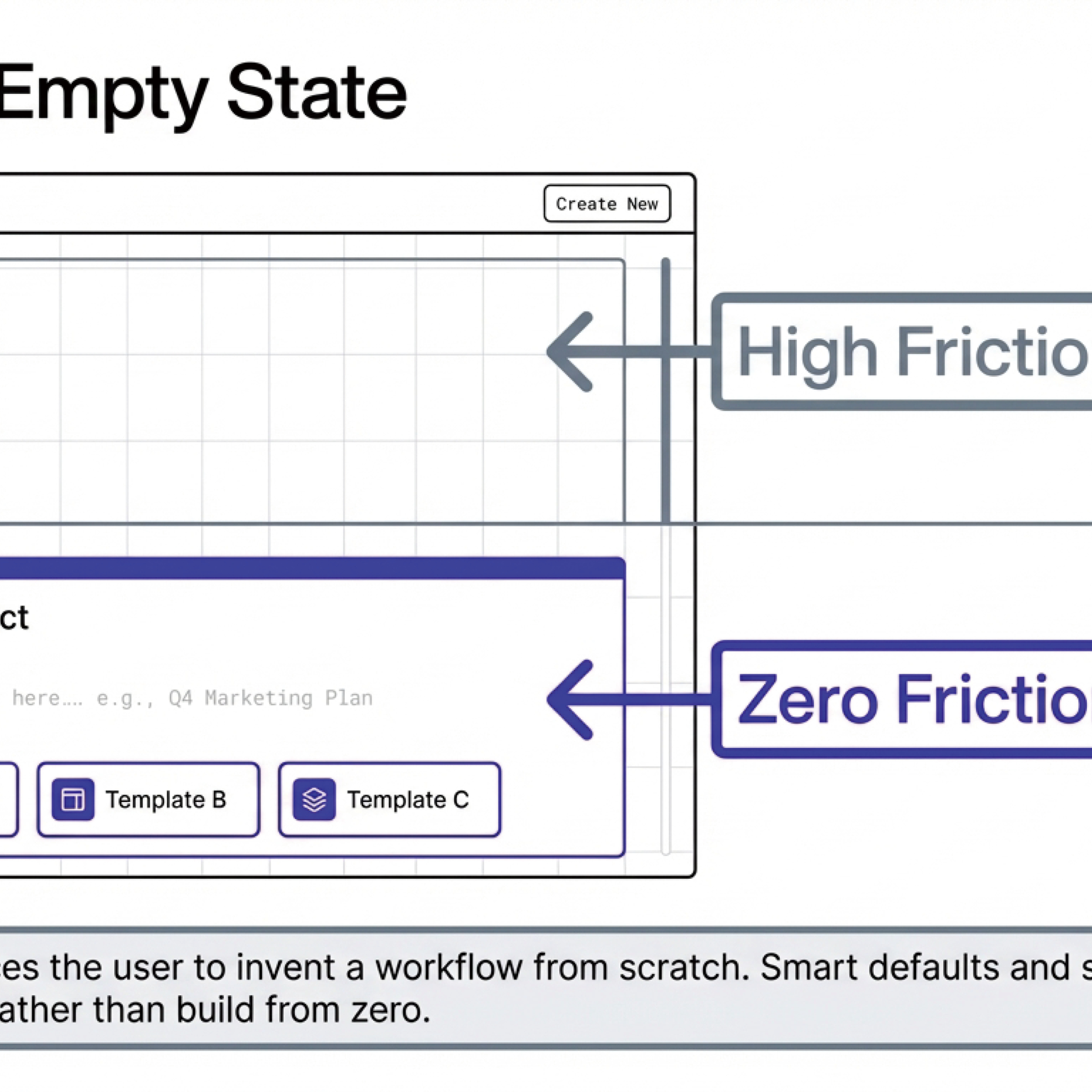
In this episode, we focus on the most critical—and most overlooked—moment in the entire user journey:the first ten minutes after a user logs in.This is where users decide whether your product is worth their time… or not.We introduce a powerful framework called the First Session Blueprint—a five-step design pattern that turns confusion into clarity and friction into momentum: Welcome – Set context and reduce uncertainty Guided Action – Help users take their first meaningful step Reinforcement – Show that they’re making progress Next Step – Keep the momentum going Dismissal – Step out of the way at the right momentInstead of overwhelming users with passive feature tours, we explain why the best products guide users into doing something valuable immediately.Because value isn’t understood by watching—it’s understood by experiencing.We also explore a subtle but critical shift in mindset:Once users achieve their first small win, get out of their way.Over-guidance can be just as harmful as no guidance at all.Finally, we break down one of the most underestimated design opportunities in SaaS:The Empty State.Instead of showing blank, intimidating screens, great products turn empty states into clear, actionable moments that answer a simple question:“What should I do next?”This episode is just one piece of the larger system.If you want the complete playbook for designing frictionless user experiences—from first login to long-term retention—you’ll find it here:https://www.amazon.com/dp/B0GTHWKNX1
-
3
2. Eliminating Signup Friction
In this episode, we tackle the very first—and often most underestimated—barrier in any SaaS product: the signup process.This is where many products lose users before they even begin. Not because the product lacks value, but because the path to entry creates unnecessary friction.We explore a simple but powerful idea:The more you ask, the more users you lose.You’ll learn why every additional form field reduces conversion, and how to design a Minimum Viable Signup—a frictionless entry point that gets users in quickly, without overwhelming them.The episode also introduces a key concept for modern product design:The Progressive Commitment Model.Instead of demanding everything upfront—job title, company size, use case—you defer those questions until after users have experienced real value. Because once users see value, they’re far more willing to invest.We also break down one of the most effective ways to eliminate friction entirely: Interactive product demos Freemium experiences Pre-populated sample data that lets users explore instantlyThe goal is simple: let users experience the product before asking them to commit.This episode is just the starting point.If you want the full framework for designing frictionless products—from signup to long-term retention—you’ll find it here:https://www.amazon.com/dp/B0GTHWKNX1
-
2
1. The SAFE Journey Framework: The Four Stages of User Success
In this episode, we unpack one of the most practical frameworks in modern SaaS: the SAFE Journey Framework—a clear lens for understanding why users stay… or quietly disappear.Instead of vague retention advice, we break the lifecycle into four concrete stages:Signup, Activation, Frequency, and Expansion.Where do most products fail?Not at growth. Not at acquisition.But in the invisible gaps between these stages.You’ll learn how to: Identify exactly where users drop off Diagnose friction with precision, not guesswork Tie each stage to real success metrics that actually matterBut the real centerpiece of this episode is a concept that changes everything:Time to Value (TTV).If users don’t experience value fast enough, nothing else matters.We explore why: TTV is the single most important retention metric in early-stage SaaS Speed to value determines whether a product becomes a habit or gets abandoned Most SaaS products unintentionally delay value—and how to fix itThis episode is just a glimpse.If you want the full system—the frameworks, real-world applications, and deeper breakdowns of frictionless design—you’ll find it here:https://www.amazon.com/dp/B0GTHWKNX1
-
1
Silent Churn: The Users Who Leave Without Complaining
The hosts would dive into the dangerous phenomenon of "silent churn," where users sign up, fail to experience value, and abandon the software without ever offering feedback or contacting support. The episode would break down the three distinct waves of this churn: the immediate drop-off in the first 10 minutes, the failure to build habits between days 1 and 7, and the decision friction around day 30. Additionally, the conversation would cover the "Activation Gap"—the crucial distance between a user signing up and experiencing meaningful value—and explain why minimizing this gap is the highest-leverage way to prevent silent drop-off and build long-term habits.
No matches for "" in this podcast's transcripts.
No topics indexed yet for this podcast.
Loading reviews...
Loading similar podcasts...
URL copied to clipboard!