
PODCAST · technology
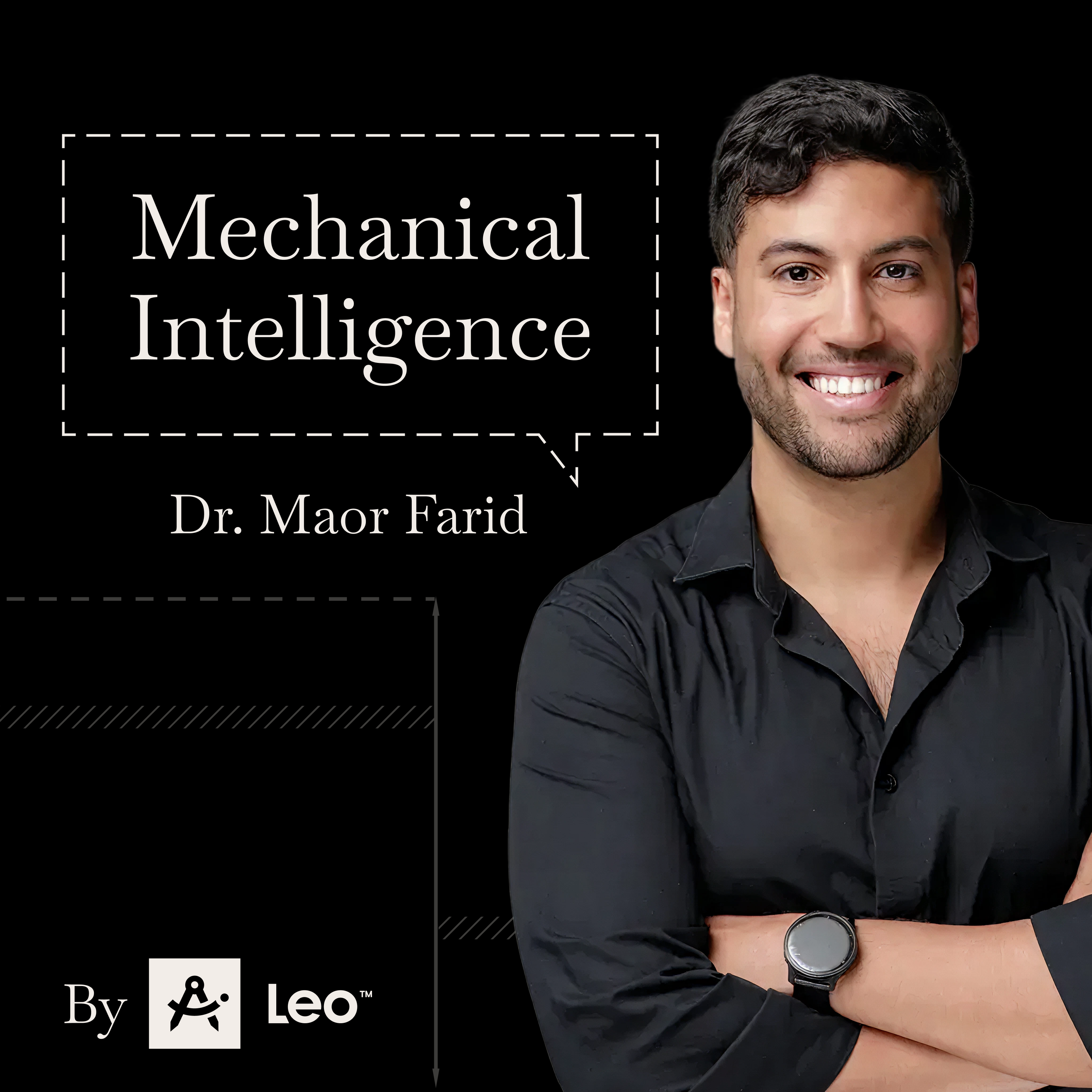
Mechanical Intelligence with Dr. Maor Farid
by Dr. Maor Farid
Mechanical Engineering Conversations with Leading Experts hosted by Leo AI CEO Dr. Maor Farid This podcast speaks to mechanical engineers and engineering leaders who want clarity, practical insight, inspiration and real industry wisdom. Dr. Maor Farid is a mechanical engineer, AI researcher and entrepreneur. He holds a Ph.D. in mechanical engineering from Technion – Israel Institute of Technology (graduated at 24), did post-doctoral work in applied mathematics and AI at MIT (as a Fulbright and ISEF fellow), and completed an executive program at Harvard Kennedy School.Dr. Farid is co-founder and CEO of Leo AI, a company building domain-specific AI tools for mechanical engineers to eliminate tedious workflows and restore creative focus. Beyond his technical and busin
-
6
Nico Haag | Simulation Engineering Director at PhysicsX
Nico Haag, Simulation Engineering Director at PhysicsX, joins Dr. Maor Farid to unpack how AI is transforming engineering by turning complex physical problems into clear, real-time insights.Nico explains how large physics models enable engineers to map geometry directly to physical behavior, dramatically reducing simulation time while expanding the number of design possibilities teams can explore.The conversation also gets practical about adoption: how AI reshapes traditional engineering workflows, why speed alone isn’t enough without trust, and how deterministic models and uncertainty quantification enable reliable decision-making.Nico also shares how these technologies allow engineers to go beyond human intuition, explore larger design spaces, and ultimately deliver better products faster.
-
5
Peter Lyu | Field CTO & VP of Solutions at Luminary
Peter Lyu, Field CTO & VP of Solutions at Luminary, joins Dr. Maor Farid to unpack how AI is actually transforming mechanical engineering workflows, without the hype.Peter explains how large physics models are enabling real-time simulation by mapping geometry directly to physical outcomes, reducing analysis time from hours or weeks to seconds.The conversation also gets practical about adoption: how AI changes the traditional design–analysis loop, why deterministic models and grounded data are critical for trust, and how engineers can validate results while dramatically increasing speed and efficiency.Peter also shares how these tools allow engineers to explore more design options, iterate faster, and move beyond traditional limitations, while maintaining engineering rigor and accountability.
-
4
Prof. Faez Ahmed | Head of MIT’s CAD & AI Lab (DeCoDE)
Prof. Faez Ahmed, Head of MIT’s CAD & AI Lab (DeCoDE), joins Dr. Maor Farid to unpack how AI is reshaping the way engineers design, simulate, and bring products to market.Faez shares how his research tackles one of the biggest challenges in engineering today: reducing the time from concept to production, which has remained largely unchanged for decades.The conversation explores how AI can bridge fragmented engineering workflows across CAD, CAE, and simulation, and how new models are enabling everything from generating CAD directly from images to autonomously operating design software.Faez also dives into the importance of data, infrastructure, and trust, and how AI systems—from CAD co-pilots to agent-based design tools—are beginning to expand the boundaries of what engineers can create.
-
3
Yoni Nir | V12 Program Manager at HP
Yoni Nir, V12 Program Manager at HP, joins Dr. Maor Farid to share a practical, grounded perspective on how AI will impact mechanical engineering in real-world, high-complexity systems.Yoni explains why AI adoption in engineering depends on both risk and complexity, and why high-risk, multi-physics systems will take longer to fully transition to AI-first workflows.The conversation also explores what AI will realistically change first: freeing engineers from tedious work like part selection, data retrieval, and documentation, while enabling them to focus on higher-value design decisions.Yoni shares how this shift could lead to a “golden age” of mechanical engineering, where engineers become significantly more productive, while still maintaining full responsibility for critical decisions.
-
2
Moshe Baum | Founder & Engineering Expert, Wild West Systems (Ex-SpaceX, Apple, Tesla)
Moshe Baum, Founder of Wild West Systems and former engineer at SpaceX, Tesla, and Apple, joins Dr. Maor Farid to share lessons from some of the world’s most demanding engineering environments.Moshe explains why strong fundamentals and first-principles thinking remain the most critical skills for engineers, especially in an era where AI is rapidly changing how work gets done.The conversation dives into practical career advice: the importance of hands-on experience, understanding full product lifecycles, and making real-world trade-offs across design, materials, and manufacturing.Moshe also shares how AI is already changing engineering workflows, why trust remains a key barrier to full adoption, and how engineers should approach new tools with curiosity, skepticism, and a focus on real-world impact.
-
1
Jon Hirschtick | Chief Evangelist at PTC
Jon Hirschtick, Chief Evangelist at PTC and co-founder of SolidWorks and Onshape, joins the conversation to share his perspective on how AI is transforming product design and engineering.This time, instead of Dr. Maor Farid, the discussion is led by Sean Manzanares, bringing a slightly different angle to the conversation.Jon explains why we are still in the early days of AI in engineering, and why he sees AI not as a single application, but as an entirely new class of tools that fundamentally change how problems are solved.The conversation explores how AI is expanding across the entire product development lifecycle—from CAD and CAM to PDM and manufacturing—and how engineers should think about different levels of maturity, from early prototypes to production-ready tools.Jon also shares why engineers should embrace multiple AI tools, how platforms like Leo complement existing systems, and why the biggest opportunity lies in rethinking workflows rather than simply automating existing ones.
-
0
Prof. Michael Beebe | Assistant Professor, North Central State College
Prof. Michael Beebe, veteran mechanical engineering leader and educator, joins Dr. Maor Farid to explore how AI is transforming engineering education — not in theory, but in real classrooms.Drawing on decades of experience in industry and academia, Prof. Beebe shares how he redesigned his curriculum to combine hands-on engineering fundamentals with real-world problem solving. He explains why communication, teamwork, and decision-making matter just as much as equations — and how modern engineers must learn to navigate uncertainty.The conversation goes deep into AI adoption in academia: how students react to engineering-grade AI tools, why AI should be treated as a “team member” rather than a threat, and what happened when his students redesigned a bridge using Leo AI alongside classical methods.Prof. Beebe also lays out a clear vision for the next decade in engineering education: why graduating students without exposure to AI will soon be unthinkable, how accreditation bodies may evolve, and what future engineers must understand before entering the workforce.If you care about the intersection of AI, engineering practice, and education, this conversation offers a grounded and practical perspective — without hype.
-
-1
Gregg Bennett | Director & Co-Founder of Sketch Design Consultancy
Gregg Bennett, Director & Co-Founder of Sketch Design Consultancy, joins Dr. Maor Farid to unpack how AI is actually changing mechanical engineering teams in the real world — without the hype.Gregg explains how his consultancy used AI to take on a complex cryogenic engineering challenge outside their core expertise, and how the right tools reduced research time from weeks to hours while increasing team confidence.The conversation goes deep into adoption strategy: why perceived risk is often higher than actual risk, how AI enables small consultancies to scale capabilities, and why maintaining engineering integrity requires a strong “human in the loop” mindset.Gregg also shares how AI improves onboarding of junior engineers, accelerates documentation workflows, and enables teams to confidently say, “no, we can do this,” when facing unfamiliar technical domains.If you want a grounded, experience-based look at AI adoption in mechanical engineering, this episode delivers exactly that.
-
-2
Ayora Berry | AI Product Leader at PTC
Ayora Berry, VP of AI Product Management at PTC, joins Dr. Maor Farid to unpack how AI will actually change mechanical engineering, without the hype. Ayora lays out a clear framework for the next decade in industrial software: three horizons. The conversation also gets practical about adoption: why data foundations matter, how to choose safe first use cases, and why “read” use cases build trust faster than “write.” Ayora closes with advice for young engineers and PMs: learn the fundamentals, talk to users, and use AI to move faster with better judgment.
-
-3
Dr. Roland Zelles | Former SVP Sales & CRO at Autodesk
Dr. Roland Zelles shares his extensive experience in mechanical design and the impact of AI on the engineering industry. He discusses his career journey, the evolution of technology, and the importance of embracing AI as a tool for productivity and innovation. Dr. Zelles emphasizes the need for engineers to adapt to new technologies and offers valuable advice for engineering leaders on how to integrate AI into their workflows. He also highlights the unique capabilities of Leo AI and its role in shaping the future of engineering.
-
-4
John McEleney | Co-Founder, Onshape (PTC) | Former CEO, SolidWorks
Maor Farid, CEO of Leo AI, discusses the integration of AI in mechanical engineering with guest John McEleney, co-founder of Onshape (PTC) and former CEO of SolidWorks.John shares his vision for how AI in CAD and AI tools for engineers are transforming product development and the future of design.The conversation explores the challenges engineers face, the role of AI in boosting productivity, and real-world applications of Leo AI. John offers insights into the evolution of CAD technologies and what’s next for engineering with AI. The session also emphasizes the importance of community feedback and continuous learning as teams adopt new tools.
-
-5
Bertrand Sicot, former CEO of Solidworks Dassault
In this first episode, Maor Farid hosts Bertrand Sicot and talks about how AI is improving CAD and PLM workflows and efficiency. Bertrand shares his experience from the early days of CAD and how he sees the future of our industry. Make sure to subscribe and share your thoughts.
We're indexing this podcast's transcripts for the first time — this can take a minute or two. We'll show results as soon as they're ready.
No matches for "" in this podcast's transcripts.
No topics indexed yet for this podcast.
Loading reviews...
ABOUT THIS SHOW
Mechanical Engineering Conversations with Leading Experts hosted by Leo AI CEO Dr. Maor Farid This podcast speaks to mechanical engineers and engineering leaders who want clarity, practical insight, inspiration and real industry wisdom. Dr. Maor Farid is a mechanical engineer, AI researcher and entrepreneur. He holds a Ph.D. in mechanical engineering from Technion – Israel Institute of Technology (graduated at 24), did post-doctoral work in applied mathematics and AI at MIT (as a Fulbright and ISEF fellow), and completed an executive program at Harvard Kennedy School.Dr. Farid is co-founder and CEO of Leo AI, a company building domain-specific AI tools for mechanical engineers to eliminate tedious workflows and restore creative focus. Beyond his technical and busin
HOSTED BY
Dr. Maor Farid
CATEGORIES
Loading similar podcasts...
URL copied to clipboard!